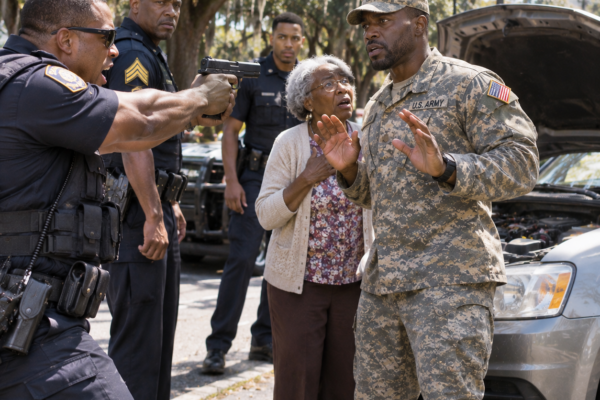
A Richmond Police Officer Pointed His Gun at Me Outside a Bank Because Someone Reported a “Suspicious Black Man” Near a Luxury SUV. I Raised My Empty Hands, Offered My Registration, and Asked What Crime He Thought I’d Committed. He Called My Questions Defiance—Until His Partner Opened My Wallet, Saw the Second Identification Card, and Suddenly Reached for Her Radio.K
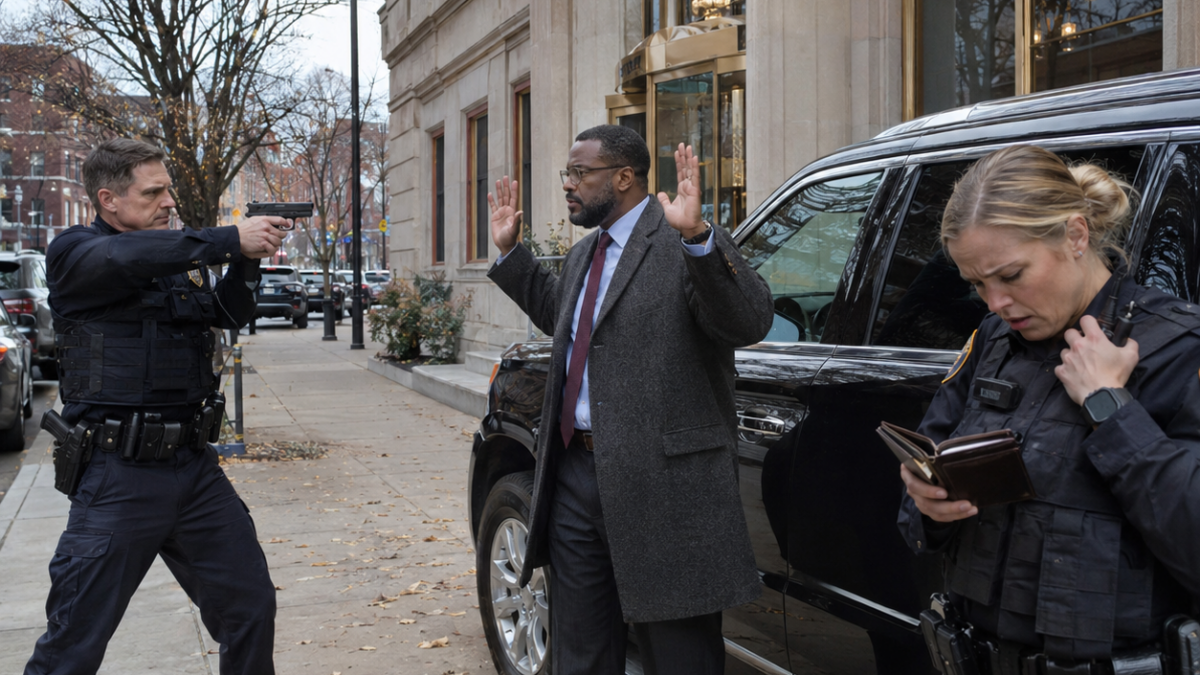
A Richmond Police Officer Pointed His Gun at Me Outside a Bank Because Someone Reported a “Suspicious Black Man” Near a Luxury SUV. I Raised My Empty Hands, Offered My Registration, and Asked What Crime He Thought I’d Committed. He Called My Questions Defiance—Until His Partner Opened My Wallet, Saw the Second Identification Card, and Suddenly Reached for Her Radio.
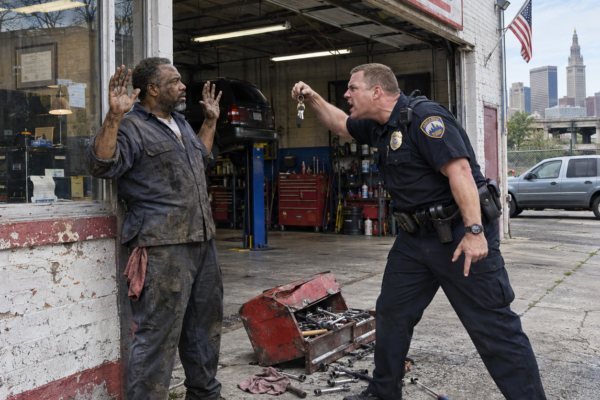
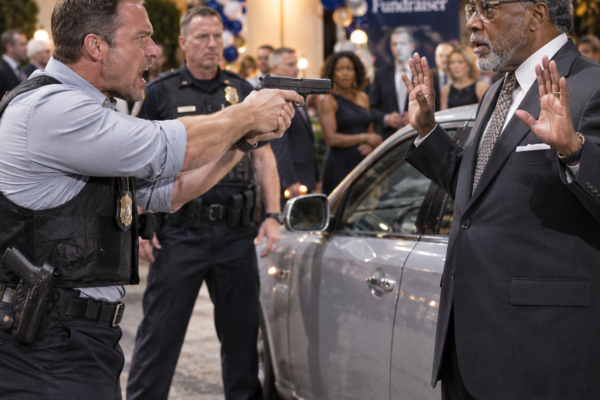
“BACK AWAY FROM THE SUV! BOTH HANDS WHERE I CAN SEE THEM!”
The officer’s pistol was pointed directly at my chest.
I stood beside my black Chevrolet Tahoe in the parking lot of Cedar Point Bank, seven feet from a man who seemed more interested in making me obey than finding out why I was there.
“My hands are visible, Officer.”
“Then stop moving!”
“I haven’t moved.”
“Keep testing me, and you’ll end up on the pavement.”
I was fifty-six years old. I’d spent more than three decades working in situations where an angry person’s next decision could change somebody’s life.
But nothing in my experience made the sight of that pistol easier to ignore.
My name is Marcus Hale.
It was 4:17 on a rainy Friday afternoon outside Richmond, Virginia. I’d spent twenty minutes inside the bank discussing confidential financial documents with the branch manager. I had an appointment, proper identification, and every reason to be there.
Now I was standing beneath flashing red-and-blue lights, being treated like an armed criminal.
The officer’s nameplate read VAUGHN.
He was a broad-shouldered man in his early thirties, with a tightly clenched jaw and a habit of moving closer whenever I asked a question.
“Step into that empty space,” he ordered.
I moved slowly away from my SUV.
“Stop there.”
I stopped.
“Don’t reach for anything.”
I kept my fingers spread.
“Can you tell me why I’m being detained?”
His expression darkened.
“You don’t get to set the terms here.”
“I’m not setting terms. I’m asking what you believe I’ve done.”
“You’re being investigated.”
“For what?”
“Keep talking, and I’ll give you something else to worry about.”
I glanced toward the second officer standing near the patrol car.
She was younger, with blond hair pulled tightly behind her head. Her nameplate read FOSTER.
Unlike Vaughn, she hadn’t drawn her weapon.
She was watching my hands.
That small difference mattered.
“Officer Foster,” I said, “would you please confirm what was reported?”
Vaughn stepped closer.
“You talk to me.”
“Then I’m asking you.”
“Stop challenging my authority.”
I swallowed the response that came to mind.
There were cameras above the bank entrance. Another recording device was mounted on Vaughn’s chest.
I wasn’t going to give him any excuse to say I’d lunged, threatened him, or reached for something.
Across the parking lane, a young man in a gray sweatshirt had stopped beside a light pole. He took out his phone and began recording.
Behind the bank’s glass doors, a woman in a blue blouse was looking directly at us.
I’d spoken with her only minutes earlier.
Her name was Emily Parker. She had checked me in for my appointment and brought me coffee while I waited for the branch manager.
She knew I hadn’t threatened anyone inside the bank.
But Vaughn didn’t ask her.
Instead, he raised his voice.
“Identification!”
“My wallet is inside my coat. I’d like permission to retrieve it so there’s no misunderstanding.”
He stared at me.
“Are you refusing to identify yourself?”
“No. I’m telling you where my identification is.”
“Use your right hand. Slowly.”
I looked at his pistol.
“Understood.”
I moved my right hand toward the inside pocket of my charcoal coat.
Every inch felt dangerous.
The officer’s finger shifted along the frame of his weapon.
I stopped.
“Keep going,” he snapped.
I carefully removed the leather wallet, holding it between two fingers.
“Put it on the hood.”
I placed the wallet against the rain-speckled metal.
“Now step back.”
I obeyed.
Officer Foster approached the SUV while Vaughn kept his gun trained on me.
She opened the wallet.
My Virginia driver’s license was in the front compartment.
Behind it was another identification card inside a dark protective sleeve.
I watched her read the first document.
Then she opened the second compartment.
Her expression changed.
She looked at me once, then read the credential again.
“Derek,” she said quietly.
Vaughn didn’t lower his pistol.
“What?”
“I need you to look at this.”
“I’m handling the suspect.”
“Derek, this identification needs to be verified.”
He glanced toward her without moving his weapon.
“Then verify it.”
She stepped away, raised her shoulder microphone, and spoke to dispatch.
I kept both hands above my shoulders.
For the first time since the confrontation began, Officer Foster was no longer watching me.
She was watching her partner.
And the officer holding me at gunpoint had no idea why.
Part 2:
“BACK AWAY FROM THE SUV! BOTH HANDS WHERE I CAN SEE THEM!”
The officer’s pistol was pointed directly at my chest.
I stood beside my black Chevrolet Tahoe in the parking lot of Cedar Point Bank, seven feet from a man who seemed more interested in making me obey than finding out why I was there.
“My hands are visible, Officer.”
“Then stop moving!”
“I haven’t moved.”
“Keep testing me, and you’ll end up on the pavement.”
I was fifty-six years old. I’d spent more than three decades working in situations where an angry person’s next decision could change somebody’s life.
But nothing in my experience made the sight of that pistol easier to ignore.
My name is Marcus Hale.
It was 4:17 on a rainy Friday afternoon outside Richmond, Virginia. I’d spent twenty minutes inside the bank discussing confidential financial documents with the branch manager. I had an appointment, proper identification, and every reason to be there.
Now I was standing beneath flashing red-and-blue lights, being treated like an armed criminal.
The officer’s nameplate read VAUGHN.
He was a broad-shouldered man in his early thirties, with a tightly clenched jaw and a habit of moving closer whenever I asked a question.
“Step into that empty space,” he ordered.
I moved slowly away from my SUV.
“Stop there.”
I stopped.
“Don’t reach for anything.”
I kept my fingers spread.
“Can you tell me why I’m being detained?”
His expression darkened.
“You don’t get to set the terms here.”
“I’m not setting terms. I’m asking what you believe I’ve done.”
“You’re being investigated.”
“For what?”
“Keep talking, and I’ll give you something else to worry about.”
I glanced toward the second officer standing near the patrol car.
She was younger, with blond hair pulled tightly behind her head. Her nameplate read FOSTER.
Unlike Vaughn, she hadn’t drawn her weapon.
She was watching my hands.
That small difference mattered.
“Officer Foster,” I said, “would you please confirm what was reported?”
Vaughn stepped closer.
“You talk to me.”
“Then I’m asking you.”
“Stop challenging my authority.”
I swallowed the response that came to mind.
There were cameras above the bank entrance. Another recording device was mounted on Vaughn’s chest.
I wasn’t going to give him any excuse to say I’d lunged, threatened him, or reached for something.
Across the parking lane, a young man in a gray sweatshirt had stopped beside a light pole. He took out his phone and began recording.
Behind the bank’s glass doors, a woman in a blue blouse was looking directly at us.
I’d spoken with her only minutes earlier.
Her name was Emily Parker. She had checked me in for my appointment and brought me coffee while I waited for the branch manager.
She knew I hadn’t threatened anyone inside the bank.
But Vaughn didn’t ask her.
Instead, he raised his voice.
“Identification!”
“My wallet is inside my coat. I’d like permission to retrieve it so there’s no misunderstanding.”
He stared at me.
“Are you refusing to identify yourself?”
“No. I’m telling you where my identification is.”
“Use your right hand. Slowly.”
I looked at his pistol.
“Understood.”
I moved my right hand toward the inside pocket of my charcoal coat.
Every inch felt dangerous.
The officer’s finger shifted along the frame of his weapon.
I stopped.
“Keep going,” he snapped.
I carefully removed the leather wallet, holding it between two fingers.
“Put it on the hood.”
I placed the wallet against the rain-speckled metal.
“Now step back.”
I obeyed.
Officer Foster approached the SUV while Vaughn kept his gun trained on me.
She opened the wallet.
My Virginia driver’s license was in the front compartment.
Behind it was another identification card inside a dark protective sleeve.
I watched her read the first document.
Then she opened the second compartment.
Her expression changed.
She looked at me once, then read the credential again.
“Derek,” she said quietly.
Vaughn didn’t lower his pistol.
“What?”
“I need you to look at this.”
“I’m handling the suspect.”
“Derek, this identification needs to be verified.”
He glanced toward her without moving his weapon.
“Then verify it.”
She stepped away, raised her shoulder microphone, and spoke to dispatch.
I kept both hands above my shoulders.
For the first time since the confrontation began, Officer Foster was no longer watching me.
She was watching her partner.
And the officer holding me at gunpoint had no idea why.
The rain had started seeping through my coat at the shoulders. I could feel water sliding down the back of my neck, but I didn’t dare reach up to adjust the collar.
Foster read the identification number into her radio, then stepped another pace away from Vaughn.
She didn’t announce what she’d found.
That was sensible. A credential could be forged, and she had every reason to confirm its authenticity through the proper channel.
What concerned me was that she now had two separate reasons to question Vaughn’s response: the original dispatch information didn’t describe an armed threat, and I had complied with every instruction.
“Did you get a name?” Vaughn demanded.
“Yes.”
“Then run it.”
“I am.”
He looked at me again.
“What’s your business at this bank?”
“I had an appointment.”
“With whom?”
“The branch manager.”
“About what?”
“Banking matters.”
His eyes narrowed.
“You think you’re funny?”
“No.”
“Then answer the question.”
“I’ve answered the part that’s relevant to why I was on the property. The bank can confirm my appointment.”
From near the entrance, Emily Parker raised her voice.
“Officer, I can confirm that. I checked him in myself.”
Vaughn turned his head.
“Ma’am, stay back.”
“I’m staying back. I’m telling you he was a customer.”
“Go inside.”
She didn’t move.
Behind her, Thomas Reed, the bank’s branch manager, stepped through the glass doors.
“I’m Thomas Reed. Mr. Hale was here for a scheduled meeting with me.”
“Sir, return to the building,” Vaughn ordered.
Thomas stopped beneath the awning.
He was a careful man in his early fifties who’d spent twenty-five years working in banking. He wasn’t inclined to argue in public, and I could see that being ordered away by a man with a gun made him uncomfortable.
But he didn’t leave.
“I’ll remain here,” he said. “My employees have confirmed that the appointment was legitimate.”
Vaughn returned his attention to me.
His pistol was still raised.
I had been standing with my hands above my shoulders for long enough that the muscles in my arms were beginning to burn.
I flexed my fingers carefully.
“Don’t move your hands,” Vaughn warned.
“They’re cramping.”
“Then hold still.”
Foster moved closer to him without crossing the direction of his muzzle.
“Derek, dispatch has confirmed there’s no robbery or weapon report. His registration matches the SUV. We should lower the threat level.”
“We haven’t finished.”
“We can finish without pointing a firearm at someone who’s standing still.”
He shot her an angry look.
“Don’t start second-guessing me in front of these people.”
I said nothing.
That sentence told me more than a long explanation would have.
He wasn’t merely worried about an unknown situation anymore. He was worried about losing control of how the situation appeared.
And the witnesses were making that harder.
The young man by the light pole kept recording.
Vaughn noticed him.
“You! Put the phone away!”
The young man held his ground several parking spaces away.
“I’m not interfering, Officer.”
“Mind your own business.”
I wanted to tell Vaughn that a person filming from a safe distance wasn’t the threat he needed to worry about.
I kept quiet.
I’d already learned that reasonable questions were not getting reasonable answers.
Foster received another response over her radio.
I watched her expression settle.
She turned toward me.
“Mr. Hale, your government identification is being confirmed with the issuing office.”
“Thank you.”
Vaughn looked sharply at her.
“Government identification?”
She met his eyes.
“Yes.”
“From where?”
“The United States Department of Justice.”
He stared at me.
I was still standing in the rain, hands raised, with no weapon and no way to make the next few seconds less dangerous.
“DOJ?” he repeated.
“Yes,” Foster said.
Vaughn’s mouth tightened.
“That doesn’t mean he can ignore instructions.”
“He hasn’t ignored any.”
I looked at her.
She hadn’t raised her voice.
She hadn’t insulted him or tried to embarrass him.
She had simply described what was happening.
For a few seconds, Vaughn appeared unsure how to respond.
Then he said, “People flash fake government IDs all the time.”
“That’s why I’m verifying it,” Foster replied.
He kept his pistol trained on me.
And I realized that even the possibility of being wrong hadn’t yet convinced him to stop.
The longer he held that position, the harder it seemed for him to admit that it might never have been necessary.
A black sedan entered the parking lot several minutes later.
It approached slowly and stopped well away from the patrol car.
Two people stepped out.
A woman in a dark raincoat came from the driver’s side, followed by a tall man carrying a slim leather folder.
I recognized them immediately.
Rachel Kim and Aaron Pierce.
They were members of the federal team I’d been working with in Richmond.
Rachel held her identification where both officers could see it.
“Officer Vaughn, my name is Rachel Kim. We’re here regarding the verification request for Mr. Hale.”
Vaughn glanced at her.
“How did you get here so fast?”
“Our office received the call. We were nearby.”
That was true.
We had been working from a temporary federal office a few blocks away while reviewing complaints involving local law enforcement.
Rachel and Aaron hadn’t come with a tactical team or a convoy of black SUVs.
They had simply responded when the local verification channel contacted our office and nobody could reach me by phone.
Rachel stopped several yards from Vaughn.
She kept her hands visible.
“Mr. Hale’s credentials are legitimate,” she said. “We’ve confirmed his identity through the appropriate channel.”
“I’m conducting a detention.”
“I understand. But your partner has confirmed his vehicle ownership and his lawful appointment at the bank. Nobody here has reported a weapon or a crime.”
Vaughn’s jaw flexed.
“He’s been argumentative.”
Rachel looked toward me.
I was still holding my hands up.
“Has he attempted to strike you?”
“No.”
“Has he threatened anyone?”
“He keeps challenging me.”
“Officer, asking why someone is being detained isn’t the same as threatening an officer.”
For the first time, I saw Vaughn’s pistol dip slightly.
Rachel didn’t move closer.
“Please lower the weapon to a safe position so everyone can discuss this without unnecessary risk.”
Vaughn hesitated.
Then he finally lowered the pistol and returned it to his holster.
I let out a breath I hadn’t realized I was holding.
Foster waited until the weapon was secured.
“Mr. Hale, you can lower your hands.”
I did.
My shoulders hurt immediately.
Rachel approached me.
“Marcus, are you all right?”
I looked at Vaughn.
“I’m not injured.”
“That wasn’t exactly what I asked.”
“I know.”
She studied my face, then nodded.
Aaron remained nearby, keeping the pathway clear for the bank customers who had begun gathering beneath the awning.
I retrieved my wallet after Foster returned it.
The credential inside identified me as a senior investigator working with the Department of Justice’s Civil Rights Division.
I had spent more than thirty years examining public institutions, interviewing witnesses, and reviewing evidence in cases involving alleged misconduct and violations of civil rights.
My current assignment involved a federal review of complaints about stops, searches, detentions, and use of force by officers serving the Richmond area.
I hadn’t been at Cedar Point Bank to conduct an undercover sting.
I had been there for an ordinary, scheduled appointment concerning records the bank was authorized to provide in connection with our work.
And I hadn’t deliberately hidden my identity from Vaughn.
He’d never asked who I was before pointing his gun at me.
I looked at Rachel.
“Please don’t turn this into a question of whether I was the wrong person to stop.”
She understood immediately.
“Because of your credentials?”
“Yes.”
I turned toward Vaughn.
“Officer, I was entitled to the same fair treatment five minutes before your partner opened my wallet.”
He didn’t answer.
I continued.
“The most important fact about me wasn’t written on that identification card. It was that I had both hands raised, no weapon, and a legitimate reason to be here.”
His expression remained hard.
“Sir, we respond to suspicious activity.”
“Then investigate the activity. Don’t turn the absence of an explanation into proof of danger.”
He looked away.
I didn’t need him to apologize in the parking lot.
I needed the evidence preserved and the incident examined fairly.
That would take more than an argument between two angry men.
A second patrol vehicle pulled into the lot.
Sergeant Paul Harlan stepped out.
He was a broad-shouldered supervisor nearing fifty, with a weathered face and a manner that suggested he’d spent many years arriving after difficult situations had already become worse.
He looked at Vaughn.
Then at Foster.
Then at Rachel’s credential and the small crowd watching from the bank.
“What happened?” he asked.
Foster answered before Vaughn could begin.
“We responded to a suspicious-person call. No robbery or weapon had been reported. Mr. Hale complied with commands and identified himself. His vehicle registration and bank appointment have been confirmed. Officer Vaughn drew his weapon and maintained it while we gathered that information.”
Harlan listened without interrupting.
Vaughn began to explain.
“He kept challenging my instructions.”
Harlan held up a hand.
“I’ll hear your account separately.”
He turned toward the bank entrance.
“I need the names of anyone who witnessed this, and I need the original recordings preserved.”
Thomas Reed stepped forward.
“Our exterior cameras cover the parking area. I’ve already asked regional security to prevent the footage from being overwritten.”
“Good.”
Harlan looked toward the student beside the light pole.
“Did you record this?”
The young man nodded.
“Yes, sir.”
“What’s your name?”
“Jordan Miles.”
“Please keep the original file. An investigator will contact you about obtaining a copy.”
Jordan lowered his phone.
“I didn’t interfere with anything.”
“I haven’t said you did,” Harlan replied.
The answer seemed to surprise him.
Harlan then instructed dispatch to retain the original call audio, radio traffic, timestamps, and computer-aided dispatch notes.
He directed Vaughn and Foster to keep their body cameras operating under department procedures until the incident was properly documented.
Finally, he looked at me.
“Mr. Hale, are you willing to give a statement?”
“Yes.”
“Would you prefer to do it here or somewhere private?”
“Here is fine. But I want the complete record preserved before anyone starts deciding what this incident means.”
Harlan nodded.
“So do I.”
For the first time that afternoon, somebody in a police uniform had asked a question and waited for my answer.
By seven-thirty that evening, the video was circulating around Richmond.
I learned that from my son.
David Hale was thirty-one, a civil engineer living in Northern Virginia. He had inherited my height, his mother’s stubbornness, and an unfortunate habit of believing that any unanswered text message meant something terrible had happened.
He called while I was sitting in a conference room at our temporary federal office.
“Dad, tell me that isn’t you.”
I closed my eyes.
“Hello to you, too.”
“There’s a video of a cop pointing a gun at a man outside a bank. It looks exactly like you.”
“It is me.”
He went silent.
Then his voice changed.
“Are you hurt?”
“No.”
“Did they arrest you?”
“No.”
“What happened?”
I looked through the glass wall of the conference room.
Rachel and Aaron were reviewing the information we’d collected. Elena Vargas, the Justice Department attorney supervising the legal side of our project, was sitting at the far end of the table with her laptop open.
“Somebody called the police because I was standing near my vehicle. The responding officer escalated the encounter without establishing what I’d done wrong.”
“You were standing near your own car?”
“Yes.”
“And he pointed a gun at you?”
“Yes.”
“Dad, that’s insane.”
I could hear him moving around his apartment.
“I’m coming down.”
“David, you don’t need to drive to Richmond tonight.”
“Don’t tell me what I need to do.”
I almost smiled.
He sounded so much like his mother that for a moment I could picture her standing in the kitchen, hands on her hips, daring me to disagree.
“I’m safe now,” I said. “Let’s talk tomorrow.”
“You always say that.”
I stopped smiling.
“What do you mean?”
“You tell me you’re safe. You tell me the work is complicated. You tell me there are things you can’t discuss. Then I find out from somebody’s phone video that you had a gun pointed at your chest.”
I looked down at my hands.
He wasn’t wrong.
For most of his childhood, I’d tried to protect him from worrying about my work.
When I traveled, I told him where I was going but rarely explained the full purpose of the trip. When investigations became controversial, I kept the details out of family conversations.
I believed discretion was a form of love.
Now I wondered whether I’d confused keeping information private with keeping my family at a distance.
“You should have heard this from me,” I said.
“Yes, I should have.”
“I’m sorry.”
There was a long pause.
Then he asked, “Did that officer know who you were?”
“Not at first.”
“And when he found out?”
“He lowered the gun after additional verification and intervention.”
David made a bitter sound.
“So your badge saved you.”
I considered that.
“Maybe the badge helped bring the situation to an end. But another officer had already tried to de-escalate, and civilians were documenting what happened.”
He didn’t interrupt.
“The important question is what would have happened if I hadn’t been carrying a federal credential.”
“That’s exactly what I’m thinking.”
“So am I.”
When we finally hung up, I sat quietly for a minute.
Then I returned to the conference room.
Elena looked up.
“Your son?”
I nodded.
“He saw the video.”
“I’m sorry.”
“His reaction is understandable.”
I sat opposite her.
“We need to discuss how my encounter affects the review.”
She closed her laptop.
“Agreed.”
Our team had been examining complaints involving police encounters across the Richmond region for several months.
Some complaints came from people stopped while walking through commercial districts.
Others involved traffic stops, searches, and allegations that officers treated questions about the reason for detention as resistance.
One woman said she’d been threatened with arrest after asking whether she was free to leave.
A father described being handcuffed outside his apartment building while officers attempted to identify a different person.
Several complaints had been resolved without findings of misconduct. Others remained disputed.
We weren’t entitled to assume every allegation was true simply because the stories sounded similar.
Our responsibility was to test the claims against records, interviews, policies, and independent evidence.
Now I’d become a witness to another disputed encounter.
“I shouldn’t investigate my own stop,” I said.
Elena nodded.
“You won’t.”
She explained that the incident would be referred through the appropriate independent review channels. The local department’s administrative investigation would proceed separately, and another federal team could evaluate the incident if it became relevant to a federal inquiry.
My colleagues could preserve information and report what they’d witnessed, but I wouldn’t direct investigative decisions about Vaughn’s conduct.
“You’re going to be a witness, Marcus,” Elena said. “Not the person deciding whether your rights were violated.”
“That’s what I want.”
Rachel leaned forward.
“There’s something else we need to keep clear.”
“What?”
“Your credentials weren’t what made the stop concerning.”
“I know.”
“The call itself was vague. No crime had been identified, and the threat assessment didn’t improve when more facts arrived.”
Aaron opened a timeline on his laptop.
“That’s where we should start.”
He pointed to the first dispatch entry.
The original call had described a Black man standing near expensive vehicles outside Cedar Point Bank.
No caller had reported seeing me force open a car door.
No robbery had occurred.
Nobody had reported a gun.
Nothing in the dispatch information connected me to a specific offense.
Vaughn had drawn his weapon after approaching and seeing me beside the Tahoe.
Then he’d continued holding it while I moved away from the vehicle and kept my hands visible.
I studied the timestamps.
“That first decision matters,” I said.
Elena nodded.
“So do the decisions after it.”
I thought about all the times I’d seen investigations reduced to one dramatic image.
A handcuff.
A punch.
A firearm.
Those moments mattered, of course. But they were often the end of a chain of decisions that began with smaller assumptions.
The question wasn’t simply why Vaughn had pointed a gun at me.
It was why he continued pointing it after the information available to him failed to support his initial suspicion.
The following morning, I watched Jordan Miles’s recording with Elena.
The video had already spread online, but Jordan had preserved the original file on his phone and provided a copy to investigators without editing it.
His sister, Natalie, worked as an associate producer at a Richmond television station. She had helped ensure that the station checked the recording’s origin before reporting on the encounter.
The clip began with my hands raised.
Vaughn stood several feet away, pistol extended.
I could hear myself asking what offense he believed I had committed.
His answer was sharp.
“You can ask questions when I’m finished.”
Then came the threat about putting me on the ground.
The camera shifted toward Foster.
Her hands were near her radio, and she was visibly watching my movements.
I heard her request clarification from dispatch.
The answer was audible through the radio.
No robbery report.
No weapon report.
No identified victim.
No confirmed crime.
Vaughn’s gun remained raised.
The next part was difficult to watch.
Not because anything violent happened.
Because nothing did.
I stood still.
He kept threatening me.
I repeated the same question.
He refused to answer it.
The longer I watched, the more I understood why the footage had upset so many people.
There was no struggle to explain away.
No sudden movement.
No weapon in my hand.
Just an officer escalating his commands while a man stood motionless in front of him.
Elena paused the video.
“How are you feeling?”
“Angry.”
She nodded.
“That’s understandable.”
“I keep thinking about all the people who don’t have federal identification.”
She closed the laptop.
“Then let’s make sure their complaints receive the same careful examination.”
Later that day, Sergeant Harlan contacted me to arrange an interview with the department’s Professional Standards investigators.
I agreed.
He also confirmed that Vaughn had been placed on administrative suspension while the department reviewed his use of force and conduct during the stop.
The decision wasn’t a final disciplinary finding.
It was a temporary measure while investigators gathered evidence and assessed whether he should remain on active duty.
I appreciated the distinction.
A fair process couldn’t depend on whether the accused person was sympathetic.
It had to apply to him as well.
The administrative investigators interviewed me the following Monday.
They asked about my movements, my requests for information, and the exact words Vaughn used.
I described the events as carefully as I could.
Then one investigator asked, “Why didn’t you immediately tell Officer Vaughn you worked for the Department of Justice?”
I looked at her.
“Because he ordered me not to reach for anything, and I didn’t have the credential in my hand.”
“Could you have told him verbally?”
“Yes.”
“Why didn’t you?”
“I was trying to explain that I had a lawful reason to be there. My professional position didn’t change that.”
She waited.
I continued.
“If I had been a grocery-store employee or an accountant, would that have made the firearm more appropriate?”
“No,” she acknowledged.
“Then I don’t want my identity to become the reason you evaluate the encounter differently.”
She made a note.
“Understood.”
I also told the investigators about Vaughn’s reaction when Foster tried to de-escalate.
He’d told her not to second-guess him in front of witnesses.
That sentence mattered because it suggested he’d become concerned about authority and embarrassment even while the threat assessment was changing.
I couldn’t tell the investigators what Vaughn had been thinking.
I could only tell them what he’d said.
And I knew the body-camera footage could confirm it.
Megan Foster was interviewed separately.
She submitted a written statement and explained how the original call had contained no report of a weapon or violent crime.
She described my compliance, the confirmation of the vehicle registration, and her efforts to persuade Vaughn to lower his pistol.
She also acknowledged something that mattered.
She wished she’d intervened more firmly, sooner.
During the first moments, she’d assumed Vaughn had noticed something she hadn’t.
He was her senior partner that afternoon, and she’d worked with him on previous calls.
But as she gathered information, the danger she thought he might have seen never became apparent.
The longer he maintained his position, the harder it became to defend.
Her honesty created problems for her inside the department.
Some colleagues thanked her privately.
Others avoided her in the locker room.
One officer she’d known for years asked why she’d been so quick to contradict a fellow officer in front of civilians.
Megan answered with a question of her own.
“What was I supposed to do when the evidence didn’t support keeping a gun pointed at him?”
He had no answer.
But he stopped inviting her to the informal lunches they’d shared for years.
Megan told her sister, Laura, about the strained atmosphere at work.
Laura was a pediatric nurse, accustomed to speaking up when a patient’s safety required questioning a decision.
She listened, then said, “You’re not responsible for protecting a bad choice just because the person who made it wears the same uniform.”
Megan repeated that sentence during a later meeting with her supervisor.
I learned about those conversations only afterward.
At the time, I knew that she’d made a difficult decision in the parking lot.
She’d chosen to describe what she saw rather than repeat what her partner wanted the encounter to mean.
That made her an important witness.
And it reminded me that accountability didn’t have to become a battle between every police officer and every civilian.
Some officers had tried to reduce the danger.
Others had preserved the evidence.
Those differences mattered.
Two weeks later, the bank’s security footage became an important part of the review.
Thomas Reed had preserved recordings from three exterior cameras.
One showed me leaving the bank at 4:12 p.m. and walking directly toward my Tahoe.
Another showed the patrol car entering the lot.
The third captured the open parking space where Vaughn ordered me to stand.
Together, they showed something neither officer’s chest camera could establish as clearly.
I had not approached anyone.
I had not moved between vehicles looking into windows.
I had not tried to open a car that didn’t belong to me.
I’d simply left a legitimate appointment and walked toward my own SUV.
Emily Parker confirmed those details during her interview.
She’d checked my identification when I arrived and escorted me to Thomas’s office.
There had been no disturbance inside the bank.
No argument.
No complaint from an employee or customer.
When she saw the police lights, her first thought had been that someone was responding to an accident.
Then she’d looked outside and recognized me standing with both hands raised.
Her testimony helped establish that the encounter hadn’t begun because of anything I’d done inside the building.
The investigators also obtained the original suspicious-person call.
The caller described a Black man near expensive vehicles and said his presence seemed unusual.
When asked what specific crime he’d witnessed, he couldn’t identify one.
He hadn’t seen anyone break into a vehicle, threaten another person, or display a weapon.
That was all the information dispatch had when the officers arrived.
The caller’s assumptions troubled me.
But I couldn’t know exactly what he’d intended.
The evidence established what he’d reported, not what was in his mind.
What mattered next was how the responding officers used that information.
One officer treated the vague report as grounds for immediate armed control.
The other eventually asked for more facts.
The recordings showed the consequences of those choices.
During the review, investigators compared Vaughn’s written report with the camera footage.
His report described me as argumentative and repeatedly unwilling to follow instructions.
It emphasized that I’d questioned him while he attempted to secure the scene.
But the video showed that I’d moved away from the Tahoe when ordered.
I’d kept my hands visible.
I’d identified the location of my wallet and waited for permission before retrieving it.
When Vaughn told me to stop moving, I stopped.
When he told me to place the wallet on the hood, I did.
The questions I’d asked concerned why I was being detained and what suspected offense had prompted the armed response.
Nothing in the recordings showed me threatening him.
That difference became central to the administrative findings.
The department’s review acknowledged that officers sometimes encounter incomplete or unreliable information and must make safety decisions quickly.
But it also examined whether Vaughn had adjusted his response when additional facts became available.
He hadn’t.
As the uncertainty decreased, his refusal to reconsider became more apparent.
By the time Foster confirmed my registration and the bank employees identified me as a legitimate customer, the original suspicion had little factual support.
Yet the gun remained pointed at me.
Even after my federal identification was discovered, Vaughn continued treating verification as a challenge to his authority rather than an opportunity to resolve the encounter.
Investigators ultimately sustained findings that his conduct violated department standards governing threat assessment, de-escalation, and the presentation of a firearm.
They also identified significant deficiencies in the accuracy and completeness of his report.
He remained removed from patrol duties while the disciplinary process continued.
Following that process, the department terminated his employment, subject to the review and appeal rights available under its procedures.
I didn’t celebrate.
I knew some people expected me to.
A reporter called and asked whether I was pleased that Vaughn had lost his job.
I told her I was pleased that his decisions had been evaluated against the evidence.
She pressed.
“Mr. Hale, do you believe he deserved to be fired?”
“I believe officers should be accountable for their conduct. The department made its disciplinary decision through its procedures.”
“Doesn’t that feel like justice?”
I considered the question.
“It’s one part of accountability,” I said. “But it doesn’t explain why the situation developed the way it did, or what the department will do to prevent something similar.”
The reporter hesitated.
“You’re saying dismissal isn’t enough?”
“I’m saying the person standing in the next parking lot won’t benefit much from what happened to me unless somebody learns from it.”
That evening, I spoke with Elena about the broader federal review.
Our team had identified several recurring areas of concern in complaints involving suspicious-person calls and vehicle-related detentions.
Not every complaint had been substantiated.
Some involved reasonable stops that ended without improper force.
Others had conflicting accounts or incomplete records.
But the review identified weaknesses in how vague information was documented, how officers assessed changes in perceived risk, and how supervisors examined incidents involving allegations of noncompliance.
The Cedar Point encounter was one example.
It wasn’t the entire investigation.
And my involvement didn’t make it more important than complaints from people who had no federal position.
I insisted on that point whenever the subject arose.
One woman whose account we’d reviewed had been stopped outside her apartment building while carrying groceries.
Another complainant described being ordered from his vehicle during a traffic stop after asking whether he could see the reason for the citation.
Their accounts required independent verification.
They didn’t become true simply because my experience sounded similar.
But they deserved the same care.
The federal review eventually produced recommendations addressing how the department documented suspicious-person calls, assessed threats, supervised stops involving drawn firearms, and investigated complaints.
The city and department had to evaluate those recommendations through their legal and administrative processes.
No policy changed overnight because I demanded it.
There were meetings.
Public comments.
Disagreements about training requirements.
Questions about cost and supervision.
Some officers welcomed clearer standards.
Others worried that additional review would make them hesitant during genuinely dangerous encounters.
Those concerns were discussed rather than dismissed.
The resulting changes focused on distinctions that experienced officers should already have understood.
An incomplete report of suspicious behavior wasn’t the same as a verified crime.
A question wasn’t automatically resistance.
A person moving slowly under an officer’s instructions wasn’t necessarily refusing to cooperate.
And information reducing suspicion had to matter when deciding what level of control remained appropriate.
The department also expanded supervisory reviews of encounters involving firearms pointed at civilians and increased audits comparing body-camera footage with written reports.
Megan Foster joined a training group focused on de-escalation and intervention.
She continued her regular policing duties while helping younger officers examine difficult scenarios.
The work wasn’t always comfortable.
Some of her colleagues remained angry that she’d challenged Vaughn.
But others began asking her questions they hadn’t asked before.
How did she know when to intervene?
What if her partner had noticed a threat she hadn’t?
What if she was wrong?
She told them what she’d learned.
“You don’t have to know everything to recognize when the facts are changing,” she said. “And you don’t help your partner by letting a bad decision become worse.”
I saw her again several months after the incident.
She’d asked whether I’d be willing to speak briefly with a group of officers attending advanced training.
I agreed on the condition that we focus on decisions rather than personalities.
During a break, Megan approached me.
“Mr. Hale, can I ask you something?”
“Of course.”
“Do you think I should have stepped in sooner?”
I looked at her.
She wasn’t asking for an easy compliment.
She wanted an honest answer.
“Yes,” I said.
She nodded slowly.
“I’ve thought about that.”
“But you did step in.”
“I was afraid of making the situation worse.”
“That fear was understandable.”
I paused.
“The lesson isn’t that you should ignore uncertainty. It’s that you have to keep examining it. You did that. And when the evidence changed, you acted.”
Her eyes filled slightly.
“Thank you.”
“Don’t thank me. Teach it to the next officer.”
She smiled.
“That’s what I’m trying to do.”
Jordan Miles was another person I wanted to thank.
His phone recording had provided an independent view of the encounter at a time when the official footage wasn’t yet available to the public.
He’d kept his distance, preserved the original file, and supplied investigators with an unedited copy.
Months after the review, we met at a small coffee shop near downtown Richmond.
He arrived wearing the same gray sweatshirt I’d seen in the parking lot.
“I didn’t know whether I should film,” he admitted.
“Why not?”
“Somebody might have thought I was interfering.”
“You stayed back.”
“I did.”
“And you recorded what happened without getting physically involved.”
He nodded.
“I just thought somebody should have a record outside the police cameras.”
I studied him.
“That was a reasonable decision.”
He looked relieved.
I told him that evidence didn’t automatically prove wrongdoing.
A recording could confirm an officer had acted appropriately just as readily as it could reveal misconduct.
Its value came from preserving what happened, not from guaranteeing a particular outcome.
Jordan said he was thinking about studying journalism.
His sister Natalie had encouraged him.
“I like finding out what’s actually true,” he said.
I smiled.
“Then don’t lose that habit.”
We talked for another hour.
Before leaving, he asked a question that stayed with me.
“Mr. Hale, were you scared?”
I could have said I was trained to stay calm.
I could have talked about my years of investigative work.
Instead, I answered him plainly.
“Yes.”
He looked surprised.
“You didn’t look scared.”
“That’s because I was trying not to make the situation worse.”
He considered that.
“Does being brave mean you know everything will turn out all right?”
“No,” I said. “Sometimes it means doing the careful thing when you don’t know how anything will turn out.”
He smiled.
I hoped he remembered that more than anything else I’d said.
My son arrived in Richmond a few days before I was scheduled to return to Washington.
We ate dinner at a small restaurant near the James River.
David studied me across the table.
“You look tired.”
“That’s because you’ve been complaining about my job for forty minutes.”
He smiled.
“Somebody has to.”
For a while, we talked about ordinary things.
His work.
The repairs he was making to his house.
The neighbor whose dog kept digging beneath his fence.
Then he grew serious.
“Dad, I still don’t like that I found out about the bank incident from a video.”
“I know.”
“I understand you can’t talk about every investigation.”
“I know that, too.”
“But you could tell me when something happens to you.”
I put down my fork.
He was right.
For years, I’d treated being a good father as keeping every difficult part of my professional life away from him.
I’d forgotten that he wasn’t a little boy waiting for me to come home anymore.
He was a grown man who loved me and deserved to know when I needed support.
“You’re right,” I said.
David blinked.
“Could you repeat that?”
I laughed.
“Don’t push your luck.”
He smiled.
Then I continued.
“I’ll do better about telling you when something affects me personally. I can’t promise to discuss protected information, but I can stop pretending everything is fine when it isn’t.”
His expression softened.
“That’s all I’m asking.”
We finished dinner and walked along the river for a while.
The evening air was cool, and the lights reflected across the water.
David put his hands into his jacket pockets.
“Are you going back to Richmond after this?”
“Probably. There’s still work to do.”
“Just promise me something.”
“What?”
“Don’t wait until another video goes viral before you call your son.”
I smiled.
“I promise.”
Several months later, I returned to Cedar Point Bank for another scheduled appointment.
It was a clear afternoon, nothing like the rainy Friday when Vaughn had confronted me.
The same parking rows stretched across the lot.
The same glass doors reflected the passing traffic.
And the same exterior cameras watched the entrance.
I parked my Tahoe in a space near the sidewalk.
For a moment, I sat behind the wheel.
I remembered the pistol.
My raised hands.
The way Vaughn had stepped closer every time I asked for an explanation.
I also remembered Foster’s expression when she realized the information wasn’t supporting her partner’s actions.
Rachel’s calm voice.
Jordan standing beside the light pole.
And Sergeant Harlan preserving the evidence before anyone could decide which story sounded more believable.
I stepped out of the SUV.
Across the parking lane, a young patrol officer was speaking to a man beside a silver sedan.
The civilian looked to be in his forties. He wore work boots and a faded green jacket.
His hands were relaxed at his sides.
The officer’s pistol remained holstered.
I didn’t know why they’d stopped to talk.
I didn’t know what the original call had reported, or whether an offense had occurred.
But I could see the officer asking a question and listening to the answer.
He spoke into his radio, checked a piece of information, and looked back at the man.
After a brief conversation, he nodded and returned to his patrol car.
The civilian climbed into the sedan.
There was no shouting.
No gun drawn.
No crowd gathering around flashing lights.
It was an ordinary interaction, ending without drama.
I watched the sedan leave.
I didn’t know whether the new training had influenced that particular officer.
I couldn’t prove that one peaceful encounter meant every problem had been solved.
But I knew what I wanted the department to keep working toward.
A person shouldn’t have to reveal a government credential before an officer considers evidence that reduces suspicion.
He shouldn’t need a powerful relative, an expensive attorney, or a camera pointed at the right angle to be treated fairly.
He might be a teacher.
A mechanic.
A student.
A retired worker.
Or a man stepping out of a bank after a perfectly ordinary appointment.
His dignity should matter before anybody discovers what he does for a living.
Thomas Reed greeted me when I entered the bank.
“Good afternoon, Mr. Hale.”
“Good afternoon, Thomas.”
He glanced briefly toward the parking lot.
“Everything all right outside?”
I looked through the glass doors.
The young officer’s patrol car had already disappeared down the road.
“Yes,” I said.
“Everything seems to be fine.”
Thomas opened the door to his office.
We went inside and began our meeting.
When I finished an hour later, I walked back toward the Tahoe and took out my keys.
The vehicle’s lights flashed as I unlocked it.
I opened the driver’s door, placed my folder on the passenger seat, and sat behind the wheel.
For a moment, I looked at the ordinary parking lot around me.
Then I started the engine.
No officer had asked who I was.
No one had demanded to see my credentials.
And that was exactly how I hoped it would be for the next person who parked there.
I drove away thinking about the question I’d asked Vaughn that first afternoon.
What crime do you think I’ve committed?
He’d treated the question as a threat.
But questions weren’t the enemy of responsible authority.
They were one of the ways responsible authority remained accountable.
And the strongest person in a difficult situation wasn’t necessarily the one with the loudest voice, the highest rank, or the weapon.
Sometimes it was the person willing to look at the evidence, recognize that something had changed, and say the words that could prevent another human being from getting hurt.
We need to stop.
I hoped the next officer would remember that before the next ordinary afternoon became another terrible story.