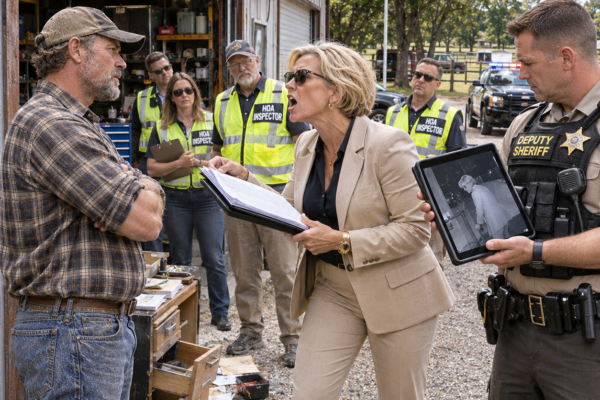
“Sign This HOA Fine, or We’ll Make You Regret It!” Two Men Wearing “HOA COP” Vests Threatened My Pregnant Wife While I Was Away. When I Pulled Into Our Driveway, Her Phone Lay Shattered, Blood Ran Down Her Cheek, and One Man Reached Toward His Holster. The HOA President Had Mocked My Navy SEAL Background—But She Had No Idea What Her Men Had Started….k
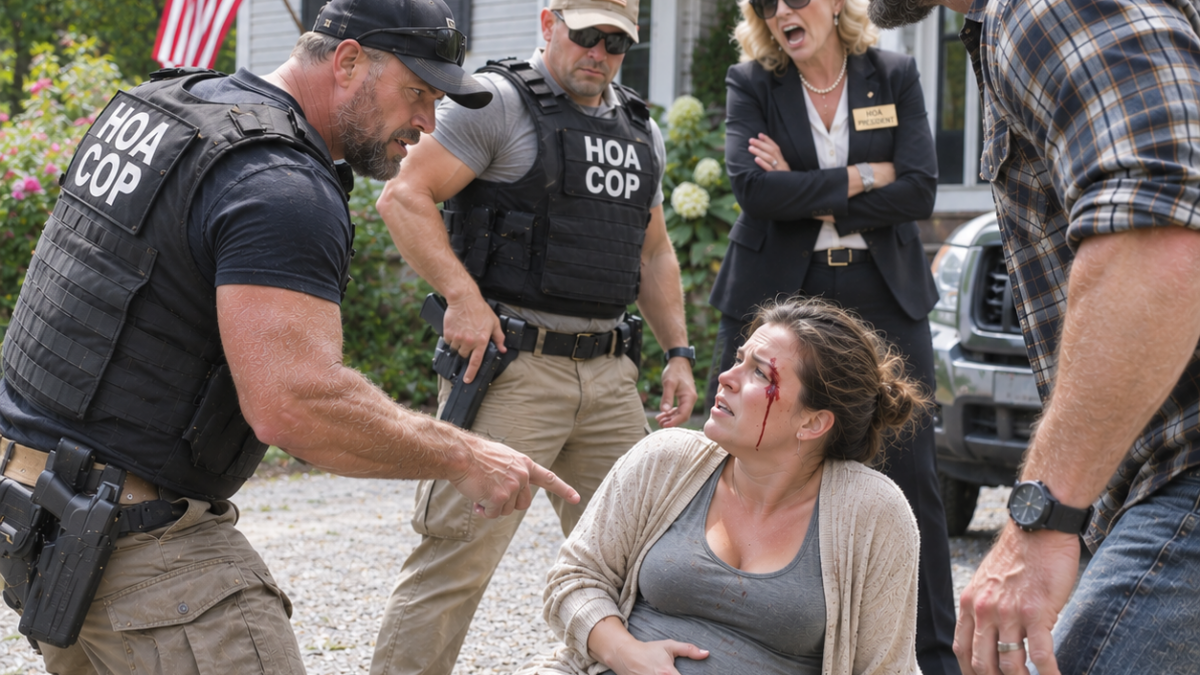
“Sign This HOA Fine, or We’ll Make You Regret It!” Two Men Wearing “HOA COP” Vests Threatened My Pregnant Wife While I Was Away. When I Pulled Into Our Driveway, Her Phone Lay Shattered, Blood Ran Down Her Cheek, and One Man Reached Toward His Holster. The HOA President Had Mocked My Navy SEAL Background—But She Had No Idea What Her Men Had Started…
Part 1:
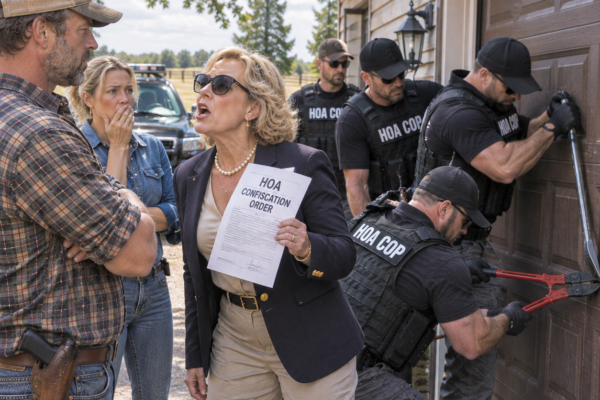
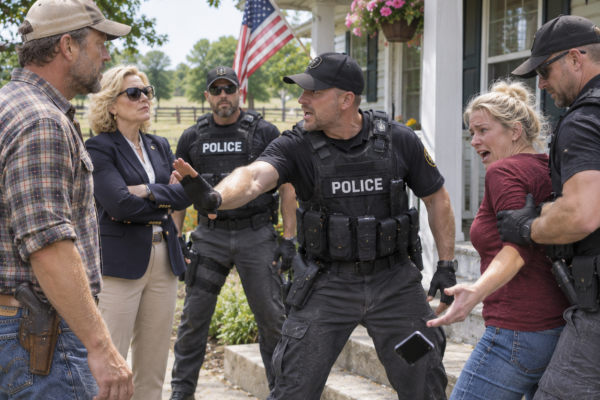
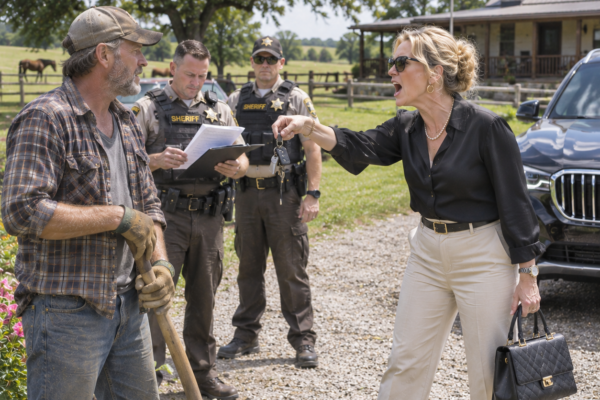
I pulled into my driveway at 12:23 on a Saturday afternoon and saw two men in black tactical vests holding my pregnant wife against our front porch railing.
There was blood on her face.
Her right hand trembled against her cheek, and a thin red line ran between her fingers.
Her phone lay shattered beside the rose bushes she’d spent the entire spring planting.
One man had his hand clamped around her upper arm.
The other stood in front of her, waving a clipboard and shouting something I couldn’t hear through my truck window.
Across both men’s vests, in large white letters, were the words:
HOA COP.
For one second, I couldn’t move.
Then I saw my wife’s expression.
Sarah was crying.
Not because she was frightened of a fine.
Not because she’d been arguing about our fence.
Because someone had hurt her.
I stopped the truck and climbed out.
“Get your hands off my wife.”
The taller man turned toward me.
He was broad-shouldered, with a buzz cut and a black badge clipped to his vest.
“Sir, stay back. We’re conducting an HOA enforcement action.”
I looked past him.
“Sarah?”
She lifted her head.
Her left arm was wrapped protectively around her stomach.
“He hit me, Michael.”
Those four words changed everything.
My name is Michael Bennett. I’m thirty-eight years old, a former Navy SEAL, and I’d spent most of my adult life learning how quickly an ordinary situation can become dangerous.
But I never imagined the most frightening moment of my life would happen in the driveway of the little house where my wife and I were preparing to raise our first child.
We had moved to Maple Hollow, a quiet neighborhood outside Elizabeth City, North Carolina, six months earlier.
Sarah was six months pregnant.
We wanted good schools, a yard big enough for a garden, and a neighborhood where our son could learn to ride a bicycle without us worrying about traffic.
The house seemed perfect.
A two-story brick home.
A wooden porch.
A wide lawn.
And a small garden where Sarah planted roses almost immediately after we moved in.
Then the HOA letters started.
The first claimed our backyard fence exceeded the approved height.
The second accused Sarah of installing an unauthorized garden structure.
That “structure” was a small wooden swing she’d assembled near the roses.
She called the HOA office, sent photographs, and requested clarification.
The association’s president, Carla Jennings, didn’t appreciate being questioned.
At the next board meeting, she told Sarah that removing the swing would be easier than challenging the association’s authority.
Sarah explained that the swing was temporary and that the fence had been there when we purchased the house.
Carla smiled coldly.
“Your husband may be used to giving orders in the military, Mrs. Bennett, but he’ll follow our rules like everybody else.”
Sarah came home upset.
I told her we’d challenge any improper notices through the association’s procedures.
I also warned her not to let strangers claiming HOA authority inside the house or onto the property without checking who they were.
I was away frequently, helping with a private security consulting contract.
Sarah was home during the day.
And Carla seemed to know exactly when I was gone.
Over the following weeks, unfamiliar cars began stopping near our driveway.
Violation notices appeared on the front door.
Someone left an unsigned warning claiming the HOA could seize our property if we refused to pay the escalating fines.
I photographed everything and forwarded it to our attorney.
Then, on Saturday morning, I drove to the hardware store to buy lumber for the treehouse I’d promised to build once our baby was old enough.
Sarah stayed home to water her roses.
At 12:02, she called.
“Michael, there are two men walking around our yard.”
I set down the boards I was carrying.
“What men?”
“They’re wearing black vests that say HOA COP.”
My stomach tightened.
“Are they inside the fence?”
“Yes. One says he’s an enforcement officer.”
“Sarah, don’t go outside. Lock the door. I’m coming home.”
She hesitated.
“They’re saying I have to sign something.”
“Don’t sign anything.”
Then the call ended.
I tried again.
No answer.
I abandoned the lumber, climbed into my truck, and drove home.
Twenty-one minutes later, I found Sarah bleeding on our porch.
Now the larger man stepped toward me, raising what looked like an official badge.
“Sir, this is a lawful compliance operation. You need to leave the area.”
I kept my eyes on his hands.
“You’re on my property. Release my wife.”
The second man loosened his grip.
Sarah staggered away from him and leaned against the porch post.
The taller man moved between us.
“Your wife has been refusing a direct order.”
I looked at her swollen cheek.
“What order requires hitting a pregnant woman?”
His jaw tightened.
“Back up.”
He put his hand near the holster on his belt.
I stopped moving.
I knew that gesture.
And I knew how quickly an armed confrontation could become irreversible.
“Don’t reach for that,” I said.
Sarah gasped behind him.
The man stared at me.
Then his hand shifted.
And in that instant, I realized the person standing between me and my injured wife wasn’t simply an HOA bully with a clipboard.
He was an armed stranger on my property.
He had already assaulted her.
And I had no way of knowing what he intended to do next.
Part 2:
The first thing I saw was the blood.
Not the two men in black vests.
Not the broken phone beside the rose bushes.
Not the clipboard, the fake police badges, or the black SUV parked half on our lawn.
The blood.
It was running down my pregnant wife’s cheek while a stranger held her against our porch railing.
For a moment, everything inside me went cold.
“Get your hands off her.”
The taller man turned.
He had a buzz cut, broad shoulders, and the kind of hard expression some men practice because they think looking dangerous is the same as being respected.
His vest said HOA COP.
A silver-colored badge hung near his chest.
There was a holster on his right hip.
“Stay back,” he ordered. “We’re conducting an authorized enforcement action.”
I looked past him.
“Sarah?”
My wife raised her head.
Tears ran down her face, mixing with the blood near her cheekbone.
“He hit me, Michael.”
I remember those words perfectly.
I remember her left arm wrapped around her stomach.
I remember the other man loosening his grip on her arm as I stepped away from my truck.
And I remember thinking that the little boy Sarah was carrying hadn’t even been born yet, and already somebody had made his mother afraid for her life.
“Sarah, come toward me.”
The man with the clipboard stepped into her path.
“Nobody leaves until these documents are signed.”
I looked at him.
“Move.”
He hesitated.
The taller man raised his badge.
“Sir, I’m warning you. We have authority to detain noncompliant residents.”
“No, you don’t.”
His face tightened.
“Back away.”
Sarah took another step toward me.
The man reached for her.
“Don’t touch her again,” I said.
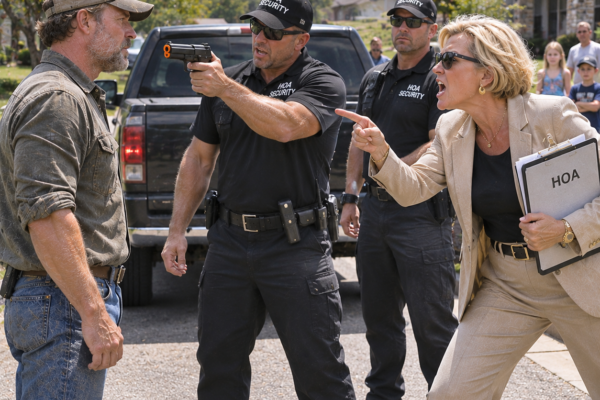
Then the taller man’s hand moved to his holster.
I stopped.
“Leave that alone.”
He stared at me.
For one second, neither of us moved.
Then he began drawing a handgun.
I had my own lawfully carried firearm.
I’d spent years training to recognize dangerous situations, but no amount of training makes you comfortable with what happens when somebody reaches for a gun near the person you love.
I believed he was about to shoot.
I fired once.
He fell beside the garden path.
The gun slipped from his hand and landed on the grass.
Sarah screamed.
I remember the sound more clearly than the shot.
The second man lunged toward me.
We collided near the fence. He swung, I moved to defend myself, and we struggled until I managed to get him away from Sarah and onto the ground.
I stopped using force when he stopped fighting.
He was breathing hard and holding his side.
“Stay down,” I told him.
He didn’t move.
I backed away.
Then I looked toward Sarah.
She was standing against the porch post, one hand on her stomach.
“Michael.”
“I’m here.”
“Please.”
I wanted to run to her.
Instead, I kept enough distance from the two men to avoid another confrontation, checked that neither was moving toward a weapon, and called 911.
I gave the dispatcher our address.
I told her there had been an assault against my pregnant wife, that shots had been fired, and that two men were injured.
I described the handgun on the ground.
Then I told her Sarah needed an ambulance.
The dispatcher asked whether everyone was safe from an immediate threat.
“As far as I can tell.”
She told me to follow her instructions and not touch the fallen man’s gun.
I didn’t.
I placed my own firearm down in a safe location away from the others, told the dispatcher exactly where it was, and kept my hands visible when the first patrol vehicles arrived.
The scene had gone from ordinary Saturday afternoon to something unrecognizable in less than two minutes.
I hadn’t come home expecting to use a weapon.
I’d been at the hardware store buying lumber.
I was supposed to spend the afternoon building shelves in the garage.
Sarah was supposed to be watering roses.
Instead, a man lay motionless beside our garden, another was groaning near the fence, and my wife was trembling so badly she could barely stand.
I kept looking at her stomach.
“Is the baby moving?”
She nodded.
“I think so.”
“Okay.”
But I didn’t know if it was okay.
I didn’t know if she’d been struck anywhere besides her face.
I didn’t know whether she’d fallen or been pushed.
I didn’t know what the shock was doing to her.
And until someone examined her, I wouldn’t know whether our son was safe.
I looked toward the fallen man.
For years, I’d served in the Navy, including time with the SEAL teams. I’d been trained for violence in circumstances most civilians would never experience.
But this wasn’t overseas.
This was my driveway.
The man’s boots were resting inches from a rosebush Sarah had planted with her mother.
And I felt no triumph.
Only dread.
Because I knew, even before the first ambulance arrived, that somebody might be dead.
My name is Michael Bennett.
I was thirty-eight years old when Carla Jennings turned an argument over our backyard fence into the worst day of my family’s life.
I had spent much of my adult life in the Navy.
When I left active service, I took work consulting on security procedures for commercial facilities.
It wasn’t glamorous.
Most days involved reviewing access-control plans, writing reports, training employees, and explaining why security personnel needed clear limits on their authority.
I’d learned one thing repeatedly.
The most dangerous security employee isn’t necessarily the strongest or best armed.
It’s the one who doesn’t understand the difference between keeping people safe and controlling them.
When Sarah and I bought our house in Maple Hollow, I thought my experience might be useful if we ever had an actual emergency.
I didn’t imagine our homeowners association would manufacture one.
Maple Hollow sat outside Elizabeth City, North Carolina.
It was a quiet subdivision with broad lawns, sidewalks, mature trees, and a little playground beside the community pond.
The school district had a good reputation.
The houses were close enough for neighbors to know one another without being stacked on top of each other.
Our home was a two-story brick house on a corner lot.
It had a front porch, a large backyard, and enough sunlight for Sarah’s roses.
That last part mattered more to her than the size of the kitchen.
Sarah was thirty-two and worked remotely as a graphic designer.
She loved flowers.
Not casually.
She kept notebooks describing soil conditions, pruning schedules, and the exact week each variety was supposed to bloom.
When we first toured the house, she stood in the backyard for nearly ten minutes, studying the sunlight.
I asked whether she liked the bedrooms.
She smiled.
“I could grow climbing roses along that fence.”
We bought the house.
Three months later, we learned we were going to have a son.
Sarah cried when the doctor confirmed the pregnancy.
I did too, although I tried to blame the tears on allergies.
We had wanted a family for years.
Now we were finally preparing for one.
We painted the nursery pale blue.
Sarah bought a little wooden rocking horse at an antique store.
And I promised to build a treehouse when our boy was old enough to enjoy it.
We were happy.
Then we met Carla Jennings.
The first time Carla Jennings came to our house, she didn’t introduce herself.
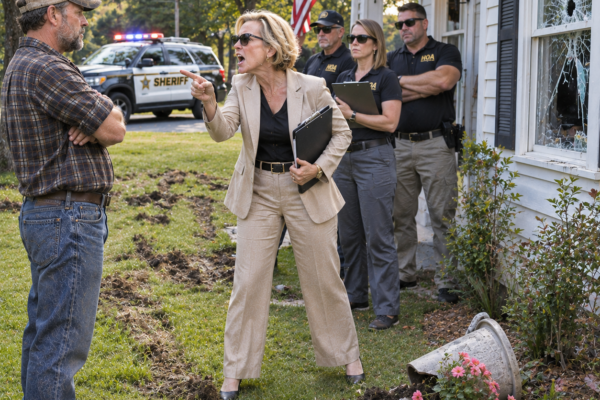
She walked straight through the open side gate while Sarah was planting roses and began measuring the backyard fence with a retractable tape measure.
Sarah looked up.
“Can I help you?”
Carla didn’t answer immediately.
She walked another few feet, stretched the tape toward the top rail, and made a note on her clipboard.
“Your fence is six inches over the permitted height.”
Sarah stood.
“I’m sorry. Who are you?”
“Carla Jennings. President of the Maple Hollow Homeowners Association.”
Sarah wiped her hands on her gardening apron.
“Oh. Hello. I’m Sarah Bennett.”
Carla barely acknowledged the greeting.
“Have you submitted a modification request?”
“For the fence?”
“Obviously.”
“The fence was here when we bought the house.”
Carla gave her a thin smile.
“That doesn’t make it compliant.”
Sarah looked toward the fence.
It matched the neighboring properties.
The builder had installed it before we purchased the house, and nothing in our closing documents suggested it was the subject of an outstanding violation.
“Could you send me the relevant rule?” Sarah asked.
Carla snapped her tape measure shut.
“You’ll receive a notice.”
Then she turned and walked out.
Sarah told me about the encounter that evening.
I asked whether Carla had entered through our gate without permission.
“Yes.”
“Did she say why she was inspecting our backyard?”
“Only that the fence was too tall.”
I looked at the closing documents.
The HOA declaration included architectural restrictions, but it also required a defined review process and an opportunity to challenge disputed violations.
I found the section dealing with fences.
Sarah sat beside me at the kitchen table.
“Do we actually have to lower it?”
“Maybe, if it’s genuinely in violation and there isn’t an applicable approval. But let’s get the documents first.”
I wasn’t interested in picking a fight with the HOA.
I’d spent years dealing with regulations and formal procedures.
Some rules are inconvenient but legitimate.
Others exist because somebody enjoys telling people what to do.
I wanted to know which kind we were dealing with.
The notice arrived four days later.
Sarah contacted the management office.
She asked whether the original fence had received architectural approval and whether the association possessed any prior inspection record.
The office promised to investigate.
While we waited, Carla discovered the swing.
It was a simple wooden garden swing Sarah had bought in a kit and assembled herself.
It stood near the roses, beneath a small shade tree.
Nothing was permanently attached to the house.
The swing didn’t cross a property line or block drainage.
Sarah loved sitting there in the evenings, one hand on her stomach, talking about what our child might be like.
Carla called it an unauthorized garden structure.
A second violation notice arrived demanding its removal.
Sarah submitted photographs and a written request for a hearing.
She also asked the association to explain why several comparable swings and benches in nearby yards hadn’t received the same notices.
The response came from Carla herself.
Other properties are not relevant to your compliance obligations.
Sarah read the message aloud.
“Well, that’s friendly.”
I looked up from my laptop.
“Keep the email.”
She smiled.
“You always say that.”
“Because people get very interested in records when they realize somebody else has them.”
Sarah laughed.
Then she attended the next HOA meeting.
I was working out of state that week, helping a client review security procedures at a warehouse complex in Virginia.
Sarah called afterward.
She sounded upset.
“Carla made me feel like an idiot in front of everybody.”
“What happened?”
“She said we were new residents who hadn’t learned to respect community standards.”
I closed my laptop.
“What did she say about the fence?”
“Nothing useful. She kept saying we should comply first and appeal later.”
I waited.
Then Sarah added, “I told her you wanted everything in writing.”
“And?”
“She asked what you did for a living.”
I sighed.
“What did you tell her?”
“That you’d served in the Navy.”
“Sarah.”
“I wasn’t trying to threaten her, Michael. She kept asking whether you thought you were above the rules.”
I softened my voice.
“I know.”
Sarah continued.
“Somebody asked what part of the Navy you served in. I told them you were a SEAL.”
There was a pause.
“Carla laughed.”
“What did she say?”
“She said, ‘We’ll see if your husband follows the rules like everybody else.'”
I stared at the hotel wall.
Then I looked down at my notebook.
“Write down exactly what happened.”
“Michael, do we really need to make a big deal out of this?”
“No. But we should preserve what was said.”
I didn’t know then how important that conversation would become.
Within two weeks, we received three additional notices.
One accused us of failing to maintain the flower bed nearest the sidewalk, even though Sarah had just planted it.
Another alleged improper placement of our trash containers.
The third claimed our wooden swing was a safety hazard requiring immediate removal.
The notices contained escalating penalties, but the figures changed from one letter to the next.
There was no consistent accounting.
I asked the management company for an itemized statement and confirmation of the hearing schedule.
The office acknowledged the request.
Carla sent another warning.
She wrote that continued noncompliance could lead to stronger enforcement, including restrictions on our use of common amenities and legal action where authorized.
I asked our attorney, Daniel Mercer, to review the notices.
Daniel was a real estate lawyer in Elizabeth City.
He examined the declaration, the correspondence, and the original fence documents.
He advised us to continue using the formal review process, preserve the records, and avoid giving Carla an excuse to claim we’d refused to cooperate.
We did exactly that.
Carla became more aggressive.
A dark SUV began appearing near our driveway.
Sometimes it sat at the curb for fifteen minutes.
Other times, it moved slowly through the neighborhood.
Once, Sarah noticed the driver photographing our front windows.
Then someone taped an unsigned notice to our mailbox.
FINAL WARNING — HOA PROPERTY SEIZURE PENDING.
It looked official from a distance.
Up close, it was ridiculous.
There was no case number, no proper legal notice, and no explanation of the supposed process.
I photographed it and called Daniel.
He confirmed that a homeowners association couldn’t simply confiscate a house through a threatening flyer.
But he was concerned about the escalating conduct.
“I want you to document the vehicles,” he told me. “And if anyone claims law-enforcement authority, ask for identification and contact the sheriff’s office.”
I did.
Then I contacted the association’s management company.
The receptionist told me Maple Hollow had recently approved a supplemental security contract.
“With whom?” I asked.
She gave me a company name.
Apex Neighborhood Compliance Services.
I’d never heard of it.
I searched the name in the ordinary business records available to me.
The company was new.
It appeared to provide private security and compliance assistance for residential associations.
There was nothing inherently wrong with an HOA hiring a legitimate security company.
But private security employees weren’t police officers.
They couldn’t issue criminal warrants, arrest residents for fence violations, or use force to collect civil fines.
I emailed the board asking for the contract, the scope of the officers’ authority, and confirmation of how residents should identify them.
No response came.
Instead, Carla sent Sarah a message.
The compliance team will contact you directly if necessary.
I was due home permanently the following week.
I told Sarah we’d get everything sorted out together.
But before that happened, Saturday arrived.
And two men in black vests walked through our gate.
I learned the full sequence of what happened that Saturday from Sarah’s statement, the surveillance recordings, and the investigators who later reconstructed the scene.
At 11:58 a.m., a black SUV stopped in front of our house.
Two men got out.
The taller one was Derek Shaw, forty-one, a former security guard who’d worked several short-term contracts before joining Apex.
The other was Evan Rusk, thirty-four, who handled the paperwork and the company’s administrative calls.
Both wore black tactical vests marked HOA COP.
Both carried imitation law-enforcement badges.
And Shaw had a real handgun.
They walked through our side gate without asking permission.
Sarah was watering the roses near the porch.
She set down the hose.
“Can I help you?”
Shaw pulled a folded notice from his vest.
“Mrs. Bennett?”
“Yes.”
“We’re with Maple Hollow HOA enforcement. You’ve been ordered to correct multiple violations.”
Sarah looked at the document.
“We have a hearing request pending.”
Rusk opened his clipboard.
“Your appeal doesn’t suspend compliance.”
“Then why hasn’t the management office answered our questions?”
Shaw stepped closer.
“We’re not here to debate.”
Sarah became uneasy.
She saw the vests.
The badges.
The way Shaw positioned himself between her and the gate.
Then she noticed the handgun.
“I need to go inside,” she said.
Rusk held out a pen.
“Sign the acknowledgment first.”
Sarah shook her head.
“I’m not signing something I haven’t had a chance to read.”
Shaw’s expression hardened.
“Mrs. Bennett, noncompliance has consequences.”
She took out her phone and called me.
That was the conversation we had while I stood in the hardware store.
She told me two men were in the yard.
I told her to go inside, lock the door, and avoid further contact.
She started toward the porch.
Shaw followed.
Rusk remained close behind.
When Sarah reached the front door, Shaw grabbed her arm.
“You’re not walking away from an enforcement officer.”
She pulled back.
“Let go of me!”
He tightened his grip.
She tried to call me again.
Rusk knocked the phone from her hand.
It struck the porch steps and landed beside the flower bed.
Sarah shouted for help.
Shaw shoved her backward against the railing.
Then, when she tried to pull away, he struck her across the face.
The blow opened a cut near her cheekbone.
She fell against the porch post.
For several seconds, she couldn’t understand what had happened.
Her ear was ringing.
Her face hurt.
And her first thought wasn’t about the men.
It was about the baby.
She wrapped an arm around her stomach and begged them to leave.
Shaw demanded her signature again.
Rusk stood beside him, holding out the clipboard.
That’s the scene I found when I turned into our driveway.
What happened next would be examined by investigators for months.
I saw Sarah bleeding.
I heard her say she’d been struck.
I saw an armed man reach toward his holster after I told him to release her.
When he began drawing the gun, I believed he presented an immediate threat of deadly force.
I fired.
The county medical examiner later confirmed that Shaw died from the gunshot wound.
I can’t describe that without remembering the sound Sarah made when he fell.
People sometimes imagine former military personnel respond to violence without emotion.
That isn’t true.
Training can help someone function under pressure.
It doesn’t make taking a life ordinary.
It doesn’t turn a front yard into a battlefield where the consequences disappear after the danger ends.
And it certainly doesn’t make you proud of a dead man lying beside your wife’s roses.
After Shaw fell, Rusk rushed toward me.
We struggled.
He fell hard against the fence during the confrontation and suffered injuries that later required medical treatment.
Once he stopped fighting, I stepped away.
I didn’t chase him.
I didn’t demand a confession.
I didn’t try to punish him for what had happened to Sarah.
My wife needed help.
That was all I could think about.
The first patrol vehicle arrived with Sheriff Rafael Morales and Deputy Allison Price.
Morales stepped out, saw the firearm I’d placed away from the others, and ordered me to show my hands.
I complied.
He directed me to move away from the weapons.
Then he had Deputy Price secure the scene while medics approached the injured men.
I told him my name.
I told him Sarah had been assaulted.
I told him I’d fired the shot.
He listened without making a judgment.
Then he asked me to sit near the patrol vehicle while investigators began separating witnesses and preserving evidence.
For a while, another deputy stayed beside me.
I understood why.
A person had been shot to death.
No matter what the circumstances appeared to be, law enforcement had to investigate.
Morales didn’t announce that I was innocent simply because my wife was injured.
He didn’t declare the shooting justified before hearing all the evidence.
He treated the scene as a serious incident that required a thorough investigation.
I respected that.
But every second I sat there felt unbearable because Sarah was being placed into an ambulance.
I stood when I saw them bring the stretcher toward the driveway.
A deputy asked me to remain seated.
I looked at him.
“She’s pregnant.”
“I know, sir.”
“Please make sure they know she’s twenty-seven weeks along.”
“They do.”
Sarah turned her head toward me.
Our eyes met.
“Michael?”
“I’m here.”
Her lips trembled.
“Please don’t leave me.”
I took a step toward her, then stopped when the deputy raised a hand.
I looked at Morales.
“Can I go to the hospital with her?”
He considered the situation.
“Mr. Bennett, we still need a formal statement. We’ll arrange for you to get there as soon as we can.”
I nodded.
I hated the answer.
But I understood it.
The medics loaded Sarah into the ambulance.
The doors closed.
Then the vehicle pulled away.
For the first time since reaching home, I felt completely helpless.
The investigators photographed the porch.
They collected the damaged phone.
They documented the fake badges, the HOA notices, and the weapons.
They examined the location of the two injured men and the visible damage near the fence.
They obtained the video stored by our doorbell camera and requested nearby surveillance recordings.
Rusk was taken to the hospital under law-enforcement supervision.
Shaw was pronounced dead at the scene.
Morales returned to me after the initial work was complete.
“Mr. Bennett, I need you to come to the station and give a detailed statement.”
“All right.”
“Do you want an attorney present?”
“Yes.”
He nodded.
“That’s your right.”
I called Daniel Mercer.
He was at a family cookout when I reached him.
“Michael? What’s going on?”
I told him Sarah had been assaulted.
That I’d fired a shot.
And that a man was dead.
There was a long silence.
Then Daniel said, “Don’t speculate about anything you didn’t actually see. Tell the investigators what happened, and I’ll meet you.”
I hung up.
For the next several hours, I answered questions about a Saturday afternoon I’d give almost anything to undo.
When the formal interview finished and I was permitted to leave, Daniel drove me to the hospital.
Sarah was in an obstetric observation room.
Her cheek had been cleaned and bandaged.
There was swelling around one eye and bruising along her jaw.
Her hands were folded across her stomach.
I stopped in the doorway.
She looked at me.
Then she started crying.
I crossed the room and held her as carefully as I could.
“I’m sorry,” I whispered.
She shook her head.
“You came home.”
I couldn’t answer.
A nurse entered to check her monitors.
She told us the baby’s heart rate was reassuring, although Sarah would continue to be observed because physical trauma and severe stress during pregnancy required careful assessment.
I sat beside the bed.
Every few minutes, I looked at the monitor.
Then at Sarah.
Then back at the monitor.
That evening, she reached for my hand.
“Michael, I thought they were going to take me away.”
I looked at her.
“What?”
“The bigger one said they could detain me. He said if I didn’t sign, they’d take me somewhere until the HOA decided what to do.”
I felt a cold wave of anger.
But I kept my voice steady.
“They couldn’t do that.”
“I know that now.”
She looked toward the window.
“At the time, I wasn’t sure what they were capable of.”
I held her hand.
There was no sentence I could say that would make her forget being trapped on our porch.
No amount of military experience could erase what she’d endured.
And as I sat beside her hospital bed, one question kept returning.
Who had sent those men to our house believing they could treat a pregnant woman like a prisoner over a fence and a garden swing?
The answer began with a neighbor named Evelyn Price.
Evelyn lived across the street.
She was seventy-one, a retired school secretary, and one of those people who knew everything happening in Maple Hollow without making a spectacle of it.
I’d always liked her.
She brought Sarah homemade soup when the morning sickness was bad and insisted we call if we ever needed someone to collect our mail.
On Monday morning, she called Daniel.
She said she had video of the men arriving at our house.
More importantly, she said her camera had captured the porch.
Her system was installed beneath the eaves of her garage, angled toward the street.
It normally recorded passing cars and anyone approaching her driveway.
But because our homes faced each other, the edge of the picture included part of our porch.
Investigators obtained the original recording.
The footage showed Shaw and Rusk walking up our driveway.
It showed Sarah backing toward the door.
It showed Shaw grabbing her arm.
Then came the moment he struck her.
The image wasn’t perfect.
There were shadows beneath the porch roof.
But the sequence was clear enough to establish that Sarah had been physically assaulted before I arrived.
The footage also captured the confrontation after I got out of my truck.
There was no audio from Evelyn’s camera.
But it showed Shaw reaching toward his holster.
Investigators compared it with the evidence recovered at the scene and the recordings from our own doorbell system.
Shaw’s handgun was found on the grass near his body.
It was loaded.
The physical evidence and witness accounts were examined as part of the shooting investigation.
None of that meant the outcome was automatically decided.
The question remained whether my belief that deadly force was immediately necessary had been reasonable under the circumstances.
Daniel reminded me of that every time I asked whether the investigation was nearly over.
“Michael, you need to let the evidence speak.”
“I know.”
“Then don’t spend your nights imagining how every detail could be misunderstood.”
That was easier said than done.
I lay awake listening to Sarah breathe.
Every time she shifted in bed, I opened my eyes.
Every time a car slowed near the house, I went to the window.
And whenever I walked past the rose bushes, I saw the place where Shaw had fallen.
Sarah noticed.
One night, she took my hand.
“You keep looking at the same patch of grass.”
I didn’t answer.
She squeezed my fingers.
“I do too.”
We stood there together for a long time.
Then she said, “I don’t want that to be the only thing we remember about this porch.”
I nodded.
But I didn’t know how to make that happen.
Meanwhile, Detective Hannah Cole began examining the circumstances that brought Shaw and Rusk to Maple Hollow.
She worked with the sheriff’s criminal-investigation unit.
Her questions weren’t limited to what happened in our yard.
She wanted to know why two private security employees had been wearing badges and vests suggesting law-enforcement authority.
Who had directed them to our address?
Who supplied the notices?
Why had they attempted to compel Sarah to sign a document?
And what did Carla Jennings know about the methods they intended to use?
The first evidence came from the papers recovered from Rusk’s clipboard.
The top sheet was an HOA compliance acknowledgment.
It listed our fence and garden swing.
But beneath the ordinary violation language was a section authorizing immediate payment of accumulated penalties and granting broad access for future inspections.
It also included a statement that Sarah voluntarily accepted the association’s findings and waived further objections to the listed violations.
That was a serious problem.
Sarah had disputed the notices in writing.
The management company had acknowledged her request for a hearing.
Now two men had arrived to pressure her into signing away those objections.
Detective Cole asked whether we’d ever been told the HOA could send armed officers to collect compliance signatures.
“No,” I said.
“Did the association approve inspections by an outside company?”
“We were told a company had been hired. We never received a clear description of its authority.”
She examined the notices.
Then she asked for our earlier correspondence.
I gave her everything.
The emails.
The letters.
The hearing requests.
The strange unsigned warning.
And the message from Carla stating that the compliance team would contact us directly.
The next records came from Apex.
Its office was a small rented suite on the outskirts of town.
Investigators obtained the relevant contracts, schedules, and communications through the applicable legal process.
The official service agreement described a limited role.
Security patrols.
Reporting suspicious activity.
Observing common-property violations.
Assisting with communications when residents requested information.
It did not authorize impersonating law enforcement, using force to collect fines, or entering homes to obtain signatures.
Yet Shaw and Rusk had been wearing HOA COP vests and imitation badges.
Their instructions appeared to go far beyond the written contract.
Then investigators examined the message history.
A series of texts between Carla and Rusk discussed my house.
One message referred to Sarah as the pregnant resident who keeps refusing to cooperate.
Another described me as the former SEAL who thinks he can intimidate the board.
I read those words later through the records produced in the case.
The fact that Carla had made my military service part of the dispute sickened me.
I had never threatened her.
I’d never mentioned my service in a board meeting.
I’d merely asked that the association follow its own procedures.
But Carla appeared to have decided my past was a challenge to her authority.
Then there was a message that became central to the investigation.
It was sent the evening before the attack.
He’ll be out most of Saturday. Get the wife’s signature while he’s gone. I don’t want another debate. Make it clear refusal is not an option.
The message was attributed to Carla.
Rusk’s reply stated that Shaw could handle any resistance.
Carla responded:
Then make sure she understands who’s in charge.
I stared at the words.
Sarah hadn’t imagined the intimidation.
It hadn’t been a spontaneous argument with two overzealous guards.
The messages suggested a deliberate plan to confront her while I wasn’t home and force a disputed acknowledgment.
Detective Cole continued reviewing the financial records.
Three payments had been made from association accounts to Apex under descriptions such as special enforcement deployment and compliance recovery services.
The total was nearly $25,000.
Several expenditures had been approved without the independent review required by the board’s financial procedures.
The ordinary management company hadn’t processed all of them.
Carla had arranged some payments directly.
The payments weren’t proof by themselves that she ordered an assault.
But they linked association funds to a special enforcement effort she had helped direct.
And residents hadn’t been told what their dues were funding.
A few days later, investigators interviewed Rusk after he was medically cleared and advised of his rights.
He had retained an attorney.
His account was examined against the communications and physical evidence.
Eventually, he acknowledged that Carla had directed them to obtain the signed acknowledgment and had encouraged an aggressive approach.
He also admitted that their badges and vests were intended to make residents believe they possessed more authority than ordinary private security guards.
He tried to minimize his own role.
He claimed he hadn’t expected Shaw to strike Sarah.
He said he’d been frightened when the confrontation escalated.
Investigators didn’t simply accept his account.
They compared it with the videos, messages, and statements.
But his information helped establish how the two men ended up on our porch.
The most disturbing discovery came from another Maple Hollow resident.
A woman named Patricia Ellis contacted the sheriff’s office after seeing the news.
She reported that two men in the same black vests had visited her home the previous week.
They’d told her that refusal to pay an HOA fine could result in detention.
She hadn’t believed them.
But she’d been frightened enough to write a check.
Other residents came forward with similar accounts.
Most hadn’t been physically injured.
Still, their statements showed that the false claims of police authority extended beyond Sarah.
Carla had created an enforcement operation that made ordinary homeowners afraid of being arrested over lawn care, fences, and landscaping.
And it had taken a violent confrontation at our house before anyone fully understood what those uniforms were being used to accomplish.
The first news report called it the Maple Hollow shooting.
By the end of the week, a local television station was referring to it as the Maple Hollow HOA scandal.
I hated both names.
A scandal sounded like somebody had been caught misusing a community credit card.
A shooting sounded like the whole story began when I pulled the trigger.
Neither description captured what Sarah had endured before I reached the house.
Neither captured the way she’d curled her arm around our unborn child while a stranger struck her.
And neither captured the weeks of threats that had preceded the attack.
Reporters called.
Some wanted an interview about my Navy service.
Others wanted to know whether I’d used military training against the two men.
One asked whether I felt like a hero.
I ended that conversation immediately.
I didn’t feel like a hero.
I felt like a husband whose wife was frightened to step onto her own porch.
I also felt the weight of knowing that Derek Shaw would never go home to his family.
Whatever he had done, the fact of his death wasn’t something I wanted to turn into entertainment.
Daniel advised us to decline interviews until the investigations had progressed.
Sarah agreed.
But she wanted her own experience recognized.
“I’m tired of everybody talking about what you did,” she told me one evening.
I looked at her.
“What do you mean?”
“They keep asking whether you were justified. Whether you were trained. Whether you could’ve handled the men differently.”
Her eyes filled.
“Nobody asks what it was like when he hit me.”
I moved beside her.
She continued.
“I was standing on our porch, Michael. I was pregnant, and I was trying to get into our own house. I told them I didn’t want to sign their papers, and they treated me like I wasn’t allowed to say no.”
I took her hand.
“You were allowed to say no.”
“I know.”
She looked toward the front window.
“But I didn’t feel that way.”
A few days later, Sarah agreed to speak with a victim advocate assigned through the sheriff’s office.
She also began counseling to address the fear and anxiety following the assault.
I went with her to some appointments when she asked.
At first, I told myself I didn’t need help.
I’d dealt with difficult situations before.
I’d been through stressful deployments.
I knew how to function when things went wrong.
Then I started waking at three in the morning, convinced I’d heard somebody at the gate.
I began checking the same camera feed several times each night.
I had trouble concentrating at work.
And sometimes, when Sarah dropped a plate or shut a cabinet too loudly, I reacted before I realized what the sound was.
Eventually, I admitted I needed help too.
A counselor who worked with veterans helped me separate the danger we’d faced from the danger I kept expecting to return.
I still wished the whole incident had never happened.
But I began understanding that protecting my family also meant taking care of myself afterward.
Meanwhile, the HOA board was falling apart.
Carla initially issued a statement describing Shaw and Rusk as independent contractors involved in an unfortunate confrontation.
She expressed sympathy for everyone affected.
She also insisted the association had never authorized physical violence.
That last statement wasn’t necessarily inconsistent with the written security contract.
But it didn’t explain the messages instructing the men to obtain Sarah’s signature while I was away.
Nor did it explain the special payments.
Several directors demanded access to the complete Apex contract and associated financial records.
The association’s treasurer, Robert Fleming, was particularly upset.
He’d been on the board for three years and had believed the new security company would provide ordinary evening patrols around the community pool and parking areas.
He hadn’t approved an operation involving armed men wearing badges and demanding signatures from residents.
At an emergency board meeting, he asked Carla why the company had been paid nearly $25,000 under special enforcement categories.
Carla said the additional expenses were necessary because certain homeowners refused to comply.
Robert asked whether those expenditures had been reviewed by the finance committee.
She didn’t give him a straight answer.
Then the association’s secretary, Ellen Brooks, produced copies of board minutes showing that the special enforcement procedures hadn’t received the approval Carla had claimed.
The directors retained independent counsel.
They ordered preservation of the association’s records and requested an audit.
Carla protested that the board was abandoning her because of public pressure.
The directors voted to remove her from the presidency under the governing documents.
She remained a defendant in the investigation.
But she no longer controlled the association’s official communications.
A few days later, Robert called Daniel.
He wanted to arrange a meeting with Sarah and me.
I wasn’t enthusiastic.
“What does he want?” I asked.
“To acknowledge what happened and explain what the new board is doing.”
“Is he bringing Carla?”
“No.”
I looked at Sarah.
She was sitting on the couch, folding little blue baby clothes.
“Do you want to meet him?”
She considered it.
Then nodded.
“Yes. I want somebody from that board to hear what happened from me.”
We met at Daniel’s office.
Robert arrived with Ellen.
Neither wore a business suit.
Robert carried a folder of records.
Ellen brought a handwritten letter.
Before they sat down, Robert looked at Sarah.
“Mrs. Bennett, I’m sorry.”
She didn’t answer.
He continued.
“We should’ve questioned what Carla was doing. We should’ve made sure the security company understood its limits. And we should’ve stopped the harassment when you first asked for a fair hearing.”
Sarah looked at him.
“Did you know those men were coming to our house?”
“No.”
“Did you know Carla was sending people to pressure residents into signing fines?”
Robert hesitated.
“I knew there had been complaints about aggressive enforcement. I didn’t know the full extent of it.”
Sarah’s voice remained steady.
“Then you should’ve found out.”
Robert lowered his eyes.
“You’re right.”
For several seconds, the room was quiet.
Then Ellen handed Sarah the letter.
It confirmed that the association was withdrawing the disputed notices concerning our fence and garden swing, subject to the normal review of any legitimate property issues.
It also confirmed that Apex’s contract had been terminated and that no private contractor would be authorized to impersonate law enforcement or use physical intimidation to enforce association rules.
A separate review would examine fines collected through the special enforcement program.
I read the letter.
Then looked at Robert.
“That should’ve happened before someone got hurt.”
He nodded.
“I know.”
Sarah placed the paper on the table.
“I want the residents to understand something.”
Robert leaned forward.
She continued.
“An HOA letter can be corrected. A disputed fine can be withdrawn. But I can’t forget standing on my porch begging two strangers not to hurt me or my baby.”
Her voice trembled.
She took a breath.
“And Derek Shaw is dead. That’s part of what this has done to everyone.”
Nobody spoke.
Finally, Ellen said, “We’ll make sure the board hears that.”
I believed she meant it.
But apologies weren’t enough.
The investigation still had to determine what Carla had directed, what the men had done, and who would be legally responsible.
Months passed before those questions reached their final answers.
The district attorney’s office completed its review of the shooting several months later.
By then, investigators had examined the surveillance footage, recovered firearms, medical evidence, witness statements, and the sequence of events leading to the confrontation.
They had also reviewed the evidence showing that Shaw reached for his handgun while standing between me and my injured wife.
The prosecutor announced that no criminal charges would be filed against me in connection with Shaw’s death.
The decision was based on the evidence supporting my claim that I reasonably believed deadly force was necessary to stop an immediate threat.
I remember sitting in Daniel’s office when he told me.
“Michael, the review is complete.”
I looked at him.
“And?”
“They aren’t filing charges against you.”
I closed my eyes.
For months, I’d been carrying the uncertainty of that decision.
Now the legal question had been answered.
But the personal consequences remained.
A man was dead.
My wife had been assaulted.
Our home had become a crime scene.
And no prosecutor’s announcement could make those things disappear.
Daniel watched me for a moment.
“How are you feeling?”
I considered the question.
“Relieved.”
He nodded.
“Anything else?”
I looked toward the window.
“Sad that any of it happened.”
He didn’t try to talk me out of that feeling.
I appreciated him for it.
The investigation into Carla Jennings continued.
Rusk’s cooperation provided important evidence, but prosecutors also relied on the independent records.
The text messages.
The payments from HOA accounts.
The falsified claims of enforcement authority.
The previous incidents involving other residents.
And the documents the men had attempted to force Sarah to sign.
Further records showed that Carla knew Apex employees were using police-style badges and identifying themselves as HOA officers with detention authority.
She had received photographs of their uniforms.
When one board member questioned the wording, she’d dismissed the concern.
The evidence also established that Carla had instructed the men to confront Sarah while I was away and to make refusal seem impossible.
She denied intending any physical injury.
That issue was examined carefully during the criminal proceedings.
But the broader pattern of intimidation and the financial arrangements were documented.
Carla eventually entered a negotiated guilty plea to offenses arising from the conspiracy, misuse of association funds, and the unlawful enforcement scheme.
Her sentence included six years in state prison, with financial restitution obligations determined through the court.
Rusk entered a separate guilty plea connected to his participation in the assault and coercive conduct.
He received a three-year prison sentence.
The court considered his cooperation alongside his own actions.
Neither man could claim that a homeowners association had given him police authority.
And Carla couldn’t avoid responsibility for directing an unlawful intimidation campaign simply by calling the people carrying it out independent contractors.
I attended part of the proceedings.
Sarah chose to attend the sentencing hearing.
She stood before the court and read a statement she’d written herself.
Her hands shook at first.
Then she looked directly toward Carla.
“You told me my family had to learn how to obey your rules.”
The courtroom was quiet.
Sarah continued.
“I asked for a hearing. I asked for the documents. I asked you to explain what rule we’d broken. I never threatened you.”
She paused.
“Then you sent armed men to my house while my husband was away. One of them hit me while I was pregnant. I was so frightened that I thought I might lose my baby.”
Carla looked down.
Sarah took another breath.
“I want you to understand that this wasn’t about a fence. It was about believing you had the right to frighten people into submission.”
She looked toward the judge.
“I hope nobody else ever has to feel as helpless in their own home as I felt that afternoon.”
Then she sat down.
I put my arm around her.
I had never been prouder of her.
Not because she’d spoken without fear.
She’d been afraid.
She’d spoken anyway.
The association faced consequences of its own.
Its independent audit identified unauthorized expenditures and serious failures in financial oversight.
The board established a process for reviewing fines obtained through the improper enforcement program.
Affected residents received refunds or corrections where appropriate.
The HOA also reached a civil settlement addressing our documented medical expenses, property damage, and other losses related to the events at our home.
The agreement included changes to the association’s procedures.
Security contractors would be limited to legitimate security functions.
Disputed architectural violations would follow the ordinary notice and hearing process.
No board president could authorize extraordinary enforcement expenditures without appropriate approval.
And residents would receive clear information about the difference between HOA personnel and sworn law-enforcement officers.
Those reforms didn’t erase the past.
But they made it harder for another Carla Jennings to turn a neighborhood association into a private intimidation operation.
By the time the legal proceedings ended, our lives had changed again.
Our son had been born.
We named him Noah.
He arrived on a rainy Thursday morning, healthy and furious at the world.
Sarah laughed when she heard him cry.
I cried too.
This time, I didn’t even try to blame allergies.
The first time I held him, he wrapped his tiny fingers around one of mine.
I looked down at his face and thought about the afternoon on our porch.
How close we’d come to losing everything.
How frightened Sarah had been.
And how much of the following year we’d spent answering questions about the worst moment of our lives.
Noah knew none of that.
He only knew the warmth of his mother’s arms and the sound of our voices.
I wanted to keep it that way for as long as possible.
After the birth, we began making the house feel like home again.
Sarah replanted the roses damaged during the confrontation.
I repaired the porch railing.
We replaced the garden edging and restored the flower bed where her phone had been shattered.
For weeks, I’d avoided that part of the yard.
Now Sarah insisted we work there together.
One Saturday, she handed me a small rosebush.
“Put this one near the porch steps.”
I looked at the label.
It was a pale pink variety.
“Why there?”
She smiled.
“Because I want something beautiful to grow where something terrible happened.”
I took the shovel.
We planted it together.
Noah slept in his stroller beside us.
Evelyn Price came over with lemonade and spent twenty minutes telling us that the baby looked exactly like his father.
Sarah laughed.
“Poor child.”
I pretended to be offended.
It was the first ordinary Saturday we’d enjoyed in a long time.
No reporters.
No detectives.
No threatening notices.
Just neighbors, sunshine, and a little boy sleeping beside the roses.
The new HOA president stopped by later that summer.
Her name was Helen Carter, a retired accountant who had been elected after the board reorganized.
She stood outside the gate and called to me.
I walked over.
“Good afternoon.”
“Mr. Bennett, I wanted to introduce myself.”
She offered her hand.
I shook it.
She explained that the association was reviewing older architectural decisions and wanted to confirm that our fence and swing matters had been properly closed.
“Your earlier appeal should have been handled long before this,” she said.
I nodded.
“Yes, it should have.”
She looked toward the backyard.
“Mrs. Bennett’s garden is beautiful.”
“She’ll be glad to hear that.”
Helen smiled.
Then she said something I wished Carla had understood.
“An association should help neighbors maintain a good community. It shouldn’t make them afraid to answer their own doors.”
I studied her for a moment.
“That’s a good place to start.”
We talked for a few more minutes.
Then she left.
No clipboard waved in my face.
No threat of arrest.
No claim that wearing a badge made somebody more important than the law.
Just a neighbor having a conversation.
That was all we’d ever wanted.
The following spring, Noah was old enough to sit on a blanket in the backyard and watch me work.
I hadn’t built the treehouse yet.
He was still too young to climb one.
Instead, I started with a small wooden bench beneath the oak tree, where Sarah could sit beside him while he played.
I used some of the lumber I’d originally intended to buy on the day of the attack.
The hardware store had held the order after I’d abandoned my cart.
Weeks later, when I finally returned, the manager recognized me.
He asked how Sarah was doing.
Then he told me there was no rush to finish whatever I’d been building.
I appreciated that kindness more than he knew.
Now I measured boards while Noah sat in the grass, waving a plastic hammer.
Sarah came outside carrying two glasses of iced tea.
She stopped beside the unfinished bench.
“Looking good.”
“Needs another coat of finish.”
“You always say that.”
“Because things usually do.”
She laughed.
Then her eyes moved toward the porch.
The pale pink rosebush had started blooming.
For a moment, neither of us spoke.
I knew she was remembering.
So was I.
But the memory no longer swallowed everything around it.
Sarah looked down at Noah.
Then back at the roses.
“Do you ever wish we’d moved somewhere else?”
I considered the question.
There had been nights when I wanted to sell the house and never see Maple Hollow again.
Nights when the sight of that driveway made me sick.
Nights when I wished I’d taken a different road home or reached Sarah’s call a few minutes earlier.
But I couldn’t change what had happened.
And I didn’t want Carla Jennings to make another decision for our family.
“No,” I said finally. “Not anymore.”
Sarah leaned against me.
“Me neither.”
We watched Noah try to lift his toy hammer with both hands.
He missed the wooden block entirely and laughed as though he’d accomplished something extraordinary.
I laughed with him.
Before moving to Maple Hollow, I’d believed being prepared meant knowing how to respond when something went wrong.
After the attack, I learned preparation wasn’t enough.
You also needed people willing to tell the truth.
Neighbors who preserved evidence.
Investigators who checked facts instead of accepting a uniform at face value.
Lawyers who understood that a homeowners association had legal limits.
And a wife brave enough to stand in court and explain what intimidation had cost her.
Carla believed she could control our neighborhood through fear.
She thought my military service was a challenge she had to defeat.
She thought two armed men wearing HOA COP vests could force a pregnant woman to surrender her rights over a fence and a garden swing.
She was wrong.
But I would never describe what happened as a victory worth celebrating.
A man had lost his life.
My wife had been hurt.
And our family had spent months recovering from something that should never have occurred.
The justice that followed mattered because it recognized those harms and held the responsible people accountable.
It also reminded every homeowner in Maple Hollow of a simple truth.
An HOA can enforce legitimate community rules. It cannot give itself police powers, and it cannot use violence to force people to obey.
That evening, after Noah fell asleep, Sarah and I sat on the porch swing she’d fought so hard to keep.
The new roses moved gently in the breeze.
The neighborhood was quiet.
She rested her head against my shoulder.
“Michael?”
“Yeah?”
“I’m glad we stayed.”
I kissed her forehead.
“Me too.”
For the first time in a long while, I wasn’t thinking about the black vests, the shattered phone, or the blood on her cheek.
I was thinking about the little boy asleep upstairs.
The roses blooming beside our porch.
And the life we were finally getting back.
That was the peace we’d come to Maple Hollow looking for.
And this time, nobody was going to mistake it for weakness.