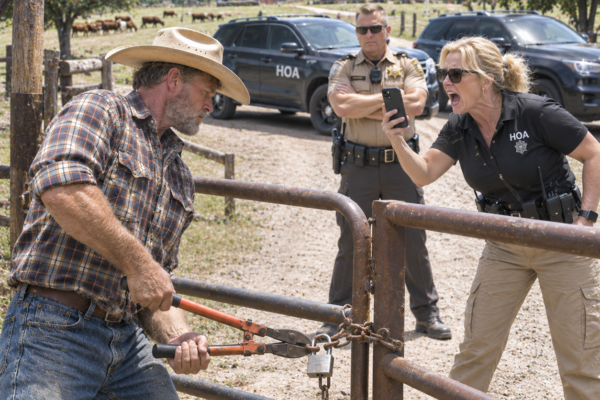
The HOA President Sent Bulldozers Onto My Family’s 68 Acres to Start Her “Model Home” After I Refused to Join Her Neighborhood. She Waved a County Permit and Said My Land Had Been Annexed Without Me. I Handed the Foreman My Deed, Called Planning—and the Inspector Froze When He Saw Whose Signature Authorized Construction..k
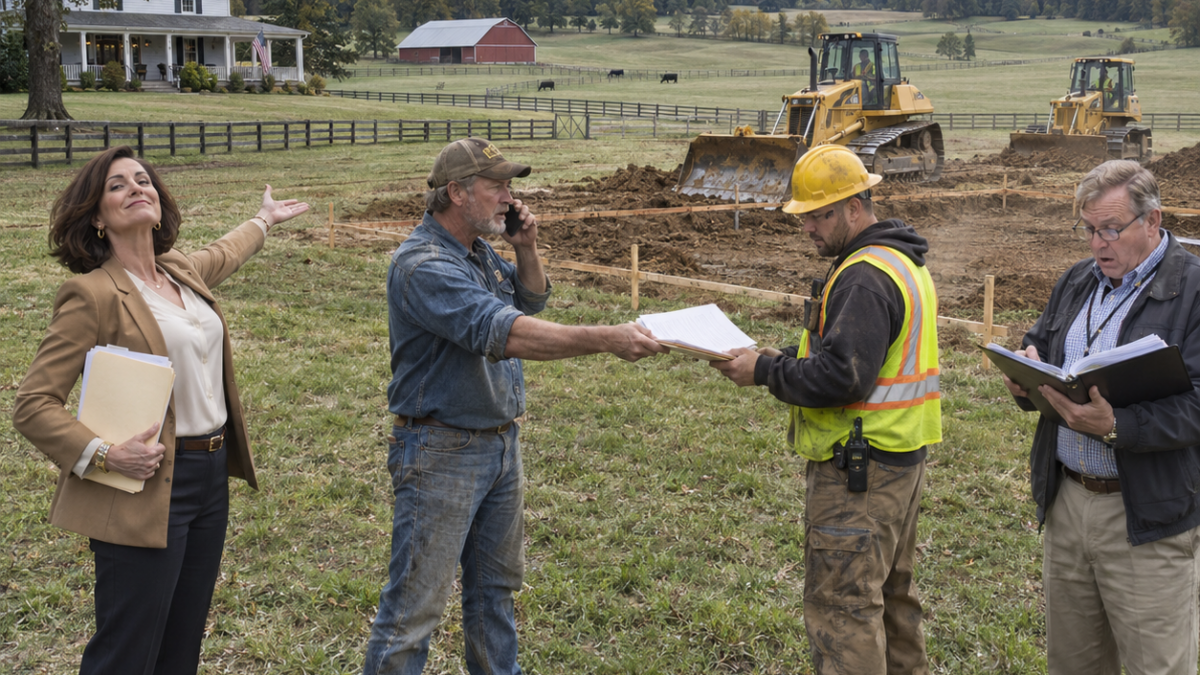
The HOA President Sent Bulldozers Onto My Family’s 68 Acres to Start Her “Model Home” After I Refused to Join Her Neighborhood. She Waved a County Permit and Said My Land Had Been Annexed Without Me. I Handed the Foreman My Deed, Called Planning—and the Inspector Froze When He Saw Whose Signature Authorized Construction.
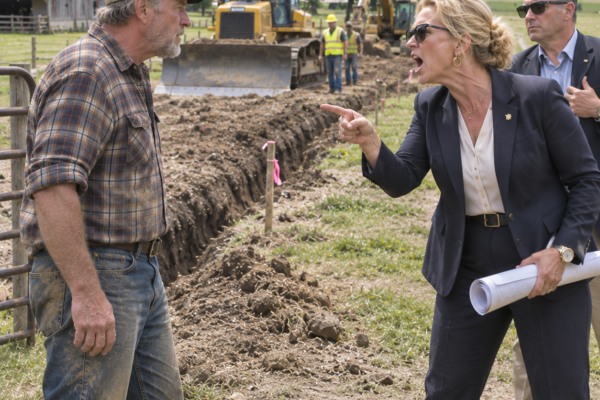
The first bulldozer crossed my fence at 7:18 on a Tuesday morning.
I know the time because I was standing on my porch with coffee when the ground started vibrating beneath my boots.
For fifty-eight years, my family’s east field had held nothing more permanent than fence posts, hay bales, and six old apple trees my grandfather planted before I was born.
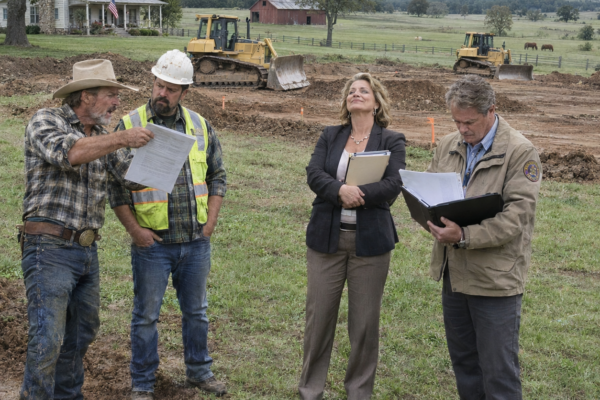
That morning, two bulldozers, a skid steer, a dump truck, and a contractor’s pickup rolled through my gate like they owned the place.
The lead machine stopped halfway up the rise.
Then the operator dropped the blade.
I ran.
“Stop!”
The operator lifted it immediately.
A heavyset man in a fluorescent vest climbed from the pickup.
“Sir, you need to stay clear of the equipment.”
“You need to get the equipment off my farm.”
He looked down at his clipboard.
“This is Pinecrest Phase Three, Lot A-1.”
“No. This is Walker Farm.”
He checked again.
“Model-home site.”
“You’re standing about four hundred yards outside Pinecrest.”
His confidence faded.
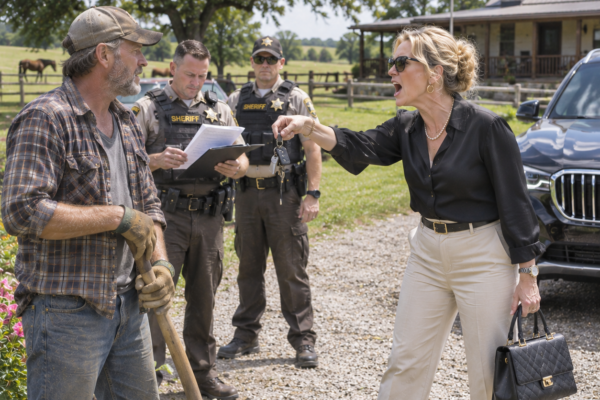
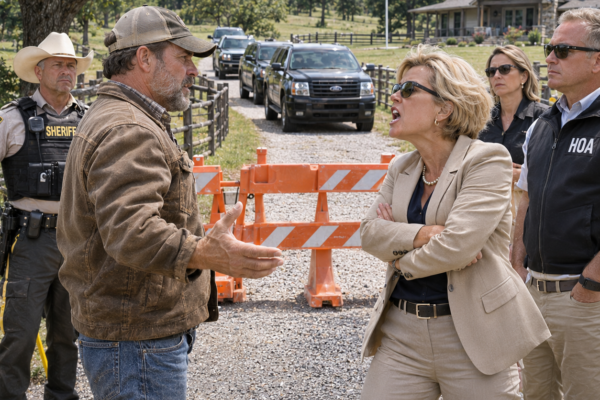
Then a black Lexus SUV came through the gate.
Linda Caldwell stepped out.
President of the Pinecrest Estates Homeowners Association.
She wore a cream jacket, sunglasses, and the same expression she had worn three months earlier when she told me joining her HOA was “inevitable.”
“Evan,” she said, “I was hoping we could avoid another confrontation.”
I stared at her.
“You brought bulldozers onto my land.”
“The county approved the expansion.”
“No county approval transfers my property to you.”
She opened a leather folder.
Inside was a site plan stamped by the county planning office.
My east field was shaded yellow.
A 5,400-square-foot house sat directly over the old orchard rise.
Across the bottom:
PINECREST SIGNATURE MODEL RESIDENCE
I looked at Linda.
“This is the model home?”
“For the new phase.”
“And after the sales period?”
She hesitated.
“I have an option to purchase it.”
There it was.
She wasn’t just trying to expand Pinecrest onto my land.
She was trying to build herself a house on it.
Three months earlier, Linda had knocked on the door of the little cabin I built beside Willow Creek and handed me an HOA membership package.
My grandparents bought our first forty acres in 1966.
Dad added twenty-eight more over the years.
No Pinecrest covenant.
No HOA dues.
No architectural committee.
No shared road.
Nothing.
Pinecrest was built a quarter mile east of us decades later.
Linda said my farm had become a “planning obstacle.”
I told her that sounded like Pinecrest’s problem.
She offered to grandfather my barn and livestock if I signed voluntarily.
I said no.
Then she told me the development would eventually surround me anyway.
“Property lines don’t move because your subdivision gets bigger,” I told her.
She didn’t appreciate that.
Now she was standing in my field claiming the line had moved without me.
The contractor’s foreman, Russell Dean, examined the plan.
“Mrs. Caldwell, did the owner execute authorization?”
“The county issued the permit.”
“That isn’t what I asked.”
She snapped:
“You have a contract. Start grading.”
Russell shook his head.
“If he owns this parcel, I’m not moving another bucket until somebody verifies title.”
I liked Russell immediately.
Linda didn’t.
I called the sheriff’s non-emergency line.
Then the county planning office.
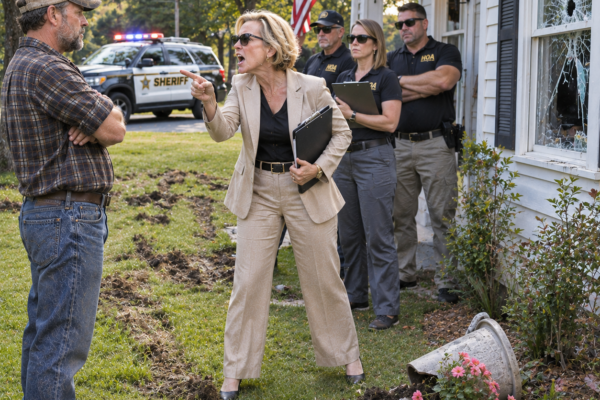
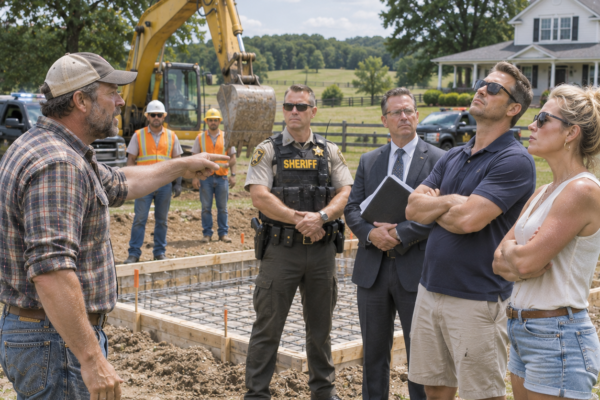
Deputy Marcus Hale arrived first.
County permit inspector Denise Porter arrived twelve minutes later.
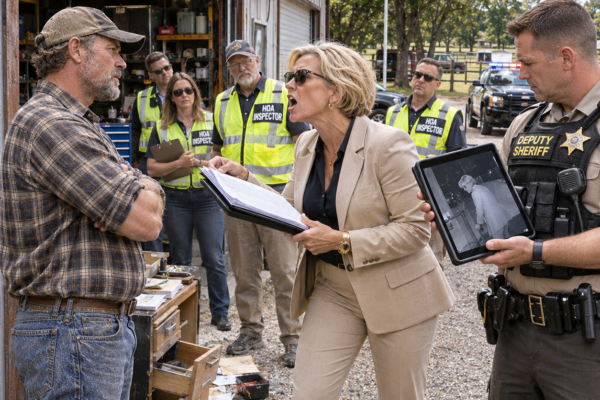
Denise took Linda’s permit packet and began reading.
Page one.
Page two.
Site plan.
Parcel number.
Then she stopped.
“Mr. Walker?”
“Yes?”
“Did you appoint Pinecrest Development as your authorized agent?”
“No.”
“Sell this parcel?”
“No.”
“Option it?”
“No.”
“Sign a development agreement?”
“No.”
Linda interrupted.
“The property was annexed into the revised planning boundary.”
Denise looked at her.
“Zoning or planning approval does not transfer title.”
Linda’s jaw tightened.
“The county signed the permit.”
“Yes. Which is why I’m asking how this page got into the file.”
She turned the application around.
At the bottom was an owner-authorization statement.
My printed name:
EVAN WALKER
Under it was a signature.
It wasn’t mine.
Not close.
Denise looked at me.
“You didn’t sign this?”
“No.”
Linda said quickly:
“That came from the developer.”
Denise closed the folder.
“Then the permit is suspended effective now.”
For the first time all morning, Linda stopped talking.
What none of us knew yet was that the false signature wasn’t the worst thing buried in that file.
Because somebody had created the permit months after Linda had already promised Pinecrest residents a new model home—and promised herself the right to buy it.
Part 2:
The first bulldozer crossed my fence at 7:18 on a Tuesday morning.
I know the time because I was standing on my porch with coffee when the ground started vibrating beneath my boots.
For fifty-eight years, my family’s east field had held nothing more permanent than fence posts, hay bales, and six old apple trees my grandfather planted before I was born.
That morning, two bulldozers, a skid steer, a dump truck, and a contractor’s pickup rolled through my gate like they owned the place.
The lead machine stopped halfway up the rise.
Then the operator dropped the blade.
I ran.
“Stop!”
The operator lifted it immediately.
A heavyset man in a fluorescent vest climbed from the pickup.
“Sir, you need to stay clear of the equipment.”
“You need to get the equipment off my farm.”
He looked down at his clipboard.
“This is Pinecrest Phase Three, Lot A-1.”
“No. This is Walker Farm.”
He checked again.
“Model-home site.”
“You’re standing about four hundred yards outside Pinecrest.”
His confidence faded.
Then a black Lexus SUV came through the gate.
Linda Caldwell stepped out.
President of the Pinecrest Estates Homeowners Association.
She wore a cream jacket, sunglasses, and the same expression she had worn three months earlier when she told me joining her HOA was “inevitable.”
“Evan,” she said, “I was hoping we could avoid another confrontation.”
I stared at her.
“You brought bulldozers onto my land.”
“The county approved the expansion.”
“No county approval transfers my property to you.”
She opened a leather folder.
Inside was a site plan stamped by the county planning office.
My east field was shaded yellow.
A 5,400-square-foot house sat directly over the old orchard rise.
Across the bottom:
PINECREST SIGNATURE MODEL RESIDENCE
I looked at Linda.
“This is the model home?”
“For the new phase.”
“And after the sales period?”
She hesitated.
“I have an option to purchase it.”
There it was.
She wasn’t just trying to expand Pinecrest onto my land.
She was trying to build herself a house on it.
My name is Evan Walker.
I was thirty-nine when this happened.
Walker Farm sits outside Knoxville, Tennessee, where suburban development has been eating into old farm country for years.
My grandparents bought the first forty acres in 1966.
Granddad worked maintenance at a paper mill.
Grandma ran the lunch counter at a pharmacy downtown.
They saved almost everything.
When twenty-eight neighboring acres became available in the late seventies, they bought those too.
Sixty-eight acres total.
Not an empire.
Enough.
Pasture.
Hay ground.
Creek bottom.
Woods.
A weathered barn.
And an orchard Granddad planted because Grandma liked apple butter.
Dad grew up there.
So did I.
I left after college.
Spent nine years working construction management in Nashville.
I was good at it.
Commercial projects.
Apartment buildings.
Medical offices.
Schedules, permits, subcontractors, inspections.
I thought I had escaped farm life permanently.
Then Dad had a stroke.
I came home for what I thought would be a few months.
He recovered enough to walk but never enough to run the place alone.
I stayed.
Five years later, cancer took him.
By then, leaving again felt impossible.
I built a one-bedroom cabin near Willow Creek.
Metal roof.
Wide porch.
Nothing fancy.
The farmhouse itself was old and needed more work than I wanted to take on.
The cabin gave me quiet.
Old Joe Barrett lived about a mile north.
Joe had known my grandparents.
Retired lineman.
Widower.
He showed up with apple pie whenever he decided I was working too much to feed myself.
Other than Joe, there wasn’t much around us.
Until Pinecrest Estates.
Phase One appeared on old cattle pasture east of my property.
Then Phase Two.
Big houses.
Stone entrance.
Clubhouse.
Pool.
Walking paths.
Matching streetlights.
I wasn’t thrilled about seeing rooftops where there had once been open fields.
But somebody else owned that land.
Their decision.
That was how property worked.
Pinecrest residents mostly left me alone.
Some bought eggs.
Several children liked watching calves through the fence.
One retired man hired me to mow a vacant lot.
No trouble.
Then Linda Caldwell became HOA president.
Linda was fifty-three.
Former real-estate broker.
She spoke in polished sentences that sounded prepared even when she was ordering lunch.
Her campaign promised “protecting Pinecrest’s long-term value through unified community planning.”
I didn’t care.
I wasn’t in Pinecrest.
Three weeks after her election, she came to my cabin.
Navy folder.
Printed documents.
Friendly smile.
“Evan Walker?”
“That’s me.”
“Linda Caldwell. Pinecrest HOA president.”
“I know.”
“I’d like to discuss integrating your property into the community.”
I looked behind her.
At sixty-eight acres of land that had existed before Pinecrest had a name.
“Integrating?”
She opened the folder.
Membership agreement.
Covenants.
Dues.
Architectural restrictions.
Livestock limits.
Vehicle rules.
Fence requirements.
Paint colors.
“We’ve begun long-range planning for Phase Three.”
“On whose property?”
“Several parcels are being evaluated.”
“Not mine.”
She smiled.
“That’s why I’m here.”
I flipped through the membership agreement.
“My barn wouldn’t comply with half of this.”
“Existing structures could be grandfathered.”
“Could?”
“The board would determine appropriate exemptions.”
“And cattle?”
“We would review agricultural use.”
“Why would I give you authority to review cattle I already own on land you don’t?”
Linda’s smile thinned.
“You’re looking at this too narrowly.”
“I’m looking at the signature line.”
“Pinecrest is expanding.”
“Good for Pinecrest.”
“Eventually your property will be surrounded on multiple sides.”
“Then I’ll have Pinecrest on multiple sides.”
“You may find remaining outside the association impractical.”
“That sounds like my problem.”
She leaned back.
“We can offer infrastructure improvements.”
“I don’t need them.”
“Road maintenance.”
“My road belongs to me.”
“Community security.”
“I have cameras.”
“Property-value protection.”
“I’m not selling.”
That ended most of her sales pitch.
She closed the folder.
“I’d suggest you think carefully before refusing.”
“I did.”
“You’ve had the packet ten minutes.”
“I knew who owned the land before you arrived.”
She stood.
“Property lines are not the only consideration when an area develops.”
“They’re a pretty important consideration.”
She left.
A week later, I received a letter from Pinecrest’s management company.
It referred to Walker Farm as an “adjacent nonconforming parcel.”
I laughed.
Threw it into a drawer.
Another came suggesting I voluntarily establish a landscaped buffer to protect neighborhood aesthetics.
Then Linda called.
“You haven’t responded.”
“I’m not a member.”
“Your property impacts Pinecrest.”
“My tractor probably impacts Pinecrest.”
“That is one of the concerns.”
I actually laughed.
“Linda, if you have a legitimate county complaint, make it.”
“I’d rather handle matters cooperatively.”
“Then stop sending HOA notices to someone outside your HOA.”
That should have ended it.
Instead, orange survey stakes appeared in my east field.
No call.
No notice.
No permission.
I pulled them.
Three days later, a survey crew arrived.
I stopped them at the fence.
The crew chief was polite.
He showed me his work order.
Pinecrest Development.
Conceptual Phase Three study.
“Did anyone tell you I approved access?”
He looked at the order.
“We were told access had been coordinated.”
“It hasn’t.”
He apologized.
Packed up.
Left.
I called Linda.
“Why are surveyors entering my property?”
“Preliminary planning.”
“You don’t have permission.”
“It’s just data collection.”
“Collect your data from your property.”
“You’re slowing a process that benefits the entire area.”
“I’m not part of your area.”
“Nathan—”
“Evan.”
She paused.
“Evan, you’re making routine planning unnecessarily difficult.”
“I’m comfortable with that.”
She hung up.
Two weeks later, Pinecrest Development sent me a purchase offer.
$275,000 for twelve acres along the eastern boundary.
I declined.
They returned at $350,000.
Declined.
Linda called again.
“That is a very strong offer.”
“I know.”
“You’d keep more than fifty acres.”
“Yes.”
“So what’s the obstacle?”
“I don’t want to sell.”
“That’s not really an economic answer.”
“It doesn’t need to be.”
The twelve-acre strip included the orchard rise, part of the creek, and one of our best hay fields.
More importantly, it separated my cabin from Pinecrest.
If I sold it, subdivision streets would end almost at my porch.
No amount of decorative landscaping changed that.
Linda became colder.
“Phase Three is going forward.”
“Then build it somewhere you own.”
“You might regret making this adversarial.”
I wrote down the date and time.
My father believed any conversation that started sounding like a threat deserved a pen.
Another month passed.
A laminated sign appeared on my east gate.
FUTURE PINECREST PHASE THREE ACCESS
I removed it.
Called county planning.
A clerk confirmed no final subdivision plat had been approved for any portion of my parcel.
I asked whether Pinecrest had applied.
She said preliminary materials existed but could not discuss details over the phone.
That should have made me investigate immediately.
I didn’t.
I was busy.
Hay cutting.
Fence repairs.
A water pump that decided July was the perfect month to fail.
Then, early Tuesday morning, the machines came.
The contractor’s foreman was Russell Dean.
Russell ran Dean Civil & Sitework.
He had probably fifty employees and enough equipment to reshape half the county.
His crew believed they were on a legal construction site.
That mattered.
They were not the enemy.
The permit packet looked convincing.
Real county permit number.
Real preliminary site approval.
Real parcel identification.
Real building plans.
My parcel.
Fake authorization.
When Linda ordered Russell to continue after I objected, he refused.
“If he claims ownership, I verify.”
“You have a permit.”
“I have insurance too.”
That was the smartest sentence anybody said that morning.
I called county planning and the sheriff.
Deputy Marcus Hale arrived first.
He asked everyone to stop arguing.
Nobody had started yelling except Linda.
County permit inspector Denise Porter arrived twelve minutes later.
Denise was about sixty.
Silver hair.
Reading glasses on a cord.
The exhausted confidence of someone who had spent three decades telling contractors whether concrete could be poured.
She ignored Linda’s speech.
Asked for documents.
Read.
Then turned to me.
“Mr. Walker, did you execute an owner-agent authorization?”
“No.”
“Sell Pinecrest Development any interest in this parcel?”
“No.”
“Option?”
“No.”
“License?”
“No.”
“Easement?”
“No.”
Linda stepped forward.
“The revised planning boundary was approved.”
Denise looked at her.
“Planning boundaries don’t transfer title.”
“The county issued this permit.”
“Yes.”
“That means the project was approved.”
“It means someone represented the applicant had legal authority to build.”
“They do.”
Denise looked at the owner authorization.
Then me.
“Did you sign this?”
“No.”
The signature wasn’t even close.
My signature is short.
E. Walker.
The document had an elaborate full-name scrawl.
Then I noticed something else.
My legal name is Evan.
The form said:
Nathan Evan Walker.
I have no idea where Nathan came from.
Denise frowned.
“Your legal name is Evan Walker?”
“Yes.”
“No middle name?”
“No.”
Linda said:
“That’s a clerical issue.”
Denise looked at her over the glasses.
“A clerical issue would be spelling Walker with one L.”
Then she called the planning office.
“Freeze permit 24-1187.”
Linda’s face changed.
“You cannot do that from a field.”
“I just did.”
Denise photographed the site.
The dozer had graded roughly ninety feet before I stopped it.
Topsoil scraped.
One young apple tree damaged.
No foundation.
No concrete.
That made us lucky.
Marcus took an incident report.
He didn’t arrest anyone.
He wasn’t there to decide who forged what.
He recorded names.
Copied the permit.
Photographed the gate.
Told the construction crew they could remove equipment.
Linda kept arguing.
“This project has been under review for months.”
Denise answered:
“Then the ownership verification should be easy.”
“Pinecrest has approval to annex.”
“An HOA cannot annex private title.”
“You know what I mean.”
“I’m no longer sure I do.”
By eleven, the equipment was gone.
Linda sat in her Lexus for several minutes before leaving.
I stood in the field.
Only then did I get angry.
Deep track marks crossed the grass.
The dozer blade had peeled topsoil from the rise where Granddad’s orchard used to be.
Six old apple trees remained.
One had exposed roots from the grading.
I called a lawyer.
Rebecca Ames had handled Dad’s estate.
Property law.
Land use.
Forty-eight years old.
Straightforward.
She came that afternoon.
Walked the site.
Read the documents.
Stopped at the owner authorization.
“You didn’t sign this?”
“No.”
“You ever use Nathan?”
“No.”
“Did Linda know that?”
“I don’t know.”
Rebecca photographed everything.
Then said:
“First thing tomorrow, title search.”
“Title is clean.”
“I know you believe that.”
“I have the deed.”
“I believe you too.”
“Then why—”
“Because court does not run on what both of us believe.”
Fair.
The title search was simple.
Walker Farm.
Sixty-eight acres.
My name.
No Pinecrest covenant.
No purchase option.
No development agreement.
No HOA membership.
No access easement benefiting Pinecrest.
No recorded instrument giving Linda or Pinecrest Development any right to build.
Rebecca sent preservation notices.
Pinecrest Development.
HOA.
Planning department.
Permit consultant.
Dean Civil.
Everyone.
Emails.
Texts.
Drafts.
Applications.
Signatures.
Meeting minutes.
No deletion.
Then she sought a temporary restraining order.
The judge granted limited relief quickly.
No construction.
No entry except removal of existing equipment.
No representation to contractors that Pinecrest owned or controlled Walker Farm.
No further permit activity using my name without documented authority.
Linda called it an overreaction.
Rebecca called it Tuesday.
County government opened an internal permit review.
That produced the first uncomfortable truth.
The permit had been handled by assistant planner Derek Mason.
Derek had known Linda for years through local real-estate work.
There was no evidence he forged my signature.
There was evidence he ignored safeguards.
The Pinecrest application arrived without valid owner authorization.
Instead of rejecting it, Derek marked ownership:
PENDING FINAL VERIFICATION.
Normally the permit should not have reached construction status until that box was cleared.
Emails showed Linda repeatedly pressed him.
We cannot lose another construction season because Walker refuses to engage.
Derek replied:
I can keep the planning review moving, but owner authorization must be complete before release.
Then another message from Linda:
Legal is handling Walker. Please don’t let one holdout derail Phase Three.
Two days before the permit was released, an owner-authorization PDF appeared in the system.
Derek changed the status to verified.
He never called me.
Never checked the signature against anything.
Never required Pinecrest to produce a purchase agreement.
Never compared the applicant’s claimed authority with the title record.
The county suspended Derek’s permit authority pending review.
Linda told everyone I got him fired.
He wasn’t fired.
Later, he was demoted and removed from development-signoff duties.
He admitted he let familiarity and pressure influence his judgment.
That was serious enough.
The question remained:
Who created the authorization?
Discovery answered it.
Pinecrest Development used an outside permit consultant named Tara Mills.
Tara sat for a deposition.
She testified that Linda sent her parcel information and told her owner authorization was “being finalized.”
Tara prepared a form.
She expected a signature back.
Instead, Linda later emailed an image file containing what she represented as my signature.
Tara inserted it.
Rebecca asked:
“Did you witness Mr. Walker sign?”
“No.”
“Speak with him?”
“No.”
“Receive an email from him?”
“No.”
“Know his legal name?”
“No.”
“Who gave you the name Nathan Evan Walker?”
Tara looked through records.
“Mrs. Caldwell.”
There was no Nathan.
Rebecca asked Linda later where the name came from.
She said an “old county database.”
The county had no such record.
Then came the emails.
Linda to Tara:
Use the Walker parcel information. We cannot keep waiting for Evan to come around.
Another:
Planning mainly needs the file complete so we can release the contractor. We can clean up transfer documents before model-home closing.
That was bad.
Then:
Once site work is visible, Walker will understand the practical reality. Nobody makes a developer unwind that kind of investment.
Rebecca read that one twice.
“She planned leverage.”
“What does that mean?”
“Build enough that saying no becomes expensive.”
It was exactly what I had suspected.
Get bulldozers moving.
Foundation in.
Framing up.
Utilities trenched.
Then return with a higher offer and say:
Look how far this has gone.
Be reasonable.
Sell.
Linda wasn’t trying to prove she already owned my land.
She was trying to make ownership inconvenient.
The HOA’s involvement made it worse.
Pinecrest board records showed Linda had pitched the model home months earlier.
She called it the centerpiece of Phase Three.
Residents were promised increased property values.
The HOA committed money toward entry landscaping, signage, trail connections, and shared amenities.
Approximately $86,000 in preliminary commitments.
Then we found a separate agreement.
After an eighteen-month model period, Linda held an option to purchase the house at a discounted price intended to compensate her for “development coordination services.”
Several directors later said they had never seen that term.
They approved a model home.
They did not knowingly approve a discounted residence for the president.
Treasurer Melissa Ward became the first board member to openly challenge Linda.
At an emergency meeting, she asked:
“Did Evan Walker ever sign a contract to sell?”
Linda answered:
“He engaged in negotiations.”
“Did he sign?”
“He received two offers.”
“That wasn’t my question.”
“No.”
“Then why did we commit eighty-six thousand dollars?”
“Because Phase Three had planning approval.”
“On land we didn’t own?”
“The acquisition was expected.”
Melissa stared at her.
“By who?”
That clip spread through Pinecrest.
Residents started requesting records.
Linda responded by blaming me.
She claimed I had encouraged the project and changed my mind after the county approval increased my land value.
That was false.
Rebecca had copies of both offers.
My responses were one sentence each.
Thank you. I am not interested in selling.
Hard to reinterpret.
Pinecrest Development filed suit anyway.
They alleged detrimental reliance and implied agreement.
The complaint said I had “participated in preliminary discussions and allowed planning activity to proceed.”
Their strongest example was a meeting where I asked how many acres they wanted.
Of course I asked.
Someone offered to buy land.
Understanding the offer isn’t agreeing to it.
They also claimed I had allowed survey access.
The survey crew chief gave a declaration stating the opposite.
I stopped them.
He left.
Their case began collapsing before discovery finished.
Rebecca counterclaimed.
Trespass.
Property damage.
Declaratory judgment confirming ownership.
Injunction.
Costs.
Certain fees if permitted by the applicable claims.
No fantasy demand for ten million dollars.
No attempt to own Linda’s house.
I wanted my field fixed and their hands off my deed.
Old Joe became useful in a way none of us expected.
One evening, he drove over with an apple pie and an old cardboard box.
“I think your dad would want you to have these.”
Inside were survey copies from 1994.
Photographs.
Fence notes.
One picture showed Granddad, Dad, and Joe rebuilding the east fence after an ice storm.
The same fence Pinecrest had opened.
On the back:
East line reset from original pins — March 1994.
Modern surveys already proved the boundary.
The photographs weren’t necessary.
But they showed decades of consistent possession.
No Pinecrest use.
No shared road.
No disputed boundary.
Linda’s attorney tried a new argument.
Maybe my parcel wasn’t owned by Pinecrest, but perhaps county planning designation gave the developer certain rights to proceed while acquisition was pending.
The judge rejected that immediately.
Planning approval regulates land use.
It does not convey land.
A zoning map cannot sign a deed.
A permit cannot replace owner consent.
The permanent hearing took place four months after the bulldozers arrived.
Linda sat behind Pinecrest Development’s lawyers.
Melissa Ward sat on the opposite side of the gallery with several homeowners.
Rebecca’s presentation was almost boring.
That was a good thing.
Deed.
Survey.
Title report.
Two purchase offers.
Two written refusals.
Trespass photographs.
Permit.
False authorization.
Consultant testimony.
Emails.
No smoke.
No surprise witness.
Just chronology.
Pinecrest’s attorney argued the project had generated legitimate development expectations.
The judge asked:
“What legal interest did your client hold in Mr. Walker’s parcel when construction began?”
The lawyer spoke about preliminary acquisition.
The judge repeated:
“What legal interest?”
Silence.
“Deed?”
“No.”
“Purchase contract?”
“No.”
“Option?”
“No.”
“Recorded easement?”
“No.”
“License?”
“No.”
“Valid owner authorization?”
“The authorization is disputed.”
Rebecca stood.
“My client denies signing it. The consultant who inserted it never witnessed execution. No original has been produced. The name on the document is not my client’s legal name.”
The judge looked at Pinecrest’s attorney.
“Do you have evidence Mr. Walker signed it?”
“No original, Your Honor.”
That was enough.
The court declared Pinecrest had no ownership interest, easement, license, or other development right over Walker Farm.
Pinecrest Development and the HOA were permanently barred from entering or representing control over my property without an actual agreement from me.
The county permit remained revoked.
The damaged area had to be restored.
Fence repaired.
Compacted soil remediated.
Topsoil replaced.
Drainage corrected.
The wounded apple tree evaluated by an arborist.
Pinecrest Development paid most direct restoration costs.
The HOA’s role in some expenses was resolved separately through settlement and insurance.
My documented losses and a significant portion of legal costs were covered.
No jackpot.
I didn’t need one.
The most valuable sentence in the judgment was simple:
Walker Farm is not part of Pinecrest Estates and is not subject to its covenants.
I read that sentence several times.
The HOA could have learned it for free.
Linda’s position inside Pinecrest collapsed quickly afterward.
Residents discovered the discounted-purchase option for the model home.
Then the unapproved financial commitments.
Then the emails about forcing “practical reality” onto me through construction.
Melissa called a special meeting.
Linda arrived prepared.
Slides.
Talking points.
Projected property values.
She said Phase Three would have increased everyone’s equity.
She said I had used “technical ownership objections” to destroy a community opportunity.
That phrase caused one of the loudest reactions of the night.
Melissa held up a certified copy of my deed.
“Technical ownership objection?”
Linda stared.
Melissa continued.
“This is the ownership.”
Residents asked whether Linda intended to buy the model home.
She said the arrangement had been disclosed.
Three board members said they had never seen the purchase option.
The secretary produced the original meeting packet.
No option attached.
Linda blamed Pinecrest Development.
The developer blamed Linda.
That partnership ended fast.
The board voted to remove Linda as president pending a recall vote.
Two weeks later, membership recalled her from the board completely.
Melissa became interim president.
Her first motion froze every HOA initiative involving land outside the association until independent counsel completed title review.
There were three.
None involved valid HOA rights.
One was merely a landscaping proposal.
Another involved drainage access the HOA assumed it possessed.
The third was a proposed walking path that crossed private woodland.
All stopped.
Turns out Walker Farm wasn’t the only place Linda believed convenience created authority.
The county completed its own investigation.
Derek Mason received formal discipline.
No bribery charge.
No dramatic handcuffs.
Nothing suggested he had taken money.
His failure was less cinematic and more believable.
He allowed pressure, familiarity, and deadline anxiety to override a process designed to verify ownership.
The county changed its procedures.
Private-property development applications now required direct title verification before construction release.
Owner authorization had to match recorded ownership exactly.
For specified project types, signatures required notarization or secure electronic verification.
A permit could no longer sit in a vague “pending ownership” state while every other approval marched forward.
Denise Porter told me later:
“We wrote the rule because of you.”
“Because of Linda.”
“Because of the gap she found.”
That was more accurate.
Systems usually get improved after someone shows how badly a shortcut can be abused.
Restoring the field took almost two months.
The contractor removed crushed stone.
Loosened compacted soil.
Rebuilt the grade.
Replaced topsoil.
Repaired the fence.
The damaged apple tree worried me most.
It was one of the last six from Granddad’s original orchard.
The arborist trimmed damaged roots and reduced the canopy.
For one season it survived.
Then half the crown died.
The next spring, it failed completely.
The settlement paid replacement value.
I hated that phrase.
A five-year-old nursery tree is not a forty-year-old apple tree.
Money measures wood and landscaping costs.
Not memory.
Old Joe helped me plant two replacements.
One for Granddad.
One for Dad.
He dug for about four minutes before sitting on my tailgate.
“My back says you’re younger.”
“Convenient.”
“I brought pie.”
“Then you can stay.”
He watched me finish digging.
“Think Pinecrest will come back?”
“No.”
“How do you know?”
“New president.”
“That stop greed?”
“No.”
“Court order?”
“Helps.”
He nodded.
Then pointed toward the new fence.
“Your granddad would’ve put electric wire on it.”
“Granddad also threatened a salesman with a pitchfork once.”
“Good man.”
“Complicated man.”
Joe laughed.
Life became quiet again.
That was what I wanted.
Not Linda humiliated.
Not Pinecrest bankrupt.
Quiet.
The new board sent me a formal letter.
Walker Farm was outside Pinecrest.
No HOA authority.
No dues.
No design control.
No claimed access.
No development rights.
Any future proposal involving my property required direct written agreement from me.
I filed it with the deed.
Melissa came to my gate several months later.
She stopped outside.
Called my phone.
“Evan?”
“Yes?”
“This is Melissa Ward.”
“I know.”
“I’m at the east gate. May I come in?”
That question told me more than any apology.
“Yes.”
She drove through.
We sat on my porch.
She had plans for a walking trail.
My first instinct was irritation.
Then she spread them out.
The trail stayed three feet inside Pinecrest property.
Drainage directed away from my field.
Temporary construction access entirely from their roads.
No request for my land.
“We wanted to make sure you were comfortable with the boundary treatment.”
“I am.”
“That’s it?”
“That’s it.”
“No committee?”
“I don’t have one.”
She laughed.
Then became serious.
“I’m sorry.”
“You didn’t send bulldozers.”
“I was on the board.”
“Did you know?”
“Not enough.”
That answer was better than pretending innocence.
“We let Linda summarize everything. Nobody asked for underlying documents.”
“Why?”
“She got results.”
That was probably the most important lesson Pinecrest learned.
Linda wasn’t powerful because she forced everyone.
She was powerful because people liked the outcomes she promised.
Fast approvals.
Amenities.
Higher values.
Expansion.
She made bureaucracy disappear.
Nobody asked which safeguards disappeared with it.
Until the bulldozers rolled into my field.
Pinecrest Phase Three eventually happened.
Just not on Walker Farm.
The developer redesigned it.
Bought other property from willing sellers.
Reduced the number of homes.
Moved the model residence onto land it actually owned.
Amazing concept.
Linda did not get the house.
Another family eventually bought it.
I heard she sold her Pinecrest home and moved south.
No idea where.
I never checked.
For a while, neighbors expected me to hate every Pinecrest resident.
I didn’t.
Most had nothing to do with what happened.
Some believed Linda too long.
Some ignored red flags because they liked lower dues and nicer amenities.
That’s human.
A few apologized.
One older man named George Taylor stopped at the farm.
He brought a bottle of bourbon.
“I voted for Linda.”
“Lots of people did.”
“I defended her at the first meeting.”
“I heard.”
“She told us you’d agreed to sell.”
“I hadn’t.”
“I know now.”
He held out the bourbon.
“I’m sorry.”
I accepted it.
We sat on the porch.
He looked toward the orchard.
“I don’t understand why she kept pushing after you said no.”
“I do.”
“Why?”
“Because no made everything harder.”
George frowned.
“That simple?”
“Usually.”
Pinecrest had already planned around my yes.
Budgeted around it.
Designed around it.
Promised around it.
When I said no, admitting the project needed redesign meant admitting Linda had moved too fast.
So instead of changing the plan, she tried to change reality.
That is how small abuses become large ones.
The first survey stakes seemed harmless.
Then planning maps.
Then a permit.
Then construction equipment.
Every step made the next one feel slightly less outrageous.
By the time bulldozers crossed the gate, Linda probably saw them as the logical end of a process she had mentally completed months earlier.
My consent became the missing administrative detail.
The problem was that consent is not an administrative detail.
It is the difference between an agreement and trespass.
Old Joe died two years later.
Eighty-two.
Heart failure.
His daughter gave me a box after the funeral.
Inside was another photograph.
Granddad.
Dad at seventeen.
Joe in his twenties.
All standing beside the east boundary after repairing the fence in 1994.
On the back, Joe had written:
Walker east line reset from original pins. Good for another fifty years.
I framed it.
It hangs inside the cabin.
Not the judgment.
Not Linda’s fake authorization.
Not the county inspector’s suspension order.
That photograph.
Because it reminds me what the dispute was actually about.
People like to reduce property stories to money.
Sixty-eight acres.
Purchase offers.
Development value.
Legal fees.
But land carries time.
Granddad bought it.
Dad maintained it.
I inherited responsibility.
That responsibility included saying no when no made sense.
Years later, Russell Dean came back to Walker Farm.
This time because I hired him.
The old barn roof had finally failed.
I needed site work for a replacement equipment building.
He parked outside the gate and called.
“Do I have permission to enter?”
I laughed.
“You definitely learned.”
“I’m never appearing in another Walker lawsuit.”
He came in.
We walked the new site.
Entirely within my property.
Proper permits.
My signature.
Notarized.
Russell held up the owner authorization.
“I watched you sign this one.”
“Want blood too?”
“Don’t tempt me.”
The new building went up without incident.
Denise Porter performed the final inspection.
She was nearing retirement.
Standing inside the barn, she looked at me.
“You know what I remember about that morning?”
“What?”
“You looking at the bulldozer.”
“What about it?”
“You wanted to climb in.”
I laughed.
“Maybe.”
“Glad you didn’t.”
“So am I.”
That mattered.
The source story people sometimes expect from a property dispute is simple.
Trespasser builds.
Owner jumps into bulldozer.
Owner destroys everything.
Police congratulate him.
Real life is messier.
If I had taken control of somebody else’s equipment, I could have hurt someone.
Damaged rented machinery.
Destroyed material before legal ownership was sorted out.
Created a new case inside the clean case I already had.
Rebecca’s best advice was:
“Do not give Linda a second story.”
“What does that mean?”
“She already has to explain why her people entered your land. Don’t make us explain why you destroyed theirs.”
So I didn’t.
I documented.
Called officials.
Got the permit frozen.
Got the order.
Let boring process do what anger wanted to do faster.
Boring worked.
That lesson stayed with me.
When somebody looks obviously wrong, the temptation is to act as though procedure is optional because justice is obvious.
But procedures protect the right person too.
The same county system that Linda manipulated also produced the title records that stopped her.
The same court system she tried to use later issued an order protecting my land.
The answer to abused process wasn’t abandoning process.
It was forcing it to work correctly.
The new apple trees are taller now.
One finally produced fruit last fall.
Small apples.
Tart.
Joe would have complained.
Dad would have eaten one anyway.
I made a jar of apple butter using Grandma’s old recipe.
It was terrible.
Cooking was never my inheritance.
The land was.
Pinecrest’s walking trail now runs along the far side of the fence.
Residents pass with dogs.
Children ride bicycles.
Sometimes someone waves.
I wave back.
Nobody crosses.
The fence stopped being evidence.
It went back to being a fence.
That is what peace looks like after a property dispute.
The thing becomes ordinary again.
One morning last spring, I found a Pinecrest child standing at the boundary staring at a calf.
His mother was several yards behind him.
“Can I pet it?”
“No.”
He looked disappointed.
“Why?”
“Because her mama doesn’t know you.”
His mother apologized.
“No problem.”
Then the boy asked:
“Is this your farm?”
“Yes.”
“How much of it?”
I pointed.
“From this fence to the trees, then down to the creek.”
“That’s a lot.”
“It feels smaller when something breaks.”
He nodded as though he understood.
Maybe he did.
Then they continued down the trail.
I thought about Linda’s first visit.
She saw the same land and treated it as a blank spot in a master plan.
Underused.
Unintegrated.
Nonconforming.
Those words sound neutral.
They aren’t.
They describe land from the perspective of someone who wants it to become something else.
To me, the farm was already doing what it needed to do.
Hay field.
Pasture.
Creek buffer.
Orchard.
Privacy.
Memory.
No model home required.
I still have the fake authorization.
Rebecca told me never to destroy it.
It sits in a fireproof file beside the real deed.
Sometimes I pull it out.
The signature is almost funny now.
Long dramatic loops.
Nothing like mine.
The invented name:
Nathan Evan Walker.
A man who never existed granting permission I never gave.
That single page nearly moved enough machinery onto my farm to begin a multimillion-dollar development.
Paper is powerful.
That’s exactly why it needs verification.
Linda thought a county stamp made the underlying lie true.
It didn’t.
It just made the lie more dangerous until someone looked underneath.
Denise did.
Rebecca did.
The judge did.
Eventually Pinecrest residents did too.
That was enough.
The final settlement closed almost a year after the bulldozers arrived.
Restoration complete.
Damages paid.
Fees resolved.
Pinecrest’s claims dismissed.
My title confirmed.
I drove to the east field that evening.
Parked where the model-home driveway was supposed to begin.
No pavement.
No foundation.
No sales office.
Just grass.
The scar from the dozer had mostly disappeared.
The two young apple trees stood where the old one had died.
Behind me, Pinecrest rooftops rose beyond the fence.
Nice neighborhood.
Not mine.
That distinction had cost everybody more than it should have.
But it was finally understood.
Linda once told me development would make remaining outside Pinecrest impossible.
She was wrong.
I remain outside Pinecrest every morning.
I don’t pay their dues.
They don’t approve my barn.
My tractor still runs when I need it.
My fence is whatever reasonable farm fence I choose.
The rooster Joe’s daughter inherited still crows somewhere up the road.
And nobody from an architectural committee sends me a letter about any of it.
The farm did not become more valuable to me because I beat Linda.
It became quieter because the question was settled.
No one gets to decide that your refusal is invalid because their project is more expensive than your preference.
No one gets to replace consent with momentum.
No one gets to turn “we already spent the money” into “you have to say yes.”
And no HOA president gets to redraw a deed by shading somebody else’s field yellow on a planning map.
The last time I saw Linda was outside the courthouse after the declaratory judgment.
She stood near the steps with her attorney.
I walked past.
She said:
“Evan.”
I stopped.
She looked tired.
Not defeated in some dramatic movie-villain way.
Just tired.
“All of this could have been avoided.”
I almost laughed.
Instead I said:
“Yes.”
She seemed surprised.
Then:
“You could have sold.”
“And you could have accepted no.”
Neither of us said anything after that.
I walked to my truck.
That was the closest thing we ever had to an honest conversation.
She was right.
The entire fight was avoidable.
One word would have avoided it.
No.
Not mine.
Hers.
She only had to accept it.
Years later, people still ask why I didn’t take the money.
Three hundred fifty thousand dollars was real money.
Maybe the developer would eventually have paid more.
Could have invested it.
Bought more acreage elsewhere.
Built a nicer house.
Retired earlier.
All true.
But ownership is not valuable only because someone else will pay for it.
Sometimes its value is the decision itself.
I wanted that field.
I wanted the buffer.
I wanted the creek.
I wanted the orchard rise.
I wanted to stand on my porch and see open land instead of a model home.
Maybe that is economically irrational.
It is still a decision I was entitled to make.
That is what Linda never understood.
She thought the development plan was the important thing and my ownership was the obstacle.
From my side of the fence, ownership was the important thing and her development was simply a proposal.
A proposal can be rejected.
A deed cannot be wished away.
This morning, I drank coffee on the same porch where Linda first handed me the HOA packet.
The east field was covered in light fog.
One of the young apple trees had started turning red.
A tractor needed hydraulic fluid.
Fence wire needed tightening near the creek.
Ordinary problems.
Good problems.
No bulldozers.
No fake permits.
No Linda.
Just Walker Farm.
Exactly where it has been since 1966.
And still mine because when somebody tried to make my answer irrelevant, I made sure the paperwork remembered that I had already said no.