“You Don’t Get to Ignore Our HOA Fines!” the President’s Two “Security Officers” Shouted as Their Pickup Blocked Me in Broad Daylight. One Pulled a Real Pistol and Pointed It at My Chest While Children Watched From Nearby Lawns. They Thought a Gun Would Make Me Obey. They Had No Idea I’d Spent Ten Years as a Navy SEAL..k
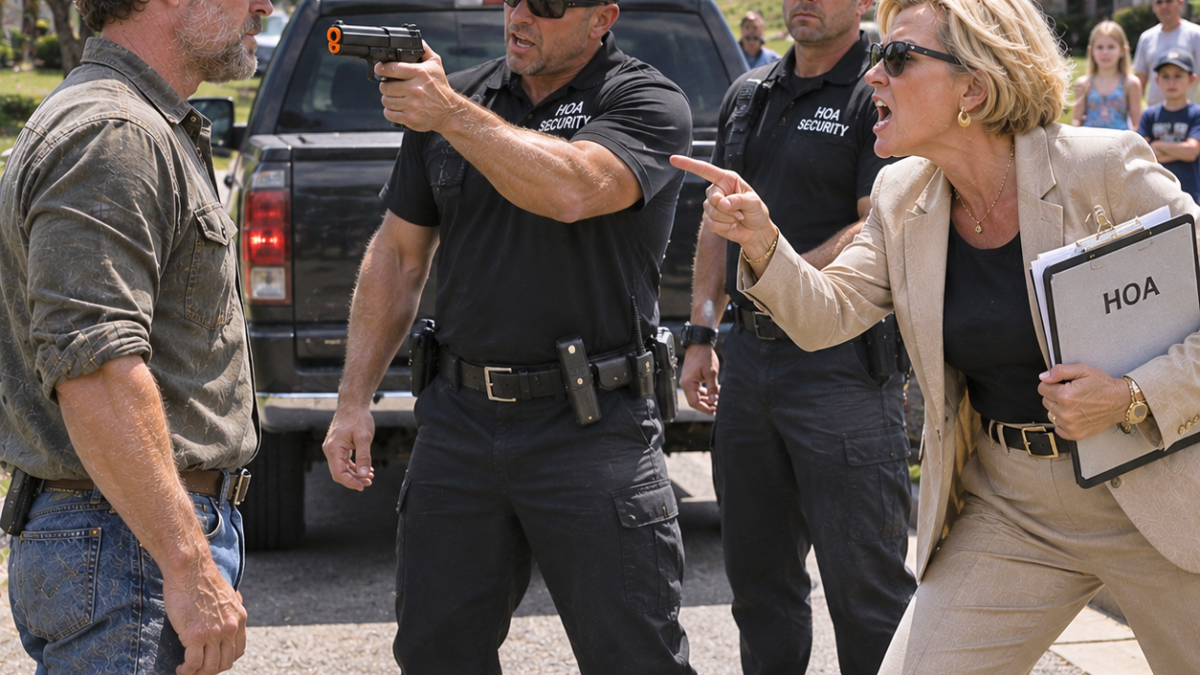
“You Don’t Get to Ignore Our HOA Fines!” the President’s Two “Security Officers” Shouted as Their Pickup Blocked Me in Broad Daylight. One Pulled a Real Pistol and Pointed It at My Chest While Children Watched From Nearby Lawns. They Thought a Gun Would Make Me Obey. They Had No Idea I’d Spent Ten Years as a Navy SEAL.
Part 1:
At 1:06 on a Saturday afternoon, a man wearing an HOA security vest pointed a loaded handgun at my chest in the middle of Oakridge Meadows.
There were children playing two houses away.
A woman was watering her roses.
And a white pickup truck sat across the sidewalk, blocking my way home.
“Don’t move!” the gunman shouted.
I stopped.
Not because his cheap badge impressed me.
Because the trembling pistol in his hand was real.
My name is Ryan Hale. I’m forty-two years old, and I’d spent ten years in the Navy’s special operations community before returning to civilian life in southeastern Virginia.
I’d been through enough dangerous situations to know that a frightened man holding a firearm could make a terrible decision in less than a second.
So I kept my hands visible.
And I watched him.
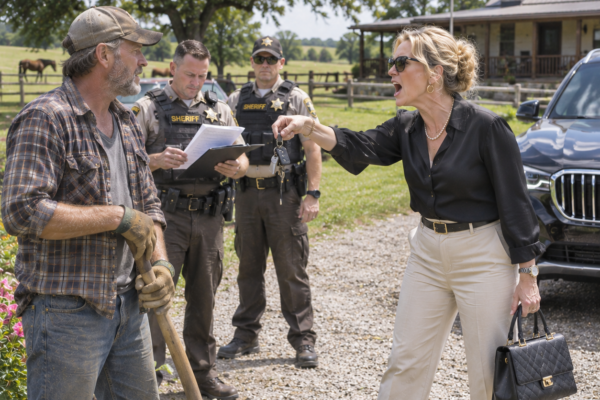
The larger man standing beside him wore a black tactical vest with OAKRIDGE MEADOWS SECURITY across the chest.
His name was Mason Rourke.
I’d met him three weeks earlier when he and another HOA patrolman arrived on my porch demanding to search my garage.
Now he was grinning like he’d finally found a way to put me in my place.
“Here’s how this works, Hale,” Mason said. “You stop ignoring your fines, or we take you in.”
“Take me where?”
“To the association office.”
“You’re not police officers.”
“We have community enforcement authority.”
I glanced toward the pistol.
“Then tell your partner to lower that weapon.”
Mason laughed.
“You don’t give orders around here.”
The gunman shifted his feet.
His name was Derek Pike. He looked younger than Mason, with a pale face and sweat running down his temples.
His hand was shaking.
That worried me more than Mason’s threats.
Three months earlier, I’d bought a modest three-bedroom house in Oakridge Meadows, a quiet subdivision near Williamsburg.
I wanted a normal life.
Morning coffee.
A little yard work.
Weekend visits with old friends.
The occasional backyard barbecue.
After a decade of service and years of deployments, quiet sounded wonderful.
But Oakridge Meadows had one problem.
Its HOA president, Tina Marsh.
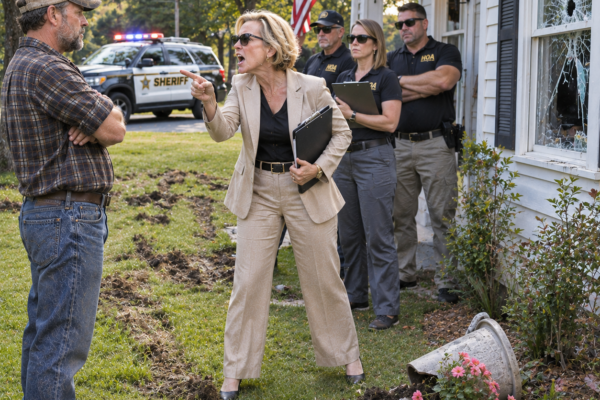
Tina was sixty-one, with perfectly styled blonde hair, a spotless white SUV, and an extraordinary talent for treating other people’s homes like extensions of her office.
She seemed to know every homeowner’s business.
Which trash cans came in late.
Whose grass needed mowing.
Who parked a truck outside overnight.
And which residents weren’t sufficiently respectful when she issued commands.
During my first week, she approached me while I was unloading boxes.
“Mr. Hale, we have very strict standards here.”
I smiled.
“That’s fine. I read the governing documents before buying.”
She didn’t appreciate that answer.
“Then you’ll understand that the board expects complete cooperation.”
“I’ll follow the rules that apply to my property.”
Her smile tightened.
“That’s not quite the same as cooperating.”
I should have recognized the warning.
Within ten days, the violation notices began.
One claimed I’d stored unauthorized tools in my garage.
Another cited a ladder visible beside my backyard shed for less than an afternoon.
A third alleged improper equipment parking because a friend’s pickup had been in my driveway while we repaired a fence.
Every time, I asked for the specific rule and an opportunity to correct any genuine violation.
Tina refused to discuss the facts.
Instead, she sent larger fines.
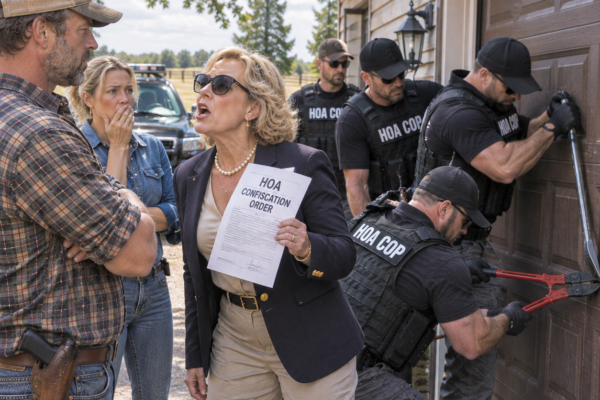
Then she created what she called the HOA Security Division.
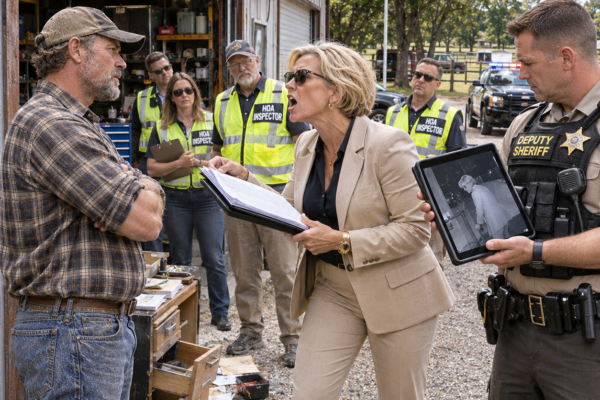
Mason and Derek began patrolling in tactical vests, carrying radios and badges that looked suspiciously similar to those used by actual law enforcement.
They drove through the neighborhood in a white pickup with flashing amber lights.
They stopped homeowners.
Photographed properties.
And demanded identification from people who questioned them.
Three weeks before the confrontation, they came to my house.
Mason announced that Tina had ordered an interior inspection.
I asked for the notice and governing authority.
He produced neither.
When he tried to step past me, I told him to leave.
He grinned.
“We’ve got authority here.”
“Not to enter my house without permission.”
I closed the door.
The next morning, Tina issued a $750 obstruction penalty.
I disputed it in writing.
Then I requested a hearing.
Instead of scheduling one, she sent another warning.
FAILURE TO COMPLY MAY RESULT IN PHYSICAL ENFORCEMENT.
I showed the letter to a neighbor who’d lived in Oakridge Meadows for twenty years.
He shook his head.
“Ryan, she’s been intimidating people for years. But I’ve never seen her put that in writing.”
I saved every message.
I never imagined she’d send armed men after me.
Now I stood in the street, twenty yards from my own driveway, facing a pistol that Derek seemed barely able to control.
Mason stepped closer.
“You’re going to apologize to Mrs. Marsh. Then you’re going to pay every dollar you owe.”
“No.”
His grin disappeared.
Derek raised the pistol slightly.
“Don’t make us do this the hard way!”
A neighbor shouted from her porch.
“Put that gun down! There are kids out here!”
Mason ignored her.
He reached toward my shoulder.
I moved back just enough to avoid being grabbed.
“Don’t touch me.”
He stopped smiling.
Then he looked toward Derek.
“You hear that? He’s resisting.”
I could see the gunman’s finger tighten against the frame of the weapon.
“Ryan,” Derek said shakily, “just get on your knees.”
I kept my hands open.
“Derek, nobody has to get hurt. Lower the gun.”
He swallowed.
Mason shouted, “Do it! Tina said we bring him in today!”
Then Derek’s arm jerked.
And the sound that followed shattered the quiet of Oakridge Meadows.
Part 2:
The first shot sounded like somebody had slammed a steel door beside my head.
A chunk of concrete jumped from the curb behind me.
I didn’t immediately understand that Derek Pike had fired his pistol.
I only knew that a moment earlier, I’d been standing in the street with my hands visible, asking him to lower his weapon.
Now a bullet had struck the pavement close enough to shower my legs with grit.
I’d spent ten years serving on Navy SEAL teams.
I’d trained for emergencies most people only see in movies.
But nothing about that training made a gun pointed at me by a frightened stranger feel ordinary.
Especially not in the middle of a quiet Virginia neighborhood, with children playing nearby.
Derek’s pistol came back toward me.
There wasn’t time for another warning.
I drew the legally carried handgun beneath my shirt and fired in response to what I believed was an immediate threat to my life.
Two shots.
Derek staggered and fell beside the pickup.
His pistol struck the asphalt and slid away.
For a fraction of a second, nobody moved.
Then Mason Rourke lunged at me.
He grabbed for my arm, and we collided hard enough to send us both stumbling toward the curb.
I got free.
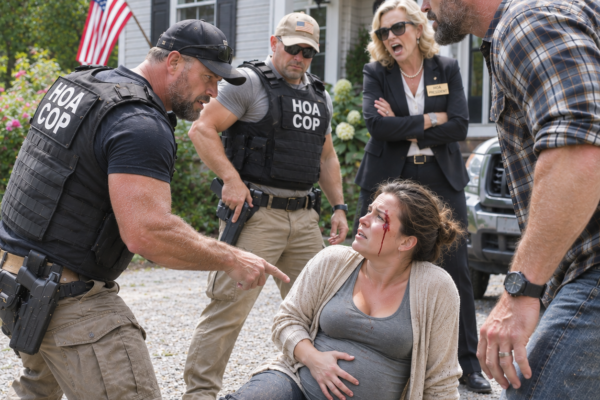
Mason fell heavily, struck the pavement, and curled onto his side.
I moved away as soon as he stopped attacking.
The entire confrontation had taken seconds.
But when I looked around, the street appeared completely different.
Derek was bleeding.
Mason was gasping for breath.
A woman was screaming from a front porch.
And a little boy had dropped his bicycle in the grass.
I felt sick.
I hadn’t moved into Oakridge Meadows to hurt anybody.
I’d bought a house there because I wanted to be finished with violence.
Now two men were lying injured in front of me because an HOA president had apparently decided that her unpaid fines required armed enforcement.
I called 911.
“My name is Ryan Hale. I’m on Birchwood Court in Oakridge Meadows. Two men confronted me. One fired a gun at me. I’ve fired in self-defense. We need police and ambulances.”
The dispatcher asked whether the threat was over.
“As far as I can tell. The other man’s gun is on the pavement. Mine is secured.”
She told me to remain at the scene, keep my hands visible when officers arrived, and follow their instructions.
I did.
I didn’t approach the dropped pistol.
I didn’t try to question Mason.
I didn’t make speeches about my military service.
I watched Derek breathing and hoped both men would live long enough to explain why they’d done this.
A woman stepped off the nearest porch.
“Ryan, are you hit?”
It was Rosa Delgado, a retired nurse who lived three houses down.
“I’m all right.”
She looked toward Derek.
“Oh, dear God.”
“Rosa, please stay back. The ambulances are coming.”
She nodded, then stopped beside her front steps.
“I called 911, too. I saw him aim at you.”
I looked at her.
“Thank you.”
She glanced toward the corner of her porch.
“My camera saw it as well.”
That mattered.
But at that moment, I was more concerned about the gunshot and the people who might have been standing behind me.
Three patrol vehicles arrived within minutes.
The first deputy stepped out with his weapon drawn.
“Hands up!”
I raised both hands.
“Ryan Hale. I’m the person who called. My handgun is secured. The other firearm is on the roadway near the injured man.”
“Don’t move.”
I didn’t.
Another deputy approached from the passenger side of the cruiser.
They secured my weapon, checked for additional threats, and temporarily restrained me while they established what had happened.
I understood.
They were arriving at the aftermath of a shooting involving multiple people.
They didn’t know who I was.
And the fact that I’d served in the military didn’t entitle me to different treatment.
Paramedics rushed toward Derek and Mason once the scene was secure.
Derek was conscious but badly hurt.
Mason was struggling to breathe comfortably.
I stood beside a patrol car while a deputy checked whether I needed medical care.
My hands were shaking.
That surprised me.
Not because I thought military training eliminated fear.
Because I’d been concentrating so intensely on the immediate danger that I hadn’t noticed what my body was doing afterward.
Sheriff Calvin Daniels arrived shortly after the ambulances.
He was fifty-eight, with gray hair, a weathered face, and a measured way of speaking that suggested he disliked making decisions before hearing the evidence.
He looked at the white pickup.
Then at the pistol being documented near the curb.
Then at me.
“Mr. Hale?”
“Yes, Sheriff.”
“Tell me what happened.”
I gave him the sequence as clearly as I could.
The pickup blocked my path.
Mason demanded payment of HOA fines.
Derek drew a pistol and pointed it at me.
I repeatedly asked him to lower it.
He fired.
I returned fire.
Mason attacked me.
We struggled, and he fell.
Daniels listened without interrupting.
Then he asked about the handgun I’d been carrying.
I provided the relevant identification and permit information.
He told me the investigators would verify the details.
He didn’t pronounce the shooting justified.
He didn’t congratulate me.
He didn’t ask how many combat missions I’d completed.
He said something much more useful.
“We’ll collect the recordings, speak with the witnesses, and examine the physical evidence. I want the whole sequence established.”
I nodded.
“That’s what I want, too.”
A deputy led me to a quiet location away from the gathering crowd.
For the first time since the shooting, I looked toward my house.
It was twenty yards away.
A simple brick home with white trim, a small front lawn, and a garage I’d spent the previous weekend organizing.
The front porch light was still on from the night before.
I’d forgotten to turn it off that morning.
Such a small, ordinary thing.
Yet it was all I could think about.
I’d moved there because I wanted a peaceful life.
And now the street outside my house was surrounded by sheriff’s vehicles.
I closed my eyes.
The trouble had started just three months earlier.
Back when Tina Marsh had introduced herself with a clipboard and a smile.
And I’d made the mistake of believing an HOA dispute would never become anything more serious than an argument over grass.
Oakridge Meadows was the sort of subdivision real-estate agents described as established and family-friendly.
About 160 homes.
Mature oak trees.
Curving streets.
A community playground.
And a pond near the entrance where ducks gathered every morning.
Most residents were ordinary working people.
Teachers.
Nurses.
Military families.
Retirees.
People who wanted to live somewhere clean and quiet without worrying about what happened beyond their front doors.
That described me perfectly.
I’d left active-duty Navy service four years earlier and spent the intervening time working in maritime safety and technical consulting.
The work was steady.
The hours were predictable.
And I no longer had to leave home for months at a time.
I’d served ten years in Navy special operations, including time assigned to SEAL teams.
Those years had shaped me.
They’d taught me discipline, patience, and the importance of recognizing danger before it became unmanageable.
But they’d also taught me that conflict always had a cost.
I didn’t tell strangers about my service unless there was a reason.
I didn’t display military equipment in my front window.
I wasn’t interested in proving how tough I was.
I wanted to cut my grass, have friends over for dinner, and live an ordinary life.
The house on Birchwood Court seemed ideal.
I bought it in March.
A modest three-bedroom place with a fenced backyard and enough garage space for my tools, fishing equipment, and an old motorcycle I intended to restore.
Before closing, I’d read the HOA declaration, architectural standards, and enforcement procedures.
Oakridge Meadows wasn’t an unreasonable association on paper.
There were restrictions on exterior modifications, parking, and property maintenance.
I could live with those.
I’d spent most of my adult life following far stricter rules.
Then Tina Marsh appeared.
She stood beside my moving truck on the first afternoon, wearing a pale-blue blouse and holding a leather folder.
“Mr. Hale?”
“That’s me.”
“I’m Tina Marsh, president of the Oakridge Meadows Homeowners Association.”
I offered my hand.
“Nice to meet you.”
She shook it.
Then looked toward the boxes stacked inside the garage.
“We have very strict community standards.”
“I’ve read the documents.”
She blinked.
“All of them?”
“The declaration and architectural guidelines, yes.”
“Good. Then you’ll know we expect full cooperation with compliance inspections.”
I paused.
“What kind of inspections?”
“Routine checks to ensure residents maintain the expected standard.”
“Exterior checks, I assume.”
She smiled.
“When necessary, our security representatives may request additional access.”
“Request?”
“Of course.”
I nodded.
“As long as we’re clear that a request isn’t an automatic right to enter my home.”
Her smile became noticeably thinner.
“Mr. Hale, we prefer neighbors who cooperate rather than argue technicalities.”
I looked at her.
“I prefer clear rules. Makes life easier for everybody.”
She studied me for another moment.
Then closed her folder.
“We’ll see how you settle in.”
She walked back to her SUV.
I watched her leave, mildly amused.
I figured she’d decided I was a difficult homeowner because I asked one question about inspections.
I was wrong.
She’d apparently decided that question was a challenge to her authority.
And Tina Marsh didn’t tolerate challenges.
The first citation arrived nine days after I moved in.
IMPROPER STORAGE OF YARD EQUIPMENT — $150.
I opened the envelope while standing beside my mailbox.
According to the notice, a ladder had been visible in my garage during an HOA inspection.
I remembered the afternoon.
I’d been installing shelving.
The garage door was open while I worked, and the ladder stood beside a stack of moving boxes.
By evening, it was folded against the wall.
I checked the architectural rules.
They prohibited long-term outdoor storage of certain equipment.
They said nothing about briefly using a ladder inside an open garage.
I sent a polite appeal with photographs.
Tina replied the next morning.
The board has already determined the violation.
I requested the inspection date and the opportunity for a hearing.
No answer.
Five days later, another notice arrived.
UNAUTHORIZED YARD EQUIPMENT — $250.
That one concerned a wheelbarrow I’d used to spread mulch.
It had been outside for less than two hours.
I documented the circumstances again.
Then came the citation for my friend’s pickup.
He’d parked in my driveway while helping repair a loose fence post.
The HOA claimed it was an unapproved commercial vehicle.
It was a standard pickup with ordinary license plates.
I sent the registration details, photographs, and a copy of the parking provision.
Tina responded by accusing me of deliberately undermining community rules.
When I asked her to identify a specific violation supported by the governing documents, she stopped answering individual questions.
Instead, she issued more notices.
By the end of my second month, the association claimed I owed $1,650 in fines and administrative charges.
I hadn’t damaged the neighborhood.
I hadn’t parked abandoned vehicles on the street.
I hadn’t built anything without approval.
I was simply refusing to pay penalties that didn’t match the rules I’d agreed to when purchasing my house.
One evening, my next-door neighbor, Harold Greene, invited me onto his porch for a beer.
Harold was seventy-one, a retired high-school principal who’d lived in Oakridge Meadows for eighteen years.
He’d watched the disagreement unfold.
“Tina’s got you on her list,” he said.
I smiled.
“Does she keep an actual list?”
He didn’t smile back.
“I wouldn’t be surprised.”
He explained that Tina had become president five years earlier.
At first, she’d been popular because she promised stricter financial management and better maintenance of common areas.
Then she began expanding the association’s enforcement activities.
Homeowners who challenged fines found themselves receiving more inspections.
Residents who questioned board spending were accused of being disruptive.
A widow named Agnes had been fined repeatedly for the same mailbox issue even after replacing it.
A young couple received warnings about their backyard after they complained about noise from an HOA landscaping contractor.
“Why doesn’t the board stop her?” I asked.
Harold looked toward the street.
“Because most of them trust her. And some don’t want to become her next project.”
“What about elections?”
“She’s good at getting people to sign proxy forms. Most residents don’t pay attention until she’s standing in their driveway.”
I took a drink.
“That sounds unhealthy.”
“It is.”
Then Harold told me something that explained Tina’s unusual obsession with security.
A year earlier, she’d proposed contracting with a licensed private-security provider to patrol the neighborhood.
The board rejected the cost.
So she’d created the Oakridge Meadows Security Division instead.
She recruited residents and former security workers to conduct inspections and respond to alleged compliance problems.
Mason Rourke became its supervisor.
Derek Pike joined a few months later.
The division’s vehicles carried HOA markings.
Its members wore tactical-style vests and official-looking badges.
Tina presented the program as a neighborhood-safety measure.
But Harold said most of its work involved confronting homeowners over property violations.
“Are they armed?” I asked.
“Some of them carry firearms.”
I looked at him.
“Does the board know that?”
“That’s a good question.”
I set down my beer.
“Private security isn’t the same thing as police.”
“Try explaining that to Mason.”
I would soon get the opportunity.
It happened on a Thursday afternoon while I was changing the oil in my motorcycle.
The garage door was open.
A small radio played quietly from the workbench.
I heard a vehicle stop outside.
Then somebody knocked against the garage frame.
Mason stood in the driveway.
He was thirty-four, tall, muscular, and wearing a black tactical vest with a silver badge clipped to the front.
Derek stood behind him.
His vest looked nearly identical.
Mason held a clipboard.
“Mr. Hale, HOA Security Division. We’re conducting a compliance inspection.”
I set my wrench down.
“What are you inspecting?”
“Your property.”
“Which part?”
“Garage, storage areas, and any spaces subject to architectural compliance.”
I wiped my hands.
“You’re welcome to identify an exterior issue covered by the rules. But you’re not entering my house or searching my belongings.”
Mason grinned.
“We’ve got authority here.”
“Not the authority you’re claiming.”
He stepped onto the garage floor.
I held up my hand.
“Stop.”
He looked offended.
“You don’t tell security officers how to do their jobs.”
“You’re an HOA employee or volunteer, not a police officer. And I’ve told you you’re not allowed inside.”
Derek glanced at Mason.
“Maybe we should call Mrs. Marsh.”
Mason ignored him.
He pointed toward the motorcycle.
“That vehicle may violate the association’s equipment-storage requirements.”
“It’s registered, and it’s inside my garage.”
“We’ll determine whether it’s compliant.”
“No. You’ll leave.”
For a moment, Mason looked as though he intended to argue further.
Then I took out my phone.
“Would you prefer to wait for a deputy?”
His grin vanished.
He backed out of the garage.
“You’re making this more serious than it needs to be.”
“I’m asking you not to enter my home.”
Derek was already moving toward the truck.
Mason turned back.
“You’ll hear from Mrs. Marsh.”
I watched them leave.
The following morning, the HOA added a $750 obstruction penalty.
The notice claimed I’d interfered with official community security personnel.
I checked the declaration.
There was no provision authorizing Mason to search my garage.
There was no defined obstruction offense covering a homeowner’s refusal to admit him.
And nothing in the documents granted Tina power to impose a penalty simply because I’d declined an unwanted inspection.
I sent a written dispute and requested a hearing.
Then I called the sheriff’s non-emergency number to document the attempted entry.
A deputy reviewed the relevant information and explained that any actual threatened trespass or criminal conduct could be reported.
He also made clear that an HOA security badge didn’t confer police powers.
I forwarded that information to the board.
Tina didn’t thank me.
She sent another letter.
FINAL WARNING — FAILURE TO COMPLY MAY RESULT IN PHYSICAL ENFORCEMENT.
I stared at the words.
Then I called Harold.
“Has she ever threatened physical enforcement before?”
“Not in writing that I know of.”
“Well, she has now.”
He was quiet for a moment.
“Ryan, I think you need a lawyer.”
So I hired one.
Her name was Nora Bell.
She practiced civil litigation in Williamsburg and had experience with homeowners association disputes.
She reviewed every notice and the governing documents.
Then she looked at the newest letter.
“Physical enforcement?” she repeated.
“That’s what it says.”
“Does Tina explain what that means?”
“No.”
Nora shook her head.
“An HOA doesn’t acquire general arrest powers through its bylaws. If there’s a valid violation, the association has lawful procedures available. Threatening physical removal over disputed fines is something else entirely.”
She sent a preservation and cease-and-desist letter to Tina and the board.
It requested a proper hearing, challenged the unsupported penalties, and demanded that the association’s agents stop entering or threatening to enter my property without authority.
Nora also advised me to document future encounters and avoid unnecessary arguments with security personnel.
I followed her advice.
For eleven days, things were quiet.
Then Tina sent a message stating that the board had exhausted its patience.
Your continued obstruction will be addressed by our security division.
The next Saturday, I walked to Harold’s house to borrow a book he’d recommended.
We drank coffee on his porch and talked about fishing.
At twelve fifty, I headed home.
It was a warm afternoon.
Sprinklers hissed across bright lawns.
A couple of children were riding bicycles near the corner.
Rosa Delgado stood beside her roses with a watering can.
Nothing seemed unusual.
Then I heard an engine accelerate behind me.
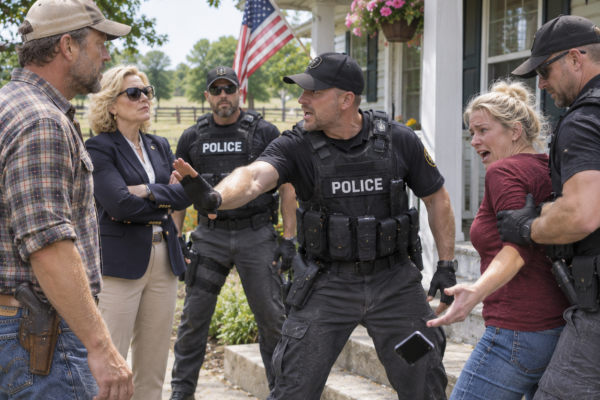
A white pickup jumped the curb and stopped diagonally across the sidewalk.
Mason climbed out.
Derek followed.
Both wore their black HOA security vests.
Mason smiled.
“Afternoon, Hale.”
I stopped.
“What do you want?”
“Mrs. Marsh has given us instructions to resolve your noncompliance.”
“Then she can speak to my attorney.”
Mason moved in front of me.
“You’re coming with us.”
“No.”
Derek stepped closer.
His right hand rested near a holster.
I noticed immediately.
“Don’t touch that weapon.”
Mason laughed.
“See? This is why Tina says you’re dangerous.”
I kept my hands visible.
“I’m walking home. Move your truck and let me pass.”
Mason shook his head.
“You’re not going anywhere until you settle those fines.”
Then Derek drew his pistol.
And everything that had seemed ridiculous about Tina’s enforcement campaign became deadly serious.
For the next several hours, I didn’t know whether Derek Pike was going to survive.
That was the first thing I asked when Detective Maya Ellis interviewed me at the sheriff’s office.
She was in her late thirties, with dark hair pulled into a bun and a manner that was direct without being unfriendly.
“Both men are alive,” she told me. “They’re receiving treatment. I can’t give you a complete medical update.”
I nodded.
“Thank you.”
She placed a recorder on the table.
“Ryan, I understand you’ve asked to have your attorney present.”
“Yes.”
Nora arrived shortly afterward.
I gave a complete account of the confrontation and answered the questions necessary to establish the sequence.
I didn’t embellish my military service.
I didn’t describe the shooting as a victory.
I explained that Derek had pointed a gun at me, ignored repeated requests to lower it, and fired before I responded.
I described Mason’s attempt to grab me and the struggle that followed.
Then I told Ellis about the HOA’s enforcement campaign.
She raised her eyebrows when I showed her the letter threatening physical enforcement.
“Do you have the original?”
“Nora has it.”
Nora placed a copy on the table and identified the preserved original.
Ellis read it.
“Who signed this?”
“Tina Marsh.”
“And these two men worked under her security program?”
“Yes.”
She looked at me.
“Did they say anything about her during the confrontation?”
“Mason said Tina had ordered them to bring me in that day.”
Ellis wrote it down.
“Did either man tell you they had police authority?”
“Mason said they could take me to the association office. He claimed they had community enforcement authority.”
“Did he use the word arrest?”
“Not during that encounter. But he repeatedly told me I had no right to refuse detention.”
She nodded.
“That’s a distinction we’ll examine.”
The interview lasted nearly three hours.
When it ended, the investigators told me the shooting, the earlier threats, and the security operation would all be examined.
My firearm remained in evidence.
I was permitted to leave after the necessary procedures were completed.
No one declared me innocent at the interview table.
That was appropriate.
A man had been shot.
Another had suffered serious injuries.
The system needed to establish what happened rather than accept the version told by the person who happened to survive the encounter without serious injury.
Nora drove me home.
As we turned onto Birchwood Court, I saw workers cleaning the pavement.
The pickup had been towed.
The evidence markers were gone.
But the street didn’t look normal.
A dark stain remained near the curb.
The children weren’t outside.
And Rosa’s roses had been knocked over when the ambulance crew moved equipment through her front yard.
I went inside without saying much.
Nora stood in the doorway.
“Ryan, I want you to leave the HOA correspondence alone for now.”
“I wasn’t planning to write Tina a letter.”
“Good. And don’t talk to reporters or post an account online.”
“Understood.”
She hesitated.
“Are you staying here tonight?”
“Yes.”
“Call somebody you trust. You shouldn’t have to sit with this alone.”
After she left, I stood in my kitchen.
Then I called an old teammate named Caleb.
He answered on the second ring.
“Ryan. What’s up?”
I tried to tell him.
My voice caught halfway through the first sentence.
Caleb was quiet.
Then he said, “I’m coming over.”
He lived forty minutes away.
He arrived with dinner and stayed until after midnight.
We didn’t talk about tactics or who should have moved where.
We talked about the human cost.
The frightened children.
The injured men.
The possibility that someone might not have survived.
And the strange, heavy feeling of realizing that an ordinary Saturday had become something I’d remember for the rest of my life.
I slept perhaps three hours.
At seven the following morning, Harold knocked.
He carried a bag of biscuits from a local diner.
“You need breakfast.”
I stepped aside.
He came into the kitchen and put the bag on the counter.
For several minutes, we sat without speaking.
Then he looked at me.
“Ryan, Tina’s telling people you attacked two security officers.”
I closed my eyes.
“Of course she is.”
“She says they were responding to a dangerous resident.”
I looked at Harold.
“She knows they had a gun.”
He nodded.
“And she’s saying they believed you were armed.”
“I was carrying legally. I never displayed my weapon until after Derek fired.”
“I know.”
I looked at him sharply.
“How?”
Harold reached into his jacket.
He took out his phone.
“Rosa sent me the clip from her porch camera.”
He didn’t play it without asking.
I appreciated that.
“Does it show the shooting?”
“From the moment the truck arrived.”
I looked toward the window.
“Then the investigators need it.”
“They have the original. She gave it to them last night.”
I leaned back.
Harold hesitated.
“Ryan, there’s something else.”
“What?”
“Before Tina became president, I served on the HOA board. I know what its powers are supposed to be. None of us ever voted to give security officers authority to detain residents.”
I looked at him.
“Then who authorized what Mason was doing?”
“That’s what the current board needs to answer.”
He opened another message.
It was a neighborhood-wide email from Tina.
URGENT COMMUNITY SAFETY NOTICE.
She claimed security officers had been assaulted while carrying out lawful duties and that I was under investigation for violent conduct.
She asked residents not to interfere with future enforcement activities.
I stared at the message.
Two men had confronted me at gunpoint.
One had fired.
And Tina was still describing the event as ordinary HOA enforcement.
I forwarded the email to Nora.
Then I asked Harold to preserve it.
He nodded.
“Already done.”
Across the street, Rosa was walking down her porch steps.
She saw us through the window and waved.
I walked outside.
“Ryan,” she called, “I wanted you to know something.”
“What?”
“Little Evan was riding his bike when the pickup arrived. I got him into the house before the shooting.”
I felt my stomach drop.
Evan was eleven.
He lived next door to Rosa and often rode past my driveway with two friends.
“Did he see what happened?”
“Enough to be frightened.”
I looked toward the place where the pickup had stopped.
A child had almost been standing in the line of fire because Tina Marsh wanted to collect disputed fines.
Rosa stepped closer.
“I’ve given the investigators the footage. Whatever she tells people, the camera recorded what those men did.”
I thanked her.
Then she said something I’ll never forget.
“Ryan, you shouldn’t have needed to survive a gunfight just to be allowed to walk home.”
She went back inside.
I stood on the sidewalk long after she closed the door.
Because she was right.
And for the first time, I understood that the legal case wasn’t going to be about my military record.
It was going to be about why an HOA president believed she could send armed men to seize a homeowner over a few thousand dollars.
The investigation lasted months, not days.
Detective Ellis collected statements from residents who’d been on Birchwood Court that afternoon.
Rosa’s camera showed the pickup pulling across the sidewalk.
Harold’s doorbell camera captured part of the confrontation from farther down the street.
A teenager across the road had recorded several seconds on his phone after hearing Mason shouting.
Together, the recordings established the critical sequence.
Derek had drawn his pistol while I stood with my hands visible.
He had aimed at me.
I had repeatedly asked him to lower the weapon.
Then his gun had discharged.
Investigators recovered the fired bullet from a damaged masonry wall behind the curb.
The physical evidence and the video aligned.
The recordings also showed that I hadn’t reached for my handgun before Derek fired.
And they showed Mason rushing me after the shooting, rather than retreating or surrendering.
I didn’t watch every recording.
I’d lived through the incident once.
That was enough.
The prosecutor’s office reviewed the evidence before determining that the available facts supported my account of self-defense.
The investigating agencies returned the appropriate findings through the legal process, and I was not charged for the defensive shooting.
That decision didn’t make me happy.
It relieved me of an enormous burden.
But it didn’t undo the fact that Derek had been seriously wounded.
His injuries required surgery to his shoulder and leg.
Mason suffered broken ribs and a lung injury following the struggle and fall.
Both eventually survived.
I learned that through the official process rather than from rumors circulating around the neighborhood.
Some residents thought I ought to celebrate.
I couldn’t.
I’d wanted two men to leave me alone.
Nothing more.
Meanwhile, the investigation into the HOA security division was becoming considerably larger.
Mason had told deputies that Tina personally authorized the attempted detention.
Derek initially claimed he’d drawn the pistol because he believed I was dangerous.
But that explanation became harder to maintain when investigators recovered messages from the men’s phones and the association’s office.
One exchange began three days before the confrontation.
Tina had written to Mason:
Hale has had every opportunity to comply. I want this resolved Saturday.
Mason replied:
What if he refuses again?
Her answer was direct.
Bring him to the office. Don’t come back with another excuse.
The next message was worse.
If you have to show your weapons to make him understand, do it. He’s all talk.
I read that sentence in Nora’s office after the evidence was disclosed through the appropriate proceedings.
For several moments, I couldn’t speak.
Tina hadn’t been surprised that her security men carried firearms.
She’d known.
She’d encouraged them to use the threat of armed force to intimidate me.
I looked at Nora.
“She wanted them to pull guns over an HOA fine.”
Nora nodded.
“That’s what the message supports.”
“Did she tell them to shoot?”
“Not in that message. But encouraging an armed threat is serious enough. The prosecutor will evaluate her responsibility for what followed.”
There was also a payment arrangement.
The HOA’s security account included an additional $2,500 authorized for what Tina called successful compliance intervention.
Mason and Derek would receive the money if I agreed to pay the disputed penalties and signed a document acknowledging the association’s claimed enforcement authority.
I stared at the description.
“Tina was going to pay them a bonus for making me sign?”
“That’s what the records indicate.”
“And she used association money?”
“Yes.”
The board hadn’t approved a special intervention against me.
The treasurer hadn’t understood what the payment was intended to accomplish.
And the directors hadn’t been told that Tina was instructing security personnel to threaten a resident with firearms.
The inquiry also uncovered problems with the security division’s credentials.
Mason had ordered metal badges resembling official police shields.
The vest patches identified the men as security officers, but several badges used the phrase Special Community Officer.
During previous encounters, Mason had told homeowners he could detain them and had described the patrol as being authorized to enforce local law.
Investigators examined those representations under the laws governing security services and impersonation of law enforcement.
The HOA could hire lawful security services to protect common property.
It couldn’t turn private contractors into sworn deputies by printing badges and handing them radios.
And it couldn’t authorize armed detention to collect civil penalties.
That distinction was becoming impossible for Tina to ignore.
Yet she kept trying.
At a board meeting three weeks after the incident, she claimed the messages had been taken out of context.
She said the security team was supposed to bring me in only if I cooperated.
She insisted that asking men to show their weapons didn’t mean they should threaten anyone.
When the treasurer asked why a $2,500 bonus had been authorized, Tina called it a performance incentive.
A board member named Elaine Porter asked one question.
“Performance at what, Tina? Frightening people into paying fines?”
According to the meeting minutes, Tina refused to answer directly.
Then she blamed Mason.
She claimed he’d exceeded his instructions.
That was the same pattern she’d followed with homeowners for years.
When a policy was challenged, she called it board authority.
When the consequences became serious, she blamed the person who carried it out.
But the messages were in her name.
The authorization was signed by her.
And the warning letter threatening physical enforcement had been issued from the president’s office.
The board could no longer treat the incident as an unfortunate misunderstanding.
It hired independent counsel.
The security division’s activities were suspended.
Its contracts and insurance arrangements were reviewed.
And all enforcement matters involving the disputed fines were placed on hold.
Then Elaine came to see me.
She was sixty-four, had served on the board for two years, and looked embarrassed before she even sat down.
“Ryan, I owe you an apology.”
I poured her coffee.
“You weren’t in that pickup.”
“No. But I accepted Tina’s explanations for too long.”
She described the board meetings.
Whenever a homeowner disputed a violation, Tina characterized the person as disruptive.
Whenever a resident questioned the security program, Tina said stronger enforcement was essential for neighborhood safety.
Most directors trusted her.
Some were intimidated by her.
Others simply didn’t want to spend their evenings arguing about parking and landscaping.
Elaine shook her head.
“We were supposed to oversee her. Instead, we let her tell us what she’d already decided.”
I looked toward the front window.
“What happens now?”
“We’re reviewing every fine issued under her presidency. Residents are demanding a special election.”
“Good.”
She lowered her eyes.
“And the board will offer a formal apology.”
I was quiet.
Then I said, “Elaine, I don’t need a speech about how sorry everybody is. I need to know these men won’t be replaced by two more people with badges and guns.”
She nodded.
“That is exactly what we’re changing.”
Before leaving, she mentioned Agnes Miller, the widow Harold had told me about.
Agnes had paid nearly $3,000 in repeated assessments and compliance penalties after refusing to allow security personnel into her backyard.
She’d been afraid the association could place a lien against her home.
Another couple had paid fines without receiving the hearing required by the HOA’s own enforcement procedures.
A retired teacher had been threatened with towing for parking an ordinary vehicle in his driveway.
The board’s independent review began uncovering how much harm Tina’s methods had caused.
I hadn’t been the only target.
I’d simply been the person who refused long enough for her intimidation to become a public emergency.
And when the board finally held its special meeting, more than a hundred residents came to hear what had happened.
The special meeting was held on a Thursday evening in the Oakridge Meadows clubhouse.
I didn’t attend.
Nora had advised me to avoid direct contact with Tina while the criminal investigation and related legal matters were active.
Harold went.
So did Rosa, Elaine, and several residents who’d experienced problems with the security division.
Later, Harold told me what happened.
Tina opened the meeting by insisting the association was under attack.
She blamed the media.
She blamed disgruntled homeowners.
And she blamed the sheriff’s office for failing to recognize the important work of community security.
Then she accused me of using my military background to provoke an innocent confrontation.
Rosa stood.
She was a small woman with silver hair and the kind of quiet confidence that comes from working as a nurse for forty years.
“Tina,” she said, “my porch camera recorded what happened.”
Tina interrupted.
“Mrs. Delgado, you don’t understand the full circumstances.”
“I understand that one of your security men pointed a gun at Ryan while children were playing outside.”
The room went quiet.
Rosa continued.
“I was there. I saw the pickup block him. I heard him ask the man to lower his weapon. And I heard the first shot.”
Tina began to object.
But Elaine asked her to stop.
Then the treasurer presented the messages and payment records that had been properly disclosed to the association.
The $2,500 bonus.
The instructions to bring me in.
The warning that the men should show their weapons if necessary.
A man near the front raised his hand.
“Did our dues pay for that?”
Elaine looked at him.
“Association funds were allocated to the operation.”
Another resident stood.
“Then why were we told the security program was for preventing theft and vandalism?”
Nobody answered.
An older woman asked why the HOA had been sending armed patrolmen to collect architectural fines.
A younger father wanted to know whether the guards had ever received appropriate training or authorization to perform the duties they claimed.
Then Agnes Miller stood.
She held copies of the penalties she’d paid after security officers repeatedly threatened to enter her backyard.
“I was afraid they’d take my house,” she said.
According to Harold, that was the moment the atmosphere changed completely.
People stopped treating the security division as a neighborhood amenity that had simply gone too far.
They began seeing it as a system of intimidation that had operated using their own money.
Tina tried to regain control.
She insisted everyone was overreacting.
She said the association needed strong leadership.
Then she made the mistake of describing the shooting as a necessary lesson about compliance.
Rosa stood again.
“A boy was riding his bicycle less than fifty yards away, Tina. What lesson were you trying to teach him?”
Tina didn’t answer.
The directors suspended the meeting long enough to complete the procedures required under the governing documents.
Then they voted to remove her from the presidency.
The security division was formally dissolved.
Its contracts were terminated.
And the association began correcting the fines and enforcement decisions that had been issued without proper support or procedure.
Within weeks, refunds were approved for several residents, including Agnes.
Other disputed charges went through a documented review.
Tina was no longer the most powerful person in Oakridge Meadows.
She was a defendant facing serious criminal allegations.
The cases took nearly a year to resolve.
Derek pleaded guilty to offenses arising from the armed assault and unlawful attempt to detain me.
His sentence included six years of imprisonment.
Mason’s case resulted in a four-year custodial sentence for his role in the attempted detention and assault.
The proceedings also addressed their misleading representations of police-like authority, the earlier threats, and the evidence showing that they had acted under Tina’s instructions.
Tina fought the allegations for months.
Then her attorneys negotiated a plea resolution involving her role in organizing the armed intimidation and directing the unlawful enforcement effort.
The court imposed an eighteen-month custodial sentence, followed by supervision and restitution obligations.
Her ability to return to association leadership was also restricted through the HOA’s revised governing procedures and the terms of the related civil resolution.
The sentences weren’t announced two weeks after the shooting.
There were hearings, evidence reviews, negotiations, and decisions made by the courts.
I attended the proceedings when required.
I testified about what had happened.
And when they were finished, I went home.
I didn’t smile at the defendants.
I didn’t tell Derek he’d gotten what he deserved.
A young man had nearly died because he listened to someone who told him threatening a homeowner was part of his job.
He was responsible for drawing and firing his weapon.
But Tina had helped create the circumstances in which he believed he should do it.
That was the part I wanted Oakridge Meadows to remember.
After the criminal matters, the civil claims against the association and the security operation were resolved.
The final settlement provided compensation for the harm caused, reimbursement of agreed costs, and a formal acknowledgment that the attempted detention had never been authorized by the HOA’s governing documents or any lawful enforcement process.
Every disputed fine against my property was canceled.
The association adopted clear limits on security activities, including prohibiting personnel from representing themselves as sworn law-enforcement officers or using private detention to collect HOA penalties.
It also required independent legal review of serious enforcement disputes.
The rules weren’t complicated.
They were the sort of boundaries that should have existed from the beginning.
A few months later, Sheriff Daniels came by my house.
He had paperwork related to the final release of my personal property after the evidence-retention requirements had been satisfied.
My handgun had been examined during the investigation.
The records had been reviewed.
And the prosecutor had completed the relevant determination concerning my defensive actions.
Daniels handed me the final documentation.
“How are you doing, Ryan?”
I considered the question.
“Better.”
He nodded.
“I heard you’ve been staying out of the neighborhood meetings.”
“Trying to.”
He smiled faintly.
“Probably wise.”
We stood on the porch looking toward the street.
The damaged curb had been repaired.
The masonry wall had been patched.
Children were riding bicycles near Rosa’s house again.
I watched them for a moment.
Then Daniels said, “A lot of people seem to think your military background is what made this case turn out the way it did.”
I looked at him.
“It wasn’t.”
“No?”
“It helped me stay focused when things got dangerous. But what mattered afterward was the evidence.”
He nodded.
“That’s how it should be.”
“Rosa’s camera. The witnesses. The messages. The physical evidence. Any homeowner should be entitled to the same investigation.”
Daniels looked toward the road.
“You’re right.”
After he left, I sat on the porch.
For months, reporters had wanted me to talk about being a Navy SEAL.
They’d asked whether my training had given me an advantage.
They’d wanted to know what it felt like to defeat two armed HOA security guards.
I turned down most of those interviews.
Because I hadn’t defeated a problem.
I’d survived one.
And I’d spent a long time wishing it had never happened.
The shooting stayed with me.
I sometimes woke at night remembering Derek’s shaking hand.
I remembered the sound of the first gunshot.
The sight of blood on the pavement.
The little boy’s bicycle lying in the grass.
I spoke with a counselor.
I talked with Caleb.
I stopped pretending that a person who’d been through difficult things before ought to be unaffected by another one.
Gradually, the memories became less intrusive.
I started enjoying the neighborhood again.
I worked on the motorcycle.
Planted tomatoes behind the garage.
Helped Harold replace his fence.
And brought Rosa fresh coffee whenever she was working in her rose garden.
One Saturday, she called from across the street.
“Ryan, can you give me a hand with something?”
I walked over.
She needed help moving a heavy planter away from the porch.
We carried it together.
Then she looked toward the spot where the pickup had once blocked me.
“Hard to believe all that happened right here.”
I nodded.
“It is.”
She studied me.
“You’re happy you stayed?”
I looked toward my house.
The white trim.
The small front lawn.
The garage door I’d painted the previous weekend.
“Yes.”
She smiled.
“Good.”
I stayed because Oakridge Meadows wasn’t Tina Marsh.
It wasn’t Mason Rourke.
It wasn’t two tactical vests and a pickup truck.
It was Harold checking on me after a difficult night.
Rosa protecting a frightened child and telling investigators what she’d witnessed.
Elaine admitting the board had failed and helping repair the damage.
And neighbors who wanted to live without being threatened by the people supposed to represent them.
The next HOA election brought in new directors.
Meetings became quieter.
Fines were evaluated under the actual governing documents.
Homeowners received the hearings the rules required.
And nobody sent armed men to demand payment.
One evening, Harold stopped by while I was cleaning the garage.
He leaned against the doorframe.
“Remember what you told Tina when you first moved in?”
I looked up.
“What?”
“That you’d follow the rules that applied to your property.”
I laughed quietly.
“She didn’t like that.”
“No, she didn’t.”
He shook his head.
“All she had to do was enforce the rules fairly. Instead, she decided everybody had to obey her personally.”
I set down my wrench.
“That’s the difference.”
He nodded.
“Guess it took a long time for the board to learn it.”
After Harold left, I closed the garage and walked toward the porch.
The sun was setting behind the oak trees.
A sprinkler clicked on across the street.
Somebody was grilling in a backyard.
I could hear children laughing near the pond.
Ordinary neighborhood sounds.
The kind I’d moved here hoping to enjoy.
I thought about the afternoon Mason and Derek blocked my path.
They’d believed a badge, a tactical vest, and a firearm made them powerful.
Tina had believed her presidency entitled her to send those men after a homeowner who challenged her fines.
And all three had discovered, in the worst possible way, that authority doesn’t come from frightening people into obedience.
It comes from lawful responsibility.
From boundaries.
From accountability.
I looked toward the curb where the confrontation had happened.
There was no marker.
No sign.
Nothing announcing that an HOA dispute had once turned into gunfire at that spot.
Just an ordinary stretch of neighborhood pavement.
I was grateful for that.
I’d spent ten years in the Navy learning how to survive dangerous situations.
But when I bought my house in Oakridge Meadows, I hadn’t been looking for another fight.
I’d been looking for a place where I wouldn’t need one.
Now, at last, I had it.
I went inside, locked the front door, and turned off the porch light.
And for the first time in a long while, I didn’t look out the window to see whether an HOA patrol was coming.