“Pay HOA Dues or We’ll Make Your Life Miserable,” the President Warned—Even Though My House Was Never Part of Her Association. For Six Years, Her Self-Appointed “Officers” Tore Up My Lawn, Smashed My Windows, and Rang My Doorbell After Midnight. She Told Me a Nonmember Had No Right to Sue. Then the Judge Asked One Question About My Security Footage…k
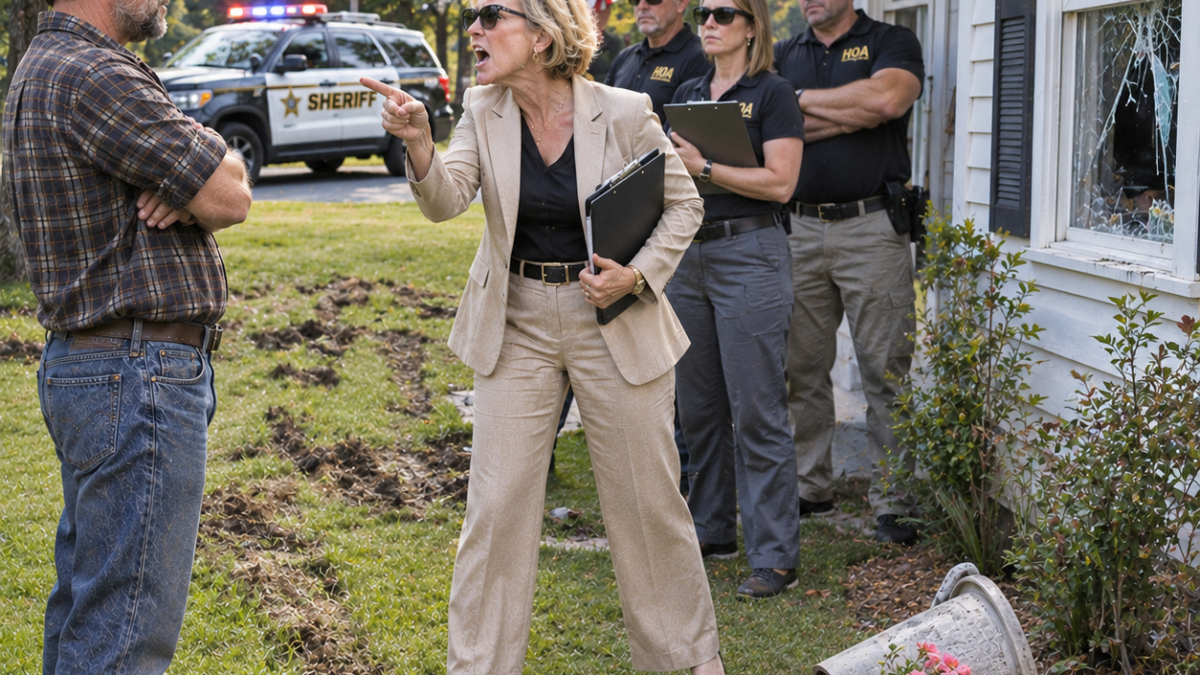
“Pay HOA Dues or We’ll Make Your Life Miserable,” the President Warned—Even Though My House Was Never Part of Her Association. For Six Years, Her Self-Appointed “Officers” Tore Up My Lawn, Smashed My Windows, and Rang My Doorbell After Midnight. She Told Me a Nonmember Had No Right to Sue. Then the Judge Asked One Question About My Security Footage…
Part 1:
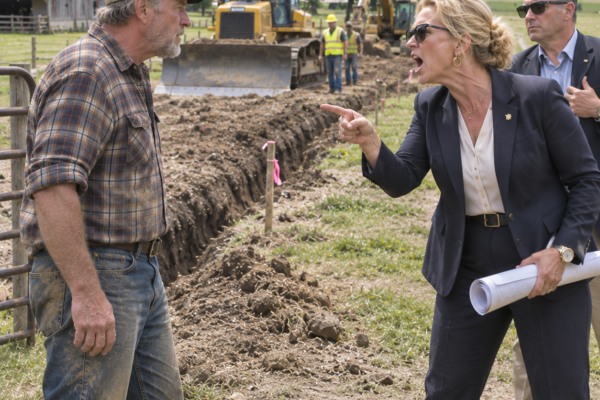
At 2:13 on a freezing December morning, three men wearing reflective HOA patrol vests walked across my front lawn carrying a metal rake, a coil of chain, and a clipboard.
One went straight to my porch.
Another stopped beside the flower beds my late wife had planted.
The third looked directly into my security camera.
Then he smiled.
Seconds later, my doorbell began ringing.
Not once.
Not twice.
Over and over, until the sound echoed through my dark house.
I was sixty-three years old, standing barefoot in my hallway, watching three grown men deliberately torment me because I refused to pay an HOA I had never joined.
Then the man beside the flower beds drove the rake through the frozen soil and began tearing up the plants.
I grabbed my phone.
The camera was recording everything.
My name is Walter Benson. I’d lived in the same house outside York, Pennsylvania, for twenty-seven years.
My wife, Susan, and I bought it when our children were young.
We raised our family there, planted trees, built a stone walkway, and turned a tired two-acre property into the place we expected to grow old together.
Susan passed away a few years earlier.
The gardens were the last things she had worked on before becoming ill.
I maintained them because they mattered to her.
And because every spring, when the daffodils appeared, I could almost hear her reminding me not to cut them back too early.
Now three strangers were destroying them under the authority of a homeowners association that didn’t own a single square foot of my property.
The trouble had begun years earlier, when a developer built Pine Hollow Estates on land beyond my eastern fence.
Forty-six new houses appeared.
Then came decorative streetlights, landscaped entrances, a private clubhouse, and a homeowners association.
I had no objection to any of it.
The people buying those homes had every right to enjoy their neighborhood.
But my house wasn’t part of their development.
My deed had no HOA covenants.
I wasn’t included in their recorded subdivision declaration.
And when the developer offered longtime neighboring owners the opportunity to join voluntarily, I declined.
That should have been the end of it.
Instead, the new HOA president, Marjorie Bell, began sending me membership packets.
At first, they arrived once a month.
Then every two weeks.
Eventually, almost every Friday.
Each demanded annual assessments, architectural compliance, and acceptance of Pine Hollow’s governing documents.
I returned the first few with a short explanation.
MY PROPERTY IS NOT SUBJECT TO YOUR HOA.
Marjorie responded with a letter threatening legal action.
She claimed my refusal to join undermined the neighborhood’s property values.
When I showed her my deed, she called it outdated.
When I produced the recorded subdivision map, she called it incomplete.
And when I asked why I should pay fees to an association I didn’t belong to, she gave me a smile I would learn to hate.
“Mr. Benson, you can cooperate voluntarily, or we can make compliance very uncomfortable.”
I didn’t believe her at first.
Then she created what she called the Pine Hollow Neighborhood Safety Officer Program.
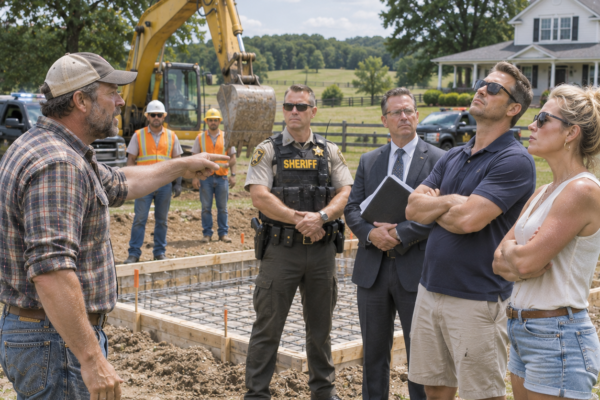
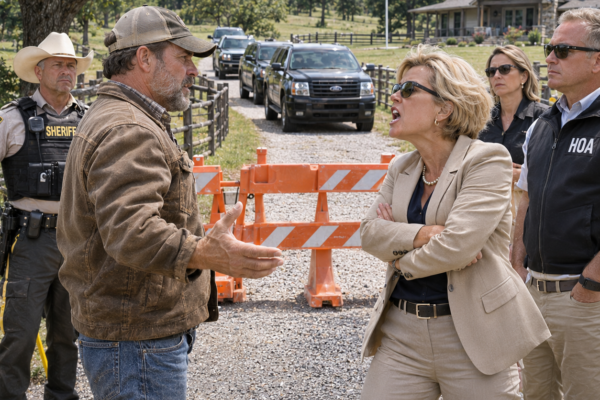
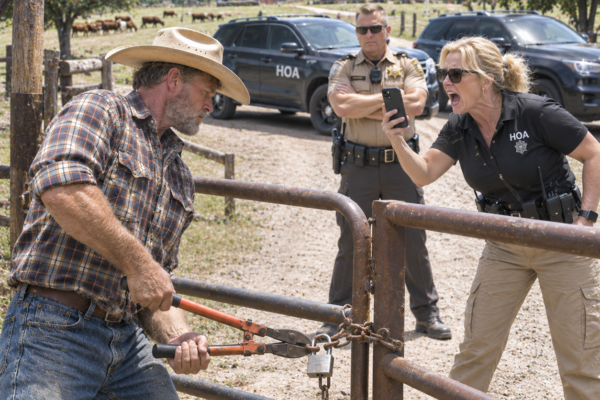
Six volunteers received reflective vests, identification badges, and authority from the board to conduct “community compliance patrols.”
They weren’t police officers.
They weren’t county inspectors.
They were HOA volunteers with clipboards.
But that didn’t stop them from entering my property.
The first time, they photographed my garage.
The second time, they left warning notices on my porch.
The third time, they drove across my lawn, leaving tire tracks through the grass.
I called the police.
By the time officers arrived, the patrol had disappeared.
Then the vandalism began.
A broken window.
A damaged sprinkler line.
Fresh tire ruts across my yard.
Someone repeatedly ringing my doorbell in the middle of the night.
Every incident happened when witnesses were scarce.
Every time I called the authorities, the patrol members were already gone.
I replaced a window.
They broke another.
I repaired the lawn.
They tore it up again.
Eventually, I stopped fixing things immediately because I couldn’t afford to keep repairing the same damage.
My adult daughter begged me to sell the property.
I refused.
Not because I wanted a fight.
Because I wasn’t going to abandon the home Susan and I had built simply because Marjorie Bell couldn’t accept the word no.
I hired an attorney, Denise Alvarez.
She reviewed my deed and the HOA’s recorded documents.
Her conclusion was straightforward.
Pine Hollow’s rules didn’t apply to my property.
But proving the boundary wasn’t the same as proving who was destroying my home.
Denise recommended installing cameras.
So I did.
One watched the porch.
Another covered the driveway.
Two overlooked the garden and side yard.
And a fifth recorded the entrance gate.
For months, the cameras captured little more than delivery trucks, passing deer, and occasional visitors.
Then, on that December night, the HOA patrol came back.
I watched from inside as the men walked across my lawn.
The first rang the doorbell again and again.
The second tore apart Susan’s flower beds.
The third dragged the heavy chain across my stone walkway, chipping its edges.
I called the police and kept recording.
When the men finally left, I went outside with a flashlight.
The garden was ruined.
The walkway was damaged.
And a yellow notice had been taped to my front door.
FINAL WARNING — HOA COMPLIANCE REQUIRED.
At the bottom was Marjorie Bell’s signature.
I photographed it.
Then sent everything to Denise.
The following morning, she called.
“Walter, I need you to preserve those original video files.”
“I already have.”
“And don’t tell Marjorie exactly what the cameras captured.”
“Why?”
Denise paused.
“Because we’ve spent years trying to establish who is responsible for these incidents. Now I want to know whether she’ll tell a court the same story she’s been telling you.”
I looked toward Susan’s destroyed garden.
For the first time in years, I felt something other than helplessness.
But I didn’t know then how far Marjorie would go to keep those recordings out of court.
Or why the association’s lawyers would eventually argue that, because I wasn’t an HOA member, I had no right to bring the case against them at all.
Part 2:
At 2:13 on a December morning, the doorbell rang fourteen times before I got out of bed.
I counted later.
At the time, I was standing barefoot in the hallway, looking at my security monitor and trying to understand why three grown men were wandering around my front yard in reflective vests.
The first man stood on my porch with his finger pressed against the doorbell.
The second was dragging a metal rake through my wife’s flower beds.
The third had a heavy chain looped over one shoulder.
He stopped beneath the porch light, tilted his head toward the camera, and smiled.
Then he dropped the chain onto my stone walkway.
Even through the closed windows, I heard the crack.
I felt my chest tighten.
Those stones had been there since 2004. Susan and I laid them ourselves over two summer weekends, arguing good-naturedly about the pattern while our daughter carried water bottles back and forth from the kitchen.
Now someone was deliberately damaging them.
I picked up my phone and called the police.
I didn’t open the door.
I didn’t shout through the window.
I didn’t give the men the confrontation they seemed to want.
Instead, I stood in the dark, watching the recording continue.
The man in the flower beds lifted the rake again.
This time, he tore through a row of daffodil bulbs.
I gripped the phone so tightly my fingers hurt.
My name is Walter Benson. I was sixty-three years old that winter, and I’d spent almost four years trying to convince a homeowners association that it didn’t own my house.
By the time the case finally ended, the fight would have lasted six years.
Six years of letters.
Six years of unwanted visits.
Six years of damaged property, false accusations, and legal bills.
All because I refused to join an association I had no legal obligation to join.
I’d bought my home outside York, Pennsylvania, in 1995.
Back then, the property was a tired two-story farmhouse surrounded by two acres of lawn, trees, and overgrown gardens.
The house needed paint.
The roof needed repairs.
And the gravel driveway had developed a rut deep enough to collect rainwater like a small pond.
But Susan loved it.
She stood beneath the big oak beside the porch during our first visit and said, “Walter, this feels like somewhere we could stay forever.”
That was enough for me.
We bought the place.
I was working as a maintenance supervisor at a packaging plant. Susan taught second grade.
We weren’t wealthy, but we were careful with money and weren’t afraid of weekend projects.
Over the years, we replaced the roof, restored the porch, installed a proper drainage system, and built a detached garage.
Susan transformed the yard.
She planted roses along the fence.
Hydrangeas beside the porch.
Daffodils and tulips along the stone walkway.
Every spring, she bought more bulbs even when we had nowhere obvious to put them.
I’d complain that the flower beds were getting too large.
She’d tell me there was always room for one more row.
We raised our two children in that house.
Daniel went away to college, married, and settled near Pittsburgh.
Hannah stayed closer, becoming a nurse at a hospital less than an hour away.
When Susan became ill, the children came home whenever they could.
We spent her final summer sitting on the porch in the evenings, watching lightning bugs rise above the grass.
She died in 2018.
For months afterward, I couldn’t bring myself to change anything in the garden.
I kept the same arrangement of pots on the steps.
The same bird feeder outside the kitchen.
The same worn gardening gloves hanging from a nail in the garage.
People told me the house was too much work for one man.
Maybe they were right.
But I wasn’t ready to leave.
Then Pine Hollow Estates appeared beyond my eastern boundary.
The developer purchased a former hayfield and built forty-six houses.
The new homes were attractive, with wide driveways, attached garages, and landscaped entrances.
A small clubhouse stood near the center of the development.
I watched the construction without much concern.
The houses weren’t on my land.
The road didn’t cross my driveway.
And the developers had purchased the neighboring acreage legally.
I had no objection to new families moving into the area.
In the spring of 2019, the homeowners association began operating.
The new subdivision lots were sold subject to recorded covenants.
Homeowners who bought those properties became members according to the governing documents.
Several older properties around the development, including mine, were different.
Our deeds predated the subdivision.
We weren’t included in its recorded declaration.
The developer sent us invitations to participate voluntarily in certain association amenities and services.
I declined.
I didn’t use their clubhouse.
I didn’t drive on their private roads.
And I didn’t want another organization making decisions about my property.
That seemed like an ordinary choice.
Then Marjorie Bell became president.
The first time I met her, she came to my front door wearing a pale-blue suit and carrying a membership packet.
She was about sixty, with dark hair cut neatly at her jaw and a smile that lasted exactly as long as it took me to disagree with her.
“Mr. Benson, we’ve noticed you haven’t completed your membership forms.”
“That’s right.”
“You need to return them with the annual assessment.”
“I’m not joining.”
She blinked.
“Excuse me?”
“My property isn’t part of Pine Hollow.”
She gave a small laugh.
“You’re surrounded by the community.”
“That doesn’t mean I belong to the association.”
She looked toward my garage.
“Our rules protect the appearance and property values of the entire neighborhood.”
“I’m sure your members appreciate that.”
“Then you understand why compliance matters.”
“I understand why your members agreed to the rules. I haven’t.”
Her smile disappeared.
“Mr. Benson, we don’t want to begin our relationship with unnecessary conflict.”
“Neither do I.”
“Then sign the paperwork.”
“No, thank you.”
For several seconds, she stared at me.
Then she picked up her folder.
“You may regret being so uncooperative.”
I watched her walk back to her car.
I remember thinking she was simply a woman who wasn’t accustomed to hearing no.
I didn’t realize how far she was willing to go to punish it.
The letters began a week later.
At first, they were ordinary membership reminders.
Then came assessment demands.
Then notices claiming I owed late fees for failing to submit payment.
I responded with copies of the property records and the recorded subdivision map.
Marjorie sent another bill.
I returned it.
She sent a warning about collection proceedings.
I wrote back explaining that no recorded covenant or signed agreement made me liable for the association’s dues.
That should have settled a legitimate misunderstanding.
Instead, Marjorie arrived on my porch again.
“You’re creating a serious problem,” she said.
I stood inside the doorway.
“Because I won’t pay an association I don’t belong to?”
“Because your attitude undermines community cooperation.”
“Marjorie, I’m happy to be a good neighbor. I’m not signing away control of my property.”
Her jaw tightened.
“You don’t understand how much influence this board has.”
“Influence isn’t ownership.”
She leaned closer.
“Then perhaps we need to show you what noncompliance looks like.”
I looked at her for a moment.
“Is that a threat?”
She smiled.
“Consider it a warning.”
Three weeks later, the HOA established its Neighborhood Safety Officer Program.
And that was when ordinary harassment became something much uglier.
The program sounded harmless in the newsletter.
Pine Hollow Neighborhood Safety Officers will assist with routine observation, community standards, and neighborhood well-being.
There was a photograph of six smiling volunteers standing outside the clubhouse.
They wore matching dark-blue polo shirts.
Each had a reflective vest with the words PINE HOLLOW SAFETY OFFICER across the back.
I recognized two of them from previous encounters with Marjorie.
Dale Hargrove was a former security guard who lived near the subdivision entrance. He was a heavyset man in his late fifties who liked telling people he had “law enforcement experience,” although I never heard him claim he’d actually been a police officer.
The other was Martin Phelps, a retired warehouse manager who seemed to follow Marjorie’s instructions without questioning them.
I didn’t pay much attention at first.
The association could organize volunteer patrols on property where it had permission to operate.
That was its business.
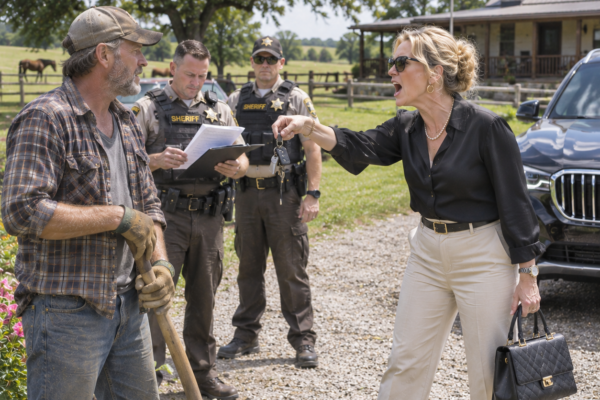
Then Dale drove onto my lawn.
It happened on a Saturday afternoon while I was replacing a broken board on the back fence.
A white SUV came through my open driveway gate and rolled across the grass toward the detached garage.
The driver stopped beside Susan’s rose bushes.
Dale stepped out wearing his reflective vest.
“Afternoon, Mr. Benson.”
I put down my hammer.
“Can I help you?”
“Routine compliance inspection.”
“Of what?”
“Exterior property conditions.”
I looked at the SUV.
Its tires had left two dark tracks across the damp grass.
“You’re on private property.”
He smiled.
“All properties affecting Pine Hollow’s community appearance fall within our observation area.”
“Not mine.”
He opened a clipboard.
“We need to document your garage siding and the condition of the fence.”
“No. You need to leave.”
His expression changed.
“Mr. Benson, obstructing a safety officer’s duties isn’t advisable.”
I stared at him.
“You’re an HOA volunteer, Dale. Not a police officer.”
He stepped closer.
“You’d be surprised what authority we have.”
“Then show me the legal document granting it.”
He looked down at the clipboard.
“We’ll record your refusal.”
“Record whatever you want from somewhere you’re legally allowed to stand. But get your vehicle off my grass.”
He returned to the SUV.
As he drove away, the rear tire slipped in a muddy patch and tore a shallow groove beside the roses.
I photographed the damage.
Then I called the association.
Marjorie answered.
“Your patrol officer just drove across my lawn.”
She sounded amused.
“Our officers conduct necessary inspections.”
“Not on my property.”
“Perhaps you should cooperate instead of creating problems.”
I asked her to reimburse the damage.
She laughed.
“Mr. Benson, you can’t demand compensation every time somebody visits.”
Then she hung up.
Two weeks later, I found a yellow notice taped to my garage door.
UNAPPROVED EXTERIOR CONDITION — CORRECT IMMEDIATELY.
The condition was a small patch of peeling paint.
The fine was $150.
I sent the notice back.
Then another appeared.
This one complained about the height of my backyard fence.
A third cited my trash cans.
A fourth claimed the flowers along the walkway were not approved landscaping.
That last one made me angrier than the rest.
Susan had planted those flowers.
She’d spent years tending them.
And now a woman who’d never known her was treating the garden as a violation.
I wrote Marjorie one more letter.
I explained that my parcel wasn’t bound by Pine Hollow’s architectural restrictions.
I demanded that the board stop sending unauthorized inspectors onto my property.
And I asked for the recorded instrument supporting any claim of authority.
She never produced one.
Instead, the doorbell incidents began.
The first happened at eleven-thirty on a Thursday night.
Somebody rang the bell three times, then disappeared before I reached the door.
The second happened two nights later.
Four rings.
Then silence.
The third happened just after one in the morning.
By the time I looked outside, the driveway was empty.
I assumed teenagers were playing a prank.
Then I noticed a yellow HOA notice beneath the doormat.
A week later, someone threw a handful of gravel against my front window.
The glass cracked.
I called the police.
An officer documented the damage, but there was no witness and no camera footage identifying who’d done it.
I couldn’t prove the HOA was responsible.
I suspected it.
That wasn’t the same thing.
Then someone damaged my sprinkler line near the eastern fence.
The repair cost nearly six hundred dollars.
Two weeks afterward, fresh tire marks appeared across the front lawn.
A flowerpot was broken.
Another warning notice lay beside it.
I began keeping a notebook.
Every date.
Every time.
Every letter.
Every damaged object.
Every call to the police.
It wasn’t satisfying work.
But it gave me something to do besides sit in the house feeling powerless.
One evening, Hannah came over after her hospital shift.
She found me measuring the damaged portion of the lawn.
“Dad, what are you doing?”
“Documenting another inspection.”
She looked at the tire marks.
“That’s not an inspection.”
“I know.”
“Have you called the police?”
“Yes.”
“And?”
“They need evidence identifying who’s doing it.”
She glanced toward the house.
“Then get cameras.”
“I don’t want to turn your mother’s home into a surveillance station.”
Hannah looked at me.
“Dad, Mom would want you safe.”
I knew she was right.
But I hated the thought of pointing cameras at a porch where Susan had once spent summer evenings reading.
That fall, I hired Denise Alvarez.
Her office was in York, above a storefront that sold running shoes.
She was a practical attorney in her forties, with a sharp eye for documents and very little patience for people who confused personal confidence with legal authority.
She reviewed my deed, the Pine Hollow declaration, and the letters.
Then she asked a straightforward question.
“Walter, did you ever sign an agreement joining this association?”
“No.”
“Did Susan?”
“No.”
“Does any recorded instrument in your property’s title history subject it to their covenants?”
“Not that the title search or recorder’s records show.”
She nodded.
“Then the association has a serious problem establishing the authority it claims.”
I felt relieved.
Then she looked at my photographs.
“But that’s only the first issue.”
“What do you mean?”
“Proving they don’t have authority to regulate your property doesn’t automatically prove their volunteers committed every act of damage. We need to connect the conduct to the responsible people.”
“How?”
“Security footage. Witnesses. Repair records. Original notices. A reliable chronology.”
She recommended cameras covering my own entrances, driveway, and yard.
Video only, with no unnecessary recording of neighbors’ private spaces.
I hired an installer.
Five cameras went up.
They weren’t hidden.
Anybody standing on my property could see them.
I hoped their presence would discourage the patrols.
For a few weeks, it did.
Then the pandemic arrived.
Courts reduced operations.
Hearings were postponed.
Legal schedules changed.
I was careful about leaving home, partly because of my age and partly because I didn’t want to expose Hannah after her shifts at the hospital.
The HOA didn’t stop mailing bills.
Marjorie continued demanding dues and fines while the world outside was struggling through a public-health crisis.
In late 2020, Denise filed our civil action seeking relief for the documented trespass, interference, and property damage.
We also sought a determination that Pine Hollow’s governing restrictions did not apply to my parcel.
The association responded by arguing that I lacked standing to sue it because I wasn’t a member.
When Denise called to tell me, I actually laughed.
“They’ve spent a year insisting I have to be a member. Now they’re saying I can’t sue because I’m not one?”
“That’s their argument.”
“Does that make any sense?”
“Not much in the context of your property-damage claims. You don’t have to join an organization before you can sue it for allegedly damaging your property.”
The court ultimately rejected that effort to prevent the case from proceeding.
But months had passed.
The hearings and discovery process continued moving slowly.
And the harassment didn’t stop.
By the end of 2021, my notebook was thick enough that I needed a second one.
Then Marjorie found a new way to hurt me.
She stopped treating my property like a house she wanted to regulate.
She began treating it like something she could damage until I gave up.
The worst damage began with a letter about drainage.
Marjorie claimed rainwater from my lawn was running toward Pine Hollow and creating a maintenance problem near the subdivision’s entrance.
That wasn’t true.
My property sloped toward a drainage swale that had existed long before the development. The swale collected runoff and carried it toward a county-maintained culvert.
The stormwater plan for Pine Hollow showed its own drainage system, separate from mine.
But Marjorie insisted the association needed to inspect and correct conditions along my eastern boundary.
I refused access.
Denise sent another letter.
She explained that Pine Hollow couldn’t perform construction work on my land without consent or a valid legal right.
Then came a rainy Friday in September.
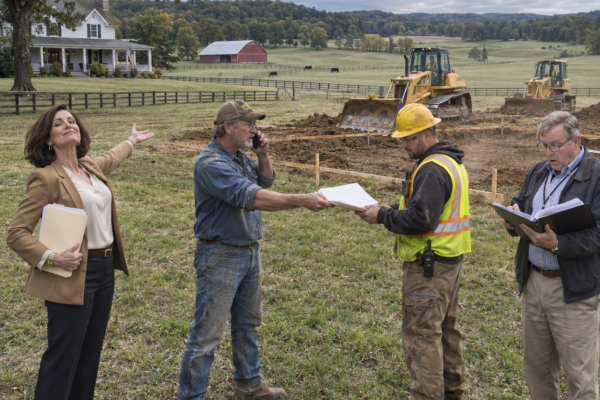
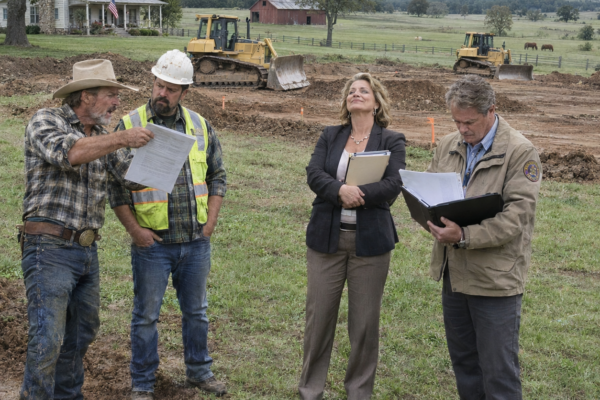
I returned from the grocery store and found a small landscaping tractor parked near my front fence.
The driver had already cut a broad swath through the grass.
A chain dragged behind the vehicle.
The ground was saturated.
Deep grooves ran across the lawn.
Near the eastern flower beds, the tractor had crushed part of the sprinkler system.
I stopped my car and got out.
“Turn that machine off!”
The driver looked toward me.
He was wearing a Pine Hollow contractor vest.
Another man stood near the fence holding a clipboard.
Dale Hargrove.
I recognized him immediately.
He raised one hand.
“Mr. Benson, we’re correcting a drainage violation.”
“On my property?”
“Under the board’s maintenance authority.”
“You’ve been told repeatedly that you have no authority here.”
Dale looked toward the driver.
“Finish the pass.”
The tractor moved forward another few feet.
Its rear tire climbed over the border stones around Susan’s hydrangeas.
I felt a flash of anger so strong that I had to force myself to remain still.
“Stop the machine,” I said.
The driver finally switched it off.
Dale folded his arms.
“You’re obstructing corrective maintenance.”
I took out my phone.
“I’m calling the police. And I’m recording the damage.”
His expression changed.
He glanced toward the vehicle.
Then told the driver to leave.
They were gone before the responding officer arrived.
But this time, my driveway camera had captured the tractor entering the property.
It showed the equipment, the operator, and Dale walking beside it.
The officer took a report.
Denise obtained the contractor’s information.
The company acknowledged that a Pine Hollow representative had arranged the work.
But the contractor disputed the scope of the damage and claimed it had relied on the HOA’s assurances about access.
That argument would be examined later.
For the moment, I was left with torn grass, damaged irrigation, displaced landscape stones, and an expensive problem that hadn’t existed that morning.
I hired a landscaping specialist to assess the property.
He walked the yard, inspected the drainage, and shook his head.
“Walter, this isn’t something you fix by scattering grass seed.”
He pointed to the deep ruts.
“The soil’s compacted. Some of the grading has been disturbed. And the damaged irrigation line is running beneath areas where they drove.”
The first restoration estimate was more than I could afford comfortably.
I sat on the porch that evening with the estimate in my lap.
The sun was setting behind the maple trees.
Inside the house, the refrigerator hummed.
Everything looked ordinary from a distance.
But the yard was torn open, and the flower beds were damaged.
I felt as though I were losing the house one small piece at a time.
Hannah visited that weekend.
She walked the lawn with me.
Then stood beside the damaged hydrangeas.
“Dad, you can’t keep living like this.”
“I know.”
“Come stay with us for a while.”
“And leave the place empty?”
“At least you’d get some sleep.”
I looked toward the porch.
“If I leave, Marjorie gets exactly what she wants.”
Hannah sighed.
“I don’t care whether she wins an argument. I care about you.”
That stopped me.
I’d become so focused on refusing the HOA that I hadn’t noticed what the fight was doing to my daughter.
She worried every time my phone rang late at night.
She checked on me before work.
She asked whether I’d eaten dinner.
My determination to protect the house was becoming a burden on the people I loved.
I promised her I’d follow Denise’s advice and stop confronting the patrols in person.
I’d document incidents and let the authorities handle them.
But I wasn’t moving away permanently.
Over the following months, the attacks became less predictable.
A broken window in November.
A damaged gate latch in January.
An overnight visit in March that left several rose bushes torn from the soil.
Then a period of silence.
The silence was almost worse.
I’d go to bed wondering whether the doorbell would ring.
If headlights crossed the curtains, I’d sit up.
I began sleeping with my phone beside the pillow.
Every camera alert made my heart race.
The footage documented some incidents clearly and others only partially.
One showed a man in a reflective vest leaving a warning notice on my porch shortly before midnight.
Another captured an HOA-marked vehicle entering the driveway while I was away.
A third showed two figures crossing the side yard, but their faces were obscured by darkness.
Denise wouldn’t let me claim more than the evidence proved.
“Don’t fill gaps with assumptions,” she told me. “A court will believe the things you can establish. We don’t strengthen a case by guessing about the rest.”
I listened.
I recorded what I knew.
And I waited.
Then came December 2022.
At 2:13 on that freezing morning, three men returned.
The porch camera captured Dale Hargrove ringing my doorbell again and again.
The side-yard camera showed Martin Phelps dragging a rake through Susan’s flower beds.
The driveway camera recorded a third man arriving in a white SUV bearing the Pine Hollow patrol placard.
The rear plate was readable.
The man with the chain walked directly beneath the porch light before dragging it across the stone walkway.
He looked up at the camera.
He smiled.
For a moment, I couldn’t understand why he’d do that.
Then I remembered Marjorie’s repeated claims that association officers couldn’t be held responsible for ordinary compliance activities.
Perhaps he’d believed the badge on his vest protected him.
Perhaps he’d assumed I would never get a trial.
Either way, the cameras recorded the encounter from beginning to end.
When the men left, I waited for the police before going outside.
The responding officer photographed the garden.
The broken stones.
The damaged shrubs.
And the yellow warning notice on my door.
I gave him copies of the original files, preserving the complete recordings and their timestamps.
The following morning, I called Denise.
“Walter,” she said after reviewing the footage, “this is important.”
“I know.”
“No. I need you to understand why. We can identify the men, follow their movements, and connect the incident to the notice they left.”
I looked through the window at Susan’s ruined garden.
“Then why do I still feel like I’m losing?”
Denise was quiet for a moment.
“Because a lawsuit can’t give you back the years they took from you.”
I swallowed.
Then she continued.
“But it can establish responsibility. And we’re going to make sure the court sees what happened.”
That afternoon, Marjorie sent another email.
Your continuing refusal to cooperate will result in additional enforcement measures.
I stared at it.
Then looked at the video thumbnails on my computer.
For the first time, her threat didn’t frighten me as much as it angered me.
Because I now had recordings of the very people she’d spent years denying were involved.
And I intended to let a judge see them.
Marjorie’s response to the recordings was not what I expected.
She didn’t apologize.
She didn’t suspend the patrol officers.
She didn’t even acknowledge that the men in the footage were wearing Pine Hollow vests.
Instead, the association’s attorney sent Denise a letter objecting to my surveillance cameras.
The letter claimed the recordings had been obtained without the patrol members’ consent and might violate their privacy.
I read it at my kitchen table.
Then I read it again.
“Denise, they’re complaining that I recorded people damaging my yard?”
“That’s their position.”
“They were outside my front door at two in the morning.”
“I know.”
“They looked directly at the camera.”
“I saw that.”
I shook my head.
“What are they expecting? That I ask permission before recording somebody tearing up my wife’s garden?”
Denise let me finish.
Then she said, “The admissibility questions will be addressed properly. Your cameras were recording visible areas of your own property, and we have the original files and the installer’s records. Their objection isn’t the end of the discussion.”
I leaned back.
“Do you think Marjorie knows how bad this looks?”
“Possibly. But don’t assume she sees the risk the way we do.”
That proved to be good advice.
Through 2023, Pine Hollow continued defending its position.
The association insisted that its safety officers had been conducting authorized community activities.
It denied responsibility for several incidents.
And it argued that any damage caused by individual volunteers should not automatically be attributed to the board.
Those were issues the court would need to decide based on the evidence.
Denise began obtaining documents through discovery.
Patrol schedules.
Board minutes.
Emails.
Contractor invoices.
Officer training materials.
And the association’s records concerning my property.
The volume surprised me.
For years, Marjorie had treated my refusal to join as a minor administrative matter.
But the documents showed she had been discussing my house at board meetings almost from the beginning.
In one email, she described me as “the last major holdout on the western approach.”
In another, she complained that my refusal encouraged other older property owners to question the association’s reach.
A third message instructed the safety officers to increase their presence near my house until I understood that refusing membership carried consequences.
I sat with Denise as she reviewed the correspondence.
“She actually wrote that?”
“Yes.”
“Increase their presence until I understand the consequences?”
“Those are her words.”
Then Denise turned to a patrol work sheet.
It listed specific dates and assignments.
My address appeared repeatedly.
Some entries called for posting notices.
Others instructed volunteers to document property conditions.
Several referred to evening compliance visits.
One of the dates was December 13, 2022.
The night the three men destroyed Susan’s garden.
Beside the entry was Dale Hargrove’s name.
I felt a cold anger settle over me.
For years, Marjorie had claimed her officers were acting independently whenever something went wrong.
Yet the association had scheduled visits to my property.
It had issued the notices.
It had maintained records of the patrols.
And its president had repeatedly encouraged the enforcement campaign.
That didn’t mean every broken window could automatically be blamed on her.
But it made the claim that she knew nothing about the harassment much harder to believe.
Then a former board secretary agreed to speak with Denise.
Her name was Evelyn Pierce.
Evelyn was seventy, a retired librarian, and one of the first residents to move into Pine Hollow.
She’d joined the board because she wanted to help organize neighborhood events and keep the common areas maintained.
Instead, she’d spent years watching Marjorie turn the association into a personal enforcement campaign.
Evelyn described raising objections when patrol members began approaching older properties outside the recorded subdivision.
She’d asked whether those owners had signed membership agreements.
Marjorie told her the HOA’s rules applied because the properties benefited from the neighborhood.
Evelyn requested a legal opinion.
The request was never acted on.
Then the patrol program expanded.
Evelyn became uncomfortable with the language used during board discussions.
She said Marjorie referred to nonmembers as “uncooperative holdouts” and insisted they needed pressure before they would recognize the association’s authority.
Eventually, Evelyn resigned.
But she’d preserved copies of meeting minutes and correspondence she received while serving on the board.
She provided those records to Denise through the appropriate process and agreed to testify.
When I met her, she apologized.
“Walter, I should have spoken up sooner.”
I looked at her.
“You weren’t the one tearing up my lawn.”
“No. But I heard the way Marjorie talked about you. I should have realized things would get worse.”
I thought about that.
Then I said, “You can still help make sure it doesn’t happen again.”
She nodded.
“That’s why I’m here.”
The association tried to settle in early 2024.
Its offer was $12,000.
The proposed agreement required me to release the claims and agree not to disparage the HOA.
Buried in the final pages was a provision requiring me to acknowledge the association’s future architectural oversight over my property.
I stared at it.
“She still wants me to join?”
Denise shook her head.
“Apparently.”
I pushed the papers back across the table.
“No.”
“Walter, I expected that answer.”
“She damages my property for years, offers me a fraction of the repair costs, and still wants authority over my house?”
“I know.”
“Then we’re going to court.”
Denise nodded.
“But understand what that means. More time. More expense. And no guaranteed outcome.”
I looked toward the window.
My yard was still scarred.
Several flower beds remained bare because I hadn’t wanted to replant them until the destruction stopped.
The stone walkway was partially fenced off.
And each month, another bill arrived from somebody helping me document, evaluate, or repair the damage.
“I understand,” I said. “I also know what happens if I sign that agreement.”
We rejected the offer.
The association stopped proposing voluntary membership.
It also became more careful about entering my property.
I didn’t see the safety patrols again that summer.
But the absence of harassment didn’t erase what had happened.
The legal case continued through depositions, expert evaluations, and motions.
Denise commissioned a detailed property-damage assessment.
The specialists documented the damaged landscaping, irrigation, walkway, fencing, windows, soil conditions, and drainage features.
Their job wasn’t to produce the largest possible number.
It was to identify the restoration work reasonably required and distinguish documented damage from ordinary age and wear.
By late 2024, we had a substantial record.
The recorded deed and subdivision documents.
Six years of correspondence.
Police reports.
Original security footage.
Association patrol records.
Independent damage assessments.
And testimony from witnesses who had seen how the enforcement campaign developed.
Then the court scheduled trial for the following spring.
I should have felt relieved.
Instead, I lay awake that night wondering whether a judge and jury would see six years of suffering—or simply see an old man who didn’t want to pay an HOA bill.
The trial began on a Monday morning at the York County courthouse.
Hannah drove me there.
She insisted.
I’d told her I could make the trip myself, but she arrived at seven with two coffees and a look that made it clear the discussion was over.
She handed me a cup.
“Mom would’ve wanted me here.”
I didn’t argue after that.
We drove mostly in silence.
When we reached the courthouse, Hannah looked at me before we got out.
“Dad, whatever happens today, you don’t have to keep proving to us that the house matters.”
I stared through the windshield.
“I know.”
“Daniel and I understand why you stayed.”
I nodded.
Then she added, “But we also want you to enjoy living there again.”
That was what nearly broke me.
Not Marjorie’s letters.
Not the vandalism.
Not the legal bills.
The realization that my daughter had spent years watching me defend a home I no longer seemed able to enjoy.
I squeezed her hand.
“Let’s finish this.”
Inside, Denise was waiting with our files.
Marjorie sat across the courtroom with the association’s attorneys.
She looked composed.
Her hair was carefully arranged.
Her jacket was immaculate.
She glanced toward me once, then looked away.
For six years, she’d written letters describing me as an unreasonable holdout.
Now she was about to explain the evidence under oath.
Our first witnesses established the property records.
The recorded subdivision declaration applied to Pine Hollow’s forty-six developed lots.
My house was not among them.
The title history contained no recorded amendment subjecting my parcel to its covenants.
I had never signed a voluntary membership agreement.
The association’s attorney tried to emphasize that my property benefited from nearby street improvements and rising neighborhood values.
Denise asked whether any of those benefits created a recorded obligation to pay association dues.
No such instrument was identified.
The judge made the distinction clear.
Whatever community benefits Pine Hollow claimed to provide, that did not by itself establish its power to enforce covenants against my property.
The defense then returned to an argument it had used repeatedly during the litigation.
Because I wasn’t a member, it claimed, I couldn’t pursue certain remedies against the association.
The judge addressed that point directly.
My lack of membership might matter to a claim based specifically on rights under the HOA’s governing agreement.
It didn’t prevent me from bringing ordinary civil claims for alleged trespass and property damage.
The association couldn’t simultaneously claim authority over my land and insist it was immune from suit because I hadn’t joined.
I watched Marjorie shift in her chair.
Then we turned to the damage.
The landscaping specialist explained the repeated harm to the lawn, soil, irrigation, and drainage system.
A masonry contractor described the damaged walkway and steps.
Window replacement records established the cost of the broken glass and associated repairs.
Denise presented photographs taken over the years.
The garden before the first incident.
The same garden afterward.
Then the lawn damage.
The broken windows.
The tire tracks.
The damaged fence and gate.
The records didn’t establish who had committed every act.
We acknowledged that.
But the jury could consider the incidents for which the evidence identified the responsible people and showed a connection to the association’s activities.
Evelyn Pierce testified about the board discussions.
She described Marjorie’s repeated demands to bring older homeowners into the association.
She explained the objections she’d raised when the safety patrols expanded beyond Pine Hollow’s recorded boundaries.
Then she identified the meeting minutes and emails she’d retained.
Marjorie’s attorney asked whether Evelyn had a personal dispute with the president.
Evelyn answered calmly.
“I disagreed with her about the limits of the association’s authority.”
“So you resigned because you didn’t get your way?”
“I resigned because I didn’t want my name attached to activities I believed were wrong.”
She folded her hands.
“There’s a difference.”
Then Dale Hargrove testified.
He wore a dark suit that looked too small across his shoulders.
He described the neighborhood safety program as a volunteer service intended to protect property values.
Denise asked about his visits to my house.
He acknowledged delivering notices.
He denied deliberately damaging my property.
Then she asked about December 13, 2022.
Dale looked toward the jury.
“I don’t recall anything unusual that night.”
“Did you visit Mr. Benson’s property after midnight?”
“I don’t believe so.”
“Did you ring his doorbell repeatedly?”
“No.”
“Did you instruct anyone to damage his landscaping?”
“Absolutely not.”
Denise let the answer settle.
Then she turned toward the judge.
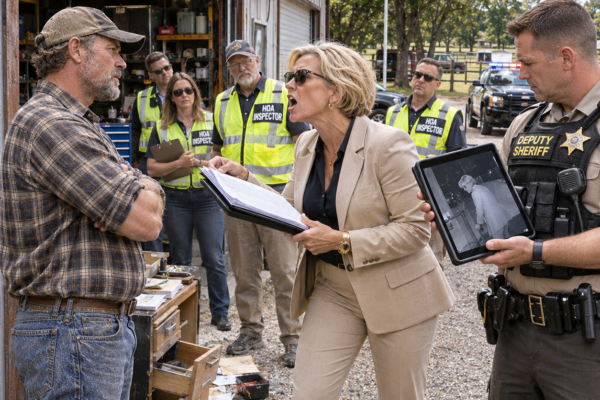
“Your Honor, we’d like to present the authenticated security recordings.”
The association’s attorney objected again.
He argued that the footage had been recorded without his client’s volunteers’ consent and questioned whether the files had been altered.
Denise had anticipated both points.
The camera installer testified about the equipment and its placement.
I testified about how I downloaded and preserved the files.
The original timestamps and file records were available for examination.
The cameras showed visible areas of my own property, not the interior of anybody else’s home.
They recorded video, without secretly capturing private conversations.
After considering the foundation and objections, the judge permitted the relevant footage to be shown.
The lights dimmed.
The first recording appeared on the courtroom monitor.
At 2:13 a.m., three men walked across my lawn.
Dale Hargrove stepped onto my porch.
He pressed the doorbell.
Pressed it again.
And kept pressing.
The next recording showed Martin Phelps dragging the rake through Susan’s flower beds.
The third showed the man carrying the chain.
He walked toward the camera.
Looked directly into it.
Smiled.
Then dragged the chain across the stone walkway.
Nobody spoke.
The footage didn’t need dramatic music or an angry narrator.
It showed exactly what happened.
Denise paused the video on Dale’s face.
Then looked toward the witness stand.
“Mr. Hargrove, is that you?”
Dale stared at the screen.
“Yes.”
“Did you testify a few minutes ago that you didn’t visit Mr. Benson’s property after midnight?”
He swallowed.
“Yes.”
“Then why are you standing on his porch at 2:13 in the morning?”
He looked toward Marjorie.
She stared at the table.
Dale opened his mouth.
Then closed it.
For the first time in six years, I watched one of Marjorie’s officers run out of explanations.
And the trial wasn’t over.
Marjorie testified the following afternoon.
She insisted the safety officers had acted independently.
She claimed she hadn’t known about the nighttime visits.
She described my refusal to join Pine Hollow as an unfortunate source of misunderstanding.
Then Denise showed her the patrol assignments.
The scheduled visits.
The compliance notices.
The emails instructing volunteers to increase pressure on nonmembers.
Marjorie acknowledged the messages but claimed she’d never authorized vandalism.
Denise didn’t ask the jury to believe that every patrol instruction was an explicit order to destroy property.
She showed how the campaign had been organized, how the association had continued after repeated warnings, and how its volunteers had acted while carrying out assigned HOA activities.
Then the judge asked the question that stayed with me.
“Mrs. Bell, after Mr. Benson produced his deed and the recorded subdivision declaration, what legal basis did the association have for continuing to demand his membership?”
Marjorie looked toward her lawyer.
For years, she’d answered that question with speeches about community standards.
Now those speeches wouldn’t help.
She couldn’t identify a recorded covenant binding my land.
She couldn’t produce a signed membership agreement.
And she couldn’t explain why a private association believed its volunteers could enter a nonmember’s property at two in the morning.
The jury deliberated after the evidence and closing arguments were complete.
I sat beside Hannah in the hallway.
We talked about nothing important.
The weather.
Her work schedule.
Whether Daniel could bring the children over the following weekend.
Anything except the verdict.
Then we were called back inside.
The jury found in my favor on the principal claims arising from the sustained trespass, harassment, and documented property destruction.
The damages totaled $200,000.
The award included compensation for established property damage and related losses, together with punitive damages reflecting the particularly serious intentional misconduct the jury found.
When the amount was read aloud, Hannah grabbed my hand.
I stared at the front of the courtroom.
Two hundred thousand dollars.
I knew I should have felt victorious.
Instead, I felt tired.
Six years of fighting had left me with damaged property, thousands of pages of paperwork, and memories of nights when I was afraid to answer my own door.
The money could repair the garden.
Replace the damaged landscaping.
Restore the walkway.
And cover losses I’d been forced to carry.
But it couldn’t give Susan back to me.
It couldn’t restore the peaceful retirement I’d imagined.
And it couldn’t erase six years of being treated like a criminal for refusing to join a private association.
The court entered judgment and granted narrowly tailored injunctive relief barring the association and its agents from further unauthorized entries, targeted harassment, and collection demands asserting the same nonexistent membership obligation.
Further violations of the injunction could expose the responsible parties to contempt proceedings and additional sanctions.
Pine Hollow was also required to cease the enforcement activity directed at my parcel.
The association’s safety officer program came under independent review, and evidence of potentially criminal conduct was referred to the appropriate authorities for separate consideration.
The civil verdict didn’t automatically make every volunteer a convicted criminal.
That determination belonged to the investigators and courts responsible for any separate criminal proceedings.
But the program Marjorie had used to intimidate me could no longer operate as though HOA badges gave ordinary residents police powers.
Within weeks, Pine Hollow’s board suspended the patrol program.
Marjorie resigned as president.
Several directors requested a full review of the association’s enforcement decisions, spending, and prior demands against neighboring owners.
The HOA remained in existence.
Its actual members were still subject to the valid covenants attached to their properties.
But older neighboring homeowners like me weren’t suddenly members because Marjorie had mailed them bills.
Other residents began seeking legal advice about incidents they’d previously been afraid to challenge.
Some contacted Denise.
Others retained their own attorneys.
I didn’t know how every claim ended.
And I didn’t need to.
For the first time in six years, my responsibility was no longer proving that I had a right to live in my own house.
It was making the house feel like home again.
The judgment was eventually satisfied through the necessary collection and payment arrangements.
I hired a reputable landscaping company.
They repaired the damaged ground, corrected the drainage, restored the walkway, and rebuilt the flower beds.
For the first time in years, I could spend money on repairs without wondering whether another HOA patrol would destroy the work.
Hannah and Daniel came home one weekend in October.
We spent Saturday replanting Susan’s garden.
Hannah brought daffodil bulbs.
Daniel repaired the wooden border beside the porch.
His children helped carry small bags of mulch, although most of the mulch ended up on their shoes.
At one point, Hannah knelt beside me and held up a bulb.
“Was this one of Mom’s favorites?”
I smiled.
“She loved all of them.”
“That’s not helpful, Dad.”
“Your mother never met a flower she didn’t think belonged somewhere in this yard.”
Hannah laughed.
Then she grew quiet.
“She’d be happy we’re doing this.”
I looked toward the porch.
“Yes,” I said. “She would.”
When the planting was finished, we sat outside with sandwiches and lemonade.
For the first time in years, nobody mentioned the HOA.
Nobody discussed court dates.
Nobody asked whether there had been another incident during the night.
We talked about the children, Thanksgiving plans, and whether the old maple tree needed trimming.
Ordinary family things.
Things I’d nearly forgotten how to enjoy.
The following spring, the daffodils came up.
I was standing at the kitchen sink when I noticed the first yellow flowers beyond the walkway.
I put down my coffee and went outside.
The lawn was green.
The windows were intact.
The stone path had been restored.
A few birds were hopping through the flower beds.
And the front door was quiet.
No pounding.
No repeated ringing.
No yellow compliance notice.
No stranger in a reflective vest telling me my own home belonged under somebody else’s rules.
I sat on the porch steps and looked at the flowers.
For six years, I’d believed that winning meant forcing Marjorie Bell to admit she was wrong.
In the end, I didn’t need her admission.
The recorded property documents had always established my position.
The cameras had shown what her officers were doing.
And the court had held the responsible parties accountable.
The $200,000 mattered.
The injunction mattered.
But the thing I appreciated most was something I’d once taken for granted.
Peace.
I could sleep through the night.
I could maintain my home without worrying that someone would tear it apart.
And I could watch flowers grow in the same garden Susan had loved.
I looked toward the stone walkway we’d built together.
Twenty-seven years of memories had survived six years of bullying.
Marjorie had tried to make me regret refusing her HOA.
Instead, she taught me something I’d never forget.
An association can enforce the rules it’s legally authorized to enforce.
It cannot invent ownership.
It cannot turn volunteers into police officers.
And it cannot destroy a man’s property simply because he refuses to join.
I picked up my coffee and settled into the porch chair.
The morning was quiet.
The daffodils moved gently in the breeze.
And for the first time in six years, I wasn’t waiting for someone to ring my doorbell.