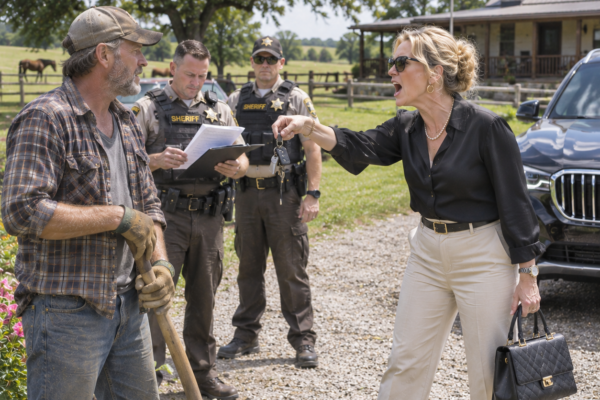
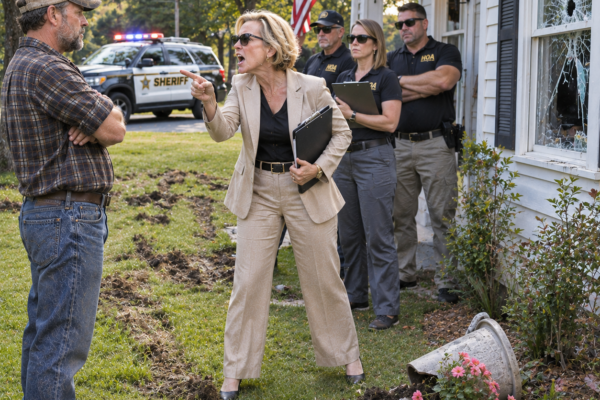
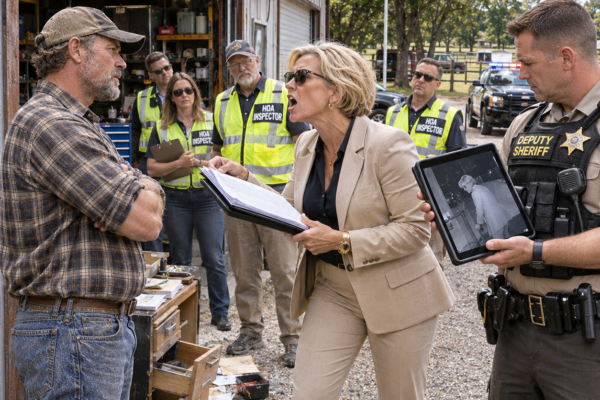
The HOA President Sent Three Men in Fake Police Vests to My House Because We Ignored Her “Compliance Orders.” One Knocked My Wife’s Phone Away and Slapped Her When She Started Recording. They Thought I Was Just Another Homeowner They Could Scare—Until I Stepped Onto the Porch, Studied Their Badges, and Asked One Question None of Them Could Answer.k
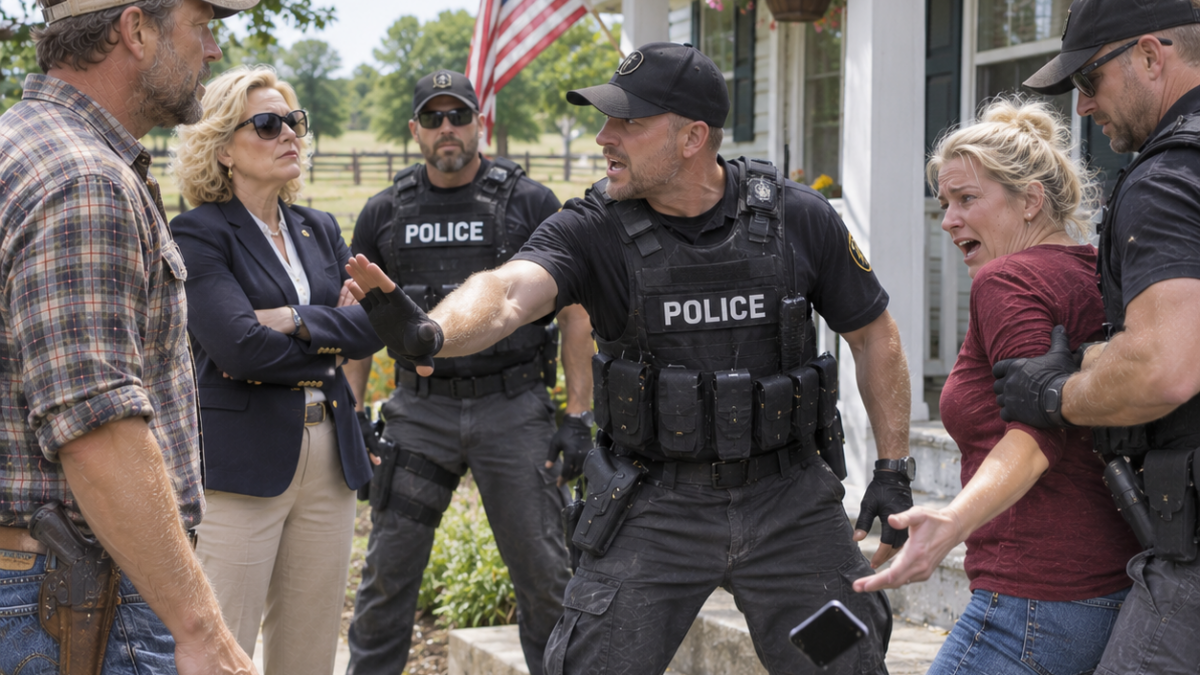
The HOA President Sent Three Men in Fake Police Vests to My House Because We Ignored Her “Compliance Orders.” One Knocked My Wife’s Phone Away and Slapped Her When She Started Recording. They Thought I Was Just Another Homeowner They Could Scare—Until I Stepped Onto the Porch, Studied Their Badges, and Asked One Question None of Them Could Answer.
Sarah was watering the hydrangeas when the black SUV came around our block for the third time.
She noticed because our street didn’t get much traffic.
Twelve houses.
One entrance.
A cul-de-sac at the far end.
If you passed our place three times, you were either lost or looking for somebody.
The SUV stopped across from our driveway.
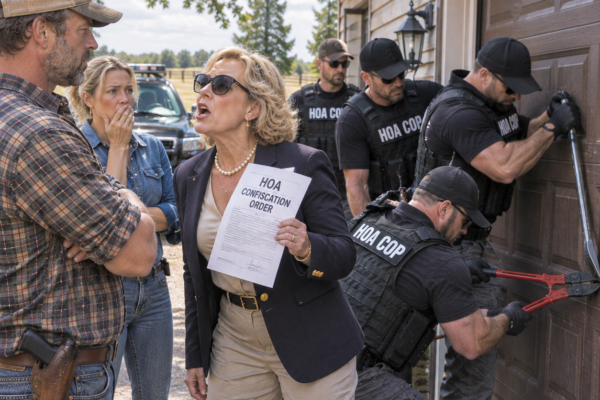
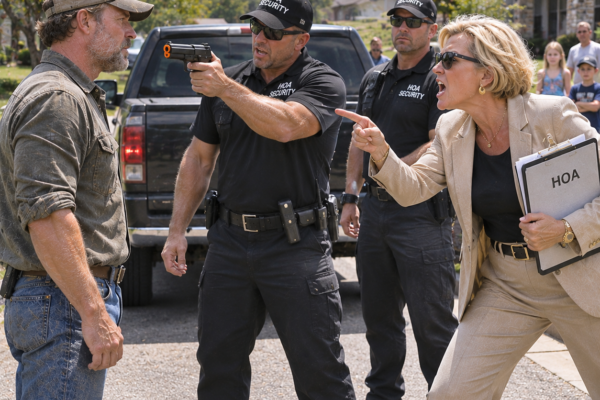
Three men got out.
Dark tactical vests.
Black pants.
Badges on their chests.
At first glance, they looked like police.
At second glance, they looked like men who wanted people to think they were police.
Sarah saw it immediately.
Cheap nylon belts.
Plastic-looking holsters.
No shoulder microphones.
No marked vehicle.
No visible agency name.
The tallest man crossed our lawn without knocking at the gate.
“Ma’am. HOA compliance inspection.”
Sarah set down the hose.
“Which police department are you with?”
He flashed a badge so quickly she couldn’t read it.
“We’re authorized enforcement.”
“That wasn’t my question.”
Another man smirked.
“We are the authority today.”
That was when Sarah took out her phone.
“Then I’m recording.”
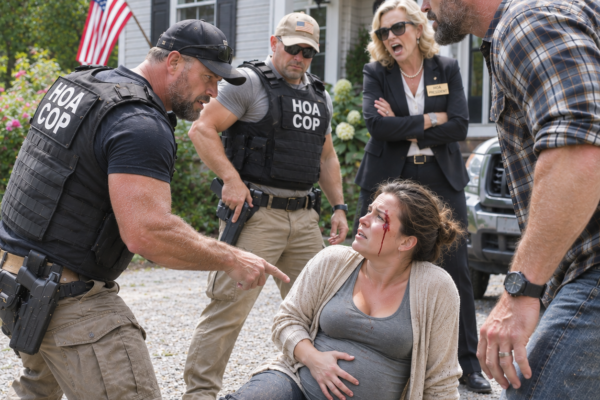
The third man stepped forward and knocked the phone from her hand.
It hit the walkway.
Sarah bent to retrieve it.
He slapped her across the face.
I heard her yell from inside the garage.
By the time I reached the side door, Sarah was standing beside the flower bed with one hand against her cheek.
Three strangers in tactical vests were inside my fence.
Everything in me went still.
I spent twelve years in the Navy, most of them in special operations.
That part of my life had been over for a long time.
I didn’t advertise it.
No giant flag on the truck.
No SEAL stickers.
No stories at neighborhood cookouts.
I had learned something more useful than how to fight.
I had learned that once violence starts, control disappears quickly.
So I didn’t charge them.
I stopped ten feet away.
“Who struck my wife?”
The man nearest Sarah smiled.
“She interfered with an enforcement action.”
“Agency?”
The tall one answered.
“Community compliance police.”
“There is no such agency.”
His smile vanished slightly.
“We’re operating under HOA authorization.”
“Police department?”
No answer.
“Sheriff’s office?”
Nothing.
“State certification numbers?”
The shorter man reached toward the handcuffs clipped to his belt.
“Turn around.”
I didn’t move.
“Don’t touch those.”
He froze.
I looked at all three.
“You are on private property. My wife has told you to leave. I am telling you again. Walk back to your vehicle.”
The tall one pointed toward my pickup.
“Karen Ellis sent us because you’ve ignored repeated violations. The truck, the fence, the dogs—”
“Karen Ellis is an HOA president.”
“She has enforcement authority.”
“She has the authority contained in the covenants. She does not have a police department.”
Sarah had retrieved her phone.
The screen was cracked, but the camera still worked.
She was recording again.
The tall man noticed.
“Put that away.”
“No,” she said.
He moved toward her.
I stepped between them.
“Stop.”
For the first time, all three hesitated.
Not because I had announced my past.
I hadn’t.
Because their bluff depended on us behaving as though their uniforms made them legitimate.
I asked the tall man:
“What agency issued your badge?”
He stared.
“What is your badge number?”
Nothing.
“Who is your supervisor?”
Silence.
“Dispatch frequency?”
His face changed.
That was the question.
Real law enforcement officers could answer basic questions about who they worked for.
These men couldn’t.
Sarah said quietly:
“I already called the sheriff.”
The shortest man looked toward the SUV.
The leader swore.
Then he made another mistake.
He looked straight into Sarah’s camera and said:
“Karen told us you people needed to be scared into cooperating.”
Twenty-three minutes later, two real Brunswick County sheriff’s cruisers turned onto our street.
By then, the three men had backed toward their SUV.
They didn’t get far.
Deputies separated everyone, recovered the fake badges, photographed the tactical vests, and took Sarah’s statement.
One deputy watched her video twice.
Then he looked at me.
“You know these men?”
“Never seen them before.”
“Any idea why they’re here?”
I pointed toward the leader.
“He says Karen Ellis sent them.”
The deputy turned.
“Karen Ellis from Harbor Ridge HOA?”
The man’s face told us more than his answer did.
That evening, sheriff’s investigators searched the SUV under lawful authority.
Inside they found printed HOA violation notices bearing Karen’s name, three prepaid debit cards, a handwritten list of addresses, and a typed instruction sheet.
My address was first.
Beside it were four words:
MAKE HIM TAKE US SERIOUSLY.
That was when the story stopped being about three idiots wearing fake badges.
Because there were five more addresses below mine.
Part 2:
Sarah was watering the hydrangeas when the black SUV came around our block for the third time.
She noticed because our street didn’t get much traffic.
Twelve houses.
One entrance.
A cul-de-sac at the far end.
If you passed our place three times, you were either lost or looking for somebody.
The SUV stopped across from our driveway.
Three men got out.
Dark tactical vests.
Black pants.
Badges on their chests.
At first glance, they looked like police.
At second glance, they looked like men who wanted people to think they were police.
Sarah saw it immediately.
Cheap nylon belts.
Plastic-looking holsters.
No shoulder microphones.
No marked vehicle.
No visible agency name.
The tallest man crossed our lawn without knocking at the gate.
“Ma’am. HOA compliance inspection.”
Sarah set down the hose.
“Which police department are you with?”
He flashed a badge so quickly she couldn’t read it.
“We’re authorized enforcement.”
“That wasn’t my question.”
Another man smirked.
“We are the authority today.”
That was when Sarah took out her phone.
“Then I’m recording.”
The third man stepped forward and knocked the phone from her hand.
It hit the walkway.
Sarah bent to retrieve it.
He slapped her across the face.
I heard her yell from inside the garage.
By the time I reached the side door, Sarah was standing beside the flower bed with one hand against her cheek.
Three strangers in tactical vests were inside my fence.
Everything in me went still.
My name is Daniel Mercer.
I was forty-eight when three fake officers showed up at our home in Harbor Ridge, a quiet development outside Southport, North Carolina.
Sarah and I had moved there four years earlier.
We chose Harbor Ridge precisely because nothing happened there.
No nightlife.
No through traffic.
No drama beyond whose pine needles blew into whose yard.
I had spent enough of my younger life in places where something was always happening.
I joined the Navy at nineteen.
Eventually made it into special operations.
Twelve years total.
Enough deployments that airports started feeling more familiar than living rooms.
I left before I turned thirty-two.
Not because of one dramatic injury or secret mission.
I was tired.
Tired of leaving.
Tired of watching Sarah build a life around uncertainty.
We had been married three years when I separated.
She never once asked me to leave the Navy.
That somehow made leaving easier.
Afterward, I went into logistics and security consulting.
Boring work compared with what people imagined a former SEAL should do.
I loved it.
Spreadsheets.
Warehouses.
Risk assessments.
Training plans.
Home for dinner.
My military background rarely came up.
Harbor Ridge certainly didn’t know much about it.
A couple neighbors knew I had served.
Nobody knew details.
I preferred that.
Then Karen Ellis became HOA president.
Karen was fifty-six and had lived in Harbor Ridge for almost a decade.
Before her presidency, I barely noticed her.
She organized holiday decorations.
Managed the clubhouse reservation calendar.
Complained about people leaving trash cans visible after collection day.
Ordinary HOA stuff.
Then she won a board election by promising “consistent enforcement.”
Within two months, Harbor Ridge changed.
Warning letters became fines.
Fines became hearings.
Hearings became public lectures.
Karen liked the phrase:
Rules are only rules if everyone is afraid to break them.
That sentence told me everything.
Sarah disliked her almost immediately.
I tried to ignore her.
Our first violation involved my pickup.
Ford F-250.
Dark blue.
Clean.
Registered.
Parked in our driveway.
Karen sent a notice saying “oversized commercial-style vehicle” could not remain visible overnight.
I checked the covenants.
The restriction applied to commercial vehicles displaying business markings or equipment.
My truck had neither.
I emailed the board.
Please identify the covenant provision applicable to a privately registered unmarked pickup.
Karen responded:
The board has discretion to interpret visual-impact concerns.
I replied:
Please provide the board vote adopting that interpretation.
No answer.
A week later, a $100 fine appeared on our account.
I appealed.
At the hearing, treasurer Melissa Grant asked Karen where the authority came from.
Karen said:
“We cannot draft covenants for every possible loophole.”
Melissa answered:
“Then we cannot fine people for provisions that don’t exist.”
The fine disappeared.
Karen did not forget.
Next came our fence.
We replaced a damaged rear section.
Same height.
Same style.
Same material.
City permit where required.
Architectural request filed because Harbor Ridge required one.
Thirty days passed without a response.
The covenants said applications were deemed approved after thirty days unless the committee issued a written denial.
On day thirty-two, our contractor started.
Day thirty-four, Karen arrived with a stop-work notice.
“Unauthorized fence.”
I showed her the rule.
She said:
“That clause does not apply when the board has concerns.”
“Where does it say that?”
“I’m telling you how it is interpreted.”
“Then send me that interpretation in writing.”
Her mouth tightened.
“You seem to enjoy challenging everything.”
“No. I enjoy reading what I signed.”
The fence stayed.
Then came the dogs.
Ranger and Scout.
Both Labrador mixes.
Ranger was trained as Sarah’s medical-alert service dog after she developed a cardiac rhythm condition several years earlier.
Scout was just Scout.
The HOA received an anonymous complaint that “large military-style dogs” created fear.
I still don’t know what a military-style Labrador looks like.
Ranger wore a service harness.
Scout carried tennis balls like classified documents.
Karen demanded we remove one because Harbor Ridge limited homes to two domestic pets.
We had two.
She then claimed Ranger should count as “special equipment” rather than a pet, making Scout our second animal and somehow creating an extra violation.
That logic didn’t survive the HOA attorney reading it.
By then, Karen had lost three fights with us.
That was when things became personal.
She started parking near our house.
Once Sarah saw her photographing our driveway at 6:20 in the morning.
Another time, Karen walked to our side gate and tried the latch.
I came outside.
“Can I help you?”
“Inspection.”
“From the street?”
“I need to see the backyard.”
“No.”
“HOA officers have inspection authority.”
“Show me the section allowing warrantless entry through a locked gate.”
She called me hostile.
I called her attorney.
Her attorney told her not to enter.
After that, we received written notices only.
Most were weak.
Trash container visible for forty minutes after pickup.
Garden edging color.
A portable basketball hoop used by our nephew for a weekend.
Sarah started a binder.
Every letter.
Every email.
Every photograph.
Every response.
She labeled it:
KAREN’S HOBBY.
I laughed the first time I saw it.
Three months later, that binder mattered.
The week before the fake officers arrived, Karen sent a certified letter.
FINAL COMPLIANCE DEMAND.
It listed four alleged violations.
Pickup.
Fence.
Dogs.
“Hostile resistance to authorized inspections.”
The last one wasn’t even a covenant violation.
At the bottom:
Failure to comply may result in enhanced enforcement measures, including outside compliance resources.
I emailed the HOA’s management company.
Please define “outside compliance resources.”
The manager, Holly Price, replied:
We have not authorized any external enforcement vendor for your property. I am forwarding this to the board.
That was Thursday.
The men arrived Monday.
That morning, I had taken the day off.
Our garage shelves had become chaos.
Camping gear.
Old uniforms.
Tools.
Boxes we hadn’t opened since moving.
Sarah was outside watering plants.
I was sorting bins when I heard her say loudly:
“Get off our property.”
Then the sound of something hitting concrete.
Then her yell.
I moved toward the side door.
Old training does strange things to time.
People imagine it makes you aggressive.
For me, it did the opposite.
The first thing training taught me was not to react to the first emotion.
Observe.
Hands.
Waistbands.
Distance.
Weapons.
Exits.
Three men.
No visible firearms I trusted to be real.
One baton.
One set of cuffs.
One canister clipped to a vest.
Sarah upright.
No blood.
Phone on ground.
I stopped ten feet away.
“Who struck my wife?”
The third man smiled.
“She interfered.”
That answer almost broke my restraint.
Almost.
I didn’t need to win a fight.
I needed Sarah safe and evidence intact.
“Agency?”
The tall man said:
“Community compliance police.”
No such agency existed.
“What department?”
“We’re authorized by Harbor Ridge.”
“Police department?”
He ignored me.
The shorter man stepped forward.
“You’re Daniel Mercer?”
“Yes.”
“You’ve been warned repeatedly.”
“Identification.”
He touched the badge.
“You can see it.”
“Agency name.”
No answer.
“Badge number.”
Nothing.
“Supervisor.”
Silence.
“Dispatch?”
The tall man’s eyes narrowed.
“You think this is funny?”
“No.”
“What do you do for a living, smart guy?”
“Not relevant.”
He pointed toward my truck.
“Karen Ellis says you’ve ignored lawful orders. Oversized vehicle. Unauthorized fence. Aggressive animals.”
“Karen Ellis is not law enforcement.”
“We’re contracted security.”
“Then stop representing yourselves as police.”
The third man said:
“Same difference.”
“No.”
Sarah had picked up her cracked phone.
She began recording.
The man who slapped her looked over.
“Put that away.”
“No.”
He started toward her.
I stepped between them.
“Stop.”
He stopped.
I didn’t threaten to break him.
Didn’t tell stories about deployments.
Didn’t announce I was a SEAL.
That would have accomplished nothing except making me sound like a man looking for a fight.
I said:
“You have been told to leave. Leave.”
The shorter man reached for his cuffs.
“Turn around.”
“No.”
“We’ll arrest you.”
“For what offense?”
“Obstruction.”
“Of what official duty?”
His hand stayed on the cuffs.
I kept mine visible.
“Do not touch me.”
That mattered later.
Sarah’s camera captured it.
Clear warning.
No aggression.
The tall man looked at her.
“You called someone?”
“Yes.”
“Who?”
“The sheriff.”
That was the first moment their confidence cracked.
The leader swore.
Then said:
“Karen told us you people needed to be scared into cooperating.”
Sarah caught every word.
They backed toward the SUV.
I didn’t follow.
My instinct wanted distance between Sarah and them more than I wanted to keep them there.
A fake officer can become a real threat quickly when his bluff collapses.
Sarah and I went onto the porch.
I told her:
“Inside.”
“I’m fine.”
“You were just hit.”
“I’m recording.”
“That’s exactly why you should record from inside.”
She gave me the look married people use when they intend to ignore sensible advice.
Then compromised by standing behind the locked storm door.
The men remained beside the SUV.
Maybe they expected Karen to call.
Maybe they thought leaving would look guilty.
Twenty-three minutes after Sarah called, two Brunswick County sheriff’s cruisers arrived.
Deputy Luis Herrera and Corporal James Nolan.
Both got out cautiously.
They saw tactical vests.
Badges.
Unknown status.
Nolan ordered everyone to keep hands visible.
I raised mine.
The three men hesitated.
That hesitation was not intelligent.
Nolan repeated the command.
They complied.
Sarah stepped onto the porch.
“Those three came into our yard claiming to be police. One hit me.”
Nolan looked at her cheek.
Red mark already forming.
He separated us.
That was proper.
He did not immediately assume my version was correct.
Herrera spoke with Sarah.
Nolan spoke with the three men.
Then with me.
“Did you touch any of them?”
“No.”
“Threaten them?”
“I told one not to touch my wife again if he moved toward her.”
“Any weapons displayed?”
“Not by me.”
“You armed now?”
“No.”
“Any guns in the house?”
“Yes.”
“Secured?”
“Yes.”
He nodded.
Then asked about my background.
I told him I had prior military service and security work.
I did not say more.
Sarah showed Herrera the video.
He watched.
Then called Nolan over.
They watched again.
The leader’s face changed while they listened to his own words.
Nolan walked to them.
“What law-enforcement agency employs you?”
They said they were security contractors.
“Why are you wearing badges reading POLICE?”
One claimed they said “special police.”
They didn’t.
The patch clearly said POLICE.
“State security license?”
One produced a private protective-services card.
Expired.
The other two had nothing.
“Who hired you?”
Silence.
Herrera held up Sarah’s phone.
“You already named Karen Ellis.”
The leader looked at the ground.
The deputies detained all three while they investigated.
Not dramatic.
No tackle.
No guns in faces.
Cuffs.
Pat-downs.
Separate cruiser seats.
The SUV was secured pending legal authority to search.
Sarah went to urgent care.
No fracture.
Bruising.
Small cut inside her cheek.
The phone screen was destroyed.
By evening, investigators had enough probable cause for charges related to assault, trespass, and impersonation under applicable North Carolina law.
The exact charging decisions belonged to the prosecutor.
That distinction mattered.
I wasn’t a lawyer.
I wasn’t going to announce on my lawn that impersonating a local officer was automatically some specific federal felony with a ten-year sentence.
Real law doesn’t work from internet slogans.
But it was serious.
Very serious.
Investigators obtained lawful authority to examine the SUV and associated evidence.
That was when the situation widened.
Inside:
Three tactical vests.
Fake police-style badges.
Plastic restraints.
A baton.
Printed Harbor Ridge violation notices.
Prepaid debit cards.
An envelope containing cash.
A typed list of six addresses.
Mine first.
Beside my name:
MAKE HIM TAKE US SERIOUSLY.
The other five belonged to Harbor Ridge residents.
The sheriff’s office contacted them.
Three reported previous confrontations with men claiming to be “HOA enforcement.”
One elderly homeowner said two uniformed men had stood on her porch and told her they could “cite” her if she didn’t remove a flagpole.
Another resident had paid $400 directly to avoid what he was told would become a “municipal compliance case.”
That money never appeared in HOA accounting.
Now we had something larger than an assault.
The next morning, Harbor Ridge’s management company called an emergency board meeting.
Karen attended.
So did Melissa Grant, board treasurer.
Secretary Paul Hensley.
Vice president Tom Avery.
The management company’s attorney joined remotely.
Sarah and I did not attend.
We weren’t interested in walking into a room with Karen while investigators were still sorting evidence.
Melissa later told us what happened.
Karen opened by claiming the three men were legitimate security contractors hired to “support compliance.”
The attorney interrupted.
“Who authorized the contract?”
Karen said executive enforcement authority allowed it.
The attorney asked:
“Under what section?”
Karen couldn’t identify one.
Melissa asked:
“Was there a board vote?”
Karen said no formal vote was necessary.
Tom asked:
“Where did the money come from?”
Silence.
That question became important.
The HOA books showed no payment to a security firm.
No contract.
No vendor onboarding.
No insurance certificate.
Nothing.
Yet the men had cash and prepaid cards tied to Karen’s instructions.
Investigators traced the cards through ordinary legal process.
They had been purchased using Karen’s personal funds.
The cash appeared to be hers too.
Then one of the men cooperated.
His name was Trevor Maddox.
Thirty-one.
Prior work as nightclub security.
No law-enforcement experience.
He told investigators Karen found them through a private social-media group used by event security workers.
She wanted men who “looked official.”
She allegedly told them not to carry firearms because she “didn’t want a legal headache.”
That sentence would have been funny if Sarah hadn’t been hit.
Trevor said the assignment was simple.
Visit selected homeowners.
Wear police-style gear.
Tell them the HOA had escalated enforcement.
Make them believe citations or arrests were possible.
Karen specifically described me as “the difficult military guy.”
She told them:
“Don’t let him turn it into a debate.”
The instruction for Sarah was worse.
If I wasn’t home, they were to pressure her into signing an acknowledgment that our fence and vehicle violated Harbor Ridge rules.
Sarah had never signed anything.
Trevor claimed nobody was supposed to be assaulted.
Maybe true.
Maybe self-serving.
The video showed one of them made that choice anyway.
Investigators obtained messages between Karen and Trevor.
Need them scared enough to stop challenging everything.
Another:
Badges help. People listen when they think consequences are real.
Then:
Do not say HOA security. Say compliance police.
That message ended Karen’s claim that the men had simply misunderstood her instructions.
The sheriff’s office interviewed her.
She brought an attorney.
That was sensible.
She stopped giving long explanations.
Also sensible.
The HOA board suspended her immediately.
Not because they had already proved every criminal allegation.
Because she had apparently hired unauthorized private contractors, used police-style impersonation as an enforcement tactic, and exposed the association to extraordinary liability.
Melissa became acting president.
Her first email to residents was short.
Harbor Ridge does not maintain, employ, or authorize any police force. No board member or contractor has authority to arrest residents or enter private property without lawful consent. Residents contacted by anyone claiming otherwise should call actual law enforcement.
I printed that one.
Sarah added it to Karen’s Hobby binder.
She changed the label.
EXHIBIT A.
I laughed for the first time in two days.
Then the civil side began.
Karen didn’t sue us that afternoon.
That part of stories like this usually makes no sense.
Lawsuits take preparation.
Instead, about three weeks later, after the board removed her from office, Karen filed a civil complaint against me.
Defamation.
Assault.
Intentional interference with contract.
Damage to reputation.
Her theory was that I had publicly portrayed legitimate private security contractors as criminals and used my military background to intimidate them.
The complaint had an immediate problem.
I had made almost no public statements.
I posted nothing online.
Sarah posted nothing.
We spoke to investigators and our attorney.
That was it.
The only widely circulated video came from a neighbor’s doorbell camera after police records became part of the public case.
Karen’s lawyer also alleged I had physically attacked the men.
Sarah’s video showed I had not.
My attorney, Rachel Morgan, read the complaint in her office.
Then looked at me.
“She has a version problem.”
“What’s that?”
“Her version is testable.”
Rachel had practiced civil litigation for twenty years.
She had zero interest in theatrical revenge.
I liked her immediately.
“What do we do?”
“We answer accurately. Then we counterclaim only where facts and law support it.”
“No giant ten-million-dollar demand?”
“If you want a giant meaningless number, hire somebody else.”
“I don’t.”
“Good.”
Our counterclaims focused on trespass, assault-related damages to Sarah, property damage, and civil claims arising from the coordinated harassment to the extent supported by state law.
We also demanded preservation of Karen’s communications with the three men.
Harbor Ridge’s insurer opened its own coverage investigation.
The HOA hired independent counsel.
That distinction protected the homeowners.
Karen had acted without board authorization.
The association still had exposure because she had used her position, HOA records, and resident information.
But whether insurance covered intentional personal conduct was another question.
Karen quickly discovered that “HOA president” was not a magic shield.
The criminal cases against the three men moved separately.
Trevor negotiated through counsel and cooperated.
The man who slapped Sarah, Raymond Pike, faced the most serious assault-related exposure in addition to impersonation charges.
The third, Scott Lyle, had fewer direct actions on video but still participated.
They were not held without bail forever.
They had bond hearings.
Conditions.
Court dates.
Normal process.
That was less dramatic than internet stories.
It was also real.
Karen’s own legal exposure developed more slowly.
Investigators reviewed messages, payments, resident complaints, and HOA records.
Eventually, prosecutors brought charges they believed the evidence supported.
I am deliberately careful describing that part.
Being angry at someone doesn’t let me decide what crime they committed.
That belongs to prosecutors and courts.
What mattered to Sarah and me was simpler.
Karen had sent men in fake police gear to our home.
One assaulted Sarah.
There was video.
There were messages.
There were payments.
There were other addresses.
The evidence did not need embellishment.
The civil hearing on Karen’s request for preliminary relief happened first.
Her lawyer asked the court to stop me from “publicly representing” Karen as the organizer of criminal conduct.
Rachel stood.
“My client has made no public statements.”
The judge asked Karen’s lawyer:
“What specific statement are you seeking to restrain?”
They cited Sarah’s statement to a neighbor that investigators had asked about Karen.
Rachel produced the actual recording from the doorbell camera.
Sarah had said:
“The sheriff is looking into who hired them.”
No accusation.
No name.
The request was denied.
Karen’s broader civil suit continued briefly.
Then discovery began.
That changed everything.
Rachel requested the text messages.
Payment records.
HOA notices found in the SUV.
The six-address list.
Board communications.
Karen’s deposition.
Karen’s attorney fought several requests.
The court narrowed some.
Allowed others.
When the text messages came in, her assault theory against me became impossible to maintain.
Sarah’s video showed me with hands visible.
No strikes.
No takedowns.
No knee on anyone’s back.
I never touched the men.
That was one of the biggest improvements over what might have happened.
I knew I could have hurt them.
That is not bragging.
It is why I chose not to.
Training does not create an obligation to use force.
It creates responsibility for knowing what force can do.
If a man had attacked Sarah again, I would have protected her.
But once they hesitated and backed away, chasing them would have turned defense into something else.
That line saved us later.
At my deposition, Karen’s lawyer asked:
“Mr. Mercer, were you attempting to intimidate these men with your military experience?”
“No.”
“You adopted what witnesses described as a combat stance.”
“I stood between strangers and my wife.”
“Did you tell them you were a Navy SEAL?”
“No.”
“Did you threaten to kill them?”
“No.”
“Disable them?”
“No.”
“Strike them?”
“No.”
“Restrain them?”
“No.”
“Did you prevent them from leaving?”
“No.”
“Then what did you do?”
“I asked who they worked for and told them to leave my property.”
There wasn’t much else to work with.
Sarah’s deposition was harder emotionally.
She had to describe being slapped.
The cracked phone.
The fear that the men might be armed.
The moment she saw me come outside and worried I would react.
Karen’s lawyer asked:
“Mrs. Mercer, did your husband appear angry?”
Sarah stared at him.
“A stranger had just hit his wife.”
The lawyer paused.
“So yes?”
“Yes.”
“Did that frighten you?”
“No.”
“What frightened you?”
“The men pretending to be police.”
That ended the line.
The HOA investigation produced another surprise.
Karen had created a spreadsheet titled Enhanced Compliance Targets.
Six homeowners.
Same six addresses found in the SUV.
Each had challenged Karen successfully.
Melissa Grant had questioned a landscaping fine.
Edwin Shaw had refused to pay a parking penalty later voided by counsel.
Mrs. Alvarez challenged a flagpole notice.
We challenged several things.
Karen had not randomly chosen difficult residents.
She had created a retaliation list.
The board’s reaction was immediate.
They commissioned a full review of enforcement actions during Karen’s presidency.
Thirty-seven fines were reversed.
Twelve homeowners received account credits.
Several warning letters were withdrawn.
The new board also discovered Karen had been using a personal email account for enforcement communications, making oversight harder.
That wasn’t automatically illegal.
It was terrible governance.
Melissa changed the policy.
No unofficial enforcement channels.
No individual board member directing contractors without written authorization.
No entry onto owner property except under covenant authority, consent, emergency law, or court order.
And, most obviously:
No badges.
No uniforms suggesting law enforcement.
No one thought that rule would ever need to be written.
Sarah insisted it did.
Months passed.
Our case did not end with a judge slamming a gavel after watching one dramatic video.
Real litigation moves slower.
Motions.
Discovery.
Depositions.
Insurance negotiations.
Criminal proceedings on a separate track.
Karen eventually dismissed most of her claims against me after her lawyer faced the evidence produced in discovery.
The remaining issues were resolved through settlement.
The exact dollar amount was confidential.
I can say Sarah’s medical expenses, phone replacement, counseling, legal costs allocated under the settlement, and additional damages were addressed.
Harbor Ridge’s insurer contributed to covered portions.
Karen made a personal contribution connected to claims arising from actions outside ordinary board authority.
The HOA did not collapse.
It did not need to.
Two hundred families should not lose their community because one president abused her position.
The board’s better decision was to fix the institution.
Karen was permanently removed.
Melissa became president through a regular election.
She hated the job.
That was probably why she was good at it.
At her first annual meeting, she said:
“If anyone here wants authority badly enough to enjoy having it, we should probably keep an eye on them.”
That made the room laugh.
Then she became serious.
“An HOA enforces covenants. It does not create police powers.”
Simple sentence.
Should never have been necessary.
Sarah’s cheek healed within days.
The emotional part took longer.
For several weeks, every dark SUV on our street got her attention.
She stopped gardening alone in the front yard.
Ranger started following her more closely.
Scout remained mostly concerned with squirrels.
I suggested cameras.
Sarah said:
“We already have cameras.”
“More cameras.”
“No.”
“Gate?”
“No.”
“Better lock?”
“Daniel.”
“What?”
“I’m not turning our house into a compound because Karen Ellis lost her mind.”
She was right.
That was another lesson.
You can win a dispute and still let the person change how you live.
Sarah refused.
So on a Saturday morning, she went back outside.
Same hydrangeas.
Same hose.
I sat on the porch and pretended not to watch.
She noticed.
“Go inside.”
“I’m drinking coffee.”
“You’ve been drinking the same cup for forty minutes.”
“It’s a large cup.”
She pointed the hose toward me.
I went inside.
That afternoon, Mrs. Alvarez walked over.
She was seventy-one and lived three houses down.
One of Karen’s compliance targets.
“They came to my house too.”
Sarah turned off the hose.
“The same men?”
“Two of them.”
“When?”
“Three weeks before yours.”
Mrs. Alvarez had not reported it because she believed they were legitimate.
They told her the HOA had authority to issue municipal citations for her flagpole.
They demanded $400.
She paid with a check made out to a name they provided.
Karen later denied knowing about the payment.
But messages tied the visit to her instructions.
Mrs. Alvarez cried when she realized she had been deceived.
Sarah hugged her.
That made me angrier than our own incident.
Karen’s tactic worked because most decent people assume uniforms mean something.
They assume badges mean accountability.
She exploited that trust.
Not just HOA authority.
Public authority.
That was why law enforcement took the impersonation seriously.
Corporal Nolan stopped by several months later.
Not officially.
His daughter was selling school fundraiser cookies.
Sarah bought six boxes.
I accused her of being irresponsible.
She bought two more.
Nolan stood on our porch.
“You know, your video made our lives easy.”
“Sarah’s video.”
“Fair.”
She handed him money.
He continued.
“The best thing you did was not put hands on them.”
I looked at him.
“I know.”
“Guys hear former SEAL and expect some action movie.”
“I’ve seen enough action.”
He nodded.
“If you’d hurt one while he was trying to leave, we’d have another issue to sort out.”
“That’s what I figured.”
Sarah said:
“I figured it too.”
Nolan smiled.
“She’s smarter than both of us.”
“Frequently.”
He left with the cookie order.
I thought about that conversation for days.
The version of the story people wanted was different.
Three fake cops arrive.
Former Navy SEAL beats all three.
Sheriff shows up.
Everyone applauds.
That story is satisfying for about thirty seconds.
It also teaches the wrong lesson.
My military background mattered.
Just not because it helped me hit people.
It mattered because I recognized inconsistency.
Bad gear.
Bad procedure.
No communication equipment.
No agency identification.
No answer to basic questions.
It mattered because I knew fear makes people rush decisions.
It mattered because I knew escalation is easy and control is hard.
The most useful thing I carried out of special operations wasn’t a technique.
It was discipline.
Karen counted on the opposite.
She wanted intimidation to produce emotional mistakes.
Residents yelling.
Paying.
Signing.
Submitting.
Anything except calmly asking:
What authority do you actually have?
That question destroyed her system.
A year after the incident, Harbor Ridge felt normal again.
My F-250 still sat in the driveway.
The fence remained exactly where we built it.
Ranger continued working as Sarah’s service dog.
Scout continued violating every known rule about personal space.
The HOA sent newsletters about pool hours and storm-drain maintenance.
Boring.
Wonderful.
One morning, I saw Melissa walking toward our house.
No clipboard.
No folder.
She stopped at the sidewalk.
“Am I allowed on the property?”
Sarah laughed from the porch.
“Depends. Got a badge?”
Melissa held both hands up.
“Nothing.”
“Come on.”
She joined us for coffee.
“I wanted to tell you the final compliance review is done.”
“How bad?”
“Worse than I hoped. Better than I feared.”
Thirty-seven fines reversed.
Several refunds.
No evidence anyone besides Karen on the elected board knew she had hired the fake officers.
That mattered.
I never wanted to believe the entire board planned it.
Melissa had opposed Karen repeatedly.
Paul had been largely passive.
Tom admitted he trusted Karen too much.
Failure, yes.
Conspiracy, no.
“What happens now?” Sarah asked.
“Training.”
I almost groaned.
Melissa laughed.
“Real training. Board authority. Fair housing. disability accommodation. Records. Due process.”
“And fake police?”
“That slide is one sentence.”
“What?”
“Do not create a police force.”
Sarah laughed so hard she nearly spilled coffee.
Melissa reached into her bag.
She pulled out the old final compliance demand Karen had sent us.
The one threatening “outside compliance resources.”
“We found this in her board file.”
“I have a copy.”
“Look at the handwritten note.”
At the bottom:
If Mercer wins another appeal, escalate outside normal process.
Karen’s handwriting.
Sarah stared at it.
That note bothered her more than the lawsuit.
Not because it changed anything legally.
Because it confirmed the attack wasn’t spontaneous.
Karen believed normal process had failed because normal process allowed us to win.
So she went outside it.
That is the danger with people who believe authority exists to guarantee their preferred outcome.
When rules work against them, suddenly rules become inconvenient.
We gave the original note to our attorney.
Melissa took the copy back for the association archive.
Harbor Ridge now maintains better records.
Every enforcement notice is tied to a specific covenant section.
Hearings are recorded in minutes.
Fines require board authorization where the documents require it.
Appeals go through a separate committee.
No single president controls the entire process.
Karen had concentrated too much power because people were tired of meetings.
That was the uncomfortable truth.
Residents wanted somebody to handle things.
Karen handled them.
For a while, that felt efficient.
Efficiency is attractive right up until the efficient person decides you are the problem.
I never joined the board.
Several neighbors asked.
No interest.
I had spent enough years inside chains of command.
Sarah considered it.
Then decided she preferred the garden.
Mrs. Alvarez joined instead.
That surprised everyone.
She was quiet.
Polite.
Seventy-one.
Karen had assumed she was easy to intimidate.
At Mrs. Alvarez’s first meeting, someone proposed increasing penalties for repeat parking violations.
She asked:
“Which covenant gives us that amount?”
The room went silent.
Then Melissa smiled.
“Excellent question.”
That became the new culture.
Show the rule.
Show the vote.
Show the authority.
If you can’t, stop.
Karen eventually sold her house.
She did not disappear into poverty.
She was not hauled away in front of the neighborhood in some dramatic finale.
Her criminal case moved through the justice system on its own timeline.
The men who came to our home resolved their cases through combinations of pleas, sentencing, and court supervision appropriate to their individual conduct.
Raymond, who struck Sarah, faced the most serious consequences among them.
Trevor’s cooperation affected his outcome.
I didn’t control any of that.
Nor should I have.
Karen’s legal consequences were also decided through process, not neighborhood revenge.
What I can say is that she lost the thing she valued most.
Authority.
No board seat.
No compliance letters.
No keys.
No ability to turn personal anger into official-looking orders.
The last time I saw her, she was loading boxes into a moving truck.
I drove past.
She looked at me.
I considered stopping.
Didn’t.
There was nothing left to say.
A week later, new owners moved in.
Young couple.
Two kids.
They came over with a plate of brownies.
That reversal made Sarah laugh.
“Usually the established neighbors bring food.”
“They’re proactive.”
Their names were Matt and Jenna.
Matt asked:
“Anything we should know about the HOA?”
Sarah and I looked at each other.
Then she said:
“Read the covenants.”
“That bad?”
“No.”
She smiled.
“That important.”
Good answer.
The black SUV from that day eventually came back to us in photographs through the case file.
One image showed it across from our house before the men got out.
Another showed the tactical vests laid on an evidence table.
Without people inside them, they looked cheap.
Costume-like.
Fake badges.
Velcro patches.
Plastic holsters.
All the authority had existed in presentation.
That fascinated me.
Uniforms matter because institutions stand behind them.
Take away the institution and you have fabric.
Karen understood the visual part of authority but not the moral part.
She thought looking official was enough.
For a few minutes, it almost was.
If Sarah had been less observant, she might have obeyed.
If Mrs. Alvarez had known what to ask, she might have kept her $400.
If the other residents had demanded identification, maybe the scheme would have ended earlier.
That is why Sarah and I eventually agreed to speak at one neighborhood safety meeting.
Not about Karen.
About verification.
If someone claims to be police and you genuinely doubt it, keep distance, avoid sudden movements, call the actual agency or 911 through a verified number, and let legitimate law enforcement resolve the issue.
Do not play detective.
Do not start a physical confrontation just because someone’s badge looks wrong.
Stay safe.
Document when safe.
That was the message.
Afterward, an older resident asked me:
“Were you ever scared?”
I answered truthfully.
“Yes.”
He looked surprised.
“But you were a SEAL.”
“So?”
“I just figured…”
“That training removes fear?”
He nodded.
“No.”
“What does it do?”
“Teaches you not to let fear make every decision.”
That is probably the best explanation I have.
When I saw Sarah holding her cheek, I wanted to hurt the man responsible.
That thought was immediate.
Human.
Training didn’t erase it.
Training gave me one second between feeling it and acting on it.
That second changed the entire story.
If I had attacked first, Karen would have had material.
Former commando assaults security contractors.
Violent homeowner.
Threatening veteran.
She would have used every word.
Instead, the video showed something else.
Three men entering.
Sarah questioning them.
Phone knocked away.
Assault.
Me arriving.
Questions.
Warnings.
Retreat.
Real deputies.
Evidence.
Clean sequence.
Sarah later told me that was when she knew we were going to be okay.
“When?”
“When you asked about their badge numbers.”
“Really?”
“Yes.”
“Why?”
“Because I thought you were going to punch somebody.”
“I thought about it.”
“I know.”
“How?”
“We’ve been married twenty years. Your ears turn red.”
Apparently elite military training cannot defeat marriage.
We still joke about that.
Not the slap.
Not Karen.
My ears.
That is how you know something terrible has finally become history instead of the present.
The hydrangeas survived too.
One of the men stepped on a plant during the confrontation.
Sarah complained about that longer than the cracked phone.
The following spring, she replaced it.
Purple blooms.
Biggest in the neighborhood.
Melissa walked past one morning.
“Those compliant?”
Sarah looked at her.
“Come measure them.”
Melissa kept walking.
Peace.
That was what we got back.
Not victory in the cinematic sense.
Peace.
A quiet street.
A pickup in the driveway.
Two dogs.
A garden.
A boring HOA.
No tactical vests.
No fake badges.
No one pounding on doors claiming powers they did not possess.
Sometimes I think about the sentence Karen wrote beside my name.
MAKE HIM TAKE US SERIOUSLY.
She succeeded.
Just not the way she intended.
I took the abuse of HOA authority seriously.
The sheriff took impersonation seriously.
The board took oversight seriously.
Residents took appeals and documentation seriously.
And Harbor Ridge finally took the difference between community rules and actual law seriously.
Karen wanted fear.
What she created was scrutiny.
That was much harder for her to control.
One evening, almost two years after the incident, Sarah and I sat on the porch.
Ranger was asleep beside her chair.
Scout was trying to carry two tennis balls at once.
The sun dropped behind the houses.
Sarah looked toward the driveway.
“You ever miss the Navy?”
“Sometimes.”
“What part?”
“The people.”
“Not the job?”
“Parts of it.”
She nodded.
Then:
“Did you ever think that part of your life would matter here?”
I understood what she meant.
“No.”
“But it did.”
“Not for the reason people think.”
She smiled.
“I know.”
My past did not matter because I could beat three men in a fight.
I never had to.
It mattered because years earlier, people had taught me that the loudest person in tactical gear is not automatically the person in control.
Sometimes control belongs to the person who stays calm enough to notice what doesn’t fit.
The missing radio.
The wrong badge.
The unanswered question.
The man pretending to have authority he cannot name.
Karen sent three fake cops to our home because she believed a costume could finish what her violation letters could not.
One of them hit my wife.
All three expected fear to do the rest.
Instead, Sarah picked up her phone.
I asked them who they worked for.
And twenty-three minutes later, the people with real badges arrived.
That was all it took to separate appearance from authority.
The rest was paperwork.
Remove the duplicated opening before Part 2Fix the contradictory investigation timeline