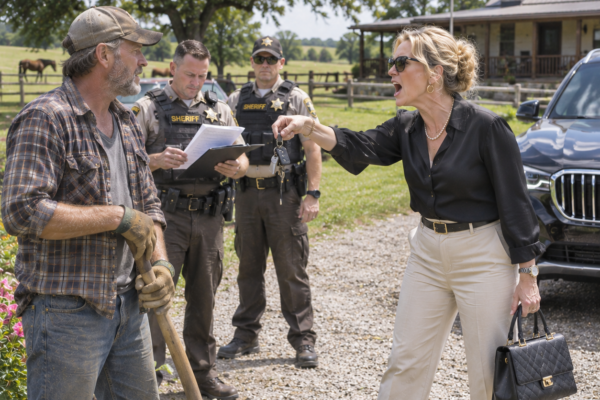
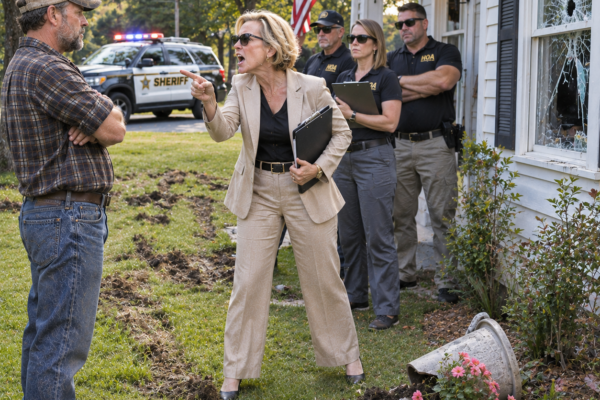
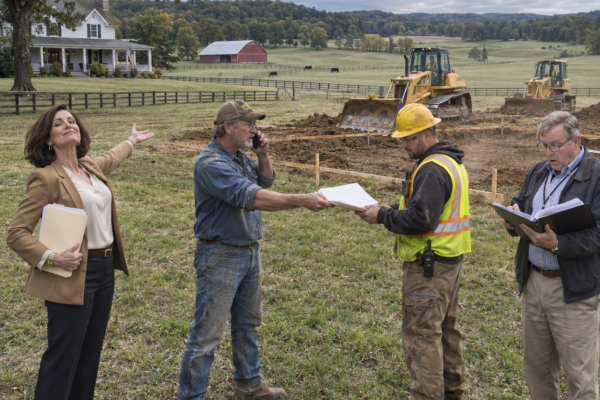
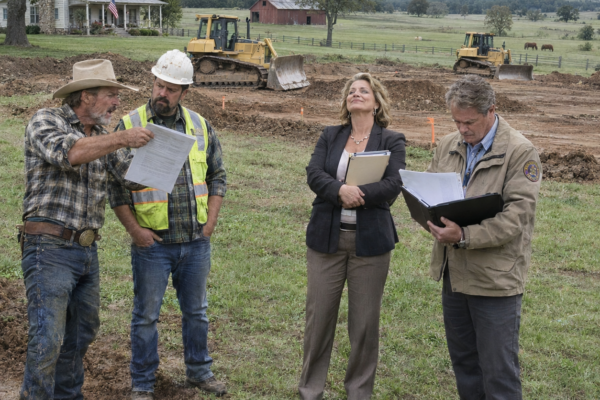
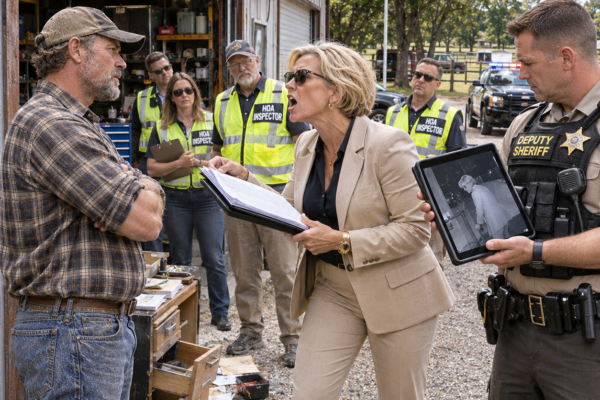
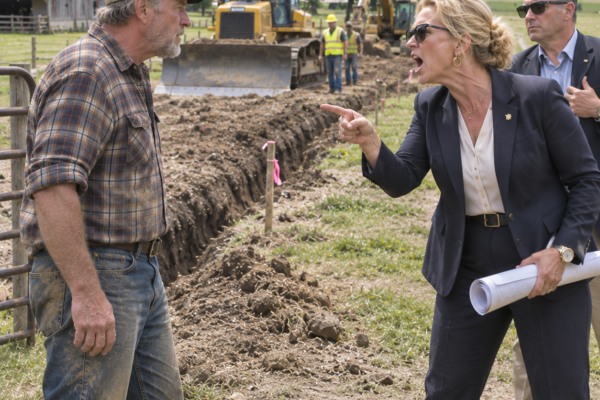
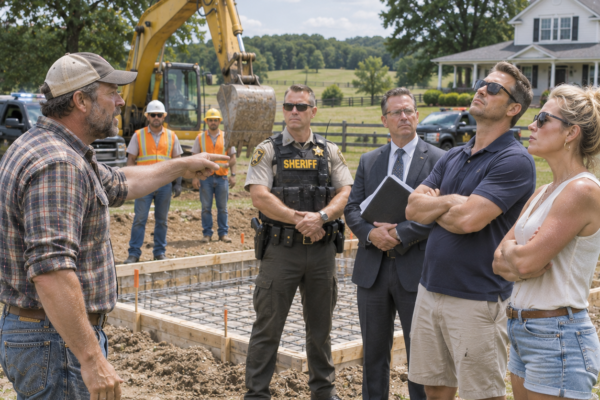
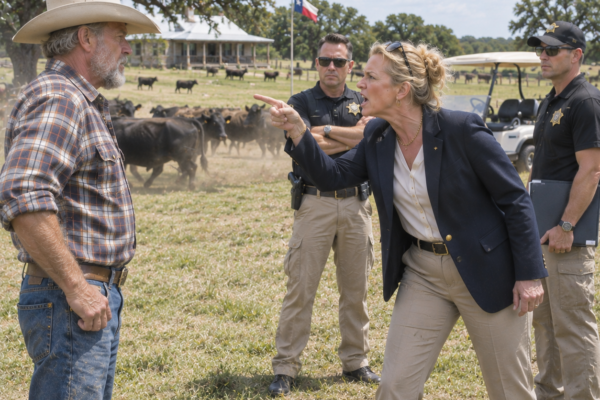
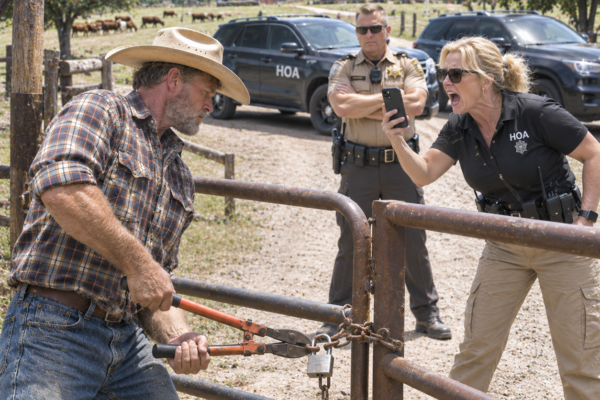
“Every Road Here Belongs to the HOA!” the Board Member Sneered as Three SUVs Patrolled My Family’s Private 20-Acre Property. I Showed Him the Boundary Markers and Called the Sheriff. Seven Days Later, Orange Barricades Blocked Our Only Driveway, a Sign Announced “CLOSED FOR HOA REPAIRS,” and My Elderly Father Couldn’t Leave. Then the Association President Arrived With Another Demand…k
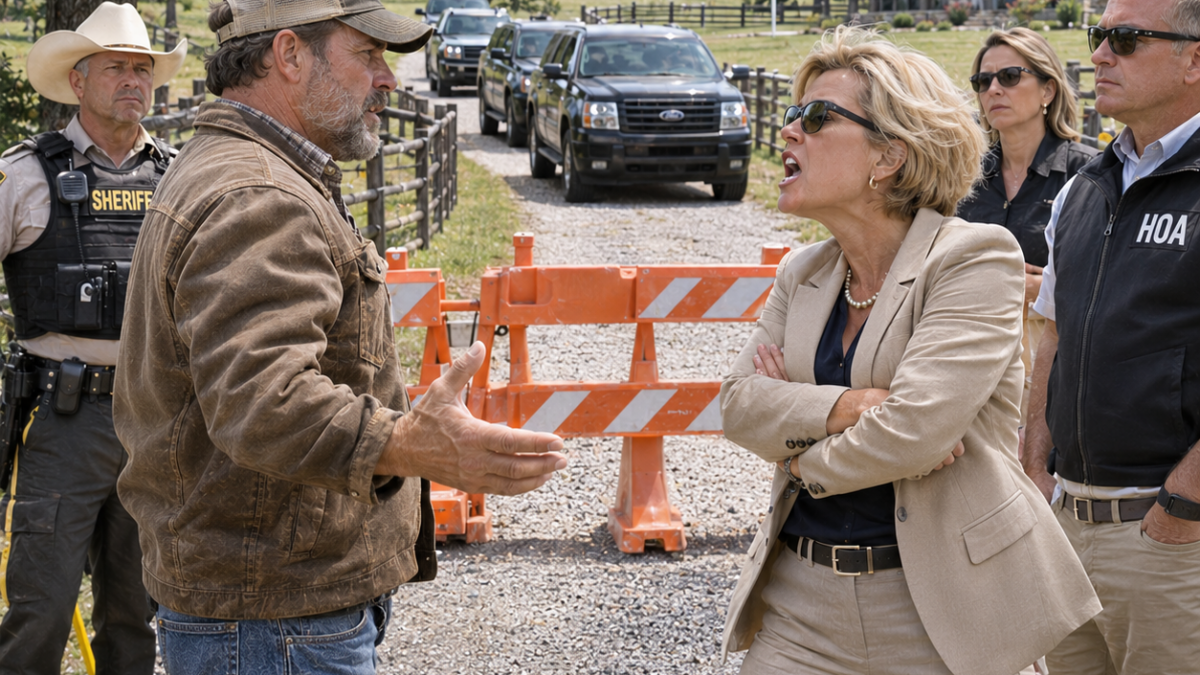
“Every Road Here Belongs to the HOA!” the Board Member Sneered as Three SUVs Patrolled My Family’s Private 20-Acre Property. I Showed Him the Boundary Markers and Called the Sheriff. Seven Days Later, Orange Barricades Blocked Our Only Driveway, a Sign Announced “CLOSED FOR HOA REPAIRS,” and My Elderly Father Couldn’t Leave. Then the Association President Arrived With Another Demand…
Part 1:
At 6:38 on a Tuesday morning, I found the only entrance to my family’s twenty-acre property blocked by orange traffic cones, a wooden barricade, and a sign that made me wonder whether somebody had completely lost their mind.
ROAD CLOSED — HOA MAINTENANCE.
There was one small problem.
The road belonged to my family.
Every foot of it.
My grandfather had built that winding driveway more than fifty years earlier, long before Cedar Bluff Estates existed. It began at the county road, climbed through oak trees and open grassland, and ended at the house where three generations of my family had lived.
Now someone had decided our private driveway was an HOA road.
My eighty-year-old father stood beside me, gripping the porch railing.
“Daniel,” he said, “how am I supposed to get to my appointment?”
I looked at the clock on my phone.
We had forty minutes to get him to the clinic.
And somebody had parked an HOA maintenance truck directly behind the barricade.
My name is Daniel Mercer. I’m fifty-three years old, and I live with my father on twenty acres in the Sierra Nevada foothills near Placerville, California.
My grandparents built our house in the early 1970s. My parents raised me there. When Mom passed away, I moved back to help Dad manage the property.
We didn’t have a fancy entrance.
Just a steel gate, an old gravel road, a few cattle fences, and enough open space to enjoy the quiet.
That quiet ended when Cedar Bluff Estates elected a new HOA board.
The president, Beverly Stanton, immediately announced stricter standards for fences, paint colors, holiday decorations, and neighborhood appearance.
Then her board began treating surrounding private land as though it belonged to the association.
The trouble started seven days before the barricade appeared.
I’d been repairing a water trough near the lower pasture when three white SUVs came driving up our private road.
Each displayed a magnetic Cedar Bluff HOA placard.
One stopped near the creek crossing.
Another pulled beside our equipment shed.
The third continued toward the house.
I followed them in my pickup.
Near the lower bend, I found a man standing beside one of the vehicles, studying the drainage ditch with a clipboard.
“Excuse me,” I said. “What are you doing on my property?”
He looked up.
“I’m John Haskins, chairman of the association’s roads committee.”
“That doesn’t answer my question.”
“We’re conducting a routine community-road inspection.”
“This isn’t a community road.”
John gave me a patronizing smile.
“Every roadway within the development area falls under HOA oversight, including privately maintained roads.”
I stared at him.
“Privately maintained isn’t the same as HOA-owned.”
He shrugged.
“Our responsibility is to protect the community.”
“Then inspect the community’s property. This road isn’t part of it.”
His expression hardened.
“Mr. Mercer, if you’re claiming an exemption, you’ll need to provide documentation.”
I pointed toward the private-property sign twenty feet behind him.
Then toward the surveyed boundary marker.
“My family’s owned this road for fifty years. You don’t get to drive through our gate and demand that we prove we own it.”
John folded his arms.
“There’s no reason to become aggressive.”
“I haven’t touched you. I’m asking you to leave.”
He looked toward the other vehicles.
Then back at me.
“I’m afraid that’s not your decision.”
I took out my phone.
“Then I’ll ask the sheriff to explain it.”
His smile disappeared.
I called the sheriff’s office and reported unauthorized vehicles on our private road.
John immediately ordered his companions back into their SUVs.
As they drove away, he rolled down his window.
“This inspection isn’t finished, Mr. Mercer.”
I followed at a safe distance until all three vehicles crossed our gate onto the county road.
Two deputies arrived shortly afterward.
They reviewed my property records, took my statement, and spoke with John and the association’s leadership.
I was assured the board had been warned not to enter our property without permission or lawful authority.
I thought that settled it.
Apparently, Beverly disagreed.
Because one week later, I woke up to find our driveway barricaded.
Dad was due at the clinic, and a truck was blocking his only vehicle route off the property.
I photographed the barricade and called the sheriff again.
Deputy Laura Bennett arrived twenty minutes later.
She stepped out, studied the sign, and looked at me.
“Mr. Mercer, didn’t we just deal with this?”
“That’s what I thought.”
She examined the road, the gate, and the maintenance truck.
Then she made a call.
A few minutes later, a black SUV turned off the county road.
Beverly Stanton stepped out carrying a folder.
She didn’t apologize.
She didn’t ask whether my father was all right.
She looked at the barricade, then at me, and smiled.
“Mr. Mercer, I’m glad you’re finally taking our authority seriously.”
I stared at her.
“You’re blocking an eighty-year-old man’s access to his doctor.”
She opened her folder.
“Your family has accumulated several violations. Until those are resolved, this road remains under association control.”
Deputy Bennett stepped forward.
“Mrs. Stanton, what legal authority do you have to close this driveway?”
Beverly pulled out a document.
And when she started reading it aloud, I realized the barricade wasn’t the end of her plan.
It was how she intended to force my family to submit to the HOA.
Part 2:
My father was standing beside the kitchen table in his good blue shirt when I told him somebody had blocked our driveway.
He looked up from the appointment card in his hand.
“Blocked it how?”
“Traffic cones. A wooden barrier. There’s an HOA maintenance truck parked across the entrance.”
Dad frowned.
“At our gate?”
“At our gate.”
He set the card down.
For a moment, he didn’t say anything.
Then he asked, “Do those people understand we live here?”
That was the part I couldn’t answer.
My name is Daniel Mercer. I was fifty-three years old, and I’d spent most of my life on the same twenty acres of California foothill country my grandparents purchased in the early 1970s.
The property sat outside Placerville, along a county road that wound through oak-covered hills, small vineyards, horse properties, and newer residential developments.
Our house wasn’t remarkable.
Three bedrooms.
A wide front porch.
A metal workshop.
An equipment shed.
And a long gravel driveway that climbed from the public road to the house through a stand of old black oaks.
The entrance road was entirely private.
It didn’t connect to another neighborhood.
It didn’t serve as access to anybody else’s home.
And there was no public thoroughfare through the property.
Granddad had built the original driveway using a borrowed grader and a dump truck full of gravel.
He’d cut a drainage ditch along the lowest section and installed a culvert where seasonal runoff crossed the approach.
Dad maintained it afterward.
When I was twelve, he taught me how to clear the culvert before the winter rains.
When I was sixteen, he taught me to operate the little tractor we used to smooth the gravel.
By the time I returned home after Mom died, maintaining that road was as familiar to me as mowing the grass.
Dad was eighty now.
His knees weren’t good, and an irregular heartbeat meant he had regular appointments in town.
He still enjoyed feeding the birds, checking the vegetable garden, and telling me I was doing things incorrectly even when I’d done them exactly as he’d taught me.
But driving long distances had become difficult for him.
That’s why I took him to the clinic.
And that’s why finding our only driveway blocked on a Tuesday morning was more than an inconvenience.
There was an eighty-year-old man behind that barricade who needed to get to his doctor.
The HOA apparently considered that less important than asserting its authority.
The trouble had started the week before.
I was working near the lower pasture when I heard vehicles approaching along our road.
That wasn’t normal.
Visitors usually called first, and delivery drivers came straight to the house.
These vehicles were moving slowly.
Stopping.
Backing up.
Driving around as though they were inspecting a commercial development.
I climbed into my pickup and followed the sound.
Near the creek crossing, three white SUVs had spread out along the lane.
Each displayed a Cedar Bluff Estates HOA placard.
One driver was photographing the drainage ditch.
Another had parked beside our equipment shed.
A third stood near the old fence line holding a clipboard.
I stopped.
“Can I help you?”
The man with the clipboard turned.
He was in his late fifties, wore a pressed polo shirt, and had the kind of expression that suggested he considered every question an interruption.
“I’m John Haskins. Chair of the Cedar Bluff roads committee.”
I nodded toward the vehicles.
“What’s your committee doing on my family’s driveway?”
“We’re conducting a routine inspection.”
“Of what?”
“Community road conditions.”
“This isn’t a community road.”
He smiled.
“All roads within the development area are subject to association oversight.”
I stared at him.
“My grandparents built this road before Cedar Bluff existed.”
“That doesn’t necessarily exempt it.”
“Exempt it from what?”
“Our responsibility to maintain community infrastructure.”
I looked behind him.
The driveway ran uphill toward our house.
Beyond the lower fence were our pasture and equipment shed.
There wasn’t a Cedar Bluff home anywhere along the route.
“John, this road doesn’t serve your subdivision.”
He sighed.
“Mr. Mercer, I don’t believe you understand how association jurisdiction works.”
I felt my jaw tighten.
“Then explain it.”
“We oversee access roads, drainage structures, and safety conditions throughout the community.”
“On property the association owns or has authority to manage.”
“On roads affecting the community.”
“That’s not the same thing.”
He looked impatient.
“If you have documents proving this isn’t subject to oversight, our board can review them.”
That annoyed me more than it should have.
My family had owned this land for fifty years.
We paid the taxes.
Maintained the road.
Repaired the fences.
And kept the drainage open.
Now a man who’d driven through our private gate without permission was demanding that I prove I had a right to tell him to leave.
I pointed toward the private-property sign at the entrance.
“There’s your first document.”
He didn’t smile.
“There’s no need to get confrontational.”
“I’m asking you to leave my land.”
“That’s not something you can simply order.”
I took out my phone.
“Then I’ll call the sheriff’s office.”
His expression changed immediately.
For a moment, he looked toward the other vehicles.
Then he raised his hand.
“All right, everybody. We’re leaving.”
He turned toward me.
“But this inspection isn’t finished.”
I didn’t answer.
I followed them down the road in my pickup, keeping a safe distance.
All three vehicles crossed our gate and turned onto the county road.
A few minutes later, two sheriff’s patrol vehicles arrived.
Deputy Laura Bennett took my statement.
She examined my deed, the parcel map, and the survey showing that the driveway lay inside our twenty-acre property.
I showed her photographs of the HOA vehicles.
She asked whether I’d authorized their entry.
“No.”
“Did they damage anything?”
“Not that I’ve found.”
“Did you ask them to leave?”
“Several times.”
Laura noted the details.
Then she said the deputies would contact the association and tell its representatives to stay off our property absent permission or lawful authority.
Before leaving, she looked toward the road.
“Mr. Mercer, keep the original property documents handy. And if somebody comes back after being told to stay out, call us.”
I thanked her.
I thought the warning would settle everything.
That was my first mistake.
The next day, a letter arrived from Cedar Bluff Estates.
It was printed on expensive stationery.
At the bottom was the name of the association president.
BEVERLY STANTON.
The letter claimed the roads committee had identified potential maintenance problems affecting community safety.
It instructed me to cooperate with future inspections.
It also warned that refusal to grant access could result in enforcement action.
I read it twice.
Then I called the management office.
A woman answered and transferred me to Beverly.
“Mrs. Stanton, I’m Daniel Mercer. Your roads committee entered my property without permission yesterday.”
Her voice was pleasant.
“Yes, Mr. Mercer. John told me you were quite upset.”
“I asked him to leave a private driveway.”
“He was doing his job.”
“Not on land your association doesn’t control.”
She gave a small laugh.
“Property ownership and community oversight are different things.”
“I agree. But neither gives your HOA an automatic right to patrol my road.”
There was a pause.
Then she said, “Mr. Mercer, I suggest you stop turning an ordinary maintenance issue into a legal confrontation.”
I looked toward the driveway.
“Then I suggest you tell your committee not to return.”
Her voice cooled.
“We’ll proceed according to our governing documents.”
She hung up.
I placed the letter in a folder and went back to work.
For six days, nothing happened.
Then came the barricade.
And that was when I realized Beverly hadn’t misunderstood my objection.
She’d decided she didn’t have to respect it.
At 6:38 the following Tuesday morning, I went outside to warm up the truck before taking Dad to his medical appointment.
The first thing I noticed was a flash of orange at the bottom of the driveway.
I thought somebody might have left a roadwork cone beside the county road.
Then I drove around the lower bend.
Six cones stood across our entrance.
A wooden barricade stretched between them.
Behind it was a small truck marked with Cedar Bluff maintenance decals.
And a plywood sign announced:
ROAD CLOSED — HOA REPAIRS.
I got out.
The barricade had been secured with heavy plastic ties.
Two cones stood on our private gravel.
The others were placed where the driveway met the public road.
There wasn’t a road crew in sight.
No equipment was running.
No excavations had been started.
But the arrangement prevented me from driving out without moving somebody else’s barricade and vehicle.
I took photographs before touching anything.
Then I called the sheriff’s office.
I explained that the same HOA warned about trespassing the previous week had now obstructed my only driveway.
I also mentioned Dad’s appointment.
The dispatcher told me deputies were on the way.
I walked back up to the house.
Dad was standing on the porch.
“What’s happening?”
“I called the sheriff.”
“Again?”
“Again.”
He shook his head.
“That John fellow?”
“Looks like his association’s decided they’re in charge of the road.”
Dad gave me a weary look.
“Your grandfather used to say that if somebody wanted to borrow a thing, they ought to ask before taking it.”
I smiled.
“He wasn’t wrong.”
Dad sat down slowly.
“I just don’t want a fight every time I need to leave the house.”
That sentence bothered me.
He wasn’t asking for much.
He wanted to attend his appointments, visit the grocery store, and take a drive through the hills when the weather was nice.
For fifty years, our driveway had been the most ordinary part of his life.
Now strangers were making it a source of anxiety.
Deputy Laura Bennett arrived twenty minutes later.
She parked on the county-road shoulder and walked toward the barricade.
She read the sign.
Then looked at me.
“Mr. Mercer, didn’t we deal with this last week?”
“That’s what I thought.”
She examined the location of the cones and photographed the maintenance truck.
Then she called the association’s management office.
I could hear only her side of the conversation.
“Yes, ma’am. I’m standing at the Mercer entrance.”
A pause.
“No, this is not an HOA road according to the property records I’ve been shown.”
Another pause.
“Then someone needs to come explain why the only access to a residence has been obstructed.”
She ended the call.
“President’s on her way.”
Beverly arrived in a black SUV.
She was a few years older than me, neatly dressed, with shoulder-length auburn hair and a leather folder tucked beneath one arm.
She stepped out and looked toward the barricade.
Then at me.
“Mr. Mercer, I understand you’ve involved law enforcement again.”
I stared at her.
“Your people blocked my driveway.”
She glanced toward Dad, who was standing near the porch farther up the lane.
Then she looked back at me.
“Maintenance sometimes causes inconvenience.”
“What maintenance?”
“The association is evaluating road safety.”
“Then evaluate roads you actually have authority over.”
Her expression tightened.
She turned toward Laura.
“Deputy, this road has been identified as part of the Cedar Bluff community-maintenance network.”
Laura remained calm.
“Do you have a recorded easement or agreement authorizing your association to close it?”
Beverly opened her folder.
She removed a copy of the HOA’s road-maintenance policy.
“The board approved this.”
Laura glanced at it.
“Ma’am, these are your association’s internal rules.”
“Correct.”
“They don’t show a right to occupy Mr. Mercer’s private driveway.”
Beverly looked offended.
“Our legal counsel has reviewed the policy.”
“Then counsel can provide the relevant property instrument.”
There was a pause.
Then Beverly said, “John may have misunderstood the precise maintenance boundary.”
I almost laughed.
Last week, John had insisted every road in the development area belonged under his committee’s oversight.
Now his president was suggesting he’d made a small administrative mistake.
I looked at her.
“Did John also misunderstand who owned the truck parked across my entrance?”
She ignored me.
Laura looked toward the maintenance vehicle.
“Who has the keys?”
Beverly called the management office.
A maintenance employee arrived in another truck about ten minutes later.
He moved the vehicle and removed the barricade at Laura’s direction while the deputy documented the circumstances.
Nobody needed to break anything.
Nobody got into a shouting match.
The road was clear.
But Dad had already missed the time we needed to leave.
I called the clinic and explained the delay.
Fortunately, they could see him later that morning.
As we drove down the now-open driveway, he looked toward the empty space where the barricade had been.
“Daniel?”
“Yeah?”
“Do those people know I helped build this road?”
“They don’t seem interested in who built it.”
He looked out the window.
“Maybe they ought to be.”
I didn’t know how to answer.
That afternoon, Laura called to tell me the deputies had spoken with the association’s leadership again.
The HOA had been warned that unauthorized entry and obstruction could result in further investigation and potential charges depending on the circumstances.
I thanked her.
Then I went outside and installed another private-property sign near the gate.
I thought that would finally end the matter.
It ended the barricades.
But Beverly found another way to make our lives miserable.
Three days later, the first violation letter arrived.
It accused us of failing to maintain roadside vegetation to Cedar Bluff standards.
The fine was $250.
I read it while standing beside the mailbox.
Then I looked down our driveway.
The oaks were healthy.
The drainage ditch was clear.
The gravel was in good condition.
Nothing had changed.
A second letter arrived two days later.
Improper fence style.
Another $250.
Then a third.
Nonconforming exterior storage near the road.
A fourth.
Unauthorized private-property signage.
A fifth.
Failure to provide access to HOA maintenance personnel.
By the end of the next two weeks, Beverly’s association had issued eight disputed citations.
Every one relied on the premise that Cedar Bluff could enforce its governing rules against land it didn’t own or otherwise control.
I requested the legal basis for each demand.
The management office sent copies of the association’s bylaws.
I requested the recorded instrument binding our parcel.
They sent a neighborhood map with a broad colored area labeled Cedar Bluff Community District.
My property appeared inside the colored background.
But the map wasn’t a deed.
It wasn’t a subdivision declaration.
And it didn’t show a valid easement over our driveway.
It was a marketing-style illustration.
I checked the map against the county’s recorded parcel information.
The HOA-owned common property ended well before our driveway began.
I forwarded the records to Beverly.
She replied with one sentence.
The board considers the matter closed unless you remit the outstanding fines.
I sat at the kitchen table staring at the email.
Then Dad came in carrying a cup of tea.
“Another letter?”
“Another threat.”
He looked tired.
“How much do they say we owe now?”
“Two thousand dollars.”
He shook his head.
“I’ve paid taxes on this place for half a century. What did I do to owe somebody two thousand dollars?”
“Nothing.”
He was quiet for a moment.
Then he asked, “Can they put something against the house?”
“They can threaten it. They can’t make an invalid claim legitimate by repeating it.”
He nodded, but I could see he wasn’t reassured.
That night, I found him at the dining table with the HOA letters spread in front of him.
He’d been adding the amounts on the back of an envelope.
When he noticed me, he tried to cover the paper.
I sat beside him.
“Dad, you don’t need to worry about paying these.”
He looked at me.
“They keep saying legal action.”
“I know.”
“I don’t want you spending your savings protecting a place your mother and I already paid for.”
I put my hand over his.
“That’s exactly why I’m not paying them.”
I realized then that Beverly’s campaign wasn’t merely annoying.
It was affecting an old man who should have been enjoying his retirement.
And if I wanted it to stop permanently, another telephone call to the sheriff wasn’t going to be enough.
The next morning, I drove to the El Dorado County Recorder-Clerk’s office with a cardboard box of family documents on the passenger seat.
I had copies of the deed.
The old subdivision maps.
The most recent survey.
And a yellowed folder Dad had kept since the 1980s.
The clerk who helped me, Elena Ortiz, pulled up the current parcel records.
I explained what Cedar Bluff was claiming.
She listened, then opened the subdivision’s recorded map.
“There,” she said, pointing to the eastern boundary.
Cedar Bluff Estates ended beyond a row of common-area landscaping and a narrow drainage strip.
Our property began farther uphill.
The driveway itself was entirely within our parcel, apart from its ordinary connection to the public road.
Elena showed me the recorded subdivision declaration.
Our legal description wasn’t included.
There was no later document adding our parcel.
No road easement in favor of Cedar Bluff.
No recorded agreement allowing the association to close or maintain our entrance.
I studied the documents.
“Could their board vote to bring our road under HOA control?”
Elena shook her head.
“A board resolution wouldn’t, by itself, convey an ownership interest or create a new easement over somebody else’s land.”
I nodded.
That was what I’d been saying since John first appeared with his clipboard.
But I wanted more than my own interpretation.
I requested certified copies of the relevant records.
Then I contacted Gail Navarro, a licensed surveyor who’d worked on rural properties throughout the foothills.
Gail came to our place the following Wednesday.
She was in her early sixties, wore a wide-brimmed hat, and moved around rough ground with the confidence of someone who’d spent decades reading the landscape.
We walked the boundary together.
She recovered two old survey monuments, verified the modern measurements, and checked where the driveway sat relative to the recorded property lines.
Dad came outside when we reached the lower gate.
He recognized one of the monuments.
“Your grandfather helped set that marker,” he told me.
Gail smiled.
“Well, whoever placed it did a good job. It’s still right where the records say it should be.”
Dad looked pleased.
It was the first time I’d seen him smile about the whole mess.
Gail completed the fieldwork and prepared her report.
It confirmed the roadway was private and located within our property, with no recorded HOA road easement identified in the title materials we’d supplied.
That didn’t decide every imaginable legal claim.
But it eliminated any reasonable basis for simply calling the driveway Cedar Bluff common property.
I sent the report to the association.
Three days later, Beverly responded.
The board does not accept your unilateral survey as dispositive of community jurisdiction.
I stared at the message.
A professionally prepared survey.
Certified land records.
Fifty years of tax history.
And Beverly called it unilateral.
I forwarded everything to an attorney.
Her name was Rachel Kim.
She practiced property and civil litigation in Sacramento and had represented homeowners in disputes involving easements, associations, and improper assessments.
I met her on a Friday morning.
Her office overlooked a busy street, and she had a habit of reading silently for several minutes before asking the question that mattered.
She examined the deed.
Then the recorded subdivision declaration.
Then Gail’s survey.
Finally, she reviewed the violation letters.
“Daniel, have you ever signed an agreement giving Cedar Bluff control of your road?”
“No.”
“Did your parents?”
“No.”
“Do you have any reason to believe a previous owner granted an easement?”
“My grandparents built the road. The title records don’t show one.”
Rachel nodded.
“Then the association is going to need much better evidence than an internal policy to justify what it’s doing.”
I leaned forward.
“Can we sue?”
“We can evaluate claims for trespass, interference with access, property damage, and other relief supported by the evidence. We should also demand that the association identify the legal basis for its fines.”
I handed her the photographs of the barricade.
Then the deputy’s incident information.
Then the eight letters.
She arranged them by date.
“Did they know your father lived there?”
“Yes. Beverly saw him standing outside when the barricade was up.”
“Was he able to reach his medical appointment?”
“Not at the scheduled time. The clinic accommodated us later.”
Rachel made a note.
“Save any records of the delay and expenses. And if the events are affecting your father’s health, document the actual impact rather than assuming the court will award a particular amount.”
I nodded.
She continued.
“I also want you to stop dealing directly with Beverly.”
“That won’t be difficult.”
“All communication goes through my office. If the association wants to assert authority, it can put the claim in writing and provide the recorded documents supporting it.”
Before leaving, I asked whether there was a California law automatically awarding homeowners a thousand dollars for every invalid HOA violation.
I’d seen that claim circulating online.
Rachel gave me a look.
“No. Don’t rely on internet summaries that promise automatic payouts. The remedies depend on the actual legal claims, statutes, governing documents, evidence, and circumstances.”
That was enough for me.
I didn’t want a made-up penalty to fight a made-up fine.
I wanted a legally defensible case.
Rachel sent the association a detailed notice.
It identified the property boundaries, described the unauthorized entries and obstruction, disputed the eight fines, and demanded that Cedar Bluff stop interfering with our driveway.
She requested preservation of the relevant communications, inspection records, board authorizations, contractor instructions, and financial documents.
She also warned that further interference might require emergency court relief.
For nine days, nothing happened.
Then I received a letter from the HOA’s attorney.
It stated that Cedar Bluff believed it possessed certain maintenance and community-safety responsibilities in the surrounding area.
It didn’t identify a recorded easement.
It didn’t explain how our parcel became subject to its architectural restrictions.
And it didn’t withdraw the fines.
Rachel read the letter.
Then looked at me.
“They’re keeping the claim deliberately broad.”
“Why?”
“Because the actual recorded documents don’t seem to support the specific authority they’re asserting.”
I thought about Dad sitting at the kitchen table with the fines.
“How do we make them stop?”
“We keep building the record. And we make it expensive for them to continue making unsupported demands.”
I drove home that afternoon feeling more determined than relieved.
A lawyer could help.
A survey could establish the boundary.
But none of that erased the anxiety Beverly had brought into our house.
Then something happened that changed the way I understood the dispute.
A Cedar Bluff homeowner called me.
Her name was Ellen Walsh.
She lived near the subdivision’s lower entrance and had served on its landscaping committee before Beverly became president.
“I hope you don’t mind me contacting you,” she said.
“Not at all.”
“I’ve heard what happened with your road.”
I waited.
Then she asked, “Did Beverly tell you the association had an agreement to use it?”
“She claims some kind of maintenance authority.”
Ellen sighed.
“Daniel, the board discussed your driveway last year.”
My grip tightened around the phone.
“What did they say?”
“They wanted another route for the maintenance trucks.”
I looked toward the lower pasture.
“Why?”
“Because the contractors complain about having to use the southern service entrance. It’s narrow, and they have to drive around the entire subdivision.”
I said nothing.
Ellen continued.
“Somebody suggested using your road as a shortcut. The management company told them they needed permission from the owner.”
“Which they never asked for.”
“Right.”
She hesitated.
“At least, not that I know of.”
I looked at the HOA letters spread across my desk.
So this wasn’t simply John misunderstanding a boundary.
The board had discussed our road before sending inspectors onto it.
And apparently someone had decided permission was optional.
Ellen agreed to speak with Rachel.
She also provided copies of meeting records she’d received as a homeowner while serving on the landscaping committee.
One agenda item was titled Alternative Maintenance Vehicle Routing.
It discussed congestion near Cedar Bluff’s southern service entrance and the possibility of obtaining temporary access through neighboring private land.
Our driveway was mentioned by location.
The management company’s recommendation was straightforward.
Before using the road, the association should obtain a written agreement from its owners.
No such agreement existed.
A later meeting summary said the board would continue exploring options.
Then Beverly took office.
Within months, John and his committee were driving patrol vehicles through our gate.
Rachel looked at the documents.
“So the association knew it needed permission.”
“Apparently.”
“And instead of asking, its roads committee began treating your driveway as part of the maintenance network.”
I shook my head.
“They could have knocked on our door.”
“Yes.”
“They could have explained what they wanted.”
“Yes.”
“They might even have made a reasonable offer.”
Rachel looked at me.
“Would you have agreed?”
I thought about the narrow bend, the culvert, and Dad’s need for safe access.
“Probably not for unrestricted truck traffic. But I would have listened.”
That was the difference Beverly never seemed to understand.
She treated every refusal as proof somebody was being uncooperative.
It never occurred to her that asking for permission was a necessary first step.
Rachel arranged the meeting records beside our other evidence.
Then she asked whether I had kept records of all the road incidents.
I had.
The first unauthorized patrol had involved three SUVs.
The second was the nighttime placement of the barricade and maintenance truck.
Then there had been a survey crew that stopped just inside the gate before I turned it away.
A landscape contractor who drove several hundred feet up our lane claiming he had an HOA work order.
And a fifth incident involving John himself, who returned with a camera and started photographing our drainage culvert despite the deputies’ warnings.
Each occurred after I’d expressly withheld permission.
Each was documented by photographs, witness statements, or camera footage.
By then, I’d installed two simple security cameras.
One covered the gate.
The other looked down the private road.
The recordings weren’t dramatic.
There were no car chases.
No threats with weapons.
Mostly, they showed people driving onto property where they’d been told not to go, then acting offended when I asked them to leave.
But those ordinary recordings mattered.
They established that the association knew the road was private and kept sending people anyway.
John’s final visit was particularly revealing.
He stood near the culvert with a measuring tape.
I approached on foot.
“John, what are you doing?”
He didn’t look up.
“Checking drainage compliance.”
“Under whose authority?”
“The association.”
“I’ve already sent your board the deed and survey. The sheriff’s office has warned you.”
He straightened.
Then said, “Mr. Mercer, you can’t expect us to abandon our responsibilities just because your family has been here a long time.”
I pointed toward the gate.
“You can abandon the part where you trespass.”
He closed his tape measure.
“You’re making a lot of enemies.”
I stared at him.
“I didn’t know owning my driveway was supposed to make me friends.”
He walked toward his SUV.
Then turned back.
“Mrs. Stanton isn’t going to be pleased about this.”
I looked at the camera mounted above the gate.
“She can watch the recording.”
That was the last time John personally entered our property.
But the fines continued.
The letters grew more threatening.
One described the unpaid assessments as a potential burden on my property’s marketability.
Another warned that the association reserved the right to pursue every legal remedy available.
Dad found that letter before I got home.
When I walked into the kitchen, he was sitting in his chair with his reading glasses on.
He held the notice in both hands.
“Daniel, can they take this place?”
“No.”
“Are you sure?”
I pulled out the chair beside him.
“They’d have to establish an actual legal claim. They haven’t.”
He nodded slowly.
Then he looked toward the window.
“When your mother was alive, she used to say nobody could ever make her leave this house.”
I felt something tighten in my chest.
“She was right.”
Dad lowered the letter.
“I don’t mind if they build their nice houses. I don’t mind if they drive their fancy cars. I just don’t understand why they won’t let us live here.”
That did it.
I’d been trying to stay calm for weeks.
I’d filed the documents.
Called the deputies.
Sent the surveys.
Written polite letters.
But hearing Dad say that made me realize the association had taken more than time and money.
It had made him uncertain about whether the home he’d helped build was safe from someone else’s demands.
I called Rachel the next morning.
“I’m done answering individual notices.”
She listened.
“I want this resolved.”
“Then we should prepare the civil claims and a comprehensive settlement demand.”
I gave her every photograph, repair invoice, incident report, medical appointment record, and recording I had.
We reviewed actual losses and the legal theories potentially available.
The estimate of our broader claims, including the disputed conduct and its consequences, was substantial.
Rachel prepared an initial demand totaling $116,000.
That number wasn’t eight automatic thousand-dollar penalties or some guaranteed statutory payout.
It was a litigation demand reflecting the categories of relief we intended to seek, subject to what could actually be proved and recovered.
Rachel explained the distinction carefully.
“Daniel, the initial demand is not a prediction of what a judge will award. Some claims are stronger than others. Some losses are easier to prove. The point is to put the association and its insurer on notice of the exposure created by the repeated conduct.”
I understood.
Then she asked what mattered most to me.
“An apology?” she said.
“That would be nice.”
“Money?”
“Enough to cover the expenses and make them take this seriously.”
“Anything else?”
I looked out toward the driveway.
“An enforceable commitment to leave our road alone.”
She nodded.
“That goes at the top.”
The demand went to Cedar Bluff’s counsel and the association’s registered management address.
It included the recorded boundaries, the incident chronology, documentation of the blocked appointment, the damaged gate hardware from repeated sign installations, the improper fines, and the correspondence showing the board had previously discussed the need to obtain permission.
For the first time since John arrived with his clipboard, the association stopped sending me violation letters.
Instead, its attorney requested a meeting.
Beverly attended with two board members and the management company representative.
Rachel and I sat across from them.
The HOA’s attorney opened with a carefully worded statement.
“The association believes this matter arose from a misunderstanding regarding maintenance responsibilities.”
I almost laughed.
Rachel spoke before I could.
“A misunderstanding might explain one incorrect inspection. It doesn’t explain repeated entry after notice, a barricade blocking the only residential driveway, and eight unsupported fines.”
Beverly folded her arms.
“John exceeded his instructions.”
I looked at her.
“John was chairman of your roads committee.”
“He wasn’t authorized to harass anyone.”
“Who sent the maintenance truck to my gate?”
She didn’t answer.
Rachel placed a document on the table.
It was the work order for the barricade installation.
The order described an HOA maintenance closure and identified the location as the Mercer driveway.
At the bottom was an approval field.
Beverly’s name appeared in it.
Her attorney leaned over and read the page.
Then looked at her.
“Beverly, did you approve this?”
She hesitated.
“I approved maintenance activities.”
“At this address?”
She glanced at the work order.
“I wasn’t aware of the precise location.”
I watched her.
The road had been the subject of our conversations for weeks.
I’d shown her the survey.
Deputies had already spoken to the association.
And now she was claiming not to recognize the address of the very property she kept fining.
The attorney set down his pen.
Then he asked the association’s management representative whether Cedar Bluff had any recorded easement or agreement over the driveway.
The woman shook her head.
“Not that we’ve located.”
The room became quiet.
Beverly looked toward John, who wasn’t present to defend himself.
Then she said, “We acted in the community’s best interest.”
Rachel leaned forward.
“Your community’s convenience does not create a property right over my client’s land.”
For once, Beverly had no immediate answer.
The meeting ended without a settlement.
But something had changed.
For the first time, the association’s own attorney was asking the same questions I’d been asking for months.
Where was the easement?
Where was the recorded authority?
Who approved the barricade?
And why did the HOA continue issuing fines after receiving a survey showing my driveway lay entirely outside its jurisdiction?
Two weeks later, Rachel called.
“The association has offered to settle.”
I was standing in the workshop replacing a worn belt on the lawn tractor.
“How much?”
“Eight thousand dollars, withdrawal of the fines, and a letter acknowledging the driveway is private.”
I leaned against the workbench.
“That’s half of what they’ve already cost me in money, time, and trouble, and it doesn’t account for what they put Dad through.”
“I know.”
“Did they agree to stop entering?”
“Not in language I’m satisfied with.”
“Then no.”
Rachel didn’t argue.
She knew I wasn’t trying to become rich from the dispute.
I wanted the association to understand that it couldn’t simply violate a boundary and offer a token payment when somebody challenged it.
Negotiations continued.
Cedar Bluff’s insurer reviewed the documented incidents.
The association’s independent counsel examined its recorded subdivision documents and financial records.
The board also reviewed the contractor instructions that had been issued during Beverly’s presidency.
Several homeowners learned about the dispute after the expenses appeared in the association’s reports.
One of them was Ellen Walsh.
She called me again.
“Daniel, there’s going to be a special board meeting.”
“About what?”
“The road inspections. The legal expenses. The fines.”
I waited.
Then she added, “A lot of residents aren’t happy.”
I looked toward the lower gate.
“Neither am I.”
Ellen sighed.
“Most of us moved here because we wanted a peaceful neighborhood. We didn’t buy houses so the HOA could harass a family living next door.”
That was the first time anyone associated with Cedar Bluff had said it so plainly.
The board meeting was held the following Thursday.
I didn’t attend.
Rachel advised that we had more to gain by letting the association address its internal failures without turning the meeting into another personal confrontation.
Ellen called afterward.
She told me the members had demanded answers about the legal bills and inspection expenses.
Beverly tried to explain that the board had been defending community safety.
But the minutes from the earlier access discussions contradicted the idea that the HOA had always possessed authority over my road.
The management company had explicitly recommended obtaining permission.
The survey showed the road wasn’t common property.
And the barricade had been installed after deputies had already warned the association to stay away.
A director named William Price asked the question that apparently ended the argument.
“If we knew we needed permission, why did we start using the road without it?”
Beverly had no satisfactory answer.
The directors voted to withdraw the unsupported fines.
They suspended further enforcement activity involving our parcel.
And they required legal review of any proposed access or maintenance work beyond the recorded boundaries of the association’s property.
Beverly was removed from the presidency under the association’s procedures after the directors reviewed the unauthorized work orders and her handling of the dispute.
John resigned from the roads committee.
Neither announcement made the local news.
There were no dramatic arrests.
No courthouse steps crowded with reporters.
But the people who had treated my family’s land as their personal inspection route no longer held the positions they’d used to justify that conduct.
That was enough for me.
A week later, Rachel called with the final proposed terms.
The association and its insurer would pay $16,000 to resolve the civil claims, including the agreed damages, expenses, and costs.
Every disputed fine would be canceled.
The HOA would provide written acknowledgment that our driveway was private and that it had no identified easement or management authority over it.
The association would agree not to enter, inspect, obstruct, or conduct maintenance activities on our property without our permission or a valid legal right.
It would also reimburse the specific repair items addressed in the settlement and issue a formal apology.
Rachel sent me the proposed agreement.
I read every page.
Then I asked her to clarify the provision concerning future access.
I wanted it to be unmistakable.
No more committee patrols.
No more cones.
No more homemade closure signs.
No more trucks parked across the entrance because somebody at the clubhouse thought it would be convenient.
Rachel revised the language with opposing counsel.
When the final agreement came back, I signed.
A few days later, the payment was issued as required by the settlement.
I deposited it and paid the outstanding bills.
The difference between our initial $116,000 demand and the $16,000 settlement didn’t bother me.
Litigation carried uncertainty, expense, and months of disruption.
We’d negotiated a practical resolution rather than gamble the family’s peace on the largest number in a demand letter.
More important, the HOA had formally acknowledged the boundary.
It had canceled the fines.
And it had committed to leaving our property alone.
The apology arrived on association letterhead.
I read it to Dad over breakfast.
He was stirring sugar into his coffee.
When I finished, he looked at me.
“Does that mean they’re done?”
“That’s what the agreement requires.”
“No more fines?”
“No more fines based on that claim.”
“No more people driving up and down our road?”
“Not without permission or lawful authority.”
Dad sat back.
Then he smiled.
“Good. I was getting tired of looking at that gate like it was a battlefield.”
I laughed.
“Me too.”
That afternoon, I took down the temporary camera I’d installed near the lower bend.
I kept the one at the gate.
There was nothing wrong with knowing who came onto our property.
But I didn’t want to spend the rest of my life checking every recording and wondering whether another HOA vehicle would appear.
The original private-property sign stayed.
I cleaned it, repainted the post, and tightened the bolts.
I also repaired the gouges left in the gravel where the maintenance barricade had been dragged across the entrance.
Dad came outside while I was working.
He carried an old photograph.
In it, my grandfather stood beside a much younger version of the same driveway.
The road was narrower then.
The oaks were smaller.
And the farmhouse looked almost new.
Dad handed me the picture.
“Your granddad took that the summer we finished the culvert.”
I examined it.
He was standing with one boot resting on a shovel, smiling at the camera.
Behind him was the wooden gate that had preceded our steel one.
“Looks like hard work,” I said.
“It was.”
Dad smiled.
“He spent three weekends getting the drainage right. Said if we built it properly, the road would still be there when his grandchildren were old.”
I looked toward the driveway.
“He wasn’t wrong.”
Dad was quiet for a moment.
Then he said, “You know what bothered me most about those HOA people?”
“What?”
“They never asked.”
I looked at him.
He continued.
“If they’d come up here politely and said they needed help getting a truck somewhere, I would have listened. Might’ve even helped them find another way.”
I nodded.
“But they came acting like the road belonged to them.”
“Exactly.”
He looked down at the photograph.
“Some folks don’t understand the difference between asking a favor and giving an order.”
That was the clearest explanation of the whole dispute I’d heard.
Beverly and John hadn’t merely mistaken a driveway for an HOA road.
They’d treated my family’s refusal as an offense.
They’d entered private land without permission.
Blocked our only access.
Ignored the recorded boundary.
And sent threatening fines because they believed their association title entitled them to control whatever lay nearby.
The recorded documents had never supported that belief.
Neither had the sheriff’s office.
And eventually, even their own association decided it couldn’t defend what they’d done.
Over the following months, life returned to normal.
Dad attended his medical appointments without seeing orange cones at the gate.
The landscapers from Cedar Bluff used their designated southern entrance.
The association still held meetings, maintained its streets, and sent newsletters to its members.
That was fine.
I had never wanted to destroy the neighborhood.
I wanted the HOA to manage what it was actually responsible for and leave everybody else’s property alone.
A few Cedar Bluff residents stopped by to apologize.
One brought a homemade peach pie.
Another offered to help me spread gravel near the lower bend.
I accepted the pie.
I told the other man the road was in good condition, but thanked him for offering.
Most of those homeowners had done nothing wrong.
They hadn’t ordered patrols onto our land.
They hadn’t installed a barricade.
And they hadn’t tried to frighten an eighty-year-old man with fines against a house he’d spent his life maintaining.
I wasn’t going to hold them responsible for the arrogance of their former board members.
That fall, I was clearing leaves from the culvert when a white SUV slowed on the county road.
For a second, I felt the old irritation return.
Then I recognized the driver.
It was Ellen.
She rolled down her window.
“Morning, Daniel!”
“Morning.”
“How’s your dad?”
“Doing well.”
She smiled.
“Glad to hear it.”
Then she pointed toward the driveway.
“Everything peaceful up there?”
I looked toward the house.
Dad was sitting on the porch with the dog asleep beside his chair.
The oaks were beginning to turn.
The gravel road curved through the trees exactly as it had for decades.
“Couldn’t be better,” I said.
She waved and drove on.
I went back to cleaning the culvert.
It wasn’t exciting work.
Leaves, mud, and a drainage grate that seemed determined to collect everything the wind carried downhill.
But I enjoyed it.
Because I was maintaining my family’s road.
Not arguing with strangers about who controlled it.
When I finished, I drove slowly back toward the house.
I passed the old pasture fence.
The equipment shed.
The bend where John had stood with his clipboard.
Then I came around the final curve and saw Dad waiting on the porch.
He raised one hand.
I waved back.
For fifty years, our family had taken care of this place.
We’d paid for it.
Worked on it.
Repaired it after storms.
And kept the road open because it was the only way home.
Beverly Stanton had believed an HOA policy gave her the authority to change that.
It didn’t.
Her association could adopt rules for the property legally subject to its governing documents.
It could inspect the roads it owned or had lawful responsibility to maintain.
It could make decisions for the community it represented.
But it couldn’t vote itself ownership of my family’s driveway.
And it couldn’t turn our refusal into an excuse for trespassing, barricades, and invented fines.
I parked beside the porch.
Dad looked down at me.
“Road all clear?”
“Every inch.”
He smiled.
“Then come inside. Coffee’s ready.”
I climbed the steps.
Behind me, the driveway lay quiet beneath the trees.
No HOA vehicles.
No maintenance barricade.
No threatening notices.
Just twenty acres of family land and the long winding road my grandfather had built.
It was private before Cedar Bluff Estates existed.
It was private when Beverly tried to claim it.
And after everything the association had done, it was still private.
Exactly the way my family intended.