“Look at the Big Girl Paying for a Broke Man’s Lobster!” a Woman Laughed While Filming Me Cover a Stranger’s $163.80 Lunch. My Manager Fired Me on the Spot, Then Withheld the $710 I Needed for My Mother’s Heart Medicine. I Thought the Stranger Couldn’t Afford His Meal—Until He Appeared at My New Job Wearing a Dishwasher’s Apron and Refused to Tell Me His Last Name…k
“Look at the Big Girl Paying for a Broke Man’s Lobster!” a Woman Laughed While Filming Me Cover a Stranger’s $163.80 Lunch. My Manager Fired Me on the Spot, Then Withheld the $710 I Needed for My Mother’s Heart Medicine. I Thought the Stranger Couldn’t Afford His Meal—Until He Appeared at My New Job Wearing a Dishwasher’s Apron and Refused to Tell Me His Last Name…
Part 1:
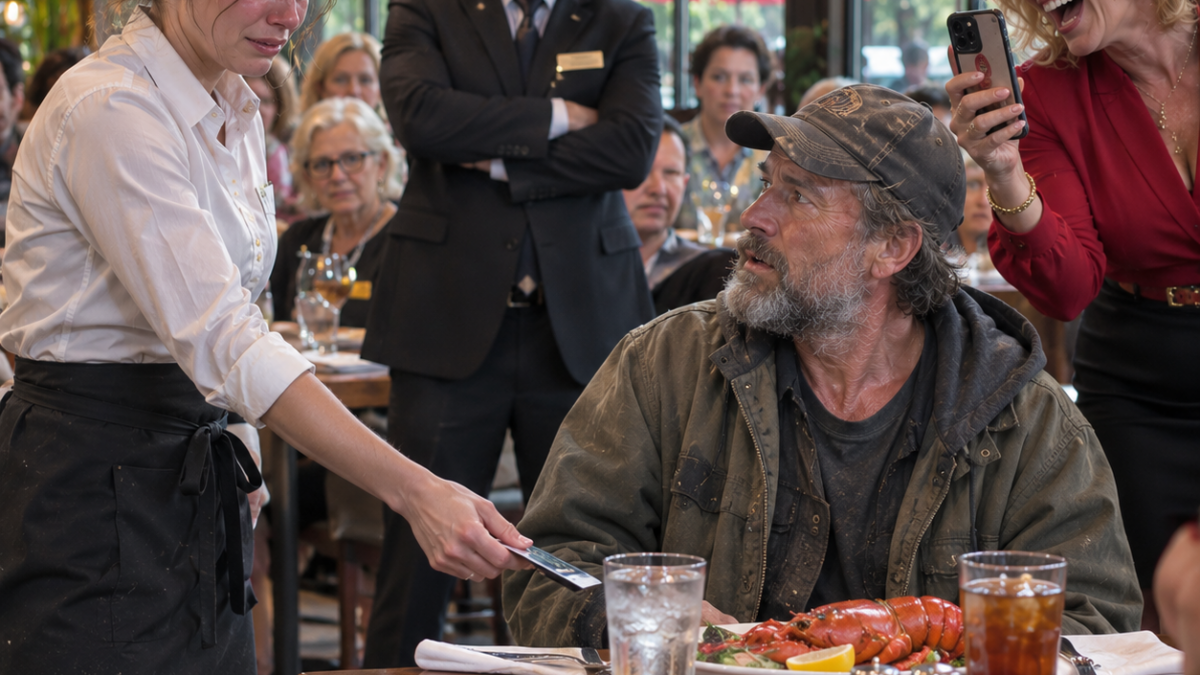
“I’m sorry, sir. Your card was declined.”
I said it as quietly as I could.
But the woman sitting across from him heard every word.
She raised her phone, turned the camera toward us, and laughed.
“Oh, look at the big girl’s face! She feels sorry for you!”
The man sitting at table twelve went completely still.
In front of him sat a lobster dinner, an almost-empty champagne glass, and a check totaling $163.80.
Around us, the lunchtime crowd at Marlowe’s continued talking, eating, and enjoying the harbor view.
But at that table, everything had stopped.
“Run it again,” the man said.
His voice was steady, but I recognized the look in his eyes.
I’d seen it before.
Eighteen years earlier, when I was nine years old, my father had worn exactly that expression.
I swallowed.
“Of course, sir.”
I tried the card again.
Declined.
The woman laughed louder.
Then she tilted her phone to include my face.
“This is priceless. A grown man takes a woman to the fanciest restaurant on the pier, orders lobster and champagne, and can’t even pay!”
The man looked up at her.
“Laugh at me. Not her.”
That only amused her more.
“Oh, he’s all yours, sweetheart.”
She stood, collected her purse, and walked away, still filming.
I watched her go.
Then I looked back at the man.
He wasn’t young, perhaps in his late thirties. He had dark hair, a tired face, and a small compass tattoo near his wrist.
He stared at his declined card as though it had brought back something he’d spent years trying to forget.
“My machine may be acting up,” I said. “Let me check it inside.”
He nodded without looking at me.
My name is Maeve Doherty. I was twenty-seven years old, and I’d worked at Marlowe’s for four years.
I wasn’t the kind of waitress wealthy customers remembered.
I was the woman who carried their plates, refilled their water, and smiled when they complained.
I lived with my mother, Rose, in a small apartment in South Boston.
My father, Frank, had been a mail carrier for twenty years before he died.
Mom had a heart condition, and our insurance was refusing to cover one of her medications while an appeal worked its way through the system.
That morning, I’d tucked an envelope into my apron.
Across the front, I’d written one word.
MA.
Inside was the money I’d saved toward her next prescription.
It wasn’t enough to cover everything. But Friday was payday, and between my wages and tips, I expected to make the rest.
We’d worked out the timing carefully.
Then I looked at that man sitting alone at table twelve.
And I remembered my father.
I went to the register.
Took the envelope from my apron.
And paid $163.80 toward the stranger’s lunch with my own money.
I included the eighty cents.
I knew how humiliating it could be when somebody made a spectacle of a person who couldn’t pay.
I wasn’t going to let that woman have the last word.
When I returned to the table, I handed him the receipt.
“You’re all set, sir.”
He frowned.
“I thought my card wasn’t working.”
“It went through.”
He looked at me.
For a moment, I thought he might ask another question.
Instead, he said, “Thank you.”
I smiled.
“Enjoy the rest of your afternoon.”
That should’ve been the end of it.
It wasn’t.
Howard Pell, Marlowe’s general manager, had watched the transaction from behind the bar.
He was a hard-faced man who treated every employee like an expense he’d prefer to eliminate.
“Maeve. Office. Now.”
I followed him through the kitchen.
He closed the door.
“Did you pay that customer’s bill yourself?”
“Yes.”
“With your own money?”
“Yes, Mr. Pell.”
He stared at me.
“You’re fired.”
I thought I’d misheard.
“Excuse me?”
“Staff members do not pay customers’ checks. This is a restaurant, not a soup kitchen.”
“It was my money. The bill was paid. Nobody lost anything.”
“Four years here, Maeve. You know better.”
My face grew hot.
“You’re firing me for helping somebody?”
He opened a drawer and took out an envelope containing my final pay statement.
“Your last check is $710, tips included. I’ll hold it until the register has been reconciled.”
I stared at him.
“Mr. Pell, you can’t keep my wages.”
“Then you shouldn’t have broken company policy.”
I knew what this was really about.
For months, I’d been recording discrepancies in the tips Marlowe’s servers received.
Every paycheck contained a deduction labeled HOUSE SHARE — 15%.
Pell claimed the money went to upstairs staff.
But the numbers never added up.
And I’d started keeping a notebook.
Now he had an excuse to get rid of me.
I left the restaurant carrying my apron and the little notebook that had made my manager hate me.
Outside, the man from table twelve stood near the pier.
He approached when he saw me.
“Why did you do that?”
“Do what?”
“Pay for my lunch.”
I tried to smile.
“Somebody needed a hand.”
He looked toward the restaurant.
“Did you lose your job?”
I didn’t answer.
His expression changed.
“I’m sorry.”
“It’s not your fault.”
I began walking toward the bus stop.
He followed at a respectful distance.
“At least tell me your name.”
“Maeve.”
“I’m Nico.”
“Nico what?”
He hesitated.
“Just Nico.”
I gave him a tired smile.
“Well, Just Nico, I hope the rest of your Tuesday goes better.”
Then I walked away.
I thought I’d never see him again.
That evening, my coworker Inez called.
The woman who’d humiliated Nico had posted her video online.
Hundreds of thousands of people were already watching it.
And beneath the recording, strangers were laughing at the heavyset waitress who’d paid a broke man’s bill.
I hung up, opened the kitchen drawer, and stared at my mother’s pharmacy slip.
I had no job.
Pell was withholding my last paycheck.
And the money for Mom’s medication had gone into a restaurant register.
The next morning, the pharmacy called.
“Maeve? This is Mr. Toomey. There’s been a change with your mother’s prescription.”
I gripped the phone.
“What’s wrong?”
“Nothing’s wrong. It’s covered.”
I closed my eyes.
“The insurance appeal finally went through?”
There was a pause.
Then Mr. Toomey said, “Come pick it up whenever you’re ready.”
I started crying.
What I didn’t know was that the insurance company hadn’t changed its decision at all.
And the stranger whose lunch I’d paid for had already made a second trip to the pharmacy.
Part 2:
The card reader made a sound I had learned to dread.
One short beep.
A red message.
DECLINED.
I glanced toward table twelve.
The man sitting there watched me with an expression I couldn’t quite read. His lobster shell lay beside an almost-empty champagne glass, and a neatly folded napkin rested across his lap.
Across from him, a beautiful woman in a white designer blouse was already reaching for her phone.
“I’m sorry, sir,” I said quietly. “It didn’t go through.”
“Run it again.”
I nodded.
I always gave a customer a second chance.
Sometimes a bank blocked an unusual charge. Sometimes the machine lost its connection. And sometimes people simply needed a minute to move money between accounts without a stranger watching.
There were a hundred ordinary explanations.
None required an audience.
I tried the card again.
Declined.
The woman laughed.
“Oh, look at his face.”
Then she turned her phone toward me.
“And the waitress feels sorry for him! This is too good.”
My cheeks grew hot.
“Ma’am, could you please stop filming?”
She ignored me.
“Bad Date Diaries, episode forty-seven. A man who orders lobster and champagne and can’t pay for either.”
The man looked up.
“Laugh at me. Not her.”
She laughed again.
“Oh, he’s all yours, sweetheart.”
Then she stood and walked toward the restaurant entrance.
I watched her leave.
She had the kind of confidence that came from believing the worst thing that could happen in a public place was being ignored.
The man at table twelve stared at his card.
He looked about thirty-seven, with dark hair, a navy shirt, and a small compass tattoo on the back of his hand.
There was a faded blue swallow farther up his wrist.
He wasn’t wearing an expensive watch.
He didn’t have a flashy jacket.
And he looked more exhausted than embarrassed.
I knew that look.
I’d seen it on my father’s face when I was nine.
“I’ll check the terminal inside,” I told him.
He nodded.
“I’m sorry.”
“You haven’t done anything to me.”
I walked through the terrace doors into the restaurant.
Marlowe’s was one of the most expensive dining rooms along the Boston waterfront.
Tourists came for the harbor view.
Businessmen came to impress clients.
Couples came to celebrate anniversaries and engagements.
And people with more money than consideration came because they liked having someone bring them expensive seafood while they looked down on the people serving it.
I’d worked there four years.
I knew the difference between a wealthy customer and a decent one.
Sometimes they overlapped.
Often they didn’t.
My name is Maeve Doherty.
I was twenty-seven, lived with my mother in South Boston, and worked as many shifts as Howard Pell would give me.
Mom had a heart condition.
Her prescriptions were expensive, especially after our insurance company denied coverage for one medication pending an appeal.
We were trying to stay ahead of the bills.
Some months we managed.
Others we counted every dollar.
That Tuesday, I had an envelope in my apron containing money I’d set aside for her prescription.
I’d written MA across the front.
It wasn’t enough for the full refill.
Mr. Toomey, our pharmacist, had agreed to hold the medication until Friday, when I expected to receive my wages and tips.
I should have left the envelope alone.
But when I looked toward the terrace, I remembered something.
My father had once sat at a table just like that one.
His card had been declined.
People had laughed.
And he had carried the shame for years.
I took the money out.
One hundred sixty-three dollars.
And eighty cents.
Exactly the amount printed on the check.
I paid the bill at the register.
Then I returned to table twelve.
“You’re all set, sir.”
The man frowned.
“What happened?”
“The payment went through.”
He looked at the receipt.
Then at me.
For a moment, I thought he’d understood.
“Thank you,” he said.
“Enjoy the rest of your afternoon.”
I went back inside.
Howard Pell was waiting.
He’d been Marlowe’s general manager for seven years, and he possessed an extraordinary talent for making everyone in his presence feel as though they were doing something wrong.
He wasn’t a large man.
He didn’t need to be.
He used schedules, paychecks, and the threat of losing your job to make people nervous.
“Maeve. Office.”
I followed him.
He shut the door and folded his arms.
“Did you pay a customer’s bill out of your own pocket?”
“Yes.”
“Why?”
“The card wasn’t working, and somebody was humiliating him.”
“This is a restaurant, not a soup kitchen.”
“It was my money.”
“That’s not the point.”
“Then what is?”
He stared at me.
“You’re fired.”
I felt my stomach drop.
“Mr. Pell, I’ve worked here four years.”
“And you should know our policies after four years.”
“Nobody lost a cent.”
He opened a drawer.
“Your last check is seven hundred ten dollars, including tips. It’ll remain here until I reconcile the register.”
I stared at him.
“That’s money I’ve already earned.”
“Then you should’ve considered the consequences before breaking the rules.”
I knew what he was doing.
This wasn’t just about a lunch.
For nearly two years, I’d been asking questions about a deduction on our pay statements.
HOUSE SHARE — 15%.
Pell claimed it was a legitimate distribution to other employees.
But I’d spoken to the people who supposedly received it.
The figures didn’t match.
Some employees said their tips were short.
Others couldn’t explain where the money went.
I’d started writing everything down.
Dates.
Table numbers.
Tip amounts.
What appeared on my paycheck.
What disappeared.
Pell had seen the notebook.
He hated it.
Now he had an excuse to fire me.
I left without signing his acknowledgment that the restaurant owed me nothing.
Outside, I found the man from table twelve waiting near the pier railing.
He looked toward my empty hands.
“Where’s your apron?”
I tried to smile.
“Apparently I’m unemployed.”
His face changed.
“They fired you?”
“It’s complicated.”
“Because of me?”
“No. Because of a man who thinks every employee is replaceable.”
He looked miserable.
“Why did you pay?”
I glanced toward the harbor.
“Because I’ve seen what a declined card can do to somebody’s face.”
He waited.
I didn’t explain.
Not yet.
“What’s your name?” he asked.
“Maeve.”
“I’m Nico.”
“Nico what?”
He hesitated.
“Just Nico.”
I almost laughed.
“Well, Just Nico, I hope your next lunch goes better.”
He took a step toward me.
“Let me pay you back.”
“You can worry about that when you’ve got a working card.”
Then I walked toward the bus stop.
I didn’t see the older man who joined him afterward.
I didn’t hear the conversation they had near the dock.
And I certainly didn’t know that a video of the whole thing was about to make both of us famous.
I only knew I had lost my job.
And my mother’s medicine money was gone.
That afternoon, I sat on a bench near the last stop on my bus route.
I didn’t want to go home.
Mom was turning sixty-two.
It was her birthday.
I’d promised to bring supper and a small cake.
Instead, I was unemployed, short on money, and trying not to cry in public.
My friend Inez called.
She was another waitress from Marlowe’s.
“Maeve, where are you?”
“End of the line.”
“What?”
“The bus. I’m sitting here.”
“Your shift ended an hour ago.”
“I know.”
Inez was silent for a moment.
Then she said, “Pell’s telling everyone the register came up short.”
I closed my eyes.
“It didn’t.”
“I know.”
“He’s keeping my check.”
“I know that too.”
She paused.
“Do you want me to come get you?”
I looked at the time.
“No. Go back before he notices you’re gone.”
“Maeve—”
“I’ll be okay.”
We ended the call.
For several minutes, I watched buses pull in and leave.
Then I took my phone out and called Mr. Toomey.
“Could you hold Mom’s medication until Friday?”
There was a pause.
“Of course, Maeve.”
“I’ll pay everything then.”
“Don’t worry about that today. Wish your mother a happy birthday.”
I thanked him.
Then I went home.
Mom was sitting at the kitchen table, sorting old photographs.
She looked up when I came inside.
“You’re early.”
“Quiet afternoon.”
She studied my face.
“Maeve.”
I put my bag down.
“Happy birthday, Ma.”
She didn’t smile.
“What happened?”
I sat across from her.
And I told her everything.
The lobster.
The camera.
The declined card.
The money.
Pell.
My paycheck.
When I finished, she looked toward the window.
Then she said something I hadn’t expected.
“Your father would’ve done exactly the same thing.”
I lowered my eyes.
“That’s why I did it.”
Mom reached across the table and took my hand.
“Your father’s kindness nearly ruined us more than once.”
“I know.”
“But I never wished he’d been cruel instead.”
I began crying.
Mom came around the table and held me.
For a while, neither of us spoke.
Then she asked about the medicine.
I told her Mr. Toomey would hold it.
“Friday,” I said. “We’ll make it work.”
She nodded.
But I could see the worry in her eyes.
The following morning, Mr. Toomey called.
“Maeve, your mother’s prescription is covered.”
I gripped the phone.
“The insurance appeal?”
“Come collect the medicine whenever you’re ready.”
I nearly dropped the receiver.
I ran into the living room.
“Ma! The medication went through!”
She stared at me.
Then she began laughing and crying at the same time.
“About time those insurance people paid for something!”
I laughed too.
For the first time since leaving Marlowe’s, I felt something inside my chest loosen.
I didn’t know Mr. Toomey had carefully avoided answering my question about the appeal.
I didn’t know a man had walked into the pharmacy carrying my prescription slip the night before.
And I didn’t know he’d paid $2,856 in cash.
Enough to cover an entire year.
All I knew was that Mom had her medicine.
And for one precious morning, that was enough.
The video reached two million views before the end of the week.
I found out from Inez.
She sent me a link with a warning.
Don’t read the comments.
Naturally, I read the comments.
The woman who’d filmed table twelve was named Kendall Vale.
She made videos about expensive dates, embarrassing encounters, and the apparent failures of people who didn’t meet her standards.
She’d titled our encounter LOBSTER GUY CAN’T PAY.
The thumbnail showed Nico staring at his card and me standing beside him with the payment terminal.
Someone had added a caption mocking my appearance.
I watched the first ten seconds.
Then turned it off.
I didn’t mind people knowing I’d helped someone.
I minded being turned into a joke.
The worst part was that strangers thought they’d witnessed everything.
They hadn’t seen Pell fire me.
They didn’t know about Mom.
They didn’t know where the $163.80 came from.
They saw a laughing woman, a declined card, and a waitress paying a stranger’s check.
Then they decided what kind of people we were.
That afternoon, Inez called with better news.
“Maeve, somebody wants to hire you.”
I sat upright.
“Who?”
“Benny Marino. Dorchester Avenue. His breakfast waitress is leaving, and he needs somebody who knows what she’s doing.”
I’d been to Benny’s twice.
It was a narrow diner with red vinyl stools, scratched wooden tables, and the best inexpensive breakfast sandwiches in South Boston.
Benny was nearly seventy.
He’d operated the place for decades.
“He saw the video,” Inez said. “He says anybody who’d spend her own money to keep a stranger from being humiliated deserves a conversation.”
I stared at the wall.
“When?”
“Tomorrow. Five in the morning.”
I laughed.
“Of course.”
Benny didn’t believe in easing people into a new job.
I arrived before dawn.
He was standing behind the counter wearing a white apron with a coffee stain near the pocket.
“Maeve Doherty?”
“Yes, sir.”
He looked at me.
“Your father was Frank Doherty?”
I nodded.
“He delivered my mail twenty years. Never once lost a package.”
I smiled.
“That sounds like Dad.”
Benny pointed toward the dining room.
“Fifteen dollars an hour, breakfast included. Tips are yours. We start early and work hard. Interested?”
“Very.”
“Good. Aprons are in the back.”
He turned toward the kitchen.
“Just Nico! You done with those pans?”
A familiar voice answered.
“Almost!”
I stopped.
Then Nico appeared from behind the swinging door.
He wore a dishwashing apron, rubber gloves, and an expression of surprise.
“Maeve?”
I stared at him.
“You’re working here?”
He looked down at his apron.
“Apparently.”
Benny chuckled.
“Worst dishwasher I’ve ever hired. Keeps showing up on time, though.”
I laughed before I could stop myself.
That was how Nico became part of my mornings.
He arrived before five.
Washed dishes badly at first.
Improved.
Carried heavy boxes when Benny’s knees bothered him.
And somehow always made sure a fresh cup of coffee appeared near my station when the breakfast rush started.
He didn’t ask about the video.
He didn’t talk about the woman who’d laughed at him.
He didn’t even ask whether I’d forgiven Marlowe’s.
He worked.
That mattered to me.
Men can tell impressive stories about themselves.
It’s harder to fake showing up every morning when the kitchen is hot, the sink is full, and nobody is watching.
Mom was less impressed.
“A man who doesn’t give you his last name?”
“Ma, he washes dishes.”
“Dishwashers have last names.”
I rolled my eyes.
She wasn’t wrong.
One Sunday, I brought him home for stew.
Mom studied the tattoos on his hand.
“The compass?”
“My father’s boat,” he said.
“He was a sailor?”
“Fisherman. He lost the boat when I was nineteen. Bank took it.”
Mom nodded slowly.
“And the swallow?”
“My mother. Sailors say swallows always come home.”
“Did she?”
Nico looked at his plate.
“No, ma’am.”
Mom’s expression softened.
Then she passed him another serving of stew.
“Eat.”
He did.
Afterward, he helped carry a broken bookcase down to the basement and tightened the loose rail on our front steps without being asked.
Mom watched him work.
When he left, she said, “Those are working hands.”
I smiled.
“See?”
She wasn’t finished.
“But why does a dishwasher arrive in a car with a driver?”
I froze.
“What driver?”
“The man who waited outside the building.”
I went to the window.
A dark sedan was pulling away from the curb.
I stared after it.
“Maybe a friend.”
Mom gave me a look.
“Maybe.”
I should’ve asked Nico that week.
Instead, I was distracted by something else.
Pell had posted a notice at Marlowe’s.
NEW OWNERSHIP — STAFF MEETING FRIDAY, NOON. ALL CURRENT AND FORMER EMPLOYEES WITH OUTSTANDING PAY CLAIMS MAY ATTEND.
Inez sent me a photograph.
“Does this include you?” she asked.
I looked at my notebook.
“It had better.”
The following afternoon, Pell appeared outside Benny’s.
He looked exhausted.
His shirt collar was crooked, and there were dark circles beneath his eyes.
He held an envelope.
“Maeve. Your final check.”
I stared at him.
“You drove across town to give me money you said you were keeping?”
“Management wants outstanding balances resolved.”
I took the envelope but didn’t open it.
He held out another paper.
“Sign this acknowledgment.”
I read it.
The document stated I’d received all compensation owed and had no further wage claims against Marlowe’s.
I looked up.
“Absolutely not.”
His face tightened.
“You want your check or not?”
“I want the money I’ve earned. And I’m not signing away the rest.”
He glanced toward my apron pocket.
“Where’s your notebook?”
I felt a chill.
“Why?”
“I want to review your calculations.”
“Then you can review them with my attorney or the labor authorities.”
He stepped closer.
“Maeve, don’t make this harder than it has to be.”
A voice came from behind me.
“She’s already said no.”
Nico stood near the doorway, still wearing his dishwashing apron.
Pell looked him up and down.
“And what are you supposed to be? Her muscle?”
Nico didn’t move.
“I wash dishes.”
Pell sneered.
“Then go wash some.”
A black sedan stopped at the curb.
An older man climbed out.
He looked toward Nico.
“Everything okay, boss?”
I turned.
Pell went pale.
For a moment, nobody spoke.
Then I looked at Nico.
“Boss?”
He closed his eyes.
“Maeve, I need to explain.”
I stepped backward.
Suddenly Mom’s questions made sense.
The driver.
The mysterious last name.
The way Benny had seemed to know more than he said.
And the way Pell looked at a dishwasher as though he’d just discovered his own execution date.
I stared at Nico.
“Who are you?”
He hesitated.
Then answered.
“Nico Ferrante.”
I knew that name.
Everybody along the waterfront knew it.
Ferrante Marine Holdings owned much of the commercial dock property around the pier.
The company had rebuilt sections of the waterfront after a major downturn and become one of the most influential private operators in the harbor district.
Its founder was regularly mentioned in business articles.
I’d never paid much attention to the photographs.
Now I was looking at the man himself.
The dishwasher with the compass tattoo.
The stranger with the declined credit card.
The person whose lobster lunch I’d paid for with Mom’s medicine money.
And the man who, apparently, owned enough waterfront property to make Howard Pell turn gray.
I took another step backward.
“Your card didn’t work.”
Nico looked at me.
“No.”
“How is that possible?”
He didn’t answer quickly enough.
And the silence told me something I didn’t want to believe.
It hadn’t been an accident.
Nico asked me to come to Marlowe’s the next day.
“Every document you want to see,” he said. “Every explanation. In front of witnesses.”
I didn’t answer immediately.
He looked toward the envelope in Pell’s hand.
“Don’t sign anything yet.”
Pell left without another word.
I stood outside Benny’s with my arms folded.
“How long have you been hiding this?”
Nico swallowed.
“Longer than I should have.”
“Did Benny know?”
“Yes.”
“Did the man in the car know?”
“Salvatore’s worked with me for years.”
I felt foolish.
I’d invited Nico into Mom’s kitchen.
I’d told him stories about my family.
I’d worried about his money.
He’d been standing beside me at a restaurant sink with enough wealth to buy the entire block.
“Why?” I asked.
He looked down.
“Because I wanted somebody to know me without knowing what I owned.”
I stared at him.
“Then you should’ve started by telling the truth about who you were.”
I walked inside.
He didn’t follow.
That night, Mom listened while I explained.
When I finished, she said, “Well, that explains the car.”
I didn’t smile.
“Ma.”
She took my hand.
“Did he ask you for money?”
“No.”
“Has he treated you badly at Benny’s?”
“No.”
“Then perhaps you should hear what he’s going to say before deciding what it means.”
I thought about it.
Then I showed her the video again.
The declined card.
Kendall laughing.
Me taking the check inside.
Mom watched quietly.
When it ended, she said, “You helped a man because you believed he needed help.”
“Yes.”
“That part remains true, regardless of who he is.”
“But what if he never needed it?”
Mom didn’t have an answer.
Neither did I.
The next day, I went to Marlowe’s.
The terrace was crowded.
Current and former servers stood near the tables, talking quietly.
Inez hurried toward me.
“Maeve, do you know who’s bought the place?”
I nodded.
Her eyes widened.
“How?”
“Long story.”
Nico entered wearing a dark suit.
Without the apron, he looked different.
Not better.
Just like somebody I’d never met.
Salvatore followed carrying a file.
A lawyer from Ferrante Marine Holdings introduced Nico as the new owner of Marlowe’s operating business, acquired through a negotiated transfer involving Halloran Hospitality, which had fallen months behind on its dockside lease obligations.
The property itself had already belonged to Nico’s company.
I stared at the harbor beyond the terrace.
For weeks, I’d been working beside a man who could have explained all of this in a single sentence.
Instead, he’d allowed me to believe he was a dishwasher.
Nico addressed the staff.
“Marlowe’s owes people money.”
Pell stood near the back.
“That’s an accounting dispute.”
Nico nodded toward the lawyer.
The lawyer displayed records from the restaurant’s payroll and financial systems.
Over the previous year, more than $58,000 in server tips had been withheld or diverted through the so-called house-share deduction.
The records showed amounts that were supposed to reach eligible employees but hadn’t.
Pell began objecting.
“This is how the company handles gratuity allocation.”
I opened my notebook.
“March ninth,” I said.
Every face turned toward me.
“My tables left two hundred twelve dollars in tips. My pay statement shows one hundred eighty dollars and twenty cents.”
I turned the page.
“April sixth. Two hundred forty-seven in recorded tips. Thirty-seven dollars and five cents taken as house share.”
I looked at Pell.
“Every shift. Two years.”
Nico’s lawyer examined the notebook.
Then compared it with the payroll files.
The numbers matched.
Pell tried to argue that the deductions had been approved by the operator.
That made the matter worse, not better.
Nico announced that the recovered records would be referred to the appropriate state labor authorities and that affected employees would receive the money owed to them, with legally required additional amounts determined through the proper process.
He turned toward Pell.
“Leave your keys with Inez.”
Pell stared.
“You can’t do this.”
“Your employment is terminated.”
Inez looked as though she might faint.
Nico then addressed me.
“Maeve, your seven hundred ten dollars has been released. Any additional compensation owed will be included in the full review.”
He paused.
“And your job is available if you want it.”
I looked at him.
“That isn’t a gift?”
“No. You earned it.”
I nodded.
Then he took a card from his wallet.
I recognized it immediately.
The same card that had been declined at table twelve.
He placed it on the table.
“This card stopped working ten years ago.”
I stared.
Nico continued.
“When I was twenty-seven, I was building my company. I had almost nothing left. I took a woman named Lauren to dinner, and that card was declined.”
He looked toward the harbor.
“I’d planned to ask her to marry me.”
Nobody moved.
“She left the ring on the bread plate and walked out.”
I felt a dull ache beginning in my chest.
Nico looked at me.
“After that, I started using the card to find out whether anyone would stay when they thought I had nothing.”
I whispered, “How many?”
“Twelve women.”
I stared at him.
“And I was number thirteen.”
He shook his head.
“You weren’t supposed to be part of it.”
“But I paid.”
“Yes.”
“With my mother’s medicine money.”
His expression crumpled.
“I know.”
My stomach dropped.
“What do you mean, you know?”
He didn’t answer.
I looked at him.
“Nico?”
“I found the pharmacy slip you dropped.”
For a moment, I couldn’t understand.
Then I remembered the call from Mr. Toomey.
The prescription suddenly covered.
The insurance appeal I’d believed had been approved.
I stared at Nico.
“Was that you?”
He nodded.
“I paid for the medication.”
“How much?”
“Two thousand eight hundred fifty-six dollars.”
I felt as though the floor had shifted.
“A year?”
“Yes.”
I stepped backward.
“You let me think the insurance company paid.”
“I asked the pharmacist not to identify me.”
“Why?”
“I wanted to make sure your mother had what she needed.”
I looked at him.
“You don’t get to decide what I should know about my own life.”
He lowered his eyes.
“You’re right.”
I could hear people whispering.
Somebody near the terrace entrance was filming.
I didn’t care.
“You had another working card in your wallet that day, didn’t you?”
Nico looked at me.
“Yes.”
I felt tears burning my eyes.
“While I was emptying my mother’s medicine envelope, you were testing whether strangers were decent enough to help you?”
He didn’t answer.
I continued.
“You didn’t feel what I felt when I paid that bill. You knew you could walk away.”
“I know.”
“You were keeping score.”
His voice broke.
“Yes.”
For a moment, I looked at the man I’d begun to care about.
Then I looked at the dead card on the table.
I understood why he’d kept it.
But I couldn’t accept what he’d done with it.
“Thank you for returning the wages I earned,” I said.
“Maeve—”
“And thank you for helping Mom.”
I swallowed.
“But I need you to understand something.”
He waited.
“I don’t want to pass anyone’s test.”
I walked away.
Inez followed me into the hallway.
She didn’t ask me to forgive him.
She simply put an arm around my shoulders.
That night, I called Mr. Toomey.
He confirmed the insurance appeal had not been approved.
Nico had paid the full $2,856 in cash.
“Why didn’t you tell me?” I asked.
“He asked for privacy,” Mr. Toomey said gently. “But I won’t lie to Frank Doherty’s daughter when she asks me directly.”
I thanked him.
Then I went home and told Mom.
She listened quietly.
When I finished, she stood and brought me a notebook.
It was one of Dad’s old postal-route ledgers.
Inside, he’d written a rule at the top of the first page.
What you owe, you pay back. What isn’t yours, you don’t keep.
Mom placed it in my hands.
“If you need to repay Nico, you can do it little by little.”
I looked at her.
“Twenty-five dollars every Friday.”
She nodded.
“That’s a good start.”
I opened to a blank page.
Wrote down $2,856.
Then underneath it:
Payment 1 — $25.
I wasn’t trying to insult Nico.
I wasn’t denying he’d helped us.
I just needed to know that our lives belonged to us.
And if he wanted to be part of mine, he would have to learn that love wasn’t something he could buy, test, or arrange behind my back.
Nico didn’t disappear.
But he stopped trying to fix things for me.
That was the first sign he might actually have listened.
He still arrived at Benny’s before five.
He still washed dishes.
He still made terrible coffee when Benny wasn’t looking.
And when we were alone, he didn’t ask whether I’d forgiven him.
One morning, I found him carrying a heavy crate of dishes toward the kitchen.
“You own Marlowe’s,” I said.
He stopped.
“Yes.”
“So why are you still washing plates here?”
He considered the question.
“Because Benny hired me to wash plates.”
“That’s not what I meant.”
“I know.”
He set down the crate.
“When my father lost his fishing boat, I promised myself I’d never be powerless again. I built a company. I made money. Then I spent ten years wondering whether anybody wanted me for anything else.”
I looked at him.
“So you became a dishwasher.”
He smiled faintly.
“I wanted to know whether I could still be useful without my name.”
I studied his face.
“You’re very bad at pretending you’re ordinary.”
“I’ve been told.”
I almost smiled.
Then I went back to work.
That Friday, I gave him an envelope containing twenty-five dollars.
He looked confused.
“Maeve, what’s this?”
“First payment toward Mom’s medication.”
“You don’t have to—”
“I do.”
He started to argue.
Then stopped.
He took the envelope.
“Thank you.”
It was a small moment.
But it mattered.
For once, he hadn’t decided what I should accept.
I’d made the decision myself.
A few days later, a woman named Lauren Ashcroft came to Benny’s.
I recognized her from a photograph Inez had found online.
She was the woman who’d left Nico’s engagement ring on a bread plate ten years earlier.
She now ran a crisis-management firm in New York.
She wore an elegant coat, carried an expensive handbag, and looked around Benny’s as though she’d entered the wrong building.
“Maeve Doherty?”
“Yes.”
She sat at a table.
“Coffee, please.”
I brought it.
Then she handed me a sealed envelope.
“Fifty thousand dollars.”
I stared at her.
“What?”
“Sign the enclosed statement and the money is yours.”
I opened the envelope.
The proposed statement said I’d known Nico was wealthy before paying his restaurant check, had deliberately arranged the incident to gain publicity, and had misrepresented myself as an innocent waitress.
I looked at Lauren.
“You want me to sign a lie.”
She smiled.
“I’m offering you an opportunity to move past an embarrassing situation.”
“An embarrassing situation for whom?”
“Maeve, Nico isn’t going to marry a waitress. I know him.”
I folded the paper.
“You knew a man who carried a dead credit card.”
Her smile weakened.
“I know him very well.”
“I know a dishwasher who hasn’t been late once.”
I pushed the envelope back.
“Keep your money.”
Lauren’s expression hardened.
“You’ll regret this after the Harbor Lights gala.”
I looked at her.
“Is that a threat?”
“It’s advice.”
She stood.
I watched her leave.
Then I took the envelope to Benny, who preserved it until I could give it to Nico’s attorney.
I was beginning to understand that Nico’s money hadn’t merely made people dishonest around him.
It had made dishonesty profitable.
Lauren was working with Grant Halloran, the former operator of Marlowe’s.
Grant also sat on the board of Ferrante Marine Holdings and controlled thirty percent of the company’s voting shares.
He had retained Lauren’s crisis firm after the video went viral.
The official purpose was protecting the company’s reputation.
But I soon learned the larger struggle had nothing to do with lobster.
Ferrante Marine owned the docks beneath several waterfront businesses.
It provided jobs to boat crews, maintenance workers, commercial operators, and the people who kept the harbor functioning.
Nico had founded the business after losing his father’s fishing boat to a bank when he was nineteen.
As the company grew, he gave twenty percent of its voting equity to a trust representing the dockworkers.
He told me why one evening as we cleaned the diner.
“My father’s boat disappeared because people who’d never been to sea made decisions about whether he could keep working.”
He rinsed a plate.
“I wanted the people who actually worked the docks to have a voice in what happened to them.”
I looked at him.
“And Grant?”
“Grant wants to sell the waterfront property to a developer.”
“For what?”
“Luxury condos.”
I stared.
“What happens to the workers?”
“They get a payout. Then most of their jobs disappear.”
He lowered the plate into the rack.
“That’s why I won’t agree.”
Suddenly I understood why Grant was so interested in the viral video.
A public scandal could weaken Nico’s position.
An accusation involving an exploited waitress could become a reason to challenge his leadership.
And Lauren could help shape the story.
The Harbor Lights gala took place two weeks later.
I was there working a dinner shift through Marlowe’s event staff.
Nico had offered me my old position back, and I’d accepted limited evening shifts while continuing my mornings at Benny’s.
I needed the income.
I wasn’t about to let complicated feelings about Nico keep me from earning it.
The ballroom overlooked the harbor.
White tablecloths covered round tables.
Elegant couples drank champagne beneath chandeliers.
The company board occupied a table near the stage.
Lauren sat beside Grant.
Kendall Vale, the woman who’d filmed the original lobster incident, was also there.
She recognized me immediately.
“Oh, look! The waitress from the video!”
She raised her phone.
“Still working, sweetheart?”
I kept moving.
She laughed.
“Want to try the card machine again?”
I didn’t answer.
Then Grant stood at the microphone.
He gave a short speech about protecting Ferrante Marine’s reputation.
Lauren followed.
She spoke about Nico’s history of testing women with a declined credit card.
Then she projected photographs from the viral video.
My face appeared on the screen.
I stopped beside a table.
Lauren continued.
“Since that lunch, our chief executive has been paying the waitress’s family expenses. An entire year of her mother’s heart medication.”
The room murmured.
My hands went cold.
That information wasn’t public.
I’d never told Lauren.
I looked toward the stage.
She smiled.
“Some might call that generosity. Others might ask how much the waitress knew before deciding to pay.”
Kendall raised her phone.
Several guests turned toward me.
I felt nine years old again.
Standing beside my father’s restaurant table while strangers laughed because his card didn’t work.
Then I remembered Dad’s notebook.
I set down my tray.
Walked toward the microphone.
And looked at Lauren.
“My name is Maeve Doherty.”
She hesitated.
I continued.
“I paid a stranger’s lunch because I thought he was being humiliated.”
I took my notebook from my apron pocket.
“When I learned who he was, I didn’t ask him for money. I started repaying the prescription he covered.”
I opened to the first page.
“Twenty-five dollars every Friday.”
I held up the payment record.
“Every payment dated. Every balance recorded.”
The room quieted.
“I didn’t know Nico Ferrante owned this company when I paid $163.80 for his lunch.”
I looked toward Kendall.
“I didn’t ask to appear in your video.”
Then toward Lauren.
“And I don’t need to pass anyone’s test to deserve basic respect.”
I stepped away.
Nico took the microphone.
He didn’t pretend the original incident had been innocent.
He admitted he’d knowingly used a dead card to test women after Lauren left him ten years earlier.
He said he’d been wrong to let me pay.
Wrong to hide the truth.
And wrong to believe someone else’s kindness could be measured by what she was willing to sacrifice.
Then he looked at Lauren.
“We’re not getting back together.”
She went pale.
He continued.
“Maeve doesn’t owe anyone a performance. She has spent years working for wages your client has helped keep from employees.”
Grant stood abruptly.
“That’s enough.”
Nico looked toward him.
“No, Grant. It isn’t.”
What happened next was exactly what Grant had been waiting for.
He announced that Ferrante Marine’s governance documents contained a conduct clause permitting action against a director or executive whose behavior seriously harmed the company.
He demanded an emergency shareholder vote on Nico’s removal.
Pending the authorized corporate review, the board moved to restrict Nico’s access to company spending accounts and suspend certain executive privileges.
The vote was scheduled for Thursday.
When Nico reached me afterward, he looked shaken.
“I didn’t know they were going to use you like that.”
I stared at him.
“But you knew Lauren was working for Grant.”
“Yes.”
“You knew they wanted a scandal.”
“I suspected.”
I looked toward the ballroom.
“Then you should’ve told me.”
He lowered his head.
“You’re right.”
The following day, Nico’s company card was declined when he tried to pay for a small meal at the pier.
For the first time since meeting him, the card failure wasn’t staged.
His wealth was tied up in company ownership, and he couldn’t freely use those assets during the dispute.
I watched him stare at the terminal.
Then I took out my own card.
“Nineteen dollars,” I said to the cashier. “Two chowders and two hot dogs.”
Nico looked at me.
“Maeve, you don’t have to.”
“I know.”
We sat outside beside the harbor.
He looked toward me.
“Why are you still here?”
I thought about the question.
Then I answered.
“Because this time you didn’t arrange for your card to fail.”
He gave a sad smile.
I continued.
“Ten years you’ve been asking who stays when the money disappears. Now it’s actually happened.”
I reached for my chowder.
“I’m still here.”
He stared at me.
Then I added something.
“But if you ever decide what I need to know again without asking me, that changes.”
He nodded.
“I understand.”
For the first time, I believed he might.
The night before the shareholder vote, I found the number that changed everything.
It was 15%.
The same deduction that had appeared on my Marlowe’s pay statements for two years.
Inez had introduced me to servers from three other Halloran restaurants along the waterfront.
They all had the same complaint.
Their tips were being reduced by something called house share.
Their pay statements used identical wording.
And their payroll was processed through Halloran Hospitality.
I spread the copies across Benny’s counter after closing.
Nico sat across from me.
Salvatore stood near the coffee machine.
I opened my notebook.
“At Marlowe’s, Pell recorded the deductions and transferred matching amounts to Halloran Hospitality.”
I pointed toward the payroll summaries.
“These three restaurants have the same system.”
Nico leaned forward.
“How much?”
I had checked the calculations repeatedly.
“Across four restaurants, about $412,000 over two years.”
Salvatore swore under his breath.
Nico looked at the figures.
“Are you certain?”
“The payroll records and statements need to be authenticated, but the pattern is there. The state investigators already have Marlowe’s books. They’ve requested records from the other locations.”
I tapped the table.
“Grant knows the investigators are looking.”
Nico stared at the documents.
Then he looked at Salvatore.
“When did he call for the shareholder vote?”
“Three days after the latest records requests.”
We sat in silence.
Then Salvatore said, “If Grant gets control of the dockworkers’ twenty percent, he can push the property sale.”
I looked toward Nico.
“Then the dockworkers need to know what they’re voting for.”
The following morning, I stood before the dockworkers’ trust representatives.
I wasn’t there to tell them what to do.
I wasn’t a shareholder.
I wasn’t a lawyer.
I was a waitress carrying a notebook full of numbers.
But the people sitting across from me understood paychecks.
They had spouses, children, brothers, and sisters who worked in restaurants along the pier.
So I explained what the records showed.
The deductions.
The missing tips.
The transfer patterns.
The state investigation.
And the proposed sale of the docks to a developer who intended to replace working waterfront facilities with luxury condominiums.
An older dockworker named Sal Russo listened without interrupting.
When I finished, he looked at Nico.
“Did you know about the tip deductions?”
“Not until Maeve brought the Marlowe’s records forward.”
“And you reported them?”
“Yes.”
Sal studied him.
Then looked at me.
“You think this company should stay in his hands?”
I considered the question.
“Nico’s made mistakes.”
He nodded.
“I know.”
“But he’s admitted them. Grant’s trying to hide financial records while asking you to give him control.”
Sal leaned back.
Then smiled faintly.
“That’s an answer.”
The shareholder meeting began at noon.
Grant sat at the front beside Lauren.
Nico was present with company counsel.
The ownership breakdown was straightforward.
Nico controlled 45% of the voting shares.
Grant controlled 30%.
Small investors held 5%.
And the dockworkers’ trust controlled 20%.
Grant needed the trust’s support to defeat Nico and advance his preferred restructuring.
He began by repeating the public-relations accusations.
Nico’s dead credit card.
The dating tests.
The viral video.
The humiliation at the gala.
Then he turned toward me.
“This young woman has been drawn into a deeply inappropriate relationship with our chief executive.”
I stood.
“My name is Maeve Doherty.”
Grant stopped.
“I know your name.”
“Then please use it.”
A few shareholders shifted in their seats.
I walked toward the table with permission from the meeting chair.
Then I handed over the documents.
“These are pay statements and supporting records from four Halloran-operated restaurants.”
Grant’s expression changed.
I continued.
“The same fifteen-percent deduction appears across them. Based on the records assembled so far, the disputed total is approximately $412,000.”
Grant rose.
“Those are confidential company records!”
“Then the state labor investigators will be able to examine the originals.”
I looked around the room.
“The employees who earned that money weren’t allowed to decide what happened to it. Now the people responsible want control of the docks before the investigation is finished.”
Lauren stood.
“This is an attempt to distract shareholders from Nico’s conduct.”
I took the $50,000 offer from my folder.
“Then perhaps you can explain why you offered me money to sign a statement I knew was false.”
Her face went pale.
Grant turned toward her.
“Lauren?”
She didn’t answer.
Nico’s attorney confirmed that the relevant documents had been preserved for proper examination and that the labor investigation was ongoing.
No one pretended the disputed records had already become a criminal conviction.
But the shareholders had enough evidence to understand why the transactions required independent scrutiny.
Then Sal Russo stood.
“The dockworkers’ trust has made its decision.”
He looked toward Grant.
“We’re not voting to sell our jobs out from under ourselves.”
The trust voted against Grant’s proposed control changes.
His effort to remove Nico failed.
A properly noticed subsequent motion addressing Grant’s own board position, supported by the required voting majority and legal procedures, resulted in his removal from the board.
He left without looking at me.
Lauren followed.
Nico stayed seated for a moment.
Then he turned toward me.
“You saved the docks.”
I shook my head.
“The workers saved the docks. I just brought the numbers.”
He smiled.
For once, he didn’t argue.
The wage investigation continued.
Five months later, the affected employees began receiving restitution payments and applicable interest following the regulators’ review and the resulting resolution.
Inez cried when she opened hers.
Several servers used the money to catch up on rent.
Others paid medical bills.
One woman told me she could finally replace the car she’d been borrowing from her brother.
My own payment covered wages I’d worked years to earn.
I deposited it.
Then I went to Benny’s for my morning shift.
By then, Benny had been talking about retirement for months.
His knees were getting worse, and he wanted to spend more time with his grandchildren.
One morning, he handed me a proposal.
He wanted to sell me the diner through an installment arrangement.
I stared at him.
“Benny, I can’t afford what this place is worth.”
He shrugged.
“Then pay me over time.”
“Why would you trust me with that?”
He smiled.
“Your father delivered my mail for twenty years, Maeve. Never once late.”
I looked down.
Benny continued.
“You’ve been here every morning. You’ve kept customers coming back. You know the staff. And you understand that feeding people is more important than making them feel small.”
I began crying.
He sighed.
“Now don’t start. I’m trying to retire, not drown the place.”
I laughed through the tears.
We worked out a proper purchase agreement with professional advice.
I made the payments from the business as agreed.
Benny kept a small role during the transition.
And I became the owner of the diner where I’d started over after losing my job.
I kept its name.
I kept its breakfast menu.
I kept Salvatore’s favorite table by the window.
And I added one rule.
Nobody gets humiliated here because a card doesn’t work.
The first time that rule mattered, I was standing behind the counter on a rainy Tuesday.
A customer tried to pay for breakfast.
His card declined.
He looked embarrassed.
Then somebody nearby recognized Nico and me from the old video.
“Hey! Bad Date Diaries!”
A phone appeared.
I held up my hand.
“No filming customers in here.”
The person lowered it.
I turned toward the embarrassed man.
“Machine’s been acting up. Let me try inside.”
I did.
The payment was resolved without an audience.
When I returned, the man looked relieved.
“Thank you.”
“Enjoy your breakfast.”
After he left, Nico came from the kitchen.
He still helped at Benny’s several mornings a week, though he was increasingly useful with supplies and repairs and still not particularly good at washing delicate glasses.
He looked toward the register.
“You handled that well.”
I smiled.
“Learned from experience.”
He reached into his pocket.
Then hesitated.
“Maeve, can I ask you something?”
I turned.
“Of course.”
He looked nervous.
I hadn’t seen him that nervous since the day I found out who he was.
“I don’t have a test for you.”
I laughed.
“That’s encouraging.”
He took out a small ring box.
“No hidden conditions. No dead card. No cameras. And if you say no, I’ll still come to your mother’s house for Sunday stew.”
My eyes filled.
He opened the box.
“Maeve Doherty, will you marry me?”
I stared at him.
For a moment, I thought about the day we’d met.
A stranger sitting alone over lobster.
A woman laughing.
A declined card.
The money I’d taken from Mom’s envelope.
Then everything that followed.
The lies.
The apologies.
The wages recovered.
The payments I’d made every Friday.
The ordinary mornings when Nico had proved, slowly and without expecting applause, that he could show up and tell the truth.
He wasn’t perfect.
Neither was I.
But the man kneeling beside the counter wasn’t asking me to prove I loved him by sacrificing something.
He was simply asking.
I wiped my eyes.
“Yes.”
He stared.
“Yes?”
I laughed.
“Yes, Nico.”
He slipped the ring onto my finger.
Behind us, Salvatore cleared his throat loudly.
“About time.”
Benny appeared from the kitchen.
“Don’t block the counter. Some of us are trying to run a business.”
I laughed harder.
Nico stood and kissed me.
Then I looked toward the register.
The little machine sat beside the coffee cups, just as an ordinary part of a diner should.
Ten years earlier, Nico had watched a woman leave his engagement ring on a bread plate because a card wouldn’t work.
He’d spent the next decade making strangers answer for that humiliation.
And I’d spent eighteen years remembering the night my father walked twenty blocks to borrow forty dollars after being laughed at in a restaurant.
We had both carried an old wound into that lunch at Marlowe’s.
The difference was that I’d tried to stop someone else from feeling what Dad had felt.
Nico had tried to find someone willing to endure it.
Eventually, he learned the difference.
I never wanted to be the woman who passed his test.
I wanted to be the woman he trusted enough to stop testing.
And that morning, when he asked me to marry him without a trick, a crowd, or a performance, I finally knew we had reached the same place.
A few minutes later, the breakfast rush began.
I put the ring box safely behind the counter, tied on my apron, and returned to work.
A customer handed me a card.
I ran it through the machine.
One short beep.
Then a green message.
APPROVED.
I smiled.
“It went through.”