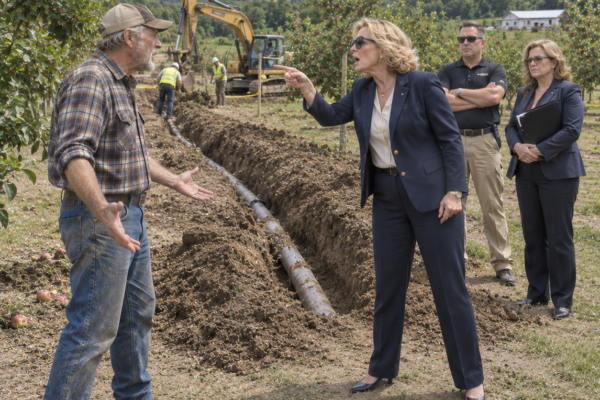
“Men Like You Confuse Ownership With Authority,” the HOA President Sneered When I Locked My Family’s 400-Foot Farm Lane. Her Dump Truck Had Gouged 18-Inch Ruts and Destroyed 40 Feet of Cattle Fence—Yet She Claimed My Gate Blocked Emergency Access for 240 Homes. Then She Brought a Contractor With a Cutting Saw, Dialed 911, and Answered One Question She Couldn’t Take Back..k
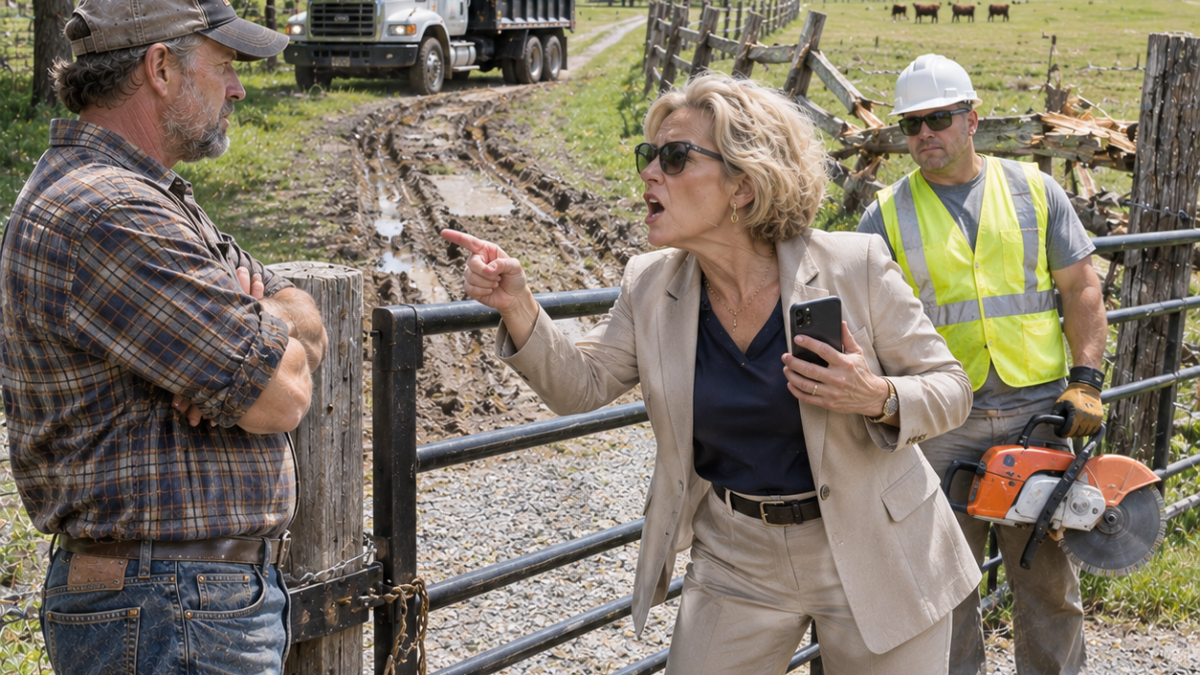
“Men Like You Confuse Ownership With Authority,” the HOA President Sneered When I Locked My Family’s 400-Foot Farm Lane. Her Dump Truck Had Gouged 18-Inch Ruts and Destroyed 40 Feet of Cattle Fence—Yet She Claimed My Gate Blocked Emergency Access for 240 Homes. Then She Brought a Contractor With a Cutting Saw, Dialed 911, and Answered One Question She Couldn’t Take Back.
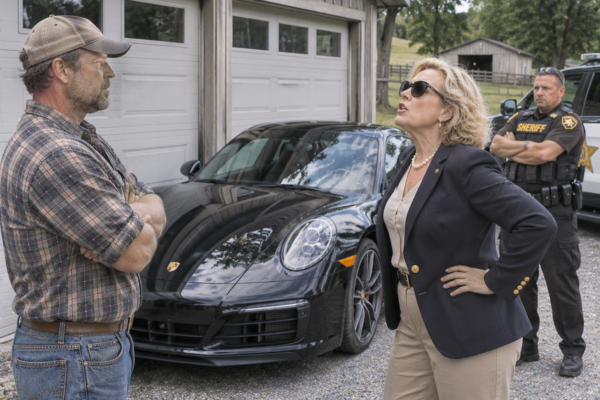
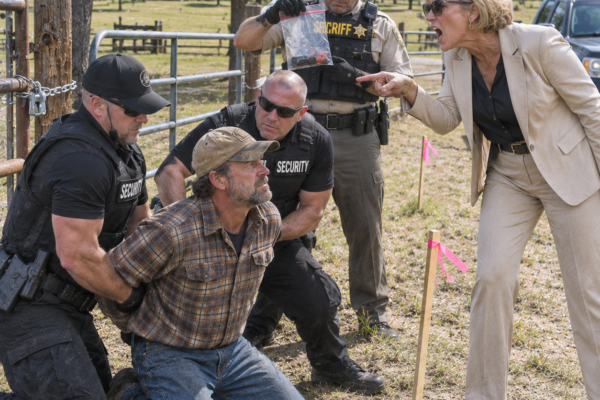
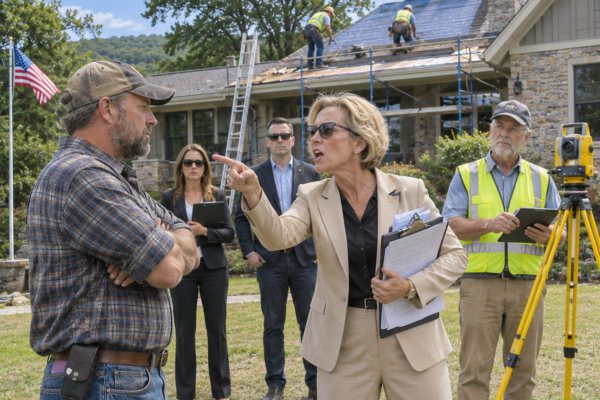
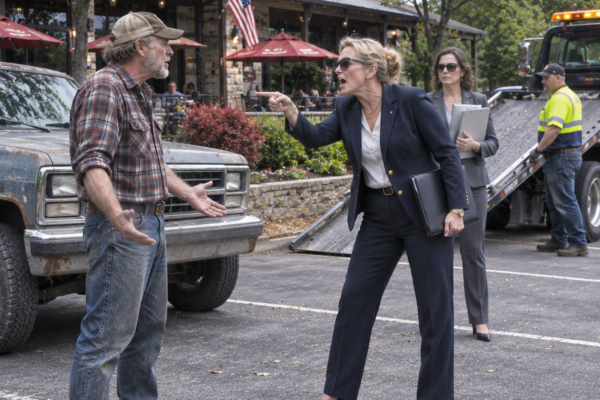
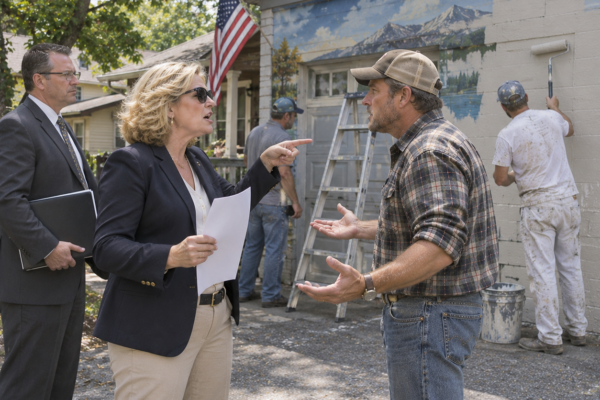
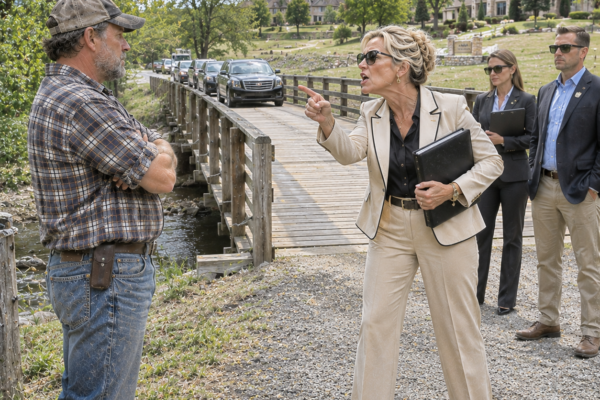
At 9:17 on a Saturday morning, the president of Ashford Glenn Homeowners Association stood at my locked farm gate with a contractor, a battery-powered cutting saw, and a phone pressed against her ear.
“Yes, I need a deputy immediately,” she told the 911 dispatcher. “There’s a hostile man obstructing emergency access to our neighborhood.”
I was standing eleven feet away.
On my own land.
Beside the green steel gate my father had welded more than thirty years earlier.
The contractor had already put his saw down. He looked like a man who’d accepted a routine maintenance job and discovered he’d been hired to start a fight.
Vivian Whitcomb, on the other hand, looked delighted.
She wore a cream blazer, pressed slacks, and sunglasses that probably cost more than the gate’s original materials.
“Tell them you’re threatening us,” she whispered sharply.
“I’m not threatening anybody,” I answered. “I’m asking you not to cut the lock on my private property.”
She turned away and resumed speaking to the dispatcher.
“Ma’am, this is an emergency access situation. Two hundred forty homes depend on this road. The property owner is refusing to cooperate, and things are escalating.”
I kept my hands at my sides.
My name is Silas Booker. I’m forty-eight years old, and my family owns Booker Ridge Farm, thirty-four acres of hayfields, soybeans, cattle pasture, and red clay outside a growing North Carolina subdivision.
I’d spent most of my life repairing tractors, hauling feed, and keeping fences upright.
Vivian had spent months treating me as though my work boots made me too ignorant to understand property law.
But I understood one thing perfectly.
The lane behind that gate belonged to my family.
It ran four hundred feet from the county road to our equipment barn, entirely inside our recorded property boundary.
No public roadway crossed it.
No permanent easement gave Ashford Glenn access.
And no homeowners association had ever been granted authority to order me to keep it open.
That hadn’t stopped Vivian.
Twelve years earlier, when Ashford Glenn was under construction on the neighboring property, my father had temporarily allowed the developer’s trucks to use our lane.
He’d signed a written agreement limited to the construction period.
It explicitly stated that the permission created no permanent easement and would terminate when the development was completed.
Construction ended nine years earlier.
The agreement expired.
But over time, HOA landscaping crews began using the lane anyway.
At first, it was an occasional pickup.
Then mowing trailers.
Then trucks hauling materials toward the subdivision’s stormwater retention pond.
The last straw came after a week of heavy rain.
A loaded tandem dump truck drove down my farm lane, leaving eighteen-inch-deep ruts for roughly 150 feet.
While turning around, the truck caught my pasture fence and dragged forty feet of woven wire into the mud.
I found two heifers wandering through the damaged opening the next morning.
Four days of work later, I had repaired the fence, stabilized the road enough to use it, and installed a heavy chain and padlock on my own gate.
Forty-eight hours later, Vivian arrived.
“Who gave you permission to lock our access road?” she demanded.
“Nobody,” I said. “Because it isn’t yours.”
She laughed in my face.
Then came the letters.
Remove the chain.
Leave the gate open twenty-four hours a day.
Allow unrestricted HOA contractor access.
Comply within ten business days or face legal action and fines.
I sent her the deed and the temporary construction agreement.
She ignored both.
Instead, she brought a landscaping contractor and a skid steer, ordered me to unlock the gate, and told me I was costing the neighborhood money.
When I refused, she stepped toward me.
“Men like you always confuse ownership with authority.”
I looked at her.
“And people like you confuse convenience with an easement.”
Her smile disappeared.
A few days later, someone bolted a professionally printed emergency-access sign to my gatepost.
It was the first time I’d seen Vivian claim that my private farm road was necessary for the safety of every family in Ashford Glenn.
I photographed the sign and removed it carefully.
Then I started checking county records.
What I found made Vivian’s sudden concern about emergency access far more interesting.
But I didn’t confront her with everything I’d learned.
Not yet.
I installed two security cameras covering the gate and its approaches.
Eleven days passed.
Then the cameras caught Vivian meeting a mobile locksmith beside my gate.
Two days later, she returned with a different contractor.
This time, he was carrying a cutting saw.
“Unlock it,” she commanded.
“No.”
“This is your last chance.”
“To do what? Let you cut a lock you don’t own?”
She turned red.
Then she dialed 911.
Now she was telling the dispatcher that a dangerous farmer had blocked a life-saving emergency route.
I watched her carefully.
She was so confident that she barely noticed the contractor quietly returning his saw to his truck.
Then the dispatcher asked her a question.
Vivian stopped talking.
For the first time that morning, she looked uncertain.
She glanced at my gate.
Then at the ground beneath her expensive shoes.
Finally, she answered.
And although she didn’t realize it, the county’s emergency communications system had just begun checking a claim she couldn’t prove.
A patrol car appeared over the hill several minutes later.
Vivian straightened her blazer and smiled.
“Now you’ll learn how this works,” she whispered.
I looked at the deputy stepping out of his cruiser.
Then at the folder of records I’d brought from the house.
I hadn’t raised my voice once.
And I wasn’t about to start.
Part 2:
“UNLOCK THAT GATE.”
Vivian Whitcomb stood beside a gray contractor’s truck with one hand extended toward the chain on my family’s farm gate.
A battery-powered cutting saw rested on the gravel beside her.
She’d brought the man holding it to my property on a Saturday morning, apparently believing that a tool and an HOA presidency were all she needed to turn somebody else’s land into her private service road.
I stopped beside my pickup.
“No.”
Her expression hardened.
“Mr. Booker, I’m giving you one last opportunity to cooperate.”
I looked at the contractor.
He appeared to be in his midforties, with sunburned forearms and work boots that had seen actual use. He was staring at the saw instead of looking at me.
“Did she tell you this is a public road?” I asked him.
Vivian answered before he could.
“This is an emergency access route serving two hundred forty homes.”
“That’s not what I asked.”
She stepped closer.
“Men like you always think owning a little piece of land means nobody can tell you what to do.”
I glanced toward the green steel gate.
My father had welded it in the 1990s. It had been standing there since before Ashford Glenn existed, and it was going to remain there long after Vivian grew tired of shouting at it.
“You’re standing at my private farm entrance,” I told her. “If you believe you have a legal right to cross it, show me the document.”
She reached into her handbag.
For a moment, I thought she’d finally produce something useful.
Instead, she pulled out her phone.
“I’m calling the sheriff.”
“Go ahead.”
She smiled.
“Then perhaps you’ll learn some respect.”
She dialed 911.
And with that call, she turned an ugly disagreement over access into something neither of us could take back.
But to understand why Vivian wanted my gate open so badly, you have to go back twelve years, to a conversation my father had with a developer beside that same green steel gate.
My name is Silas Booker.
I’m forty-eight years old, and I run Booker Ridge Farm, thirty-four acres of hay, soybeans, pasture, and stubborn red clay on the rural edge of a growing North Carolina community.
The farm had been in our family for more than three decades.
My father bought it when the county road out front was still gravel and the nearest large grocery store was a twenty-minute drive away.
He wasn’t a wealthy man.
He worked the land during daylight and held a second job for eleven years to keep up with the mortgage, equipment expenses, and repairs.
Some winters, he’d come home so tired he barely spoke during dinner.
But every morning, he was back outside checking the fences before heading to work.
I grew up watching him do it.
He taught me to sharpen mower blades, replace broken bearings, weld a gate hinge, and recognize when a stretch of pasture needed to rest.
He also taught me to keep paperwork.
Every deed.
Every tax receipt.
Every farm equipment warranty.
Every agreement involving our land.
Dad had a wooden file box that stayed on a shelf in the barn office, away from rain and mice.
Whenever someone wanted to use our property for something, he’d listen politely.
Then he’d say, “Put it in writing.”
When I was young, I thought that was unnecessary.
If a man shook your hand and promised something, shouldn’t that be enough?
Dad disagreed.
“A handshake can be forgotten, Silas. A written agreement tells both people what they actually promised.”
I didn’t know how valuable that lesson would become.
The eastern edge of our farm bordered a property once known locally as the Ashford place.
For years, it had been open ground and a few aging farm buildings.
Then the owner sold it to a developer.
Road crews arrived.
Trees disappeared.
Survey stakes appeared beside fields where I used to see deer.
And before long, construction began on a subdivision called Ashford Glenn.
The plans called for 240 houses, internal streets, landscaped common areas, and a stormwater retention basin behind the northern homes.
The developer was building its main entrance from the county road.
But during a major phase of construction, access through that entrance was repeatedly interrupted.
One afternoon, a man wearing a hard hat drove to our gate.
He introduced himself as the project manager.
He explained that his crews needed a temporary route for concrete trucks and smaller service vehicles while the entrance was being rebuilt.
Our lane ran roughly four hundred feet from the county road to the equipment barn.
It wasn’t a commercial road.
It was a farm lane wide enough for my tractor, pickup, trailers, and the occasional delivery truck.
The project manager asked Dad whether his crews could use it for a limited period.
Dad considered the request.
He didn’t dislike the developer.
And he understood that construction was difficult when large trucks had nowhere to turn.
So he agreed—with conditions.
The developer would be responsible for damage.
Access would be limited to construction activities.
The permission would not create a permanent easement.
And it would automatically expire when the relevant construction work was completed.
All of that went into a three-page agreement.
It was signed, notarized, and preserved with the other land records.
The agreement stated twice that no permanent property interest was being conveyed.
Once in the main text.
Again in a closing paragraph Dad underlined in pencil.
Twelve years later, I could still see where he’d pressed too hard with the pencil point.
Ashford Glenn finished construction nine years before Vivian called 911.
The streets received names.
The lots filled with houses.
The sales trailer disappeared.
The developer filed its completion documents and transferred the common property responsibilities to the homeowners association.
Our temporary access agreement terminated by its own terms.
That should have been the end of it.
For several years, it more or less was.
The HOA maintained its own roads and landscaping.
Its contractors reached the retention pond behind the houses using the subdivision’s internal service drive.
I saw their trucks from the soybean field.
They came down Hawthorne Loop, turned onto the maintenance drive, serviced the pond, and left.
Nobody needed my lane.
Then, about two years before the gate dispute, things started changing.
A mowing crew came down my farm lane one afternoon.
I assumed the driver had made a wrong turn.
A few weeks later, a pickup carrying landscaping supplies did the same.
Then came a small trailer.
And another.
The vehicles were cutting through our property to reach the maintenance strip behind Ashford Glenn.
At first, I didn’t object.
I was busy.
Spring planting had started.
The hay equipment needed work.
And Dad had always believed in being reasonable with neighbors.
I figured somebody would eventually realize they were taking the wrong route.
But the occasional shortcut became a habit.
Then the heavy trucks arrived.
One Tuesday in early spring, after nearly a week of rain, a tandem-axle dump truck drove down my lane carrying a load of river rock.
The ground was saturated.
The lane was soft.
And the truck was far heavier than the surface had been intended to handle.
Its rear tires sank into the clay, cutting ruts eighteen inches deep.
For approximately 150 feet, it tore up the road.
Near the culvert, the weight damaged the shoulder.
Then the driver tried to reverse.
The rear corner of the truck caught my woven-wire fence.
It pulled three posts sideways and dragged forty feet of fencing into the mud.
Nobody knocked on my door.
Nobody left a note.
The driver apparently finished the delivery and departed through the subdivision.
I found the damage the following morning.
Two of my heifers had wandered through the broken section.
They were standing in the muddy lane, calmly chewing grass as if the entire situation had been arranged for their amusement.
I wasn’t amused.
I spent the first hour getting them back into the pasture.
Then I examined the road.
The ruts were deep enough to trap a small truck.
The shoulder near the culvert needed stabilization.
The damaged fencing couldn’t simply be pulled upright.
I’d have to replace posts, repair the wire, and make sure the herd couldn’t get out again.
I took photographs.
Measured the damage.
And began making calls.
The landscaping company confirmed one of its subcontractors had delivered materials to Ashford Glenn that week.
But when I asked about the damaged farm lane, the supervisor said the HOA had assured them they were permitted to use it.
“Who at the HOA?” I asked.
“Mrs. Whitcomb.”
That was the first time I heard Vivian’s name.
I asked the company to preserve the delivery records and spoke with its insurance representative.
Then I spent four days repairing what I hadn’t damaged.
My neighbor Caleb helped replace the posts.
I rented a small compactor to restore the worst section of lane.
We reset the culvert shoulder and hauled gravel.
By the time the fence was secure and the road usable, I’d lost four days of farm work and spent a little over three thousand dollars.
That was enough.
I drove to the hardware store, bought a heavy chain and a weatherproof padlock, and locked the green steel gate for the first time in twelve years.
I wasn’t trying to punish anyone.
I wasn’t announcing a war with the neighborhood.
I was closing a private entrance that strangers had been using without permission.
Two days later, Vivian Whitcomb drove up my driveway in a silver sedan.
The car was immaculate.
She wore a cream blazer and sunglasses she never removed, even when she stepped into the barn’s shade.
I was working on a tractor tire when she approached.
She didn’t introduce herself.
She didn’t ask whether I was the owner.
She looked at my clothes, then toward the gate.
“Who told you that you could lock our access road?”
I straightened.
“Nobody.”
She frowned.
“What?”
“Nobody told me, because it isn’t your road.”
She stared for a moment.
Then she laughed.
Not politely.
Not because I’d made a joke.
She laughed like a person who couldn’t believe a farmhand had spoken to her that way.
“I’m Vivian Whitcomb, president of Ashford Glenn Homeowners Association.”
“Silas Booker.”
“I know who you are.”
“Then you know whose farm you’re standing on.”
Her smile vanished.
“Our association has used that road for years.”
“That doesn’t mean you own it.”
“We have maintenance obligations to more than two hundred homes.”
“And you have a road inside your subdivision.”
She stepped closer.
“Mr. Booker, you clearly don’t understand the way community obligations work.”
I looked at the gate.
“Seems to me you’re confusing a shortcut with a property right.”
She shook her head.
“I’ll have our legal department contact you.”
“That’s fine.”
“You may want to reconsider before this becomes expensive.”
I picked up my wrench.
“I already paid three thousand dollars fixing damage from your contractor.”
For the first time, she looked toward the muddy lane.
Then she dismissed it with a flick of her hand.
“That’s a maintenance issue. We’re discussing access.”
She climbed back into her sedan and drove away.
Nine days later, her letter arrived.
It was printed on heavy paper with a gold-and-navy association crest.
The heading read:
NOTICE OF UNAUTHORIZED OBSTRUCTION OF COMMUNITY ACCESS
Four demands followed.
Remove the chain and padlock.
Leave the gate open twenty-four hours a day.
Allow unrestricted use by HOA contractors.
Confirm compliance within ten business days.
Then came the threat of daily fines and legal action.
I read the letter twice.
On the second pass, I started laughing.
I wasn’t a member of Ashford Glenn.
I never had been.
My land wasn’t included in its recorded subdivision declaration.
And its bylaws didn’t apply to me simply because its contractors found my lane convenient.
I called the management office the following morning.
Vivian answered.
I explained that my parcel was outside her association and that the old construction agreement had expired.
She let me finish.
Then she said something I’ve never forgotten.
“You may not live inside Ashford Glenn, Mr. Booker. But your property affects us, and that means our rules affect you.”
I wrote the sentence down after we hung up.
At the time, I thought it was merely arrogant.
Later, I understood it was the principle she’d built her entire argument around.
She believed that because the neighborhood benefited from using my land, its members had somehow acquired the right to control it.
Six days later, she returned.
This time, a landscaping truck followed her.
A skid steer sat chained to its trailer.
Vivian walked straight to my gate.
She grasped the chain, rattled it, and turned toward me.
“Open it.”
I stood beside the driveway.
“No.”
She gestured toward the contractor.
“These men are on the clock. You’re costing the community money.”
“Then they should use the access road your community owns.”
“This is the access road we’ve always used.”
“That’s not true. And it wouldn’t give you ownership even if it were.”
Her face hardened.
“Men like you always confuse ownership with authority.”
The contractor stopped looking at the gate.
He looked at Vivian.
Then at me.
I let the silence stretch.
Finally, I said, “And people like you confuse convenience with an easement.”
That ended the conversation.
Vivian marched back to her sedan.
But the contractor stayed.
He approached me after she’d left.
“Mr. Booker, can I ask something?”
“Sure.”
“Is there another way to reach that pond?”
“Yes. Hawthorne Loop.”
He frowned.
“Mrs. Whitcomb said that route wasn’t available.”
“Why not?”
“She didn’t explain.”
He looked back at the equipment on his trailer.
“She told us we’d have permanent access through this gate. Said it was already arranged.”
I stared at him.
“Permanent?”
“That’s what she said.”
I looked toward the subdivision.
Nobody had asked me to grant permanent access.
Nobody had offered to pay for an easement.
And nobody had explained why the HOA had stopped using the service drive built specifically for its maintenance crews.
I decided to find out.
I started with the subdivision’s own newsletters.
Ashford Glenn maintained a public website where residents could download announcements, meeting summaries, and photographs of completed landscaping projects.
Most of it was ordinary neighborhood material.
Holiday decorations.
Pool maintenance.
Community yard sales.
A reminder not to park overnight on certain streets.
Then I found an announcement from two years earlier.
Hawthorne Loop Beautification Project Completed.
The accompanying photograph showed Vivian smiling beside a row of ornamental pear trees.
Behind her stood eight enormous precast concrete planters, arranged around a stamped-concrete entrance with a low decorative seat wall.
There were flower beds, carefully trimmed shrubs, and a landscaped island dividing the turnaround.
It looked expensive.
It also looked familiar.
I pulled out the original subdivision site plan.
The landscaping occupied the exact location where the service drive left Hawthorne Loop and descended toward the retention basin.
I enlarged the newsletter photograph.
Then I opened the engineering drawing.
The original access drive was broad enough for maintenance trucks and emergency vehicles.
The new landscaping squeezed the entrance into a narrow passage with an awkward turn.
The answer was sitting right there in the HOA’s own publicity photograph.
Vivian hadn’t started using my lane because the subdivision lacked a service road.
She’d made its existing service road difficult to use.
Then she’d decided my farm should absorb the inconvenience.
I drove around Ashford Glenn using public streets.
At the end of Hawthorne Loop, I stopped where I could observe the entrance without going onto HOA property.
The concrete planters were enormous.
Each looked heavy enough to require specialized equipment to move.
The pear trees stood close to the paved approach.
The decorative wall extended along the edge.
A landscaping contractor could probably thread a pickup through the remaining opening.
A large maintenance truck would struggle.
A fire apparatus might not fit at all.
I wasn’t a fire inspector.
I wasn’t going to declare the improvements illegal based on what I saw from the road.
But I had enough experience with farm equipment to recognize a serious access problem.
And I knew exactly which documents could answer the question.
The following Monday, I took Dad’s file box to the county recorder’s office.
Cole Avery, the clerk who assisted me, was a careful man with thick glasses and the patience to explain property records to people who had never read a legal description.
I told him I wanted the complete recorded history of my parcel and the adjoining subdivision.
“Anything particular?” he asked.
“Any instrument granting Ashford Glenn or its predecessor a permanent right to use my farm lane.”
“How far back?”
“All the way.”
We searched the records.
My family’s deed.
The relevant plats.
The developer’s conveyances.
The subdivision declaration.
Recorded easements.
The old construction-access agreement.
Nothing showed a permanent right for the HOA to cross my land.
The temporary agreement was there, exactly as Dad had preserved it.
It identified the developer, described the permitted construction use, and expressly disclaimed creation of a permanent easement.
Its expiration provision was unmistakable.
The development-completion record showed the work had ended nine years earlier.
Cole printed certified copies of the relevant documents.
Then he looked at the old agreement.
“Your father was careful.”
“He was.”
“This doesn’t look like somebody granting an indefinite right of access.”
“No.”
Cole handed me the copies.
“Of course, a dispute over some other claimed easement theory would ultimately have to be evaluated under the law. But nothing in these recorded documents grants the HOA the permanent access they’re claiming.”
That distinction mattered.
I wasn’t asking Cole to decide a lawsuit at the counter.
I was asking what the public records actually contained.
And the answer was that the association’s supposed right had no support in those documents.
I put everything into a new binder.
Then I drove home.
The next morning, I found a sign bolted to my gatepost.
It was aluminum, professionally printed in white and red.
EMERGENCY ACCESS — DO NOT BLOCK
A small Ashford Glenn crest appeared in the corner.
I sat in my truck looking at it.
Somebody had come onto my property with a drill and attached an official-looking notice declaring my private lane an emergency route.
It wasn’t a request.
It wasn’t a warning from the county.
It was an assertion of authority.
I took several photographs showing the sign, the gate, the road, and the surrounding property.
Then I removed the four bolts with a socket wrench.
I didn’t bend the sign.
I didn’t throw it away.
I wrapped it in a feed sack and placed it behind the truck seat.
Vivian arrived before ten.
She got out of her sedan already shouting.
“You removed an emergency access sign!”
“Somebody installed it on my property without permission.”
“That sign was there for public safety!”
I looked at her.
“Which agency approved the emergency designation?”
She blinked.
“What?”
“Which fire authority or building official designated my lane as emergency access?”
“The association has maintained that route for years.”
“That wasn’t my question.”
She folded her arms.
“Mr. Booker, your obsession with paperwork is becoming dangerous.”
I stared at her.
“Dangerous?”
“If someone is hurt because you’ve blocked access, you’ll be responsible.”
The words landed differently from her earlier threats.
She was no longer simply demanding a shortcut for landscapers.
She was claiming that locking my gate endangered hundreds of residents.
That was a matter the county could verify.
I called the fire marshal’s office that afternoon.
After explaining the dispute, I requested the approved emergency-access and site plans for Ashford Glenn.
A plans examiner sent the relevant public records.
I printed them in the barn office and spread them across the workbench.
The plans showed the subdivision streets, stormwater basin, emergency-vehicle turning provisions, and secondary emergency access.
One location was clearly designated.
The service drive at the end of Hawthorne Loop.
Not Booker Ridge Farm.
Not my gate.
Not the lane my father had built.
The approved emergency plan required that route to maintain twenty feet of unobstructed clear width and thirteen feet six inches of vertical clearance, along with the other applicable conditions.
It connected the subdivision’s internal street system to the service area near the basin and the designated secondary access arrangement.
My property appeared as adjoining private agricultural land.
That was all.
Then I placed the newsletter photograph beside the plan.
The original route required twenty feet of clearance.
The landscaping appeared to have reduced the usable opening to roughly eleven feet at its narrowest point.
Concrete planters stood where a larger vehicle would need room to maneuver.
The decorative wall and trees tightened the approach further.
I understood Vivian’s problem now.
She’d spent HOA money creating an attractive entrance at the end of Hawthorne Loop.
But that attractive entrance had compromised the very access the original plans required.
Instead of correcting it, she’d begun redirecting contractors through my lane.
And when I closed my gate, she’d tried to declare my lane the neighborhood’s emergency route.
I didn’t know whether Vivian had realized the safety implications when the landscaping was installed.
That was something the HOA and fire marshal would need to examine.
But I knew the approved route was not on my property.
And I knew her sign didn’t change that.
I considered immediately contacting the entire board.
Then I thought about how Vivian had handled every disagreement so far.
She’d turned a request to respect my property into accusations about my intelligence, selfishness, and supposed disregard for community safety.
I wanted the official record organized before she created another public confrontation.
So I spent $240 on two additional cameras.
I mounted one near the equipment barn with a clear view down the lane.
The other went on a post inside my boundary, angled toward the gate and the county-road approach.
I tested the timestamps.
Checked the footage.
Verified that the gate, post, and nearby ground were visible.
Then I went back to my hayfields.
Eleven quiet days passed.
I almost enjoyed them.
The weather held.
I finished cutting the first section of hay.
My heifers stayed where they belonged.
And nobody arrived to explain why my father had apparently spent thirty years operating an emergency road without knowing it.
Then, on a Thursday evening, my phone sounded a motion alert.
I opened the camera feed.
Vivian’s silver sedan had stopped near the gate.
A white commercial van pulled in behind her.
The lettering on its side identified a mobile locksmith service.
A man got out carrying a small equipment case.
He examined my chain and padlock while Vivian spoke to him.
They spent four minutes and eleven seconds at the gate.
Then the man returned to his van.
Nobody cut anything that evening.
But the visit told me she hadn’t given up.
I saved the recording and contacted the locksmith company.
Its owner confirmed that an employee had been asked to assess a lock-removal job.
When the employee learned the person requesting the work couldn’t demonstrate ownership or legal authority over the gate, he declined to proceed.
I thanked him.
“Was Mrs. Whitcomb upset?”
The owner chuckled.
“Let’s just say she wasn’t pleased.”
I wasn’t surprised.
Saturday morning arrived warm and clear.
I’d been working in the west field since shortly after sunrise, checking an irrigation line that had been losing pressure.
My boots were muddy.
My shirt was damp with sweat.
At 8:52, my phone sounded another motion alert.
Vivian’s sedan was back.
This time, a gray contractor’s truck followed her.
A man wearing a safety vest stepped out and lifted a battery-powered cutting saw from the truck bed.
He carried it toward my gate.
Vivian pointed at the chain.
The man looked at the lock.
Then at the gate.
Then at the surrounding property.
I wiped my hands on a rag, climbed into my pickup, and drove slowly down the four-hundred-foot lane.
By the time I reached them, the contractor had placed his saw on the ground.
Vivian saw my truck and turned.
Her expression shifted into something almost theatrical.
“Mr. Booker. Finally.”
I got out.
“Morning.”
“Unlock it.”
I looked at the contractor.
Then at her.
“No.”
She took a step closer.
“I’m giving you one last chance.”
“One last chance to do what?”
“To comply with your community obligations.”
“On my property?”
She stared at me.
I continued.
“Vivian, you keep using that phrase. Community obligations. But nobody has shown me a recorded easement or agreement giving Ashford Glenn permanent access through this gate.”
“We’ve used it for years.”
“You were permitted temporary construction access twelve years ago. That agreement expired.”
“That’s your interpretation.”
“It’s what the agreement says.”
She folded her arms.
“Men like you always think a few acres and a fence make you powerful.”
I didn’t answer.
She gestured toward the farm.
“You don’t understand what it takes to maintain a community of this size.”
“I understand you have a service road inside your subdivision.”
Her face reddened.
“Don’t start lecturing me about our own neighborhood.”
“Then use the road you own.”
The contractor shifted.
He looked from Vivian to me.
Then he quietly picked up his saw.
I noticed him carrying it back to the truck.
Vivian didn’t.
She was too busy reaching into her handbag.
“I’m calling the police.”
“That’s your decision.”
She dialed 911.
The dispatcher answered.
Vivian launched into her account immediately.
“I’m the president of Ashford Glenn Homeowners Association. We have a man obstructing emergency access to two hundred forty homes. He’s refusing to open a gate, and the situation is escalating.”
I stood beside my pickup.
I said nothing.
The dispatcher asked for the location.
Vivian gave the county road and my farm address.
Then she repeated that emergency access was being blocked.
The dispatcher asked whether there was an active fire, medical emergency, or another immediate incident requiring passage.
Vivian said no, but insisted that the route was essential for neighborhood safety.
Then came a question that stopped her cold.
“Ma’am, whose property is the gate located on?”
Vivian looked at me.
For four or five seconds, she didn’t speak.
Then she answered.
“Technically, his.”
I watched her.
Technically.
As though my deed was a minor inconvenience to an otherwise perfectly reasonable plan.
The dispatcher asked whether there was a public roadway or recorded easement at that location.
Vivian shifted.
“We’ve been using it for years.”
“That wasn’t the question,” the dispatcher said calmly.
Vivian’s jaw tightened.
Then came another question.
“Are you currently at the gate?”
“Yes.”
“What are you doing there?”
“We came to have the lock removed.”
The contractor looked toward her.
Then toward his truck.
Vivian had just told an emergency dispatcher that she was present on another person’s property for the purpose of cutting off his lock.
And she still believed she was winning.
When the call ended, she put the phone away.
“A deputy is coming,” she announced.
I nodded.
“Good.”
Her smile widened.
“Now you’ll learn how things work.”
She folded her arms and waited.
What she didn’t know was that her repeated description of a blocked emergency route had prompted a check of the official records.
The dispatcher could see that my address wasn’t identified as an emergency access route for Ashford Glenn.
The claim was referred for confirmation through the relevant fire-communications records.
The answer was clear.
Booker Ridge Farm was private agricultural property.
No approved secondary emergency route for Ashford Glenn crossed my lane.
The designated access was the service drive at Hawthorne Loop.
The responding deputy received that information before reaching us.
He also received a summary of Vivian’s own statements.
The gate was on my property.
She had no confirmed easement.
And she’d arrived with a contractor to remove my lock.
I didn’t know any of that was happening.
I was simply standing beside my pickup with a binder containing the records I’d spent weeks collecting.
Then a patrol car appeared over the rise.
Vivian straightened her blazer.
She gave me one last satisfied look.
And Deputy Nolan Pierce pulled onto the shoulder.
Deputy Pierce got out of his cruiser with a notebook in his hand.
He was a solidly built man in his early forties, with sunglasses pushed onto his forehead and the calm expression of somebody who’d spent years explaining basic property rights to angry neighbors.
Vivian stepped forward.
“Deputy, thank goodness. This man has blocked a road our entire community depends on.”
Pierce didn’t interrupt.
She explained that Ashford Glenn had used my lane for years, that the HOA was responsible for essential drainage infrastructure, and that I’d suddenly decided to lock everyone out.
She described me as unreasonable.
Uncooperative.
Hostile.
Then she said the gate created a dangerous emergency-access obstruction.
Pierce wrote a few notes.
When she finished, he asked one question.
“Ma’am, do you have an easement?”
Vivian smiled.
“Of course.”
She returned to her sedan and brought back a color-printed map in a plastic sleeve.
A bold yellow line ran from the county road through my farm lane and around the rear of the subdivision.
Beside it were two words.
Service Access.
Pierce examined the page.
Then he turned it over.
Nothing on the back.
He looked at the front again.
“Is this a recorded easement?”
“It’s the association’s approved access map.”
“I’m asking whether you have an instrument granting the association a legal right to cross Mr. Booker’s land.”
She hesitated.
“We’ve been using the route for more than a decade.”
“That doesn’t answer the question.”
I approached my truck.
“Deputy, I have the recorded property documents if you’d like to review them.”
He nodded.
“Please.”
I spread four documents across the hood.
My deed.
The parcel survey.
The temporary construction agreement with its expiration language and the development-completion certification.
And the official emergency-access plan for Ashford Glenn.
Pierce examined the first three.
The lane lay inside my boundary, more than sixty feet from the property line at every relevant point.
The agreement had allowed construction traffic for a limited purpose.
The developer had completed the work nine years earlier.
No permanent access right appeared in those records.
Pierce looked toward Vivian.
“Do you have another document supporting your claim?”
She folded her arms.
“Surely the continuous use creates some rights.”
“That’s a legal question for a court,” he replied. “I can’t order this man to open a private gate based on an association map.”
Vivian’s expression changed.
Then she pointed at me.
“He’s been aggressive all morning!”
Pierce looked toward me.
“What did you say to her?”
I explained that I’d refused to unlock the gate and had asked her not to cut my chain.
I offered the camera recordings.
The contractor spoke up.
“Deputy, he didn’t threaten anybody. I was hired to remove a lock, but once he explained that the property was his, I put the saw away.”
Vivian turned sharply.
“You don’t need to get involved.”
Pierce looked at her.
“He’s already involved, ma’am. You brought him.”
The contractor nodded.
Pierce then explained that the association could pursue its claimed access rights through the civil courts.
Until a court determined otherwise or a valid legal authority was established, he wasn’t going to compel me to remove a lock from my private gate.
He also warned the contractor not to cut it without appropriate authority or my permission.
The man answered immediately.
“Yes, sir.”
Vivian stared at Pierce.
“So you’re taking his side?”
He shook his head.
“I’m looking at the documents.”
That seemed to infuriate her more than anything else.
Then Pierce told her something she hadn’t expected.
“Dispatch has already checked the county’s emergency-access records. Your association’s designated secondary access isn’t at this farm gate.”
Vivian’s mouth opened.
Nothing came out.
Pierce continued.
“Fire communications confirmed that the approved route is at Hawthorne Loop.”
I picked up the fourth document.
“Deputy, that’s why I brought this.”
I handed him the stamped emergency-access plan.
It identified the service drive at the end of Hawthorne Loop and required twenty feet of unobstructed width.
I explained what I’d observed from the public road.
Eight concrete planters.
Ornamental pear trees.
A decorative seat wall.
A landscaped island.
All installed near the entrance to the designated route.
The remaining clear width appeared to be about eleven feet.
Pierce studied the plan.
Then he looked toward the subdivision.
Vivian stepped forward.
“That landscaping has absolutely nothing to do with this situation!”
I looked at her.
“Vivian, you’re the person who called 911 about emergency access.”
She stared at me.
“You said two hundred forty homes were in danger because my gate was locked.”
“I said the community depends on proper access!”
“Then shouldn’t its actual emergency route be clear?”
Pierce raised a hand.
He wasn’t going to decide a fire-code question beside my gate.
He said he’d document what we had shown him and refer the information about Hawthorne Loop to the fire marshal’s office for independent review.
Then he turned to Vivian.
“Ma’am, Mr. Booker has asked you to leave his property. I’m asking you to do that now.”
She looked from him to me.
Then toward the contractor.
For the first time, nobody moved to obey her.
Vivian climbed into her sedan.
She shut the door hard enough to make the contractor flinch.
Then she drove away.
Pierce remained until the vehicles were gone.
Before leaving, he looked toward the old gate.
“How long’s that been here?”
“Since the nineties. My father built it.”
He smiled.
“Seems to be doing its job.”
I laughed.
“That’s what I’ve been telling everybody.”
He returned to his cruiser.
And I went back to repairing the irrigation line Vivian had interrupted.
That evening, I sent one email to the seven members of Ashford Glenn’s board.
I attached the deed, the survey, the expired access agreement, and the emergency-access plan.
I explained that my lane was private, that no recorded easement had been identified, and that the association’s contractors needed to stop using it without permission.
No insults.
No threats.
No long speech about Vivian.
Just the documents.
Two hours later, she sent a message to all 240 households.
She accused an uncooperative neighboring landowner of endangering the community by blocking a route the HOA had historically used.
She promised to pursue every available remedy.
She didn’t include my documents.
She didn’t mention the deputy.
And she didn’t say anything about Hawthorne Loop.
The following evening, my phone rang.
A woman introduced herself as Marin Holt, the association’s treasurer.
She sounded uneasy.
“Mr. Booker, I’ve read your email twice.”
“Then you know where the boundary is.”
“Yes. But I need to ask something.”
“Go ahead.”
“Did Vivian explicitly tell you we have a permanent easement?”
“Repeatedly.”
Marin was quiet.
Then she said, “You need to know what our own attorney told us two years ago.”
My hand tightened around the phone.
“What attorney?”
“Graham Voss. He reviewed the access situation before the Hawthorne Loop landscaping project.”
She read from a letter addressed to Vivian.
The opinion explained that the HOA had no established permanent easement across Booker Ridge Farm.
The temporary construction agreement had expired.
The subsequent use did not, on the facts reviewed, establish the permanent right Vivian claimed.
If the HOA wanted continued access, it needed to negotiate with me.
And pay for a properly documented agreement.
I sat down on the porch steps.
Vivian had known.
Two years before she threatened to fine me.
Before she declared my gate an emergency route.
Before she brought a cutting saw.
Her own lawyer had told her she couldn’t simply claim my land.
Marin hadn’t finished.
“There was also a warning from the landscaping contractor,” she said.
“What warning?”
“The original proposal for Hawthorne Loop noted that the planters could obstruct the service drive and recommended confirming the fire-vehicle clearance requirements before installation.”
“Did the board see that?”
“I can’t find evidence it was discussed.”
“Who approved the work?”
Marin sighed.
“Vivian.”
A special board meeting was scheduled for the following Thursday.
I was invited because the dispute could expose the association to legal liability.
I brought my binder.
Marin brought hers.
Vivian opened the meeting by describing me as a stubborn farmer whose ego threatened neighborhood safety.
She spoke for several minutes.
I let her.
When the board finally invited me to respond, I placed the documents on the table one at a time.
First, the recorded deed.
Then the survey.
Then Dad’s temporary construction agreement.
Next, the completion certification proving the agreement had expired.
Finally, the official fire-access plan showing Hawthorne Loop as the designated route.
I didn’t raise my voice.
I explained what each document established.
Then I placed Graham Voss’s opinion letter on the table.
“This is the advice your own attorney gave your president two years ago,” I said. “He told the association it had no permanent right to use my farm lane.”
A director looked at Vivian.
“Why weren’t we shown that letter?”
She opened her mouth.
Then closed it.
Marin answered.
“I’ve searched the board minutes. I can’t find any record of the opinion being distributed or discussed.”
She opened her own folder.
Then she read the landscaping contractor’s warning about the planters.
The room went quiet.
A board member asked who had approved the project without confirming the emergency-clearance requirements.
Marin pointed to the authorization.
Vivian’s signature was on it.
Another director looked toward the newsletter photograph.
“So we blocked our own access drive?”
“The fire marshal needs to make that determination,” I said. “But the approved plan shows where the route belongs, and it’s not on my farm.”
A man near the back raised his hand.
“Then why have we been paying contractors to use Mr. Booker’s road?”
Nobody answered.
Another resident asked why the HOA had threatened legal action when its attorney had already advised that no easement existed.
Vivian began insisting that the association had acted in good faith.
Then someone asked why she’d called 911.
She said she’d been frightened by my behavior.
I offered the gate footage.
Marin asked that the recording be preserved for the board’s review.
At that point, the vice president called for an executive session in accordance with the association’s procedures.
Vivian was asked to step aside while the directors discussed matters involving her conduct.
She gathered her portfolio and moved from the president’s chair to a seat against the wall.
I watched her.
After months of demands, threats, and public accusations, nobody shouted at her.
Nobody insulted her clothes.
Nobody ordered her off property she owned.
She was simply asked to stop directing the meeting.
And for once, she had no choice but to comply.
Eleven days later, the board sent its decisions in writing.
Vivian had been removed as president under the association’s governing procedures.
The HOA formally withdrew its claim of permanent access across Booker Ridge Farm.
It acknowledged that no recorded easement supported the right it had asserted.
All contractors received written instructions not to use my lane without permission.
The association also agreed to reimburse the documented road and fence repairs.
The check covered a little over three thousand dollars.
More importantly, the fire marshal’s office reviewed the Hawthorne Loop entrance.
The landscaping had indeed compromised the required clearance.
Six of the eight concrete planters were relocated.
Four ornamental pear trees were removed.
The decorative wall was shortened.
The entrance was reconfigured and inspected, restoring the required twenty-foot unobstructed width.
The work cost the association more money than the original landscaping project.
Money its members might never have needed to spend if Vivian had shown them the contractor’s warning before approving the installation.
But the residents finally had their proper service and emergency-access route.
And I had my private farm lane back.
A few weeks later, Deputy Pierce drove past while I was replacing the old sign on my gate.
He slowed his cruiser.
“Still causing trouble, Mr. Booker?”
I smiled.
“Gate hasn’t moved in thirty years, Deputy.”
He laughed.
“Wish I could say that about everybody I meet.”
Then he drove on.
I finished tightening the bolts.
The new sign was plain white with black letters.
PRIVATE FARM ROAD
NO HOA ACCESS
RECORDED PROPERTY BOUNDARY
Nothing decorative.
Nothing insulting.
Just three statements of fact.
I stepped back and examined it.
Beyond the gate, the lane stretched four hundred feet toward the equipment barn.
The ruts had been repaired.
The fence stood straight.
My cattle were grazing behind the lower pasture, and the soybean field was showing the first signs of new growth.
I thought about Dad.
About the eleven years he’d worked a second job to keep this farm.
About the file box he’d maintained so carefully.
And about the three-page agreement he’d insisted on when the developer asked to borrow our road.
Without that document, the dispute might have been harder.
Without the recorded plan, Vivian could have kept telling neighbors my gate was their emergency route.
Without the dispatch recording, her version of the 911 call might have sounded more convincing.
But every piece of the record had told the same story.
The lane belonged to Booker Ridge Farm.
The construction permission had expired.
The HOA had its own access road.
And its president had known those facts long before she picked up her phone.
Vivian once told me men like me built gates because we wanted to feel powerful.
She never understood that I didn’t need a gate to feel powerful.
I needed it to keep my cattle where they belonged, protect my equipment lane, and make sure strangers didn’t tear up the ground my family had worked for decades.
I closed the gate and checked the lock.
Then I walked toward the barn.
The afternoon sun warmed the fields.
Somewhere behind the trees, a tractor started.
And for the first time in months, the road was quiet.
Nobody was demanding that I open it.
Nobody was threatening fines.
Nobody was sending contractors to cut through my chain.
The gate stood where my father had built it.
The deed said what it had always said.
And the land on the other side was still ours.