The HOA President Parked Her $100,000 Porsche Sideways Across Both Doors of My Garage, Then Told Me, “You’ll Get Access Back When You Respect Cedar Ridge Rules.” My Shop Wasn’t Even Inside Her HOA. I Filmed Her Saying It, Called the Sheriff—and 40 Minutes Later, She Was Still Bragging at a Board Meeting When Someone Asked, “Whose Porsche Is Being Towed Outside?”.k
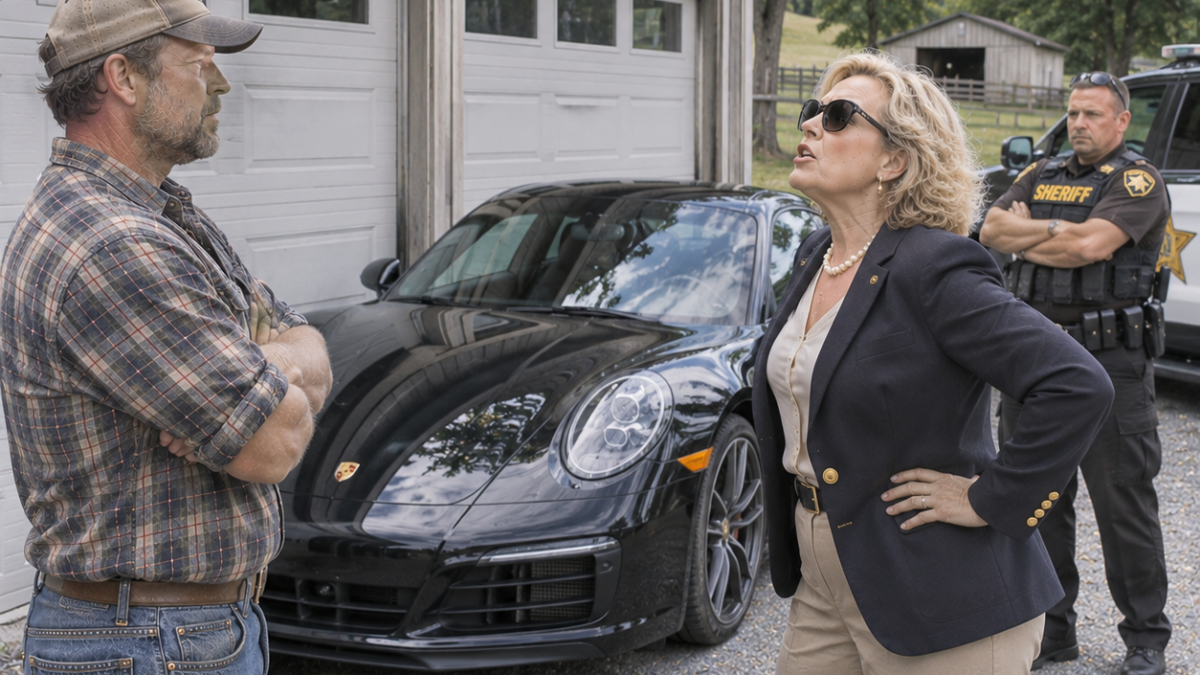
The HOA President Parked Her $100,000 Porsche Sideways Across Both Doors of My Garage, Then Told Me, “You’ll Get Access Back When You Respect Cedar Ridge Rules.” My Shop Wasn’t Even Inside Her HOA. I Filmed Her Saying It, Called the Sheriff—and 40 Minutes Later, She Was Still Bragging at a Board Meeting When Someone Asked, “Whose Porsche Is Being Towed Outside?”
Marissa Vance parked her black Porsche sideways across both doors of my garage at 5:17 on a Thursday afternoon.
Not beside them.
Across them.
The nose sat inches from one bay.
The rear bumper covered the other.
I had a restored 1971 Chevelle inside that needed to be loaded for delivery before eight that night, and the only way out was through the space occupied by a car worth more than most of the houses I grew up around.
I walked outside with my phone recording.
“Marissa.”
She was halfway across my gravel apron.
She stopped.
“Yes, Garrett?”
“Move the Porsche.”
“I have a board meeting.”
“You’re blocking both garage doors.”
“I’m aware.”
That answer was so clean I almost thought I had misunderstood her.
“You did this intentionally?”
She adjusted the strap of her handbag.
“I’m restricting access until you comply with Cedar Ridge parking rules.”
I looked at the phone in my hand.
Then at her.
“My property isn’t in Cedar Ridge.”
“We’ve discussed your attitude about jurisdiction.”
“No. We’ve discussed the deed.”
Her mouth tightened.
“Maybe three hours without access to your little repair shop will help you understand who controls this neighborhood.”
Then she walked toward the clubhouse two hundred yards down the road.
I didn’t touch the Porsche.
I didn’t block it in.
I didn’t follow her.
I photographed every tire, both garage doors, the property pins, my private-property signs, and the county survey I kept in the red folder above my workbench.
Then I called the sheriff’s non-emergency line.
Twenty minutes later, Deputy Cole Rourke arrived.
I showed him everything.
My deed.
Survey.
Video.
And the certified plat proving Holloway Motorworks sat on 3.7 acres that had existed eleven years before Cedar Ridge Estates was ever developed.
Cole watched the video twice.
Then frowned.
“There’s one problem.”
“What?”
“Mrs. Vance previously gave the department a map showing this strip as shared access.”
I almost laughed.
“Then compare it with the county plat.”
He did.
My copy carried the recorder’s certification.
Marissa’s didn’t.
Cole called Sheriff Dean Mercer.
Dean arrived fifteen minutes later, took both maps, and read them without saying much.
Then he asked:
“Did you request she move the vehicle?”
I pressed play.
Marissa’s voice came through clearly.
I’m restricting access until you comply.
Dean looked at the Porsche.
“That answers that.”
He radioed for a county-licensed tow operator.
Meanwhile, inside the Cedar Ridge clubhouse, Marissa was opening a meeting titled ENFORCEMENT ACTION REGARDING HOLLOWAY PROPERTY.
She had never invited me.
Apparently she planned to fine me $5,000 for violating HOA rules I had never agreed to and restrict access to land her association didn’t own.
By the time the tow truck arrived, roughly thirty homeowners were inside listening to her explain that nobody was above Cedar Ridge rules.
The truck’s amber lights flashed through the clubhouse windows.
Paige Ellison, the HOA treasurer, looked outside.
Then she raised her hand.
“Marissa?”
“What?”
“Isn’t that your Porsche?”
Chairs scraped.
People stood.
Marissa turned toward the window.
The tow operator was already positioning his wheel lift beneath her front tires.
She ran outside.
“You cannot touch that car!”
Sheriff Mercer held up her map.
“Show me the recorded easement giving Cedar Ridge rights over Mr. Holloway’s property.”
“It’s right there.”
Dean pointed to tiny print along the bottom.
PRELIMINARY CONCEPT — NOT FOR RECORDING.
Marissa went silent.
My map came from the county recorder.
Hers came from somewhere else.
And when the tow truck pulled her Porsche away from my garage, Dean asked the question that would eventually unravel far more than one parking dispute.
“Mrs. Vance, where exactly did you get this map?”
She said it had always been in the HOA records.
Paige heard her.
Then Paige walked across the gravel toward me.
“Garrett,” she said quietly, “you need to know something.”
“What?”
“This isn’t the first time she’s used that map.”
That was when the Porsche stopped being the biggest problem in Cedar Ridge.
Part 2:
Marissa Vance parked her black Porsche sideways across both doors of my garage at 5:17 on a Thursday afternoon.
Not beside them.
Across them.
The nose sat inches from one bay.
The rear bumper covered the other.
I had a restored 1971 Chevelle inside that needed to be loaded for delivery before eight that night, and the only way out was through the space occupied by a car worth more than most of the houses I grew up around.
I walked outside with my phone recording.
“Marissa.”
She was halfway across my gravel apron.
She stopped.
“Yes, Garrett?”
“Move the Porsche.”
“I have a board meeting.”
“You’re blocking both garage doors.”
“I’m aware.”
That answer was so clean I almost thought I had misunderstood her.
“You did this intentionally?”
She adjusted the strap of her handbag.
“I’m restricting access until you comply with Cedar Ridge parking rules.”
I looked at the phone in my hand.
Then at her.
“My property isn’t in Cedar Ridge.”
“We’ve discussed your attitude about jurisdiction.”
“No. We’ve discussed the deed.”
Her mouth tightened.
“Maybe three hours without access to your little repair shop will help you understand who controls this neighborhood.”
Then she walked toward the clubhouse two hundred yards down the road.
I didn’t touch the Porsche.
I didn’t block it in.
I didn’t follow her.
That was harder than it sounds.
My name is Garrett Holloway.
I was forty-seven years old when Marissa decided a Porsche was an enforcement tool.
I own Holloway Motorworks, a two-bay restoration and repair shop on 3.7 acres along the western edge of Cedar Ridge Estates.
The shop existed before Cedar Ridge.
So did the land.
My father bought the parcel when I was twelve.
Back then, there was no subdivision next door.
Just field, scrub oak, and a county road.
Dad built the garage himself.
Nothing fancy.
Concrete block.
Two steel roll-up doors.
A little office in back.
Gravel apron out front.
He repaired tractors, pickups, work vans, and whatever else people could afford to keep running.
I grew up sweeping that floor.
By fourteen, I could rebuild a carburetor.
By sixteen, I knew how to weld badly.
By twenty-three, I could weld well enough that Dad stopped redoing my work after I went home.
When he died, I inherited the property and the business.
I improved both gradually.
New lifts.
Better drainage.
Security cameras.
Fresh roof.
But the basic footprint stayed the same.
The county recorded my parcel years before the first Cedar Ridge subdivision plat was approved.
When developers eventually built 206 homes beside me, nobody asked me to join the HOA.
I wouldn’t have anyway.
My deed remained independent.
No covenants.
No association dues.
No architectural review.
No HOA parking rules.
Nothing.
For years, that caused no trouble.
Cedar Ridge’s clubhouse parking lot sat just beyond a low fence near the edge of my gravel apron.
When big events filled the lot, people occasionally used the front edge of my property to turn around.
Sometimes someone parked for five minutes while picking up a child.
I let it go.
Not because they had a right.
Because life is easier when every inconvenience doesn’t become a constitutional crisis.
Then Marissa Vance became president.
She was forty-four.
Sharp dresser.
Expensive car.
The kind of confidence that made ordinary opinions sound like policy.
Her campaign was built around something called the Cedar Ridge Uniform Appearance Initiative.
Mailbox colors.
Driveway sealant.
Garage-door palettes.
Overnight parking.
Commercial vehicles.
Restoration projects.
Some residents loved it.
Others thought it was ridiculous.
I didn’t care because none of it applied to me.
Marissa disagreed.
My first letter arrived less than two months after she took office.
VIOLATION NOTICE — $250.
Unpainted garage door.
Unauthorized commercial vehicle.
I read it twice.
Then wrote one sentence across the bottom.
My property is not in Cedar Ridge Estates.
I mailed it back.
A week later:
$500.
Then $750.
The third notice warned that continued noncompliance could result in a lien against my property.
That was when I started the red folder.
Every letter went inside.
Dad taught me that.
“If somebody puts nonsense in writing, don’t throw it away. They may need to read it later.”
My first real conversation with Marissa happened at the fence line.
She arrived carrying another violation packet.
“Garrett, you’re making this unnecessarily difficult.”
“No. I’m making it accurate.”
“Your garage affects Cedar Ridge property values.”
“That doesn’t put it inside Cedar Ridge.”
“Your customers use our roads.”
“They use the county road.”
“They see our entrance.”
“That is usually how eyesight works.”
She didn’t appreciate that.
“Your business impacts the community.”
“Lots of things impact the community.”
“Which is why the HOA has authority to regulate them.”
“No.”
She stared at me.
“No?”
“Affecting something doesn’t make it yours.”
That sentence ended the conversation.
The next day I installed two signs.
PRIVATE PROPERTY
NO HOA PARKING
Not aggressive.
Not decorative.
Just clear.
One disappeared before breakfast.
My camera showed Marissa’s Porsche idling beside it at 6:12 that morning.
I couldn’t see her physically removing the sign because the angle was partially blocked.
So I didn’t accuse her.
I replaced it.
Then adjusted the camera.
That was my habit.
Fix the weak angle.
Don’t argue with incomplete evidence.
A week later, Cedar Ridge residents received a mass email.
Marissa announced that the pavement and gravel area in front of Holloway Motorworks had been designated a shared emergency access zone.
That got my attention.
The email included a map.
Thin yellow line.
It crossed the edge of my apron and continued toward the clubhouse.
She described it as a longstanding easement.
I zoomed in.
The map was dated 2003.
Cedar Ridge’s final subdivision approval wasn’t recorded until 2005.
I drove to the county recorder the next morning.
The clerk pulled two certified records.
My deed and survey.
Cedar Ridge’s final plat.
No easement.
No shared road.
No emergency access strip.
Nothing crossing my property.
The final Cedar Ridge line stopped exactly where I knew it stopped.
I asked the clerk whether there were older development files.
She suggested county planning.
That afternoon, I requested them.
While I waited, another HOA letter arrived.
This one said if I didn’t comply before Thursday, Cedar Ridge would begin “restricting vehicular access associated with the Holloway property.”
That phrase felt different from a fine.
I called the county planning department.
“What happens if an HOA blocks access to property that isn’t inside the HOA?”
The planner asked:
“Do they have an easement?”
“No.”
“Court order?”
“No.”
“Recorded agreement?”
“No.”
“Then document everything.”
I added another camera.
One aimed at both garage doors.
Then a handwritten log.
Date.
Time.
Letters.
Visits.
Cars.
Every interaction.
Thursday came.
Marissa’s meeting began at six.
At 5:17, the Porsche arrived.
She turned into my apron slowly.
Then positioned it sideways.
Both doors blocked.
I stepped outside.
Phone recording.
“Marissa.”
“Yes?”
“Move the Porsche.”
“I have a meeting.”
“You’re blocking the shop.”
“I know.”
“Are you doing that as an HOA action?”
She smiled.
“I’m restricting access until you comply.”
“You understand I have a customer vehicle inside?”
“That sounds like your business problem.”
“Move the car.”
“After the meeting.”
“That could be three hours.”
“Maybe three hours will help you understand who controls this neighborhood.”
Then she left.
I stood there looking at the Porsche.
Black Panamera.
Perfect paint.
Polished wheels.
Probably over a hundred thousand dollars new.
For about five seconds, every stupid idea a mechanic could have crossed my mind.
Move it with dollies.
Pull it with my truck.
Lift it with equipment.
Instead, I photographed it.
Every angle.
Every tire.
Property markers.
Garage doors.
License plate.
Clock.
Then called the sheriff.
Deputy Cole Rourke arrived first.
He knew my shop.
Had brought his personal truck there once.
I handed him the folder.
He read the deed.
Survey.
HOA notices.
Then watched the video.
He looked toward the clubhouse.
“She actually said she’s restricting access?”
“You heard it.”
He watched again.
Then sighed.
“There’s something I need to tell you.”
“What?”
“Cedar Ridge sent our office a map last week. Claims this area is shared emergency access.”
I showed him my certified plat.
“Compare them.”
He did.
Mine carried the recorder stamp.
Marissa’s copy didn’t.
Cole wasn’t comfortable making a title decision himself.
That was reasonable.
He called Sheriff Dean Mercer.
Dean was fifty-five and had the patience of a man who had spent decades listening to neighbors explain where fences should be.
He arrived.
Read both maps.
Walked the property line.
Checked the boundary pin.
Then asked:
“Did she refuse to move?”
I played the recording.
I’m restricting access until you comply.
Dean nodded once.
“That answers intent.”
He called a tow operator.
Not because the sheriff suddenly decided a private title dispute.
Because the certified county survey showed the Porsche sat inside my parcel, I had revoked permission for it to remain there, its owner had expressly stated she was using it to prevent access, and she refused to move it.
The tow company arrived about fifteen minutes later.
I stayed by my garage.
Inside the clubhouse, Marissa was apparently telling people I was finally going to be taught a lesson.
I know because several residents told me later.
She had a slide presentation.
HOLLOWAY COMPLIANCE STRATEGY.
She proposed fines up to $5,000.
A board member named Paige Ellison asked whether Cedar Ridge could legally fine someone outside the association.
Marissa answered:
“He benefits from Cedar Ridge infrastructure.”
Paige asked:
“Does benefit equal membership?”
Marissa said:
“We cannot allow technical boundaries to undermine community standards.”
That sentence would age badly.
The tow truck’s amber lights appeared through the clubhouse windows.
Paige looked outside.
Then asked:
“Marissa, is that your Porsche?”
People stood.
Marissa ran outside.
By then, the operator had the wheel lift positioned.
“You cannot tow my car!”
Sheriff Mercer held the HOA map.
“Show me the recorded easement.”
“This is HOA property.”
“No. The certified plat says otherwise.”
She pointed to her photocopy.
“It’s right there.”
Dean looked at the corner.
Then showed her.
PRELIMINARY CONCEPT — NOT FOR RECORDING.
Her face changed.
Barely.
But enough.
“That’s an old notation.”
“It’s an important notation.”
“The access was later adopted.”
“Where?”
“In HOA records.”
“Not county records.”
She tried another argument.
“I’ve only been parked there a few minutes.”
I showed Dean the timestamp.
Nearly fifty.
Then the video.
Her own voice.
No misunderstanding.
No accidental parking.
No confusion.
The operator lifted the Porsche.
Marissa stepped behind the truck.
Cole told her:
“Ma’am, step away from the active tow.”
“This is outrageous.”
“Step back.”
She did.
The Porsche rolled away.
I opened my garage.
Loaded the Chevelle.
Delivered it forty minutes late.
The customer understood.
When I returned, Paige was waiting.
“You need to know something.”
“What?”
“That map.”
“Yes?”
“Marissa has been using it for years.”
“For what?”
Paige looked toward the clubhouse.
“An assessment.”
That was the first time I heard the phrase West Access Maintenance Assessment.
For three years, Cedar Ridge residents had paid $180 annually under that line item.
Two hundred six homes.
The budget described it as money for maintenance of the western access road serving the clubhouse.
Except the “western access road” was my gravel apron.
My land.
I had paid every drainage repair.
Every load of gravel.
Every grading job.
Every bit of maintenance.
Cedar Ridge had never spent a dollar on it.
Paige was treasurer, but Marissa had controlled much of the budget preparation.
Paige had always assumed West Access referred to some old legal arrangement predating her time on the board.
Now she wasn’t so sure.
“Do you know how much was collected?”
“Roughly thirty-one thousand dollars.”
I stared at her.
“Where did it go?”
“That’s what I’m trying to find out.”
The Porsche was no longer funny.
The next morning, I hired Grant Farley.
Property lawyer.
Early fifties.
Office in town.
He had the irritating habit of becoming quieter as problems became more serious.
He reviewed everything.
The notices.
Survey.
Map.
Video.
Tow report.
Then the assessment.
“How long has Cedar Ridge been claiming this easement?”
“At least three years.”
“And your deed is eleven years older than the subdivision?”
“Yes.”
“You ever sign anything?”
“No.”
“Ever receive maintenance?”
“No.”
“Any recorded easement?”
“No.”
Grant nodded.
“We ask for records.”
He sent Cedar Ridge a formal demand.
Final recorded plat.
Historical planning documents.
Board minutes.
West Access invoices.
Budget records.
Legal opinions.
Correspondence mentioning my property.
Assessment accounting.
Map provenance.
Marissa responded through the HOA’s existing attorney with a cease-and-desist letter accusing me of harassment.
Grant almost smiled.
“Have you contacted residents?”
“No.”
“Attended their meetings?”
“No.”
“Entered the clubhouse?”
“No.”
“Posted about Marissa?”
“No.”
“Then this is useful.”
“How?”
“They’re accusing the wrong person of unwanted contact.”
He responded by certified mail.
Short.
Factual.
Then county mapping specialist Wade Kesler called.
He had found the 2003 document.
It was exactly what I suspected.
An early concept plat.
The developer had once considered buying a strip of my father’s property to create a secondary access road.
The purchase never happened.
The access was removed from the final plan.
The preliminary map originally contained several disclaimers.
PROPOSED.
SUBJECT TO LAND ACQUISITION.
NOT FOR RECORDING.
The version Marissa circulated was different.
The yellow access line had been darkened.
Two disclaimers removed.
One remained accidentally in the corner.
That one saved Sheriff Mercer a lot of time.
Grant obtained the digital file used by Cedar Ridge.
Metadata showed it had been created less than two years earlier.
Author:
M. Vance.
That alone didn’t prove everything.
Grant made that clear.
“Metadata can be challenged.”
“But it helps.”
“With the rest of the file, yes.”
Marissa responded by calling another emergency meeting.
DEFENDING CEDAR RIDGE PROPERTY RIGHTS.
She proposed spending $25,000 from reserves to sue me.
Paige objected.
Residents asked why they should finance litigation that began with Marissa parking across my doors.
Marissa said I had provoked her.
Then my video circulated among board members.
That argument collapsed.
A few days later, the next escalation arrived.
At 6:08 in the morning, two Cedar Ridge maintenance workers crossed onto my property.
My cameras caught them unloading six concrete bollards.
They installed them along the edge of what Marissa still claimed was the shared access lane.
Three sat inside my surveyed boundary.
Between twenty-eight and forty-one inches.
I didn’t touch them.
Didn’t pull them out.
Didn’t block the workers.
I sent the footage to Grant.
Wade came back and performed an updated certified survey.
Same answer.
Three posts on my property.
Grant filed for temporary injunctive relief.
The association received notice.
The court held an expedited hearing.
Cedar Ridge could produce no recorded easement.
No deed.
No owner agreement.
Only the disputed preliminary map.
The judge entered a temporary order prohibiting the HOA from entering my parcel, placing new obstructions, enforcing HOA rules against me, or relying on the disputed map as evidence of access rights until the case could be resolved.
The bollards had to come out.
Marissa told residents:
“A temporary order doesn’t change what we know belongs to Cedar Ridge.”
Paige asked at the next meeting:
“Where is the deed proving that?”
Marissa had no answer.
Paige moved for an independent financial audit.
That passed.
Barely.
The audit made the parking dispute look small.
$4,800 for “property enforcement consulting.”
$6,200 for “legal research.”
$3,600 in towing retainers.
$2,100 for “map preparation.”
Nearly $16,700 in spending approved through Marissa without clear corresponding board resolutions.
Then one invoice caught Grant’s attention.
RECONSTRUCTION OF WEST ACCESS EXHIBIT.
Not reproduction.
Not archive retrieval.
Reconstruction.
The vendor was a small design and mapping company.
Grant subpoenaed records during the civil case.
The firm cooperated.
Its employees said Marissa had provided the 2003 concept plat.
Her instructions:
Remove preliminary language.
Remove “subject to land acquisition.”
Darken the access strip.
Clean up the exhibit for presentation.
The firm said it believed the result was for an internal historical presentation.
Not a legal representation of property rights.
Marissa had used it as exactly that.
To homeowners.
Contractors.
Her own board.
And the sheriff’s office.
Grant forwarded the relevant material to county officials and law enforcement.
Sheriff Mercer didn’t make dramatic pronouncements.
He said the documentation would be reviewed by the appropriate investigative unit.
That was enough.
My civil case remained about civil things.
Trespass.
Invalid enforcement.
Property interference.
Business loss.
Survey expenses.
Attorney fees where recoverable.
Damage to gravel and drainage from the bollard work.
Late delivery.
Canceled transport booking.
By the time Grant calculated documented losses and fees, we were around $42,600.
Marissa’s lawyer offered settlement.
All HOA fines against me would be dropped if I withdrew my claims.
Grant read the offer aloud.
Then looked at me.
“They’re offering not to enforce rules that never applied.”
“Generous.”
“Extremely.”
We rejected it.
Mediation followed.
I asked for four things.
One:
Formal acknowledgment that no Cedar Ridge easement crossed my property.
Two:
Refund the West Access Maintenance Assessment to the homeowners who had paid it.
Three:
Pay my documented losses and appropriate legal expenses.
Four:
No direct contact from Marissa.
The first was easy.
Third negotiable.
Fourth almost insulting in its obviousness.
The second ended mediation.
Marissa refused.
Not because Cedar Ridge couldn’t mathematically issue credits.
Because refunding the assessment meant admitting what the line item had really been.
For three years, residents paid money to maintain a road the HOA didn’t own.
Worse, only about $4,000 of the collected money could be tied to anything resembling western-area maintenance.
The rest had been folded into general operations.
Paige sent one email to the board that evening.
WHERE DID THE WEST ACCESS MONEY GO?
That question spread.
Board members who had supported Marissa started asking for the audit.
Several admitted they voted for the assessment without ever verifying the easement.
They saw a budget line.
Assumed somebody else had checked.
That assumption was what Marissa needed.
The next general meeting was packed.
I didn’t attend.
Grant suggested I could.
I chose not to.
My presence would make it easier for Marissa to turn an accounting problem into a personality contest.
Paige presented the numbers.
More than $31,000 collected.
Roughly $4,000 traceable to expenses that could loosely relate to the western clubhouse area.
Nothing showing Cedar Ridge maintained my apron.
Nothing showing Cedar Ridge owned it.
Nothing showing residents were told the legal basis had never been verified.
Questions came fast.
“Why were we charged?”
“Who approved the map?”
“Why did we pay to maintain Garrett’s land if Garrett maintained it himself?”
“Is it true Marissa parked across his garage?”
That one caused a pause.
Marissa said:
“He manipulated the situation.”
Paige replied:
“He isn’t even here.”
That landed.
Paige moved to suspend Marissa’s independent spending authority pending completion of the audit and litigation.
Passed.
Then another motion:
Retain independent association counsel rather than continuing with the attorney Marissa had personally selected.
Passed.
Then residents demanded a recall process.
Marissa warned them Cedar Ridge would fall apart without experienced leadership.
Someone in the back answered:
“We were fine before you weaponized a Porsche.”
I heard about that one later.
At some point during the meeting, Marissa received a call from the impound lot.
She had disputed the tow rather than promptly retrieving the Porsche.
Storage charges had accumulated.
The HOA would not pay them.
She eventually did.
The next morning, Cedar Ridge’s newly retained counsel contacted Grant.
Different tone.
The association was no longer interested in defending every action Marissa had taken.
Its new attorney had reviewed:
My deed.
Certified plat.
Preliminary map.
Vendor invoice.
Metadata.
Video.
Court order.
Audit.
West Access assessment.
He advised the board that continuing to insist an easement existed could increase liability.
Negotiations changed immediately.
Cedar Ridge formally acknowledged there was no access easement.
Every fine against me was voided.
The bollards and any HOA signage were removed.
The HOA agreed to send a written notice to all residents confirming Holloway Motorworks was outside Cedar Ridge and not subject to its covenants.
Homeowners who paid the West Access Maintenance Assessment received credits.
My business losses, survey costs, property restoration, and much of my legal expense were resolved through settlement.
By the time all agreed remediation items were calculated, the total association exposure connected to the dispute came to roughly $68,400.
That number included more than a check to me.
There were homeowner credits.
Survey and restoration work.
Legal remediation.
Accounting expenses tied to correcting the problem.
The insurer separately reviewed Marissa’s conduct.
Deliberately blocking my garage after announcing it was an enforcement tactic was difficult to characterize as an ordinary good-faith board decision.
The altered map created an even larger problem.
The carrier reserved rights on several matters.
That meant Cedar Ridge’s board had strong incentive to separate legitimate association liability from Marissa’s personal actions.
They demanded she reimburse certain expenses she had approved without valid board authorization.
Then came the recall.
The result wasn’t close.
Marissa Vance was removed as president.
Paige became interim president.
I wasn’t there.
I was rebuilding a transmission.
That felt appropriate.
Later, somebody sent me a photograph.
Marissa leaving the clubhouse.
Porsche parked outside.
Certified envelope tucked beneath the wiper.
The letter came from Cedar Ridge’s own attorney.
Demand for reimbursement of unauthorized expenditures.
I looked at the picture for a few seconds.
Then deleted it.
I had spent months resisting bills sent by Marissa.
I didn’t need to celebrate her receiving one.
The settlement required boundary clarification.
Wade installed new survey markers.
I built a low fence exactly inside my line.
Not to be hostile.
To end ambiguity.
The gravel apron stayed mine.
I widened one section using part of the settlement funds.
Every inch surveyed first.
The rest went into upgraded cameras, drainage improvements, attorney costs not fully recovered, and the business.
No revenge project.
No giant sign insulting the HOA.
Just practical things.
A month later, Sheriff Mercer stopped at the shop.
He had a copy of the incident and tow reports I requested.
I was standing beneath a lifted Ford pickup.
He handed me the file.
“Keep it with your red folder.”
“It’s becoming a red cabinet.”
He laughed.
Then looked toward Cedar Ridge.
“Funny how this started.”
“With bad parking.”
Dean shook his head.
“No.”
“No?”
“It started when somebody decided a title gave her rights she didn’t actually have.”
I thought about that.
He was right.
The Porsche made the problem visible.
But it didn’t create it.
Marissa had already tried to fine a nonmember.
Threaten a lien.
Remove my sign.
Reclassify my property.
Use a preliminary map as a legal easement.
Collect assessment money around that fiction.
Spend association funds to reinforce it.
The Porsche was simply the cleanest evidence.
Her own car.
Her own words.
Her own intent.
I’m restricting access until you comply.
Hard to explain that away.
Cedar Ridge changed quickly under Paige.
At her first meeting, she read the settlement terms aloud.
No hiding numbers.
No vague summary.
Then the board adopted two new policies.
Any claimed easement, shared-access right, or maintenance obligation had to be supported by a certified recorded document before it appeared in enforcement material or budget assessments.
And no board member could use a personal vehicle or other physical obstruction to enforce a property dispute.
That second rule made me laugh.
Not because it was wrong.
Because somewhere in America, a homeowners association had apparently needed to write down:
Do not block somebody’s garage with your Porsche.
People say regulations are written in blood.
HOA regulations, apparently, are sometimes written in German luxury sedans.
The West Access credits appeared on homeowner accounts the following quarter.
A few residents came by afterward.
Some apologized.
Most were embarrassed.
One man named Robert Hale stood near my workbench.
“I voted for that assessment three years in a row.”
“Okay.”
“I never asked what road it covered.”
“A lot of people didn’t.”
“I assumed the board knew.”
“That’s usually how it happens.”
He looked toward the red folder.
“You knew?”
“I knew I owned my land.”
“I mean about the money.”
“No.”
“Would you have cared if they charged their members and left you alone?”
That was a good question.
“Yes.”
“Why?”
“Because sooner or later, a fake budget line needs a fake right to justify it.”
That was exactly what happened.
As long as Cedar Ridge collected money for West Access, somebody had to preserve the fiction that West Access existed.
Once the real property owner started objecting, the fiction required enforcement.
Fines.
Map.
Threats.
Bollards.
Porsche.
Bad paperwork grows teeth when money depends on it.
Months later, the law-enforcement review continued separately.
I wasn’t given every detail.
Nor should I have been.
The design firm records had been forwarded.
So had the altered exhibit.
Whether prosecutors believed any conduct met a criminal statute was their decision.
I stopped asking.
My civil outcome was done.
My land was clear.
My business was open.
My garage doors worked.
That was enough.
Marissa stayed in Cedar Ridge for a while.
I saw the Porsche occasionally.
She no longer stopped.
Once, late in the afternoon, she drove past Holloway Motorworks while I stood outside with a customer.
Normal speed.
No dramatic glare.
No horn.
No gesture.
She simply kept going.
That was the most ordinary thing she had ever done around my property.
I appreciated it.
Paige later won the formal election.
Her entire campaign was one sentence:
Every assessment should pay for something we can prove exists.
Hard to argue with that.
Cedar Ridge meetings became quieter.
Budgets came with documentation.
Property questions went to county records before they went to enforcement.
The clubhouse did not collapse.
The neighborhood did not descend into chaos.
Mailboxes survived without executive supervision.
People still complained.
That is what neighborhoods do.
But their president stopped behaving like governor of an independent country.
I remained outside it all.
Never joined.
Never paid dues.
Never attended a social event there.
A few Cedar Ridge residents became customers.
That was enough community for me.
One summer afternoon, I was finishing a 1969 Camaro when Paige walked over.
She stopped at the fence.
“Can I come through?”
That question mattered.
“Sure.”
She opened the gate.
“I need your opinion.”
“Dangerous.”
“The board is considering replacing the fence between the clubhouse and this side.”
“Okay.”
“We have a survey.”
“Already better than last time.”
She smiled.
“We want to make sure construction access doesn’t cross your apron.”
“That would be appreciated.”
She handed me a site drawing.
The contractor route stayed entirely inside Cedar Ridge.
I looked at it.
“Looks fine.”
“That’s it?”
“That’s it.”
“No meeting?”
“No lawsuit.”
“No sheriff?”
“Try not to sound disappointed.”
She laughed.
Before leaving, she looked toward the garage doors.
“Hard to believe all of this started here.”
“Dean says it didn’t.”
“What does he say?”
“It started when Marissa decided her title created property rights.”
Paige nodded.
“That sounds like Dean.”
Then she left.
The fence project happened two months later.
No trespass.
No confusion.
No drama.
That is what competence looks like most of the time.
Nothing interesting happens.
Holloway Motorworks stayed busy.
I finished the Chevelle that had been trapped the night of the Porsche tow.
The owner brought it back for a carburetor adjustment the following spring.
“You know,” he said, “that car made me famous at my club.”
“Why?”
“Everyone knows it as the Chevelle held hostage by the HOA.”
“It wasn’t held hostage.”
“Sounds better.”
“Most things do.”
He laughed.
After he left, I closed both garage doors.
They were still the same color Marissa had fined me over.
Bare galvanized steel with years of weather.
No HOA-approved paint.
No permit sticker.
No fine.
Just doors.
That was the funny part.
For all the noise Marissa made about appearance, not one person in Cedar Ridge ever proved my garage harmed a single property value.
The customers kept coming.
Homes kept selling.
The world survived an unpainted door.
What didn’t survive was the assumption that nobody would check her claims.
That had been Marissa’s real authority.
Not the bylaws.
Not the presidency.
Certainty.
She spoke as though every question had already been answered.
Most people accepted that because checking records takes effort.
Going to the county recorder is boring.
Reading plats is boring.
Auditing budget lines is boring.
Comparing invoice dates is boring.
That boredom protected her.
Until I needed my garage door open.
Then boredom became useful.
Certified plat.
Video.
Timestamp.
Metadata.
Invoice.
Survey.
Assessment spreadsheet.
Court order.
No dramatic secret witness.
No magic deed discovered under a floorboard.
Just documents that had been available the whole time.
My father would have loved that.
Dad trusted paper.
He never trusted people who said, “Everybody knows.”
Whenever somebody used that phrase in his shop, he answered:
“Then it ought to be easy to prove.”
Marissa said everybody knew the western access belonged to Cedar Ridge.
It wasn’t easy to prove.
Because it wasn’t true.
She said everybody knew I was subject to HOA standards because my business affected the neighborhood.
Not true.
She said everybody knew the assessment funded road maintenance.
Not true.
She said everybody knew the map showed a real easement.
Not true.
The louder “everybody knows” became, the thinner the supporting file got.
A year after the Porsche tow, I replaced the old red folder with a small steel file cabinet.
Not because I expected another fight.
Because there was too much paper.
I labeled one drawer:
CEDAR RIDGE.
Inside:
Violation letters.
Surveys.
Recorded plat.
Tow report.
Settlement.
Assessment records.
Court order.
Photographs.
At the very front, I kept a printout of the frame from my security video.
Marissa’s Porsche sideways across both garage doors.
Not as a trophy.
As a reminder.
If I had moved the car myself that night, the story could have become about what I did to her vehicle.
If I had shouted.
Threatened.
Touched her.
Blocked her.
Followed her into the clubhouse.
Anything.
She would have had another story.
Instead, I let her own words do the work.
I’m restricting access until you comply.
That sentence turned a parking dispute into evidence of deliberate coercion.
Then the fake map turned it into a property-rights case.
Then the assessment turned it into an accounting problem.
Then the audit turned it into a governance failure.
Each step existed before I knew about it.
All I had to do was stop giving Marissa opportunities to make the story about me.
That was the hardest part.
Silence can feel like weakness when somebody is lying about you.
It isn’t always.
Sometimes silence gives facts room to catch up.
One afternoon, Mr. Patterson—no relation to anyone in my shop, just a Cedar Ridge resident I had come to know—stopped by.
He had paid the West Access assessment every year.
“Got my credit.”
“Good.”
“Hundred eighty times three.”
“Five hundred forty.”
“You mechanics do math too?”
“Occasionally.”
He smiled.
Then looked toward the clubhouse.
“I used to think Marissa was just strict.”
“A lot of people did.”
“She made everything sound official.”
“Official and correct aren’t synonyms.”
He nodded.
“I suppose not.”
Before leaving, he asked:
“You ever think about suing her personally for more?”
“No.”
“Why not?”
“I got what I needed.”
“That’s it?”
“My property. Losses. Fees. Boundary. No HOA interference.”
“She put you through hell.”
“Yes.”
“You don’t want revenge?”
I thought about the question.
“No.”
That was true.
By then I didn’t.
Revenge would have kept Marissa in my life longer.
I had spent enough time on her.
The settlement gave me my quiet back.
Worth more.
Another season passed.
Then another.
The new fence grew weathered.
My survey markers stayed visible.
People stopped using the apron as casual clubhouse overflow parking.
Occasionally someone unfamiliar would start to pull in.
They’d see the sign.
Back out.
No confrontation.
That was all the sign had ever been for.
PRIVATE PROPERTY
NO HOA PARKING
Not:
I hate my neighbors.
Not:
Stay away forever.
Just:
This belongs to somebody.
Ask.
Boundaries sound hostile only to people accustomed to crossing them without permission.
That was Marissa’s problem from the beginning.
She looked across the fence at Holloway Motorworks and saw something that disrupted Cedar Ridge’s visual order.
Then she made a leap.
If it affected Cedar Ridge, Cedar Ridge should control it.
That idea was the engine behind everything.
The fines.
The access claim.
The map.
The assessment.
The bollards.
The Porsche.
Once you accept that premise, every later decision feels logical.
The problem is the premise was false.
My land could affect Cedar Ridge and still remain mine.
My garage could be visible and still remain outside their covenants.
Residents could use roads near my shop without acquiring rights over my property.
A president could dislike my business without gaining authority to regulate it.
Simple distinctions.
Expensive lesson.
The funniest part came at the end of Paige’s first year.
A new Cedar Ridge handbook came out.
Someone dropped a copy at my garage.
I wasn’t a member, but curiosity won.
Most of it was ordinary.
Pool hours.
Architectural review.
Parking.
Financial procedures.
Near the back was a new section.
BOUNDARY AND ACCESS VERIFICATION POLICY
Any enforcement involving an easement, shared-access claim, boundary, or neighboring parcel required certified county documentation before notices were issued.
Below that:
BOARD MEMBER CONDUCT
No director or officer could use a personal vehicle, temporary barrier, vendor, or maintenance employee to obstruct disputed property as a method of enforcement.
I read the paragraph twice.
Then laughed.
Dad would have laughed too.
It took a six-figure Porsche to teach adults not to physically blockade a garage they didn’t own.
I put the handbook in the Cedar Ridge drawer.
The next morning, a customer’s restored Mustang rolled out of the same bay Marissa had blocked.
Sunlight hit the hood.
The engine settled into a clean idle.
The owner drove away.
I lowered the garage door.
Across the road, Cedar Ridge’s bulletin board had a notice posted.
ALL PROPERTY ACCESS CLAIMS MUST BE VERIFIED THROUGH COUNTY RECORDS PRIOR TO ENFORCEMENT.
I could read the headline from my apron.
That was enough.
Then, as if the neighborhood had a sense of timing, a black Porsche appeared at the far end of the road.
Marissa.
She drove past.
Normal speed.
Stayed on the pavement.
Didn’t stop.
For one second, I saw her through the windshield.
Then the car continued down the road and disappeared.
I went back inside.
There was a transmission on the bench waiting for me.
That was where I wanted to be.
Not in a clubhouse.
Not in court.
Not standing beside a tow truck.
In my garage.
On my land.
Doing the work my father taught me.
Marissa had parked her Porsche across those doors because she wanted to prove Cedar Ridge controlled what happened on my property.
Forty minutes later, the car was on a tow truck.
Months later, the map she relied on was exposed as an altered preliminary drawing.
The $31,000 “road maintenance” assessment collapsed.
Her spending authority disappeared.
Then her presidency.
But the part I remember most clearly isn’t the tow.
It’s the moment before I made the call.
Porsche across my doors.
Phone in my hand.
Anger right there, easy to reach.
I could have made the wrong move.
Instead, I pressed record.
Sometimes standing your ground doesn’t look like shouting.
Sometimes it looks like a timestamp.
A county stamp.
A red folder.
And enough patience to let someone who built her authority on paperwork discover that paperwork works both ways.