HOA Karen Planted a Fake No-Fishing Sign on My Private Lake and Called 911 When I Removed It—She Vastly Underestimated What I’d Protect.k
HOA Karen Planted a Fake No-Fishing Sign on My Private Lake and Called 911 When I Removed It—She Vastly Underestimated What I’d Protect
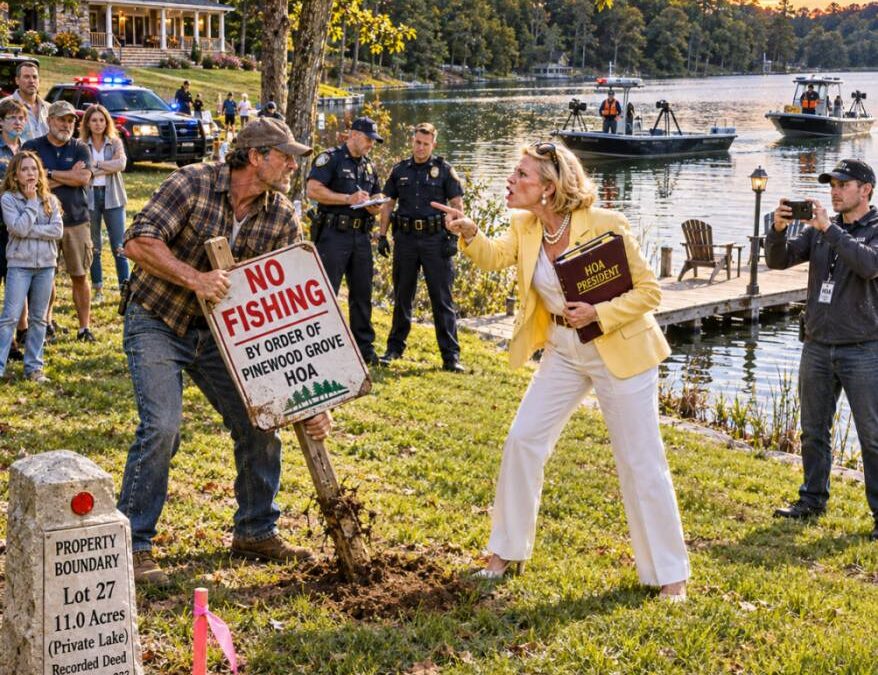
HOA Karen planted a fake “NO FISHING” sign twenty feet inside my lakefront property, then called 911 when I pulled it out of the ground.
The next morning, two unfamiliar boats were circling my shoreline while men photographed my dock, my trees, and the house where my wife and children slept.
That was when I realized nobody was fighting me over fishing—they were trying to make me surrender something far more valuable.
I had the sign halfway out of the ground when Evelyn Blake started screaming.
“What do you think you’re doing?”
I turned.
She was marching down the shoreline in white sneakers and a pale-yellow jacket, one hand gripping a leather folder while the other pointed at me like she’d caught me smashing windows.
A young man followed twenty feet behind her with his phone held horizontally.
Recording.
That bothered me more than Evelyn’s shouting.
Because he had been ready.
I looked at the wooden sign in my hands.
NO FISHING
BY ORDER OF PINEWOOD GROVE HOA
The HOA logo beneath the words was faded and wrong.
Pinewood had changed logos the previous year.
I’d noticed because I’d paid for the stupid redesign through my dues.
“Evelyn,” I said, “why is HOA property twenty feet inside my survey line?”
She stopped.
“You are destroying association property.”
“This?”
I lifted the crooked sign.
“This looks like something somebody painted in a garage.”
Her face tightened.
“The board authorized shoreline restrictions.”
“My shoreline isn’t HOA shoreline.”
“The lake serves the entire community.”
“No. The walking path does. The south picnic area does. The drainage easement does. This parcel doesn’t.”
The man behind her moved closer.
Still recording.
I pointed at him.
“Who is that?”
“He’s documenting your behavior.”
“For who?”
“Put the sign back.”
“No.”
Her eyes changed.
Not anger.
Calculation.
Then she pulled out her phone.
“I’m calling the police.”
I almost laughed.
“Tell them to bring a surveyor.”
Evelyn dialed 911.
Her voice changed instantly.
Suddenly softer.
Shaky.
“I need officers at Lake Vernon Court. A man is destroying HOA property and becoming aggressive.”
I stared at her.
“Aggressive?”
She turned slightly away from me.
“Yes. He’s confronting me near the water.”
I set the sign on the grass.
Both hands visible.
The young man kept filming.
Ten minutes later, two patrol cars stopped near my driveway.
Neighbors came outside.
Evelyn met the officers first.
Of course.
She showed them papers from her folder.
I waited beside the dock.
When the senior officer approached, I handed him the survey I’d pulled up on my phone, then walked him to the iron boundary marker near the oak tree.
My property line extended well beyond where the sign had been planted.
Then I showed him the recorded parcel map.
The lakebed itself—almost eleven acres—was part of the property my grandfather had left me.
The officer looked at Evelyn.
“Ma’am, do you have documentation showing the association owns this section?”
She handed him a sheet.
He read it.
“This is an HOA memo.”
“It’s board authority.”
“It’s not a deed.”
Evelyn’s face hardened.
The officer looked at me.
“Don’t destroy the sign. Keep it as evidence if ownership is disputed. Everybody stay off each other’s property and sort the boundary issue through counsel if necessary.”
Reasonable.
Not satisfying.
Reasonable.
Evelyn walked away.
I thought it was finished.
Then I heard her speaking to the young man near her SUV.
Too quietly for most people.
Not quietly enough for me.
“The sign didn’t work.”
A pause.
Then:
“Tell David we need another way to establish use before the July deadline.”
I stopped walking.
July deadline.
Establish use.
David.
The next morning at 7:03, two boats appeared in the center of my lake.
Neither belonged to me.
And neither man inside them had brought bait.
part 2
My name is Daniel Carter.
I was forty-four when Evelyn Blake decided my grandfather’s lake was something she could acquire by exhausting me.
Before all that, I had wanted exactly three things from the property.
Cold beer.
Quiet weekends.
Enough water between me and civilization that nobody could ask me to join a committee.
I was married to Emily, a physical therapist who possessed the patience of a saint until somebody messed with our children.
We had two kids.
Ethan was eight.
Sophie was eleven.
They fought over everything except the lake.
The lake belonged to both of them in the way children believe anything their family owns has existed solely for their happiness.
My grandfather, Thomas Carter, bought the property in 1968.
Back then it wasn’t surrounded by a subdivision.
It was woods.
A dirt road.
A shallow natural pond that he expanded through permitted excavation into a small private lake.
He built a cedar cabin first.
Then, in the eighties, replaced it with the house we eventually inherited.
Pinewood Grove came later.
Much later.
A developer bought surrounding farmland in the 1990s.
The subdivision wrapped around the western and southern edges of Grandpa’s property but never absorbed the Carter parcel.
That mattered.
Pinewood Grove had common land.
A walking trail.
A narrow drainage easement.
A community picnic strip near the southwest corner.
But the lake parcel itself remained privately owned.
Grandpa had fought about that during development.
I knew because he kept every document.
Survey.
Plat.
Recorded deed.
Drainage agreement.
Letters from attorneys.
Meeting notes.
Even certified-mail receipts.
When I was sixteen, I thought the boxes in his basement proved he was paranoid.
At forty-four, I thought they made him a genius.
He died two years before the sign appeared.
The property passed to me.
Emily and I sold our smaller house and moved to the lake permanently.
For the first two years, Pinewood barely bothered us.
Lawn notices.
One reminder about trash bins.
A disagreement about whether our mailbox needed a decorative post.
Normal HOA nonsense.
I paid dues only on the narrow residential lot that had been annexed into Pinewood decades earlier when Grandpa connected the home to subdivision utilities.
The lake parcel remained separately described in county records and outside the association’s ownership.
That distinction was boring.
Which is exactly how I liked it.
Then Evelyn became HOA president.
She was fifty-six, blond hair, immaculate nails, clothes that somehow looked expensive even when she was wearing jeans.
She had served on the architectural committee before taking over the board.
Evelyn loved words like stewardship.
Character.
Shared resources.
Responsible ownership.
At first, we had no problem.
She waved when driving by.
Complimented Sophie’s school fundraiser.
Once asked whether I’d consider letting Pinewood use a strip of shoreline for an annual children’s fishing day.
I said no.
Politely.
Not because I hated children.
Because my grandfather had warned me about informal access.
“Let people use land enough,” he’d say, “and eventually somebody forgets you’re being generous.”
That wasn’t always legally precise.
It was emotionally precise.
I told Evelyn the lake was private and our insurance didn’t cover community events.
She smiled.
“Of course.”
That should have been the end.
Instead, three months later, the fake sign appeared.
The two boats the following morning belonged to men I’d never seen.
I walked onto my dock with my phone recording.
“Morning!”
One man lifted a hand.
“Morning.”
“This is private water.”
He looked toward shore.
Evelyn was standing near the walking trail.
Clipboard.
Sunglasses.
Watching.
I raised my voice.
“Who gave you permission?”
The second man started his motor.
Evelyn called back:
“They’re conducting an HOA shoreline-use assessment.”
I stared.
“On my lake?”
“Riparian rights are under review.”
That phrase was so confidently wrong I almost admired it.
I walked along my shore until I reached the public path.
“Evelyn, riparian rights don’t mean your HOA gets a boat.”
“The community borders the water.”
“Some common land touches a drainage inlet.”
“Exactly.”
“No. Not exactly.”
She handed me papers.
PINEWOOD GROVE COMMUNITY WATER ACCESS REVIEW.
The header used the old association logo again.
There was a stamp at the bottom.
Looked official from ten feet away.
Up close, it looked like something purchased at an office-supply store.
I flipped through.
No recorded instrument.
No county map.
No legal opinion.
Just board language claiming the HOA was “investigating historic community use.”
One of the boaters said:
“Think the survey team got enough yesterday?”
My head snapped toward him.
“What survey team?”
He realized he’d said too much.
Evelyn raised her voice.
“Everybody back to shore.”
I started recording openly.
“Who’s David?”
She froze.
“What?”
“Yesterday you told your cameraman to tell David you needed to establish use before July.”
Her face changed.
Just slightly.
“I don’t know what you’re talking about.”
“Good. Say it again.”
She turned away.
Both boats headed toward the western bank.
One man had spent twenty minutes photographing my shoreline.
Not fishing.
Not measuring water depth.
Photographing.
Dock.
Boat shed.
Drainage culvert.
Access road.
Trees.
That afternoon, I called Brian Walsh.
Brian had been my college roommate before making the questionable decision to become a real-estate attorney.
He now practiced property litigation in Lansing.
I sent him everything.
Deeds.
Surveys.
HOA memo.
Video.
Police incident number.
He called that evening.
“First thing: stop arguing law with Evelyn.”
“She came onto my property.”
“I know.”
“She put boats in my lake.”
“I know.”
“She called 911.”
“I know.”
“You’re irritating.”
“That’s why people pay me.”
He paused.
“Daniel, this paperwork isn’t normal.”
“I figured.”
“Does Pinewood have a lawyer?”
“Yes.”
“These documents don’t look like something their lawyer drafted.”
“Meaning?”
“Meaning I want the recorded plat, board minutes, and any correspondence about lake access.”
“What about riparian rights?”
“People throw that phrase around like magic. Ownership and access depend on the deeds, plats, shoreline rights, lakebed ownership, easements, and state law. Nobody gets community boating rights because they can see water from a picnic table.”
“Good.”
“But don’t assume the HOA is the whole story.”
“What do you mean?”
“Those men were surveying something.”
The anonymous letter arrived that evening.
No return address.
Inside:
SMART OWNERS SELL BEFORE THEY’RE FORCED.
EVERYTHING HAS A PRICE.
Emily read it twice.
Then looked at me.
“Police.”
“Brian first.”
“Police first.”
There are moments when marriage teaches hierarchy.
We filed a report.
The officer photographed the letter.
No fingerprints obvious.
No immediate suspect.
I gave him Evelyn’s name but made clear I did not know who sent it.
Then Pinewood’s neighborhood Facebook page exploded.
Evelyn posted:
Certain private owners are obstructing Pinewood families’ historic enjoyment of community natural resources.
She did not name me.
Didn’t need to.
People did it for her.
Daniel won’t let kids fish.
Guy thinks he owns the water.
How can one family own an entire lake?
Nature should be shared.
I responded once.
The Carter lake parcel is privately owned. No HOA rule grants public or community access. Please do not enter the property or water without permission.
Then I stopped.
Brian called.
“Good.”
“What?”
“You didn’t write a manifesto.”
“I had one drafted.”
“Delete it.”
Comments multiplied.
Most harmless.
Some ugly.
Then identical emails started arriving.
Almost the same wording.
Your refusal to permit reasonable community access undermines neighborhood values.
Different names.
Same sentence.
Brian asked me to save everything.
Then my phone rang at 10:16 p.m.
Blocked number.
A man’s voice.
“Mr. Carter.”
“Who’s this?”
“You should cooperate.”
“With what?”
“The lake agreement.”
“What lake agreement?”
“You have a wife working at Vernon Physical Therapy.”
My entire body went cold.
Then:
“Your son goes to Pinewood Elementary.”
I stood.
Emily looked at me from the couch.
“Who is this?”
The caller said:
“Everybody has something more important than property.”
Then disconnected.
I called police immediately.
This time, nobody called it an HOA dispute.
A threat involving my family was different.
Still, tracing a blocked call wasn’t instant magic.
The report existed.
Detectives requested what they could.
We changed routines.
Emily varied her drive.
I took Ethan to school.
Sophie stopped riding her bicycle alone.
That was when my anger changed.
Before, Evelyn had irritated me.
Now I wanted her nowhere near my family.
Brian stopped me from doing something stupid.
“Don’t confront her.”
“She knows about the call.”
“How do you know?”
“I don’t.”
“Exactly.”
“I know she’s behind this.”
“You suspect.”
“I heard her talk about a deadline.”
“Good evidence of something. Not evidence of this call.”
I hated lawyers most when they were right.
We installed cameras.
Driveway.
Dock.
Shoreline.
Back path.
Cloud storage.
Motion lights.
Every no-trespassing sign documented.
Then somebody spray-painted one.
NATURE BELONGS TO ALL.
Police report.
Photographs.
No suspect.
Two nights later, Emily found a note beneath her windshield wiper outside work.
PARENTS WHO DEFY COMMUNITY VALUES TEACH CHILDREN SELFISHNESS.
She called me from the parking lot.
Her voice shook.
That frightened me because Emily rarely shook.
“Don’t touch it.”
“I already did.”
“Go inside.”
“Daniel—”
“Please.”
She went back into the clinic.
Police collected the note.
Again, no immediate link.
Our family shrank.
That’s what harassment does before it ever wins legally.
We stopped going out.
Stopped using the dock after dark.
Emily checked windows twice.
Sophie asked whether somebody wanted to hurt us.
Ethan stopped inviting friends over because kids had heard rumors that police were “investigating his dad.”
Then the fish died.
I woke before sunrise and smelled it before seeing it.
Chemical.
Rot.
Something bitter hanging over the water.
Dozens of fish floated near the south cove.
Bluegill.
Bass.
Perch.
Some still moving weakly.
I called environmental authorities.
Then Brian.
Then police.
Nobody touched the water.
A state environmental response team collected samples.
The preliminary field test showed abnormal chemical contamination concentrated near a drainage channel feeding from the subdivision side.
Not enough to identify who introduced it.
Enough to close recreational contact temporarily.
I sat on the dock after everyone left.
Grandpa’s old tackle box beside me.
The lake looked dead.
Ethan found me.
Emily must have let him come down.
He sat beside me.
“Dad?”
“Yeah?”
“Did we do something bad?”
“No.”
“Then why does everybody say we’re bad?”
I couldn’t answer.
He stared at a dead fish near the reeds.
“Is the lake going to die?”
My throat tightened.
“No.”
“You sure?”
“No.”
That was the first time I cried over any of it.
Not loudly.
Just enough that Ethan pretended not to notice.
He leaned against my shoulder.
The next break came from a stupid coincidence.
I was replacing a damaged camera near the side yard when I heard Evelyn on the walking path beyond the hedge.
She was speaking on the phone.
“Phase one has done what it needed to.”
I froze.
She continued.
“The lake is unusable right now, which changes valuation.”
My heartbeat hammered.
Then:
“No, Daniel’s not selling yet. We need Plan B ready before the option window closes.”
I lifted my phone.
Recorded the final twenty seconds.
Not everything.
Enough.
She disappeared down the path.
Brian listened.
“Now we’re getting somewhere.”
“Who is she talking to?”
“We find out.”
“Can we subpoena phone records?”
“Eventually, if litigation supports it. First, I want to know what option window means.”
Property records gave us the first clue.
Bayside Development LLC had spent the previous eighteen months acquiring parcels west of Pinewood Grove.
Small houses.
Vacant lots.
One old marina parcel.
The acquisitions formed a rough arc around the lake.
My lake sat in the middle.
Bayside didn’t own Pinewood.
It didn’t need to.
It was assembling land for a proposed mixed-use residential project that would be worth significantly more if it obtained controlled lake access.
There was the motive.
Brian found a county planning submission.
Concept drawings.
Not final approval.
One showed a private residential development labeled:
VERNON LAKESIDE.
A proposed access corridor crossed a narrow strip near Pinewood.
Then a dotted line reached my shoreline.
Conceptual recreational water amenity.
My lake.
I stared.
“They’re designing around property they don’t own.”
Brian nodded.
“Developers do conceptual plans all the time.”
“Why?”
“To see what could work.”
“Does Bayside have an option on anything Pinewood owns?”
“That’s what we need.”
We requested HOA records.
Evelyn resisted.
Pinewood management initially claimed certain development discussions were confidential.
Brian sent a formal demand through the association’s governing procedures and corporate-record rights.
Then three board members apparently asked why nobody had told them about development negotiations.
That caused panic.
Records began appearing.
An email from Evelyn to Bayside vice president David Holt:
The Carter parcel remains the primary obstacle. Community-use history may create leverage if we can document it before July.
David:
Our counsel is not relying on adverse-use theories. We need voluntary acquisition or another lawful access arrangement.
Evelyn:
Pressure creates voluntary decisions.
My stomach turned.
Another email:
Daniel inherited the property and is emotionally attached. Direct offer will fail. If community conflict increases carrying cost and reduces enjoyment, he may become realistic.
Brian sat back.
“There.”
I looked at him.
“She is trying to make us miserable so we’ll sell.”
“That’s what the email supports.”
“Is Bayside in on it?”
“Careful.”
He pointed to David’s earlier response.
“David specifically says they need voluntary acquisition and aren’t relying on whatever access theory Evelyn’s inventing.”
“So she went rogue?”
“Maybe.”
“Why?”
We found the answer in a consulting agreement.
Evelyn had a side business.
Blake Community Strategies.
Bayside had hired it to provide “local stakeholder engagement and acquisition support.”
Compensation included a success fee if specified parcels were acquired.
My parcel was one of them.
I stared at the contract.
“She’s HOA president.”
“Yes.”
“She’s also being paid if I sell.”
“Looks that way.”
“Did the board know?”
“No evidence yet.”
That changed everything.
Conflict of interest.
Misuse of association identity.
Potential misrepresentations.
Possibly trespass coordination.
But not yet proof of threats.
Not yet proof of poisoning.
Brian insisted we separate those.
Then one of the boaters called me.
His name was Jason Miller.
He owned a small land-survey subcontracting business.
“Evelyn hired us.”
“To do what?”
“Photograph access points.”
“Did you know the lake was private?”
“She told us the HOA had water rights.”
“It doesn’t.”
“I know that now.”
“Who paid you?”
“Blake Community Strategies.”
Not Pinewood.
That mattered.
“Why are you calling?”
“Because David Holt’s attorney contacted us. Bayside says they didn’t authorize trespassing.”
“Do you have the work order?”
“Yes.”
He sent it.
Task:
Document historic and apparent community access to Carter Lake, shoreline improvements, and potential ingress points.
Authorized by Evelyn Blake.
Our case hardened.
Then Mrs. Ellis appeared.
Margaret Ellis.
Eighty-one.
Lived near Pinewood’s original entrance.
She called Emily.
“I need to speak to Daniel.”
She came to our house carrying an accordion file.
Everybody in HOA stories eventually discovers an elderly woman with an accordion file.
Maybe civilization survives because older women refuse to throw paperwork away.
Margaret had served on the board before Evelyn.
She knew her history.
“Evelyn was removed as treasurer years ago.”
I stared.
“What?”
“Not removed from the board. Removed from officer duties.”
“Why?”
“Expense reimbursements.”
“Embezzlement?”
“No.”
Margaret shook her head.
“Don’t exaggerate. She reimbursed herself for expenses without enough documentation and fought the audit. She repaid some charges. The board let her remain because nobody wanted a scandal.”
Brian later confirmed the minutes.
There had been a dispute.
No criminal case.
No secret identity.
No past fraud arrest.
Reality was smaller.
More believable.
More useful.
Margaret also had meeting notes showing Evelyn had talked about “unlocking community lake access” months before Bayside appeared publicly.
“She wanted the HOA to purchase part of your shoreline,” Margaret said.
“Did the board approve it?”
“No.”
“Discuss it?”
“Once. Rejected. Insurance concerns.”
“Then why the sign?”
Margaret’s mouth tightened.
“Because Evelyn doesn’t hear no very well.”
We filed suit.
Not for twelve million dollars.
Not against six states.
Against Evelyn.
Her consulting company.
And, initially, Pinewood Grove for specific actions conducted under HOA color or with association resources.
Bayside was brought in for discovery and related contractual claims, but evidence increasingly suggested the company hadn’t authorized Evelyn’s worst tactics.
Brian sought an injunction.
No unauthorized entry onto the lake parcel.
No boating.
No signs.
No representation that Pinewood possessed lake access rights absent documented legal authority.
No direct contact with my children.
No harassment through association processes outside normal procedures.
The court granted substantial temporary relief.
Evelyn called it persecution.
Then she tried to frame me as unstable.
At a special HOA meeting, she presented a packet alleging I had threatened residents, vandalized association property, and prevented children from accessing “historic recreational resources.”
The clubhouse was packed.
Brian sat beside me.
Emily stayed home with the kids.
Evelyn stood at the front.
“Mr. Carter has turned a community disagreement into litigation.”
I raised my hand.
The interim board chair, Carl Reese, recognized me.
I stood.
“Can I ask one question?”
Evelyn folded her arms.
“What?”
“Are you being paid by Bayside Development if they acquire my property?”
The room went silent.
Evelyn’s face changed.
“That is unrelated.”
Carl turned toward her.
“What?”
She looked at him.
“Private consulting work.”
Carl stared.
“You have a financial agreement with the developer?”
“It is not an HOA matter.”
“You’ve been using HOA meetings to argue for access to Daniel’s lake.”
“Because community access benefits residents.”
“While you get paid if he sells?”
Evelyn’s face reddened.
“You are mischaracterizing the agreement.”
Brian said quietly:
“Let her talk.”
So I did.
Carl asked:
“Did you disclose this to the board?”
“I wasn’t required to.”
“Why not?”
“Because Pinewood isn’t purchasing the property.”
Another director, Denise Morgan, leaned toward the microphone.
“Did you authorize the no-fishing sign?”
Evelyn hesitated.
“The association supported access-management signage.”
“Which vote?”
Silence.
“Which vote, Evelyn?”
She flipped papers.
Denise continued.
“Did the board authorize boats on Daniel’s lake?”
“Historic-use documentation—”
“Which vote?”
Evelyn’s face hardened.
“This board is becoming hostile because Daniel has manipulated everyone.”
Then Jason Miller stood in the back.
The survey contractor.
Evelyn froze.
He held up a copy of his work order.
“You hired me personally.”
Murmurs erupted.
Jason continued.
“Your company paid me. You told me the HOA had access rights.”
Evelyn pointed at him.
“Sit down.”
Carl said:
“No.”
That one word changed the room.
Evelyn looked at him.
Carl repeated:
“He can speak.”
For the first time, she wasn’t running the meeting.
Jason explained the assignment.
Photographs.
Boats.
Access points.
No boundary survey authorized by Pinewood.
No legal opinion.
Just Evelyn’s instructions.
Then Brian projected her consulting contract.
Not every page.
The compensation clause.
Success fee.
My parcel number.
The room erupted.
Evelyn raised her voice.
“This is perfectly legal consulting.”
Brian finally spoke.
“Maybe.”
People quieted.
He continued.
“The issue tonight isn’t whether consulting is inherently illegal. The issue is whether an HOA officer used association authority, branding, meetings, residents, or common resources to pressure an owner while holding a financial interest in his sale.”
Evelyn pointed toward me.
“He still hasn’t told you why he refuses reasonable access.”
I stood.
“Because it’s private.”
“The community surrounds the lake.”
“Partly.”
“Families have looked at that water for decades.”
“Looking doesn’t create a deed.”
“You inherited it. You didn’t earn it.”
That sentence hung there.
I felt something in me go very still.
“My grandfather did.”
Evelyn rolled her eyes.
“Exactly. One family’s outdated property arrangement is holding back an entire community.”
There it was.
Not fishing.
Development.
She had finally said it publicly.
Denise asked:
“Did Bayside tell you to create pressure?”
Evelyn looked toward Brian.
“I want counsel.”
Correct decision.
Too late for the emails.
The board voted that night to suspend Evelyn from acting as president pending independent investigation.
Four to one.
She voted against.
Her lawyer arrived the next week.
The HOA retained separate counsel.
Pinewood’s insurer entered.
Bayside’s attorneys produced records quickly.
They wanted distance.
Their communications showed David Holt knew Evelyn believed community pressure could encourage a sale, but several emails warned her not to trespass, misrepresent ownership, or use HOA authority improperly.
One message from David:
Do not create access incidents. We need a negotiated transaction, not litigation.
That complicated my anger.
Bayside wanted my land.
Absolutely.
It had offered Evelyn a success fee.
That was aggressive.
But wanting to buy property isn’t the same as poisoning a lake or threatening children.
We kept digging.
The threatening phone call remained unsolved.
The notes remained unattributed.
The dead fish became the biggest question.
Environmental testing identified a herbicide concentration inconsistent with ordinary residential runoff.
Someone had introduced a substantial amount near the south drainage channel.
The drainage channel ran through a narrow Pinewood common strip before reaching my property.
My new camera covered the area after the poisoning.
Not before.
Then Sophie remembered something.
“Dad.”
She was looking through old photos on her tablet.
“What?”
“I took pictures of fireflies the night before the fish died.”
She showed me.
Blurry.
Mostly darkness.
Then one image.
A maintenance utility cart near the drainage inlet.
Timestamp:
11:48 p.m.
I zoomed.
Pinewood logo.
Not enough to identify driver.
We requested maintenance logs.
One utility cart had been checked out by a vendor that evening.
GroundsCare West.
Work order:
AQUATIC WEED CONTROL — SOUTH DRAINAGE / LAKE EDGE.
Authorized by Evelyn.
My heart hammered.
The invoice listed herbicide.
Same active ingredient found in the water.
But again, precision.
The product was legal for certain approved vegetation-control applications when used correctly.
The question was dose and location.
Investigators interviewed the technician.
He claimed Evelyn told him the HOA had authority to treat vegetation “along the community lake edge.”
He sprayed near the drainage area.
Then, according to him, Evelyn told him to pour remaining diluted solution into the channel because “it all drains to the lake anyway.”
His supervisor denied company policy allowed that.
Environmental investigators took over.
That was the moment Evelyn’s civil problem became something potentially bigger.
Still no dramatic raid.
No FBI helicopter.
Administrative investigation.
Police interviews.
Environmental enforcement.
Records.
The technician cooperated.
His GPS work app placed him at the drainage area.
His chemical-use log documented quantity.
The environmental report connected the discharge to the fish kill with sufficient confidence for enforcement proceedings.
Evelyn denied instructing improper disposal.
The technician maintained she did.
The case would eventually resolve through plea negotiations and civil penalties rather than a television trial.
But for our immediate lawsuit, the evidence was devastating.
Especially because of an email Evelyn sent David Holt two days later:
Lake condition may accelerate Carter’s willingness to negotiate. Property enjoyment has dropped substantially.
David replied:
What happened to the lake?
Evelyn:
Maintenance issue. Don’t worry about it.
David’s next email:
I am worrying about it. Do not involve Bayside in anything involving contamination or access disputes.
That email probably saved Bayside from a much worse position.
It also showed Evelyn understood the poisoning event created leverage.
Whether she intended the fish kill from the start would remain disputed.
Whether she tried to exploit it afterward was not.
The HOA investigation expanded.
Evelyn had used old logo files because she retained copies from her earlier board term.
The no-fishing sign had not been authorized.
The “community water access review” had not been approved.
The boats were privately hired through her consulting company.
The young man filming me during the first confrontation was her nephew, paid by Blake Community Strategies.
The identical complaint letters?
A template she had emailed to supporters.
The protest?
Mostly residents who genuinely believed the lake had historically been community property because Evelyn told them so.
That part made me feel almost sorry for them.
Almost.
Carl called another special meeting.
This time Evelyn attended with counsel and said almost nothing.
Her attorney had apparently introduced her to restraint.
The board presented its findings.
No recorded community lake right.
No board authorization for shoreline signs.
No authorization for boats.
No disclosure of her Bayside contract.
Use of HOA branding in private acquisition efforts.
Improper direction of a common-area vendor connected to the contamination incident.
The motion was simple.
Remove Evelyn Blake as HOA president permanently.
Five to zero.
Evelyn abstained.
Separate procedures governed her director position.
She resigned before the recall vote.
Pinewood issued a written notice to every homeowner:
The Carter lake parcel is private property. Pinewood Grove does not possess recreational boating, fishing, or shoreline access rights except where separately documented on specific common land. Residents must not enter the parcel without owner permission.
I read it three times.
Emily read it once.
“Frame it.”
“I’m not framing HOA mail.”
“You framed Ethan’s first fishing license.”
“Different.”
“Frame it.”
I framed it.
The civil case went into mediation.
Brian warned me.
“You’re not getting a movie ending.”
“I know.”
“No twelve-million-dollar conspiracy.”
“I know.”
“No prison sentence because she annoyed you.”
“I know.”
“What do you want?”
I thought.
“Lake restoration.”
“Good.”
“Security costs.”
“Good.”
“Legal fees.”
“Good.”
“Protection for my family.”
“Define it.”
“No contact with the kids. No coming onto the property. No fake community notices. No representing that she has access rights.”
“Good.”
“Compensation for contamination.”
“Good.”
“And I want every document saying Pinewood owns access withdrawn.”
Brian nodded.
“That’s a settlement position.”
We eventually resolved the civil claims through agreements involving Evelyn, her consulting company, Pinewood’s insurer, and other parties according to their respective involvement.
Bayside paid some costs tied to resolving its acquisition relationship and terminated Evelyn’s consulting contract, while continuing to deny authorization of harassment.
Pinewood paid for portions of shoreline remediation through its insurance and vendor relationships because the discharge originated from work conducted on common land.
Evelyn personally contributed through settlement.
My legal fees were substantially reimbursed.
The developer never acquired my lake.
The environmental enforcement case continued separately.
The technician received administrative consequences through his employer and cooperated.
Evelyn ultimately entered a plea to offenses related to false statements and unlawful environmental conduct arising from the drainage incident, while other accusations were resolved or dismissed depending on proof.
She received probation.
Restitution.
Community service.
Environmental remediation obligations.
No three-year federal prison sentence.
No FBI uncovering a twelve-million-dollar national empire.
Reality didn’t need one.
Her local scheme was enough.
She had a financial incentive to pressure me into selling.
She misused an HOA title.
She sent people onto property she didn’t control.
She manufactured “historic access” evidence.
She exploited residents’ assumptions.
And she became entangled in an environmental violation that damaged the very lake she claimed the community deserved.
That was enough.
The threatening phone call?
Never conclusively attributed.
The note on Emily’s car?
No proof.
The first anonymous sell-or-else letter?
No proof.
That frustrated me for years.
It still does.
Maybe Evelyn sent them.
Maybe one of her supporters did.
Maybe someone connected to the developer acted independently.
I don’t know.
I stopped pretending certainty was required for closure.
We knew enough.
The lake recovered slowly.
Environmental crews removed contaminated sediment near the drainage outlet.
Aeration.
Water testing.
Fish-stock assessment.
Restrictions stayed in place until experts were comfortable with recreational contact.
The first morning we were cleared to fish again, Ethan woke me at 5:11.
“Dad.”
I opened one eye.
“What?”
“We can fish.”
“It’s dark.”
“So?”
“Fish sleep.”
“No they don’t.”
“Go away.”
He stood there.
Silent.
I lasted twenty seconds.
We went fishing.
The lake looked almost normal.
That’s the strange thing about environmental damage.
Land doesn’t display legal exhibits.
The water didn’t care who had won mediation.
It reflected sunrise exactly as it always had.
Ethan caught the first fish.
Small bluegill.
Held it carefully.
“Is he okay?”
“Looks okay.”
“Can we keep him?”
“No.”
“Why?”
“Because I just spent a fortune making sure there are fish in this lake.”
He laughed.
We released it.
That moment did more for me than the HOA vote.
The family recovered slower.
Emily stopped checking the parking lot outside work after a while.
Sophie eventually rode her bike alone again.
Ethan stopped asking whether strangers were watching our house.
But the damage lingered in weird places.
If a boat motor sounded on the lake before I recognized it, my body went tight.
If an unknown number called after dark, I stared at it.
If Pinewood mailed something, I expected war.
Home had become something I monitored.
I hated Evelyn most for that.
Not the sign.
Not the fake fishing rules.
The way she made peace feel temporary.
Pinewood changed leadership.
Carl became president reluctantly.
His first meeting lasted three hours because homeowners wanted every decision explained.
Good.
A new conflict-of-interest policy required directors to disclose financial relationships with vendors, developers, real-estate projects, and transactions affecting association property.
No board officer could use Pinewood branding for private business.
Development communications had to be shared with the full board.
Access claims involving neighboring property required title review before anybody sent a letter.
Carl complained about legal bills.
Brian told him:
“Cheaper than inventing ownership.”
Carl did not find that funny.
The HOA also installed a permanent boundary map in its records.
My parcel.
Pinewood common strips.
Drainage easement.
Walking path.
Everything boringly labeled.
I loved that map.
Not because maps prevent bad people.
Because ambiguity is oxygen for people like Evelyn.
The clearer the paper, the harder it is to govern by confidence alone.
Bayside eventually changed its development plan.
Without my lake access, the project became smaller.
No private marina.
No “Vernon Lakeside.”
They built townhomes on parcels they legitimately owned.
The project wasn’t evil.
That was another uncomfortable lesson.
Developers aren’t automatically villains because they want land.
They make offers.
Owners say yes or no.
The corruption begins when “no” becomes a problem somebody thinks they have the right to solve through pressure instead of negotiation.
David Holt called me once after litigation ended.
I almost didn’t answer.
“Daniel Carter.”
“David Holt.”
“What do you want?”
“To apologize.”
I laughed.
“That’s new.”
“For hiring Evelyn.”
“Did you know what she was doing?”
“Not all of it.”
“That’s not no.”
He was quiet.
“We knew she thought community pressure would help negotiations.”
“Meaning?”
“Meetings. Resident support. Political pressure for access.”
“Did you know about the fake sign?”
“No.”
“Boats?”
“No.”
“Threats?”
“No.”
“Contamination?”
“Absolutely not.”
I believed the last answer.
Maybe because his email record supported it.
“Why hire her?”
“She knew the neighborhood.”
“No. Why agree to a success fee tied to my land?”
He sighed.
“Because we wanted your land.”
“That’s the honest answer.”
“Yes.”
“Then next time send an offer.”
“We did.”
“After months of nonsense.”
“I know.”
I looked across the lake.
“What was your highest number?”
David laughed once.
“You serious?”
“Curious.”
He told me.
It was a lot.
Emily nearly killed me when I told her.
“You said no to that?”
“Yes.”
“We could’ve retired.”
“You like your job.”
“Not that much.”
“Too late now.”
She shook her head.
Then smiled.
“I would’ve said no too.”
“See?”
“Don’t use me to justify bad financial decisions.”
Marriage.
Evelyn stayed in Pinewood for another year.
Her house eventually went on the market.
No midnight moving van.
No crowd cheering.
She sold.
The final time I saw her was at the lake.
That surprised me.
I was repairing a dock board when she stopped on the public walking path.
She didn’t cross the boundary.
At least she had learned something.
“Daniel.”
I stood.
“Evelyn.”
She looked toward the water.
“It recovered.”
“Mostly.”
“I’m glad.”
I almost laughed.
“Are you?”
Her face tightened.
“I never wanted the lake destroyed.”
“The technician says you told him to dump leftover mixture into the drainage.”
“My lawyer advised me not to discuss that.”
“Then don’t.”
Silence.
She watched sunlight move across the water.
“You made me into a monster.”
“No.”
“You told everyone I was trying to steal your property.”
“You had a success fee if I sold.”
“That’s not stealing.”
“Correct.”
She looked surprised.
I continued.
“Harassing someone until selling feels like relief isn’t stealing either.”
“You’re still accusing me.”
“Your emails said pressure creates voluntary decisions.”
She looked away.
“I believed the lake should benefit more people.”
“Then you could’ve offered to buy access.”
“We did.”
“After you tried to manufacture it.”
Evelyn crossed her arms.
“You inherited eleven acres of water and decided nobody else deserved to enjoy it.”
There it was.
Still.
At the end.
I looked at her.
“This was never about what people deserve.”
“That’s convenient.”
“It’s about what people own.”
“Property isn’t morality.”
“No.”
I nodded.
“That’s why I let friends fish here.”
Her face changed.
“I let the elementary-school conservation club test water here.”
She didn’t know that.
“I let the fire department train on water rescue here twice.”
Silence.
“I wasn’t against sharing.”
I pointed toward her.
“I was against you deciding sharing was mandatory because your developer needed it.”
Evelyn’s shoulders lowered slightly.
“If you’d just worked with us—”
“No.”
The word came out harder than I intended.
She stopped.
“That’s the lesson you still haven’t learned.”
“What?”
“I was allowed to say no.”
She stared at me.
For once, no answer.
Then she walked away.
I watched until she disappeared behind the trees.
The lake got quieter after that.
Not silent.
There is no such thing as a silent lake.
Frogs.
Geese.
Wind.
Boat motors when I allowed friends out.
Ethan yelling when he lost a fish.
Sophie playing music on the dock.
Emily telling everybody to wear sunscreen.
Normal noise.
Years passed.
Sophie went to high school.
Then college.
Ethan got taller than me and insisted he knew where every bass lived.
He didn’t.
Pinewood residents slowly stopped treating the lake like forbidden territory.
That sounds backward.
The conflict made people more respectful.
Once the legal boundary was clear, generosity became easier.
I started an annual fishing morning for Pinewood kids.
Invitation only.
Waivers.
Life jackets.
Parents present.
Limited shoreline.
Brian nearly fainted when I told him.
“After everything?”
“Exactly.”
“Your grandfather is haunting you.”
“Probably.”
“Why?”
“Because I want access to be something I choose.”
That was the difference.
Permission has meaning only when refusal is allowed.
The first fishing morning brought fifteen kids.
Carl attended.
So did Mrs. Ellis.
Ethan taught a six-year-old to cast.
The kid hooked Carl’s jacket.
Best event of the year.
At the end, a parent said:
“It’s nice that this finally became a community lake.”
I smiled.
Then corrected her.
“Private lake.”
Her face fell.
I laughed.
“But you’re welcome today.”
She understood.
That mattered.
My grandfather’s boxes remain in the basement.
I added my own.
Police reports.
Environmental tests.
Evelyn’s fake memo.
Bayside contract.
Board emails.
The injunction.
Settlement.
Photographs of dead fish.
One copy of the original fake NO FISHING sign.
I kept the sign itself too.
It’s in the shed.
Flaking paint.
Old HOA logo.
Sometimes I think about burning it.
Emily won’t let me.
“Evidence.”
“The case is over.”
“History.”
“You’ve become my grandfather.”
“Could be worse.”
She isn’t wrong.
I understand Grandpa now.
Paper looks obsessive until somebody tries to rewrite what happened.
Then paper becomes memory with teeth.
That’s what saved us.
Not one secret recording.
Not one dramatic confession.
Not a nationwide investigation.
Layers.
Recorded deed.
Survey.
Police incident.
Work orders.
Consulting contract.
Emails.
Environmental testing.
Vendor logs.
Board minutes.
Camera timestamps.
Evidence rarely arrives as one lightning bolt.
More often, it accumulates until denial becomes expensive.
That is what happened to Evelyn.
At first, every incident had another explanation.
Fake sign?
Misunderstanding.
Boats?
Access review.
Photographs?
Documentation.
Facebook posts?
Community speech.
Developer consulting?
Private business.
Drainage treatment?
Maintenance.
One by one, each action could hide inside a softer word.
Together, they showed intent.
Pressure.
Control.
Acquisition.
That’s why I tell people not to start with revenge.
Start with a folder.
Revenge wants a villain.
Evidence wants chronology.
Dates don’t care how angry you are.
Neither do deeds.
Neither do invoices.
One summer, long after Evelyn was gone, Ethan found the old fake sign.
He dragged it out of the shed.
“Dad.”
“What?”
“Can I hang this in my room?”
“No.”
“Why?”
“Because it looks terrible.”
“That’s why.”
“No.”
He turned it around.
“What does ‘by order of HOA’ mean if they didn’t order it?”
“It means somebody wanted me to think they did.”
“That’s stupid.”
“Yes.”
“Did you believe it?”
“No.”
“Why’d it work then?”
I looked at him.
Smart kid.
“It didn’t work as law.”
I took the sign.
“It worked as pressure.”
“What’s the difference?”
“One tells you what someone actually has authority to do.”
“And the other?”
“Makes you afraid they might.”
He thought about that.
“So you check.”
“Exactly.”
“Then what?”
“If they’re right, deal with it.”
“And if they’re wrong?”
“Make them show their work.”
He grinned.
“That’s what Mom says about math.”
“Same principle.”
He took the sign anyway.
I found it above his desk later.
I left it.
The lake belongs to him and Sophie someday.
I hope they never need the boxes.
But they’ll know where they are.
Last fall, I sat on the dock with Emily after sunset.
Kids gone.
House quiet.
Cold beer in my hand.
Exactly the life I’d wanted before Evelyn turned fishing into war.
Emily leaned against me.
“You ever think about selling?”
“No.”
“Never?”
“Everybody has a price.”
She laughed.
“That’s what the threat said.”
“I know.”
“Bad joke.”
“Excellent joke.”
The water moved beneath us.
Small waves touching the pilings.
Lap.
Pause.
Lap.
I thought about the first sign.
About Evelyn calling 911.
About boats full of cameras.
Dead fish.
Threats.
Courtrooms.
Meetings.
Developers.
All that noise because one woman saw my refusal as an obstacle to be solved.
Grandpa had been right.
When people start fighting over small access, sometimes they want something bigger.
But he had been wrong about one thing.
I used to think the answer was guarding every inch forever.
Now I know ownership isn’t proven by saying no to everybody.
It’s proven by having the right to decide when the answer is yes.
The following morning, Ethan came down carrying two rods.
“Dad.”
“What?”
“Fishing?”
I looked toward the water.
No sign.
No strangers.
No HOA boats.
Just our dock.
Our morning.
Our choice.
“Give me five minutes.”
He grinned.
I grabbed the coffee.
And for the first time in years, the lake was exactly what it had always been before Evelyn tried to turn it into leverage.
Not a development asset.
Not a community resource.
Not a bargaining chip.
Not evidence.
Water.
Family.
Home.
THE STORY ENDS HERE
HOA Karen Planted a Fake No-Fishing Sign on My Private Lake and Called 911 When I Removed It—She Vastly Underestimated What I’d Protect
HOA Karen planted a fake “NO FISHING” sign twenty feet inside my lakefront property, then called 911 when I pulled it out of the ground.
The next morning, two unfamiliar boats were circling my shoreline while men photographed my dock, my trees, and the house where my wife and children slept.
That was when I realized nobody was fighting me over fishing—they were trying to make me surrender something far more valuable.
I had the sign halfway out of the ground when Evelyn Blake started screaming.
“What do you think you’re doing?”
I turned.
She was marching down the shoreline in white sneakers and a pale-yellow jacket, one hand gripping a leather folder while the other pointed at me like she’d caught me smashing windows.
A young man followed twenty feet behind her with his phone held horizontally.
Recording.
That bothered me more than Evelyn’s shouting.
Because he had been ready.
I looked at the wooden sign in my hands.
NO FISHING
BY ORDER OF PINEWOOD GROVE HOA
The HOA logo beneath the words was faded and wrong.
Pinewood had changed logos the previous year.
I’d noticed because I’d paid for the stupid redesign through my dues.
“Evelyn,” I said, “why is HOA property twenty feet inside my survey line?”
She stopped.
“You are destroying association property.”
“This?”
I lifted the crooked sign.
“This looks like something somebody painted in a garage.”
Her face tightened.
“The board authorized shoreline restrictions.”
“My shoreline isn’t HOA shoreline.”
“The lake serves the entire community.”
“No. The walking path does. The south picnic area does. The drainage easement does. This parcel doesn’t.”
The man behind her moved closer.
Still recording.
I pointed at him.
“Who is that?”
“He’s documenting your behavior.”
“For who?”
“Put the sign back.”
“No.”
Her eyes changed.
Not anger.
Calculation.
Then she pulled out her phone.
“I’m calling the police.”
I almost laughed.
“Tell them to bring a surveyor.”
Evelyn dialed 911.
Her voice changed instantly.
Suddenly softer.
Shaky.
“I need officers at Lake Vernon Court. A man is destroying HOA property and becoming aggressive.”
I stared at her.
“Aggressive?”
She turned slightly away from me.
“Yes. He’s confronting me near the water.”
I set the sign on the grass.
Both hands visible.
The young man kept filming.
Ten minutes later, two patrol cars stopped near my driveway.
Neighbors came outside.
Evelyn met the officers first.
Of course.
She showed them papers from her folder.
I waited beside the dock.
When the senior officer approached, I handed him the survey I’d pulled up on my phone, then walked him to the iron boundary marker near the oak tree.
My property line extended well beyond where the sign had been planted.
Then I showed him the recorded parcel map.
The lakebed itself—almost eleven acres—was part of the property my grandfather had left me.
The officer looked at Evelyn.
“Ma’am, do you have documentation showing the association owns this section?”
She handed him a sheet.
He read it.
“This is an HOA memo.”
“It’s board authority.”
“It’s not a deed.”
Evelyn’s face hardened.
The officer looked at me.
“Don’t destroy the sign. Keep it as evidence if ownership is disputed. Everybody stay off each other’s property and sort the boundary issue through counsel if necessary.”
Reasonable.
Not satisfying.
Reasonable.
Evelyn walked away.
I thought it was finished.
Then I heard her speaking to the young man near her SUV.
Too quietly for most people.
Not quietly enough for me.
“The sign didn’t work.”
A pause.
Then:
“Tell David we need another way to establish use before the July deadline.”
I stopped walking.
July deadline.
Establish use.
David.
The next morning at 7:03, two boats appeared in the center of my lake.
Neither belonged to me.
And neither man inside them had brought bait.
part 2
My name is Daniel Carter.
I was forty-four when Evelyn Blake decided my grandfather’s lake was something she could acquire by exhausting me.
Before all that, I had wanted exactly three things from the property.
Cold beer.
Quiet weekends.
Enough water between me and civilization that nobody could ask me to join a committee.
I was married to Emily, a physical therapist who possessed the patience of a saint until somebody messed with our children.
We had two kids.
Ethan was eight.
Sophie was eleven.
They fought over everything except the lake.
The lake belonged to both of them in the way children believe anything their family owns has existed solely for their happiness.
My grandfather, Thomas Carter, bought the property in 1968.
Back then it wasn’t surrounded by a subdivision.
It was woods.
A dirt road.
A shallow natural pond that he expanded through permitted excavation into a small private lake.
He built a cedar cabin first.
Then, in the eighties, replaced it with the house we eventually inherited.
Pinewood Grove came later.
Much later.
A developer bought surrounding farmland in the 1990s.
The subdivision wrapped around the western and southern edges of Grandpa’s property but never absorbed the Carter parcel.
That mattered.
Pinewood Grove had common land.
A walking trail.
A narrow drainage easement.
A community picnic strip near the southwest corner.
But the lake parcel itself remained privately owned.
Grandpa had fought about that during development.
I knew because he kept every document.
Survey.
Plat.
Recorded deed.
Drainage agreement.
Letters from attorneys.
Meeting notes.
Even certified-mail receipts.
When I was sixteen, I thought the boxes in his basement proved he was paranoid.
At forty-four, I thought they made him a genius.
He died two years before the sign appeared.
The property passed to me.
Emily and I sold our smaller house and moved to the lake permanently.
For the first two years, Pinewood barely bothered us.
Lawn notices.
One reminder about trash bins.
A disagreement about whether our mailbox needed a decorative post.
Normal HOA nonsense.
I paid dues only on the narrow residential lot that had been annexed into Pinewood decades earlier when Grandpa connected the home to subdivision utilities.
The lake parcel remained separately described in county records and outside the association’s ownership.
That distinction was boring.
Which is exactly how I liked it.
Then Evelyn became HOA president.
She was fifty-six, blond hair, immaculate nails, clothes that somehow looked expensive even when she was wearing jeans.
She had served on the architectural committee before taking over the board.
Evelyn loved words like stewardship.
Character.
Shared resources.
Responsible ownership.
At first, we had no problem.
She waved when driving by.
Complimented Sophie’s school fundraiser.
Once asked whether I’d consider letting Pinewood use a strip of shoreline for an annual children’s fishing day.
I said no.
Politely.
Not because I hated children.
Because my grandfather had warned me about informal access.
“Let people use land enough,” he’d say, “and eventually somebody forgets you’re being generous.”
That wasn’t always legally precise.
It was emotionally precise.
I told Evelyn the lake was private and our insurance didn’t cover community events.
She smiled.
“Of course.”
That should have been the end.
Instead, three months later, the fake sign appeared.
The two boats the following morning belonged to men I’d never seen.
I walked onto my dock with my phone recording.
“Morning!”
One man lifted a hand.
“Morning.”
“This is private water.”
He looked toward shore.
Evelyn was standing near the walking trail.
Clipboard.
Sunglasses.
Watching.
I raised my voice.
“Who gave you permission?”
The second man started his motor.
Evelyn called back:
“They’re conducting an HOA shoreline-use assessment.”
I stared.
“On my lake?”
“Riparian rights are under review.”
That phrase was so confidently wrong I almost admired it.
I walked along my shore until I reached the public path.
“Evelyn, riparian rights don’t mean your HOA gets a boat.”
“The community borders the water.”
“Some common land touches a drainage inlet.”
“Exactly.”
“No. Not exactly.”
She handed me papers.
PINEWOOD GROVE COMMUNITY WATER ACCESS REVIEW.
The header used the old association logo again.
There was a stamp at the bottom.
Looked official from ten feet away.
Up close, it looked like something purchased at an office-supply store.
I flipped through.
No recorded instrument.
No county map.
No legal opinion.
Just board language claiming the HOA was “investigating historic community use.”
One of the boaters said:
“Think the survey team got enough yesterday?”
My head snapped toward him.
“What survey team?”
He realized he’d said too much.
Evelyn raised her voice.
“Everybody back to shore.”
I started recording openly.
“Who’s David?”
She froze.
“What?”
“Yesterday you told your cameraman to tell David you needed to establish use before July.”
Her face changed.
Just slightly.
“I don’t know what you’re talking about.”
“Good. Say it again.”
She turned away.
Both boats headed toward the western bank.
One man had spent twenty minutes photographing my shoreline.
Not fishing.
Not measuring water depth.
Photographing.
Dock.
Boat shed.
Drainage culvert.
Access road.
Trees.
That afternoon, I called Brian Walsh.
Brian had been my college roommate before making the questionable decision to become a real-estate attorney.
He now practiced property litigation in Lansing.
I sent him everything.
Deeds.
Surveys.
HOA memo.
Video.
Police incident number.
He called that evening.
“First thing: stop arguing law with Evelyn.”
“She came onto my property.”
“I know.”
“She put boats in my lake.”
“I know.”
“She called 911.”
“I know.”
“You’re irritating.”
“That’s why people pay me.”
He paused.
“Daniel, this paperwork isn’t normal.”
“I figured.”
“Does Pinewood have a lawyer?”
“Yes.”
“These documents don’t look like something their lawyer drafted.”
“Meaning?”
“Meaning I want the recorded plat, board minutes, and any correspondence about lake access.”
“What about riparian rights?”
“People throw that phrase around like magic. Ownership and access depend on the deeds, plats, shoreline rights, lakebed ownership, easements, and state law. Nobody gets community boating rights because they can see water from a picnic table.”
“Good.”
“But don’t assume the HOA is the whole story.”
“What do you mean?”
“Those men were surveying something.”
The anonymous letter arrived that evening.
No return address.
Inside:
SMART OWNERS SELL BEFORE THEY’RE FORCED.
EVERYTHING HAS A PRICE.
Emily read it twice.
Then looked at me.
“Police.”
“Brian first.”
“Police first.”
There are moments when marriage teaches hierarchy.
We filed a report.
The officer photographed the letter.
No fingerprints obvious.
No immediate suspect.
I gave him Evelyn’s name but made clear I did not know who sent it.
Then Pinewood’s neighborhood Facebook page exploded.
Evelyn posted:
Certain private owners are obstructing Pinewood families’ historic enjoyment of community natural resources.
She did not name me.
Didn’t need to.
People did it for her.
Daniel won’t let kids fish.
Guy thinks he owns the water.
How can one family own an entire lake?
Nature should be shared.
I responded once.
The Carter lake parcel is privately owned. No HOA rule grants public or community access. Please do not enter the property or water without permission.
Then I stopped.
Brian called.
“Good.”
“What?”
“You didn’t write a manifesto.”
“I had one drafted.”
“Delete it.”
Comments multiplied.
Most harmless.
Some ugly.
Then identical emails started arriving.
Almost the same wording.
Your refusal to permit reasonable community access undermines neighborhood values.
Different names.
Same sentence.
Brian asked me to save everything.
Then my phone rang at 10:16 p.m.
Blocked number.
A man’s voice.
“Mr. Carter.”
“Who’s this?”
“You should cooperate.”
“With what?”
“The lake agreement.”
“What lake agreement?”
“You have a wife working at Vernon Physical Therapy.”
My entire body went cold.
Then:
“Your son goes to Pinewood Elementary.”
I stood.
Emily looked at me from the couch.
“Who is this?”
The caller said:
“Everybody has something more important than property.”
Then disconnected.
I called police immediately.
This time, nobody called it an HOA dispute.
A threat involving my family was different.
Still, tracing a blocked call wasn’t instant magic.
The report existed.
Detectives requested what they could.
We changed routines.
Emily varied her drive.
I took Ethan to school.
Sophie stopped riding her bicycle alone.
That was when my anger changed.
Before, Evelyn had irritated me.
Now I wanted her nowhere near my family.
Brian stopped me from doing something stupid.
“Don’t confront her.”
“She knows about the call.”
“How do you know?”
“I don’t.”
“Exactly.”
“I know she’s behind this.”
“You suspect.”
“I heard her talk about a deadline.”
“Good evidence of something. Not evidence of this call.”
I hated lawyers most when they were right.
We installed cameras.
Driveway.
Dock.
Shoreline.
Back path.
Cloud storage.
Motion lights.
Every no-trespassing sign documented.
Then somebody spray-painted one.
NATURE BELONGS TO ALL.
Police report.
Photographs.
No suspect.
Two nights later, Emily found a note beneath her windshield wiper outside work.
PARENTS WHO DEFY COMMUNITY VALUES TEACH CHILDREN SELFISHNESS.
She called me from the parking lot.
Her voice shook.
That frightened me because Emily rarely shook.
“Don’t touch it.”
“I already did.”
“Go inside.”
“Daniel—”
“Please.”
She went back into the clinic.
Police collected the note.
Again, no immediate link.
Our family shrank.
That’s what harassment does before it ever wins legally.
We stopped going out.
Stopped using the dock after dark.
Emily checked windows twice.
Sophie asked whether somebody wanted to hurt us.
Ethan stopped inviting friends over because kids had heard rumors that police were “investigating his dad.”
Then the fish died.
I woke before sunrise and smelled it before seeing it.
Chemical.
Rot.
Something bitter hanging over the water.
Dozens of fish floated near the south cove.
Bluegill.
Bass.
Perch.
Some still moving weakly.
I called environmental authorities.
Then Brian.
Then police.
Nobody touched the water.
A state environmental response team collected samples.
The preliminary field test showed abnormal chemical contamination concentrated near a drainage channel feeding from the subdivision side.
Not enough to identify who introduced it.
Enough to close recreational contact temporarily.
I sat on the dock after everyone left.
Grandpa’s old tackle box beside me.
The lake looked dead.
Ethan found me.
Emily must have let him come down.
He sat beside me.
“Dad?”
“Yeah?”
“Did we do something bad?”
“No.”
“Then why does everybody say we’re bad?”
I couldn’t answer.
He stared at a dead fish near the reeds.
“Is the lake going to die?”
My throat tightened.
“No.”
“You sure?”
“No.”
That was the first time I cried over any of it.
Not loudly.
Just enough that Ethan pretended not to notice.
He leaned against my shoulder.
The next break came from a stupid coincidence.
I was replacing a damaged camera near the side yard when I heard Evelyn on the walking path beyond the hedge.
She was speaking on the phone.
“Phase one has done what it needed to.”
I froze.
She continued.
“The lake is unusable right now, which changes valuation.”
My heartbeat hammered.
Then:
“No, Daniel’s not selling yet. We need Plan B ready before the option window closes.”
I lifted my phone.
Recorded the final twenty seconds.
Not everything.
Enough.
She disappeared down the path.
Brian listened.
“Now we’re getting somewhere.”
“Who is she talking to?”
“We find out.”
“Can we subpoena phone records?”
“Eventually, if litigation supports it. First, I want to know what option window means.”
Property records gave us the first clue.
Bayside Development LLC had spent the previous eighteen months acquiring parcels west of Pinewood Grove.
Small houses.
Vacant lots.
One old marina parcel.
The acquisitions formed a rough arc around the lake.
My lake sat in the middle.
Bayside didn’t own Pinewood.
It didn’t need to.
It was assembling land for a proposed mixed-use residential project that would be worth significantly more if it obtained controlled lake access.
There was the motive.
Brian found a county planning submission.
Concept drawings.
Not final approval.
One showed a private residential development labeled:
VERNON LAKESIDE.
A proposed access corridor crossed a narrow strip near Pinewood.
Then a dotted line reached my shoreline.
Conceptual recreational water amenity.
My lake.
I stared.
“They’re designing around property they don’t own.”
Brian nodded.
“Developers do conceptual plans all the time.”
“Why?”
“To see what could work.”
“Does Bayside have an option on anything Pinewood owns?”
“That’s what we need.”
We requested HOA records.
Evelyn resisted.
Pinewood management initially claimed certain development discussions were confidential.
Brian sent a formal demand through the association’s governing procedures and corporate-record rights.
Then three board members apparently asked why nobody had told them about development negotiations.
That caused panic.
Records began appearing.
An email from Evelyn to Bayside vice president David Holt:
The Carter parcel remains the primary obstacle. Community-use history may create leverage if we can document it before July.
David:
Our counsel is not relying on adverse-use theories. We need voluntary acquisition or another lawful access arrangement.
Evelyn:
Pressure creates voluntary decisions.
My stomach turned.
Another email:
Daniel inherited the property and is emotionally attached. Direct offer will fail. If community conflict increases carrying cost and reduces enjoyment, he may become realistic.
Brian sat back.
“There.”
I looked at him.
“She is trying to make us miserable so we’ll sell.”
“That’s what the email supports.”
“Is Bayside in on it?”
“Careful.”
He pointed to David’s earlier response.
“David specifically says they need voluntary acquisition and aren’t relying on whatever access theory Evelyn’s inventing.”
“So she went rogue?”
“Maybe.”
“Why?”
We found the answer in a consulting agreement.
Evelyn had a side business.
Blake Community Strategies.
Bayside had hired it to provide “local stakeholder engagement and acquisition support.”
Compensation included a success fee if specified parcels were acquired.
My parcel was one of them.
I stared at the contract.
“She’s HOA president.”
“Yes.”
“She’s also being paid if I sell.”
“Looks that way.”
“Did the board know?”
“No evidence yet.”
That changed everything.
Conflict of interest.
Misuse of association identity.
Potential misrepresentations.
Possibly trespass coordination.
But not yet proof of threats.
Not yet proof of poisoning.
Brian insisted we separate those.
Then one of the boaters called me.
His name was Jason Miller.
He owned a small land-survey subcontracting business.
“Evelyn hired us.”
“To do what?”
“Photograph access points.”
“Did you know the lake was private?”
“She told us the HOA had water rights.”
“It doesn’t.”
“I know that now.”
“Who paid you?”
“Blake Community Strategies.”
Not Pinewood.
That mattered.
“Why are you calling?”
“Because David Holt’s attorney contacted us. Bayside says they didn’t authorize trespassing.”
“Do you have the work order?”
“Yes.”
He sent it.
Task:
Document historic and apparent community access to Carter Lake, shoreline improvements, and potential ingress points.
Authorized by Evelyn Blake.
Our case hardened.
Then Mrs. Ellis appeared.
Margaret Ellis.
Eighty-one.
Lived near Pinewood’s original entrance.
She called Emily.
“I need to speak to Daniel.”
She came to our house carrying an accordion file.
Everybody in HOA stories eventually discovers an elderly woman with an accordion file.
Maybe civilization survives because older women refuse to throw paperwork away.
Margaret had served on the board before Evelyn.
She knew her history.
“Evelyn was removed as treasurer years ago.”
I stared.
“What?”
“Not removed from the board. Removed from officer duties.”
“Why?”
“Expense reimbursements.”
“Embezzlement?”
“No.”
Margaret shook her head.
“Don’t exaggerate. She reimbursed herself for expenses without enough documentation and fought the audit. She repaid some charges. The board let her remain because nobody wanted a scandal.”
Brian later confirmed the minutes.
There had been a dispute.
No criminal case.
No secret identity.
No past fraud arrest.
Reality was smaller.
More believable.
More useful.
Margaret also had meeting notes showing Evelyn had talked about “unlocking community lake access” months before Bayside appeared publicly.
“She wanted the HOA to purchase part of your shoreline,” Margaret said.
“Did the board approve it?”
“No.”
“Discuss it?”
“Once. Rejected. Insurance concerns.”
“Then why the sign?”
Margaret’s mouth tightened.
“Because Evelyn doesn’t hear no very well.”
We filed suit.
Not for twelve million dollars.
Not against six states.
Against Evelyn.
Her consulting company.
And, initially, Pinewood Grove for specific actions conducted under HOA color or with association resources.
Bayside was brought in for discovery and related contractual claims, but evidence increasingly suggested the company hadn’t authorized Evelyn’s worst tactics.
Brian sought an injunction.
No unauthorized entry onto the lake parcel.
No boating.
No signs.
No representation that Pinewood possessed lake access rights absent documented legal authority.
No direct contact with my children.
No harassment through association processes outside normal procedures.
The court granted substantial temporary relief.
Evelyn called it persecution.
Then she tried to frame me as unstable.
At a special HOA meeting, she presented a packet alleging I had threatened residents, vandalized association property, and prevented children from accessing “historic recreational resources.”
The clubhouse was packed.
Brian sat beside me.
Emily stayed home with the kids.
Evelyn stood at the front.
“Mr. Carter has turned a community disagreement into litigation.”
I raised my hand.
The interim board chair, Carl Reese, recognized me.
I stood.
“Can I ask one question?”
Evelyn folded her arms.
“What?”
“Are you being paid by Bayside Development if they acquire my property?”
The room went silent.
Evelyn’s face changed.
“That is unrelated.”
Carl turned toward her.
“What?”
She looked at him.
“Private consulting work.”
Carl stared.
“You have a financial agreement with the developer?”
“It is not an HOA matter.”
“You’ve been using HOA meetings to argue for access to Daniel’s lake.”
“Because community access benefits residents.”
“While you get paid if he sells?”
Evelyn’s face reddened.
“You are mischaracterizing the agreement.”
Brian said quietly:
“Let her talk.”
So I did.
Carl asked:
“Did you disclose this to the board?”
“I wasn’t required to.”
“Why not?”
“Because Pinewood isn’t purchasing the property.”
Another director, Denise Morgan, leaned toward the microphone.
“Did you authorize the no-fishing sign?”
Evelyn hesitated.
“The association supported access-management signage.”
“Which vote?”
Silence.
“Which vote, Evelyn?”
She flipped papers.
Denise continued.
“Did the board authorize boats on Daniel’s lake?”
“Historic-use documentation—”
“Which vote?”
Evelyn’s face hardened.
“This board is becoming hostile because Daniel has manipulated everyone.”
Then Jason Miller stood in the back.
The survey contractor.
Evelyn froze.
He held up a copy of his work order.
“You hired me personally.”
Murmurs erupted.
Jason continued.
“Your company paid me. You told me the HOA had access rights.”
Evelyn pointed at him.
“Sit down.”
Carl said:
“No.”
That one word changed the room.
Evelyn looked at him.
Carl repeated:
“He can speak.”
For the first time, she wasn’t running the meeting.
Jason explained the assignment.
Photographs.
Boats.
Access points.
No boundary survey authorized by Pinewood.
No legal opinion.
Just Evelyn’s instructions.
Then Brian projected her consulting contract.
Not every page.
The compensation clause.
Success fee.
My parcel number.
The room erupted.
Evelyn raised her voice.
“This is perfectly legal consulting.”
Brian finally spoke.
“Maybe.”
People quieted.
He continued.
“The issue tonight isn’t whether consulting is inherently illegal. The issue is whether an HOA officer used association authority, branding, meetings, residents, or common resources to pressure an owner while holding a financial interest in his sale.”
Evelyn pointed toward me.
“He still hasn’t told you why he refuses reasonable access.”
I stood.
“Because it’s private.”
“The community surrounds the lake.”
“Partly.”
“Families have looked at that water for decades.”
“Looking doesn’t create a deed.”
“You inherited it. You didn’t earn it.”
That sentence hung there.
I felt something in me go very still.
“My grandfather did.”
Evelyn rolled her eyes.
“Exactly. One family’s outdated property arrangement is holding back an entire community.”
There it was.
Not fishing.
Development.
She had finally said it publicly.
Denise asked:
“Did Bayside tell you to create pressure?”
Evelyn looked toward Brian.
“I want counsel.”
Correct decision.
Too late for the emails.
The board voted that night to suspend Evelyn from acting as president pending independent investigation.
Four to one.
She voted against.
Her lawyer arrived the next week.
The HOA retained separate counsel.
Pinewood’s insurer entered.
Bayside’s attorneys produced records quickly.
They wanted distance.
Their communications showed David Holt knew Evelyn believed community pressure could encourage a sale, but several emails warned her not to trespass, misrepresent ownership, or use HOA authority improperly.
One message from David:
Do not create access incidents. We need a negotiated transaction, not litigation.
That complicated my anger.
Bayside wanted my land.
Absolutely.
It had offered Evelyn a success fee.
That was aggressive.
But wanting to buy property isn’t the same as poisoning a lake or threatening children.
We kept digging.
The threatening phone call remained unsolved.
The notes remained unattributed.
The dead fish became the biggest question.
Environmental testing identified a herbicide concentration inconsistent with ordinary residential runoff.
Someone had introduced a substantial amount near the south drainage channel.
The drainage channel ran through a narrow Pinewood common strip before reaching my property.
My new camera covered the area after the poisoning.
Not before.
Then Sophie remembered something.
“Dad.”
She was looking through old photos on her tablet.
“What?”
“I took pictures of fireflies the night before the fish died.”
She showed me.
Blurry.
Mostly darkness.
Then one image.
A maintenance utility cart near the drainage inlet.
Timestamp:
11:48 p.m.
I zoomed.
Pinewood logo.
Not enough to identify driver.
We requested maintenance logs.
One utility cart had been checked out by a vendor that evening.
GroundsCare West.
Work order:
AQUATIC WEED CONTROL — SOUTH DRAINAGE / LAKE EDGE.
Authorized by Evelyn.
My heart hammered.
The invoice listed herbicide.
Same active ingredient found in the water.
But again, precision.
The product was legal for certain approved vegetation-control applications when used correctly.
The question was dose and location.
Investigators interviewed the technician.
He claimed Evelyn told him the HOA had authority to treat vegetation “along the community lake edge.”
He sprayed near the drainage area.
Then, according to him, Evelyn told him to pour remaining diluted solution into the channel because “it all drains to the lake anyway.”
His supervisor denied company policy allowed that.
Environmental investigators took over.
That was the moment Evelyn’s civil problem became something potentially bigger.
Still no dramatic raid.
No FBI helicopter.
Administrative investigation.
Police interviews.
Environmental enforcement.
Records.
The technician cooperated.
His GPS work app placed him at the drainage area.
His chemical-use log documented quantity.
The environmental report connected the discharge to the fish kill with sufficient confidence for enforcement proceedings.
Evelyn denied instructing improper disposal.
The technician maintained she did.
The case would eventually resolve through plea negotiations and civil penalties rather than a television trial.
But for our immediate lawsuit, the evidence was devastating.
Especially because of an email Evelyn sent David Holt two days later:
Lake condition may accelerate Carter’s willingness to negotiate. Property enjoyment has dropped substantially.
David replied:
What happened to the lake?
Evelyn:
Maintenance issue. Don’t worry about it.
David’s next email:
I am worrying about it. Do not involve Bayside in anything involving contamination or access disputes.
That email probably saved Bayside from a much worse position.
It also showed Evelyn understood the poisoning event created leverage.
Whether she intended the fish kill from the start would remain disputed.
Whether she tried to exploit it afterward was not.
The HOA investigation expanded.
Evelyn had used old logo files because she retained copies from her earlier board term.
The no-fishing sign had not been authorized.
The “community water access review” had not been approved.
The boats were privately hired through her consulting company.
The young man filming me during the first confrontation was her nephew, paid by Blake Community Strategies.
The identical complaint letters?
A template she had emailed to supporters.
The protest?
Mostly residents who genuinely believed the lake had historically been community property because Evelyn told them so.
That part made me feel almost sorry for them.
Almost.
Carl called another special meeting.
This time Evelyn attended with counsel and said almost nothing.
Her attorney had apparently introduced her to restraint.
The board presented its findings.
No recorded community lake right.
No board authorization for shoreline signs.
No authorization for boats.
No disclosure of her Bayside contract.
Use of HOA branding in private acquisition efforts.
Improper direction of a common-area vendor connected to the contamination incident.
The motion was simple.
Remove Evelyn Blake as HOA president permanently.
Five to zero.
Evelyn abstained.
Separate procedures governed her director position.
She resigned before the recall vote.
Pinewood issued a written notice to every homeowner:
The Carter lake parcel is private property. Pinewood Grove does not possess recreational boating, fishing, or shoreline access rights except where separately documented on specific common land. Residents must not enter the parcel without owner permission.
I read it three times.
Emily read it once.
“Frame it.”
“I’m not framing HOA mail.”
“You framed Ethan’s first fishing license.”
“Different.”
“Frame it.”
I framed it.
The civil case went into mediation.
Brian warned me.
“You’re not getting a movie ending.”
“I know.”
“No twelve-million-dollar conspiracy.”
“I know.”
“No prison sentence because she annoyed you.”
“I know.”
“What do you want?”
I thought.
“Lake restoration.”
“Good.”
“Security costs.”
“Good.”
“Legal fees.”
“Good.”
“Protection for my family.”
“Define it.”
“No contact with the kids. No coming onto the property. No fake community notices. No representing that she has access rights.”
“Good.”
“Compensation for contamination.”
“Good.”
“And I want every document saying Pinewood owns access withdrawn.”
Brian nodded.
“That’s a settlement position.”
We eventually resolved the civil claims through agreements involving Evelyn, her consulting company, Pinewood’s insurer, and other parties according to their respective involvement.
Bayside paid some costs tied to resolving its acquisition relationship and terminated Evelyn’s consulting contract, while continuing to deny authorization of harassment.
Pinewood paid for portions of shoreline remediation through its insurance and vendor relationships because the discharge originated from work conducted on common land.
Evelyn personally contributed through settlement.
My legal fees were substantially reimbursed.
The developer never acquired my lake.
The environmental enforcement case continued separately.
The technician received administrative consequences through his employer and cooperated.
Evelyn ultimately entered a plea to offenses related to false statements and unlawful environmental conduct arising from the drainage incident, while other accusations were resolved or dismissed depending on proof.
She received probation.
Restitution.
Community service.
Environmental remediation obligations.
No three-year federal prison sentence.
No FBI uncovering a twelve-million-dollar national empire.
Reality didn’t need one.
Her local scheme was enough.
She had a financial incentive to pressure me into selling.
She misused an HOA title.
She sent people onto property she didn’t control.
She manufactured “historic access” evidence.
She exploited residents’ assumptions.
And she became entangled in an environmental violation that damaged the very lake she claimed the community deserved.
That was enough.
The threatening phone call?
Never conclusively attributed.
The note on Emily’s car?
No proof.
The first anonymous sell-or-else letter?
No proof.
That frustrated me for years.
It still does.
Maybe Evelyn sent them.
Maybe one of her supporters did.
Maybe someone connected to the developer acted independently.
I don’t know.
I stopped pretending certainty was required for closure.
We knew enough.
The lake recovered slowly.
Environmental crews removed contaminated sediment near the drainage outlet.
Aeration.
Water testing.
Fish-stock assessment.
Restrictions stayed in place until experts were comfortable with recreational contact.
The first morning we were cleared to fish again, Ethan woke me at 5:11.
“Dad.”
I opened one eye.
“What?”
“We can fish.”
“It’s dark.”
“So?”
“Fish sleep.”
“No they don’t.”
“Go away.”
He stood there.
Silent.
I lasted twenty seconds.
We went fishing.
The lake looked almost normal.
That’s the strange thing about environmental damage.
Land doesn’t display legal exhibits.
The water didn’t care who had won mediation.
It reflected sunrise exactly as it always had.
Ethan caught the first fish.
Small bluegill.
Held it carefully.
“Is he okay?”
“Looks okay.”
“Can we keep him?”
“No.”
“Why?”
“Because I just spent a fortune making sure there are fish in this lake.”
He laughed.
We released it.
That moment did more for me than the HOA vote.
The family recovered slower.
Emily stopped checking the parking lot outside work after a while.
Sophie eventually rode her bike alone again.
Ethan stopped asking whether strangers were watching our house.
But the damage lingered in weird places.
If a boat motor sounded on the lake before I recognized it, my body went tight.
If an unknown number called after dark, I stared at it.
If Pinewood mailed something, I expected war.
Home had become something I monitored.
I hated Evelyn most for that.
Not the sign.
Not the fake fishing rules.
The way she made peace feel temporary.
Pinewood changed leadership.
Carl became president reluctantly.
His first meeting lasted three hours because homeowners wanted every decision explained.
Good.
A new conflict-of-interest policy required directors to disclose financial relationships with vendors, developers, real-estate projects, and transactions affecting association property.
No board officer could use Pinewood branding for private business.
Development communications had to be shared with the full board.
Access claims involving neighboring property required title review before anybody sent a letter.
Carl complained about legal bills.
Brian told him:
“Cheaper than inventing ownership.”
Carl did not find that funny.
The HOA also installed a permanent boundary map in its records.
My parcel.
Pinewood common strips.
Drainage easement.
Walking path.
Everything boringly labeled.
I loved that map.
Not because maps prevent bad people.
Because ambiguity is oxygen for people like Evelyn.
The clearer the paper, the harder it is to govern by confidence alone.
Bayside eventually changed its development plan.
Without my lake access, the project became smaller.
No private marina.
No “Vernon Lakeside.”
They built townhomes on parcels they legitimately owned.
The project wasn’t evil.
That was another uncomfortable lesson.
Developers aren’t automatically villains because they want land.
They make offers.
Owners say yes or no.
The corruption begins when “no” becomes a problem somebody thinks they have the right to solve through pressure instead of negotiation.
David Holt called me once after litigation ended.
I almost didn’t answer.
“Daniel Carter.”
“David Holt.”
“What do you want?”
“To apologize.”
I laughed.
“That’s new.”
“For hiring Evelyn.”
“Did you know what she was doing?”
“Not all of it.”
“That’s not no.”
He was quiet.
“We knew she thought community pressure would help negotiations.”
“Meaning?”
“Meetings. Resident support. Political pressure for access.”
“Did you know about the fake sign?”
“No.”
“Boats?”
“No.”
“Threats?”
“No.”
“Contamination?”
“Absolutely not.”
I believed the last answer.
Maybe because his email record supported it.
“Why hire her?”
“She knew the neighborhood.”
“No. Why agree to a success fee tied to my land?”
He sighed.
“Because we wanted your land.”
“That’s the honest answer.”
“Yes.”
“Then next time send an offer.”
“We did.”
“After months of nonsense.”
“I know.”
I looked across the lake.
“What was your highest number?”
David laughed once.
“You serious?”
“Curious.”
He told me.
It was a lot.
Emily nearly killed me when I told her.
“You said no to that?”
“Yes.”
“We could’ve retired.”
“You like your job.”
“Not that much.”
“Too late now.”
She shook her head.
Then smiled.
“I would’ve said no too.”
“See?”
“Don’t use me to justify bad financial decisions.”
Marriage.
Evelyn stayed in Pinewood for another year.
Her house eventually went on the market.
No midnight moving van.
No crowd cheering.
She sold.
The final time I saw her was at the lake.
That surprised me.
I was repairing a dock board when she stopped on the public walking path.
She didn’t cross the boundary.
At least she had learned something.
“Daniel.”
I stood.
“Evelyn.”
She looked toward the water.
“It recovered.”
“Mostly.”
“I’m glad.”
I almost laughed.
“Are you?”
Her face tightened.
“I never wanted the lake destroyed.”
“The technician says you told him to dump leftover mixture into the drainage.”
“My lawyer advised me not to discuss that.”
“Then don’t.”
Silence.
She watched sunlight move across the water.
“You made me into a monster.”
“No.”
“You told everyone I was trying to steal your property.”
“You had a success fee if I sold.”
“That’s not stealing.”
“Correct.”
She looked surprised.
I continued.
“Harassing someone until selling feels like relief isn’t stealing either.”
“You’re still accusing me.”
“Your emails said pressure creates voluntary decisions.”
She looked away.
“I believed the lake should benefit more people.”
“Then you could’ve offered to buy access.”
“We did.”
“After you tried to manufacture it.”
Evelyn crossed her arms.
“You inherited eleven acres of water and decided nobody else deserved to enjoy it.”
There it was.
Still.
At the end.
I looked at her.
“This was never about what people deserve.”
“That’s convenient.”
“It’s about what people own.”
“Property isn’t morality.”
“No.”
I nodded.
“That’s why I let friends fish here.”
Her face changed.
“I let the elementary-school conservation club test water here.”
She didn’t know that.
“I let the fire department train on water rescue here twice.”
Silence.
“I wasn’t against sharing.”
I pointed toward her.
“I was against you deciding sharing was mandatory because your developer needed it.”
Evelyn’s shoulders lowered slightly.
“If you’d just worked with us—”
“No.”
The word came out harder than I intended.
She stopped.
“That’s the lesson you still haven’t learned.”
“What?”
“I was allowed to say no.”
She stared at me.
For once, no answer.
Then she walked away.
I watched until she disappeared behind the trees.
The lake got quieter after that.
Not silent.
There is no such thing as a silent lake.
Frogs.
Geese.
Wind.
Boat motors when I allowed friends out.
Ethan yelling when he lost a fish.
Sophie playing music on the dock.
Emily telling everybody to wear sunscreen.
Normal noise.
Years passed.
Sophie went to high school.
Then college.
Ethan got taller than me and insisted he knew where every bass lived.
He didn’t.
Pinewood residents slowly stopped treating the lake like forbidden territory.
That sounds backward.
The conflict made people more respectful.
Once the legal boundary was clear, generosity became easier.
I started an annual fishing morning for Pinewood kids.
Invitation only.
Waivers.
Life jackets.
Parents present.
Limited shoreline.
Brian nearly fainted when I told him.
“After everything?”
“Exactly.”
“Your grandfather is haunting you.”
“Probably.”
“Why?”
“Because I want access to be something I choose.”
That was the difference.
Permission has meaning only when refusal is allowed.
The first fishing morning brought fifteen kids.
Carl attended.
So did Mrs. Ellis.
Ethan taught a six-year-old to cast.
The kid hooked Carl’s jacket.
Best event of the year.
At the end, a parent said:
“It’s nice that this finally became a community lake.”
I smiled.
Then corrected her.
“Private lake.”
Her face fell.
I laughed.
“But you’re welcome today.”
She understood.
That mattered.
My grandfather’s boxes remain in the basement.
I added my own.
Police reports.
Environmental tests.
Evelyn’s fake memo.
Bayside contract.
Board emails.
The injunction.
Settlement.
Photographs of dead fish.
One copy of the original fake NO FISHING sign.
I kept the sign itself too.
It’s in the shed.
Flaking paint.
Old HOA logo.
Sometimes I think about burning it.
Emily won’t let me.
“Evidence.”
“The case is over.”
“History.”
“You’ve become my grandfather.”
“Could be worse.”
She isn’t wrong.
I understand Grandpa now.
Paper looks obsessive until somebody tries to rewrite what happened.
Then paper becomes memory with teeth.
That’s what saved us.
Not one secret recording.
Not one dramatic confession.
Not a nationwide investigation.
Layers.
Recorded deed.
Survey.
Police incident.
Work orders.
Consulting contract.
Emails.
Environmental testing.
Vendor logs.
Board minutes.
Camera timestamps.
Evidence rarely arrives as one lightning bolt.
More often, it accumulates until denial becomes expensive.
That is what happened to Evelyn.
At first, every incident had another explanation.
Fake sign?
Misunderstanding.
Boats?
Access review.
Photographs?
Documentation.
Facebook posts?
Community speech.
Developer consulting?
Private business.
Drainage treatment?
Maintenance.
One by one, each action could hide inside a softer word.
Together, they showed intent.
Pressure.
Control.
Acquisition.
That’s why I tell people not to start with revenge.
Start with a folder.
Revenge wants a villain.
Evidence wants chronology.
Dates don’t care how angry you are.
Neither do deeds.
Neither do invoices.
One summer, long after Evelyn was gone, Ethan found the old fake sign.
He dragged it out of the shed.
“Dad.”
“What?”
“Can I hang this in my room?”
“No.”
“Why?”
“Because it looks terrible.”
“That’s why.”
“No.”
He turned it around.
“What does ‘by order of HOA’ mean if they didn’t order it?”
“It means somebody wanted me to think they did.”
“That’s stupid.”
“Yes.”
“Did you believe it?”
“No.”
“Why’d it work then?”
I looked at him.
Smart kid.
“It didn’t work as law.”
I took the sign.
“It worked as pressure.”
“What’s the difference?”
“One tells you what someone actually has authority to do.”
“And the other?”
“Makes you afraid they might.”
He thought about that.
“So you check.”
“Exactly.”
“Then what?”
“If they’re right, deal with it.”
“And if they’re wrong?”
“Make them show their work.”
He grinned.
“That’s what Mom says about math.”
“Same principle.”
He took the sign anyway.
I found it above his desk later.
I left it.
The lake belongs to him and Sophie someday.
I hope they never need the boxes.
But they’ll know where they are.
Last fall, I sat on the dock with Emily after sunset.
Kids gone.
House quiet.
Cold beer in my hand.
Exactly the life I’d wanted before Evelyn turned fishing into war.
Emily leaned against me.
“You ever think about selling?”
“No.”
“Never?”
“Everybody has a price.”
She laughed.
“That’s what the threat said.”
“I know.”
“Bad joke.”
“Excellent joke.”
The water moved beneath us.
Small waves touching the pilings.
Lap.
Pause.
Lap.
I thought about the first sign.
About Evelyn calling 911.
About boats full of cameras.
Dead fish.
Threats.
Courtrooms.
Meetings.
Developers.
All that noise because one woman saw my refusal as an obstacle to be solved.
Grandpa had been right.
When people start fighting over small access, sometimes they want something bigger.
But he had been wrong about one thing.
I used to think the answer was guarding every inch forever.
Now I know ownership isn’t proven by saying no to everybody.
It’s proven by having the right to decide when the answer is yes.
The following morning, Ethan came down carrying two rods.
“Dad.”
“What?”
“Fishing?”
I looked toward the water.
No sign.
No strangers.
No HOA boats.
Just our dock.
Our morning.
Our choice.
“Give me five minutes.”
He grinned.
I grabbed the coffee.
And for the first time in years, the lake was exactly what it had always been before Evelyn tried to turn it into leverage.
Not a development asset.
Not a community resource.
Not a bargaining chip.
Not evidence.
Water.
Family.
Home.