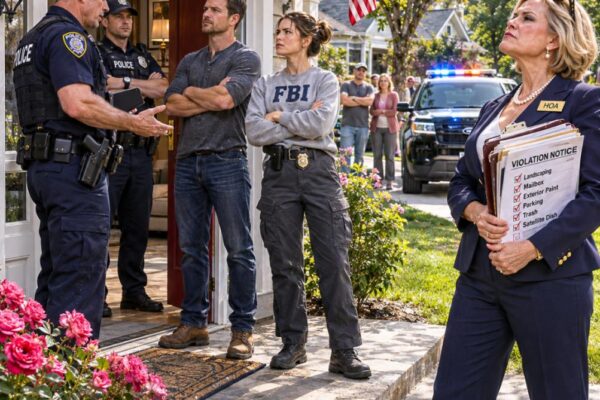
HOA Karen Fined My Wife $300 for Parking Six Inches Over a Line—She Has Vastly Underestimated the Woman She Chose to Target.k
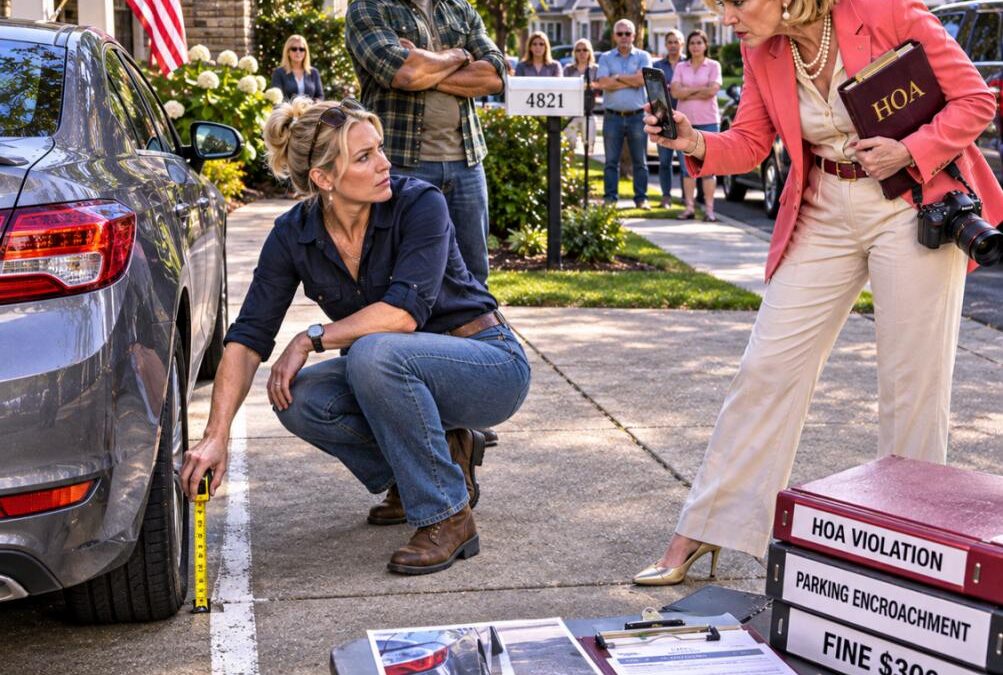
HOA Karen Fined My Wife $300 for Parking Six Inches Over a Line—She Has Vastly Underestimated the Woman She Chose to Target
She measured six inches of tire past a painted driveway divider and treated it like a property crime.
Within days, HOA Karen was circulating photographs of a woman who wasn’t even my wife and using them to convince neighbors Emily was some arrogant rich outsider.
Emily never corrected her—not because she was afraid, but because she wanted to know how far Karen would go once nobody stopped her.
The car was six inches over the line.
Exactly six.
I knew because my wife had measured it.
I was sitting at the kitchen table with coffee when Emily Parker eased our gray sedan backward, stopped, got out, crouched beside the rear tire, and placed a folding ruler against the faded white divider between our driveway apron and the strip beside Tom Harrison’s.
She adjusted the car another inch.
Then stood.
“Sweetheart,” I called through the open window, “you’ve officially become the person you complain about in grocery-store parking lots.”
Emily looked toward me.
Hazel eyes.
Hair pinned behind her head.
Expression completely calm.
“It’s fine.”
“Your tire is over Tom’s side.”
“I know.”
“You know.”
“Yes.”
I walked onto the porch.
“Emily.”
She picked up the ruler.
“James.”
“You parallel park like you’re taking a licensing exam. Why are you suddenly parking like you lost depth perception?”
A small smile appeared.
Not her normal smile.
This one meant she knew something I didn’t.
I’d been married to Emily eight years.
There were three versions of her silence.
Tired Emily.
Angry Emily.
And detective Emily.
This was detective Emily.
“What are you doing?”
She slipped the ruler into her purse.
“Testing a theory.”
“About parking?”
“About Karen.”
That explained almost nothing.
Ten minutes later, Karen Mitchell appeared.
She came from three houses down wearing cream slacks, a coral blouse, and the dark burgundy clipboard she carried through Willow Ridge as if the governor had appointed her Minister of Lawn Height.
Karen was fifty-eight.
HOA president for three years.
Retired office manager.
Collector of rules, rumors, and other people’s mistakes.
She stopped beside our sedan.
Looked at the tire.
Then pulled a tape measure from her bag.
I nearly choked on my coffee.
“You knew she’d do that,” I whispered.
Emily stood beside me.
“Maybe.”
Karen crouched.
Measured.
Photographed.
Measured again.
Then photographed the house.
My wife didn’t move.
Ten minutes later, the doorbell rang.
Emily answered.
Karen stood there holding a white envelope.
“Good morning.”
“Morning.”
“I regret having to do this.”
That was a lie delivered beautifully.
She handed Emily the notice.
“Section 4.7. Vehicle encroachment and interference with adjacent property enjoyment.”
Emily read it.
Karen continued.
“Three hundred dollars.”
“For six inches?”
“Standards exist for a reason.”
Emily looked at the page.
“And Tom complained?”
Karen hesitated.
“The association does not disclose complainants.”
Interesting.
Tom had given Emily permission the night before.
His late wife Ellen had once painted that divider herself because the original markings had faded. It wasn’t a surveyed property boundary. It was a courtesy line between two widened driveway aprons.
Karen knew that.
Or should have.
Emily nodded.
“I understand.”
Karen seemed disappointed.
“You do?”
“Yes.”
“No dispute?”
“No.”
“No explanation?”
“Not today.”
Karen’s expression changed.
She had arrived expecting a fight.
Emily gave her acceptance.
Karen took half a step back.
“Well. Good.”
She glanced past Emily toward me.
Then lowered her voice.
“Honestly, I think some newer residents assume money or status lets them disregard ordinary courtesy.”
Emily’s face didn’t move.
“What makes you think that?”
Karen smiled.
“Experience.”
She turned away.
Emily watched her walk down the path.
Then closed the door.
I held out my hand.
“Let me see.”
She gave me the notice.
Official Willow Ridge letterhead.
Three hundred dollars.
Payment due in ten days.
Language threatening additional administrative charges, collection costs, and possible legal remedies.
I read Section 4.7.
Then looked at Emily.
“This doesn’t say anything about six inches.”
“I know.”
“It says vehicles cannot substantially obstruct an adjacent owner’s access.”
“I know.”
“You didn’t obstruct anything.”
“I know.”
“Tom didn’t complain.”
“No.”
“So what exactly are you testing?”
Emily took the notice from me.
She opened a black accordion folder sitting on the counter.
Inside were other documents.
Lots of them.
Copies.
Invoices.
Letters.
Photographs.
I stared.
“Emily.”
She slid Karen’s notice into a section labeled MITCHELL.
“What is that?”
She closed the folder.
“Something I’ve been building for a while.”
“How long?”
She looked through the front window.
Karen had stopped near the sidewalk and was typing on her phone.
“Long enough.”
Then my phone buzzed.
A notification from the Willow Ridge neighborhood forum.
Karen had posted.
Some residents apparently believe basic property boundaries are optional. Respect is demonstrated through conduct, not appearances.
I looked at Emily.
She was smiling again.
Not because she thought it was funny.
Because Karen had just done exactly what Emily expected.
“What happens now?” I asked.
Emily picked up her coffee.
“Now we see whether she can resist making it worse.”
part 2
My name is James Parker.
I’m a freelance writer, which sounds more glamorous than it is.
Most mornings I sit in sweatpants at a kitchen table writing corporate newsletters for companies whose executives use the word synergy without irony.
Emily is the interesting one.
She works for the county police department.
Detective.
Financial crimes.
Procurement fraud.
Identity theft.
Embezzlement.
Contractor scams.
The sort of crimes where nobody kicks down a door until six thousand pages of paperwork have already ruined somebody’s week.
Our neighbors did not know exactly what she did.
They knew law enforcement.
That was about it.
Emily didn’t advertise her badge.
Didn’t hang department stickers on the car.
Didn’t wear police shirts at block parties.
At home, she wanted to be Emily.
That mattered later.
Because Karen had spent months constructing an entire fictional version of my wife without realizing she had never bothered to learn who Emily actually was.
We moved into Willow Ridge two years earlier.
Nice place.
Quiet streets.
Mature maples.
Brick homes built in the late nineties.
An HOA that was supposed to handle common landscaping, architectural review, the small clubhouse, and enforcement of a fairly ordinary covenant package.
Nothing extreme.
At least on paper.
Karen introduced herself the second day.
She brought lemon bars.
They were surprisingly good.
She also brought a printed copy of the community handbook.
Less good.
“People lose these,” she said.
“We have the PDF.”
“Digital documents get ignored.”
Emily smiled.
“I read everything.”
Karen laughed.
“Everyone says that.”
She didn’t know how literally Emily meant it.
The first year was uneventful.
A warning when our trash container stayed visible overnight.
Fair.
A reminder about submitting paint colors before replacing porch trim.
Annoying but legitimate.
Then Ellen Harrison died.
Tom’s wife.
Cancer.
Fast.
Six months from diagnosis to funeral.
Tom lived next door.
Seventy-one.
Retired machinist.
Nice man.
After Ellen died, he seemed to shrink.
Stopped grilling.
Stopped attending neighborhood dinners.
Sometimes I’d find him standing near the mailbox wanting to talk about nothing because nothing was better than going back into an empty house.
Karen noticed too.
She inserted herself immediately.
At first, maybe for good reasons.
She brought food.
Helped organize a meal train.
Handled some HOA paperwork Tom couldn’t face.
Then she started speaking for him.
“Tom is concerned about parking.”
“Tom prefers the hedge trimmed lower.”
“Tom finds late deliveries disruptive.”
I asked Tom about one of those complaints.
He looked confused.
“I never said that.”
That was the first moment Emily paid attention.
Not officially.
Personally.
A month later, Mrs. Larson across the street received a $250 fine for “repeated grass-height violations.”
Mrs. Larson was eighty.
Her lawn service had missed one week after an equipment breakdown.
She paid.
Then Gwen Patel was fined $400 for a “nonconforming mailbox.”
Her mailbox was identical to three others on the street.
She paid too.
Then the Wilsons got a $300 charge for unauthorized flower-bed edging.
They had submitted an application.
Karen claimed it was never received.
They paid because the appeal deadline had supposedly expired.
Emily began asking questions.
Not as a detective.
As an HOA member.
There’s an important difference.
Police officers do not get to turn neighborhood disagreements into personal investigations because they happen to carry badges.
Emily knew that better than anybody.
She never ran Karen through police databases.
Never opened a case file on her own.
Never used department resources.
She requested association records available to homeowners.
Budgets.
Fine schedules.
Board minutes.
Policies.
She compared them to the letters neighbors voluntarily showed her.
That’s how the first problem emerged.
Several fines didn’t match the HOA’s published enforcement schedule.
For example, Willow Ridge’s adopted schedule listed an initial landscaping fine at fifty dollars after notice and hearing.
Mrs. Larson had been charged two hundred fifty immediately.
Karen’s letter called it an “expedited remediation assessment.”
That phrase appeared nowhere in the rules.
Gwen Patel’s mailbox charge was labeled an “architectural noncompliance administrative fee.”
Also not in the schedule.
The Wilsons’ flower-bed charge had been deposited into an account described in the annual budget as “miscellaneous compliance revenue.”
Emily hated miscellaneous accounts.
Financial-crimes detectives often do.
She made a spreadsheet.
Not because she had jurisdiction.
Because she wanted to understand our own HOA.
Then she found Mitchell Enforcement Services.
That was the name printed at the bottom of one letter.
Not Willow Ridge HOA.
MITCHELL ENFORCEMENT SERVICES.
Emily asked the management company what it was.
The manager, Diane Foster, answered:
We have no contracted vendor by that name.
Interesting.
Karen later explained that Mitchell Enforcement Services was simply the name she used for “administrative support work” she performed for the board.
Emily asked whether the board had approved it.
Karen said the arrangement had been “informally authorized.”
Emily asked for minutes.
Nothing.
Then Tom’s wife died.
A month after the funeral, Tom paid a $600 “property-compliance stabilization charge.”
Emily found out because Tom mentioned it casually while I was helping him replace a light fixture.
“What stabilization charge?”
“The HOA thing.”
He pulled out the letter.
It alleged three separate problems.
Peeling shed paint.
Visible garbage container.
Untrimmed rear hedge.
Tom’s shed had been repainted two months earlier.
His garbage container was inside the garage.
The hedge belonged to the rear neighbor.
Emily photographed everything with Tom’s permission.
Then asked him whether he had appealed.
“I didn’t want trouble.”
“Did Karen explain the charge?”
“She said ignoring it could lead to a lien.”
Emily’s expression changed.
“Did she say the HOA would file a lien?”
“Something like that.”
“Exactly what?”
Tom thought.
“She said unpaid compliance debts can put your property at risk.”
That statement wasn’t entirely false in the abstract. Depending on governing documents and state law, some association debts can create serious collection consequences.
But using that general fear to pressure an elderly grieving homeowner into paying a questionable, non-scheduled fee was something else.
Emily called our attorney.
Not the police.
Not her sergeant.
Our attorney.
His name was Alan Mercer.
He reviewed the documents.
“Do you have evidence Karen personally received this money?”
“No,” Emily said.
“Then don’t call it theft.”
“I didn’t.”
“You were thinking it.”
“I was thinking the accounting is wrong.”
“That’s better.”
He examined the bylaws.
“Board president can issue ordinary notices through management, but special charges require board authorization. Some fines require hearing rights. I don’t see authority for half these labels.”
“What about the bank account?”
“We need financial records.”
As homeowners, our rights to inspect association records depended on state law, the nonprofit statutes, and Willow Ridge’s governing documents.
Alan helped us make the request correctly.
General ledger.
Fine receipts.
Contracts.
Vendor payments.
Board approvals.
Bank reconciliation summaries available to members.
The management company produced records slowly.
Karen complained that Emily was harassing volunteers.
Then something odd happened.
Karen started telling neighbors Emily was wealthy.
Not comfortable.
Not successful.
Wealthy.
The first clue came from Tom.
He appeared on our porch holding coffee.
“James, can I ask something?”
“Sure.”
“Does Emily teach yoga?”
I stared.
“Does she what?”
“Yoga.”
“No.”
“Karen said she runs wellness retreats.”
I laughed.
Tom didn’t.
“She showed me pictures.”
“What pictures?”
“Emily at some resort.”
My amusement disappeared.
Emily was inside.
I called her.
She came to the door.
Tom looked embarrassed.
“I’m sorry.”
“Show me what Karen showed you.”
He opened his phone.
Karen had texted him screenshots.
A woman who looked vaguely like Emily.
Same general height.
Brown hair.
Similar age.
That was it.
The woman appeared to be a yoga and lifestyle influencer named Emma Parker.
Not Emily.
Emma’s public profile showed resort retreats, expensive fitness clothing, international travel, meditation workshops.
Karen had apparently searched the wrong name.
Emily scrolled.
Then laughed.
“That’s incredible.”
Tom looked confused.
“You aren’t her?”
“No.”
“You don’t teach yoga?”
“I can barely touch my toes.”
I said, “Confirmed.”
Tom’s face reddened.
“Oh God.”
Emily handed back the phone.
“Don’t worry about it.”
“But Karen said—”
“I know.”
After Tom left, I expected Emily to confront her.
She didn’t.
Instead, she searched the public posts Karen had made on the neighborhood forum.
References to “certain wealthy residents.”
“Social-media lifestyles.”
“People who flaunt privilege but refuse accountability.”
None named Emily directly.
But the timing matched.
“Why aren’t you correcting her?”
Emily looked at me.
“Because she’s building enforcement decisions around information she hasn’t verified.”
“So?”
“So I want to know whether she makes a mistake, realizes it, corrects it—or keeps going because the story is useful.”
That was the first time I understood the parking job.
The six inches.
It wasn’t about catching Karen committing a crime.
Emily wasn’t running a sting.
She had no authority to create a personal police operation.
She was testing something much simpler.
Would Karen use a trivial, consented parking overlap to manufacture another unsupported charge?
The answer came immediately.
Yes.
And then she did something even more revealing.
She connected the parking issue to a fictional online identity.
The second letter arrived two days later.
Karen wrote:
Residents who publicly display luxury travel and high-cost lifestyle experiences should be especially mindful that community rules apply equally regardless of financial status or social influence.
Emily read it at breakfast.
Then slid it to me.
“She’s officially using the wrong woman’s social-media account as part of HOA enforcement.”
“Can we please tell her now?”
“No.”
“Why?”
“Because I want the board to see how far she goes.”
“Emily, this is bizarre.”
“Yes.”
“You’re enjoying it.”
“A little.”
Then she picked up a rolled yoga mat.
I stared.
“Where did that come from?”
“Target.”
“No.”
She walked toward the garage.
“Research.”
“You hate yoga.”
“Karen doesn’t know that.”
She carried the mat to the car the next morning.
When Karen came outside, Emily stretched dramatically beside the driveway.
Poorly.
Karen watched.
Emily gave her a peaceful little wave.
I almost fell over laughing.
“That’s evil,” I said when she came back inside.
“Confirmation bias.”
“What?”
“Karen thinks she’s right, so every new thing gets interpreted as proof.”
“You bought a yoga mat to make her more wrong.”
“I bought a yoga mat to see whether she checks.”
“She won’t.”
“I know.”
She didn’t.
Within a week, Karen was telling people about Emily’s “five-hundred-dollar meditation weekends.”
That number came directly from Emma Parker’s website.
Tom heard it.
Mrs. Larson heard it.
Gwen Patel heard it.
Then Karen hosted what she called a neighborhood compliance information session in her backyard.
I attended from our side of the hedge.
Not officially invited.
But sound travels.
About twelve neighbors sat in folding chairs.
Karen held up printed screenshots.
“This is the kind of entitlement we’re dealing with.”
Tom was there.
He looked miserable.
A woman asked, “Are you sure that’s Emily?”
Karen replied, “The information is publicly available.”
Not an answer.
Another person said, “She looks different.”
Karen waved the concern away.
“Social-media filters.”
I covered my mouth to stop laughing.
Emily stood beside me.
No expression.
“You okay?” I whispered.
“Perfect.”
Karen continued.
“This isn’t about one parking violation. It’s about a pattern of people believing they can buy their way around ordinary standards.”
Tom nodded uncertainly.
She had him.
Not because he was stupid.
Because he trusted her.
Karen had spent months positioning herself as the person who understood the rules.
Tom was grieving.
Isolated.
He wanted someone to tell him what was happening around him.
Karen gave him a story.
Then she gave him a role.
Witness.
The more he participated, the harder it became for him to question it.
Emily understood that.
Financial fraud often works the same way.
People don’t merely lose money.
They become invested in believing the person manipulating them.
Karen’s confidence grew.
By Thursday, another letter arrived.
PAYMENT DEMAND.
$300 original parking fine.
$150 administrative escalation.
Payment due in seventy-two hours.
Failure to remit could result in further collection action.
Alan Mercer reviewed it.
He called Emily.
“This is getting serious.”
“Legally?”
“Potentially. Not because the amount is huge. Because the authority is unclear and the collection language is aggressive.”
“Should we pay?”
“No.”
That surprised me.
He continued.
“File the appeal. Demand a hearing. State that Tom authorized the temporary overlap and that no access was obstructed. Challenge the fee schedule.”
Emily smiled.
“Good.”
“What are you doing?”
“Nothing illegal.”
“That’s not comforting.”
She filed the appeal.
Karen denied it personally.
That should not have happened.
Under Willow Ridge’s own written procedure, contested fines above a certain amount were supposed to be heard by a board panel or designated committee rather than decided solely by the person issuing them.
Emily saved the denial.
Then Monday came.
Karen called the police.
She did not call because the car remained over the line.
It didn’t.
Emily had moved it that first day.
She called because she claimed Emily was engaged in a pattern of harassment, property interference, and possible fraud involving “false representations to avoid HOA enforcement.”
I still don’t know exactly what she thought the police would do.
Maybe she believed her folder would turn a civil dispute into a crime.
Maybe she wanted patrol cars in front of our house.
Maybe she wanted humiliation.
She stood on the sidewalk with Tom holding documents when Officer Daniel Brooks arrived.
Tom looked uncomfortable.
Karen looked energized.
I watched from the porch.
Brooks spoke to her for nearly ten minutes.
She showed screenshots.
Letters.
Photos.
The yoga influencer.
Our driveway.
Then Brooks walked toward us.
Emily opened the door.
“Ma’am, can I speak with you about a complaint?”
“Sure.”
“Emily Parker?”
“Yes.”
“Can I see identification?”
She handed him her driver’s license.
Her department credentials were in the same wallet.
Not displayed theatrically.
Not used as intimidation.
Brooks saw them.
His eyes changed.
“Detective Parker?”
Emily nodded.
“Yes.”
“I’ve seen your name on county financial-crimes bulletins.”
Karen was close enough to hear.
Her face emptied.
Tom looked at Emily.
Then at me.
Then back at Emily.
“You’re a detective?”
Emily said, “Yes.”
Karen stepped forward.
“A police detective?”
Brooks turned.
“Mrs. Mitchell, please give us space.”
She didn’t.
“But she never disclosed that.”
Emily looked at her.
“Why would my occupation affect a parking notice?”
Karen had no answer.
Brooks reviewed the situation.
The car was no longer over any line.
Tom confirmed he had given us permission for the original six-inch overlap because he was having a landscaping delivery and had temporarily repositioned his own vehicle.
No damage.
No obstruction.
No criminal trespass claim from Tom.
No fraud by Emily.
No crime.
Brooks explained that HOA enforcement and disputed private-property issues were ordinarily civil matters unless actual criminal conduct existed.
Karen pointed toward Emily.
“She deliberately misled everyone.”
“How?” Brooks asked.
Karen held up the influencer photographs.
“She’s been presenting herself as this person online.”
Emily laughed for the first time.
“No, I haven’t.”
Karen froze.
Emily continued.
“You found another woman named Emma Parker.”
Silence.
Tom slowly took the screenshots from Karen’s folder.
He looked at them.
Then at Emily.
“Oh my God.”
Karen’s face turned red.
“You carried a yoga mat.”
Emily nodded.
“I own a yoga mat.”
“You deliberately—”
“Did I ever tell you I was the woman in those photographs?”
No.
“Did James?”
No.
“Did any official record?”
No.
Karen looked trapped by the simplest fact in the world.
She had never asked.
Brooks handed Emily’s ID back.
“There doesn’t appear to be a criminal issue here.”
Karen’s voice rose.
“What about intimidation? She’s a police officer.”
“Has she threatened you with police authority?”
“No, but—”
“Displayed a weapon?”
“No.”
“Threatened arrest?”
“No.”
“Used department systems against you?”
Karen hesitated.
“I don’t know.”
Emily’s expression sharpened.
“I have not.”
Brooks looked toward Karen.
“If you have actual evidence of police misconduct, there are formal channels for reporting it. But being mistaken about someone’s job isn’t misconduct by them.”
Karen’s folder lowered.
The performance was over.
Brooks left.
Tom stayed.
He looked sick.
“I need to talk to you.”
Emily nodded toward our porch.
“Come over.”
He did.
For twenty minutes, Tom apologized.
Not dramatically.
Painfully.
He admitted Karen had been feeding him information for months.
She told him Emily was arrogant.
Rich.
Dismissive.
Dangerous to property values.
She said we had taken advantage of his grief when Emily parked over the line.
Tom had believed her.
“I thought I was protecting Ellen’s house.”
Emily’s expression softened.
“I know.”
“No, you don’t.”
He rubbed his face.
“After Ellen died, Karen handled everything. Notices. Lawn stuff. She kept telling me people would take advantage if I wasn’t careful.”
Then he pulled out his phone.
“I have messages.”
Lots.
Karen instructing him what to say.
When to complain.
How to describe us.
One message read:
Don’t mention you gave permission. That weakens the enforcement case. The issue is that they assumed they could use your space.
Emily read it twice.
“Tom.”
“I know.”
“You told her you gave permission?”
“Yes.”
“She told you to conceal that?”
He nodded.
Another message:
People with that kind of money always think ordinary rules are for someone else. We need to make an example before everyone starts pushing limits.
Another:
If she appeals, say you felt pressured and didn’t really consent.
Tom’s hands shook.
“I never said that.”
Emily looked at him.
“You kept these?”
“I don’t delete anything Ellen used to tell me not to.”
That was the first moment I saw her detective expression become something else.
Not excitement.
Recognition.
The issue was no longer just a silly mistaken identity.
It was pressure.
Fabricated support.
Potentially false records.
Questionable money.
Still, Emily did not arrest Karen.
She couldn’t.
And wouldn’t.
Instead, she called her supervisor.
Not because she was opening a personal case.
Because she needed to disclose a possible conflict.
Emily’s department had previously received unrelated complaints involving association payment irregularities in our county.
She explained that she was personally involved as a homeowner and therefore should not participate in any official investigation touching Willow Ridge.
Her supervisor agreed.
From that moment on, Emily stayed out of the law-enforcement side.
That mattered.
The records went through proper channels.
Alan Mercer handled our HOA dispute.
Tom voluntarily provided his messages to the board’s attorney.
Several homeowners requested an independent audit.
The HOA’s management company finally produced the general ledger.
That’s when the money problem became real.
Not $2,500 stolen from fifteen families exactly as neighborhood rumor later claimed.
Reality was messier.
Over eighteen months, approximately $24,700 had been collected under a series of labels that did not match the adopted fine schedule.
Administrative remediation.
Expedited compliance.
Special enforcement assessment.
Property stabilization.
Some amounts had been deposited into the HOA’s operating account.
Others had been routed through reimbursements and service invoices connected to Mitchell Enforcement Services.
That was the real problem.
Mitchell Enforcement Services was not a properly approved association vendor.
It was a sole proprietorship registered to Karen.
She had been submitting invoices to the HOA for “compliance administration,” including time spent generating notices and conducting inspections.
The board had never formally approved a contract.
At least two directors said they believed Karen was volunteering.
The treasurer claimed he had been told the payments were authorized management reimbursements.
Karen claimed prior board presidents had allowed similar arrangements.
The records did not clearly support that.
Now we had something more serious than neighborhood pettiness.
Potential self-dealing.
Unauthorized compensation.
Improperly assessed charges.
Maybe fraud.
Maybe breach of fiduciary duty.
Maybe accounting failures.
Those distinctions would be determined by people with authority to determine them.
Not us.
Friday’s neighborhood meeting became the largest Willow Ridge had seen in years.
Forty-three homeowners packed the clubhouse.
Tom stood at the front.
He insisted on speaking first.
His voice shook.
“My wife died seven months ago.”
The room quieted.
“I wasn’t doing well.”
He swallowed.
“Karen helped me.”
Karen sat in the back.
No clipboard.
Tom continued.
“And then she started telling me the Parkers were taking advantage of me.”
He looked toward us.
“I believed her.”
Then he held up printed messages.
“She told me not to mention that I gave Emily permission to use the driveway space.”
Murmurs.
“She told me to say I felt pressured.”
He looked down.
“I didn’t.”
Karen stood.
“This is completely out of context.”
The temporary board chair, Linda Chavez, raised a hand.
“You’ll have a chance.”
Karen sat.
Tom continued.
“I participated in complaints I should have questioned.”
He looked at Emily.
“I am sorry.”
Emily nodded.
Tom turned toward everyone else.
“And if Karen told you something about them, don’t assume it was true just because she sounded sure.”
That sentence changed the meeting.
Mrs. Larson spoke next.
Her $250 grass fine.
Then Gwen Patel.
Her mailbox.
Then the Wilsons.
Flower-bed edging.
Then a couple named Mark and Susan Ellis showed a $500 “holiday-display remediation” charge for lights that had been removed within the published deadline.
Another homeowner had paid $350 for a parking violation based on a photograph taken on a public street the HOA didn’t regulate.
One after another.
Not all were clearly invalid.
Some homeowners genuinely had violated rules.
But the labels, amounts, and procedures varied wildly.
And Karen’s private business name appeared repeatedly.
Alan Mercer presented the issue carefully.
“We should avoid declaring anyone guilty tonight.”
Karen looked almost relieved.
Then Alan continued.
“But there are sufficient irregularities to justify immediate suspension of discretionary collection activity, preservation of records, independent forensic accounting, and legal review of Ms. Mitchell’s compensation arrangements.”
Karen’s face tightened again.
Linda called for a board vote.
First motion.
Suspend Karen from exercising presidential enforcement authority pending investigation.
Four to one.
Karen voted no.
Second.
Freeze collection on disputed special fees not clearly tied to the adopted schedule.
Passed unanimously.
Karen abstained.
Third.
Hire an independent forensic accountant.
Passed.
Then Karen stood.
“This is mob justice.”
Linda answered.
“No. Mob justice would be deciding the outcome tonight.”
She looked toward Karen.
“We’re asking someone independent to check the books.”
Karen pulled out her phone.
“I want state police.”
Alan said, “You are free to contact any lawful authority.”
She actually called.
Not 911.
The non-emergency state police line.
Put it on speaker as if she expected instant vindication.
She described Emily as a detective who had “engineered a neighborhood campaign” against her.
The call taker told her that if she had evidence of official misconduct, she could file a formal complaint with the appropriate department or oversight body.
Karen said Emily had observed her behavior for months.
The call taker asked whether Emily had used police authority.
Karen couldn’t identify an example.
Whether Emily had threatened arrest.
No.
Whether Emily had accessed confidential records.
No evidence.
Whether Emily had seized property.
No.
The call taker explained that a complaint could still be submitted and would be reviewed through proper procedure.
No dramatic shutdown.
No humiliation from a dispatcher.
Just process.
Karen ended the call.
Emily leaned toward me.
“That was more professional than this meeting.”
I almost laughed.
The forensic audit took seven weeks.
During that time, Emily went to work every day.
She did not touch the Willow Ridge matter professionally.
Her supervisor documented the conflict.
Another unit, and later the county prosecutor’s financial-crimes staff where appropriate, evaluated any evidence independently.
That protected Emily.
And the case.
The audit found that Karen had received approximately $18,400 over two years through Mitchell Enforcement Services for compliance-related work without a clearly documented board-approved contract.
Some of that work had genuinely been performed.
Photos.
Letters.
Site inspections.
Administrative time.
The problem was authorization, disclosure, and accounting.
More damaging was the fine process.
Approximately $26,000 in special charges had been assessed outside the standard published schedule.
Not all had been paid.
Some were later credited.
Some had gone into association accounts.
A portion funded Karen’s invoiced compliance work.
The audit could not simply label every dollar stolen.
That would have been inaccurate.
It concluded that the association had serious governance failures, conflicts of interest, weak internal controls, and unsupported enforcement charges requiring reimbursement or legal review.
Then investigators looked at individual cases.
Tom’s $600 stabilization charge had no documented authorization.
Mrs. Larson’s accelerated landscaping fine had skipped required notice.
Gwen’s mailbox charge cited a design restriction that did not exist in the adopted architectural standard.
The Wilson charge had been generated after the committee’s approval email was already in the file.
Our $300 parking fine was especially embarrassing.
Tom had consented.
No driveway access was obstructed.
The enforcement policy required a warning before monetary penalty for a first occurrence.
Karen had skipped it.
Then she had denied the appeal personally despite the policy requiring board review.
The social-media material appeared in her notes under:
BACKGROUND / ATTITUDE EVIDENCE.
I stared at that phrase.
Emily laughed.
“Attitude evidence.”
“What?”
“I’ve arrested fraud suspects with better documentation standards.”
“Technically you aren’t supposed to be funny about your cases.”
“I’m not talking about a case.”
Fair.
Then the investigator found Karen’s searches.
Not police records.
Public internet history from an HOA-owned tablet that Karen had used for compliance work.
She had searched Emily Parker luxury lifestyle.
Emily Parker yoga retreat.
Emily Parker influencer.
Never once had she verified the photograph.
She found Emma Parker and decided the woman was Emily.
Then built a moral case around it.
That mistake mattered because it revealed something larger.
Karen wasn’t investigating violations.
She was building narratives and then finding material to support them.
The same pattern appeared with other homeowners.
Mrs. Larson became “chronically negligent.”
Tom became “vulnerable and needing protection.”
Gwen became “argumentative.”
We became “wealthy outsiders.”
Once Karen chose a category, every event confirmed it.
The outside attorney called that confirmation bias in his final report.
Emily circled the phrase.
“Told you.”
“You bought a yoga mat.”
“Science requires experimentation.”
“You’re a detective, not a scientist.”
“Multidisciplinary household.”
The board called a membership meeting after receiving the audit.
By then Karen had retained her own attorney.
That was smart.
People sometimes treat asking for a lawyer as proof of guilt.
It isn’t.
Karen had every right to counsel.
Her attorney challenged several findings and argued that prior boards had implicitly authorized her administrative work.
Some evidence supported the idea that directors knew Karen spent significant time on compliance.
Less evidence supported the specific amounts she billed.
There were also disputes over whether certain special fees were actually fines or reimbursements of administrative costs.
Messy.
Real.
Not the kind of thing solved by neighbors shouting.
The board eventually negotiated a resolution.
Karen resigned as president.
She repaid a portion of the compensation that outside counsel determined lacked adequate approval, without admitting criminal intent.
The HOA refunded or credited unsupported special charges to affected homeowners.
Our parking fine disappeared.
Tom’s charge disappeared.
Mrs. Larson got money back.
Gwen did too.
Several other cases were reviewed individually.
The association’s insurer covered part of the legal and accounting expense.
Karen’s private business relationship with Willow Ridge ended permanently.
The county prosecutor did receive the audit and supporting materials.
After review, the matter did not become the spectacular felony prosecution neighbors predicted.
Some conduct supported civil claims and governance remedies more clearly than criminal fraud beyond a reasonable doubt.
That disappointed people who wanted handcuffs.
Emily wasn’t one of them.
“Criminal law isn’t a customer-service department for angry neighborhoods,” she told me.
“What does that mean?”
“It means bad governance and even dishonest-looking conduct do not automatically equal a provable felony.”
“You’ve been waiting years to say that sentence.”
“Yes.”
Karen did not have thirty days to leave the county.
No community vote could lawfully exile her.
Her house was not seized by angry neighbors.
The HOA could not order a confession.
Reality has limits.
What happened instead was quieter.
And probably harder.
Karen had to sit through a formal mediation while fourteen homeowners described what her enforcement had done to them.
Tom spoke.
Again.
This time not in front of a crowd.
He told her how she had used his grief.
Mrs. Larson explained that she had skipped medication one month to cover the unexpected fine because she believed the HOA could put her home at risk immediately.
Gwen described feeling humiliated every time Karen photographed her mailbox.
The Wilsons talked about paying a fee simply because they didn’t have time to fight.
Then Emily spoke.
Karen looked at her.
For months, Karen had imagined my wife as a spoiled yoga influencer hiding behind money.
Now she knew Emily was a detective.
That didn’t matter anymore.
Emily didn’t bring her badge.
She brought the original $300 notice.
“You know what bothered me most about this?”
Karen said nothing.
“It wasn’t the money.”
Emily placed the notice on the table.
“You made up a person.”
Karen’s attorney shifted.
Emily continued.
“You saw a name online and decided the woman in those photographs was me.”
Karen looked down.
“Then you decided her lifestyle explained my behavior.”
“I made a mistake.”
“Yes.”
“You deliberately encouraged it.”
Emily nodded.
“After you had already issued the fine.”
Karen looked up.
“That was manipulative.”
“Yes.”
I turned toward Emily.
She didn’t flinch.
“I wanted to see whether you’d verify what you were saying before you escalated.”
Karen’s voice sharpened.
“You baited me.”
“I parked six inches across a courtesy line with Tom’s permission.”
“You knew I’d act.”
“I suspected.”
“You carried a yoga mat.”
“That was petty.”
I almost smiled.
Emily continued.
“But you were the HOA president. I was a homeowner being accused. The burden wasn’t on me to make your assumptions accurate.”
That landed.
Karen’s lawyer started to speak.
Karen raised her hand.
“No.”
Then she looked at Emily.
“I thought you were mocking me.”
“Eventually, I was.”
I had never heard Emily admit that so plainly.
She continued.
“But you had already threatened collection based on a violation that didn’t support the amount you charged.”
Karen stared at the notice.
“What did you want?”
Emily thought.
“At first?”
“Yes.”
“To prove you were careless.”
“And later?”
“To understand where the money went.”
“And now?”
Emily looked around the mediation room.
“For you never to have that authority again.”
That was it.
No revenge speech.
No threat.
No badge.
Karen signed the settlement documents two weeks later.
Then Willow Ridge had to rebuild itself.
That was harder than removing one president.
Karen had accumulated power because everybody else was busy.
Board volunteers assumed she was handling things.
Homeowners paid small fines because appeals took time.
Management assumed board approvals existed.
The treasurer coded deposits without questioning unfamiliar labels.
One weak check connected to another.
Eventually nobody could explain who had authorized what.
The new board made boring changes.
Those are usually the good ones.
Every fine had to cite the exact adopted rule.
The amount had to match a published schedule.
No invented administrative labels.
No board officer could bill the association through a related business without written disclosure, competitive review where appropriate, and board approval excluding the interested director.
Appeals went to people who had not issued the original notice.
Payments required clearer coding.
Monthly financial reports became available to owners as permitted.
Collection threats were reviewed by management or counsel instead of improvised in letters.
No social-media “background research” on homeowners.
That last rule received unanimous support.
Tom volunteered for the finance-review committee.
The first time he attended, he brought a three-ring binder and looked terrified.
Emily smiled.
“You’ll be fine.”
“I don’t know accounting.”
“You know how to ask what something is.”
“That enough?”
“More often than you’d think.”
He became good at it.
Grief had made him easy to manipulate.
Recovery gave him a reason to protect other people from the same thing.
That mattered more than his apology.
Mrs. Larson joined the landscaping committee.
Her first proposal was a warning period before any grass fine unless there was an actual health or safety issue.
Passed.
Gwen Patel rewrote the mailbox guideline.
It was one page.
Photos included.
Approved colors.
Dimensions.
Replacement procedure.
No mysteries.
She emailed it to me.
THIS IS WHAT NORMAL PEOPLE DO.
I printed it and put it on the refrigerator.
The neighborhood changed.
Not dramatically.
We still had petty arguments.
Someone left a camper in his driveway for six weeks.
A family painted their front door bright yellow and triggered a three-hour architectural debate that nearly ended civilization.
Dogs barked.
Trash cans stayed out too long.
Humans remained humans.
But authority stopped feeling mystical.
If someone received a notice, they could click a link and see the rule.
If they appealed, another group reviewed it.
If money moved, more than one person saw it.
Simple controls.
Emily called them anti-Karen architecture.
I told her that was unfair.
“There will always be another Karen.”
“Exactly.”
“Then call it anti-human architecture.”
She thought.
“Better.”
Karen stayed in Willow Ridge for another nine months.
People expected her to move immediately.
She didn’t.
Why should she?
It was her home too.
That fact tested us.
At the first block party after settlement, Karen came.
I was surprised.
She brought potato salad.
Nobody knew whether to eat it.
Tom went over first.
I watched from across the yard.
They spoke for maybe five minutes.
Then he hugged her.
That surprised me more.
Later I asked him why.
“I forgave her.”
“Already?”
“No.”
He looked toward Karen.
“I started.”
That was very Tom.
Emily and Karen didn’t speak that day.
Not until almost sunset.
Karen approached while Emily was stacking paper plates.
“Detective Parker.”
Emily looked up.
“Emily is fine.”
Karen nodded.
“Emily.”
Awkward silence.
Then Karen said, “I owe you an apology.”
Emily continued stacking plates.
“For what?”
Karen almost smiled.
“You really do make people be specific.”
“Yes.”
“For assuming things about you.”
Emily waited.
“For using those assumptions in HOA enforcement.”
Another pause.
“For treating Tom like a source instead of a neighbor.”
Tom was within earshot.
He looked down.
Karen continued.
“And for billing the association through my business without making the arrangement clear enough.”
Emily stopped stacking plates.
“Clear enough?”
Karen’s jaw tightened.
Old habits.
Then she corrected herself.
“Without proper board approval.”
Emily nodded.
“Thank you.”
Karen looked toward me.
“And James.”
“Yeah?”
“I’m sorry your wife convinced the neighborhood she was a yoga instructor.”
Emily laughed.
“That part was fun.”
Karen stared at her.
Then, unexpectedly, she laughed too.
Small.
Embarrassed.
But real.
“I hate yoga.”
“So do I,” Emily said.
That might have been the strangest peace treaty in suburban history.
The Mitchells eventually sold their house.
Not to pay restitution.
Karen and her husband had already been considering moving closer to their son.
The controversy probably accelerated things.
The sale price was ordinary.
No financial ruin.
No lonely apartment.
No dramatic exile.
The buyers were a young couple named Devon and Marissa Lee.
Neither was a police officer.
Thank God.
I had enough irony already.
The Lees moved in with twins and an enormous golden retriever.
Their first HOA violation came six months later.
Trash bins visible from the street.
Devon knocked on our door.
“Is this legitimate?”
I read it.
“Yes.”
“Seriously?”
“Rule’s right there.”
“Forty-eight-hour cure period?”
“Yep.”
“No fine yet?”
“No.”
He looked suspicious.
“That seems almost reasonable.”
I nodded solemnly.
“We worked very hard to achieve boring.”
He moved the bins.
End of crisis.
Emily received a commendation from her department that year.
Not for the HOA matter.
For an unrelated elder-financial-exploitation investigation that recovered money for multiple victims.
The neighborhood tried to connect everything anyway.
At a block party, someone introduced her as “the detective who took down Karen.”
Emily corrected them.
“I didn’t take down anyone.”
“You exposed the fraud.”
“The HOA audit exposed governance problems.”
The person looked disappointed.
I leaned over.
“She does this for fun.”
Emily elbowed me.
But she was right.
The fantasy version of our story was better television.
Quiet wife parks six inches over line.
HOA Karen attacks.
Surprise badge.
Secret eighteen-month investigation.
Police arrest.
Forced confession.
Twenty-five thousand dollars returned.
Karen banished.
Justice.
Reality wasn’t as neat.
Emily had noticed suspicious patterns as a homeowner.
She tested Karen’s behavior.
Karen made a ridiculous mistaken-identity error.
The parking dispute exposed procedural problems.
Tom’s messages exposed manipulation.
Other owners provided records.
An independent audit found financial and governance irregularities.
Attorneys separated bad judgment from potentially actionable conduct.
The board restructured controls.
Money was returned where appropriate.
Karen lost authority.
No one had to invent crimes.
The truth was enough.
That became the lesson I carried.
Karen’s greatest weakness wasn’t greed.
I’m not even sure greed was her primary motive.
She liked control.
Liked being the person people called.
Liked knowing which rule applied.
Liked being needed.
Then somewhere along the way, “I help enforce the rules” became “I decide what the rules mean.”
After that, money and ego became tangled together.
She billed for work she believed she deserved payment for.
Issued fees she believed people deserved.
Constructed stories about homeowners she thought needed discipline.
And because people rarely challenged her, every successful overreach became precedent in her own mind.
That’s dangerous.
Not just in HOAs.
Anywhere.
Power doesn’t always announce corruption with briefcases of cash.
Sometimes it starts with a person becoming too certain nobody needs to review her work.
Emily’s six-inch parking stunt worked because Karen couldn’t tolerate a tiny irregularity without turning it into a moral judgment.
If she had simply asked Tom, the whole experiment would have ended in thirty seconds.
“Did you give them permission?”
“Yes.
Done.
Instead she measured.
Photographed.
Fined.
Searched.
Assumed.
Posted.
Manipulated.
Escalated.
Called police.
Every step was optional.
That’s why I stopped thinking of Emily’s plan as a trap.
Karen wasn’t pushed into anything.
She was given room.
She filled it herself.
Six months after the settlement, I sat with Tom on my porch.
He had started dating someone.
Her name was Margaret.
He was terrified.
“I’m seventy-two.”
“So?”
“What am I doing dating?”
“Probably the same thing people do at thirty, but slower.”
He looked offended.
Then laughed.
We sat quietly.
Eventually he said, “Ellen would’ve hated what I did.”
“Don’t.”
“She would’ve.”
“You were grieving.”
“That explains it. Doesn’t excuse it.”
I looked at him.
He had learned that distinction too.
“I let Karen tell me what to think because making decisions felt exhausting.”
“That makes sense.”
“I hurt you.”
“You apologized.”
“Still.”
He looked toward the Lee house, formerly Karen’s.
“I think the worst part is I liked feeling useful again.”
That surprised me.
“What?”
“Karen needed me.”
He rubbed his hands together.
“After Ellen died, nobody needed me for anything. Then Karen kept asking what I’d seen. What you’d done. What Emily said.”
He smiled sadly.
“I became important.”
That was the first time I understood his side completely.
Manipulation works best when it gives something before it takes.
Karen gave Tom purpose.
Then used it.
Emily later helped him volunteer with a county elder-scam education group.
Not through her police role directly, but by connecting him with the public outreach coordinator after the conflict was resolved.
Tom was excellent.
He would stand in front of retirees and tell them:
“Being lonely doesn’t make you stupid. It makes attention feel valuable.”
People listened.
His story helped.
So did Karen’s, eventually.
Not in official police training manuals.
That was another exaggeration.
But Willow Ridge’s governance review became a useful local example for nearby associations.
Our management company developed a conflict-of-interest checklist.
Other boards adopted clearer fine schedules.
One neighboring HOA invited Alan Mercer to give a seminar called:
ENFORCEMENT WITHOUT GETTING SUED.
I told him the title lacked elegance.
He said elegance doesn’t pay malpractice insurance.
Emily never became a neighborhood hero.
She would have hated that.
Some people admired her.
Some thought she had manipulated Karen unfairly.
A few still believed parking six inches over the line deliberately was childish.
They had a point.
Emily admitted it.
“If I had to do it again,” she told me one night, “I’d probably choose something cleaner.”
“Like what?”
“I don’t know.”
“You enjoyed the yoga mat.”
“I regret nothing about the yoga mat.”
We still have it.
Unused.
It lives in the garage behind paint cans.
Sometimes I see it and laugh.
The black accordion folder is still in our office too.
Mitchell.
Larson.
Patel.
Wilson.
Harrison.
Audit.
Settlement.
I asked Emily once why she kept it.
“Retention period.”
“That’s romantic.”
“Paper wins fights.”
“Also romantic.”
She looked at me.
“You married me.”
“Against legal advice.”
One anniversary, I framed the original six-inch parking photograph.
Emily threatened divorce.
I took it down.
Marriage requires judgment.
The painted driveway divider eventually faded completely.
Tom asked whether we should repaint it.
I said yes.
Emily said no.
“Why?”
She looked at the asphalt.
“Let it die.”
We compromised.
A contractor marked the actual driveway edges correctly after reviewing the survey.
No fake boundary.
No courtesy line masquerading as property law.
Just clear pavement.
Clear ownership.
Clear access.
That felt appropriate.
Years later, people occasionally ask me what it was like being married to a detective during the whole mess.
They imagine Emily coming home every night with secret knowledge.
She didn’t.
Most of the time she was frustrated because her job made her more careful, not less.
She knew exactly how badly personal conflict could contaminate an investigation.
The moment the HOA’s finances started looking potentially criminal, she stepped away from official involvement.
That choice didn’t make the story less dramatic to me.
It made me respect her more.
Power isn’t proven by using every tool you have.
Sometimes it’s proven by knowing which tools you’re not entitled to use.
Karen never learned that until too late.
Emily had built her career around it.
That’s the difference between authority and restraint.
One Saturday morning, several years after Karen left, Emily parked our sedan.
Perfectly.
Centered.
Equal spacing on both sides.
I stood in the kitchen with coffee.
“Sweetheart?”
She looked toward the window.
“You’re parked correctly.”
“Thank you.”
“I’m disappointed.”
She laughed.
Then checked the distance anyway.
Of course she did.
I walked outside.
Willow Ridge was waking up.
Sprinklers.
Garage doors.
Someone walking a dog.
Tom’s girlfriend—now wife, which none of us saw coming—watering flowers.
The Lee twins riding scooters.
Nothing dramatic.
No clipboard.
No police car.
No neighborhood forum exploding with accusations.
Peace.
Emily leaned against the car.
“Do you ever miss Karen?”
“No.”
“Not even a little?”
“I miss having material.”
“Writer.”
“Detective.”
She smiled.
Then she looked toward Tom’s driveway.
“You know what the funny part is?”
“What?”
“The whole thing started with a line that wasn’t even a property line.”
I looked down at the asphalt.
She was right.
A strip of paint.
Everybody treated it like law because Karen said it was.
That was the story in miniature.
Karen’s power had worked the same way.
Some of it was real.
She was president.
The HOA had legitimate authority.
Rules existed.
Fines could be valid.
But then there were the painted lines she added herself.
Unofficial fees.
Invented labels.
Personal interpretations.
Assumptions about wealth.
Stories about homeowners.
Every time nobody questioned one, it looked more official.
Until eventually people couldn’t tell the difference between what the governing documents actually said and what Karen had decided they meant.
Emily could.
Not because she was a detective.
Because she checked.
That sounds too simple for the trouble it caused.
Check the photograph.
Check the rule.
Check the vote.
Check the account.
Check whether Tom complained.
Check whether the woman in the yoga picture is actually your neighbor.
Karen didn’t.
She preferred certainty.
Certainty made her powerful.
Facts made her accountable.
I think that’s why her mistake with Emily became so symbolic.
She thought she had discovered the truth about my wife online.
In reality, she had discovered a story that matched what she already wanted to believe.
Wealthy.
Entitled.
Self-absorbed.
Privileged.
Then she interpreted everything through that story.
Emily’s quietness became arrogance.
Her refusal to pay became financial superiority.
A yoga mat became proof.
Her social reserve became contempt.
Even her career, once revealed, became another accusation.
She must have been abusing police power.
Why?
Because Karen needed the next fact to preserve the story.
That’s how bad systems grow.
Not only through lies.
Through people becoming emotionally invested in never being wrong.
The HOA reforms made being wrong easier.
That was intentional.
Board members could reverse notices without treating reversal as humiliation.
Appeals weren’t attacks.
Financial questions weren’t accusations.
Conflicts had to be disclosed.
Rules were posted publicly.
People could say, “I made a mistake.”
That’s a bigger safeguard than it sounds.
Karen had built an identity around certainty.
The new board built procedures around fallibility.
We are going to get things wrong.
So here’s how we correct them.
That may be the best thing Willow Ridge gained.
Not punishment.
Correction.
Karen wrote us once after moving.
A Christmas card.
I nearly threw it away because I assumed it was another notice out of habit.
Inside was a photograph of her and her husband standing beside a lake somewhere in Tennessee.
The handwritten note said:
James and Emily,
I hope you’re both well.
I’ve had time to think about Willow Ridge and about choices I made while trying too hard to control outcomes.
I still believe community standards matter. I also understand now that authority without proper review damages trust.
I am sorry for my part in that.
Karen.
Emily read it.
Then put it on the refrigerator.
I stared.
“You’re keeping that?”
“Yes.”
“Why?”
“Evidence.”
I laughed.
She smiled.
Then she added, “And maybe an ending.”
We left it there until February.
After that, it went into the folder.
Not because everything was forgiven.
Not because Karen became our friend.
Because accountability is more useful when it leaves room for people to understand what happened.
The original $300 fine is still beside it.
Two pieces of paper.
One written when Karen believed authority meant being unquestioned.
One written after she learned it didn’t.
That’s a pretty good summary of the whole neighborhood.
Sometimes the best revenge isn’t destroying the person who underestimated you.
It’s making the system strong enough that the next person can’t do the same thing.
Emily understood that before I did.
Karen thought she was hunting a careless neighbor.
Emily let her keep walking.
Not into a police trap.
Not into some dramatic sting.
Into her own paperwork.
Every unsupported charge.
Every false assumption.
Every manipulated witness.
Every unauthorized invoice.
Every careless post.
She created the trail herself.
Emily merely refused to erase it for her.
And that is why, whenever someone asks how my wife beat HOA Karen, I always correct them.
“She didn’t.”
They usually look disappointed.
“Then who did?”
I tell them the truth.
“Karen did most of the work herself.”