HOA Karen Fined Me $30,000 Over a Cabin 40 Miles Away and Threatened My Paid-Off Home—I Refused to Let Her Decide How Far Her Power Reached.k
HOA Karen Fined Me $30,000 Over a Cabin 40 Miles Away and Threatened My Paid-Off Home—I Refused to Let Her Decide How Far Her Power Reached
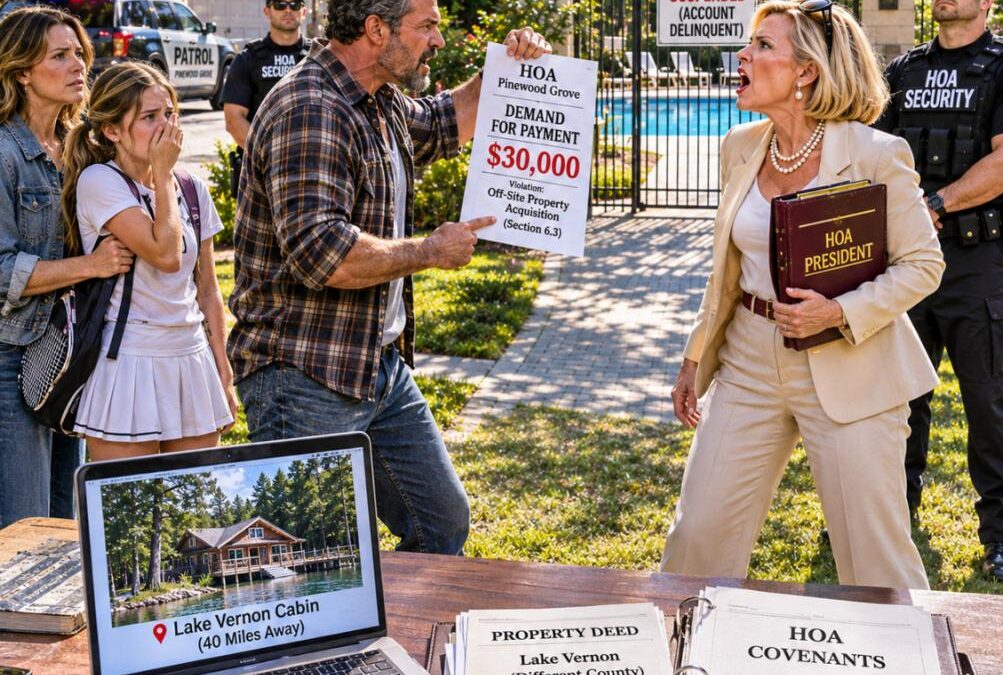
HOA Karen claimed a lake cabin forty miles outside our subdivision somehow violated the rules attached to my house—and slapped me with a $30,000 demand.
When I challenged her, my daughter lost access to the community pool, patrol cars started lingering outside my home, and every ordinary thing we did suddenly became a violation.
Then I learned Cynthia wasn’t merely trying to collect a fine—she was building a paper trail designed to put my paid-off home within reach.
The letter was waiting between a grocery flyer and my electric bill.
Plain white envelope.
Pinewood Grove Homeowners Association printed in the corner.
I opened it over the kitchen counter with chopsticks in one hand and a cold beer in the other, expecting another reminder about fall leaf pickup.
Instead, the first line read:
NOTICE OF ASSESSMENT AND DEMAND FOR PAYMENT — $30,000.
I put the beer down.
Read it again.
Thirty thousand dollars.
Violation:
Unauthorized off-site property acquisition and undisclosed commercial asset associated with the Pinewood Grove residential lot.
I laughed.
Actually laughed.
Then I reached the paragraph citing Article 6.3.
It claimed the lake cabin I’d bought in April through Carter Lake Holdings LLC created an “external property interest affecting the tax, commercial, and residential character of Pinewood Grove.”
My cabin was forty miles away.
Different township.
Different county tax parcel.
Different utility provider.
Different everything.
Pinewood Grove didn’t mow its grass.
Didn’t maintain its road.
Didn’t insure it.
Didn’t even know it existed until Cynthia Blake apparently went looking.
I called her.
She answered on the second ring.
“Daniel.”
The way she said my name told me she’d been waiting.
“Cynthia, I have a thirty-thousand-dollar letter in my hand.”
“I’m aware.”
“For a cabin at Lake Vernon.”
“Correct.”
“You understand Lake Vernon isn’t in Pinewood Grove.”
“I understand where it is.”
“Then fix this.”
A pause.
“You failed to disclose the acquisition.”
“To who?”
“The association.”
“Why would I disclose property I own somewhere else?”
“Because your LLC uses your Pinewood address.”
“So does my bank.”
“Daniel, don’t be difficult.”
I stopped pacing.
“Show me the covenant that gives you jurisdiction over a house forty miles away.”
“Section 6.3.”
“I’m reading 6.3. It prohibits operating a commercial enterprise from a residential lot.”
“Your company is registered here.”
“It’s an LLC holding title to a cabin. It doesn’t operate anything.”
“That is your interpretation.”
“No, Cynthia. That’s English.”
Her voice chilled.
“The board has already ruled.”
“The board cannot decide it owns jurisdiction over the entire state of Michigan.”
“You were given notice.”
“I was given a bill.”
“If you refuse to cooperate, additional enforcement remedies are available.”
“Against what?”
“Your Pinewood property.”
I looked through the kitchen window.
My house.
The place I’d spent eighteen years paying for and finally owned free and clear.
“Are you threatening a lien on my home because I bought a cabin somewhere else?”
Cynthia didn’t answer directly.
That was worse.
She said, “You should review the collection section before deciding how confrontational you want to be.”
Then she hung up.
The next afternoon, Lily came home from school carrying her tennis bag.
She stood in the kitchen doorway.
“Dad?”
“What’s wrong?”
“My pool card doesn’t work.”
I looked up.
“They said our household privileges are suspended because we’re delinquent.”
My stomach went cold.
“We’re not delinquent.”
Lily stared at me.
“Then why did Mrs. Blake tell people we are?”
That was the moment the thirty-thousand-dollar letter stopped being ridiculous.
It became dangerous.
part 2
My name is Daniel Carter.
I was forty-seven when Cynthia Blake decided the ownership boundaries printed in our county records were apparently only suggestions.
I’m a project manager for a commercial electrical contractor outside Grand Rapids. Nothing glamorous. I spend most of my day solving problems caused by people who insist the drawings are wrong until somebody discovers they never read them.
Maybe that’s why I tolerated Pinewood Grove’s HOA for so long.
Rules don’t bother me.
Vague rules do.
People inventing rules bother me even more.
Pinewood Grove was one of those subdivisions built in the early 2000s when developers discovered people would pay extra for beige houses if you added stone entrance columns and called everything “premium.”
Two-story homes.
Curved sidewalks.
Small clubhouse.
Pool.
Two tennis courts.
A pond nobody was allowed to swim in.
My daughter Lily and I lived at the end of Red Maple Court.
Our house wasn’t the biggest.
It wasn’t the prettiest.
It was ours.
Her mother and I divorced when Lily was four.
No spectacular betrayal.
No courtroom war.
We became people who functioned better from different addresses.
Lily lived with me most of the school year and spent regular time with her mother, Stephanie, who lived about thirty minutes away.
I bought the Pinewood house nine years before the cabin.
The mortgage was finally paid off the previous summer.
I still remembered the day the lender mailed the release paperwork.
I stood in my garage holding the letter like I’d won something.
Eighteen years of payments between the old mortgage and refinances.
Done.
Lily didn’t understand why I was emotional.
“You already lived here.”
“Now the bank doesn’t own half my nervous system.”
“That’s not how mortgages work.”
“You’re twelve.”
“I’m still right.”
She usually was.
The HOA had always been annoying in predictable ways.
Approved mailbox colors.
Trash cans hidden after collection.
No street parking overnight.
Exterior paint review.
I followed the rules.
Not because I respected every one.
Because I valued peace more than victory.
Then Cynthia became president.
She was fifty-six, slim, gray-blond bob, expensive glasses, and an almost supernatural ability to transform spreadsheets into threats.
Cynthia had been treasurer before president.
She understood numbers.
She also understood that most homeowners stopped asking questions if you put enough numbers on official letterhead.
Our relationship had been polite.
“Morning, Daniel.”
“Morning, Cynthia.”
“Your hydrangeas look dry.”
“They’re hydrangeas. They enjoy suffering.”
She didn’t appreciate jokes.
Still, no serious trouble.
Then I bought the cabin.
Lake Vernon sat roughly forty miles north.
The cabin wasn’t fancy.
Nine hundred square feet.
Two bedrooms.
Cedar siding.
Tiny kitchen.
A dock that leaned slightly west no matter how many times I corrected it.
I bought it through Carter Lake Holdings LLC because my accountant recommended separating ownership for estate-planning and liability reasons.
The LLC did not operate a rental business.
No Airbnb.
No short-term guests.
No income.
It held title.
That was it.
Lily called the cabin “our anti-HOA zone.”
The first weekend, she stood on the dock wearing an oversized sweatshirt and said, “Can we paint the door purple?”
“If you want.”
“No committee?”
“No committee.”
“Can we have wind chimes?”
“As many as your father can tolerate.”
“Can I leave my bike outside?”
“Don’t get carried away.”
She grinned.
That cabin became the first place in years where I stopped checking my watch.
We repaired the dock.
Burned marshmallows.
Sat outside while the lake went black after sunset.
I thought I’d purchased quiet.
Cynthia somehow converted it into an offense.
The morning after Lily’s pool card was deactivated, I went to the management office.
Pinewood didn’t have a grand clubhouse office.
The association rented a storefront near the subdivision between a pet-grooming salon and a vape shop.
The place smelled like artificial lemon.
Cynthia sat behind a desk with three binders open.
“Daniel.”
I placed the thirty-thousand-dollar demand on her desk.
“Explain this.”
“I already did.”
“No. You recited nonsense over the phone.”
Her expression hardened.
“I’ll ignore the tone.”
“Generous.”
“Article 6.3 prohibits commercial use associated with a Pinewood residence.”
“The cabin isn’t used commercially.”
“Your LLC is registered at this address.”
“My LLC has to receive mail somewhere.”
“It creates a business nexus.”
“That’s not what the covenant says.”
Cynthia tapped the paper.
“The board has interpretive authority.”
“Over ambiguous terms.”
“Correct.”
“Not imaginary ones.”
She leaned back.
“Daniel, why are you fighting this?”
I stared at her.
“Because it’s thirty thousand dollars.”
“The amount reflects the duration of nondisclosure.”
“I had no disclosure obligation.”
“Again, your interpretation.”
I took the cabin deed from my folder and placed it in front of her.
“Different county.”
“I know.”
“Different parcel.”
“I know.”
“No Pinewood covenant recorded against it.”
“Not relevant.”
I laughed.
“Not relevant?”
“Your obligations arise from your ownership here.”
“So if I buy stock in Ford, Pinewood gets a vote?”
“Don’t be childish.”
“Buy a boat?”
“Depends how it’s used.”
“A condo in Florida?”
“Potentially.”
That answer scared me more than the original letter.
Cynthia believed this.
Or believed she could make me believe it.
I pointed to Article 6.3.
“This says no business may be operated from a lot if it creates traffic, signage, employees, customers, or other commercial impacts.”
“Your LLC uses the address.”
“No customers.”
“No traffic.”
“No employees.”
“No sign.”
“No rental activity.”
Cynthia closed the binder.
“The board has decided.”
“Then I’ll appeal.”
“You had twenty days from the first notice.”
“What first notice?”
She pulled out a document dated almost five weeks earlier.
CERTIFIED COMPLIANCE INQUIRY.
I had never seen it.
“Where was this sent?”
“Your address.”
“Certified?”
“According to the record.”
“Tracking number?”
She hesitated.
“I’d have to ask management.”
“Ask now.”
Her jaw tightened.
“This is exactly the behavior that’s making resolution impossible.”
“Verifying whether you actually notified me?”
“You’ve become hostile.”
There it was.
Hostile.
The magic word people use when questions start costing them control.
I gathered my papers.
“Restore Lily’s pool and tennis access.”
“Not until the account is current.”
“She is twelve.”
“Household privileges are household privileges.”
I stared at Cynthia.
“You’re punishing my child over a disputed business interpretation involving property forty miles away.”
“I’m enforcing the rules.”
That was when I called Rachel Morgan.
Rachel practiced real-estate litigation in Grand Rapids.
She had represented a condominium association on one matter for my employer and a homeowner on another.
She understood both sides, which I liked.
I emailed her the declaration, bylaws, fine letter, cabin deed, LLC documents, and everything Cynthia had given me.
Rachel called the next morning.
“Daniel.”
“How bad?”
“Depends what you mean.”
“Can they fine me thirty thousand dollars for owning the cabin?”
“Based on what you’ve sent, I don’t see the authority they’re claiming.”
I sat down.
“That’s lawyer language.”
“Yes.”
“So translate.”
“Article 6.3 regulates commercial activity on or connected to your Pinewood lot. It doesn’t appear to give Pinewood jurisdiction over unrelated property merely because an LLC uses your home as its mailing address.”
“Good.”
“But.”
“Of course.”
“The declaration gives the association enforcement rights against your Pinewood lot for actual violations. We need to take the fine and lien threat seriously even if the underlying theory is weak.”
“Can they lien my house?”
“That depends on the governing documents, the type of charge, statutory requirements, notice, hearing rights, and whether the fine is valid in the first place.”
“That’s not comforting.”
“It’s not supposed to be. It’s supposed to be accurate.”
Rachel asked whether I’d received earlier notices.
“No.”
“Any certified mail?”
“No.”
“Email?”
“Not about the cabin.”
“Any reason the HOA would know you purchased it?”
I thought.
“My LLC registration is public.”
“Anything else?”
“Maybe property records.”
“Cynthia searched?”
“Apparently.”
Rachel went quiet.
“That’s unusual.”
“She doesn’t have hobbies.”
“We’ll keep personal opinions outside the letter.”
Her first letter was six pages.
No threats.
No insults.
It demanded withdrawal of the fine, restoration of common-area privileges, proof of notice, the board minutes authorizing the interpretation, the fine schedule, and any legal opinion the association was willing to disclose supporting jurisdiction over off-site property.
It also put them on notice not to record any lien or initiate collection while the dispute was being challenged.
For four days, nothing happened.
Then Lily tried the tennis court again.
Still blocked.
A courtesy patrol vehicle appeared outside my house that evening.
Pinewood hired a private security company to patrol common areas.
The vehicle parked across the cul-de-sac for forty-five minutes.
No emergency.
No call.
Just sat.
The next night, same thing.
I walked over.
The driver rolled down his window.
“Can I help you?”
“I was going to ask you that.”
He looked embarrassed.
“Routine patrol.”
“You’ve been parked outside my house two nights.”
“Association requested additional observation.”
“Of what?”
“I’m just doing my shift.”
I nodded.
“Who requested it?”
“You’ll have to ask management.”
I did.
No response.
Two days later, Tom Weller from four houses down stood near my driveway photographing my truck.
Tom and I had once spent an afternoon arguing about lawn fertilizer like two men with no real problems.
Now he held his phone up when I left for work.
“Tom.”
He lowered it.
“What?”
“Why are you taking pictures?”
“I’m documenting.”
That word again.
“For who?”
“The compliance committee.”
“About what?”
He looked at my truck.
“It’s been parked outside.”
“It’s my driveway.”
“Apparently there are questions about business use.”
I stared at the company logo on my truck door.
Same truck I’d parked there for five years.
“Why now?”
Tom shrugged.
“Don’t shoot the messenger.”
“I haven’t seen a messenger. I’ve seen a neighbor photographing my house.”
He walked away.
Then came the notices.
Commercial vehicle.
Withdrawn after Rachel pointed out prior written approval.
Lawn height.
Measured at three inches.
Within rule.
Trash bin visible eighteen minutes after the deadline.
Warning.
Guest activity.
Lily had three friends sleep over.
The notice described “possible unregistered transient occupancy.”
That one almost made me lose my mind.
Rachel called.
“Don’t respond yourself.”
“They called my daughter’s sleepover transient occupancy.”
“I know.”
“They think three twelve-year-olds are renters?”
“I know.”
“Can I call Cynthia?”
“No.”
“Can I call her something?”
“Only in your kitchen.”
I started a file.
Printed everything.
Digitized everything.
Installed two cameras.
One over the garage.
One at the front door.
Not because I thought someone was coming to hurt us.
Because I no longer trusted the record.
Then packages started disappearing.
A set of dock cleats.
Lily’s shoes.
An electrical tester I’d ordered for work.
Delivery photographs showed boxes on my porch.
They weren’t there when I got home.
Could’ve been porch thieves.
Could’ve been teenagers.
Could’ve been coincidence.
Then the Postal Service sent a confirmation notice for a forwarding request I hadn’t submitted.
That was not coincidence.
I contacted the Postal Service.
They canceled the request.
I reported the issue through the appropriate postal channels.
Rachel made me promise not to accuse Cynthia.
“I know what you’re thinking.”
“You don’t.”
“I absolutely do.”
“She benefits.”
“That isn’t proof.”
“She has access to the neighborhood.”
“So do several hundred people.”
“I hate you.”
“Good. You’re listening.”
Then the dead fish arrived.
Plastic grocery bag on my porch.
Three dead perch wrapped in newspaper.
A typed note:
HOPE THE CABIN WAS WORTH IT.
My front camera had been temporarily offline because I’d made the brilliant decision to reboot the system from work and forgot to confirm it came back.
No video.
No fingerprints usable by the local officer who took the report.
No witness.
Lily saw the bag.
That mattered.
She stood six feet behind me.
“What is that?”
“Nothing.”
“It smells.”
“Go inside.”
“Is it because of the cabin?”
I looked at her.
“Inside, Lily.”
She obeyed.
That night she didn’t finish dinner.
I checked every lock twice before bed.
The next morning, Rachel’s tone changed.
“We’re not treating this as only an assessment dispute anymore.”
“Harassment?”
“Potentially.”
“By Cynthia?”
“By whoever can be tied to conduct. Do not outrun the evidence.”
Again.
Evidence.
I started a journal.
Dates.
Cars.
Notices.
Calls.
Everything.
Cynthia found a new angle.
The cabin was allegedly a short-term rental.
An inspector from Lake Vernon’s township contacted me after receiving a complaint that I was operating an unlicensed vacation rental.
I drove up to meet him.
He looked through the place.
One bedroom mine.
One Lily’s.
Family photos.
No guest log.
No rental listing.
No lockbox.
No rental income.
He laughed when I showed him the Pinewood correspondence.
“That’s forty miles away.”
“Thank you.”
He still documented the inspection.
Good.
I wanted paper.
Complaint closed.
A week later:
GARAGE DOOR STRUCTURAL NONCOMPLIANCE.
The same garage door that had been on the house since I bought it.
Cynthia claimed exterior paneling differed from approved architectural records.
Rachel requested the records.
The HOA couldn’t locate original approval.
Then somebody flew a drone over my backyard.
Lily and I were grilling.
She pointed with a fork.
“Dad.”
The drone hovered above our rear property line.
Camera facing us.
Then moved along the fence.
I filmed it.
It left.
I reported it to management.
No answer.
Rachel included it in the preservation demand.
Three weeks later, the HOA’s vendor invoices would tell us exactly what it was.
But we didn’t know that yet.
Then police came.
Two cruisers.
Lights on.
7:20 p.m.
Lily was doing math at the kitchen table.
I opened the door with my hands visible because even innocent people understand what flashing lights do to the nervous system.
The first officer said they had received a report of possible weapons trafficking and an unlicensed business operating from the property.
I stared.
“Weapons trafficking?”
“That’s what was reported.”
“I own one hunting rifle locked in a safe.”
He nodded.
“We’re talking to you. That’s all.”
I invited them inside voluntarily.
Not because I had to prove innocence.
Because Lily was watching.
I wanted the situation over.
They saw my work computer.
Tool bags.
Family photos.
A locked gun safe in the basement.
No business customers.
No weapons inventory.
No illegal activity.
The older officer looked embarrassed.
“Sorry for the disruption.”
“Who called?”
“Report came through anonymously.”
“Can I get an incident number?”
“Absolutely.”
Lily waited until the patrol cars left.
“They thought you were a criminal.”
“No.”
“They brought two police cars.”
“Because somebody said something serious.”
“Who?”
“I don’t know.”
She looked down at her sketchbook.
“Cynthia.”
“Lily.”
“It is.”
“We don’t know that.”
“Everybody knows.”
“No.”
I sat beside her.
“We know what we can prove.”
She hated that answer.
So did I.
Rachel explored protective relief related to the escalating pattern, but the first request for broad anti-harassment restrictions did not produce everything we wanted. The court wanted clearer attribution tying specific acts to Cynthia or the association.
That frustrated me.
It also forced us to become better.
More precise.
The break came from Carl Jensen.
Carl owned a car wash.
He served on Pinewood’s board because, according to him, his wife volunteered him while he was golfing.
He called at 9:40 one night.
“Daniel?”
“Yeah.”
“It’s Carl.”
I sat up.
“Board Carl?”
“Can we not call me that?”
“What’s wrong?”
His voice dropped.
“Things are getting out of hand.”
“They’ve been out of hand.”
“I didn’t know about the police call.”
“Neither did I until the police arrived.”
“Cynthia says it wasn’t board-related.”
“Okay.”
“She also says you’re hiding rental income.”
“I’m not.”
“I figured.”
“Why are you calling?”
Carl breathed out.
“She’s planning something with the lien.”
My stomach tightened.
“What?”
“Come to the meeting Thursday.”
“I always can attend.”
“I know.”
“Then why tell me?”
“Because I want you to hear what she says.”
Thursday night, I brought a laptop.
Not hidden.
Not secretly recording private conversations.
The board meeting was open to owners under our association procedures, and the association itself used an audio recorder to prepare minutes.
I set my laptop on the table and said, “I’m recording my own copy.”
Cynthia looked irritated.
The association attorney wasn’t present.
That became important.
The first twelve minutes were budgets.
Snow removal.
Pool chemicals.
Then my account.
Cynthia opened a binder.
“Mr. Carter’s ongoing refusal to comply with Article 6.3 presents a serious governance issue.”
I raised my hand.
“You mean the cabin.”
“You will have owner comment after board discussion.”
Carl stared at the table.
Another director, Ellen Watkins, had resigned months earlier, so five directors remained.
Cynthia continued.
“If one homeowner can ignore a valid enforcement determination, everyone can.”
Director Susan Hale asked, “Rachel Morgan sent another letter saying the cabin isn’t subject to our declaration.”
Cynthia waved her hand.
“That’s advocacy.”
“Do we have our own legal opinion?”
“Our documents are clear.”
Carl finally spoke.
“They aren’t clear to me.”
Cynthia’s eyes snapped toward him.
“Then read them again.”
Carl reddened.
“That’s not an answer.”
She closed the binder.
“We have the votes.”
“What votes?” I asked.
Cynthia glared.
“Owner comment later.”
I shut up.
Carl said, “You’re talking about collection?”
Cynthia answered.
“If Daniel’s account reaches collectible delinquency, we record what the declaration allows us to record.”
Susan looked worried.
“On his home?”
“Where else?”
“For fines tied to another property?”
“They’re tied to his noncompliance here.”
Carl said, “Rachel is going to sue us.”
Cynthia laughed.
“Let her.”
Then she said the sentence that changed everything.
“Hold the line until he’s delinquent long enough. People get brave until their title report has a lien on it.”
Silence.
Even I stopped breathing.
Susan asked:
“Are we enforcing a rule or trying to pressure him?”
Cynthia smiled.
“Those aren’t mutually exclusive.”
I looked at Carl.
He looked at me.
Then Cynthia noticed the red recording indicator on my laptop.
Her face changed.
“You cannot record board deliberations.”
I said, “The association recorder is running too.”
She looked toward the small device beside the secretary.
It was.
Cynthia stood.
“Turn yours off.”
“No.”
“This is harassment.”
“No. This is a meeting.”
She adjourned my agenda item five minutes later.
Rachel listened to the audio that night.
She didn’t call it dynamite.
Rachel hated dramatic words.
She said:
“This is useful.”
Which, coming from her, meant dynamite.
She sent the recording to the HOA’s insurer and the association’s outside counsel with another demand that no lien be recorded and no collection action proceed until the underlying authority dispute was resolved.
Then Cynthia issued another fine.
Twenty-two thousand dollars in new penalties and charges.
My alleged balance now exceeded fifty thousand.
Rachel filed suit.
Declaratory relief.
Injunctive relief.
Claims arising from improper enforcement and governance conduct.
Additional claims would depend on what discovery showed.
We did not sue Cynthia for everything that had ever irritated me.
No kitchen-sink pleading.
No wild accusations about dead fish or mail theft without proof.
Rachel wanted credibility.
The first hearing concerned one question.
Could Pinewood continue using disputed fines tied to my off-site cabin as the basis for collection pressure against my Pinewood home while the court determined whether the declaration authorized that interpretation?
The judge read Article 6.3.
Then the recorded declaration.
Then the LLC documents.
Pinewood’s attorney argued the association possessed interpretive authority and that using my Pinewood address for Carter Lake Holdings LLC constituted prohibited business activity.
Rachel asked:
“Where is the business activity?”
The attorney answered:
“The LLC registration.”
“Customers?”
None.
“Employees?”
None.
“Traffic?”
None.
“Advertising?”
None.
“Rental activity?”
None documented.
“Revenue?”
None.
The judge didn’t declare the entire case over.
He issued temporary relief preserving the status quo.
No lien based on the disputed cabin fines while the case proceeded.
No foreclosure-related collection action based on that disputed balance.
No suspension of Lily’s pool or tennis privileges based solely on those challenged charges.
That was enough for me to breathe for the first time in weeks.
Lily’s card worked the next afternoon.
She held it up at the pool gate.
Green light.
She looked at me.
“Can Cynthia turn it off again?”
“Not for this.”
“Because the judge said?”
“Yes.”
She smiled.
“Good judge.”
“Don’t start ranking judges. Rachel will bill us.”
Lily didn’t understand.
I barely did.
Then discovery started.
That’s when Pinewood Grove stopped being about a cabin.
The first surprise came from the declaration.
Rachel pulled the certified version from the county Register of Deeds.
Article 6.3 was exactly what we’d always said.
Commercial activity from a Pinewood lot.
Nothing about undisclosed second homes.
Nothing about external property interests.
Nothing about “tax uniformity.”
Then the HOA produced its digital governing-document packet.
Article 6.3 was different.
Someone had added a paragraph:
Owners must disclose secondary properties held through entities registered to a Pinewood address where such ownership may affect the residential, commercial, or tax character of the community.
Rachel compared metadata.
The paragraph had been inserted eleven months earlier.
No recorded amendment.
No member approval record.
No signed amendment.
No valid certification.
Just a modified PDF uploaded to the HOA portal.
“Who changed it?” I asked.
“Discovery.”
Then Ellen Watkins called.
Former treasurer.
She asked to meet at a diner.
Rachel came.
Ellen arrived carrying a manila envelope.
“I should’ve done this sooner.”
Inside were board emails.
An older version of the governing packet.
Meeting minutes.
And one message from Cynthia.
Subject:
CLEANUP OF DIGITAL CHARTER.
Cynthia wrote:
I corrected several gaps in the online copy to reflect current board interpretation. No need for a membership vote because these are clarifications, not amendments.
Ellen had responded:
You can’t add obligations to the declaration as a clarification.
Cynthia:
We’re not changing the declaration. We’re explaining it.
Ellen:
Then why is the new language written inside the declaration?
No response.
Ellen looked at me.
“That’s why I resigned.”
“Why didn’t you tell homeowners?”
“I was afraid of getting sued.”
Rachel asked, “Did the board vote on the added paragraph?”
“No.”
“Did members?”
“No.”
“Was anything recorded with the county?”
“Not that I know.”
“Did counsel review it?”
Ellen laughed bitterly.
“Cynthia stopped inviting counsel when he disagreed too much.”
That sentence opened the next door.
Invoices.
Pinewood had paid for “community compliance investigations.”
Private security observations.
Property-record searches.
Drone imaging.
Aerial inspection.
There it was.
The drone over my backyard had been contracted through a vendor and charged to the association.
The work order:
CARTER PROPERTY — VERIFY EXTERIOR BUSINESS ACTIVITY / STORAGE / OCCUPANCY.
Authorized by Cynthia.
No board vote.
No attorney signoff.
The security vehicle parked outside my house?
Also Cynthia.
Extra patrol billed as “compliance observation.”
Tom photographing my driveway?
Volunteer compliance assignment documented in an email.
Cynthia:
Please photograph commercial indicators at Carter residence whenever observed.
Tom later claimed he thought the board had formally authorized the investigation.
Records suggested otherwise.
Then came the police calls.
We never proved Cynthia was responsible for every anonymous report.
That mattered.
One call about possible illegal business activity came from a number registered to a compliance contractor Pinewood had hired.
The contractor said he called after being told to “report anything concerning.”
The weapons allegation had been added during the call after he claimed he’d seen “cases or long boxes” entering my garage.
They were electrical tool cases.
Cynthia had sent the contractor the assignment.
We still couldn’t say she personally told him to report weapons.
So we didn’t.
The truth was strong enough.
Then Rachel obtained emails discussing my account.
Cynthia:
Daniel thinks because his mortgage is paid he has nothing to lose. Once a lien appears, he’ll understand Pinewood still has leverage.
Susan:
I am not comfortable with that wording.
Cynthia:
It’s reality.
Carl:
What happens if Article 6.3 doesn’t apply?
Cynthia:
It applies because we say it applies until a court says otherwise.
Rachel stopped reading.
Looked at me.
“There.”
“What?”
“That’s the governance problem in one sentence.”
I understood.
Cynthia saw authority backward.
Rules weren’t limits on power.
Power defined the rules until somebody stronger intervened.
The dead fish remained unsolved.
So did the forwarding request.
We never connected either to Cynthia.
I had to learn to live with that.
I wanted one perfect villain.
Reality gave me verified misconduct surrounded by unanswered questions.
Rachel refused to let anger fill the gaps.
That restraint became one of the reasons the judge trusted our case.
The association’s insurer noticed too.
Coverage counsel appeared.
The board finally hired independent counsel separate from Cynthia.
Then everything moved quickly.
Carl called a special board meeting.
Cynthia objected.
The bylaws allowed it if enough directors demanded one.
They did.
The clubhouse overflowed.
I sat with Lily in the back.
She insisted on coming.
“You’re twelve.”
“Exactly. Old enough to hear why people keep saying we’re losing our house.”
That ended the argument.
Cynthia sat at the center table.
Gray cardigan.
Pearls.
Three binders.
Still performing control.
Carl opened.
“The purpose of tonight’s meeting is to address litigation risk, governance records, and the president’s authority.”
Cynthia interrupted.
“This meeting is procedurally defective.”
Independent counsel shook his head.
“It is not.”
Her face tightened.
Carl continued.
“We have confirmed that language was added to the digital declaration without a recorded amendment.”
Cynthia leaned forward.
“Clarified.”
The attorney spoke.
“A recorded declaration is not amended by editing a PDF.”
Murmurs filled the room.
Cynthia turned toward him.
“Nobody said it was amended.”
“Then the added paragraph cannot be represented as though it has the same legal status as the recorded declaration.”
“It reflects board interpretation.”
“Then it should’ve been labeled board policy or guidance, and even then the board cannot invent powers the declaration doesn’t grant.”
Cynthia’s face went red.
Lily whispered:
“He’s good.”
“Quiet.”
Carl projected the original Article 6.3.
Then Cynthia’s version.
Side by side.
A homeowner near the front said:
“She changed the rules?”
Cynthia snapped:
“I corrected outdated language.”
The attorney said:
“No.”
One word.
It hit harder than a speech.
Then Susan presented the invoice summary.
Drone contractor.
Security patrol.
Property research.
Compliance investigator.
Thousands of dollars spent on my property without full-board authorization.
Cynthia defended it as enforcement expense.
Carl asked:
“Where’s the vote?”
“Operational decisions don’t require votes.”
“For surveillance of one homeowner?”
“I reject that word.”
“You hired a drone.”
“Exterior inspection.”
“You hired security to sit outside his house.”
“Observation.”
“You had Tom photograph his driveway.”
“Volunteer compliance.”
Lily leaned toward me.
“Dad.”
“Yeah?”
“They really were spying on us.”
I hated hearing her say it.
Not because she was wrong.
Because a child shouldn’t have to learn the vocabulary of petty institutional power before algebra.
Then Ellen stood.
Karen looked stunned to see her.
Ellen walked to the microphone.
“I was treasurer when the digital language was added.”
Cynthia stared.
“Ellen, you’re not on the board.”
“No.”
“Then you have no role.”
“I was there.”
Independent counsel said she could speak during owner comment.
Ellen read her email exchange.
The room changed.
People started asking questions.
Not only about me.
A retired couple had received a fine because tomatoes were visible from the street.
A woman had been cited for a replacement mailbox that looked identical to the old one.
Someone else received a warning over wind chimes.
One homeowner said Cynthia had threatened to suspend clubhouse access over unpaid landscaping fines before his appeal was heard.
People had stories.
Most weren’t illegal.
Some were legitimate enforcement.
The important thing was how few homeowners knew where Cynthia’s discretion ended.
Then Carl played the meeting recording.
Cynthia’s own voice:
“Hold the line until he’s delinquent long enough. People get brave until their title report has a lien on it.”
The room went silent.
She looked at me.
I didn’t smile.
I wasn’t enjoying it.
That surprised me.
For months, I had imagined Cynthia exposed in front of everyone.
I thought I’d feel vindicated.
Instead I looked at Lily sitting beside me and wished none of this had happened.
Cynthia stood.
“That statement is being taken out of context.”
Carl asked:
“What context improves it?”
She turned toward him.
“I was discussing legitimate collection.”
“On a disputed rule you inserted into the online declaration?”
“I did not insert anything improperly.”
Ellen laughed once.
Cynthia snapped:
“You resigned because you couldn’t handle the workload.”
Ellen looked hurt.
Then angry.
“I resigned because you wanted the documents to say whatever you needed.”
That landed.
Cynthia pointed toward me.
“This entire community is being manipulated by one homeowner who refuses accountability.”
I finally stood.
The room quieted.
Cynthia looked almost relieved.
She wanted me angry.
I had been angry for months.
I was tired now.
“What accountability?”
“You bought property through a business entity tied to your Pinewood address and refused disclosure.”
“Because no valid covenant required it.”
“That’s your lawyer’s position.”
“It’s the recorded document.”
“You’ve disrupted board operations, encouraged public attacks, and damaged the association financially.”
I nodded.
“How much has the HOA spent investigating my cabin?”
She didn’t answer.
I looked at Carl.
He did.
“Twenty-seven thousand four hundred and some change, not counting legal fees.”
Homeowners reacted.
I looked at Cynthia.
“You spent almost thirty thousand dollars investigating property forty miles away because you wanted me to pay you thirty thousand.”
Cynthia’s face tightened.
“The principle matters.”
“Yes.”
I nodded.
“That’s why we’re here.”
She looked confused.
“The principle is that Pinewood’s authority ends somewhere.”
Silence.
“My cabin has its own deed. Its own parcel. Its own taxes. Its own local rules. Owning a home here doesn’t make every other thing I own subject to you.”
“You used this address for the LLC.”
“So does my daughter’s college savings account use this address.”
“That’s different.”
“Why?”
“It just is.”
There it was.
The answer Cynthia always reached when documents stopped helping.
It just is.
I sat down.
Carl made the motion.
Remove Cynthia Blake as president.
One director seconded.
Cynthia laughed.
“This is insane.”
The association attorney explained that under the bylaws the board could remove an officer from the officer position, though any separate director status followed different procedures.
Cynthia looked at Susan.
“You’ll regret this.”
Susan stared at the table.
“No.”
Then raised her hand.
Four to one.
Cynthia lost the presidency.
She stayed in the room.
That surprised me.
Maybe she still thought she could reverse it.
Carl became acting president.
His first sentence:
“We’re suspending all collection activity on Daniel’s disputed account.”
Applause started.
I hated that.
I stood again.
“Don’t.”
People stopped.
“This isn’t a football game.”
I looked around.
“Some of you supported these fines because you thought they couldn’t reach you.”
No one moved.
“Today it’s my cabin. Tomorrow it’s whatever somebody decides your life should look like.”
Then I sat.
Lily whispered:
“That was dramatic.”
“I know.”
“You said you weren’t going to give a speech.”
“I failed.”
“Definitely.”
The civil case continued.
Cynthia being removed didn’t erase what happened.
Pinewood’s insurer pushed mediation.
Independent counsel began an internal audit.
Rachel’s claims narrowed as evidence improved.
We had a strong declaration issue.
Strong due-process and governance evidence.
Strong support for improper use of association funds.
Potential defamation tied to specific statements would depend on publication and proof.
The harassment pattern mattered.
The unsolved fish and mail issues did not magically become Cynthia’s responsibility because she was unpleasant.
Rachel excluded anything we couldn’t prove.
The court later entered a declaratory ruling on the core covenant issue.
Article 6.3 did not give Pinewood Grove authority to regulate my ownership of the Lake Vernon property merely because my LLC used my Pinewood home as a mailing address.
The digital added paragraph did not become part of the recorded declaration simply because it appeared in the association’s portal.
The fifty-two-thousand-dollar collection balance tied to that theory could not stand.
My account was corrected.
Zero.
I logged into the homeowner portal three times.
Balance:
$0.00.
I took a screenshot.
Lily saw me.
“You know it isn’t going to change if you refresh.”
“I spent months looking at fifty-two thousand.”
“Old-man behavior.”
“I’m forty-seven.”
“Exactly.”
The settlement handled the rest.
Pinewood agreed to reimburse a substantial portion of my legal expenses and compensate us for documented losses resulting from improper amenity suspension and targeted enforcement.
Not millions.
Not retirement money.
Enough to matter.
The association adopted a formal rule that any future amendment to recorded restrictions had to follow the governing documents and applicable law, with the final recorded version controlling over convenience copies on websites.
Enforcement notices had to cite an actual provision.
Owners received defined appeal procedures before discretionary suspensions.
Board spending above certain limits required recorded authorization except for genuine emergencies.
Private surveillance services aimed at individual properties required legal review and board approval.
Drone use for compliance inspections was sharply restricted.
The insurer required governance training.
Carl hated every minute of it.
“More forms.”
Rachel told him:
“Forms are cheaper than lawsuits.”
He couldn’t argue.
Cynthia resigned her board seat before the audit was complete.
She didn’t vanish.
Not yet.
She created something called the Pinewood Preservation Committee.
Not an HOA.
A private group of residents.
Newsletter.
Facebook page.
Lots of language about neighborhood integrity.
At first, that was legal.
People can organize.
Complain.
Talk.
Then the group started publishing what it called “community concern reports.”
Pictures of homes.
Owner names.
Alleged violations.
One post included the location of Lily’s school bus stop while complaining about “unsupervised youth gatherings.”
That crossed a line for me.
Rachel sent a demand.
Not because Cynthia couldn’t criticize us.
Because private information, false factual claims, and targeted harassment created separate risks.
The page removed several posts.
Then Cynthia sued me.
Fifty thousand dollars.
Defamation.
She claimed I had destroyed her reputation by sharing the board recording and speaking to a local reporter after court filings became public.
Rachel read the complaint.
Then looked at me.
“You’re enjoying this.”
“No.”
“You are.”
“A little.”
“Don’t.”
Cynthia alleged I’d falsely accused her of fraud.
I hadn’t.
My interview was careful.
I said the online governing document had been altered without the amendment process required to make the added language part of the recorded declaration.
That was supported by the records.
I said association money had been spent monitoring my property without full-board authorization.
Invoices supported that.
I said the court had blocked enforcement of the cabin fine.
Public order.
I did not call Cynthia a criminal.
I did not say she mailed the fish.
I did not accuse her of tampering with my mail.
Accuracy mattered.
Her suit didn’t survive long.
The judge dismissed the central claims after reviewing what had actually been said and the underlying records.
Some issues were disposed of early; others Cynthia withdrew after her new lawyer apparently explained the economics.
The court awarded part of my additional fees under the legal standards applicable to the circumstances.
Rachel refused to celebrate.
I didn’t.
Lily did.
She baked cupcakes.
“These are litigation cupcakes.”
“That isn’t a thing.”
“It is now.”
“Your mother is going to blame me.”
“She already does.”
Meanwhile, the audit landed.
Cynthia had not stolen HOA money.
That rumor became popular online.
It was false.
She had done something less dramatic and more relevant.
She had repeatedly approved enforcement-related expenditures without documentation required by Pinewood’s own financial policy.
She had treated disputed fines as though they were settled debt.
She had directed vendors toward individual homeowners without clear board authorization.
She had allowed the website copy of governing documents to diverge from the recorded version.
She had failed to disclose enough of her own involvement when asking directors to approve later enforcement steps.
Bad governance.
Not embezzlement.
Again, truth didn’t need upgrading.
Pinewood held new elections.
Carl ran reluctantly.
Won.
Susan stayed.
Three new directors joined.
One was Frank Holloway, a retired Army mechanic with an impressive ability to turn every agenda item into an argument about common sense.
At his first meeting, somebody proposed a new rule about decorative flags.
Frank asked:
“Is there an actual problem?”
Silence.
He repeated:
“Is someone being harmed?”
No.
“Then why are we writing a rule?”
Proposal died.
I liked Frank.
Pinewood didn’t become anti-rule.
We still had lawn standards.
Parking rules.
Exterior approval.
Pool hours.
The board fined somebody for abandoning a broken trailer in the street for two months.
Correctly.
Another homeowner lost an appeal over an unapproved six-foot commercial sign mounted to his garage.
Correctly.
I wasn’t trying to destroy the HOA.
That would have been childish.
We shared common property.
Some structure was necessary.
The goal was narrower.
Make them use the authority they actually possessed.
Not the authority Cynthia imagined.
The media attention faded.
Thank God.
One local station covered the case after the court ruling.
They interviewed me beside my mailbox.
Not because the mailbox mattered.
It was simply where the camera crew could stand without blocking traffic.
Lily sat in the driveway drawing with chalk.
The reporter asked:
“Do you see yourself as an HOA reform activist now?”
I laughed.
“No.”
“What are you?”
“Tired.”
She smiled.
Then asked what I wanted other homeowners to learn.
I thought about it.
“Read the recorded documents, not just whatever PDF somebody emails you.”
“Anything else?”
“Ask what rule they’re actually enforcing.”
“And if they’re wrong?”
“Document it before you yell.”
Rachel later texted:
Most responsible thing you’ve said all year.
I replied:
Bill me.
She did.
Lily became the unexpected center of neighborhood repair.
Kids are better at moving on than adults.
Once she got pool access back, she went swimming.
No speech.
No symbolic return.
She swiped her card.
Jumped in.
Two months later, she asked whether we could host a block cookout.
“Why?”
“Because everyone hates everyone.”
“That’s an exaggeration.”
“Have you been to an HOA meeting?”
Fair.
We didn’t call it an HOA event.
No board banner.
No speeches.
Just neighbors.
Grill.
Potluck.
Someone brought karaoke equipment, which should’ve been prohibited by federal law.
Frank sang Johnny Cash badly.
Carl attempted Journey.
Lily filmed him for blackmail.
Neighbors who had supported Cynthia came.
Some avoided me.
One apologized.
Tom was one of them.
He stood near my garage holding a beer.
“I shouldn’t have taken those pictures.”
“No.”
“I thought it was official.”
“It was requested by the president.”
“I still shouldn’t have done it.”
I nodded.
He waited.
“What?”
“I was hoping you’d say it’s okay.”
“It’s not.”
Tom looked down.
Then I added:
“But we’re okay.”
He looked relieved.
That’s the difference between forgiveness and pretending nothing happened.
Ellen came too.
She had moved out of Pinewood by then but drove back for the cookout.
She brought the original printed governing packet she’d saved.
“I think this belongs in a museum.”
“No.”
She laughed.
“Burn it?”
“Also no.”
Frank overheard.
“Fire pit.”
Rachel would’ve murdered us.
We did not burn governing records.
We burned hot dogs.
Much safer.
Cynthia’s house went on the market the following winter.
No dramatic moving van at midnight.
No exile.
A real-estate sign.
Then boxes.
Then movers.
The final time I spoke to her was beside the cluster mailboxes.
She was carrying a package.
I was checking mine.
“Daniel.”
“Cynthia.”
She looked older.
Maybe I did too.
“You got what you wanted.”
I almost smiled.
She still believed every conflict had a winner who desired the loser’s pain.
“What do you think I wanted?”
“Control.”
That surprised me enough to laugh.
“Me?”
“You challenged everything.”
“You fined me for property outside the subdivision.”
“You used a business entity tied to your residence.”
“And the judge disagreed with your interpretation.”
“One judge.”
“That’s generally enough for the case in front of you.”
Her mouth tightened.
She looked toward my house.
“You made people think I was corrupt.”
“I repeatedly said you weren’t accused of stealing.”
“That isn’t what people heard.”
“I can’t control gossip.”
“You fed it.”
“By showing the recorded declaration?”
She looked away.
For a moment, I almost felt sorry for her.
Then she said:
“Pinewood used to be orderly.”
“It still is.”
“No.”
“Trash gets collected. Pool opens. Roads get plowed.”
“That’s not what I mean.”
I knew.
She meant obedience felt like order.
I leaned against the mailbox structure.
“Cynthia, the cabin is forty miles away.”
Her eyes closed briefly.
“You’re still on that.”
“That’s literally what this started over.”
“It was never only the cabin.”
That caught me.
“What was it?”
She hesitated.
Then finally said something honest.
“You stopped respecting the association.”
I thought about that.
“No.”
She looked at me.
“I stopped confusing the association with you.”
Silence.
Cynthia stared.
Then walked away.
A month later, the house was empty.
The new owners were a couple in their thirties with twin boys and a golden retriever that treated my lawn as international territory.
Normal people.
I told them nothing about Cynthia.
They asked whether the HOA was difficult.
I said:
“Read before you sign.”
Good advice anywhere.
The Lake Vernon cabin remained exactly what I bought it to be.
A place to disappear.
The first weekend after the final settlement, Lily and I drove up.
She was thirteen by then.
Older.
More skeptical.
She carried her sketchbook to the dock while I fixed a loose board.
The lake was flat.
Cold Michigan sky.
Pines mirrored in the water.
I opened a beer.
Lily looked at the bottle.
“Is this the peaceful weekend you kept promising?”
“Don’t ruin it.”
She smiled.
We sat on the dock.
No phones.
No board notices.
No patrol car.
Eventually she asked:
“Did you ever find out who sent the fish?”
“No.”
“Mail thing?”
“No.”
“Police call?”
“Partly.”
“Doesn’t that bother you?”
“Yes.”
She waited.
“But?”
“I learned that not every blank gets filled.”
She frowned.
“That sounds annoying.”
“It is.”
“What if Cynthia did it?”
“Then I still can’t say she did without evidence.”
“What if everyone knows?”
“Everyone knowing isn’t the same as knowing.”
She drew a line across the page.
“Rachel brainwashed you.”
“Rachel charged me for the privilege.”
Lily laughed.
Then looked toward the cabin.
“Can anyone from Pinewood ever tell us what to do here?”
“No.”
“Really?”
“Really.”
“Can I paint the door purple?”
I stared at her.
She had been waiting more than a year.
“Fine.”
Her entire face lit up.
We painted it two weeks later.
Deep purple.
Ugly.
She loved it.
I eventually did too.
No architectural application.
No color chart.
No board vote.
But the strange part was that freedom felt less dramatic after everything.
Before Cynthia, I imagined freedom as absence of rules.
After Cynthia, I understood it differently.
Freedom is knowing which rules legitimately apply.
My Lake Vernon cabin had township rules.
Building code.
Zoning.
Property taxes.
Environmental requirements.
Those were real.
Pinewood had rules too.
On Pinewood property.
Real authority has edges.
Cynthia’s mistake was treating edges like insults.
If she could connect something to me, she thought she could connect it to her office.
The cabin.
The LLC.
My truck.
Lily’s friends.
My mail.
My backyard.
My reputation.
Eventually, the house itself.
That is how petty power grows.
Not usually by announcing:
I own you.
It grows through:
Just one more interpretation.
One more fee.
One more exception.
One more document nobody checks.
One more vendor nobody approved.
One more homeowner too tired to appeal.
The lien threat scared me more than I admitted.
A paid-off home feels permanent.
Then somebody sends a letter using the word lien and suddenly eighteen years of work feels paper-thin.
Rachel taught me something important.
A threat printed on letterhead is not the same thing as a lawful result.
Read it.
Check the authority.
Check notice.
Check procedure.
Check the recorded documents.
Ask what type of charge it is.
Ask what remedies actually attach.
Don’t ignore it.
But don’t surrender because the font is bold.
I kept Cynthia’s original thirty-thousand-dollar demand.
It’s in a folder at the cabin.
Lily found it once.
“Why keep this?”
“Evidence.”
“The case is over.”
“Memory.”
She looked at the number.
“$30,000.”
“Yep.”
“For owning this place.”
“Basically.”
She laughed.
“That’s so stupid.”
Children remain the best appellate court.
Years passed.
Pinewood got quieter.
Not because everyone suddenly liked each other.
Because the process improved.
The board began sending draft rules before votes.
Meeting minutes included dissent.
Large enforcement expenses required approval.
The online document portal linked directly to scanned recorded instruments rather than editable “cleaned-up” PDFs.
Homeowners still complained.
That’s what homeowners do.
But they knew where to look.
Carl served one term as president.
Then refused reelection.
“I own a car wash,” he told me. “People yelling about wax packages are easier than people yelling about fences.”
Frank became president.
The first month, he called me.
“Daniel.”
“What?”
“There’s a request to ban wind chimes.”
I laughed.
“No.”
“I’m serious.”
“Who complained?”
“One person.”
“About?”
“A wind chime.”
“Is it twenty feet tall?”
“No.”
“Powered by jet engine?”
“No.”
“Then why are you calling me?”
“Because Cynthia fined somebody for them once and nobody knows whether that was real.”
“Read the recorded documents.”
Silence.
Then Frank said:
“I hate you.”
“Leadership.”
He hung up.
No wind-chime ban.
Somewhere, civilization continued.
The strangest consequence of everything was how long Lily carried the eviction rumor.
She was fifteen when she finally mentioned it again.
We were driving to the cabin.
She said:
“You know I had a suitcase packed.”
I looked over.
“What?”
“When people at school said we were losing the house.”
My hands tightened around the steering wheel.
“When?”
“Back then.”
“You never told me.”
“You were already stressed.”
“What did you pack?”
“Clothes. Sketchbooks. Mom’s old sweatshirt.”
I swallowed.
“Where’d you put it?”
“Under my bed.”
For a mile, I couldn’t speak.
Cynthia’s fifty-two-thousand-dollar fake balance had eventually become zero.
The lien never happened.
The court order protected us.
The board reformed.
Money was reimbursed.
Everyone called it a victory.
My daughter had slept with a packed suitcase under her bed.
No settlement language fixes that.
“I’m sorry.”
Lily looked confused.
“For what?”
“I should’ve known.”
“How?”
“I’m your dad.”
“That’s not magic.”
“Supposed to be.”
She smiled.
Then became serious.
“Did we almost lose the house?”
“No.”
“Like actually no?”
“Actually no. The threat was serious enough to fight, but they couldn’t just take the house because Cynthia wanted them to.”
She nodded.
“I wish somebody told thirteen-year-old me.”
“So do I.”
That conversation changed how I remembered the whole case.
I had spent years thinking the central injury was authority over property.
It wasn’t.
It was uncertainty.
Cynthia made Lily uncertain whether home was permanent.
Made me uncertain whether every envelope held another attack.
Made neighbors uncertain whether speaking to me meant choosing a side.
Made vendors uncertain about whose directions were lawful.
Power loves uncertainty.
It makes people compliant before anyone proves anything.
That’s why documentation matters.
It replaces uncertainty with something boring.
Page numbers.
Dates.
Votes.
Recorded instruments.
Invoices.
Audio.
Authority.
Boring is underrated.
The cabin dock eventually needed replacement.
Not repair.
Replacement.
I hired a local carpenter named Mike.
He looked at the purple door.
“Teenage daughter?”
“That obvious?”
“I’ve got three.”
He rebuilt the dock in four days.
When he finished, he handed me an invoice.
I looked toward the lake.
“Any HOA approval?”
He stared.
Then realized I was joking.
“Don’t say that word around here.”
“Good man.”
Lily was seventeen by then.
She stood at the end of the new dock.
“Better.”
“The old dock had character.”
“The old dock had tetanus.”
“Character.”
We sat until dark.
She was looking at colleges.
I was pretending not to calculate tuition every fourteen seconds.
She asked:
“Are you going to sell Pinewood when I leave?”
The question surprised me.
“I don’t know.”
“You don’t even like it.”
“I like the house.”
“You hate HOAs.”
“I hate bad governance.”
“That’s such a dad answer.”
“It’s true.”
“Would you move here?”
“Full time?”
“Yeah.”
I looked at the cabin.
Maybe someday.
But I didn’t want Cynthia making that decision retroactively either.
If I left Pinewood, I wanted it to be because I chose something new.
Not because she’d poisoned the old place.
“I’ll decide later.”
Lily nodded.
“Good.”
“Why good?”
“Because if you moved here immediately after the lawsuit, it’d feel like she chased you out.”
I looked at her.
“You’re annoyingly perceptive.”
“Genetics.”
“Not mine.”
“Definitely not.”
We laughed.
A few years later, I did sell the Pinewood house.
Lily was in college.
The house had become too big.
Too many empty bedrooms.
Too much lawn.
I sold to a family with three young children.
The father asked about the HOA during inspection.
“Any horror stories?”
I looked at him.
A hundred answers came to mind.
Then I said:
“Read the declaration.”
He laughed.
“I’m serious.”
“Okay.”
“And get the recorded version.”
“Why?”
“Because websites can change.”
He frowned.
That was enough.
I didn’t tell him Cynthia’s whole story.
Pinewood wasn’t Cynthia anymore.
The board had changed.
The rules had changed.
The culture had changed.
Not perfect.
Better.
He deserved to buy the house that existed now, not the battlefield I remembered.
On closing day, I walked through one final time.
Kitchen.
Living room.
Lily’s old bedroom.
Garage.
The spot where I’d opened the first thirty-thousand-dollar letter.
I stood there longer than I expected.
Then I found something in the junk drawer.
Her old pool card.
The one Cynthia had disabled.
I turned it over.
Green stripe.
Pinewood logo.
A stupid piece of plastic that once made Lily feel like our family had been expelled from its own neighborhood.
I almost threw it away.
Instead I put it in my pocket.
At the cabin, I keep a small box in the desk.
Not a shrine.
Just history.
Original fine letter.
Court order.
Zero-balance screenshot.
One photograph of the Pinewood house on the day I paid off the mortgage.
Now the pool card.
Lily saw the box when she came home from college.
“You kept that?”
“Apparently.”
“Why?”
“Same reason you keep bad drawings.”
She gasped.
“My drawings are art.”
“Some are evidence.”
“Take that back.”
“No.”
She threw a couch pillow at me.
The cabin is still there.
Purple door faded slightly.
Dock straight.
Most days, nobody knows the story.
That’s how I prefer it.
I work less now.
Drink coffee on the porch.
Sometimes beer at sunset.
The lake makes the same gentle sound against the dock that made me buy the place in the first place.
Lap.
Pause.
Lap.
No agenda.
No jurisdiction.
No interpretive flexibility.
Just water behaving according to physics instead of bylaws.
I think about Cynthia occasionally.
Not with the anger I expected to keep forever.
More like an old injury that aches when weather changes.
She wasn’t a criminal mastermind.
That’s important.
She was a board president who became convinced that managing a neighborhood meant managing the people inside it.
Then she found tools that rewarded certainty.
Fines.
Notices.
Suspensions.
Vendors.
Records she could edit.
Neighbors she could recruit.
Legal language she could stretch.
And most importantly, homeowners who were too busy to challenge every step.
That’s how power becomes ridiculous without ever feeling ridiculous to the person using it.
One small interpretation at a time.
She told herself she was protecting Pinewood.
I told myself for a while that I was fighting Cynthia.
Both stories were too simple.
What we were really fighting over was the edge of authority.
Where does your power stop?
It’s one of the most important questions anyone can ask an institution.
Not because institutions are evil.
Because useful institutions need boundaries more than useless ones.
An HOA can maintain common property.
Collect valid assessments.
Enforce recorded restrictions.
Protect shared investments.
Sometimes that is good.
Sometimes neighbors need structure.
What it cannot do is decide that because you own one home under its declaration, every other part of your life becomes subject to its interpretation.
Not your cabin.
Not your daughter.
Not your business entity just because mail arrives at your house.
Not your reputation.
Not your peace.
Cynthia kept trying to turn association membership into personal jurisdiction.
The court didn’t let her.
The board eventually didn’t let her.
The insurer didn’t let her.
The documents didn’t let her.
Most importantly, once people read them, the homeowners didn’t let her.
That last part matters.
Bad governance survives on distance.
Everybody experiences one weird fine and assumes it’s only them.
Tom photographs one driveway.
Ellen sees one altered paragraph.
Carl hears one ugly sentence in a meeting.
Susan questions one collection threat.
Nobody sees the architecture until the pieces sit on the same table.
Then suddenly:
There it is.
The system.
That’s why I saved everything.
Not because paper is revenge.
Because paper lets strangers compare memory without trusting whoever has the loudest voice.
One summer evening, years after the case, Lily and I sat on the dock.
She was twenty-one.
Almost finished with college.
Old enough to drink a beer legally.
She hated beer.
Still does.
She had lemonade.
“Do you ever miss Pinewood?”
“Some neighbors.”
“Frank?”
“Unfortunately.”
“Tom?”
“Sometimes.”
“Cynthia?”
I looked at her.
She laughed.
“Sorry.”
We watched a fishing boat move across the far end of the lake.
Then she said:
“You know what I remember most?”
“What?”
“Not the police.”
I waited.
“Not the pool card either.”
“What?”
“The night you put all the papers on the table.”
I remembered.
Deeds.
Letters.
Bylaws.
My laptop.
Before Rachel.
Before court.
Before I knew whether Cynthia could actually hurt us.
“You looked terrified,” Lily said.
“I was.”
“You never said.”
“Parents lie.”
“I knew.”
“Then I’m bad at it.”
She smiled.
“I remember thinking adults must be fake.”
“That’s a reasonable conclusion.”
“No. I mean I thought adults always knew what to do.”
I laughed.
“That’s adorable.”
“You didn’t.”
“Still don’t.”
“But you kept reading.”
That stayed with me.
She was right.
I didn’t outsmart Cynthia with one trick.
Didn’t find a magic loophole.
Didn’t expose her with a dramatic speech.
I read.
Rachel read better.
Ellen kept records.
Carl finally spoke.
Susan finally questioned.
The judge read the actual declaration instead of Cynthia’s version.
Everything turned on people refusing to accept confidence as proof.
Maybe that’s the story.
Not an HOA Karen getting humiliated.
A tired single dad discovering that the fastest way to shrink somebody else’s fake authority is to make them point to the page where it supposedly exists.
Sometimes the page is real.
Then you follow it.
Sometimes it isn’t.
Then the fight changes.
The sun dropped behind the trees.
Lily stood.
“I’m hungry.”
“There’s food.”
“You cook.”
“You’re twenty-one.”
“And visiting.”
“That isn’t a disability.”
She walked toward the cabin.
At the purple door, she turned.
“Dad?”
“Yeah?”
“Still glad you bought this place?”
I looked at the lake.
The dock.
The chair beside me.
The cabin that had somehow triggered the most exhausting legal fight of my life despite sitting forty miles outside the neighborhood that started it.
“Yeah.”
“Even with everything?”
“Especially now.”
She shook her head.
“That’s stubborn.”
“Correct.”
She went inside.
I stayed another minute.
Cold beer.
Quiet weekend.
Lake water touching the dock.
Exactly what I’d wanted all along.
No victory speech.
No cameras.
No HOA letter waiting inside.
Just the sound of something reaching the edge of where it belonged—
and stopping there.