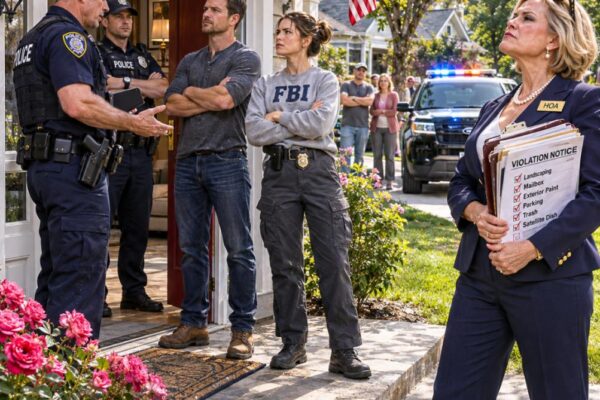
HOA Karen Built Her $4 Million Mansion Across Land Dedicated as a Children’s Park and Ordered Me Off My Own Lot—She Has Vastly Underestimated My Intelligence.k
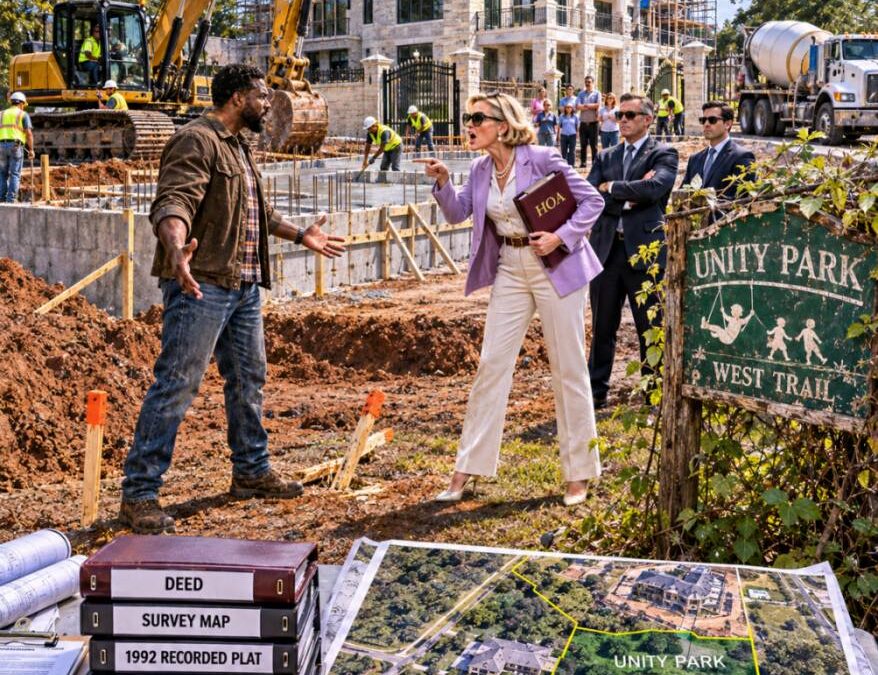
HOA Karen Built Her $4 Million Mansion Across Land Dedicated as a Children’s Park and Ordered Me Off My Own Lot—She Has Vastly Underestimated My Intelligence
She built a four-million-dollar mansion beside my property, then sent me an HOA notice claiming part of the land I had just purchased belonged to her community.
When I challenged the boundary, the fines started, my survey stakes disappeared, and contractors began pouring concrete where old records said children once played.
HOA Karen thought a new deed and a luxury gate could erase thirty years of history, but maps have a way of remembering what people want forgotten.
The excavator was sitting on my property when I arrived at 7:16 on a Saturday morning.
At least, according to the survey I had paid $2,800 for before closing, it was my property.
Its steel tracks had crushed two of the orange survey stakes along the southern edge of my lot. A trench ran through the red clay where I had planned to put the footings for a modest front porch. Beyond it, men in reflective vests were setting forms for what looked like a retaining wall connected to the mansion rising next door.
Not a house.
A mansion.
Three stories of pale limestone, black-framed windows, copper roof accents, and enough glass to make a hotel jealous.
I shut off my truck and climbed out.
“Who authorized you to cross this line?”
The excavator operator pointed toward the road.
“She did.”
A white Range Rover turned into the gravel lane.
Monica Vale stepped out wearing cream trousers, oversized sunglasses, and a tailored lavender blazer that had probably never been within fifty feet of wet concrete.
She carried the same burgundy HOA binder she had given me the week I bought the lot.
“Ethan,” she called. “Good. We need to clear up some confusion.”
I pointed at the destroyed stake.
“That isn’t confusion.”
Monica removed her sunglasses.
“This strip is not part of your buildable parcel.”
“My survey says it is.”
“Your survey is based on outdated information.”
“It was completed twenty-three days ago.”
She smiled.
“You’re new here.”
There it was again.
The sentence she used whenever facts became inconvenient.
I walked toward the trench.
“Stop the work.”
Monica’s expression changed.
“You don’t have authority over my contractor.”
“He’s on my deeded land.”
“No, he isn’t.”
She opened the binder and handed me a certified-looking notice stamped with the Willow Creek Estates logo.
UNAUTHORIZED OCCUPATION OF HOA COMMON AREA.
I stared at it.
I had not built anything.
I had not moved dirt.
I had not even submitted house plans yet.
Monica tapped the page.
“The association recognizes the southern tract as part of the former common-property system attached to my parcel.”
“Your parcel?”
“My residence incorporates several legally acquired surplus lots.”
Behind her, a concrete truck turned the corner.
I looked past the mansion toward a grove of ancient oaks.
Something stood half buried beneath vines beside one trunk.
A rusted green post.
On it, barely visible beneath decades of paint and dirt, were three words.
UNITY PARK — WEST TRAIL.
My pulse changed.
Monica saw where I was looking.
“That sign is obsolete.”
“Why is there a park sign behind your house?”
“There used to be some recreational space here. It was abandoned years ago.”
“Who abandoned it?”
“The city.”
“When?”
Her smile vanished.
“You need to stop digging into things you don’t understand.”
My phone rang.
Tom Alvarez, the surveyor who had marked my property.
I answered.
“Tom.”
“Ethan, are you at the lot?”
“Yes.”
“Is anyone moving dirt?”
I looked at the excavator.
“Right now.”
His voice tightened.
“Do not let them pour permanent concrete across your south line.”
“Why?”
There was a pause.
Then Tom said, “Because your boundary isn’t the strange part.”
I looked at Monica.
“What is?”
“The parcel on the other side.”
He lowered his voice.
“Ethan, I pulled the 1992 recorded plat. Monica Vale’s mansion isn’t sitting on abandoned land.”
Another pause.
“It’s sitting inside a dedicated public park.”
part 2
My name is Ethan Cole, and if you had asked me six months earlier what I wanted most in life, I would have given you a painfully boring answer.
Quiet.
Not money.
Not status.
Not some giant house with a theater and a wine cellar.
Quiet.
I was thirty-five, unmarried, and teaching high-school geography in a district where students believed every map existed solely to torture them before standardized tests.
I loved the job.
Most days.
I loved watching a sixteen-year-old suddenly understand why cities form near rivers, why borders look strange, or why two maps of the same place can tell completely different stories depending on who drew them.
But after thirteen years of apartment living, I had reached my limit.
My upstairs neighbor worked nights and apparently practiced bowling before every shift.
The couple across the hall fought with a level of creativity I occasionally considered assigning as extra credit.
Someone two floors down owned a subwoofer powerful enough to register tectonic activity.
I wanted land.
A porch.
Trees.
A place where the loudest thing after midnight was an owl.
Willow Creek Estates looked perfect.
The neighborhood sat outside a growing midsized American city where suburban development gave way to older farmland and wooded parcels.
The main subdivision had been built in phases beginning in the early 1990s.
Large oaks.
Curving streets.
A small lake.
Homes expensive enough to signal stability without looking like private resorts.
At least most of them.
My lot was different.
It sat at the western edge of Willow Creek, just under an acre, bordered by the subdivision on one side and an older wooded tract on the other.
The house that once stood there had burned almost a decade earlier.
The previous owner’s estate eventually sold the vacant parcel.
I bought it for $168,000.
That was nearly everything I had saved plus a construction loan approval that made my stomach hurt every time I looked at the numbers.
The plan was modest.
About 1,900 square feet.
Two bedrooms.
Home office.
Deep front porch.
Detached workshop.
No marble staircase.
No infinity pool.
Just enough house.
My real-estate agent, Denise Porter, had been unusually enthusiastic about the lot.
“You won’t find another one this size inside Willow Creek.”
“Why has it been listed so long?”
“People don’t like building from scratch.”
“Anything wrong with title?”
“Clean as far as I know.”
“HOA?”
“Yes, but manageable.”
That should have frightened me.
Manageable is what people say about things they know will become your problem later.
Still, I did what every cautious buyer is supposed to do.
Title search.
Survey.
HOA documents.
Municipal zoning.
Utility availability.
No major red flags appeared.
The recorded deed description matched the survey.
The title insurer issued a commitment subject to ordinary exceptions.
The lot was within Willow Creek’s HOA, which meant my future house needed architectural approval.
I read the covenants before signing.
Monica Vale arrived the afternoon after closing.
White Range Rover.
Ivory heels.
Pale lavender blazer.
Pearls.
Burgundy binder with gold clips.
She looked like an HOA president generated by a committee.
“Mr. Cole?”
“Ethan is fine.”
“I’m Monica Vale, president of Willow Creek Estates.”
She held out the binder.
“This will save you trouble.”
It hit my hands like a textbook.
Inside were architectural rules, landscaping standards, mailbox requirements, exterior-lighting limits, temporary-sign restrictions, trash-can storage rules, fence specifications, approved roofing materials, and four pages devoted to paint colors that all looked beige.
Monica stood beside my truck explaining them one by one.
“No black plastic trash bins visible from the street.”
“Okay.”
“Mailboxes must be forty-two inches from grade.”
“Very precise.”
“Uniformity protects value.”
“Sure.”
“No chain-link fencing.”
“Wasn’t planning any.”
“No prefabricated sheds visible above approved screening height.”
“Okay.”
“Exterior colors require approval.”
“I noticed the beige section.”
She did not laugh.
Her attention drifted toward the oak grove bordering my south line.
Beyond it stood the massive house under construction.
“That’s yours?” I asked.
“My husband and I are building our retirement home.”
“Retirement?”
“We’ve been in Willow Creek twenty-six years.”
She smiled.
“We finally bought enough adjoining land to build properly.”
Enough adjoining land.
I remembered the phrase later.
At the time, I merely nodded.
The mansion’s foundation alone looked larger than my planned house.
Monica followed my eyes.
“Don’t worry. Our construction will be complete long before yours.”
Something in the way she said ours and yours bothered me.
Not enough to matter.
Then Harold Bennett walked over after she left.
Harold was seventy-eight and lived in a brick ranch across the street.
He wore an Atlanta Braves cap bleached almost white by years of sun and had dirt under every fingernail.
“Monica give you the Bible?”
He nodded toward the binder.
“Apparently.”
“Read the real covenants too.”
“I did.”
“Good.”
He smiled.
“You’re already ahead.”
Harold looked toward the mansion.
“Never thought I’d see a house there.”
“Why?”
“That used to be Unity Park.”
I turned.
“The woods?”
“All of it.”
He pointed from the oak grove behind my lot toward where Monica’s new west wing was taking shape.
“Playground was near those trees. Picnic tables farther back. Walking path looped around.”
“What happened?”
Harold shrugged.
“Closed gradually.”
“Why?”
“Monica said maintenance problems. Vandalism. Liability.”
“When?”
“Long time ago.”
He scratched his cheek.
“My girls played there when they were small.”
“City park?”
“Some kind of neighborhood-city deal. I don’t remember.”
Then he said something almost casually.
“Funny how land disappears once nobody remembers what it was.”
I looked toward the construction.
Harold waved and returned home.
The geography teacher in me did not forget that sentence.
Three weeks later, the certified HOA letter arrived.
It accused me of unauthorized activity on “common-area land adjacent to Lot 18.”
I had done nothing.
I called the management company.
A woman named Claire answered.
“I haven’t started construction.”
“The notice came from the board.”
“Based on what?”
“There was an allegation that your planning stakes encroach on common property.”
“The stakes were placed by a licensed surveyor.”
“I understand.”
“Can you identify the common-property parcel?”
“I would have to ask the board.”
“Who filed the complaint?”
Pause.
“President Vale.”
Of course.
I emailed Monica.
She replied within eleven minutes.
“Your surveyor appears to have relied on an obsolete boundary configuration. The southern edge of your parcel interfaces with former community land consolidated through later conveyances.”
Former community land.
That was different from HOA common area.
I replied:
“Please provide the recorded instrument changing my deed boundary.”
She did not.
Instead, she called.
“Ethan, you’re making this unnecessarily adversarial.”
“I asked for a deed.”
“You’re a teacher, correct?”
I actually pulled the phone away from my ear.
“What does that have to do with anything?”
“I’m saying property records are complicated.”
“I teach cartography and land-use geography.”
Silence.
Then:
“Academic maps and legal title are different things.”
“Yes.”
I smiled despite myself.
“That is exactly why I asked for the recorded instrument.”
Her voice became colder.
“You should focus on your own building approval.”
“I will as soon as you explain why your contractor is treating part of my parcel like his job site.”
“You are not entitled to information about my property.”
“Then keep your property off mine.”
She hung up.
That Saturday, I found the excavator across my survey line.
Then Tom Alvarez called and told me Monica’s mansion appeared to be inside a recorded public park.
I stopped the concrete pour by doing something much less dramatic than screaming.
I called the police non-emergency line.
Then my title company.
Then the city building department.
And I filmed everything.
The contractor was furious.
Monica was worse.
“You cannot interfere with permitted construction.”
The city inspector arrived ninety minutes later.
His name was Calvin Price.
He reviewed my survey.
Then Monica’s building plans.
Then Tom’s old plat printout.
He did not declare anyone guilty of anything.
He did something more useful.
He issued a temporary stop-work order affecting the disputed boundary area until ownership and setbacks could be verified.
Monica stared at the paper.
“You can’t stop my entire project over an outdated map.”
Calvin shook his head.
“I’m not stopping the entire project. I’m stopping permanent construction in the disputed area.”
“There is no dispute.”
I raised my hand slightly.
“I dispute it.”
Monica looked at me like murder had briefly become an architectural option.
The contractor shut down the concrete truck.
That afternoon I met Tom at his survey office.
He spread three maps across a conference table.
Current GIS parcel layer.
My recorded survey.
1992 Willow Creek subdivision plat.
The difference was immediate.
On the 1992 plat, an eleven-acre green-space tract sat between the original homes and what later became my lot.
UNITY PARK — DEDICATED FOR PUBLIC RECREATIONAL USE.
Walking trails.
Playground area.
Picnic pavilion.
Drainage pond.
The future site of Monica’s mansion sat almost entirely inside the outlined park.
I leaned closer.
“How does a park become a private house?”
Tom shook his head.
“I’m a surveyor, not a lawyer.”
“What about my south line?”
“That’s the strange part.”
He overlaid the deed descriptions.
Your line is basically where it always was.”
“So Monica’s contractors crossed it.”
“Yes.”
“Why did her notice call it common area?”
“Because one of the later parcel maps appears to shift the boundary twenty-eight feet north.”
“Can a GIS map do that?”
“GIS doesn’t control title.”
I looked at him.
“You sound offended.”
“Surveyors spend half our lives explaining that colored internet lines are not deeds.”
He tapped the 1992 plat.
“This is recorded.”
Then my deed.
“This is recorded.”
Then Monica’s recent acquisition deed.
“This is recorded too.”
I stared.
“How can all three exist?”
“That’s what you pay lawyers to enjoy.”
I went to the city planning office Monday morning.
I took a personal day from school.
The receptionist sent me to land records.
A planning technician named Tom Harris eventually came out.
Different Tom.
Same level of enthusiasm as a man serving jury duty.
I explained Unity Park.
He typed.
Clicked.
Scrolled.
“Those parcels were disposed of as surplus land.”
“When?”
“Different dates.”
“To Monica Vale?”
“Some to an LLC.”
“What LLC?”
“Vale Residential Holdings.”
I wrote it down.
“How many parcels?”
Tom looked at me.
“Why?”
“Because one is overlapping land next to property I own.”
He returned to the screen.
“Seven conveyances over about five years.”
My stomach tightened.
Seven.
“For how much?”
“I don’t have every deed price here.”
“Can I request the files?”
“Yes.”
“Council approvals too?”
“If they exist.”
That phrase stopped me.
“If they exist?”
“Older surplus dispositions may have archived backup.”
“These are from the last decade.”
Tom stiffened.
“You’ll need a records request.”
I filed one before leaving.
Then I went to the county library.
Not because I expected a conspiracy file labeled MONICA’S CRIMES.
Because local-history librarians know where governments bury things accidentally.
The woman behind the archive desk was named Janet Morales.
I told her I was looking for Unity Park.
Her face lit up.
“Willow Creek?”
“Yes.”
“My kids used to go there.”
That was the first moment the park became real.
Not lines.
Not plats.
Children.
Janet disappeared into a back room.
Twenty minutes later, she returned pushing a cart.
Old newspapers.
City newsletters.
Planning reports.
Photographs.
A folder labeled:
UNITY PARK DEVELOPMENT — 1992–1995.
My hands went cold.
Inside was a city council resolution accepting dedication of the land for public recreational use.
A funding agreement.
A $2.3 million capital-project budget.
Not all city money.
Some county recreational funds.
A grant.
Developer contributions.
Construction invoices.
Playground equipment purchases.
Trail contracts.
A ribbon-cutting photograph dated May 1994.
Kids.
Balloons.
Mayor holding giant scissors.
Behind him, unmistakably, stood the same oak trees now beside Monica’s swimming-pool excavation.
Unity Park had not merely been proposed.
It had existed.
I copied everything.
Then Janet found a 1998 aerial photograph.
Playground.
Trails.
Picnic pavilion.
I compared it to a current satellite image on my phone.
Monica’s mansion sat where the central lawn had been.
Her pool occupied the old playground zone.
I felt sick.
Not because the house was expensive.
Because somebody had successfully converted public memory into private square footage.
The next question was how.
My records request started producing documents a week later.
The city sent electronic files.
Surplus-property memoranda.
Appraisals.
Quitclaim deeds.
Staff recommendations.
Seven parcels sold to entities associated with Monica or her husband.
Prices ranged from $11,000 to $64,000.
That did not automatically mean corruption.
Odd-shaped municipal remnants can be cheap.
But the descriptions bothered me.
“Unused drainage tract.”
“Abandoned recreational remnant.”
“Nonfunctional buffer parcel.”
“Surplus open-space fragment.”
Unity Park had been eleven acres.
Someone had divided it into administrative pieces and stopped calling the whole thing a park.
Language had done what bulldozers later finished.
I made another spreadsheet.
Parcel number.
Original park location.
Date reclassified.
Date declared surplus.
Buyer.
Sale price.
Approving official.
Supporting resolution.
Three parcels had clear council action.
Four did not.
At least not in the produced records.
Monica’s mansion touched five.
One had been sold to her directly.
Four to Vale Residential Holdings.
Then came the detail that changed everything.
The 1992 dedication resolution contained a restriction.
The land was accepted for public recreational use.
Any abandonment or conversion required formal municipal action consistent with applicable law, notice procedures, and the terms of the grant funding.
There was also a provision requiring evaluation of replacement recreational property if the park use ended.
I called James Carter.
James was recommended by another teacher whose family had fought a boundary dispute involving a developer.
His office looked exactly like an attorney’s office should.
Old brick building.
Wood shelves.
Too much paper.
No inspirational signs.
I laid everything on his conference table.
He read quietly for forty minutes.
Then he took off his glasses.
“Ethan.”
“Yes?”
“Tell me you haven’t accused anyone of fraud publicly.”
“No.”
“Good.”
“I’ve thought it loudly.”
“Keep doing that privately.”
He held up the dedication resolution.
“If this is what it appears to be, Monica’s house is not your biggest problem.”
“Her house is pretty big.”
He ignored me.
“This land may have been dedicated to public use subject to restrictions that were never lawfully extinguished.”
“What does that mean?”
“It means a deed from the city may not automatically solve the problem if the city lacked authority to convey the park this way.”
“Can the deed be void?”
“Possibly void, possibly voidable, possibly subject to public-use restrictions. Depends on state law, the exact dedication, abandonment procedures, grant conditions, chain of title, and what the city actually did.”
“So we sue?”
“We investigate.”
“I already investigated.”
“No.”
He pointed at my folders.
“You gathered evidence. Now we investigate legally.”
I liked him immediately.
James sent preservation letters.
City.
HOA.
Monica.
Vale Residential Holdings.
The contractor.
Title companies involved in the mansion.
He demanded that no records concerning Unity Park, land disposition, boundary modifications, or HOA enforcement against me be destroyed.
Then he sent Monica a separate letter regarding the encroachment on my parcel.
Stop entry.
Preserve survey stakes.
No further construction within the disputed area.
Monica responded through attorney Richard Hale.
Her letter called my allegations “historically confused and legally unfounded.”
That phrase made James smile.
“Why are you happy?”
“Because they didn’t attach the park-abandonment resolution.”
“What does that mean?”
“They may have one.”
“And if they don’t?”
“We keep pulling.”
The harassment began three days later.
Grass violation.
My vacant lot had grass above six inches.
I measured.
Four and three-quarters.
Truck violation.
My pickup was allegedly parked overnight on an unimproved surface.
It was parked on the gravel access pad that existed before I bought the lot.
Trash violation.
I did not have trash service there yet.
Architectural violation.
Unauthorized temporary markers.
Those were Tom Alvarez’s survey stakes.
Every notice carried Monica’s signature.
James told me to appeal each one.
Calmly.
Document.
Photograph.
Measure.
Do not insult anyone.
I hated him a little for being right.
Then my survey stakes disappeared.
No camera.
No proof who removed them.
Tom reset them.
Two days later, one vanished again.
I installed trail cameras.
The next stake remained.
Then someone slashed two tires on my truck while it sat overnight at the lot.
Not four.
Two.
Enough to strand me.
The police took a report.
I had no footage of the vandalism.
No suspect.
Monica was not accused.
That distinction mattered.
Fear makes people invent certainty.
I refused to become Karen in reverse.
But I did upgrade the cameras.
The worst part was not the tires.
It was the rumors.
A Willow Creek neighborhood page suddenly contained anonymous posts about “outsiders exploiting old documents to seize private homes.”
Another warned about “unstable new residents harassing longtime community leaders.”
Nobody named me.
Nobody needed to.
At school, I caught myself staring at my phone between classes.
One afternoon a student asked:
“Mr. Cole, you okay?”
“Fine.”
“You’ve been looking at the same map for ten minutes.”
He was right.
I had projected a population-density map and stopped speaking.
I shut the screen off.
“Everyone take five.”
Teenagers know when adults lie.
That evening, I drove to the lot and stood beneath the oaks.
The mansion glowed under temporary construction lights.
Three million dollars of structure already above ground.
Probably more.
A crane sat beside the unfinished east wing.
The swimming pool was only an excavated shell because of the stop-work area near my boundary.
I imagined selling.
The market had already risen.
I could probably get out without losing much.
Find another piece of land.
Build somewhere else.
No Monica.
No records requests.
No lawyers billing in six-minute increments.
I was thirty-five.
Why spend years fighting over a park that had disappeared before I was old enough to drive?
Then Harold appeared.
He walked slowly across the street carrying a photograph.
“You look like a man thinking about running.”
“I prefer strategic relocation.”
“Same thing in nicer shoes.”
He handed me the picture.
Three girls on swings.
Two boys near a slide.
A younger Harold standing beside a picnic table.
“What year?”
“Ninety-six.”
He pointed at one girl.
“My daughter Rachel.”
Another.
“Emily.”
He looked toward Monica’s mansion.
“My grandkids don’t believe there used to be a park.”
I studied the photograph.
Harold sighed.
“Maybe let it go.”
I looked at him.
“You just handed me evidence.”
“I’m old enough to know evidence and peace aren’t the same thing.”
“Why are you scared?”
That was too direct.
Harold looked down.
“I’ve lived next to Monica twenty years.”
“What does that mean?”
“It means people who challenge her get tired.”
He walked away.
I stood there holding the photograph.
Then I called James.
“I’m not selling.”
He sighed.
“You lawyers really dislike motivation.”
“I dislike clients announcing things dramatically at eight at night.”
“Sorry.”
“Good.”
Pause.
“Also, I found someone.”
“Who?”
“Paul Evans.”
The name meant nothing to me.
It meant everything to Unity Park.
Paul had been Willow Creek’s maintenance supervisor from 1993 until 2011.
James and I met him at a diner forty minutes from town.
Paul was seventy-one.
His hands shook slightly when he lifted his coffee.
Parkinson’s, he explained.
Not fear.
Though he had plenty of that too.
“You don’t understand Monica.”
James said, “Then help us.”
Paul looked at me.
“You’re the teacher?”
“Yes.”
“Should’ve picked a quieter neighborhood.”
“I’ve heard.”
He smiled faintly.
Then pulled an envelope from his jacket.
Photographs.
Maintenance invoices.
Work orders.
Unity Park.
Swings.
Trail resurfacing.
Picnic-table repairs.
Tree trimming.
Garbage pickup.
The records extended through 2009.
Not ancient history.
Paul pointed to one photograph.
“That’s Monica.”
She stood near the playground with several board members.
“Why was she there?”
“Park committee.”
I looked at him.
“She ran the park committee?”
“Started around 2005.”
That was the year she became HOA president.
Paul explained slowly.
The city owned Unity Park.
Willow Creek’s HOA had a maintenance agreement for some landscaping and routine oversight because the subdivision surrounded the property.
The park remained public.
Anyone could use it.
Monica hated that.
According to Paul, she complained about teenagers.
Cars.
People from outside Willow Creek.
Trash.
Noise.
She pushed the city to remove older equipment after two safety inspections.
Some equipment genuinely needed replacement.
That part was legitimate.
But instead of replacing it, the HOA fenced sections off.
The picnic pavilion closed.
Trail maintenance stopped.
Monica repeatedly described the park as unsafe and underused.
Paul handed us a 2008 photograph.
Children on swings.
Then a 2009 weekend attendance sheet.
Dozens of users.
“Underused?”
He shook his head.
“Not then.”
“What happened?”
“Budget fight.”
The city reduced parks maintenance during the recession.
The HOA declined to contribute more.
Monica argued Unity Park was a liability.
A temporary fence became permanent.
The swings were removed.
Picnic tables disappeared.
By 2010, signs said CLOSED FOR REHABILITATION.
Rehabilitation never happened.
Paul retired in 2011.
“What about reclassification?”
He shook his head.
“I heard years later they called it abandoned.”
“Who?”
“Monica.”
“City?”
“She had friends at planning.”
James looked at him.
“Names.”
Paul hesitated.
Then gave one.
Thomas Harris.
The clerk I had met.
James did not react.
He simply wrote it down.
That was the beginning of discovery.
Not the courtroom.
Not a dramatic confession.
Discovery.
James filed my civil case narrowly at first.
Boundary declaration.
Trespass.
Injunction against construction encroaching my deeded lot.
He also sought judicial clarification regarding the disputed park-related conveyances because those deeds affected the boundary and access issues.
The city responded differently than Monica expected.
Its new city attorney reviewed our exhibits and asked for time.
Then the city filed its own internal notice preserving all Unity Park records.
Two weeks later, the city council hired outside counsel.
That changed the atmosphere.
Monica could dismiss me as a troublesome teacher.
She could not dismiss her seller asking whether it had authority to sell.
The first court hearing concerned only temporary relief.
James did not ask the judge to demolish Monica’s mansion.
That would have been absurd at that stage.
He asked for construction to stop in disputed areas while title and public-use rights were investigated.
Monica’s attorney argued delay would cause millions in damages.
James answered:
“Permanent construction is precisely why preservation is necessary.”
The judge agreed in part.
No new permanent work on the disputed park parcels.
No work inside my recorded boundary.
Existing structures could be weatherproofed and secured.
No demolition.
No occupancy.
No further pool construction.
Monica walked out of the courthouse without looking at me.
That was hearing one.
There would be many more.
Discovery exposed the paper trail.
In 2009, Monica had written city staff advocating Unity Park’s closure.
In 2010, she described it as “functionally abandoned” even while maintenance records showed scheduled work.
In 2012, a planning memo recommended evaluating the land for reuse.
No final council abandonment resolution appeared.
No public hearing record matching the required park-conversion procedure appeared.
No replacement-park finding.
No grant-release documentation.
Then, years later, the property began being split administratively.
A drainage parcel.
A buffer strip.
A recreational remnant.
Each smaller description made the original park harder to see.
Some city conveyances had proper council votes.
Others relied on a delegated surplus-property process usually used for narrow strips and unusable remnants.
That was the legal fight.
Could officials sell pieces of dedicated parkland through a general surplus process without first lawfully ending the public dedication?
The city’s outside counsel eventually concluded there was a serious problem.
Then Thomas Harris resigned.
Not because of anything I personally proved.
The city’s internal review found that he had processed several surplus files with incomplete supporting records and had bypassed normal archival cross-checks.
Investigators referred certain transactions to the appropriate state authorities for review.
I never learned every detail.
James told me not to speculate.
What mattered to my case was documentary.
Unity Park had been dedicated.
Built.
Maintained.
Used.
Closed administratively.
Then parceled and sold without any clear recorded act extinguishing the underlying public-use status.
Monica’s emails made her knowledge harder to explain away.
One message to Harris read:
“Once the old park designation is cleaned out of the map layers, these remnants will finally have usable value.”
Another:
“The HOA has treated the recreational function as dead for years.”
Another:
“I would be interested personally if the city ever disposes of the west tract.”
Personally.
That word mattered.
James leaned back after reading it.
“She was both HOA president and potential buyer.”
“Conflict?”
“Possibly.”
“Fraud?”
“Stop.”
“I know.”
“You don’t.”
He pointed at me.
“Fraud requires elements. Knowledge. Misrepresentation. Reliance. Intent. We prove what records prove.”
“I’m a geography teacher.”
“Then map, don’t prosecute.”
Annoying man.
Excellent lawyer.
Monica continued sending HOA violations even while litigation was pending.
By then the board had begun cracking.
Treasurer Susan Keller asked why association money was paying for legal correspondence tied partly to Monica’s personal mansion.
Monica claimed the dispute threatened HOA common property.
James sent Susan the deed maps.
There was no HOA common property in the disputed strip.
The board called a special meeting.
Monica tried to close homeowner comment after ten minutes.
Harold stood up.
“I have lived here since 1993.”
She looked irritated.
“Harold, please.”
“No.”
The room quieted.
He held up his photograph of Unity Park.
“My daughters played there.”
Monica said, “Nobody disputes that a recreational area existed.”
“You told Ethan it was abandoned.”
“It was.”
“No.”
Harold’s voice shook.
“You closed it.”
That was the moment Willow Creek stopped treating the lawsuit like my private obsession.
Other residents brought photographs.
Birthday parties.
Little League picnics.
Halloween events.
School fundraisers.
A woman named Grace Miller produced a 2001 newspaper clipping about Unity Park’s accessible playground improvements.
Someone else found a 2004 city parks brochure listing it as a public facility.
Memory came back in pieces.
Monica looked smaller each time.
Not defeated.
Angrier.
“This nostalgia has nothing to do with current title.”
James had warned me not to speak unless necessary.
I ignored him.
“Then show us the legal abandonment.”
Monica turned toward me.
“This meeting is for owners.”
“I am an owner.”
“You’ve been here four months.”
“And I can read.”
The room reacted.
Monica struck her gavel.
“You have destabilized this entire community because you refuse to accept recorded deeds.”
I stood.
“No.”
I held up the 1992 dedication.
“I’m asking why these recorded documents were treated as if they never existed.”
“You want my house destroyed.”
“I want the court to determine who owns what.”
“Don’t pretend.”
Her voice cracked slightly.
“You have been obsessed with my home since the day you arrived.”
I stared at her.
“I wanted a porch.”
A few people laughed.
“I still want a porch.”
The laughter spread.
Monica’s face reddened.
I continued.
“You built a four-million-dollar house next to a schoolteacher buying his first piece of land. I wasn’t competing with you.”
Silence.
“You crossed my survey line.”
I held up the old park map.
“And then I found this.”
That was the truth.
I had not gone looking for Monica.
She drove an excavator into my life.
The HOA board voted that night to suspend all discretionary enforcement actions against me pending independent review.
Monica voted no.
It passed four to one.
Then Susan requested an audit of the association’s involvement in the park closure and subsequent property transactions.
Passed three to two.
Monica left before adjournment.
The rumors got worse for a while.
Then discovery became public through court filings.
Facts replaced gossip.
The title company that insured Monica’s property joined the dispute.
So did a lender with millions secured against the unfinished mansion.
That was when the financial stakes became brutal.
Nobody wanted a $4 million structure sitting on land the owner might not legally control.
Settlement talks began.
Monica refused the first three proposals.
According to James, one would have allowed parts of the structure outside the park area to remain if major encroachments were removed and public land restored.
She said no.
She insisted the deeds were valid.
The city could not undo its own sales.
Her title insurer defended her subject to policy terms.
Her lender demanded resolution.
Meanwhile, the city’s historical grant file surfaced.
Unity Park’s original funding included a state recreation grant containing a conversion restriction.
If grant-assisted land stopped being used for public recreation, formal approval and replacement recreational property of equivalent value were required.
No approval could be found.
That did not automatically decide title.
But it added another layer.
The city had accepted money to create a park.
Then somehow sold the park in pieces without completing the process designed to protect the public investment.
The state recreation agency entered the discussion.
Monica’s legal position weakened.
Then Paul Evans gave his deposition.
He brought photographs.
Invoices.
Meeting notes.
He testified that Unity Park remained actively maintained and used until portions were deliberately closed.
Monica’s attorney attacked his memory.
Fairly.
Paul was seventy-one.
Some dates blurred.
Then James put a 2009 maintenance invoice in front of him.
Paul smiled.
“I wrote that.”
Playground inspection.
Trash collection.
Trail mowing.
Six months after Monica had described the park to city staff as “functionally abandoned.”
James asked:
“Was it abandoned?”
Paul looked directly at Monica.
“No.”
“Was it empty?”
“No.”
“Who ordered the playground fenced?”
“The HOA board after Monica recommended it.”
“Permanent closure?”
“She called it temporary.”
“How long?”
Paul looked at the courtroom.
“Long enough for everyone to forget.”
That sentence made the evening news.
I hated the attention.
Students found the clip.
The next morning a senior in my first-period class raised his hand.
“Mr. Cole?”
“Yes?”
“Are you famous?”
“No.”
“My mom saw you on TV.”
“That proves your mom needs hobbies.”
The class laughed.
Another student asked:
“Did somebody really build a mansion in a public park?”
I paused.
“Court is deciding complicated property rights.”
They groaned.
“That is the boring adult answer.”
“Yes.”
“Do you think she stole it?”
I looked at the map projected behind me.
“I think words matter.”
They went quiet.
“So does evidence.”
Then I taught class.
That became my refuge.
Contour lines.
Urbanization.
Migration.
Political boundaries.
Maps that changed honestly over time because rivers shifted or governments negotiated.
And maps that changed because somebody with power wanted the new version to become the only version anyone remembered.
The lawsuit lasted eleven months before the decisive ruling.
Not two hearings.
Not one dramatic afternoon.
Eleven months.
Motions.
Depositions.
Expert reports.
Title analysis.
Historical records.
Survey testimony.
City council files.
Grant documents.
The judge issued a detailed written decision on the core property questions.
Unity Park had been validly dedicated and accepted for public recreational use.
The city had not demonstrated that the legally required process to abandon or convert the entire dedicated park had been completed before the disputed conveyances.
Certain later deeds affecting the dedicated land therefore could not extinguish the public-use rights the way Monica claimed.
Some peripheral parcels had separate histories and remained private.
Others, including substantial portions beneath Monica’s mansion and pool area, remained subject to the park dedication and related public rights.
My own deed boundary was confirmed substantially as surveyed.
Monica’s contractor had encroached onto my parcel.
I read that section first.
Then the park section.
Then again.
James took the opinion from me.
“Breathe.”
“What happens to the house?”
“Now we negotiate remedies.”
“No demolition?”
“Ethan.”
“I’m asking.”
“A property ruling is not a wrecking ball.”
Real justice is bureaucratic.
That was one of the most educational disappointments of my life.
The court ordered the parties into a remedial process.
The city had to restore lawful public control of the dedicated park portions.
Monica and related entities had to surrender claims inconsistent with the ruling.
The mansion could not receive a certificate of occupancy while substantial portions remained on land Monica could not lawfully possess free of the public dedication.
Engineers assessed whether the structure could be modified.
It could.
Technically.
The west wing, pool complex, retaining walls, and much of the driveway would have to go.
What remained would have been an awkward, extremely expensive fragment sitting on a reduced private parcel.
Monica’s lender did the math.
So did her insurer.
Settlement came quickly after that.
Monica did not “forfeit everything” because a judge wanted to punish her.
The legal mechanism was much less cinematic.
Deeds affecting the dedicated park were set aside or corrected.
Public land returned to city control subject to the park restrictions.
Encroachments on my property were removed.
The construction lender foreclosed on the valid private collateral after Monica’s development entity defaulted under its loan terms.
The partially completed mansion was sold through the resulting process to a redevelopment company under conditions requiring removal of structures from public land.
The company decided demolition was cheaper than surgical reconstruction.
I watched the first excavator arrive eight months later.
This time it was supposed to be there.
Harold stood beside me.
“You happy?”
I thought about it.
“No.”
The mansion’s limestone facade looked beautiful.
Wastefully beautiful.
Millions of dollars in materials.
Labor.
Craftsmanship.
All about to become rubble because somebody assumed enough paperwork could make history disappear.
“It feels sad,” I said.
Harold nodded.
“Good things can be built in the wrong place.”
That sentence stayed with me.
Monica faced consequences too.
Civil consequences first.
The city sought recovery related to restoration, professional fees, and losses tied to the invalid land transactions.
Her title insurer and lender litigated their own coverage and contractual issues.
The HOA pursued reimbursement for certain legal expenses the audit concluded had improperly advanced her personal property interests.
The state investigation into the land-disposition process continued separately.
Thomas Harris eventually entered a plea on charges related to falsifying or mishandling municipal records in transactions unrelated to just one parcel.
I did not celebrate.
Monica herself was not marched out of court in handcuffs.
Evidence did not support turning every bad decision into a criminal conspiracy.
What did happen was devastating enough.
She lost control of the mansion project.
She lost several disputed parcels.
She paid substantial amounts through civil settlements.
She resigned as HOA president before a recall vote that she almost certainly would have lost.
And, for the first time in decades, Willow Creek residents could see exactly how much authority she had accumulated without anyone checking the paper beneath it.
The HOA audit was ugly.
Monica had mixed association interests and personal development interests repeatedly.
Not always illegally.
Often improperly.
She had advocated for park closure as HOA president while later expressing personal interest in buying adjoining parcels.
She had used HOA communications to pressure city staff.
She had ordered enforcement actions against me while our property dispute directly affected her mansion.
She had caused association legal funds to be spent on questions that partly benefited her private title position.
The new board adopted conflict-of-interest procedures immediately.
Directors had to disclose financial interests in matters before the board.
Interested directors had to recuse where required.
Association counsel received clearer authority to stop enforcement unsupported by actual covenants.
Records-access procedures were rewritten.
No more disappearing minutes.
No more one-person compliance system.
No more calling a privately purchased tract “common area” because the president said so.
Susan Keller became interim president.
She came to my lot one afternoon carrying a much thinner binder.
“You’re giving me another one?”
“This is the revised architectural guide.”
I held it.
“Where are the forty-two-inch mailbox diagrams?”
“Page eleven.”
“Civilization survives.”
She smiled.
“I also owe you an apology.”
“For what?”
“I voted for two of those early violations.”
“Why?”
“Monica told us your survey was wrong.”
“Did you check?”
“No.”
“That’s the apology.”
Susan looked embarrassed.
“I trusted her.”
“I know.”
“We all did.”
“That’s the problem.”
She nodded.
Then looked toward the demolition site where only part of the mansion remained.
“You know people blame you for that.”
“I know.”
“Does it bother you?”
“Yes.”
She seemed surprised.
I continued.
“I didn’t build it there.”
Susan looked toward me.
“No.”
“I didn’t sell the land.”
“No.”
“I didn’t erase Unity Park.”
“No.”
“But I understand why they look at the guy holding the old map.”
She smiled sadly.
“Maps are dangerous.”
“Only to people depending on everyone forgetting the first version.”
Demolition took three months.
The pool shell was crushed.
The west retaining wall removed.
Utilities capped.
Concrete hauled away.
Engineers tested soil.
Arborists assessed trees.
The city held public meetings about park restoration.
That was where I expected another disaster.
Instead, the meetings were surprisingly good.
Older residents brought memories.
Younger families brought ideas.
Some wanted a huge modern playground.
Others wanted trails.
Harold wanted the picnic pavilion back exactly where it had been.
A group of teenagers asked for basketball.
The city had limited funds.
The original $2.3 million from 1994 was long gone, and restoring a park decades later cost far more.
Money came from several sources.
Civil settlement funds.
City capital money.
Insurance proceeds where applicable.
A state recreation grant.
Private donations.
And, eventually, the HOA.
Not because a court magically ordered Willow Creek to pay for everything.
Because residents voted to contribute after recognizing that the association had helped close the park years earlier.
The total restoration plan exceeded two million dollars.
That number looked satisfying in newspaper headlines.
Reality was messier.
Money arrived in installments.
Phase one restored trails and drainage.
Phase two built the playground.
Phase three added a pavilion and accessible garden.
Nobody wrote Monica a single $2.3 million bill.
That would have made a better revenge ending.
It would have made a worse legal story.
My own case settled after the encroachment was removed.
The contractor restored my damaged boundary area.
My title insurer covered part of my legal expense under its obligations.
Monica’s side paid additional amounts tied to the trespass and survey damage.
The HOA withdrew every unsupported violation and reimbursed fees I had paid defending them.
The tire slashing remained unsolved.
That bothered me more than I expected.
I wanted everything connected.
One villain.
One explanation.
One clean arc.
Life refused.
Someone damaged my tires.
I never proved who.
So that fact stayed exactly what it was.
Unknown.
By then, Denise Porter—the real-estate agent who sold me the lot—had called three times.
I finally answered.
“Ethan, I’m so sorry.”
“For what?”
“I knew there had been old park issues.”
My stomach tightened.
“What does that mean?”
“I didn’t know any of this.”
“You told me the lot was clean.”
“Your lot was.”
“You said nothing about the mansion dispute.”
“There wasn’t a public dispute yet.”
“Did Monica talk to you before I bought?”
Silence.
“Denise.”
“She asked who was looking at the lot.”
“When?”
“A few times.”
“Why?”
“She said the south line was complicated.”
I closed my eyes.
“And you didn’t think to mention that?”
“I thought it was HOA setback stuff.”
“You were my agent.”
“I know.”
That became another claim.
Smaller.
Professional.
Her brokerage’s insurer negotiated a settlement regarding disclosure issues.
Denise kept her license.
I did not try to destroy her career.
She had failed me.
There was a difference between negligence and Monica’s deliberate pressure campaign.
Learning to separate degrees of wrongdoing became one of the strangest lessons in the entire ordeal.
People wanted heroes and villains.
James wanted elements and evidence.
I learned to prefer James.
A year and a half after I bought the lot, construction finally began on my house.
My construction.
For the first time.
The builder asked whether I wanted to move the house farther from the restored park for privacy.
“No.”
“You sure?”
“I bought this because of the trees.”
He pointed toward the playground site.
“You’re going to hear kids.”
I smiled.
“That seems fair.”
The house went up slowly.
Foundation.
Framing.
Roof.
Windows.
The porch was the first thing I obsessed over.
Deep enough for two chairs.
Wide steps.
Ceiling fan.
Oak posts.
No marble.
No fountain.
No twelve-car garage.
When Monica’s old mansion had finally disappeared, the view from my future porch opened across the original Unity Park lawn.
For months, that view had been construction fencing and dirt.
Then one morning, workers installed the first swing set.
Harold came over.
He stood beside me.
Neither of us spoke.
The swing frame was bright blue.
Two standard seats.
Two toddler seats.
One adaptive swing.
Harold wiped his eyes.
“Allergies?”
“Shut up.”
A week later, his granddaughter brought her children.
Harold stood beside the new swings while his great-grandson pumped his legs higher and higher.
I took a photograph.
Then I showed Harold the 1996 picture he had given me.
His daughters.
Same oak tree in the background.
Different swings.
Same place.
“Maps remember,” he said.
I looked at him.
“That was supposed to be my line.”
“I’m older.”
“Not how copyright works.”
He laughed.
Unity Park reopened officially the following spring.
No giant political speeches.
The mayor came.
So did council members.
Susan represented the HOA.
Paul Evans arrived with his daughter.
James stood far enough away that nobody would accidentally ask him to speak.
I had invited Monica.
I do not know why.
Maybe because by then I was tired of treating everything like a battlefield.
She did not come.
She sent a letter.
One sentence.
“I believe the court got much of the history wrong, but I hope the restored property serves the neighborhood well.”
Still Monica.
I laughed.
Then I put the letter in my records box.
The ribbon-cutting plaque said:
UNITY PARK
ORIGINALLY DEDICATED 1992
RESTORED FOR PUBLIC RECREATIONAL USE
No mention of me.
I asked for that.
The city initially wanted a donor plaque recognizing “citizen advocacy.”
I refused.
The park had existed before I arrived.
The story was not that Ethan Cole saved it.
The story was that a whole community had forgotten something it already owned.
I merely found the map.
That afternoon, a girl with two pigtails ran past me toward the swings.
Her father followed carrying a diaper bag.
Harold stood beside the trail entrance.
Susan was arguing with a contractor about mulch.
Normal.
Beautifully normal.
Then James walked up.
“You realize you still haven’t built a fence.”
“HOA approval.”
He looked horrified.
“I’m joking.”
“You’re becoming dangerous.”
We sat on a bench.
The park spread out in front of us.
“Do you regret it?” he asked.
“Buying the lot?”
“All of it.”
I thought about the legal bills.
The tires.
The rumors.
The nights spent reading documents until two in the morning.
The way people had avoided me.
The months my future home looked more like a crime scene than a dream.
“No.”
“That answer came too fast.”
“Fine.”
I looked toward the swings.
“I regret parts.”
“Better.”
“I regret letting Monica occupy my head.”
“Good.”
“I regret thinking every setback meant corruption.”
“Very good.”
“I regret how many weekends you billed me.”
“There he is.”
I laughed.
Then James became serious.
“What did you think would happen when you found that first park map?”
“I thought a judge would look at it and say, obviously.”
“Everyone thinks that.”
“It took almost a year.”
“That’s fast.”
“That is a horrifying sentence.”
He smiled.
“Law is what happens after the map.”
I looked at him.
“That’s actually good.”
“I bill for aphorisms separately.”
Monica sold her original Willow Creek house six months after resigning.
Not the mansion.
Her old house.
The partially built mansion project belonged to lenders and litigation by then.
I saw her once before she moved.
I was at the park.
She walked down the path alone.
No clipboard.
No Range Rover.
Just Monica in walking shoes and a gray sweater.
She stopped when she saw me.
“Ethan.”
“Monica.”
She looked around.
Children were playing.
“Happy?”
The question carried an edge.
But not much.
“Yes.”
“You got what you wanted.”
“No.”
She frowned.
“You got the park.”
“I got a house.”
I pointed toward my porch through the trees.
“That’s what I wanted.”
Monica looked at it.
Modest.
Dark green siding.
White trim.
Oak posts.
“You could’ve built somewhere else.”
“You could’ve built somewhere else too.”
She flinched.
Fair enough.
For a moment, we stood quietly.
Then Monica said, “Do you know what that land looked like when I bought it?”
“Yes.”
“No, you don’t.”
Her voice sharpened.
“Weeds. Broken pavement. Graffiti. Rusted fencing. Nobody used it.”
“I’ve seen the photographs.”
“Then you know.”
“I know it had been neglected.”
“That isn’t the same thing?”
“No.”
She folded her arms.
“The city had abandoned it in every practical sense.”
“Practical abandonment and legal abandonment aren’t the same thing.”
She laughed bitterly.
“There’s the geography teacher.”
“Property law, technically.”
“I was told the deeds were valid.”
“I believe you were.”
That surprised her.
“Then why did you act like I stole it?”
“I said the land had a history the deeds weren’t answering.”
“You ruined me over paperwork.”
I looked toward the swings.
“No.”
Her eyes hardened.
“I lost millions.”
“I know.”
“My retirement.”
“I know.”
“My reputation.”
“I know.”
“And you’re standing there telling me this wasn’t because of you?”
I took my time.
“You built before the title questions were settled.”
“The title company insured it.”
“Yes.”
“The city sold it.”
“Yes.”
“My lawyers reviewed it.”
“I know.”
“Then what was I supposed to do?”
That question was harder than I expected.
Because Monica had not fabricated every deed herself.
She had benefited from a broken process.
She had pushed that process.
She had ignored warnings.
But she was not standing there with a cartoon villain’s confession.
“I think you believed that once enough official paper pointed your direction, the older paper stopped mattering.”
She said nothing.
“You knew the park existed.”
“Yes.”
“You helped close it.”
“It was failing.”
“You personally asked about buying the land afterward.”
“Years afterward.”
“Yes.”
“You pushed the HOA to call my boundary common property while your mansion was crossing it.”
Her jaw tightened.
“That was based on our survey.”
“And when I asked for the deed change?”
“You became hostile.”
“I asked for a document.”
Silence.
I looked at her.
“That’s where you lost me.”
“What?”
“You kept treating questions like attacks.”
Monica looked toward the playground.
“I wanted Willow Creek to stay valuable.”
“So did everybody.”
“I wanted order.”
“Fine.”
“I wanted neglected land used.”
“Also fine.”
She looked back at me.
“Then why am I the villain?”
I almost smiled.
“I don’t need you to be.”
That surprised her more than anything else I had said.
“I needed the boundary fixed.”
I pointed toward my property.
“I needed the park title examined.”
Then toward the neighborhood.
“I needed the HOA to stop punishing me for asking.”
Monica looked away.
“Those are actions.”
“Yes.”
“Not identity.”
“Exactly.”
She was quiet.
Then she asked:
“Do you think I knew those deeds were defective?”
“I don’t know.”
“You had discovery.”
“We had evidence.”
“That isn’t an answer.”
“No.”
I shook my head.
“It’s the only honest one.”
Monica seemed disappointed.
People often want either forgiveness or condemnation because uncertainty is harder.
I gave her neither.
She walked toward the old oak.
A small bronze marker beneath it showed the original park boundary.
She touched it.
Then said:
“My son used to play here.”
I stared at her.
“You had a son?”
“He’s forty now.”
She almost smiled.
“He broke his wrist falling off that old slide.”
For the first time, I could picture Monica before the blazer.
A mother.
A child on a playground.
Maybe that made everything sadder.
“Then you remembered.”
She looked at me.
“Yes.”
“Why did you tell me it was obsolete?”
Her eyes dropped.
“Because by then I needed it to be.”
That was the closest she ever came to an admission.
Not criminal.
Human.
She left without saying goodbye.
I watched her walk the trail.
My house was finished two months later.
The first night I slept there, I woke at 2:14 a.m.
No upstairs neighbor.
No bass speaker.
No shouting in a hallway.
Just rain against the roof.
I got out of bed and walked to the porch.
Unity Park was dark beyond the trees.
The city closed it at dusk.
One path light remained near the entrance for security.
My porch boards smelled new.
I sat down.
This was all I had wanted.
Quiet.
The next morning ruined it beautifully.
At 7:03, children arrived.
Saturday soccer group.
Doors slamming.
Parents talking.
Someone laughing far too loudly.
A toddler screaming because another child had stolen a ball.
I stood at the kitchen window.
My peaceful property now bordered a public park full of noise.
Harold called.
“Enjoying the quiet?”
“I hate you.”
He laughed and hung up.
I made coffee.
Then walked onto the porch.
Kids ran along the trail.
A boy stopped and looked toward my house.
“Morning!”
I waved.
“Morning.”
Maybe quiet had never really been what I wanted.
Maybe what I wanted was peace.
Those are not the same thing.
Quiet is the absence of sound.
Peace is the absence of threat.
Monica’s mansion had been quiet.
Her letters had been quiet.
Records disappearing into storage were quiet.
A survey stake vanishing in the night was quiet.
A park being slowly erased from memory had been almost silent.
The restored Unity Park was loud.
Children.
Dogs.
Bicycles.
Families.
Birthday parties.
Life.
And none of it made me feel invaded.
Because nobody was pretending my porch belonged to them.
Nobody was moving my boundary.
Nobody was sending me fines under rules that did not exist.
There were lines.
Clear ones.
My lot.
Public park.
HOA common property.
City land.
Private land.
Lines do not always divide people.
Sometimes they let people live beside one another without fear.
That was the lesson Monica never understood until it was too late.
My students eventually heard the whole story.
Not from me.
A local paper published a long feature about Unity Park.
One Monday, someone had taped it to my classroom door.
The headline called me “THE TEACHER WHO FOUND A LOST PARK.”
I tore it down.
By second period, another appeared.
Teenagers are ruthless.
During class, a student named Malik raised his hand.
“So, Mr. Cole.”
“No.”
“You always say maps are political.”
“I say maps reflect political decisions.”
“Same thing.”
“It is not.”
“Did the map save the park?”
I looked at the class.
“No.”
They waited.
“The map asked a question.”
“What question?”
“What happened here?”
I pulled up the 1992 plat.
Then the current one.
Two versions of the same place.
“The answer came from council minutes, deeds, grant agreements, photographs, surveys, witnesses, and eventually a court.”
Malik frowned.
“So maps don’t tell the truth?”
“They can.”
I pointed toward the screen.
“But maps are made by people.”
I changed the slide.
“Good geographers ask who made them, when, why, and what changed.”
Another student asked:
“What if everyone forgets?”
I thought about Harold.
Paul Evans.
Janet at the library.
The old park sign buried in vines.
“Then you go looking.”
That became my favorite lesson.
Years later, Unity Park looks ordinary.
That is its greatest success.
The swings have scratches.
One picnic table has initials carved into it despite the city’s best efforts.
The trail floods near the northeast corner after heavy rain.
Teenagers leave cups near the basketball court.
Parents complain about parking.
Children complain about everything.
Nobody treats it like sacred ground.
Good.
Public places should be used, not worshiped.
Harold died three years after the reopening.
His daughters placed a memorial bench beneath the oak.
Not because he owned anything.
Because he remembered.
Paul Evans came to the dedication.
His tremor was worse.
He sat beside me and looked toward the playground.
“Looks different.”
“Better?”
He shrugged.
“New swings squeak less.”
That was his review.
Susan served one term as HOA president.
Then quit.
Voluntarily.
The board rotated responsibilities after that.
No single compliance czar.
No president personally controlling architectural complaints.
Conflict disclosures became normal.
Meeting minutes went online.
Nobody called records requests hostile.
That may have been the most meaningful reform of all.
My south boundary remains exactly where Tom Alvarez originally staked it.
I built a low split-rail fence several feet inside it.
Not because the HOA required one.
Because I liked it.
The first time Monica’s replacement on the architectural committee came to inspect it, she carried a printed copy of my approved plan.
She measured.
“Looks good.”
“That’s it?”
She seemed confused.
“Yes.”
“No speech about neighborhood character?”
She laughed.
“I’ve heard about you.”
“That worries me.”
“You should probably get used to it.”
She left.
No violation.
No drama.
I stood beside the fence feeling oddly disappointed.
Then I laughed at myself.
People get addicted to conflict too.
You spend enough time fighting and ordinary peace can feel anticlimactic.
That is why I still keep the original Unity Park map framed in my office.
Not the courtroom order.
Not the newspaper article.
Not Monica’s HOA violations.
The map.
Faded blue ink.
Green rectangle.
Walking path.
Playground.
Picnic pavilion.
Three simple words:
DEDICATED PUBLIC PARK.
Beside it hangs the current survey of my lot.
My students occasionally ask why I frame property maps instead of photographs.
I tell them:
“Because sometimes a line is a promise.”
That sounds sentimental.
Maybe it is.
But I watched what happened when people stopped checking whether the promise still existed.
A park became a remnant.
A remnant became surplus.
Surplus became private property.
Private property became a mansion.
And the mansion became so expensive that questioning the first step felt impossible.
That is how power often works.
It makes the current reality look too large to challenge.
Look at the four-million-dollar house.
Surely the paperwork must be right.
Look at the HOA president.
Surely she knows the boundary.
Look at the official deed.
Surely nothing older matters.
Sometimes all of those things are true.
Sometimes they are not.
You do not know until you trace the line backward.
One autumn evening, I sat on my porch grading essays while sunlight moved through the oaks.
A father pushed his daughter on a swing.
Two boys raced bicycles down the path.
Someone was grilling at the pavilion.
The smell drifted across my yard.
Harold’s bench sat beneath the old tree.
Nothing remained of Monica’s mansion except one section of decorative stone incorporated into a low park wall after the demolition contractor salvaged it.
That had been Susan’s idea.
At first, I hated it.
Then I understood.
Erasing Monica’s house completely would have repeated the same mistake.
History is not safer when we delete the parts we dislike.
So the stone remained.
A small plaque beside it read:
RECLAIMED MATERIAL FROM THE FORMER PRIVATE DEVELOPMENT, 2025.
No name.
No insult.
Just fact.
I closed the essays.
The geography teacher in me appreciated that.
Maps change.
Land changes.
People change.
But the honest version keeps a record of what was there before.
I looked across the park toward the place where Monica’s pool had been.
A little girl with pigtails ran through the grass carrying a red kite.
She tripped.
Got up.
Kept running.
Her father followed, laughing.
That land had once been treated like something useless because people stopped seeing the public promise beneath it.
Now it was doing exactly what the old documents said it was supposed to do.
Children playing.
Families gathering.
Open space.
Nothing complicated.
I leaned back in my chair.
The house behind me was smaller than Monica’s old kitchen wing.
My mortgage was still uncomfortable.
The porch needed staining.
One gutter leaked during heavy rain.
I loved every inch of it.
I had bought the lot because I wanted roots.
I thought roots meant owning soil.
I was wrong.
Roots are memory.
They are records.
They are the people who remember what stood somewhere before you arrived.
They are the promises attached to a place and the obligation to ask whether those promises were ever lawfully changed.
Monica believed ownership meant having enough money and paperwork to make the present unquestionable.
I learned something different.
Sometimes the strongest claim is not the newest one.
Sometimes the newest map is the one that needs explaining.
And sometimes the line somebody tried hardest to erase is exactly the line worth following home.