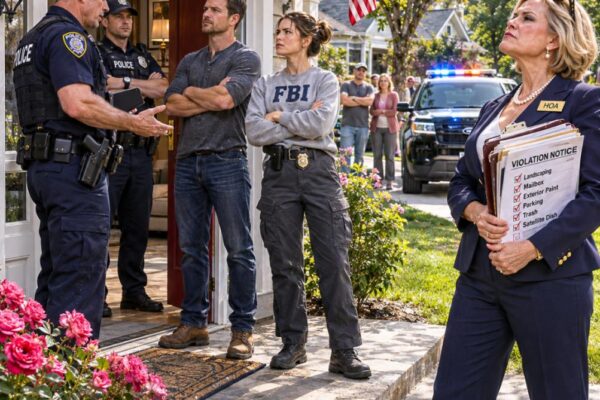
HOA Karen Invented a Fake HOA, Fined Me $650, and Sent Fake Security to My House—She Has Vastly Underestimated My Intelligence.k
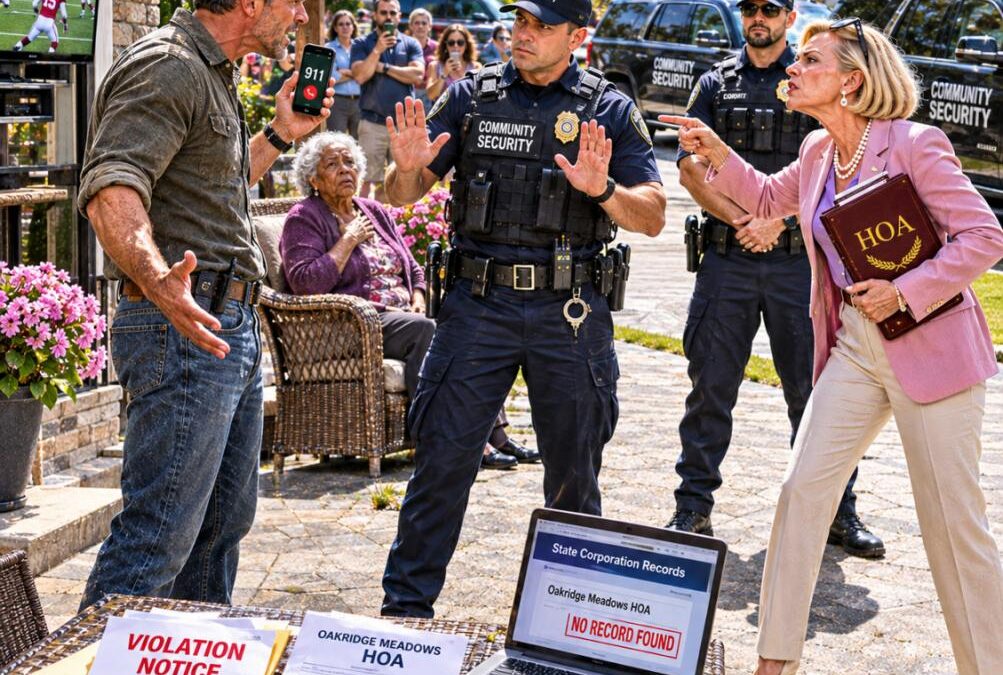
HOA Karen Invented a Fake HOA, Fined Me $650, and Sent Fake Security to My House—She Has Vastly Underestimated My Intelligence
She fined me $650 for watching football in my own backyard under an HOA that did not legally exist.
Then HOA Karen hired uniformed “community security” men to intimidate my elderly neighbor and make her fake authority look real.
When one of those men showed up wearing a badge and ordered me to come with him, I stopped treating Clara Wentworth like a difficult neighbor and started treating every document she touched like evidence.
The man standing on my front walk wore a badge that was almost right.
Almost.
That was the problem.
Real law enforcement equipment becomes invisible after you’ve worked around it long enough. You stop seeing the polish and start noticing placement. Weight. Habit. The way a radio pulls on a duty belt. The way an officer stands when one hand is occupied. The way a badge sits after years of being attached to the same kind of carrier.
This man’s badge looked like something designed by somebody who had studied photographs.
His navy uniform read COMMUNITY SECURITY SERVICES across the shoulder.
His belt carried a radio, flashlight, cuffs, and what looked like an empty holster.
Behind him, two black SUVs sat along Oakridge Lane.
Another sedan was parked near the cul-de-sac entrance.
Too spread out for visitors.
Too deliberate for neighbors.
I opened my door halfway.
“Can I help you?”
He held up a plastic identification card.
“Ethan Caldwell?”
“Yes.”
“You need to accompany us for questioning regarding interference with community governance.”
I stared at him.
“Who is ‘us’?”
“Community security acting under Oakridge Meadows authority.”
That told me almost everything.
There was no Oakridge Meadows authority.
No incorporated homeowners association.
No recorded declaration creating one.
No board.
No covenants authorizing fines.
Nothing.
My friend Nathan Harper, a real-estate lawyer, had confirmed that seventy-two hours earlier after a woman named Clara Wentworth taped a professionally printed “HOA violation notice” to my door demanding $650 for noise and an unauthorized gathering.
The man took one step closer.
“You’ve been informed of the consequences of continued obstruction.”
I kept my hands visible.
Old habits.
Eight years commanding a SWAT unit taught me that tense encounters rarely improve because somebody decides to win them quickly.
“What law gives you authority to detain me?”
His jaw tightened.
“This is not a criminal arrest.”
“Then I’m not going anywhere.”
“You are required to cooperate.”
“With what?”
He looked toward the street.
That was when I saw Clara.
She stood beside one of the SUVs in a pale pink blazer with a leather folder pressed against her chest.
Watching.
Waiting.
She had called a city inspector over two men cheering at a football game.
She had invented HOA fines.
She had distributed flyers calling me a threat to neighborhood property values.
And now she had men dressed to resemble police standing at my house.
I stepped onto the porch and closed the door behind me.
The uniformed man straightened.
“Mr. Caldwell, failure to comply will be documented.”
“Good.”
That surprised him.
“Document everything.”
Clara started walking toward us.
“You were warned, Ethan.”
I looked at her.
“No.”
Her face sharpened.
“You were warned twice.”
“No, Clara. You sent papers.”
She stopped.
“There is a difference.”
The man reached toward his belt—not the holster, the radio.
A burst of canned-sounding chatter came through the speaker.
Too clean.
Too repetitive.
I heard the same dispatch tone twice.
Nathan’s car was parked half a block away.
My phone vibrated.
His message contained four words.
BADGE IS NOT POLICE.
I looked back at Clara.
She smiled.
And that was when I realized she wasn’t bluffing anymore.
She believed the uniform was enough.
She believed the neighborhood would believe what it saw before anybody checked what was real.
So I took out my phone, dialed 911 myself, and said calmly:
“There are individuals at my residence representing themselves in a way that may cause residents to believe they have police authority. I need actual law enforcement to verify who they are.”
Clara’s smile disappeared.
part 2
The uniformed man stepped backward.
That movement told me more than his badge ever could.
Real officers generally don’t become nervous because someone calls 911 to confirm who they are.
He did.
Clara moved faster.
“You’re wasting emergency resources.”
I kept the dispatcher on speaker.
“My address is 418 Oakridge Lane.”
The man lifted his hand.
“There’s been a misunderstanding.”
I looked at him.
“You said I had to accompany you for questioning.”
“Administrative questioning.”
“You’re wearing handcuffs.”
“For security work.”
“You told me I was required to cooperate.”
“Community rules—”
“There is no HOA.”
Clara interrupted.
“There absolutely is.”
Nathan stepped out of his car.
He had been waiting because we expected Clara to escalate her fake fines at the emergency neighborhood meeting scheduled that evening.
We had not expected this.
He walked toward us holding his phone.
“Clara, what is the legal name of the association?”
Her eyes narrowed.
“You are not a resident.”
“I’m Mr. Caldwell’s attorney.”
That wasn’t technically why he was there that morning.
Nathan was my friend first.
But he was licensed, and Clara had crossed far enough into legal territory that friendship had acquired paperwork.
She lifted her chin.
“Oakridge Meadows Homeowners Association.”
Nathan nodded.
“Entity number?”
Silence.
“Registered agent?”
Nothing.
“Recorded declaration?”
Clara’s face flushed.
“This neighborhood has operated under community standards for decades.”
“That’s not what I asked.”
The uniformed man moved toward the nearest SUV.
I pointed at him.
“Don’t leave before the police get here.”
He turned.
“You don’t have authority to detain me.”
“No.”
I nodded.
“Interesting concept, isn’t it?”
Nathan almost smiled.
Clara did not.
Sirens arrived four minutes later.
Two marked city cruisers.
No tactical team.
No dramatic convoy.
No former SWAT officers coming to rescue their retired commander.
That would have been absurd.
I had called Captain Reynolds, my former supervisor, once during the first weekend of this mess because I wanted advice on preserving evidence around people using pseudo-law-enforcement imagery.
His response had been simple:
Don’t play cop anymore, Ethan.
You’re a civilian.
Call the actual department.
He was right.
Retirement meant giving up authority even when muscle memory hadn’t caught up.
So when Officers Ramirez and Coleman walked up my driveway, I stepped back.
“This is your scene.”
Ramirez looked at me, then Nathan, then the uniformed man.
“Who called?”
“I did.”
Clara immediately said, “I am the HOA president.”
Ramirez held up one hand.
“We’ll get everybody’s information.”
The uniformed man identified himself as Marcus Vale.
Community Security Services.
Private contractor.
Licensed security guard, he claimed.
Ramirez asked for his state license.
Marcus produced one.
Ramirez checked it.
Valid.
That complicated things.
He wasn’t simply a fake cop.
He was a legitimate private security guard wearing a uniform designed close enough to police styling that an elderly person could easily misinterpret his authority.
That distinction mattered.
So did what he had said.
Ramirez asked me exactly what happened.
I told him.
“Did he say you were under arrest?”
“No.”
“Did he identify himself as police?”
“Not directly.”
“Did he say you had to go with him?”
“Yes.”
“Exact words?”
“‘You need to accompany us for questioning regarding interference with community governance.’ Then he said I was required to cooperate.”
Marcus cut in.
“I meant under the HOA compliance agreement.”
Nathan asked, “Which agreement?”
Ramirez looked at him.
“Sir, let me handle the interview.”
Nathan nodded.
Fair.
Marcus continued.
“We were retained by the community association to provide compliance support and event security.”
Ramirez looked toward Clara.
“You hired them?”
“Yes.”
“Through what association?”
“Oakridge Meadows HOA.”
Nathan coughed.
Ramirez ignored him for the moment.
“Do you have documents establishing the association?”
Clara held up her folder.
“I have bylaws.”
“Recorded with the county?”
“Not every governing document needs to be recorded.”
Nathan could no longer stay quiet.
“Restrictions running with land generally need a legal basis.”
Ramirez looked at him.
“Attorney?”
“Yes.”
“I figured.”
He turned back to Clara.
“Are you collecting money?”
Her face shifted.
“Dues.”
“Mandatory?”
“Community safety assessments.”
“Required?”
“Yes.”
Nathan looked at me.
There.
That was the first moment this stopped being a bizarre neighbor dispute and started resembling something much more serious.
I had moved into Oakridge Meadows eight months earlier.
The place had been built in phases between the late 1980s and early 2000s.
Quiet streets.
Older trees.
No gate.
No clubhouse.
No pool.
No visible common property beyond a landscaped entrance island maintained through a voluntary neighborhood fund.
That part was important.
Voluntary.
When I closed on my house, I read everything.
Occupational hazard.
Eight years of commanding a tactical unit taught me to mistrust summaries.
Read the warrant.
Read the map.
Read the after-action report.
Read the thing everyone else says you don’t need to read.
My title packet contained no mandatory HOA declaration.
The seller’s disclosure said:
NO MANDATORY HOMEOWNERS ASSOCIATION.
There was a voluntary civic association that collected $75 a year for entrance landscaping, holiday lights, and a neighborhood email list.
I paid it.
Why not?
Seventy-five dollars seemed reasonable to avoid being the new retired guy complaining about Christmas lights.
Clara Wentworth lived three houses away.
Fifty-six.
Divorced.
Former compliance manager for a regional property-management company, according to Nathan’s later research.
That explained why her fake notices sounded so professional.
She had spent years around actual community associations.
She knew the vocabulary.
Notice of violation.
Cure period.
Special assessment.
Architectural compliance.
Emergency authority.
Lien warning.
The problem was she knew the words better than most residents knew their property records.
And she eventually realized that gap could be monetized.
My first interaction with her happened two weeks after I moved in.
She came to my door holding a floral folder.
“Mr. Caldwell?”
“Ethan.”
“Clara Wentworth. Oakridge Meadows neighborhood standards committee.”
I almost asked what committee.
Instead, I let her talk.
“We’ve had concerns about visible commercial activity.”
“What commercial activity?”
“Your vehicle.”
My pickup had the name of my security-consulting company in small vinyl lettering on the rear window.
CALDWELL RISK CONSULTING.
“It’s my personal truck.”
“You operate a business.”
“From a home office.”
“Customers coming here?”
“No.”
“Employees?”
“No.”
“Inventory?”
“No.”
“Then the logo should be removed.”
“Under what restriction?”
Her smile cooled.
“Community standards.”
I asked where I could read them.
She promised to email them.
Nothing arrived.
I forgot about it.
Then came the football game.
Nathan arrived Saturday afternoon.
We watched outside because October in Virginia had given us one of those perfect days—cool air, clear sky, leaves turning gold.
Two men.
One television.
One cooler.
At 4:17, our team scored.
We yelled.
Thirty seconds.
Maybe forty.
I have conducted raids quieter than some suburban birthday parties.
Twenty minutes later, a city code inspector arrived.
He looked embarrassed before he reached the backyard.
“Noise complaint.”
Nathan stared at him.
“Now?”
The television volume was low enough that we could hear a lawn mower two houses away.
The inspector checked.
No violation.
He told us the city noise ordinance became more restrictive at night and asked us to keep things reasonable.
Then he joked about our defense and left.
Across the street, Clara stood behind her kitchen window.
Watching.
Five minutes later, she marched over.
“This is a quiet neighborhood.”
Nathan whispered, “Incoming.”
Clara ignored him.
“Your gatherings are becoming disruptive.”
“Gatherings?”
I pointed at Nathan.
“That’s one lawyer and one retired cop.”
She looked at the cooler.
“Alcohol outdoors.”
“Legal.”
“Noise.”
“Inspector found no violation.”
“That doesn’t mean community standards weren’t violated.”
Nathan sat forward.
“What community standards?”
Clara looked at him.
“HOA standards.”
I said, “There isn’t an HOA.”
Her posture changed.
“All residents are bound by Oakridge Meadows governance.”
“No, they aren’t.”
“You signed closing documents.”
“I read my closing documents.”
“Then read them again.”
Nathan pulled out his phone.
“What is the association’s legal name?”
Clara stared at him.
“Who are you?”
“Nathan Harper.”
“Are you a resident?”
“No.”
“Then this is none of your concern.”
“Real-estate lawyer.”
For the first time, she looked uncertain.
Not much.
Enough.
She walked away.
Two hours later, the fake notice appeared.
$300 — EXCESSIVE COMMUNITY NOISE.
$350 — UNAUTHORIZED GATHERING / FAILURE TO REGISTER GUESTS.
PAYMENT REQUIRED WITHIN 48 HOURS.
Failure to pay may result in escalating enforcement, recovery fees, suspension of neighborhood privileges, and lien referral.
Nathan read it at my kitchen counter.
Then read it again.
“This is good.”
“Good?”
“Professionally written.”
“That sounds bad.”
“It is.”
He pointed at the footer.
A payment website.
An email.
A post-office box.
“This isn’t someone yelling at you over hedges.”
He searched the state corporate database.
No Oakridge Meadows Homeowners Association.
County land records.
No recorded declaration creating one across my parcel.
No mandatory-assessment covenant.
Nothing.
The voluntary civic group had a different name:
Oakridge Meadows Neighborhood Association.
OMNA.
Not HOA.
President: Jack Brennan.
Retired Marine.
Age sixty-eight.
I called him.
“Jack, are you aware Clara is sending HOA fines?”
Long silence.
Then:
“She is doing what?”
That was the beginning.
Sunday morning, yellow flyers appeared throughout the neighborhood.
EMERGENCY HOA MEETING.
SECURITY THREAT TO PROPERTY VALUES.
The flyer mentioned “recent disruptive residents” without naming me.
But my house appeared in one photograph.
My pickup visible.
Nathan read it.
“She is manufacturing legitimacy.”
“Why?”
“Money would be my guess.”
He was right.
The Sunday meeting was supposed to explain everything.
Instead, it made the problem bigger.
Clara had rented the community room at a nearby church.
A banner hung behind a podium.
OAKRIDGE MEADOWS HOMEOWNERS ASSOCIATION.
Beneath it:
PROTECTING PROPERTY. PROTECTING FAMILIES.
Four uniformed security contractors stood near the walls.
Marcus Vale introduced himself as director of Community Security Services.
His pitch was polished.
Rising property crime.
Police response times.
Package theft.
“Unmonitored outsiders.”
Potential decline in property values.
Then he offered “priority neighborhood security” for $150 a month.
Patrols.
Vacation checks.
Emergency response.
Incident documentation.
Clara presented her HOA structure.
Annual dues.
Security assessments.
Compliance committee.
Fine schedule.
I sat in the back row.
Nathan waited outside because Clara had announced “residents only.”
I didn’t challenge her.
I wanted to hear.
Sixty people had come.
Many were scared.
Not stupid.
Scared.
Those are different.
Mrs. Larsson had two children and a husband who traveled.
She heard burglaries were rising and wanted protection.
Mr. Danvers had recently had a package stolen.
Elena Vargas was seventy-six and lived alone.
Fear gave Clara’s presentation traction.
Then she put my house on the screen.
“This is an example of the type of unregistered commercial activity that weakens residential oversight.”
My jaw tightened.
She showed photographs.
Nathan’s car.
My consulting truck.
A delivery van from an office-supply company.
A city inspector.
Different days presented as if they were a parade of suspicious activity.
Then Clara said:
“Mr. Caldwell has repeatedly refused HOA registration.”
I stood.
“Because your HOA doesn’t exist.”
The room turned.
Clara smiled.
“Mr. Caldwell, questions will be taken later.”
“I have one now.”
“You are disrupting the meeting.”
“Show everyone the recorded declaration.”
A few people murmured.
Clara said, “Our legal documents are available to members in good standing.”
“Then show the entity registration.”
“You have refused membership.”
“Because membership is voluntary.”
Her smile disappeared.
Marcus stepped away from the wall.
Not threatening.
Yet.
“Sir, please remain seated.”
I looked at him.
“You don’t work for me.”
“I work for the association.”
“What association?”
People laughed nervously.
Clara struck the podium with one hand.
“This is exactly the conduct we’re trying to address.”
Elena stood.
Small woman.
Silver hair.
Five feet tall if that.
“I’ve lived here thirty-one years.”
Everyone quieted.
“There has never been a mandatory HOA.”
Clara turned.
“Mrs. Vargas, the neighborhood has evolved.”
“Land records don’t evolve because you make a banner.”
That earned a real laugh.
Clara’s face reddened.
Then she made a mistake.
She looked at Elena and said:
“This is why vulnerable residents need professional guidance.”
Elena’s back straightened.
“Vulnerable?”
“Due to age.”
“I am old, Clara. I am not stupid.”
Applause.
Clara tried to recover.
“We’re offering protection.”
Elena sat down.
Later that night, two security contractors knocked at her house.
She told me the next morning.
“They said they needed to perform a safety assessment.”
“Did you let them in?”
“No.”
“Good.”
“They told me refusal could affect my community security status.”
My stomach tightened.
“Exact words?”
“Yes.”
“Write it down.”
She did.
Then she added:
“One of them asked whether I had paid the assessment.”
There it was.
Money connected to fear.
By Monday, Nathan and I had enough to contact the state consumer-protection office and local police financial-crimes unit.
Not the FBI.
Not SWAT.
Not some cinematic task force.
We didn’t yet know if the facts justified anything bigger.
We provided documents.
Fake HOA notices.
Payment link.
Flyers.
Security pitch.
Elena’s statement.
County records showing no mandatory HOA.
Copies of checks voluntarily shared by two neighbors who had already paid.
The payment recipient was not an HOA.
It was an LLC.
Oakridge Community Management Services.
Registered three months earlier.
Organizer:
Clara Wentworth.
Nathan stared at the filing.
“There it is.”
“What?”
“The separation.”
“Explain.”
“She created a company with a name that sounds like an association.”
“And collects money through it.”
“Looks that way.”
“Illegal?”
“Could be fraud if she’s materially misrepresenting authority to obtain money. Could be deceptive trade practices. Could implicate other statutes. We let investigators decide.”
That was Nathan at his best.
No theatrical conclusions.
Facts first.
Then Marcus’s men appeared at my house.
Actual licensed guards.
Not actual police.
Their uniforms and language were still alarming enough that real officers documented the encounter.
The next evening, Clara held another meeting.
This one was different.
People came angry instead of afraid.
Jack Brennan arrived with a box.
The real voluntary association records.
Articles.
Bank statements.
Years of newsletters.
A letter from the neighborhood’s original developer confirming no mandatory HOA had ever been established.
Mrs. Larsson brought the $450 “security initiation fee” receipt she’d paid to Clara’s LLC.
Mr. Danvers brought two fine notices.
Elena brought her handwritten statement.
Nathan brought county records.
I brought the first fake violation.
Clara brought Marcus and three guards.
The room filled.
She opened as if nothing had changed.
“Recent misinformation has created confusion.”
Jack stood.
“No confusion.”
She ignored him.
“The Oakridge Meadows HOA has authority derived from longstanding community practices and resident participation.”
Nathan whispered to me, “That sentence means she has nothing.”
Clara continued.
“Certain individuals are encouraging residents to resist lawful assessments.”
Jack raised the original OMNA bylaws.
“This is the only association we’ve ever had.”
Clara snapped, “That organization became obsolete.”
“Who dissolved it?”
“The community effectively transitioned.”
“When?”
“Over time.”
“Vote?”
Silence.
“Amendment?”
Nothing.
“Recorded covenant?”
Nothing.
Jack sat down.
“Thought so.”
Clara looked toward Marcus.
That should have been his cue to maintain order.
Instead, he approached me.
“Mr. Caldwell, you need to step outside.”
“No.”
“You’ve been warned regarding interference.”
Nathan stood.
“Under what authority?”
Marcus said, “Community security.”
“That isn’t legal authority to compel him anywhere.”
Clara said loudly, “He is being removed from a private association meeting.”
Jack turned.
“I rented this room.”
The entire scene froze.
Clara stared at him.
“What?”
Jack held up the church rental confirmation.
“I booked the room for the neighborhood association years ago. We maintain the recurring reservation.”
That was how deeply Clara had relied on everyone assuming she controlled things.
Even the room wasn’t hers.
Marcus stepped back.
Clara’s face went red.
Then one of the security guards moved toward Nathan.
“Sir, you need to—”
Elena stood.
“No.”
Her voice wasn’t loud.
It didn’t need to be.
“These men came to my house and tried to frighten me into paying.”
Everyone turned.
Marcus stiffened.
“That is false.”
Elena held up her statement.
“You told me refusing your inspection could affect my security status.”
“I was explaining service eligibility.”
“You asked whether I’d paid.”
“Because membership status determines—”
“I never joined.”
Silence.
Mrs. Larsson stood next.
“Neither did I.”
She held up her receipt.
“I thought the $450 was required.”
Clara said, “It was.”
Nathan stepped forward.
“Required under what recorded obligation?”
Clara slammed her folder onto the podium.
“You people are intentionally undermining community safety.”
Jack said, “You charged my neighbors money using an organization that doesn’t exist.”
“It exists.”
“As your LLC?”
That hit.
People began talking at once.
Clara shouted for order.
Nobody listened.
Then Marcus made the mistake that ended whatever control remained.
He pulled out handcuffs.
Not dramatically.
Just enough to display them.
“Anyone refusing to leave after being instructed may be physically removed.”
The room went silent.
I stood.
“Put those away.”
He looked at me.
“You don’t give orders anymore, Commander.”
That told me he’d researched my background.
“Correct.”
I nodded.
“I don’t.”
Then I pointed toward the exit.
“But the actual police do.”
Blue lights appeared through the windows.
The financial-crimes detectives had planned to attend quietly after residents voluntarily provided statements and investigators reviewed the documentation.
I had known they might come.
I had not known when.
Two uniformed officers entered first.
Then Detective Morgan.
No SWAT.
No dramatic breach.
No former team.
Professional.
Quiet.
Morgan approached Marcus.
“Sir, keep your hands away from the cuffs.”
Marcus complied.
The room became so silent I could hear the projector fan.
Detective Morgan asked Clara to step away from the podium.
She stared at him.
“I’m conducting an HOA meeting.”
“Ms. Wentworth, we need to speak with you regarding financial complaints and representations made to residents.”
“This is harassment.”
“You’re not under arrest at this moment.”
At this moment.
Important phrase.
He continued.
“But you’re not going to collect additional funds here tonight.”
Clara looked around the room.
Neighbors who had trusted her were watching.
Mrs. Larsson.
Elena.
Jack.
People holding receipts.
She pointed at me.
“He did this.”
Morgan looked at me.
“No.”
Then at her.
“Multiple residents filed complaints.”
That mattered.
I wasn’t the all-powerful retired commander bringing down an enemy.
I was one complainant.
One witness.
One homeowner.
Clara had created the rest herself.
The meeting ended.
Investigators collected copies of receipts from residents who volunteered them.
They interviewed Marcus separately.
His company had apparently been hired under a private services contract and told that Clara represented a legitimate community association.
That did not excuse every tactic his guards used.
But it complicated the story again.
Marcus had been paid.
He had not created the fake HOA.
His attorneys would later argue he believed he was enforcing private event and property rules, not impersonating police.
The empty holster and badge-style uniforms drew scrutiny, but the final legal treatment depended on specific state licensing and impersonation statutes.
No instant courtroom.
No handcuffs for everyone.
Reality moved slower.
Clara’s financial trail moved faster.
Within two weeks, investigators identified more than $41,000 paid by residents to Oakridge Community Management Services.
Some payments were clearly described as voluntary security subscriptions.
Those weren’t necessarily fraudulent.
Others were labeled mandatory HOA assessments.
Late fees.
Compliance penalties.
Guest-registration fines.
Architectural-review charges.
That was different.
Nathan built a spreadsheet.
I laughed when I saw it.
“What?”
“Nothing.”
“You spent eight years commanding tactical operations and spreadsheets amuse you?”
“Every investigation eventually becomes a spreadsheet.”
Twenty-seven households had paid something.
Nineteen reported they believed at least part of the payment was mandatory.
Several had received threats of liens.
There was no lien authority.
One widow had paid a $1,200 “emergency reserve assessment” because a letter said failure to pay could affect title clearance during any future home sale.
That one made Nathan furious.
“She’s leveraging fear of title defects.”
“Can she actually cloud title?”
“Not lawfully based on what we’ve seen.”
“But people don’t know that.”
“Exactly.”
That was Clara’s business model.
Not brilliance.
Information asymmetry.
She knew enough property-management language to scare people who did not spend their evenings searching county records.
She created professional forms.
Professional logos.
Professional terminology.
Then relied on one assumption:
Nobody will check.
My fake $650 fine had been a small part of something already operating.
Why target me?
That question bothered me.
I had disrupted her football-noise narrative accidentally.
Then Nathan exposed the missing HOA.
That made me dangerous to her scheme.
But the investigation found she’d photographed my house even before the football game.
She had searched my consulting business.
She had requested information from neighbors about visitors.
Her attention predated the confrontation.
Then Nathan found something strange.
An old newspaper article.
Clara’s nephew, Thomas Wentworth.
Three years earlier.
Twenty-six years old.
Drug possession.
Probation violation.
Later detained in county jail after missing court.
He died from an overdose months after release.
I remembered the name.
Not immediately.
Then all at once.
Tommy Wentworth.
I had met him once.
Not during a SWAT operation.
During a department outreach program.
Toward the end of my law-enforcement career, our agency participated in a diversion and treatment initiative for people repeatedly cycling through low-level drug offenses.
I spoke at one session.
Tommy stayed afterward.
He asked whether addiction treatment programs actually worked or whether cops just said that for public relations.
I gave him the contact information for a treatment coordinator.
That was it.
Ten minutes.
Maybe fifteen.
He later called my office once asking how to surrender on an outstanding warrant without creating a scene at his mother’s house.
I connected him with the appropriate unit.
I never arrested him.
Never investigated him.
Never commanded an operation involving him.
But Clara had found my name somewhere in his paperwork.
Her grief had built a story.
The detectives discovered emails Clara sent to a cousin after I moved into Oakridge.
One said:
You will not believe who moved three houses away. Caldwell. The commander connected to Tommy’s case.
Another:
Men like him ruin families and retire comfortably while everyone else carries the damage.
That changed how I understood her hostility.
It did not excuse the fake HOA.
It did explain why my house became a target so quickly.
Nathan asked:
“Do you want this public?”
“No.”
“Why?”
“Her nephew’s death isn’t community entertainment.”
He nodded.
The prosecutor eventually charged Clara with multiple offenses related to fraudulent representations and financial transactions.
I won’t pretend every charge in the original neighborhood rumor survived.
They didn’t.
Criminal cases narrow.
Some allegations become civil disputes.
Some facts support restitution but not criminal elements.
Some residents misunderstood language rather than being directly lied to.
Clara’s attorneys negotiated.
She eventually pleaded guilty to several fraud-related counts and one offense involving forged or false organizational documents.
The exact sentence was nowhere near the melodramatic version people spread afterward.
She served a custodial term followed by supervised release and was ordered to pay restitution established through the case.
Her LLC was dissolved.
Assets traceable to the operation were subject to lawful recovery procedures.
No instant freezing of everything she owned.
No house seized because neighbors demanded it.
Due process applied to her too.
That mattered.
Marcus was charged separately over conduct connected to misleading security representations and coercive tactics, though not every allegation resulted in conviction.
His company lost the neighborhood contract immediately.
The state licensing body opened its own review.
Again:
Separate conduct.
Separate process.
No guilt by association.
Elena received restitution for money she had paid.
So did Mrs. Larsson.
Jack Brennan worked with Nathan to rebuild the voluntary neighborhood association.
Not a mandatory HOA.
A voluntary civic organization.
That distinction became almost sacred.
Its first newsletter began:
WE CANNOT FINE YOU.
Jack printed it in bold.
Nathan laughed for five minutes.
Then volunteered to help draft new bylaws anyway.
The association did three things.
Entrance landscaping.
Neighborhood events.
Information sharing.
No fake patrol authority.
No mandatory guest registration.
No lien threats.
If residents wanted private security, they could voluntarily contract with licensed providers individually or through a transparent opt-in program.
No one person controlled the payment account.
Two signatures for expenditures.
Published financial statements.
Annual elections.
Boring.
Beautiful.
Elena Vargas became honorary treasurer.
She refused actual treasurer because, as she put it:
“I am seventy-six. I have survived enough bookkeeping.”
The neighborhood gave her a standing ovation.
She hated that too.
The hardest part for me came after Clara’s plea.
She requested a mediated meeting with several victims as part of a restorative component tied to restitution discussions.
Participation was voluntary.
I almost declined.
Nathan asked why.
“I don’t need to hear excuses.”
“Then don’t go.”
I stared at the letter.
“But I want to understand why she chose me.”
“You already know part.”
“I want to hear it from her.”
So I went.
Small conference room.
No jail visit.
No cinematic glass partition.
Clara sat with her attorney and a mediator.
No pink blazer.
Gray sweater.
No makeup that I could see.
Smaller somehow.
She looked at me.
“I knew who you were when you moved in.”
“I figured that out.”
“Tommy talked about you.”
That surprised me.
“What did he say?”
Her eyes filled.
“He said you were the only commander who ever spoke to him like he wasn’t garbage.”
I didn’t know what to say.
She continued.
“He called me after that outreach meeting.”
I remembered the folding chairs.
Fluorescent lights.
Tommy asking whether treatment worked.
“He said you gave him numbers.”
“Yes.”
“He tried one program.”
“I didn’t know.”
“He left after three weeks.”
Clara wiped her eyes.
“Then everything got worse again.”
I stayed silent.
“When he died, I needed somebody responsible.”
Her attorney shifted.
She ignored him.
“The dealers disappeared. His friends blamed each other. His mother blamed herself. Tommy blamed himself in his last messages.”
She looked at me.
“You had a title.”
A cold feeling moved through me.
“So you chose me.”
“I chose the system.”
“No.”
I shook my head.
“You chose my house.”
She flinched.
“Yes.”
I continued.
“You invented fines.”
“Yes.”
“You told neighbors I was dangerous.”
“Yes.”
“You used their fear to collect money.”
Her eyes dropped.
“Yes.”
“That’s not grief.”
“No.”
She swallowed.
“Not anymore.”
The mediator let silence work.
Then Clara said:
“I told myself if I could make everyone see what kind of man you were, it would prove Tommy had never had a chance.”
I stared at her.
“What kind of man did you think I was?”
“Powerful.”
“That isn’t a moral category.”
“I know.”
“Cold?”
“Yes.”
“Corrupt?”
She hesitated.
“I wanted you to be.”
That was the saddest answer.
Not because it hurt me.
Because grief had required a villain so badly that she built one.
“Tommy called my office once after the outreach program.”
Clara looked up.
“What?”
“He had an outstanding warrant.”
Her face changed.
“He wanted to surrender without police coming to his mother’s house.”
She stared at me.
“I connected him with the warrant unit.”
“No.”
“He was scared.”
“No.”
“He said he wanted to get clean.”
Clara started crying.
Not movie crying.
No dramatic collapse.
Just tears.
Quiet.
“He wanted to surrender?”
“Yes.”
“He never told me.”
“He may have been ashamed.”
She covered her mouth.
I could have stopped.
Instead, I gave her the truth she deserved even if it hurt.
“Tommy wasn’t a monster.”
Her shoulders shook.
“He also wasn’t a helpless victim of one cop.”
She looked at me.
“He was a young man struggling with addiction who made choices, wanted help, failed, tried again, and didn’t get enough time.”
Clara looked down.
I continued.
“You didn’t need to turn him into a saint to love him.”
Silence.
“And you didn’t need to turn me into a villain to grieve him.”
That meeting lasted less than an hour.
I did not forgive everything.
I did not promise friendship.
I did not tell the court to erase consequences.
Understanding motive and excusing conduct are not the same thing.
Clara still defrauded people.
Elena was still frightened in her own home.
Mrs. Larsson still paid money she believed she legally owed.
People still lost trust in one another.
Grief explained the match.
It did not justify the fire.
A year later, Oakridge held a neighborhood barbecue.
Not “Truth Day.”
Jack refused that name immediately.
“We’re grilling hamburgers, not founding a republic.”
So it became the Oakridge Fall Cookout.
Nathan manned the grill and nearly poisoned six people with chicken before Elena removed him from duty.
Mrs. Larsson brought her children.
Marcus—the security contractor, not me—obviously did not attend.
Neither did Clara.
She was still serving her sentence then.
Nobody toasted her downfall.
Nobody wanted to.
That surprised me.
By then, people were tired of Clara being the center of every conversation.
That was healing too.
The best victory over a person who tried to control a community is eventually having days where nobody mentions them.
The voluntary association launched a fraud-awareness workshop that winter.
I agreed to speak.
Not as a SWAT commander.
As a retired officer who had watched neighbors hand money to professional-looking documents.
My talk lasted twenty minutes.
I gave everyone one rule.
“Authority leaves a paper trail.”
People wrote it down.
“If someone says you owe money because of property restrictions, ask what recorded covenant creates the obligation.”
“If somebody claims to represent an association, verify the entity.”
“If someone threatens a lien, check whether they actually have lien authority.”
“If private security tells you they can arrest you for violating neighborhood rules, call actual police and an attorney.”
“If something looks official, that is not evidence that it is official.”
Then Elena raised her hand.
“What if it’s printed in color?”
Everyone laughed.
“Especially then.”
Two years after Clara’s first fake fine, I still lived at 418 Oakridge Lane.
My retirement remained busier than planned.
That was partly my fault.
I started teaching occasional training sessions for property managers and senior groups about impersonation, coercive scams, and the psychological tricks that make fake authority effective.
Uniform.
Logo.
Deadline.
Late fee.
Threat.
Official language.
Social proof.
Those ingredients are cheap.
People assume fraud looks sloppy.
Often it looks polished because polish is the product.
Nathan turned the whole Oakridge fiasco into a continuing-education lecture for real-estate attorneys.
He titled it:
THE HOA THAT WASN’T.
I told him that sounded ridiculous.
He told me lawyers need entertainment too.
Jack expanded the neighborhood watch, but carefully.
No uniforms.
No badges.
No patrol vehicles pretending to be police.
Just residents sharing information with clear rules:
Observe.
Document.
Call professionals when professionals are needed.
Do not play cop.
That last line was mine.
I had spent too many years wearing legitimate authority to tolerate amateurs enjoying the costume.
Mrs. Larsson apologized to me once.
We were standing near the mailbox.
“I believed Clara.”
“About what?”
“That you were a threat.”
I shrugged.
“She gave you official-looking documents.”
“I should’ve asked you.”
“Yes.”
She looked embarrassed.
I softened.
“But you were worried about your kids and your house.”
“That doesn’t make it okay.”
“No.”
I nodded.
“But it makes it understandable.”
She smiled.
“You always talk like a police report.”
“Occupational damage.”
Elena became the unofficial matriarch of Oakridge.
Clara had called her vulnerable.
The neighborhood responded by asking Elena’s opinion on almost everything.
She hated it.
When Jack proposed new holiday-light spending, she said:
“Forty dollars per house for plastic reindeer is how civilizations collapse.”
Proposal rejected.
I stayed out of association leadership.
People kept asking.
No.
I had already spent enough years with radios going off during dinner.
My backyard became the thing I had originally wanted.
Football.
Cold beer.
Neighbors.
Nathan almost every weekend during the season.
Jack came sometimes.
Mrs. Larsson’s husband.
A younger couple from two streets over.
Elena once walked in during the fourth quarter carrying lemonade and announced that none of us understood defense.
She was probably right.
We cheered when our team scored.
Loudly.
Nobody called the city inspector.
At least not yet.
One afternoon Nathan looked around the yard.
“You realize this is technically an unauthorized gathering.”
I threw a pretzel at him.
He laughed.
Then he became serious.
“You ever think about moving?”
“No.”
“Not even after all that?”
“No.”
“Why?”
I looked toward Clara’s old house.
She had sold it after the criminal case resolved enough for the transaction to proceed.
A young family owned it now.
Two little girls.
One golden retriever.
Chalk drawings covered the driveway.
“Because she doesn’t get to decide what this place means.”
Nathan nodded.
That was all.
Years in tactical work taught me to think in terms of control.
Control the entry.
Control the perimeter.
Control the suspect’s hands.
Control communication.
Control time.
Retirement taught me something harder.
Community cannot be controlled that way.
The minute someone tries, fear fills the gaps.
Clara understood fear better than most.
She took ordinary anxieties and gave them uniforms.
Property values.
Crime.
Unknown visitors.
An aging neighbor.
A retired cop with a consulting business.
Then she built authority around those anxieties.
Letters.
Logos.
Meetings.
Fines.
Guards.
Most people did not obey because they were foolish.
They obeyed because they assumed somebody else had verified the foundation.
The church assumed she represented the neighborhood.
The security company assumed she represented an HOA.
Residents assumed the “HOA” must appear somewhere in their closing documents.
Neighbors assumed somebody else remembered voting.
Everybody saw the upper floors.
Nobody checked whether the building had a foundation.
Nathan checked.
That was all it took to start the collapse.
I think about that first $650 notice sometimes.
It still sits in a file in my office.
$300 noise.
$350 unauthorized gathering.
Forty-eight-hour deadline.
Threat of enforcement.
Professional formatting.
Seal in the corner.
I can now see exactly how it worked.
Short deadline so you act before checking.
Official language so you assume expertise.
Escalation threat so paying feels safer than questioning.
A small enough amount that hiring a lawyer seems excessive.
And social embarrassment if you’re publicly labeled noncompliant.
Perfect.
Clara knew people.
She just forgot that one of the men she targeted watched documents for a living.
Not because I was a SWAT commander.
That part helped me stay calm.
Nathan was the real nightmare for her.
Give a real-estate lawyer a fake lien threat and he becomes emotionally invested.
The biggest lesson, though, came from Elena.
When fake security came to her door, she did not argue.
She did not let them inside.
She asked:
“Who gave you authority?”
They answered:
“The association.”
She asked:
“Show me.”
They couldn’t.
Then she closed the door.
Five feet tall.
Seventy-six years old.
No badge.
No military experience.
No law degree.
Just the right question.
That is why I don’t like the version of this story where my old SWAT team rides in and saves everyone.
It misses everything.
I wasn’t the hero because I’d once commanded tactical officers.
Nathan wasn’t the hero because he knew property law.
Jack wasn’t the hero because he had been a Marine.
Real police weren’t the heroes simply because they wore authentic badges.
The community saved itself when ordinary residents stopped outsourcing their judgment to symbols of authority.
Mrs. Larsson asked for documentation.
Elena refused a fake inspection.
Jack brought the real association records.
Neighbors provided receipts.
Investigators followed money.
Prosecutors followed evidence.
A court imposed consequences.
No single dramatic reversal.
A chain.
Real justice usually looks like that.
Years later, Clara sent Elena a letter.
Elena showed it to me because my name appeared once.
The letter did not ask for forgiveness.
I respected that.
Clara apologized for frightening her.
Admitted she’d used age as leverage.
Said grief had made control feel like safety.
Then she wrote one line about Tommy.
He wanted to be better than the worst thing he did.
Elena cried.
So did I, later.
I never wrote Clara.
Not because I hated her.
Because some relationships do not need closure through correspondence.
The consequences were real.
So was her remorse, as far as I could tell.
Both could exist.
That’s another thing police work took too long to teach me.
People are capable of doing terrible things without becoming nothing but the terrible thing.
Tommy wasn’t only an addict.
Clara wasn’t only a fraudster.
I wasn’t only a commander.
Elena wasn’t vulnerable simply because she was old.
Nathan wasn’t merely the lawyer who ruined football by fact-checking halftime.
We were all larger than the labels people used when they wanted easy stories.
The final irony?
Oakridge eventually formed a legitimate association.
Voluntary.
Not an HOA.
A registered nonprofit civic group.
Nathan helped file it properly.
The vote was public.
Bylaws distributed in advance.
Dues optional.
Accounts transparent.
No lien powers.
No property restrictions.
The name?
Oakridge Meadows Community Association.
Jack proposed calling it OMCA.
Elena objected.
“Too close to HOA.”
Nobody wanted that trauma.
So people simply called it Oakridge Neighbors.
Perfect.
The group organizes block parties, senior check-ins, emergency text alerts, and the annual cookout.
It has exactly one official enforcement power:
None.
My kind of institution.
Last October, almost exactly four years after Clara’s first noise complaint, Nathan came over for football.
Same outdoor television.
Same cooler.
More people now.
Our team scored late in the fourth.
The backyard exploded.
Jack shouted.
Mrs. Larsson’s husband jumped out of his chair.
Nathan spilled beer on my patio.
Thirty seconds of noise.
Maybe forty-five.
Then silence.
I looked toward the house where Clara once lived.
One of the little girls was drawing with chalk.
Her father waved.
I waved back.
Nathan saw me smiling.
“What?”
“Nothing.”
“You’re having a sentimental retired-guy moment.”
“Shut up.”
He opened another beer.
Then he lifted the bottle.
“To unauthorized gatherings.”
I lifted mine.
“To checking the paperwork.”
Jack yelled from the grill:
“To not letting Nathan cook chicken.”
Elena shouted:
“Amen.”
Everyone laughed.
That was my retirement.
Not silence.
Not isolation.
Not pretending danger never existed.
Peace built on people who knew the difference between community and control.
Clara once thought she could create authority by printing it.
A fake association.
Fake fines.
Manufactured fear.
Security uniforms.
Threats.
Deadlines.
She almost succeeded because every piece looked enough like the real thing that people hesitated to question it.
Then questions started.
Is there an HOA?
Where is it registered?
What did I sign?
Who voted?
Where is the covenant?
Where does the money go?
Who authorized the security company?
Can they actually detain anyone?
Can you actually file a lien?
Every question made the costume thinner.
That’s the ending I remember.
Not handcuffs.
Not Clara crying.
Not some tactical team arriving to reveal who I used to be.
The moment that ended her power happened much earlier.
Nathan sat at my kitchen counter with the $650 violation notice in his hand.
He searched the county database.
Then the state records.
Then looked at me and said:
“Ethan, there is no HOA.”
One sentence.
Everything after that was consequence.
Clara believed symbols created authority.
My old career taught me the opposite.
Authority is one of the most dangerous things human beings can carry.
It needs a source.
A statute.
A warrant.
A contract.
A vote.
Consent.
Something real.
Otherwise it’s only theater.
And theater works right up until somebody turns on the house lights.
THE STORY ENDS HERE
HOA Karen Invented a Fake HOA, Fined Me $650, and Sent Fake Security to My House—She Has Vastly Underestimated My Intelligence
She fined me $650 for watching football in my own backyard under an HOA that did not legally exist.
Then HOA Karen hired uniformed “community security” men to intimidate my elderly neighbor and make her fake authority look real.
When one of those men showed up wearing a badge and ordered me to come with him, I stopped treating Clara Wentworth like a difficult neighbor and started treating every document she touched like evidence.
The man standing on my front walk wore a badge that was almost right.
Almost.
That was the problem.
Real law enforcement equipment becomes invisible after you’ve worked around it long enough. You stop seeing the polish and start noticing placement. Weight. Habit. The way a radio pulls on a duty belt. The way an officer stands when one hand is occupied. The way a badge sits after years of being attached to the same kind of carrier.
This man’s badge looked like something designed by somebody who had studied photographs.
His navy uniform read COMMUNITY SECURITY SERVICES across the shoulder.
His belt carried a radio, flashlight, cuffs, and what looked like an empty holster.
Behind him, two black SUVs sat along Oakridge Lane.
Another sedan was parked near the cul-de-sac entrance.
Too spread out for visitors.
Too deliberate for neighbors.
I opened my door halfway.
“Can I help you?”
He held up a plastic identification card.
“Ethan Caldwell?”
“Yes.”
“You need to accompany us for questioning regarding interference with community governance.”
I stared at him.
“Who is ‘us’?”
“Community security acting under Oakridge Meadows authority.”
That told me almost everything.
There was no Oakridge Meadows authority.
No incorporated homeowners association.
No recorded declaration creating one.
No board.
No covenants authorizing fines.
Nothing.
My friend Nathan Harper, a real-estate lawyer, had confirmed that seventy-two hours earlier after a woman named Clara Wentworth taped a professionally printed “HOA violation notice” to my door demanding $650 for noise and an unauthorized gathering.
The man took one step closer.
“You’ve been informed of the consequences of continued obstruction.”
I kept my hands visible.
Old habits.
Eight years commanding a SWAT unit taught me that tense encounters rarely improve because somebody decides to win them quickly.
“What law gives you authority to detain me?”
His jaw tightened.
“This is not a criminal arrest.”
“Then I’m not going anywhere.”
“You are required to cooperate.”
“With what?”
He looked toward the street.
That was when I saw Clara.
She stood beside one of the SUVs in a pale pink blazer with a leather folder pressed against her chest.
Watching.
Waiting.
She had called a city inspector over two men cheering at a football game.
She had invented HOA fines.
She had distributed flyers calling me a threat to neighborhood property values.
And now she had men dressed to resemble police standing at my house.
I stepped onto the porch and closed the door behind me.
The uniformed man straightened.
“Mr. Caldwell, failure to comply will be documented.”
“Good.”
That surprised him.
“Document everything.”
Clara started walking toward us.
“You were warned, Ethan.”
I looked at her.
“No.”
Her face sharpened.
“You were warned twice.”
“No, Clara. You sent papers.”
She stopped.
“There is a difference.”
The man reached toward his belt—not the holster, the radio.
A burst of canned-sounding chatter came through the speaker.
Too clean.
Too repetitive.
I heard the same dispatch tone twice.
Nathan’s car was parked half a block away.
My phone vibrated.
His message contained four words.
BADGE IS NOT POLICE.
I looked back at Clara.
She smiled.
And that was when I realized she wasn’t bluffing anymore.
She believed the uniform was enough.
She believed the neighborhood would believe what it saw before anybody checked what was real.
So I took out my phone, dialed 911 myself, and said calmly:
“There are individuals at my residence representing themselves in a way that may cause residents to believe they have police authority. I need actual law enforcement to verify who they are.”
Clara’s smile disappeared.
part 2
The uniformed man stepped backward.
That movement told me more than his badge ever could.
Real officers generally don’t become nervous because someone calls 911 to confirm who they are.
He did.
Clara moved faster.
“You’re wasting emergency resources.”
I kept the dispatcher on speaker.
“My address is 418 Oakridge Lane.”
The man lifted his hand.
“There’s been a misunderstanding.”
I looked at him.
“You said I had to accompany you for questioning.”
“Administrative questioning.”
“You’re wearing handcuffs.”
“For security work.”
“You told me I was required to cooperate.”
“Community rules—”
“There is no HOA.”
Clara interrupted.
“There absolutely is.”
Nathan stepped out of his car.
He had been waiting because we expected Clara to escalate her fake fines at the emergency neighborhood meeting scheduled that evening.
We had not expected this.
He walked toward us holding his phone.
“Clara, what is the legal name of the association?”
Her eyes narrowed.
“You are not a resident.”
“I’m Mr. Caldwell’s attorney.”
That wasn’t technically why he was there that morning.
Nathan was my friend first.
But he was licensed, and Clara had crossed far enough into legal territory that friendship had acquired paperwork.
She lifted her chin.
“Oakridge Meadows Homeowners Association.”
Nathan nodded.
“Entity number?”
Silence.
“Registered agent?”
Nothing.
“Recorded declaration?”
Clara’s face flushed.
“This neighborhood has operated under community standards for decades.”
“That’s not what I asked.”
The uniformed man moved toward the nearest SUV.
I pointed at him.
“Don’t leave before the police get here.”
He turned.
“You don’t have authority to detain me.”
“No.”
I nodded.
“Interesting concept, isn’t it?”
Nathan almost smiled.
Clara did not.
Sirens arrived four minutes later.
Two marked city cruisers.
No tactical team.
No dramatic convoy.
No former SWAT officers coming to rescue their retired commander.
That would have been absurd.
I had called Captain Reynolds, my former supervisor, once during the first weekend of this mess because I wanted advice on preserving evidence around people using pseudo-law-enforcement imagery.
His response had been simple:
Don’t play cop anymore, Ethan.
You’re a civilian.
Call the actual department.
He was right.
Retirement meant giving up authority even when muscle memory hadn’t caught up.
So when Officers Ramirez and Coleman walked up my driveway, I stepped back.
“This is your scene.”
Ramirez looked at me, then Nathan, then the uniformed man.
“Who called?”
“I did.”
Clara immediately said, “I am the HOA president.”
Ramirez held up one hand.
“We’ll get everybody’s information.”
The uniformed man identified himself as Marcus Vale.
Community Security Services.
Private contractor.
Licensed security guard, he claimed.
Ramirez asked for his state license.
Marcus produced one.
Ramirez checked it.
Valid.
That complicated things.
He wasn’t simply a fake cop.
He was a legitimate private security guard wearing a uniform designed close enough to police styling that an elderly person could easily misinterpret his authority.
That distinction mattered.
So did what he had said.
Ramirez asked me exactly what happened.
I told him.
“Did he say you were under arrest?”
“No.”
“Did he identify himself as police?”
“Not directly.”
“Did he say you had to go with him?”
“Yes.”
“Exact words?”
“‘You need to accompany us for questioning regarding interference with community governance.’ Then he said I was required to cooperate.”
Marcus cut in.
“I meant under the HOA compliance agreement.”
Nathan asked, “Which agreement?”
Ramirez looked at him.
“Sir, let me handle the interview.”
Nathan nodded.
Fair.
Marcus continued.
“We were retained by the community association to provide compliance support and event security.”
Ramirez looked toward Clara.
“You hired them?”
“Yes.”
“Through what association?”
“Oakridge Meadows HOA.”
Nathan coughed.
Ramirez ignored him for the moment.
“Do you have documents establishing the association?”
Clara held up her folder.
“I have bylaws.”
“Recorded with the county?”
“Not every governing document needs to be recorded.”
Nathan could no longer stay quiet.
“Restrictions running with land generally need a legal basis.”
Ramirez looked at him.
“Attorney?”
“Yes.”
“I figured.”
He turned back to Clara.
“Are you collecting money?”
Her face shifted.
“Dues.”
“Mandatory?”
“Community safety assessments.”
“Required?”
“Yes.”
Nathan looked at me.
There.
That was the first moment this stopped being a bizarre neighbor dispute and started resembling something much more serious.
I had moved into Oakridge Meadows eight months earlier.
The place had been built in phases between the late 1980s and early 2000s.
Quiet streets.
Older trees.
No gate.
No clubhouse.
No pool.
No visible common property beyond a landscaped entrance island maintained through a voluntary neighborhood fund.
That part was important.
Voluntary.
When I closed on my house, I read everything.
Occupational hazard.
Eight years of commanding a tactical unit taught me to mistrust summaries.
Read the warrant.
Read the map.
Read the after-action report.
Read the thing everyone else says you don’t need to read.
My title packet contained no mandatory HOA declaration.
The seller’s disclosure said:
NO MANDATORY HOMEOWNERS ASSOCIATION.
There was a voluntary civic association that collected $75 a year for entrance landscaping, holiday lights, and a neighborhood email list.
I paid it.
Why not?
Seventy-five dollars seemed reasonable to avoid being the new retired guy complaining about Christmas lights.
Clara Wentworth lived three houses away.
Fifty-six.
Divorced.
Former compliance manager for a regional property-management company, according to Nathan’s later research.
That explained why her fake notices sounded so professional.
She had spent years around actual community associations.
She knew the vocabulary.
Notice of violation.
Cure period.
Special assessment.
Architectural compliance.
Emergency authority.
Lien warning.
The problem was she knew the words better than most residents knew their property records.
And she eventually realized that gap could be monetized.
My first interaction with her happened two weeks after I moved in.
She came to my door holding a floral folder.
“Mr. Caldwell?”
“Ethan.”
“Clara Wentworth. Oakridge Meadows neighborhood standards committee.”
I almost asked what committee.
Instead, I let her talk.
“We’ve had concerns about visible commercial activity.”
“What commercial activity?”
“Your vehicle.”
My pickup had the name of my security-consulting company in small vinyl lettering on the rear window.
CALDWELL RISK CONSULTING.
“It’s my personal truck.”
“You operate a business.”
“From a home office.”
“Customers coming here?”
“No.”
“Employees?”
“No.”
“Inventory?”
“No.”
“Then the logo should be removed.”
“Under what restriction?”
Her smile cooled.
“Community standards.”
I asked where I could read them.
She promised to email them.
Nothing arrived.
I forgot about it.
Then came the football game.
Nathan arrived Saturday afternoon.
We watched outside because October in Virginia had given us one of those perfect days—cool air, clear sky, leaves turning gold.
Two men.
One television.
One cooler.
At 4:17, our team scored.
We yelled.
Thirty seconds.
Maybe forty.
I have conducted raids quieter than some suburban birthday parties.
Twenty minutes later, a city code inspector arrived.
He looked embarrassed before he reached the backyard.
“Noise complaint.”
Nathan stared at him.
“Now?”
The television volume was low enough that we could hear a lawn mower two houses away.
The inspector checked.
No violation.
He told us the city noise ordinance became more restrictive at night and asked us to keep things reasonable.
Then he joked about our defense and left.
Across the street, Clara stood behind her kitchen window.
Watching.
Five minutes later, she marched over.
“This is a quiet neighborhood.”
Nathan whispered, “Incoming.”
Clara ignored him.
“Your gatherings are becoming disruptive.”
“Gatherings?”
I pointed at Nathan.
“That’s one lawyer and one retired cop.”
She looked at the cooler.
“Alcohol outdoors.”
“Legal.”
“Noise.”
“Inspector found no violation.”
“That doesn’t mean community standards weren’t violated.”
Nathan sat forward.
“What community standards?”
Clara looked at him.
“HOA standards.”
I said, “There isn’t an HOA.”
Her posture changed.
“All residents are bound by Oakridge Meadows governance.”
“No, they aren’t.”
“You signed closing documents.”
“I read my closing documents.”
“Then read them again.”
Nathan pulled out his phone.
“What is the association’s legal name?”
Clara stared at him.
“Who are you?”
“Nathan Harper.”
“Are you a resident?”
“No.”
“Then this is none of your concern.”
“Real-estate lawyer.”
For the first time, she looked uncertain.
Not much.
Enough.
She walked away.
Two hours later, the fake notice appeared.
$300 — EXCESSIVE COMMUNITY NOISE.
$350 — UNAUTHORIZED GATHERING / FAILURE TO REGISTER GUESTS.
PAYMENT REQUIRED WITHIN 48 HOURS.
Failure to pay may result in escalating enforcement, recovery fees, suspension of neighborhood privileges, and lien referral.
Nathan read it at my kitchen counter.
Then read it again.
“This is good.”
“Good?”
“Professionally written.”
“That sounds bad.”
“It is.”
He pointed at the footer.
A payment website.
An email.
A post-office box.
“This isn’t someone yelling at you over hedges.”
He searched the state corporate database.
No Oakridge Meadows Homeowners Association.
County land records.
No recorded declaration creating one across my parcel.
No mandatory-assessment covenant.
Nothing.
The voluntary civic group had a different name:
Oakridge Meadows Neighborhood Association.
OMNA.
Not HOA.
President: Jack Brennan.
Retired Marine.
Age sixty-eight.
I called him.
“Jack, are you aware Clara is sending HOA fines?”
Long silence.
Then:
“She is doing what?”
That was the beginning.
Sunday morning, yellow flyers appeared throughout the neighborhood.
EMERGENCY HOA MEETING.
SECURITY THREAT TO PROPERTY VALUES.
The flyer mentioned “recent disruptive residents” without naming me.
But my house appeared in one photograph.
My pickup visible.
Nathan read it.
“She is manufacturing legitimacy.”
“Why?”
“Money would be my guess.”
He was right.
The Sunday meeting was supposed to explain everything.
Instead, it made the problem bigger.
Clara had rented the community room at a nearby church.
A banner hung behind a podium.
OAKRIDGE MEADOWS HOMEOWNERS ASSOCIATION.
Beneath it:
PROTECTING PROPERTY. PROTECTING FAMILIES.
Four uniformed security contractors stood near the walls.
Marcus Vale introduced himself as director of Community Security Services.
His pitch was polished.
Rising property crime.
Police response times.
Package theft.
“Unmonitored outsiders.”
Potential decline in property values.
Then he offered “priority neighborhood security” for $150 a month.
Patrols.
Vacation checks.
Emergency response.
Incident documentation.
Clara presented her HOA structure.
Annual dues.
Security assessments.
Compliance committee.
Fine schedule.
I sat in the back row.
Nathan waited outside because Clara had announced “residents only.”
I didn’t challenge her.
I wanted to hear.
Sixty people had come.
Many were scared.
Not stupid.
Scared.
Those are different.
Mrs. Larsson had two children and a husband who traveled.
She heard burglaries were rising and wanted protection.
Mr. Danvers had recently had a package stolen.
Elena Vargas was seventy-six and lived alone.
Fear gave Clara’s presentation traction.
Then she put my house on the screen.
“This is an example of the type of unregistered commercial activity that weakens residential oversight.”
My jaw tightened.
She showed photographs.
Nathan’s car.
My consulting truck.
A delivery van from an office-supply company.
A city inspector.
Different days presented as if they were a parade of suspicious activity.
Then Clara said:
“Mr. Caldwell has repeatedly refused HOA registration.”
I stood.
“Because your HOA doesn’t exist.”
The room turned.
Clara smiled.
“Mr. Caldwell, questions will be taken later.”
“I have one now.”
“You are disrupting the meeting.”
“Show everyone the recorded declaration.”
A few people murmured.
Clara said, “Our legal documents are available to members in good standing.”
“Then show the entity registration.”
“You have refused membership.”
“Because membership is voluntary.”
Her smile disappeared.
Marcus stepped away from the wall.
Not threatening.
Yet.
“Sir, please remain seated.”
I looked at him.
“You don’t work for me.”
“I work for the association.”
“What association?”
People laughed nervously.
Clara struck the podium with one hand.
“This is exactly the conduct we’re trying to address.”
Elena stood.
Small woman.
Silver hair.
Five feet tall if that.
“I’ve lived here thirty-one years.”
Everyone quieted.
“There has never been a mandatory HOA.”
Clara turned.
“Mrs. Vargas, the neighborhood has evolved.”
“Land records don’t evolve because you make a banner.”
That earned a real laugh.
Clara’s face reddened.
Then she made a mistake.
She looked at Elena and said:
“This is why vulnerable residents need professional guidance.”
Elena’s back straightened.
“Vulnerable?”
“Due to age.”
“I am old, Clara. I am not stupid.”
Applause.
Clara tried to recover.
“We’re offering protection.”
Elena sat down.
Later that night, two security contractors knocked at her house.
She told me the next morning.
“They said they needed to perform a safety assessment.”
“Did you let them in?”
“No.”
“Good.”
“They told me refusal could affect my community security status.”
My stomach tightened.
“Exact words?”
“Yes.”
“Write it down.”
She did.
Then she added:
“One of them asked whether I had paid the assessment.”
There it was.
Money connected to fear.
By Monday, Nathan and I had enough to contact the state consumer-protection office and local police financial-crimes unit.
Not the FBI.
Not SWAT.
Not some cinematic task force.
We didn’t yet know if the facts justified anything bigger.
We provided documents.
Fake HOA notices.
Payment link.
Flyers.
Security pitch.
Elena’s statement.
County records showing no mandatory HOA.
Copies of checks voluntarily shared by two neighbors who had already paid.
The payment recipient was not an HOA.
It was an LLC.
Oakridge Community Management Services.
Registered three months earlier.
Organizer:
Clara Wentworth.
Nathan stared at the filing.
“There it is.”
“What?”
“The separation.”
“Explain.”
“She created a company with a name that sounds like an association.”
“And collects money through it.”
“Looks that way.”
“Illegal?”
“Could be fraud if she’s materially misrepresenting authority to obtain money. Could be deceptive trade practices. Could implicate other statutes. We let investigators decide.”
That was Nathan at his best.
No theatrical conclusions.
Facts first.
Then Marcus’s men appeared at my house.
Actual licensed guards.
Not actual police.
Their uniforms and language were still alarming enough that real officers documented the encounter.
The next evening, Clara held another meeting.
This one was different.
People came angry instead of afraid.
Jack Brennan arrived with a box.
The real voluntary association records.
Articles.
Bank statements.
Years of newsletters.
A letter from the neighborhood’s original developer confirming no mandatory HOA had ever been established.
Mrs. Larsson brought the $450 “security initiation fee” receipt she’d paid to Clara’s LLC.
Mr. Danvers brought two fine notices.
Elena brought her handwritten statement.
Nathan brought county records.
I brought the first fake violation.
Clara brought Marcus and three guards.
The room filled.
She opened as if nothing had changed.
“Recent misinformation has created confusion.”
Jack stood.
“No confusion.”
She ignored him.
“The Oakridge Meadows HOA has authority derived from longstanding community practices and resident participation.”
Nathan whispered to me, “That sentence means she has nothing.”
Clara continued.
“Certain individuals are encouraging residents to resist lawful assessments.”
Jack raised the original OMNA bylaws.
“This is the only association we’ve ever had.”
Clara snapped, “That organization became obsolete.”
“Who dissolved it?”
“The community effectively transitioned.”
“When?”
“Over time.”
“Vote?”
Silence.
“Amendment?”
Nothing.
“Recorded covenant?”
Nothing.
Jack sat down.
“Thought so.”
Clara looked toward Marcus.
That should have been his cue to maintain order.
Instead, he approached me.
“Mr. Caldwell, you need to step outside.”
“No.”
“You’ve been warned regarding interference.”
Nathan stood.
“Under what authority?”
Marcus said, “Community security.”
“That isn’t legal authority to compel him anywhere.”
Clara said loudly, “He is being removed from a private association meeting.”
Jack turned.
“I rented this room.”
The entire scene froze.
Clara stared at him.
“What?”
Jack held up the church rental confirmation.
“I booked the room for the neighborhood association years ago. We maintain the recurring reservation.”
That was how deeply Clara had relied on everyone assuming she controlled things.
Even the room wasn’t hers.
Marcus stepped back.
Clara’s face went red.
Then one of the security guards moved toward Nathan.
“Sir, you need to—”
Elena stood.
“No.”
Her voice wasn’t loud.
It didn’t need to be.
“These men came to my house and tried to frighten me into paying.”
Everyone turned.
Marcus stiffened.
“That is false.”
Elena held up her statement.
“You told me refusing your inspection could affect my security status.”
“I was explaining service eligibility.”
“You asked whether I’d paid.”
“Because membership status determines—”
“I never joined.”
Silence.
Mrs. Larsson stood next.
“Neither did I.”
She held up her receipt.
“I thought the $450 was required.”
Clara said, “It was.”
Nathan stepped forward.
“Required under what recorded obligation?”
Clara slammed her folder onto the podium.
“You people are intentionally undermining community safety.”
Jack said, “You charged my neighbors money using an organization that doesn’t exist.”
“It exists.”
“As your LLC?”
That hit.
People began talking at once.
Clara shouted for order.
Nobody listened.
Then Marcus made the mistake that ended whatever control remained.
He pulled out handcuffs.
Not dramatically.
Just enough to display them.
“Anyone refusing to leave after being instructed may be physically removed.”
The room went silent.
I stood.
“Put those away.”
He looked at me.
“You don’t give orders anymore, Commander.”
That told me he’d researched my background.
“Correct.”
I nodded.
“I don’t.”
Then I pointed toward the exit.
“But the actual police do.”
Blue lights appeared through the windows.
The financial-crimes detectives had planned to attend quietly after residents voluntarily provided statements and investigators reviewed the documentation.
I had known they might come.
I had not known when.
Two uniformed officers entered first.
Then Detective Morgan.
No SWAT.
No dramatic breach.
No former team.
Professional.
Quiet.
Morgan approached Marcus.
“Sir, keep your hands away from the cuffs.”
Marcus complied.
The room became so silent I could hear the projector fan.
Detective Morgan asked Clara to step away from the podium.
She stared at him.
“I’m conducting an HOA meeting.”
“Ms. Wentworth, we need to speak with you regarding financial complaints and representations made to residents.”
“This is harassment.”
“You’re not under arrest at this moment.”
At this moment.
Important phrase.
He continued.
“But you’re not going to collect additional funds here tonight.”
Clara looked around the room.
Neighbors who had trusted her were watching.
Mrs. Larsson.
Elena.
Jack.
People holding receipts.
She pointed at me.
“He did this.”
Morgan looked at me.
“No.”
Then at her.
“Multiple residents filed complaints.”
That mattered.
I wasn’t the all-powerful retired commander bringing down an enemy.
I was one complainant.
One witness.
One homeowner.
Clara had created the rest herself.
The meeting ended.
Investigators collected copies of receipts from residents who volunteered them.
They interviewed Marcus separately.
His company had apparently been hired under a private services contract and told that Clara represented a legitimate community association.
That did not excuse every tactic his guards used.
But it complicated the story again.
Marcus had been paid.
He had not created the fake HOA.
His attorneys would later argue he believed he was enforcing private event and property rules, not impersonating police.
The empty holster and badge-style uniforms drew scrutiny, but the final legal treatment depended on specific state licensing and impersonation statutes.
No instant courtroom.
No handcuffs for everyone.
Reality moved slower.
Clara’s financial trail moved faster.
Within two weeks, investigators identified more than $41,000 paid by residents to Oakridge Community Management Services.
Some payments were clearly described as voluntary security subscriptions.
Those weren’t necessarily fraudulent.
Others were labeled mandatory HOA assessments.
Late fees.
Compliance penalties.
Guest-registration fines.
Architectural-review charges.
That was different.
Nathan built a spreadsheet.
I laughed when I saw it.
“What?”
“Nothing.”
“You spent eight years commanding tactical operations and spreadsheets amuse you?”
“Every investigation eventually becomes a spreadsheet.”
Twenty-seven households had paid something.
Nineteen reported they believed at least part of the payment was mandatory.
Several had received threats of liens.
There was no lien authority.
One widow had paid a $1,200 “emergency reserve assessment” because a letter said failure to pay could affect title clearance during any future home sale.
That one made Nathan furious.
“She’s leveraging fear of title defects.”
“Can she actually cloud title?”
“Not lawfully based on what we’ve seen.”
“But people don’t know that.”
“Exactly.”
That was Clara’s business model.
Not brilliance.
Information asymmetry.
She knew enough property-management language to scare people who did not spend their evenings searching county records.
She created professional forms.
Professional logos.
Professional terminology.
Then relied on one assumption:
Nobody will check.
My fake $650 fine had been a small part of something already operating.
Why target me?
That question bothered me.
I had disrupted her football-noise narrative accidentally.
Then Nathan exposed the missing HOA.
That made me dangerous to her scheme.
But the investigation found she’d photographed my house even before the football game.
She had searched my consulting business.
She had requested information from neighbors about visitors.
Her attention predated the confrontation.
Then Nathan found something strange.
An old newspaper article.
Clara’s nephew, Thomas Wentworth.
Three years earlier.
Twenty-six years old.
Drug possession.
Probation violation.
Later detained in county jail after missing court.
He died from an overdose months after release.
I remembered the name.
Not immediately.
Then all at once.
Tommy Wentworth.
I had met him once.
Not during a SWAT operation.
During a department outreach program.
Toward the end of my law-enforcement career, our agency participated in a diversion and treatment initiative for people repeatedly cycling through low-level drug offenses.
I spoke at one session.
Tommy stayed afterward.
He asked whether addiction treatment programs actually worked or whether cops just said that for public relations.
I gave him the contact information for a treatment coordinator.
That was it.
Ten minutes.
Maybe fifteen.
He later called my office once asking how to surrender on an outstanding warrant without creating a scene at his mother’s house.
I connected him with the appropriate unit.
I never arrested him.
Never investigated him.
Never commanded an operation involving him.
But Clara had found my name somewhere in his paperwork.
Her grief had built a story.
The detectives discovered emails Clara sent to a cousin after I moved into Oakridge.
One said:
You will not believe who moved three houses away. Caldwell. The commander connected to Tommy’s case.
Another:
Men like him ruin families and retire comfortably while everyone else carries the damage.
That changed how I understood her hostility.
It did not excuse the fake HOA.
It did explain why my house became a target so quickly.
Nathan asked:
“Do you want this public?”
“No.”
“Why?”
“Her nephew’s death isn’t community entertainment.”
He nodded.
The prosecutor eventually charged Clara with multiple offenses related to fraudulent representations and financial transactions.
I won’t pretend every charge in the original neighborhood rumor survived.
They didn’t.
Criminal cases narrow.
Some allegations become civil disputes.
Some facts support restitution but not criminal elements.
Some residents misunderstood language rather than being directly lied to.
Clara’s attorneys negotiated.
She eventually pleaded guilty to several fraud-related counts and one offense involving forged or false organizational documents.
The exact sentence was nowhere near the melodramatic version people spread afterward.
She served a custodial term followed by supervised release and was ordered to pay restitution established through the case.
Her LLC was dissolved.
Assets traceable to the operation were subject to lawful recovery procedures.
No instant freezing of everything she owned.
No house seized because neighbors demanded it.
Due process applied to her too.
That mattered.
Marcus was charged separately over conduct connected to misleading security representations and coercive tactics, though not every allegation resulted in conviction.
His company lost the neighborhood contract immediately.
The state licensing body opened its own review.
Again:
Separate conduct.
Separate process.
No guilt by association.
Elena received restitution for money she had paid.
So did Mrs. Larsson.
Jack Brennan worked with Nathan to rebuild the voluntary neighborhood association.
Not a mandatory HOA.
A voluntary civic organization.
That distinction became almost sacred.
Its first newsletter began:
WE CANNOT FINE YOU.
Jack printed it in bold.
Nathan laughed for five minutes.
Then volunteered to help draft new bylaws anyway.
The association did three things.
Entrance landscaping.
Neighborhood events.
Information sharing.
No fake patrol authority.
No mandatory guest registration.
No lien threats.
If residents wanted private security, they could voluntarily contract with licensed providers individually or through a transparent opt-in program.
No one person controlled the payment account.
Two signatures for expenditures.
Published financial statements.
Annual elections.
Boring.
Beautiful.
Elena Vargas became honorary treasurer.
She refused actual treasurer because, as she put it:
“I am seventy-six. I have survived enough bookkeeping.”
The neighborhood gave her a standing ovation.
She hated that too.
The hardest part for me came after Clara’s plea.
She requested a mediated meeting with several victims as part of a restorative component tied to restitution discussions.
Participation was voluntary.
I almost declined.
Nathan asked why.
“I don’t need to hear excuses.”
“Then don’t go.”
I stared at the letter.
“But I want to understand why she chose me.”
“You already know part.”
“I want to hear it from her.”
So I went.
Small conference room.
No jail visit.
No cinematic glass partition.
Clara sat with her attorney and a mediator.
No pink blazer.
Gray sweater.
No makeup that I could see.
Smaller somehow.
She looked at me.
“I knew who you were when you moved in.”
“I figured that out.”
“Tommy talked about you.”
That surprised me.
“What did he say?”
Her eyes filled.
“He said you were the only commander who ever spoke to him like he wasn’t garbage.”
I didn’t know what to say.
She continued.
“He called me after that outreach meeting.”
I remembered the folding chairs.
Fluorescent lights.
Tommy asking whether treatment worked.
“He said you gave him numbers.”
“Yes.”
“He tried one program.”
“I didn’t know.”
“He left after three weeks.”
Clara wiped her eyes.
“Then everything got worse again.”
I stayed silent.
“When he died, I needed somebody responsible.”
Her attorney shifted.
She ignored him.
“The dealers disappeared. His friends blamed each other. His mother blamed herself. Tommy blamed himself in his last messages.”
She looked at me.
“You had a title.”
A cold feeling moved through me.
“So you chose me.”
“I chose the system.”
“No.”
I shook my head.
“You chose my house.”
She flinched.
“Yes.”
I continued.
“You invented fines.”
“Yes.”
“You told neighbors I was dangerous.”
“Yes.”
“You used their fear to collect money.”
Her eyes dropped.
“Yes.”
“That’s not grief.”
“No.”
She swallowed.
“Not anymore.”
The mediator let silence work.
Then Clara said:
“I told myself if I could make everyone see what kind of man you were, it would prove Tommy had never had a chance.”
I stared at her.
“What kind of man did you think I was?”
“Powerful.”
“That isn’t a moral category.”
“I know.”
“Cold?”
“Yes.”
“Corrupt?”
She hesitated.
“I wanted you to be.”
That was the saddest answer.
Not because it hurt me.
Because grief had required a villain so badly that she built one.
“Tommy called my office once after the outreach program.”
Clara looked up.
“What?”
“He had an outstanding warrant.”
Her face changed.
“He wanted to surrender without police coming to his mother’s house.”
She stared at me.
“I connected him with the warrant unit.”
“No.”
“He was scared.”
“No.”
“He said he wanted to get clean.”
Clara started crying.
Not movie crying.
No dramatic collapse.
Just tears.
Quiet.
“He wanted to surrender?”
“Yes.”
“He never told me.”
“He may have been ashamed.”
She covered her mouth.
I could have stopped.
Instead, I gave her the truth she deserved even if it hurt.
“Tommy wasn’t a monster.”
Her shoulders shook.
“He also wasn’t a helpless victim of one cop.”
She looked at me.
“He was a young man struggling with addiction who made choices, wanted help, failed, tried again, and didn’t get enough time.”
Clara looked down.
I continued.
“You didn’t need to turn him into a saint to love him.”
Silence.
“And you didn’t need to turn me into a villain to grieve him.”
That meeting lasted less than an hour.
I did not forgive everything.
I did not promise friendship.
I did not tell the court to erase consequences.
Understanding motive and excusing conduct are not the same thing.
Clara still defrauded people.
Elena was still frightened in her own home.
Mrs. Larsson still paid money she believed she legally owed.
People still lost trust in one another.
Grief explained the match.
It did not justify the fire.
A year later, Oakridge held a neighborhood barbecue.
Not “Truth Day.”
Jack refused that name immediately.
“We’re grilling hamburgers, not founding a republic.”
So it became the Oakridge Fall Cookout.
Nathan manned the grill and nearly poisoned six people with chicken before Elena removed him from duty.
Mrs. Larsson brought her children.
Marcus—the security contractor, not me—obviously did not attend.
Neither did Clara.
She was still serving her sentence then.
Nobody toasted her downfall.
Nobody wanted to.
That surprised me.
By then, people were tired of Clara being the center of every conversation.
That was healing too.
The best victory over a person who tried to control a community is eventually having days where nobody mentions them.
The voluntary association launched a fraud-awareness workshop that winter.
I agreed to speak.
Not as a SWAT commander.
As a retired officer who had watched neighbors hand money to professional-looking documents.
My talk lasted twenty minutes.
I gave everyone one rule.
“Authority leaves a paper trail.”
People wrote it down.
“If someone says you owe money because of property restrictions, ask what recorded covenant creates the obligation.”
“If somebody claims to represent an association, verify the entity.”
“If someone threatens a lien, check whether they actually have lien authority.”
“If private security tells you they can arrest you for violating neighborhood rules, call actual police and an attorney.”
“If something looks official, that is not evidence that it is official.”
Then Elena raised her hand.
“What if it’s printed in color?”
Everyone laughed.
“Especially then.”
Two years after Clara’s first fake fine, I still lived at 418 Oakridge Lane.
My retirement remained busier than planned.
That was partly my fault.
I started teaching occasional training sessions for property managers and senior groups about impersonation, coercive scams, and the psychological tricks that make fake authority effective.
Uniform.
Logo.
Deadline.
Late fee.
Threat.
Official language.
Social proof.
Those ingredients are cheap.
People assume fraud looks sloppy.
Often it looks polished because polish is the product.
Nathan turned the whole Oakridge fiasco into a continuing-education lecture for real-estate attorneys.
He titled it:
THE HOA THAT WASN’T.
I told him that sounded ridiculous.
He told me lawyers need entertainment too.
Jack expanded the neighborhood watch, but carefully.
No uniforms.
No badges.
No patrol vehicles pretending to be police.
Just residents sharing information with clear rules:
Observe.
Document.
Call professionals when professionals are needed.
Do not play cop.
That last line was mine.
I had spent too many years wearing legitimate authority to tolerate amateurs enjoying the costume.
Mrs. Larsson apologized to me once.
We were standing near the mailbox.
“I believed Clara.”
“About what?”
“That you were a threat.”
I shrugged.
“She gave you official-looking documents.”
“I should’ve asked you.”
“Yes.”
She looked embarrassed.
I softened.
“But you were worried about your kids and your house.”
“That doesn’t make it okay.”
“No.”
I nodded.
“But it makes it understandable.”
She smiled.
“You always talk like a police report.”
“Occupational damage.”
Elena became the unofficial matriarch of Oakridge.
Clara had called her vulnerable.
The neighborhood responded by asking Elena’s opinion on almost everything.
She hated it.
When Jack proposed new holiday-light spending, she said:
“Forty dollars per house for plastic reindeer is how civilizations collapse.”
Proposal rejected.
I stayed out of association leadership.
People kept asking.
No.
I had already spent enough years with radios going off during dinner.
My backyard became the thing I had originally wanted.
Football.
Cold beer.
Neighbors.
Nathan almost every weekend during the season.
Jack came sometimes.
Mrs. Larsson’s husband.
A younger couple from two streets over.
Elena once walked in during the fourth quarter carrying lemonade and announced that none of us understood defense.
She was probably right.
We cheered when our team scored.
Loudly.
Nobody called the city inspector.
At least not yet.
One afternoon Nathan looked around the yard.
“You realize this is technically an unauthorized gathering.”
I threw a pretzel at him.
He laughed.
Then he became serious.
“You ever think about moving?”
“No.”
“Not even after all that?”
“No.”
“Why?”
I looked toward Clara’s old house.
She had sold it after the criminal case resolved enough for the transaction to proceed.
A young family owned it now.
Two little girls.
One golden retriever.
Chalk drawings covered the driveway.
“Because she doesn’t get to decide what this place means.”
Nathan nodded.
That was all.
Years in tactical work taught me to think in terms of control.
Control the entry.
Control the perimeter.
Control the suspect’s hands.
Control communication.
Control time.
Retirement taught me something harder.
Community cannot be controlled that way.
The minute someone tries, fear fills the gaps.
Clara understood fear better than most.
She took ordinary anxieties and gave them uniforms.
Property values.
Crime.
Unknown visitors.
An aging neighbor.
A retired cop with a consulting business.
Then she built authority around those anxieties.
Letters.
Logos.
Meetings.
Fines.
Guards.
Most people did not obey because they were foolish.
They obeyed because they assumed somebody else had verified the foundation.
The church assumed she represented the neighborhood.
The security company assumed she represented an HOA.
Residents assumed the “HOA” must appear somewhere in their closing documents.
Neighbors assumed somebody else remembered voting.
Everybody saw the upper floors.
Nobody checked whether the building had a foundation.
Nathan checked.
That was all it took to start the collapse.
I think about that first $650 notice sometimes.
It still sits in a file in my office.
$300 noise.
$350 unauthorized gathering.
Forty-eight-hour deadline.
Threat of enforcement.
Professional formatting.
Seal in the corner.
I can now see exactly how it worked.
Short deadline so you act before checking.
Official language so you assume expertise.
Escalation threat so paying feels safer than questioning.
A small enough amount that hiring a lawyer seems excessive.
And social embarrassment if you’re publicly labeled noncompliant.
Perfect.
Clara knew people.
She just forgot that one of the men she targeted watched documents for a living.
Not because I was a SWAT commander.
That part helped me stay calm.
Nathan was the real nightmare for her.
Give a real-estate lawyer a fake lien threat and he becomes emotionally invested.
The biggest lesson, though, came from Elena.
When fake security came to her door, she did not argue.
She did not let them inside.
She asked:
“Who gave you authority?”
They answered:
“The association.”
She asked:
“Show me.”
They couldn’t.
Then she closed the door.
Five feet tall.
Seventy-six years old.
No badge.
No military experience.
No law degree.
Just the right question.
That is why I don’t like the version of this story where my old SWAT team rides in and saves everyone.
It misses everything.
I wasn’t the hero because I’d once commanded tactical officers.
Nathan wasn’t the hero because he knew property law.
Jack wasn’t the hero because he had been a Marine.
Real police weren’t the heroes simply because they wore authentic badges.
The community saved itself when ordinary residents stopped outsourcing their judgment to symbols of authority.
Mrs. Larsson asked for documentation.
Elena refused a fake inspection.
Jack brought the real association records.
Neighbors provided receipts.
Investigators followed money.
Prosecutors followed evidence.
A court imposed consequences.
No single dramatic reversal.
A chain.
Real justice usually looks like that.
Years later, Clara sent Elena a letter.
Elena showed it to me because my name appeared once.
The letter did not ask for forgiveness.
I respected that.
Clara apologized for frightening her.
Admitted she’d used age as leverage.
Said grief had made control feel like safety.
Then she wrote one line about Tommy.
He wanted to be better than the worst thing he did.
Elena cried.
So did I, later.
I never wrote Clara.
Not because I hated her.
Because some relationships do not need closure through correspondence.
The consequences were real.
So was her remorse, as far as I could tell.
Both could exist.
That’s another thing police work took too long to teach me.
People are capable of doing terrible things without becoming nothing but the terrible thing.
Tommy wasn’t only an addict.
Clara wasn’t only a fraudster.
I wasn’t only a commander.
Elena wasn’t vulnerable simply because she was old.
Nathan wasn’t merely the lawyer who ruined football by fact-checking halftime.
We were all larger than the labels people used when they wanted easy stories.
The final irony?
Oakridge eventually formed a legitimate association.
Voluntary.
Not an HOA.
A registered nonprofit civic group.
Nathan helped file it properly.
The vote was public.
Bylaws distributed in advance.
Dues optional.
Accounts transparent.
No lien powers.
No property restrictions.
The name?
Oakridge Meadows Community Association.
Jack proposed calling it OMCA.
Elena objected.
“Too close to HOA.”
Nobody wanted that trauma.
So people simply called it Oakridge Neighbors.
Perfect.
The group organizes block parties, senior check-ins, emergency text alerts, and the annual cookout.
It has exactly one official enforcement power:
None.
My kind of institution.
Last October, almost exactly four years after Clara’s first noise complaint, Nathan came over for football.
Same outdoor television.
Same cooler.
More people now.
Our team scored late in the fourth.
The backyard exploded.
Jack shouted.
Mrs. Larsson’s husband jumped out of his chair.
Nathan spilled beer on my patio.
Thirty seconds of noise.
Maybe forty-five.
Then silence.
I looked toward the house where Clara once lived.
One of the little girls was drawing with chalk.
Her father waved.
I waved back.
Nathan saw me smiling.
“What?”
“Nothing.”
“You’re having a sentimental retired-guy moment.”
“Shut up.”
He opened another beer.
Then he lifted the bottle.
“To unauthorized gatherings.”
I lifted mine.
“To checking the paperwork.”
Jack yelled from the grill:
“To not letting Nathan cook chicken.”
Elena shouted:
“Amen.”
Everyone laughed.
That was my retirement.
Not silence.
Not isolation.
Not pretending danger never existed.
Peace built on people who knew the difference between community and control.
Clara once thought she could create authority by printing it.
A fake association.
Fake fines.
Manufactured fear.
Security uniforms.
Threats.
Deadlines.
She almost succeeded because every piece looked enough like the real thing that people hesitated to question it.
Then questions started.
Is there an HOA?
Where is it registered?
What did I sign?
Who voted?
Where is the covenant?
Where does the money go?
Who authorized the security company?
Can they actually detain anyone?
Can you actually file a lien?
Every question made the costume thinner.
That’s the ending I remember.
Not handcuffs.
Not Clara crying.
Not some tactical team arriving to reveal who I used to be.
The moment that ended her power happened much earlier.
Nathan sat at my kitchen counter with the $650 violation notice in his hand.
He searched the county database.
Then the state records.
Then looked at me and said:
“Ethan, there is no HOA.”
One sentence.
Everything after that was consequence.
Clara believed symbols created authority.
My old career taught me the opposite.
Authority is one of the most dangerous things human beings can carry.
It needs a source.
A statute.
A warrant.
A contract.
A vote.
Consent.
Something real.
Otherwise it’s only theater.
And theater works right up until somebody turns on the house lights.