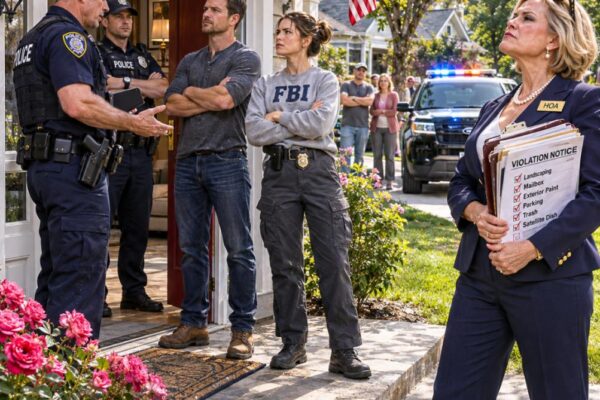
HOA Karen Invented Violations, Called 911 on Moving Day, and Tried to Fine Me Into Submission—She Has Vastly Underestimated My Intelligence.k
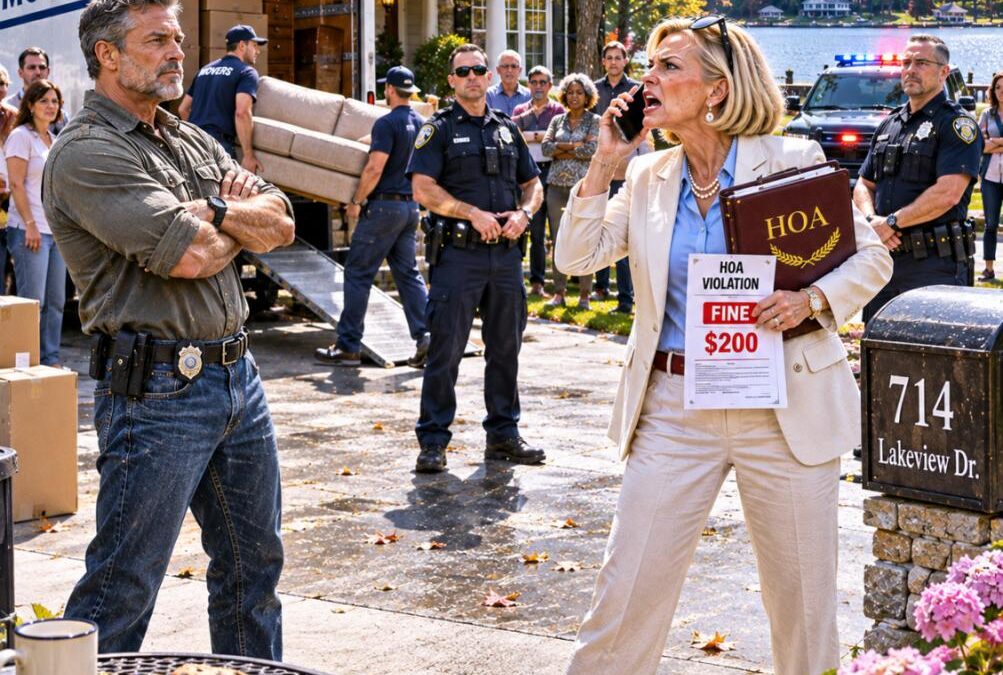
HOA Karen Invented Violations, Called 911 on Moving Day, and Tried to Fine Me Into Submission—She Has Vastly Underestimated My Intelligence
She fined me $200 before I had even finished unloading the moving truck, then called 911 when I refused to hand her a check.
Within forty-eight hours, HOA Karen doubled the penalties, circulated my photograph, and convinced half the neighborhood I was a dangerous former cop.
What she didn’t understand was that after thirty years of reading reports, warrants, budgets, and lies, I knew exactly what to preserve when someone started manufacturing a case.
The cookies were still warm when Diane Walsh called 911 on me.
That is the part I remember most clearly.
Not the patrol cars.
Not the citation in her hand.
Not even the way her voice changed when she spoke to the dispatcher.
The cookies.
Chocolate chip, homemade, sitting on a ceramic plate near the edge of my driveway while the rental truck idled behind me and two movers carried my sofa through the front door.
Diane had walked over like a welcoming committee.
Late fifties. Blonde hair sprayed into something the October wind couldn’t move. Cream slacks. Pale blue blouse. Leather folder tucked under one arm.
“Welcome to Whispering Pines.”
I was fifty-eight, three months into retirement after thirty years in law enforcement and eight years as a precinct captain. I had moved to the lake because I wanted mornings without radio traffic and evenings without incident reports.
I took one cookie.
“Michael Reed.”
“I know.”
That should have bothered me.
Instead, I smiled.
Then Diane looked past me at the moving truck.
Her warmth disappeared.
“That can’t stay there.”
I followed her eyes.
“It’s a moving truck.”
“It violates Section 12B.”
“For moving?”
“For oversized commercial vehicles visible from the street.”
“It’ll be gone by four.”
She opened the folder.
“Temporary presence still affects community aesthetics.”
I thought she was joking.
She wasn’t.
“I haven’t even slept here yet.”
“That doesn’t suspend the covenants.”
She photographed the truck.
Then my driveway.
Then the movers.
I felt an old instinct wake up.
Not anger.
Observation.
“Can you show me the rule?”
Her pen stopped.
“What?”
“The actual section.”
“I just told you.”
“I’d like to read it.”
Her expression tightened.
“Mr. Reed, most new residents appreciate guidance rather than challenging it.”
“I appreciate documentation.”
That was apparently the wrong answer.
She pulled out a preprinted form.
“Two hundred dollars.”
I stared at it.
“Fine?”
“Yes.”
“For a moving truck?”
“For failure to comply after notice.”
“You notified me thirty seconds ago.”
“Your attitude constitutes refusal.”
I handed the paper back.
“I’m not paying that.”
Diane’s face flushed.
“You do not get to decide which rules apply to you.”
“Neither do you.”
The movers slowed.
One of them looked away quickly.
Diane stepped backward and lifted her phone.
“Do not approach me.”
I hadn’t moved.
“Diane, I’m standing in my driveway.”
She dialed.
“Who are you calling?”
“Police.”
That almost made me laugh.
Then she said into the phone:
“I need officers at 714 Lakeview Drive. A new resident is becoming aggressive and refusing to comply with community restrictions.”
My smile disappeared.
I took out my own phone and started recording.
Fifteen minutes later, two patrol cars turned onto Whispering Pines Road.
Diane immediately became smaller.
Shoulders slightly rounded.
Voice trembling.
“He was angry. He got in my face.”
I said nothing until Officer Carter asked.
Then I handed him my license.
“My moving truck is scheduled to leave this afternoon. She issued an HOA fine. I disputed it. I never threatened her.”
Carter looked toward the truck.
Then at Diane.
Then back at my identification.
His eyes dropped to the retired police association card visible inside my wallet.
“Sir, were you law enforcement?”
Before I could answer, another cruiser arrived.
The sergeant who stepped out took one look at me and stopped.
“Captain Reed?”
I knew him immediately.
Marcus Brooks.
He had worked patrol under me twelve years earlier.
Diane’s expression changed.
Brooks walked up and shook my hand.
“Didn’t know you moved out here.”
“Three days ago.”
He looked toward Diane.
Then at the citation.
Then at the moving truck.
“What happened?”
Diane lifted the paper.
“This resident violated HOA rules and became threatening when I enforced them.”
Brooks read it.
Then looked at her.
“You called 911 over an HOA moving-truck fine?”
Her mouth opened.
And for the first time that morning, Diane Walsh looked like someone had asked a question she hadn’t prepared an answer for.
part 2
Brooks did not arrest her.
He did not threaten her.
He did not announce that calling police over an HOA dispute was automatically illegal.
That part matters because neighborhood retellings eventually turned the scene into something much more dramatic than it was.
What he actually did was professional.
He separated us.
Asked me what happened.
Asked Diane what happened.
Asked the movers what they observed.
Officer Carter checked whether any municipal rule prohibited the truck.
None did.
Then Brooks told Diane:
“If you believe Mr. Reed violated your association documents, use the association process. Police don’t enforce private covenants.”
She tried again.
“He intimidated me.”
Brooks looked at her.
“How?”
“He refused to comply.”
“That isn’t intimidation.”
“He became confrontational.”
“Did he threaten you?”
She hesitated.
“Not directly.”
“Did he touch you?”
“No.”
“Block you?”
“No.”
“Advance toward you?”
“No.”
Diane’s face reddened.
I stood twenty feet away and kept quiet.
That was harder than people think.
After three decades in police work, you learn that silence is often the most useful thing in a disputed account.
People who are manufacturing a narrative usually hate empty space.
They fill it.
Diane did.
“He made it very clear that he doesn’t respect the authority of the association.”
Brooks nodded once.
“That still isn’t a police matter.”
Her lips tightened.
I saw the moment she realized the uniform she had summoned wasn’t going to validate her.
Brooks turned toward me.
“Mike.”
I hadn’t heard anyone call me that in years.
“You good?”
“Yes.”
“Truck leaving today?”
“Four o’clock.”
“Then let the association figure out its own paperwork.”
I nodded.
Before the officers left, Brooks pulled me aside.
“I know you don’t need the advice.”
“Give it anyway.”
“Document everything.”
I smiled.
“Now you sound like me.”
“You trained me.”
Then his voice lowered.
“And don’t lean on the badge you used to have.”
That surprised me.
He continued.
“You’re not captain here.”
“I know.”
“Good.”
He looked toward Diane, who was still standing beside the cookie plate.
“Because I think she’s going to want you to become one.”
I understood.
She wanted the retired cop to overreact.
Flash credentials.
Make calls.
Threaten people.
Become the arrogant former officer she could use to prove her story.
I nodded.
“I’m a homeowner.”
“Exactly.”
The patrol cars left.
Diane remained.
The moving truck engine hummed between us.
I picked up the citation.
“You want this?”
“No.”
She folded her arms.
“Your refusal will be documented.”
“Everything should be.”
Her eyes narrowed.
Then she gathered the untouched cookies and walked away.
At 4:12 p.m., the rental truck left Whispering Pines.
At 7:43 that evening, an email arrived.
SUBJECT: CONTINUING NONCOMPLIANCE — 714 LAKEVIEW DRIVE.
Original fine: $200.
Failure to cooperate: $100.
Disturbance of community peace: $100.
Total: $400.
Payment due within forty-eight hours.
Failure to remit may result in additional collection expenses, suspension of amenity privileges, and legal enforcement.
I read it twice.
Then printed it.
Not because I enjoy paper.
Because I spent thirty years learning that screens change and files disappear.
Paper stays annoyingly honest.
I created a folder.
DIANE WALSH / HOA.
My retirement had lasted eighty-six days.
Nathan Ellis laughed when I called him.
He had been my partner early in my career before leaving law enforcement, going to law school, and eventually becoming a civil-rights and real-estate attorney.
“You lasted less than three months.”
“I hate you.”
“You retired to a lake.”
“Yes.”
“And immediately got into an HOA dispute.”
“I did not get into it. It arrived with cookies.”
That made him laugh harder.
Then I sent him the violation.
His tone changed.
“Send me your purchase documents.”
“Why?”
“Because I want the declaration.”
“You think the fine’s invalid?”
“I think we start by reading what actually binds your property.”
That became the rhythm of the next month.
Diane acted.
Nathan asked for documents.
I preserved them.
Whispering Pines was a real HOA.
Unlike some suburban horror stories, there was no fake association.
My deed was subject to a recorded declaration.
Annual assessments were legitimate.
Architectural rules existed.
The association owned a lakeside pavilion, private roads, a boat launch, two small parks, and landscaped entrance property.
Diane was properly elected president.
That was the inconvenient part.
She had authority.
Just not as much as she thought.
Nathan found Section 12B.
Commercial vehicles over a specified weight could not be parked overnight or stored in visible areas except for temporary service, construction, delivery, or moving activity.
My rental truck fell squarely inside the exception.
The declaration even used the phrase:
temporary moving vehicles reasonably necessary for occupancy transition.
I called Nathan.
“You’re enjoying this.”
“I am.”
“Can they still fine me?”
“They can issue a fine. The question is whether it survives their required process.”
“What process?”
“Written notice. Opportunity to cure. Hearing before certain monetary penalties become final.”
“I received none of that.”
“I know.”
“Should I send her the section?”
“No.”
“Why?”
“Because I already did.”
Nathan had sent a two-page letter.
Not twenty.
He believed short letters made bad actors more nervous.
Paragraph one:
Mr. Reed disputes the fine.
Paragraph two:
Section 12B expressly exempts temporary moving vehicles.
Paragraph three:
Please schedule the hearing required under Article 7.
Paragraph four:
Preserve all communications concerning Mr. Reed, the October 14 police call, and any enforcement action.
Diane responded personally.
Counsel is not necessary for routine HOA matters.
Nathan replied:
Thank you. Please provide the hearing date.
No answer.
The next morning, my neighbor Eric Lawson approached while I was installing shelves in the garage.
He glanced toward Diane’s house before speaking.
“You’re fighting her.”
“I asked for a hearing.”
“Same thing.”
Eric was maybe forty-five, software salesman, two teenage daughters, always dressed like he’d just stepped out of an airport lounge.
“She does this?”
He laughed nervously.
“You really are new.”
“What has she done?”
“Fines. Threats. Police calls. Compliance inspections.”
“Valid violations?”
“Some.”
That answer mattered.
“Others?”
He lowered his voice.
“Depends how much she likes you.”
I put down the drill.
“Give me an example.”
He hesitated.
Then shook his head.
“I shouldn’t have said anything.”
“Eric.”
“I have kids.”
“So do half the neighborhood.”
“You don’t understand.”
“Then help me.”
He looked toward Diane’s house again.
“She keeps files.”
“Violation files?”
“Everything.”
“What does everything mean?”
“Who’s divorced. Who’s behind on dues. Who’s refinancing. Which kid got arrested. Who drinks too much. Who’s fighting with who.”
“How would she know financial records?”
“Board access. Management company. People talk.”
“That doesn’t mean she has private credit data.”
“No.”
Eric rubbed his neck.
“But she knows enough to make people nervous.”
Then he left.
No witness statement.
No smoking gun.
Just fear.
I wrote down the conversation anyway.
Date.
Time.
Words as close as I remembered them.
Three days later, Clara Bennett knocked on my door.
Seventy-four.
Silver hair.
Walking cane she clearly resented needing.
She handed me a manila envelope.
“You’re Michael Reed.”
“Usually.”
“You were a police captain.”
“That used to matter more.”
She smiled.
“Good answer.”
Then she pushed the envelope toward me.
“Read these.”
Inside were copies of old HOA notices.
Court filings.
News clippings.
Board minutes.
One family name appeared repeatedly.
Thompson.
Robert and Denise Thompson had lived on Pineview Court.
Their problems began in 2018 over a dock modification.
Then lawn violations.
Visitor parking.
Holiday decorations.
Noise.
A fence.
The dispute escalated into litigation.
In 2019, a local court invalidated several fines because the HOA had failed to follow required procedures and because some penalties lacked adequate board authorization under the governing documents.
The ruling did not declare Diane personally evil.
It did not abolish the HOA.
It was narrower.
Yet Clara had highlighted one sentence:
Association officers may not substitute individual discretion for board authority where the governing documents reserve enforcement decisions to the board or designated committee.
I looked at her.
“Diane was president?”
“Yes.”
“Then?”
“Yes.”
“What happened to the Thompsons?”
“Moved.”
“Because of the lawsuit?”
Clara’s face tightened.
“After.”
She sat at my kitchen table.
“They won the important parts.”
“Then why leave?”
“Because winning didn’t make living here pleasant.”
That sentence stayed with me.
Clara continued.
“Complaints kept coming.”
“From Diane?”
“Hard to prove.”
“Did the court order her personally to stop?”
“No.”
“Then let’s be careful.”
She looked surprised.
“You’re defending her?”
“No.”
“I’m separating what the record says from what people remember.”
Clara stared at me.
Then smiled.
“You really were a cop.”
“Unfortunately.”
She tapped the envelope.
“Read the financial exhibits.”
That part was more interesting.
The Thompson litigation cost the association nearly sixteen thousand dollars beyond insurance coverage.
Within months, dues increased by fifty dollars per month for one year under what the board called a temporary stabilization assessment.
The increase itself wasn’t automatically improper.
HOAs sometimes need money.
But minutes describing the assessment were vague.
No clear explanation tied it directly to litigation.
Nathan requested financial records homeowners were entitled to inspect.
That started another war.
Diane emailed me:
Your attorney’s excessive requests are creating unnecessary administrative costs that may ultimately be charged back to your account.
I forwarded it to Nathan.
His response:
She shouldn’t threaten a requesting owner with costs that aren’t authorized. Save it.
I printed that too.
Meanwhile, Diane began working on my reputation.
A neighborhood forum post appeared.
SECURITY CONCERN — LAKEVIEW DRIVE.
It warned residents about “aggressive behavior toward board volunteers.”
No name.
But it referenced a recent police response involving “a resident with a law-enforcement background.”
Everyone knew.
Then a local weekly paper published a short community item claiming a “retired police official” had been involved in a dispute after refusing HOA compliance.
The article included a still image from neighborhood security footage showing me pointing toward my moving truck.
In the original footage, I had been showing Officer Carter where the truck was scheduled to depart.
The still made it look like I was confronting Diane.
I called Nathan.
“How did a newspaper get HOA security footage?”
“Excellent question.”
The reporter would not identify the source.
Fair.
Journalists protect sources.
But the image came from a camera controlled by the HOA.
We requested access logs and board authorization for release.
Diane called the request harassment.
Nathan called it discovery preparation.
I called it Tuesday.
My peaceful retirement was becoming a clerical job.
Then came the emergency HOA meeting.
Diane scheduled it for Sunday evening under:
RESIDENT CONDUCT AND COMMUNITY SAFETY.
I attended.
The pavilion overlooked the lake.
Thirty-seven homeowners sat beneath ceiling fans while sunset burned red across the water.
Diane presented a slide deck.
Noise.
Visitor registration.
Commercial activity.
Then my house appeared.
Again.
I had become visual aid number six.
She described “a pattern of hostility.”
Slide:
MOVING TRUCK INCIDENT.
Slide:
POLICE RESPONSE.
Slide:
UNREGISTERED BUSINESS ACTIVITY.
That one came from my consulting work.
I operated Caldwell—no, Reed Security Advisory LLC—from a home office.
No customers.
No employees.
No signage.
No inventory.
My declaration expressly allowed quiet professional work from home.
Diane knew that because I had sent her the section.
She showed the slide anyway.
Then Eric Lawson stood.
My stomach dropped before he spoke.
“Michael threatened Diane.”
The pavilion went silent.
Diane lowered her eyes modestly.
I stared at Eric.
He wouldn’t look at me.
Nathan sat beside me.
“Don’t react.”
I didn’t.
Eric continued.
“I heard him say she’d regret targeting him.”
I had never said that.
Diane said softly:
“Thank you, Eric. I know this is difficult.”
Something in his face looked wrong.
Not confident.
Afraid.
But a lie is still a lie even when fear produces it.
I wanted to stand.
Nathan touched my arm.
“Later.”
After the meeting, Clara met me near my car.
“Don’t quit.”
“I’m not quitting.”
“She did this to the Thompsons.”
“You keep saying that.”
“Because I watched people stop inviting them places.”
I looked back toward the pavilion.
Eric was speaking privately with Diane.
Clara followed my eyes.
“She isolates people.”
“Then we don’t let her isolate facts.”
Nathan heard me.
“That’s annoyingly good.”
“I have my moments.”
The financial records arrived two weeks later.
Not all of them.
Enough.
Nathan and I sat in his office with three years of ledgers.
Legal fees.
Consulting.
Travel reimbursement.
Vendor payments.
Administrative expenses.
The sixteen-thousand-dollar Thompson litigation expense was real.
So was the temporary dues increase.
But saying Diane “stole” sixteen thousand dollars would have been false.
The association had actually paid legal bills.
What concerned Nathan was that some expenses had been coded under generic categories that concealed their purpose from ordinary financial summaries.
“Bad transparency,” he said.
“Illegal?”
“Not automatically.”
Then we found payments to Walsh Community Consulting.
My stomach tightened.
“Her company?”
“Looks like it.”
Six payments.
Total just under twelve thousand dollars over eighteen months.
Descriptions:
SPECIAL PROJECT COORDINATION.
VENDOR REVIEW.
COMMUNITY RISK ASSESSMENT.
Nathan looked at the board minutes.
“No obvious disclosure.”
“Conflict?”
“Potentially.”
“Fraud?”
“Too early.”
I hated that phrase by then.
Too early.
Then Nathan found something better.
The HOA conflict policy required any director with a financial interest in a vendor transaction to disclose that interest and abstain from voting.
We searched minutes.
No disclosure.
Not proof she had secretly stolen eighty thousand dollars.
But a real governance problem.
Then came Eric.
He knocked on my door at 10:30 one night.
He looked sick.
“I lied.”
I said nothing.
“My statement.”
“I know.”
His head snapped up.
“You knew?”
“I knew what I said.”
He stepped inside after I invited him.
“I can’t sleep.”
“Why did you do it?”
He sat at the kitchen table.
“Diane threatened my family.”
“How?”
“She knows my daughter had a shoplifting charge last year.”
Juvenile.
Resolved.
Not public in the same way adult convictions are.
My expression changed.
“How does she know?”
“I told another board member when we asked for community service verification.”
“Okay.”
“She said if I didn’t support her version of the moving-day incident, she’d raise concerns about ‘criminal activity’ tied to our house.”
My jaw tightened.
“Did she say she’d publish your daughter’s case?”
“Not exactly.”
“Eric.”
“She said, ‘It would be unfortunate if residents learned why your family has had law-enforcement contact.’”
That was ugly.
Not necessarily blackmail in the technical criminal-law sense without more analysis.
But ugly.
“Did you record it?”
“No.”
“Text?”
“No.”
“Email?”
“No.”
“Anyone hear?”
“My wife.”
“Will she give a statement?”
“Yes.”
I sat across from him.
“Then write what happened tonight while you remember.”
He started crying.
Not dramatically.
Just quietly.
“I’m sorry.”
I was angry.
But I had seen fear make good people cowardly before.
“I accept the apology.”
His shoulders dropped.
“That doesn’t erase the lie.”
“I know.”
“You’ll correct it publicly.”
He nodded.
“Yes.”
“And if Nathan needs a sworn statement, you tell the truth.”
“Yes.”
That changed things.
Not because Eric was the magic witness.
Because his story fit a pattern.
Diane did not merely enforce rules.
She created leverage.
Then Nathan obtained something I hadn’t expected.
The 2019 Thompson case file included deposition exhibits not easily visible in the online docket.
One email from Diane to another director said:
If the Thompsons believe a court ruling means they can stay here comfortably, they’re mistaken. We still have every right to monitor compliance closely.
Not an admission of illegal harassment.
But disturbing.
Another said:
People who fight the association should understand that living in a community requires consequences.
Nathan read it aloud.
“Consequences.”
I leaned back.
“She thinks the lawsuit itself justified more scrutiny.”
“Yes.”
“Can we use this?”
“Context.”
Again.
Always context.
Then Clara brought one more envelope.
She seemed to have an endless supply.
Inside was an audio recording on a USB drive.
“Where did this come from?”
“My doorbell camera.”
I frowned.
“Diane visited you?”
“Last week.”
I listened.
Diane’s voice:
You need to decide whether you want another Thompson situation.
Clara:
What does that mean?
Diane:
They spent thousands, embarrassed the neighborhood, and left anyway.
Clara:
Are you threatening Michael?
Diane:
I’m explaining reality.
Clara:
He’ll hear about this.
Diane:
He should.
There was no dramatic confession.
But there was intent to use the Thompsons as a warning.
Nathan listened twice.
“Preserve the original device.”
Clara nodded.
“I haven’t deleted anything.”
Then he asked:
“Was she aware your doorbell records audio?”
Clara pointed at the visible camera mounted beside her door.
“Hard to miss.”
State recording law mattered.
Nathan checked before we relied on it.
Always process.
The board meeting showdown happened Tuesday night.
Not because I orchestrated a trap.
Because Diane placed a motion on the agenda to suspend my pavilion and boat-launch privileges for repeated conduct violations.
She planned to make me an example.
Nathan and I planned to make everyone read.
The pavilion filled.
More than sixty homeowners.
Diane wore a navy suit.
Her PowerPoint began.
MOVING VIOLATION.
NOISE.
POLICE CONTACT.
HOSTILE COMMUNICATION.
BUSINESS ACTIVITY.
BOARD INTIMIDATION.
I sat silently through all of it.
Then Eric stood.
“I need to correct something.”
Diane froze.
Eric faced the room.
“At the last meeting, I said Michael threatened Diane.”
He swallowed.
“That was false.”
Murmurs.
Diane said:
“Eric, this isn’t the time.”
He looked at her.
“It is.”
Then he explained the conversation involving his daughter’s juvenile matter.
Diane interrupted repeatedly.
“He misunderstood.”
“I never threatened disclosure.”
“I encouraged responsible community conduct.”
Eric’s wife stood beside him.
“I heard the call on speaker.”
The room quieted.
Diane looked toward the board attorney.
He was writing furiously.
Then Nathan spoke.
Not dramatically.
“Before any vote concerning Mr. Reed, we request that the board consider whether enforcement decisions involving him have been handled by a neutral process.”
He distributed a packet.
Moving-truck exemption.
Hearing requirement.
Police incident report showing no threat.
Home-business provision.
Conflict policy.
Walsh Community Consulting payments.
2019 Thompson ruling excerpts.
Diane’s email about monitoring the Thompsons after litigation.
Then Clara’s recording.
Nathan did not start by playing it.
He explained it.
Diane objected.
The board attorney asked to hear it.
So we played it.
You need to decide whether you want another Thompson situation.
They spent thousands, embarrassed the neighborhood, and left anyway.
No one spoke afterward.
Diane finally said:
“That was taken out of context.”
Nathan nodded.
“Then give the context.”
Her face tightened.
“I was warning Clara about the costs of unnecessary conflict.”
Clara stood.
“You were warning me not to help Michael.”
“No.”
“You came to my house because you knew I’d given him the Thompson file.”
Diane’s expression changed.
That was new to me.
“How did she know?”
Clara looked at her.
“Exactly.”
The room erupted.
The board chair—Diane herself—tried to restore order.
Nobody listened until the vice president, Susan Bell, stood and said:
“We need to recess.”
Diane snapped:
“No.”
Susan looked at the attorney.
He nodded.
“We should recess.”
For fifteen minutes, board members disappeared into a side room.
Diane remained outside.
She walked directly toward me.
Nathan stepped between us.
She looked at him.
“I don’t need your permission to speak to a homeowner.”
Nathan moved aside.
I stood.
Diane’s voice dropped.
“You think you’ve won something.”
“No.”
“You have no idea what I’ve done for this place.”
“I believe you’ve done a lot.”
That confused her.
“Then why are you trying to destroy me?”
“I’m trying to stop you from using the HOA as a personal weapon.”
Her face turned red.
“You came here eight months ago.”
“Yes.”
“I have protected this community for twelve years.”
“From moving trucks?”
“From people who think rules don’t apply to them.”
“The moving truck was exempt.”
“That isn’t the point.”
I almost laughed.
“It is literally the point.”
Her hands trembled.
“The Thompsons tried this too.”
“There it is.”
She realized what she had said.
I waited.
Diane continued anyway.
“They sued. They humiliated everyone. And after all that, they still left.”
“Why are you proud of that?”
Her face went blank.
“I am not proud.”
“You use them as a warning.”
“I use them as an example of what happens when residents turn every disagreement into warfare.”
I leaned closer, not threatening, simply making sure she heard me.
“The court found some of your fines invalid.”
“That doesn’t mean they were good neighbors.”
“Maybe not.”
She blinked.
Again, she expected me to make the Thompsons saints.
I wouldn’t.
“Good neighbors can violate rules.”
I continued.
“Difficult people still deserve due process.”
Nathan smiled slightly behind her.
Diane stepped back.
The board returned.
Susan took the microphone.
“The board will not vote tonight on sanctions against Michael Reed.”
Applause started.
Susan raised her hand.
“Please.”
It stopped.
“Instead, the board is authorizing independent counsel to review enforcement procedures, conflict disclosures, and selected financial transactions.”
Diane stood.
“You cannot do that without the president’s approval.”
The board attorney answered:
“The bylaws permit a majority vote.”
Susan called the motion.
Four to one.
Diane against.
Then Susan introduced another.
Temporary recusal of Diane from enforcement matters involving me, Eric, Clara, and any matter connected to the Thompson litigation review.
Three to two.
Passed.
Diane sat down.
She looked smaller.
Not defeated.
Cornered.
That was dangerous.
Three nights later, at 2:07 a.m., the alarm at the HOA office activated.
I did not hear it.
I was asleep.
Eric did.
As part of the association’s volunteer technology committee, he had recently been given access to building-security alerts because the previous vendor’s contract was being reviewed.
His phone received an automated notification.
He opened the camera feed.
A person was inside the office.
Not smashing windows.
Not masked.
Diane.
She had used a key.
That mattered legally.
Whether it was burglary, unauthorized entry, destruction of records, or something else would depend on her remaining authority and intent.
Eric called 911.
Then called Susan.
Police arrived.
They found Diane inside with boxes of shredded papers and a laptop open to the association’s cloud-storage system.
The neighborhood version became:
She was caught deleting everything.
Reality was more specific.
Investigators preserved the computer.
Forensic review later showed deletion activity involving certain directories after the board’s independent-review vote.
Some files were recoverable.
Some shredding involved duplicate paper records.
Some involved documents relevant to vendor payments.
That was serious.
But I refused to call it all evidence destruction until investigators did.
Diane was removed from the office that night.
She was later charged based on conduct prosecutors believed they could prove.
Separate financial investigation followed.
And this is where the story everyone tells becomes exaggerated.
People claimed she stole eighty thousand dollars.
The audit did not support that exact number as personal theft.
It identified roughly seventy-eight thousand dollars in transactions requiring additional documentation, including legal costs, consulting fees, travel, vendor reimbursements, and payments involving entities connected to Diane.
After review, a smaller but still significant portion was determined to involve improper self-dealing, unsupported reimbursement, or expenses outside authorized purposes.
That was bad enough.
No need to inflate it.
Walsh Community Consulting had received payments without proper conflict disclosure.
Several travel expenses charged to association accounts had mixed personal and HOA purposes.
Some vendor invoices lacked documentation.
Investigators referred findings to prosecutors and the state agency overseeing relevant corporate matters.
Diane eventually entered a plea agreement involving financial misconduct and records-related offenses.
She did not receive some television-style twenty-year sentence.
She received a combination of incarceration on a limited term, suspended time, supervised probation, restitution, and restrictions connected to fiduciary activity.
The exact restitution figure was lower than the neighborhood rumors.
Her house was not “seized.”
She later sold it voluntarily while dealing with legal bills and restitution obligations.
That distinction matters.
Punishment should come from law.
Not gossip.
The board removed her as president immediately after the office incident.
Removing her elected director seat required the membership process.
The recall vote happened three weeks later.
Diane did not attend in person.
Her attorney submitted a statement.
It argued that some accusations had been exaggerated.
That was true.
It argued she had contributed years of valuable service.
Also true.
Then it claimed the investigation was retaliation orchestrated by me.
That part irritated me.
When my turn came, I walked to the microphone.
No badge.
No retired police card.
No uniform.
Just a homeowner.
“I spent thirty years in law enforcement.”
The room quieted.
“I’ve seen what happens when authority becomes personal.”
I looked toward the empty seat where Diane usually sat.
“Cops are dangerous when they confuse disrespect with illegality.”
I paused.
“HOA boards are dangerous when they confuse disagreement with noncompliance.”
Susan nodded slightly.
“Diane was right about something.”
People shifted.
“Communities need rules.”
“I bought here knowing there was an HOA.”
“I expect to follow the declaration.”
I held up my original moving citation.
“But this truck was expressly exempt.”
Then my hearing request.
“I was entitled to process.”
Then the business provision.
“My consulting office was permitted.”
Then the police report.
“No threat was substantiated.”
I put everything down.
“I do not want a special exemption because I used to be a police captain.”
That mattered deeply to me.
“When Sergeant Brooks recognized me on moving day, the atmosphere changed.”
Several people remembered.
“That shouldn’t be the reason anyone listens.”
Silence.
“If I had spent thirty years repairing air conditioners, Section 12B would still say the same thing.”
“If I had never worn a badge, Diane still should not have been able to invent a violation.”
I looked around.
“Authority should survive the identity of the person questioning it.”
Then I addressed Eric.
“He lied about me.”
Eric lowered his head.
“He also corrected the lie publicly and gave investigators the truth.”
Then Clara.
“She brought records.”
Then Susan.
“She asked for an audit.”
“This was not one retired cop defeating one HOA president.”
I shook my head.
“It was a group of homeowners deciding that documents matter more than fear.”
I stepped away.
The recall passed.
Not unanimously.
Strongly.
Diane’s era ended.
Susan became interim president.
Her first announcement was:
“No new rule proposals for sixty days.”
People applauded harder for that than the recall.
Then came reform.
Not revolution.
We did not dissolve the HOA.
It owned roads and common facilities that required maintenance.
We needed governance.
What we didn’t need was personality-based governance.
Independent financial audit every year.
Quarterly summaries posted to owners.
Conflict disclosures.
Two-signature controls for certain payments.
Documented board votes.
Written hearing procedures.
No individual director permitted to issue monetary fines alone.
Clear standards for releasing security footage.
Privacy rules around homeowner information.
A complaint process for board misconduct.
Emergency-service guidance reminding residents that 911 was for emergencies, not covenant enforcement.
Nathan helped draft what residents jokingly called the Homeowner Bill of Rights.
He hated the name because it sounded grander than the document.
It was really six pages of procedures.
Notice.
Evidence.
Hearing.
Appeal.
Conflict disclosure.
Record access.
Boring.
Beautiful.
Then Susan asked me to run for president.
I laughed.
“No.”
“You’re qualified.”
“Exactly why I’m saying no.”
“You ran a precinct.”
“I’m retired.”
“You attend every meeting.”
“Because Diane made me paranoid.”
“You understand procedure.”
“That is not enough reason to give a retired cop another position of authority.”
Susan stared at me.
“That may be the best reason.”
I still said no.
For three months.
Then Clara cornered me at the mailbox.
“You should do it.”
“No.”
“Why?”
“I moved here for peace.”
She looked around.
“How’s that going?”
I hated her.
Eventually, I agreed to serve one term.
One.
With conditions.
No president-issued fines.
No president-controlled security files.
No president-only access to financial systems.
Authority distributed.
If I ever started saying:
Because I’m the president,
I wanted someone to throw me into the lake.
Nathan volunteered.
Enthusiastically.
I won the election.
Not because everyone worshiped the retired captain.
Some homeowners voted against me specifically because I was one.
Fair.
I became HOA president fourteen months after Diane fined my moving truck.
My first board meeting lasted twenty-seven minutes.
People thought I was a genius.
I wasn’t.
I published the agenda early.
Kept discussion to actual motions.
Sent side arguments to committees.
And refused to let anybody give a twelve-minute speech about mailbox colors.
Police command skills, finally useful.
We contacted the Thompsons.
That mattered.
I found Robert Thompson through Nathan.
He lived in North Carolina.
When I called, he was suspicious.
“Why?”
“Because the HOA reviewed the 2019 case.”
“You reopening it?”
“No.”
“I’m the new president.”
Long silence.
Then:
“God help you.”
I laughed.
“We found the court ruling, the follow-up emails, and some enforcement history.”
“What do you want?”
“To apologize.”
Another silence.
“On behalf of the association, for continuing scrutiny that appears to have been influenced by the litigation.”
Robert breathed out slowly.
“You’re serious.”
“Yes.”
He did not cry.
I did not cry.
Nobody delivered a cinematic speech.
He said:
“Thank you.”
Then:
“We’re not coming back.”
“I didn’t expect you to.”
“Good.”
I asked whether we could reimburse certain fines the review identified as improperly issued after the ruling.
He agreed to let Nathan send a proposal.
The association approved the payment.
Not huge.
Symbolic in one sense.
Concrete in another.
A debt acknowledged.
The neighborhood began healing.
Eric volunteered for the financial committee.
Some residents objected because he had lied.
I supported him.
With safeguards.
People should be accountable.
They should also be allowed to repair what they damaged.
He became obsessive about documentation.
Every invoice scanned.
Every approval attached.
Every vendor conflict checked.
Fear had made him dishonest once.
Guilt made him transparent afterward.
Clara became the unofficial conscience of Whispering Pines.
She hated the title.
Then behaved exactly like someone who enjoyed it.
At every meeting:
“Did you read the minutes?”
“Yes, Clara.”
“Did Nathan?”
“He wrote them.”
“That’s not what I asked.”
She was relentless.
Brooks visited occasionally.
Never in uniform.
He brought beer once for a football game.
When he walked into my backyard, Nathan pointed at him.
“Noise enforcement?”
Brooks said:
“Absolutely. I’ll need one beer as evidence.”
We watched the game.
Our team lost.
Diane’s criminal case moved through court while the neighborhood moved on.
I attended one hearing.
Not because I needed to see her punished.
Because I had submitted records.
She looked older.
No power suit.
No perfect hair.
When the judge accepted her plea, he focused on fiduciary responsibility, financial honesty, and preservation of records.
No speech about HOA tyranny.
No grand morality play.
Law deals in elements.
That is one reason I still respect it.
Afterward, Diane’s attorney approached Nathan and me.
“She wants to apologize.”
I almost said no.
Then I remembered the Thompsons.
Winning doesn’t always close a wound.
Sometimes words help.
We agreed to mediation months later.
Diane sat across from me in a conference room.
She did not look at me initially.
Then said:
“I thought you were going to take control.”
I almost laughed.
“Of what?”
“Whispering Pines.”
“I had been here one day.”
“You were a police captain.”
“So?”
“People like you enter a room and everyone listens.”
That sentence surprised me.
She continued.
“I spent twelve years becoming the person everyone listened to.”
There it was.
Not property values.
Not trucks.
Power.
“You felt threatened.”
“Yes.”
“By me existing?”
“By what you represented.”
“What did I represent?”
“Someone people might trust more.”
I leaned back.
“Then the fine wasn’t about the truck.”
“It started with the truck.”
“Diane.”
She looked down.
“No.”
The word was quiet.
“It wasn’t.”
I waited.
She told me something I had not known.
Her husband had died six years earlier.
For years before that, he had handled the finances, home, travel, major decisions.
After his death, HOA work gave her structure.
Then identity.
Then status.
Every solved problem made people call her.
Every crisis expanded her role.
Eventually, being needed became being obeyed.
“I convinced myself they were the same thing.”
She looked at me.
“They aren’t.”
“No.”
She nodded.
“I know.”
Then she apologized for involving police.
For using Eric’s family information.
For the misleading forum posts.
For the financial conflicts.
Not everything.
She still believed some of the Thompson enforcement had been justified.
Maybe some had.
People are allowed to retain disagreement after accountability.
Then she said:
“I hated you before I knew you.”
I stared at her.
“That’s efficient.”
She almost smiled.
“Because Brooks respected you.”
That stunned me.
“After the 911 call?”
“Yes.”
“You hated me because a sergeant shook my hand?”
“No.”
She shook her head.
“Because I saw how quickly everyone looked at me differently once they knew who you were.”
I understood.
Her authority depended on perception.
Mine had arrived accidentally through history.
Diane interpreted respect for me as loss for her.
That made the rest easier to see.
“There didn’t have to be only one respected person.”
“I know.”
“Now.”
“Yes.”
I accepted the apology.
That did not erase restitution.
Probation.
The recall.
The damage.
Forgiveness and accountability are not opposites.
Then, six months into my presidency, Vanessa Hall moved into Diane’s old house.
Neighborhood gossip almost killed me.
New woman.
Early fifties.
Meticulous.
Carried a clipboard.
Asked for HOA records.
Measured her property line.
People started whispering.
“Diane 2.0.”
Clara called me.
“Watch her.”
I laughed.
“What has she done?”
“She requested six years of financial statements.”
“She is entitled to inspect records.”
“She measured the setback by the lake.”
“Probably smart.”
“She asked about enforcement authority.”
“So did I.”
Silence.
Clara sighed.
“I hate when you’re reasonable.”
Vanessa attended the next meeting.
She sat in the front row with a binder.
At homeowner comments, she stood.
“My name is Vanessa Hall. I bought 802 Pine Shore.”
I nodded.
“Welcome.”
“I have several questions.”
Nathan texted me from the back row.
YOUR NIGHTMARE HAS ARRIVED.
I ignored him.
Vanessa asked about reserve funding.
Good question.
Then vendor bidding.
Good.
Then board conflict disclosures.
Very good.
Then why one landscaping contract had renewed automatically.
Excellent.
People shifted nervously.
They expected me to become Diane.
I didn’t.
I answered what I knew.
Where I didn’t know, I said:
“I don’t know.”
Then assigned follow-up.
Vanessa looked almost disappointed.
Afterward, Clara approached.
“Well?”
“Well what?”
“She’s trouble.”
“Why?”
“She asks too many questions.”
I stared at her.
Then Clara realized.
“Oh.”
“Yes.”
She started laughing.
“Diane said that about you.”
“Exactly.”
The lesson hit all of us.
We had spent a year fighting the idea that questions were defiance.
Then almost repeated it against the next newcomer.
Vanessa became treasurer the following year.
She was irritating.
Detailed.
Demanding.
Wonderful.
She found an insurance-renewal error that saved the association eleven thousand dollars.
Clara apologized for misjudging her.
Eventually.
Two years after Diane left, my backyard became exactly what I had wanted on moving day.
Football.
Friends.
Lake beyond the fence.
Beer in the cooler.
Brooks sometimes.
Nathan constantly.
Eric and his wife.
Clara if she heard food was involved.
Vanessa occasionally, though she brought spreadsheets.
One Saturday our team scored with thirty seconds left.
Everyone yelled.
I looked instinctively toward Diane’s old house.
Vanessa stood on her deck.
She held up her phone.
I froze.
Then she shouted:
“DECIBEL METER!”
Everybody laughed.
She came over five minutes later.
“No violation.”
“Thank God.”
“Peak was eighty-two.”
Nathan said:
“Fine him anyway.”
I threw a chip at him.
Peace, I discovered, was not silence.
It was living somewhere you could make ordinary noise without wondering whether somebody would convert annoyance into punishment.
It was receiving a real violation when you actually broke a real rule and knowing you could challenge it.
It was a treasurer asking uncomfortable questions without being treated like an enemy.
It was a former liar like Eric becoming useful because systems no longer depended on personal trust alone.
It was Clara correcting everyone.
Constantly.
It was Brooks visiting as a friend instead of arriving because somebody weaponized 911.
That first morning still comes back to me sometimes.
Diane with cookies.
Moving truck.
Citation.
Phone call.
Brooks recognizing me.
For years in law enforcement, I believed abuse of authority usually looked obvious.
A bad arrest.
A falsified report.
A threat.
A bribe.
Retirement taught me that smaller institutions have their own versions.
Selective fines.
Private information used as leverage.
Board rules interpreted through grudges.
Financial controls resting in one person’s hands.
Security footage released for personal purposes.
A president convincing herself that questioning her is the same as undermining the community.
Power doesn’t need a gun to become unhealthy.
Sometimes all it needs is a password, a checkbook, and nobody reading the minutes.
I keep my original $200 moving-truck citation in my office.
Framed.
Vanessa thinks that’s unhealthy.
Nathan thinks it’s hilarious.
Beneath it I added the actual language from Section 12B:
TEMPORARY MOVING VEHICLES ARE PERMITTED FOR REASONABLE OCCUPANCY TRANSITION.
Visitors notice the contradiction immediately.
That’s why I kept it.
Diane’s first mistake was not misunderstanding the rule.
Everyone misunderstands rules.
Her first mistake was refusing to check after being questioned.
Everything after that grew from certainty.
I spent three decades watching certainty ruin investigations.
Detective decides the husband did it.
Now every fact points toward the husband.
Officer decides a driver is lying.
Now nervousness becomes deception.
Commander decides a plan cannot fail.
Now warnings become negativity.
Diane decided I was defiant.
Then every question became aggression.
Every visitor became an unauthorized gathering.
Every email became harassment.
Every legal request became intimidation.
Once you decide who the problem is, evidence becomes decoration.
That is why our new HOA procedures contain something Nathan jokingly calls the Reed Rule.
It isn’t actually named after me.
I would never allow that.
The policy says:
No fine becomes final solely on the determination of the officer or director who initiated the complaint when a material factual dispute or personal conflict exists.
Second review.
Simple.
One extra set of eyes.
Vanessa says it’s inefficient.
I tell her inefficiency is sometimes the price of fairness.
She tells me that’s something old people say when software could solve the problem.
We argue.
Healthy community.
I served one term as president.
Then stepped down.
People tried to convince me to stay.
No.
Power should rotate before comfort turns it into identity.
Susan ran next.
Then Vanessa.
I returned to my porch.
Exactly where I belonged.
Occasionally someone still calls me Captain.
Usually Brooks.
Nathan calls me Dictator whenever I ask him to use a coaster.
Clara calls me Michael when she’s pleased and Reed when I have disappointed her.
I can live with that.
Diane’s old house looks different now.
Vanessa removed the white shutters.
Painted the front door dark green.
Installed native plants Diane would probably have called untidy.
All approved.
Properly.
One evening I walked past while Vanessa was measuring something near the driveway.
“You need a hobby.”
She looked up.
“This setback is wrong on the association map.”
I stopped.
“How wrong?”
“Twenty-two inches.”
“Does it matter?”
“Probably not.”
“Then why are you measuring?”
She stared at me like I was stupid.
“Because the map should be right.”
I smiled.
Whispering Pines had found exactly the president it needed.
Someone annoying for the right reasons.
I never saw Diane again after mediation.
I heard through counsel that she completed her sentence and restitution obligations.
I hope she built a life somewhere no one needed her to be in charge.
I mean that.
People expect me to say I hope she suffered.
She did.
So did her victims.
There is no moral profit in extending suffering past accountability.
The useful question is whether the system learned.
Whispering Pines did.
The Thompsons received an apology.
Eric told the truth.
Clara stopped being afraid of board meetings.
Financial records opened.
Security footage received privacy controls.
911 stopped being a compliance tool.
Questions became ordinary.
That matters more to me than Diane’s punishment.
Thirty years in policing taught me how easily communities become dependent on strong personalities.
Someone decisive.
Someone willing to handle conflict.
Someone who says:
Leave it to me.
At first, that’s convenient.
Then people stop reading.
Stop voting.
Stop asking.
Stop noticing when the useful leader becomes the unquestioned leader.
Diane did not seize Whispering Pines in one dramatic act.
People handed her pieces.
One meeting at a time.
One password.
One unchallenged reimbursement.
One “whatever Diane thinks is best.”
Then everyone woke up surprised that she thought the association belonged to her.
I don’t blame residents for all of it.
But I don’t let them pretend they had no role either.
Community governance is work.
Boring work.
Budgets.
Minutes.
Elections.
Questions.
If nobody wants to do it, eventually the person who wants power most will do it for you.
And they may send cookies first.
Four years after moving day, Nathan and I were sitting in the backyard watching football.
Same setup.
Outdoor television.
Cooler.
Lake beyond the trees.
Our team was losing badly.
Nathan looked at the framed moving citation hanging just inside my patio door.
“You know, without Diane you’d never have become HOA president.”
“Don’t ruin retirement for me twice.”
“You owe her.”
“I will drown you.”
“You’re becoming aggressive.”
I pointed toward the lake.
“Leave.”
He laughed.
Then our team intercepted a pass.
Touchdown.
We both jumped.
Shouted.
Probably too loud.
Vanessa texted seconds later.
UNAUTHORIZED GATHERING. $650. PAYABLE TO ME PERSONALLY.
I stared at the screen.
Then laughed until my ribs hurt.
Nathan looked over.
“What?”
I showed him.
He shook his head.
“Community has healed.”
Maybe it had.
Not because we forgot what happened.
Because we could finally joke about authority without fearing what authority would do next.
That is the retirement I eventually earned.
Not a life without conflict.
A life where conflict had boundaries.
Where a president could be questioned.
Where a homeowner could be wrong.
Where a retired captain did not get special treatment.
Where the rule mattered more than the person quoting it.
Diane called police on me because I challenged a $200 moving-truck fine.
She believed my refusal proved I was dangerous.
Brooks recognizing me broke that story for a moment.
But recognition was never the real victory.
Documents were.
The moving-truck exception.
The hearing requirement.
The Thompson ruling.
The conflict policy.
The bank records.
The security logs.
Eric’s correction.
Clara’s recording.
One boring piece after another.
By the time Diane’s authority finally collapsed, nobody needed my old badge.
That’s the part I am proudest of.
Because peace built on one respected man’s reputation isn’t peace.
It’s another hierarchy waiting for the wrong person to inherit it.
Whispering Pines became stronger when nobody had to ask who I used to be before deciding whether my question deserved an answer.
And now, when a new homeowner raises a hand at a meeting and says:
“Can you show me where that rule is written?”
Nobody glares.
Nobody calls them defiant.
Nobody reaches for a phone.
Someone opens the binder.
That small difference took us years to learn.
It was worth every page.
THE STORY ENDS HERE
HOA Karen Invented Violations, Called 911 on Moving Day, and Tried to Fine Me Into Submission—She Has Vastly Underestimated My Intelligence
She fined me $200 before I had even finished unloading the moving truck, then called 911 when I refused to hand her a check.
Within forty-eight hours, HOA Karen doubled the penalties, circulated my photograph, and convinced half the neighborhood I was a dangerous former cop.
What she didn’t understand was that after thirty years of reading reports, warrants, budgets, and lies, I knew exactly what to preserve when someone started manufacturing a case.
The cookies were still warm when Diane Walsh called 911 on me.
That is the part I remember most clearly.
Not the patrol cars.
Not the citation in her hand.
Not even the way her voice changed when she spoke to the dispatcher.
The cookies.
Chocolate chip, homemade, sitting on a ceramic plate near the edge of my driveway while the rental truck idled behind me and two movers carried my sofa through the front door.
Diane had walked over like a welcoming committee.
Late fifties. Blonde hair sprayed into something the October wind couldn’t move. Cream slacks. Pale blue blouse. Leather folder tucked under one arm.
“Welcome to Whispering Pines.”
I was fifty-eight, three months into retirement after thirty years in law enforcement and eight years as a precinct captain. I had moved to the lake because I wanted mornings without radio traffic and evenings without incident reports.
I took one cookie.
“Michael Reed.”
“I know.”
That should have bothered me.
Instead, I smiled.
Then Diane looked past me at the moving truck.
Her warmth disappeared.
“That can’t stay there.”
I followed her eyes.
“It’s a moving truck.”
“It violates Section 12B.”
“For moving?”
“For oversized commercial vehicles visible from the street.”
“It’ll be gone by four.”
She opened the folder.
“Temporary presence still affects community aesthetics.”
I thought she was joking.
She wasn’t.
“I haven’t even slept here yet.”
“That doesn’t suspend the covenants.”
She photographed the truck.
Then my driveway.
Then the movers.
I felt an old instinct wake up.
Not anger.
Observation.
“Can you show me the rule?”
Her pen stopped.
“What?”
“The actual section.”
“I just told you.”
“I’d like to read it.”
Her expression tightened.
“Mr. Reed, most new residents appreciate guidance rather than challenging it.”
“I appreciate documentation.”
That was apparently the wrong answer.
She pulled out a preprinted form.
“Two hundred dollars.”
I stared at it.
“Fine?”
“Yes.”
“For a moving truck?”
“For failure to comply after notice.”
“You notified me thirty seconds ago.”
“Your attitude constitutes refusal.”
I handed the paper back.
“I’m not paying that.”
Diane’s face flushed.
“You do not get to decide which rules apply to you.”
“Neither do you.”
The movers slowed.
One of them looked away quickly.
Diane stepped backward and lifted her phone.
“Do not approach me.”
I hadn’t moved.
“Diane, I’m standing in my driveway.”
She dialed.
“Who are you calling?”
“Police.”
That almost made me laugh.
Then she said into the phone:
“I need officers at 714 Lakeview Drive. A new resident is becoming aggressive and refusing to comply with community restrictions.”
My smile disappeared.
I took out my own phone and started recording.
Fifteen minutes later, two patrol cars turned onto Whispering Pines Road.
Diane immediately became smaller.
Shoulders slightly rounded.
Voice trembling.
“He was angry. He got in my face.”
I said nothing until Officer Carter asked.
Then I handed him my license.
“My moving truck is scheduled to leave this afternoon. She issued an HOA fine. I disputed it. I never threatened her.”
Carter looked toward the truck.
Then at Diane.
Then back at my identification.
His eyes dropped to the retired police association card visible inside my wallet.
“Sir, were you law enforcement?”
Before I could answer, another cruiser arrived.
The sergeant who stepped out took one look at me and stopped.
“Captain Reed?”
I knew him immediately.
Marcus Brooks.
He had worked patrol under me twelve years earlier.
Diane’s expression changed.
Brooks walked up and shook my hand.
“Didn’t know you moved out here.”
“Three days ago.”
He looked toward Diane.
Then at the citation.
Then at the moving truck.
“What happened?”
Diane lifted the paper.
“This resident violated HOA rules and became threatening when I enforced them.”
Brooks read it.
Then looked at her.
“You called 911 over an HOA moving-truck fine?”
Her mouth opened.
And for the first time that morning, Diane Walsh looked like someone had asked a question she hadn’t prepared an answer for.
part 2
Brooks did not arrest her.
He did not threaten her.
He did not announce that calling police over an HOA dispute was automatically illegal.
That part matters because neighborhood retellings eventually turned the scene into something much more dramatic than it was.
What he actually did was professional.
He separated us.
Asked me what happened.
Asked Diane what happened.
Asked the movers what they observed.
Officer Carter checked whether any municipal rule prohibited the truck.
None did.
Then Brooks told Diane:
“If you believe Mr. Reed violated your association documents, use the association process. Police don’t enforce private covenants.”
She tried again.
“He intimidated me.”
Brooks looked at her.
“How?”
“He refused to comply.”
“That isn’t intimidation.”
“He became confrontational.”
“Did he threaten you?”
She hesitated.
“Not directly.”
“Did he touch you?”
“No.”
“Block you?”
“No.”
“Advance toward you?”
“No.”
Diane’s face reddened.
I stood twenty feet away and kept quiet.
That was harder than people think.
After three decades in police work, you learn that silence is often the most useful thing in a disputed account.
People who are manufacturing a narrative usually hate empty space.
They fill it.
Diane did.
“He made it very clear that he doesn’t respect the authority of the association.”
Brooks nodded once.
“That still isn’t a police matter.”
Her lips tightened.
I saw the moment she realized the uniform she had summoned wasn’t going to validate her.
Brooks turned toward me.
“Mike.”
I hadn’t heard anyone call me that in years.
“You good?”
“Yes.”
“Truck leaving today?”
“Four o’clock.”
“Then let the association figure out its own paperwork.”
I nodded.
Before the officers left, Brooks pulled me aside.
“I know you don’t need the advice.”
“Give it anyway.”
“Document everything.”
I smiled.
“Now you sound like me.”
“You trained me.”
Then his voice lowered.
“And don’t lean on the badge you used to have.”
That surprised me.
He continued.
“You’re not captain here.”
“I know.”
“Good.”
He looked toward Diane, who was still standing beside the cookie plate.
“Because I think she’s going to want you to become one.”
I understood.
She wanted the retired cop to overreact.
Flash credentials.
Make calls.
Threaten people.
Become the arrogant former officer she could use to prove her story.
I nodded.
“I’m a homeowner.”
“Exactly.”
The patrol cars left.
Diane remained.
The moving truck engine hummed between us.
I picked up the citation.
“You want this?”
“No.”
She folded her arms.
“Your refusal will be documented.”
“Everything should be.”
Her eyes narrowed.
Then she gathered the untouched cookies and walked away.
At 4:12 p.m., the rental truck left Whispering Pines.
At 7:43 that evening, an email arrived.
SUBJECT: CONTINUING NONCOMPLIANCE — 714 LAKEVIEW DRIVE.
Original fine: $200.
Failure to cooperate: $100.
Disturbance of community peace: $100.
Total: $400.
Payment due within forty-eight hours.
Failure to remit may result in additional collection expenses, suspension of amenity privileges, and legal enforcement.
I read it twice.
Then printed it.
Not because I enjoy paper.
Because I spent thirty years learning that screens change and files disappear.
Paper stays annoyingly honest.
I created a folder.
DIANE WALSH / HOA.
My retirement had lasted eighty-six days.
Nathan Ellis laughed when I called him.
He had been my partner early in my career before leaving law enforcement, going to law school, and eventually becoming a civil-rights and real-estate attorney.
“You lasted less than three months.”
“I hate you.”
“You retired to a lake.”
“Yes.”
“And immediately got into an HOA dispute.”
“I did not get into it. It arrived with cookies.”
That made him laugh harder.
Then I sent him the violation.
His tone changed.
“Send me your purchase documents.”
“Why?”
“Because I want the declaration.”
“You think the fine’s invalid?”
“I think we start by reading what actually binds your property.”
That became the rhythm of the next month.
Diane acted.
Nathan asked for documents.
I preserved them.
Whispering Pines was a real HOA.
Unlike some suburban horror stories, there was no fake association.
My deed was subject to a recorded declaration.
Annual assessments were legitimate.
Architectural rules existed.
The association owned a lakeside pavilion, private roads, a boat launch, two small parks, and landscaped entrance property.
Diane was properly elected president.
That was the inconvenient part.
She had authority.
Just not as much as she thought.
Nathan found Section 12B.
Commercial vehicles over a specified weight could not be parked overnight or stored in visible areas except for temporary service, construction, delivery, or moving activity.
My rental truck fell squarely inside the exception.
The declaration even used the phrase:
temporary moving vehicles reasonably necessary for occupancy transition.
I called Nathan.
“You’re enjoying this.”
“I am.”
“Can they still fine me?”
“They can issue a fine. The question is whether it survives their required process.”
“What process?”
“Written notice. Opportunity to cure. Hearing before certain monetary penalties become final.”
“I received none of that.”
“I know.”
“Should I send her the section?”
“No.”
“Why?”
“Because I already did.”
Nathan had sent a two-page letter.
Not twenty.
He believed short letters made bad actors more nervous.
Paragraph one:
Mr. Reed disputes the fine.
Paragraph two:
Section 12B expressly exempts temporary moving vehicles.
Paragraph three:
Please schedule the hearing required under Article 7.
Paragraph four:
Preserve all communications concerning Mr. Reed, the October 14 police call, and any enforcement action.
Diane responded personally.
Counsel is not necessary for routine HOA matters.
Nathan replied:
Thank you. Please provide the hearing date.
No answer.
The next morning, my neighbor Eric Lawson approached while I was installing shelves in the garage.
He glanced toward Diane’s house before speaking.
“You’re fighting her.”
“I asked for a hearing.”
“Same thing.”
Eric was maybe forty-five, software salesman, two teenage daughters, always dressed like he’d just stepped out of an airport lounge.
“She does this?”
He laughed nervously.
“You really are new.”
“What has she done?”
“Fines. Threats. Police calls. Compliance inspections.”
“Valid violations?”
“Some.”
That answer mattered.
“Others?”
He lowered his voice.
“Depends how much she likes you.”
I put down the drill.
“Give me an example.”
He hesitated.
Then shook his head.
“I shouldn’t have said anything.”
“Eric.”
“I have kids.”
“So do half the neighborhood.”
“You don’t understand.”
“Then help me.”
He looked toward Diane’s house again.
“She keeps files.”
“Violation files?”
“Everything.”
“What does everything mean?”
“Who’s divorced. Who’s behind on dues. Who’s refinancing. Which kid got arrested. Who drinks too much. Who’s fighting with who.”
“How would she know financial records?”
“Board access. Management company. People talk.”
“That doesn’t mean she has private credit data.”
“No.”
Eric rubbed his neck.
“But she knows enough to make people nervous.”
Then he left.
No witness statement.
No smoking gun.
Just fear.
I wrote down the conversation anyway.
Date.
Time.
Words as close as I remembered them.
Three days later, Clara Bennett knocked on my door.
Seventy-four.
Silver hair.
Walking cane she clearly resented needing.
She handed me a manila envelope.
“You’re Michael Reed.”
“Usually.”
“You were a police captain.”
“That used to matter more.”
She smiled.
“Good answer.”
Then she pushed the envelope toward me.
“Read these.”
Inside were copies of old HOA notices.
Court filings.
News clippings.
Board minutes.
One family name appeared repeatedly.
Thompson.
Robert and Denise Thompson had lived on Pineview Court.
Their problems began in 2018 over a dock modification.
Then lawn violations.
Visitor parking.
Holiday decorations.
Noise.
A fence.
The dispute escalated into litigation.
In 2019, a local court invalidated several fines because the HOA had failed to follow required procedures and because some penalties lacked adequate board authorization under the governing documents.
The ruling did not declare Diane personally evil.
It did not abolish the HOA.
It was narrower.
Yet Clara had highlighted one sentence:
Association officers may not substitute individual discretion for board authority where the governing documents reserve enforcement decisions to the board or designated committee.
I looked at her.
“Diane was president?”
“Yes.”
“Then?”
“Yes.”
“What happened to the Thompsons?”
“Moved.”
“Because of the lawsuit?”
Clara’s face tightened.
“After.”
She sat at my kitchen table.
“They won the important parts.”
“Then why leave?”
“Because winning didn’t make living here pleasant.”
That sentence stayed with me.
Clara continued.
“Complaints kept coming.”
“From Diane?”
“Hard to prove.”
“Did the court order her personally to stop?”
“No.”
“Then let’s be careful.”
She looked surprised.
“You’re defending her?”
“No.”
“I’m separating what the record says from what people remember.”
Clara stared at me.
Then smiled.
“You really were a cop.”
“Unfortunately.”
She tapped the envelope.
“Read the financial exhibits.”
That part was more interesting.
The Thompson litigation cost the association nearly sixteen thousand dollars beyond insurance coverage.
Within months, dues increased by fifty dollars per month for one year under what the board called a temporary stabilization assessment.
The increase itself wasn’t automatically improper.
HOAs sometimes need money.
But minutes describing the assessment were vague.
No clear explanation tied it directly to litigation.
Nathan requested financial records homeowners were entitled to inspect.
That started another war.
Diane emailed me:
Your attorney’s excessive requests are creating unnecessary administrative costs that may ultimately be charged back to your account.
I forwarded it to Nathan.
His response:
She shouldn’t threaten a requesting owner with costs that aren’t authorized. Save it.
I printed that too.
Meanwhile, Diane began working on my reputation.
A neighborhood forum post appeared.
SECURITY CONCERN — LAKEVIEW DRIVE.
It warned residents about “aggressive behavior toward board volunteers.”
No name.
But it referenced a recent police response involving “a resident with a law-enforcement background.”
Everyone knew.
Then a local weekly paper published a short community item claiming a “retired police official” had been involved in a dispute after refusing HOA compliance.
The article included a still image from neighborhood security footage showing me pointing toward my moving truck.
In the original footage, I had been showing Officer Carter where the truck was scheduled to depart.
The still made it look like I was confronting Diane.
I called Nathan.
“How did a newspaper get HOA security footage?”
“Excellent question.”
The reporter would not identify the source.
Fair.
Journalists protect sources.
But the image came from a camera controlled by the HOA.
We requested access logs and board authorization for release.
Diane called the request harassment.
Nathan called it discovery preparation.
I called it Tuesday.
My peaceful retirement was becoming a clerical job.
Then came the emergency HOA meeting.
Diane scheduled it for Sunday evening under:
RESIDENT CONDUCT AND COMMUNITY SAFETY.
I attended.
The pavilion overlooked the lake.
Thirty-seven homeowners sat beneath ceiling fans while sunset burned red across the water.
Diane presented a slide deck.
Noise.
Visitor registration.
Commercial activity.
Then my house appeared.
Again.
I had become visual aid number six.
She described “a pattern of hostility.”
Slide:
MOVING TRUCK INCIDENT.
Slide:
POLICE RESPONSE.
Slide:
UNREGISTERED BUSINESS ACTIVITY.
That one came from my consulting work.
I operated Caldwell—no, Reed Security Advisory LLC—from a home office.
No customers.
No employees.
No signage.
No inventory.
My declaration expressly allowed quiet professional work from home.
Diane knew that because I had sent her the section.
She showed the slide anyway.
Then Eric Lawson stood.
My stomach dropped before he spoke.
“Michael threatened Diane.”
The pavilion went silent.
Diane lowered her eyes modestly.
I stared at Eric.
He wouldn’t look at me.
Nathan sat beside me.
“Don’t react.”
I didn’t.
Eric continued.
“I heard him say she’d regret targeting him.”
I had never said that.
Diane said softly:
“Thank you, Eric. I know this is difficult.”
Something in his face looked wrong.
Not confident.
Afraid.
But a lie is still a lie even when fear produces it.
I wanted to stand.
Nathan touched my arm.
“Later.”
After the meeting, Clara met me near my car.
“Don’t quit.”
“I’m not quitting.”
“She did this to the Thompsons.”
“You keep saying that.”
“Because I watched people stop inviting them places.”
I looked back toward the pavilion.
Eric was speaking privately with Diane.
Clara followed my eyes.
“She isolates people.”
“Then we don’t let her isolate facts.”
Nathan heard me.
“That’s annoyingly good.”
“I have my moments.”
The financial records arrived two weeks later.
Not all of them.
Enough.
Nathan and I sat in his office with three years of ledgers.
Legal fees.
Consulting.
Travel reimbursement.
Vendor payments.
Administrative expenses.
The sixteen-thousand-dollar Thompson litigation expense was real.
So was the temporary dues increase.
But saying Diane “stole” sixteen thousand dollars would have been false.
The association had actually paid legal bills.
What concerned Nathan was that some expenses had been coded under generic categories that concealed their purpose from ordinary financial summaries.
“Bad transparency,” he said.
“Illegal?”
“Not automatically.”
Then we found payments to Walsh Community Consulting.
My stomach tightened.
“Her company?”
“Looks like it.”
Six payments.
Total just under twelve thousand dollars over eighteen months.
Descriptions:
SPECIAL PROJECT COORDINATION.
VENDOR REVIEW.
COMMUNITY RISK ASSESSMENT.
Nathan looked at the board minutes.
“No obvious disclosure.”
“Conflict?”
“Potentially.”
“Fraud?”
“Too early.”
I hated that phrase by then.
Too early.
Then Nathan found something better.
The HOA conflict policy required any director with a financial interest in a vendor transaction to disclose that interest and abstain from voting.
We searched minutes.
No disclosure.
Not proof she had secretly stolen eighty thousand dollars.
But a real governance problem.
Then came Eric.
He knocked on my door at 10:30 one night.
He looked sick.
“I lied.”
I said nothing.
“My statement.”
“I know.”
His head snapped up.
“You knew?”
“I knew what I said.”
He stepped inside after I invited him.
“I can’t sleep.”
“Why did you do it?”
He sat at the kitchen table.
“Diane threatened my family.”
“How?”
“She knows my daughter had a shoplifting charge last year.”
Juvenile.
Resolved.
Not public in the same way adult convictions are.
My expression changed.
“How does she know?”
“I told another board member when we asked for community service verification.”
“Okay.”
“She said if I didn’t support her version of the moving-day incident, she’d raise concerns about ‘criminal activity’ tied to our house.”
My jaw tightened.
“Did she say she’d publish your daughter’s case?”
“Not exactly.”
“Eric.”
“She said, ‘It would be unfortunate if residents learned why your family has had law-enforcement contact.’”
That was ugly.
Not necessarily blackmail in the technical criminal-law sense without more analysis.
But ugly.
“Did you record it?”
“No.”
“Text?”
“No.”
“Email?”
“No.”
“Anyone hear?”
“My wife.”
“Will she give a statement?”
“Yes.”
I sat across from him.
“Then write what happened tonight while you remember.”
He started crying.
Not dramatically.
Just quietly.
“I’m sorry.”
I was angry.
But I had seen fear make good people cowardly before.
“I accept the apology.”
His shoulders dropped.
“That doesn’t erase the lie.”
“I know.”
“You’ll correct it publicly.”
He nodded.
“Yes.”
“And if Nathan needs a sworn statement, you tell the truth.”
“Yes.”
That changed things.
Not because Eric was the magic witness.
Because his story fit a pattern.
Diane did not merely enforce rules.
She created leverage.
Then Nathan obtained something I hadn’t expected.
The 2019 Thompson case file included deposition exhibits not easily visible in the online docket.
One email from Diane to another director said:
If the Thompsons believe a court ruling means they can stay here comfortably, they’re mistaken. We still have every right to monitor compliance closely.
Not an admission of illegal harassment.
But disturbing.
Another said:
People who fight the association should understand that living in a community requires consequences.
Nathan read it aloud.
“Consequences.”
I leaned back.
“She thinks the lawsuit itself justified more scrutiny.”
“Yes.”
“Can we use this?”
“Context.”
Again.
Always context.
Then Clara brought one more envelope.
She seemed to have an endless supply.
Inside was an audio recording on a USB drive.
“Where did this come from?”
“My doorbell camera.”
I frowned.
“Diane visited you?”
“Last week.”
I listened.
Diane’s voice:
You need to decide whether you want another Thompson situation.
Clara:
What does that mean?
Diane:
They spent thousands, embarrassed the neighborhood, and left anyway.
Clara:
Are you threatening Michael?
Diane:
I’m explaining reality.
Clara:
He’ll hear about this.
Diane:
He should.
There was no dramatic confession.
But there was intent to use the Thompsons as a warning.
Nathan listened twice.
“Preserve the original device.”
Clara nodded.
“I haven’t deleted anything.”
Then he asked:
“Was she aware your doorbell records audio?”
Clara pointed at the visible camera mounted beside her door.
“Hard to miss.”
State recording law mattered.
Nathan checked before we relied on it.
Always process.
The board meeting showdown happened Tuesday night.
Not because I orchestrated a trap.
Because Diane placed a motion on the agenda to suspend my pavilion and boat-launch privileges for repeated conduct violations.
She planned to make me an example.
Nathan and I planned to make everyone read.
The pavilion filled.
More than sixty homeowners.
Diane wore a navy suit.
Her PowerPoint began.
MOVING VIOLATION.
NOISE.
POLICE CONTACT.
HOSTILE COMMUNICATION.
BUSINESS ACTIVITY.
BOARD INTIMIDATION.
I sat silently through all of it.
Then Eric stood.
“I need to correct something.”
Diane froze.
Eric faced the room.
“At the last meeting, I said Michael threatened Diane.”
He swallowed.
“That was false.”
Murmurs.
Diane said:
“Eric, this isn’t the time.”
He looked at her.
“It is.”
Then he explained the conversation involving his daughter’s juvenile matter.
Diane interrupted repeatedly.
“He misunderstood.”
“I never threatened disclosure.”
“I encouraged responsible community conduct.”
Eric’s wife stood beside him.
“I heard the call on speaker.”
The room quieted.
Diane looked toward the board attorney.
He was writing furiously.
Then Nathan spoke.
Not dramatically.
“Before any vote concerning Mr. Reed, we request that the board consider whether enforcement decisions involving him have been handled by a neutral process.”
He distributed a packet.
Moving-truck exemption.
Hearing requirement.
Police incident report showing no threat.
Home-business provision.
Conflict policy.
Walsh Community Consulting payments.
2019 Thompson ruling excerpts.
Diane’s email about monitoring the Thompsons after litigation.
Then Clara’s recording.
Nathan did not start by playing it.
He explained it.
Diane objected.
The board attorney asked to hear it.
So we played it.
You need to decide whether you want another Thompson situation.
They spent thousands, embarrassed the neighborhood, and left anyway.
No one spoke afterward.
Diane finally said:
“That was taken out of context.”
Nathan nodded.
“Then give the context.”
Her face tightened.
“I was warning Clara about the costs of unnecessary conflict.”
Clara stood.
“You were warning me not to help Michael.”
“No.”
“You came to my house because you knew I’d given him the Thompson file.”
Diane’s expression changed.
That was new to me.
“How did she know?”
Clara looked at her.
“Exactly.”
The room erupted.
The board chair—Diane herself—tried to restore order.
Nobody listened until the vice president, Susan Bell, stood and said:
“We need to recess.”
Diane snapped:
“No.”
Susan looked at the attorney.
He nodded.
“We should recess.”
For fifteen minutes, board members disappeared into a side room.
Diane remained outside.
She walked directly toward me.
Nathan stepped between us.
She looked at him.
“I don’t need your permission to speak to a homeowner.”
Nathan moved aside.
I stood.
Diane’s voice dropped.
“You think you’ve won something.”
“No.”
“You have no idea what I’ve done for this place.”
“I believe you’ve done a lot.”
That confused her.
“Then why are you trying to destroy me?”
“I’m trying to stop you from using the HOA as a personal weapon.”
Her face turned red.
“You came here eight months ago.”
“Yes.”
“I have protected this community for twelve years.”
“From moving trucks?”
“From people who think rules don’t apply to them.”
“The moving truck was exempt.”
“That isn’t the point.”
I almost laughed.
“It is literally the point.”
Her hands trembled.
“The Thompsons tried this too.”
“There it is.”
She realized what she had said.
I waited.
Diane continued anyway.
“They sued. They humiliated everyone. And after all that, they still left.”
“Why are you proud of that?”
Her face went blank.
“I am not proud.”
“You use them as a warning.”
“I use them as an example of what happens when residents turn every disagreement into warfare.”
I leaned closer, not threatening, simply making sure she heard me.
“The court found some of your fines invalid.”
“That doesn’t mean they were good neighbors.”
“Maybe not.”
She blinked.
Again, she expected me to make the Thompsons saints.
I wouldn’t.
“Good neighbors can violate rules.”
I continued.
“Difficult people still deserve due process.”
Nathan smiled slightly behind her.
Diane stepped back.
The board returned.
Susan took the microphone.
“The board will not vote tonight on sanctions against Michael Reed.”
Applause started.
Susan raised her hand.
“Please.”
It stopped.
“Instead, the board is authorizing independent counsel to review enforcement procedures, conflict disclosures, and selected financial transactions.”
Diane stood.
“You cannot do that without the president’s approval.”
The board attorney answered:
“The bylaws permit a majority vote.”
Susan called the motion.
Four to one.
Diane against.
Then Susan introduced another.
Temporary recusal of Diane from enforcement matters involving me, Eric, Clara, and any matter connected to the Thompson litigation review.
Three to two.
Passed.
Diane sat down.
She looked smaller.
Not defeated.
Cornered.
That was dangerous.
Three nights later, at 2:07 a.m., the alarm at the HOA office activated.
I did not hear it.
I was asleep.
Eric did.
As part of the association’s volunteer technology committee, he had recently been given access to building-security alerts because the previous vendor’s contract was being reviewed.
His phone received an automated notification.
He opened the camera feed.
A person was inside the office.
Not smashing windows.
Not masked.
Diane.
She had used a key.
That mattered legally.
Whether it was burglary, unauthorized entry, destruction of records, or something else would depend on her remaining authority and intent.
Eric called 911.
Then called Susan.
Police arrived.
They found Diane inside with boxes of shredded papers and a laptop open to the association’s cloud-storage system.
The neighborhood version became:
She was caught deleting everything.
Reality was more specific.
Investigators preserved the computer.
Forensic review later showed deletion activity involving certain directories after the board’s independent-review vote.
Some files were recoverable.
Some shredding involved duplicate paper records.
Some involved documents relevant to vendor payments.
That was serious.
But I refused to call it all evidence destruction until investigators did.
Diane was removed from the office that night.
She was later charged based on conduct prosecutors believed they could prove.
Separate financial investigation followed.
And this is where the story everyone tells becomes exaggerated.
People claimed she stole eighty thousand dollars.
The audit did not support that exact number as personal theft.
It identified roughly seventy-eight thousand dollars in transactions requiring additional documentation, including legal costs, consulting fees, travel, vendor reimbursements, and payments involving entities connected to Diane.
After review, a smaller but still significant portion was determined to involve improper self-dealing, unsupported reimbursement, or expenses outside authorized purposes.
That was bad enough.
No need to inflate it.
Walsh Community Consulting had received payments without proper conflict disclosure.
Several travel expenses charged to association accounts had mixed personal and HOA purposes.
Some vendor invoices lacked documentation.
Investigators referred findings to prosecutors and the state agency overseeing relevant corporate matters.
Diane eventually entered a plea agreement involving financial misconduct and records-related offenses.
She did not receive some television-style twenty-year sentence.
She received a combination of incarceration on a limited term, suspended time, supervised probation, restitution, and restrictions connected to fiduciary activity.
The exact restitution figure was lower than the neighborhood rumors.
Her house was not “seized.”
She later sold it voluntarily while dealing with legal bills and restitution obligations.
That distinction matters.
Punishment should come from law.
Not gossip.
The board removed her as president immediately after the office incident.
Removing her elected director seat required the membership process.
The recall vote happened three weeks later.
Diane did not attend in person.
Her attorney submitted a statement.
It argued that some accusations had been exaggerated.
That was true.
It argued she had contributed years of valuable service.
Also true.
Then it claimed the investigation was retaliation orchestrated by me.
That part irritated me.
When my turn came, I walked to the microphone.
No badge.
No retired police card.
No uniform.
Just a homeowner.
“I spent thirty years in law enforcement.”
The room quieted.
“I’ve seen what happens when authority becomes personal.”
I looked toward the empty seat where Diane usually sat.
“Cops are dangerous when they confuse disrespect with illegality.”
I paused.
“HOA boards are dangerous when they confuse disagreement with noncompliance.”
Susan nodded slightly.
“Diane was right about something.”
People shifted.
“Communities need rules.”
“I bought here knowing there was an HOA.”
“I expect to follow the declaration.”
I held up my original moving citation.
“But this truck was expressly exempt.”
Then my hearing request.
“I was entitled to process.”
Then the business provision.
“My consulting office was permitted.”
Then the police report.
“No threat was substantiated.”
I put everything down.
“I do not want a special exemption because I used to be a police captain.”
That mattered deeply to me.
“When Sergeant Brooks recognized me on moving day, the atmosphere changed.”
Several people remembered.
“That shouldn’t be the reason anyone listens.”
Silence.
“If I had spent thirty years repairing air conditioners, Section 12B would still say the same thing.”
“If I had never worn a badge, Diane still should not have been able to invent a violation.”
I looked around.
“Authority should survive the identity of the person questioning it.”
Then I addressed Eric.
“He lied about me.”
Eric lowered his head.
“He also corrected the lie publicly and gave investigators the truth.”
Then Clara.
“She brought records.”
Then Susan.
“She asked for an audit.”
“This was not one retired cop defeating one HOA president.”
I shook my head.
“It was a group of homeowners deciding that documents matter more than fear.”
I stepped away.
The recall passed.
Not unanimously.
Strongly.
Diane’s era ended.
Susan became interim president.
Her first announcement was:
“No new rule proposals for sixty days.”
People applauded harder for that than the recall.
Then came reform.
Not revolution.
We did not dissolve the HOA.
It owned roads and common facilities that required maintenance.
We needed governance.
What we didn’t need was personality-based governance.
Independent financial audit every year.
Quarterly summaries posted to owners.
Conflict disclosures.
Two-signature controls for certain payments.
Documented board votes.
Written hearing procedures.
No individual director permitted to issue monetary fines alone.
Clear standards for releasing security footage.
Privacy rules around homeowner information.
A complaint process for board misconduct.
Emergency-service guidance reminding residents that 911 was for emergencies, not covenant enforcement.
Nathan helped draft what residents jokingly called the Homeowner Bill of Rights.
He hated the name because it sounded grander than the document.
It was really six pages of procedures.
Notice.
Evidence.
Hearing.
Appeal.
Conflict disclosure.
Record access.
Boring.
Beautiful.
Then Susan asked me to run for president.
I laughed.
“No.”
“You’re qualified.”
“Exactly why I’m saying no.”
“You ran a precinct.”
“I’m retired.”
“You attend every meeting.”
“Because Diane made me paranoid.”
“You understand procedure.”
“That is not enough reason to give a retired cop another position of authority.”
Susan stared at me.
“That may be the best reason.”
I still said no.
For three months.
Then Clara cornered me at the mailbox.
“You should do it.”
“No.”
“Why?”
“I moved here for peace.”
She looked around.
“How’s that going?”
I hated her.
Eventually, I agreed to serve one term.
One.
With conditions.
No president-issued fines.
No president-controlled security files.
No president-only access to financial systems.
Authority distributed.
If I ever started saying:
Because I’m the president,
I wanted someone to throw me into the lake.
Nathan volunteered.
Enthusiastically.
I won the election.
Not because everyone worshiped the retired captain.
Some homeowners voted against me specifically because I was one.
Fair.
I became HOA president fourteen months after Diane fined my moving truck.
My first board meeting lasted twenty-seven minutes.
People thought I was a genius.
I wasn’t.
I published the agenda early.
Kept discussion to actual motions.
Sent side arguments to committees.
And refused to let anybody give a twelve-minute speech about mailbox colors.
Police command skills, finally useful.
We contacted the Thompsons.
That mattered.
I found Robert Thompson through Nathan.
He lived in North Carolina.
When I called, he was suspicious.
“Why?”
“Because the HOA reviewed the 2019 case.”
“You reopening it?”
“No.”
“I’m the new president.”
Long silence.
Then:
“God help you.”
I laughed.
“We found the court ruling, the follow-up emails, and some enforcement history.”
“What do you want?”
“To apologize.”
Another silence.
“On behalf of the association, for continuing scrutiny that appears to have been influenced by the litigation.”
Robert breathed out slowly.
“You’re serious.”
“Yes.”
He did not cry.
I did not cry.
Nobody delivered a cinematic speech.
He said:
“Thank you.”
Then:
“We’re not coming back.”
“I didn’t expect you to.”
“Good.”
I asked whether we could reimburse certain fines the review identified as improperly issued after the ruling.
He agreed to let Nathan send a proposal.
The association approved the payment.
Not huge.
Symbolic in one sense.
Concrete in another.
A debt acknowledged.
The neighborhood began healing.
Eric volunteered for the financial committee.
Some residents objected because he had lied.
I supported him.
With safeguards.
People should be accountable.
They should also be allowed to repair what they damaged.
He became obsessive about documentation.
Every invoice scanned.
Every approval attached.
Every vendor conflict checked.
Fear had made him dishonest once.
Guilt made him transparent afterward.
Clara became the unofficial conscience of Whispering Pines.
She hated the title.
Then behaved exactly like someone who enjoyed it.
At every meeting:
“Did you read the minutes?”
“Yes, Clara.”
“Did Nathan?”
“He wrote them.”
“That’s not what I asked.”
She was relentless.
Brooks visited occasionally.
Never in uniform.
He brought beer once for a football game.
When he walked into my backyard, Nathan pointed at him.
“Noise enforcement?”
Brooks said:
“Absolutely. I’ll need one beer as evidence.”
We watched the game.
Our team lost.
Diane’s criminal case moved through court while the neighborhood moved on.
I attended one hearing.
Not because I needed to see her punished.
Because I had submitted records.
She looked older.
No power suit.
No perfect hair.
When the judge accepted her plea, he focused on fiduciary responsibility, financial honesty, and preservation of records.
No speech about HOA tyranny.
No grand morality play.
Law deals in elements.
That is one reason I still respect it.
Afterward, Diane’s attorney approached Nathan and me.
“She wants to apologize.”
I almost said no.
Then I remembered the Thompsons.
Winning doesn’t always close a wound.
Sometimes words help.
We agreed to mediation months later.
Diane sat across from me in a conference room.
She did not look at me initially.
Then said:
“I thought you were going to take control.”
I almost laughed.
“Of what?”
“Whispering Pines.”
“I had been here one day.”
“You were a police captain.”
“So?”
“People like you enter a room and everyone listens.”
That sentence surprised me.
She continued.
“I spent twelve years becoming the person everyone listened to.”
There it was.
Not property values.
Not trucks.
Power.
“You felt threatened.”
“Yes.”
“By me existing?”
“By what you represented.”
“What did I represent?”
“Someone people might trust more.”
I leaned back.
“Then the fine wasn’t about the truck.”
“It started with the truck.”
“Diane.”
She looked down.
“No.”
The word was quiet.
“It wasn’t.”
I waited.
She told me something I had not known.
Her husband had died six years earlier.
For years before that, he had handled the finances, home, travel, major decisions.
After his death, HOA work gave her structure.
Then identity.
Then status.
Every solved problem made people call her.
Every crisis expanded her role.
Eventually, being needed became being obeyed.
“I convinced myself they were the same thing.”
She looked at me.
“They aren’t.”
“No.”
She nodded.
“I know.”
Then she apologized for involving police.
For using Eric’s family information.
For the misleading forum posts.
For the financial conflicts.
Not everything.
She still believed some of the Thompson enforcement had been justified.
Maybe some had.
People are allowed to retain disagreement after accountability.
Then she said:
“I hated you before I knew you.”
I stared at her.
“That’s efficient.”
She almost smiled.
“Because Brooks respected you.”
That stunned me.
“After the 911 call?”
“Yes.”
“You hated me because a sergeant shook my hand?”
“No.”
She shook her head.
“Because I saw how quickly everyone looked at me differently once they knew who you were.”
I understood.
Her authority depended on perception.
Mine had arrived accidentally through history.
Diane interpreted respect for me as loss for her.
That made the rest easier to see.
“There didn’t have to be only one respected person.”
“I know.”
“Now.”
“Yes.”
I accepted the apology.
That did not erase restitution.
Probation.
The recall.
The damage.
Forgiveness and accountability are not opposites.
Then, six months into my presidency, Vanessa Hall moved into Diane’s old house.
Neighborhood gossip almost killed me.
New woman.
Early fifties.
Meticulous.
Carried a clipboard.
Asked for HOA records.
Measured her property line.
People started whispering.
“Diane 2.0.”
Clara called me.
“Watch her.”
I laughed.
“What has she done?”
“She requested six years of financial statements.”
“She is entitled to inspect records.”
“She measured the setback by the lake.”
“Probably smart.”
“She asked about enforcement authority.”
“So did I.”
Silence.
Clara sighed.
“I hate when you’re reasonable.”
Vanessa attended the next meeting.
She sat in the front row with a binder.
At homeowner comments, she stood.
“My name is Vanessa Hall. I bought 802 Pine Shore.”
I nodded.
“Welcome.”
“I have several questions.”
Nathan texted me from the back row.
YOUR NIGHTMARE HAS ARRIVED.
I ignored him.
Vanessa asked about reserve funding.
Good question.
Then vendor bidding.
Good.
Then board conflict disclosures.
Very good.
Then why one landscaping contract had renewed automatically.
Excellent.
People shifted nervously.
They expected me to become Diane.
I didn’t.
I answered what I knew.
Where I didn’t know, I said:
“I don’t know.”
Then assigned follow-up.
Vanessa looked almost disappointed.
Afterward, Clara approached.
“Well?”
“Well what?”
“She’s trouble.”
“Why?”
“She asks too many questions.”
I stared at her.
Then Clara realized.
“Oh.”
“Yes.”
She started laughing.
“Diane said that about you.”
“Exactly.”
The lesson hit all of us.
We had spent a year fighting the idea that questions were defiance.
Then almost repeated it against the next newcomer.
Vanessa became treasurer the following year.
She was irritating.
Detailed.
Demanding.
Wonderful.
She found an insurance-renewal error that saved the association eleven thousand dollars.
Clara apologized for misjudging her.
Eventually.
Two years after Diane left, my backyard became exactly what I had wanted on moving day.
Football.
Friends.
Lake beyond the fence.
Beer in the cooler.
Brooks sometimes.
Nathan constantly.
Eric and his wife.
Clara if she heard food was involved.
Vanessa occasionally, though she brought spreadsheets.
One Saturday our team scored with thirty seconds left.
Everyone yelled.
I looked instinctively toward Diane’s old house.
Vanessa stood on her deck.
She held up her phone.
I froze.
Then she shouted:
“DECIBEL METER!”
Everybody laughed.
She came over five minutes later.
“No violation.”
“Thank God.”
“Peak was eighty-two.”
Nathan said:
“Fine him anyway.”
I threw a chip at him.
Peace, I discovered, was not silence.
It was living somewhere you could make ordinary noise without wondering whether somebody would convert annoyance into punishment.
It was receiving a real violation when you actually broke a real rule and knowing you could challenge it.
It was a treasurer asking uncomfortable questions without being treated like an enemy.
It was a former liar like Eric becoming useful because systems no longer depended on personal trust alone.
It was Clara correcting everyone.
Constantly.
It was Brooks visiting as a friend instead of arriving because somebody weaponized 911.
That first morning still comes back to me sometimes.
Diane with cookies.
Moving truck.
Citation.
Phone call.
Brooks recognizing me.
For years in law enforcement, I believed abuse of authority usually looked obvious.
A bad arrest.
A falsified report.
A threat.
A bribe.
Retirement taught me that smaller institutions have their own versions.
Selective fines.
Private information used as leverage.
Board rules interpreted through grudges.
Financial controls resting in one person’s hands.
Security footage released for personal purposes.
A president convincing herself that questioning her is the same as undermining the community.
Power doesn’t need a gun to become unhealthy.
Sometimes all it needs is a password, a checkbook, and nobody reading the minutes.
I keep my original $200 moving-truck citation in my office.
Framed.
Vanessa thinks that’s unhealthy.
Nathan thinks it’s hilarious.
Beneath it I added the actual language from Section 12B:
TEMPORARY MOVING VEHICLES ARE PERMITTED FOR REASONABLE OCCUPANCY TRANSITION.
Visitors notice the contradiction immediately.
That’s why I kept it.
Diane’s first mistake was not misunderstanding the rule.
Everyone misunderstands rules.
Her first mistake was refusing to check after being questioned.
Everything after that grew from certainty.
I spent three decades watching certainty ruin investigations.
Detective decides the husband did it.
Now every fact points toward the husband.
Officer decides a driver is lying.
Now nervousness becomes deception.
Commander decides a plan cannot fail.
Now warnings become negativity.
Diane decided I was defiant.
Then every question became aggression.
Every visitor became an unauthorized gathering.
Every email became harassment.
Every legal request became intimidation.
Once you decide who the problem is, evidence becomes decoration.
That is why our new HOA procedures contain something Nathan jokingly calls the Reed Rule.
It isn’t actually named after me.
I would never allow that.
The policy says:
No fine becomes final solely on the determination of the officer or director who initiated the complaint when a material factual dispute or personal conflict exists.
Second review.
Simple.
One extra set of eyes.
Vanessa says it’s inefficient.
I tell her inefficiency is sometimes the price of fairness.
She tells me that’s something old people say when software could solve the problem.
We argue.
Healthy community.
I served one term as president.
Then stepped down.
People tried to convince me to stay.
No.
Power should rotate before comfort turns it into identity.
Susan ran next.
Then Vanessa.
I returned to my porch.
Exactly where I belonged.
Occasionally someone still calls me Captain.
Usually Brooks.
Nathan calls me Dictator whenever I ask him to use a coaster.
Clara calls me Michael when she’s pleased and Reed when I have disappointed her.
I can live with that.
Diane’s old house looks different now.
Vanessa removed the white shutters.
Painted the front door dark green.
Installed native plants Diane would probably have called untidy.
All approved.
Properly.
One evening I walked past while Vanessa was measuring something near the driveway.
“You need a hobby.”
She looked up.
“This setback is wrong on the association map.”
I stopped.
“How wrong?”
“Twenty-two inches.”
“Does it matter?”
“Probably not.”
“Then why are you measuring?”
She stared at me like I was stupid.
“Because the map should be right.”
I smiled.
Whispering Pines had found exactly the president it needed.
Someone annoying for the right reasons.
I never saw Diane again after mediation.
I heard through counsel that she completed her sentence and restitution obligations.
I hope she built a life somewhere no one needed her to be in charge.
I mean that.
People expect me to say I hope she suffered.
She did.
So did her victims.
There is no moral profit in extending suffering past accountability.
The useful question is whether the system learned.
Whispering Pines did.
The Thompsons received an apology.
Eric told the truth.
Clara stopped being afraid of board meetings.
Financial records opened.
Security footage received privacy controls.
911 stopped being a compliance tool.
Questions became ordinary.
That matters more to me than Diane’s punishment.
Thirty years in policing taught me how easily communities become dependent on strong personalities.
Someone decisive.
Someone willing to handle conflict.
Someone who says:
Leave it to me.
At first, that’s convenient.
Then people stop reading.
Stop voting.
Stop asking.
Stop noticing when the useful leader becomes the unquestioned leader.
Diane did not seize Whispering Pines in one dramatic act.
People handed her pieces.
One meeting at a time.
One password.
One unchallenged reimbursement.
One “whatever Diane thinks is best.”
Then everyone woke up surprised that she thought the association belonged to her.
I don’t blame residents for all of it.
But I don’t let them pretend they had no role either.
Community governance is work.
Boring work.
Budgets.
Minutes.
Elections.
Questions.
If nobody wants to do it, eventually the person who wants power most will do it for you.
And they may send cookies first.
Four years after moving day, Nathan and I were sitting in the backyard watching football.
Same setup.
Outdoor television.
Cooler.
Lake beyond the trees.
Our team was losing badly.
Nathan looked at the framed moving citation hanging just inside my patio door.
“You know, without Diane you’d never have become HOA president.”
“Don’t ruin retirement for me twice.”
“You owe her.”
“I will drown you.”
“You’re becoming aggressive.”
I pointed toward the lake.
“Leave.”
He laughed.
Then our team intercepted a pass.
Touchdown.
We both jumped.
Shouted.
Probably too loud.
Vanessa texted seconds later.
UNAUTHORIZED GATHERING. $650. PAYABLE TO ME PERSONALLY.
I stared at the screen.
Then laughed until my ribs hurt.
Nathan looked over.
“What?”
I showed him.
He shook his head.
“Community has healed.”
Maybe it had.
Not because we forgot what happened.
Because we could finally joke about authority without fearing what authority would do next.
That is the retirement I eventually earned.
Not a life without conflict.
A life where conflict had boundaries.
Where a president could be questioned.
Where a homeowner could be wrong.
Where a retired captain did not get special treatment.
Where the rule mattered more than the person quoting it.
Diane called police on me because I challenged a $200 moving-truck fine.
She believed my refusal proved I was dangerous.
Brooks recognizing me broke that story for a moment.
But recognition was never the real victory.
Documents were.
The moving-truck exception.
The hearing requirement.
The Thompson ruling.
The conflict policy.
The bank records.
The security logs.
Eric’s correction.
Clara’s recording.
One boring piece after another.
By the time Diane’s authority finally collapsed, nobody needed my old badge.
That’s the part I am proudest of.
Because peace built on one respected man’s reputation isn’t peace.
It’s another hierarchy waiting for the wrong person to inherit it.
Whispering Pines became stronger when nobody had to ask who I used to be before deciding whether my question deserved an answer.
And now, when a new homeowner raises a hand at a meeting and says:
“Can you show me where that rule is written?”
Nobody glares.
Nobody calls them defiant.
Nobody reaches for a phone.
Someone opens the binder.
That small difference took us years to learn.
It was worth every page.