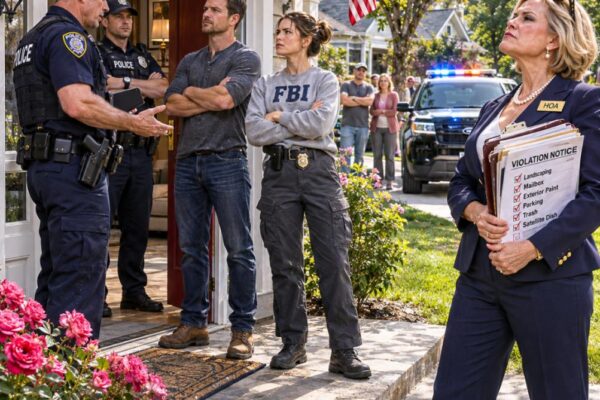
HOA Karen Tore Down My Fence to Seize a Trail Across My 30-Acre Oregon Forest—but I’m Not Someone You Can Easily Push Off My Own Land.k
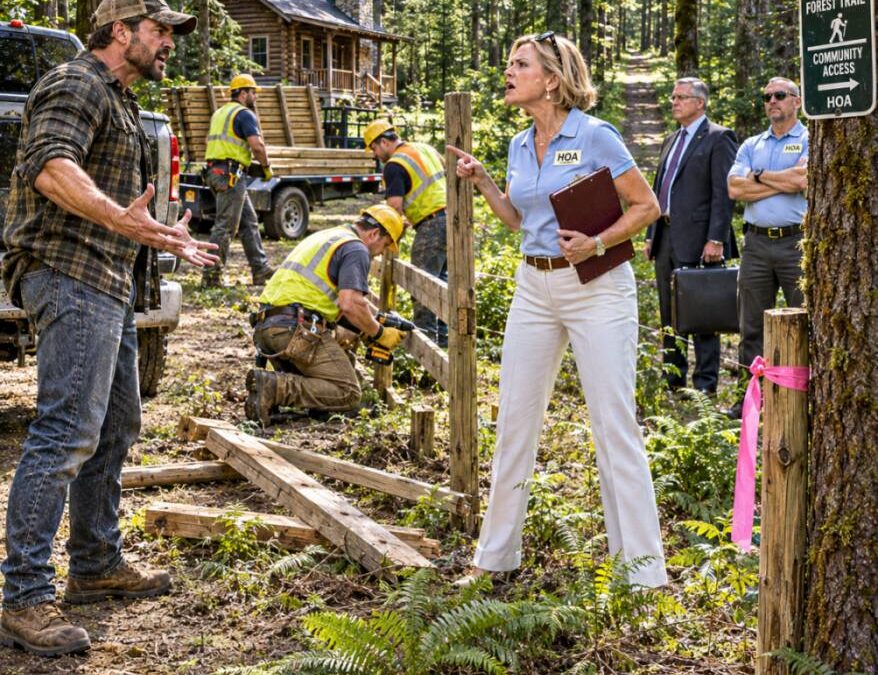
HOA Karen Tore Down My Fence to Seize a Trail Across My 30-Acre Oregon Forest—but I’m Not Someone You Can Easily Push Off My Own Land
She sent a work crew onto my thirty acres and dismantled the fence I had built on two professional surveys because she claimed her HOA had “historic public access” through my forest.
Then HOA Karen started producing maps, witnesses, and legal threats for a trail that somehow became more official every time I refused to surrender it.
When my own brother called while her crew was carrying my fence panels away and said, “Lucas, don’t call the sheriff yet—I need to tell you what I signed,” I realized the HOA hadn’t been working alone.
The first panel was already on the ground when I reached the northwest corner.
Two men in reflective vests were standing inside my property with cordless impact drivers. A third was loading six-foot cedar fence sections onto a flatbed trailer.
I stopped my truck sideways across the old logging spur and got out.
“Put it back.”
The man holding the impact driver looked toward the woman standing twenty feet behind him.
Evelyn Hart.
President of Crestview Estates.
Pale blue HOA polo.
White pants.
Black sunglasses resting on her blond hair.
Burgundy clipboard against her chest.
She smiled as if I had arrived late to a meeting she had scheduled on my land.
“Good morning, Lucas.”
“What are these men doing?”
“Restoring community access.”
I looked at the fence.
Four steel posts had been pulled.
Two cedar panels lay stacked beside the trail.
Red survey ribbon I had tied along the legal boundary was trampled into the mud.
“This is private property.”
“We’ve been through this.”
“No, you’ve talked. I’ve said no.”
Her smile tightened.
Behind her, the old path disappeared through Douglas fir, sword fern, and salal. It wasn’t a road. It wasn’t maintained. It wasn’t on any county trail map. It was a worn strip through the trees that Crestview residents had been using for years because nobody before me had bothered to stop them.
That changed when I bought the place.
Thirty acres.
One cabin.
Two surveys.
One recorded deed.
No HOA covenants.
No public easement shown in the title report.
I pointed toward the workers.
“Who hired them?”
“Crestview.”
“Based on what authority?”
Evelyn tapped the clipboard.
“Our counsel has confirmed longstanding recreational access.”
“Show me the easement.”
“This is a prescriptive right.”
“Show me the court order.”
Her face hardened.
“We don’t need a court order to maintain an existing community path.”
I laughed once.
“You’re standing behind a crew removing a fence from land you don’t own.”
One of the workers stopped.
He looked uncomfortable now.
Good.
“Sir,” he said, “we were told this was HOA common access.”
“It isn’t.”
Evelyn snapped, “Keep working.”
The impact driver started again.
I pulled out my phone and began recording.
“I’m notifying everyone here that I do not consent to entry, fence removal, or trail construction. I’ve asked you to leave.”
The impact driver stopped.
Evelyn stepped toward me.
“You are obstructing a right Crestview residents have exercised for years.”
“My attorney already asked you for the recorded right.”
“You’ll see it in court.”
“Then you can wait for court.”
Her eyes flashed.
“You don’t get to move into this community and erase history.”
“I didn’t move into your community.”
I pointed toward the property line.
“I moved next to it.”
My phone rang.
Owen.
My brother.
I almost ignored him.
Then I saw his second call come through.
I answered without taking my eyes off Evelyn.
“What?”
His voice sounded wrong.
“Lucas, are people at the fence?”
I went still.
“How do you know?”
Silence.
“Owen.”
“Don’t call the sheriff yet.”
I looked at Evelyn.
For the first time that morning, she stopped smiling.
My brother exhaled.
“I need to tell you what I signed.”
part 2
I wish I could tell you I immediately understood what Owen meant.
I didn’t.
For about three seconds, my brain tried to protect me by offering simpler explanations.
Maybe he’d signed a petition.
Maybe he had given the HOA permission to use his driveway.
Maybe he’d joined some neighborhood committee and was embarrassed about it.
Then I looked at Evelyn.
She knew he was calling.
I could see it.
Not because she said anything.
Because people who believe they have already won carry themselves differently.
“What did you sign?” I asked.
Owen hesitated.
“A cooperation agreement.”
“With who?”
“Crestview Development Trust.”
The name meant nothing to me then.
It would eventually mean too much.
“What does that have to do with my fence?”
“It involves access.”
My jaw tightened.
“To my property?”
“It’s complicated.”
“No. It’s a yes-or-no question.”
Evelyn folded her arms.
The workers were listening now.
Owen said, “I thought we could work something out.”
I stared into the trees.
Our father had been dead for three years.
At that moment, I was glad he wasn’t alive to hear the next thirty seconds.
“What did you promise them?”
“Lucas—”
“What?”
“A connection.”
“Across what?”
Another pause.
“Five acres near the west side.”
“That land isn’t yours.”
“Part of Dad’s old tract—”
“Dad divided the property.”
“I know.”
“You received the roadside parcel. I received the forest and cabin.”
“I know.”
“Then what did you sign?”
“I gave them an option on my parcel and agreed to support a trail connection.”
“Across my land?”
“I didn’t say I owned your land.”
“What did you say?”
Silence.
That was my answer.
I closed my eyes.
“Owen, I’ll call you back.”
“Lucas, don’t do anything stupid.”
I looked at Evelyn.
“No promises.”
I ended the call.
Then I called the sheriff.
Not because I wanted anyone arrested.
Because once a boundary dispute involves people physically removing structures, you create a record before somebody later decides the morning happened differently.
Deputy Sarah Coleman arrived twenty-five minutes later.
By then, the work crew had stopped.
Evelyn had called Leonard Pike, Crestview’s attorney, who appeared in a black Mercedes with a leather briefcase and an expression that suggested inconvenience was a constitutional violation.
Coleman listened to me first.
Then Evelyn.
Then the contractor.
I gave her my deed.
My survey.
The second survey.
A title report showing no recorded trail easement across the northwest section.
Evelyn handed over a letter from Leonard claiming Crestview possessed a “mature prescriptive recreational easement established through continuous historic community use.”
Coleman read it.
Then looked at Leonard.
“Is there a judgment?”
“No.”
“Recorded easement?”
“Prescriptive rights do not require a written grant.”
“I understand that. Has a court determined you have one?”
“No.”
She turned toward the contractor.
“Who owns the fence?”
The foreman pointed toward me.
“Apparently him.”
“Then nobody removes anything else today.”
Evelyn started arguing.
Coleman stopped her.
“This is a civil property dispute until somebody damages property after being told ownership is contested. Don’t make it something else.”
The contractors reinstalled what they could before leaving.
Two posts had been bent.
One panel had split.
I photographed everything.
Evelyn stood beside the trail watching.
“You think a fence changes the law?”
“No.”
I put my phone away.
“I think it changes whether people can casually trespass while we’re finding out what the law actually is.”
She smiled.
“You’re going to lose.”
“Maybe.”
That answer irritated her.
I meant it.
Because by then I had learned enough in life to understand that owning property and proving every legal right associated with property can become two very different experiences.
My name is Lucas Hayes.
I’m forty-eight.
Until that year, the most complicated legal dispute of my life involved a contractor installing the wrong windows.
I wasn’t a lawyer.
Wasn’t a retired general.
Wasn’t some secret federal agent.
I restored timber-frame houses for a living.
Old barns.
Historic cabins.
Rural homes whose owners wanted someone willing to spend six hours figuring out why a wall had moved half an inch instead of simply covering it with drywall.
I liked old structures because they punish arrogance.
You can’t walk into a hundred-year-old building and decide your assumptions outrank what the structure is telling you.
You observe first.
Measure.
Find the load path.
Understand what came before.
Then touch it.
Apparently that philosophy also works with land.
The thirty acres bordered the southern edge of Crestview Estates outside a small town in western Oregon.
Dense Douglas fir.
Western red cedar.
A seasonal creek.
A meadow maybe an acre and a half wide.
A neglected cabin built in 1976.
The property had belonged to my father, Daniel Hayes.
Dad bought forty-two acres in the late 1980s.
Long before Crestview.
Long before developers pushed subdivisions toward those woods.
When my mother died, Dad started talking about splitting the property between Owen and me.
Owen had no interest in forests.
He lived in Portland.
Marketing job.
Hybrid SUV.
Shoes that had never known honest mud.
I was the one who spent weekends helping Dad clear deadfall and repair the cabin.
Still, Dad believed equal love did not require identical inheritance.
He had the property surveyed and divided before he died.
Owen got twelve acres along the county road.
Flat.
Developable.
Worth more per acre.
I got the thirty wooded acres and cabin behind it.
Recorded deeds.
Separate parcel numbers.
Clear boundaries.
No shared ownership.
That detail would become crucial.
After Dad died, Owen sold seven of his twelve acres to pay debts from a failed restaurant investment.
He kept five.
My thirty stayed intact.
I bought out the remaining small loan attached to improvements Dad had made, refinanced the cabin renovation, and moved in full time.
The realtor handling my refinance knew exactly why I liked the property.
“No HOA,” she said.
“Say it again.”
“No HOA.”
“Slower.”
She laughed.
The Crestview declaration stopped at my northern boundary.
My title report showed no architectural covenants from Crestview.
There were utility easements along a narrow strip near the road and a decades-old timber access agreement on the east side.
Nothing granting Crestview residents recreational access across the northwest corner.
I paid for a survey anyway.
Then another after survey stakes near the subdivision didn’t match an old fence line.
Both licensed surveyors agreed.
The informal path crossed approximately seven hundred feet of my property.
At one point it cut almost two hundred feet inside the line.
Residents had used it before I arrived.
I knew that.
Dad knew that.
For years, he allowed it.
That word mattered.
Allowed.
He had never loved the joggers.
But he liked the local kids.
People would ask to walk through.
Sometimes they wouldn’t.
Dad would grumble, then wave.
Once, he built a little plank across a muddy section because he got tired of watching people destroy the bank.
He never dedicated the path to the public.
Never signed an easement.
Never told anyone they had a permanent legal right.
As far as I knew, it was neighborly permission.
Then Crestview changed.
The original subdivision had been built nine years before my fence dispute.
That alone made me suspicious of Evelyn’s claim that Crestview itself had acquired a ten-year prescriptive easement.
But Rachel Kim, the attorney I hired, corrected me.
“Don’t celebrate yet.”
“Why?”
“Because they can try to prove use predating the HOA.”
“By whom?”
“Prior owners, local residents, predecessors in interest. They may argue the use can be tacked together if the legal requirements are satisfied.”
“But Dad allowed people through.”
“That’s important.”
“Doesn’t permission kill an adverse claim?”
“It can. But we prove facts. We don’t win by repeating legal vocabulary.”
Rachel specialized in real property litigation.
Forty-two.
Calm.
Terrifying with a yellow legal pad.
I brought her three banker boxes.
She looked at them.
“What’s this?”
“Everything.”
“I haven’t asked you anything yet.”
“I was raised by a man who saved spark-plug receipts.”
She smiled.
“We’re going to get along.”
Rachel explained Oregon’s prescriptive-easement problem in language I could understand.
A party claiming a prescriptive easement generally needs evidence of open, notorious, continuous, adverse use for the required period.
Ten years was the number that mattered in our dispute.
But recreational use through wooded land can be factually messy.
Was it under claim of right?
Was it merely tolerated?
Was the route continuous and definite?
Did use shift over time?
Did the owner give permission?
Who exactly used it?
A handful of neighbors occasionally walking through is not automatically the same thing as a legally established community easement.
“Can Evelyn just remove my fence because she thinks they have one?”
“No.”
“Good.”
“But don’t confuse a weak self-help argument with certainty about the underlying easement claim.”
“Meaning?”
“Fence stays. Lawsuit comes.”
She was right.
Crestview sued twelve days later.
The complaint asked the court to declare an easement across my property and enjoin me from obstructing it.
Evelyn attached photographs.
Statements from residents.
Maps.
One affidavit from a woman who said she had walked the trail for “at least fifteen years.”
That got my attention.
I called Dad’s old neighbor, Frank Delaney.
Frank was seventy-six and still lived east of us.
“Fifteen years?”
He laughed.
“What trail?”
“The path through Dad’s northwest corner.”
“Oh, that.”
“People used it before Crestview?”
“Sometimes.”
“How often?”
“Hikers. Kids. Hunters until Dan chased them off.”
“Did Dad allow it?”
“Hell, yes.”
“You sure?”
“Your father used to say if they shut the damn gates behind them and didn’t leave trash, he didn’t care.”
That was useful.
“Would you testify?”
A long silence.
“I hate court.”
“I know.”
“I hate HOAs more.”
Also useful.
Then I called people who had known the property before Crestview.
Dad’s friends.
Former neighbors.
A retired mail carrier.
A woman whose family once owned land north of ours before selling to the developer.
The story became clearer.
There had been no single established trail for decades.
There were deer paths.
Logging spurs.
Foot tracks.
Kids used different routes depending on weather.
The modern path became distinct only after Crestview built its southern walking loop.
The developer had even installed a little gravel apron up to my father’s boundary.
But stopped there.
Why?
Because Dad had refused an easement.
I found the letter in his files.
Crestview Development LLC.
REQUEST FOR PEDESTRIAN ACCESS EASEMENT.
They offered Dad twelve thousand dollars.
His handwritten response was attached.
NO THANKS. NEIGHBORS CAN ASK TO WALK THROUGH LIKE THEY ALWAYS HAVE. I AM NOT GRANTING PERMANENT PUBLIC ACCESS.
I sat at my kitchen table holding that page.
Then called Rachel.
“You’re going to like this.”
“How much?”
“Twelve-thousand-dollars worth.”
She drove out that evening.
Read the letter.
Then the developer’s follow-up acknowledging Dad’s refusal.
She smiled.
Not broadly.
Rachel rarely wasted expressions.
“This helps.”
“Helps?”
“A lot.”
“I was hoping for dancing.”
“I bill extra for dancing.”
The document did not end the case.
But it made Crestview’s narrative difficult.
If residents already possessed a permanent legal right, why had the developer tried to buy one?
And Dad’s response explicitly described continuing access as permission.
That weakened the argument that use was hostile or under a claim of right.
Then Evelyn escalated.
First came the vandalism.
I returned from the hardware store and found sixty feet of fence destroyed.
Boards split.
Two posts bent sideways.
Red spray paint across one panel.
THIS ISN’T YOURS.
Trail cameras captured three figures at night.
Hoods.
No identifiable faces.
One vehicle passed in the distance, but the plate wasn’t readable.
I filed a report.
Rachel sent Crestview a preservation letter and demanded the HOA condemn the vandalism.
They issued a statement.
“Crestview does not condone unlawful conduct by any resident.”
Evelyn followed with her own email:
“Community frustration is understandable when longstanding access is abruptly blocked.”
Rachel read it.
“She just condemned vandalism and defended it in consecutive paragraphs.”
“Efficient.”
We saved it.
I rebuilt.
Steel posts this time.
Tamper-resistant hardware.
Additional cameras.
NO TRESPASSING signs every fifty feet near the disputed corridor.
I didn’t enjoy turning my forest into a warning label.
But peaceful ambiguity had become expensive.
Then Owen called.
“You’re making this worse.”
“I’m making what worse?”
“The neighborhood.”
“You don’t live in the neighborhood.”
“My five acres border it.”
“Your choice.”
“You could grant them the trail.”
“I could also give them my truck.”
“Don’t be an ass.”
I leaned against the workbench.
“Tell me what you signed.”
Owen exhaled.
The cooperation agreement gave Crestview Development Trust an option to purchase his remaining five acres.
That part was legal.
His land.
His decision.
But the purchase price increased dramatically if his parcel became useful as a recreational and emergency-access connection to Crestview’s southern greenbelt.
Owen had also agreed to “cooperate in securing contiguous pedestrian access through the Hayes family lands.”
That phrase made me furious.
“You told them you could get access through mine.”
“I said I’d help.”
“You don’t control mine.”
“I know that.”
“Do they?”
“Lucas.”
“Do they know?”
He went silent.
Then I understood.
“What did you tell them?”
“I said Dad always intended the property to stay connected.”
“That isn’t an answer.”
“I told them he’d allowed the trail.”
“Allowed.”
“Yes.”
“Did you tell them he rejected the easement?”
Another silence.
“You knew?”
“I vaguely remembered.”
“There’s a letter.”
“Fine.”
“No, Owen. Not fine.”
I stood up.
“You took money based on making my property more valuable to them.”
“It was an option payment.”
“How much?”
“Twenty thousand.”
I laughed.
I couldn’t help it.
“My brother sells the possibility of access across land he doesn’t own for twenty grand.”
“I didn’t sell your land.”
“You sold them confidence.”
He snapped:
“I’m tired of you acting like Dad left you everything that mattered.”
There it was.
Not money.
Not trails.
Dad.
“He left you the road parcel.”
“He left you the cabin.”
“You hated the cabin.”
“I hated that he thought you understood him better.”
That stopped me.
Family disputes often hide inside property because dirt can hold grudges longer than people admit.
I lowered my voice.
“Owen, this isn’t how you solve that.”
“I know.”
“Do you?”
“I thought you’d eventually sell them an easement.”
“You thought wrong.”
He hung up.
I didn’t sleep much.
The next breach happened in daylight.
Two men removed fence panels carefully and stacked them beside the posts.
They wore reflective vests.
One had a magnetic sign on his truck:
CRESTVIEW TRAIL MAINTENANCE.
I called the sheriff before driving over.
Deputy Coleman arrived while they were still there.
The crew supervisor produced a work order from the HOA.
Coleman looked at Evelyn’s signature.
Then at my fence.
Then at the pending lawsuit information Rachel had told me to keep in my truck.
She said:
“Everyone stops.”
The supervisor protested that he had been told the trail was community property.
Coleman answered:
“Now you’ve been told it is disputed private property. Put the panels back.”
He did.
No arrests.
No cinematic showdown.
Just a contractor realizing he had been hired into someone else’s lawsuit.
That afternoon, I went to the Crestview clubhouse.
Rachel later told me I shouldn’t have.
She was right.
But I went.
Evelyn sat in an office behind the reception desk.
Her smile appeared before I finished opening the door.
“Lucas.”
“You sent another crew.”
“We maintained access.”
“You lost access the moment I locked the gate.”
“That’s what the court will decide.”
“Exactly. The court. Not you.”
She leaned back.
“The residents are tired of being bullied.”
I stared at her.
“You’re calling me the bully while removing my fence?”
“You bought forest adjoining a community and immediately closed a path families have used for years.”
“I bought private property.”
“You knew about the trail.”
“Yes.”
“And still blocked it.”
“Yes.”
She smiled.
“Judges don’t like unreasonable landowners.”
“Good thing the deed doesn’t require me to be charming.”
Her smile vanished.
Then I said:
“Stop sending people onto my land.”
“Or?”
“Or Rachel asks the court for an injunction against self-help entry while the case is pending.”
Her eyes narrowed.
“You think your little survey decides everything.”
“No.”
I turned toward the door.
“The title does a pretty good job, though.”
The temporary injunction came two weeks later.
No one representing Crestview could remove, alter, cross, or modify my fence except under emergency circumstances or by agreement while the easement case was pending.
I had to preserve the disputed route and could not intentionally destroy evidence of historic use.
Fair.
The fence stayed.
The trail stayed behind it.
Nobody used it.
Then Crestview hired Dr. Henry Voss.
Professor emeritus.
Land-use historian.
Expert witness.
His report was forty-three pages long and filled with phrases that sounded devastating until Rachel translated them.
“Longstanding landscape continuity.”
“Community-origin access corridor.”
“Recreational succession.”
“Historic spatial persistence.”
I asked:
“Does any of that mean trail?”
“Not necessarily.”
He used aerial photographs from different years.
One showed a faint line in 2014.
Another showed vegetation disturbance in 2011.
A 2008 image was blurry enough that Voss interpreted a pale strip as “probable pedestrian movement.”
Rachel hired our own aerial-imagery specialist.
She disagreed.
The supposed 2008 path was likely a drainage feature and logging disturbance.
The route shifted.
In some years it vanished.
Most importantly, Crestview itself did not exist until much later.
Voss argued predecessor use could establish continuity.
Possible in theory.
But who?
Under what claim?
With whose permission?
Those questions remained weak.
Then Rachel investigated Voss’s relationship with Crestview.
Nothing illegal about an expert being paid.
Experts are paid.
What mattered was disclosure and credibility.
Voss’s report described him as independent.
Discovery showed he had consulted for the developer on two prior zoning matters and had been paid through Evergreen Community Strategies, an LLC partly funded by Crestview’s developer.
Again, not automatically improper.
Then an email surfaced.
Evelyn to the development manager:
“Henry needs to build the strongest continuity narrative possible. The old aerials are messy, but if he frames the route as historically persistent we can get past Lucas’s fence argument.”
The developer replied:
“Do not ask him to manufacture facts.”
Evelyn:
“I’m asking him to make the history coherent.”
Rachel printed that one.
“What?”
I asked.
She smiled.
“Nothing. I’m having a pleasant afternoon.”
At Voss’s deposition, Rachel was surgical.
“You used the phrase historically persistent.”
“Yes.”
“Was the path visible in every aerial year you reviewed?”
“No.”
“Most?”
“Not continuously.”
“Was the physical route identical?”
“Approximately.”
“Within how many feet?”
“Variable.”
“Twenty?”
“Sometimes.”
“Fifty?”
“Potentially.”
“More?”
“In certain historical images.”
“So what exactly persisted?”
Voss disliked that.
Then she showed him Dad’s 2015 easement rejection.
“Were you provided this before writing your report?”
“No.”
That mattered.
He read the letter.
His face changed slightly.
“Does this document affect your opinion?”
“It provides additional evidence concerning permission.”
“Does permissive use matter?”
“Yes.”
“Significantly?”
“It can.”
Evelyn was sitting behind her lawyer.
Rachel did not look at her.
She didn’t need to.
The case got worse for Crestview when Tom Randall contacted me.
Tom served on the HOA board.
Sixty-one.
Retired insurance adjuster.
We met at a diner twenty miles away because he didn’t want residents watching.
He slid a flash drive across the table.
“I’m done.”
“With what?”
“Evelyn.”
Rachel, sitting beside me, did not touch the drive.
“Mr. Randall, before we review anything, I need to know how you obtained it.”
“Board emails. My account. Records I lawfully received as a director.”
“Any hacked accounts?”
“No.”
“Stolen passwords?”
“No.”
“Confidential attorney communications?”
“Some emails may include counsel. I separated anything marked legal.”
Rachel nodded.
“Good.”
Tom looked at me.
“She doesn’t care about walkers.”
“What does she care about?”
“Your land.”
I knew that much.
“Why?”
He opened a paper map.
Crestview’s existing forest loop ended at my boundary.
On the other side of my thirty acres sat Owen’s five-acre parcel.
Beyond that:
A proposed second entrance road.
Future residential expansion.
A narrow connection across the northwest corner of my property would transform Owen’s land from a dead-end wooded parcel into a strategic access point.
A pedestrian trail was phase one.
Emergency access came later.
Then possibly a road easement.
Tom said:
“Evelyn’s husband is invested in the development trust.”
Of course.
Rachel asked:
“Disclosed?”
“Not to the full board.”
“Any use of HOA funds?”
“Legal case.”
That alone wasn’t necessarily improper if the HOA genuinely believed it owned an easement.
Then Tom showed us another email.
Evelyn:
“If we establish recreational rights now, it creates a much better basis for future access negotiations.”
Development manager:
“Do not represent that the HOA trail litigation is for vehicle access.”
Evelyn:
“Obviously.”
I stared at the page.
“This was never just about joggers.”
“No,” Tom said.
“It was about controlling the corridor.”
Then Owen’s name appeared.
He had promised the trust he would “assist with family cooperation.”
Another message from Owen said:
“Lucas is stubborn, but litigation pressure will make him see the practical side.”
I felt physically sick.
My own brother.
Not selling my land.
Not forging a deed.
Something more believable and more painful.
Helping strangers pressure me because he assumed eventually I would get tired.
Rachel placed one hand over the page.
“Lucas.”
“What?”
“Do not call him right now.”
“I wasn’t going to.”
“Your face says otherwise.”
“My face is private.”
“Not especially.”
She was right.
I waited until morning.
Then called Owen.
He answered immediately.
“You’ve talked to Tom.”
“How do you know?”
“Evelyn’s furious.”
“Good.”
“Lucas—”
“You told them litigation pressure would change my mind.”
“I shouldn’t have written that.”
“You shouldn’t have thought it.”
“I was trying to make a deal.”
“With my property.”
“With mine.”
“Your deal only works if mine becomes access.”
He exhaled.
“I needed the money.”
“Then sell your five acres.”
“They won’t pay nearly as much without connectivity.”
“That sounds like your problem.”
“It was Dad’s land too.”
“Not anymore.”
That sentence hurt both of us.
He went quiet.
Then said:
“You always got to be the good son.”
I sat at my kitchen table.
“This isn’t about Dad.”
“It has always been about Dad.”
“No. You just finally found a way to bill me for it.”
He hung up.
For the first time since the lawsuit started, I wanted to sell everything.
Not because Evelyn had won.
Because the forest didn’t feel peaceful anymore.
Every tree looked like evidence.
Every fence post looked like litigation.
The old path became a wound running through the land.
Rachel noticed.
“You don’t have to prove anything by staying.”
“I know.”
“If you want to sell after this, sell.”
“I don’t.”
“Then don’t.”
“Useful advice.”
“I charge four hundred dollars an hour for clarity.”
The preliminary evidentiary hearing on Crestview’s request to reopen access lasted two days.
Their lawyer presented residents.
A mother who had walked the path with her children.
A runner.
A dog owner.
An elderly couple.
I didn’t hate any of them.
That surprised me.
They genuinely loved the route.
One woman cried while describing watching her son learn to ride a bicycle on the forest loop.
I understood.
But loving access does not create ownership.
Rachel never attacked them.
She asked:
“Did Mr. Hayes’s father ever tell you not to use the trail?”
“No.”
“Did he ever wave?”
“Yes.”
“Did you ever speak with him?”
“Many times.”
“Did he ever say you could walk through?”
“Yes.”
“What did he say?”
“Usually something like, ‘Go ahead, just close the gate.’”
Permission.
Another resident remembered Dad saying:
“Use it as long as folks respect the place.”
Permission.
A third testified that after the subdivision opened, Dad complained about beer cans and temporarily chained the path until Crestview residents cleaned it up.
That fact hurt Crestview’s adversity claim even more.
The person supposedly being subjected to an unstoppable public right had closed the route and reopened it conditionally.
Then Rachel introduced the 2015 easement offer.
The courtroom became very quiet.
Crestview’s former development manager testified remotely.
“Yes, we sought a written easement.”
“Why?”
“To secure permanent legal access.”
“Did Mr. Daniel Hayes grant it?”
“No.”
“After he refused, were residents still allowed to walk?”
“Yes.”
“Why?”
“My understanding was informal permission.”
That was the case.
Not completely.
But close.
The judge denied Crestview’s request for preliminary relief reopening the trail.
The fence remained.
The full easement claim still awaited final resolution.
Outside the courthouse, Evelyn caught me near the steps.
“Happy?”
Rachel was speaking with an expert twenty feet away.
I turned.
“My fence is still standing.”
“You’ve taken something from hundreds of families.”
“No.”
“You enjoy this.”
“I’ve spent more on legal fees than the fence cost.”
“Then compromise.”
“Buy a legitimate easement.”
Her expression changed.
“We offered your father.”
“He said no.”
“We’ll offer you.”
“Then offer.”
“You know what we need.”
“Yes.”
“Five acres.”
There it was.
Not a walking path.
Land.
“You want the corridor.”
“We need connectivity.”
“Then stop pretending this lawsuit is about tradition.”
Evelyn stepped closer.
“Every community grows.”
“Grow somewhere else.”
“You’re one man sitting on thirty acres.”
I laughed.
“And there it is.”
“What?”
“The part you usually hide.”
Her mouth tightened.
“You don’t need all that land.”
“I don’t need your permission to keep it.”
I walked away.
Local news eventually found the case.
The headline was more restrained than I expected.
FOREST LANDOWNER FIGHTS HOA OVER DISPUTED TRAIL.
A reporter asked if she could interview me.
Rachel said:
“Don’t be clever.”
“I wasn’t planning to.”
“You are always planning to.”
The interview took place at the gate.
The reporter asked:
“Why not simply allow residents to keep using a trail they’ve enjoyed for years?”
Fair question.
“Because the HOA sued to convert permission into permanent legal control after I exercised my right to close it.”
“Would you consider reopening it?”
“Maybe someday under terms I agree to.”
“Why does that distinction matter?”
“Because asking and owning are different things.”
That quote spread.
Not viral.
No millions of views.
But enough that people understood the case differently.
Then someone vandalized the fence again.
This time the camera got a face.
Seventeen-year-old Crestview resident.
He admitted he had done it after hearing adults say I had “stolen the trail.”
His parents brought him to my cabin.
The boy looked terrified.
“I’m sorry.”
“How much did you damage?”
He looked at his father.
“About eight hundred dollars.”
“You have a job?”
“Grocery store.”
“Pay me back half.”
His father started to object.
I raised a hand.
“He works off the other half helping repair it.”
The boy looked surprised.
Rachel later said I was becoming sentimental.
Maybe.
He spent two Saturdays replacing boards.
By the end, he asked:
“Why don’t you like us?”
“I don’t know you.”
“Crestview.”
“I don’t dislike Crestview.”
“Then why block everyone?”
I handed him Dad’s easement rejection letter.
He read it.
Then looked at the trail.
“So your dad let people use it.”
“Yes.”
“But he didn’t give it away.”
“Exactly.”
The boy nodded.
“That makes more sense.”
It shouldn’t have taken a lawsuit for a teenager to receive the clearest explanation of the entire dispute.
The case moved toward trial.
Then Crestview’s position collapsed internally.
Tom Randall called a special membership meeting after enough homeowners signed a petition.
The board’s legal spending had become public.
More than ninety thousand dollars on the trail dispute.
Residents were furious.
Especially when they learned the trail case benefited a future development corridor connected to Evelyn’s husband’s investment.
The clubhouse overflowed.
I did not attend.
Not my HOA.
Rachel agreed.
But Tom sent me the recording later.
Evelyn tried to defend the lawsuit.
She called the connection to development “coincidental strategic planning.”
Bad phrase.
Residents demanded to know why the conflict had not been disclosed.
Why the association had twice sent crews onto land under active dispute.
Why legal fees kept rising.
Why the original easement offer to Dad had not been disclosed when the lawsuit was authorized.
Then Owen appeared.
That shocked me.
He stood during member comment.
“My name is Owen Hayes.”
People recognized the name.
Evelyn looked alarmed.
Owen continued.
“I own five acres west of Lucas’s property. I signed an option agreement with Crestview Development Trust.”
Murmurs.
“The value of my deal increases if access can be connected across Lucas’s land.”
Evelyn tried to interrupt.
Tom stopped her.
Owen kept going.
“I told them I thought Lucas could be pressured into cooperating.”
He swallowed.
“I was wrong.”
No excuses.
“I knew our father had refused a permanent easement years earlier. I didn’t tell Lucas I was working with the development trust until after the fence dispute had already escalated.”
Evelyn shouted:
“This has nothing to do with the HOA easement claim.”
Owen looked toward her.
“You told me the lawsuit would soften him up.”
Silence.
That sentence did what no legal brief could.
It made motive understandable.
Not legal motive.
Human motive.
Pressure.
Crestview members voted that night to remove Evelyn as president pending the procedure required for her board seat.
Three directors resigned.
Tom became acting president.
Within a week, the new board asked Rachel about settlement.
The terms were straightforward.
Crestview dismissed its prescriptive-easement claim with prejudice as to the disputed route.
The HOA acknowledged no established recreational easement across my parcel.
The association paid for fence damage tied to crews it had directly hired.
Insurance and negotiated association funds covered a substantial portion of my legal costs as part of the settlement, without pretending every dollar was automatically fee-shifted by statute.
Crestview agreed not to enter my land without written permission, emergency necessity, or some independently established legal right.
I agreed not to pursue several additional civil claims against the association.
The teenager’s vandalism remained separate.
The unknown nighttime vandalism stayed unsolved.
Not every mystery gets a villain reveal.
The development trust terminated Owen’s purchase option.
Without connectivity, his five acres were worth much less to them.
He lost most of the promised premium.
I did not feel sorry for him.
Not immediately.
Evelyn’s personal legal problems continued.
The county reviewed whether any filings or representations connected to the trail and future access had crossed into actionable misconduct.
Law enforcement investigated the repeated fence entries.
The state did not swoop in and charge her with grand land fraud because angry homeowners wanted a dramatic ending.
What could be proved was narrower.
Months later, she resolved a misdemeanor trespass-related charge arising from an entry onto my property after the temporary injunction was in place.
Community service.
Fine.
No-contact condition regarding my property.
The developer severed ties with her.
Crestview homeowners later voted her off the board entirely.
She sold her house the following year.
Rumor said Arizona.
I never checked.
Dr. Voss amended his professional opinion after receiving the full historical record.
He wasn’t stripped of a career.
He wasn’t arrested.
Experts can be wrong.
What mattered was that his original report had relied on incomplete information and assumptions that did not survive cross-examination.
Leonard Pike, the HOA lawyer, remained a lawyer too.
He had aggressively advocated for his client.
Some of his advice had been reckless in my opinion.
But lawyers do not lose licenses merely because their client’s case collapses.
Reality has fewer cinematic punishments than people want.
The consequences that mattered were enough.
The fence stayed.
The claim died.
The corridor plan died.
Then I had to decide what to do with the trail.
For months, I left it closed.
Not out of spite.
I needed the forest to feel mine again.
I walked it with Scout, my old black Lab.
He sniffed every stump like he was conducting a title examination.
Fall came.
Then winter.
The old path softened under needles and rain.
Without constant traffic, ferns began pushing into the edges.
I liked that.
Then a biology teacher named Sarah Connelly emailed me.
She taught at the local middle school.
“Mr. Hayes, I know you’ve had problems with the Crestview trail, and I completely understand if the answer is no. I’m looking for a forest site where twelve students can conduct a native-plant survey.”
She attached insurance information.
School supervision plan.
Dates.
No entitlement.
No speech about community rights.
Just a request.
I said yes.
Twelve students arrived on a Thursday morning wearing rain jackets and carrying notebooks.
They stayed on the designated route.
Asked questions.
Picked up trash that wasn’t theirs.
One boy found a salamander and reacted like he’d discovered gold.
Afterward, Sarah said:
“Thank you for letting us use the property.”
Letting.
Such a small word.
It changed everything.
A month later, a Scout troop asked.
Then an Audubon volunteer group.
Then a veterans outdoor program.
I started thinking.
Not public access.
Not an HOA trail.
Something controlled.
Permission-based.
I worked with Rachel.
Naturally.
She warned me about liability.
Naturally.
We created a simple written recreational-license program for organized groups.
Advance request.
Limited dates.
Insurance requirements where appropriate.
No motor vehicles.
No fires.
Pack out trash.
Trail closed during wet conditions and wildlife-sensitive periods.
Permission revocable.
No permanent easement created.
Rachel insisted on language making the nature of the use clear.
I installed a gate.
Not a wall.
A gate.
I called the route Hayes Forest Walk.
Owen laughed when he heard.
“Creative.”
“Shut up.”
He had started calling again.
At first, I didn’t answer.
Then Dad’s birthday came.
Owen texted:
Thinking about him today.
I stared at it for an hour.
Then replied:
Me too.
Reconciliation did not happen in one cinematic scene.
It happened annoyingly.
Slowly.
A text.
Then a phone call.
Then coffee.
He apologized.
I did not say it was fine.
Because it wasn’t.
“I was jealous,” he said.
We were sitting at a diner between Portland and the forest.
“Of what?”
“You got the part of Dad I wanted.”
“That doesn’t make sense.”
“The cabin. The trees. All his projects.”
“You hated all of that.”
“I hated working on it.”
“Important distinction.”
He smiled sadly.
“I thought when he gave you the thirty acres, he was saying you were the son who stayed.”
“You moved because you wanted a different life.”
“I know.”
“Dad knew too.”
“He still trusted you with the place.”
I looked out the window.
“He trusted you too.”
Owen laughed.
“Bad judgment.”
“No.”
I turned back.
“He gave you valuable land because he knew you’d decide for yourself what to do with it.”
“And I almost sold access to yours.”
“Yes.”
He nodded.
“I’m sorry.”
That time I believed him.
Not because his voice cracked.
Because he’d already testified against his own financial interest.
He had lost the option payment premium.
Damaged his relationship with the developer.
Admitted publicly what he’d done.
Consequences came before forgiveness.
That mattered.
The following spring, he arrived at the cabin with a young Oregon white oak in a black nursery pot.
I stared at it.
“What is this?”
“A tree.”
“I can see that.”
“You remember Dad’s oak?”
The old oak near our childhood house had died years earlier.
“Yeah.”
“Thought we could plant one.”
I didn’t answer.
He added:
“Or you can tell me to go to hell.”
“Both are possible.”
We planted it near the meadow.
No dramatic speech.
Mostly arguments about depth.
Owen thought I was digging too wide.
I told him city people had no opinions on roots.
He told me I was unbearable.
That felt normal.
When we finished, we stood looking at the little tree.
“Can I still visit?” he asked.
I looked at him.
“Gate code hasn’t changed.”
He nodded.
Then drove away.
The Crestview relationship changed too.
Tom Randall won the next election.
His campaign slogan might as well have been:
PLEASE, GOD, NO MORE LAWSUITS.
He called me after taking office.
“I want to talk.”
“Do you want my land?”
“No.”
“Good start.”
“We’d like a neighbor agreement.”
“What kind?”
“Emergency contact. Fire coordination. Invasive-species management near the boundary. Maybe volunteer trail days if you invite us.”
“If I invite you.”
“Yes.”
That mattered.
We put it in writing.
Not because I distrusted Tom.
Because good relationships deserve good documents too.
Crestview residents no longer had automatic access through the gate.
Some complained.
Most adapted.
The subdivision created a new loop entirely within its own property.
Shorter.
Less scenic.
Legally theirs.
A few residents applied to join organized nature walks on my land.
I approved some.
Denied others when numbers became too high.
Nobody sued.
Imagine that.
One afternoon, a woman named Melissa from Crestview emailed me.
Her nine-year-old son, Jonah, was autistic and obsessed with trees.
She had heard about the controlled forest walks but worried a large group would overwhelm him.
Could she bring him alone?
I said yes.
They arrived on a Tuesday morning.
Jonah barely spoke to me.
Fine.
Not everyone needs to.
He touched bark.
Looked at moss through a magnifying glass.
Counted Douglas fir cones.
At the gate on the way out, he wrapped both arms around one of the cedar posts.
His mother looked embarrassed.
“Sorry.”
“Don’t be.”
He stayed there for maybe ten seconds.
Then released it.
In the car, Melissa rolled down her window.
“Thank you.”
I nodded.
After they left, I rested one hand on the same post.
The fence had become famous locally as a symbol of conflict.
People kept calling it “the wall.”
It wasn’t.
It was a boundary.
Boundaries are often confused with hostility by people who benefit from crossing them.
That does not make the boundary wrong.
But I had learned something too.
A fence can say no.
A gate can say ask.
I preferred the gate.
The local newspaper came back for a follow-up story.
The reporter asked:
“So after fighting the HOA over public access, you created recreational access yourself.”
“Limited access.”
“Isn’t that ironic?”
“No.”
“Why not?”
“Because consent isn’t irony.”
She smiled.
I continued.
“The issue was never footsteps.”
It was true.
If Crestview had approached me when I moved in and said:
Lucas, residents have used this route for years. Would you consider some form of licensed access?
I might have.
Maybe not immediately.
But I would have listened.
Instead, Evelyn said history had already made the decision for me.
Then she removed my fence.
Twice.
Then sued.
Then used my brother’s resentment as leverage.
The battle was never about whether people walking through trees harmed me.
It was about who had the right to decide.
That was what Dad understood in 2015.
Neighbors can ask.
I’m not granting permanent public access.
The distinction survived him.
I eventually mounted his handwritten response inside my workshop.
Not outside.
Not as a warning sign.
For me.
Whenever I became tempted to turn the forest into some monument to winning, I read it.
Dad didn’t hate neighbors.
He didn’t hate walkers.
He didn’t even hate Crestview.
He simply understood that generosity loses its meaning when someone converts it into entitlement.
The legal file stayed in Rachel’s office for years.
One day she called.
“You want these boxes?”
“What boxes?”
“Your case.”
“Oh.”
“We’re closing archives.”
I drove over.
Three banker boxes.
Depositions.
Aerial photos.
Invoices.
Expert reports.
Survey maps.
Vandalism photographs.
Evelyn’s emails.
Owen’s agreement.
The whole miserable year reduced to cardboard.
Rachel leaned against her desk.
“Any regrets?”
“Hiring you was expensive.”
“Anything else?”
I thought.
“I should’ve put the fence up sooner.”
She laughed.
“That’s your takeaway?”
“No.”
I looked at the boxes.
“I thought owning the land meant I would never have to explain why it was mine.”
Rachel nodded.
“Property law would be a very small profession if that were true.”
“Did they ever have a chance?”
“The easement case?”
“Yes.”
She thought about it.
“Before we found your father’s letter? A litigable claim. Not a guaranteed winner, but enough factual history to fight over.”
“After?”
“Much worse for them.”
“So the fence wasn’t automatically right just because I had the deed.”
“The fence was on your surveyed boundary. But an easement, if valid, could burden land you own.”
I nodded.
That was another lesson worth keeping.
Ownership has layers.
A deed doesn’t always mean nobody else possesses rights.
Utility easements.
Access easements.
Timber rights.
Water rights.
Covenants.
Licenses.
People should actually read title documents before declaring victory.
I had been lucky Dad’s permission history was documented.
She pointed toward the boxes.
“And they were unlucky Evelyn kept emailing people.”
“Generational weakness among HOA presidents.”
“Please don’t make that a legal doctrine.”
I loaded the boxes into my truck.
I burned nothing.
No victory bonfire.
No shredding.
Records deserve better.
They went into shelving beside Dad’s old property files.
Years passed.
The oak Owen and I planted grew.
Slowly.
Oregon white oaks have no interest in satisfying impatient brothers.
The fence weathered silver.
The gate needed a new hinge.
Scout died at fourteen.
I buried him near the meadow.
For weeks after, I kept expecting to hear him behind me on the trail.
That loss hurt more than the lawsuit ever did.
Peace has a price too.
You eventually lose the things that made it peaceful.
Owen came for the burial.
He stood beside me with his hands in his jacket pockets.
“You okay?”
“No.”
“Yeah.”
That was enough.
Crestview expanded east instead of south.
Another developer eventually bought Owen’s five acres.
Not for some secret corridor.
Three houses.
Large lots.
Owen got a fair price.
He called before signing.
“You want first refusal?”
“No.”
“You sure?”
“Yes.”
“I’m checking.”
“I appreciate it.”
That was trust rebuilding.
Not forgetting.
Checking.
Tom stayed HOA president for four years, then quit because he developed what he called “a severe allergy to committee people.”
Crestview remained annoyingly normal.
Fence stains.
Roof colors.
Parking.
One legendary dispute over a basketball hoop.
No one invaded my forest.
The county eventually improved emergency access on its own road, eliminating the development trust’s old argument that my corridor was strategically necessary.
Funny how many “essential” private-property solutions disappear when someone is forced to pay for a legitimate alternative.
The controlled nature program continued.
Schools.
Scout troops.
Veterans.
Birders.
Researchers.
A forestry professor began using part of the land for long-term tree-health monitoring.
I never charged admission.
I did require permission.
Every time.
Some people found that petty.
I didn’t.
Permission preserved the thing Evelyn tried to erase.
Choice.
One fall morning, almost ten years after I built the original fence, I walked the old disputed route alone.
Fog sat low between the firs.
The trail was narrower now because I rerouted organized groups away from several wet areas.
At one point, the original Crestview path disappeared completely beneath ferns.
I stopped there.
That was the strip Dr. Voss once described as a historically persistent recreational corridor.
Nature had erased it in less than a decade.
I laughed.
Not at him.
At all of us.
People enter courtrooms and speak about paths as if landscape were permanent.
Forests move.
Trees fall.
Creeks shift.
People choose routes because one patch is dry one year and muddy the next.
Then memory hardens wandering footsteps into “the way it’s always been.”
Dad knew better.
He remembered when there wasn’t a trail.
Frank remembered kids creating shortcuts.
Aerial photographs showed shifts.
Records restored uncertainty where Evelyn wanted certainty.
That was the difference between history and nostalgia.
History tolerates inconvenient evidence.
At the northwest gate, I found something hanging from the post.
A small carved wooden plaque.
No name.
No note.
THANKS FOR SAVING THIS PLACE.
I took it down at first.
Then put it back.
Not because I believed I had saved the forest single-handedly.
I hadn’t.
The land wasn’t facing clear-cutting.
Evelyn’s future corridor might never have become a road.
The lawsuit could have failed without creating broader development.
People love turning uncertainty into epic consequences after the fact.
I refused.
What I knew was simpler.
I protected the right to decide.
That was enough.
A week later, Owen visited.
He saw the plaque.
“Did you make that?”
“No.”
“Admirer?”
“Probably Rachel.”
“Lawyers don’t carve wood.”
“That’s classist.”
He laughed.
We walked to the oak.
It was finally taller than both of us.
Owen touched the trunk.
“Dad would think this whole thing was hilarious.”
“No.”
“He’d be furious?”
“At first.”
“Then?”
“He’d ask why we paid lawyers instead of just putting a bigger gate up.”
Owen smiled.
“That sounds right.”
We stood there.
Then he said:
“I really am sorry.”
It had been years since his first apology.
I looked at him.
“I know.”
“Do you forgive me?”
I considered giving him a profound answer.
Instead:
“Mostly.”
“Mostly?”
“You cost me a fortune.”
“I testified.”
“You also started it.”
“Fair.”
I looked toward the cabin.
“You want coffee?”
“That your version of forgiveness?”
“Don’t push it.”
We walked back.
The property is still mine.
Thirty acres.
Recorded boundaries.
No Crestview easement through the northwest route.
The fence still stands.
Not because six feet of cedar defeated an HOA.
Because the law eventually recognized what the documents and facts supported.
Crestview’s residents had enjoyed access.
Enjoyment was real.
Tradition was real.
Their memories were real.
But none of those automatically transformed my father’s permission into ownership of a permanent right.
That distinction saved the forest from becoming something other people could control without asking me.
It also changed me.
When I first built the fence, I thought ownership meant exclusion.
Mine.
Not yours.
Stay out.
After the lawsuit, I understood something more complicated.
Ownership means deciding responsibly.
Sometimes the answer is no.
Sometimes yes.
Sometimes yes on conditions.
Sometimes not today.
A right has value because you can choose how to exercise it.
Otherwise it is not a right.
It’s an obligation wearing your name.
One summer, Jonah came back.
The autistic boy who had hugged my fence post was seventeen now.
Taller than me.
He had joined a conservation program at school.
His mother drove him.
He carried a field notebook.
“You remember me?” I asked.
“Yes.”
That was all.
We walked the trail.
He identified mushrooms I couldn’t name.
Measured an oak sapling.
Stopped beside the northwest fence.
“You replaced this post.”
I stared at him.
“You remember the old one?”
“Yes.”
“It rotted.”
“This one is cedar.”
“So was the old one.”
“This one is newer.”
I smiled.
“Good eye.”
He touched the post.
Then looked through the trees toward Crestview.
“My mom told me people fought over this trail.”
“They did.”
“Why?”
“Different ideas about who controlled it.”
He thought.
“Who controlled it?”
“I did.”
“Still?”
“Yes.”
He nodded.
Then walked on.
No moral.
No dramatic reaction.
Just information processed and stored.
I liked that.
That evening, after they left, I sat on the cabin porch.
The forest was exactly as loud as I had hoped when I first moved there.
Wind.
Crows.
A woodpecker somewhere uphill.
No traffic.
No impact drivers.
No Evelyn shouting about historic access.
For years, I thought peace meant nobody bothering you.
That’s impossible.
People bother people.
Neighbors disagree.
Family betrays you.
Lawyers send letters.
Trees fall.
Dogs die.
Peace is not the absence of conflict.
It’s knowing conflict doesn’t own the place after it leaves.
I looked toward the gate.
I could barely see it through the trees.
The same gate that once symbolized the beginning of war now opened several times a month for people I chose to welcome.
That felt right.
Evelyn believed the trail belonged to Crestview because people had walked it.
Owen believed family history gave him a say in what I should do with land Dad left me.
The development trust believed enough financial pressure would turn resistance into cooperation.
For a while, even I believed a stronger fence was the answer to all of them.
It wasn’t.
The real protection was less dramatic.
A deed.
Two surveys.
My father’s letter.
Old photographs.
Witnesses who remembered permission.
Cameras when people crossed lines.
A lawyer who refused to let anger improve the facts.
A deputy willing to distinguish a civil claim from permission to destroy property.
Homeowners willing to question why their dues were funding someone else’s development strategy.
And eventually, my brother telling the truth even though the truth cost him money.
That’s what held the boundary.
Not cedar.
Evidence.
I took one last walk before dark.
At the northwest corner, I opened the gate.
Stood on the old trail.
Then closed it behind me.
The latch clicked.
Small sound.
Nothing dramatic.
But that click meant something different than it had ten years earlier.
Back then it meant:
Stay out.
Now it meant:
Ask.
And maybe that was the peace I had been looking for all along.