HOA Karen Painted Over My Family’s 1897 Lake Trail and Called 911 When I Came Back—She Has Vastly Underestimated What the County Records Still Remember.k
HOA Karen Painted Over My Family’s 1897 Lake Trail and Called 911 When I Came Back—She Has Vastly Underestimated What the County Records Still Remember
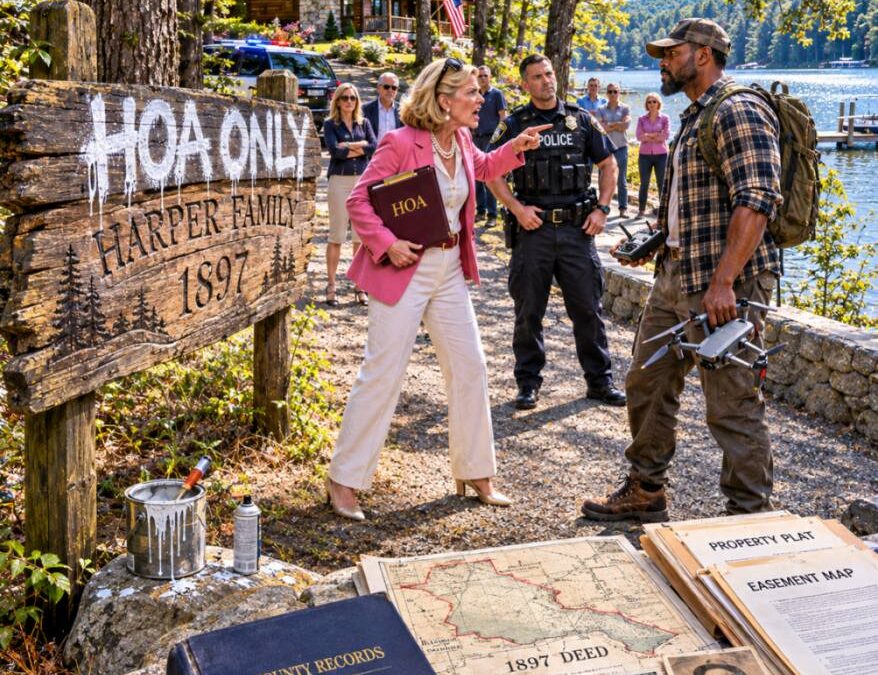
She painted HOA ONLY across the wooden sign my great-grandfather carved in 1897 and then called police when I walked the same lakeside trail my family had used for more than a century.
HOA Karen said I was a trespasser, waved her clipboard at the responding officer, and insisted her subdivision owned everything from the road to the water.
What she didn’t know was that the old sign wasn’t the most important thing my family had preserved—the county records were, and one name buried in them belonged to hers.
The first thing I noticed was the paint.
Bright white.
Still tacky.
Two words sprayed across weathered cedar that had survived more than a hundred years of storms.
HOA ONLY.
I stood on the lakeside trail with my drone case hanging from one hand and stared at the sign.
Beneath the paint, I could still feel the carved grooves with my thumb.
HARPER FAMILY — 1897.
My great-grandfather Elias had carved those letters after building the original cabin above Emerald Lake. My father had sealed the board every few years. I had done it myself the previous fall.
Now somebody had tried to erase it in one afternoon.
“Excuse me!”
I didn’t turn immediately.
I knew the voice.
Cassandra Vaughn came marching through the manicured shrubs bordering Emerald Ridge, designer blazer buttoned despite the heat, phone in one hand and burgundy clipboard in the other.
A measuring tape hung from her belt.
So did a whistle.
I wish I were joking.
“Do you have permission to be here?”
I looked down at the trail beneath my boots.
Then toward the cabin visible through the pines.
Then back at her.
“Permission from who?”
Her face tightened.
“From the association.”
“This isn’t association property.”
“It absolutely is.”
“Based on what?”
“I am the HOA president.”
“That wasn’t the question.”
I set down my drone case and took out my phone.
Cassandra pointed at it.
“Don’t you record me.”
“I’m standing on the trail to my cabin.”
“You are standing on private community property.”
“My deed says otherwise.”
“Your deed is outdated.”
I actually smiled.
“That’s a new legal theory.”
She looked at the drone case.
“And what is that?”
“Survey equipment.”
“It looks like a drone.”
“It is.”
“You cannot fly surveillance equipment over private homes.”
“I map shoreline erosion for an environmental contractor. I don’t fly over people’s windows.”
“You are not flying anything here.”
I unfolded the small quadcopter.
Cassandra’s voice jumped an octave.
“That is illegal surveillance.”
“No.”
“It is harassment.”
“No.”
“You’re stalking residents.”
“Cassandra, I’m mapping the lake.”
She raised her phone.
“I am calling 911.”
“For what?”
“Trespassing. Harassment. Suspicious surveillance.”
I looked at her.
“Tell dispatch exactly where I am.”
Her eyes narrowed.
“Right here.”
“No. Tell them I’m standing beside the Harper cabin trail.”
She hesitated.
Then dialed anyway.
When the dispatcher answered, Cassandra transformed.
Her voice became breathless.
Controlled panic.
“There is a man trespassing near our private lake with drone equipment. He’s refusing to leave. He’s becoming confrontational.”
I said loudly enough for the phone to catch it, “My name is Lucas Harper, and I’m standing on Parcel 18-A.”
Cassandra covered the phone.
“You need to stop talking.”
I laughed.
Then she told dispatch something that ended any chance of me treating this like another silly HOA argument.
“He may be casing homes.”
I stopped smiling.
A police cruiser arrived nine minutes later.
Officer Tom Rivera stepped out.
Cassandra rushed toward him.
“Thank God. He’s over there.”
Rivera looked at me.
Then at my drone.
Then at the painted sign.
“Sir, can I see some identification?”
“Absolutely.”
I opened the waterproof folder I kept with my mapping gear.
Driver’s license.
FAA remote-pilot certificate.
Copy of my deed.
Current boundary survey.
Rivera read the first page.
Then looked at the old sign.
Then back at Cassandra.
“Ma’am,” he said, “why did you tell dispatch this man had no right to be here?”
Cassandra lifted her chin.
“Because the HOA owns this land.”
Rivera looked down again.
“No.”
That single word drained the color from her face.
Then he pointed to a name in the deed’s title history.
“Lucas, do you know an Edward Vaughn?”
I shook my head.
Cassandra did not.
Her clipboard slipped half an inch in her hand.
And that was the moment I realized the fight over my family’s trail had started decades before either of us was born.
part 2
My name is Lucas Harper.
I’m thirty-four.
Carpenter by trade, licensed drone operator on the side, stubborn by inheritance.
The cabin above Emerald Lake has been in my family longer than the road serving the subdivision beside it.
Longer than the clubhouse.
Longer than the stone entrance monument that says EMERALD RIDGE in letters tall enough to be seen from space.
Longer than almost everything except the lake itself.
My great-grandfather Elias Harper bought the first parcel in 1897.
Not two hundred acres.
Not some kingdom.
Twenty-seven wooded acres running from a ridge down toward the western shoreline.
Over time, family purchases and inheritance added smaller adjoining pieces.
Some were later sold.
Some were lost.
Some were transferred between relatives.
But the cabin parcel remained.
Always.
County Book 14.
Page 233.
Elias Harper.
Grantee.
That’s the kind of information my father made me memorize.
Other fathers taught baseball statistics.
Mine taught deed references.
“You can forget who won the World Series,” Dad used to say. “Don’t forget where your boundary is.”
I thought he was being dramatic.
Then I met Cassandra Vaughn.
The Harper cabin wasn’t impressive.
One story.
Rough timber walls.
Stone chimney.
Tin roof.
A porch facing the lake.
My great-grandfather built the original version himself.
My grandfather enlarged it after the Second World War.
Dad replaced the roof and reinforced the foundation.
I rebuilt the porch when I was twenty-six.
The cabin smelled like pine, old smoke, and lake water.
It was the one place in the world where nothing felt temporary.
The sign Cassandra had painted over originally hung at the trailhead because the trail crossed our western strip before reaching the cabin.
Nobody considered it political.
It said who maintained the path.
That was all.
When Emerald Ridge was developed in the late 1990s, the subdivision went in east and north of our land.
Eighty-six upscale homes.
Private streets maintained by the HOA.
Large common green.
Community dock.
Walking paths.
The original developer negotiated two easements involving Harper property.
One drainage easement.
One narrow emergency-maintenance easement for utility access.
No recreational easement through the cabin trail.
No HOA ownership.
I knew that because Dad had kept the closing binders.
Cassandra apparently believed confidence could amend recorded instruments.
She had moved into Emerald Ridge fifteen years earlier.
By the time I returned to the cabin full-time, she had become HOA president.
Late forties.
Perfect lawn.
Perfect SUV.
Perfect posture.
She treated every conversation like testimony.
My first interaction with her occurred three months after I moved back.
I was replacing rotten boards on the cabin stairs.
She walked down the trail without asking.
“Lucas?”
“Yeah?”
“Cassandra Vaughn. HOA president.”
I stood.
“Nice to meet you.”
She looked at the lumber.
“Are those exterior modifications?”
“They’re stairs.”
“Did architectural review approve them?”
“No.”
She blinked.
“You need approval.”
“My parcel isn’t in the HOA.”
“Everything surrounding the lake is subject to community standards.”
“Not my parcel.”
She smiled.
“You may want to review your documents.”
“I have.”
The smile disappeared.
That was our beginning.
Then came letters.
Notices about debris.
A warning about “unapproved exterior storage” because I stacked cedar boards beneath the porch.
A complaint about my work truck.
A notice claiming my cabin’s metal roof failed to conform to Emerald Ridge’s approved materials.
The roof had been metal since 1973.
Every time, I responded the same way.
Please identify the recorded instrument giving the HOA authority over Parcel 18-A.
No answer.
Then the trail signs appeared.
First:
PRIVATE COMMUNITY TRAIL.
Then:
EMERALD RIDGE RESIDENTS ONLY.
I removed neither.
I photographed them.
Sent Cassandra a letter.
Asked who installed them.
No response.
Then someone painted over the Harper sign.
That was the day I flew the drone.
I wasn’t trying to bait Cassandra.
The environmental firm I subcontracted for was mapping erosion along three miles of shoreline after unusually heavy spring rains.
I had permission from the relevant landowners and operated under FAA rules.
I launched from my parcel.
Stayed below the applicable ceiling.
Avoided sustained flight over people.
No peering into windows.
Nothing remotely resembling the espionage Cassandra described to police.
Officer Rivera understood that within minutes.
What interested him more was my deed.
Because of the Vaughn name.
“Edward Vaughn,” he said again.
Cassandra stepped closer.
“My grandfather was Edward Vaughn.”
Rivera looked at her.
“This document references a 1952 quitclaim involving land adjoining the Harper tract.”
Cassandra shook her head.
“My grandfather had nothing to do with his property.”
I took the folder.
There it was.
Not my cabin parcel itself.
An exception in the legal description.
Reference to a 1952 deed from Harper heirs to Vaughn Development Company involving land east of the old boundary.
I’d seen it before.
Never cared.
Why would I?
That land had become part of the subdivision decades before I was born.
Rivera handed the folder back.
“This isn’t something I’m sorting out roadside.”
Fair.
He looked at Cassandra.
“But based on what I’m seeing, I don’t have grounds to remove Mr. Harper from this parcel.”
“He’s trespassing on HOA land.”
“You need to establish that through records or civil process.”
“I have maps.”
“Then give them to your attorney.”
Her face reddened.
“And the drone?”
Rivera looked at me.
“You operating commercially?”
“Part 107.”
“Stay within your rules and don’t interfere with anyone.”
“Understood.”
Then he looked at the painted sign.
“Who did that?”
Cassandra answered too quickly.
“The association updated trail signage.”
I stared at her.
Rivera did too.
“You painted over his family sign?”
“It was misleading.”
The officer sighed.
The kind of sigh produced only by years of unnecessary human conflict.
“I’m going to document the call.”
Cassandra looked offended.
“For him?”
“For everyone.”
He left.
She didn’t.
She stood there gripping the clipboard.
“You embarrassed me.”
I laughed.
“You called police.”
“You forced me.”
“No.”
I pointed toward the sign.
“You made a choice.”
She looked at the drone.
“Your family history doesn’t give you control over Emerald Ridge.”
“I haven’t asked for control.”
“You keep behaving like this land exists outside the community.”
“It does.”
Her eyes hardened.
“You are one cabin beside eighty-six homes.”
“That sounds like a math problem, not a property argument.”
She turned and walked away.
I spent the rest of the afternoon flying the erosion survey.
But I kept thinking about Edward Vaughn.
That night I opened Dad’s old metal file box.
Deeds.
Surveys.
Tax receipts.
Letters.
Aerial photos.
The kind of archive ordinary families create accidentally across generations.
At the bottom sat an envelope I’d never opened.
Dad had written:
OLD EAST TRACT — 1952 PROBLEM.
I stared at it.
Then opened it.
Inside were photocopies of county records.
A tax map.
Two letters from my grandfather.
A newspaper clipping.
And a photograph.
Black and white.
Three families standing beside small wooden houses near the eastern shore.
One woman held a guitar.
On the back, in my father’s handwriting:
Ruth Harper Brightwater and relatives before removal.
I sat down.
My family had always told stories about Ruth.
My great-grandmother’s cousin.
Cherokee ancestry through her mother’s family.
The details were fragmentary.
Like many families, ours had oral history stronger than documentation.
I had never used that history to claim anything legally.
Never needed to.
But now I had a photograph connected to the same 1952 transaction referenced in the deed.
I called my aunt.
She was seventy-nine.
“Do you remember Edward Vaughn?”
Silence.
Then:
“Where did you find that name?”
“In Dad’s papers.”
Another silence.
“Lucas, don’t start something you don’t understand.”
That guaranteed I would.
“What happened in 1952?”
She sighed.
“Your grandfather spent fifty years trying to prove it.”
“Prove what?”
“That they stole more land than they bought.”
I stopped breathing for a second.
“Who?”
“The Vaughns. Developers. County people. It was complicated.”
“Did we own it?”
“Some. Other families owned other parts.”
“What happened?”
“Tax trouble. Quitclaims. People pressured to sign. Some left. Some fought. Nobody had money.”
“Why didn’t Dad tell me?”
“He did. You didn’t listen.”
That hurt because it was probably true.
She continued.
“Your cabin stayed ours. Your grandfather made sure of that.”
“What about the development?”
“Different pieces. Don’t assume every house is sitting on stolen Harper land.”
“I wasn’t.”
“Good. Because that kind of talk can hurt innocent people.”
My aunt had a talent for ruining revenge before it started.
The next morning, I went to the county recorder.
Then the county archives.
Then the historical society.
By Friday, I had enough questions to hire a lawyer.
Her name was Rebecca Sloan.
Real-estate litigation.
Title disputes.
Historic land issues.
She read the papers slowly.
Then looked at me.
“What do you want?”
“I want Cassandra off my trail.”
“That part looks straightforward.”
“And I want to know what happened in 1952.”
“That part does not.”
“Can we find out?”
“Yes.”
“Can we fix it?”
She leaned back.
“Maybe some things.”
I hated lawyer words.
“Meaning?”
“Meaning seventy-year-old title issues can involve statutes of limitation, recording acts, adverse possession, bona fide purchasers, lost evidence, probate, tax procedures, and a lot of innocent current owners.”
“I don’t want people’s houses.”
“Good.”
“I want the truth.”
“That we can chase.”
So we did.
First, the current issue.
Rebecca ordered a boundary survey.
No surprise.
Parcel 18-A matched the recorded deed.
The trail segment Cassandra claimed sat inside my parcel for nearly four hundred feet.
The HOA’s own GIS map showed the boundary incorrectly.
Not by a little.
The map had apparently been copied from an old conceptual development drawing rather than the recorded plat.
That’s where Cassandra got her confidence.
Her HOA map colored the trail green.
Green meant common area.
The recorded plat did not.
Rebecca sent a cease-and-desist.
Stop representing the Harper trail as HOA property.
Remove the new signs.
Do not interfere with lawful access to Parcel 18-A.
Do not enter without permission except under recorded easement rights.
Restore or compensate for the damaged historic sign.
Cassandra responded through the HOA attorney.
For the first time, her language softened.
The association was “evaluating competing mapping sources.”
Competing mapping sources.
I printed that and taped it over my desk.
Then came the old records.
The 1952 transaction involved three parcels.
Not the entire modern subdivision.
One belonged to the Harper family.
Two to other families connected through marriage and community ties.
Edward Vaughn’s development company had acquired quitclaim deeds after county tax proceedings.
At least one deed appeared regular.
One was questionable.
The third was deeply troubling.
The notarization date preceded the date the supposed signer returned to North Carolina from working in Detroit.
The county tax file also contained correspondence showing payment tendered before the sale but apparently rejected over a procedural issue.
Rebecca didn’t celebrate.
“This is evidence.”
“Of fraud?”
“Potentially.”
“That’s lawyer for yes?”
“That’s lawyer for stop putting words in my mouth.”
We hired a title historian.
Then an archivist.
Then I contacted the tribal historic preservation office associated with the Cherokee community our family history referenced.
Not because ancestry magically gave me ownership.
It doesn’t.
Because the 1952 records included families with documented Cherokee connections, and the historic site might contain cultural materials relevant to preservation.
That was how I met Eliza Brightwater.
She was eighty-three.
Not a mystical keeper of secret federal papers.
A retired teacher.
Family historian.
Sharp enough to make Cassandra look slow.
She arrived at the cabin with her grandson Daniel and a wooden document box.
“You’re Lucas.”
“Yes.”
“You have Elias’s nose.”
“I’ve been told worse.”
She smiled.
Then walked toward the painted sign.
Her expression changed.
“Who did that?”
“HOA.”
“Idiots.”
I liked her immediately.
Inside the cabin, she opened the box.
Photographs.
Church records.
Family letters.
Copies of deeds.
A diary.
Not Edward Vaughn’s secret confession to stealing half the county.
Something more credible.
A field notebook kept by a survey assistant who had worked for Vaughn Development in the early 1950s.
The assistant was Eliza’s uncle.
He had written down dates.
Names.
Instructions.
One entry mentioned “clearing east families before resort plan.”
Another said:
E.V. says tax issue gives leverage. Do not redraw Harper western line.
I read that twice.
“E.V.?”
“Edward Vaughn,” Eliza said.
Rebecca looked at her.
“How do you establish that?”
“Other entries use his full name.”
She showed us.
Then a photograph.
Edward Vaughn standing beside county officials near one of the old houses.
Cassandra’s grandfather.
No crime proved by a photograph.
But history was becoming visible.
Eliza pulled out another picture.
The woman with the guitar.
I knew her from Dad’s copy.
“My great-grandmother’s cousin.”
Eliza nodded.
“Ruth.”
She touched the photograph.
“She carved that sign.”
I looked toward the porch.
“The Harper sign?”
“She helped Elias.”
Family history shifted under my feet.
All my life I’d imagined great-grandfather Elias alone carving our name.
History had simplified itself.
Eliza smiled.
“Men got credit for everything back then too.”
Rebecca laughed.
I did not.
I was staring at Ruth’s face.
What had been family folklore was becoming human.
The next development came from Cassandra herself.
She called an emergency HOA meeting.
Her goal was to stop rumors.
It did the opposite.
The clubhouse filled.
Cassandra stood at the front beneath a projection of my drone photograph.
“This individual is attempting to use outdated title claims to destabilize Emerald Ridge.”
Individual.
Not Lucas.
Interesting.
She showed the HOA conceptual map.
Green trail.
Common area.
Then I raised my hand.
She ignored me.
A homeowner named Maria Lopez spoke.
“Why doesn’t the county plat show the trail as common?”
Cassandra froze.
Maria had apparently done her homework.
“The county materials are incomplete.”
Rebecca whispered beside me.
“That’s a dangerous sentence.”
Another homeowner, Mike Daniels, asked, “Can this affect our titles?”
Cassandra answered instantly.
“No.”
Rebecca whispered again.
“Also dangerous.”
We didn’t know that yet.
That was the whole point.
Some homes had valid title chains completely independent of the disputed 1952 parcels.
Several common-area tracts had more complicated histories.
One portion of the community trail appeared to cross land the HOA did not own.
The clubhouse itself was safe.
The houses were not suddenly vanishing.
But Cassandra preferred certainty over accuracy.
Then the HOA attorney stood.
“I need to clarify that title review is ongoing.”
Cassandra stared at him.
“We discussed this.”
“Yes.”
“And?”
“And I cannot tell owners there is zero title risk before the review is complete.”
The room erupted.
That wasn’t my doing.
It was Cassandra’s.
She had spent weeks telling everybody I was a fraud.
Now her own attorney was telling them the records required review.
Then Rebecca presented the current survey.
Not ancient history.
Today.
The Harper trail.
Parcel 18-A.
My property.
The screen showed the actual boundary.
The green HOA overlay was wrong.
Cassandra’s face tightened.
Rebecca spoke calmly.
“The issue before homeowners tonight need not include 1952.”
She pointed toward the map.
“Your association has represented Mr. Harper’s privately owned trail as HOA property without recorded support.”
Then the painted sign.
“Someone acting for the association defaced a longstanding marker.”
Then the 911 incident.
“And the president reported him as a trespasser while he was standing on his own parcel.”
No drama.
Facts.
They were enough.
A homeowner in the back called out.
“Who authorized painting the sign?”
Cassandra said, “It was routine trail maintenance.”
“Who authorized it?”
“The president has operational discretion.”
The treasurer spoke.
“Not for private property.”
Cassandra turned.
“You’re assuming his survey is correct.”
Rebecca held up the stamped map.
“Then commission another licensed survey.”
The board did.
Two weeks later, their survey agreed with ours.
That should have ended the trail dispute.
Instead, Cassandra doubled down on history.
She posted online that I was trying to “weaponize heritage claims.”
She said outside activists were helping me threaten homeowners.
She implied Eliza was part of an attempt to seize the subdivision.
Eliza read the post at my kitchen table.
Then removed her glasses.
“She called me an activist?”
“Technically.”
“I am eighty-three.”
“Apparently you’re a threat.”
She smiled.
“Good.”
The title historian finished his preliminary report three days later.
The houses of Emerald Ridge were not all invalid.
That was the first important conclusion.
Most residential lots had long, independently insurable chains of title.
Nobody was coming to bulldoze homes.
But three HOA-controlled parcels were another story.
One included part of the south trail system.
Another included shoreline used for a picnic area.
The third was undeveloped woods near the lake.
Their title chain relied partly on the 1952 Vaughn transactions.
The historian identified discrepancies significant enough to warrant a quiet-title action and further investigation.
That meant court.
Not federal agents descending from black SUVs.
Not a government official declaring me owner of two hundred acres on a tablet.
Court.
Evidence.
Notice.
Competing claims.
Slow.
Expensive.
Real.
Rebecca filed on my behalf regarding the Harper boundary and our claimed interest in one disputed strip.
Eliza’s family organization and another descendant group filed separate claims where they had standing and evidence.
The HOA’s insurer appointed counsel.
Several title insurers got involved.
Cassandra hated losing control of the story.
Then the record destruction allegation surfaced.
Her uncle, Gerald Vaughn, was a retired county judge.
Not a sitting federal criminal mastermind.
Retired.
Seventy-six.
His name appeared in several later real-estate transactions involving the Vaughn family.
During discovery, we learned he had kept boxes of old company records.
Rebecca requested preservation.
So did counsel for Eliza’s group.
Two weeks later, a Vaughn family storage building caught fire.
Accidental electrical fire, according to the initial report.
People immediately screamed evidence destruction.
Rebecca refused.
“No proof.”
Then investigators recovered surveillance footage showing Gerald’s assistant removing document boxes the night before.
Still not proof of arson.
But enough to subpoena records and ask questions.
Gerald had also emailed Cassandra:
Do not let them get Edward’s original development files. Half of what is in there will be misunderstood.
Cassandra replied:
I’m trying.
That email changed the litigation.
Not because “misunderstood” meant stolen land.
Because Cassandra had represented to the HOA that no relevant family records existed.
She had lied.
Under oath later, she tried to explain that she meant she personally did not possess them.
The court was unimpressed.
Then came the notebook.
Eliza’s survey-assistant notebook was authenticated through handwriting comparisons and family provenance sufficiently for the court to consider it with appropriate limitations.
The entries did not magically void seventy years of deeds.
They did support the argument that the 1952 transactions deserved scrutiny.
Other records surfaced.
County correspondence.
Old tax receipts.
A letter from my grandfather objecting to boundary stakes in 1954.
A lawyer’s response from Vaughn Development promising the Harper western line would remain untouched.
That letter became crucial.
Because the modern HOA map had crossed exactly that line.
The one Cassandra claimed belonged to Emerald Ridge.
We didn’t need to win 1952 to win today.
The Vaughns’ own lawyer had acknowledged our boundary seventy years earlier.
Rebecca put the letter in front of Cassandra during deposition.
“Have you seen this before?”
“No.”
“Did your grandfather’s company write it?”
“Apparently.”
“It states the Harper western boundary would not be disturbed.”
Cassandra looked at the page.
“Yes.”
“Yet you represented the Harper trail as HOA property.”
“I relied on association maps.”
“After Mr. Harper gave you his deed?”
“I believed the map was more current.”
“After the licensed survey?”
“I believed there was still an issue.”
“After the second survey commissioned by your HOA agreed with his?”
Cassandra stopped.
Rebecca waited.
Finally:
“I believed the trail should belong to the community.”
That sentence ended the dispute more cleanly than any legal argument could.
Should.
Not did.
She had confused preference with title.
Again.
The quiet-title case continued for another year.
Some historical claims were dismissed.
Some settled.
One disputed common parcel was confirmed to remain with the HOA because later transactions cured defects through lawful means.
Another strip was not.
The south trail and western shoreline boundary were confirmed in my family’s favor.
The HOA removed its signs.
Paid for professional restoration of the Harper marker.
Covered a negotiated portion of my legal costs.
The association also agreed never again to represent Parcel 18-A as common property.
The historical cases involving Eliza’s family produced a different kind of outcome.
Not mass eviction.
Nobody wanted that.
Current homeowners were not personally responsible for what Edward Vaughn may have done seventy years earlier.
Instead, settlement focused on recognition, preservation, and compensation tied to specific parcels and parties.
A section of undeveloped land with documented cultural significance was transferred into a conservation and heritage trust governed jointly by descendant representatives and a local land conservancy.
Historic markers were installed.
The HOA funded archival work.
The county corrected several public mapping errors.
A small cultural center later opened near the trailhead.
Not because the internet demanded a spectacular ending.
Because the people actually affected spent months negotiating what repair could realistically look like.
Cassandra fought every step.
Until the financial records surfaced.
Remember her obsession with property values?
The audit showed why.
Cassandra had pushed repeated “lake modernization” studies involving vendors connected to Vaughn family businesses.
Her cousin owned one consulting company.
Another relative had an interest in a landscape contractor.
Some contracts were competitively priced.
Others weren’t.
The problem wasn’t simply nepotism.
It was nondisclosure.
Undocumented conflicts.
Invoices approved through processes that did not match HOA policy.
The forensic review identified roughly $180,000 in questionable related-party payments requiring explanation.
Not automatically embezzlement.
The board referred the findings to counsel and, where warranted, authorities.
Then additional records showed one vendor had billed for work never completed.
That became a criminal matter.
Cassandra herself was not charged with stealing every questionable dollar.
Reality was narrower.
She faced civil claims for breach of duty and misrepresentation.
A relative involved in false billing faced criminal charges.
Gerald Vaughn eventually faced obstruction allegations after investigators concluded he had intentionally concealed records responsive to lawful process.
Not fifteen years because a story needed a villain.
A negotiated plea.
Probation.
A fine.
Loss of certain professional privileges.
Public embarrassment.
Enough.
Cassandra resigned as HOA president before the next election.
She did not become “FBI Karen.”
Children did not follow her around chanting.
Nobody ordered her to attend Cherokee classes as punishment.
That would have turned history into humiliation theater.
Eliza would have hated it.
What happened was harder.
Cassandra attended the first public history meeting voluntarily.
She sat in the back.
No clipboard.
No blazer.
Just Cassandra.
Eliza spoke for forty minutes.
Photographs.
Maps.
Families.
Displacement.
Developers.
Court records.
Things proven.
Things uncertain.
Things lost.
She never once called Cassandra evil.
That made the room more uncomfortable.
Afterward, Cassandra approached her.
I stood nearby.
“You think my grandfather stole everything.”
Eliza shook her head.
“No.”
Cassandra looked surprised.
“I think your grandfather did some things the record does not let us excuse.”
“That’s different?”
“Yes.”
Eliza looked at her.
“If I make him a monster, you learn nothing.”
Cassandra’s eyes moved toward me.
I said nothing.
Eliza continued.
“Monsters are easy. Families are harder.”
That sentence stayed with me.
The old HOA survived.
But not in its old form.
That is another difference between truth and fantasy.
I did not reveal secret deeds giving me sixty-six percent of the neighborhood and dissolve it with one dramatic vote.
I owned one cabin parcel and some adjoining land.
Enough to matter in the property dispute.
Not enough to rule people.
The homeowners themselves forced reform.
They amended the bylaws.
Conflict-of-interest disclosures became mandatory.
Major vendor contracts required multiple bids unless an emergency was documented.
Property maps used for enforcement had to match recorded surveys.
No president could declare privately owned land to be common property based on an internal drawing.
Drone complaints had to be tied to actual conduct, not fear.
And before the HOA called police over a property dispute, management had to verify basic ownership where reasonably possible.
That last one passed almost unanimously.
Cassandra abstained.
I found that funny.
The biggest change was cultural.
People started asking:
Where is that written?
Cassandra hated that question when I asked it.
By the end, everybody asked it.
Where is the easement?
Where is the vote?
Where is the contract?
Where is the conflict disclosure?
Where is the survey?
Where is the invoice?
Where is the authority?
A community becomes much harder to bully when ordinary people learn those questions.
The restored Harper sign went back up the following spring.
A conservator removed as much of the white paint as possible without destroying the old cedar.
Some remained in the grain.
You can still see it if the sun hits sideways.
I thought about replacing the sign.
Eliza stopped me.
“No.”
“It looks damaged.”
“It is damaged.”
“Exactly.”
“That is history.”
I understood.
So the scar stayed.
HARPER FAMILY — 1897.
White paint ghosting the grooves.
One afternoon Cassandra came down the trail.
I was repairing a railing.
She stopped twenty feet away.
“Lucas.”
“Cassandra.”
She looked at the sign.
“They couldn’t remove all of it.”
“No.”
“I paid for the restoration.”
“The HOA did.”
She nodded.
“Right.”
Silence.
Then she said, “I saw the new historical marker.”
Near the common trail, the heritage trust had installed a panel explaining settlement patterns, Cherokee family connections in the area, development history, and the disputed 1950s transactions.
No sensational accusations.
Sources listed.
Uncertainty acknowledged.
Cassandra had read it.
“My grandfather’s name is there.”
“Yes.”
“My family hates that.”
“I imagine.”
She looked at me.
“Do you?”
“Do I what?”
“Hate that.”
I set down the drill.
“I hate what happened to my sign.”
She waited.
“I hate that you called me a vagrant without bothering to check the deed.”
Her face tightened.
“I never used that word.”
“You called me suspicious. You told dispatch I might be casing houses.”
She looked away.
“I remember.”
“I hate that.”
Then I pointed toward the historical marker through the trees.
“But your grandfather’s name isn’t on there because I hate your family.”
“Why is it?”
“Because it’s in the records.”
She crossed her arms.
“You make everything sound simple.”
“No.”
I laughed once.
“Nothing about this has been simple.”
She looked toward the lake.
“My grandfather was a war veteran.”
“So was mine.”
“He helped build half this county.”
“Maybe.”
“He wasn’t some thief.”
“I didn’t say he was only one thing.”
That stopped her.
I continued.
“People can build things and still hurt people.”
She stared at me.
“Families can inherit pride and still discover parts of the story aren’t clean.”
Silence.
“That’s what Eliza meant.”
Cassandra sat on a large stone beside the trail.
For the first time since I’d known her, she looked tired rather than angry.
“I spent fifteen years here believing the HOA owned this whole trail system.”
“I know.”
“My grandfather told my father the Vaughns helped create the development.”
“I know.”
“I thought your cabin was some leftover exemption we were tolerating.”
There it was.
Tolerating.
I nodded slowly.
“That’s the problem.”
She looked at me.
“I understand that now.”
“Do you?”
She sighed.
“Lucas, I called police because I believed you were challenging my authority on purpose.”
“I was walking home.”
“I know.”
“You painted over my family name.”
“I authorized the sign update.”
“Same thing.”
“Yes.”
That word surprised me.
Yes.
No defense.
No interpretation.
No technicality.
She looked toward the cedar board.
“I shouldn’t have.”
“No.”
“I thought acknowledging your sign made the HOA look weak.”
I almost laughed.
“A piece of wood made you feel weak?”
“Not the wood.”
“What?”
“The idea that the neighborhood didn’t own everything I thought it owned.”
That was probably the most honest sentence Cassandra ever gave me.
I sat on the opposite side of the trail.
“Property can do that.”
She nodded.
“So can history.”
We stayed there for a while.
Then she said, “Eliza invited me to the archive project.”
“That sounds like her.”
“I don’t know why.”
“Maybe she thinks you’re useful.”
Cassandra smiled faintly.
“That’s not a compliment.”
“With Eliza, it is.”
She stood.
“Goodbye, Lucas.”
“See you around.”
She walked back toward Emerald Ridge.
We were never friends.
That would have made the ending too neat.
But she started volunteering with the archive committee.
At first, people distrusted her.
Fair.
Then she did something useful.
She found Vaughn family photographs nobody else had.
Construction photos.
Old boundary stakes.
Early resort plans.
A letter from Edward Vaughn arguing with a county official about compensation owed to one displaced family.
The letter didn’t absolve him.
It complicated him.
History does that.
Eliza loved it.
“See?” she told me. “This is why you don’t burn the enemy’s papers.”
I laughed.
The drone footage became useful too.
Not as evidence of Cassandra’s tyranny.
As environmental data.
The heritage trust used my shoreline maps to identify erosion threatening an old foundation site.
Archaeologists documented it before stabilization work.
That first flight Cassandra tried to stop ended up helping preserve the history she thought threatened her neighborhood.
There was satisfaction in that.
Years passed.
Emerald Ridge changed slowly.
No mass exodus.
No worthless mortgages.
No homes seized by federal agents.
Property values remained fine.
Possibly because buyers like clear titles and functional governance more than they like fantasy.
The HOA still existed.
It still maintained roads.
Common landscaping.
The pool.
Community docks.
It still sent annoying emails.
I received one for leaving construction material near the trail too long.
The rule actually applied.
I moved the lumber.
No revolution.
That’s the part I wish more people understood.
The problem was never rules.
The problem was people using rules to replace proof.
Cassandra had said:
I am the authority.
That sentence revealed everything.
Healthy authority says:
Here is the document.
Here is the process.
Here is the boundary.
Here is the appeal.
Unhealthy authority says:
Because I said so.
My great-grandfather’s sign survived because my family maintained it.
My deed survived because somebody recorded it.
The old 1952 complaints survived because people kept copies.
Eliza’s photographs survived because her family put them in a box instead of deciding painful history was better forgotten.
Paper isn’t glamorous.
Neither are archives.
Neither are survey monuments half buried beneath leaves.
But when someone powerful decides your memory is inconvenient, boring records become weapons against erasure.
I don’t use that word lightly.
Erasure.
Cassandra didn’t physically erase my family.
She painted over a sign.
Yet the instinct behind it was the same one that had bothered me from the beginning.
Your story complicates ours.
So we’ll call ours official.
The old development maps did something similar.
They showed clean green common areas.
Trails.
Amenities.
Lots.
Nothing about the families who lived there before.
Nothing about disputed tax proceedings.
Nothing about Ruth and her guitar.
Nothing about Elias carving a sign.
Maps can tell the truth.
They can also tell only the part somebody wanted preserved.
That’s why I eventually helped create a second map.
Not a property map.
A history map.
The heritage trust installed it online and in the cultural center.
Layers.
Current parcels.
Historic parcels.
Old roads.
Former homesites.
Recorded deed references.
Areas where ownership history was uncertain.
Places associated with documented Cherokee families.
The Harper cabin.
The Vaughn development phases.
Click a layer.
Read the source.
No mythology.
No “Lucas owns two hundred acres because secret federal papers say so.”
No “every house is stolen.”
No “Cassandra’s family committed seventy years of crimes.”
Just evidence.
One high school teacher told me students use it in local-history classes now.
That meant more to me than winning the lawsuit.
I visited once.
A kid raised his hand.
“Mr. Harper, was Cassandra a bad person?”
The teacher looked horrified.
I laughed.
“That’s a hard question.”
The kid persisted.
“Did she do bad stuff?”
“Yes.”
“So?”
I thought about Cassandra sitting on the stone beside the trail.
About her authorizing paint over my family’s sign.
Calling 911.
Lying about ownership.
Then later carrying boxes into the archive center.
“People aren’t math problems,” I said.
The kid frowned.
“That’s not an answer.”
“Exactly.”
The class laughed.
I continued.
“She did things that were wrong. Some were serious. The important part isn’t deciding whether she’s permanently good or bad.”
“What is?”
“Making sure nobody can do the same thing without being questioned.”
That answer satisfied him.
Mostly.
It satisfied me too.
Officer Rivera retired a few years later.
I saw him at a hardware store.
He recognized me.
“Drone guy.”
“HOA guy.”
He laughed.
“Still flying?”
“Yes.”
“Still terrifying homeowners?”
“Only geese.”
He grew serious.
“That call stuck with me.”
“Why?”
“She sounded so sure.”
I knew exactly what he meant.
“Dispatch said trespasser with surveillance equipment.”
He shook his head.
“Then I get there, and you’re standing next to a sign with your own name carved into it.”
“Technically my ancestor’s name.”
“You know what I mean.”
He looked down the aisle.
“I’ve thought about how easy it would’ve been to treat her certainty like evidence.”
That mattered.
“What stopped you?”
He shrugged.
“Your documents helped.”
Then he added, “And I’m old enough to know people who call police confidently aren’t automatically right.”
I smiled.
“Put that on a training poster.”
“Too many words.”
We shook hands.
I carried that conversation home.
Because for years I had wondered what would have happened if I’d left my deed folder in the cabin.
What if I hadn’t been a white carpenter who spoke calmly to the officer?
What if English wasn’t my first language?
What if Cassandra had been more convincing?
What if Rivera had been less patient?
Power doesn’t become dangerous only when somebody holds a gun or a title.
It becomes dangerous whenever one person’s story is automatically treated as more credible than another person’s evidence.
That was the thread running through everything.
The HOA map.
My painted sign.
The 911 call.
Cassandra’s grandfather.
My family.
Eliza’s family.
Who gets believed?
Who gets recorded?
Who gets to say this is mine?
Who has to prove it twice?
The answer cannot be whoever has the loudest voice.
That’s why I still carry the waterproof folder when I fly the drone.
Not because I expect another Cassandra.
Habit.
Driver’s license.
Part 107 card.
Survey authorization.
Property map.
The deed copy is no longer necessary for every flight.
I keep it anyway.
Dad would approve.
The Harper sign still stands.
The paint scar is still visible.
A small bronze plaque now sits beside it.
Not on it.
The heritage trust insisted we leave the original untouched.
The plaque reads:
HARPER CABIN TRAIL
RECORDED FAMILY PROPERTY SINCE 1897
RESTORED AFTER THE EMERALD RIDGE BOUNDARY DISPUTE
That’s all.
No Cassandra.
No accusation.
No victory language.
History without revenge.
Eliza died two years after the cultural center opened.
Eighty-five.
At her memorial, Daniel gave me the wooden document box.
I tried to refuse.
“It belongs with your family.”
He shook his head.
“Grandma said the archive should have the originals eventually.”
“Then give it to them.”
“She said you were supposed to carry it there.”
I laughed.
“That sounds unnecessarily ceremonial.”
“That also sounds like Grandma.”
So I carried it.
From the cabin.
Down the Harper trail.
Past the restored sign.
Through Emerald Ridge.
To the cultural center.
Inside were copies of deeds, photographs, letters, and the survey assistant’s notebook that had helped reopen questions everyone assumed were dead.
Cassandra was waiting at the center.
She held the door.
No clipboard.
No whistle.
Just the door.
I carried the box inside.
She touched the lid.
“Eliza would have liked this.”
“Yes.”
We stood beside the archive table.
Then Cassandra said something I never expected.
“My family kept everything that made us look successful.”
I looked at her.
“She kept everything that hurt.”
I understood immediately.
“Different kinds of history.”
“Yes.”
She nodded toward the box.
“Maybe hers was more useful.”
I thought about that.
“No.”
Cassandra looked surprised.
“Why not?”
“Both are useful.”
“The ugly parts too?”
“Especially together.”
A family photograph of Edward Vaughn cutting a ribbon at a new development tells one truth.
A field notebook about families being pressured off land tells another.
History isn’t honest until both can exist in the same room.
Cassandra seemed to understand.
We never discussed forgiveness.
I didn’t need to.
Some things were repaired.
Some weren’t.
My sign remained scarred.
So did the community.
Scars don’t mean healing failed.
Sometimes they prove healing happened at all.
Last fall, I flew another erosion survey over Emerald Lake.
Same drone route as the morning Cassandra called 911.
I launched from the trail.
Climbed slowly.
The lake opened beneath me.
Cabin.
Pines.
Subdivision.
Docks.
Historic trust parcel.
Modern homes.
Old shoreline.
Everything in one frame.
From four hundred feet, the boundaries disappeared.
You couldn’t see deeds.
Couldn’t see easements.
Couldn’t see who had sued whom.
Couldn’t see which family had lived where in 1952.
Just trees, roofs, water, roads.
Beautiful.
Dangerously simple.
Maps from above can make history look clean.
So can neighborhoods.
That’s why you have to come back down.
Walk the ground.
Read the records.
Touch the grooves somebody tried to paint over.
I landed the drone beside the sign.
Ran my fingers across the cedar.
HARPER FAMILY — 1897.
Still there.
I used to think that was the victory.
Our name survived.
Now I think the victory was larger.
Cassandra wanted one version of Emerald Ridge.
Neat.
Exclusive.
Simple.
HOA land.
HOA trail.
HOA authority.
Her family’s development story.
My family’s records ruined that simplicity.
So did Eliza’s.
So did the county archive.
So did the survey.
So did the court.
Truth usually does.
It makes things messier.
But mess isn’t the enemy.
Erasure is.
The afternoon Cassandra first found me on that trail, she asked whether I had permission to be there.
For months afterward, I replayed that sentence and imagined clever answers.
My family was here first.
Read the deed.
Ask your grandfather.
Call the county.
Eventually I realized the best answer was the simplest one.
I didn’t need her permission.
I needed a valid right.
Those are not the same thing.
Permission comes from a person above you.
Rights exist even when that person is angry.
That’s what Cassandra misunderstood.
That’s what Edward Vaughn’s generation sometimes tried to manipulate.
That’s what my father protected in file boxes.
That’s what Eliza protected in photographs.
And that’s why, years later, I still stop sometimes beside that scarred sign when I walk home from the lake.
Not to admire a victory.
To remember the rule.
Never confuse confidence with ownership.
Never confuse habit with title.
Never confuse an official-looking map with a recorded boundary.
And never let somebody else’s authority erase a history just because your history makes their story inconvenient.
THE STORY ENDS HERE
HOA Karen Painted Over My Family’s 1897 Lake Trail and Called 911 When I Came Back—She Has Vastly Underestimated What the County Records Still Remember
She painted HOA ONLY across the wooden sign my great-grandfather carved in 1897 and then called police when I walked the same lakeside trail my family had used for more than a century.
HOA Karen said I was a trespasser, waved her clipboard at the responding officer, and insisted her subdivision owned everything from the road to the water.
What she didn’t know was that the old sign wasn’t the most important thing my family had preserved—the county records were, and one name buried in them belonged to hers.
The first thing I noticed was the paint.
Bright white.
Still tacky.
Two words sprayed across weathered cedar that had survived more than a hundred years of storms.
HOA ONLY.
I stood on the lakeside trail with my drone case hanging from one hand and stared at the sign.
Beneath the paint, I could still feel the carved grooves with my thumb.
HARPER FAMILY — 1897.
My great-grandfather Elias had carved those letters after building the original cabin above Emerald Lake. My father had sealed the board every few years. I had done it myself the previous fall.
Now somebody had tried to erase it in one afternoon.
“Excuse me!”
I didn’t turn immediately.
I knew the voice.
Cassandra Vaughn came marching through the manicured shrubs bordering Emerald Ridge, designer blazer buttoned despite the heat, phone in one hand and burgundy clipboard in the other.
A measuring tape hung from her belt.
So did a whistle.
I wish I were joking.
“Do you have permission to be here?”
I looked down at the trail beneath my boots.
Then toward the cabin visible through the pines.
Then back at her.
“Permission from who?”
Her face tightened.
“From the association.”
“This isn’t association property.”
“It absolutely is.”
“Based on what?”
“I am the HOA president.”
“That wasn’t the question.”
I set down my drone case and took out my phone.
Cassandra pointed at it.
“Don’t you record me.”
“I’m standing on the trail to my cabin.”
“You are standing on private community property.”
“My deed says otherwise.”
“Your deed is outdated.”
I actually smiled.
“That’s a new legal theory.”
She looked at the drone case.
“And what is that?”
“Survey equipment.”
“It looks like a drone.”
“It is.”
“You cannot fly surveillance equipment over private homes.”
“I map shoreline erosion for an environmental contractor. I don’t fly over people’s windows.”
“You are not flying anything here.”
I unfolded the small quadcopter.
Cassandra’s voice jumped an octave.
“That is illegal surveillance.”
“No.”
“It is harassment.”
“No.”
“You’re stalking residents.”
“Cassandra, I’m mapping the lake.”
She raised her phone.
“I am calling 911.”
“For what?”
“Trespassing. Harassment. Suspicious surveillance.”
I looked at her.
“Tell dispatch exactly where I am.”
Her eyes narrowed.
“Right here.”
“No. Tell them I’m standing beside the Harper cabin trail.”
She hesitated.
Then dialed anyway.
When the dispatcher answered, Cassandra transformed.
Her voice became breathless.
Controlled panic.
“There is a man trespassing near our private lake with drone equipment. He’s refusing to leave. He’s becoming confrontational.”
I said loudly enough for the phone to catch it, “My name is Lucas Harper, and I’m standing on Parcel 18-A.”
Cassandra covered the phone.
“You need to stop talking.”
I laughed.
Then she told dispatch something that ended any chance of me treating this like another silly HOA argument.
“He may be casing homes.”
I stopped smiling.
A police cruiser arrived nine minutes later.
Officer Tom Rivera stepped out.
Cassandra rushed toward him.
“Thank God. He’s over there.”
Rivera looked at me.
Then at my drone.
Then at the painted sign.
“Sir, can I see some identification?”
“Absolutely.”
I opened the waterproof folder I kept with my mapping gear.
Driver’s license.
FAA remote-pilot certificate.
Copy of my deed.
Current boundary survey.
Rivera read the first page.
Then looked at the old sign.
Then back at Cassandra.
“Ma’am,” he said, “why did you tell dispatch this man had no right to be here?”
Cassandra lifted her chin.
“Because the HOA owns this land.”
Rivera looked down again.
“No.”
That single word drained the color from her face.
Then he pointed to a name in the deed’s title history.
“Lucas, do you know an Edward Vaughn?”
I shook my head.
Cassandra did not.
Her clipboard slipped half an inch in her hand.
And that was the moment I realized the fight over my family’s trail had started decades before either of us was born.
part 2
My name is Lucas Harper.
I’m thirty-four.
Carpenter by trade, licensed drone operator on the side, stubborn by inheritance.
The cabin above Emerald Lake has been in my family longer than the road serving the subdivision beside it.
Longer than the clubhouse.
Longer than the stone entrance monument that says EMERALD RIDGE in letters tall enough to be seen from space.
Longer than almost everything except the lake itself.
My great-grandfather Elias Harper bought the first parcel in 1897.
Not two hundred acres.
Not some kingdom.
Twenty-seven wooded acres running from a ridge down toward the western shoreline.
Over time, family purchases and inheritance added smaller adjoining pieces.
Some were later sold.
Some were lost.
Some were transferred between relatives.
But the cabin parcel remained.
Always.
County Book 14.
Page 233.
Elias Harper.
Grantee.
That’s the kind of information my father made me memorize.
Other fathers taught baseball statistics.
Mine taught deed references.
“You can forget who won the World Series,” Dad used to say. “Don’t forget where your boundary is.”
I thought he was being dramatic.
Then I met Cassandra Vaughn.
The Harper cabin wasn’t impressive.
One story.
Rough timber walls.
Stone chimney.
Tin roof.
A porch facing the lake.
My great-grandfather built the original version himself.
My grandfather enlarged it after the Second World War.
Dad replaced the roof and reinforced the foundation.
I rebuilt the porch when I was twenty-six.
The cabin smelled like pine, old smoke, and lake water.
It was the one place in the world where nothing felt temporary.
The sign Cassandra had painted over originally hung at the trailhead because the trail crossed our western strip before reaching the cabin.
Nobody considered it political.
It said who maintained the path.
That was all.
When Emerald Ridge was developed in the late 1990s, the subdivision went in east and north of our land.
Eighty-six upscale homes.
Private streets maintained by the HOA.
Large common green.
Community dock.
Walking paths.
The original developer negotiated two easements involving Harper property.
One drainage easement.
One narrow emergency-maintenance easement for utility access.
No recreational easement through the cabin trail.
No HOA ownership.
I knew that because Dad had kept the closing binders.
Cassandra apparently believed confidence could amend recorded instruments.
She had moved into Emerald Ridge fifteen years earlier.
By the time I returned to the cabin full-time, she had become HOA president.
Late forties.
Perfect lawn.
Perfect SUV.
Perfect posture.
She treated every conversation like testimony.
My first interaction with her occurred three months after I moved back.
I was replacing rotten boards on the cabin stairs.
She walked down the trail without asking.
“Lucas?”
“Yeah?”
“Cassandra Vaughn. HOA president.”
I stood.
“Nice to meet you.”
She looked at the lumber.
“Are those exterior modifications?”
“They’re stairs.”
“Did architectural review approve them?”
“No.”
She blinked.
“You need approval.”
“My parcel isn’t in the HOA.”
“Everything surrounding the lake is subject to community standards.”
“Not my parcel.”
She smiled.
“You may want to review your documents.”
“I have.”
The smile disappeared.
That was our beginning.
Then came letters.
Notices about debris.
A warning about “unapproved exterior storage” because I stacked cedar boards beneath the porch.
A complaint about my work truck.
A notice claiming my cabin’s metal roof failed to conform to Emerald Ridge’s approved materials.
The roof had been metal since 1973.
Every time, I responded the same way.
Please identify the recorded instrument giving the HOA authority over Parcel 18-A.
No answer.
Then the trail signs appeared.
First:
PRIVATE COMMUNITY TRAIL.
Then:
EMERALD RIDGE RESIDENTS ONLY.
I removed neither.
I photographed them.
Sent Cassandra a letter.
Asked who installed them.
No response.
Then someone painted over the Harper sign.
That was the day I flew the drone.
I wasn’t trying to bait Cassandra.
The environmental firm I subcontracted for was mapping erosion along three miles of shoreline after unusually heavy spring rains.
I had permission from the relevant landowners and operated under FAA rules.
I launched from my parcel.
Stayed below the applicable ceiling.
Avoided sustained flight over people.
No peering into windows.
Nothing remotely resembling the espionage Cassandra described to police.
Officer Rivera understood that within minutes.
What interested him more was my deed.
Because of the Vaughn name.
“Edward Vaughn,” he said again.
Cassandra stepped closer.
“My grandfather was Edward Vaughn.”
Rivera looked at her.
“This document references a 1952 quitclaim involving land adjoining the Harper tract.”
Cassandra shook her head.
“My grandfather had nothing to do with his property.”
I took the folder.
There it was.
Not my cabin parcel itself.
An exception in the legal description.
Reference to a 1952 deed from Harper heirs to Vaughn Development Company involving land east of the old boundary.
I’d seen it before.
Never cared.
Why would I?
That land had become part of the subdivision decades before I was born.
Rivera handed the folder back.
“This isn’t something I’m sorting out roadside.”
Fair.
He looked at Cassandra.
“But based on what I’m seeing, I don’t have grounds to remove Mr. Harper from this parcel.”
“He’s trespassing on HOA land.”
“You need to establish that through records or civil process.”
“I have maps.”
“Then give them to your attorney.”
Her face reddened.
“And the drone?”
Rivera looked at me.
“You operating commercially?”
“Part 107.”
“Stay within your rules and don’t interfere with anyone.”
“Understood.”
Then he looked at the painted sign.
“Who did that?”
Cassandra answered too quickly.
“The association updated trail signage.”
I stared at her.
Rivera did too.
“You painted over his family sign?”
“It was misleading.”
The officer sighed.
The kind of sigh produced only by years of unnecessary human conflict.
“I’m going to document the call.”
Cassandra looked offended.
“For him?”
“For everyone.”
He left.
She didn’t.
She stood there gripping the clipboard.
“You embarrassed me.”
I laughed.
“You called police.”
“You forced me.”
“No.”
I pointed toward the sign.
“You made a choice.”
She looked at the drone.
“Your family history doesn’t give you control over Emerald Ridge.”
“I haven’t asked for control.”
“You keep behaving like this land exists outside the community.”
“It does.”
Her eyes hardened.
“You are one cabin beside eighty-six homes.”
“That sounds like a math problem, not a property argument.”
She turned and walked away.
I spent the rest of the afternoon flying the erosion survey.
But I kept thinking about Edward Vaughn.
That night I opened Dad’s old metal file box.
Deeds.
Surveys.
Tax receipts.
Letters.
Aerial photos.
The kind of archive ordinary families create accidentally across generations.
At the bottom sat an envelope I’d never opened.
Dad had written:
OLD EAST TRACT — 1952 PROBLEM.
I stared at it.
Then opened it.
Inside were photocopies of county records.
A tax map.
Two letters from my grandfather.
A newspaper clipping.
And a photograph.
Black and white.
Three families standing beside small wooden houses near the eastern shore.
One woman held a guitar.
On the back, in my father’s handwriting:
Ruth Harper Brightwater and relatives before removal.
I sat down.
My family had always told stories about Ruth.
My great-grandmother’s cousin.
Cherokee ancestry through her mother’s family.
The details were fragmentary.
Like many families, ours had oral history stronger than documentation.
I had never used that history to claim anything legally.
Never needed to.
But now I had a photograph connected to the same 1952 transaction referenced in the deed.
I called my aunt.
She was seventy-nine.
“Do you remember Edward Vaughn?”
Silence.
Then:
“Where did you find that name?”
“In Dad’s papers.”
Another silence.
“Lucas, don’t start something you don’t understand.”
That guaranteed I would.
“What happened in 1952?”
She sighed.
“Your grandfather spent fifty years trying to prove it.”
“Prove what?”
“That they stole more land than they bought.”
I stopped breathing for a second.
“Who?”
“The Vaughns. Developers. County people. It was complicated.”
“Did we own it?”
“Some. Other families owned other parts.”
“What happened?”
“Tax trouble. Quitclaims. People pressured to sign. Some left. Some fought. Nobody had money.”
“Why didn’t Dad tell me?”
“He did. You didn’t listen.”
That hurt because it was probably true.
She continued.
“Your cabin stayed ours. Your grandfather made sure of that.”
“What about the development?”
“Different pieces. Don’t assume every house is sitting on stolen Harper land.”
“I wasn’t.”
“Good. Because that kind of talk can hurt innocent people.”
My aunt had a talent for ruining revenge before it started.
The next morning, I went to the county recorder.
Then the county archives.
Then the historical society.
By Friday, I had enough questions to hire a lawyer.
Her name was Rebecca Sloan.
Real-estate litigation.
Title disputes.
Historic land issues.
She read the papers slowly.
Then looked at me.
“What do you want?”
“I want Cassandra off my trail.”
“That part looks straightforward.”
“And I want to know what happened in 1952.”
“That part does not.”
“Can we find out?”
“Yes.”
“Can we fix it?”
She leaned back.
“Maybe some things.”
I hated lawyer words.
“Meaning?”
“Meaning seventy-year-old title issues can involve statutes of limitation, recording acts, adverse possession, bona fide purchasers, lost evidence, probate, tax procedures, and a lot of innocent current owners.”
“I don’t want people’s houses.”
“Good.”
“I want the truth.”
“That we can chase.”
So we did.
First, the current issue.
Rebecca ordered a boundary survey.
No surprise.
Parcel 18-A matched the recorded deed.
The trail segment Cassandra claimed sat inside my parcel for nearly four hundred feet.
The HOA’s own GIS map showed the boundary incorrectly.
Not by a little.
The map had apparently been copied from an old conceptual development drawing rather than the recorded plat.
That’s where Cassandra got her confidence.
Her HOA map colored the trail green.
Green meant common area.
The recorded plat did not.
Rebecca sent a cease-and-desist.
Stop representing the Harper trail as HOA property.
Remove the new signs.
Do not interfere with lawful access to Parcel 18-A.
Do not enter without permission except under recorded easement rights.
Restore or compensate for the damaged historic sign.
Cassandra responded through the HOA attorney.
For the first time, her language softened.
The association was “evaluating competing mapping sources.”
Competing mapping sources.
I printed that and taped it over my desk.
Then came the old records.
The 1952 transaction involved three parcels.
Not the entire modern subdivision.
One belonged to the Harper family.
Two to other families connected through marriage and community ties.
Edward Vaughn’s development company had acquired quitclaim deeds after county tax proceedings.
At least one deed appeared regular.
One was questionable.
The third was deeply troubling.
The notarization date preceded the date the supposed signer returned to North Carolina from working in Detroit.
The county tax file also contained correspondence showing payment tendered before the sale but apparently rejected over a procedural issue.
Rebecca didn’t celebrate.
“This is evidence.”
“Of fraud?”
“Potentially.”
“That’s lawyer for yes?”
“That’s lawyer for stop putting words in my mouth.”
We hired a title historian.
Then an archivist.
Then I contacted the tribal historic preservation office associated with the Cherokee community our family history referenced.
Not because ancestry magically gave me ownership.
It doesn’t.
Because the 1952 records included families with documented Cherokee connections, and the historic site might contain cultural materials relevant to preservation.
That was how I met Eliza Brightwater.
She was eighty-three.
Not a mystical keeper of secret federal papers.
A retired teacher.
Family historian.
Sharp enough to make Cassandra look slow.
She arrived at the cabin with her grandson Daniel and a wooden document box.
“You’re Lucas.”
“Yes.”
“You have Elias’s nose.”
“I’ve been told worse.”
She smiled.
Then walked toward the painted sign.
Her expression changed.
“Who did that?”
“HOA.”
“Idiots.”
I liked her immediately.
Inside the cabin, she opened the box.
Photographs.
Church records.
Family letters.
Copies of deeds.
A diary.
Not Edward Vaughn’s secret confession to stealing half the county.
Something more credible.
A field notebook kept by a survey assistant who had worked for Vaughn Development in the early 1950s.
The assistant was Eliza’s uncle.
He had written down dates.
Names.
Instructions.
One entry mentioned “clearing east families before resort plan.”
Another said:
E.V. says tax issue gives leverage. Do not redraw Harper western line.
I read that twice.
“E.V.?”
“Edward Vaughn,” Eliza said.
Rebecca looked at her.
“How do you establish that?”
“Other entries use his full name.”
She showed us.
Then a photograph.
Edward Vaughn standing beside county officials near one of the old houses.
Cassandra’s grandfather.
No crime proved by a photograph.
But history was becoming visible.
Eliza pulled out another picture.
The woman with the guitar.
I knew her from Dad’s copy.
“My great-grandmother’s cousin.”
Eliza nodded.
“Ruth.”
She touched the photograph.
“She carved that sign.”
I looked toward the porch.
“The Harper sign?”
“She helped Elias.”
Family history shifted under my feet.
All my life I’d imagined great-grandfather Elias alone carving our name.
History had simplified itself.
Eliza smiled.
“Men got credit for everything back then too.”
Rebecca laughed.
I did not.
I was staring at Ruth’s face.
What had been family folklore was becoming human.
The next development came from Cassandra herself.
She called an emergency HOA meeting.
Her goal was to stop rumors.
It did the opposite.
The clubhouse filled.
Cassandra stood at the front beneath a projection of my drone photograph.
“This individual is attempting to use outdated title claims to destabilize Emerald Ridge.”
Individual.
Not Lucas.
Interesting.
She showed the HOA conceptual map.
Green trail.
Common area.
Then I raised my hand.
She ignored me.
A homeowner named Maria Lopez spoke.
“Why doesn’t the county plat show the trail as common?”
Cassandra froze.
Maria had apparently done her homework.
“The county materials are incomplete.”
Rebecca whispered beside me.
“That’s a dangerous sentence.”
Another homeowner, Mike Daniels, asked, “Can this affect our titles?”
Cassandra answered instantly.
“No.”
Rebecca whispered again.
“Also dangerous.”
We didn’t know that yet.
That was the whole point.
Some homes had valid title chains completely independent of the disputed 1952 parcels.
Several common-area tracts had more complicated histories.
One portion of the community trail appeared to cross land the HOA did not own.
The clubhouse itself was safe.
The houses were not suddenly vanishing.
But Cassandra preferred certainty over accuracy.
Then the HOA attorney stood.
“I need to clarify that title review is ongoing.”
Cassandra stared at him.
“We discussed this.”
“Yes.”
“And?”
“And I cannot tell owners there is zero title risk before the review is complete.”
The room erupted.
That wasn’t my doing.
It was Cassandra’s.
She had spent weeks telling everybody I was a fraud.
Now her own attorney was telling them the records required review.
Then Rebecca presented the current survey.
Not ancient history.
Today.
The Harper trail.
Parcel 18-A.
My property.
The screen showed the actual boundary.
The green HOA overlay was wrong.
Cassandra’s face tightened.
Rebecca spoke calmly.
“The issue before homeowners tonight need not include 1952.”
She pointed toward the map.
“Your association has represented Mr. Harper’s privately owned trail as HOA property without recorded support.”
Then the painted sign.
“Someone acting for the association defaced a longstanding marker.”
Then the 911 incident.
“And the president reported him as a trespasser while he was standing on his own parcel.”
No drama.
Facts.
They were enough.
A homeowner in the back called out.
“Who authorized painting the sign?”
Cassandra said, “It was routine trail maintenance.”
“Who authorized it?”
“The president has operational discretion.”
The treasurer spoke.
“Not for private property.”
Cassandra turned.
“You’re assuming his survey is correct.”
Rebecca held up the stamped map.
“Then commission another licensed survey.”
The board did.
Two weeks later, their survey agreed with ours.
That should have ended the trail dispute.
Instead, Cassandra doubled down on history.
She posted online that I was trying to “weaponize heritage claims.”
She said outside activists were helping me threaten homeowners.
She implied Eliza was part of an attempt to seize the subdivision.
Eliza read the post at my kitchen table.
Then removed her glasses.
“She called me an activist?”
“Technically.”
“I am eighty-three.”
“Apparently you’re a threat.”
She smiled.
“Good.”
The title historian finished his preliminary report three days later.
The houses of Emerald Ridge were not all invalid.
That was the first important conclusion.
Most residential lots had long, independently insurable chains of title.
Nobody was coming to bulldoze homes.
But three HOA-controlled parcels were another story.
One included part of the south trail system.
Another included shoreline used for a picnic area.
The third was undeveloped woods near the lake.
Their title chain relied partly on the 1952 Vaughn transactions.
The historian identified discrepancies significant enough to warrant a quiet-title action and further investigation.
That meant court.
Not federal agents descending from black SUVs.
Not a government official declaring me owner of two hundred acres on a tablet.
Court.
Evidence.
Notice.
Competing claims.
Slow.
Expensive.
Real.
Rebecca filed on my behalf regarding the Harper boundary and our claimed interest in one disputed strip.
Eliza’s family organization and another descendant group filed separate claims where they had standing and evidence.
The HOA’s insurer appointed counsel.
Several title insurers got involved.
Cassandra hated losing control of the story.
Then the record destruction allegation surfaced.
Her uncle, Gerald Vaughn, was a retired county judge.
Not a sitting federal criminal mastermind.
Retired.
Seventy-six.
His name appeared in several later real-estate transactions involving the Vaughn family.
During discovery, we learned he had kept boxes of old company records.
Rebecca requested preservation.
So did counsel for Eliza’s group.
Two weeks later, a Vaughn family storage building caught fire.
Accidental electrical fire, according to the initial report.
People immediately screamed evidence destruction.
Rebecca refused.
“No proof.”
Then investigators recovered surveillance footage showing Gerald’s assistant removing document boxes the night before.
Still not proof of arson.
But enough to subpoena records and ask questions.
Gerald had also emailed Cassandra:
Do not let them get Edward’s original development files. Half of what is in there will be misunderstood.
Cassandra replied:
I’m trying.
That email changed the litigation.
Not because “misunderstood” meant stolen land.
Because Cassandra had represented to the HOA that no relevant family records existed.
She had lied.
Under oath later, she tried to explain that she meant she personally did not possess them.
The court was unimpressed.
Then came the notebook.
Eliza’s survey-assistant notebook was authenticated through handwriting comparisons and family provenance sufficiently for the court to consider it with appropriate limitations.
The entries did not magically void seventy years of deeds.
They did support the argument that the 1952 transactions deserved scrutiny.
Other records surfaced.
County correspondence.
Old tax receipts.
A letter from my grandfather objecting to boundary stakes in 1954.
A lawyer’s response from Vaughn Development promising the Harper western line would remain untouched.
That letter became crucial.
Because the modern HOA map had crossed exactly that line.
The one Cassandra claimed belonged to Emerald Ridge.
We didn’t need to win 1952 to win today.
The Vaughns’ own lawyer had acknowledged our boundary seventy years earlier.
Rebecca put the letter in front of Cassandra during deposition.
“Have you seen this before?”
“No.”
“Did your grandfather’s company write it?”
“Apparently.”
“It states the Harper western boundary would not be disturbed.”
Cassandra looked at the page.
“Yes.”
“Yet you represented the Harper trail as HOA property.”
“I relied on association maps.”
“After Mr. Harper gave you his deed?”
“I believed the map was more current.”
“After the licensed survey?”
“I believed there was still an issue.”
“After the second survey commissioned by your HOA agreed with his?”
Cassandra stopped.
Rebecca waited.
Finally:
“I believed the trail should belong to the community.”
That sentence ended the dispute more cleanly than any legal argument could.
Should.
Not did.
She had confused preference with title.
Again.
The quiet-title case continued for another year.
Some historical claims were dismissed.
Some settled.
One disputed common parcel was confirmed to remain with the HOA because later transactions cured defects through lawful means.
Another strip was not.
The south trail and western shoreline boundary were confirmed in my family’s favor.
The HOA removed its signs.
Paid for professional restoration of the Harper marker.
Covered a negotiated portion of my legal costs.
The association also agreed never again to represent Parcel 18-A as common property.
The historical cases involving Eliza’s family produced a different kind of outcome.
Not mass eviction.
Nobody wanted that.
Current homeowners were not personally responsible for what Edward Vaughn may have done seventy years earlier.
Instead, settlement focused on recognition, preservation, and compensation tied to specific parcels and parties.
A section of undeveloped land with documented cultural significance was transferred into a conservation and heritage trust governed jointly by descendant representatives and a local land conservancy.
Historic markers were installed.
The HOA funded archival work.
The county corrected several public mapping errors.
A small cultural center later opened near the trailhead.
Not because the internet demanded a spectacular ending.
Because the people actually affected spent months negotiating what repair could realistically look like.
Cassandra fought every step.
Until the financial records surfaced.
Remember her obsession with property values?
The audit showed why.
Cassandra had pushed repeated “lake modernization” studies involving vendors connected to Vaughn family businesses.
Her cousin owned one consulting company.
Another relative had an interest in a landscape contractor.
Some contracts were competitively priced.
Others weren’t.
The problem wasn’t simply nepotism.
It was nondisclosure.
Undocumented conflicts.
Invoices approved through processes that did not match HOA policy.
The forensic review identified roughly $180,000 in questionable related-party payments requiring explanation.
Not automatically embezzlement.
The board referred the findings to counsel and, where warranted, authorities.
Then additional records showed one vendor had billed for work never completed.
That became a criminal matter.
Cassandra herself was not charged with stealing every questionable dollar.
Reality was narrower.
She faced civil claims for breach of duty and misrepresentation.
A relative involved in false billing faced criminal charges.
Gerald Vaughn eventually faced obstruction allegations after investigators concluded he had intentionally concealed records responsive to lawful process.
Not fifteen years because a story needed a villain.
A negotiated plea.
Probation.
A fine.
Loss of certain professional privileges.
Public embarrassment.
Enough.
Cassandra resigned as HOA president before the next election.
She did not become “FBI Karen.”
Children did not follow her around chanting.
Nobody ordered her to attend Cherokee classes as punishment.
That would have turned history into humiliation theater.
Eliza would have hated it.
What happened was harder.
Cassandra attended the first public history meeting voluntarily.
She sat in the back.
No clipboard.
No blazer.
Just Cassandra.
Eliza spoke for forty minutes.
Photographs.
Maps.
Families.
Displacement.
Developers.
Court records.
Things proven.
Things uncertain.
Things lost.
She never once called Cassandra evil.
That made the room more uncomfortable.
Afterward, Cassandra approached her.
I stood nearby.
“You think my grandfather stole everything.”
Eliza shook her head.
“No.”
Cassandra looked surprised.
“I think your grandfather did some things the record does not let us excuse.”
“That’s different?”
“Yes.”
Eliza looked at her.
“If I make him a monster, you learn nothing.”
Cassandra’s eyes moved toward me.
I said nothing.
Eliza continued.
“Monsters are easy. Families are harder.”
That sentence stayed with me.
The old HOA survived.
But not in its old form.
That is another difference between truth and fantasy.
I did not reveal secret deeds giving me sixty-six percent of the neighborhood and dissolve it with one dramatic vote.
I owned one cabin parcel and some adjoining land.
Enough to matter in the property dispute.
Not enough to rule people.
The homeowners themselves forced reform.
They amended the bylaws.
Conflict-of-interest disclosures became mandatory.
Major vendor contracts required multiple bids unless an emergency was documented.
Property maps used for enforcement had to match recorded surveys.
No president could declare privately owned land to be common property based on an internal drawing.
Drone complaints had to be tied to actual conduct, not fear.
And before the HOA called police over a property dispute, management had to verify basic ownership where reasonably possible.
That last one passed almost unanimously.
Cassandra abstained.
I found that funny.
The biggest change was cultural.
People started asking:
Where is that written?
Cassandra hated that question when I asked it.
By the end, everybody asked it.
Where is the easement?
Where is the vote?
Where is the contract?
Where is the conflict disclosure?
Where is the survey?
Where is the invoice?
Where is the authority?
A community becomes much harder to bully when ordinary people learn those questions.
The restored Harper sign went back up the following spring.
A conservator removed as much of the white paint as possible without destroying the old cedar.
Some remained in the grain.
You can still see it if the sun hits sideways.
I thought about replacing the sign.
Eliza stopped me.
“No.”
“It looks damaged.”
“It is damaged.”
“Exactly.”
“That is history.”
I understood.
So the scar stayed.
HARPER FAMILY — 1897.
White paint ghosting the grooves.
One afternoon Cassandra came down the trail.
I was repairing a railing.
She stopped twenty feet away.
“Lucas.”
“Cassandra.”
She looked at the sign.
“They couldn’t remove all of it.”
“No.”
“I paid for the restoration.”
“The HOA did.”
She nodded.
“Right.”
Silence.
Then she said, “I saw the new historical marker.”
Near the common trail, the heritage trust had installed a panel explaining settlement patterns, Cherokee family connections in the area, development history, and the disputed 1950s transactions.
No sensational accusations.
Sources listed.
Uncertainty acknowledged.
Cassandra had read it.
“My grandfather’s name is there.”
“Yes.”
“My family hates that.”
“I imagine.”
She looked at me.
“Do you?”
“Do I what?”
“Hate that.”
I set down the drill.
“I hate what happened to my sign.”
She waited.
“I hate that you called me a vagrant without bothering to check the deed.”
Her face tightened.
“I never used that word.”
“You called me suspicious. You told dispatch I might be casing houses.”
She looked away.
“I remember.”
“I hate that.”
Then I pointed toward the historical marker through the trees.
“But your grandfather’s name isn’t on there because I hate your family.”
“Why is it?”
“Because it’s in the records.”
She crossed her arms.
“You make everything sound simple.”
“No.”
I laughed once.
“Nothing about this has been simple.”
She looked toward the lake.
“My grandfather was a war veteran.”
“So was mine.”
“He helped build half this county.”
“Maybe.”
“He wasn’t some thief.”
“I didn’t say he was only one thing.”
That stopped her.
I continued.
“People can build things and still hurt people.”
She stared at me.
“Families can inherit pride and still discover parts of the story aren’t clean.”
Silence.
“That’s what Eliza meant.”
Cassandra sat on a large stone beside the trail.
For the first time since I’d known her, she looked tired rather than angry.
“I spent fifteen years here believing the HOA owned this whole trail system.”
“I know.”
“My grandfather told my father the Vaughns helped create the development.”
“I know.”
“I thought your cabin was some leftover exemption we were tolerating.”
There it was.
Tolerating.
I nodded slowly.
“That’s the problem.”
She looked at me.
“I understand that now.”
“Do you?”
She sighed.
“Lucas, I called police because I believed you were challenging my authority on purpose.”
“I was walking home.”
“I know.”
“You painted over my family name.”
“I authorized the sign update.”
“Same thing.”
“Yes.”
That word surprised me.
Yes.
No defense.
No interpretation.
No technicality.
She looked toward the cedar board.
“I shouldn’t have.”
“No.”
“I thought acknowledging your sign made the HOA look weak.”
I almost laughed.
“A piece of wood made you feel weak?”
“Not the wood.”
“What?”
“The idea that the neighborhood didn’t own everything I thought it owned.”
That was probably the most honest sentence Cassandra ever gave me.
I sat on the opposite side of the trail.
“Property can do that.”
She nodded.
“So can history.”
We stayed there for a while.
Then she said, “Eliza invited me to the archive project.”
“That sounds like her.”
“I don’t know why.”
“Maybe she thinks you’re useful.”
Cassandra smiled faintly.
“That’s not a compliment.”
“With Eliza, it is.”
She stood.
“Goodbye, Lucas.”
“See you around.”
She walked back toward Emerald Ridge.
We were never friends.
That would have made the ending too neat.
But she started volunteering with the archive committee.
At first, people distrusted her.
Fair.
Then she did something useful.
She found Vaughn family photographs nobody else had.
Construction photos.
Old boundary stakes.
Early resort plans.
A letter from Edward Vaughn arguing with a county official about compensation owed to one displaced family.
The letter didn’t absolve him.
It complicated him.
History does that.
Eliza loved it.
“See?” she told me. “This is why you don’t burn the enemy’s papers.”
I laughed.
The drone footage became useful too.
Not as evidence of Cassandra’s tyranny.
As environmental data.
The heritage trust used my shoreline maps to identify erosion threatening an old foundation site.
Archaeologists documented it before stabilization work.
That first flight Cassandra tried to stop ended up helping preserve the history she thought threatened her neighborhood.
There was satisfaction in that.
Years passed.
Emerald Ridge changed slowly.
No mass exodus.
No worthless mortgages.
No homes seized by federal agents.
Property values remained fine.
Possibly because buyers like clear titles and functional governance more than they like fantasy.
The HOA still existed.
It still maintained roads.
Common landscaping.
The pool.
Community docks.
It still sent annoying emails.
I received one for leaving construction material near the trail too long.
The rule actually applied.
I moved the lumber.
No revolution.
That’s the part I wish more people understood.
The problem was never rules.
The problem was people using rules to replace proof.
Cassandra had said:
I am the authority.
That sentence revealed everything.
Healthy authority says:
Here is the document.
Here is the process.
Here is the boundary.
Here is the appeal.
Unhealthy authority says:
Because I said so.
My great-grandfather’s sign survived because my family maintained it.
My deed survived because somebody recorded it.
The old 1952 complaints survived because people kept copies.
Eliza’s photographs survived because her family put them in a box instead of deciding painful history was better forgotten.
Paper isn’t glamorous.
Neither are archives.
Neither are survey monuments half buried beneath leaves.
But when someone powerful decides your memory is inconvenient, boring records become weapons against erasure.
I don’t use that word lightly.
Erasure.
Cassandra didn’t physically erase my family.
She painted over a sign.
Yet the instinct behind it was the same one that had bothered me from the beginning.
Your story complicates ours.
So we’ll call ours official.
The old development maps did something similar.
They showed clean green common areas.
Trails.
Amenities.
Lots.
Nothing about the families who lived there before.
Nothing about disputed tax proceedings.
Nothing about Ruth and her guitar.
Nothing about Elias carving a sign.
Maps can tell the truth.
They can also tell only the part somebody wanted preserved.
That’s why I eventually helped create a second map.
Not a property map.
A history map.
The heritage trust installed it online and in the cultural center.
Layers.
Current parcels.
Historic parcels.
Old roads.
Former homesites.
Recorded deed references.
Areas where ownership history was uncertain.
Places associated with documented Cherokee families.
The Harper cabin.
The Vaughn development phases.
Click a layer.
Read the source.
No mythology.
No “Lucas owns two hundred acres because secret federal papers say so.”
No “every house is stolen.”
No “Cassandra’s family committed seventy years of crimes.”
Just evidence.
One high school teacher told me students use it in local-history classes now.
That meant more to me than winning the lawsuit.
I visited once.
A kid raised his hand.
“Mr. Harper, was Cassandra a bad person?”
The teacher looked horrified.
I laughed.
“That’s a hard question.”
The kid persisted.
“Did she do bad stuff?”
“Yes.”
“So?”
I thought about Cassandra sitting on the stone beside the trail.
About her authorizing paint over my family’s sign.
Calling 911.
Lying about ownership.
Then later carrying boxes into the archive center.
“People aren’t math problems,” I said.
The kid frowned.
“That’s not an answer.”
“Exactly.”
The class laughed.
I continued.
“She did things that were wrong. Some were serious. The important part isn’t deciding whether she’s permanently good or bad.”
“What is?”
“Making sure nobody can do the same thing without being questioned.”
That answer satisfied him.
Mostly.
It satisfied me too.
Officer Rivera retired a few years later.
I saw him at a hardware store.
He recognized me.
“Drone guy.”
“HOA guy.”
He laughed.
“Still flying?”
“Yes.”
“Still terrifying homeowners?”
“Only geese.”
He grew serious.
“That call stuck with me.”
“Why?”
“She sounded so sure.”
I knew exactly what he meant.
“Dispatch said trespasser with surveillance equipment.”
He shook his head.
“Then I get there, and you’re standing next to a sign with your own name carved into it.”
“Technically my ancestor’s name.”
“You know what I mean.”
He looked down the aisle.
“I’ve thought about how easy it would’ve been to treat her certainty like evidence.”
That mattered.
“What stopped you?”
He shrugged.
“Your documents helped.”
Then he added, “And I’m old enough to know people who call police confidently aren’t automatically right.”
I smiled.
“Put that on a training poster.”
“Too many words.”
We shook hands.
I carried that conversation home.
Because for years I had wondered what would have happened if I’d left my deed folder in the cabin.
What if I hadn’t been a white carpenter who spoke calmly to the officer?
What if English wasn’t my first language?
What if Cassandra had been more convincing?
What if Rivera had been less patient?
Power doesn’t become dangerous only when somebody holds a gun or a title.
It becomes dangerous whenever one person’s story is automatically treated as more credible than another person’s evidence.
That was the thread running through everything.
The HOA map.
My painted sign.
The 911 call.
Cassandra’s grandfather.
My family.
Eliza’s family.
Who gets believed?
Who gets recorded?
Who gets to say this is mine?
Who has to prove it twice?
The answer cannot be whoever has the loudest voice.
That’s why I still carry the waterproof folder when I fly the drone.
Not because I expect another Cassandra.
Habit.
Driver’s license.
Part 107 card.
Survey authorization.
Property map.
The deed copy is no longer necessary for every flight.
I keep it anyway.
Dad would approve.
The Harper sign still stands.
The paint scar is still visible.
A small bronze plaque now sits beside it.
Not on it.
The heritage trust insisted we leave the original untouched.
The plaque reads:
HARPER CABIN TRAIL
RECORDED FAMILY PROPERTY SINCE 1897
RESTORED AFTER THE EMERALD RIDGE BOUNDARY DISPUTE
That’s all.
No Cassandra.
No accusation.
No victory language.
History without revenge.
Eliza died two years after the cultural center opened.
Eighty-five.
At her memorial, Daniel gave me the wooden document box.
I tried to refuse.
“It belongs with your family.”
He shook his head.
“Grandma said the archive should have the originals eventually.”
“Then give it to them.”
“She said you were supposed to carry it there.”
I laughed.
“That sounds unnecessarily ceremonial.”
“That also sounds like Grandma.”
So I carried it.
From the cabin.
Down the Harper trail.
Past the restored sign.
Through Emerald Ridge.
To the cultural center.
Inside were copies of deeds, photographs, letters, and the survey assistant’s notebook that had helped reopen questions everyone assumed were dead.
Cassandra was waiting at the center.
She held the door.
No clipboard.
No whistle.
Just the door.
I carried the box inside.
She touched the lid.
“Eliza would have liked this.”
“Yes.”
We stood beside the archive table.
Then Cassandra said something I never expected.
“My family kept everything that made us look successful.”
I looked at her.
“She kept everything that hurt.”
I understood immediately.
“Different kinds of history.”
“Yes.”
She nodded toward the box.
“Maybe hers was more useful.”
I thought about that.
“No.”
Cassandra looked surprised.
“Why not?”
“Both are useful.”
“The ugly parts too?”
“Especially together.”
A family photograph of Edward Vaughn cutting a ribbon at a new development tells one truth.
A field notebook about families being pressured off land tells another.
History isn’t honest until both can exist in the same room.
Cassandra seemed to understand.
We never discussed forgiveness.
I didn’t need to.
Some things were repaired.
Some weren’t.
My sign remained scarred.
So did the community.
Scars don’t mean healing failed.
Sometimes they prove healing happened at all.
Last fall, I flew another erosion survey over Emerald Lake.
Same drone route as the morning Cassandra called 911.
I launched from the trail.
Climbed slowly.
The lake opened beneath me.
Cabin.
Pines.
Subdivision.
Docks.
Historic trust parcel.
Modern homes.
Old shoreline.
Everything in one frame.
From four hundred feet, the boundaries disappeared.
You couldn’t see deeds.
Couldn’t see easements.
Couldn’t see who had sued whom.
Couldn’t see which family had lived where in 1952.
Just trees, roofs, water, roads.
Beautiful.
Dangerously simple.
Maps from above can make history look clean.
So can neighborhoods.
That’s why you have to come back down.
Walk the ground.
Read the records.
Touch the grooves somebody tried to paint over.
I landed the drone beside the sign.
Ran my fingers across the cedar.
HARPER FAMILY — 1897.
Still there.
I used to think that was the victory.
Our name survived.
Now I think the victory was larger.
Cassandra wanted one version of Emerald Ridge.
Neat.
Exclusive.
Simple.
HOA land.
HOA trail.
HOA authority.
Her family’s development story.
My family’s records ruined that simplicity.
So did Eliza’s.
So did the county archive.
So did the survey.
So did the court.
Truth usually does.
It makes things messier.
But mess isn’t the enemy.
Erasure is.
The afternoon Cassandra first found me on that trail, she asked whether I had permission to be there.
For months afterward, I replayed that sentence and imagined clever answers.
My family was here first.
Read the deed.
Ask your grandfather.
Call the county.
Eventually I realized the best answer was the simplest one.
I didn’t need her permission.
I needed a valid right.
Those are not the same thing.
Permission comes from a person above you.
Rights exist even when that person is angry.
That’s what Cassandra misunderstood.
That’s what Edward Vaughn’s generation sometimes tried to manipulate.
That’s what my father protected in file boxes.
That’s what Eliza protected in photographs.
And that’s why, years later, I still stop sometimes beside that scarred sign when I walk home from the lake.
Not to admire a victory.
To remember the rule.
Never confuse confidence with ownership.
Never confuse habit with title.
Never confuse an official-looking map with a recorded boundary.
And never let somebody else’s authority erase a history just because your history makes their story inconvenient.