HOA Karen Blocked My Disabled Veteran Father’s Medical Van and Fined Our Wheelchair Ramp—She Picked the Wrong Family to Corner.k
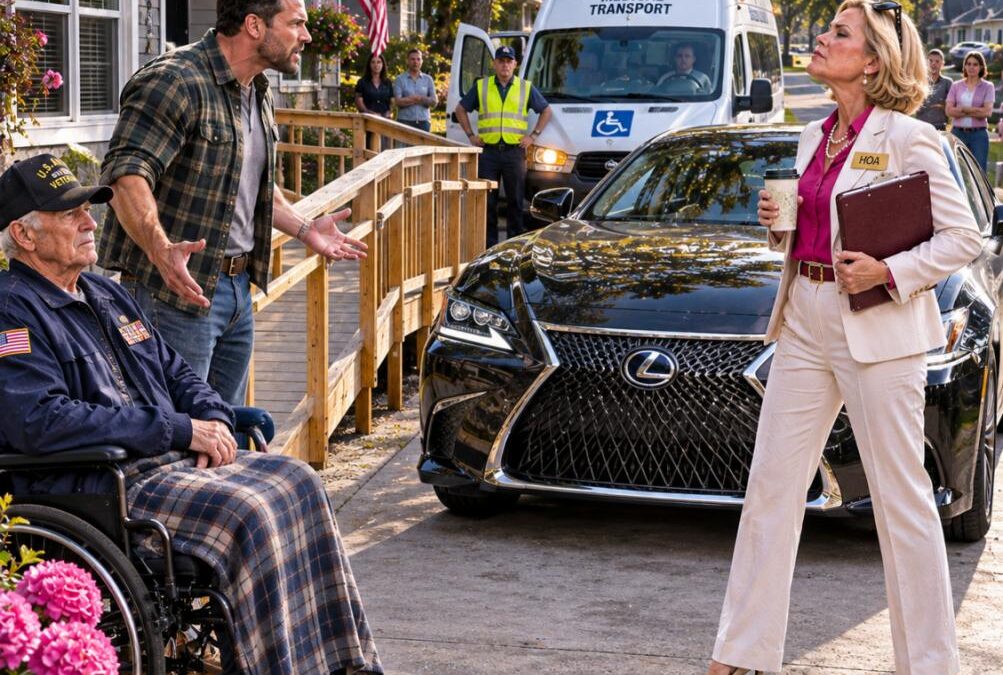
HOA Karen Blocked My Disabled Veteran Father’s Medical Van and Fined Our Wheelchair Ramp—She Picked the Wrong Family to Corner
HOA Karen fined me for building the wheelchair ramp my disabled veteran father needed to get safely into the house, then started targeting the work truck that paid my family’s bills.
When I challenged her, her Lexus somehow kept ending up across my driveway on the exact mornings Dad’s medical transport was due.
By the fourth time she blocked him from leaving for treatment, I stopped treating it like neighborhood pettiness and started building a record she couldn’t explain away.
At 6:02 on a Wednesday morning, my father’s medical transport van was sitting in the street with its hazard lights flashing, and Susan Harper’s black Lexus was parked sideways across the mouth of my driveway.
Again.
The driver leaned on the horn.
My father Frank sat behind me in his wheelchair wearing a blue jacket over his pajamas, one hand gripping the armrest.
“How late are we?”
“Not late yet.”
“Michael.”
“We’re fine.”
He gave me the look fathers reserve for sons who are lying badly.
The dialysis center had given us a narrow arrival window.
Miss it and they would try to fit him later.
Sometimes they could.
Sometimes they couldn’t.
For Dad, after three years of kidney trouble layered on top of old spinal injuries, “later” wasn’t an inconvenience.
It was medical risk.
I stepped outside.
Susan stood across the street beside her garage holding an oat-milk latte.
She watched me.
Actually watched me.
No surprise.
No confusion.
No hurried realization that she’d accidentally blocked a wheelchair transport.
Just that small smile she used whenever she believed a rule, a car, or a board vote had placed me somewhere beneath her.
“Susan.”
She took a sip.
“Morning, Michael.”
“Move the Lexus.”
“I’m leaving shortly.”
“The medical van is here.”
“I can see that.”
My jaw tightened.
“This is the fourth time this month.”
“You’re keeping count?”
“Move the car.”
She glanced toward my ramp.
The same ramp she’d fined me seven hundred dollars for building after the HOA told us the architectural committee couldn’t review it for eight weeks.
“Maybe if your property were better organized, access wouldn’t be such a recurring problem.”
I stared at her.
“My property?”
“Your commercial truck. Material deliveries. That ramp. You’ve created constant congestion.”
The transport driver got out.
“Sir, we need to get going.”
“I know.”
Susan looked toward him.
“You can wait five minutes.”
He frowned.
“Ma’am, he’s scheduled for treatment.”
“So am I supposed to abandon my own errands?”
I pulled out my phone.
Susan’s smile changed.
I took photographs.
Her Lexus.
My driveway.
The medical van.
Dad visible through the front doorway.
Timestamp.
6:04.
She crossed her arms.
“You really want to make this dramatic?”
“No.”
I turned on video.
“I want it documented.”
Her face hardened.
“You’ve been warned about harassing board members.”
“You’re blocking my driveway.”
“I’m temporarily stopped.”
“In front of my property.”
“Common curb area.”
“Move.”
Susan finally walked toward the Lexus.
Then stopped beside me.
“Keep pushing, Michael.”
I looked at her.
“What?”
“The ramp fines. The truck fines. Your so-called accessibility complaint.”
She leaned closer.
“You think because your father is a veteran, everyone has to rearrange the neighborhood around you.”
My father heard her.
I knew because behind me the screen door opened.
Susan heard it too.
She turned.
Frank sat there in his wheelchair.
Seventy-three years old.
Vietnam veteran.
Former union carpenter.
Hands still thick from decades of work.
He stared at her.
“Lady.”
Susan’s face tightened.
Dad continued.
“I built half the houses around this city before your subdivision existed.”
She smiled coldly.
“And now you live in one with rules.”
The medical driver muttered something under his breath.
Susan opened her Lexus.
Then she looked back at me.
“Your next hearing is Friday.”
“For what?”
“You’ll find out.”
She drove away at 6:07.
Three minutes.
That’s all.
Dad still made treatment.
But when I wheeled him toward the van, he didn’t complain about Susan.
He said something worse.
“Mike.”
“Yeah?”
“Don’t let that woman make your wife raise this baby in a war zone.”
Emily was eight months pregnant.
Standing in the doorway behind us.
And for the first time since Susan Harper began targeting my house, I understood that winning couldn’t mean getting angrier than she was.
It had to mean proving exactly what she was doing.
part 2
My name is Michael Santoro.
I was forty-five when Susan Harper decided my family had become a problem Cedar Grove Estates needed to solve.
I’m a general contractor.
Not one of those television contractors who walks into a kitchen, says “open concept,” and magically produces marble countertops after a commercial break.
I pour concrete.
Frame additions.
Repair roofs.
Build decks.
Deal with inspectors.
Argue with suppliers.
Explain to homeowners that water still runs downhill even if they dislike where downhill happens to be.
My company, Santoro Construction, isn’t huge.
Seven full-time employees.
Three subcontractor crews we use regularly.
One Ford F-250 that gets washed less often than it should.
I inherited my grandmother Lucia’s house in Cedar Grove after she died.
Grandma bought it in 1976, long before the HOA became the organization Susan eventually controlled.
She had opinions about the association from the day it formed in the early nineties.
“The Lord already gave us weather,” she’d say. “Why do we need another thing telling us what color the door can be?”
Grandma fought over everything.
Shrubs.
Mailboxes.
A flagpole.
One memorable six-month battle about whether tomatoes counted as ornamental landscaping.
I spent my teenage years embarrassed by her.
By forty-five, I understood her much better.
Three months before Susan’s first ramp fine, Emily and I moved into the house full-time.
Emily was thirty-eight, pregnant with our second child, and still teaching second grade because apparently a classroom full of seven-year-olds was less frightening to her than maternity leave.
Dad moved with us.
Frank Santoro had spent forty years building things.
Commercial framing.
Concrete.
Custom houses.
Schools.
Hospitals.
He served in Vietnam before any of that.
He rarely talked about the war.
His body did.
Old shrapnel damage.
A lower-back injury aggravated by construction work.
Then a fall at a job site twelve years earlier made everything worse.
By the time he moved into Grandma’s old house, Dad used a wheelchair almost full-time.
He could transfer with assistance.
Stand briefly.
Manage a few steps on a good day.
The problem was that “good day” had become less reliable.
The front entrance had five concrete steps.
The side entrance had three.
The garage had two.
Dad needed a ramp.
Not decorative.
Not optional.
Needed.
I submitted an architectural request the first week.
Site plan.
Slope.
Handrails.
Pressure-treated lumber with composite decking.
Paint color matched to the trim.
I knew how to build it because it was literally my profession.
Management replied:
Next architectural committee review: approximately eight weeks.
I called.
“My father is wheelchair-bound.”
“We understand.”
“He needs to enter and leave the house.”
“You can request expedited review.”
“I am requesting expedited review.”
“Put it in writing.”
I did.
Two days later, Susan appeared in the driveway.
She wore an emerald blazer and heels that looked like they belonged at a closing table, not a construction site.
Real-estate agent.
HOA president.
Professional wearer of expensive irritation.
She pointed toward the temporary aluminum ramp I’d rented.
“That needs approval.”
“It’s temporary.”
“It’s visible from the street.”
“My father uses it.”
“You still need approval.”
“I submitted the permanent design.”
“Committee meets next month.”
“Eight weeks.”
“Approximately.”
I looked at her.
“Are you telling me Dad should stay inside for eight weeks?”
“I’m telling you not to make permanent exterior changes without approval.”
“Then expedite it.”
Susan smiled.
“We can’t change procedure for every personal circumstance.”
Dad was behind me near the garage door.
He heard everything.
That night, he tried using the front steps with me helping.
One leg buckled.
I caught him before his shoulder struck the railing.
Emily came running.
“Frank!”
“I’m fine.”
He wasn’t.
He sat on the second step breathing hard.
Humiliated.
I hated that more than the fall.
The next morning, I built the permanent ramp.
Correct slope.
Landings.
Handrails.
Non-slip surface.
Everything from the submitted plan.
At 7:45 the following morning, Susan taped a violation notice to my front door.
UNAPPROVED EXTERIOR STRUCTURE.
Initial fine: $700.
I called an attorney before I called Susan.
That decision saved me months of stupidity.
Her name was Lisa Wong.
She handled real-estate disputes and fair-housing matters.
I emailed her the HOA documents, ramp application, Dad’s disability documentation, and the expedited-review request.
She called that afternoon.
“First question: does your father live there?”
“Yes.”
“Primary residence?”
“Yes.”
“Good.”
“Why?”
“Because disability-related housing rights are going to matter.”
“Can the HOA make us remove the ramp?”
“Don’t remove anything.”
“That’s what I wanted to hear.”
“Don’t celebrate yet.”
Lisa explained the distinction between an ordinary architectural request and a disability-related reasonable accommodation or modification issue.
The HOA could have legitimate interests in safety and design.
What it couldn’t do was simply pretend Dad’s disability was irrelevant while delaying meaningful access indefinitely.
She sent a letter.
Professional.
Not threatening.
Dad resided at the property.
He had a mobility disability.
The ramp was necessary for use and enjoyment of the dwelling.
We were willing to discuss reasonable design conditions.
Immediate fines and an eight-week delay were disputed.
Please suspend enforcement and engage in an accommodation process.
Management forwarded it to Susan.
Susan responded personally.
The association does not discriminate. Mr. Santoro proceeded without approval and must accept responsibility for his decision.
Lisa called me.
“Do nothing.”
“I wasn’t doing anything.”
“You were thinking loudly.”
I was.
The ramp remained.
The fine remained too.
Then Susan found my truck.
My F-250 had Santoro Construction lettered on both doors.
Same truck I’d parked at Grandma’s house dozens of times before moving in.
Now that I lived there, it became a “commercial vehicle.”
The declaration restricted certain large commercial vehicles, trailers, heavy equipment, and overnight work fleets.
My pickup wasn’t prohibited by name.
More importantly, the neighborhood was full of work trucks.
Plumbers.
Electricians.
A pest-control supervisor.
And three Harper Construction pickups.
Susan’s husband James owned Harper Construction.
My competitor.
Not my biggest competitor.
But we bid on the same residential projects sometimes.
At first, I assumed Susan could separate those roles.
Then I received the emergency truck notice.
$200 per day beginning after a five-day cure period.
I photographed every comparable work truck.
Especially Harper’s.
One parked in Susan’s driveway.
Another at her son’s house.
A third near a board member’s property during a renovation.
At the hearing, I projected the photographs.
Susan sat in the center.
“Harper vehicles have temporary permissions.”
“Where are the permits?”
“They’re internal.”
“Can owners inspect them?”
“Not necessarily.”
I looked at the board.
“Then how am I supposed to know this rule is being applied equally?”
Susan leaned toward the microphone.
“Because the board says it is.”
That answer told me everything.
The board upheld the fine four to one.
A physician named Dr. Kim voted no.
Afterward, an eighty-year-old woman named Mildred Carter caught me in the parking lot.
Small woman.
Gray hair.
Knitted cardigan.
Eyes like a prosecutor.
“You’re Lucia’s grandson.”
“Unfortunately.”
Mildred smiled.
“I loved your grandmother.”
“That sounds suspicious.”
“She was a menace.”
“Correct.”
Mildred handed me a folder.
“She gave me copies before she died.”
Inside was an old amendment from 1993, recorded with the county.
Grandma had apparently negotiated language for her property when the HOA expanded commercial-vehicle restrictions.
Her lot retained a limited exception for one contractor or tradesman’s pickup personally used by the resident owner, provided no heavy equipment or trailer was stored overnight.
I read it twice.
Then called Lisa.
She pulled the recorded copy herself.
Valid.
Still attached to the property.
My truck fit.
Susan had fined a vehicle the recorded amendment expressly permitted.
Lisa sent the document.
The truck fines disappeared.
No apology.
Susan lost round one.
That’s when things got personal.
Her Lexus began appearing across my driveway.
The first time, I assumed accident.
She had stopped to talk with a neighbor.
Ten minutes.
Moved when I asked.
The second time happened during a concrete delivery.
Mixer truck couldn’t enter.
Susan said she was “temporarily positioned.”
The driver waited.
We lost time.
Third incident:
Dad’s transport.
Thirty-five-minute delay.
She moved before police arrived.
Fourth:
Emily had false labor contractions.
Susan’s Lexus blocked the driveway while she visited the empty house next door, which she had listed for sale.
I called her.
No answer.
Walked across the street.
No Susan.
I was considering calling a tow company when she appeared from around the corner.
“What’s the emergency?”
“My nine-month-pregnant wife needs to leave.”
“Then ask politely.”
I stared.
“I called you four times.”
“You’ve become very aggressive.”
“Move your car.”
She did.
That was when I installed exterior cameras.
Not hidden.
Visible.
Driveway.
Front porch.
Ramp.
Garage.
Susan complained they created “privacy concerns.”
Lisa responded with one sentence:
The cameras are directed toward Mr. Santoro’s property and public-facing areas for legitimate security purposes.
No violation followed.
Then came the medical-van obstruction from the opening.
That one gave us clean video.
Susan standing across the street.
My request.
Her statement about Dad.
Timestamp.
Duration.
Dad’s transport records.
I filed a police incident report even though the car had been moved before officers arrived.
The officer took the video.
No arrest.
No ticket based solely on what he hadn’t personally observed.
Fine.
The report existed.
Three days later, Susan issued another notice.
INTERFERENCE WITH ASSOCIATION OFFICER.
I almost admired the creativity.
Lisa did not.
She sent a broader preservation letter.
Board communications.
Ramp records.
Vehicle exemptions.
Parking complaints.
Vendor contracts.
Communications between Susan and Harper Construction regarding my property or business.
That last category made Susan furious.
Management’s lawyer responded.
Lisa reminded them Susan’s husband competed with my company while she had initiated enforcement affecting my work vehicle.
Conflict-of-interest questions were legitimate.
Then my business started taking hits.
A homeowner I’d bid a $42,000 deck project for suddenly stopped returning calls.
Another canceled a kitchen addition.
A third told me bluntly:
“Susan Harper said your company was having licensing issues.”
We were not.
I asked him to put that in writing.
He did.
Then another client said James Harper had approached him after hearing Santoro Construction might be “too tied up in legal problems to finish.”
I called Lisa.
“Can we sue them now?”
“We can investigate now.”
“I hate that answer.”
“Good.”
She wrote to Susan and James demanding they stop making false business statements.
Both denied doing so.
Then we found something cleaner.
Public bidding emails from one homeowner showed Susan forwarding James’s estimate after telling the owner my company was “under compliance scrutiny in Cedar Grove.”
That wasn’t merely gossip anymore.
It connected her HOA role to her husband’s commercial interest.
The homeowner chose neither company after realizing what had happened.
Smart woman.
The board should have cared.
Most didn’t.
Susan had controlled Cedar Grove for years.
She knew which directors hated conflict.
Which homeowners never attended meetings.
Which vendors depended on association work.
The power wasn’t magical.
It was organizational.
She always had more patience than everybody else.
Until Mildred.
Mildred had more.
She started helping me pull records.
Meeting packets.
Old amendments.
Financial summaries.
Vendor payments.
She had served as treasurer twenty years earlier and understood where to look.
“Never fight a woman with free afternoons,” Emily said.
Mildred heard.
“That’s right.”
Dad loved her.
Possibly too much.
“She’s single,” he told me.
“You’re on dialysis.”
“I’m not dead.”
“You’re also impossible.”
“Genetic.”
Then something happened that scared me more than the fines.
Adult Protective Services came to the house.
Complaint:
Possible neglect of disabled elderly resident.
Unsafe access.
Missed medical care.
Improper living environment.
My father sat in the living room staring at the investigator.
“Neglect?”
The investigator was professional.
“I’m required to follow up.”
Dad’s face changed.
His war memories surfaced under stress.
Always had.
He began talking too fast.
Then stopped talking entirely.
I showed the investigator the ramp.
Medical schedules.
Transport records.
Dad’s room.
His medications.
Home-health documentation.
She closed the case after review.
Still, Dad didn’t sleep well for a week.
Then Emily’s school received a welfare inquiry alleging she had endangered our unborn child by “recklessly driving during medical distress.”
That complaint went nowhere.
But it frightened her enough that her obstetrician ordered more rest after her blood pressure climbed.
I wanted Susan destroyed.
Lisa wanted evidence.
“Do we know she filed either report?”
“No.”
“Then stop saying her name when we discuss them.”
“Who else?”
“Maybe her. Maybe somebody supporting her. Maybe somebody unrelated. We prove what we can.”
That lesson became the center of everything.
Susan was doing enough openly.
I didn’t need to blame her for every dark thing.
The business statements.
Documented.
Ramp fine.
Documented.
Selective truck enforcement.
Documented.
Driveway obstruction.
Documented.
HOA spending.
We were getting there.
The board records arrived in batches.
That’s when Dr. Kim called me.
“We need to talk.”
He had opposed several of Susan’s enforcement decisions but stayed quiet publicly.
At a coffee shop, he placed copies of board emails on the table.
Susan to directors:
Santoro needs to understand that disability accommodation does not create immunity from community standards.
Another:
His father is being used as leverage to excuse unapproved construction.
My hands tightened.
Dr. Kim said, “There’s more.”
Susan discussing my work truck:
Michael’s continued commercial presence undermines the residential appearance of Cedar Grove and creates unfair visibility for his business.
A board member replied:
What about James’s trucks?
Susan:
Harper Construction performs association-approved and resident-requested work. Different situation.
Then this:
If Santoro cannot operate comfortably under our rules, perhaps Grandma’s old house is no longer the right fit for his family.
I looked at Dr. Kim.
“Why didn’t you stop her?”
He closed his eyes briefly.
“I kept thinking she’d calm down.”
“Did she?”
“No.”
“Then why now?”
“Because she’s talking about liens.”
My stomach dropped.
“What liens?”
Dr. Kim slid another email across.
Susan:
Continue fines. Once the balance is significant enough, collection counsel can advise on lien remedies. Financial pressure usually restores compliance faster than endless hearings.
There it was.
Not a secret foreclosure plot.
Something more believable.
Use accumulating charges to create pressure.
If the debt became enforceable, then collection mechanisms might follow.
That was enough.
Lisa sent emergency demands to Cedar Grove’s counsel and insurer.
She also filed suit seeking declaratory and injunctive relief around the ramp, vehicle enforcement, fines, and retaliatory collection.
The court didn’t instantly wipe Susan from existence.
It did something better.
It slowed her down.
Temporary orders prevented the association from escalating collection on the disputed ramp and truck fines while their validity was litigated.
The court required the HOA to maintain Dad’s access and refrain from interfering with the ramp pending resolution.
My truck could remain under the recorded exception.
That was a major win.
Susan acted like nothing had happened.
At the next HOA meeting, she called it “procedural.”
Technically, she wasn’t wrong.
Temporary relief isn’t final victory.
Then Carl Russo called.
Car-wash owner.
Board member.
Nervous enough that I could hear him whispering in his own office.
“Michael.”
“Yeah?”
“Things are out of hand.”
“They’ve been out of hand.”
“Susan’s spending association money on enforcement vendors.”
“What kind?”
“Private investigator.”
I sat up.
“What?”
“Maybe not private investigator. Compliance contractor.”
“For me?”
“Mostly.”
“How much?”
“I don’t know.”
“You’re on the board.”
“She approves anything under a certain threshold as operational expense.”
“How many under-threshold expenses?”
Silence.
“Carl.”
“A lot.”
Mildred and Lisa attacked the records.
Invoices showed repeated “compliance services.”
Drive-by photography.
Property observation.
Business-registration research.
License checks.
Vendor calls.
Some of that could be legitimate HOA work in the right circumstances.
The volume was not.
Then we found payments to a drone-imaging company.
Susan had authorized aerial photographs of my backyard “to document exterior modifications and commercial storage.”
The drone Lily and I had seen while grilling.
There it was.
Not a mystery anymore.
Lisa asked:
“Board authorization?”
Carl shook his head.
“No.”
“Legal review?”
“No.”
“Why?”
Carl looked embarrassed.
“She said we needed proof.”
Proof of what?
A ramp everyone could see.
A truck everyone could see.
A barbecue grill.
My father’s wheelchair.
The harder Susan searched for wrongdoing, the clearer it became she had decided guilt first.
Then Mildred found the money.
Not embezzlement.
That was the rumor.
The truth was conflict.
Over three years, Harper Construction and affiliated vendors had received tens of thousands of dollars in Cedar Grove work.
Fence repair.
Clubhouse maintenance.
Concrete.
Drainage.
Snow damage.
Some jobs competitively bid.
Some not.
Susan had voted on or influenced several approvals without fully documenting her spouse’s financial interest in the minutes.
James’s company may have done legitimate work.
That wasn’t the point.
The conflict should have been disclosed and managed.
More troubling, my company had once been invited to bid two neighborhood projects.
Both times, Harper won.
I requested the bid sheets.
Mine hadn’t simply lost.
One had been marked:
Vendor currently subject to compliance enforcement. Recommend against award.
Susan’s handwriting.
I stared at it.
“She used HOA enforcement to disqualify my business.”
Lisa nodded.
“That’s what the document suggests.”
“James got the contract.”
“Yes.”
My hands shook.
That was the first time I truly understood the financial motive.
Maybe Susan had started because she disliked the ramp.
Maybe she loved control.
But once my company became inconvenient to her husband’s, she had a separate reason to keep me labeled noncompliant.
Conflict of interest.
Selective enforcement.
Business interference.
Documents.
We didn’t need conspiracy theories.
Susan had put enough on paper.
The insurer reacted.
Fast.
Insurance companies become philosophical when risk is abstract.
Once invoices and litigation arrive, philosophy ends.
Coverage counsel requested board records.
Independent association counsel was appointed.
Susan objected.
Lost the vote three to two.
Then the board scheduled a special meeting.
Almost two hundred homeowners came.
Cedar Grove’s clubhouse held eighty comfortably.
The rest stood in the hall and outside.
News had started spreading.
Not through a dramatic Facebook revenge group.
Through neighbors comparing letters.
One homeowner fined for a wreath.
Another for garden edging.
A veteran couple fighting over an accessibility handrail.
A Black family cited repeatedly for driveway basketball while similar hoops existed on three other streets.
A Latino contractor questioned over parking his personal work van.
Not every complaint was connected.
Not every fine invalid.
Susan didn’t invent every rule.
But a pattern of discretion had grown around her.
She decided which violation mattered.
Which exception counted.
Which owner deserved patience.
That was the problem.
Susan entered wearing an emerald blazer.
Same color as the first day she criticized Dad’s ramp.
I wondered whether that was intentional.
She sat at the center.
Independent counsel opened.
“This meeting concerns governance practices, conflicts of interest, enforcement procedures, and current litigation. I strongly recommend directors avoid public speculation concerning ongoing claims.”
Susan immediately said:
“Then we should not be holding this spectacle.”
Counsel looked at her.
“The board called the meeting.”
“I am president.”
“You are one director and one officer.”
That distinction hit the room.
Susan’s expression changed.
Carl presented first.
Vendor invoices.
Compliance spending.
Drone services.
Security observation.
Susan interrupted.
“All authorized.”
“By who?” Carl asked.
“By the office of the president under operating authority.”
“Show me.”
Susan pointed to a policy.
Carl read it.
“Up to five thousand dollars for emergency or routine operational needs.”
“Exactly.”
Carl looked toward counsel.
“Can twenty-two separate expenses against one homeowner count as separate routine needs?”
Counsel answered carefully.
“That’s one of the questions under review.”
Then Dr. Kim spoke.
He projected the email about Dad.
His father is being used as leverage.
Emily gripped my hand.
Dad sat beside her in his wheelchair.
He had insisted on attending.
Susan said:
“That’s being taken out of context.”
Dad spoke from the audience.
“What’s the good context?”
Susan froze.
Everyone turned.
Dad raised one hand.
“Seriously. I’m curious.”
Some people laughed.
Dad didn’t.
“I’m leverage?”
Susan leaned toward the microphone.
“Mr. Santoro, I was referring to your son’s repeated invocation of your disability during architectural enforcement.”
“I use a wheelchair.”
“We know.”
“He built a ramp.”
“Without approval.”
“Because you told him to wait two months.”
“The committee had a schedule.”
Dad stared.
“I had dialysis.”
Silence.
Susan’s voice became colder.
“You were never denied access to medical care.”
That was technically true.
We had found ways.
Temporary ramp.
Michael helping.
Transport delays.
Dad smiled without humor.
“Lady, you’re confusing surviving your decisions with your decisions being reasonable.”
The room reacted.
Susan looked toward counsel.
Counsel looked down.
Then I presented the driveway videos.
Not all of them.
Four.
Dates.
Times.
Her Lexus blocking access.
On one, the medical transport van waiting.
On another, Emily needing to leave during false labor.
On the opening video, Susan saying:
You think because your father is a veteran, everyone has to rearrange the neighborhood around you.
Susan stared at the screen.
“That was a private confrontation.”
I said, “In my driveway.”
“You were filming me without permission.”
“My exterior camera recorded my property.”
She turned toward counsel.
He didn’t rescue her.
Then Mildred walked forward carrying Grandma Lucia’s old folder.
Susan looked annoyed.
“Mildred, we have an agenda.”
Mildred smiled.
“I’ve been waiting thirty years for somebody like you to say that.”
The room laughed.
Susan did not.
Mildred placed the recorded 1993 amendment on the table.
“Lucia Santoro negotiated this because the association tried the same nonsense with her landscaping truck.”
Susan said, “We’ve already acknowledged the exception.”
“After fining Michael.”
“An administrative oversight.”
Mildred turned toward homeowners.
“Funny how the oversight always costs the homeowner first.”
Then came the conflict records.
Harper Construction payments.
Susan’s participation.
My bids marked noncompliant.
The room stopped laughing.
James Harper wasn’t there.
Susan’s husband had stopped attending HOA events once litigation began.
Carl asked:
“Did you disclose your financial interest when Harper Construction received these contracts?”
Susan snapped:
“James’s company is separate from me.”
Independent counsel said:
“That’s not the question.”
Susan’s face reddened.
“Everybody knew James owned Harper Construction.”
“Knowledge is not the same as recorded conflict disclosure and recusal.”
Susan stared at him.
“You’re representing the association.”
“Correct.”
“Then act like it.”
“I am.”
That may have been the moment she realized the association was no longer synonymous with Susan Harper.
The board voted to place her presidential authority on temporary suspension pending the audit.
Four to one.
Susan voted no.
She remained a director.
For eleven days.
Then the accessibility issue reached mediation.
The association’s new counsel did what should’ve happened on day one.
Reviewed Dad’s disability documentation.
Reviewed the ramp.
Reviewed safety.
Reviewed aesthetics.
The ramp was approved with two minor changes I volunteered to make.
Different handrail finish.
Small landscaping screen near one landing.
Reasonable.
Nobody had needed a war.
The ramp fines were withdrawn.
The truck fines already gone.
Collection charges tied to them were removed.
Dad rolled down the ramp the day the final approval arrived.
He stopped halfway.
“Looks different.”
“What?”
“The ramp.”
“Same ramp.”
“No.”
He tapped the paper folded in his jacket.
“Now Susan approves.”
I laughed.
“Try not to crash celebrating.”
He flipped me off.
Then the audit landed.
Susan had not stolen hundreds of thousands from the HOA.
That rumor traveled faster than facts.
The auditors did find serious governance failures.
Conflict disclosures missing.
Competitive-bid rules inconsistently followed.
President-level spending fragmented across multiple invoices.
Enforcement expenses heavily concentrated on a small number of homeowners.
Vendor oversight poor.
Legal advice sometimes ignored.
Meeting minutes sanitized disagreements.
Appeals handled by the same officers who initiated enforcement.
And several Harper Construction contracts approved through processes that should have included Susan’s recusal.
That was enough.
The board called another meeting.
Susan arrived with her own attorney.
Smartest thing she’d done in months.
Carl made the motion.
“Remove Susan Harper as president permanently.”
Her lawyer whispered to her.
Susan stayed silent.
Vote:
Five to one.
Susan again cast the only vote for herself.
Removing her as an elected director required a separate member process.
She resigned three days later.
The civil case did not magically disappear.
Lisa kept it narrow.
Disability-related access claims.
Improper fines.
Selective enforcement.
Business interference tied to documented statements and bid records.
Unauthorized surveillance expenditures.
Governance issues where they caused actual harm.
We didn’t claim Susan stole my mail.
Couldn’t prove it.
We didn’t claim she sent the dead fish.
Couldn’t prove it.
We didn’t claim she personally made every anonymous report.
Couldn’t prove it.
Those unanswered parts still bothered me.
They also made the proven parts more credible because we refused to invent conclusions.
Mediation took eleven hours.
Susan attended separately.
James attended with his own attorney because Harper Construction’s interests weren’t identical to hers.
The HOA’s insurer attended.
Everybody hated everybody by lunch.
By dinner, we had framework terms.
The association withdrew disputed fines and paid negotiated compensation covering a substantial portion of legal expenses and certain documented losses.
It formally recognized Dad’s disability accommodation.
Governance reforms became mandatory.
Conflict-of-interest disclosure.
Recusal procedures.
Competitive-bid requirements.
Written citation of actual governing provisions before fines.
Appeal review by people who had not initiated the enforcement where practicable.
Rules for vendor surveillance.
No drone compliance inspections of private backyards without clear authority, legal review, and documented board approval.
Reasonable-accommodation procedures for disability-related requests.
Common-area privileges couldn’t be weaponized before required process.
The HOA also agreed to reimburse my company for one documented bidding cost tied to a process tainted by undisclosed conflict.
Harper Construction separately resolved the business-disparagement dispute without admitting every allegation.
My lost contracts weren’t magically restored.
One client returned.
Most didn’t.
Reputation is easier to damage than repair.
Still, the documented lie stopped circulating.
That mattered.
Susan’s Lexus remained.
This is where everybody expects the revenge.
Tow truck.
Hook.
Susan screaming.
Car disappearing.
Reality took longer.
The board adopted a neutral access policy after homeowners complained that vehicles repeatedly blocking driveways and accessibility paths had become a safety problem.
Not Susan’s Lexus specifically.
Any vehicle.
First violation documented warning when feasible.
Immediate action for actual emergency obstruction.
Towing only when legally authorized and after required notice or when a vehicle created a qualifying access or safety obstruction under applicable rules.
No friend of mine secretly waited with a tow truck.
No trap.
Then Susan blocked Dad’s transport again.
After losing the presidency.
I couldn’t believe it.
7:11 a.m.
Her Lexus sat half across the driveway while she spoke to a real-estate client two houses down.
Dad’s van arrived.
My camera recorded everything.
I called Susan.
No answer.
I texted:
Medical transport blocked. Please move vehicle immediately.
No response.
The driver waited.
I called the non-emergency police line and management.
Management called the towing vendor under the new policy after confirming the obstruction through the security camera system and my timestamped video.
A police officer arrived first.
He saw the Lexus.
Saw the medical van.
Ran the plate.
Then Susan finally appeared.
“What is this?”
The officer pointed toward her vehicle.
“Is that yours?”
“Yes.”
“You need to move it.”
Susan looked at me.
“He’s doing this.”
The officer frowned.
“Doing what?”
“Harassing me.”
“Your vehicle is blocking his driveway.”
“For five minutes.”
The medical driver said:
“Fourteen.”
Susan stared at him.
Then the tow truck turned onto the street.
Her face changed.
“I’m moving it.”
The officer said:
“Then move it now.”
She did.
No tow.
That surprised everyone who later heard the story.
The Lexus did not disappear that day.
But Susan received a formal citation for obstructing access under local rules based on what the officer observed.
And the incident became part of the civil enforcement record.
Two months later, the Lexus actually was towed.
Not because of me.
At a Cedar Grove holiday event, Susan parked in a clearly marked fire lane outside the clubhouse after being told the lot was full.
New board.
New enforcement.
No special treatment.
Fire access had to remain clear.
Management asked her to move.
She refused.
The fire marshal conducting a scheduled occupancy check arrived during the event.
The vehicle was ordered removed under the same rules applicable to anyone else.
The tow company hooked it.
I was inside when somebody yelled:
“Susan’s car!”
Dad looked at me.
I stayed seated.
“Aren’t you going outside?”
“No.”
“You’ve waited a year.”
“Exactly.”
Dad rolled toward the window.
“You’re no fun.”
Outside, Susan argued.
Her Lexus left on a flatbed.
No racial slurs.
No kicking the truck.
No dramatic arrest.
Just consequences.
That was enough.
People filmed anyway.
By morning, the video was everywhere in Cedar Grove.
I didn’t post it.
Didn’t need to.
Susan’s real trouble came from the financial and business records, not the Lexus.
Her brokerage opened an internal ethics review after clients complained about her using HOA status in business conversations.
I don’t know every detail.
She eventually stopped working under that brokerage.
James filed for divorce months later.
I did not celebrate.
Marriages fail for reasons outsiders never fully understand.
I wasn’t going to pretend our HOA dispute caused everything.
James did, however, cooperate in producing records during the civil case.
Those records showed something important.
He had repeatedly told Susan to stop using his business as an HOA vendor without formal bids.
One text:
You’re making this look dirty. Stop involving me in your board fights.
Susan replied:
Then win bids without me.
That hurt her more than anything I could’ve said.
Her own husband had understood the conflict.
The board election after Susan’s resignation brought out more voters than anyone could remember.
Mildred refused to run for president.
“Absolutely not.”
Dad said:
“You’d win.”
“That’s why I’m not doing it.”
Dr. Kim became president.
Carl stayed treasurer.
Three new directors joined.
The first six months were painfully boring.
I attended every meeting.
Budget.
Pool resurfacing.
Insurance.
Tree removal.
Ramp policy.
Contract bids.
Boring became my favorite word.
Dad’s health stabilized for a while.
He never became healthy.
Dialysis doesn’t care about neighborhood victories.
But transport was no longer a battle.
Every Monday, Wednesday, Friday, the van pulled up.
Driveway clear.
Ramp clear.
Dad rolled out.
He’d salute the camera.
“Documenting.”
“Very funny.”
“Evidence.”
“Get in the van.”
Emily gave birth in October.
A girl.
We named her Lucia.
Not Freedom.
Dad cried when he held her.
So did I.
Emily pretended she didn’t.
Lily—my daughter from my first marriage—was fifteen by then and immediately declared herself Lucia’s only competent guardian.
Our family expanded while the lawsuit shrank.
That was the best thing that happened.
Susan had spent months occupying every conversation.
Then a baby arrived and nobody cared about Susan for hours at a time.
Then days.
That was healing.
The dead-fish mystery remained.
Mail issue too.
Postal inspectors never tied the forwarding request to Susan.
Police never identified whoever left the bag.
My cameras never captured another incident.
I learned to tolerate unfinished stories.
Humans hate them.
We want every villain responsible for every bad event.
Truth doesn’t cooperate.
Susan did enough that we didn’t need to assign her crimes we couldn’t prove.
Dad taught me that, strangely.
One night we sat in the garage.
“Think she sent the fish?” I asked.
“Probably.”
“That’s not evidence.”
“Didn’t say it was.”
“You sound like Lisa.”
“Smart woman.”
“Annoying woman.”
“Usually same thing.”
Dad took a sip of coffee.
“Mike.”
“Yeah?”
“You already got her on what she did.”
“I know.”
“Then stop needing her to have done everything.”
He was right.
I hated it.
Cedar Grove changed slowly.
Not magically.
Some homeowners complained the new board was too cautious.
Legal review cost money.
Competitive bidding took longer.
Appeals delayed enforcement.
One man shouted at a meeting:
“Under Susan, things got done.”
Dr. Kim answered:
“Yes.”
Then waited.
The whole room laughed.
Even the angry man.
Susan’s old influence faded.
Her house went on the market the following spring.
Six thousand square feet.
Perfect lawn.
Black Lexus gone—she eventually replaced it.
No dramatic foreclosure.
No federal agents carrying boxes out.
She sold.
Moved.
I saw the moving truck from Dad’s ramp.
He was drinking coffee.
“That’s it?”
“What?”
“She just moves?”
“What were you expecting?”
“Helicopter.”
“You’re impossible.”
He grinned.
The new owners had two children and a golden retriever.
Normal people.
They asked about the HOA.
I told them the truth.
“Read the rules.”
“Strict?”
“Not if everybody does their job.”
They looked confused.
Good.
They didn’t need to inherit our war.
My business recovered too.
Not explosively.
No magical quarter-million-dollar surge because the local news liked my story.
Reputation rebuilt one job at a time.
A deck.
A roof.
A restaurant renovation.
Then a homeowner who had dropped us during Susan’s campaign called.
“I owe you an apology.”
“You don’t owe me work.”
“I know.”
He hired us anyway.
Fair bid.
We won.
That felt better than revenge.
Harper Construction remained in business under James.
We competed once after the divorce.
He beat my price by four percent.
I cursed him.
Then sent a congratulations text.
He replied:
Don’t get sentimental.
Good.
Normal competition.
No board president tilting the field.
Dad lived long enough to see Lucia take her first steps.
That mattered more than anything else in this story.
One afternoon, she toddled toward his ramp holding the railing.
Dad looked terrified.
“Michael.”
“I’m watching.”
“She’ll fall.”
“That’s what toddlers do.”
“Get her.”
“You’re the one who taught me kids bounce.”
“I was younger.”
He rolled toward her.
Lucia grabbed his chair.
Dad laughed.
I stood there thinking about the ramp.
The thing Susan called unauthorized.
The structure we supposedly should’ve waited eight weeks to build.
Now my father rolled down it while his granddaughter tried to climb up.
Sometimes a piece of lumber really is just a piece of lumber.
Sometimes it is access.
Dignity.
Independence.
A path between generations.
That’s why laws and accommodation processes matter.
Not because people with disabilities deserve special treatment.
Because “equal” can become meaningless when a rule ignores physical reality.
Dad couldn’t use stairs because Susan believed everybody should wait for committee day.
The problem wasn’t that Cedar Grove had architectural standards.
The problem was treating a disability-related need like a request for decorative shutters.
The new board understood that.
They created an expedited accommodation process.
Temporary safe modifications allowed while review occurred where appropriate.
Clear documentation.
Professional safety review.
Written decisions.
Appeal.
Nobody received automatic approval for anything they wanted merely by saying disability.
Nobody had to wait two months to access their own front door either.
Balance.
Real governance is mostly balance.
Susan preferred obedience.
Years later, Lisa asked me to speak to a small homeowners’ association training group.
Not lawmakers.
Not Congress.
No statewide act named after me.
A room with thirty board members and property managers.
I said no.
She asked again.
I said absolutely not.
Then Dad said:
“Do it.”
“Why?”
“Because they need to see what a homeowner looks like when you treat him like an enemy.”
So I went.
I didn’t tell them how to crush an HOA.
I told them the opposite.
Most associations aren’t evil.
Most volunteers aren’t villains.
The danger is concentration.
One person complains.
Investigates.
Interprets.
Fines.
Hears the appeal.
Selects the vendor.
Controls the minutes.
That’s too much power even when the person is decent.
Maybe especially then, because nobody questions them until they stop being decent.
I showed them one slide.
Susan’s email:
Financial pressure usually restores compliance faster than endless hearings.
Then another.
Dad’s ramp.
I asked:
“Compliance with what?”
Nobody answered.
That was my whole speech.
Frank died three years after the fight.
Not dramatically.
His health had been declining.
He spent his last Christmas in our house.
Lucia climbed onto his lap.
Lily brought him terrible coffee because she still believed cinnamon belonged in everything.
Emily made him promise not to teach Lucia profanity.
He promised.
Lied.
After the funeral, I sat on the ramp alone.
Snow along the edges.
The handrail cold beneath my palm.
For a while, I hated Cedar Grove again.
Not because of Susan.
Because Dad wasn’t there to roll down the ramp we’d fought so hard to keep.
Emily sat beside me.
“You okay?”
“No.”
“Good.”
I looked at her.
She smiled sadly.
“Lisa taught me.”
I laughed.
Then cried.
We kept the ramp.
People asked whether we’d remove it.
No.
A ramp isn’t ugly.
And even if someone thinks it is, someday another person may need it.
Grandma Lucia would’ve approved.
Probably would’ve painted it red.
We didn’t.
The HOA would allow red now only with architectural approval.
Some rules survive reform.
Years later, I found Grandma’s old file while cleaning the basement.
The 1993 commercial-vehicle amendment.
Her notes in the margins.
One line:
NEVER LET THE BOARD TELL YOU WHAT THE PAPER DOESN’T SAY.
I sat down.
Grandma had terrible handwriting.
Excellent advice.
Susan’s real power had never been her Lexus.
Or her blazer.
Or even the presidency.
It was the assumption that whatever she said the rules meant must be what they meant.
Grandma challenged that.
Lisa challenged it.
Mildred challenged it.
Eventually, the board did too.
The lesson isn’t that every homeowner should resist every HOA notice.
Sometimes your grass really is too high.
Sometimes your trailer really is blocking the road.
Sometimes your architectural application really does violate a covenant you agreed to.
Read the rule.
Then follow it.
But if the rule doesn’t say what the letter claims?
Ask.
If the same rule somehow changes depending on who owns the vehicle?
Compare.
If a board member’s spouse profits from enforcement decisions?
Demand disclosure.
If accessibility is involved?
Treat the person before the paperwork becomes a weapon.
If a fine starts growing while the appeal process is unclear?
Get advice early.
And document.
I used to think documentation was something contractors did to avoid change-order disputes.
Now I think of it as civilian body armor.
Photos.
Timestamps.
Letters.
Minutes.
Recorded amendments.
Medical transport schedules.
Emails.
Videos.
You don’t need to scream when the record is organized.
Susan screamed plenty for all of us.
The last time I saw her was maybe four years after she moved.
Home-improvement store.
Of all places.
She was standing near lighting fixtures.
I almost walked away.
She saw me.
“Michael.”
“Susan.”
She looked older.
So did I.
“How’s your father?”
That surprised me.
“He passed.”
Her expression changed.
“I’m sorry.”
“Thank you.”
Silence.
Then she said:
“I never wanted him hurt.”
I believed that.
Mostly.
“Then why did you keep blocking the driveway?”
Her face tightened.
“I wasn’t intentionally blocking medical transport.”
“The fourth time was on camera.”
“I was showing a property.”
“You stood across the street drinking coffee.”
She looked away.
“I was angry.”
That was new.
Not “enforcing standards.”
Angry.
“At me?”
“Yes.”
“Why?”
“Because you challenged everything.”
I almost laughed.
“Ramp. Truck. Business. Those weren’t everything.”
“Every time I made a decision, your lawyer sent a letter.”
“Maybe stop making decisions about my family without checking your authority.”
Susan sighed.
“You made me look like a monster.”
“No.”
Her eyes hardened.
“I know what people said.”
“I corrected people when they accused you of things we couldn’t prove.”
That surprised her.
“Why?”
“Because facts mattered when I needed people to believe me.”
She looked down.
Then said:
“James always thought I took the HOA too seriously.”
“James was right.”
“Don’t push it.”
For half a second, she sounded like the old Susan.
Then we both laughed.
Not friendship.
Not forgiveness.
Just recognition.
She asked whether Santoro Construction was doing well.
“Fine.”
“Harper too.”
“I know.”
“You keep track?”
“We bid against each other.”
She nodded.
Then picked up a box of lightbulbs.
“Goodbye, Michael.”
“Goodbye, Susan.”
That was it.
No confession.
No handcuffs.
No courtroom collapse.
No life sentence for being awful at neighborhood governance.
She moved on.
So did I.
Cedar Grove still exists.
The HOA still sends letters.
Last month I received one about my trash cans.
They were out too early.
They were.
I moved them.
No lawsuit.
No moral crisis.
No war.
That’s how I know things improved.
An HOA notice can just be an HOA notice again.
Emily still teaches.
Lucia is in elementary school now.
Lily is studying engineering and delights in telling me contractors don’t understand design.
I remind her architects and engineers don’t understand budgets.
Family tradition.
Santoro Construction grew to twelve employees.
We eventually replaced the F-250.
The old truck had almost three hundred thousand miles.
When I traded it, I removed Grandma’s 1993 amendment copy from the glove box.
I had carried it there for years.
No reason.
Habit.
I framed it in the office.
One of my guys asked:
“What’s that?”
“Reason I once kept a truck.”
He stared.
“That’s the least exciting story I’ve ever heard.”
“Good.”
He’ll learn.
The ramp remains at the house.
Gray composite now.
We replaced the boards once.
Same footprint.
Same slope.
No fine.
Sometimes I sit on the landing with a beer.
Especially summer evenings.
Lucia draws chalk on the driveway.
Emily grades papers.
Neighbors walk past.
The new HOA president waves.
Nothing happens.
Nobody parks across the ramp.
Nobody photographs the work truck.
Nobody sends a compliance contractor to watch us eat dinner.
Nobody tells me my father’s disability was leverage.
That quiet feels earned.
Not because Susan lost everything.
She didn’t.
Because she lost the one thing she had confused with ownership.
Unchecked authority.
And once that was gone, the neighborhood discovered something Cedar Grove should’ve known all along.
Rules don’t become weaker when leaders have to follow them too.
They become legitimate.
One Friday evening, I sat on Dad’s ramp holding a beer while Lucia drew a crooked house in chalk.
She pointed to it.
“That’s us.”
“That house has six chimneys.”
“We’re rich.”
“Fair.”
She drew a stick figure in a wheelchair beside the front door.
I stopped.
“Who’s that?”
“Grandpa Frank.”
She only knew him from pictures and stories now.
I swallowed.
“Why’s he outside?”
She looked at me like I was stupid.
“Because there’s a ramp.”
Of course.
I looked down the driveway.
No Lexus.
No medical van.
No fight.
Just a little girl drawing her grandfather where he belonged.
Able to get home.
And after everything Susan tried to turn that ramp into—a violation, a fine, an act of defiance—I realized Lucia saw it exactly right.
It was never rebellion.
It was a way in.
That was all we had asked for.
And all along, that should have been enough.
THE STORY ENDS HERE
HOA Karen Blocked My Disabled Veteran Father’s Medical Van and Fined Our Wheelchair Ramp—She Picked the Wrong Family to Corner
HOA Karen fined me for building the wheelchair ramp my disabled veteran father needed to get safely into the house, then started targeting the work truck that paid my family’s bills.
When I challenged her, her Lexus somehow kept ending up across my driveway on the exact mornings Dad’s medical transport was due.
By the fourth time she blocked him from leaving for treatment, I stopped treating it like neighborhood pettiness and started building a record she couldn’t explain away.
At 6:02 on a Wednesday morning, my father’s medical transport van was sitting in the street with its hazard lights flashing, and Susan Harper’s black Lexus was parked sideways across the mouth of my driveway.
Again.
The driver leaned on the horn.
My father Frank sat behind me in his wheelchair wearing a blue jacket over his pajamas, one hand gripping the armrest.
“How late are we?”
“Not late yet.”
“Michael.”
“We’re fine.”
He gave me the look fathers reserve for sons who are lying badly.
The dialysis center had given us a narrow arrival window.
Miss it and they would try to fit him later.
Sometimes they could.
Sometimes they couldn’t.
For Dad, after three years of kidney trouble layered on top of old spinal injuries, “later” wasn’t an inconvenience.
It was medical risk.
I stepped outside.
Susan stood across the street beside her garage holding an oat-milk latte.
She watched me.
Actually watched me.
No surprise.
No confusion.
No hurried realization that she’d accidentally blocked a wheelchair transport.
Just that small smile she used whenever she believed a rule, a car, or a board vote had placed me somewhere beneath her.
“Susan.”
She took a sip.
“Morning, Michael.”
“Move the Lexus.”
“I’m leaving shortly.”
“The medical van is here.”
“I can see that.”
My jaw tightened.
“This is the fourth time this month.”
“You’re keeping count?”
“Move the car.”
She glanced toward my ramp.
The same ramp she’d fined me seven hundred dollars for building after the HOA told us the architectural committee couldn’t review it for eight weeks.
“Maybe if your property were better organized, access wouldn’t be such a recurring problem.”
I stared at her.
“My property?”
“Your commercial truck. Material deliveries. That ramp. You’ve created constant congestion.”
The transport driver got out.
“Sir, we need to get going.”
“I know.”
Susan looked toward him.
“You can wait five minutes.”
He frowned.
“Ma’am, he’s scheduled for treatment.”
“So am I supposed to abandon my own errands?”
I pulled out my phone.
Susan’s smile changed.
I took photographs.
Her Lexus.
My driveway.
The medical van.
Dad visible through the front doorway.
Timestamp.
6:04.
She crossed her arms.
“You really want to make this dramatic?”
“No.”
I turned on video.
“I want it documented.”
Her face hardened.
“You’ve been warned about harassing board members.”
“You’re blocking my driveway.”
“I’m temporarily stopped.”
“In front of my property.”
“Common curb area.”
“Move.”
Susan finally walked toward the Lexus.
Then stopped beside me.
“Keep pushing, Michael.”
I looked at her.
“What?”
“The ramp fines. The truck fines. Your so-called accessibility complaint.”
She leaned closer.
“You think because your father is a veteran, everyone has to rearrange the neighborhood around you.”
My father heard her.
I knew because behind me the screen door opened.
Susan heard it too.
She turned.
Frank sat there in his wheelchair.
Seventy-three years old.
Vietnam veteran.
Former union carpenter.
Hands still thick from decades of work.
He stared at her.
“Lady.”
Susan’s face tightened.
Dad continued.
“I built half the houses around this city before your subdivision existed.”
She smiled coldly.
“And now you live in one with rules.”
The medical driver muttered something under his breath.
Susan opened her Lexus.
Then she looked back at me.
“Your next hearing is Friday.”
“For what?”
“You’ll find out.”
She drove away at 6:07.
Three minutes.
That’s all.
Dad still made treatment.
But when I wheeled him toward the van, he didn’t complain about Susan.
He said something worse.
“Mike.”
“Yeah?”
“Don’t let that woman make your wife raise this baby in a war zone.”
Emily was eight months pregnant.
Standing in the doorway behind us.
And for the first time since Susan Harper began targeting my house, I understood that winning couldn’t mean getting angrier than she was.
It had to mean proving exactly what she was doing.
part 2
My name is Michael Santoro.
I was forty-five when Susan Harper decided my family had become a problem Cedar Grove Estates needed to solve.
I’m a general contractor.
Not one of those television contractors who walks into a kitchen, says “open concept,” and magically produces marble countertops after a commercial break.
I pour concrete.
Frame additions.
Repair roofs.
Build decks.
Deal with inspectors.
Argue with suppliers.
Explain to homeowners that water still runs downhill even if they dislike where downhill happens to be.
My company, Santoro Construction, isn’t huge.
Seven full-time employees.
Three subcontractor crews we use regularly.
One Ford F-250 that gets washed less often than it should.
I inherited my grandmother Lucia’s house in Cedar Grove after she died.
Grandma bought it in 1976, long before the HOA became the organization Susan eventually controlled.
She had opinions about the association from the day it formed in the early nineties.
“The Lord already gave us weather,” she’d say. “Why do we need another thing telling us what color the door can be?”
Grandma fought over everything.
Shrubs.
Mailboxes.
A flagpole.
One memorable six-month battle about whether tomatoes counted as ornamental landscaping.
I spent my teenage years embarrassed by her.
By forty-five, I understood her much better.
Three months before Susan’s first ramp fine, Emily and I moved into the house full-time.
Emily was thirty-eight, pregnant with our second child, and still teaching second grade because apparently a classroom full of seven-year-olds was less frightening to her than maternity leave.
Dad moved with us.
Frank Santoro had spent forty years building things.
Commercial framing.
Concrete.
Custom houses.
Schools.
Hospitals.
He served in Vietnam before any of that.
He rarely talked about the war.
His body did.
Old shrapnel damage.
A lower-back injury aggravated by construction work.
Then a fall at a job site twelve years earlier made everything worse.
By the time he moved into Grandma’s old house, Dad used a wheelchair almost full-time.
He could transfer with assistance.
Stand briefly.
Manage a few steps on a good day.
The problem was that “good day” had become less reliable.
The front entrance had five concrete steps.
The side entrance had three.
The garage had two.
Dad needed a ramp.
Not decorative.
Not optional.
Needed.
I submitted an architectural request the first week.
Site plan.
Slope.
Handrails.
Pressure-treated lumber with composite decking.
Paint color matched to the trim.
I knew how to build it because it was literally my profession.
Management replied:
Next architectural committee review: approximately eight weeks.
I called.
“My father is wheelchair-bound.”
“We understand.”
“He needs to enter and leave the house.”
“You can request expedited review.”
“I am requesting expedited review.”
“Put it in writing.”
I did.
Two days later, Susan appeared in the driveway.
She wore an emerald blazer and heels that looked like they belonged at a closing table, not a construction site.
Real-estate agent.
HOA president.
Professional wearer of expensive irritation.
She pointed toward the temporary aluminum ramp I’d rented.
“That needs approval.”
“It’s temporary.”
“It’s visible from the street.”
“My father uses it.”
“You still need approval.”
“I submitted the permanent design.”
“Committee meets next month.”
“Eight weeks.”
“Approximately.”
I looked at her.
“Are you telling me Dad should stay inside for eight weeks?”
“I’m telling you not to make permanent exterior changes without approval.”
“Then expedite it.”
Susan smiled.
“We can’t change procedure for every personal circumstance.”
Dad was behind me near the garage door.
He heard everything.
That night, he tried using the front steps with me helping.
One leg buckled.
I caught him before his shoulder struck the railing.
Emily came running.
“Frank!”
“I’m fine.”
He wasn’t.
He sat on the second step breathing hard.
Humiliated.
I hated that more than the fall.
The next morning, I built the permanent ramp.
Correct slope.
Landings.
Handrails.
Non-slip surface.
Everything from the submitted plan.
At 7:45 the following morning, Susan taped a violation notice to my front door.
UNAPPROVED EXTERIOR STRUCTURE.
Initial fine: $700.
I called an attorney before I called Susan.
That decision saved me months of stupidity.
Her name was Lisa Wong.
She handled real-estate disputes and fair-housing matters.
I emailed her the HOA documents, ramp application, Dad’s disability documentation, and the expedited-review request.
She called that afternoon.
“First question: does your father live there?”
“Yes.”
“Primary residence?”
“Yes.”
“Good.”
“Why?”
“Because disability-related housing rights are going to matter.”
“Can the HOA make us remove the ramp?”
“Don’t remove anything.”
“That’s what I wanted to hear.”
“Don’t celebrate yet.”
Lisa explained the distinction between an ordinary architectural request and a disability-related reasonable accommodation or modification issue.
The HOA could have legitimate interests in safety and design.
What it couldn’t do was simply pretend Dad’s disability was irrelevant while delaying meaningful access indefinitely.
She sent a letter.
Professional.
Not threatening.
Dad resided at the property.
He had a mobility disability.
The ramp was necessary for use and enjoyment of the dwelling.
We were willing to discuss reasonable design conditions.
Immediate fines and an eight-week delay were disputed.
Please suspend enforcement and engage in an accommodation process.
Management forwarded it to Susan.
Susan responded personally.
The association does not discriminate. Mr. Santoro proceeded without approval and must accept responsibility for his decision.
Lisa called me.
“Do nothing.”
“I wasn’t doing anything.”
“You were thinking loudly.”
I was.
The ramp remained.
The fine remained too.
Then Susan found my truck.
My F-250 had Santoro Construction lettered on both doors.
Same truck I’d parked at Grandma’s house dozens of times before moving in.
Now that I lived there, it became a “commercial vehicle.”
The declaration restricted certain large commercial vehicles, trailers, heavy equipment, and overnight work fleets.
My pickup wasn’t prohibited by name.
More importantly, the neighborhood was full of work trucks.
Plumbers.
Electricians.
A pest-control supervisor.
And three Harper Construction pickups.
Susan’s husband James owned Harper Construction.
My competitor.
Not my biggest competitor.
But we bid on the same residential projects sometimes.
At first, I assumed Susan could separate those roles.
Then I received the emergency truck notice.
$200 per day beginning after a five-day cure period.
I photographed every comparable work truck.
Especially Harper’s.
One parked in Susan’s driveway.
Another at her son’s house.
A third near a board member’s property during a renovation.
At the hearing, I projected the photographs.
Susan sat in the center.
“Harper vehicles have temporary permissions.”
“Where are the permits?”
“They’re internal.”
“Can owners inspect them?”
“Not necessarily.”
I looked at the board.
“Then how am I supposed to know this rule is being applied equally?”
Susan leaned toward the microphone.
“Because the board says it is.”
That answer told me everything.
The board upheld the fine four to one.
A physician named Dr. Kim voted no.
Afterward, an eighty-year-old woman named Mildred Carter caught me in the parking lot.
Small woman.
Gray hair.
Knitted cardigan.
Eyes like a prosecutor.
“You’re Lucia’s grandson.”
“Unfortunately.”
Mildred smiled.
“I loved your grandmother.”
“That sounds suspicious.”
“She was a menace.”
“Correct.”
Mildred handed me a folder.
“She gave me copies before she died.”
Inside was an old amendment from 1993, recorded with the county.
Grandma had apparently negotiated language for her property when the HOA expanded commercial-vehicle restrictions.
Her lot retained a limited exception for one contractor or tradesman’s pickup personally used by the resident owner, provided no heavy equipment or trailer was stored overnight.
I read it twice.
Then called Lisa.
She pulled the recorded copy herself.
Valid.
Still attached to the property.
My truck fit.
Susan had fined a vehicle the recorded amendment expressly permitted.
Lisa sent the document.
The truck fines disappeared.
No apology.
Susan lost round one.
That’s when things got personal.
Her Lexus began appearing across my driveway.
The first time, I assumed accident.
She had stopped to talk with a neighbor.
Ten minutes.
Moved when I asked.
The second time happened during a concrete delivery.
Mixer truck couldn’t enter.
Susan said she was “temporarily positioned.”
The driver waited.
We lost time.
Third incident:
Dad’s transport.
Thirty-five-minute delay.
She moved before police arrived.
Fourth:
Emily had false labor contractions.
Susan’s Lexus blocked the driveway while she visited the empty house next door, which she had listed for sale.
I called her.
No answer.
Walked across the street.
No Susan.
I was considering calling a tow company when she appeared from around the corner.
“What’s the emergency?”
“My nine-month-pregnant wife needs to leave.”
“Then ask politely.”
I stared.
“I called you four times.”
“You’ve become very aggressive.”
“Move your car.”
She did.
That was when I installed exterior cameras.
Not hidden.
Visible.
Driveway.
Front porch.
Ramp.
Garage.
Susan complained they created “privacy concerns.”
Lisa responded with one sentence:
The cameras are directed toward Mr. Santoro’s property and public-facing areas for legitimate security purposes.
No violation followed.
Then came the medical-van obstruction from the opening.
That one gave us clean video.
Susan standing across the street.
My request.
Her statement about Dad.
Timestamp.
Duration.
Dad’s transport records.
I filed a police incident report even though the car had been moved before officers arrived.
The officer took the video.
No arrest.
No ticket based solely on what he hadn’t personally observed.
Fine.
The report existed.
Three days later, Susan issued another notice.
INTERFERENCE WITH ASSOCIATION OFFICER.
I almost admired the creativity.
Lisa did not.
She sent a broader preservation letter.
Board communications.
Ramp records.
Vehicle exemptions.
Parking complaints.
Vendor contracts.
Communications between Susan and Harper Construction regarding my property or business.
That last category made Susan furious.
Management’s lawyer responded.
Lisa reminded them Susan’s husband competed with my company while she had initiated enforcement affecting my work vehicle.
Conflict-of-interest questions were legitimate.
Then my business started taking hits.
A homeowner I’d bid a $42,000 deck project for suddenly stopped returning calls.
Another canceled a kitchen addition.
A third told me bluntly:
“Susan Harper said your company was having licensing issues.”
We were not.
I asked him to put that in writing.
He did.
Then another client said James Harper had approached him after hearing Santoro Construction might be “too tied up in legal problems to finish.”
I called Lisa.
“Can we sue them now?”
“We can investigate now.”
“I hate that answer.”
“Good.”
She wrote to Susan and James demanding they stop making false business statements.
Both denied doing so.
Then we found something cleaner.
Public bidding emails from one homeowner showed Susan forwarding James’s estimate after telling the owner my company was “under compliance scrutiny in Cedar Grove.”
That wasn’t merely gossip anymore.
It connected her HOA role to her husband’s commercial interest.
The homeowner chose neither company after realizing what had happened.
Smart woman.
The board should have cared.
Most didn’t.
Susan had controlled Cedar Grove for years.
She knew which directors hated conflict.
Which homeowners never attended meetings.
Which vendors depended on association work.
The power wasn’t magical.
It was organizational.
She always had more patience than everybody else.
Until Mildred.
Mildred had more.
She started helping me pull records.
Meeting packets.
Old amendments.
Financial summaries.
Vendor payments.
She had served as treasurer twenty years earlier and understood where to look.
“Never fight a woman with free afternoons,” Emily said.
Mildred heard.
“That’s right.”
Dad loved her.
Possibly too much.
“She’s single,” he told me.
“You’re on dialysis.”
“I’m not dead.”
“You’re also impossible.”
“Genetic.”
Then something happened that scared me more than the fines.
Adult Protective Services came to the house.
Complaint:
Possible neglect of disabled elderly resident.
Unsafe access.
Missed medical care.
Improper living environment.
My father sat in the living room staring at the investigator.
“Neglect?”
The investigator was professional.
“I’m required to follow up.”
Dad’s face changed.
His war memories surfaced under stress.
Always had.
He began talking too fast.
Then stopped talking entirely.
I showed the investigator the ramp.
Medical schedules.
Transport records.
Dad’s room.
His medications.
Home-health documentation.
She closed the case after review.
Still, Dad didn’t sleep well for a week.
Then Emily’s school received a welfare inquiry alleging she had endangered our unborn child by “recklessly driving during medical distress.”
That complaint went nowhere.
But it frightened her enough that her obstetrician ordered more rest after her blood pressure climbed.
I wanted Susan destroyed.
Lisa wanted evidence.
“Do we know she filed either report?”
“No.”
“Then stop saying her name when we discuss them.”
“Who else?”
“Maybe her. Maybe somebody supporting her. Maybe somebody unrelated. We prove what we can.”
That lesson became the center of everything.
Susan was doing enough openly.
I didn’t need to blame her for every dark thing.
The business statements.
Documented.
Ramp fine.
Documented.
Selective truck enforcement.
Documented.
Driveway obstruction.
Documented.
HOA spending.
We were getting there.
The board records arrived in batches.
That’s when Dr. Kim called me.
“We need to talk.”
He had opposed several of Susan’s enforcement decisions but stayed quiet publicly.
At a coffee shop, he placed copies of board emails on the table.
Susan to directors:
Santoro needs to understand that disability accommodation does not create immunity from community standards.
Another:
His father is being used as leverage to excuse unapproved construction.
My hands tightened.
Dr. Kim said, “There’s more.”
Susan discussing my work truck:
Michael’s continued commercial presence undermines the residential appearance of Cedar Grove and creates unfair visibility for his business.
A board member replied:
What about James’s trucks?
Susan:
Harper Construction performs association-approved and resident-requested work. Different situation.
Then this:
If Santoro cannot operate comfortably under our rules, perhaps Grandma’s old house is no longer the right fit for his family.
I looked at Dr. Kim.
“Why didn’t you stop her?”
He closed his eyes briefly.
“I kept thinking she’d calm down.”
“Did she?”
“No.”
“Then why now?”
“Because she’s talking about liens.”
My stomach dropped.
“What liens?”
Dr. Kim slid another email across.
Susan:
Continue fines. Once the balance is significant enough, collection counsel can advise on lien remedies. Financial pressure usually restores compliance faster than endless hearings.
There it was.
Not a secret foreclosure plot.
Something more believable.
Use accumulating charges to create pressure.
If the debt became enforceable, then collection mechanisms might follow.
That was enough.
Lisa sent emergency demands to Cedar Grove’s counsel and insurer.
She also filed suit seeking declaratory and injunctive relief around the ramp, vehicle enforcement, fines, and retaliatory collection.
The court didn’t instantly wipe Susan from existence.
It did something better.
It slowed her down.
Temporary orders prevented the association from escalating collection on the disputed ramp and truck fines while their validity was litigated.
The court required the HOA to maintain Dad’s access and refrain from interfering with the ramp pending resolution.
My truck could remain under the recorded exception.
That was a major win.
Susan acted like nothing had happened.
At the next HOA meeting, she called it “procedural.”
Technically, she wasn’t wrong.
Temporary relief isn’t final victory.
Then Carl Russo called.
Car-wash owner.
Board member.
Nervous enough that I could hear him whispering in his own office.
“Michael.”
“Yeah?”
“Things are out of hand.”
“They’ve been out of hand.”
“Susan’s spending association money on enforcement vendors.”
“What kind?”
“Private investigator.”
I sat up.
“What?”
“Maybe not private investigator. Compliance contractor.”
“For me?”
“Mostly.”
“How much?”
“I don’t know.”
“You’re on the board.”
“She approves anything under a certain threshold as operational expense.”
“How many under-threshold expenses?”
Silence.
“Carl.”
“A lot.”
Mildred and Lisa attacked the records.
Invoices showed repeated “compliance services.”
Drive-by photography.
Property observation.
Business-registration research.
License checks.
Vendor calls.
Some of that could be legitimate HOA work in the right circumstances.
The volume was not.
Then we found payments to a drone-imaging company.
Susan had authorized aerial photographs of my backyard “to document exterior modifications and commercial storage.”
The drone Lily and I had seen while grilling.
There it was.
Not a mystery anymore.
Lisa asked:
“Board authorization?”
Carl shook his head.
“No.”
“Legal review?”
“No.”
“Why?”
Carl looked embarrassed.
“She said we needed proof.”
Proof of what?
A ramp everyone could see.
A truck everyone could see.
A barbecue grill.
My father’s wheelchair.
The harder Susan searched for wrongdoing, the clearer it became she had decided guilt first.
Then Mildred found the money.
Not embezzlement.
That was the rumor.
The truth was conflict.
Over three years, Harper Construction and affiliated vendors had received tens of thousands of dollars in Cedar Grove work.
Fence repair.
Clubhouse maintenance.
Concrete.
Drainage.
Snow damage.
Some jobs competitively bid.
Some not.
Susan had voted on or influenced several approvals without fully documenting her spouse’s financial interest in the minutes.
James’s company may have done legitimate work.
That wasn’t the point.
The conflict should have been disclosed and managed.
More troubling, my company had once been invited to bid two neighborhood projects.
Both times, Harper won.
I requested the bid sheets.
Mine hadn’t simply lost.
One had been marked:
Vendor currently subject to compliance enforcement. Recommend against award.
Susan’s handwriting.
I stared at it.
“She used HOA enforcement to disqualify my business.”
Lisa nodded.
“That’s what the document suggests.”
“James got the contract.”
“Yes.”
My hands shook.
That was the first time I truly understood the financial motive.
Maybe Susan had started because she disliked the ramp.
Maybe she loved control.
But once my company became inconvenient to her husband’s, she had a separate reason to keep me labeled noncompliant.
Conflict of interest.
Selective enforcement.
Business interference.
Documents.
We didn’t need conspiracy theories.
Susan had put enough on paper.
The insurer reacted.
Fast.
Insurance companies become philosophical when risk is abstract.
Once invoices and litigation arrive, philosophy ends.
Coverage counsel requested board records.
Independent association counsel was appointed.
Susan objected.
Lost the vote three to two.
Then the board scheduled a special meeting.
Almost two hundred homeowners came.
Cedar Grove’s clubhouse held eighty comfortably.
The rest stood in the hall and outside.
News had started spreading.
Not through a dramatic Facebook revenge group.
Through neighbors comparing letters.
One homeowner fined for a wreath.
Another for garden edging.
A veteran couple fighting over an accessibility handrail.
A Black family cited repeatedly for driveway basketball while similar hoops existed on three other streets.
A Latino contractor questioned over parking his personal work van.
Not every complaint was connected.
Not every fine invalid.
Susan didn’t invent every rule.
But a pattern of discretion had grown around her.
She decided which violation mattered.
Which exception counted.
Which owner deserved patience.
That was the problem.
Susan entered wearing an emerald blazer.
Same color as the first day she criticized Dad’s ramp.
I wondered whether that was intentional.
She sat at the center.
Independent counsel opened.
“This meeting concerns governance practices, conflicts of interest, enforcement procedures, and current litigation. I strongly recommend directors avoid public speculation concerning ongoing claims.”
Susan immediately said:
“Then we should not be holding this spectacle.”
Counsel looked at her.
“The board called the meeting.”
“I am president.”
“You are one director and one officer.”
That distinction hit the room.
Susan’s expression changed.
Carl presented first.
Vendor invoices.
Compliance spending.
Drone services.
Security observation.
Susan interrupted.
“All authorized.”
“By who?” Carl asked.
“By the office of the president under operating authority.”
“Show me.”
Susan pointed to a policy.
Carl read it.
“Up to five thousand dollars for emergency or routine operational needs.”
“Exactly.”
Carl looked toward counsel.
“Can twenty-two separate expenses against one homeowner count as separate routine needs?”
Counsel answered carefully.
“That’s one of the questions under review.”
Then Dr. Kim spoke.
He projected the email about Dad.
His father is being used as leverage.
Emily gripped my hand.
Dad sat beside her in his wheelchair.
He had insisted on attending.
Susan said:
“That’s being taken out of context.”
Dad spoke from the audience.
“What’s the good context?”
Susan froze.
Everyone turned.
Dad raised one hand.
“Seriously. I’m curious.”
Some people laughed.
Dad didn’t.
“I’m leverage?”
Susan leaned toward the microphone.
“Mr. Santoro, I was referring to your son’s repeated invocation of your disability during architectural enforcement.”
“I use a wheelchair.”
“We know.”
“He built a ramp.”
“Without approval.”
“Because you told him to wait two months.”
“The committee had a schedule.”
Dad stared.
“I had dialysis.”
Silence.
Susan’s voice became colder.
“You were never denied access to medical care.”
That was technically true.
We had found ways.
Temporary ramp.
Michael helping.
Transport delays.
Dad smiled without humor.
“Lady, you’re confusing surviving your decisions with your decisions being reasonable.”
The room reacted.
Susan looked toward counsel.
Counsel looked down.
Then I presented the driveway videos.
Not all of them.
Four.
Dates.
Times.
Her Lexus blocking access.
On one, the medical transport van waiting.
On another, Emily needing to leave during false labor.
On the opening video, Susan saying:
You think because your father is a veteran, everyone has to rearrange the neighborhood around you.
Susan stared at the screen.
“That was a private confrontation.”
I said, “In my driveway.”
“You were filming me without permission.”
“My exterior camera recorded my property.”
She turned toward counsel.
He didn’t rescue her.
Then Mildred walked forward carrying Grandma Lucia’s old folder.
Susan looked annoyed.
“Mildred, we have an agenda.”
Mildred smiled.
“I’ve been waiting thirty years for somebody like you to say that.”
The room laughed.
Susan did not.
Mildred placed the recorded 1993 amendment on the table.
“Lucia Santoro negotiated this because the association tried the same nonsense with her landscaping truck.”
Susan said, “We’ve already acknowledged the exception.”
“After fining Michael.”
“An administrative oversight.”
Mildred turned toward homeowners.
“Funny how the oversight always costs the homeowner first.”
Then came the conflict records.
Harper Construction payments.
Susan’s participation.
My bids marked noncompliant.
The room stopped laughing.
James Harper wasn’t there.
Susan’s husband had stopped attending HOA events once litigation began.
Carl asked:
“Did you disclose your financial interest when Harper Construction received these contracts?”
Susan snapped:
“James’s company is separate from me.”
Independent counsel said:
“That’s not the question.”
Susan’s face reddened.
“Everybody knew James owned Harper Construction.”
“Knowledge is not the same as recorded conflict disclosure and recusal.”
Susan stared at him.
“You’re representing the association.”
“Correct.”
“Then act like it.”
“I am.”
That may have been the moment she realized the association was no longer synonymous with Susan Harper.
The board voted to place her presidential authority on temporary suspension pending the audit.
Four to one.
Susan voted no.
She remained a director.
For eleven days.
Then the accessibility issue reached mediation.
The association’s new counsel did what should’ve happened on day one.
Reviewed Dad’s disability documentation.
Reviewed the ramp.
Reviewed safety.
Reviewed aesthetics.
The ramp was approved with two minor changes I volunteered to make.
Different handrail finish.
Small landscaping screen near one landing.
Reasonable.
Nobody had needed a war.
The ramp fines were withdrawn.
The truck fines already gone.
Collection charges tied to them were removed.
Dad rolled down the ramp the day the final approval arrived.
He stopped halfway.
“Looks different.”
“What?”
“The ramp.”
“Same ramp.”
“No.”
He tapped the paper folded in his jacket.
“Now Susan approves.”
I laughed.
“Try not to crash celebrating.”
He flipped me off.
Then the audit landed.
Susan had not stolen hundreds of thousands from the HOA.
That rumor traveled faster than facts.
The auditors did find serious governance failures.
Conflict disclosures missing.
Competitive-bid rules inconsistently followed.
President-level spending fragmented across multiple invoices.
Enforcement expenses heavily concentrated on a small number of homeowners.
Vendor oversight poor.
Legal advice sometimes ignored.
Meeting minutes sanitized disagreements.
Appeals handled by the same officers who initiated enforcement.
And several Harper Construction contracts approved through processes that should have included Susan’s recusal.
That was enough.
The board called another meeting.
Susan arrived with her own attorney.
Smartest thing she’d done in months.
Carl made the motion.
“Remove Susan Harper as president permanently.”
Her lawyer whispered to her.
Susan stayed silent.
Vote:
Five to one.
Susan again cast the only vote for herself.
Removing her as an elected director required a separate member process.
She resigned three days later.
The civil case did not magically disappear.
Lisa kept it narrow.
Disability-related access claims.
Improper fines.
Selective enforcement.
Business interference tied to documented statements and bid records.
Unauthorized surveillance expenditures.
Governance issues where they caused actual harm.
We didn’t claim Susan stole my mail.
Couldn’t prove it.
We didn’t claim she sent the dead fish.
Couldn’t prove it.
We didn’t claim she personally made every anonymous report.
Couldn’t prove it.
Those unanswered parts still bothered me.
They also made the proven parts more credible because we refused to invent conclusions.
Mediation took eleven hours.
Susan attended separately.
James attended with his own attorney because Harper Construction’s interests weren’t identical to hers.
The HOA’s insurer attended.
Everybody hated everybody by lunch.
By dinner, we had framework terms.
The association withdrew disputed fines and paid negotiated compensation covering a substantial portion of legal expenses and certain documented losses.
It formally recognized Dad’s disability accommodation.
Governance reforms became mandatory.
Conflict-of-interest disclosure.
Recusal procedures.
Competitive-bid requirements.
Written citation of actual governing provisions before fines.
Appeal review by people who had not initiated the enforcement where practicable.
Rules for vendor surveillance.
No drone compliance inspections of private backyards without clear authority, legal review, and documented board approval.
Reasonable-accommodation procedures for disability-related requests.
Common-area privileges couldn’t be weaponized before required process.
The HOA also agreed to reimburse my company for one documented bidding cost tied to a process tainted by undisclosed conflict.
Harper Construction separately resolved the business-disparagement dispute without admitting every allegation.
My lost contracts weren’t magically restored.
One client returned.
Most didn’t.
Reputation is easier to damage than repair.
Still, the documented lie stopped circulating.
That mattered.
Susan’s Lexus remained.
This is where everybody expects the revenge.
Tow truck.
Hook.
Susan screaming.
Car disappearing.
Reality took longer.
The board adopted a neutral access policy after homeowners complained that vehicles repeatedly blocking driveways and accessibility paths had become a safety problem.
Not Susan’s Lexus specifically.
Any vehicle.
First violation documented warning when feasible.
Immediate action for actual emergency obstruction.
Towing only when legally authorized and after required notice or when a vehicle created a qualifying access or safety obstruction under applicable rules.
No friend of mine secretly waited with a tow truck.
No trap.
Then Susan blocked Dad’s transport again.
After losing the presidency.
I couldn’t believe it.
7:11 a.m.
Her Lexus sat half across the driveway while she spoke to a real-estate client two houses down.
Dad’s van arrived.
My camera recorded everything.
I called Susan.
No answer.
I texted:
Medical transport blocked. Please move vehicle immediately.
No response.
The driver waited.
I called the non-emergency police line and management.
Management called the towing vendor under the new policy after confirming the obstruction through the security camera system and my timestamped video.
A police officer arrived first.
He saw the Lexus.
Saw the medical van.
Ran the plate.
Then Susan finally appeared.
“What is this?”
The officer pointed toward her vehicle.
“Is that yours?”
“Yes.”
“You need to move it.”
Susan looked at me.
“He’s doing this.”
The officer frowned.
“Doing what?”
“Harassing me.”
“Your vehicle is blocking his driveway.”
“For five minutes.”
The medical driver said:
“Fourteen.”
Susan stared at him.
Then the tow truck turned onto the street.
Her face changed.
“I’m moving it.”
The officer said:
“Then move it now.”
She did.
No tow.
That surprised everyone who later heard the story.
The Lexus did not disappear that day.
But Susan received a formal citation for obstructing access under local rules based on what the officer observed.
And the incident became part of the civil enforcement record.
Two months later, the Lexus actually was towed.
Not because of me.
At a Cedar Grove holiday event, Susan parked in a clearly marked fire lane outside the clubhouse after being told the lot was full.
New board.
New enforcement.
No special treatment.
Fire access had to remain clear.
Management asked her to move.
She refused.
The fire marshal conducting a scheduled occupancy check arrived during the event.
The vehicle was ordered removed under the same rules applicable to anyone else.
The tow company hooked it.
I was inside when somebody yelled:
“Susan’s car!”
Dad looked at me.
I stayed seated.
“Aren’t you going outside?”
“No.”
“You’ve waited a year.”
“Exactly.”
Dad rolled toward the window.
“You’re no fun.”
Outside, Susan argued.
Her Lexus left on a flatbed.
No racial slurs.
No kicking the truck.
No dramatic arrest.
Just consequences.
That was enough.
People filmed anyway.
By morning, the video was everywhere in Cedar Grove.
I didn’t post it.
Didn’t need to.
Susan’s real trouble came from the financial and business records, not the Lexus.
Her brokerage opened an internal ethics review after clients complained about her using HOA status in business conversations.
I don’t know every detail.
She eventually stopped working under that brokerage.
James filed for divorce months later.
I did not celebrate.
Marriages fail for reasons outsiders never fully understand.
I wasn’t going to pretend our HOA dispute caused everything.
James did, however, cooperate in producing records during the civil case.
Those records showed something important.
He had repeatedly told Susan to stop using his business as an HOA vendor without formal bids.
One text:
You’re making this look dirty. Stop involving me in your board fights.
Susan replied:
Then win bids without me.
That hurt her more than anything I could’ve said.
Her own husband had understood the conflict.
The board election after Susan’s resignation brought out more voters than anyone could remember.
Mildred refused to run for president.
“Absolutely not.”
Dad said:
“You’d win.”
“That’s why I’m not doing it.”
Dr. Kim became president.
Carl stayed treasurer.
Three new directors joined.
The first six months were painfully boring.
I attended every meeting.
Budget.
Pool resurfacing.
Insurance.
Tree removal.
Ramp policy.
Contract bids.
Boring became my favorite word.
Dad’s health stabilized for a while.
He never became healthy.
Dialysis doesn’t care about neighborhood victories.
But transport was no longer a battle.
Every Monday, Wednesday, Friday, the van pulled up.
Driveway clear.
Ramp clear.
Dad rolled out.
He’d salute the camera.
“Documenting.”
“Very funny.”
“Evidence.”
“Get in the van.”
Emily gave birth in October.
A girl.
We named her Lucia.
Not Freedom.
Dad cried when he held her.
So did I.
Emily pretended she didn’t.
Lily—my daughter from my first marriage—was fifteen by then and immediately declared herself Lucia’s only competent guardian.
Our family expanded while the lawsuit shrank.
That was the best thing that happened.
Susan had spent months occupying every conversation.
Then a baby arrived and nobody cared about Susan for hours at a time.
Then days.
That was healing.
The dead-fish mystery remained.
Mail issue too.
Postal inspectors never tied the forwarding request to Susan.
Police never identified whoever left the bag.
My cameras never captured another incident.
I learned to tolerate unfinished stories.
Humans hate them.
We want every villain responsible for every bad event.
Truth doesn’t cooperate.
Susan did enough that we didn’t need to assign her crimes we couldn’t prove.
Dad taught me that, strangely.
One night we sat in the garage.
“Think she sent the fish?” I asked.
“Probably.”
“That’s not evidence.”
“Didn’t say it was.”
“You sound like Lisa.”
“Smart woman.”
“Annoying woman.”
“Usually same thing.”
Dad took a sip of coffee.
“Mike.”
“Yeah?”
“You already got her on what she did.”
“I know.”
“Then stop needing her to have done everything.”
He was right.
I hated it.
Cedar Grove changed slowly.
Not magically.
Some homeowners complained the new board was too cautious.
Legal review cost money.
Competitive bidding took longer.
Appeals delayed enforcement.
One man shouted at a meeting:
“Under Susan, things got done.”
Dr. Kim answered:
“Yes.”
Then waited.
The whole room laughed.
Even the angry man.
Susan’s old influence faded.
Her house went on the market the following spring.
Six thousand square feet.
Perfect lawn.
Black Lexus gone—she eventually replaced it.
No dramatic foreclosure.
No federal agents carrying boxes out.
She sold.
Moved.
I saw the moving truck from Dad’s ramp.
He was drinking coffee.
“That’s it?”
“What?”
“She just moves?”
“What were you expecting?”
“Helicopter.”
“You’re impossible.”
He grinned.
The new owners had two children and a golden retriever.
Normal people.
They asked about the HOA.
I told them the truth.
“Read the rules.”
“Strict?”
“Not if everybody does their job.”
They looked confused.
Good.
They didn’t need to inherit our war.
My business recovered too.
Not explosively.
No magical quarter-million-dollar surge because the local news liked my story.
Reputation rebuilt one job at a time.
A deck.
A roof.
A restaurant renovation.
Then a homeowner who had dropped us during Susan’s campaign called.
“I owe you an apology.”
“You don’t owe me work.”
“I know.”
He hired us anyway.
Fair bid.
We won.
That felt better than revenge.
Harper Construction remained in business under James.
We competed once after the divorce.
He beat my price by four percent.
I cursed him.
Then sent a congratulations text.
He replied:
Don’t get sentimental.
Good.
Normal competition.
No board president tilting the field.
Dad lived long enough to see Lucia take her first steps.
That mattered more than anything else in this story.
One afternoon, she toddled toward his ramp holding the railing.
Dad looked terrified.
“Michael.”
“I’m watching.”
“She’ll fall.”
“That’s what toddlers do.”
“Get her.”
“You’re the one who taught me kids bounce.”
“I was younger.”
He rolled toward her.
Lucia grabbed his chair.
Dad laughed.
I stood there thinking about the ramp.
The thing Susan called unauthorized.
The structure we supposedly should’ve waited eight weeks to build.
Now my father rolled down it while his granddaughter tried to climb up.
Sometimes a piece of lumber really is just a piece of lumber.
Sometimes it is access.
Dignity.
Independence.
A path between generations.
That’s why laws and accommodation processes matter.
Not because people with disabilities deserve special treatment.
Because “equal” can become meaningless when a rule ignores physical reality.
Dad couldn’t use stairs because Susan believed everybody should wait for committee day.
The problem wasn’t that Cedar Grove had architectural standards.
The problem was treating a disability-related need like a request for decorative shutters.
The new board understood that.
They created an expedited accommodation process.
Temporary safe modifications allowed while review occurred where appropriate.
Clear documentation.
Professional safety review.
Written decisions.
Appeal.
Nobody received automatic approval for anything they wanted merely by saying disability.
Nobody had to wait two months to access their own front door either.
Balance.
Real governance is mostly balance.
Susan preferred obedience.
Years later, Lisa asked me to speak to a small homeowners’ association training group.
Not lawmakers.
Not Congress.
No statewide act named after me.
A room with thirty board members and property managers.
I said no.
She asked again.
I said absolutely not.
Then Dad said:
“Do it.”
“Why?”
“Because they need to see what a homeowner looks like when you treat him like an enemy.”
So I went.
I didn’t tell them how to crush an HOA.
I told them the opposite.
Most associations aren’t evil.
Most volunteers aren’t villains.
The danger is concentration.
One person complains.
Investigates.
Interprets.
Fines.
Hears the appeal.
Selects the vendor.
Controls the minutes.
That’s too much power even when the person is decent.
Maybe especially then, because nobody questions them until they stop being decent.
I showed them one slide.
Susan’s email:
Financial pressure usually restores compliance faster than endless hearings.
Then another.
Dad’s ramp.
I asked:
“Compliance with what?”
Nobody answered.
That was my whole speech.
Frank died three years after the fight.
Not dramatically.
His health had been declining.
He spent his last Christmas in our house.
Lucia climbed onto his lap.
Lily brought him terrible coffee because she still believed cinnamon belonged in everything.
Emily made him promise not to teach Lucia profanity.
He promised.
Lied.
After the funeral, I sat on the ramp alone.
Snow along the edges.
The handrail cold beneath my palm.
For a while, I hated Cedar Grove again.
Not because of Susan.
Because Dad wasn’t there to roll down the ramp we’d fought so hard to keep.
Emily sat beside me.
“You okay?”
“No.”
“Good.”
I looked at her.
She smiled sadly.
“Lisa taught me.”
I laughed.
Then cried.
We kept the ramp.
People asked whether we’d remove it.
No.
A ramp isn’t ugly.
And even if someone thinks it is, someday another person may need it.
Grandma Lucia would’ve approved.
Probably would’ve painted it red.
We didn’t.
The HOA would allow red now only with architectural approval.
Some rules survive reform.
Years later, I found Grandma’s old file while cleaning the basement.
The 1993 commercial-vehicle amendment.
Her notes in the margins.
One line:
NEVER LET THE BOARD TELL YOU WHAT THE PAPER DOESN’T SAY.
I sat down.
Grandma had terrible handwriting.
Excellent advice.
Susan’s real power had never been her Lexus.
Or her blazer.
Or even the presidency.
It was the assumption that whatever she said the rules meant must be what they meant.
Grandma challenged that.
Lisa challenged it.
Mildred challenged it.
Eventually, the board did too.
The lesson isn’t that every homeowner should resist every HOA notice.
Sometimes your grass really is too high.
Sometimes your trailer really is blocking the road.
Sometimes your architectural application really does violate a covenant you agreed to.
Read the rule.
Then follow it.
But if the rule doesn’t say what the letter claims?
Ask.
If the same rule somehow changes depending on who owns the vehicle?
Compare.
If a board member’s spouse profits from enforcement decisions?
Demand disclosure.
If accessibility is involved?
Treat the person before the paperwork becomes a weapon.
If a fine starts growing while the appeal process is unclear?
Get advice early.
And document.
I used to think documentation was something contractors did to avoid change-order disputes.
Now I think of it as civilian body armor.
Photos.
Timestamps.
Letters.
Minutes.
Recorded amendments.
Medical transport schedules.
Emails.
Videos.
You don’t need to scream when the record is organized.
Susan screamed plenty for all of us.
The last time I saw her was maybe four years after she moved.
Home-improvement store.
Of all places.
She was standing near lighting fixtures.
I almost walked away.
She saw me.
“Michael.”
“Susan.”
She looked older.
So did I.
“How’s your father?”
That surprised me.
“He passed.”
Her expression changed.
“I’m sorry.”
“Thank you.”
Silence.
Then she said:
“I never wanted him hurt.”
I believed that.
Mostly.
“Then why did you keep blocking the driveway?”
Her face tightened.
“I wasn’t intentionally blocking medical transport.”
“The fourth time was on camera.”
“I was showing a property.”
“You stood across the street drinking coffee.”
She looked away.
“I was angry.”
That was new.
Not “enforcing standards.”
Angry.
“At me?”
“Yes.”
“Why?”
“Because you challenged everything.”
I almost laughed.
“Ramp. Truck. Business. Those weren’t everything.”
“Every time I made a decision, your lawyer sent a letter.”
“Maybe stop making decisions about my family without checking your authority.”
Susan sighed.
“You made me look like a monster.”
“No.”
Her eyes hardened.
“I know what people said.”
“I corrected people when they accused you of things we couldn’t prove.”
That surprised her.
“Why?”
“Because facts mattered when I needed people to believe me.”
She looked down.
Then said:
“James always thought I took the HOA too seriously.”
“James was right.”
“Don’t push it.”
For half a second, she sounded like the old Susan.
Then we both laughed.
Not friendship.
Not forgiveness.
Just recognition.
She asked whether Santoro Construction was doing well.
“Fine.”
“Harper too.”
“I know.”
“You keep track?”
“We bid against each other.”
She nodded.
Then picked up a box of lightbulbs.
“Goodbye, Michael.”
“Goodbye, Susan.”
That was it.
No confession.
No handcuffs.
No courtroom collapse.
No life sentence for being awful at neighborhood governance.
She moved on.
So did I.
Cedar Grove still exists.
The HOA still sends letters.
Last month I received one about my trash cans.
They were out too early.
They were.
I moved them.
No lawsuit.
No moral crisis.
No war.
That’s how I know things improved.
An HOA notice can just be an HOA notice again.
Emily still teaches.
Lucia is in elementary school now.
Lily is studying engineering and delights in telling me contractors don’t understand design.
I remind her architects and engineers don’t understand budgets.
Family tradition.
Santoro Construction grew to twelve employees.
We eventually replaced the F-250.
The old truck had almost three hundred thousand miles.
When I traded it, I removed Grandma’s 1993 amendment copy from the glove box.
I had carried it there for years.
No reason.
Habit.
I framed it in the office.
One of my guys asked:
“What’s that?”
“Reason I once kept a truck.”
He stared.
“That’s the least exciting story I’ve ever heard.”
“Good.”
He’ll learn.
The ramp remains at the house.
Gray composite now.
We replaced the boards once.
Same footprint.
Same slope.
No fine.
Sometimes I sit on the landing with a beer.
Especially summer evenings.
Lucia draws chalk on the driveway.
Emily grades papers.
Neighbors walk past.
The new HOA president waves.
Nothing happens.
Nobody parks across the ramp.
Nobody photographs the work truck.
Nobody sends a compliance contractor to watch us eat dinner.
Nobody tells me my father’s disability was leverage.
That quiet feels earned.
Not because Susan lost everything.
She didn’t.
Because she lost the one thing she had confused with ownership.
Unchecked authority.
And once that was gone, the neighborhood discovered something Cedar Grove should’ve known all along.
Rules don’t become weaker when leaders have to follow them too.
They become legitimate.
One Friday evening, I sat on Dad’s ramp holding a beer while Lucia drew a crooked house in chalk.
She pointed to it.
“That’s us.”
“That house has six chimneys.”
“We’re rich.”
“Fair.”
She drew a stick figure in a wheelchair beside the front door.
I stopped.
“Who’s that?”
“Grandpa Frank.”
She only knew him from pictures and stories now.
I swallowed.
“Why’s he outside?”
She looked at me like I was stupid.
“Because there’s a ramp.”
Of course.
I looked down the driveway.
No Lexus.
No medical van.
No fight.
Just a little girl drawing her grandfather where he belonged.
Able to get home.
And after everything Susan tried to turn that ramp into—a violation, a fine, an act of defiance—I realized Lucia saw it exactly right.
It was never rebellion.
It was a way in.
That was all we had asked for.
And all along, that should have been enough.