HOA Karen Cut Power to My 50-Acre Ranch and Demanded $50,000 to Join Her Grid—but She Had No Idea What Ran Beneath Her Entire Development.k
HOA Karen Cut Power to My 50-Acre Ranch and Demanded $50,000 to Join Her Grid—but She Had No Idea What Ran Beneath Her Entire Development
She padlocked the electrical disconnect at my ranch and told me the lights would stay off until I paid her HOA fifty thousand dollars.
My property had been energy-independent for twenty years, yet HOA Karen kept sending inspectors, fines, and contractors onto land her subdivision had never owned.
Then I saw where her survey crew had marked a new utility trench, and I realized Silver Ridge had built its future directly across something my grandfather had buried in 1978.
The lights died at 5:17 on a Thursday morning.
I know the exact time because the digital clock above my workshop door froze at 5:17, the ventilation fan wound down, and the coffee maker clicked off halfway through a pot.
For several seconds, I stood in the dark listening to silence.
That was wrong.
My ranch did not simply lose power.
I had spent twenty years making sure of that.
Solar on the south barn.
Two wind turbines on the ridge.
Battery storage in a climate-controlled equipment room.
A permitted backup interconnection for emergencies.
The system was redundant enough that a storm could knock half the county dark and my refrigerator would not notice.
So when every AC circuit in the house dropped at once, I knew somebody had touched something.
I grabbed a flashlight and stepped outside.
October frost silvered the grass.
At the end of the gravel drive, two white utility-style trucks were parked beside my service enclosure.
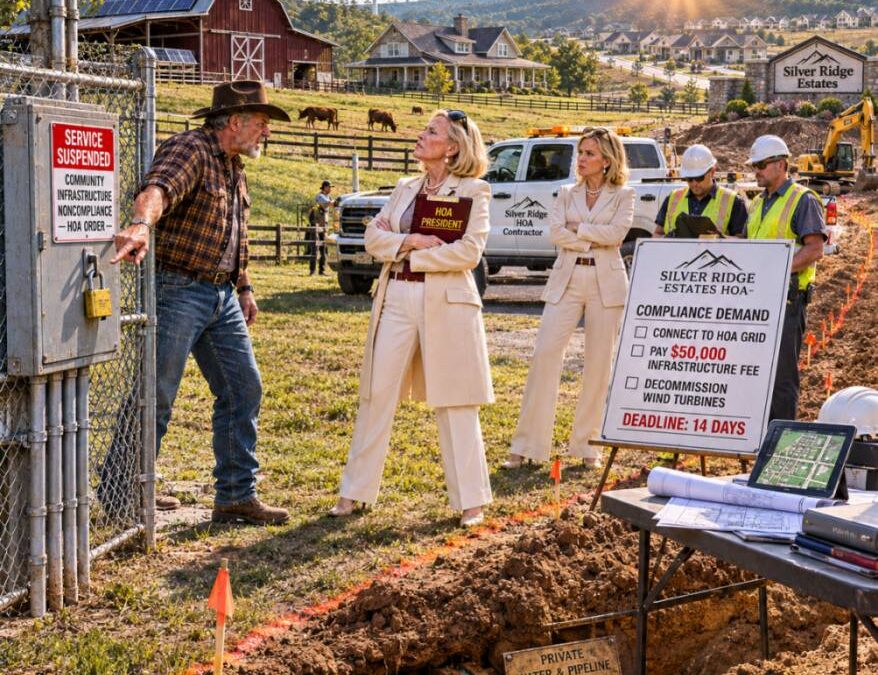
And standing between them in an ivory coat was Evelyn Pierce.
President of Silver Ridge Estates.
Sixty years old.
Platinum-blond hair sprayed into perfect shape.
Pearl earrings.
White trousers.
Burgundy clipboard.
She smiled when she saw me.
“Good morning, Mr. Harper.”
I kept walking.
A yellow padlock hung from my exterior disconnect cabinet.
A printed notice had been zip-tied to the fence.
SERVICE SUSPENDED — COMMUNITY INFRASTRUCTURE NONCOMPLIANCE.
I looked at the two men beside the trucks.
Their jackets carried the logo of a private electrical contractor.
Not the utility company.
“Who touched my equipment?”
Neither answered.
Evelyn did.
“Silver Ridge authorized a safety shutdown.”
“You don’t have authority to shut down anything on this ranch.”
“You’ve been warned.”
“My property isn’t in Silver Ridge.”
“You are surrounded by Silver Ridge.”
“That isn’t the same thing.”
Her younger sister, Lauren, climbed out of the Range Rover behind them.
Vice president of the HOA.
Same blond hair.
Same expensive clothes.
Less skill hiding contempt.
She held up a tablet.
“Your energy system doesn’t meet current community modernization standards.”
I laughed.
“My system produces more power than I use.”
“That’s not relevant.”
“It seems relevant to power.”
Evelyn tapped the clipboard.
“You were offered a reasonable path to compliance. Connect to the subdivision grid. Pay the infrastructure assessment. Decommission the unapproved turbines.”
“Fifty thousand dollars.”
“Forty-nine thousand eight hundred.”
“Thank you for the discount.”
Her smile disappeared.
I stepped toward the cabinet.
One contractor moved in front of me.
“Sir, don’t break the lock.”
“Did you install it?”
He hesitated.
Evelyn said, “Do not interfere with an authorized safety action.”
I looked beyond them.
Fresh orange paint marked the grass along my eastern fence.
Survey lines.
Utility arrows.
A trench route.
The markings crossed from Silver Ridge Phase Two, ran toward my workshop, then continued south beneath a stand of old cottonwoods.
My anger paused.
I knew that line.
Not the paint.
The ground underneath it.
My grandfather had shown it to me when I was seventeen.
He had made me walk the route with a paper map and told me something I had not thought about in forty-five years.
Never lose this drawing, Nate.
If development ever reaches us, this will matter.
I looked at Evelyn.
Then at the orange marks.
Then at the polished roofs of Silver Ridge visible beyond my fence.
And suddenly the fifty-thousand-dollar demand made a lot more sense.
part 2
My name is Nathan Harper.
I am sixty-two years old, and before retirement I spent almost four decades working as a hydraulic systems engineer.
Pipelines.
Pump stations.
Pressure-control networks.
Industrial water systems.
Agricultural distribution.
Fire-suppression infrastructure.
If liquid moved through a pipe under pressure and somebody needed it to arrive alive at the other end, there was a decent chance I’d spent part of my career thinking about it.
I liked that work.
Hydraulics is unforgiving in a way I respect.
Pressure does not care about confidence.
Flow does not respond to titles.
You can call yourself president, director, commissioner, executive, emperor of the moon—if your pipe is undersized or your valve is wrong, the water will tell the truth.
My ranch worked the same way.
Fifty acres.
Low pasture to the east.
Pine ridge to the west.
Workshop.
Barn.
Small two-story house.
My grandfather, Henry Harper, bought the first thirty acres in 1962 and added another twenty over the following decade.
I inherited the property after my father’s death.
By then I’d already been working as an engineer for almost twenty years.
The ranch became my long-term project.
Solar panels went up first.
Then a wind turbine.
Then batteries.
A second turbine came after I retired.
I still maintained a backup interconnection with the local cooperative, because genuine independence does not mean pretending redundancy is weakness.
But for normal operations, I generated my own power.
My well supplied water.
Septic handled waste.
Propane backed up heat.
I was not some survivalist waiting for civilization to collapse.
I simply liked systems I understood.
And I liked quiet.
For years, the nearest house was almost a mile away.
Then developers arrived.
At first, that did not bother me.
Land changes.
Cities expand.
Families need homes.
Silver Ridge Estates began as forty-eight upscale houses on what had once been cattle pasture north of my property.
Then came Phase Two.
Another sixty homes.
Stone entrance pillars.
Decorative streetlights.
Clubhouse.
Pool.
Walking trails.
Evelyn Pierce appeared with them.
She was not merely HOA president.
Her husband had invested in the development company.
Lauren ran a real-estate marketing firm that sold several Phase Two homes.
Evelyn called herself a “community architect.”
The phrase made me tired.
Our first meeting happened two years before the power incident.
I was repairing a fence when her white Range Rover stopped beside the road.
She stepped out holding the burgundy clipboard.
“Mr. Harper?”
“Nathan.”
“I’m Evelyn Pierce, president of Silver Ridge.”
“I know.”
She looked surprised.
“Then you’ve received our communications?”
“Three letters.”
“And?”
“I recycled two.”
Her expression tightened.
“What about the third?”
“I gave it to my lawyer.”
That ended the friendliness.
The letters claimed my eastern fence failed Silver Ridge appearance standards.
My ranch was not part of Silver Ridge.
They claimed my wind turbines exceeded community height restrictions.
My ranch was not part of Silver Ridge.
They claimed my workshop lights disturbed residents.
The nearest Silver Ridge house sat more than eight hundred feet away behind a tree line.
My fixtures were shielded downward.
County-compliant.
They had no measurements.
No ordinance violation.
No jurisdiction.
Still, Evelyn kept trying.
She spoke as if being surrounded by a subdivision had somehow annexed me socially.
“You benefit from increased property values.”
“I pay county taxes.”
“You use Silver Ridge roads.”
“I use the county road.”
“You benefit from our security presence.”
“I didn’t ask for it.”
“You’re part of the community whether you admit it or not.”
“My deed disagrees.”
She hated that answer.
The first actual demand came six months later.
Silver Ridge announced a “community modernization program.”
New underground electrical service.
Fiber internet.
Upgraded water distribution.
Decorative lighting.
Common backup generator systems.
Every HOA homeowner would pay an assessment.
Fine.
Their subdivision.
Their decision.
Then I received an invoice.
$49,800.
INFRASTRUCTURE PARTICIPATION ASSESSMENT.
I called management.
“Why am I receiving this?”
The manager sounded embarrassed.
“The board classified adjacent legacy parcels as participating properties.”
“My ranch isn’t an HOA parcel.”
“I understand.”
“Then unclassify me.”
“I’ll raise it with the board.”
Evelyn called that afternoon.
“You can’t cherry-pick benefits.”
“What benefit?”
“Grid resilience.”
“I don’t use your grid.”
“You have a cooperative connection.”
“Not through Silver Ridge.”
“Your turbines are obsolete.”
I looked out my kitchen window toward the west ridge.
They were producing nicely.
“Evelyn, I’ve designed industrial hydraulic controls older than your development that still work better than half the equipment installed today.”
“This isn’t about your ego.”
“Correct. It’s about my property.”
She lowered her voice.
“Silver Ridge is becoming the dominant community in this area. Fighting integration will only become more expensive.”
That sentence stayed with me.
Not because it scared me.
Because it revealed how she thought.
Dominance creates authority.
Enough houses.
Enough money.
Enough lawyers.
Enough signs.
Eventually, everybody around you becomes part of the system whether they signed or not.
I sent the invoice to my attorney.
His name was David Chen.
David was forty-five, patient, and irritatingly unwilling to let me turn obvious stupidity into legal certainty.
He reviewed my deed, Silver Ridge declaration, county parcel maps, road documents, easements, and utility agreements.
Then he said:
“They don’t have assessment authority over you.”
“Good.”
“They may have separate rights under recorded easements if any exist.”
“None that I know of.”
“Let’s not rely on memory.”
He ordered a title search.
Nothing gave Silver Ridge architectural or assessment control.
Evelyn’s modernization invoice disappeared.
For almost a month.
Then it returned as a “voluntary participation offer.”
Same amount.
Different letterhead.
I ignored it.
That’s when the inspections started.
County code officer.
Electrical inspector.
Environmental complaint.
Turbine-noise complaint.
Fire inspection.
One inspector arrived because somebody claimed I stored industrial chemicals.
I showed him lubricants, hydraulic oil, ordinary workshop solvents, and properly secured fuel.
He apologized.
Another came because somebody reported an unsafe battery installation.
My storage system had permits and an inspection record.
Complaint closed.
Then a man appeared claiming to conduct “magnetic soil interference testing.”
I asked for identification.
He left.
That one still makes me laugh.
I documented everything.
Date.
Time.
Agency.
Vehicle.
Complaint.
Outcome.
Engineers are boring under pressure.
That’s useful.
My friend Mike Torres noticed the pattern too.
Mike was an electrician I’d known for twenty-five years.
He had wired part of my backup system.
One afternoon he called.
“You’ve irritated the princess.”
“Which princess?”
“Evelyn.”
“What now?”
“She was at a contractor meeting yesterday asking how quickly somebody could condemn a nonstandard off-grid installation.”
“Mine?”
“She used your parcel number.”
I leaned back.
“What did they tell her?”
“That HOA presidents don’t condemn electrical systems.”
“Reasonable.”
“She wasn’t happy.”
“Also reasonable.”
Mike became serious.
“She asked whether the county could force a grid connection.”
That interested me.
“Why does she care this much?”
“Good question.”
The answer came accidentally from Lauren.
Evelyn called me on speakerphone one night.
“Final opportunity, Mr. Harper.”
“For what?”
“To join modernization voluntarily.”
“I declined voluntarily.”
“You are putting yourself in a vulnerable position.”
“How?”
“Services become complicated when owners refuse integration.”
“What services?”
“Emergency access. Utility coordination. Infrastructure prioritization.”
“I own a well and generate my own electricity.”
“Things fail.”
“That’s why engineers build redundancy.”
Lauren’s voice came faintly in the background.
“Just tell him the resort needs the corridor.”
Silence.
Then Evelyn:
“Lauren.”
“What? He’s going to find out eventually.”
The line went dead.
Resort.
I wrote the word down.
Then searched county planning records.
There it was.
SILVER RIDGE RESERVE.
Concept proposal.
Private spa lodge.
Thirty luxury cabins.
Event pavilion.
Small equestrian center.
More than one hundred additional residential units in later phases.
The plan required major upgrades to water, wastewater, and power infrastructure.
And the easiest utility corridor ran along my eastern boundary.
Suddenly my obsolete turbines were not the problem.
My refusal to join their infrastructure system was.
If my ranch remained independent and outside the HOA, their clean master-planned map had a fifty-acre hole in it.
Worse, certain utility connections had to cross near that hole.
David reviewed the project.
“They may be trying to pressure you into granting easements.”
“They haven’t asked.”
“They may want leverage first.”
“Why not just make an offer?”
“Maybe because they think they can get it cheaper after wearing you down.”
I hated how plausible that sounded.
Then came the morning they killed my power.
The private contractor had not disconnected utility service.
They had padlocked my exterior transfer equipment after Evelyn signed a “community safety authorization” that had no lawful force over my parcel.
The lock prevented my inverter system from feeding the main house panel.
My batteries were still charged.
Solar still worked.
The equipment was fine.
They had simply disabled the path.
I called the sheriff.
Then David.
Then the county electrical department.
The contractor supervisor became visibly nervous when I asked who had authorized entry.
He produced a work order.
Signed by Evelyn.
NOTES:
ADJACENT LEGACY PARCEL — SAFETY DISCONNECT PENDING COMMUNITY GRID CONVERSION.
David arrived forty minutes later.
He read it.
Then looked at Evelyn.
“Under what recorded right did you enter Mr. Harper’s property and interfere with his electrical equipment?”
Evelyn said:
“Community emergency authority.”
“Show me.”
Lauren handed him a section of the Silver Ridge declaration.
David read two paragraphs.
“This applies to lots within Silver Ridge.”
Evelyn’s face tightened.
“He is physically surrounded by the community.”
David nodded toward my fence.
“Property law has remained stubbornly unimpressed by geography.”
I enjoyed that.
The sheriff’s deputy documented the entry and interference.
The county inspector ordered the private lock removed.
My system came back online.
No explosion.
No heroic bypass.
No revenge.
Just a contractor realizing the document he had relied on did not give him the right to touch my equipment.
Then I showed David the orange paint.
“What’s this?”
“New utility survey.”
“Authorized?”
“Not by me.”
We walked the line.
Eastern fence.
Cottonwoods.
Workshop.
Then south.
My memory sharpened with every step.
Grandfather.
Brown paper map.
A cast-iron main.
David looked at me.
“What?”
“There may be an old utility line under us.”
“What kind?”
“Water.”
“For your ranch?”
“No.”
I looked toward Silver Ridge.
“For everybody.”
That afternoon I went into the attic.
My grandfather’s records occupied six cardboard boxes labeled in handwriting that became less legible as he aged.
TRACTOR.
CATTLE.
TAX.
WATER.
MISC.
MORE MISC.
I opened WATER.
There it was.
A folded engineering drawing dated June 1978.
HENRY HARPER PRIVATE DISTRIBUTION MAIN.
Eight-inch cast-iron pipe.
Source connection near the old county pumping station.
Route across the Harper property.
Branches serving what had then been eight rural homes and one agricultural packing shed.
I stared at the sheet.
Silver Ridge now occupied most of that old service area.
Then I found the easement.
Recorded.
Not hidden.
Just old.
The county had upgraded the regional network in the late seventies.
My grandfather allowed a privately financed water distribution main to cross his land because the county did not want to fund the entire extension.
Henry paid part of the construction cost with several neighboring landowners.
The agreement created a utility corridor.
It also reserved ownership and access rights over portions of the private distribution infrastructure and allowed downstream connections only under specified conditions.
That did not mean I could turn a valve and shut off a subdivision whenever I felt angry.
Thank God.
It meant something better.
It meant the modern development had apparently connected to an old private main whose easement conditions and capacity rights might never have been properly updated.
I called David.
He came over that evening.
He read every page.
Then again.
“Do not touch any valve.”
“I wasn’t planning to.”
“I’m saying it anyway.”
“Lawyers ruin everything.”
He ignored me.
“This could matter a great deal.”
“How much?”
“If Silver Ridge expanded service using this corridor without a valid amended easement or connection agreement, they may have title, trespass, utility, and permitting problems.”
“What about control?”
“You do not unilaterally shut off water to families.”
“I know.”
“Good.”
He pointed at the map.
“But you can ask a court to determine rights. And if the developer installed new connections or increased loads beyond what the recorded agreement permits, regulators and the utility provider may care.”
That was the real trump card.
Not a secret shutoff valve.
A recorded right nobody had bothered to read.
The next morning, we ordered a title search focused on utility easements.
We also contacted the regional water authority.
Not as enemies.
As engineers and lawyers asking questions.
The authority sent two staff members to review records.
Their modern GIS map showed a twelve-inch water main serving Silver Ridge.
But beneath part of Phase One, the twelve-inch line connected to an older eight-inch segment crossing my property.
The connection had been upgraded near the subdivision boundary.
No one could immediately produce a new easement from me.
“Maybe the developer acquired one from your predecessor,” the utility engineer said.
“I inherited directly from my father.”
“Then maybe from him?”
David shook his head.
“We’ve searched.”
The engineer looked uncomfortable.
“That would be a problem.”
We spent two weeks confirming it.
There was no easement amendment.
No purchase.
No condemnation.
No signed consent.
The original 1978 agreement allowed certain existing users and replacement connections within specified limits.
It did not authorize a large subdivision expansion, fire-flow demand for more than one hundred homes, or the resort project Evelyn was planning.
Silver Ridge had built new infrastructure around an old legal assumption.
Somewhere during development, everyone had apparently treated the line as if it belonged fully to the public system.
It didn’t.
The water authority owned newer sections.
The original corridor across my land remained subject to recorded private rights and restrictions.
The mistake had not caused a crisis because I had never challenged it.
Now Evelyn had sent contractors to disable my electricity while trying to force me into her infrastructure plan.
She had drawn my attention to the exact place she least wanted me looking.
David sent formal notices.
Silver Ridge HOA.
Developer.
Water authority.
County planning department.
Lenders associated with the resort project.
No threats.
No demand that anyone shut water off.
Just:
Title rights disputed.
No further expansion or additional connections should occur until easement rights are resolved.
Preserve records.
The reaction was immediate.
Evelyn called.
“You are trying to sabotage the community.”
“No.”
“You contacted our utility provider.”
“Yes.”
“Families live here.”
“I know.”
“You are threatening their water.”
“I have threatened nothing.”
“You’re claiming ownership of infrastructure.”
“I’m asking everyone to read the recorded documents.”
“You know what you’re doing.”
I did.
I was making the people with actual authority look at the paperwork.
That was enough.
The water authority placed a hold on approval for additional Silver Ridge connections pending legal review.
Existing service remained on.
Nobody’s faucets went dry.
Nobody’s heater failed.
No children lost water because an angry engineer decided revenge was more important than public safety.
The resort project, however, could not proceed without confirmed utility capacity and legal access.
That hurt Evelyn.
A lot.
Her investors demanded answers.
The development lender requested title opinions.
County planning paused final infrastructure approval.
Suddenly the woman who had spent months telling me compliance was inevitable wanted to negotiate.
She arrived at my ranch with Lauren and Leonard Price, the development attorney.
No security contractors.
No padlocks.
No inspectors.
They sat at my kitchen table.
Evelyn folded her hands.
“We want to resolve the easement issue.”
David sat beside me.
“Good.”
Leonard opened a folder.
“Our position is that the 1978 agreement has been superseded by decades of public utility use.”
David nodded.
“Then you can make that argument in court.”
Leonard continued.
“Litigation would be costly.”
“So was padlocking Nathan’s power system.”
Evelyn glared at him.
David smiled.
“We preserved that work order.”
Lauren shifted uncomfortably.
Leonard slid a proposal toward us.
Permanent utility easement.
Twenty-five thousand dollars.
I laughed.
Evelyn said:
“That is more than fair for underground infrastructure already in place.”
I looked at her.
“You wanted fifty thousand from me to connect to a grid I didn’t need.”
“That was different.”
“Yes.”
I pushed the paper back.
“It was imaginary.”
Her face reddened.
David placed another document on the table.
Our engineer’s preliminary analysis.
The eight-inch section was already operating near recommended limits under certain peak-demand and fire-flow scenarios.
The resort would likely require either a parallel main or replacement.
Both options needed land rights.
My land.
Evelyn read the first page.
“This is extortion.”
David’s expression changed.
“No.”
He spoke slowly.
“Extortion would be Nathan threatening to harm existing residents unless you pay him. He has done the opposite. He has explicitly agreed not to interfere with existing service while legal rights are determined.”
He tapped the report.
“You are the developer seeking new capacity.”
Silence.
“Development costs money.”
Evelyn stood.
“This community will not be held hostage by one stubborn old man.”
I looked up.
“Then route your pipe somewhere else.”
She had no answer.
Because that was always an option.
Expensive.
Longer.
Technically difficult.
But legal.
That meeting ended without agreement.
The retaliation started three days later.
Another code complaint.
Then a noise complaint.
Then an anonymous social-media post showing my wind turbines with the caption:
ONE MAN BLOCKING WATER SECURITY FOR 300 FAMILIES.
False.
Existing water remained untouched.
Still, people believed it.
Cars slowed outside my ranch.
Someone threw a bottle at my mailbox.
Then a neighbor named Sheila Morrison knocked on my door.
She lived in Silver Ridge Phase One.
“I’m angry with you.”
“Good morning.”
She looked embarrassed.
“I thought you were threatening our water.”
“I’m not.”
“Evelyn says you are.”
“Would you like to see the letters?”
That surprised her.
I showed her.
Not confidential legal strategy.
The formal notice clearly stated that I would not interfere with existing service while rights were resolved.
She read it twice.
“She didn’t tell us this.”
“No.”
“She said you’re planning to shut the valve.”
“I haven’t even confirmed where every valve is.”
She looked toward the eastern field.
“You could shut us off?”
“Physically, I don’t know. Legally, I would not.”
Her shoulders dropped.
“My mother lives with us.”
“I’m not trying to hurt your mother.”
That conversation changed something.
Sheila posted the letter in the neighborhood group.
Then residents started asking questions.
Evelyn responded badly.
She called an emergency HOA meeting.
Her presentation was titled:
PROTECTING SILVER RIDGE FROM INFRASTRUCTURE THREATS.
I attended.
So did David.
The clubhouse was packed.
Evelyn stood at the front beside Lauren.
She described me as a “legacy landowner exploiting obsolete documents.”
I almost admired the phrase.
Then she claimed I had threatened to terminate water service.
David raised his hand.
“Please identify the threat.”
She ignored him.
A homeowner shouted:
“Did he threaten it or not?”
Evelyn looked annoyed.
“He has asserted control over the supply line.”
David stood.
“Asserted recorded property rights.”
Leonard leaned toward his microphone.
“Counsel, this is not a courtroom.”
“No,” David said. “Which is why factual accuracy should be easier.”
A few people laughed.
Evelyn glared at them.
Then Sheila stood.
“I spoke to Nathan.”
Evelyn’s expression changed.
“He showed me the notice.”
Sheila held up a copy.
“It specifically says existing residential water service is not to be interrupted.”
More murmurs.
A man near the back asked:
“Then what’s actually stopped?”
I answered from my seat.
“New connections.”
Evelyn snapped:
“Because of him.”
I looked at her.
“Because nobody confirmed the development had the rights it needed before designing Phase Three.”
The room went quiet.
Somebody asked:
“What is Phase Three?”
Evelyn froze.
Lauren closed her eyes.
There it was.
The resort had not been publicly presented to Silver Ridge residents as an HOA project.
Many had no idea.
Questions erupted.
Resort?
Cabins?
Event center?
More houses?
Whose project?
Who owns it?
Evelyn tried to regain control.
“It’s conceptual.”
David opened the public planning application on a tablet.
“Submitted six weeks ago.”
The room became louder.
A board member named Patricia Wells turned toward Evelyn.
“Why didn’t we know?”
“You didn’t need to.”
Patricia stared at her.
“We’re the board.”
Evelyn corrected herself.
“This is a development-company matter, not HOA business.”
Then another homeowner shouted:
“Why are HOA letters being used against Nathan over land the development company needs?”
That was the question.
Evelyn did not answer.
The board’s treasurer, Martin Cole, asked to see invoices.
By the end of the meeting, residents had demanded an independent review of HOA spending related to infrastructure and enforcement against my ranch.
Evelyn opposed it.
Four directors overruled her.
The review began the following week.
It did not uncover a twelve-million-dollar criminal empire.
Reality was smaller.
And more damaging because it was believable.
Evelyn had used HOA legal funds to pay for advice connected partly to the resort developer’s access problem.
She had directed management staff to generate enforcement letters against my property even after association counsel warned that the HOA lacked jurisdiction over the ranch.
Her sister Lauren’s marketing company had billed Silver Ridge for “community growth communications” that overlapped with promotion of the resort concept.
Bruno’s security company had been paid to conduct “boundary monitoring” near my ranch.
Some contracts had not gone through the approval procedures required by the bylaws.
There was no proof of mobsters.
No hidden casino fraud.
No murder.
No dark-web fentanyl.
There didn’t need to be.
Conflict of interest.
Misuse of association resources.
Retaliatory enforcement.
False representations.
Those were enough.
Then the private electrical contractor cooperated.
He turned over the email chain that led to my power shutdown.
His first response to Evelyn had been:
“We need confirmation Silver Ridge has authority over Harper parcel before touching owner equipment.”
Evelyn replied:
“Board counsel has confirmed our right to enforce modernization compliance.”
That was false.
Silver Ridge’s own attorney later produced his advice.
He had written:
“The Harper ranch does not appear subject to the architectural declaration or infrastructure assessment. The association should not enter the property or interfere with private utility systems absent a separate recorded right or emergency.”
Evelyn received that email eleven days before my power was padlocked.
I read it in David’s office.
“She knew.”
David nodded.
“She knew counsel said the opposite.”
That shifted the case.
We filed suit.
Not because I wanted spectacle.
Because negotiations had failed and retaliation continued.
The complaint sought declaratory relief establishing my property and easement rights, damages for unauthorized entry and interference with my electrical system, an injunction against further trespass or enforcement actions unsupported by recorded rights, and compensation connected with any unauthorized utility use proven through the case.
The developer became involved separately because its expansion depended on the water corridor.
The court entered temporary restrictions quickly.
No further entry onto my ranch without consent, lawful easement authority, or genuine emergency.
No interference with my energy equipment.
No new water connections through the disputed corridor pending resolution.
Existing Silver Ridge residential service remained protected.
That last part was important.
I asked for it.
David asked why.
“Because homeowners didn’t do this.”
“Correct.”
“They bought houses.”
“Correct.”
“I don’t want anybody’s kid brushing their teeth from bottled water because their HOA president is an idiot.”
David smiled.
“Put less elegantly, that’s also our position.”
The engineering work became fascinating.
I had spent my career designing systems like this.
Now I was analyzing one beneath my own property.
We excavated limited inspection pits with proper approvals.
The original cast-iron main remained in service.
Sections had been lined internally years earlier.
At the northern boundary, Silver Ridge’s developer had connected newer ductile-iron piping through an adapter assembly.
That connection had apparently been installed during Phase One based on the assumption that the corridor functioned as a standard public utility easement.
Nobody had gone backward far enough in title records.
The water authority admitted its file was incomplete.
The developer blamed the title company.
The title company blamed the survey package.
The surveyor said he had been given a utility map showing the line as existing public infrastructure.
Everyone had assumed someone else verified it.
I had seen that failure in engineering for forty years.
A wrong assumption becomes institutional truth because every later person trusts the previous drawing.
Then somebody finally opens the original file.
The 1978 agreement was not a weapon.
It was a design constraint.
Once everyone understood that, solutions became possible.
Option one:
Relocate the main entirely outside my property.
Very expensive.
Option two:
Install a parallel route along the county road.
Also expensive.
Option three:
Negotiate a modern permanent easement with me, including maintenance access, capacity limits, liability terms, compensation, and protections against future unauthorized expansion.
I preferred three.
Not because I wanted Evelyn’s money.
Because moving a working water main for spite would have been stupid.
The system served families.
The problem was not the pipe.
The problem was people pretending my consent did not matter.
Negotiations resumed.
This time, the water authority attended.
So did the developer’s lender.
So did engineers.
Evelyn was no longer leading.
That helped.
We negotiated a permanent easement covering existing residential service.
The developer funded upgrades to replace vulnerable portions of the old line.
My ranch received a new independent well-house backup connection for fire protection.
The agreement required my written approval or a lawful condemnation process for any future expansion beyond specified capacity.
Silver Ridge paid fair compensation based on appraisal and infrastructure burden.
Not millions.
Not revenge money.
Enough to recognize that private property had been carrying a public-like burden for decades.
The resort project still faced a problem.
Its additional demand exceeded what the existing agreement covered.
If the developer wanted the resort, it would need a major main upgrade and additional route rights.
They eventually redesigned the project.
Smaller.
Fewer units.
No giant spa lodge.
Different utility route.
Evelyn hated that.
Investors hated it more.
Her influence on the HOA began collapsing before our case even settled.
The independent review went to residents in a forty-eight-page report.
I read every page.
Findings:
The Harper ranch was not subject to Silver Ridge architectural enforcement.
The $49,800 modernization assessment had no valid basis against my parcel.
Evelyn directed repeated enforcement after being advised of jurisdictional limitations.
The electrical shutdown was unauthorized.
HOA funds had been used for work that overlapped with private development interests.
Conflict disclosures were incomplete.
Certain contracts lacked required board approval.
Lauren’s company had received payments without adequate documentation of competitive review.
Security monitoring near my property exceeded normal HOA enforcement needs.
The report recommended suspension of Evelyn’s authority, recovery review of improper expenditures, revised contracting controls, conflict rules, and independent management oversight.
The special membership meeting happened in January.
Cold night.
Clubhouse packed.
I almost didn’t go.
David told me I should.
“Why?”
“Because you’ve spent a year being talked about in rooms where you weren’t present.”
So I went.
Evelyn sat at the front.
Ivory blazer this time.
Lauren beside her.
No smiles.
The meeting began with the auditor.
Then association counsel.
Then residents.
Mike Torres spoke.
Sheila.
Martin Cole.
A retired firefighter raised concerns about the water system.
A young couple said they had bought into Silver Ridge believing Phase Three was only rumor.
George Miller—different George, not from any previous story, just a local farmer who had known my grandfather—stood and said:
“Henry Harper put that water line in because nobody else would pay to bring service out here. Now his grandson is being called difficult for asking people to read the agreement.”
That hit me.
Not because it was dramatic.
Because it was true.
My grandfather did not build the main to control people.
He built it because rural infrastructure often happens through cooperation.
Neighbors pooled money.
Landowners granted rights.
Everybody signed paper.
The current problem existed because later people inherited the benefit but forgot the agreement.
My name was called.
I walked to the microphone.
“I want to make one thing clear.”
The room settled.
“I never shut off Silver Ridge’s water.”
Evelyn looked away.
“I never threatened to.”
I held up a copy of the notice our attorney had sent.
“Existing families were never the target.”
I put it down.
“My ranch was.”
Silence.
“For months, I was told I needed to join a system I did not ask for. Pay fifty thousand dollars. Remove turbines. Accept inspections. Allow access. When I said no, somebody entered my land and padlocked my electrical equipment.”
I looked at Evelyn.
“She thought pressure would create consent.”
Then at the homeowners.
“It doesn’t.”
I explained the old main.
The 1978 agreement.
The new easement.
The difference between existing service and future development.
Then I said:
“This case was never about whether Silver Ridge should have water.”
I paused.
“It was about whether someone who wants something from your land gets to manufacture authority until no becomes too expensive.”
Nobody interrupted.
“Sometimes development is good.”
I looked toward the windows at the rows of houses outside.
“Most of you live in homes that didn’t exist five years ago. That’s fine.”
Then back to Evelyn.
“But growth does not erase boundaries.”
I sat down.
Evelyn spoke last.
She blamed confusing records.
Aggressive lawyers.
Outdated infrastructure.
A hostile legacy property owner.
Then she made the mistake that ended her presidency.
“I was elected to protect the future of Silver Ridge, not preserve every antiquated arrangement made by people who lived here half a century ago.”
Someone behind me said:
“Those arrangements are deeds.”
Another person:
“And contracts.”
Then Martin Cole asked:
“Did association counsel tell you Nathan’s ranch was outside our enforcement authority before you ordered the power disconnect?”
Evelyn hesitated.
The entire room felt it.
Martin repeated the question.
“Yes or no?”
She looked toward her attorney.
He did not rescue her.
Finally:
“He gave an opinion.”
“Did he tell you not to enter the property?”
“He did not understand the urgency.”
That was enough.
The membership voted to remove Evelyn from the board.
Lauren resigned before her own removal process finished.
The HOA pursued reimbursement from companies connected to some questioned expenditures.
Those matters settled privately in part.
The county never uncovered a giant bribery network.
No FBI agent emerged from the bushes.
No national racketeering indictment followed.
What happened was less spectacular.
The county ethics office reviewed whether any employee had been improperly influenced.
Most of the inspectors who visited me had simply been responding to complaints.
One admitted Evelyn had pushed aggressively for priority review but denied taking money.
No proof showed otherwise.
I accepted that.
Evidence matters even when it refuses to make your enemy worse.
One contract inspector had submitted sloppy reports.
The county stopped using him.
That was the extent of that scandal.
The civil case resolved through settlement.
Silver Ridge acknowledged the ranch was outside its architectural jurisdiction.
All supposed HOA fines and assessments against me were withdrawn.
The association reimbursed damage associated with the unauthorized electrical shutdown and covered agreed legal costs.
The developer and water authority entered the permanent easement agreement with me.
Infrastructure upgrades began the following spring.
The old eight-inch main was replaced in stages with modern pipe through the existing corridor under controlled access.
I supervised nothing officially.
I was retired.
Naturally, I stood there every day anyway.
The project engineer, a woman named Priya Shah, finally said:
“Nathan, you know you’re not employed here.”
“I’m observing.”
“You’re criticizing.”
“I’m mentoring.”
“You called our valve layout ‘an insult to fluid mechanics.’”
“It was.”
She stared at me.
Then moved the valve.
Good engineer.
The upgraded system improved fire flow for Silver Ridge and gave the water authority clearer maintenance rights.
My compensation from the easement was enough to replace one aging wind turbine and modernize the ranch batteries.
I used part of the remaining money to create an engineering scholarship at the local community college.
HENRY HARPER INFRASTRUCTURE SCHOLARSHIP.
For students studying electrical, civil, mechanical, water, or industrial systems.
My grandfather had left school after eighth grade.
He could repair nearly anything.
He believed engineering was just giving names to things farmers already knew.
I disagreed with him often.
He was not entirely wrong.
The first scholarship recipient was a nineteen-year-old woman named Kayla Brooks.
She wanted to design municipal water systems.
At the ceremony, she asked:
“Did your grandfather really build the pipe himself?”
“Not alone.”
“So the story online is exaggerated?”
“Most stories online are.”
She looked disappointed.
“He helped organize the project, paid part of it, granted the corridor, and worked with the contractor.”
“Still cool.”
“Much cooler than pretending one man buried eight-inch cast iron across miles of countryside with a shovel.”
She laughed.
That was another thing I learned.
People love revenge stories more than infrastructure stories.
The viral version would have been simple.
HOA cuts my power.
I discover secret valve.
I shut down their water.
Evelyn panics.
FBI arrives.
Everybody cheers.
That version has excellent symmetry.
It would also make me a fool.
Water systems are not toys.
Residential service protects drinking water.
Sanitation.
Fire suppression.
Families.
Elderly residents.
Children.
People with medical needs.
You do not punish innocent homeowners because their HOA president is corrupt.
The real revenge—if someone insists on calling it that—was making Evelyn obey the same thing she tried to ignore.
Process.
She tried to use authority she did not have.
I used the authority I actually had.
Property rights.
Recorded agreements.
Courts.
Engineering evidence.
Board votes.
That difference is everything.
Evelyn remained in Silver Ridge for almost eight months after removal.
I saw her twice.
The first time, at the grocery store.
We passed in the produce aisle.
She pretended not to see me.
I returned the favor.
The second time, she came to my ranch.
No Range Rover convoy.
No Lauren.
No contractor.
Just Evelyn.
She stopped outside the gate.
That alone impressed me.
I walked down.
“What do you need?”
She looked older.
Not dramatically.
Just tired.
“I’m moving.”
“I heard.”
She looked toward the turbines.
“They’re still ugly.”
I laughed.
“That may be the first thing you’ve said I agree with.”
She almost smiled.
Then didn’t.
“I lost a lot because of you.”
“No.”
Her face hardened.
“There it is.”
“What?”
“That self-righteous calm.”
I leaned against the fence.
“You lost a board position because homeowners voted.”
“My reputation.”
“Your emails did that.”
“Money.”
“You chose contracts.”
“The resort.”
“Your investors chose not to fund the redesign.”
She stared at me.
“You always have an answer.”
“I spent forty years troubleshooting systems.”
“This isn’t a system.”
“Yes, it is.”
She looked away.
For a while, neither of us spoke.
Then she said:
“I genuinely believed connecting your ranch would improve the whole area.”
“I believe you.”
That surprised her.
“You do?”
“Yes.”
“Then why did you fight everything?”
“Because believing a result is good doesn’t give you authority to force it.”
She crossed her arms.
“You were impossible.”
“I said no.”
“Repeatedly.”
“That’s how no works.”
She looked toward the eastern field where crews had finished replacing the water main.
“The agreement you signed is basically what I wanted.”
“No.”
“It connects the system.”
“The system was already connected.”
“You allowed modernization.”
“After negotiation.”
“Difference without distinction.”
“No, Evelyn.”
I stood straight.
“Consent is the distinction.”
That ended the argument.
She looked at the house.
“Did you really live off-grid for twenty years?”
“Mostly.”
“How?”
I laughed.
“Now you’re interested?”
“I never understood why anyone would want to.”
“Same reason some people want HOAs.”
She raised an eyebrow.
“Control?”
“Reliability.”
That made her smile despite herself.
Then the smile faded.
“I shouldn’t have shut your power off.”
There it was.
Not an apology for everything.
Specific.
Useful.
“No,” I said.
“You shouldn’t have.”
“I thought if you experienced inconvenience, you’d become reasonable.”
“I was already reasonable.”
“That’s debatable.”
I laughed again.
She actually laughed too.
Then she said:
“I’m sorry.”
I nodded.
“Thank you.”
We did not become friends.
She drove away.
Moved three weeks later.
Lauren moved the following year.
Silver Ridge elected Patricia Wells president.
Her administration was boring.
Gloriously boring.
No modernization wars.
No resort conspiracies.
No mystery inspections.
They argued about landscaping.
Pool hours.
Parking.
A mailbox color dispute lasted six weeks.
I attended one meeting after Patricia invited me to speak about utility planning.
Halfway through, a homeowner complained that my wind turbines reduced the “visual quality of the western horizon.”
Patricia asked:
“Are they on Silver Ridge property?”
“No.”
“Subject to our declaration?”
“No.”
“Then next item.”
I nearly stood and applauded.
That was governance.
Not everybody gets what they want.
Not every annoyance becomes jurisdiction.
Mike Torres visited after the new battery system went online.
He walked through the equipment room.
“Overkill.”
“Redundancy.”
“You have enough storage to run the house for four days.”
“Three and a half in winter.”
“Normal people buy generators.”
“Normal people call electricians when outlets stop working.”
“That’s how I make money.”
Scout, my old Australian shepherd mix, slept near the door while we argued.
He had replaced the golden retriever I grew up with years earlier and had exactly one useful engineering skill:
he knew when I had been in the workshop too long.
At six, he stood and stared.
“Dinner?”
He wagged his tail.
Mike said:
“Finally, someone with management authority.”
We went inside.
My life became quiet again.
That was harder than it sounds.
For almost a year, every unfamiliar truck on the county road made me look toward the gate.
Every official envelope tightened my chest.
When my inverter controller sent an ordinary maintenance alert, I woke at two in the morning convinced someone had tampered with the system.
I had spent months fighting to keep other people from controlling my ranch.
Then I discovered the fight was still controlling part of me.
So I did something retired engineers hate.
I talked to someone.
Counselor.
Veterans clinic referral.
No dramatic diagnosis.
No breakdown.
Just stress.
Sleep.
Hypervigilance.
Anger.
I learned that solving the legal problem and convincing your nervous system the legal problem is over are separate projects.
The second took longer.
One year after the power shutdown, I woke at 5:17.
Same time.
Pure coincidence.
The house was quiet.
But not dead.
Refrigerator humming.
Battery indicator glowing green.
Coffee maker starting automatically.
I walked outside.
The turbines turned slowly against a pale sky.
Beyond the eastern fence, Silver Ridge streetlights were still on.
Same electrical grid.
Different legal world.
My ranch remained independent.
Their development remained connected to the modernized water main.
Nobody had to lose for that arrangement to work.
That was what made Evelyn’s campaign so unnecessary.
She treated negotiation as weakness.
I treated it as engineering.
Identify constraints.
Respect pressure.
Design around reality.
A few months later, Patricia invited me to a Silver Ridge infrastructure workshop.
I resisted.
She said:
“We’ll pay you.”
“How much?”
“Coffee.”
“Insulting.”
“And donuts.”
“Fine.”
About thirty homeowners attended.
I explained the water-main history.
Not the drama.
The engineering.
1978 demand.
Original pipe.
Private corridor.
Incremental development.
Capacity.
Fire flow.
Why easements matter.
Why old infrastructure records matter.
A young homeowner raised his hand.
“So you could have shut our water off?”
I sighed.
“No.”
“But physically?”
“Physical capability and legal authority are different questions.”
“Could you?”
“Possibly in limited sections. That doesn’t mean I had the right.”
He looked disappointed.
Someone else asked:
“What would have happened?”
“If someone recklessly closed the wrong valve?”
“Yes.”
“Pressure loss. Boil-water concerns. Fire protection issues. Damage. Liability. Potential injuries.”
The room quieted.
“So why do people online say you shut it down?”
“Because responsible paperwork gets fewer clicks.”
That got a laugh.
Then I said something I wanted them to remember.
“Infrastructure is trust made physical.”
Pipes cross property because someone signed.
Roads cross land because someone granted rights.
Power lines exist because agreements define access.
When later generations forget those documents, they start believing the physical thing itself proves ownership.
It doesn’t.
A pipe underground is not permission.
Neither is a road.
Neither is a cable.
Every system has a legal layer under the engineering layer.
I had learned that from my grandfather without understanding it.
Never lose this drawing.
He knew.
Not because he expected Evelyn.
Because land changes slower than people.
Documents have to bridge the difference.
The Henry Harper scholarship grew.
Mike donated.
The water authority donated.
Eventually, even Silver Ridge contributed.
That amused me.
The second recipient was a young man named Javier Morales studying civil engineering.
He visited the ranch before classes started.
I showed him the new valve vault.
He looked at the modern line.
“Where’s the old pipe?”
“Abandoned section is still underground farther south.”
“Can we see it?”
“You want to look at rusty cast iron?”
“Yes.”
I liked him immediately.
We excavated a small retired section later as part of a documented training demonstration.
The pipe wall was thick.
Scale inside.
Forty-plus years of service.
I ran my hand across it.
Grandfather had watched that line go into the ground.
Probably never imagined gated houses.
Resort proposals.
HOA assessments.
Court filings.
He just wanted water.
That perspective helped.
Our conflicts feel enormous while we’re inside them.
Then time turns them into another layer.
A pipe.
A tree.
A contract.
A story somebody tells wrong until another person checks the record.
Three years after Evelyn moved, Silver Ridge completed its redesigned third phase.
No resort.
Twenty-four additional homes.
Utility route stayed mostly along the county corridor.
One small easement crossed my northeastern corner.
I granted it voluntarily after negotiation.
Fair market payment.
Clear access conditions.
Restoration requirements.
Insurance.
No HOA jurisdiction.
David reviewed every page.
“You’re getting soft.”
“I’m getting paid.”
“Capitalism heals.”
“Lawyers shouldn’t joke about healing.”
He signed off.
Construction finished without incident.
One afternoon, I watched a crew restore grass over the trench.
No anger.
No feeling that they were invading.
Because they had asked.
That was the lesson reduced to one word.
Ask.
Evelyn could have started there.
Nathan, we need a utility corridor. Will you sell an easement?
Maybe I would have.
Maybe I wouldn’t.
Then negotiate.
Maybe reroute.
Maybe pay more.
Maybe redesign.
That is how free people coexist.
You do not manufacture a rule.
You do not send inspectors.
You do not padlock somebody’s equipment.
You do not call resistance noncompliance when no obligation exists.
My ranch still looks strange beside Silver Ridge.
Their lawns are manicured.
Mine sometimes needs mowing.
Their streetlights match.
My workshop has three different exterior fixtures because I bought them during three different decades.
Their houses share approved colors.
My barn is red because barns should be red.
The turbines are objectively unattractive.
I love them.
People ask whether I regret not selling.
No.
Could I have made more money?
Probably.
Land near Silver Ridge became expensive.
The resort developer once floated a number large enough to change anyone’s attention.
But money is not the only measure.
I wake up and see pasture.
Scout’s successor—another mutt named Duke—runs the fence.
I work in the shop when I want.
Solar covers the roof.
Wind turns above the ridge.
Water comes from my well.
And beneath the eastern field runs a modern main serving hundreds of people through an agreement everyone actually signed.
That feels right.
Not isolation.
Not domination.
Boundaries with cooperation.
The difference matters.
One autumn morning, I found Duke digging near the old cottonwoods.
“Stop.”
He looked at me.
Mud across his nose.
“You are nowhere near qualified for underground utility work.”
Tail wag.
I dragged him away.
Then I noticed one of the old orange paint marks still faintly visible on a stone from years earlier.
That morning came back instantly.
Dark house.
Padlock.
Evelyn smiling beside my electrical cabinet.
Fifty-thousand-dollar demand.
At the time, I thought the most satisfying outcome would be making Silver Ridge feel what they had done to me.
Darkness for darkness.
Pressure for pressure.
I was wrong.
Retaliation feels symmetrical.
Justice rarely is.
The better outcome was that everyone kept power.
Everyone kept water.
I kept my ranch.
Silver Ridge learned its boundaries.
The developer paid for what it needed instead of inventing authority.
Evelyn lost the power she misused.
And nobody innocent had to suffer so I could enjoy the shape of revenge.
That is less cinematic.
I can live with that.
I picked up the old stone.
Turned it over.
The paint had almost faded away.
Then I placed it back where it was.
Some marks do not need preserving.
The documents are in a fireproof cabinet now.
1978 water agreement.
Grandfather’s map.
My deed.
New easement.
Electrical permits.
Settlement.
All labeled.
Duke sleeps beside the cabinet sometimes.
Terrible guard dog.
Excellent company.
When younger engineers visit, I show them the old drawing.
Not because it is a secret weapon.
Because it teaches the opposite lesson.
Knowledge is not power because it lets you hurt someone.
Knowledge is power because it lets you stop someone from pretending they have rights they don’t.
Evelyn had money.
Lawyers.
Contractors.
Board letterhead.
Inspectors responding to complaints.
A development company.
Investors.
I had an old map nobody thought mattered.
But the map only mattered because somebody recorded the rights behind it.
That is the part people forget.
Paper can look weak beside money.
Until somebody reads it.
I spent my career designing systems around pressure.
There are two ways to respond when pressure rises.
One is to push back harder until something bursts.
The other is to understand where the pressure comes from, what the system can safely carry, and which valve actually controls the outcome.
Evelyn tried the first method.
I chose the second.
And that is why Silver Ridge still has water.
My ranch still has lights.
And every time those polished homes glow beyond my eastern fence after sunset, I can see the result of the only victory I ever really wanted.
Their system works.
Mine works.
And neither one gets to own the other.