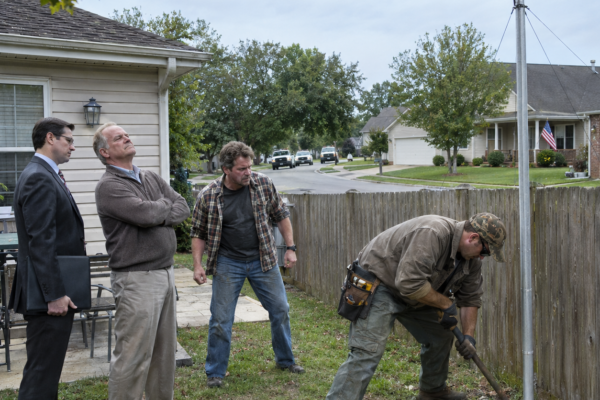
The HOA President Painted Over the 30-Year-Old Mural on My Garage While I Was Away, Then Handed Me a $6,800 “Cleanup” Bill. She Called It Amateur Graffiti and Said Her Board Outranked My Property Rights. What She Didn’t Know Was That the Artist’s Estate Had Warned Her in Writing Three Hours Before the First Roller Touched the Wall.k
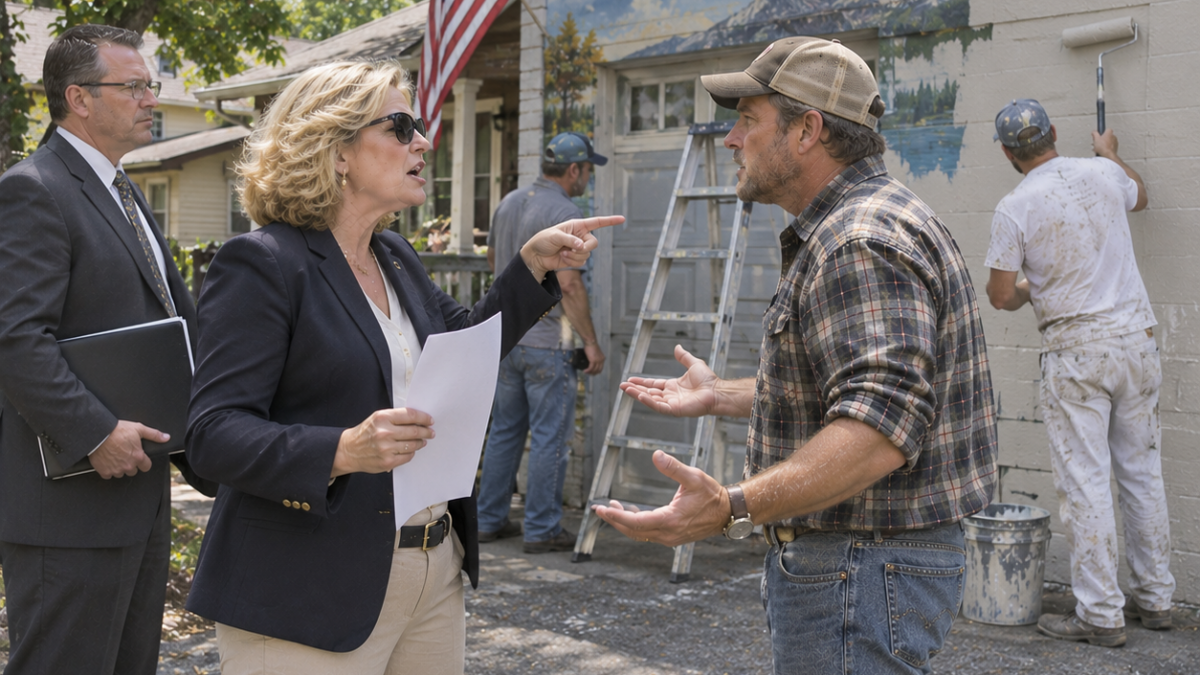
The HOA President Painted Over the 30-Year-Old Mural on My Garage While I Was Away, Then Handed Me a $6,800 “Cleanup” Bill. She Called It Amateur Graffiti and Said Her Board Outranked My Property Rights. What She Didn’t Know Was That the Artist’s Estate Had Warned Her in Writing Three Hours Before the First Roller Touched the Wall.
Vanessa Whitcomb was still standing in my driveway when I came home and realized the mural was gone.
Not damaged.
Not partially covered.
Gone.
The entire brick wall of my detached garage had been buried beneath two coats of pale gray exterior paint, the color of a hospital hallway.
Two contractors were folding drop cloths near the curb.
One man was rinsing a roller in a bucket.
The other wouldn’t look at me.
Vanessa did.
She stood in front of the wet wall holding a clipboard against her chest.
“You’re welcome,” she said.
I stared at her.
For nearly thirty years, the side of that garage had carried a nighttime orchard painted directly onto the brick.
Black twisting trees.
Tiny illuminated windows hidden among the branches.
A narrow path disappearing into darkness.
And one solitary figure walking away from the viewer.
Now there was nothing.
Just gray.
“Who gave you permission to come onto my property?”
Vanessa smiled.
“The association authorized emergency remediation.”
“Emergency?”
“That mural was deteriorating and inconsistent with Briar Glen’s appearance standards.”
I walked closer.
Fresh paint was still dripping toward the foundation.
“You painted my wall while I was gone.”
“We corrected a violation.”
Then she handed me a bill.
$6,800.
Surface preparation.
Exterior primer.
Two finish coats.
Emergency remediation charge.
Association oversight fee.
I read it once.
Then again.
“You’re charging me for this?”
“Thirty days. After that, collection procedures begin.”
One of the contractors shifted uncomfortably.
I looked at him.
“Did anyone tell you there was a preservation dispute?”
Vanessa answered before he could.
“There was no legitimate preservation dispute.”
The contractor finally spoke.
“She asked us to use a high-adhesion primer.”
Vanessa glared at him.
He continued anyway.
“She wanted to make sure the old colors couldn’t bleed through.”
Something in my stomach tightened.
I didn’t yell.
I didn’t threaten anybody.
I took out my phone and started taking pictures.
The wall.
Wet paint.
Contractor truck.
License plate.
Paint cans.
Invoice.
Drop cloths.
The bronze mounting holes where a small plaque had been removed from the base of the wall.
Vanessa laughed.
“Photograph whatever you like, Elias. The board has already acted.”
Then my phone buzzed.
An email.
From Tessa Rowland, counsel for the estate of August Reddick.
The subject line read:
DO NOT ALLOW ANYONE TO ALTER MIDNIGHT ORCHARD.
I opened it.
Then looked at the timestamp.
10:14 a.m.
The painting crew had started shortly after one.
Vanessa was copied on the same email.
I opened the delivery record.
Her address showed the message as opened.
Three hours before the first roller touched the wall.
I looked at her.
“Did you read Tessa Rowland’s email this morning?”
Her expression barely changed.
“I received a great many emails today.”
“That wasn’t my question.”
She stepped closer.
“Elias, you restore chairs for a living. I run this association. Please stop pretending this is something larger than it is.”
Six months earlier, I might have believed her.
Back then, I didn’t know what was painted on my garage.
I only knew I liked it.
The house was the oldest one left in Briar Glen.
I bought it partly because it didn’t look like everything around it.
The detached brick garage sat at an angle to the private neighborhood road, and the mural had been faded by decades of weather.
Three days after I moved in, Vanessa arrived with eleven violation notices.
The mural was number one.
She called it “amateur exterior artwork.”
I told her I wanted to research its history before permanently changing anything.
She laughed.
Then I found a signature hidden among the branches.
A. REDDICK.
I sent photographs to the estate of August Reddick, a respected American muralist whose work appeared in historic hotels, train stations, and public buildings.
Three days later, an estate representative called me.
“Look near the left side of the mural,” she said. “Is there a tiny silver bird sitting on one of the branches?”
There was.
That bird was a private mark Reddick used on personal pieces.
The estate had heard rumors for years about an undocumented work called Midnight Orchard.
No one knew whether it survived.
Until my garage.
Then an elderly neighbor found a photograph from the early 1990s.
August Reddick himself stood in front of the freshly completed mural beside members of Briar Glen’s original board.
And inside my closing documents, we found an old property addendum.
The mural had been formally approved as permanent neighborhood artwork.
Later aesthetic restrictions did not apply to it.
No alteration could occur without written consent from the artist’s designated representative.
Vanessa received copies.
So did the board.
An art conservator examined the wall.
The estate authenticated it.
A preliminary insurance valuation placed Midnight Orchard near $1.65 million.
A regional museum expressed interest in a future unveiling.
Then Vanessa scheduled her own “Briar Glen Heritage Wall” project along the same stretch of road.
My garage sat directly in the view she wanted to standardize.
Suddenly the mural had to disappear immediately.
And now it had.
Vanessa looked at the gray wall.
Then at me.
“You should be grateful. It finally looks respectable.”
I put the $6,800 invoice into my pocket.
“I think you should call your attorney.”
She smiled.
“I think you should call yours.”
So I did.
Three days later, Vanessa, every board member, the management company, and the painting contractor received preservation notices and a seven-figure claim.
And that was before my door camera showed everyone exactly what Vanessa had told the painters to cover first.
Part 2:
Vanessa Whitcomb was still standing in my driveway when I came home and realized the mural was gone.
Not damaged.
Not partially covered.
Gone.
The entire brick wall of my detached garage had been buried beneath two coats of pale gray exterior paint, the color of a hospital hallway.
Two contractors were folding drop cloths near the curb.
One man was rinsing a roller in a bucket.
The other wouldn’t look at me.
Vanessa did.
She stood in front of the wet wall holding a clipboard against her chest.
“You’re welcome,” she said.
I stared at her.
For nearly thirty years, the side of that garage had carried a nighttime orchard painted directly onto the brick.
Black twisting trees.
Tiny illuminated windows hidden among the branches.
A narrow path disappearing into darkness.
And one solitary figure walking away from the viewer.
Now there was nothing.
Just gray.
“Who gave you permission to come onto my property?”
Vanessa smiled.
“The association authorized emergency remediation.”
“Emergency?”
“That mural was deteriorating and inconsistent with Briar Glen’s appearance standards.”
I walked closer.
Fresh paint was still dripping toward the foundation.
“You painted my wall while I was gone.”
“We corrected a violation.”
Then she handed me a bill.
$6,800.
Surface preparation.
Exterior primer.
Two finish coats.
Emergency remediation charge.
Association oversight fee.
I read it once.
Then again.
“You’re charging me for this?”
“Thirty days. After that, collection procedures begin.”
One of the contractors shifted uncomfortably.
I looked at him.
“Did anyone tell you there was a preservation dispute?”
Vanessa answered before he could.
“There was no legitimate preservation dispute.”
The contractor finally spoke.
“She asked us to use a high-adhesion primer.”
Vanessa glared at him.
He continued anyway.
“She wanted to make sure the old colors couldn’t bleed through.”
Something in my stomach tightened.
I didn’t yell.
I didn’t threaten anybody.
I took out my phone and started taking pictures.
The wall.
Wet paint.
Contractor truck.
License plate.
Paint cans.
Invoice.
Drop cloths.
The bronze mounting holes where a small plaque had been removed from the base of the wall.
Vanessa laughed.
“Photograph whatever you like, Elias. The board has already acted.”
Then my phone buzzed.
An email.
From Tessa Rowland, counsel for the estate of August Reddick.
The subject line read:
DO NOT ALLOW ANYONE TO ALTER MIDNIGHT ORCHARD.
I opened it.
Then looked at the timestamp.
10:14 a.m.
The painting crew had started shortly after one.
Vanessa was copied on the same email.
I opened the delivery record.
Her address showed the message as opened.
Three hours before the first roller touched the wall.
I looked at her.
“Did you read Tessa Rowland’s email this morning?”
Her expression barely changed.
“I received a great many emails today.”
“That wasn’t my question.”
She stepped closer.
“Elias, you restore chairs for a living. I run this association. Please stop pretending this is something larger than it is.”
That sentence would come back later.
At the time, I let it pass.
My name is Elias Wren.
I’m fifty-six years old, and I restore antique furniture for a living.
Tables.
Cabinets.
Writing desks.
Chairs.
Sometimes entire rooms of built-in woodwork if somebody has enough patience and money.
Restoration teaches you humility.
Old things rarely announce what they are worth.
A chair can look worthless until you notice hand-cut dovetails.
A drawer can appear ordinary until a maker’s mark turns up beneath the bottom panel.
Paint that somebody calls ugly may be the only surviving finish applied by the original craftsman.
You learn not to destroy first and research afterward.
That habit was the only reason Midnight Orchard survived as long as it did.
Six months before Vanessa painted it gray, I bought the oldest house in Briar Glen.
Most of the neighborhood had been rebuilt or heavily renovated over the years.
My house hadn’t.
It was a brick Cape Cod near the edge of the development with old oak floors, narrow closets, original trim, and a detached garage that sat closer to the private road than modern rules would ever allow.
I loved it immediately.
Not because it was perfect.
Because it wasn’t.
The newer homes around me had matching stone facades and carefully coordinated landscaping.
My place looked like it remembered another decade.
The mural on the garage was part of that.
It covered most of the outward-facing wall.
A dark orchard beneath a deep blue-black sky.
Trees curved inward almost like they were protecting the path between them.
Small rectangles of yellow light appeared among the branches.
The farther you stood from the wall, the more those lights looked like houses hidden deep inside the orchard.
At the right edge, one figure walked away.
You could never see his face.
Only his coat and shoulders.
I didn’t know who painted it.
The seller, a widower named Malcolm Greene, knew almost nothing either.
“It was here when we bought,” he told me.
“When was that?”
“1997.”
“Ever cause trouble with the HOA?”
“Not until recently.”
“What changed?”
He shrugged.
“People.”
That should have warned me.
Vanessa Whitcomb arrived three days after closing.
I had barely unpacked my tools.
She knocked once and handed me eleven violations.
No welcome.
No introduction beyond:
“Vanessa Whitcomb, HOA president.”
The mural was first.
UNAPPROVED EXTERIOR GRAPHIC ELEMENT.
I read it.
Then looked toward the garage.
“It’s been there for decades.”
“That doesn’t make it attractive.”
“Is there a record showing it was never approved?”
“The current architectural standards prohibit it.”
“That wasn’t my question.”
She looked annoyed.
“Mr. Wren, Briar Glen is a premium residential community. We cannot preserve every outdated choice made before modern standards existed.”
“I’d like to research it before doing anything permanent.”
She laughed.
“Research?”
“Yes.”
“It’s paint on brick.”
“So are a lot of important things.”
Her eyes traveled toward my workshop.
“You repair furniture?”
“I restore it.”
“Then perhaps you’re accustomed to sentimentalizing old material.”
“Sometimes old material deserves it.”
She did not like that answer.
“Thirty days.”
“For what?”
“To bring the property into compliance.”
I thanked her for the notice.
She seemed disappointed I didn’t argue.
That night, I walked around the mural with a flashlight.
The wall needed conservation.
No question.
Sun had faded the upper third.
Mortar joints near the foundation were weathered.
A few small areas had flaking pigment.
But there was no major structural damage.
No mold bloom.
No loose masonry.
Nothing that justified destroying it immediately.
Three evenings later, I noticed the signature.
I had angled a work light almost parallel to the wall.
Raking light reveals surface detail.
It’s useful in furniture restoration because old scratches, repairs, and incised marks appear in relief.
Near one painted branch, faint letters appeared.
A. REDDICK.
Then a date.
The name meant nothing to me at first.
I searched it.
August Reddick.
American painter and muralist.
Born in New Mexico.
Career spanning several decades.
Large works in libraries, railroad stations, hotels, and civic buildings.
A retrospective exhibition had recently renewed interest in his work.
Auction prices had increased.
But there was no Midnight Orchard listed anywhere.
I zoomed in on the signature photograph.
Could be coincidence.
Could be another Reddick.
Could even be somebody copying the name.
I wasn’t about to announce I had discovered a lost masterpiece based on six faded letters.
So I found the estate’s official contact.
Sent photographs.
Explained the property history.
Then waited.
Three days later, Miriam Bellamy called.
She represented Reddick’s family and archival foundation.
Her first question had nothing to do with the signature.
“Mr. Wren, on the left side of the mural, is there a small silver bird?”
I went outside with the phone.
“Where?”
“Upper-left quadrant. Dark branch. About shoulder height if you’re standing near the center.”
I found it.
Tiny.
Easy to overlook.
Silver-gray body.
Half-folded wings.
“Yes.”
Miriam went quiet.
Then:
“Please don’t touch the wall.”
“I wasn’t planning to.”
“No washing chemicals. No scraping. No paint removal.”
“Understood.”
“And please don’t allow anyone else to alter it.”
That part was harder.
I told her about Vanessa.
Miriam asked for everything.
The HOA notice.
Photographs.
Property records.
She explained the bird.
Reddick sometimes incorporated it into personal works.
Not public commissions.
Friends and family called it the watcher.
The estate had references in letters to a private mural painted in 1993 called Midnight Orchard.
They had never located it.
The description was close.
A month later, they sent an art conservator named Jonah Creel.
By then, I had formally notified the HOA that the mural was under expert review.
Vanessa responded with a $500 fine.
Her notice said external claims did not suspend association standards.
Two days later, $1,250.
I requested a board hearing.
That was my first real mistake.
Not because requesting a hearing was wrong.
Because I still assumed Vanessa wanted information.
The clubhouse was nearly full.
She projected a photograph of the mural.
“Apparently Mr. Wren now believes a faded signature transforms his garage into a museum.”
A few people laughed.
I waited.
Then held up Miriam’s letter.
“I’d like this entered into the record.”
Vanessa interrupted before I finished.
“This is correspondence from a private family.”
“From the artist’s estate.”
“Alleged artist.”
“Then let them finish verifying it.”
“The dead do not override community standards.”
The room became quiet.
She looked at me.
“Nor does someone who restores furniture qualify himself as an authority on fine art.”
“I never claimed to be.”
“You’re refusing a lawful directive.”
“I’m asking you not to permanently destroy something until qualified people determine what it is.”
Vanessa leaned back.
“I know what it is.”
“What?”
“Graffiti.”
I looked toward the board.
Vice president Marlene Shaw seemed uncomfortable.
Treasurer Douglas Reed was reading Miriam’s letter.
The secretary, Joan Keller, kept taking notes.
I asked:
“Does anyone on this board hold credentials in art conservation or appraisal?”
Vanessa answered.
“My authority comes from my position.”
“That’s not what I asked.”
She refused to pause enforcement.
The meeting ended.
Outside, an older resident named Franklin Dorsey approached me.
“I know that mural.”
“You do?”
“I remember when it was painted.”
I turned toward him.
“You knew the artist?”
“Not personally. But he stayed here.”
Franklin explained that Reddick had spent several months in Briar Glen visiting relatives.
Franklin was in his thirties then.
He remembered people gathering when the mural was finished.
“Wait.”
“What?”
“There was a ceremony.”
“For a garage mural?”
He smiled.
“It was the nineties. We had ceremonies for everything.”
He thought he had photographs.
Two days later, he showed up carrying a grocery bag.
Inside was a cardboard photo box.
We sat at my kitchen table.
Twenty minutes later, he found it.
August Reddick stood in front of Midnight Orchard.
Younger.
Dark hair.
Paint on his jeans.
The mural looked almost luminous compared with its faded modern condition.
Several early Briar Glen board members stood beside him.
A wooden sign leaned against the wall.
MIDNIGHT ORCHARD
AUGUST REDDICK
1993
Another photograph showed a ribbon across the driveway.
On the back, handwritten:
Permanent neighborhood art dedication.
I called Miriam.
She drove down the next day.
Then came the document that changed everything.
While searching my closing file, I found a thin envelope labeled HISTORIC PROPERTY ADDENDA.
Inside was a recorded agreement from 1993.
The homeowner retained title to the garage and physical artwork.
Reddick’s designated representative retained limited inspection, documentation, and preservation rights.
No covering, removal, or permanent alteration could occur without written consent under the agreement.
Most importantly for the HOA dispute, Briar Glen itself had agreed that Midnight Orchard was exempt from future aesthetic restrictions unless a genuine safety condition required intervention.
Original association president’s signature.
Homeowner signature.
Reddick’s signature.
County recording information.
I called Vanessa.
“We found the original agreement.”
“What agreement?”
“The mural.”
Silence.
Then:
“Send it.”
I did.
Miriam sent it too.
Jonah arrived with specialized lights, magnification equipment, moisture meters, pigment-testing supplies, and copies of Reddick’s archived sketches.
He worked quietly.
I understood that kind of quiet.
He examined brick.
Mortar.
Pigment layers.
Signature.
Silver bird.
Then Miriam laid a preparatory drawing beside my photograph.
Every major branch matched.
Window placement.
Path.
Figure.
Even the strange bend in the leftmost tree.
Jonah looked at me.
“It’s authentic.”
I sat down on an overturned crate.
Miriam smiled.
“Midnight Orchard.”
The estate had found it.
That should have ended the HOA dispute.
Instead, it made Vanessa more determined.
The estate’s preliminary valuation placed the mural near $1.65 million for insurance purposes, subject to formal appraisal and market qualifications.
The number surprised me.
Jonah explained why.
Reddick’s market had strengthened.
Midnight Orchard appeared to be his final surviving outdoor work.
It remained in its original location.
Its provenance was unusually strong.
And it had never been publicly cataloged.
The estate planned conservation.
Weather protection.
Professional photography.
A catalog entry.
A regional museum expressed interest in participating in an unveiling and future exhibition program built around Reddick’s career.
Vanessa received all of this.
Tessa Rowland, the estate’s attorney, sent formal notice to the HOA.
The mural was authenticated.
The historic agreement was attached.
No alteration.
No covering.
No chemical treatment.
No contractor access without authorization.
Vanessa signed for the packet.
Her response:
The association does not recognize any external estate’s veto over Briar Glen community standards.
That sentence later cost her dearly.
But I still didn’t understand why she cared so much.
Then Marlene Shaw mentioned the Heritage Wall.
“What Heritage Wall?”
She looked surprised.
“Vanessa’s project.”
I knew nothing about it.
Marlene explained.
Vanessa wanted to create a coordinated visual corridor along our section of Briar Glen.
Matching pale walls.
Donor plaques.
Community-history displays.
A large centerpiece honoring neighborhood improvements.
The unveiling was scheduled to include local realtors and a reporter from a regional lifestyle magazine.
My garage sat directly along that corridor.
Midnight Orchard ruined the uniform background.
I found Vanessa’s concept rendering online.
There it was.
My garage.
Painted pale gray.
A plaque beside it:
BRIAR GLEN HERITAGE CORRIDOR
FOUNDED UNDER PRESIDENT VANESSA WHITCOMB
That explained more than any covenant.
The mural wasn’t threatening property values.
It was interfering with Vanessa’s legacy project.
She visited my workshop three days later.
I was repairing an 1880s walnut writing desk.
She stood beside the door.
“We need to resolve this.”
“I agree.”
“I’ll erase every fine.”
“No.”
“You haven’t heard the offer.”
“I don’t need to.”
“Cover the mural temporarily.”
“Absolutely not.”
“Before the final appraisal.”
“No.”
“You’re allowing a wealthy estate to use your property.”
“They’re preserving work their family owns rights in.”
“Your garage is still your garage.”
“Yes.”
“So act like it.”
I stopped working.
“What does that mean?”
“It means decide for yourself.”
“I have.”
She smiled thinly.
“You know what separates people like us?”
“I suspect you’re going to tell me.”
“I make decisions. You repair things other people leave behind.”
I looked at the desk.
Then at her.
“Repairing something usually starts with understanding what it is.”
She left angry.
Jonah’s preliminary report arrived that week.
Insurance valuation around $1.65 million.
Initial conservation budget a little over $100,000.
Stable overall condition.
Weather vulnerability.
No hazardous mold condition requiring emergency treatment.
Then Vanessa produced a contractor report claiming the opposite.
Mold.
Paint instability.
Possible hazardous contamination.
The report used dramatic close-up photographs.
Jonah looked at them.
“That isn’t your wall.”
“You’re sure?”
“Different brick.”
We compared them.
He was right.
My garage used dark red handmade brick with irregular mortar.
The report showed uniform modern brick.
Miriam located the building in another part of Briar Glen.
A storage structure near the pool.
Vanessa had obtained a generic assessment and presented the photographs as evidence supporting action against my property.
Tessa sent another warning.
I sent written denial of entry.
Then Vanessa called what she described as an emergency board vote by email.
Three members responded.
Two agreed only that an independent inspection should occur.
Vanessa later treated the exchange as authorization for remediation.
The next morning, I left town for a furniture delivery.
My door camera recorded her arriving at 12:46.
Contractor behind her.
She pointed toward the mural.
“Start with the signature.”
The contractor asked:
“Why?”
“Because that’s what they’re using to authenticate it.”
That sentence sat on my server.
She never knew.
The contractor asked whether they should pause because of the legal notices.
Vanessa said:
“The board authorized remediation.”
It hadn’t.
They draped tarps to obstruct the view.
A neighbor approached.
Vanessa told her it was hazardous-material work.
Then the crew started.
Primer first.
Industrial bonding product.
The contractor suggested one coat might be enough.
Vanessa demanded two.
“I don’t want any of that imagery coming back through.”
She stood there until the signature disappeared.
Then she had the old bronze plaque removed from near the base.
Later, investigators found it in the contractor’s truck storage because he had assumed the HOA intended to preserve it.
Vanessa had never asked for it back.
When I returned that afternoon, the second coat was still wet.
That was the moment where this story began.
Gray wall.
$6,800 invoice.
Vanessa insulting my profession.
Tessa’s email on my phone.
I called Miriam first.
Then Jonah.
Then Tessa.
All three arrived before sunset.
Jonah collected microscopic edge samples.
Measured the new layers.
Examined adhesion.
His face became grimmer as he worked.
“The primer bonded aggressively.”
“Can you remove it?”
“Yes.”
“All of it?”
He hesitated.
“That’s the wrong question.”
“What’s the right one?”
“How much original material survives removal?”
That answer was unknown.
Some pigments had already transferred.
Some friable sections had been driven deeper into the brick surface.
Removal could itself cause further loss.
Restoration was possible.
Perfect restoration wasn’t.
Miriam stood facing the blank wall.
She touched it once.
Two fingers.
Then turned to me.
“Did Vanessa know the appraisal was complete?”
I showed her the delivery receipt.
“Yes.”
Tessa closed her folder.
“Then this isn’t a misunderstanding.”
Three days later, formal claim notices went out.
To Vanessa.
The HOA.
Management company.
Contractor.
Their insurer.
The demand was $2.4 million.
Not because somebody invented a dramatic punishment number.
The estate documented components.
Appraised loss and impairment of value.
Conservation.
Stabilization.
Long-term monitoring.
Lost museum and publication opportunities under negotiation before the destruction.
The demand also required preservation of every email, text, board communication, contract, invoice, security record, and vote related to the mural.
Then Tessa asked for the bronze plaque.
That request frightened the contractor.
He returned it immediately.
Vanessa called an emergency community meeting.
She told residents I had conspired with a wealthy estate to extort the HOA.
She said I had forged the signature.
That Franklin’s photographs could have been fabricated.
That the appraisal was inflated after the fact.
That the old addendum was irrelevant.
Then she demanded authorization to countersue me.
The board’s insurer intervened first.
Its claims attorney requested the full record.
Tessa supplied it.
Authentication reports.
Historic addendum.
Pre-destruction appraisal.
Museum letter.
Warning notices.
Proof Vanessa opened them.
Contractor invoice.
Photographs.
And excerpts from the door camera recording.
The insurer sent a reservation-of-rights letter.
Intentional conduct outside legitimate board authority might not be covered personally.
That was the first time Vanessa’s confidence truly broke.
She called me.
“I’ll cancel your invoice.”
“You should.”
“And all fines.”
“You should.”
“You can commission another mural.”
“No.”
“Any artist.”
“No.”
“I’m offering a complete resolution.”
“You destroyed an authenticated work after receiving written notice.”
“You own the wall.”
“That doesn’t give you the right to enter my property and paint it.”
“You could ask the estate to reduce the claim.”
“No.”
“They listen to you.”
“That doesn’t make their loss mine to forgive.”
She went quiet.
Then:
“You’re enjoying this.”
“No.”
“You expect me to believe that?”
“I expected you to read your email.”
She hung up.
Then Marlene Shaw found the altered minutes.
Vanessa had edited the emergency vote after the painting occurred.
The original email thread showed only three responses.
Two supported inspection.
One objected.
No majority.
No authorization to paint.
The final minutes claimed full approval.
They included the name of a director who had been in Toronto on business and never responded.
Marlene saved the original thread.
Tessa sent another preservation notice.
Vanessa asked Joan, the secretary, whether old emails could be “cleaned up.”
Joan refused.
That decision probably saved the association from an even worse outcome.
The full community meeting happened two weeks later.
Vanessa controlled the room at first.
She had a slideshow.
Photographs.
The $6,800 invoice projected fifteen feet wide.
She called Midnight Orchard deteriorated graffiti.
She called me stubborn.
She suggested I resented female authority.
Then she said:
“Mr. Wren may know how to repair an old table, but that does not qualify him to dictate aesthetic policy to this board.”
I waited.
When she finished, I asked three questions.
“Did you receive Tessa Rowland’s warning before the painting?”
“Yes.”
“Did you supervise the painting?”
“Yes.”
“Did you believe you had authority to cover the mural regardless of the estate’s objection?”
“Yes.”
Joan wrote every answer.
Then Tessa stood.
“Good evening. I’m Tessa Rowland, counsel for the August Reddick estate.”
Vanessa’s face changed.
Tessa placed documents on the table.
Historic photographs.
Reddick’s preparatory sketch.
Private notebook reproductions.
Recorded addendum.
Conservation report.
Appraisal completed before destruction.
Museum interest letter.
Franklin stood and identified the photograph he had personally taken in 1993.
A document specialist had examined the original print stock and writing.
Nothing about it suggested recent fabrication.
Jonah explained the authentication.
Pigments.
Signature.
Silver bird.
Composition.
Historic materials.
Miriam explained the estate archive.
Then Tessa showed Vanessa’s email to the contractor.
COVER SIGNATURE AREA FIRST. ONCE IDENTIFYING MARKS ARE GONE, ESTATE CLAIM BECOMES MUCH HARDER TO SUPPORT.
Nobody moved.
Vanessa said:
“That is being taken out of context.”
Tessa looked at her.
“What context would change the meaning?”
Vanessa didn’t answer.
Then Tessa looked at me.
I connected my laptop.
The door camera video played.
Timestamp.
12:46.
Vanessa entering.
Pointing.
Signature first.
Contractor asking about legal notice.
Vanessa dismissing it.
Demanding second coat.
Saying she wanted the work to disappear before the estate could “turn it into a circus.”
The room became completely still.
Then Marlene stood.
She produced the original emergency-vote thread.
No authorization.
No majority.
No painting approval.
Then the altered minutes.
Two versions.
Side by side.
Vanessa started blaming people.
Contractor.
Marlene.
Me.
The estate.
She claimed the contractor chose the wrong primer.
He produced his work order.
Product specified by Vanessa.
Two coats specifically requested by Vanessa.
The insurer’s representative stood.
She spoke carefully.
“The carrier is continuing its coverage investigation. No statement tonight should be interpreted as a final coverage decision.”
Vanessa leaned forward.
“Are you defending me or not?”
“We are reviewing whether certain alleged intentional acts fall within covered association duties.”
That answer frightened her more than anything Tessa had said.
Marlene made a motion.
Immediate suspension of Vanessa’s presidential authority.
Freeze association cards issued to her.
Terminate her access to management systems pending independent review.
No contractor directives.
Independent counsel retained.
The vote passed.
Vanessa had to move from the president’s seat.
Nobody made her sit in the back.
That detail always gets exaggerated when neighbors retell the story.
She chose a chair near the rear exit herself.
Before leaving, she stopped beside me.
“You ruined my reputation.”
I looked at her.
“I kept the recording.”
She stared.
“That’s all.”
Then she walked out.
The months afterward were slower.
Lawyers.
Insurance adjusters.
Conservators.
Mediators.
Accountants.
The contractor cooperated.
He admitted he should have stopped when he saw the preservation notices but said Vanessa repeatedly represented the work as HOA-authorized remediation.
His insurer contributed to the eventual resolution.
The association’s insurer funded portions it determined were covered.
Briar Glen’s reserve account contributed under a settlement approved after independent counsel reviewed the board’s failures.
Vanessa faced personal claims for conduct alleged to exceed her authority.
She eventually agreed to substantial personal contribution rather than continue toward trial.
The exact final settlement remained confidential.
Public filings confirmed the estate received more than $1 million across the combined resolution.
A significant portion was placed into a conservation fund for Reddick’s surviving works.
The HOA canceled my $6,800 invoice.
Every mural-related fine disappeared.
It also paid for repairs associated with the unauthorized entry.
Vanessa lost the recall vote by a margin nobody could call close.
She was removed from the board.
The management company barred her from acting as an association representative.
An internal audit found she had used “emergency remediation” procedures in several earlier disputes to avoid full votes.
Those cases were reopened.
Not all were improper.
Some were.
The board refunded several fines.
One homeowner received reimbursement for landscaping Vanessa had ordered removed without valid approval.
The biggest task remained Midnight Orchard.
Restoration took almost a year.
Jonah’s team worked section by section.
The gray topcoat came off first.
Then the bonding primer.
Chemical poultices.
Controlled solvents.
Microscopic tools.
Hours measured in inches.
Some original paint survived beautifully.
Other sections were permanently altered.
The estate made an important decision.
They would not create a fake perfect version.
Where original pigment survived, they preserved it.
Where enough information existed for careful reversible inpainting, conservators used distinguishable techniques.
Where Vanessa’s intervention had caused irreversible loss, they documented it rather than pretending history had never happened.
Slowly, the orchard returned.
First the black branches.
Then windows.
Then the blue-black sky.
Then the walking figure.
The silver bird appeared late in the process.
Miriam cried when she saw it.
The signature came back last.
Faint.
Not pristine.
Still there.
A. REDDICK.
I stood beside Jonah.
“You saved it.”
He shook his head.
“We saved what survived.”
That distinction mattered.
The new board changed Briar Glen’s rules.
No officer could authorize permanent alteration of private property alone.
Emergency entry required documented immediate safety grounds unless consent or judicial authority existed.
Historic exemptions and recorded property addenda had to be checked before aesthetic enforcement.
Major contractor commitments required board vote.
Association records could no longer be retroactively edited without version history.
Boring rules.
Good rules.
They asked me to join the board.
I refused.
Then they asked again.
Still no.
Marlene eventually became president.
She was quieter than Vanessa.
Much better at asking questions.
I did volunteer for one project.
The records archive.
Briar Glen had decades of old property documents sitting in mismatched boxes.
I built a climate-stable cabinet in the clubhouse.
Quarter-sawn oak.
Brass label holders.
Soft-close drawers.
It was more my speed.
One drawer now contains historic exceptions.
Another contains recorded easements.
Midnight Orchard’s addendum has a digital backup and two indexed hard copies.
No future president will be able to say nobody told them where to look.
A year after restoration began, the estate held a formal unveiling.
No giant gala.
No red carpet.
Residents.
Museum representatives.
Reddick’s family.
Conservators.
A few reporters.
Franklin sat in the front row holding the same old photograph he had taken decades earlier.
The estate installed a small bronze plaque beside the wall.
MIDNIGHT ORCHARD
AUGUST REDDICK
1993
RESTORED 2025–2026
Below that, a short note explained that the work had survived an unauthorized covering and had been conserved with portions of its damage intentionally documented as part of its history.
Vanessa’s name was nowhere on it.
That was appropriate.
Miriam stood beside me afterward.
“Do you regret buying the house?”
I looked at the mural.
The colors were quieter than they had been in Franklin’s photograph.
Age remained visible.
So did restoration.
And if you knew exactly where to look, you could still see a faint pale interruption where the gray primer had taken something no conservator could return.
“No.”
“You got more trouble than you expected.”
“I restore old things.”
“That doesn’t mean you wanted one attached to your garage.”
“I didn’t know what it was.”
She smiled.
“Neither did Vanessa.”
“No.”
Then I thought about that.
“That’s not actually true.”
Miriam looked at me.
“What do you mean?”
“Vanessa didn’t know what it was when she first complained.”
I looked toward the silver bird.
“But she knew before she destroyed it.”
That was the difference.
Ignorance can be corrected.
Arrogance rejects correction.
Vanessa had every opportunity to stop.
The signature.
The estate.
The old photographs.
The recorded agreement.
Jonah’s inspection.
The appraisal.
Tessa’s letters.
Museum interest.
Even her own contractor hesitated.
Every warning gave her another exit.
She kept going because stopping would have meant admitting her authority had limits.
That was the thing she could not tolerate.
For months, people framed the fight as male homeowner against female HOA president.
Vanessa encouraged that.
It made the conflict easier for her to dismiss.
I was a stubborn craftsman resisting a capable woman.
But gender had nothing to do with the wall.
Neither did my profession.
A recorded agreement did not care whether I restored chairs or argued cases in court.
A painting’s provenance did not change because Vanessa thought my job was unimpressive.
Private property did not become common property because an HOA president carried a gate key.
And expertise did not transfer automatically with a title.
I know furniture.
Jonah knows conservation.
Tessa knows the law.
Miriam knows Reddick’s archive.
Vanessa’s mistake was believing her office made all those distinctions unnecessary.
After the unveiling, life became ordinary again.
That was the best part.
I returned to my workshop.
The walnut desk Vanessa had interrupted months earlier was finally finished.
I delivered it to a family in Louisville.
They had no idea their desk had been sitting twenty feet from a seven-figure legal dispute.
I didn’t tell them.
Franklin continued stopping by.
He enjoyed the attention his photograph received.
“I’m basically an art historian now.”
“You’re a retired accountant with a camera.”
“Same thing.”
“No.”
He laughed.
Marlene’s board stopped sending absurd notices.
Real violations still existed.
A resident built a six-foot fence where four feet was allowed.
The HOA gave notice.
He requested a hearing.
They checked the documents.
He corrected it.
Nobody sued anybody.
Nobody painted over anything.
That was healthy governance.
One afternoon, about eighteen months after the dispute began, a woman and her teenage son stopped on the sidewalk outside my garage.
They were looking at Midnight Orchard.
The boy asked:
“Is this really worth over a million dollars?”
I was sanding a chair near the open garage door.
“Depends who you ask.”
“My mom says somebody tried to destroy it.”
His mother looked embarrassed.
“I’m sorry.”
“It’s public record.”
The boy walked closer without touching.
“Why would somebody do that?”
I considered giving him a complicated answer.
Power.
Pride.
Association politics.
Legacy projects.
Then I gave him the simple one.
“She decided what she thought about it before she knew what it was.”
He nodded.
Teenagers understand that better than adults like to admit.
The two of them left.
I looked at the mural.
That sentence described more than Vanessa.
It described the entire reason I became a furniture restorer.
People throw away old things because they decide too quickly.
Ugly.
Outdated.
Damaged.
Worthless.
Sometimes they’re right.
Sometimes the chair really is junk.
Sometimes the peeling finish hides rotten wood.
But you inspect first.
You learn.
Then decide.
Vanessa reversed the order.
She decided.
Then rejected every fact that threatened the decision.
That approach cost Briar Glen more money than any cosmetic problem she ever claimed to solve.
I still have her $6,800 invoice.
Not framed.
Not displayed.
It sits in a file.
The same page she handed me while standing in front of wet gray paint.
Sometimes I look at it when somebody brings me furniture they think cannot be saved.
SURFACE PREPARATION.
TWO COATS.
EMERGENCY REMEDIATION.
ASSOCIATION OVERSIGHT.
That invoice was supposed to prove Vanessa had won.
Instead, it became one of the cleanest pieces of evidence in the case.
It identified the contractor.
Date.
Products.
Scope.
Payment source.
And the fact that the work was commissioned through the HOA.
Her own bill tied her to the act she later tried to blame on everyone else.
There’s poetry in that.
Not the kind Vanessa intended.
The Heritage Wall project was abandoned.
Not because residents hated the idea of celebrating Briar Glen’s history.
Because the new board realized history should probably include the things that were actually there.
Marlene proposed something better.
A small walking map showing older features of the neighborhood.
Original stone entrance.
Historic oak.
Old pump house.
Midnight Orchard.
Nothing repainted to match.
No founder plaque.
No president’s name.
The map simply told people what they were looking at.
I liked that.
Vanessa sold her vacation property as part of satisfying her settlement obligations.
She did not lose her primary home.
She did not become destitute.
Nobody wanted that.
Consequences do not need to become cruelty to be real.
She paid.
Lost her position.
Lost the polished leadership image she had spent years cultivating.
Then eventually disappeared from Briar Glen politics.
I still saw her occasionally for a while.
At the grocery store once.
At a traffic light.
Neither of us spoke.
I heard she later moved.
I never checked where.
Her location no longer mattered.
One autumn morning, I opened the garage before sunrise.
The air was cool.
The restored wall was mostly dark.
As the sun rose behind the houses across the road, light reached the bricks gradually.
First the path.
Then the nearest tree.
Then the yellow windows.
Finally the silver bird.
That was when I understood why the mural had survived in memory even when nobody remembered the paperwork.
It changes with light.
At noon, the orchard looks almost flat.
Late afternoon gives it depth.
At dusk, the painted windows seem brighter than the sky.
Reddick had positioned it intentionally.
Even the angle of my odd old garage mattered.
Vanessa saw an inconvenient wall.
Reddick had seen light.
That’s the difference between looking and seeing.
Miriam sent me a copy of the official catalog entry.
MIDNIGHT ORCHARD, 1993.
Private exterior mural.
Brick substrate.
Briar Glen.
Authenticated from archival sketches, estate correspondence, historic photographs, physical examination, and recorded property documentation.
Condition notes include the unauthorized 2025 overpainting and subsequent conservation.
I read it twice.
Then filed it in the archive cabinet I built at the clubhouse.
A copy stays in my fireproof safe.
No one will ever need Franklin’s grocery bag to prove the mural existed again.
That may be the best outcome of all.
The dispute exposed something larger than one difficult president.
Briar Glen had forgotten its own history because nobody cared enough to organize it.
Old approvals disappeared into boxes.
New boards assumed current standards were the only standards.
Authority became whatever the newest binder said.
Vanessa exploited that.
Maybe not consciously at first.
But once a system rewards certainty without verification, somebody eventually uses it badly.
The new board fixed that.
Not perfectly.
No organization ever stays fixed forever.
But now documents are searchable.
Votes are recorded.
Contracts require review.
Property entry requires actual authority.
Nobody gets to say, “I’m president, therefore I can.”
That sentence is gone.
Good.
A few weeks after the unveiling, I was repairing a small maple chair when Marlene stopped by.
She stood in my workshop doorway.
“You know, Vanessa used to say your work was just fixing chairs.”
“She wasn’t entirely wrong.”
Marlene looked at the chair.
One leg was cracked.
The seat had separated.
Old finish almost black.
“What’s that worth?”
“Finished?”
“Yes.”
“Maybe eight hundred.”
“What’s it worth now?”
“Probably fifty.”
“So you can turn fifty into eight hundred?”
“If I do my job.”
She smiled.
“Sounds like expertise.”
“I’m going to charge you consultation fees if you keep flattering me.”
She laughed.
Then looked outside at Midnight Orchard.
“Do you think it’s worth $1.65 million?”
“I think that was an insurance valuation.”
“You avoided the question.”
“I think it’s worth what qualified people can support.”
“Very careful.”
“I learned from Tessa.”
She started to leave.
Then paused.
“Elias?”
“Yes?”
“Thank you for not joining the board.”
I laughed.
“Why?”
“We finally have meetings under ninety minutes.”
That may have been the nicest thing anyone said to me all year.
I went back to the chair.
Outside, a couple walked past the mural.
They slowed.
Looked.
Then continued.
No one needed to know the whole story.
The wall did not require an audience.
It had existed before I owned the house.
Hopefully it will exist after I’m gone.
That changes how you think about ownership.
I own the garage.
But ownership doesn’t always mean absolute freedom to destroy everything attached to it.
Sometimes documents, agreements, preservation obligations, contracts, or other rights travel with property.
That is why paperwork matters.
It is also why arrogance is expensive.
Vanessa believed two coats of gray paint could settle an argument permanently.
Instead, those two coats became part of Midnight Orchard’s official history.
The conservation team did not erase every trace.
If you stand close to the lower-right portion of the wall, you can see a faint pale ghost inside the mortar.
Jonah could have disguised it more completely.
He chose not to.
“Damage is part of provenance now,” he told me.
At first, I disliked that.
Then I understood.
Restoration is not pretending nothing happened.
It is preserving what remains honestly.
People could learn something from that too.
Vanessa never apologized to me.
Not meaningfully.
There were settlement statements drafted by lawyers.
No personal apology.
I stopped needing one.
The wall came back.
The estate preserved its history.
Briar Glen changed its procedures.
The $6,800 bill vanished.
The fines disappeared.
The people who enabled Vanessa’s authority finally understood what unreviewed authority costs.
That was enough.
One evening, almost two years after I bought the house, I stood in the driveway with Franklin.
He carried another old photograph.
“What now?”
“Found this in my sister’s attic.”
He handed it to me.
August Reddick sitting on an overturned bucket beside the unfinished mural.
Paintbrush in one hand.
Coffee in the other.
On the back, someone had written:
August says the orchard needs one person walking away because every beautiful place should remind you not everything can be kept.
I read it twice.
Franklin looked at me.
“Pretty good.”
“Better than your usual material.”
“Rude.”
I looked at the painted figure at the end of the path.
For nearly thirty years, it had been walking away.
Vanessa covered it.
Jonah brought it back.
And it still faced away from us.
Unbothered.
Unchanged in purpose.
Franklin left.
I stayed outside until the light faded.
The glowing windows appeared stronger as the real neighborhood darkened around them.
That was my favorite hour.
I thought about Vanessa standing in the same driveway with her clipboard.
She believed authority lived in titles.
Invoices.
Gate codes.
Votes she could rewrite after the fact.
She thought a wall became worthless because she declared it ugly.
She thought history disappeared if you covered the signature first.
What she never understood was that real evidence is stubborn.
Photographs survive.
Recorded agreements survive.
Emails survive.
Security footage survives.
Old neighbors survive long enough to remember.
And sometimes, beneath two coats of paint and an industrial primer, even a silver bird survives.
I locked my workshop.
Turned toward the house.
Then looked back once.
Midnight Orchard covered the wall again.
Not exactly the way it had before.
Some colors were weaker.
Some scars remained.
But the path was there.
The windows.
The trees.
The walking figure.
The signature.
The bird.
Vanessa had tried to turn all of it into a blank surface for her own project.
Instead, she gave the mural another chapter.
The most expensive chapter in Briar Glen history.
And every evening when the last sunlight reaches that old brick wall, the thing she tried hardest to erase is still there.
Visible.
Documented.
Protected.
While the only part of Briar Glen that finally disappeared was her authority over it.