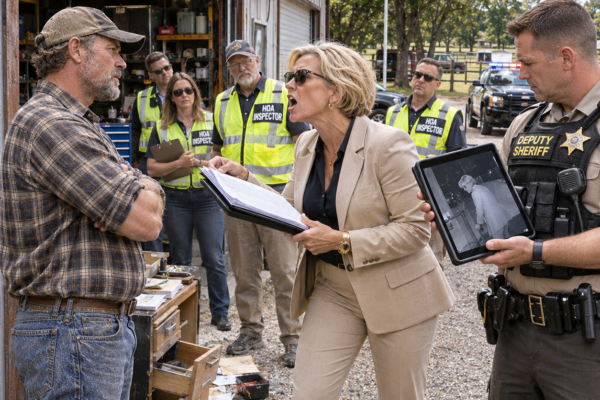
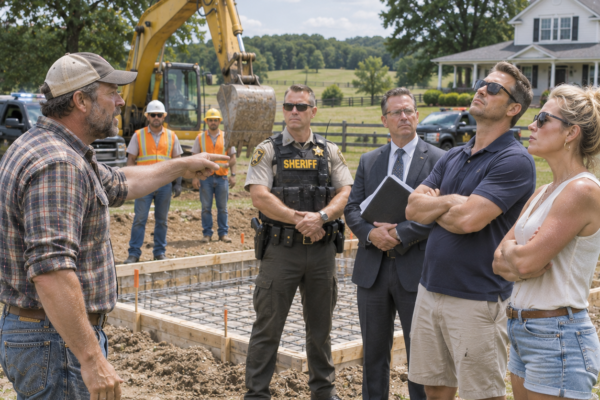
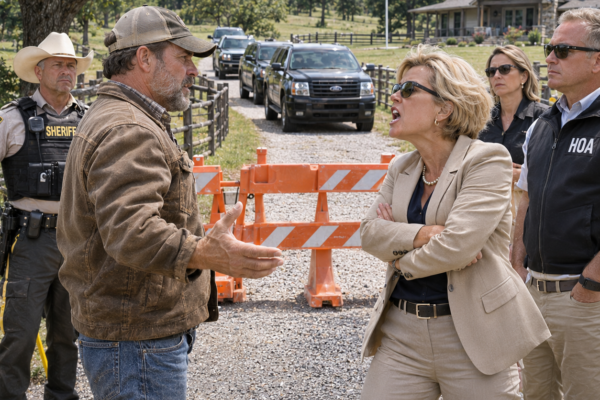
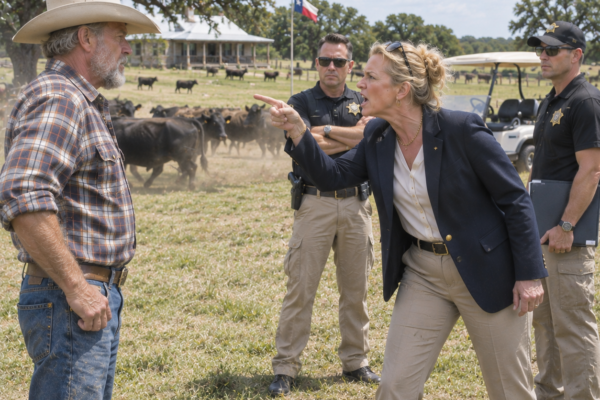
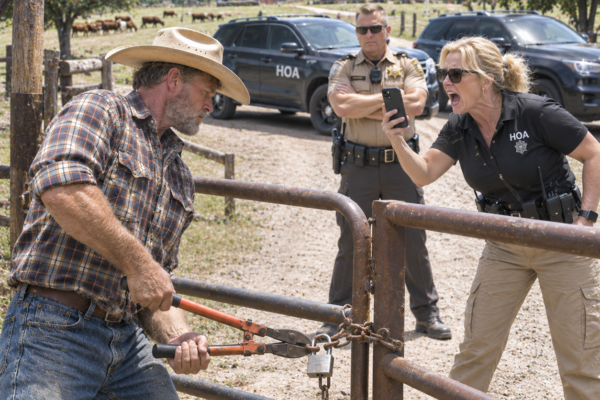
“This Road Is Going Through Your Farm Whether You Like It or Not!” the HOA President Sneered as Bulldozers Tore Across My Family’s 200 Acres Before Sunrise. My Great-Grandfather Had Worked That Iowa Soil Since 1912, and I’d Already Refused His Shortcut. When I Dug Trenches Through His Illegal Road, He Came Back Furious—and Reached Inside His Jacket…k
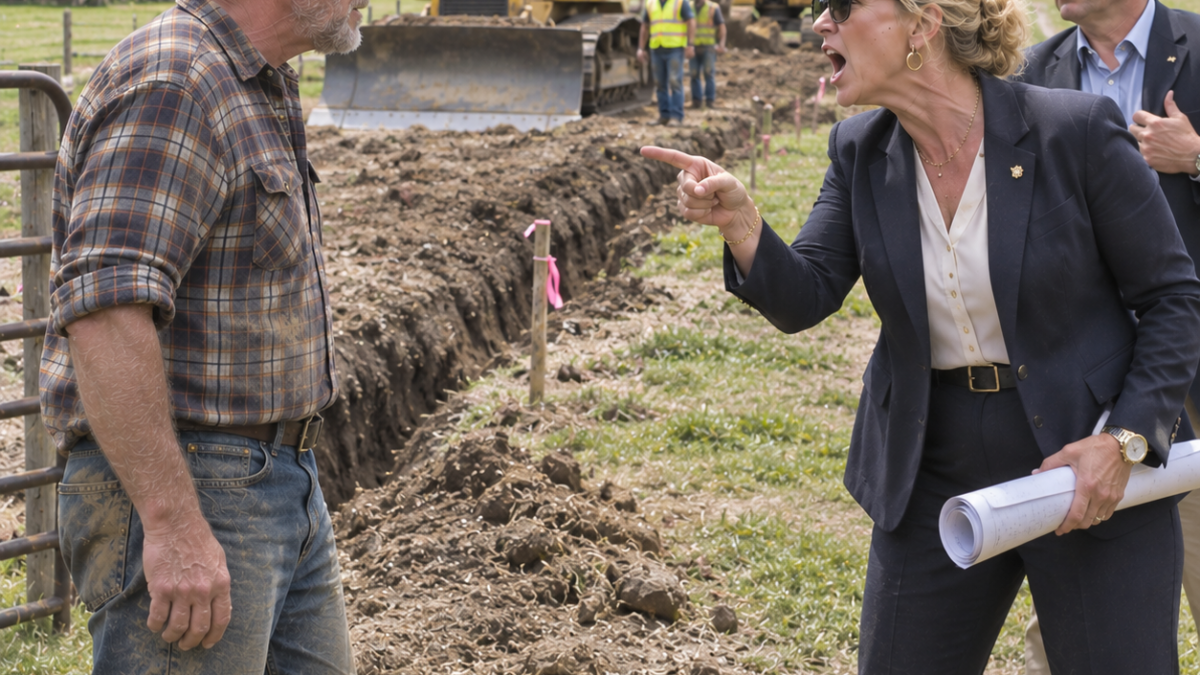
“This Road Is Going Through Your Farm Whether You Like It or Not!” the HOA President Sneered as Bulldozers Tore Across My Family’s 200 Acres Before Sunrise. My Great-Grandfather Had Worked That Iowa Soil Since 1912, and I’d Already Refused His Shortcut. When I Dug Trenches Through His Illegal Road, He Came Back Furious—and Reached Inside His Jacket…
At 5:37 on a Monday morning, I woke to the sound of a bulldozer tearing through the south pasture of my family’s 200-acre Iowa farm.
At first, I thought I was dreaming.
Then the bedroom windows rattled.
I pulled back the curtain and saw two enormous yellow machines pushing through the field where my grandfather had once grazed dairy cows.
A third machine was scraping away the topsoil.
And standing beside the construction crew, directing traffic from the window of a shiny black SUV, was Tom Wilson.
President of the Culver’s Creek Homeowners Association.
The same man I’d told six days earlier that he couldn’t build a road across my property.
I threw on my jeans and work boots.
By the time I reached the pasture, the bulldozers had carved a wide brown scar through nearly three hundred feet of farmland.
Fence posts lay scattered in the dirt.
A drainage ditch had been flattened.
And the ground my family had worked for more than a century was being turned into a shortcut for a subdivision I didn’t belong to.
“SHUT THOSE MACHINES DOWN!”
The foreman glanced at me.
Then kept working.
I stepped into his line of sight, well clear of the machinery, and waved both arms.
“You’re trespassing! This is private property!”
He finally stopped and climbed down.
“Sir, we’ve got authorization.”
“From whom?”
“The homeowners association.”
I couldn’t believe what I was hearing.
“My name is Henry McCready. I own this land.”
The foreman looked uncomfortable.
Then Tom’s SUV rolled up beside us.
He stepped out wearing a crisp white shirt, polished shoes, and the same politician’s smile he’d shown me outside church the previous Sunday.
“Morning, Henry! We’re finally making some progress.”
I stared at him.
“Tom, what have you done?”
He gestured toward the torn-up field.
“Just a little road construction. It’ll connect Culver’s Creek directly to the highway. Your land is the most practical route.”
“I told you no.”
He laughed.
“One stubborn farmer can’t hold up improvements that benefit hundreds of families.”
I looked toward the bulldozers.
“My great-grandfather founded this farm in 1912. You don’t get to carve a road through it because your residents want a shorter drive.”
Tom’s smile disappeared.
“Progress requires sacrifice, Henry.”
“Then sacrifice something you own.”
His face reddened.
He stepped closer.
“Don’t make me involve the county. There are ways to acquire land for public purposes whether the owner agrees or not.”
I knew what he was suggesting.
Eminent domain.
Except Culver’s Creek was a private subdivision, and Tom Wilson wasn’t a government official.
He couldn’t seize farmland simply because his HOA wanted another entrance.
My wife, Betty, came hurrying across the yard.
She put a hand on my arm.
“Henry, I’ve called our attorney. Don’t let him provoke you.”
Then she looked toward the machines.
“Mr. Wilson, you’ve brought heavy equipment onto our farm without permission. Stop this work.”
Tom ignored her.
Instead, he looked me in the eye.
“This road is happening, Henry. One way or another.”
My name is Henry McCready. I’m fifty-seven years old, and I’ve spent every year of my life on this farm outside Ames, Iowa.
My great-grandfather broke the original prairie sod.
My grandfather Amos raised dairy cattle here.
My father planted corn and soybeans.
And Betty and I raised our three children in the old white farmhouse overlooking the south field.
We weren’t wealthy.
But the farm was paid for.
Our deeds were recorded.
Our boundaries were surveyed.
And until Culver’s Creek appeared on the former Patterson property downhill, nobody had ever questioned our right to decide what happened on our own land.
Tom Wilson changed that.
Six days earlier, he’d approached me after church and proposed cutting a road through our south pasture.
He called it a community improvement.
I called it a permanent loss of valuable farmland.
I told him no.
Now he had arrived before sunrise with bulldozers.
Our attorney, Rebecca Hart, instructed us to document everything and report the unauthorized construction immediately.
I photographed the damaged fence, the stripped topsoil, and the machines.
The sheriff’s office took our complaint.
By that afternoon, the crew had stopped working while the property rights and construction authorization were reviewed.
But the damage remained.
A wide strip of exposed earth cut through our pasture like an open wound.
That evening, Betty found me standing beside it.
“Henry, promise me you won’t let that man drag you into something foolish.”
I looked at the ruined ground.
“I won’t hurt anybody, Betty.”
She squeezed my hand.
“Then let Rebecca handle him.”
I nodded.
But the next morning, after confirming the equipment was gone and the unfinished track was closed to traffic, I took my backhoe out to the damaged strip.
I wasn’t going to leave an unauthorized road that someone could start using before a court settled the matter.
Working carefully, I cut several shallow trenches across the newly graded section, keeping clear of the old drainage system and marking the excavation.
The track was unusable.
For the first time since the bulldozers arrived, I felt I’d regained some control.
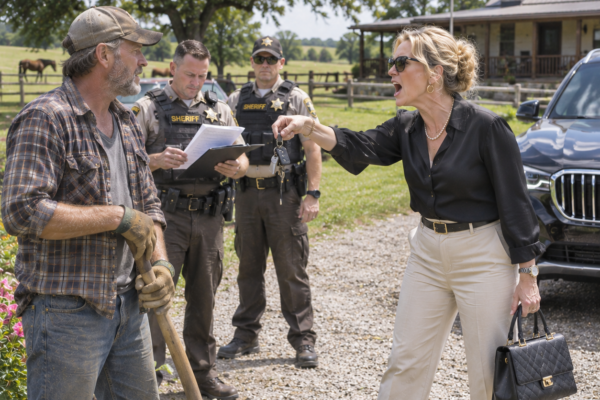
At 2:16 that afternoon, Tom Wilson’s black SUV came racing up our driveway.
He climbed out, slammed the door, and marched toward me.
His face was dark red.
“What the HELL did you do to my road?”
I set down my shovel.
“Your road?”
“Do you have any idea how much money you’ve cost me?”
I looked at him.
“Tom, you dug through land that belongs to my family. I told you no. The answer hasn’t changed.”
He stepped closer.
“You senile old fool. You think you can embarrass me and get away with it?”
Then his hand disappeared inside his suit jacket.
I saw the anger in his eyes.
I saw the way his shoulders tightened.
And for one terrible second, I realized this was no longer an argument about a road.
Something was about to happen that neither Betty nor I could undo.
Part 2:
The first bulldozer crossed my south pasture before the sun was up.
I knew the sound immediately.
After fifty-seven years on a working farm, you learn to recognize machinery without looking out the window. A combine has a different rumble from a tractor. A grain truck sounds different from a loaded feed wagon. And a bulldozer pushing through packed soil makes a particular low growl that can carry a long way on a quiet morning.
At 5:37, that growl was coming from land my family had owned since 1912.
I got out of bed and went to the bedroom window.
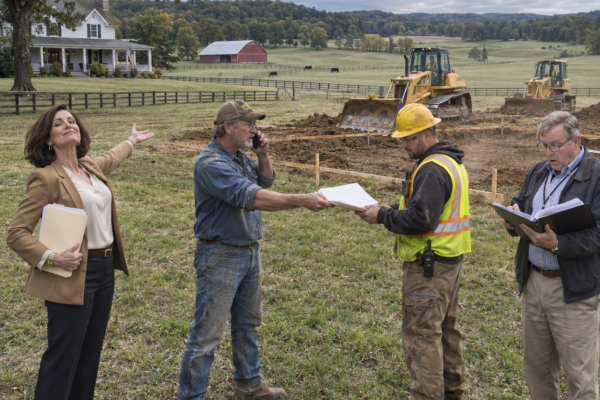
Three yellow machines were working in the field below the farmhouse.
One was pushing aside topsoil. Another was grading a strip through the south pasture. A third stood near a line of fence posts, where somebody had already opened a gap wide enough for construction trucks.
I stared at the scene.
Then I reached for my jeans.
“Henry?” my wife called from the bed.
“Somebody’s digging up the south pasture.”
Betty sat upright.
“What?”
I pointed through the window.
She took one look.
“Oh, Lord.”
I was already pulling on my boots.
By the time I reached the yard, I could see how much damage the crew had done. Fresh tracks crossed the meadow. Several cedar fence posts had been pulled out. A drainage swale that carried spring runoff away from our lower cornfield had been flattened beneath the new grading.
I walked toward the machines, stopping at a safe distance.
“SHUT IT DOWN!”
A man in an orange vest looked toward me.
He spoke into his radio.
One bulldozer stopped.
The other continued forward, pushing a ridge of dirt across the pasture.
I waved again.
“You’re on private property!”
The foreman climbed down from his pickup and approached.
“Sir, you’ll need to stay out of the work area.”
I looked at his vest.
BRADLEY EARTHWORKS.
Then at the strip of bare dirt running across my land.
“Who authorized this?”
“We’ve got a road contract.”
“With whom?”
“Culver’s Creek development.”
I stared at him.
“That development doesn’t own this field.”
He looked uncomfortable.
“Sir, I was told the access rights had been cleared.”
“They haven’t. My name is Henry McCready. This is my farm.”
Before he could answer, a black SUV came rolling down the temporary track.
Tom Wilson stepped out.
He wore a white dress shirt and polished shoes that weren’t going to stay polished very long if he walked through that dirt.
“Morning, Henry!”
I turned toward him.
“Tom, tell these men to stop.”
He spread his arms.
“Let’s not make this unpleasant.”
“You’ve brought bulldozers onto my property.”
“We’re creating a much-needed connection to the highway.”
“I told you no.”
He smiled.
“Your position was noted. But the board determined that the public benefits outweigh your objections.”
I looked at him.
“What board?”
“The Culver’s Creek HOA board.”
“The Culver’s Creek board can’t vote to take McCready land.”
His smile disappeared.
“You don’t understand how development works.”
I stepped closer.
“I understand what happens when somebody drives heavy machinery through my pasture without permission.”
Tom pointed toward the highway.
“This road will reduce traffic congestion, improve emergency access, and increase everybody’s property values.”
“Then build it on property you own.”
He lowered his voice.
“Henry, don’t be that stubborn old farmer who holds an entire community hostage.”
I glanced toward the ruined fence.
“An entire community isn’t being held hostage. One HOA president is ignoring the word no.”
That’s when Betty came hurrying down from the house.
She put a hand on my shoulder.
“Henry, Rebecca’s on the phone.”
Rebecca Hart was our attorney. She’d handled several farm-property matters for us over the years.
Betty handed me the phone.
Rebecca asked me to describe exactly what was happening.
Then she gave me three instructions.
“Photograph everything. Don’t confront the machinery physically. And ask the foreman to stop pending verification of the property rights. I’m contacting the county and the developer’s attorney.”
I repeated her request to the foreman.
He called his office.
Within minutes, the machines began shutting down.
Tom looked furious.
“You don’t get to stop an authorized improvement simply because it inconveniences you.”
“Then show me the authorization.”
He stepped closer.
“Progress is coming whether you approve of it or not.”
I looked toward the freshly graded strip.
“Not through my farm.”
His face turned red.
“This isn’t finished.”
I watched him climb back into his SUV.
He drove away fast enough to throw dust over the contractors standing beside their trucks.
I thought the worst thing I’d see that week was the destruction already done to our pasture.
I was wrong.
Because the next afternoon, Tom returned.
And this time he wasn’t carrying a development map.
He was carrying a gun.
But before I tell you what happened beside that unfinished road, you need to understand why those two hundred acres meant so much to my family.
The McCready farm wasn’t fancy.
Our farmhouse had a sagging porch on one side and a kitchen floor that creaked near the refrigerator.
The barn needed painting every few years.
Our equipment shed contained more secondhand machinery than new.
And the south pasture was never going to appear on a postcard advertising beautiful Iowa countryside.
But the land was productive.
And it had history.
My great-grandfather, Daniel McCready, founded the farm in 1912.
He came west from Illinois with a team of horses, two young children, and a wife who apparently had more determination than anybody else in the family.
The original acreage was rough prairie and old pasture.
Daniel broke the sod, planted crops, and built a small house that later became part of the home Betty and I lived in.
My grandfather Amos was born here.
He raised dairy cows and expanded the fields.
When I was little, I followed him everywhere.
I remember sitting beside him on a tractor so old it seemed impossible that it could pull anything.
He’d let me hold the steering wheel while he kept one hand close enough to take over.
“Henry,” he’d say, “don’t ever forget that good soil isn’t something you make in a season. You’re borrowing the work of everyone who came before you.”
I was too young to understand what he meant.
Now I understood perfectly.
Grandma Lily kept chickens near the old barn. She used to send me into the coop with a wire basket, telling me to gather eggs without upsetting the hens.
I was afraid of one particular Rhode Island Red that liked pecking my boots.
Grandma thought that was hilarious.
In the evenings, the whole house smelled of supper, hay dust, and whatever vegetables she’d taken from the garden.
I grew up believing that was what home was supposed to smell like.
Dad continued the dairy operation for years.
Then milk prices became difficult, equipment costs climbed, and we began shifting toward row crops.
By the time I took over full-time, we were growing mostly corn and soybeans.
We still had a small hay meadow and kept some chickens.
A neighboring farmer occasionally leased part of the south pasture for seasonal grazing.
The change made our operation simpler, but not easier.
There were still bills to pay.
Machinery to repair.
Weather to worry about.
And years when the crop didn’t bring enough to justify all the work we’d put into it.
Betty and I raised three children here.
Our oldest son, Paul, became a mechanic.
Our daughter, Grace, worked as a nurse.
And our youngest, Daniel, taught agricultural science at a community college.
They had their own lives now.
But all three came home for holidays, harvest dinners, and whenever a problem was big enough that I had to admit I needed help.
Betty and I had been married thirty-four years.
She wasn’t merely the woman who lived in the farmhouse while I worked outside.
She managed our records, negotiated equipment purchases, kept track of the crop insurance, and knew more about our finances than I ever would.
When somebody asked how the farm stayed in business, I always said the same thing.
“I grow the crops. Betty makes sure we can afford to do it again next year.”
She’d roll her eyes.
But she knew it was true.
We didn’t expect to become wealthy from farming.
We wanted to work honestly, pay our obligations, and leave our children something worth keeping.
For most of my life, that had seemed possible.
Then Culver’s Creek arrived.
The former Patterson property lay downhill from our eastern fields.
For most of my childhood, it had belonged to a farmer named Earl Patterson, a quiet man who’d lend you a tractor part without asking when you planned to return it.
His daughter inherited the land after he passed away.
A few years later, she sold it to a development company.
I wasn’t thrilled when the first survey flags appeared.
Then came the bulldozers.
Then the concrete trucks.
Within eighteen months, rows of nearly identical houses stretched across what had once been pasture.
Culver’s Creek.
It was a nice enough neighborhood.
Two hundred homes were planned, with broad sidewalks, a community swimming pool, landscaped entrances, and decorative ponds.
The developer advertised a peaceful rural lifestyle close to Ames.
Betty said we should welcome the new neighbors.
“Families need places to live, Henry.”
“I know.”
“And they’re buying the land fair and square.”
“I know that too.”
She smiled.
“Then stop looking at those houses like somebody planted weeds in your garden.”
I laughed.
She was right.
Most of the people moving into Culver’s Creek weren’t interested in bothering us.
They were families with children.
Retired couples.
Young professionals commuting into town.
I waved when I drove the tractor down the county road.
Some residents bought eggs from Betty.
Others stopped at our seasonal roadside stand for sweet corn.
We even allowed a few neighbors to walk a marked path along the creek at the back of our property, provided they asked permission and stayed away from machinery and crop fields.
I liked seeing children interested in the farm.
One afternoon, a little boy asked me why our corn didn’t come in cans.
I told him the grocery store was still working on growing the cans.
He spent ten minutes trying to decide whether I was joking.
For a while, the subdivision and the farm coexisted comfortably.
Then Tom Wilson became HOA president.
He was in his early fifties, a real estate salesman with a habit of smiling before delivering bad news.
He drove a shiny black SUV, wore expensive suits, and talked about Culver’s Creek as though he’d personally invented the concept of neighborhoods.
I met him at a county planning meeting.
He was arguing for changes to the subdivision’s road layout.
His main complaint was that residents had to travel north through the original entrance before reaching the highway.
A direct connection to the south would save time.
The problem was that our farm stood between the subdivision and the most convenient highway connection.
Tom approached me afterward.
“Henry McCready. I’ve heard good things about your farm.”
“That’s kind of you.”
“We should talk sometime.”
“About what?”
“Opportunities for cooperation.”
I smiled.
“That sounds expensive.”
He laughed.
Then he handed me his business card.
I put it in my truck’s glove compartment and forgot about it.
The following Sunday, he caught me outside church.
Betty had gone inside to help with a fundraising breakfast.
I was standing near the parking lot when Tom appeared beside his SUV.
“Henry, got a minute?”
“Sure.”
He unrolled a glossy map on the hood.
A red line ran straight across my south pasture.
It connected Culver’s Creek to the county highway.
“We’d like to build a secondary access road,” he said. “This is the most efficient alignment.”
I studied the map.
The proposed road would divide the south pasture, cut across a drainage swale, and pass close to the field entrance our equipment used during planting.
It would also require new fencing and create a permanent traffic corridor through the farm.
“No,” I said.
Tom blinked.
“Excuse me?”
“That route won’t work.”
He pointed toward the drawing.
“We’re prepared to discuss reasonable compensation.”
“I’m not selling that part of the farm.”
“You haven’t heard the amount.”
“Doesn’t matter.”
He stared.
Then smiled again.
“Henry, this could increase your property value significantly.”
“Why would I want to increase its value by making it harder to farm?”
“The community needs improved access.”
“Then improve access on land the community owns.”
His smile faded.
“The alternative requires a much longer route and expensive infrastructure.”
“Then your developer should’ve accounted for that before building.”
He rolled up the map.
“We could pursue eminent domain.”
I looked at him.
“Who is ‘we’?”
“The association and interested public authorities.”
“Have any public authorities proposed taking my land?”
“Not yet.”
“Then you’re just threatening me with something your HOA can’t do.”
His face reddened.
“I don’t appreciate being dismissed.”
“Tom, I’m not dismissing you. I’m answering your request.”
I held out my hand.
“The answer is no.”
He didn’t shake it.
Instead, he climbed into his SUV and drove away.
I told Betty about the conversation over breakfast.
She listened.
Then asked, “Did he explain why the developer didn’t plan an entrance before selling those homes?”
“No.”
“Then don’t spend the rest of Sunday worrying about it.”
I should’ve listened.
Six days later, Tom sent the bulldozers.
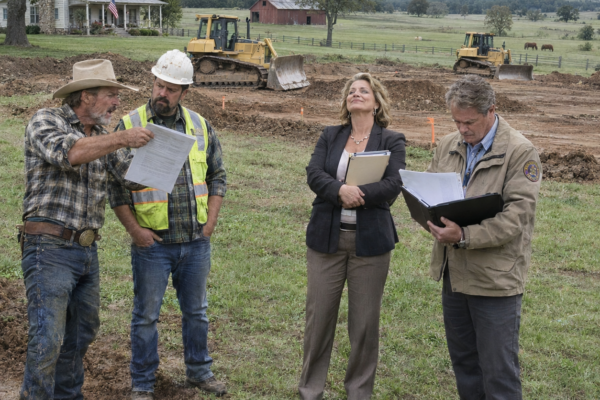
After the crews stopped working that Monday morning, Rebecca Hart arrived at the farm.
She brought a copy of our deed, the most recent survey, and the records she’d obtained from the county.
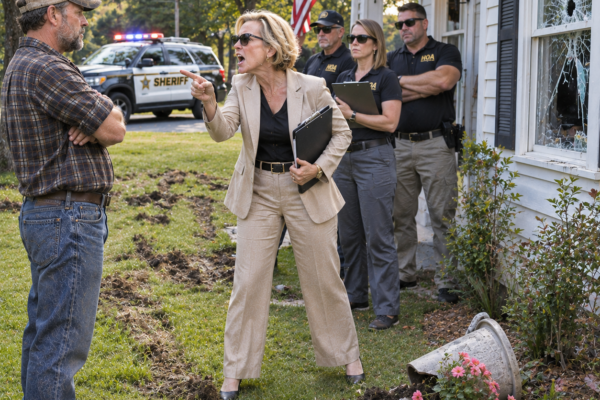
A deputy from the Story County Sheriff’s Office came to document the unauthorized entry.
The foreman, a man named Pete Bradley, showed us his work order.
The job was described as a subdivision access-road extension.
Attached was a preliminary route drawing.
At the bottom, under a section labeled Property Access, someone had written:
Cleared through Culver’s Creek HOA leadership.
Rebecca read it aloud.
Then looked at Pete.
“Do you have written permission from Henry McCready?”
“No, ma’am.”
“A recorded easement?”
“Not with me.”
“A county authorization allowing construction on his property?”
“I was told those approvals were being handled.”
She folded the document.
“Then you need to stop until those rights are established.”
Pete looked toward his equipment.
The crew had already shut down.
“I don’t want trouble, ma’am. Our office was told this was approved.”
“Then your office needs to verify who actually approved it.”
The deputy examined the scene, spoke with the contractors, and documented the boundary dispute and property damage.
He didn’t claim to resolve title questions by himself.
But he made clear that the workers were on land whose owner had expressly denied permission and that they should not continue without a lawful basis.
Pete called his supervisor.
The equipment was moved out of the active work area.
By afternoon, the construction had stopped.
But nobody could undo what had already happened.
Nearly three hundred feet of our pasture had been stripped.
The fence opening was large enough for a tractor-trailer.
The drainage swale was damaged.
And somebody had piled topsoil beneath a row of trees where the roots would be vulnerable if the material sat too long.
Rebecca took photographs and measurements.
Then she walked the damaged strip with me.
“Henry, this could be a substantial claim.”
“I don’t want a claim. I want my field back.”
“I understand.”
She stopped near the fence.
“But we need a documented restoration plan. You don’t want somebody dumping gravel here and calling the damage repaired.”
I looked at the exposed earth.
“My father kept drainage running through here for forty years.”
“Then we’ll make sure the drainage is part of the remedy.”
She also told me something that angered me even more.
The county had no record of a granted easement across our farm for Culver’s Creek.
The preliminary subdivision maps showed a proposed secondary access route.
Proposed.
Not approved.
Not acquired.
Not owned.
Tom had apparently treated a future possibility as though it were a completed legal right.
That evening, Betty and I stood beside the torn-up pasture.
She looked toward the broken fence.
“Your grandpa would’ve been sick seeing this.”
I nodded.
“He spent half his life keeping that field drained.”
She took my hand.
“We’ll get it fixed.”
I stared at the wide strip of exposed dirt.
“They’ll just come back when nobody’s watching.”
“Rebecca will get an order.”
“That takes time.”
Betty turned toward me.
“Henry, don’t do anything reckless.”
I nodded.
“I won’t.”
I meant it.
I wasn’t planning to hurt anyone.
I wasn’t even planning to damage working equipment.
But the road had been graded far enough that an ordinary truck could start using it.
And Tom had made very clear he intended to continue.
The following morning, after checking that the contractors and equipment were gone, I drove my backhoe to the unfinished track.
The work had been suspended.
No one had opened the route to traffic.
There were no buried services shown in the construction information we’d obtained.
I marked the area and used the backhoe to cut several shallow trenches across the new grading.
I kept clear of the damaged drainage swale so I wouldn’t make that problem worse.
When I finished, the would-be road was impassable.
A vehicle couldn’t simply drive from Culver’s Creek across our pasture to the highway.
I shut down the backhoe and stood beside it.
For the first time in two days, the field was quiet.
I didn’t feel victorious.
I felt tired.
But at least nobody could pretend the unauthorized construction had become an ordinary road simply because the first stretch had been graded.
I went inside for lunch.
Betty looked at the dirt on my clothes.
“What have you been doing?”
“Making sure nobody drives through the south pasture.”
She frowned.
“Henry.”
“I didn’t touch their equipment. I worked on the unfinished track, on our land.”
She studied me.
Then shook her head.
“You and your grandpa Amos. Same stubborn streak.”
“Amos would’ve dug twice as many trenches.”
“That doesn’t mean it would’ve been smart.”
I smiled.
She didn’t.
“Call Rebecca and tell her what you’ve done.”
I did.
Rebecca wasn’t pleased that I’d taken action before speaking to her.
She asked for photographs and told me to keep the area clearly marked and avoid further earthwork until the property and safety questions were settled.
I agreed.
Then, a little after two that afternoon, I heard an engine roaring up the driveway.
Tom Wilson’s black SUV stopped so hard that gravel scattered beneath its tires.
He got out and slammed the door.
I was standing near the machine shed with a shovel.
“What the hell did you do?” he shouted.
I set the shovel down.
“Good afternoon, Tom.”
“Do you have any idea how much money you’ve cost me?”
I looked toward the south pasture.
“Probably less than you’ve cost me.”
He marched closer.
“Those trenches have destroyed the work my contractor completed!”
“The work you ordered on my land without permission.”
His face turned purple.
“You senile old fool! You think you can make me look stupid in front of the entire community?”
“I didn’t make you do anything.”
“You’ve embarrassed me.”
“Tom, you’ve got no business building a road through my farm.”
He stepped so close I could smell the coffee on his breath.
“Fill those trenches.”
“No.”
“I’m giving you one last chance.”
“The answer is still no.”
His hand moved inside his jacket.
At first, I thought he was reaching for his phone.
Then I saw the pistol.
He drew it and shoved the muzzle beneath my chin.
My whole body went cold.
“You listen to me, McCready,” he said through clenched teeth. “Those trenches get filled, and that road gets finished. Or I’ll put a bullet through your head right here.”
I could hear the wind moving through the corn.
I could hear a tractor somewhere beyond the highway.
And I could hear my own breathing.
I didn’t reach for the gun.
I didn’t move toward him.
I kept my hands where he could see them.
“Tom,” I said quietly, “put the pistol down.”
He pressed it harder against my chin.
“You think I’m bluffing?”
“No. That’s why I’m asking you to stop.”
His hand shook.
I looked into his eyes.
“If you shoot me, you’ll destroy your life. And it still won’t give you a right to this farm.”
For a long moment, neither of us moved.
Then his expression changed.
He lowered the pistol.
“This isn’t over, old man.”
He backed toward his SUV.
I stayed where I was.
He climbed in and drove away.
Only when the vehicle disappeared beyond the trees did my knees begin to shake.
I sat down hard on the step outside the machine shed.
My hands wouldn’t stop trembling.
Then I heard Betty calling my name.
She had seen part of the confrontation from the kitchen window.
She came running across the yard with her phone in her hand.
“Henry!”
I looked up.
“I’m all right.”
She saw my face.
Then looked toward the driveway.
“What did he do?”
I swallowed.
“He pulled a gun on me.”
Her mouth opened.
For a moment, she couldn’t speak.
Then she sat beside me, put one arm around my shoulders, and called 911.
I had spent fifty-seven years working this farm.
I’d been kicked by cattle.
Caught in storms.
Pinned beneath a broken gate.
Nearly lost a hand in a piece of machinery.
But I’d never had a neighbor point a loaded pistol at my face because I wouldn’t let him build a road across my land.
That afternoon changed the way I looked at Tom Wilson.
He wasn’t merely arrogant.
He was dangerous.
And for the first time, I wondered whether I had underestimated how far he’d go to get what he wanted.
Deputy Mark Ellison arrived with another officer twenty minutes after Betty called.
He found me sitting at the kitchen table with a glass of water I hadn’t touched.
Betty was beside me.
My hands had finally stopped shaking, but I still felt the pressure of the gun beneath my chin.
Ellison listened while I described the confrontation.
He asked where we’d been standing.
What Tom had said.
Whether I’d threatened him.
Whether I’d made any movement toward the weapon.
I answered each question.
Then he took Betty’s statement separately.
She’d been near the kitchen window when the argument began. She saw Tom move close to me, draw the pistol, and hold it against my face.
She hadn’t heard every word.
But she’d seen enough to understand what was happening.
I showed Ellison the driveway and the step outside the machine shed.
He photographed the area and checked whether our security camera had captured anything.
The camera above the shed mostly covered the equipment entrance, but part of the driveway was visible.
The footage showed Tom arriving, marching toward me, and leaving a few minutes later.
It didn’t provide a clear view of the pistol.
I wished it did.
Ellison didn’t seem particularly bothered.
“Video can help,” he said. “But it’s not the only kind of evidence.”
He collected our statements and the available recording.
Then he looked toward the unfinished road.
“Did this dispute start over that construction?”
“Yes.”
He asked me to explain the timeline.
I showed him the certified deed, Rebecca’s photographs, and the contractor’s work order.
He made notes.
Then he looked at Betty.
“Mrs. McCready, is Mr. Wilson likely to come back tonight?”
“I don’t know,” she answered. “And that’s what scares me.”
Ellison nodded.
“We’re going to follow up with him. If he comes onto the property or threatens either of you again, call immediately. Don’t confront him.”
We promised we wouldn’t.
That evening, the sheriff’s office contacted Tom.
He was taken into custody after investigators reviewed the statements and circumstances and established probable cause for the alleged assault involving a firearm.
The prosecutor’s office would decide the charges.
I didn’t get to make that decision, and I didn’t want to.
The law was supposed to work the same way whether the victim was a farmer or an HOA president.
By the following morning, word had spread through Culver’s Creek.
Some residents were shocked.
Others insisted there must be another side to the story.
A few complained online that I had deliberately sabotaged a public road.
I didn’t respond.
There was no public road.
There was an unauthorized strip of grading across my pasture.
And a man who’d threatened my life because I refused to surrender it.
Rebecca called before breakfast.
“Henry, I heard what happened.”
I described the confrontation again.
When I finished, she was silent.
Then she said, “I’m relieved you’re safe.”
“Betty’s taking it harder than I am.”
I looked toward the kitchen, where my wife was washing the same coffee cup for the second time.
Rebecca continued.
“We need to request immediate civil protection against further construction. The criminal case will address the firearm incident, but that doesn’t automatically restore the land.”
“I understand.”
“I also want the contractor, developer, and HOA to preserve their communications. We need to know what each of them believed they were authorized to do.”
By noon, she’d prepared the necessary filings.
We sought an injunction preventing further unauthorized construction or entry connected to the proposed road.
We requested protection of the damaged drainage area, preservation of relevant evidence, and proper restoration.
Rebecca also sent formal preservation notices to the construction company, developer, and association.
Tom’s threats changed the urgency.
But the property documents still had to establish the underlying rights.
The following week, Rebecca obtained a set of planning records that made me angrier than I’d expected.
The original subdivision application showed a secondary road connection through the south pasture as a potential future access route.
The note beneath the map was straightforward.
SUBJECT TO ACQUISITION OF NECESSARY PROPERTY RIGHTS AND APPROVALS.
The engineer who prepared the drawing hadn’t claimed the developer owned our land.
He’d identified a possible alignment.
Nothing more.
But a later version distributed to the HOA board had removed most of that explanation.
The road was labeled CULVER’S CREEK SOUTH ACCESS.
A presentation slide described it as a planned community connection.
And Tom had repeatedly told residents that the connection was practically guaranteed.
He hadn’t just wanted a road.
He’d convinced people it was already coming.
Then he had to find a way to deliver it.
Rebecca arranged an interview with the original engineer through the appropriate legal process.
His name was Daniel Frost.
He was a quiet man in his forties who carried an enormous roll of drawings and seemed relieved to be speaking to someone interested in the actual plans.
“The route was conceptual,” he explained.
“Did anybody ever ask us for a formal easement?” I asked.
“Not through my office. I understood negotiations were ongoing.”
“Who told you that?”
“Mr. Wilson.”
Rebecca leaned forward.
“Did you approve starting construction?”
“No. The required land rights weren’t established. I made that clear in writing.”
He produced an email.
The message had gone to Tom and the developer’s construction coordinator three weeks before the bulldozers entered my pasture.
It stated that the proposed connection couldn’t proceed without landowner authorization and the appropriate county review.
I read it twice.
“Tom got that message?”
Daniel nodded.
“He replied.”
Rebecca asked to see the response.
Daniel handed it over.
Tom’s message said:
The landowner issue is being resolved at the association level. Please keep the access schedule on track.
I looked at Rebecca.
She looked back at me.
“Resolved at the association level,” I repeated.
Like my farm was an item on a clubhouse maintenance list.
Daniel continued.
“The county’s review of the secondary access wasn’t complete either. The documents weren’t construction authorization for that route.”
That distinction became crucial.
The developer had a subdivision plan.
Tom had an HOA resolution supporting improved access.
The contractor had a work order.
But none of those documents gave anybody permission to dig across the McCready farm.
Rebecca also discovered that the association board hadn’t voted to seize land or authorize construction on my property.
Its minutes showed approval of continued negotiations for a possible access arrangement.
Some directors had believed the developer was obtaining the necessary rights.
Tom had taken that limited approval and treated it as authority to proceed.
I remembered him standing beside the bulldozers.
The board determined the public benefits outweigh your objections.
He’d made it sound like a lawful government decision.
It wasn’t.
He’d been bluffing.
And when I refused to let the bluff become reality, he’d pulled a gun.
The court held an initial hearing on our request for an injunction.
The judge reviewed the deed, survey, planning documents, and evidence of the unauthorized construction.
The defendants were given an opportunity to respond.
Their attorneys argued about whether the route could still be negotiated and whether the damage could be addressed without stopping the project.
Rebecca kept the issue simple.
“The question isn’t whether a second road would be convenient,” she said. “The question is whether these defendants possess a legal right to build it across the plaintiffs’ farmland.”
They couldn’t produce one.
The judge prohibited further road construction or unauthorized use of the route while the case proceeded and required appropriate measures to stabilize the disturbed soil and drainage.
The order didn’t decide the final amount of damages.
It didn’t make the criminal charges disappear.
But it protected our land from another sunrise arrival by heavy equipment.
When Rebecca called with the result, Betty let out a breath that sounded as though she’d been holding it for a week.
“Does that mean Tom can’t come back with bulldozers?”
“It means there’s a court order telling him and the other parties not to.”
Betty closed her eyes.
“Thank God.”
I took her hand.
We were one step closer to getting our farm back.
But we still had to find out how much of it could be repaired.
The first heavy rain came nine days after the injunction.
It started after midnight.
By morning, water was running across the lower field in sheets.
Ordinarily, the south pasture’s drainage swale carried that runoff toward the creek without flooding the nearby corn rows.
My father had spent years improving that drainage.
He’d walked the field after storms, studied where the water collected, and adjusted the contour so the soil stayed where it belonged.
Tom’s bulldozers had flattened part of the swale.
The temporary stabilization helped, but it couldn’t replace a functioning drainage system.
At seven, Luis called me from the southern fence.
“Henry, you’d better come look.”
I pulled on my raincoat and drove down.
Water was spilling across the disturbed strip.
A muddy plume stretched toward the corn.
The sediment barriers installed after the injunction were beginning to fill.
Luis stood beside a shallow pool forming near the field entrance.
“This never happened here before.”
“I know.”
I looked toward the old channel.
There had been a gentle depression in the ground for as long as I could remember.
Now the earth was nearly level.
Water had nowhere to go.
We stayed clear of the unstable sections and called the restoration contractor.
Rebecca arranged for a soil and drainage specialist to inspect the site after the storm.
His name was Warren Beck.
He’d spent twenty-five years working with agricultural drainage and land restoration.
Warren walked the route with a survey level and a field notebook.
He examined the stripped topsoil, damaged fence, compacted subsoil, and altered drainage grade.
Then he took samples.
When we reached the cornfield, he crouched beside a section where muddy runoff had deposited sediment over the young plants.
He picked up a handful of soil.
“That’s going to need careful handling,” he said.
“Can it be fixed?”
“Most of it, yes. But you can’t just push dirt back into place and call it restored.”
I nodded.
“That’s what Rebecca said.”
Warren explained the work required.
The unauthorized roadbed material needed removal.
Topsoil and subsoil had to be handled separately.
Compacted areas needed appropriate rehabilitation.
The drainage swale had to be reestablished based on the historical grade and a proper design.
Fence posts needed replacing.
And the affected crop areas had to be assessed for lost production.
Then there was the soil itself.
Some of the topsoil had been mixed with construction fill.
Some had been stockpiled improperly.
The compacted areas might take more than one growing season to return to normal productivity.
I stood beside him, looking at the damaged ground.
“My grandfather taught me never to scrape good topsoil off a field unless you had a very good reason.”
Warren nodded.
“He was right.”
When his report came, the estimated restoration and related losses were far greater than the cost of the initial grading.
I looked at the figures, then at the torn-up land.
Tom had spent one morning trying to save the subdivision the cost of building a legitimate access road.
Now somebody would have to spend months fixing what his shortcuts had destroyed.
The criminal case was moving through its own process.
Tom was released subject to court conditions that prohibited him from contacting or threatening Betty and me.
He was no longer permitted to bring a firearm near us.
We didn’t see him on the farm again.
But I still found myself looking toward the driveway whenever a dark SUV passed.
Betty noticed.
One evening, she found me standing at the kitchen window long after dinner.
“Henry, what are you looking for?”
“Nothing.”
She came beside me.
“You’ve been watching that road every night.”
I didn’t answer.
She took my hand.
“He frightened you.”
I looked at her.
“Yes.”
It was the first time I’d said it out loud.
I’d told deputies what happened.
I’d told lawyers.
I’d answered questions.
But I’d been so busy dealing with the land and the court filings that I hadn’t let myself admit how close I’d come to being shot.
Betty leaned against me.
“He frightened me too.”
I wrapped my arm around her.
For a while, we stood there without speaking.
Then she said, “I don’t want that man deciding how we spend the rest of our lives.”
I kissed the top of her head.
“Neither do I.”
That conversation stayed with me.
I realized I could defend the farm without allowing Tom Wilson to become the center of every thought I had.
The next morning, I got up before sunrise and went to check the soybean fields.
I fixed a loose hinge.
Helped Luis adjust the planter.
And spent an hour cleaning a clogged drain near the barn.
Ordinary work.
The kind that reminded me why I was fighting in the first place.
Then Rebecca called with news from the HOA.
Several Culver’s Creek directors had demanded a review of Tom’s conduct and the proposed road project.
One director, Helen Warren, had asked to see the complete construction authorization file.
The board had been told that our landowner agreement was nearly finished.
Tom had apparently never disclosed that I’d refused permission outright.
He also hadn’t disclosed Rebecca’s formal notice challenging the proposed route before the bulldozers arrived.
Those omissions mattered.
The board’s recorded decision was to continue exploring a possible southern connection.
It wasn’t authorization to enter private farmland.
It certainly wasn’t permission to use association money to fund a project that hadn’t secured the necessary land rights.
The directors ordered the work suspended and engaged independent counsel.
Tom continued claiming the road was needed for the community’s future.
But more residents were beginning to ask why a private HOA had sent machines onto a neighbor’s farm without an easement.
Then we learned Tom had another interest in the road.
He wasn’t simply an HOA president who wanted a shorter commute.
He was also a licensed real estate broker involved in marketing lots in the subdivision’s next phase.
His brokerage agreement provided additional compensation tied to sales in that phase.
The marketing materials promoted convenient southern highway access as a major selling feature.
Several prospective purchasers had been shown maps depicting the access road as though it were a settled part of the development.
It wasn’t.
Tom had been promising buyers something he didn’t have authority to deliver.
I remembered his words when he saw the trenches.
Do you have any idea how much money you’ve cost me?
At the time, I’d assumed he was talking about the construction crew.
Now I wondered how much of his anger came from the risk of losing commissions and a reputation built around promises he’d made.
Rebecca was careful.
“His financial interest doesn’t prove why he drew the weapon,” she said. “But it helps explain the pressure surrounding the road project, and the disclosure questions are significant for the HOA.”
The board began reviewing the transactions and Tom’s role.
At a special homeowners’ meeting, residents demanded answers.
I attended with Betty and Rebecca.
We weren’t there to argue about whether Culver’s Creek residents deserved good roads.
We were there because Tom had used the association’s name to justify entering our farm.
A man stood near the front.
“My wife and I bought our home because we were told there would be a second entrance.”
Another resident asked, “Did the HOA ever own that access?”
Helen answered.
“Not according to the land records and the documents we’ve now reviewed.”
The man stared.
“Then why were we told it was guaranteed?”
Nobody answered immediately.
Tom sat near the board table, his face tight.
Finally, he spoke.
“The south access is essential to the long-term success of this development.”
A woman in the third row stood.
“That doesn’t answer the question, Tom. Did the farmer agree to give you the land?”
He looked toward me.
Then toward the floor.
“No.”
The woman sat down slowly.
For a moment, the room was silent.
Then a gray-haired homeowner near the aisle spoke.
“My father farmed for forty years. You don’t drive bulldozers onto somebody’s field because you think your property values matter more.”
Several people nodded.
Betty squeezed my hand beneath the table.
I could feel her trembling.
But this time, it wasn’t from fear.
For months, we’d worried that the subdivision would automatically believe Tom because he was its president.
Now his own neighbors were beginning to understand what he’d done.
The board voted to remove him from the presidency under its governing rules.
An independent review followed.
The association formally withdrew its claim that it had any authority to enter our south pasture or construct a road there.
It also began correcting the marketing and planning information that described the proposed connection as established access.
The developer’s attorney contacted Rebecca within days.
They wanted to settle the property dispute.
And this time, nobody suggested that I was obligated to sell an easement.
The settlement negotiations took several weeks.
Rebecca didn’t let anyone rush them.
The developer initially offered to repair the fence and spread fresh topsoil over the damaged track.
I told her that wasn’t enough.
Warren’s report showed the full scope of the problem.
We needed the unauthorized roadbed removed, drainage restored, soil rehabilitated, the affected crop areas addressed, and compensation for the work we’d lost.
The contractor also had to correct damage to the access path the machinery had used to enter our property.
Rebecca insisted that all restoration follow an approved plan, with inspections and documented completion requirements.
The developer’s insurer reviewed the claim.
The construction company provided its work records.
The HOA’s independent counsel examined how Tom had represented the proposed road to the board and contractors.
There was plenty of arguing over responsibility.
But one fact never changed.
Nobody had obtained our permission.
The final civil agreement required the responsible parties to pay for the restoration, compensate our documented losses, and reimburse the recoverable expenses involved in resolving the dispute.
The HOA and developer also agreed to permanent restrictions against using or entering our farm for the proposed road without a separately established lawful right.
The court entered the appropriate injunctive relief.
The unfinished road would be removed.
The land would be returned to agricultural use as closely as practical.
And Culver’s Creek would have to pursue its transportation improvements somewhere else.
A month later, a different construction crew arrived.
This time, they stopped at the farmhouse.
Their foreman introduced himself, showed me the restoration plan, and asked where we wanted the equipment staged.
It was such a simple thing.
Someone asking permission before entering our land.
I almost laughed.
For several weeks, trucks came and went.
Under the agreed plan and with the necessary erosion-control oversight, the crews removed the road material, corrected the grading, rebuilt the drainage swale, and restored the fence.
Warren inspected the soil work.
Luis and I walked the site with him when the heavier equipment was gone.
He knelt, examined the restored surface, and checked his measurements.
“We’ll need to monitor how the soil performs,” he said. “One good season won’t tell us everything.”
I nodded.
“But the road’s gone?”
He looked across the pasture.
“Yes, Henry. The road is gone.”
I stood there quietly.
The ground wasn’t exactly as it had been before.
It would take time for grass to establish and for the affected soil to recover.
But the bulldozed strip no longer divided the farm.
The drainage was functioning.
The fence stood where it belonged.
And no contractor was waiting to pour gravel across my grandfather’s field.
The criminal case took longer.
Tom contested the allegations at first.
His attorney argued that the confrontation had been a heated dispute over a development project.
But holding a pistol beneath a man’s chin isn’t an ordinary business disagreement.
The prosecutor reviewed Betty’s testimony, mine, the available video, the statements made during the investigation, and the circumstances of the confrontation.
Eventually, Tom entered a guilty plea to a charge involving assault with a dangerous weapon.
His sentence included incarceration, court-ordered conditions, and restrictions relating to his conduct.
The separate property-damage and trespass issues were addressed through the applicable proceedings and civil resolution.
I attended the sentencing hearing with Betty.
Tom looked smaller than I remembered.
He wasn’t wearing his expensive suit.
He didn’t have a crowd of HOA supporters behind him.
He sat beside his attorney, looking down at the table.
When I was given an opportunity to speak about the impact of the crime, I stood.
I hadn’t prepared a dramatic speech.
I didn’t want one.
“Your Honor, I’ve lived on my farm my entire life. I’ve worked around dangerous equipment and unpredictable animals. I understand that life comes with risks.”
I looked toward Tom.
“But I never expected a neighbor to threaten to kill me because I wouldn’t give him part of my property.”
I paused.
“My wife saw that happen. She still remembers it every time an unfamiliar car comes down our driveway.”
Betty wiped her eyes.
I continued.
“I want him held accountable. But more than anything, I want to live on my land without wondering whether saying no to somebody will put my family in danger.”
Then I sat down.
Betty took my hand.
We didn’t celebrate when the hearing ended.
We went home.
I made us supper.
And that evening, we sat on the porch with two glasses of sweet tea.
The corn was high enough to move in waves when the wind came across the field.
Crickets had started calling near the creek.
For a long time, we didn’t speak.
Then Betty leaned back in her chair.
“Do you remember what your grandpa Amos used to say about this land?”
I smiled.
“He said the weeds never took a holiday.”
She laughed.
“Besides that.”
I thought for a moment.
Then I remembered.
“He said you don’t own a farm so you can do whatever you want with it. You look after it so somebody else has the chance.”
Betty nodded.
“That’s the one.”
I looked toward the south pasture.
We’d spent months fighting over a road we never wanted.
The legal bills had been frightening.
The gun had been worse.
And there were mornings when I’d wondered whether all the stress was worth it.
But now the field was quiet.
The fence was repaired.
And the land remained ours.
Culver’s Creek eventually revised its access plans.
The developer improved the original entrance and pursued other lawful transportation options.
The subdivision continued to grow.
Families still moved into the houses.
Children still rode bicycles along the sidewalks.
And most residents remained perfectly decent neighbors.
A new HOA president named Carol Jensen stopped by one afternoon with a plate of cookies.
She apologized for the trouble Tom had caused.
Then she asked whether our roadside stand would be selling sweet corn again that summer.
I laughed.
“Carol, I don’t intend to stop growing corn just because your former president disliked my field.”
She smiled.
“Good. My grandchildren loved it last year.”
We talked for a few minutes.
No property maps.
No threats.
No lawyers.
Just two neighbors discussing the weather and the growing season.
When she left, Betty looked at the cookies.
“Well, that’s a better welcome than a bulldozer.”
I laughed.
“Considerably.”
That fall, all three of our children came home for harvest weekend.
Paul helped service the grain trucks.
Grace and Betty prepared enough food to feed twice the family.
Daniel brought our grandchildren out to see the machinery.
My youngest grandson, Noah, climbed into the cab beside me while the combine was parked.
He looked across the field.
“Grandpa, is this where the bad man wanted to build a road?”
I glanced toward the south pasture.
“Yes, buddy.”
“Why?”
“Because he thought his road was more important than our farm.”
Noah frowned.
“Was he right?”
I smiled.
“No.”
He looked toward the rows of corn.
“Good. I like it better with the plants.”
“So do I.”
We sat there for another minute, watching the late-afternoon sunlight fall over the land.
Then Noah asked whether he could help steer.
I laughed.
“Not until you’re a little older.”
“Great-Grandpa Amos let you.”
I turned toward him.
“Who told you that?”
“Daddy.”
I shook my head.
“Your daddy talks too much.”
Noah giggled.
I looked toward the pasture again.
It wasn’t perfect.
There were still places where the grass had grown back unevenly.
A few areas would require further care.
And Warren had warned us to keep checking the restored drainage after heavy storms.
But the land was recovering.
That was something Tom Wilson had never understood.
You can bulldoze a field in a morning.
You can’t rebuild a century of good farming in an afternoon.
Our family had worked those two hundred acres through wars, droughts, economic troubles, and generations of change.
We’d adapted when dairy farming became too difficult.
We’d planted different crops.
We’d repaired old buildings instead of replacing everything with something new.
And we’d learned that progress wasn’t the enemy of a farm.
Carelessness was.
Tom called his proposed road progress.
But genuine progress doesn’t begin by ignoring the people whose land lies in the way.
It doesn’t require arriving before dawn, dismissing a deed, or threatening a farmer with a pistol when he refuses.
It begins with permission, honest plans, and respect for the boundaries that already exist.
That evening, after our children left, Betty and I walked toward the south pasture.
The fence posts cast long shadows across the grass.
Beyond them stood the houses of Culver’s Creek.
Their windows glowed warmly as families settled down for the night.
I didn’t resent those families.
They deserved safe roads and good homes.
We deserved the same security on our farm.
There was room for both.
Betty slipped her arm through mine.
“Still think Grandpa Amos would’ve dug twice as many trenches?”
I laughed.
“Absolutely.”
She shook her head.
“That stubborn old man.”
I looked out over the field.
“Runs in the family.”
We walked back toward the house as the evening settled over the Iowa countryside.
The farmhouse stood where it had stood for generations.
The chickens were quiet.
The machinery was put away.
And the south pasture belonged to the McCready family, just as it had since 1912.
Tom Wilson had believed a homeowners association could bulldoze through our history simply because its members wanted a more convenient drive to the highway.
He’d been wrong about the land.
Wrong about his authority.
And terribly wrong about what happened when he tried to replace consent with a loaded gun.
The road was gone.
The farm was still here.
And tomorrow morning, just as my father and grandfather had done before me, I’d get up before sunrise and go back to work.
Not because I’d won an argument.
Because there was still a farm worth taking care of.