“At Least Travis Is Building Something,” My Wife Said After Admitting She’d Been Sleeping With My Best Friend for Almost a Year. He Offered Me a Job at His Marina While I Mowed Widows’ Lawns to Pay Rent. My Eight-Year-Old Son Had to Plant His Trees in Someone Else’s Yard. Ten Years Later, at Graduation, the Principal Announced a Name They Never Expected.k
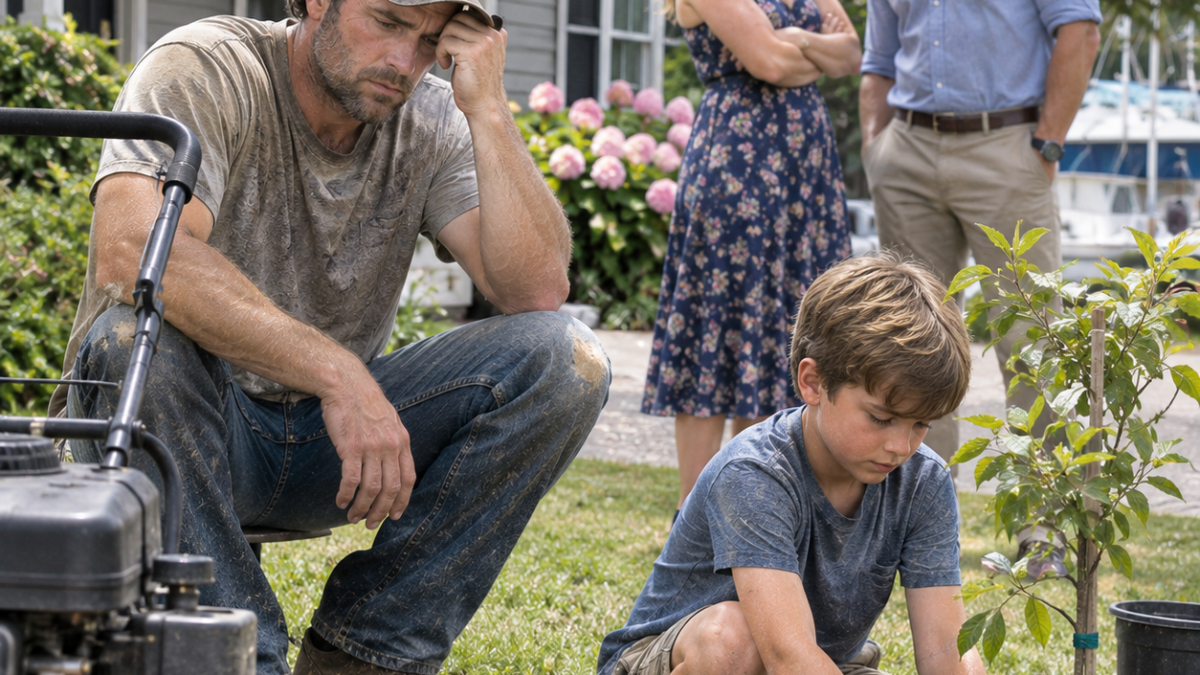
“At Least Travis Is Building Something,” My Wife Said After Admitting She’d Been Sleeping With My Best Friend for Almost a Year. He Offered Me a Job at His Marina While I Mowed Widows’ Lawns to Pay Rent. My Eight-Year-Old Son Had to Plant His Trees in Someone Else’s Yard. Ten Years Later, at Graduation, the Principal Announced a Name They Never Expected.
Part 1:
“Almost a year, Ben.”
My wife said it while standing beside the car in our driveway.
I looked from Courtney to Travis, the man who’d been my best friend for twenty years.
He’d been the best man at our wedding.
He’d held my son the day we brought him home from the hospital.
And now he couldn’t even look me in the eye.
“A year?” I asked.
Courtney folded her arms.
“Almost.”
I turned toward Travis.
“How long have you been coming into my house and pretending nothing was happening?”
“Ben, don’t do this in the driveway.”
I almost laughed.
He was worried about the neighbors.
Not about the marriage he’d helped destroy.
Not about the little boy sleeping upstairs.
Just the possibility that somebody might overhear.
“You were my best man, Trav.”
He rubbed the back of his neck.
“Things happen.”
“Things happen?”
He finally looked at me.
“Courtney wanted more, man. You have to understand that.”
More.
That word would stay with me for years.
My name is Ben Halvorsen. I was thirty-four years old, working maintenance at a Minnesota golf course, earning an honest living and believing I was building a future for my family.
We weren’t rich.
Our house needed repairs.
I drove an old pickup.
And most evenings, I came home smelling like gasoline, fertilizer, and freshly cut grass.
But the mortgage was current.
Our son, Owen, had everything he needed.
And I thought Courtney and I were happy.
Apparently, I was the only one who believed that.
Travis owned a marina on one of the larger lakes outside town.
He wore expensive watches, drove a new truck, and talked constantly about expanding his business.
He’d been my closest friend since we were teenagers.
When he needed help repairing a dock, I showed up.
When he needed someone to haul equipment, he borrowed my trailer.
When his father died, I stood beside him at the funeral.
Now he was standing beside my wife, explaining why she’d chosen him.
Courtney looked toward the garage.
“What are those?”
Two small pine saplings sat in plastic nursery containers beside my pickup.
“Owen’s trees,” I said. “I promised we’d plant them Saturday.”
She sighed.
“Of course you did.”
I stared at her.
Then she said the words that hurt almost as much as the affair.
“That’s your whole life, Ben. You’re always planting things and fixing things for other people. At least Travis is building something.”
I looked at the man beside her.
He gave me a small, uncomfortable smile.
“No hard feelings, buddy.”
I couldn’t speak.
Upstairs, our eight-year-old son was asleep.
And I remember thinking that I didn’t know which man had betrayed me more—the best friend who took my wife or the husband who apparently hadn’t noticed she was leaving.
Six weeks later, the divorce was final.
We sold the house.
Split the proceeds.
And agreed that Owen would spend alternating weeks with each of us.
Courtney moved into Travis’s waterfront home.
I rented a basement apartment with two narrow windows and a ceiling so low I could almost touch it.
I kept my job at the golf course.
Bought secondhand furniture.
And left my half of the house money untouched in a savings account because I had no idea what the future would cost.
The first Friday Owen came to stay, he walked through the apartment without saying much.
He looked at the tiny kitchen.
The folding table.
The couch I’d bought from a neighbor.
Then he pointed toward the two pine saplings sitting in containers beneath the window.
“Dad?”
“Yeah, buddy?”
“Is this where you live now?”
“For now.”
He looked at the trees.
“Can trees live down here?”
I swallowed.
“Not for long.”
“Then where are we going to plant them?”
I didn’t have an answer.
I’d promised my son we’d plant those trees together.
Big Pine for me.
Little Pine for him.
We were supposed to measure them every year and see which grew faster.
Now I didn’t even have a yard.
The following morning, I was returning a borrowed lawnmower to a hardware store when I noticed an elderly woman standing beside her car.
She had one hand on the mower’s handle and the other pressed against her forehead.
I asked whether she needed help.
She looked at me for a long moment.
Then she said, “That was my husband’s mower.”
I waited.
“He died last spring. Forty-one years together. I can’t make myself touch the thing, much less use it.”
I looked toward the mower.
Then toward her.
“I can take care of your grass, ma’am.”
She narrowed her eyes.
“What do you charge?”
I told her twenty dollars.
“It’s twenty-five,” she said firmly. “And don’t argue with an accountant.”
Her name was Agnes Thorsen.
I thought I was helping a widow with an ordinary lawn.
I didn’t know that woman was about to change the way I thought about money, work, and the future I’d lost.
And I certainly didn’t know that one day, when Courtney and Travis were sitting in a crowded graduation auditorium, Agnes would be the only person in the room who understood why hearing my name was going to change everything.
Part 2:
“Almost a year.”
My wife said those three words in the driveway of the house we’d spent eleven years paying for.
I looked at Courtney.
Then I looked at Travis.
He was standing beside his silver pickup, wearing a marina polo shirt and the expensive watch he’d bought after opening his first boat dealership.
For twenty years, Travis Vogel had been my best friend.
He’d stood beside me at my wedding.
He’d helped me move furniture into our first apartment.
He’d held Owen when my son was only a few hours old.
Now he stood beside the woman I’d married, looking irritated that I was making the conversation uncomfortable.
“How long?” I asked again.
Courtney sighed.
“I told you. Almost a year.”
I turned toward Travis.
“And you just kept coming over? Sitting at my table? Talking about football with me?”
“Ben, come on. Don’t do this in the driveway.”
I stared at him.
“You’re worried about where we’re standing?”
He rubbed his jaw.
“I’m saying we should act like adults.”
I wanted to hit him.
I won’t pretend otherwise.
For a moment, I imagined what it would feel like to knock that smug expression off his face.
Then I looked toward the upstairs window.
Owen’s bedroom.
Our eight-year-old son was asleep inside.
Whatever happened next, I didn’t want him waking up to his father being dragged away from the house by police officers.
So I kept my hands at my sides.
Courtney looked toward the garage.
Two small pine saplings stood in plastic pots beside my pickup.
“What are those?”
“Owen’s trees. I promised we’d plant them Saturday.”
She shook her head.
“Of course you did.”
Something about her tone bothered me.
“What’s that supposed to mean?”
She folded her arms.
“That’s your problem, Ben. Your whole life, you’re planting things and fixing things for other people.”
I stared at her.
“You mean working?”
“I mean going nowhere.”
Travis looked down at his boots.
Courtney continued.
“At least Travis is building something.”
There it was.
The comparison she’d apparently been making for months.
I worked maintenance at a golf course outside Brainerd, Minnesota.
I’d been there eight years, starting before sunrise to keep the equipment running and the grounds presentable.
It wasn’t glamorous.
I repaired irrigation lines, maintained mowers, cleared fallen branches, and worked whatever weekends the course needed me.
I came home tired.
Sometimes covered in dirt.
Sometimes smelling like diesel.
But I’d never missed a mortgage payment.
I’d never let Owen go without something he needed.
And I’d never thought honest work was something to be ashamed of.
Travis owned a marina.
Boats, docks, storage slips, repairs, and expensive promises about future expansion.
He always had a story about another investor or another big opportunity.
I’d admired his ambition.
Apparently, Courtney admired it more.
Travis finally spoke.
“No hard feelings, buddy. She wanted more. You’ve got to understand.”
I looked at him.
“I understand enough.”
Then I went inside.
I didn’t slam the door.
I walked upstairs and stood beside Owen’s bed.
He was sleeping with one hand curled beneath his pillow.
On his nightstand was a picture he’d drawn of the three of us standing beside two pine trees.
One tall.
One small.
Both smiling.
I sat on the edge of his bed until my anger became something quieter and much worse.
I wondered which part of my family I’d lost first.
My wife.
My best friend.
Or the version of the future I’d been working toward since Owen was born.
The divorce took six weeks once the paperwork was underway.
Neither of us fought over the furniture.
The biggest decisions concerned the house and Owen.
We sold the property, paid the remaining mortgage and expenses, and divided what was left.
Owen would spend alternating weeks with each parent.
I wanted him full-time.
Courtney wanted the same.
In the end, we agreed to a schedule that would keep him involved with both of us.
Whatever I thought of her choices, she was still his mother.
I wasn’t going to make an eight-year-old boy responsible for choosing between us.
Courtney moved into Travis’s waterfront house.
I rented a basement apartment on the edge of town.
The place had two windows near the ceiling, a narrow kitchen, a small bedroom, and a living room that smelled faintly of old carpet no matter how often I cleaned it.
There wasn’t a yard.
Just a strip of asphalt outside the entrance.
I bought a used couch, a folding table, and a secondhand bed for Owen.
I kept every dollar of my share of the house sale in a separate savings account.
I didn’t know what I’d eventually need it for.
But I knew spending it to feel better wouldn’t change what had happened.
The first Friday Owen stayed with me, he walked around the apartment in silence.
Finally, he stopped in front of the two pine saplings I’d brought from the old house.
“Dad?”
“Yeah, bud?”
“Is this where you live now?”
“For now.”
He studied the small containers.
“Can trees live down here?”
I looked at the narrow windows.
“Not for very long.”
“Then where do they go?”
That question hurt more than anything Courtney had said in the driveway.
Because I didn’t have an answer.
I’d promised we’d plant those trees together.
Big Pine for me.
Little Pine for him.
We were supposed to measure them every spring and see which grew faster.
Now the trees were sitting on a basement floor, and I didn’t even have somewhere to put a shovel into the ground.
The next morning, Owen helped me return a borrowed mower to a hardware store.
I was loading it into a trailer when I noticed an elderly woman standing beside a battered red lawnmower.
She was staring at it like it had personally offended her.
“Can I give you a hand, ma’am?”
She looked up.
“Depends. Are you any good with these things?”
“I work with mowers for a living.”
She touched the handle.
“This belonged to my husband. Forty-one years we were married. Harold died last spring.”
“I’m sorry.”
She nodded.
“I can pay somebody to fix the machine. What I can’t seem to do is take it home and start it myself.”
I understood.
Some things weren’t difficult because they required strength.
They were difficult because of what they reminded you of.
“What’s your name?” I asked.
“Agnes Thorsen. And yours?”
“Ben Halvorsen.”
She pointed toward the mower.
“Think you could take care of my lawn?”
“Sure.”
“What would you charge?”
I considered the small yard she’d described.
“Twenty dollars.”
“Twenty-five,” she said.
I smiled.
“Twenty’s fair.”
“I’m a retired accountant, Mr. Halvorsen. Don’t argue with me about numbers.”
From the passenger seat, Owen giggled.
Agnes looked through the window.
“And who’s that?”
“My son, Owen.”
She leaned toward him.
“Hello, Owen.”
“Hi.”
“Does your father always argue when somebody offers to pay him properly?”
Owen thought about it.
“Sometimes.”
Agnes nodded.
“I suspected as much.”
She handed me her address.
Then she looked at the two pine saplings in the bed of my pickup.
“Those yours?”
“Owen’s. We’re looking for somewhere to plant them.”
She studied the trees.
Then looked toward my son.
“I have a backyard nobody uses. Might be room along the back fence.”
I stared at her.
“You don’t even know us.”
Agnes shrugged.
“Then I suppose we ought to get acquainted.”
That was how I met the woman who would teach me more about building a business than anyone I’d ever worked for.
It started with twenty-five dollars.
And two pine trees that finally had somewhere to grow.
Agnes lived in a small yellow house on the north side of Brainerd.
There was a white porch railing, a narrow flower garden, and a backyard that sloped gently toward an old wooden fence.
Her husband’s lawnmower sat beneath a tarp in the garage.
When Owen and I arrived the following Saturday, she was waiting outside with three glasses of lemonade.
“You’re late,” she announced.
I checked my watch.
“By two minutes.”
“Then it’s a good thing I’m retired.”
Owen laughed.
She took us around the house and showed me the lawn.
It hadn’t been cut properly for several weeks, and the weeds were spreading into the flower beds.
I unloaded the mower.
Agnes watched me inspect the yard before starting.
“Why aren’t you mowing?”
“Checking for rocks and loose branches.”
“Good.”
She folded her arms.
“Harold used to say that most people spend more time fixing damage from rushing than they would’ve spent doing the job carefully.”
“Sounds like Harold knew what he was talking about.”
“He did. Annoyingly often.”
I mowed the lawn, trimmed the edges, and cleaned the clippings off the walkway.
Owen helped by carrying small sticks to a pile near the garage.
When I finished, Agnes handed me twenty-five dollars.
Then she pointed toward the pine saplings.
“Now let’s find somewhere for those boys.”
We carried them to the back fence.
Owen studied the larger one.
“That one’s Dad.”
Agnes smiled.
“Is it?”
“Big Pine.”
He pointed to the smaller sapling.
“And this one’s me. Little Pine.”
“Very good,” she said.
I dug two holes with enough room for the roots to spread.
Owen helped fill them with soil.
Then we watered both trees.
When we finished, he stood between them with his hands on his hips.
“Big Pine and Little Pine.”
“That’s right.”
“Promise we’ll measure them every year?”
I held out my little finger.
“Every year.”
He linked his finger with mine.
“Pinky promise.”
Agnes watched us from the porch.
When Owen ran inside to wash his hands, she came over.
“You know,” she said, “you could do more than one lawn.”
I wiped my hands on my jeans.
“I already work full-time.”
“So?”
“So there are only so many hours in a week.”
She nodded toward the mower.
“How long did my yard take?”
“About forty minutes, including trimming.”
“And I paid you twenty-five dollars.”
“Yes.”
“Now imagine ten yards like mine.”
I looked at her.
“That’s ten different customers, ten different schedules, and a lot of driving.”
She smiled.
“Good. You’ve identified the problems. Now solve them.”
I laughed.
“Agnes, I wasn’t planning to start a business.”
“Neither was I planning to teach an adult man arithmetic on a Saturday.”
She went inside and returned with a notebook.
Then she sat me at her kitchen table.
For an hour, she asked questions.
How much fuel did my equipment use?
How long did it take to load and unload?
What would repairs cost?
Did I have liability insurance?
How much should I reserve for taxes?
How many customers would I need before the work justified its own equipment?
I knew how to maintain a mower.
I didn’t know how to price a lawn business properly.
Agnes did.
She’d spent thirty-two years handling accounts for a regional manufacturing company.
After retirement, she’d helped her church keep its books.
She didn’t pretend to understand everything about landscaping.
But she understood that a business could have plenty of customers and still lose money.
The following Sunday, she introduced me to three widows from her church.
All needed lawn care.
One had a steep backyard she couldn’t manage.
Another had been relying on her nephew, who was moving out of state.
The third simply wanted someone who showed up when promised.
By June, I had five regular customers.
By August, eleven.
Most were older women who’d known Agnes for years.
I worked the golf course during the day and handled lawns after work or on weekends.
When Owen stayed with me, I planned smaller jobs so he could come along.
He wasn’t operating equipment.
He carried water bottles, helped collect light debris, and drew little route maps in the passenger seat.
He liked the idea that we were a team.
At first, I borrowed a trailer.
Then Agnes made me calculate how much time I was losing driving across town to collect it.
“You need your own,” she said.
“I know.”
“Then buy one.”
“That’s a few thousand dollars.”
“Do you have the cash?”
“I do.”
“Then what’s stopping you?”
I looked down at the notebook.
“I don’t know whether this will last.”
Agnes leaned forward.
“Ben, if you need a trailer for work you’re already being paid to do, that’s different from buying one because you think it makes you look successful.”
I thought about Travis.
His new trucks.
His expensive boats.
His constant talk about expansion.
Agnes tapped the notebook.
“Never borrow just to look prosperous. And before you spend anything, make sure you can afford the work that comes after it.”
I paid cash for a used trailer.
It wasn’t pretty.
The paint was scratched, one fender had a dent, and the deck needed new boards.
But it was mine.
And it worked.
The first time I pulled into Agnes’s driveway with it, she came outside smiling.
“Look at that. A man with a trailer.”
“Don’t get too excited.”
“Why not? I enjoy seeing sensible decisions.”
She helped me establish separate business accounts and a simple bookkeeping system.
Then she introduced the rule I would hear for the next decade.
“When money comes in, pay yourself first. Even a little.”
I frowned.
“Shouldn’t the business expenses come first?”
“Necessary expenses, taxes, and obligations have to be covered. I’m talking about making sure your work produces a living for you instead of disappearing into a pile of equipment purchases.”
She wrote three words in my notebook.
PAY YOURSELF FIRST.
Then she added a fourth.
CONSISTENTLY.
I taped that page above my basement desk.
That fall, Courtney married Travis.
They held the ceremony on a pontoon boat at his marina.
Owen was the ring bearer.
I knew because he came home wearing a little navy-blue suit and carrying a bag of wedding favors.
He was excited about the cake and the boat ride.
I let him tell me everything.
Then he said something that made me stop washing the dishes.
“Dad, Travis says you just cut grass.”
I turned.
“What?”
“He said you don’t have a real company. You just cut grass for old ladies.”
I dried my hands.
For a moment, I wanted to call Travis and say things no eight-year-old should ever hear his father say.
Instead, I sat beside Owen.
“Buddy, do you know what I do?”
He nodded.
“You cut grass.”
“That’s right.”
He looked uncertain.
“Is that bad?”
“No. People need their lawns maintained. I get paid for doing work they can’t or don’t want to do.”
He considered that.
“Will you always do that?”
“I don’t know. Maybe I’ll build something bigger.”
He smiled.
“Like Travis?”
I felt the old hurt return.
Then I remembered Agnes’s notebook.
“Maybe something different.”
That evening, after Owen went to bed, I stood in the basement looking at my equipment receipts.
Then I wrote two words across the next page.
WINTER WORK.
In Minnesota, grass doesn’t grow twelve months a year.
I could keep mowing through the summer and fall.
But if I wanted a real business, I needed something that would pay when the snow came.
The next Saturday, I showed Agnes my notebook.
She read it.
Then looked up.
“Finally.”
“What?”
“Now you’re thinking like an owner.”
Agnes didn’t tell me to buy a snowplow.
That would’ve been too easy.
Instead, she asked me what it would cost to operate one.
I spent three evenings gathering figures.
A used plow truck.
Insurance.
Fuel.
Hydraulic repairs.
Replacement cutting edges.
Emergency maintenance.
And the number of driveways I’d need under contract to make the investment worthwhile.
When I brought her the calculations, she read them twice.
“You’ve underestimated repairs,” she said.
“By how much?”
“Enough that you’ll be calling me at three in the morning if something breaks.”
I adjusted the figures.
Then she pointed to the line showing my house-sale savings.
“Still untouched?”
“Every dollar.”
“Then you can afford to buy carefully. But don’t confuse having money with having permission to waste it.”
I found a used plow truck outside St. Cloud.
It was an older three-quarter-ton pickup with a functioning plow, a rusty tailgate, and a heater that worked only after the engine had been running for fifteen minutes.
The seller wanted more than I thought it was worth.
I spent an afternoon inspecting it and paid a mechanic to check the transmission and hydraulics.
We negotiated.
I bought it outright.
When I brought it home, Owen climbed into the passenger seat.
“Dad, this thing is awesome.”
I laughed.
“It has two hundred thousand miles on it.”
“Can it push snow?”
“That’s the idea.”
“Then it’s awesome.”
He was right.
The first winter was exhausting.
I’d finish an afternoon at the golf course, sleep for a few hours, then wake when snow began falling.
Some nights I was out from midnight until dawn.
Other times, I’d clear driveways before starting my regular shift.
I learned quickly that snow removal wasn’t simply mowing lawns with different equipment.
People needed their driveways cleared before work.
Medical appointments couldn’t always wait.
A missed commercial lot could create safety problems.
And when a truck broke down during a storm, the schedule didn’t politely pause until it was fixed.
I kept spare hydraulic hoses, fittings, and tools behind the seat.
At first, that seemed like excessive caution.
Then a hose failed at 4:08 one January morning.
I was halfway through a driveway when hydraulic fluid began leaking beneath the plow.
I pulled off safely, shut the system down, and replaced the damaged hose in the bitter cold.
My hands were stiff by the time I finished.
But I got the truck moving again.
An hour later, I cleared the next driveway before its owner left for work.
She was a nurse named Linda Pruitt.
Linda worked at a dialysis clinic in Brainerd.
She was standing outside in a dark coat when I pulled in.
“You’re still out here?” she called.
“Almost done.”
She looked toward the old truck.
“That machine sounds like it’s coming apart.”
“It’s just complaining.”
She smiled.
“I’m due at the clinic at six.”
“You’ll be out before five-thirty.”
She glanced at the repaired hose.
“Are you sure?”
“I carry spares.”
I finished clearing her driveway and made sure the area beside her car was safe.
When she offered to pay extra for the early service, I refused.
“You’re getting to patients. That’s more important than an extra twenty dollars.”
She gave me a thoughtful look.
“You always talk like that?”
“Only when I’m freezing.”
She laughed.
Then she drove away.
Two winters passed.
I continued mowing in summer and plowing in winter.
The money improved.
Not dramatically.
Not overnight.
But steadily.
I added commercial insurance appropriate for the work, refined my contracts, and learned which customers were worth retaining.
Some homeowners wanted perfect service at impossible prices.
Others paid on time and treated me like a professional.
I stopped chasing the first group.
Agnes approved.
“You’re not in business to win every argument,” she told me. “You’re in business to do good work at a price that keeps you operating.”
Owen and I measured the pines every spring.
One year, Big Pine was nineteen inches tall.
Little Pine was sixteen.
He looked offended.
“I’m losing.”
I grinned.
“You’re just getting started.”
Agnes recorded the measurements in a notebook she kept beside the kitchen telephone.
She drew a star next to Owen’s name whenever he made an improvement that particularly pleased her.
The trees were no longer simply ours.
They belonged to a little ritual the three of us shared.
We mowed Agnes’s lawn.
Had lemonade.
Measured the pines.
And argued about whether Little Pine might eventually catch Big Pine.
One February night, Linda called me at 3:47.
I was sitting in the truck eating a sandwich between jobs.
“Ben?”
“Morning, Linda.”
“It’s not a good morning.”
I sat upright.
“What’s wrong?”
“Our plow company hasn’t shown up. The clinic entrance is buried, and one of our overnight technicians slipped near the door.”
“Is he hurt?”
“Bruised, but he’ll be all right. Patients start arriving before six.”
I checked my location.
“I’m about twenty minutes away.”
“Can you help?”
“I’m on my way.”
I arrived before four-thirty.
Snow had accumulated across the parking lot, and the access lane was difficult to see.
I cleared the primary entrance, the patient drop-off area, and the accessible parking spaces first.
Then I worked through the rest of the lot, carefully avoiding the curbs and drainage grates.
By the time the first patients arrived, there was a safe route to the building.
Linda met me outside.
Her eyes were tired.
“Ben, you saved us a terrible morning.”
“Glad I could help.”
“What do I owe you?”
“Whatever you would’ve paid the company that didn’t show.”
She shook her head.
“I’m not hiring them again.”
I shrugged.
“That’s between you and them.”
“No. I’m serious. We need someone who comes every time there’s a storm.”
I looked at the clinic.
Cars were pulling into the lot.
An elderly man was helping his wife from the passenger seat.
A nurse stood near the entrance.
People depended on that building being accessible.
Linda continued.
“Could you take the contract?”
I thought about my work schedule.
My aging truck.
The miles I was already driving.
Then I remembered what Agnes had said about solving problems before accepting work.
“Let me review the site’s needs and figure out how to provide backup coverage.”
Linda nodded.
“That’s exactly the kind of answer I wanted.”
The clinic became my first significant commercial account.
I didn’t win it by submitting the lowest bid.
I won it because Linda had seen me show up when another company didn’t.
When I told Agnes, she smiled.
“Homeowners remember when you cut their grass.”
She tapped the signed agreement.
“A medical clinic remembers when its doors can open on time.”
I studied the contract.
Then looked at her.
“This could change things.”
“It could,” she said. “If you handle it responsibly.”
Within another year, the lawns and snow work were bringing in enough steady revenue to rival my golf-course wages.
I showed Agnes the books.
She examined the income, expenses, taxes, and cash reserves.
Then she asked whether I was ready to leave my job.
I nodded.
“I think so.”
“Four months of living expenses set aside?”
“Yes.”
“Separate emergency money for the business?”
“Yes.”
“Insurance?”
“Current.”
“Backup equipment arrangements?”
“Covered.”
She closed the notebook.
“Well.”
I waited.
She smiled.
“Look at you.”
The next morning, I handed in my two weeks’ notice at the golf course.
My supervisor glanced at the letter.
“Eight years, huh?”
“Eight.”
He leaned back.
“Well, good luck with the lawn thing.”
I extended my hand.
“Thanks.”
He looked at the letter again.
“Ben, right?”
I nodded.
“Ben.”
I left without arguing.
For years, I’d been a reliable employee.
Now I was leaving to build something of my own.
I didn’t need him to understand it.
I only needed to do the work.
Quitting the golf course was the first decision I’d made in years that felt entirely mine.
The divorce had happened to me.
Selling the house had been necessary.
Moving into the basement apartment had been a compromise.
Even buying the plow truck was partly a response to needing enough income to remain a stable parent.
But handing in that resignation letter was different.
I wasn’t running away from something.
I was choosing what to build.
The first morning after my final shift, I woke at four-thirty out of habit.
For a moment, I reached for the old golf-course uniform.
Then I remembered.
I didn’t have to report to anybody else’s maintenance shop.
I made coffee, opened my notebook, and reviewed the day’s route.
Eleven residential properties.
Three scheduled estimates.
A meeting with a commercial property manager.
And a stack of invoices that needed to be sent.
I worked until nearly seven that evening.
When I got home, Owen was waiting at the apartment with a drawing.
It showed a green truck with a plow on the front and a pine tree painted on the door.
“What’s that?” I asked.
“Your company.”
I sat beside him.
“I don’t have a company name yet.”
He looked at me as though I’d overlooked something obvious.
“Little Pine.”
I smiled.
“Little Pine?”
“Because Big Pine is you and Little Pine is me. We’re a team.”
I studied the drawing.
Then I looked at my son.
“Little Pine Lawn & Snow.”
Owen nodded enthusiastically.
“That’s it.”
The following week, I registered the business name and ordered simple green decals for the trucks.
I kept Owen’s original drawing.
It went into a frame above the desk.
I wanted him to know that even though our family had changed, the things we’d promised each other still mattered.
Business grew in small steps.
A homeowner recommended me to his employer.
A medical office referred me to another clinic.
A church needed year-round grounds maintenance.
I learned how to estimate commercial work properly, how to plan routes that reduced unnecessary driving, and how to explain clearly what was included in a contract.
The first time I hired someone, I was nervous.
His name was Andre Bennett.
He arrived for an interview forty minutes early during a blizzard.
I found him standing beside my truck in the snow, wearing work boots and carrying a thermos.
“You’re early,” I said.
He shrugged.
“Didn’t want the roads making me late.”
I looked at him.
“You know anything about plowing?”
“Worked with my uncle’s company for three winters. Can do basic maintenance, too.”
I asked him several questions.
Then I showed him the truck.
He noticed a worn cutting edge without being prompted.
I hired him.
Andre became the kind of employee who made a growing business possible.
He arrived when he said he would.
Took care of equipment.
Admitted mistakes instead of hiding them.
And treated every customer like somebody whose time mattered.
When I told Agnes about him, she nodded.
“Then pay him well enough to want to stay.”
I laughed.
“You make everything sound simple.”
“Simple doesn’t mean easy, Ben.”
Within another year, Little Pine operated three green trucks and maintained fourteen commercial properties alongside its residential work.
I was still doing much of the driving.
Still checking equipment late at night.
Still answering customer calls.
But I was no longer responsible for every task.
Andre supervised one route.
Another experienced driver handled a second.
I learned to trust people instead of trying to personally rescue every schedule.
Then Linda Pruitt called.
She’d left the dialysis clinic after years of early mornings and administrative emergencies.
When she heard I was searching for office help, she asked whether I would consider hiring her.
I nearly laughed.
“Linda, you know I can’t match what a medical clinic paid.”
“I’m not asking you to.”
“Then why would you want this job?”
“Because I’ve spent years watching you solve problems instead of making excuses. And because your invoices are a mess.”
She wasn’t wrong.
Linda joined us part-time, then full-time as the business grew.
She organized scheduling, contracts, customer records, and receivables.
I told her Agnes had taught me everything I knew about the financial side.
Linda asked to meet her.
Within ten minutes of their introduction, the two women were discussing my shortcomings as though I weren’t standing beside them.
“Too generous with emergency calls,” Agnes said.
“Terrible at billing promptly,” Linda replied.
“He buys equipment only when the old stuff is practically begging for retirement.”
“That’s better than the opposite.”
Agnes nodded.
“True. We’ll keep him.”
I stood there holding a box of paperwork.
“Glad everyone approves.”
They ignored me.
It was the beginning of a partnership I would come to depend on.
Around that time, I bought a small rambler on the edge of town.
Two bedrooms.
A detached garage.
And, most importantly, a backyard.
Owen was twelve.
He helped me move into it.
The first evening, we stood in the empty yard with two folding chairs and a pizza box between us.
“Dad, we have a yard now.”
“Sure do.”
He looked toward the fence.
“Do Big Pine and Little Pine come here?”
I thought about Agnes.
She’d watered those trees during weeks when Owen couldn’t visit.
She’d protected them during lawn renovations.
And she’d recorded their measurements in her notebook every spring.
“Let’s ask Agnes what she thinks.”
Owen smiled.
“Okay.”
When we told her, she looked horrified.
“Move my trees?”
I laughed.
“Your trees?”
“Of course. I’ve been supervising their education for years.”
Owen grinned.
I looked toward the back fence, where both pines had grown tall enough to cast small shadows.
“Then maybe they stay here.”
Agnes nodded firmly.
“Until they decide otherwise.”
We kept measuring them every spring.
Some years, Owen wanted photographs from exactly the same angle.
Other years, he measured twice because he insisted Little Pine had grown more than I claimed.
The ritual survived the divorce, the basement apartment, the golf course, and the growth of the business.
It became one of the few things in our lives that never changed.
One summer afternoon, I stopped at Travis’s marina to pick up Owen.
Courtney had asked me to collect him there after a family outing.
Travis came down the dock wearing a new polo shirt with the marina’s logo embroidered across the chest.
“Ben! Heard you quit the golf course.”
“That’s right.”
He looked at my old pickup.
“For this?”
“For Little Pine.”
He smiled.
“Second location breaks ground next spring. Two marinas now.”
“Congratulations.”
He leaned against the railing.
“You ever think about a real job? I could put you on the docks. Benefits, regular paycheck, the whole deal.”
I looked at him.
The man who’d helped destroy my marriage was offering to employ me.
As though I ought to be grateful.
“Thanks, Travis. I’m doing fine.”
He laughed.
“Owen talks about your little company like it’s a real business.”
“It is a real business.”
“Sure, buddy. Offer stands.”
I nodded.
“Take care.”
Then I drove home with Owen.
At a stoplight, my son looked over.
“Dad?”
“Yeah?”
“Are we doing okay?”
I glanced at him.
“Why?”
“Because Travis says running your own company is risky.”
I thought about Agnes’s lessons.
The reserve account.
The equipment.
The customers.
The people depending on us.
“Running a company is risky,” I said. “That’s why you have to know what you’re doing.”
Owen considered that.
“Do you?”
I smiled.
“I’m learning.”
He looked toward the Little Pine decal on the truck door.
Then nodded.
“Good. Because I think we’re going to be big.”
I laughed.
“Let’s get through tomorrow first.”
But I kept his words with me.
I had no interest in proving Travis wrong.
I wanted to build something that would still be there when Owen was grown.
And that required a kind of success that didn’t fit neatly into the price of a truck or the size of a marina.
By the time Owen turned fourteen, Little Pine had eighteen employees during its busiest seasons.
We maintained commercial lots, residential properties, and several medical facilities across the county.
Our green trucks became familiar sights on winter mornings.
We were still a small company compared with the regional contractors bidding on shopping centers and industrial sites.
But we had steady customers, dependable employees, and enough work to support families besides my own.
Owen began spending part of his summer vacation with the crew.
He wasn’t allowed to operate dangerous equipment.
Andre taught him basic maintenance, job-site safety, and how to document completed work.
Linda showed him how to enter invoices and track hours.
He complained that paperwork was boring.
She told him every business owner eventually learned to respect paperwork.
I smiled because Agnes had said almost the same thing years earlier.
Then came the winter without snow.
Not literally without a single flake.
There were a few light dustings.
But nothing close to the regular storms we’d planned for.
That year, too many of our contracts billed by the actual plowing visit.
No storm meant no plowing.
No plowing meant no invoices.
By February, Linda and I were staring at a projected seasonal revenue shortfall of approximately $110,000.
I checked the figures myself.
Then checked them again.
The numbers didn’t improve.
“What’s our exposure?” I asked.
Linda turned her laptop toward me.
“If we continue at the current staffing level, use the cash reserve, and don’t add other work, we can get through the season. But spring will be tight.”
“What if we reduce the crew?”
She was quiet.
Then she opened another spreadsheet.
“Laying off nine seasonal employees would protect most of the operating cash.”
Nine people.
Nine households that depended on our paychecks.
I looked at the names.
Andre had just bought a house.
One of our drivers had two children in elementary school.
Another had been with us since the early commercial contracts.
I understood that a business couldn’t guarantee employment it had no money to support.
I’d seen companies disappear because owners refused to confront financial reality.
But Agnes had taught me to prepare for bad years precisely so I wouldn’t have to make desperate decisions when they arrived.
I took the numbers to her.
She’d turned eighty-two that winter and was moving more slowly, but her mind remained as sharp as ever.
We sat at her kitchen table.
I explained the revenue problem.
She listened.
Then asked one question.
“How much is in the reserve?”
I told her.
She nodded.
“And what’s it there for?”
“Emergencies.”
She looked at me.
“Ben, this sounds like one.”
“I could save most of it by letting nine people go.”
“Then why are you calling me?”
I looked down.
“Because I don’t want to.”
She took off her glasses.
“Of course you don’t.”
I stared at the list.
“We could be fine by April if I cut the crew in half.”
“And what happens next November when you need them back?”
“I’d have to rehire.”
“Would they come?”
I didn’t answer.
Agnes leaned forward.
“I didn’t make you save that money so you could admire the balance during the good years. I made you save it for a season like this.”
I rubbed my forehead.
“You’re telling me to keep everybody?”
“I’m telling you to find work, look at the numbers honestly, and use the cushion you built for the reason you built it. If the arithmetic says you can’t, then you make hard choices. But don’t start by assuming people are disposable.”
That night, I barely slept.
At six the next morning, I met with Linda and Andre.
We studied every service we could offer using the people, training, and equipment we already had.
Tree trimming within our crew’s qualifications.
Winter debris removal.
Storm cleanup.
Hauling.
Seasonal landscape preparation.
Taking down holiday lighting.
Facility maintenance tasks we could perform safely and legally.
Then we contacted customers.
By the end of the week, the schedule looked different.
Less plowing.
More outdoor maintenance.
Not as profitable as a normal winter.
But it was work.
We used much of the reserve.
Opened a modest line of credit for working capital.
And kept all eighteen employees on the payroll.
At a crew meeting, Andre asked whether layoffs were coming.
I looked at the faces around the room.
“No.”
Somebody exhaled loudly.
I continued.
“We’re going to do different work this winter. Some of it won’t be glamorous. But we’re going to keep the trucks moving and the paychecks coming.”
Andre looked at me.
“All of us?”
“All of us.”
He nodded.
“Then tell us where to start.”
We finished the winter tired and financially bruised.
By June, we’d repaid the credit line.
We hadn’t made much money during those months.
But nobody had lost a paycheck simply because the weather failed to cooperate.
That summer, I changed how we structured future commercial snow agreements.
Instead of relying so heavily on payment per push, we offered appropriately priced seasonal service contracts that spread weather risk more predictably.
Some customers declined.
Others appreciated knowing their costs in advance.
The change didn’t eliminate business risk.
But it meant a warm winter wouldn’t automatically threaten every job.
When I showed Agnes the revised contracts, she smiled.
“Look at that.”
“What?”
“You finally learned that a business survives by preparing for years that don’t go according to plan.”
I laughed.
“I thought you’d already taught me that.”
“I did. But you had to live through one before you believed it.”
That spring, Travis’s second marina changed ownership.
His expansion had depended heavily on loans.
Interest rates had risen, and demand for recreational boats had softened.
The business couldn’t support its debt.
Vogel Marine was sold to a national chain.
Travis stayed on in sales.
I heard the news from Owen.
“Travis is okay,” he told me. “Just quieter now.”
I nodded.
I didn’t celebrate.
I’d spent years being dismissed by Travis for doing simple work and avoiding unnecessary debt.
But I knew what it meant to watch a future collapse.
I’d been there.
His failure didn’t make my life better.
My work did.
The following year, Agnes moved into a senior living community.
She was eighty-three and tired of maintaining a house alone.
She insisted the decision was hers, not anybody else’s.
“I’ve spent enough years cleaning gutters,” she told me. “Someone else can have the pleasure.”
Little Pine continued maintaining her old property for the new owners.
They were a young couple with two children.
When I explained the story of the pines along the back fence, they said Owen and I could continue visiting every spring to measure them.
Agnes approved the arrangement.
“Those boys have grown up together,” she said. “No reason to interrupt their education now.”
We still visited her.
Owen brought photographs of the trees, and she recorded the measurements in the same notebook she’d been keeping for years.
By the time he was seventeen, he’d grown taller than me.
Agnes liked reminding him of that.
“Big Pine’s lost his title,” she’d say.
Owen grinned.
“Not in the backyard.”
“Give Little Pine time.”
She became a grandmother to him in all the ways that mattered.
She attended his school events when she could.
Sent him birthday cards.
And insisted he call if he had questions about money.
He usually called Linda first about business problems.
Then he called Agnes to find out whether Linda was right.
Agnes loved that.
Meanwhile, Little Pine kept growing.
We added another hospital contract and expanded into additional medical and commercial properties.
By Owen’s senior year, our crews maintained roughly 150 buildings and sites across the county.
During peak seasons, we employed sixty-one people.
Two hospitals depended on us for grounds and winter services.
So did a dozen clinics.
Our trucks worked before dawn, clearing parking lots and walkways so employees, patients, and visitors could reach buildings safely.
I still drove the original plow truck when it made sense.
I’d rebuilt enough of it over the years that Andre jokingly called it a family heirloom.
It wasn’t the nicest vehicle in the fleet.
But I knew every sound it made.
And whenever I drove it, I remembered those early winters when Owen sat in the passenger seat drawing little pine trees on scraps of paper.
One autumn morning, I stopped at the former Vogel Marine property to check a newly awarded maintenance contract.
The national chain that had bought the business had hired Little Pine to handle grounds care and winter service.
Travis was standing beside the loading area.
He recognized my old truck.
“Ben?”
I climbed out.
“Morning, Travis.”
He looked toward the plow.
“All these years, and you’re still pushing snow?”
“Still pushing snow.”
He glanced at the building.
“Corporate gave the maintenance contract to some outfit called Little Pine. I guess you’re working for them now.”
I considered correcting him.
Then decided it didn’t matter.
“Something like that.”
He smiled.
“Well, good for you, buddy.”
I asked whether the delivery entrance needed extra clearance before the week’s scheduled boat shipments.
He gave me the details.
We shook hands.
Then I drove away.
The funny thing was, I wasn’t hiding the business.
Our trucks had the company name on the doors.
The contracts carried my signature.
Our website included my name as founder.
People in town knew who owned Little Pine.
Courtney and Travis had simply never asked.
They’d made up their minds about me years earlier, and nothing they’d seen since had persuaded them to reconsider.
I had stopped needing them to.
Halfway through Owen’s senior year, his high-school principal called.
Her name was Dr. Margaret Ellis.
When Linda told me she’d requested a meeting, I assumed Owen was in trouble.
I drove to the school expecting to hear about missing homework or some teenage mistake.
Instead, Dr. Ellis offered me coffee.
“Mr. Halvorsen, your son’s doing fine.”
I relaxed.
“Good. You had me worried.”
She smiled.
“I wanted to talk about something else.”
For seven winters, Little Pine had maintained the district’s school grounds and winter access areas under its facilities contracts.
The principal explained that the staff had come to rely on the crews.
Our work wasn’t glamorous.
Most students never saw the trucks arrive before sunrise.
But the parking lots were ready, the walkways were safe, and the buses could get through.
“Your people are dependable,” she said.
I smiled.
“That’s Andre’s work as much as mine.”
“Then please thank him.”
She paused.
“Every June, I watch students graduate who don’t intend to attend a traditional four-year college.”
I nodded.
“Nothing wrong with that.”
“I agree. But some of them have been told otherwise their whole lives.”
She leaned forward.
“They want to become electricians, diesel technicians, welders, mechanics, and skilled tradespeople. They want to build things with their hands.”
I thought about my first years at the golf course.
About Travis offering me a “real job.”
About Courtney saying I wasn’t building anything.
Dr. Ellis continued.
“I’d like to establish a scholarship for one graduating senior entering a skilled trade. I wondered whether Little Pine might help fund it.”
I didn’t answer immediately.
Then I asked how much she needed.
“Five thousand dollars annually would make a meaningful difference.”
I considered the company’s finances.
We could afford it.
But I also understood that donating money to a school district that purchased services from my business required care.
“I’ll do it under three conditions,” I said.
Dr. Ellis nodded.
“Go ahead.”
“The district approves and administers the scholarship separately from our maintenance contracts. I don’t participate in selecting the recipient. And my son isn’t eligible.”
She smiled.
“Agreed.”
I leaned back.
“Then let’s do it.”
She made a note.
“What should we call the scholarship?”
“The Little Pine Scholarship.”
“That’s a lovely name. Where did it come from?”
I looked through the office window toward the school parking lot.
Then I told her about the basement apartment.
The two pine saplings.
The elderly widow who offered us space in her backyard.
And the boy who called the smaller tree Little Pine because he wanted to build something with his father.
Dr. Ellis listened without interrupting.
When I finished, her eyes were wet.
“Would you mind sending me that story in writing?”
“Why?”
“For our records. I think it deserves to be remembered.”
I sent it that evening.
Then I forgot about it.
There was work to do.
Spring contracts to prepare.
Equipment to service.
Employees to schedule.
And a son who was about to graduate.
Owen had decided to study construction management.
He wanted to understand projects from estimating and design coordination through completion.
When I asked why, he grinned.
“Somebody in this family should understand the paperwork.”
I laughed.
“I understand paperwork.”
“Dad, Linda understands your paperwork.”
I couldn’t argue.
Graduation arrived on a bright June afternoon.
The school auditorium was packed.
Parents carried cameras.
Grandparents waved programs.
Students in caps and gowns whispered to one another while teachers tried to keep the ceremony moving.
I arrived early with Agnes.
She was eighty-six now and walked with a cane.
I offered her my arm.
She took it.
“Look at all these children,” she said when we entered.
“They’re graduating seniors, Agnes.”
“Everybody’s a child when you’re eighty-six.”
We found seats near the front.
Courtney and Travis sat several rows away.
Courtney saw us and waved politely.
Things between us had become easier over the years.
We weren’t friends.
But we could talk about Owen without arguing.
Travis nodded toward me.
I nodded back.
The ceremony began.
Speeches.
Awards.
Recognition for academic achievement, athletics, and community service.
Then Dr. Ellis returned to the microphone.
“This year,” she announced, “our district is introducing a scholarship for a graduating senior entering the skilled trades.”
I smiled.
Agnes squeezed my hand.
Dr. Ellis continued.
“For seven winters, before our first school buses arrived, the parking lots and walkways of this district were cleared by a local company whose work many of our students never noticed.”
She looked across the auditorium.
“That same company now maintains two hospitals, a dozen clinics, and approximately 150 sites throughout our county. At the height of its busy season, it employs sixty-one people.”
I heard someone behind me whisper.
“Little Pine. Those green trucks.”
Dr. Ellis nodded.
“Beginning this year, that company will provide a five-thousand-dollar annual scholarship to a graduate pursuing a skilled trade.”
The name appeared on the screen.
THE LITTLE PINE SCHOLARSHIP.
A few people applauded.
Then Dr. Ellis smiled.
“I asked the founder where that name came from.”
I looked down.
Agnes was grinning.
Ten years earlier, I would’ve been terrified at the thought of people knowing how far I’d fallen.
Now I simply felt embarrassed by the attention.
Dr. Ellis continued.
“A decade ago, a father and his eight-year-old son were living in a basement apartment after a painful family separation. They had two little pine trees, but no yard in which to plant them.”
The auditorium became quiet.
“An elderly neighbor gave them a place along her back fence. They named the trees Big Pine and Little Pine.”
I looked toward Agnes.
She had tears running down her cheeks.
“That father promised his son they’d measure the trees every spring.”
Dr. Ellis paused.
“He kept the promise. And eventually, he named the company he built after the smaller tree.”
I heard a chair move behind me.
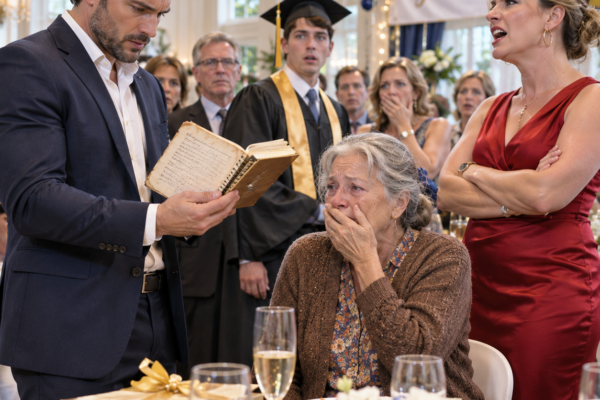
Then Dr. Ellis said, “Would the founder of Little Pine, Mr. Ben Halvorsen, please come forward to help present the first scholarship?”
For a moment, I didn’t move.
Agnes poked my arm.
“Go on, dear.”
I stood.
Applause began around me.
I looked briefly toward Courtney.
She was staring at the stage.
Travis had stopped clapping.
Both seemed to be trying to reconcile what they’d just heard with the man they’d known for years.
I walked to the front.
Dr. Ellis shook my hand.
Then she introduced the scholarship recipient.
“Isaiah Banks, who will be studying diesel technology.”
A young man stepped forward.
He looked nervous.
I shook his hand and handed him the certificate.
“Go build something, Isaiah.”
He smiled.
“Yes, sir. Thank you.”
The audience applauded.
I returned to my seat as quickly as I could.
Agnes leaned toward me.
“About time somebody said it out loud.”
I laughed softly.
“You knew.”
“Of course I knew. I’ve been doing your books in one form or another since you had eleven lawns and a trailer with a hole in the deck.”
When the ceremony ended, families gathered outside.
Owen found us first.
He hugged Agnes.
Then me.
“Dad, that was incredible.”
“You knew about this?”
He grinned.
“Maybe a little.”
I shook my head.
Then Courtney approached.
Her eyes were red.
“Ben.”
“Hi, Courtney.”
She looked toward the Little Pine logo on Owen’s summer work jacket.
“I knew those trucks. They worked at the school, the clinic, all over town.”
I nodded.
She swallowed.
“I thought you worked for them.”
“I own the company.”
“I know that now.”
She looked down.
“Owen wore that logo every summer. He talked about the work. I just never put it together.”
I didn’t know what to say.
Then Courtney looked at me.
“Congratulations. For what it’s worth, I got a lot of things wrong.”
I thought about our driveway ten years earlier.
The affair.
The humiliation.
The words she’d said about me never building anything.
I could’ve repeated every one of them.
Instead, I looked toward Owen.
He was laughing with Agnes beside the auditorium doors.
“Thank you,” I said.
Courtney nodded.
Then stepped aside.
Travis came over a moment later.
For once, he didn’t have a joke ready.
“Ben. That’s quite a business you’ve got.”
“It’s been good to us.”
He glanced toward the parking lot.
“All those years, I thought you were just mowing lawns.”
I smiled slightly.
“I was.”
He looked confused.
I continued.
“Then I kept doing it. Better. More carefully. With good people. That’s how it grew.”
He nodded slowly.
“Well. Congratulations.”
“Thanks, Travis.”
We shook hands.
I didn’t need to remind him that he’d once offered me a job at his marina.
He remembered.
I could see it.
But that day wasn’t about making him feel small.
It was about my son.
And the promise we’d kept.
Later that afternoon, we drove Agnes home, then took Owen to see the pines.
The new owners had left the gate unlocked for us.
Big Pine and Little Pine stood along the back fence, taller and fuller than the little saplings we’d planted ten years earlier.
Owen carried the measuring tape.
“Ready, Dad?”
“Ready.”
He measured Big Pine first.
Then Little Pine.
Agnes sat in a garden chair and made him read the figures twice.
When we finished, she announced that Little Pine was still winning by her preferred measure.
Owen laughed.
“You say that every year.”
“And every year, I’m right.”
I looked at the trees.
Ten years earlier, I’d stood beside them in a basement apartment, wondering whether I had anything left to offer my son.
Now he was graduating.
I had a home.
A business that supported dozens of families.
And people around me who’d helped build something lasting.
Owen put the measuring tape away.
Then he looked at me.
“Mom used to say you spent your whole life planting things for other people.”
I nodded.
“She did.”
He glanced toward the two pines.
“She was right, you know.”
I looked at him.
He smiled.
“That’s the whole point.”
For a moment, I couldn’t speak.
I thought about Agnes standing beside Harold’s old mower.
Linda needing a safe parking lot before her patients arrived.
Andre showing up early in a blizzard.
The eighteen employees we’d kept working through the winter without snow.
The scholarship recipient standing on a stage with a future in front of him.
And the little boy who’d once asked whether trees could live in a basement.
I’d spent ten years thinking I was rebuilding my life.
But standing in that backyard, I finally understood something.
The trees had never been a reminder of what I’d lost.
They’d been a promise about what I still intended to grow.
I put my arm around Owen’s shoulders.
“Come on, bud. Let’s get Agnes home before she starts charging us for overtime.”
Agnes stood immediately.
“I heard that.”
We laughed.
Then we walked toward the house together.
Behind us, Big Pine and Little Pine moved gently in the June breeze.
They’d been growing all along.
So had we.