“Your Millionaire Mother Has Been Begging for Rice for Seven Months,” the Shopkeeper Told Me When I Returned From Dubai. I’d Sent Mom $3,000 Every Month for Three Years. Yet Her Pantry Was Padlocked, Her Sewing Machine Was Gone, and My Wife Was Throwing a Lavish Graduation Party. I Stayed Quiet Until the Toast—Then Opened Mom’s Notebook…k
“Your Millionaire Mother Has Been Begging for Rice for Seven Months,” the Shopkeeper Told Me When I Returned From Dubai. I’d Sent Mom $3,000 Every Month for Three Years. Yet Her Pantry Was Padlocked, Her Sewing Machine Was Gone, and My Wife Was Throwing a Lavish Graduation Party. I Stayed Quiet Until the Toast—Then Opened Mom’s Notebook…
Part 1:
“Well, there she is. The millionaire’s mama, begging for rice on credit again.”
I heard those words outside a small grocery store on Pecan Lane, less than an hour after returning home from Dubai.
An older woman stood at the counter, clutching a worn handbag and looking down at a one-pound bag of rice.
Her dress hung loosely from her shoulders.
Her gray hair was untidy.
And when she reached for the bag, her hand trembled so badly that the shopkeeper steadied it for her.
It was my mother.
Loretta Whitlock.
Seventy years old.
The woman who had worked through the night sewing wedding dresses so I could finish school.
And apparently, she couldn’t afford a pound of rice.
“Thursday, Opal,” Mom whispered. “I’ll pay everything Thursday. I promise.”
Before the shopkeeper could answer, another woman laughed.
“Imagine having a millionaire son and still asking people for charity.”
My mother lowered her head.
I stepped inside.
“She doesn’t owe you a dime.”
Both women turned.
Mom looked at me as though I were a ghost.
“Dalton?”
I barely recognized her.
I had last seen her in person eight months earlier, during a brief visit home.
She’d been thinner then, but nothing like this.
“Hi, Mama.”
She tried to smile.
“Oh, baby. You didn’t tell me you were coming.”
I wrapped my arms around her.
She felt frighteningly small.
My name is Dalton Whitlock. I’m forty-seven, and for the past three years I’d been working in Dubai, helping develop an international logistics business.
The company had finally become successful enough that people back home had started calling me a millionaire.
I didn’t particularly care about the title.
What mattered was that my family would never again have to struggle the way Mom and I had when I was a boy.
Every month, without fail, I sent $3,000 for my mother’s expenses.
Thirty-six months.
One hundred eight thousand dollars.
I believed she had everything she needed.
My wife, Celeste, assured me she was taking care of her.
Whenever I asked about Mom, Celeste said she was eating well, receiving her medication, and enjoying a quiet retirement.
But there she stood, asking a shopkeeper to extend her grocery credit until Thursday.
Opal Grimes, who owned the store, waited until Mom stepped outside.
Then she caught my sleeve.
“Dalton, there’s something you need to know.”
“What?”
“Your mother has been buying rice on credit for seven months.”
I stared at her.
“That isn’t possible.”
Opal’s expression hardened.
“Then somebody needs to explain why she’s going hungry.”
“She gets three thousand dollars a month.”
Opal looked genuinely shocked.
“She doesn’t seem to know that.”
Then she leaned closer.
“There’s a padlock on her pantry, son.”
I felt the blood leave my face.
“A what?”
“A padlock. Somebody’s been keeping her food locked away.”
I turned toward the door.
Opal caught my arm.
“Don’t confront your wife just yet. Your mama is terrified of making trouble.”
I stood completely still.
“Celeste did this?”
Opal didn’t answer directly.
“Go see for yourself.”
I took Mom home.
Her little house looked almost exactly as I remembered it, except the kitchen seemed emptier.
No fruit on the counter.
No bread in the basket.
No food waiting on the stove.
Then I saw the pantry.
A heavy metal padlock hung from the door.
I stared at it.
“Mama, why is that locked?”
She looked embarrassed.
“Oh, Celeste says the mice were getting in.”
“Mice?”
“She keeps the key. Says it’s safer.”
I looked at my mother.
“Why doesn’t she leave you a key?”
Mom folded her hands.
“She says I eat at strange hours. It isn’t good for me.”
I swallowed.
“Mama, how much money do you get each month?”
She frowned.
“A little, when Celeste has some to spare.”
I felt something inside me break.
“I send you three thousand dollars every month.”
Mom blinked.
“How much?”
“Three thousand. On the first. For three years.”
She stared at me.
Then her eyes filled with tears.
“Celeste told me business was hard overseas. She said you sent what you could.”
I looked toward the pantry.
“Where’s your medicine?”
“There’s nothing right now, baby. I’ll be all right.”
Her forehead was hot.
She had a fever.
And her refrigerator held little more than water and a container of yesterday’s rice.
I drove to Opal’s store, bought groceries and medicine appropriate for her symptoms after speaking with a pharmacist, and returned to cook her a proper meal.
Mom ate slowly at first.
Then with the urgency of someone who hadn’t had enough food in a long time.
I sat beside her.
She apologized twice for being hungry.
I wanted to scream.
Instead, I said, “You don’t have to apologize for eating in your own house.”
That afternoon, while Mom slept, I found a notebook beneath her mattress.
The first page said:
So I won’t forget. Because later, she tells me I imagined it.
I turned the pages.
Mom had recorded dates, times, and small humiliations.
The day Celeste took her bank card.
The day she asked for meat and was given rice and water.
The day the pantry was locked.
The day her sewing machine disappeared.
And the day she turned seventy.
I ate yesterday’s rice alone. I suppose I’m too old for birthday parties now.
I closed the notebook.
For the first time in my adult life, I cried the way I had when I was a child.
Then I called my wife.
Celeste answered cheerfully.
“Baby! Isn’t it the middle of the night in Dubai?”
I looked at the padlock.
“How’s Mama?”
“Oh, she’s wonderful. I took her a pot roast today. She ate like a horse.”
I stared at the empty refrigerator.
“And her medicine?”
“Everything’s handled, sweetheart. Don’t worry.”
I looked down at Mom’s notebook.
“Good. I’ll see you Friday, like we planned.”
When I hung up, I called my attorney.
There were eleven days until our daughter Maisie’s nursing-school graduation celebration.
My wife had invited nearly a hundred guests to the Oakwood Room.
The flowers, catering, and venue were already paid for.
Celeste expected me to stand beside her and deliver a proud father’s toast.
I intended to do exactly that.
But before I raised my glass, I wanted to know where my mother’s $108,000 had gone.
And I wanted every answer supported by a document.
Because when I finally confronted my wife, I wasn’t going to let her explain away my mother’s hunger with another pretty lie.
Part 2:
“Thursday, Opal. All at once. I promise.”
Those were the first words I heard my mother say when I returned to the United States after three years of working in Dubai.
She stood at the counter of a little grocery store on Pecan Lane, holding a one-pound bag of rice in both hands.
Her dress hung loosely from her shoulders. Her gray hair had come partly undone, and she looked so thin that for a moment I didn’t recognize her.
Then a woman near the canned vegetables laughed.
“Well, there she is. The millionaire’s mama, begging for rice on credit again.”
My mother lowered her eyes.
I stepped through the doorway.
“She doesn’t owe you anything.”
The woman turned.
Opal Grimes, the shopkeeper, looked up from her ledger.
Then my mother raised her head.
“Dalton?”
I tried to smile.
“Hi, Mama.”
She stared at me.
I watched recognition move across her face, followed immediately by worry.
“You’re supposed to be in Dubai.”
“I came home early.”
“Oh, baby. I haven’t cleaned the house. I didn’t know you were coming.”
I crossed the room and hugged her.
She felt like a bundle of dry sticks.
I remembered a strong woman who used to carry heavy rolls of fabric upstairs without asking for help. A woman who’d worked at a sewing machine until two in the morning and still gotten up to make breakfast before school.
Now I could feel almost every bone beneath her dress.
“How are you feeling?” I asked.
“Fine.”
Her voice sounded weak.
Opal came around the counter.
“Loretta, why don’t you go sit outside for a minute? Dalton and I need to talk.”
Mom looked anxious.
“But the rice—”
“Take it,” Opal said. “We’ll settle up later.”
Mom thanked her twice.
When she stepped outside, Opal closed her ledger.
“Dalton, there’s something you need to know.”
I looked through the window at my mother.
“She’s sick.”
“Yes.”
“Why hasn’t anyone told me?”
Opal hesitated.
“Your mama made me promise not to.”
“Promise what?”
“That I wouldn’t call you.”
I stared.
Opal lowered her voice.
“She’s been buying rice here on credit for seven months. Sometimes bread. Sometimes beans. Never much.”
“That isn’t possible.”
Opal didn’t argue.
I continued.
“I send her three thousand dollars on the first of every month.”
She stopped moving.
“Three thousand?”
“Every month. For three years.”
Opal sat down slowly.
“Then somebody needs to explain why she’s been coming in here asking for a pound of rice.”
I looked toward Mom.
She was sitting on the bench outside, clutching the bag against her chest.
Then Opal said something I would never forget.
“Dalton, there’s a padlock on her pantry.”
I felt my stomach turn.
“What?”
“A metal padlock. On the kitchen pantry.”
“Who put it there?”
Opal looked toward the window.
“Go see for yourself.”
My name is Dalton Whitlock.
I was forty-seven years old that summer, and my family believed I was coming home from Dubai the following Friday, just in time for my daughter’s nursing-school graduation celebration.
I’d actually arrived eleven days early.
After three years overseas, I wanted to surprise my mother and spend some quiet time with her before the party.
I’d imagined taking her to lunch.
Driving around town.
Maybe helping her with a few repairs around the little house on Pecan Lane.
I hadn’t imagined finding her begging for food.
I helped Mom into my rental car and drove her home.
The house stood at 14 Pecan Lane, a white one-story bungalow with blue shutters and a narrow front porch.
My father had painted those shutters the summer before he died.
I was twelve then.
Mom never changed the color.
The flower beds were overgrown now, and the porch railing needed attention.
Inside, the house smelled closed up.
There was no fresh bread.
No pot simmering on the stove.
No flowers beside the window.
And the big wooden pantry door had a new metal hasp screwed into the frame.
A heavy padlock hung from it.
I stopped.
“Mama, what’s that?”
She glanced toward the door.
“Oh, that.”
“Why’s the pantry locked?”
“Mice were getting in.”
I looked at her.
“Mice?”
She gave a small, embarrassed laugh.
“That’s what Celeste says.”
“Where’s the key?”
“Celeste keeps it.”
“Why?”
Mom lowered her eyes.
“She says I eat at strange hours. It’s bad for me.”
I stared at the lock.
My wife had put a padlock on my mother’s food.
I opened the refrigerator.
A pitcher of water.
Half a bowl of rice.
A small container of margarine.
Nothing else.
“Where’s your medicine?”
Mom shifted nervously.
“I don’t need much.”
“You have a fever.”
“It’ll pass, baby.”
I touched her forehead.
She was burning up.
I had to grip the refrigerator door to steady myself.
“Mama, how much money does Celeste give you?”
She folded her hands.
“Whatever she can spare.”
I stared at her.
“I send three thousand dollars every month.”
She frowned.
“How much?”
“Three thousand. Since I left for Dubai.”
Her mouth opened.
Then closed.
Finally, she whispered, “She told me business was difficult overseas. That you sent what you could.”
I couldn’t speak.
Mom reached for my arm.
“Don’t be hard on Celeste. She does so much.”
I looked at the lock again.
“What does she do?”
Mom’s eyes filled.
“She looks after the bills. She says we have to be careful.”
I wanted to tear the pantry door off its hinges.
Instead, I pulled out a chair.
“Sit down, Mama.”
“But you’ve just traveled all this way.”
“Sit.”
She obeyed.
I knelt in front of her.
“You aren’t going hungry again.”
She started crying.
Not loudly.
Just small, exhausted tears.
And then she apologized.
“I’m sorry I’ve been such a burden.”
That was the moment something inside me changed.
Not when I saw the empty refrigerator.
Not when I discovered the padlock.
When the woman who had spent her whole life feeding me apologized for wanting to eat.
I took her hands.
“Mama, you never have to earn a meal in your own home.”
I called a medical clinic to arrange care for her fever and weakness. Then I went back to Opal’s, bought groceries, and returned to cook soup, chicken, and potatoes.
Mom ate slowly at first.
After a few spoonfuls, she began eating faster.
I had to remind her there was plenty.
She looked embarrassed every time she reached for more.
I sat across from her and watched.
I had spent three years building a business overseas, sending money home, and congratulating myself on taking care of my family.
And the woman who’d raised me had been living on rice and apologies.
That night, after Mom fell asleep, I found a notebook beneath her mattress.
On the first page, she’d written:
So I won’t forget. Because later she tells me I imagined it.
I turned the page.
Then another.
By the time I reached the entry describing her seventieth birthday, my hands were shaking so badly I could hardly hold the book.
Today I am seventy. I ate yesterday’s rice by myself. My Sunday dress hangs on me now.
I closed my eyes.
Then I kept reading.
Because somebody had been taking things from my mother.
And she had been writing down every single one.
Mom’s notebook wasn’t written like a diary.
There were no long reflections or carefully composed memories.
Just dates.
Times.
And little sentences that sounded almost apologetic.
April 3. Celeste took my bank card. Said she would keep it safe. I said yes.
May 19. Asked for a little meat. She said it was too heavy for someone my age. Rice and water instead.
October 14. Pantry locked. She said I was eating too much.
December 8. Sewing machine gone. Celeste says nobody orders dresses anymore.
Then, in shakier handwriting:
Called Dalton five times. Phone wouldn’t connect. Maybe I don’t know how to use it.
I stopped reading.
Mom had never been particularly comfortable with modern phones, but she knew how to make a call.
She’d called me regularly before I went overseas.
Then those calls had gradually stopped.
When I asked Celeste why, she’d said Mom was getting older and preferred a quieter life.
I’d believed her.
I looked at the next entry.
I asked Celeste to forgive me for eating.
I stared at the page.
My mother had asked my wife for forgiveness because she was hungry.
I put the notebook down and walked outside.
It was almost midnight.
The porch light illuminated the empty street.
I stood there breathing through the anger, trying to decide whether I should drive straight to my house and demand an explanation.
Then I remembered something my father used to say.
“Numbers on paper don’t argue, Dalton. People do.”
Dad had been a mechanic before his health failed.
He wasn’t educated in the formal sense, but he knew how to keep records. Every repair, every payment, every debt went into a little ledger.
He said an honest person might forget a date, but good records could remind everyone what actually happened.
I went back inside.
Copied every page of Mom’s notebook.
Photographed the pantry.
Recorded the condition of the refrigerator.
Then I called my attorney, Elias Bennett.
I’d known Elias for fifteen years.
He’d handled contracts, property purchases, and the American side of my international business.
He answered on the fourth ring.
“Dalton? Isn’t it the middle of the night where you are?”
“I’m home.”
There was a pause.
“What’s happened?”
I told him.
Everything.
When I finished, he was quiet for several seconds.
Then he said, “Don’t confront Celeste tonight.”
“She locked my mother’s food away.”
“I heard you.”
“She has been taking money from her.”
“That’s what we need to establish.”
I leaned against the kitchen counter.
“How?”
“Start with your mother’s account records, with her permission. Then the transfer instructions from your own bank. Preserve everything.”
I looked toward Mom’s bedroom.
“There’s a graduation party in eleven days.”
“I know.”
“Celeste doesn’t know I’m home.”
“Keep it that way for now, if you can do so without leaving your mother unsafe.”
I took a breath.
“Tomorrow morning?”
“Nine. My office.”
After we hung up, I sat beside Mom’s bed for a while.
Her breathing had settled.
The medication and fluids recommended by the clinic were helping, and we’d arranged follow-up care.
I looked at her small hands resting on the blanket.
Those hands had kept a sewing machine running for twenty-eight years.
They’d made wedding dresses for women who couldn’t afford designer gowns.
They’d hemmed school uniforms, repaired work trousers, and stitched funeral dresses without asking for payment.
Those hands had paid for my education.
And now somebody was using them to sign papers Mom didn’t understand.
I didn’t know the full truth yet.
But I was going to find it.
The next morning, I returned to Opal’s store.
She brought out an old ledger.
Every page had names, dates, and amounts.
Beside Loretta Whitlock’s name were seven months of small purchases.
Rice.
Beans.
Bread.
Occasionally a little cooking oil.
There were weeks when Mom had bought nothing except rice.
Opal looked embarrassed.
“I should’ve told you.”
“Why didn’t you?”
“She made me promise.”
I looked at the entries.
“Seven months, Opal.”
“I know.”
“How much does she owe you?”
“Nothing.”
I looked up.
Opal shook her head.
“Your mother made my Rosie’s wedding dress. I couldn’t pay her a cent back then. She wouldn’t take it.”
Her eyes grew wet.
“I wasn’t going to let her starve over a grocery bill.”
I reached across the counter and took her hand.
“Thank you.”
She pushed the ledger toward me.
“Make copies of these. You may need them.”
I did.
Then I took Mom to the bank.
She wore her nicest blue cardigan and carried a handbag that had belonged to my grandmother.
She seemed nervous.
“Celeste usually handles this.”
“I know, Mama.”
“She’ll be upset.”
“You’re allowed to look at your own money.”
The bank manager, Catherine Ellis, recognized me.
She was in her fifties and had known my family for years.
Mom signed an authorization permitting the bank to discuss and provide the account information.
Then Catherine opened the records.
At first, everything looked familiar.
The monthly deposits were there.
Three thousand dollars.
The first of every month.
Thirty-six deposits.
But the account receiving them wasn’t Mom’s old savings account.
It was labeled HOUSEHOLD ACCOUNT.
Celeste was listed as a joint account holder.
I frowned.
“Who opened this?”
“Mrs. Whitlock’s account arrangements were changed three years ago,” Catherine said. “Your wife used a power of attorney granted by your mother.”
“Did I approve the transfers?”
Catherine turned the monitor slightly.
“Your bank received new standing instructions for the destination account. The authorization bears your signature.”
I stared at it.
Then I remembered.
The morning I left for Dubai, Celeste had met me at the airport with a folder.
She’d been smiling, telling me we were running late.
“Sign here, baby. It’s just the family banking.”
I’d signed without reading.
I felt sick.
I’d been so eager to prove I could provide for everyone that I’d handed my wife control and stopped asking questions.
Catherine continued.
“For the first sixteen months, substantial amounts were withdrawn in cash.”
She opened another page.
“For the following twenty months, twenty-seven hundred dollars was transferred out the day after each deposit.”
“To whom?”
Catherine looked at the records.
“Brandi Vale.”
I sat back.
Brandi was Celeste’s younger sister.
She owned a dress shop on Main Street.
“How much?”
“Twenty transfers of twenty-seven hundred.”
I did the calculation anyway.
$54,000.
Mom was staring at her hands.
“Brandi gets that much?”
I couldn’t answer.
Catherine opened another file.
“There’s more. Mrs. Loretta Whitlock has three outstanding loans in her name.”
I looked up.
“Loans?”
“Total original principal, approximately thirty-eight thousand dollars.”
Mom shook her head.
“I haven’t borrowed anything.”
Catherine turned the applications toward us.
They listed Mom as the owner of Loretta’s Alterations, an active business supposedly earning $96,000 a year.
I stared.
Her sewing business had slowed to almost nothing.
Her machine was gone.
She could barely afford rice.
“Where did the loan proceeds go?”
Catherine identified payments associated with Brandi’s shop and a deposit at the Oakwood Room.
The Oakwood Room.
The venue Celeste had chosen for Maisie’s graduation celebration.
I looked at Mom.
“Did you sign these applications?”
She studied them.
Then shook her head.
“That isn’t how I write my name.”
Catherine examined the signatures.
The applications showed fast, confident writing.
But Mom had learned to write her name in a church night class when she was forty-one.
She still formed each letter slowly, as though she were being graded.
“Could you sign your name here, Mama?” I asked.
Catherine provided a blank sheet.
Mom took the pen.
“L-o-r-e-t-t-a,” she whispered.
One letter at a time.
I placed her signature beside the loan documents.
They weren’t even close.
Catherine explained that the bank would have to investigate the applications, particularly the loan processed at the branch by a person claiming to act for Mom.
I requested the available records through the proper procedures.
Then I called Elias.
“Three loans,” I said. “Thirty-eight thousand dollars. And fifty-four thousand transferred to Brandi.”
He let out a slow breath.
“Get everything the bank can lawfully provide. We’re no longer dealing with a simple family disagreement.”
I looked toward my mother.
She was still holding the pen.
“That’s what I was afraid of.”
The sewing machine bothered me almost as much as the money.
It was an old treadle Singer, dark wood with iron legs and a brass plate worn smooth by decades of use.
Dad had bought it for Mom with one of his first paychecks.
When he died, she kept working on it.
That machine had paid our grocery bills, kept the lights on, and helped put me through school.
I couldn’t understand why Mom would willingly sell it.
So I began asking around.
A man named Abner Collins ran a secondhand furniture and appliance shop on the edge of town.
He recognized the description immediately.
“Whitlock? Loretta’s boy?”
“Yes, sir.”
He leaned against the counter.
“Your mama sewed half the wedding dresses in this county.”
I smiled faintly.
“She did.”
He led me into the back room.
There stood the Singer.
Its wood was scratched, but the machine was intact.
I ran my fingers along the edge.
I’d sat beside it hundreds of nights, doing homework while Mom worked.
“Who sold it to you?”
Abner frowned.
“A well-dressed woman brought it in last December. A man carried it from a black SUV.”
“Did she give you her name?”
“She said it belonged to her late mother-in-law.”
I stared.
“My mother is alive.”
Abner’s expression changed.
He looked toward the machine.
Then back at me.
“I paid a hundred fifty dollars.”
“I’ll reimburse you.”
He shook his head.
“Not until this is sorted out. I’ll keep it safe. You have my word.”
He opened one of the drawers.
Inside were several old order slips.
Mom’s handwriting covered them.
Names.
Measurements.
Prices.
And at the bottom of every page, the same careful signature.
One letter at a time.
I took photographs with Abner’s permission.
Then asked him to write down everything he remembered about the sale.
He agreed.
That afternoon, I contacted the phone company.
Mom accompanied me to authorize a review of her line.
The representative discovered that outgoing calls to my number had been blocked for five months.
Incoming calls from my number had been forwarded to Celeste.
“Who requested that?” I asked.
“The family-plan administrator.”
“Who is that?”
“Celeste Whitlock.”
I looked toward Mom.
She stared at the floor.
“I knew I remembered the number.”
I took her hand.
“You remembered it, Mama.”
Her voice broke.
“She told me I kept doing it wrong.”
I thought back to all the evenings in Dubai when I’d called Celeste and asked about Mom.
She’s resting, baby.
She’s already asleep.
She doesn’t like talking on the phone anymore.
Celeste hadn’t simply stolen money.
She’d controlled the information reaching both of us.
And I’d helped her by accepting every explanation.
That evening, I called her.
She answered cheerfully.
“Baby! Isn’t it two in the morning there?”
“Couldn’t sleep.”
“Oh, poor thing.”
I looked at Mom’s empty pantry.
“How’s Mama?”
“Wonderful. I brought her pot roast today. She ate like a horse.”
I stared at the phone.
“And the medicine?”
“Everything’s handled.”
“I might move my flight up.”
“Don’t change anything, sweetheart. Friday, like we planned. I’ve got the party under control.”
I closed my eyes.
“All right, Celeste.”
“Love you.”
I couldn’t say it back.
When the call ended, I saved the details of the conversation in my notes.
Then I called Elias.
“I’m going to hear what she says when she thinks nobody is watching.”
“Dalton, be careful about how you obtain evidence. Don’t enter somewhere you have no right to be or make recordings that could create legal problems.”
“I understand.”
“And do not confront her alone.”
I promised.
The following Saturday, Celeste arrived at Mom’s house shortly after eleven.
I had told Mom I wanted to be nearby in case she needed me.
She was frightened but agreed.
I stayed out of sight in the adjoining hall while Celeste entered the kitchen.
Her heels clicked against the floor.
“Where did all this food come from?”
Mom hesitated.
“Opal helped me.”
Celeste laughed.
“Wonderful. Now the whole town thinks we’re running a charity case.”
I stood motionless.
Celeste opened a cupboard.
“What’s this? Meat? Fresh vegetables?”
“Opal was kind.”
“You’ll get fat on charity, Loretta.”
I closed my eyes.
Then came the sound of papers hitting the table.
“Sign these.”
“What are they?”
“Pharmacy paperwork.”
Mom’s voice trembled.
“Could I read them first?”
“For heaven’s sake, you’re so slow. Just sign where I tell you.”
I wanted to walk into that kitchen.
Instead, I remembered Elias’s warning and concentrated on keeping Mom safe.
Then Mom asked a question.
“Celeste, could I come to Maisie’s graduation party?”
Silence.
“Just for a little while,” Mom continued. “I could sit in the back. I wouldn’t bother anyone.”
Celeste’s answer was immediate.
“No.”
“But she’s my granddaughter.”
“People ask questions when you’re around.”
Mom said nothing.
Celeste lowered her voice.
“And if you tell Dalton or Opal about our private arrangements, Vernon can sign one paper and have you placed in a care home by Christmas.”
I went cold.
Vernon.
Mom’s next words were barely audible.
“Please don’t.”
“Nobody believes a confused old woman, Loretta.”
I held onto the hallway doorframe.
The name Vernon meant nothing to me yet.
But the threat did.
Celeste wasn’t merely stealing from Mom.
She was threatening to take away her freedom if she spoke.
After Celeste left, I went into the kitchen.
Mom sat at the table, staring at the unsigned papers.
I knelt beside her.
“I’m here.”
She looked terrified.
“You heard?”
“Enough.”
“Don’t make her angry.”
I took her hands.
“Mama, she doesn’t get to decide where you live.”
Mom shook her head.
“She says a doctor will.”
I thought about Vernon.
Then I looked at the papers Celeste had left behind.
They weren’t pharmacy forms.
They concerned health-care decision-making authority.
And some of the dates looked wrong.
I placed them in a folder for Elias.
The following day, Maisie came to visit me at a quiet café near the college.
My daughter was twenty-three and had just completed nursing school.
She looked exhausted from final exams but happier than I’d seen her in months.
“Dad!”
She hugged me.
“Mom said you weren’t coming until Friday.”
“I wanted to surprise you.”
Her eyes widened.
“Is this about graduation?”
“Partly.”
I ordered her lunch.
We talked about her exams, her classmates, and the hospital where she hoped to work.
Then she told me she’d accepted a position at Magnolia Care, a long-term-care facility outside town.
“Dr. Fisk helped arrange it,” she said.
I looked up.
“Who?”
“Dr. Vernon Fisk. Mom’s friend.”
The name from my mother’s kitchen.
“How well do you know him?”
Maisie shrugged.
“He’s been around forever. Mom says he was a family friend before I was born.”
I stared at my daughter.
Then asked another question.
“Have you seen Grandma lately?”
She looked embarrassed.
“Not in a couple of months. Mom says she’s tired and doesn’t want visitors.”
“Does Grandma tell you that herself?”
Maisie shook her head.
“No.”
“Last time you saw her, how did she look?”
“Thin.”
Her expression changed.
“Really thin. Mom said old people shrink.”
I put down my fork.
“Maisie, whatever happens at your party, I want you to remember something.”
She frowned.
“What?”
“None of this is your fault.”
“Dad, you’re scaring me.”
I took her hand.
“I’m still your father. Nothing changes that.”
She stared at me, confused.
I wanted to explain everything.
But it was her graduation.
I wouldn’t let Celeste’s secrets steal that day before my daughter even understood what was happening.
So I told Maisie I loved her.
Then I went to see Elias.
Because we now had a bank trail, a phone trail, missing property, and a doctor whose name kept appearing whenever Celeste wanted to frighten my mother.
And the party was only six days away.
Elias spread the documents across his conference table.
The bank statements occupied one stack.
Mom’s notebook filled another.
Beside them were the loan applications, phone records, copies of the sewing-machine order slips, and the notes Opal had kept for seven months.
Elias worked through everything slowly.
Finally, he removed his glasses.
“Dalton, these records suggest financial exploitation, possible forgery, and abuse of the authority granted under your mother’s power of attorney.”
I nodded.
“Can we stop Celeste?”
“We can challenge the transactions, notify the relevant agencies, and seek protection for your mother. But we need to move carefully.”
“Why?”
“Because your wife is going to say she was acting with permission.”
He pointed toward the account records.
“She’s a joint holder of the receiving account. She has a power of attorney. And unless we establish otherwise, she’ll argue the payments to Brandi were part of a family-care arrangement.”
“Fifty-four thousand dollars for caring for a woman who’s borrowing rice?”
“That contradiction is important. But we’ll need evidence of what services were actually provided.”
He turned to the loan papers.
“The signature differences are serious. We should request a formal review and preserve the originals.”
Then he picked up the health-care forms.
His expression changed.
“Where did these come from?”
“Celeste brought them to Mom’s house on Saturday.”
“Did your mother know what she was signing?”
“Celeste told her they were for the pharmacy.”
Elias read the documents.
Then said, “We also need to examine whether your wife is preparing a guardianship proceeding.”
I thought about Mom’s frightened voice.
Vernon can sign one paper and have you put in a home.
“Who’s Vernon Fisk?” I asked.
Elias turned toward his computer.
“A physician, apparently. We’ll need to determine what role he’s played.”
I leaned forward.
“How soon can we protect Mom?”
“We can prepare the necessary filings and revoke any authority she’s competent to revoke. But your mother must understand and choose what she wants. We shouldn’t replace one person controlling her decisions with another.”
That stopped me.
I’d been so focused on rescuing Mom that I’d barely considered the difference between helping her and taking over.
Elias continued.
“She’s your mother, Dalton. If she’s capable of making her own decisions, the purpose is to give them back to her.”
I nodded slowly.
“You’re right.”
We discussed how to report the questionable loans and financial transfers.
I authorized the attorney to prepare a complaint supported by the records.
We also began arranging an independent medical assessment for Mom.
She’d resisted seeing a doctor who might question her memory because Celeste had frightened her with threats of institutional care.
I didn’t want to drag her into another frightening situation.
I wanted her to understand that a genuine examination could help protect her.
That evening, I returned to Pecan Lane.
Mom was sitting beside the window, holding an old blue dress.
She’d made it herself years earlier.
I remembered her wearing it to my graduation.
“What’s that for?” I asked.
She looked embarrassed.
“Just getting it out.”
I sat beside her.
“Mama, will you come to Maisie’s party on Saturday?”
She shook her head.
“Oh, baby, no.”
“Why not?”
“That’s for nice people.”
I stared at her.
“What does that mean?”
“Celeste has important friends. I wouldn’t know how to talk to them.”
I took the dress from her hands.
“You raised me. You made half the clothes in this town. You’ve got nothing to be ashamed of.”
Her eyes filled.
“People will know I was buying rice on credit.”
“Yes,” I said. “They might.”
She looked down.
“I don’t want them thinking badly of you.”
I felt my throat tighten.
“Mama, you were hungry. You asked somebody for food. The shame belongs to the people who let that happen.”
She shook her head.
“You’re going to make your wife angry.”
“Celeste’s anger isn’t more important than your safety.”
Mom sat quietly.
Then asked, “What will you say?”
“The truth. But only the parts you’re willing to share.”
I put the notebook on her lap.
“You decide which pages I can read.”
She stared at it for a long time.
Finally, she opened it.
And began marking pages.
On Saturday, I arrived at the Oakwood Room with Mom on my arm.
She wore the blue dress.
I’d taken it to a seamstress for minor alterations because it had become too large.
Her gray hair was neatly pinned back.
She still looked frail.
But she was standing straight.
The room was beautiful.
White flowers decorated the tables.
A string quartet played beside the windows.
Nearly a hundred guests mingled beneath chandeliers.
And Celeste stood near the entrance in a pale gold gown that probably cost more than Mom had spent on groceries in a year.
When she saw me, she smiled brightly.
“Baby! You made it!”
Then she saw Mom.
Her smile faltered.
“Loretta.”
I looked at her.
“Hello, Celeste.”
She leaned close.
“What is she doing here?”
“Attending her granddaughter’s graduation.”
“Dalton, we discussed—”
“No. You discussed. I’m inviting her.”
Celeste stared at me.
Then she pasted on another smile as guests approached.
“Mother Whitlock! What a lovely surprise.”
Mom tightened her grip on my arm.
I guided her to the table nearest the stage.
“Right here, Mama.”
She looked frightened.
“At the front?”
“At the front.”
Maisie hurried over.
“Grandma!”
Mom’s face lit up.
My daughter hugged her gently.
Then looked at me with troubled eyes.
“She’s so thin, Dad.”
“I know.”
Before I could say more, Celeste called Maisie toward the photographer.
The celebration began.
There were speeches from instructors, photographs of the graduating class, and applause when Maisie’s name was announced.
My daughter had waited tables on weekends to pay for nursing school.
She’d worked hard.
I was proud of her.
Whatever happened next, I wanted her to hear that first.
When the master of ceremonies invited me to speak, I walked onto the stage.
Celeste smiled from the front table.
I looked at Maisie.
Then at Mom.
“Good evening. Thank you all for coming to celebrate my daughter.”
I paused.
“Maisie worked hard for this day. She studied, waited tables, and earned every bit of what we’re celebrating. I couldn’t be prouder.”
The room applauded.
I waited.
“Before we continue, I’d like to introduce someone who taught me what hard work looks like.”
I pointed toward the front table.
“That’s my mother, Loretta Whitlock.”
Mom looked down.
“She became a widow when she was thirty-three. She raised me sewing dresses at night. Plenty of evenings, all we had was rice.”
I swallowed.
“But I never once went to bed hungry. She ate whatever was left.”
The room became quiet.
“For the last three years, I’ve been working overseas. I believed I’d taken care of her.”
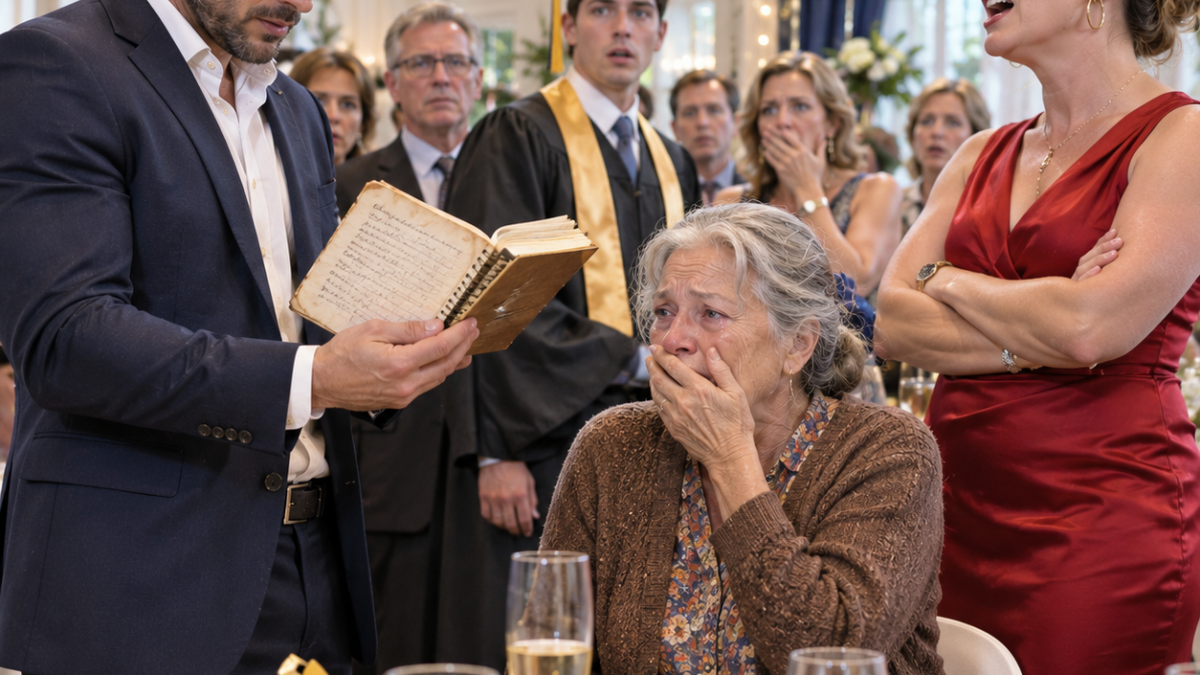
I opened Mom’s notebook.
“Two weeks ago, I found something beneath her mattress.”
Celeste stood.
“Dalton, what are you doing?”
I looked toward her.
“Reading what Mama asked me to read.”
Then I began.
Today I asked Opal for rice on credit. She looked at me like I was a ghost. Maybe I am.
I turned the page.
Today I am seventy. I ate yesterday’s rice by myself.
Somebody gasped.
Celeste stepped toward the stage.
“Dalton, stop this.”
I continued.
“I sent three thousand dollars every month. Over three years, that’s one hundred eight thousand dollars.”
I lifted the bank records.
“For twenty months, twenty-seven hundred dollars left the account the day after each deposit. Fifty-four thousand dollars went to Brandi Vale.”
Brandi, seated near the front, went pale.
“That’s my wife’s sister,” I said.
Then I placed the loan records beside the notebook.
“Three loans were taken in my mother’s name. Thirty-eight thousand dollars. Some of that money went to Brandi’s business. Another portion helped pay for this room.”
Celeste climbed onto the stage.
“He’s lying!”
I looked at her.
“Then explain the documents.”
She pointed at Mom.
“She’s confused! That old woman doesn’t remember what she signs!”
The room went silent.
Then Celeste reached into her handbag.
And pulled out a medical certificate.
“Since we’re discussing documents,” she said, “I have one too.”
At the top was the name:
DR. VERNON FISK.
Beneath it were words that made my blood run cold.
MODERATE DEMENTIA.
Celeste held the paper high.
“Your mother has been diagnosed for months, Dalton. I’ve been protecting her while you were off making your millions.”
I stared at the certificate.
The date was October 14.
The same day Mom’s notebook said she was buying rice because the pantry had been locked.
Celeste smiled.
“And on Monday, I’m going to court to make sure she receives the care she needs.”
For the first time that night, I understood why she’d never seemed afraid of being exposed.
She’d prepared an answer.
And it involved making the whole town believe my mother could no longer speak for herself.
The party ended without another toast.
Some guests left immediately.
Others stayed, whispering around their tables.
Maisie stood beside the stage looking as though she’d just watched her childhood catch fire.
Mom sat quietly at the front table, holding the notebook against her chest.
Celeste’s relatives surrounded her, insisting I was humiliating the family.
I didn’t argue with them.
I helped Mom stand.
Then I turned toward Maisie.
“I’m sorry your night ended this way.”
Her eyes filled.
“Dad, is it true?”
I looked at Celeste across the room.
“About Grandma’s money? The records are real.”
Maisie began crying.
I wanted to hold her.
But she stepped away.
“I need to think.”
I nodded.
“You can take all the time you need.”
I took Mom home.
She was silent during the drive.
When we reached her porch, she turned toward me.
“Dalton, maybe she’s right.”
I looked at her.
“Who?”
“Celeste. Maybe I’m getting confused.”
I felt my heart sink.
“Mama, you remember what happened.”
“But if a doctor says—”
“A certificate isn’t proof the examination happened.”
She folded her hands.
“People will think I made it all up.”
I pulled the car into the driveway.
“Then we’ll let the records speak. And you’ll get to speak too.”
The following Monday, Celeste filed an emergency guardianship petition.
Her attorney argued that Mom was suffering from dementia, had been improperly influenced by me, and required immediate protection.
Dr. Vernon Fisk’s certificate was attached.
So was a health-care proxy supposedly signed by Mom before her alleged diagnosis.
The court granted a narrowly temporary protective order pending an expedited hearing, relying on the urgent allegations and available papers.
Celeste was named temporary guardian for specified decisions.
Mom was to undergo evaluation at Magnolia Care.
And, over our objection, in-person visits were temporarily restricted until the hearing.
I was furious.
But Elias warned me that defying the court would only make matters worse.
“We challenge the order through the court, Dalton. Not by confronting the staff.”
I stood outside Mom’s house as the transport vehicle arrived.
She held my hand.
“Don’t make a scene, son.”
“I’ll be there Friday.”
She looked frightened.
“I don’t want to stay there.”
“I know.”
“Promise?”
I kissed her forehead.
“Friday, Mama.”
The vehicle pulled away.
I watched until it disappeared.
Then I turned toward Elias.
“Tell me what we need.”
He opened his folder.
“Everything.”
The hearing was scheduled for Friday at nine.
A court-appointed evaluator would examine Mom that morning at eight.
Celeste’s attorney had submitted the medical certificate, a purported health-care proxy, and the older power of attorney.
We had the bank records, Mom’s diary, Opal’s ledger, and the signature comparisons.
But Elias explained that we also needed independent medical evidence and proof that Dr. Fisk’s claimed examination had actually occurred.
There was another complication.
Mom had signed a revocation of Celeste’s financial power of attorney after I returned.
But Celeste’s emergency petition had been filed early Monday.
The bank received the revocation notice later that morning.
Celeste was now arguing that Mom had already lost the capacity to revoke the document.
That question had to be resolved.
Then Elias discovered a pending property sale.
Ridgeview Holdings LLC had prepared an agreement to purchase Mom’s house.
14 Pecan Lane.
Purchase price: $61,000.
The county valuation placed it at roughly three times that amount.
Closing was scheduled for Friday afternoon.
I stared at the paperwork.
“She wants to sell Mama’s house?”
“That’s what the documents indicate.”
“To whom?”
Elias turned his laptop toward me.
The company’s registered agent was Vernon Fisk.
I sat back.
Celeste’s doctor.
The man who’d signed the dementia certificate.
The man whose name appeared whenever she threatened Mom.
He was connected to the company preparing to buy Mom’s home at a fraction of its value.
“Can they close while this is disputed?”
“We’re notifying the title company and seeking emergency relief. The guardianship order doesn’t automatically authorize a real estate sale. But Celeste is also relying on the older power of attorney, and they’re trying to resolve the capacity dispute in their favor before closing.”
I looked at the clock.
It was Tuesday afternoon.
We had less than three days.
That night, Maisie called.
Her voice sounded exhausted.
“Dad, can you come over?”
I met her outside her apartment.
She had been working orientation shifts at Magnolia Care.
I noticed immediately that she was shaking.
“What’s wrong?”
She looked at me.
“Mom wants me to write something in Grandma’s chart.”
“What?”
“That Grandma didn’t recognize me. That she seemed disoriented and confused.”
I felt cold.
“Was she?”
Maisie shook her head.
“She recognized me. She asked whether I’d eaten.”
“Then don’t write anything false.”
“I won’t.”
She stared at her hands.
“There’s more.”
I waited.
“Dr. Fisk ordered lorazepam for Grandma after she arrived. Three doses a day.”
“Why?”
“That’s what I asked.”
Maisie swallowed.
“There’s no documented examination by him associated with the order. She’s been sleepy and confused since the medication started.”
I closed my eyes.
“The evaluator sees her Friday morning.”
“I know.”
Maisie’s face crumpled.
“Mom threatened my job when I questioned it. She said Vernon could make sure I never worked as a nurse again.”
I took her hands.
“Listen to me. You document what you actually observed. You report concerns through the proper clinical channels. Patient safety comes first.”
She nodded.
Then she began crying harder.
“There’s something else, Dad.”
I waited.
She could barely speak.
“Mom told me I’m not your real daughter.”
I felt the world go still.
“Maisie.”
“She said Vernon is my biological father.”
I took a slow breath.
I had suspected for years.
Long ago, when Maisie was ten, I’d overheard part of a conversation between Celeste and Brandi.
A later discovery had confirmed enough of the truth that I could no longer pretend it wasn’t possible.
During the last two weeks, a private DNA result had removed my remaining doubt.
But I hadn’t told Maisie.
I hadn’t wanted her graduation turned into a public revelation about her parentage.
Now Celeste had used that secret to frighten her.
“Does that mean you knew?” Maisie asked.
I nodded.
She stared at me.
“And you never told me?”
“I should’ve found a better way to talk to you. I’m sorry.”
Tears rolled down her face.
“Mom said you would stop loving me.”
I felt something break inside my chest.
I pulled her into my arms.
“Maisie, when I look at you, I see a little girl who used to wait up on the couch with her shoes still on because she wanted to tell me about her day.”
She sobbed against my shirt.
“I see the kid I taught to ride a bicycle. The teenager I drove to school. The young woman who just became a nurse.”
I held her tighter.
“A piece of paper can tell us about biology. It can’t tell us who raised you.”
She looked up.
“I’m your dad because I chose you,” I said. “And I’d choose you again tonight.”
She began crying harder.
For a long time, we stood beside her car.
Then she wiped her face.
“Grandma needs help.”
I nodded.
“She does.”
Maisie took out her phone.
“I’ve already reported the medication concerns to the director of nursing. I’m also contacting the long-term care ombudsman. I won’t change the chart.”
I looked at her.
“Your grandmother would be proud of you.”
She swallowed.
“I want her to know.”
“Then we’ll make sure she hears it.”
On Thursday evening, Elias called with the last piece of evidence.
“Dalton, we found a problem with Fisk’s certificate.”
“What kind?”
“The doctor claims he examined your mother at his office on October fourteenth, at ten-thirty in the morning.”
I remembered the date.
It was the day Mom’s pantry had been locked.
Elias continued.
“Opal’s ledger shows your mother bought rice at ten-twenty that morning.”
“That’s ten minutes apart.”
“Yes. And the store is forty minutes from Fisk’s office.”
I sat down.
“She couldn’t have been in both places.”
“That’s what the records suggest.”
There was more.
A woman named Gwen Tabor, the same woman who’d mocked Mom in Opal’s store, had been selling church raffle tickets on Pecan Lane during Christmas week.
She remembered seeing Vernon Fisk carrying Mom’s sewing machine into a black SUV.
Elias had obtained her statement.
Abner’s account of the sale matched.
The doctor who claimed to be protecting Mom had personally helped remove the machine that supported her livelihood.
Then Elias examined the health-care proxy Celeste had presented.
The signature date was September 30 of the previous year.
But the particular version of the form hadn’t been released until February.
Months later.
“Someone backdated it,” I said.
“That appears to be the explanation. We’ll let the court evaluate the evidence.”
I looked at Mom’s notebook.
The entries were written slowly, each date carefully recorded.
Celeste had used that very handwriting as supposed evidence that Mom was mentally declining.
Now it might help expose the documents that had been created in her name.
Friday morning arrived gray and cold.
At eight, the court-appointed evaluator examined Mom at Magnolia Care.
The examination was conducted independently, with attention to the possible effects of medication.
At nine, we entered the courtroom.
Celeste sat beside her attorney.
Vernon Fisk was behind her.
Brandi occupied a seat near the aisle.
Maisie sat beside me.
Her hands were folded tightly in her lap.
I leaned toward her.
“You doing okay?”
She nodded.
Then whispered, “I’m scared.”
“So am I.”
She looked surprised.
I smiled faintly.
“Doesn’t mean we stop.”
The judge began with the evaluator’s report.
The doctor testified that Mom was oriented to person, place, and time.
She recognized family members.
She remembered the disputed transactions well enough to discuss them.
She recalled three words after five minutes and answered questions about her household expenses.
The evaluator found no evidence supporting the claimed moderate dementia diagnosis.
There were, however, signs of residual sedation consistent with the medication recently administered.
The judge asked about the prescribing records.
The evaluator explained that the chart did not contain a documented examination supporting the new regimen, an issue requiring further clinical and regulatory review.
Celeste’s attorney requested a short recess.
During it, he approached Elias with a proposed agreement.
Celeste would withdraw her request for full guardianship.
In exchange, we would withdraw the legal challenge and agree not to interfere with outstanding financial arrangements.
Elias read the document.
Then pointed to a paragraph near the bottom.
I leaned closer.
It authorized the pending sale of 14 Pecan Lane to Ridgeview Holdings.
At two o’clock.
For sixty-one thousand dollars.
The agreement also required me to waive objections to the transaction.
I looked toward Celeste.
Even now, she was trying to get Mom’s house.
I slid the paper back.
“No.”
Elias nodded.
“We’ll proceed.”
When court resumed, the judge allowed the parties to present evidence concerning Mom’s capacity, the disputed documents, and the need for continued guardianship.
Elias began with the signature comparisons.
Mom’s recent signature was slow and deliberate.
So were the signatures on twenty-eight years of sewing order slips preserved inside her old machine.
The disputed loan applications were different.
Fast.
Confident.
Uniform.
Elias then presented the medical certificate.
“Dr. Fisk, you state that you examined Mrs. Whitlock at your office at ten-thirty on October fourteenth?”
“Yes.”
He sounded certain.
Elias placed Opal’s ledger before him.
“At ten-twenty, Mrs. Whitlock was purchasing rice at a grocery store forty minutes away.”
Fisk’s face tightened.
“Records can contain errors.”
“Then let’s hear from the person who made the entry.”
Opal took the witness stand.
She explained how she recorded every credit purchase.
She identified the page.
The date.
The time.
And the one-pound bag of rice.
“She was running a fever,” Opal said. “There was hardly anything in her house. She walked over because she needed food.”
Elias asked whether Opal was certain of the time.
“I wrote it down when she was standing at my counter.”
Fisk shifted in his seat.
Then Gwen Tabor testified about seeing him carry Mom’s sewing machine out of the house the previous December.
Abner’s records supported her account of the sale.
The judge also examined the disputed health-care proxy.
When Elias showed that the form version used was released after its supposed signing date, Celeste’s attorney stopped trying to defend the date as reliable.
Then came the hardest part.
Mom was invited to speak.
She rose slowly.
I wanted to help her.
But she shook her head.
She walked toward the witness stand on her own.
The judge addressed her gently.
“Mrs. Whitlock, do you understand why you’re here today?”
Mom nodded.
“Because my daughter-in-law says I can’t remember things.”
“And do you believe that’s true?”
Mom looked toward Celeste.
Then back at the judge.
“Sometimes I forget where I put my glasses.”
A few people smiled.
“But I remember when I was hungry.”
The courtroom became silent.
Mom continued.
“I remember the day my pantry was locked. I remember asking Opal for rice. I remember when they took my sewing machine.”
Her voice trembled.
“And I remember signing papers Celeste told me were for the pharmacy.”
The judge asked about her handwriting.
Mom took a breath.
“My husband died when I was thirty-three. I couldn’t write properly then. I learned my letters at a church night class when I was forty-one.”
She looked toward the documents.
“I’ve never signed my name fast in my life.”
Then she said something I hadn’t expected.
“I’m angry with my son.”
I looked up.
Mom turned toward me.
“He should have come home sooner.”
I lowered my eyes.
“Yes, Mama.”
“But being angry with my son doesn’t make me confused.”
She looked at the judge.
“And being old doesn’t make me a liar.”
I began crying.
Not because she needed me to defend her.
Because she was defending herself.
Maisie also testified about what she’d observed at Magnolia Care.
She explained that Mom had recognized her and had asked whether she’d eaten.
She described her concerns about the medication orders and confirmed that she’d reported them through the appropriate clinical channels rather than falsifying the chart.
Celeste interrupted.
“Maisie! Stop!”
The judge instructed her to remain silent.
Maisie looked toward me.
Then toward her mother.
“You told me Dad would stop loving me if he learned the truth.”
Celeste went pale.
Maisie’s voice strengthened.
“He didn’t.”
Vernon shifted behind the defense table.
For the first time, I saw fear on his face.
The judge reviewed the evidence and announced the ruling.
The request for continuing guardianship was denied.
The temporary order was vacated.
Mom’s capacity to make the relevant decisions was recognized, and the attempted challenge to her revocation did not succeed.
The disputed property sale was stopped.
The court directed that the questionable documents and medical evidence be referred to the appropriate investigative and regulatory authorities.
Mom would go home.
I looked at her.
She was crying.
Elias put a hand on my shoulder.
“We’ve got her.”
The words barely registered.
All I could see was Mom standing beside the witness chair.
Then she asked the judge a question.
“Your Honor, may I have my name taken off those papers I never agreed to?”
The judge looked toward the court staff.
“We’ll make sure the appropriate orders and records address them, Mrs. Whitlock.”
Mom nodded.
“Thank you.”
Investigators had been examining the financial and document evidence independently of the guardianship case.
After the hearing, officers executed arrest warrants issued on the supported allegations against Celeste and Vernon.
The proceedings against them would continue separately.
Celeste turned toward me as she was escorted from the courthouse.
“I did everything for this family!”
I looked at her.
“You did everything to it.”
Vernon tried to speak to Maisie.
“I’m your father.”
She stood beside me.
“I have a father.”
Then she took my hand.
We went home together.
Not all the consequences were resolved that Friday.
The criminal cases required further proceedings.
The bank’s investigation into the three loans continued, with collection activity suspended while the suspected forgeries were reviewed.
The $54,000 transferred to Brandi remained part of the financial recovery effort.
The medical board examined the complaints against Vernon.
And Elias helped Mom arrange for an independent review of her accounts and property records.
But the immediate danger had passed.
She was home.
Her house hadn’t been sold.
And nobody else was deciding whether she was allowed to eat.
A week later, Abner delivered the Singer sewing machine.
Mom stood in her front room, staring as he carried it through the door.
When he set it beside the window, she reached out and touched the wood.
Then she began crying.
“Harold bought me this.”
I nodded.
“I know, Mama.”
She sat down.
Opened the drawer.
And took out an old order slip.
Her fingers moved over the paper.
“Twenty-eight years,” she whispered.
She looked up at me.
“I put you through school on this machine.”
I knelt beside her.
“And now it’s home.”
That Thursday, we went to Opal’s store.
Mom carried her old ledger balance in an envelope.
Opal tried to refuse it.
“You don’t owe me a thing, Loretta.”
Mom smiled.
“That’s why I’m paying.”
Opal’s eyes filled.
They embraced across the counter.
Then Gwen Tabor appeared near the door.
She looked at Mom.
For once, she wasn’t smiling.
“Loretta, I said things in this store I’m ashamed of.”
Mom studied her.
Then pointed toward Opal’s ledger.
“Well, Gwen, perhaps you’d better pay your own tab. Opal has been patient with you too.”
Opal burst out laughing.
So did I.
And for the first time in months, Mom laughed without looking over her shoulder.
Later that summer, Maisie started visiting every Sunday.
She sat beside Grandma at the sewing machine, learning how to measure hems and make straight seams.
One afternoon, I heard Mom say, “Slow down, baby. One letter, one stitch, one thing at a time.”
I stopped in the doorway.
Maisie looked up.
“Dad, Grandma says you were never patient.”
Mom laughed.
“He wasn’t.”
I smiled.
“Some things don’t change.”
A few weeks later, I told Mom I had sold my remaining overseas business interest.
She looked shocked.
“Dalton, you didn’t have to give up your work for me.”
“I know.”
“Then why?”
I sat across from her.
“Because I spent three years sending money and telling myself that meant I was taking care of you.”
She reached for my hand.
“You were trying to help.”
“I was. But I should’ve come home.”
Mom looked at the kitchen table.
“Money doesn’t sit here and talk to you, son.”
I swallowed.
“No, Mama. It doesn’t.”
We made arrangements for a visiting nurse to help when needed.
We reviewed the bills together.
I offered to replace her phone and organize the household payments.
Then Mom stopped me.
“Ask me first.”
I smiled.
“You’re right.”
It was such a small request.
But after everything she’d endured, it mattered.
She didn’t want another person taking over her life.
Not even me.
So I asked.
And she decided.
That evening, I helped her carry two chairs onto the porch.
The sun was setting over Pecan Lane.
A warm breeze moved through the trees.
Mom sat in the chair closest to the railing.
Then she looked toward the house.
“Dalton?”
“Yes, Mama?”
“Turn on the porch light.”
I stood.
“Getting dark?”
She smiled.
“No.”
I looked at her.
“Then why?”
She leaned back in her chair.
“Let folks see somebody lives here.”
I turned on the light.
Then I sat beside her.
For three years, I’d believed that money could cross an ocean and take my place at my mother’s table.
It couldn’t.
But I was home now.
And this time, when she reached for another piece of bread, nobody told her she needed permission.