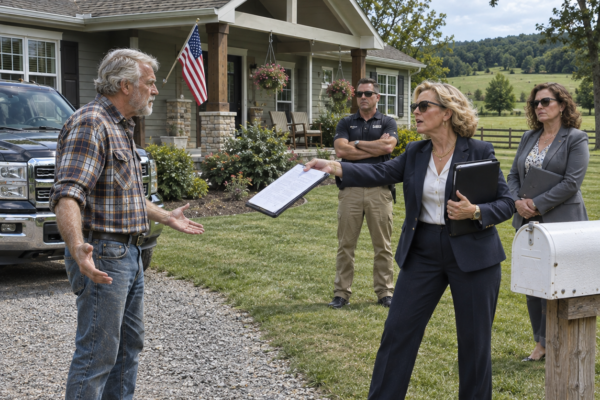
“Move Your Cows—We Reserved This Field for Our HOA Wellness Retreat,” the President Told Me After Thirty Pastel Tents Appeared on My Kentucky Farm Overnight. Her Crew Had Cut My Fence, Rerouted My Irrigation, and Built a Stage in My Cornfield. I Gave Them Three Hours to Leave. She Smiled, Raised a Zoning Map, and Said, “Actually, This Land Isn’t Entirely Yours.”.k
“Move Your Cows—We Reserved This Field for Our HOA Wellness Retreat,” the President Told Me After Thirty Pastel Tents Appeared on My Kentucky Farm Overnight. Her Crew Had Cut My Fence, Rerouted My Irrigation, and Built a Stage in My Cornfield. I Gave Them Three Hours to Leave. She Smiled, Raised a Zoning Map, and Said, “Actually, This Land Isn’t Entirely Yours.”
I knew something was wrong before I finished my first cup of coffee.
From my kitchen window, thirty pastel-colored tents were glowing through the morning fog across my back forty.
Not one tent.
Not three kids camping near the creek.
Thirty.
There was a folding stage beside my corn rows, a handmade sign that read EARTH & HARMONY WEEKEND, a portable doughnut stand, two compost toilets, and what appeared to be an inflatable pool sitting where my cattle normally crossed between pastures.
I stared long enough for the coffee to go cold in my hand.
Then I saw a woman in expensive yoga clothes trying to guide one of my goats with a silk scarf.
That was when I put on my boots.
My name is Caleb Jones. I’m fifty-eight, and I’m the third generation of my family to work Jones Creek Farm in central Kentucky.
I grow corn and hay, keep cattle and goats, and run enough equipment to know the exact sound a hydraulic pump makes two seconds before it ruins your week.
I’m not anti-neighbor.
I’m not anti-HOA.
I am, however, strongly opposed to strangers building a weekend festival in the middle of my farm without asking me.
I drove my old pickup down the muddy service track.
By the time I reached the field, somebody was arranging lavender sachets on my hay bales.
Another man was hanging hammocks from fence posts.
A woman carried a tray of green drinks past me and said, “Welcome to the space.”
I stopped the truck.
“This is my space.”
She smiled as though I had made a joke.
Then a tall woman with a clipboard walked toward me.
Blonde hair.
White jacket.
Clean shoes that had never met livestock mud before that morning.
“You must be the groundskeeper.”
“No.”
“We’ll need those cattle moved before nine. Their energy is interfering with the meditation zone.”
I looked at the cows.
Then at her.
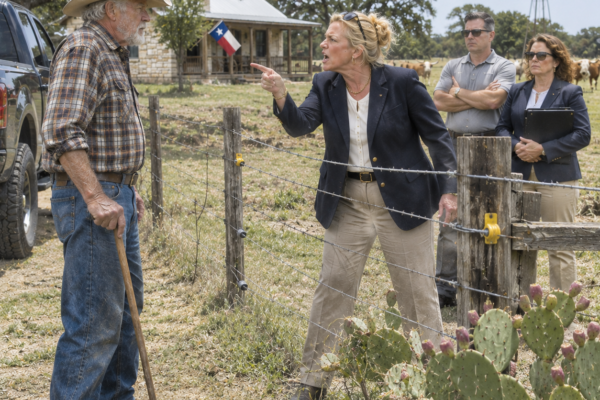
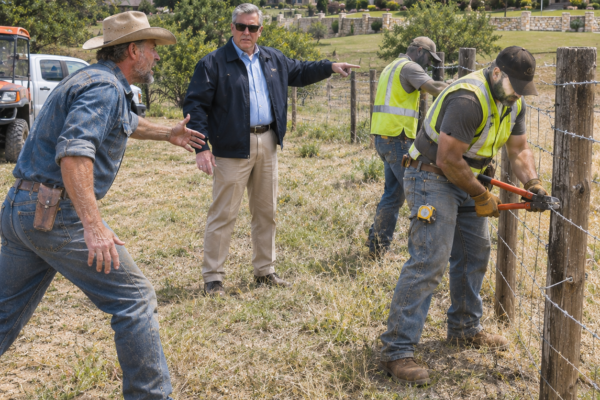
Then at the section of barbed wire fence lying on the ground behind her.
“You cut my fence.”
She gave me a patient little smile.
“We opened an access point.”
“You cut my fence.”
“We can discuss restoration after the retreat.”
“There is no retreat.”
Her smile faded slightly.
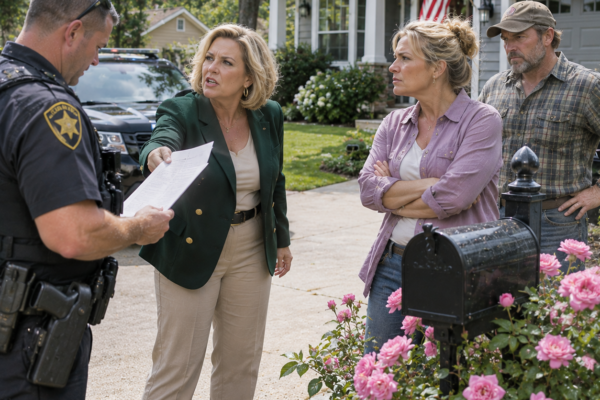
“I’m Veronica Sterling, president of Pinnacle Estates.”
“That explains nothing.”
“Our association is hosting a three-day wellness weekend. This parcel was identified as open recreational land.”
“You’re standing in an actively farmed field.”
“We were told it was underutilized.”
“By who?”
“Our land-use committee.”
I laughed once.
She didn’t.
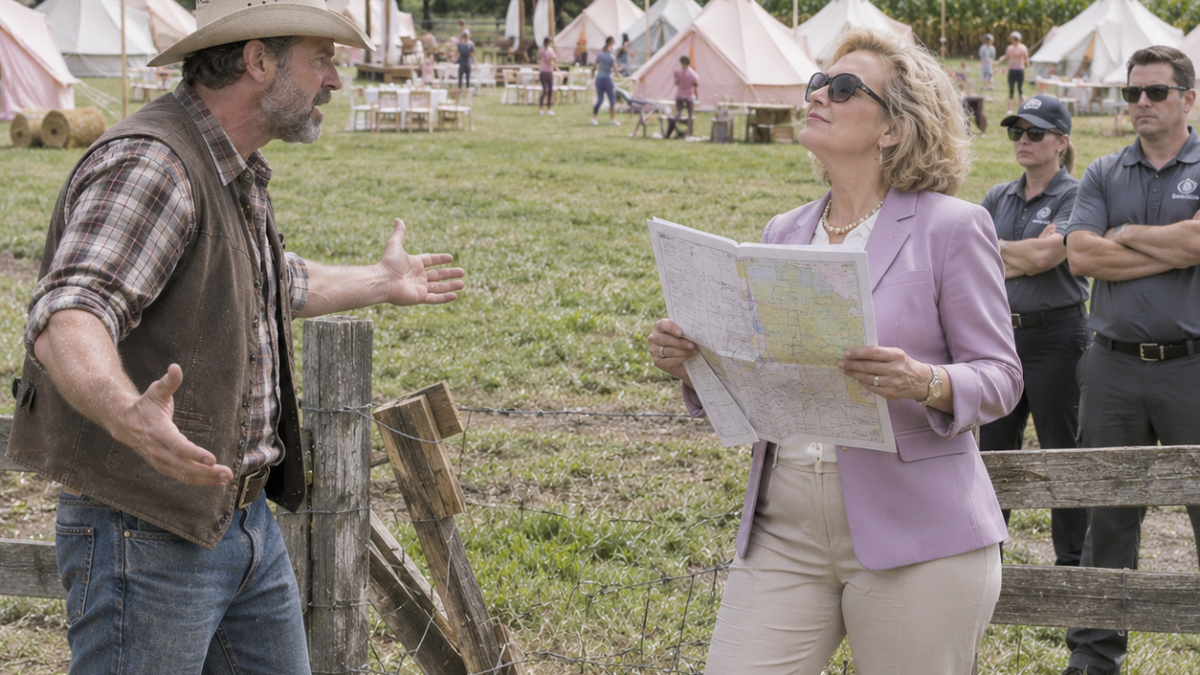
Then she unfolded a color map.
It showed Pinnacle Estates to the east, my farm to the west, and a broad green area between them labeled COMMUNITY OPEN SPACE CORRIDOR.
My property.
My creek.
My pasture.
My corn.
All shaded green.
“Where did you get that?”
“County planning archive.”
“That isn’t a deed.”
“It establishes public-use intent.”
“No, it doesn’t.”
She looked me up and down.
Mud on my jeans.
Old work shirt.
Grease under one thumbnail from fixing a baler the night before.
Then she said the sentence that changed my mood completely.
“Sweetheart, don’t be so rigid. We’re bringing life to this land.”
I pointed toward the cut fence.
“This land is alive enough without you.”
I gave her three hours.
Not three days.
Three hours to pack every tent, remove every vehicle, reconnect nothing, touch no animal, and get off my property.
She laughed.
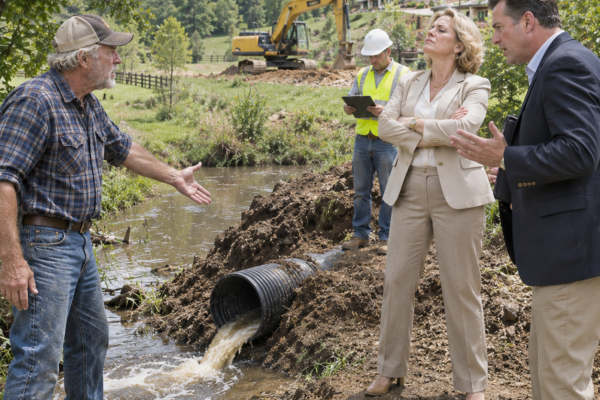
Then one of her volunteers dragged my irrigation hose toward the inflatable pool.
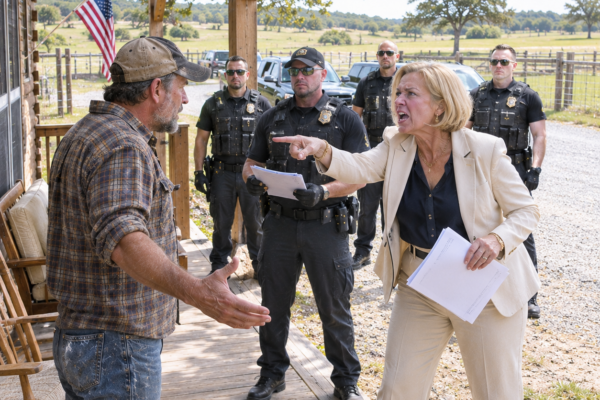
I called the sheriff.
Deputy Travis Cole arrived forty minutes later.
He had known my family for years.
He took one look at the tents and said:
“What in God’s name happened here?”
Veronica rushed toward him with the map.
She claimed the group had been told the field was subject to public recreational access.
Travis checked my deed, photographed the cut fence, and told her plainly that nothing he saw gave the HOA permission to occupy my farm.
He issued written trespass notices to Veronica and the event coordinator.
But because vehicles, tents, and thirty-two people were scattered across the field, he gave them until noon to remove everything safely rather than creating a confrontation around livestock and equipment.
Veronica acted as though she had won.
She had not.
At 11:40, I found them still assembling a projector screen.
At 11:52, the sheriff returned with two more deputies.
At 12:07, the first tent started coming down.
And at 12:31, while Veronica stood at the roadside screaming about “community access rights,” I climbed into my tractor and started the field work I had scheduled before any of them arrived.
Fertilizing.
Not spraying people.
Not damaging tents.
The field was already empty.
But the smell of cattle slurry carried all the way to the Pinnacle Estates clubhouse.
Veronica stood outside the fence watching my tanker make its first pass.
“You did that on purpose!”
I leaned out of the cab.
“I told you this was a working farm.”
Three days later, she sued me.
That was when my attorney found the old survey.
And suddenly, Veronica’s little zoning map became the least of her problems. Pasted text(20261125-020937)
Part 2:
I knew something was wrong before I finished my first cup of coffee.
From my kitchen window, thirty pastel-colored tents were glowing through the morning fog across my back forty.
Not one tent.
Not three kids camping near the creek.
Thirty.
There was a folding stage beside my corn rows, a handmade sign that read EARTH & HARMONY WEEKEND, a portable doughnut stand, two compost toilets, and what appeared to be an inflatable pool sitting where my cattle normally crossed between pastures.
I stared long enough for the coffee to go cold in my hand.
Then I saw a woman in expensive yoga clothes trying to guide one of my goats with a silk scarf.
That was when I put on my boots.
My name is Caleb Jones. I’m fifty-eight, and I’m the third generation of my family to work Jones Creek Farm in central Kentucky.
My grandfather bought the first eighty acres in 1954.
My father added more whenever neighboring land came up for sale.
By the time I inherited the place, we had 214 acres divided between pasture, hay, corn, creek bottom, woods, and one stubborn rocky ridge that had been disappointing farmers since before my family arrived.
I know every part of it.
Where the creek floods first.
Which gate sags when the ground freezes.
Where copperheads like to hide under old limestone.
Which section of pasture looks dry from a distance but will swallow a truck axle after two days of rain.
To somebody standing behind the gates of Pinnacle Estates, the back forty probably looked empty.
That was the first mistake.
Farm land can look empty while doing exactly what it is supposed to do.
The second mistake was assuming empty meant available.
Pinnacle Estates had been built on former horse pasture east of my property about twelve years earlier.
Big homes.
Stone entrance.
Golf carts.
A clubhouse with columns.
A decorative lake nobody was allowed to fish unless they filled out a form.
I never had much trouble with residents.
Some bought eggs from me.
One family hired me every fall for hayrides.
Another paid me to keep two horses because their HOA wouldn’t allow livestock.
The irony never bothered me until Veronica Sterling became president.
I first met her at a county planning meeting.
She introduced herself before I asked.
“Veronica Sterling, Pinnacle Estates.”
As though she were introducing a country.
She spoke about “protecting the rural aesthetic” while requesting permission for decorative lighting along their eastern boundary.
I remember thinking it was strange to talk about rural aesthetics while objecting to actual rural things.
But she was polite.
So was I.
That changed the morning I found her wellness retreat in my field.
I drove my old pickup down the muddy service track.
By the time I reached the field, somebody was arranging lavender sachets on my hay bales.
Another man was hanging hammocks from fence posts.
A woman carried a tray of green drinks past me and said, “Welcome to the space.”
I stopped the truck.
“This is my space.”
She smiled as though I had made a joke.
Then Veronica walked toward me.
Blonde hair.
White jacket.
Clean shoes that had never met livestock mud before that morning.
“You must be the groundskeeper.”
“No.”
“We’ll need those cattle moved before nine. Their energy is interfering with the meditation zone.”
I looked at the cows.
Then at her.
Then at the section of barbed wire fence lying on the ground behind her.
“You cut my fence.”
She gave me a patient little smile.
“We opened an access point.”
“You cut my fence.”
“We can discuss restoration after the retreat.”
“There is no retreat.”
Her smile faded slightly.
“I’m Veronica Sterling, president of Pinnacle Estates.”
“That explains nothing.”
“Our association is hosting a three-day wellness weekend. This parcel was identified as open recreational land.”
“You’re standing in an actively farmed field.”
“We were told it was underutilized.”
“By who?”
“Our land-use committee.”
I laughed once.
She didn’t.
Then she unfolded a color map.
It showed Pinnacle Estates to the east, my farm to the west, and a broad green area between them labeled COMMUNITY OPEN SPACE CORRIDOR.
My property.
My creek.
My pasture.
My corn.
All shaded green.
“Where did you get that?”
“County planning archive.”
“That isn’t a deed.”
“It establishes public-use intent.”
“No, it doesn’t.”
She looked me up and down.
Mud on my jeans.
Old work shirt.
Grease under one thumbnail from fixing a baler the night before.
Then she said:
“Sweetheart, don’t be so rigid. We’re bringing life to this land.”
I pointed toward the cut fence.
“This land is alive enough without you.”
A man in a golf visor walked by carrying a bamboo compost toilet.
He nodded.
“Beautiful property.”
“Thank you. Leave.”
He kept walking.
Another woman was tying pastel ribbons to an electric-fence post.
I yelled:
“Don’t touch that.”
She jumped.
Veronica sighed.
“Could you lower your voice? We’re creating a calming environment.”
“You’re trespassing.”
“We disagree.”
“No, you misunderstand. Trespassing isn’t a philosophy.”
I gave them three hours.
Veronica laughed.
Then somebody dragged one of my irrigation hoses toward the inflatable pool.
I called the sheriff.
Deputy Travis Cole arrived forty minutes later.
He had known my family for years.
Travis stepped out of his cruiser, looked across the tents, the stage, the inflatable pool, and the kombucha stand.
“What in God’s name happened here?”
“Apparently my cornfield found itself.”
He almost smiled.
Then Veronica rushed toward him.
“Officer, thank goodness. This man has been threatening our event.”
Travis looked at me.
“Threatening?”
“I told them to leave.”
“That’s the threat,” Veronica said.
Travis held up a hand.
“Let me see what you’ve got.”
She showed him the map.
He studied it.
Then my deed.
Then the county parcel app on his tablet.
“This green shading is not an ownership map.”
“It is a planning document.”
“Planning documents don’t give you possession.”
“It identifies this area as community open-space corridor.”
“Whose community?”
She hesitated.
Travis looked at me.
“Caleb, where’s your eastern boundary?”
I pointed toward the cut fence.
“Right there.”
He walked it.
Photographed the severed wire.
Photographed a stake they had pulled.
Photographed tire tracks.
Then found the original fence-post marker still standing beneath brush.
He came back.
“Ms. Sterling, I’m issuing written trespass notices to you and the event organizer.”
Her face hardened.
“You can’t just shut down a permitted community event.”
“Show me the permit.”
She produced a county event permit.
Travis read it.
The permit authorized temporary assembly on property controlled by Pinnacle Estates.
It did not identify my parcel.
“You gave the county the wrong location.”
“No.”
“Yes.”
“This event is adjacent to Pinnacle.”
“That isn’t what the permit says.”
People had begun gathering.
One man was holding a yoga mat.
Another still carried a tray of wellness shots.
Veronica lowered her voice.
“Deputy, perhaps we can avoid embarrassing everyone.”
“I’m trying to.”
He pointed toward the tents.
“You have until noon to remove people and property safely.”
“It will take longer.”
“Then start now.”
“Three days of programming have been sold.”
“That sounds like a civil problem between you and your customers.”
“This is outrageous.”
“No, ma’am. Cutting a farmer’s fence and setting up thirty tents without permission is outrageous.”
I liked Travis.
But even then I understood why he gave them time.
You don’t force thirty confused people to run across a field filled with equipment, livestock, guy lines, and vehicles.
You clear it safely.
Veronica treated the grace period like permission.
At 11:40, they were still assembling a projector.
At 11:52, Travis returned with two deputies.
At 12:07, the first tent came down.
At 12:31, the last vehicle crossed the temporary gap in my fence.
I closed it behind them with wire and two steel clips.
Veronica stood on the roadside.
“This isn’t over.”
“I assume that means I should save the paperwork.”
“You sabotaged a charitable wellness event.”
“You invaded a farm.”
“You could have worked with us.”
“You never asked.”
She pointed toward the field.
“You’re really going to leave it empty after ruining an entire weekend?”
“I’m not leaving it empty.”
“What?”
I walked toward the equipment shed.
Old Betsy had been my father’s manure tanker.
Rusty.
Ugly.
Reliable.
I had scheduled fertilizing for that field before Veronica arrived.
The weather had delayed me two days.
Now the field was finally clear.
I started the tractor.
Veronica’s expression changed.
“No.”
I smiled.
“Working farm.”
“You wouldn’t.”
“I absolutely would.”
The tanker rolled into the field.
No people.
No tents.
No equipment.
Just crop ground.
I opened the applicator at the first row.
Dark slurry spread in a controlled band behind the tanker.
The smell carried east immediately.
Veronica covered her nose.
“This is intentional harassment!”
“I’m fertilizing corn.”
“Today?”
“Was supposed to be Thursday.”
She stared at me.
Then the first gust of wind carried the smell toward Pinnacle Estates.
Someone at the clubhouse yelled.
I kept driving.
Not toward anyone.
Not across their property.
Just neat agricultural passes across my own field.
By the third pass, the retreat was unquestionably finished.
No one was setting up aromatherapy tents there for a while.
I slept well that night.
Two days later, the certified letter arrived.
Law Offices of Fletcher & Baines.
Veronica and Pinnacle Estates demanded compensation for:
Event cancellation.
Destroyed branding materials.
Lost vendor fees.
Emotional distress.
“Malicious agricultural activity.”
I read that phrase three times.
Then called my lawyer.
Clarence Bell had represented my father before he represented me.
Seventy-three years old.
Suspenders.
Heavy eyebrows.
A voice like gravel in a cement mixer.
He read the letter.
“Malicious agricultural activity.”
“That’s apparently what fertilizing is now.”
Clarence looked over his glasses.
“Did you spray anyone?”
“No.”
“Any equipment?”
“No.”
“Anything on their side of the boundary?”
“No.”
“You wait until the field cleared?”
“Yes.”
“Good.”
He kept reading.
Then looked at me.
“They’re claiming a right of access.”
“That green-map nonsense.”
“Bring me everything.”
I brought the deed.
Survey.
Event permit.
Sheriff report.
Photos.
Fence repair receipt.
Irrigation records.
Clarence spread them over his conference table.
“What exactly did they do to the irrigation?”
“Disconnected a lateral hose and connected it to their pool line.”
“Damage?”
“Cracked fitting. About eight hundred dollars including labor.”
“Fence?”
“Twelve hundred.”
“Crop damage?”
“Maybe half an acre trampled.”
He nodded.
“We counterclaim.”
“For what?”
“Actual damages.”
“I don’t want a war.”
“Neither do I. But when somebody sues you for using your farm after trespassing on it, a clean counterclaim helps clarify who owes whom.”
Then he stopped.
He had reached the map.
“Where did they get this?”
“County planning archive.”
“What year?”
I looked.
Clarence leaned back.
“That’s before Pinnacle existed.”
“So?”
“So this may be a conceptual greenway plan.”
“What does that mean?”
“It means the county once discussed a recreational corridor that was never necessarily acquired.”
He called the county clerk.
Then a surveyor.
That afternoon we learned something Veronica should have learned before cutting my fence.
In the late 1990s, the county considered a walking-and-biking corridor along the creek.
The planning map shaded several private parcels green.
But the county never purchased my family’s land.
No easement was recorded across my field.
No right to roam.
No public assembly right.
The project was abandoned.
The green shading remained in archived planning materials.
Veronica had found an old proposal and treated it like ownership.
That would have been enough.
Then the surveyor found something else.
Pinnacle Estates’ western boundary did not sit exactly where its ornamental fence suggested.
The developer had placed that decorative fence several feet inside its own property in some areas.
But near the north end, an old maintenance lane had shifted outward.
One of Pinnacle’s landscaped patios and part of a small HOA-owned “wellness pavilion” had been built across the recorded line.
Not thirty feet.
Not an entire cottage.
That would have been too convenient.
The verified encroachment ranged from six to eleven feet across roughly 140 feet.
Enough to matter.
Especially because the pavilion’s rear deck crossed onto my land.
I stared at the survey.
“You’re sure?”
Clarence looked at the licensed surveyor.
The surveyor nodded.
“I found the original monument and two corroborating pins.”
“Why didn’t anyone catch this before?”
“Because everybody followed the decorative fence.”
I laughed once.
“That sounds familiar.”
Clarence did not grin.
“Don’t get cute.”
“What?”
“This is not your revenge opportunity.”
“I know.”
“Good. Because we handle the boundary professionally.”
He sent formal notice.
That changed Veronica’s tone.
The first letter had called me dangerous.
The second called for “mutual de-escalation.”
Apparently property law became less spiritual once it reached her patio.
Pinnacle hired its own surveyor.
Same result.
The HOA’s rear deck crossed onto my land.
A retaining wall did too.
The pavilion itself sat mostly on Pinnacle property, but its rear stairs and landscaping extended past the boundary.
Veronica called.
Not my lawyer.
Me.
I answered because I was curious.
“Caleb.”
“Veronica.”
“I think this has gone far enough.”
“I agree.”
“We should sit down.”
“With lawyers.”
“That seems unnecessarily hostile.”
“You sued me.”
A pause.
“That filing can be revisited.”
“So can your pavilion.”
“You’re enjoying this.”
“No.”
“You sound like you are.”
“I sound like a man who has spent a week repairing damage caused by people who thought maps meant whatever they wanted them to mean.”
She exhaled sharply.
“We made an honest mistake.”
“You cut a fence.”
“We were acting on information available to us.”
“You rerouted irrigation.”
“That was a volunteer.”
“You told me my land was underused.”
Silence.
Then:
“What do you want?”
“Pay for the damage. Dismiss your claims. Correct the boundary. Stop entering my land.”
“That’s it?”
“That should have been it on day one.”
She hung up.
The case did not settle.
Not immediately.
Veronica had already turned the retreat disaster into a political issue inside Pinnacle.
She claimed I was trying to destroy the HOA.
Residents received an email describing me as an “aggressive adjacent landowner seeking to appropriate community amenities.”
That phrase reached Clarence.
He smiled in a way I didn’t like.
“What?”
“They just gave us another exhibit.”
“I don’t want to sue over an email.”
“We don’t need to. We show it to demonstrate their position.”
Pinnacle’s board was not united.
That became obvious at the first mediation.
Treasurer Daniel Brooks looked exhausted.
Vice president Marsha Cole kept asking their attorney whether Veronica had actually obtained title review before approving the retreat.
She had not.
Event spending surprised them too.
Nearly $28,000.
Tent rentals.
Wellness vendors.
Food.
Stage.
Marketing.
Portable toilets.
All approved through what Veronica called “executive event authority.”
The bylaws required board approval for discretionary spending above $7,500.
There had been no vote.
Daniel stared at her.
“You spent twenty-eight thousand dollars without approval?”
“It was spread across multiple vendor categories.”
“That’s not how the threshold works.”
“We needed to move quickly.”
“For a retreat on land we didn’t own?”
Her attorney whispered to her.
Veronica ignored him.
“This isn’t about accounting.”
Daniel answered:
“It is now.”
The mediation ended without settlement.
But Pinnacle’s board ordered an internal financial review.
Clarence and I drove home.
“You realize this may end her presidency.”
“That isn’t my goal.”
“I believe you.”
“Do you?”
“No.”
I laughed.
The civil hearing took place six weeks later.
Judge Evelyn Shaw presided.
No television.
No crowd roaring.
No theatrical manure jokes.
Just property documents.
That suited me.
Pinnacle argued its members reasonably believed the archived greenway concept created public-access rights.
Judge Shaw asked:
“Where is the recorded easement?”
Their attorney admitted there was none.
“Where is the deed?”
None.
“Where is the county acquisition?”
None.
“Where is any document transferring a recreational right over Mr. Jones’s parcel?”
None.
The judge looked at Veronica.
“Then why was a ticketed event placed there?”
Their attorney answered for her.
“Misinterpretation of planning records.”
Clarence introduced the sheriff’s trespass notices.
The cut-fence photographs.
The damaged irrigation fitting.
Crop-loss estimate.
Event permit listing the wrong control area.
Then Pinnacle’s lawsuit claiming my normal agricultural activity was “malicious.”
Judge Shaw looked at me.
“You fertilized after the field was cleared?”
“Yes, ma’am.”
“Any evidence material crossed onto Pinnacle property?”
“No.”
Their attorney had none.
The judge dismissed Pinnacle’s damages claims arising from the lawful fertilizing operation.
She found the retreat had been placed on private property without permission.
She awarded me documented repair costs, limited crop damages, surveying expenses attributable to the dispute, and a portion of attorney fees under the applicable trespass and contract provisions.
Then came the boundary issue.
The survey controlled.
Pinnacle had to remove or relocate the encroaching deck, stairs, retaining wall, and landscaping unless we reached a separate boundary agreement.
Veronica looked furious.
Judge Shaw noticed.
“Ms. Sterling?”
“Yes?”
“You appear to want to say something.”
“This ruling punishes a whole community for one farmer’s unwillingness to cooperate.”
Judge Shaw’s expression didn’t change.
“No. This ruling identifies where one parcel ends and another begins.”
“That pavilion serves eighty families.”
“Then the association should have verified its boundary before building it.”
That ended the hearing.
Outside, Earl was waiting.
My neighbor.
Childhood friend.
Professional source of bad ideas.
He slapped me on the shoulder.
“Did we win?”
“We got a ruling.”
“So yes.”
“Basically.”
“Can we put goats on the disputed patio?”
“No.”
“Can we discuss goats?”
“No.”
He sighed.
“Lawyers ruin everything.”
The HOA board meeting that followed was worse for Veronica than court.
Pinnacle’s residents had discovered the $28,000 retreat bill.
Then the survey expense.
Then legal fees.
Then repair damages.
Then the pavilion correction cost.
Daniel Brooks presented numbers.
People were furious.
Not because they hated wellness retreats.
Because nobody had authorized this one properly.
One woman stood.
“My dues paid for thirty tents on a farm we didn’t own?”
Veronica answered:
“The event was intended to improve community cohesion.”
“It improved my blood pressure in the wrong direction.”
Laughter.
Another resident asked:
“Who approved cutting the fence?”
Veronica blamed the setup contractor.
The contractor had an email from her.
CREATE ACCESS THROUGH WEST FENCE LINE.
Another resident asked about the irrigation.
Veronica blamed volunteers.
The volunteers had messages in the event group chat telling them to “use existing farm water access.”
Then Marsha Cole asked the question that ended Veronica’s position.
“Did you ever speak to Caleb before approving the retreat?”
Veronica hesitated.
“No.”
“Why?”
“We believed the land was subject to community access.”
“Based on the green map?”
“Yes.”
“Did an attorney confirm that?”
“No.”
“Surveyor?”
“No.”
“County?”
“No.”
“Owner?”
“No.”
Silence.
Marsha closed her folder.
“That is not leadership.”
The board voted that night to remove Veronica as president.
Under their bylaws, she remained a director until the next election.
She resigned three days later.
The new board settled the remaining issues.
They paid my damages.
Repaired the fence.
Reimbursed irrigation work.
Removed the pavilion deck and retaining wall portions that crossed the boundary.
No goat yoga.
Earl complained for a week.
Then something unexpected happened.
Daniel Brooks came to my farm.
No lawyer.
No clipboard.
He stood at the gate.
“Can I come in?”
That question mattered more than he knew.
“Yes.”
We sat on my porch.
He looked toward the back forty.
“I’m sorry.”
“You didn’t set up the retreat.”
“I was on the board that let Veronica spend money without oversight.”
“That’s different.”
“Not different enough.”
I respected that.
He told me Pinnacle was rewriting approval rules.
Spending above $5,000 required recorded board vote.
Property events required written permission from the landowner.
Any claimed easement had to be verified by counsel.
Simple things.
Obvious things.
Things that existed because somebody had been ridiculous enough to make them necessary.
Then he asked:
“Would you ever let us use part of the farm for anything?”
I stared at him.
He laughed.
“I know how that sounds.”
“What kind of thing?”
“Maybe a fall family day. Hayride. Pumpkin picking. Paid rental.”
“You’d ask?”
“In writing.”
“Insurance?”
“Yes.”
“Deposit?”
“Yes.”
“Stay out of livestock fields?”
“Yes.”
“Don’t touch irrigation?”
“Definitely.”
I thought about it.
“Maybe.”
Six months later, Pinnacle Estates held its first legitimate farm day.
On twelve acres I selected.
Written contract.
Insurance certificate.
Portable toilets placed where I approved.
No one cut a fence.
No one touched a goat without permission.
I charged them fairly.
They paid on time.
Earl drove the hay wagon.
That was probably a mistake.
He spent half the ride telling children exaggerated stories about Veronica’s “invasion.”
I corrected him repeatedly.
He ignored me.
By afternoon, families were buying pumpkins and cider.
Mrs. Brooks asked whether her daughter could pet one of the goats.
“She can pet Daisy.”
“Which one is Daisy?”
“The one trying to eat your sleeve.”
The girl laughed.
That was what reconnecting with land actually looked like.
Not claiming it.
Asking.
Respecting.
Learning what happens there.
A farm is not scenery.
It is work.
Risk.
Schedules.
Animals.
Equipment.
Money.
Weather.
History.
Veronica saw my back forty as empty because she did not understand its function.
She saw a fence and thought barrier.
I saw livestock containment.
She saw irrigation and thought convenient water.
I saw crop survival.
She saw hay bales and thought rustic furniture.
I saw winter feed.
That difference explained the entire fight.
The strangest thing happened a year later.
Veronica sent me a letter.
Not legal.
Handwritten.
Caleb,
I have had time to think about what happened. I still believe the situation became more hostile than necessary, but I recognize now that I treated your property like a resource available to our association rather than land belonging to a person.
I should have asked.
That was the entire apology.
No grand confession.
No dramatic transformation.
Just:
I should have asked.
I wrote back.
Veronica,
Yes.
Caleb.
Earl said I lacked poetry.
I told him poetry had caused enough problems.
The archived greenway map still exists at the county planning office.
It now has a digital note attached:
CONCEPTUAL PLAN ONLY — NO PUBLIC ACCESS RIGHTS ACQUIRED OVER JONES CREEK FARM.
Clarence had insisted.
“Future-proofing,” he called it.
I framed nothing.
I built no roadside monument to the retreat.
Old Betsy did not become a tourist attraction.
She went back to fertilizing fields.
Which was more dignified.
The back forty recovered quickly.
Corn grew.
The damaged section produced a little less that season.
Next year it was normal.
The fence remained.
The irrigation line worked.
Sometimes when fog settles low over that field, I can still picture the pastel tents.
Lavender sachets.
Yoga mats.
A gluten-free doughnut stand glowing in a Kentucky cornfield at dawn.
It makes me laugh now.
At the time, it did not.
Property disputes are funny only after your property is no longer being disputed.
One Saturday morning, Daniel stopped by while I was repairing a gate.
He waited outside until I waved him in.
“You know,” he said, “Veronica always said you hated Pinnacle.”
“I don’t.”
“She was convinced.”
“I hate people cutting my fence.”
“Fair distinction.”
He handed me an envelope.
“What’s this?”
“Rental request.”
“For?”
“Fall farm day.”
“You’re applying properly now?”
“Three pages.”
I opened it.
Dates.
Insurance.
Expected attendance.
Parking plan.
Waste removal.
Emergency contacts.
No inflatable pool.
I looked at him.
“You added that last one for me.”
“Absolutely.”
I signed.
That evening, I sat on the porch while the sun dropped behind the ridge.
The cattle were moving toward water.
Goats were making unnecessary noise.
Somewhere along the road, Earl’s old truck backfired.
Ordinary sounds.
Good sounds.
My grandfather used to say land remembers who takes care of it.
I don’t know if land remembers anything.
But people do.
They remember when they are ignored.
When boundaries are crossed.
When someone assumes politeness means weakness.
I had been polite to Veronica because I was raised that way.
She interpreted it as permission.
That was her mistake.
My answer wasn’t revenge.
Not really.
It was process.
Call the sheriff.
Document damage.
Repair the fence.
Hire a lawyer.
Get a survey.
Let the court establish the line.
Then go back to farming.
That ending is less spectacular than soaking thirty trespassers in manure.
It is also the reason I can tell the story without looking over my shoulder for a criminal summons.
And I prefer it.
Because the real victory was never humiliating Veronica.
It was getting my farm back.
The morning after the case fully settled, I woke before sunrise.
Made coffee.
Walked to the back field.
No tents.
No stage.
No wellness shots.
Just rows.
Fog.
Fencing.
The creek moving quietly beyond the sycamores.
I opened the gate.
My cattle came through one by one.
Exactly where they were supposed to.
I closed it behind them.
Everything in its place.
That was enough.