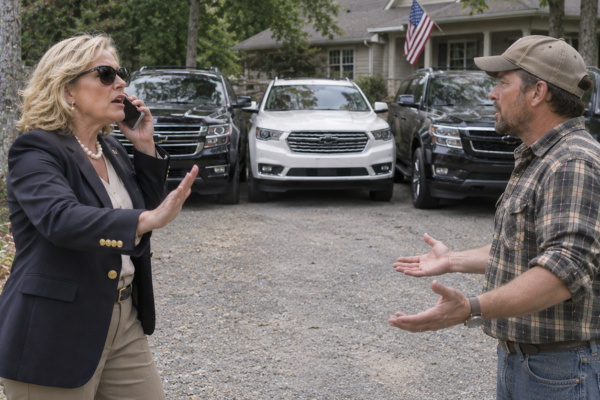
“Pay $500,000 or We’ll Take Your Dock,” the HOA President Warned After Claiming My Lakefront Cabin Owed 25 Years of Fees—Even Though My Property Had Been Outside Her Subdivision Since 1974. Then She Chained Off My Private Shoreline, Sent Me a Court Summons, and Smirked When I Called the Sheriff. She Had No Idea What I’d Spent 35 Years Investigating..k
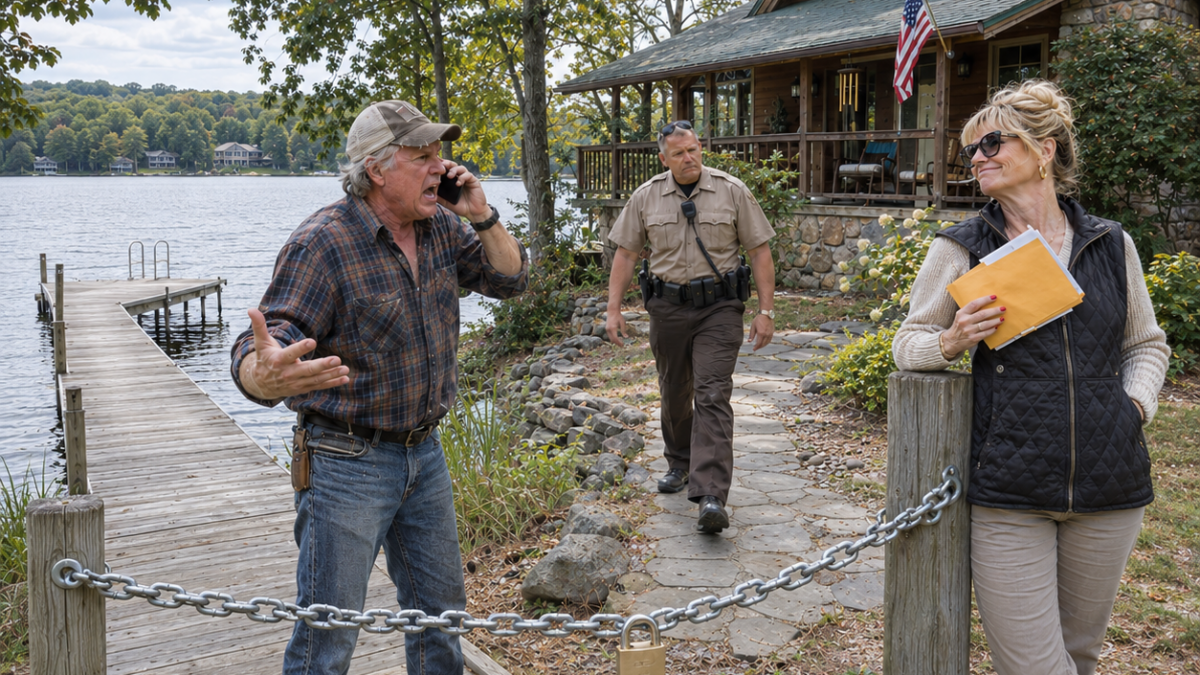
“Pay $500,000 or We’ll Take Your Dock,” the HOA President Warned After Claiming My Lakefront Cabin Owed 25 Years of Fees—Even Though My Property Had Been Outside Her Subdivision Since 1974. Then She Chained Off My Private Shoreline, Sent Me a Court Summons, and Smirked When I Called the Sheriff. She Had No Idea What I’d Spent 35 Years Investigating.
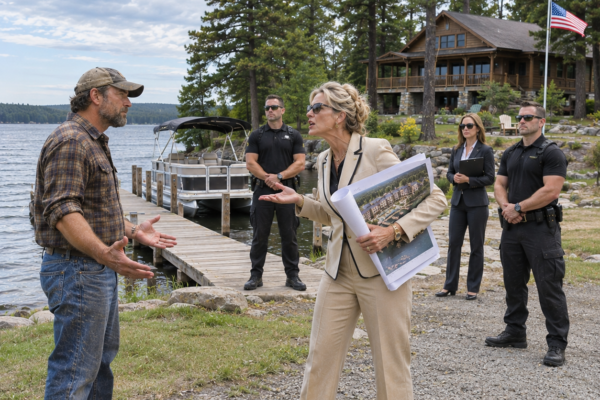
At 5:41 on a Thursday morning, the president of Silver Birch Shores HOA stood on my private lakefront property, fastening a steel chain across the path to my dock.
She didn’t know my new security cameras were recording her.
She certainly didn’t expect me to be watching from inside my cabin.
But there she was.
Patricia Monroe, president of the wealthiest homeowners association on Silver Maple Lake, wearing a blue windbreaker and expensive running shoes, shining a flashlight across a barricade her contractors had installed without my permission.
Then she looked directly into the camera.
And raised her middle finger.
I stared at my phone.
“Well, Patty,” I muttered, “that’s one way to introduce yourself to a judge.”
My name is Randall Greer. I’m sixty-two years old, retired after thirty-five years investigating water rights disputes, illegal shoreline construction, and fraudulent land-use claims across the Midwest.
I’d moved to Silver Maple Lake in northern Wisconsin two years earlier because I wanted peace.
A small log cabin.
A half-acre waterfront parcel.
A private dock where I could fish before breakfast.
And, most importantly, absolutely no homeowners association.
The property had been separately recorded since the 1970s. The subdivision called Silver Birch Shores was more than a mile away, with no recorded covenant or deed restriction connecting my cabin to its association.
I’d checked everything before buying.
The county plat.
The title commitment.
The recorded deed.
The historical shoreline survey from 1974.
My seller, an elderly fisherman named Walter Jensen, had even laughed when I asked about an HOA.
“Son,” he’d said, “I’ve lived here forty years. Nobody’s ever told me what color to paint my front door.”
That was exactly what I wanted to hear.
Then a white envelope appeared on my porch.
Across the front, stamped in red, were the words:
URGENT — $500,000 DUE IMMEDIATELY.
Inside was a statement from Silver Birch Shores Homeowners Association.
It claimed I owed twenty-five years of unpaid lake-maintenance assessments, shoreline preservation fees, dock charges, interest, and collection penalties.
The total was exactly $500,000.
The final paragraph threatened foreclosure proceedings and loss of waterfront access if I failed to pay within thirty days.
I read the letter twice.
Then I started laughing.
Twenty-five years of fees on property the association didn’t own, imposed on a man who’d bought the cabin only two years earlier.
Somebody had either made an extraordinary mistake or assumed I was too old and frightened to challenge them.
Three days later, a second envelope arrived.
This one contained a glossy color map titled Updated Shoreline Boundary — Adopted 2018.
A thick red line extended the HOA’s supposed jurisdiction far beyond its recorded subdivision.
It swallowed several privately owned lakefront cabins.
Including mine.
My dock was labeled:
HOA-MANAGED SHORELINE ACCESS.
That stopped me laughing.
The letter might have been an outrageous collection demand.
But this map looked like an attempt to manufacture ownership.
I drove straight to the county land records office.
A clerk named Evan Miller pulled up the subdivision’s official recorded plat while I unfolded the HOA’s map on the counter.
He studied them side by side.
Then frowned.
“Mr. Greer, these boundaries don’t match.”
“I know.”
“This red line crosses private parcels. There’s no recorded annexation corresponding to it.”
“Exactly.”
He examined the supposed county seal.
“Where did you get this?”
“From the association demanding half a million dollars.”
Evan looked up sharply.
Before he could answer, an elderly man carrying rolled survey maps approached the counter.
He introduced himself as Howard Lane, a retired county surveyor.
Howard took one look at Patty’s map and let out a disgusted whistle.
“Whoever drew this didn’t even line up the section corners.”
He tapped the red border.
“That’s not a recorded property boundary. Somebody drew a line over an aerial photograph and hoped nobody would ask questions.”
I felt my jaw tighten.
“Can you put that in writing?”
Howard nodded.
“I can explain what the recorded surveys actually show. And I’d be very interested to know who’s claiming this thing is official.”
I left with copies of the authentic plats and instructions on obtaining a formal survey review.
But by the following morning, the HOA had stopped relying on paperwork alone.
A six-foot steel barricade stood across my private trail to the dock.
Its posts were anchored into the ground.
A heavy chain blocked the path.
And a sign bolted to the center announced:
PROPERTY OF SILVER BIRCH SHORES HOA — LAKE ACCESS SUSPENDED UNTIL ALL FEES ARE PAID.
I photographed every bolt, drilled hole, and footprint before calling the sheriff’s office.
The responding deputy listened to my explanation, glanced at the HOA sign, and shrugged.
“Looks like a civil property dispute, sir. You’ll probably need a judge.”
I showed him the deed and the survey.
He told me to contact an attorney.
Then he left.
By the time Patty appeared on my security camera the next morning, I knew she wasn’t simply trying to collect fees.
She was testing how much of my property she could control before anyone stopped her.
That afternoon, another envelope was taped to my gate.
Inside was what appeared to be a court summons ordering me to appear before Judge Lance Holloway and explain why my shoreline should not be placed under HOA control.
The paper carried a court seal.
A case number.
And a judge’s signature.
I stared at the name.
Something about it bothered me.
I picked up the telephone and called the courthouse.
When the clerk answered, I asked one question.
“Could you tell me whether Judge Lance Holloway is still assigned to shoreline property cases?”
The woman went silent.
Then she said, “Sir, where did you get that name?”
I looked down at Patty’s summons.
“Why?”
Her answer changed everything.
Part 2:
At 5:41 on a Thursday morning, the president of Silver Birch Shores HOA stood on my private lakefront property, fastening a steel chain across the path to my dock.
She didn’t know my new security cameras were recording her.
She certainly didn’t expect me to be watching from inside my cabin.
But there she was.
Patricia Monroe, president of the wealthiest homeowners association on Silver Maple Lake, wearing a blue windbreaker and expensive running shoes, shining a flashlight across a barricade her contractors had installed without my permission.
Then she looked directly into the camera.
And raised her middle finger.
I stared at my phone.
“Well, Patty,” I muttered, “that’s one way to introduce yourself to a judge.”
My name is Randall Greer. I’m sixty-two years old, retired after thirty-five years investigating water rights disputes, illegal shoreline construction, and fraudulent land-use claims across the Midwest.
I’d moved to Silver Maple Lake in northern Wisconsin two years earlier because I wanted peace.
A small log cabin.
A half-acre waterfront parcel.
A private dock where I could fish before breakfast.
And, most importantly, absolutely no homeowners association.
The property had been separately recorded since the 1970s. The subdivision called Silver Birch Shores was more than a mile away, with no recorded covenant or deed restriction connecting my cabin to its association.
I’d checked everything before buying.
The county plat.
The title commitment.
The recorded deed.
The historical shoreline survey from 1974.
My seller, an elderly fisherman named Walter Jensen, had even laughed when I asked about an HOA.
“Son,” he’d said, “I’ve lived here forty years. Nobody’s ever told me what color to paint my front door.”
That was exactly what I wanted to hear.
Then a white envelope appeared on my porch.
Across the front, stamped in red, were the words:
URGENT — $500,000 DUE IMMEDIATELY.
Inside was a statement from Silver Birch Shores Homeowners Association.
It claimed I owed twenty-five years of unpaid lake-maintenance assessments, shoreline preservation fees, dock charges, interest, and collection penalties.
The total was exactly $500,000.
The final paragraph threatened foreclosure proceedings and loss of waterfront access if I failed to pay within thirty days.
I read the letter twice.
Then I started laughing.
Twenty-five years of fees on property the association didn’t own, imposed on a man who’d bought the cabin only two years earlier.
Somebody had either made an extraordinary mistake or assumed I was too old and frightened to challenge them.
Three days later, a second envelope arrived.
This one contained a glossy color map titled Updated Shoreline Boundary — Adopted 2018.
A thick red line extended the HOA’s supposed jurisdiction far beyond its recorded subdivision.
It swallowed several privately owned lakefront cabins.
Including mine.
My dock was labeled:
HOA-MANAGED SHORELINE ACCESS.
That stopped me laughing.
The letter might have been an outrageous collection demand.
But this map looked like an attempt to manufacture ownership.
I drove straight to the county land records office.
A clerk named Evan Miller pulled up the subdivision’s official recorded plat while I unfolded the HOA’s map on the counter.
He studied them side by side.
Then frowned.
“Mr. Greer, these boundaries don’t match.”
“I know.”
“This red line crosses private parcels. There’s no recorded annexation corresponding to it.”
“Exactly.”
He examined the supposed county seal.
“Where did you get this?”
“From the association demanding half a million dollars.”
Evan looked up sharply.
Before he could answer, an elderly man carrying rolled survey maps approached the counter.
He introduced himself as Howard Lane, a retired county surveyor.
Howard took one look at Patty’s map and let out a disgusted whistle.
“Whoever drew this didn’t even line up the section corners.”
He tapped the red border.
“That’s not a recorded property boundary. Somebody drew a line over an aerial photograph and hoped nobody would ask questions.”
I felt my jaw tighten.
“Can you put that in writing?”
Howard nodded.
“I can explain what the recorded surveys actually show. And I’d be very interested to know who’s claiming this thing is official.”
I left with copies of the authentic plats and instructions on obtaining a formal survey review.
But by the following morning, the HOA had stopped relying on paperwork alone.
A six-foot steel barricade stood across my private trail to the dock.
Its posts were anchored into the ground.
A heavy chain blocked the path.
And a sign bolted to the center announced:
PROPERTY OF SILVER BIRCH SHORES HOA — LAKE ACCESS SUSPENDED UNTIL ALL FEES ARE PAID.
I photographed every bolt, drilled hole, and footprint before calling the sheriff’s office.
The responding deputy listened to my explanation, glanced at the HOA sign, and shrugged.
“Looks like a civil property dispute, sir. You’ll probably need a judge.”
I showed him the deed and the survey.
He told me to contact an attorney.
Then he left.
By the time Patty appeared on my security camera the next morning, I knew she wasn’t simply trying to collect fees.
She was testing how much of my property she could control before anyone stopped her.
That afternoon, another envelope was taped to my gate.
Inside was what appeared to be a court summons ordering me to appear before Judge Lance Holloway and explain why my shoreline should not be placed under HOA control.
The paper carried a court seal.
A case number.
And a judge’s signature.
I stared at the name.
Something about it bothered me.
I picked up the telephone and called the courthouse.
When the clerk answered, I asked one question.
“Could you tell me whether Judge Lance Holloway is still assigned to shoreline property cases?”
The woman went silent.
Then she said, “Sir, where did you get that name?”
I looked down at Patty’s summons.
“Why?”
“Because Judge Holloway died three years ago.”
For a moment, I didn’t move.
The only sound in my kitchen was the ticking of the old wall clock above the stove.
“Are you certain?”
“Yes, sir. His successor took office shortly afterward.”
I looked again at the signature.
The summons purported to have been issued that very week.
“Would you check the case number for me?”
I read it aloud.
The clerk typed.
Then she tried a second search.
“There’s no case under that number. And that’s not the numbering format our court uses.”
I thanked her and ended the call.
Then I sat at the table, surrounded by the demands Patty had sent me.
Half a million dollars in fabricated fees.
A boundary map that didn’t match the recorded survey.
A barricade on private land.
And now a supposed court order bearing the name of a dead judge.
Some people make mistakes.
This wasn’t one mistake.
This was a campaign.
I photographed the summons and placed the original in a protective sleeve.
Then I called Julian Park, an old colleague from my water-rights investigation days.
Julian and I had worked together on cases involving illegal diversion of public water, fraudulent easements, and developers who believed a large enough legal budget could make inconvenient property owners disappear.
He answered on the second ring.
“Randall Greer. You finally get tired of fishing?”
“Something like that.”
I described what had happened.
By the time I reached the counterfeit summons, Julian had stopped interrupting.
“Have you spoken with a lawyer?”
“Not yet.”
“Call Naomi Chen. She’s handled property fraud and collection abuse for years. And Randall?”
“Yeah?”
“Don’t underestimate this woman just because her paperwork is ridiculous.”
“I don’t.”
“Good. People don’t put fake court documents in somebody’s mailbox unless they believe fear will do the rest.”
I called Naomi that afternoon.
Her office was in a renovated brick building a few blocks from the courthouse.
She was in her early forties, with short dark hair and a calm expression that didn’t change much as I described the situation.
She examined the demand letter.
Then the map.
Then the summons.
Finally, she leaned back.
“Mr. Greer, I want to make something very clear.”
“Go ahead.”
“An HOA cannot acquire your property simply by drawing a new boundary around it. And a private association cannot issue a court summons.”
“That’s what I told them.”
“But we still have to deal with the practical damage they’ve caused.”
She placed the barricade photographs beside the documents.
“Access interference. A possible fraudulent collection scheme. Potential document offenses. And a threatened lien that could create a serious problem if somebody tried to record it.”
I nodded.
“How do we stop her?”
“First, we establish the title history independently. Then we send formal notice to the association and its actual legal counsel. We seek an order protecting access if necessary, and we give the counterfeit documents to the appropriate investigators.”
I looked toward the window.
“What about the sheriff’s deputy who dismissed everything?”
“We’ll document what he did and what you showed him. But don’t build your strategy around convincing one deputy.”
She took a breath.
“You’re retired, Randall. Let the civil lawyers and investigators handle their respective jobs.”
I smiled faintly.
“You sound like my former supervisor.”
“Was your supervisor usually right?”
“Unfortunately.”
“Then listen to both of us.”
Before leaving, I asked whether the HOA’s threatened foreclosure could happen.
Naomi answered carefully.
“A valid foreclosure requires an actual enforceable obligation and proper legal process. They haven’t shown either. But fraudulent filings can still create trouble until they’re challenged. That’s why we act promptly.”
I drove home feeling better informed, but not exactly reassured.
At my age, I’d hoped to spend retirement worrying about whether the fish were biting.
Instead, I was hiring an attorney to defend a dock I’d already paid for.
And Patty Monroe was still out there, apparently convinced I would eventually hand her whatever she demanded.
The following Monday, Howard Lane accompanied a licensed surveyor to my property.
Howard had retired several years earlier, but he knew the historical survey records better than anyone I’d met.
We walked the boundary together.
The original markers were still identifiable.
The northern corner sat beyond a cluster of white pines.
The western line followed a shallow ridge down toward the water.
The lakeward boundary was documented in the recorded plat and accompanying legal descriptions.
The trail Patty had blocked was entirely inside my parcel.
So was the dock access.
There wasn’t even a plausible argument that her barricade occupied an HOA common area.
Howard stood beside the steel posts and shook his head.
“Somebody went to a lot of trouble to install this in the wrong place.”
“Do you think they knew?”
He pointed toward a survey marker less than fifteen feet away.
“That one’s visible from the trail. Somebody working from a proper plan would’ve seen it.”
The licensed surveyor documented the conditions and began preparing a report.
Howard made notes concerning the historical records and the discrepancies in the HOA’s map.
I watched them work.
A lifetime of investigating water disputes had taught me how powerful a simple line could be.
A line on a survey could decide which farmer could access a river.
Which family owned a strip of shoreline.
Whether a road was private or public.
But the line had to come from an actual legal description.
Patty’s version had no such foundation.
It was a red shape drawn across other people’s land.
That afternoon, Naomi sent a formal demand requiring the HOA to stop asserting authority over my property and remove its obstruction.
She included copies of the recorded documents.
She also informed its counsel that the purported summons had been reported for review.
Patty’s response arrived the next morning.
It was two sentences long.
Silver Birch Shores rejects Mr. Greer’s attempt to evade his longstanding community obligations. Any removal of association property will be treated as intentional destruction of HOA infrastructure.
I read it aloud to Howard when he stopped by with his preliminary findings.
He stared at me.
“Association infrastructure?”
“That’s what she calls the barricade.”
He looked toward the trail.
“I call it a fence somebody installed where it doesn’t belong.”
I couldn’t have agreed more.
But I wasn’t going to cut it apart while a lawsuit was developing.
Naomi filed for immediate protection against further interference and asked the court to order the obstruction removed.
Until the matter could be heard, I used a different route to reach the lake.
Every time I walked the longer path, I felt that cold anger return.
It wasn’t the extra distance that bothered me.
It was the idea that a stranger could put a chain across my land and dare me to challenge her.
Then, three days after Naomi filed our application, Patty visited my cabin in person.
I saw her white SUV pull into the gravel driveway at 11:18.
She stepped out wearing a pale blue blazer and carrying a folder.
A younger man in a gray suit followed her.
I opened the porch door but stayed inside.
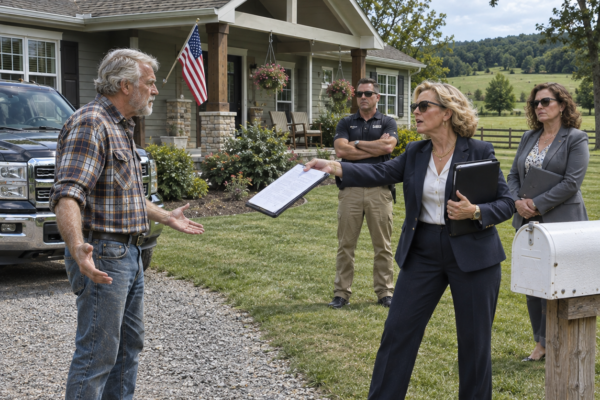
“Mr. Greer,” she said brightly. “I’m Patricia Monroe.”
“I know.”
She smiled.
“I believe we’ve had a misunderstanding.”
“Is that what you call half a million dollars and a barricade?”
Her smile tightened.
“The association has a responsibility to maintain consistent shoreline standards.”
“My property isn’t in your association.”
She sighed.
“That’s precisely the matter we’re trying to resolve.”
The man beside her opened his folder.
“I’m Keith Barlow, community compliance consultant.”
I looked at him.
“Are you an attorney?”
“No.”
“A surveyor?”
“No.”
“Do you work for the county?”
He hesitated.
“I’m authorized to represent the association in administrative matters.”
“Then you can explain why your association sent me a summons bearing the signature of a judge who’s been dead for three years.”
Patty’s expression changed.
Only slightly.
But I saw it.
“That document came from our legal department.”
“Your legal department needs to explain it to the prosecutor.”
She folded her arms.
“Mr. Greer, do you want to spend your retirement fighting expensive lawsuits?”
“No.”
“Then perhaps we should discuss a settlement.”
“What settlement?”
She opened her folder.
Inside was a proposed agreement.
If I signed, the HOA would reduce the claimed $500,000 debt to $75,000.
In exchange, I would grant Silver Birch Shores an irrevocable shoreline-management easement over my dock and lake access.
I stared at the paper.
There it was.
The real objective.
Not fees.
Not lake preservation.
Control of my waterfront.
“You want an easement.”
“We want a practical solution.”
“You want me to sign away rights to my property so you’ll forgive a debt I never owed.”
Patty’s voice grew cold.
“You’re making this more difficult than it needs to be.”
I handed the agreement back.
“Leave.”
Keith looked offended.
“Sir, you’re refusing a substantial financial concession.”
“No. I’m refusing to give away property to people who have no claim against it.”
Patty stepped closer.
“Do you know how much influence Silver Birch Shores has in this county?”
“Enough to buy nice stationery, apparently.”
Her face reddened.
I continued.
“Not enough to change my deed.”
For several seconds, she stared at me.
Then she turned toward her SUV.
“You’re going to regret that decision.”
I watched them drive away.
Then I called Naomi.
“Patty finally showed me what she wants.”
“What?”
“An easement over my shoreline.”
Naomi was silent for a moment.
“Send me that agreement.”
“I didn’t keep the original.”
“Did you photograph it?”
“Every page.”
She laughed softly.
“Randall, I think I’m going to enjoy working with you.”
I looked toward the lake.
I wasn’t enjoying any of it.
But at least we finally understood what Patty was trying to take.
And the next discovery would explain why she wanted it so badly.
The answer came from a property transaction nearly eighteen months old.
Naomi found it while reviewing the parcels shown inside Patty’s imaginary 2018 HOA boundary.
Two cabins on the north shore had changed hands after their owners received substantial assessment demands.
The owners weren’t HOA members.
Yet both had eventually signed agreements giving Silver Birch Shores control over part of their waterfront access.
One was a retired teacher named Helen Porter.
The other belonged to a couple who had moved to Arizona.
I knew Helen’s cabin.
It sat across a narrow inlet from mine, with a green metal roof and a little wooden bench beside the shore.
I’d waved to her from my boat several times.
Naomi contacted her attorney and arranged a conversation.
Helen agreed to meet us at my cabin.
She was seventy-six, wore a knitted cardigan despite the warm weather, and carried a folder held together with rubber bands.
When I offered coffee, she asked whether I had tea instead.
I put the kettle on.
Then she showed us the letter she’d received.
It looked almost identical to mine.
Different amount.
Same red stamp.
Same language threatening foreclosure and loss of waterfront access.
Her supposed debt was $92,400.
“I told them I didn’t belong to their HOA,” she said. “They said the lake district boundaries had changed.”
“Did they show you a map?” Naomi asked.
Helen nodded and pulled out a folded sheet.
The same red border.
The same invented 2018 boundary.
She’d received it the previous year.
Helen looked down.
“My husband had just died. I was trying to get his affairs settled, and they kept sending letters.”
Her voice trembled.
“Every one sounded worse than the last.”
Finally, Patty had offered to reduce the alleged debt if Helen signed a shoreline-access agreement.
Helen had paid several thousand dollars in administrative charges and granted the association permission to use a strip of land beside her dock.
“I thought it was the only way to keep them from taking my cabin.”
I felt sick.
This wasn’t simply about me.
Patty had found people she believed were frightened, isolated, or unlikely to challenge her.
Then she’d threatened them with debts manufactured from a boundary that didn’t exist.
Naomi asked whether Helen would share the documents with investigators.
Helen nodded.
“I don’t want anyone else going through this.”
After she left, I stood beside my kitchen window.
The lake was bright and peaceful.
Somewhere across the inlet, a fishing boat moved slowly toward the eastern shore.
I thought about what Helen had said.
She’d lost her husband.
Then, while she was grieving, she’d been told strangers could take away the place they’d shared.
I understood why she’d signed.
And I was furious at the people who’d put her in that position.
“Naomi,” I said, “how many others?”
“We’re going to find out.”
A week later, the court heard our request for temporary relief.
Patty attended with an attorney retained by the association.
Her lawyer argued that the HOA had a good-faith belief that its shoreline-management responsibilities extended beyond the original subdivision.
Naomi presented my recorded deed, the relevant plat, the survey findings, and the association’s demand letters.
Then she displayed the photograph of the barricade.
“Your Honor,” she said, “the association has no recorded right to occupy this trail. My client has been prevented from using his own waterfront access based on a financial claim the association hasn’t substantiated.”
The judge examined the materials.
Then she asked the HOA’s attorney a straightforward question.
“What recorded instrument makes Mr. Greer’s parcel subject to these assessments?”
The attorney referred to the 2018 map.
The judge looked at it.
“Is this a recorded plat?”
“Not in that form.”
“Is there a signed annexation agreement?”
“Not one we’ve located.”
“A deed restriction binding his parcel?”
The attorney hesitated.
“We believe the association’s historical authority supports the claim.”
The judge looked toward Naomi.
“Do you have the original chain of title?”
“Yes, Your Honor.”
She handed it over.
After reviewing the evidence and hearing the parties, the court granted temporary protection against further interference with my access and ordered the HOA to remove the barricade pending resolution of the case.
It also prohibited additional unsupported enforcement measures against my property while the dispute continued.
It wasn’t a final judgment on every issue.
But it meant I could walk to my own dock again.
The HOA had to remove the obstruction under the court’s order.
When the contractor arrived, I watched from the porch.
He unbolted the sign.
Released the chain.
Removed the posts.
And repaired the worst of the holes left in my trail.
It took less than two hours.
Patty had spent days trying to convince me her barricade was permanent.
A judge had made her remove it.
The following morning, my security camera recorded Patty standing at the cleared entrance.
She stared at the empty ground.
Then she looked directly toward the camera.
I’d installed an additional camera after the first incident, so the recording was clear.
Patty raised her middle finger.
Held it there.
Then walked away.
I saved the footage.
Not because the gesture was a crime.
Because it showed how personally she’d taken being required to respect my boundary.
That evening, Naomi called with another development.
The court had approved appropriate document production in the civil case.
The association was being required to preserve and produce the underlying records used to support its alleged jurisdiction.
That included the digital map.
And when we finally received the native design file, we found something that changed the case.
The supposed Updated Shoreline Boundary — Adopted 2018 hadn’t been created in 2018.
Its actual file history began less than a year earlier.
The original digital file was saved under a folder associated with the Silver Birch Shores administrative office.
The author information identified an account used by Patty’s assistant.
And the print records produced by the association showed copies had been generated on an office printer shortly before the first disputed assessment letters went out.
The map had been dressed up as a historical government document.
But it was really a modern illustration made inside the HOA office.
The county seal had been copied from a different document.
The boundary line hadn’t been created by a licensed surveyor.
And no matching annexation had ever been recorded.
Evan Miller’s initial concerns were now supported by the underlying electronic evidence.
Howard’s survey analysis showed the same thing from the land-record side.
The map didn’t merely contain errors.
It purported to show official authority that the recorded documents did not provide.
Naomi looked at me across her desk.
“Now we have a much better idea of where this came from.”
“Can you prove Patty ordered it?”
“We have communications requesting the map and approving its distribution. That’s evidence of involvement. Investigators will have to establish her knowledge and intent.”
I nodded.
Then she handed me another document.
It was an internal planning memorandum titled North Shore Access Consolidation.
The HOA had been discussing a private arrangement with Lakeside Development Partners, a company proposing a members-only marina and recreational club on Silver Maple Lake.
The plan depended on obtaining control over several privately owned access points.
Helen’s shoreline was one.
Mine was another.
The memorandum showed the projected cost of purchasing access rights through ordinary negotiation.
Then it showed a much lower cost if the association acquired those rights through what the document called assessment settlements.
I stared at the phrase.
“Assessment settlements?”
Naomi nodded.
“They would demand money, then offer to forgive that demand in exchange for an easement.”
I looked at the plan again.
My waterfront access was identified as an important location because it connected an existing gravel road to one of the lake’s deeper sections.
A marina developer could use it as a convenient service point.
My cabin was being treated as an obstacle.
And the $500,000 demand?
It was leverage.
Not a legitimate debt.
Not an assessment I’d missed.
A number designed to frighten me into signing over the one piece of land they wanted.
I sat back.
“Patty didn’t think I’d pay half a million.”
“Probably not.”
“She wanted me to believe giving up the dock was the cheaper option.”
“That’s consistent with the documents.”
I shook my head.
“My entire retirement has turned into a real-estate transaction I never agreed to join.”
Naomi looked at me.
“Then let’s make sure the people affected know what’s happening.”
Silver Birch Shores was holding its annual Unity Day gathering the following Saturday.
There would be food stalls, children’s games, association announcements, and a presentation about what Patty called the future of shoreline stewardship.
Naomi suggested we attend.
Not to storm the stage.
Not to turn a neighborhood festival into a confrontation.
But to provide the board and interested homeowners with the recorded facts.
I agreed.
Over the next few days, we prepared a short presentation using documents we were permitted to disclose.
The official 1974 survey.
The actual HOA plat.
The fabricated boundary map.
The counterfeit summons.
Photographs of the barricade.
And the court’s temporary order protecting my access.
I wanted the homeowners to understand that the association president wasn’t defending their property rights.
She was using their money and their name to threaten people outside the community.
At Unity Day, the parking lot smelled of grilled hot dogs and fresh popcorn.
Children bounced inside an inflatable castle.
A few retirees sat beneath a tent, drinking lemonade and discussing fishing conditions.
It would’ve been a pleasant afternoon if I hadn’t known what was hidden behind Patty’s presentation.
She stood near the front in a pale green blouse, greeting residents as though nothing unusual had happened.
When she saw Naomi and me, her smile stiffened.
“Mr. Greer. I wasn’t expecting you.”
“I thought your presentation about shoreline management might interest me.”
“This event is primarily for association members.”
“I’m here with an invitation from one of your directors.”
Her eyes flicked toward Naomi.
“Your attorney seems to accompany you everywhere.”
“Only when I think somebody might try to give me a $500,000 bill.”
Patty didn’t laugh.
We took seats near the front.
When her presentation began, she spoke warmly about protecting the lake for future generations.
She displayed photographs of clean shorelines, repaired docks, and smiling families.
Then she announced that all waterfront properties should contribute to a coordinated maintenance plan.
A few residents applauded.
Others looked puzzled.
A man near the back raised his hand.
“Are you saying people outside the subdivision will have to pay our association?”
Patty smiled.
“Where a property benefits from managed lake access, equitable participation is appropriate.”
Naomi leaned toward me.
“She’s doing it again.”
I nodded.
Then Patty displayed the fake boundary map.
The red line filled the projector screen.
And I knew it was time.
I stood.
“Mrs. Monroe, may I ask a question about that map?”
Her smile disappeared.
“Mr. Greer, this isn’t the appropriate forum for your personal dispute.”
“It’s a map you just presented to your members as the basis for collecting money.”
Several people turned toward me.
Patty folded her arms.
“Very well. Briefly.”
I walked toward the front carrying my folder.
“Can you tell everyone where this boundary was officially recorded?”
She stared at me.
“The association’s records are maintained by our administrative office.”
“That’s not what I asked.”
I held up the county’s authenticated plat.
“Where is the recorded document showing these private parcels were added to Silver Birch Shores?”
Patty glanced toward the board members.
Then she said, “The jurisdictional update was approved in 2018.”
I turned toward the audience.
“According to the file history, this map was created years after 2018, inside the HOA’s own office. And the county has no recorded annexation supporting it.”
A murmur spread across the tent.
Patty’s face reddened.
“That is a gross misrepresentation!”
Naomi stepped forward.
“We can provide the authentic land records and the court documents to the board’s counsel. There’s also an ongoing investigation into the association’s use of the map.”
A woman in the second row raised her hand.
“Then why did my mother get a bill for twenty thousand dollars?”
Another resident stood.
“My brother paid one of those shoreline fees!”
Patty gripped the microphone.
“Everyone needs to calm down.”
I opened the folder.
Then I held up the supposed court summons.
“This document was sent to me as part of the association’s enforcement campaign. It orders me to appear before Judge Lance Holloway.”
I paused.
“Judge Holloway died three years before this summons was supposedly issued.”
The tent went silent.
Someone near the back whispered, “You’ve got to be kidding.”
Patty’s expression changed.
For the first time, she looked genuinely frightened.
I continued.
“The courthouse confirmed that the case number doesn’t exist. The document isn’t a valid summons.”
A board member stood.
“Patty, who authorized that?”
She pointed toward Naomi.
“This is an attack on the association!”
“No,” I said. “It’s a question about documents carrying your association’s name.”
The board treasurer, Martin Bell, had been sitting quietly beside Patty.
Now he stood and looked toward the audience.
“I’ve asked for an independent financial review.”
Patty turned sharply.
“Martin, sit down.”
He didn’t.
“I’ve been trying to reconcile the shoreline assessments. Some deposits don’t match the maintenance accounts.”
A resident shouted, “Where did our money go?”
Another demanded to see the invoices.
Then someone asked why the HOA had paid consulting fees to companies that seemed connected to Patty’s family.
The crowd began speaking over itself.
Patty raised her voice.
“Enough! These people are outsiders trying to destroy our community!”
I stepped away from the microphone.
Naomi looked toward the residents.
“Your governing documents give you procedures for reviewing records and holding your board accountable. Use them. The evidence belongs with the appropriate investigators, not in a shouting match.”
That settled the moment better than any dramatic accusation could have.
The directors agreed to hold a special meeting and retain independent counsel.
Several residents asked Naomi how to obtain copies of the public land records.
Helen Porter, who’d come with us, stood near the back of the tent.
She wasn’t shouting.
She was holding the letter she’d received the year before.
A younger woman approached her and asked what had happened.
Helen began explaining.
I watched them from across the parking lot.
For the first time, I felt that the problem was bigger than Patty’s attempt to take my dock.
It involved people who had paid money they might never have owed.
People who had surrendered access rights because they were frightened.
And homeowners who had trusted their association’s leadership without realizing what was being done in their name.
As Naomi and I walked toward my truck, Patty called after us.
“Randall!”
I turned.
She stood beside the tent, her face flushed.
“You think you’ve won?”
I looked at her.
“No, Patty.”
She took a step closer.
“Then what do you think you’ve accomplished?”
I glanced toward the residents gathering around Martin and the other directors.
“I think people are finally asking questions you should have answered years ago.”
Then I got into my truck.
The real reckoning was still ahead.
Three days after Unity Day, I received a telephone call from Assistant District Attorney Conrad Weaver.
“Mr. Greer, I’d like you to come in tomorrow afternoon.”
“Is something wrong?”
“We’ve made progress reviewing the documents your attorney submitted. There are some additional questions.”
I looked out toward the lake.
“About the summons?”
“That, and the financial records.”
Conrad’s office was in an older building behind the courthouse.
When I arrived, Naomi was already there.
Conrad greeted us, then opened a thick folder.
He didn’t waste time with congratulations.
He explained what investigators had established and what still needed verification.
The purported boundary adjustment had not been recorded by the county.
The summons had not been issued by any court.
The judge named on it was deceased.
Investigators had also obtained communications connecting the preparation and distribution of the documents to the association’s administrative office.
But the financial records were becoming the most serious part of the case.
Over several years, Silver Birch Shores had collected substantial amounts in what it called special shoreline assessments.
Some charges were imposed on genuine HOA members without the approvals required by the association’s governing documents.
Others were demanded from property owners who had never joined the association.
The money hadn’t all gone toward shoreline maintenance.
Conrad showed us a preliminary accounting summary.
Payments had been made to businesses associated with Patty and people close to her.
There were questionable consulting fees.
Personal travel expenses.
Restaurant bills.
Vehicle payments.
And charges that appeared unrelated to any legitimate HOA responsibility.
Investigators were examining more than $300,000 in disputed transactions.
Conrad was careful to distinguish unexplained expenses from proven theft.
But the pattern was troubling.
I thought about Helen Porter.
Her $92,400 demand.
The money she’d paid.
The access rights she’d signed away because she was afraid of losing her husband’s cabin.
“Are the other property owners being contacted?” I asked.
“Yes. We’re reviewing the records and identifying potential victims.”
“What about Patty?”
“She’ll have an opportunity to respond to the allegations. We’ll follow the evidence.”
He closed the folder.
“Mr. Greer, I also want you to stay away from direct confrontations with her. There’s already an order concerning your property. Let us know immediately if she violates it.”
I nodded.
Naomi looked at me.
“He’s been doing that.”
Conrad studied my face.
“Good. Let’s keep it that way.”
I left the courthouse feeling something I hadn’t expected.
Not relief.
Sadness.
Because every questionable payment represented money that had come from somebody.
A retired couple.
A widow.
A family trying to afford their lake cabin.
People who trusted that their association dues would maintain roads, docks, and shared facilities.
Patty had apparently treated those funds as though they were hers.
That evening, I sat on my deck watching the last sunlight fade from the water.
For the first time in weeks, the trail to my dock was open.
The barricade was gone.
My boat floated quietly against its mooring.
I thought perhaps the worst was finally behind me.
Then, shortly after eight, headlights appeared near the northern edge of my driveway.
The vehicle stopped.
Its lights went out.
A minute later, it moved backward into the trees.
I stood.
Something about the movement bothered me.
I checked the security-camera application.
One camera showed a figure near the property line.
Another detected movement on the western slope.
I enlarged the first image.
The person wore a dark windbreaker.
Short hair.
A familiar posture.
It looked like Patty.
Then a second figure appeared behind her.
A man.
Larger.
Carrying a duffel bag.
I didn’t go outside.
I called Naomi.
“Someone’s on the property.”
“Can you identify them?”
“One looks like Patty. There’s another man.”
“Stay inside and call 911.”
“I already have the cameras recording.”
“Good. Keep the doors locked.”
I ended the call and contacted emergency dispatch.
I provided my address, described the two people, and explained the existing court order.
Then I waited.
The two figures continued down the path.
I switched on the exterior floodlights.
The yard became bright as day.
Patty stopped dead.
Even through the camera, I recognized her.
She shielded her eyes.
The man beside her dropped the bag.
Something metallic spilled onto the ground.
Bolt cutters.
A pry bar.
Spray paint.
Several folded forms.
I felt my stomach turn.
I couldn’t know exactly what they’d intended.
But they had brought tools capable of damaging locks and equipment, and they had entered my property after repeated warnings.
Patty looked toward the cabin.
For one terrible second, I thought she might approach the door.
Instead, she turned toward the trees.
Then I heard sirens.
Two patrol vehicles came up the driveway.
The first stopped near the garage.
The second moved toward the upper trail.
Deputies directed both trespassers to remain where they were.
The man dropped to his knees.
Patty tried to run.
She made it perhaps thirty yards before a deputy caught up with her near the edge of the woods.
I remained inside until officers secured the scene.
Then I stepped onto the porch and identified myself.
A deputy approached.
“Mr. Greer?”
“Yes.”
“Are you injured?”
“No.”
“Did you invite either of these people onto your property?”
“No. They’ve been instructed not to enter, and there’s a court order addressing interference.”
He nodded.
“We’ll need the video.”
“You can have copies. The original files are preserved.”
Patty was brought toward a patrol vehicle.
Her hands were restrained behind her back.
She looked furious.
When she saw me, she stopped walking.
“This is your fault!”
The deputy asked her to keep moving.
Patty raised her voice.
“You’ve destroyed everything I worked for!”
I stood beneath my porch light.
“No, Patty. You came onto my property with tools after being told to stay away.”
She stared at me.
Then she was placed inside the vehicle.
The second man was identified as a relative who had agreed to accompany her.
Investigators recovered the contents of the bag and documented the scene.
The incident added serious questions to the ongoing investigation, including whether Patty had intended to damage property, interfere with evidence, or violate the court’s protective orders.
I didn’t pretend to know every answer that night.
But the cameras had recorded what happened.
And I was grateful I’d called the authorities instead of walking into the darkness to confront them.
After the vehicles left, I sat on the porch.
My hands were shaking.
I’d spent thirty-five years investigating people who thought they could take what didn’t belong to them.
I’d been threatened before.
I’d seen angry landowners, dishonest contractors, and developers who believed money entitled them to special treatment.
But it was different when the target was my own home.
My retirement.
The quiet place I’d chosen after decades of work.
Naomi arrived a little later.
She looked toward the trees.
“Are you all right?”
I nodded.
“Just tired.”
She sat beside me.
For a while, we listened to the water.
Then she said, “You did the right thing tonight.”
“Staying inside?”
“Yes.”
I looked toward the dock.
“I wanted to go out there.”
“I know.”
“But I didn’t.”
She nodded.
“That’s why you’re sitting here talking to me instead of explaining a confrontation nobody needed.”
I let out a long breath.
The next few months changed Silver Birch Shores completely.
Patty’s arrest forced the remaining board members to confront what had been happening under their authority.
The association hired independent counsel.
An outside accountant reviewed its finances.
Residents requested records of every shoreline assessment, special charge, and major payment approved during Patty’s presidency.
Some of the findings were devastating.
Approximately forty percent of the disputed expenditures reviewed from a particularly active period had been directed toward expenses or entities that did not have adequate support as legitimate association obligations.
Not every dollar was necessarily criminal.
But the audit revealed a pattern of poor controls, unauthorized transactions, and misleading financial reporting.
The association began correcting accounts and cooperating with the prosecutor.
Some residents filed claims for refunds.
Others challenged liens based on disputed assessments.
Helen’s case received particular attention.
Naomi helped her obtain a legal review of the shoreline agreement she’d signed under pressure.
The agreement was ultimately rescinded through a negotiated resolution, and her access rights were restored.
When Helen called to tell me, she was crying.
“Randall, I can finally stop worrying about the dock.”
I stood beside my kitchen window.
“That’s wonderful, Helen.”
“My husband built those steps himself. Every summer he used to sit there with his fishing pole.”
Her voice broke.
“I thought I was going to lose the last place that still felt like him.”
I closed my eyes.
“I’m glad you didn’t.”
She was quiet for a moment.
Then she said, “You know, they told me fighting would cost more than paying.”
“I know.”
“I believed them.”
“That’s what they were counting on.”
We talked for several more minutes.
Afterward, I sat at the kitchen table thinking about something my old supervisor used to say.
Fraud doesn’t always work because the paperwork is convincing.
Sometimes it works because the person receiving it is exhausted, frightened, or alone.
Patty had understood that.
She’d relied on it.
She’d sent thick envelopes, stamped them with urgent warnings, and used official-looking language to make ordinary people afraid of losing their homes.
But the records had finally caught up with her.
The criminal proceedings continued for several months.
Patty’s attorneys challenged the evidence and disputed the prosecution’s interpretation of the transactions.
The investigators examined the native map files, communications, payment records, and false court documents.
Witnesses testified about the assessment demands and the circumstances under which access agreements had been signed.
Helen described her experience.
The association’s former treasurer explained the financial discrepancies he’d discovered.
I testified about the letters, barricade, trespass, and attempted intimidation.
The security footage was presented through the appropriate evidentiary process.
Patty eventually entered guilty pleas to multiple charges arising from the fraudulent documents, financial scheme, and related offenses.
The judge imposed a combined sentence totaling ten years, with the custodial and supervision portions governed by the applicable sentencing rules.
Additional restitution obligations and financial remedies were addressed through the criminal and civil proceedings.
I attended the final hearing.
Patty looked smaller than I remembered.
Not physically.
But without the podium, the expensive folders, and the association title, she no longer seemed like someone who controlled the entire lake.
She was simply a woman being held accountable for things she’d chosen to do.
When the judge finished, she glanced toward me.
Our eyes met for a moment.
I didn’t smile.
I didn’t celebrate.
I thought about the first letter she’d sent.
Half a million dollars.
A number that had once seemed so absurd I laughed.
Then I thought about Helen and the other people who had been frightened into paying or signing away rights.
There was nothing funny about it anymore.
The HOA itself faced a separate reckoning.
Its members no longer trusted the leadership structure that had allowed Patty to exercise so much control.
After independent legal review, the homeowners considered whether to rebuild the association’s governance or dissolve it under the procedures in their recorded governing documents.
There were practical issues to resolve.
Shared road maintenance.
Common property.
Outstanding contracts.
Insurance.
Valid financial obligations.
The members couldn’t simply wave their hands at a meeting and make those responsibilities disappear.
But they could decide that the existing association should no longer operate.
They held the required meetings, circulated the proposed dissolution plan, and obtained the necessary member approval.
A transition arrangement was established for the remaining common-property responsibilities.
The appropriate documents were prepared and recorded.
Over time, Silver Birch Shores HOA was formally wound down.
Its former members remained homeowners.
The lake remained where it had always been.
And the property rights of people outside the subdivision were no longer being challenged by a board that had tried to invent authority it didn’t possess.
I returned to my cabin after the final proceedings.
The afternoon sun was warm.
Silver Maple Lake was nearly motionless.
I walked down the restored trail to my dock.
No barricade.
No heavy chain.
No threatening sign.
Just a narrow path through the pines.
I stood at the water’s edge and remembered the morning I found the $500,000 letter.
At the time, I’d wanted nothing more than to spend my retirement fishing.
I hadn’t expected to spend months in lawyers’ offices, examining surveys, or testifying about a fabricated court summons.
But the experience reminded me of why I’d spent thirty-five years investigating land and water disputes.
Property records aren’t merely paper.
They protect real places.
Homes.
Family cabins.
Farms.
Shorelines.
Places people work their entire lives to own.
And when someone manufactures documents to claim authority over those places, the damage reaches far beyond money.
I looked across the inlet toward Helen’s cabin.
Her little green roof caught the sunlight.
I could see her sitting beside the water, a fishing pole resting against the railing.
I raised my hand.
She waved back.
That was enough to make me smile.
A week later, Walter Jensen, the man who’d sold me the cabin, stopped by.
He was eighty-four now, still wore the same faded fishing hat, and still believed coffee should be strong enough to remove paint.
I poured him a cup.
We sat on the deck.
He looked out over the lake.
“Quite a mess you had with that association.”
“That’s putting it mildly.”
He shook his head.
“Imagine trying to charge you for twenty-five years of something you never agreed to pay.”
I laughed.
“Half a million dollars.”
Walter whistled.
“Must’ve been some expensive lake water.”
We sat quietly.
Then he looked toward the dock.
“You ever regret buying this place?”
I considered the question.
There had been nights when I’d wondered whether peace was worth fighting so hard to protect.
But as I looked around, I knew the answer.
“No.”
Walter smiled.
“Good.”
He reached for his coffee.
“Because your cabin’s always been a good place.”
I nodded.
“It still is.”
That evening, after Walter left, I took the old evidence binder from my desk.
It contained the original demand letter.
The fake map.
The counterfeit summons.
The photographs of the barricade.
The survey report.
The court orders.
And copies of the records that had helped expose what Patty was doing.
I looked through it one final time.
Then I closed it and placed it on a shelf in my study.
I didn’t need to keep it beside my coffee maker anymore.
Outside, the sun was setting.
I carried my fishing pole down to the dock and sat in the same chair I’d used before any of this started.
A loon called from the far side of the lake.
A light breeze moved through the pines.
The water turned gold, then silver.
For months, Patty Monroe had tried to convince me that a line she’d drawn across a map could change who owned this land.
She’d threatened foreclosure.
Blocked my dock.
Sent a summons bearing the signature of a dead judge.
And when the paperwork failed, she’d come onto my property in the dark.
But none of those things changed the recorded deed.
None gave her lawful control of my shoreline.
And none meant I had to surrender the place I’d worked a lifetime to enjoy.
I cast my line into the lake.
The bobber settled beside a patch of reeds.
For a while, nothing happened.
Then it moved.
I smiled and reached for the rod.
Retirement had finally returned to being exactly what I’d wanted.
Coffee in the morning.
Fishing at sunset.
And a cabin nobody else got to claim simply by putting its name on a piece of paper.
The lake was quiet again.
My dock was mine.
And the only thing I owed Silver Birch Shores was absolutely nothing.