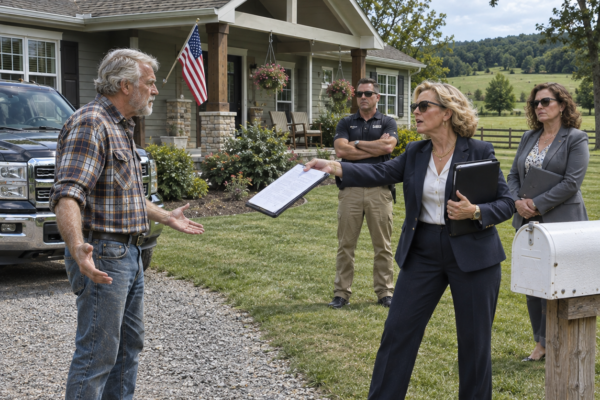
“Get Off My Land, or I’ll Call the Real Police!” the HOA President Screamed From My Own Porch—217 Feet Outside Her Subdivision. She Gave Me 72 Hours to Vacate, Cut My Gate Lock at 3:14 A.M., and Reported Me as the Trespasser. Then Four Men in Tactical Vests Arrived With Badges and a Paper They Called an “Eviction Order”….k
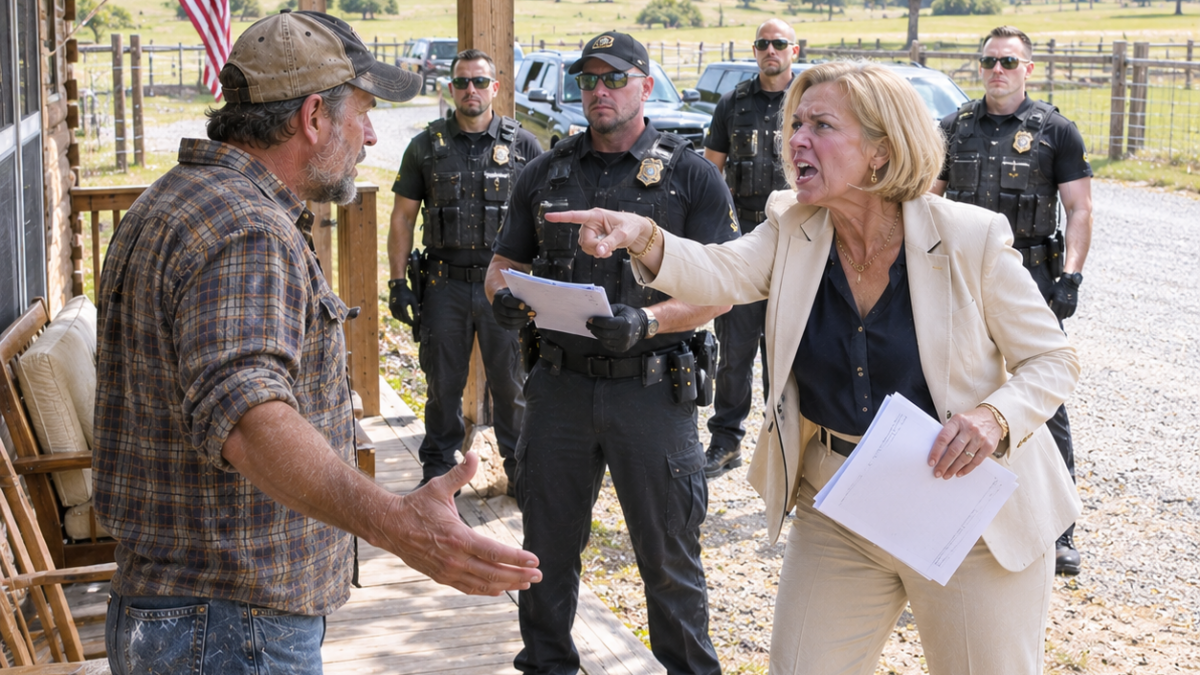
“Get Off My Land, or I’ll Call the Real Police!” the HOA President Screamed From My Own Porch—217 Feet Outside Her Subdivision. She Gave Me 72 Hours to Vacate, Cut My Gate Lock at 3:14 A.M., and Reported Me as the Trespasser. Then Four Men in Tactical Vests Arrived With Badges and a Paper They Called an “Eviction Order”…
“GET OFF MY PROPERTY BEFORE I CALL THE REAL POLICE!”
The woman screaming those words was standing on my front porch.
My porch.
On land I’d legally purchased six months earlier, exactly 217 feet outside the boundary of Copperwood Estates Homeowners Association.
I stood in the doorway holding a cup of black coffee, wondering whether I’d somehow missed the moment when private property became something a woman with a clipboard could simply claim.
“Eleanor,” I said, “you’re the one who needs to leave.”
Her face turned scarlet.
“Don’t you dare tell me where I can stand! I’ve been president of this association for twenty years!”
“Congratulations. Your association still doesn’t own my land.”
She slammed a yellow violation notice against my door.
“Seventy-two hours, Mr. Graves. Remove those unauthorized structures and submit to our inspection, or we’ll take the necessary steps to remove you.”
I looked past her toward the white Lexus parked across my gravel driveway.
Then I looked at the notice.
Unauthorized fence.
Unapproved storage shed.
Nonconforming vehicle parking.
Failure to comply with architectural standards.
Every alleged violation concerned improvements on property that had never belonged to Copperwood Estates.
My name is Nolan Graves. I was sixty-one, a retired real-estate attorney, and I’d moved to a wooded valley in northern Arizona because I was finished spending my days arguing with people who believed an expensive letterhead made them right.
I’d spent ten years of my legal career dealing directly with deeds, easements, boundary disputes, and property litigation.
I knew precisely what the recorded documents said.
And I knew Eleanor Thorne had no authority over my home.
I went inside, retrieved my closing folder, and unfolded the certified survey on the porch railing.
“Here’s the subdivision boundary,” I said, pointing. “And here’s my property line. They’re separated by 217 feet. There’s no annexation agreement, no HOA covenant against my parcel, and no recorded document giving your association enforcement authority here.”
Eleanor barely looked.
“Those maps are outdated.”
“The survey was prepared two years ago.”
“Boundaries change, Mr. Graves.”
“Not because an HOA president says they do.”
She stepped closer.
“People like you come here thinking you can ignore the community. You put up ugly fences, park junk in your yards, and expect the rest of us to tolerate it.”
“My truck is registered. My shed is permitted. And my fence is on my land.”
She pointed toward my cabin.
“Not for much longer.”
Then she turned, marched down my steps, and drove away.
I should have called an attorney immediately.
Instead, I made the mistake of believing that showing her the deed would end the problem.
The following morning, eleven emails arrived from Copperwood’s enforcement department.
By noon, yellow violation notices covered my gate, mailbox, shed, and fence.
The HOA threatened $500 in daily penalties.
Then Eleanor called.
“You have twenty-four hours to vacate,” she announced.
I informed her the call was being recorded.
She didn’t care.
“If you don’t cooperate, we’ll remove you ourselves.”
I saved the recording, called a licensed surveyor, and installed additional security cameras.
My surveyor, Fletcher Hayes, came the next day.
After checking the recorded measurements and recovering the existing boundary markers, he confirmed exactly what I’d already shown Eleanor.
My property was 217 feet beyond Copperwood’s jurisdiction.
I sent her the certified findings.
She didn’t respond.
At 3:14 the following morning, my rear camera recorded three people approaching the gate.
Eleanor was one of them.
The other two wore reflective vests marked HOA INSPECTION TEAM.
One man produced bolt cutters.
He snapped my gate lock.
Then all three entered my property.
They spent twenty-three minutes measuring, photographing, and examining the structures Eleanor claimed were illegal.
I watched the footage twice before filing a trespass and property-damage report.
Ten hours later, Eleanor returned.
This time, she brought the same two associates in business clothes.
When I confronted them with the recording, she denied everything.
Then I played the video.
Her expression changed.
For the first time, she appeared genuinely frightened.
But instead of leaving, she pulled out her phone.
“Fine,” she snapped. “I’ll let the authorities settle this.”
She dialed 911.
Then, standing in front of my camera, she reported that a dangerous man was threatening her on HOA property.
I couldn’t believe what I was hearing.
She gave dispatch my address.
She described me as an aggressive trespasser.
And she demanded that officers remove me from my own home.
I remained beside the gate, recording every word.
Fifteen minutes later, a sheriff’s cruiser turned into the driveway.
Deputy Aaron Finch stepped out.
Eleanor hurried toward him.
“Officer, thank goodness! This man refuses to leave our community property!”
The deputy looked at her.
Then at me.
Then at the survey folder in my hands.
“All right,” he said. “Before anybody goes anywhere, I need to see the documents.”
I handed him my deed.
The certified survey.
And my phone, already displaying the video of Eleanor cutting through my gate.
He watched without speaking.
Then he looked toward her.
“Mrs. Thorne,” he said slowly, “I need you to explain why you entered this man’s property at three o’clock in the morning.”
Eleanor’s smile vanished.
But instead of answering, she reached into her leather folder.
“I have something that gives us the right to be here.”
And when she unfolded the paper, I realized she hadn’t come to argue about a fence.
She’d come prepared to make me disappear.
Part 2:
“GET OFF MY PROPERTY BEFORE I CALL THE REAL POLICE!”
I had owned my cabin for six months when a woman I’d never met drove up my gravel driveway and ordered me to leave it.
She stood on my front porch in a black designer suit, one hand gripping a leather clipboard, the other resting on her hip.
Behind her, a white Lexus SUV blocked half the driveway.
The morning had been peaceful until she arrived.
I’d been drinking coffee beside an open window, listening to the wind move through the ponderosa pines. A pair of quail had been picking through the gravel near the shed. Somewhere beyond the trees, a woodpecker was making the sort of racket that sounded louder because nothing else was happening.
That was the life I’d come here for.
Then this woman decided she owned it.
“Ma’am,” I said, “you seem to have the wrong property.”
Her eyes narrowed.
“I know exactly where I am. I’m Eleanor Thorne, president of Copperwood Estates Homeowners Association.”
She said the title as if she expected me to salute.
“I’m Nolan Graves.”
“Then you are the gentleman responsible for these violations.”
She opened her clipboard.
“Unauthorized fencing. An unapproved storage structure. Nonconforming vehicle parking. Exterior improvements inconsistent with the neighborhood’s architectural standards.”
I looked toward my wooden fence.
Then my little equipment shed.
Then the pickup I’d parked beside the garage.
Nothing remarkable.
Nothing illegal.
And none of it located inside Copperwood Estates.
“You’re about 217 feet outside your jurisdiction,” I told her.
She laughed.
“Mr. Graves, I’ve been managing this community for twenty years. You don’t get to move into our valley and decide which rules apply to you.”
“I didn’t move into your community.”
“That distinction is outdated.”
I stared at her.
“Outdated?”
“Community boundaries evolve.”
“Recorded property boundaries don’t evolve because someone wants them to.”
Her mouth tightened.
I went inside and retrieved the closing folder I’d kept in the kitchen cabinet.
I’d spent ten years of my career as a real-estate attorney handling the sort of disputes that made ordinary people hate paperwork.
Disputed easements.
Incorrect legal descriptions.
Boundary encroachments.
Improperly recorded restrictions.
I’d seen families spend years fighting over six feet of land because somebody had trusted a fence instead of a survey.
That was why I’d been meticulous when buying my retirement home.
Before closing, I’d reviewed the title commitment, the legal description, the subdivision documents, and a professionally prepared survey.
I wasn’t trying to acquire a legal puzzle.
I wanted a quiet cabin on a few acres of Arizona woodland, far enough from a city to hear birds instead of traffic.
I hadn’t asked for special treatment.
I’d simply made sure I wasn’t purchasing an HOA property.
Now I spread the survey across the porch railing.
“Here’s Copperwood’s recorded boundary,” I said. “Here’s my parcel. There’s 217 feet between them.”
Eleanor glanced at the paper.
Then looked away.
“Old maps aren’t reliable.”
“This survey is two years old. The underlying records are older, but still operative.”
“Then your information hasn’t caught up with the association’s expansion.”
“Do you have a recorded instrument changing the boundaries or imposing covenants on this property?”
Her expression hardened.
“I don’t have to justify our governance to every newcomer.”
“Actually, if you’re claiming authority over someone’s land, you need a legal basis.”
She slapped a yellow notice onto my door.
“You have seventy-two hours to submit your structures for retroactive approval.”
“I’m not submitting anything.”
“Then you’ll face enforcement.”
“By whom?”
“By this association.”
“An association I don’t belong to.”
She stepped closer.
“You people always think you can move out here and do whatever you want.”
I looked at the trees behind her.
Then back at her.
“Eleanor, the only person trying to do whatever she wants is the woman standing uninvited on my porch.”
Her face flushed.
She marched down the steps, turned sharply, and pointed toward the cabin.
“Enjoy this place while you can, Mr. Graves. You may not be here much longer.”
Then she climbed into the Lexus and drove away.
I watched the dust settle.
For about thirty seconds, I considered throwing her notice in the trash.
Instead, I photographed it.
Old habits die hard.
I filed it with the closing documents and wrote down the time she arrived, what she said, and the license plate on her SUV.
I still believed the matter would end once somebody at Copperwood checked the records.
That was my first mistake.
The next morning, yellow notices appeared on my gate, mailbox, shed, and fence.
Someone had attached them with industrial tape that pulled splinters from the wood when I removed it.
The violations were almost comical.
One alleged improper livestock housing.
I didn’t own livestock.
Another cited a commercial vehicle storage area.
The vehicle was my ordinary pickup.
A third claimed my fence required approval from Copperwood’s architectural committee.
That was the very committee whose boundaries ended before my land began.
Then I opened my email.
Eleven messages.
All sent from an address identified as Copperwood Estates Legal Compliance.
The subjects became increasingly dramatic.
First Notice.
Escalated Noncompliance.
Immediate Property Inspection Required.
Final Warning Before Forced Removal.
Each contained some version of the same demand.
Submit to the HOA.
Pay the fines.
Allow inspectors onto the property.
Or suffer consequences.
The most aggressive message threatened $500 per day.
I read it while standing at the kitchen counter.
Then I reached for the phone.
I didn’t call Eleanor.
I called Fletcher Hayes.
Fletcher was a licensed land surveyor I’d known since my legal practice days. He’d helped resolve several difficult boundary cases and had a reputation for refusing to soften findings just because somebody didn’t like them.
He answered with the cheerful irritation of a man interrupted in the middle of working outdoors.
“Nolan Graves. Retirement not treating you well?”
“I’ve apparently been annexed by an HOA I don’t belong to.”
He laughed.
“That’d be a new one.”
“The president says their boundaries expanded.”
“Did they record an instrument affecting your parcel?”
“Not that I’ve found.”
“Then she’s got a problem.”
“Can you come confirm the boundary?”
“Tomorrow. I’ll bring my equipment and review the record before I get there.”
I thanked him.
Then I ordered security cameras.
I’d initially resisted installing them.
I didn’t want to spend retirement watching recordings of squirrels walking past my porch.
But somebody had entered my land overnight to post threatening notices.
And Eleanor was becoming more aggressive every time I refused her demands.
I mounted a camera above the front entrance, another facing the gate, and two along the rear approach.
All recorded locally and maintained off-site backups.
I wasn’t interested in spying on neighboring homes or public roads.
I wanted a reliable record of anyone coming onto my property.
That evening, Eleanor called.
“Mr. Graves, this is your final opportunity.”
“Final opportunity for what?”
“To comply.”
“I’ve already explained the property isn’t subject to Copperwood’s covenants.”
“Our legal team disagrees.”
“Then have your legal team send me the recorded instrument they’re relying on.”
She ignored that.
“You have twenty-four hours to vacate.”
I set down my coffee.
“Are you threatening to evict me?”
“I’m informing you of the consequences of continued noncompliance.”
“Eleanor, a homeowners association can’t issue an eviction order just because its president is angry.”
“You’ll regret making this difficult.”
I told her I was recording the call and intended to preserve the communication.
She made another threat about removal.
Then disconnected.
I saved the recording and wrote down the time.
My old law partners used to joke that I was incapable of letting a document go unfiled.
That night, I was grateful for the habit.
Fletcher arrived the next morning.
He began by checking the survey documents against the recorded legal descriptions. Then he used his equipment to locate the surviving boundary monuments and verify the lines.
I followed him along the western slope.
The land was quiet.
Pines grew between patches of rock and dry grass.
Copperwood’s distant rooftops were visible through the trees, neat rows of houses that had never concerned me before Eleanor appeared.
Fletcher finished his measurements in the afternoon.
Then he called me over.
“Well, Nolan, unless somebody has figured out how to move the county’s recorded subdivision without filing anything, your original survey is correct.”
“Two hundred seventeen feet?”
“That’s the separation at the relevant boundary. Your improvements are on your parcel. Copperwood’s declaration doesn’t describe this land.”
He showed me the measurements and explained how the findings matched the recorded monuments.
“Can you prepare a signed report?”
“Absolutely.”
“And preserve the field notes?”
He smiled.
“You really did spend too many years around lawyers.”
I laughed.
“Unfortunately.”
Before leaving, Fletcher looked toward the back gate.
“Keep an eye on those markers.”
“Why?”
“I’ve seen people disturb boundary evidence when they don’t like what it shows. It doesn’t legally change ownership, but it creates confusion.”
I nodded.
“I’ve got cameras now.”
“Good.”
I sent the completed report and supporting records to Copperwood’s management address.
The email was short.
My property was not part of the subdivision.
The association had no identified authority to enforce its covenants against my parcel.
I asked that all notices cease and that no one enter my land without permission.
There was no reply.
For the rest of the day, I almost believed the silence meant Eleanor had finally consulted someone who understood property law.
At 3:14 the following morning, my rear camera recorded a pair of bolt cutters closing around my gate lock.
Eleanor Thorne was standing beside the man holding them.
And her face was clearly visible.
The first camera recorded a white Lexus stopping beyond the gate.
A second camera showed three figures approaching on foot.
Eleanor walked in front.
She wore dark trousers and a windbreaker over her blouse.
Behind her were a heavyset man carrying the bolt cutters and a woman in a reflective vest marked HOA INSPECTION TEAM.
At 3:14 a.m., the man cut my lock.
It fell onto the gravel.
Eleanor opened the gate herself.
I watched the video in my kitchen after the alert woke me.
At first, I couldn’t quite believe what I was seeing.
This wasn’t an argument during normal business hours.
These people had come onto private land in the middle of the night, equipped to break through a secured entrance.
Eleanor held a flashlight while her companions photographed my fence, shed, and parking area.
The woman in the vest made measurements near the garage.
At one point, Eleanor approached my house.
She stood beside the front steps, looking through a window.
Then she turned and spoke into her phone.
The microphone picked up part of the conversation.
“We need enough documentation to justify removal,” she said. “He’s already ignored every notice.”
The three spent twenty-three minutes on my property.
Then they left through the damaged gate.
I didn’t go outside while they were there.
I’d spent enough years in legal practice to know that confronting determined trespassers in darkness could turn a manageable case into something much worse.
Instead, I preserved the recordings.
At sunrise, I photographed the broken lock, the damage to the gate hardware, and the footprints near the shed.
Then I called the sheriff’s non-emergency number.
The dispatcher took my report and arranged for a deputy to contact me.
While I waited, I checked the rest of the cameras.
Every movement was documented.
Eleanor entering through the gate.
Her companion cutting the lock.
The inspection team photographing private structures.
Eleanor approaching my windows.
And all three leaving before dawn.
At 9:20, Deputy Aaron Finch called.
I explained what I’d found.
He asked whether anybody had permission to enter.
“No.”
“Have you previously told them to stay away?”
“In writing.”
“Can you preserve the original video?”
“Already done.”
He arranged to visit later that morning.
But Eleanor returned before he arrived.
At 10:48, her Lexus pulled into the driveway again.
This time, she brought the same two people in business clothing.
The heavyset man wore a charcoal jacket.
The woman carried a tablet and a rolled site plan.
Eleanor marched toward the front gate.
“Mr. Graves! We’re here for our formal compliance inspection!”
I had clipped a small body camera to my shirt before going outside.
It was recording.
“You’re not entering this property.”
She looked offended.
“We’ve scheduled this inspection under the authority of Copperwood Estates.”
“You broke my gate lock last night.”
Her eyes narrowed.
“That’s a ridiculous accusation.”
“I have video.”
“Then show me.”
I took out my phone.
The three of them watched the footage.
I could see the moment Eleanor recognized herself.
Her expression changed.
The man beside her shifted his weight.
The woman looked down at the tablet.
Then Eleanor said, “We were conducting a lawful emergency inspection.”
“At three in the morning?”
“Your failure to cooperate required additional action.”
“Who authorized you to cut the lock?”
She ignored the question.
I looked toward the man.
“Did she tell you this was HOA property?”
He glanced at Eleanor.
She answered for him.
“That information is confidential association business.”
I nearly laughed.
“Confidential to whom? The person who owns the land?”
Eleanor stepped toward me.
“Mr. Graves, you have been deliberately obstructive since the moment you arrived.”
“And you’ve been trespassing since the moment you got here.”
She pulled out her phone.
“Fine. I’ll call the police.”
“You’re welcome to.”
She apparently expected that to frighten me.
Instead, I stepped back and kept recording.
Her voice changed the moment the dispatcher answered.
It became shaky and urgent.
“Yes, I need officers immediately. There’s an aggressive man on Copperwood property threatening our inspection personnel.”
I stared at her.
She gave my address.
Then she announced that I’d refused to leave the association’s land.
I didn’t interrupt the call.
I wanted the actual report preserved.
When she finished, I said, “Eleanor, this isn’t your property, and I’ve made no threat.”
She smiled.
“We’ll see what the police say.”
Fifteen minutes later, Deputy Finch drove into the driveway.
He was a broad-shouldered man in his late thirties, with a calm manner and an expression that suggested he’d encountered enough angry neighbors to recognize the signs of a long afternoon.
Eleanor hurried toward him.
“Officer, thank goodness! This man has been threatening us and refusing our authority!”
Finch held up one hand.
“Ma’am, I’m going to speak with everybody separately.”
She looked insulted.
“I’m the HOA president.”
“All right. And I’m the responding deputy.”
He turned toward me.
“Mr. Graves?”
“Yes.”
“Do you have any weapons on you?”
“No.”
“Good. Tell me what happened.”
I explained the sequence without raising my voice.
Then I handed him my deed, survey, Fletcher’s report, and the photographs of the broken lock.
He examined the property records.
“Your parcel is separate from Copperwood?”
“Yes. The county’s recorded documents are in the folder.”
Finch looked toward the distant subdivision.
Then he watched the nighttime video.
He played the section showing Eleanor opening the gate twice.
When he finished, he turned toward her.
“Mrs. Thorne, did you authorize these people to enter Mr. Graves’s property?”
She straightened.
“I authorized a lawful HOA inspection.”
“Did you authorize the lock to be cut?”
“The gate was obstructing our compliance personnel.”
“That’s not an answer.”
She looked toward her associates.
The heavyset man stared at the gravel.
Finch continued.
“What legal authority did you rely on?”
Eleanor reached into her leather folder and produced several pages.
“This is the expansion resolution.”
He examined the first page.
It was printed on Copperwood stationery.
There was a paragraph announcing that the HOA had approved the extension of its community management district across adjoining land.
Below it were signatures belonging to several board members.
At the bottom, Eleanor had written:
Effective immediately.
Finch looked up.
“Is this recorded with the county?”
“It’s an internal association resolution.”
“That’s what I asked about. Do you have an instrument showing this property became subject to your association?”
She frowned.
“Our board approved the expansion unanimously.”
“That doesn’t answer the ownership question.”
Eleanor’s face turned crimson.
“Are you going to let this man defy community authority?”
Finch glanced toward me.
Then back at her.
“I’m going to determine whether anybody committed a crime. The HOA’s architectural rules are not a substitute for a recorded property right.”
She opened her mouth.
He continued.
“And the fact that you called 911 doesn’t establish that Mr. Graves threatened anyone.”
I provided the front-camera footage of the encounter and the body-camera recording.
Finch watched the relevant sections.
He saw me standing inside my gate.
He heard Eleanor describe me as aggressive.
And he heard her threaten enforcement while refusing to produce anything establishing that her rules applied to my land.
He took statements from the two associates.
They seemed much less confident without Eleanor answering every question.
The woman admitted she’d been hired to document supposed violations but hadn’t independently checked the parcel boundaries.
The man said he’d believed Eleanor when she told him the association controlled the property.
When Finch finished, he addressed all three.
“This location is private property. Mr. Graves has revoked any permission for you to be here. You’re to leave and stay off the premises unless you have lawful authority.”
Eleanor stared at him.
“You can’t expect us to abandon an enforcement matter.”
“I’m telling you what you’re authorized to do today.”
He documented the damaged lock and explained that the trespass, property damage, and disputed emergency report would be reviewed based on the evidence.
Then he looked directly at Eleanor.
“Do not call 911 to manufacture an emergency over an HOA disagreement. If you have a legitimate complaint, use the appropriate process and state the facts accurately.”
She looked as though somebody had slapped her.
Then she climbed into her SUV.
The other two hurried after her.
As they drove away, Finch stood beside the gate.
“Mr. Graves, I have a feeling this isn’t over.”
“Neither do I.”
“Keep your cameras working. And if she returns, don’t get into an argument you don’t need.”
I nodded.
“Agreed.”
He returned to his patrol vehicle.
I closed the gate behind him.
Then I replaced the lock.
For the first time that morning, I felt tired.
Not angry.
Just tired.
I’d moved to Arizona to escape exactly this kind of conflict.
Now I’d spent an entire morning explaining to a deputy why a woman who lived in a subdivision down the valley had no right to enter my property.
And I still hadn’t eaten breakfast.
At noon, I called Fletcher.
“You aren’t going to believe this.”
He listened to the story.
Then said, “Nolan, you need your own attorney.”
“I used to be one.”
“Which means you know better than to represent yourself in an emotional property dispute.”
He was right.
I contacted a local civil-litigation attorney, Leah Morgan, whose practice included property disputes and injunctions.
She reviewed the documents that afternoon.
By evening, she’d prepared formal notice demanding that Copperwood stop its unsupported enforcement activities and preserve all relevant communications.
She also began preparing a request for court protection against further trespass and interference.
I thought having a lawyer would encourage Eleanor to slow down.
Instead, the next morning brought another message.
This one had no elaborate legal language.
Just one sentence.
Your continued defiance will have consequences beyond financial penalties.
I saved it.
Then I looked out the window toward the gate.
The lock was new.
The cameras were working.
And the sun was shining over an otherwise peaceful valley.
I had no idea that by the following morning, my truck would be sitting on four ruined tires.
At 2:06 a.m., the lights went out.
Not just the porch lights.
Everything.
The refrigerator stopped humming.
The heater shut down.
Even the small digital clock beside my bed went black.
I woke immediately.
For a moment, I lay still, listening.
There had been no storm.
No wind strong enough to bring down power lines.
And I hadn’t heard anything unusual from the road.
I picked up my phone.
The camera application was still functioning on battery backup.
One camera displayed a motion alert from the utility area.
I opened it.
Two figures wearing dark clothing had entered through the rear access path.
Both wore face coverings.
One knelt beside my exterior electrical disconnect.
The other stood watch near the garage.
The first man cut the lock.
Then opened the protective panel and operated the disconnect.
The entire sequence took less than two minutes.
A white vehicle appeared briefly beyond the trees, but the angle wasn’t good enough to identify its license plate or driver.
I watched the footage again.
The men hadn’t wandered onto my property by accident.
They’d arrived with tools.
They’d gone directly to the electrical equipment.
And they knew how to disable it.
I used a flashlight to check the house, then contacted the utility company and the sheriff’s office.
I wasn’t going to start restoring electrical service until the equipment had been examined and cleared.
When I looked outside, I saw something else.
My pickup was sitting lower than usual.
I walked onto the porch.
All four tires were flat.
I approached carefully and photographed them.
Each sidewall had deep cuts.
Someone had slashed every tire.
Then my flashlight caught a bright patch of red on the storage shed.
Words had been spray-painted across the door.
LEAVE OR ELSE.
I stood there for a long moment.
The same shed Eleanor had called an architectural violation.
The same pickup she’d demanded I move.
And the same property she’d insisted wasn’t mine.
I turned toward the fence.
Several posts had been cut deeply enough to weaken them.
The outdoor water spigot had been torn away from its connection, leaving the adjacent pipe damaged.
Whoever had done this hadn’t been interested in making a point about neighborhood appearance.
They’d been trying to make my home difficult to occupy.
No power.
No working vehicle.
Damaged water equipment.
A compromised fence.
And a threat painted where I’d have to see it every time I stepped outside.
I felt my pulse pounding.
For the first time since Eleanor arrived, I was frightened.
Not of losing a lawsuit.
Of someone returning while I slept.
I went inside, locked the doors, and waited for the deputies.
Sheriff Warren Blackwell arrived shortly after dawn with Deputy Finch.
Blackwell was in his late fifties, with a weathered face and a voice that carried authority without needing to get loud.
I’d met him only briefly at a county function.
He introduced himself again as though we were strangers.
“Mr. Graves, Deputy Finch briefed me. I wanted to see this myself.”
I showed him the damage.
We began with the utility equipment.
Then the tires.
The shed.
The fence.
The water line.
Finally, I showed him the recordings.
He watched the two masked figures enter the property.
Then he asked to see the earlier footage of Eleanor cutting the gate lock.
He watched that, too.
When he finished, he stood beside my truck.
“Do you have an estimate of the damage?”
“Not yet. The tires alone won’t be cheap. The electrical work will need a licensed contractor, and the water line has to be repaired.”
He nodded.
“We’ll document everything. Based on what we’ve seen, this is no longer just an argument about HOA paperwork.”
“That’s what I’ve been trying to explain.”
“I understand.”
Then he added something I appreciated.
“We need to establish who did the damage. The vehicle appearing near the scene is a lead, not proof by itself.”
“I know.”
“We’ll investigate it properly.”
Deputy Finch began photographing the shed.
Blackwell turned toward me.
“Have you applied for a protective court order?”
“My attorney is preparing the papers.”
“Good. Tell her what happened overnight. She should have the updated report.”
He looked toward the broken fence.
“And please don’t confront these people alone.”
“I won’t.”
He studied me for a moment.
“Mr. Graves, you’ve been remarkably calm about all this.”
I gave a humorless laugh.
“I’m working on it.”
“Well, keep working on it. Whoever came here last night wanted a reaction.”
After the sheriff left, the utility company sent a technician to assess the electrical equipment.
The damaged lock and disconnect were documented before service was restored safely.
A tire service brought replacements for my pickup.
A plumber repaired the broken water connection.
I hired a carpenter to stabilize the fence posts.
By late afternoon, the immediate repair expenses were approaching $3,000.
I hadn’t even calculated the cost of replacing the shed door.
But the money wasn’t what troubled me.
It was Eleanor’s confidence.
She’d been warned by a deputy.
She knew I had video.
She knew my attorney was involved.
And somebody had still come onto my property during the night to cause extensive damage.
At eleven the following morning, Eleanor returned.
Her Lexus came up the driveway fast enough to throw gravel against the fence.
Two associates sat inside.
I recognized the heavyset man from the gate incident.
I stayed near the porch, body camera recording.
“Eleanor,” I called, “stop at the gate.”
She stepped out.
“Mr. Graves, this situation has become completely unreasonable.”
“I agree.”
“Then you’ll finally cooperate?”
“No. I mean you’ve entered my property repeatedly, ignored the recorded boundary, and threatened to remove me from my home.”
She looked toward the red paint on the shed.
“What happened here last night was unfortunate.”
I stared at her.
“Unfortunate?”
“These situations become unpleasant when owners refuse to follow established rules.”
I felt anger rise.
“Are you saying the damage was connected to your demands?”
She smiled.
“I’m saying consequences follow when people insist on being difficult.”
I glanced at the body camera.
“You’re being recorded.”
Her eyes moved toward it.
She stiffened.
I continued.
“The sheriff’s office is investigating the damage. If you or your contractors were involved, the evidence will be examined.”
Eleanor’s expression changed.
For a moment, she looked uncertain.
Then she lifted her chin.
“I’ve been running Copperwood Estates for twenty years. I won’t be intimidated by some retired attorney who thinks he can ignore our community.”
“Then bring your actual legal authority to court.”
She stepped forward.
“This property is going to become part of Copperwood one way or another.”
I remained still.
“And how do you intend to make that happen?”
Her lips tightened.
“If you won’t leave voluntarily, we’ll make staying here more trouble than it’s worth.”
There it was.
Not a disagreement about a fence.
Not a misunderstanding about a survey.
A clear threat to make my home unlivable until I left.
I didn’t raise my voice.
“Leave my property.”
Eleanor looked toward the camera again.
The woman beside her touched her arm.
“Mrs. Thorne, we should go.”
For several seconds, Eleanor refused to move.
Then she turned sharply and returned to the Lexus.
As it drove away, I checked the recording.
Every word was there.
I sent a copy to Leah.
She called five minutes later.
“Nolan, that statement is important.”
“I thought so.”
“Keep the original file. Don’t edit it or post it online.”
“I won’t.”
“And I want you to come into the office this afternoon.”
“Why?”
“Because I’m going to ask the court to prohibit Eleanor and the association’s agents from entering or interfering with your property while the case proceeds.”
I looked toward the newly repaired gate.
“Will that stop her?”
Leah paused.
“A court order gives us a way to enforce the boundary through the legal process. Whether she’ll respect it is another question.”
That evening, Leah reviewed the growing evidence file.
It contained the initial violation notices, the county records, Fletcher’s survey, the nighttime trespass video, the false emergency report, the damaged utility equipment, the vandalism photographs, and Eleanor’s newest recorded threat.
Leah organized the materials into a chronology.
“Do you notice something?” she asked.
“What?”
“Every time you produce evidence that her claim is unsupported, she escalates.”
I looked at the dates.
She was right.
I showed the deed.
Eleanor issued more notices.
I obtained the survey.
She entered the property.
I recorded the trespass.
She called 911 and accused me.
The deputy warned her.
Someone sabotaged my home.
Now she’d threatened to make me leave by force of circumstance.
“She’s not trying to win a normal property dispute,” I said.
Leah nodded.
“At this point, her conduct raises questions that go well beyond the association’s claimed authority.”
She leaned back.
“I also want the court to see that your response has been consistent. You haven’t threatened her, damaged association property, or attempted to retaliate.”
“I came here to retire. I don’t want any part of this.”
“I believe you.”
I looked at the folder.
“Do you think she actually believes my land belongs to Copperwood?”
Leah considered the question.
“I don’t know. But she keeps asserting that position after receiving records showing otherwise. That matters.”
On the drive home, I stopped at a grocery store.
I bought coffee, eggs, bread, and a bag of oranges.
Ordinary things.
I remember standing in line looking at the people around me.
A mother trying to keep her toddler from grabbing candy.
An elderly couple discussing which cereal was on sale.
A man in paint-stained work clothes holding a frozen pizza.
Everyone appeared to be living a normal day.
And all I could think about was whether another stranger would be waiting at my gate when I got home.
That was what Eleanor had done.
She’d turned a peaceful retirement into a place where I listened for engines.
Where a phone alert could make my stomach tighten.
Where I inspected the driveway before stepping outside.
I got home shortly before sunset.
The cabin stood quiet beneath the pines.
For the first time in several nights, I slept without interruption.
At 8:37 the following morning, a white commercial van stopped outside my gate.
Four people climbed out.
All wore dark tactical-style vests.
All carried radios.
And each had a badge hanging from a belt or clipped to a chest pocket.
The largest man unfolded a document and started walking toward my house.
I stepped onto the porch.
“Can I help you?”
He raised the paper.
“Mr. Nolan Graves, we’re here to execute a mandatory property eviction.”
I stared at him.
“Under what court order?”
He didn’t answer the question.
Instead, he gestured toward the men behind him.
“Vacate the premises immediately. If you refuse, we are authorized to remove you.”
I looked at the badges.
Then the tactical vests.
Then the words printed across the paper.
COPPERWOOD ESTATES HOA ENFORCEMENT DIVISION.
For a moment, I couldn’t believe Eleanor had gone this far.
Then the man reached for the gate.
And I dialed 911.
“911, what’s your emergency?”
I kept my voice steady.
“Four people are outside my residence claiming authority to execute an eviction. They’re wearing badges and tactical vests. They have no court order that I’m aware of, and they’re threatening to remove me by force.”
The dispatcher asked for my address.
I gave it.
Then she told me to remain in a secure location and avoid confronting the men.
I stepped back inside the doorway.
The leader called toward me.
“Mr. Graves, you’ve been formally notified. Open the gate.”
“No. The police are coming.”
His expression changed.
“There’s no reason to involve them. We’re authorized enforcement personnel.”
“Authorized by whom?”
“Copperwood Estates.”
“That’s a private homeowners association.”
He looked toward the other three men.
One of them shifted nervously.
The woman beside the van lowered her radio.
Then a familiar engine approached.
Eleanor’s white Lexus came up the driveway.
She climbed out so quickly she left the driver’s door open.
“What is taking so long?”
The man holding the paper turned toward her.
“He’s called the police.”
Eleanor stared at my porch.
Then she marched toward the gate.
“Nolan! This is your last chance!”
I held up my phone.
“The dispatcher is on the line, Eleanor.”
She stopped.
Then her expression hardened.
“These officers are conducting a lawful eviction!”
“An eviction ordered by whom?”
“The Copperwood board!”
“That’s not a court.”
She pointed toward the men.
“These people are authorized to remove trespassers.”
I looked directly at her.
“You’re describing me as a trespasser in my own home.”
“You’ve been warned repeatedly!”
“Then produce the actual court order.”
She glanced toward the paper in the leader’s hand.
“Show him.”
He held it up.
I could see the HOA logo and several paragraphs of official-sounding language.
But there was no court case number.
No judge’s signature.
No court seal.
And nothing identifying an authorized law-enforcement officer.
It was a demand printed by an association, pretending to accomplish something only a lawful judicial process could authorize.
“That’s not a court order,” I said.
Eleanor’s face reddened.
“You’re deliberately obstructing official business.”
I heard sirens in the distance.
The man with the paper lowered his arm.
One of his companions stepped backward toward the van.
Then two sheriff’s vehicles turned into the driveway.
Sheriff Blackwell climbed out of the first.
Deputy Finch emerged from the second with another deputy.
“Everybody stay where you are,” Blackwell called.
The four people in vests froze.
Eleanor hurried toward him.
“Sheriff, thank goodness! We’ve been trying to execute an HOA enforcement order, and this man refuses to cooperate!”
Blackwell looked at the men.
Then at the badges.
“Who are you?”
The leader straightened.
“Copperwood Estates Enforcement Division.”
“Are you sworn law-enforcement officers?”
He hesitated.
“We’re private enforcement personnel.”
Blackwell held out his hand.
“Let me see your identification and the authority you’re claiming.”
The man handed over the paper.
Blackwell examined it.
Then he looked at Eleanor.
“Mrs. Thorne, this document was issued by your HOA.”
“Yes.”
“It isn’t an eviction order from a court.”
“Our board voted to authorize removal.”
“An HOA board can’t issue a judicial eviction order.”
She looked furious.
“Then why do we have an enforcement division?”
Blackwell turned toward the leader.
“Have you told Mr. Graves you’re authorized to physically remove him?”
The man glanced at Eleanor.
“That’s what we were instructed to do.”
“By whom?”
Nobody spoke.
Finally, the woman beside the van said quietly, “Mrs. Thorne.”
Eleanor spun toward her.
“Keep quiet!”
Blackwell’s voice sharpened.
“Mrs. Thorne, don’t interfere with the interview.”
I remained on the porch while the deputies separated the four employees and gathered their accounts.
Then Blackwell approached me.
“Do you have the incident recorded?”
“Body camera, front security camera, and the 911 call.”
He nodded.
“We’ll need the originals preserved.”
“Of course.”
I provided the relevant recordings and identified Eleanor’s earlier threats.
Blackwell reviewed enough of the material to establish what had happened at the gate, then coordinated with the deputies investigating the broader incident.
The four individuals had presented themselves using official-looking badges and enforcement language while claiming power to remove a homeowner without lawful authority.
Their exact representations, instructions, and conduct would determine the charges supported by the evidence.
But the threatened forced removal and the repeated trespass complaints were already serious matters.
After conferring with the responding deputies, Blackwell informed Eleanor that she was being taken into custody.
Her expression collapsed.
“You cannot arrest me for enforcing neighborhood rules!”
“Mrs. Thorne, this isn’t about the color of somebody’s fence. You’re accused of directing people to enter private property and threaten an unlawful removal.”
She looked toward me.
“Nolan! Tell him this is a misunderstanding!”
I stood in the doorway.
For days, I’d asked her to read the deed.
For days, I’d asked her to stay off my property.
She’d ignored a surveyor, a deputy, and repeated written warnings.
Now she wanted me to explain that she hadn’t meant any of it.
I shook my head.
“Eleanor, you brought these people here.”
She started shouting as Deputy Finch escorted her toward the cruiser.
She called me a liar.
She accused the sheriff of taking sides.
She insisted Copperwood’s authority extended over the entire valley.
But the shouting didn’t change the documents in Blackwell’s hands.
And it didn’t change what the cameras had recorded.
The enforcement team members were also detained while their roles were investigated. The officers identified grounds for arrests arising from the conduct documented at the scene, with the specific charges to be reviewed through the ordinary criminal process.
When the vehicles finally left, the commercial van was removed from my driveway.
The silence afterward felt strange.
I stood on the porch for several minutes, looking at the spot where Eleanor had been shouting.
Then I went inside.
My coffee had gone cold.
I poured it out and made another cup.
For the first time in a week, nobody was demanding that I surrender my home.
Two days later, District Attorney Vera Holbrook met with Sheriff Blackwell, Deputy Finch, and the investigators assigned to the case.
I attended as the complainant.
I brought my evidence archive.
It included forty-three hours of relevant recordings collected across several cameras, together with call files, photographs, correspondence, property records, and a dated chronology of the incidents.
Holbrook examined the organization.
“You kept all of this?”
“Yes.”
“Why?”
I looked at the folders.
“Because every time Eleanor made another claim, I wanted to be able to show what actually happened.”
Holbrook nodded.
“That’s useful.”
She was careful not to promise a particular outcome.
Investigators still needed to establish who had disabled my power, slashed the tires, damaged the fence, and painted the shed.
The camera footage showed the acts, but masked faces and a partially visible vehicle weren’t enough on their own to identify every participant.
That took additional work.
The private enforcement team provided statements about how they’d been recruited and what Eleanor told them to do.
Their contracts and messages helped establish the planning behind the attempted eviction.
Investigators also examined the earlier nighttime vandalism and the connection between the security personnel, vehicle records, and payments made by the HOA.
One contractor eventually admitted participating in the property damage after being instructed to make my continued occupancy difficult.
His account was checked against messages and the available footage.
The investigation supported further charges against the people responsible.
Eleanor’s own recorded statements became important evidence of her intentions.
She’d been told repeatedly that my parcel was outside Copperwood.
She’d been shown the survey.
She’d been warned not to enter.
And still she’d instructed people to pressure me into leaving.
The county prosecutor handled the criminal proceedings.
Leah handled my civil claims.
Those were separate processes, and I was grateful for the distinction.
I didn’t want anyone punished because I was angry.
I wanted the evidence examined and the people responsible held accountable under the law.
Meanwhile, Copperwood Estates held an emergency board meeting.
Several directors had been unaware of the extent of Eleanor’s activities.
Others admitted they’d trusted her to handle enforcement matters without adequately reviewing the legal basis for her demands.
Once the recordings and financial records were examined, that trust collapsed.
The board removed Eleanor from the presidency under its governing procedures.
It withdrew every violation notice against my property.
It confirmed in writing that my parcel was outside Copperwood’s boundaries.
And it stopped the unauthorized enforcement campaign immediately.
The association’s independent counsel contacted Leah to arrange a settlement of my property-damage and related civil claims.
I had no interest in punishing hundreds of homeowners who hadn’t personally threatened me.
But somebody had to pay for the tires, the locks, the damaged water line, the fence repairs, the shed, and the legal costs their president had forced me to incur.
Eventually, the relevant criminal and civil matters were resolved.
Eleanor accepted a negotiated disposition requiring eighteen months of probation and two hundred hours of community service, subject to the court’s approval and supervision.
The combined restitution and settlement arrangements addressing my documented losses and agreed costs totaled $8,500.
The criminal disposition and the association’s separate governance actions also ensured she would not return to an HOA leadership position during the following five years.
It wasn’t the dramatic prison sentence some people expected after seeing the footage.
But it was a real consequence.
She’d lost the presidency she’d treated like a personal government.
Her conduct was no longer hidden behind official-looking notices.
And the people she’d tried to intimidate had a documented record of what she’d done.
I attended the final hearing.
Eleanor didn’t look at me.
When she left, she walked past without speaking.
That was fine.
I had nothing left to say to her.
A month later, the cabin looked almost exactly as it had before she appeared.
The tires were replaced.
The electrical equipment was secured.
The shed door had been repainted.
The fence was repaired.
And Fletcher’s boundary markers remained undisturbed.
Leah sent me the final paperwork confirming the resolution of the property claims.
I placed it in the same cabinet where I’d stored the closing documents.
Then I closed the drawer.
For months, I’d been surrounded by evidence.
Screenshots.
Surveys.
Photographs of broken locks.
Recordings of threats.
Letters insisting that someone else’s rules controlled my home.
Now, finally, the paperwork could stay where it belonged.
In a file.
One morning, I woke just before sunrise.
The cabin was quiet.
A pale line of light appeared above the hills.
I made coffee and stepped onto the porch.
The air smelled of pine needles and damp soil.
A quail crossed the driveway.
Beyond the trees, the rooftops of Copperwood Estates were barely visible.
The subdivision still existed.
People still lived there, drove to work, walked their dogs, and cared for their yards.
Most of them had never wanted a fight with me.
They’d simply trusted a woman who’d spent twenty years convincing everyone she spoke for the community.
And she’d mistaken that trust for permission to control people who didn’t belong to it.
I thought about the first words Eleanor shouted on my porch.
Get off my property before I call the real police.
In the end, the real police had come.
They’d examined the records.
They’d reviewed the recordings.
And they’d treated a private association’s claims for what they were: claims that needed evidence and lawful authority behind them.
I hadn’t needed to threaten anybody.
I hadn’t needed to retaliate.
I hadn’t needed to become the kind of bully I was fighting.
I’d needed patience, reliable documentation, a good surveyor, legal counsel, and the discipline to let the proper authorities do their jobs.
I set my coffee on the porch railing.
For the first time since Eleanor’s white Lexus came racing up the driveway, I realized I hadn’t checked the security cameras when I woke.
I’d simply looked outside.
And enjoyed the view.
That was why I’d bought the cabin.
Not to win arguments.
Not to prove I was smarter than an HOA president.
Not to spend my retirement assembling evidence files.
I’d bought it because after years of dealing with property disputes, I wanted one place where I could sit quietly and know exactly where I belonged.
I looked toward the gate.
The new lock was in place.
The fence followed the recorded boundary.
The trees moved gently in the morning wind.
Two hundred seventeen feet separated my land from Copperwood Estates.
That distance had never changed.
The deed hadn’t changed.
And no amount of yelling, paperwork, or pretend authority had ever made Eleanor the owner of my home.
I picked up my coffee and settled into the porch chair.
The sun rose over the pines.
And for once, nobody came up the driveway to tell me I wasn’t allowed to stay.