The HOA Claimed My Ranch Road—Then a Dead Notary Exposed Everything.k
part2:
The clubhouse meeting was packed.
Ridge View had two hundred twelve homes, most built over the previous fifteen years.
It was the kind of neighborhood people chose because it sat close enough to town for groceries and schools but far enough out that they could tell friends they lived “in the country.”
Stone entrance monument.
Decorative ponds.
Curving streets.
A small playground.
Clubhouse.
The usual things.
My ranch formed most of the development’s western boundary.
For years, that had never been a problem.
Residents sometimes asked permission to retrieve a lost dog or soccer ball.
A few children liked looking through the fence at our longhorns.
Once or twice, during severe storms, I’d opened the western gate so emergency crews could move equipment more easily.
Permission.
Temporary.
Specific.
That distinction would become the center of everything.
Vanessa Klein stood at the front of the clubhouse that evening beneath a projector screen showing a map of Ridge View.
She was forty-six, maybe forty-seven.
Blond hair cut precisely to her jaw.
Expensive cream blazer.
Gold watch.
The kind of woman who spoke as if every sentence had already been voted on.
I’d met her maybe four times before.
She became HOA president eighteen months earlier after campaigning on “modernizing” the neighborhood.
At first, that meant landscaping contracts and security cameras.
Then she started talking about access.
Ridge View had one primary entrance and a smaller service entrance on the south side.
The western edge stopped at my fence.
Apparently, Vanessa had decided that was unacceptable.
“Property values depend on accessibility,” she told the room.
A slide appeared.
RIDGE VIEW SAFETY & MOBILITY INITIATIVE
Then another.
A road.
Not one that existed.
A proposed paved connection running from a Ridge View cul-de-sac through my western pasture to the county road on the far side of my property.
My stomach tightened.
I leaned toward Eleanor.
“What is that?”
She whispered:
“That’s why I called you.”
Vanessa continued.
“This new access corridor will provide emergency redundancy, improve traffic flow, and support long-term community value.”
Someone raised a hand.
“Who owns that land?”
Vanessa smiled.
“The association already holds access rights.”
I stood.
Not dramatically.
Just stood.
“Which association?”
Her eyes found me.
Her smile changed slightly.
“Ridge View Estates.”
“Through what instrument?”
Murmurs spread.
Vanessa recognized me.
“Mr. Hendricks.”
“Yes.”
“We have documentation.”
“Good.”
“Show it.”
She laughed lightly.
“This isn’t a courtroom.”
“No.”
“It’s a room full of people being told your HOA has rights over my ranch.”
“So I’m asking what document gives you those rights.”
A few heads turned toward her.
Vanessa folded her hands.
“An access agreement was executed years ago.”
“By who?”
“Your family.”
“Which member?”
“Your name is on it.”
The room went quiet.
I stared at her.
“My name?”
“Yes.”
“What year?”
“2019.”
That nearly made me laugh.
In 2019, my mother was still alive and I was living full-time in San Antonio while working a commercial construction job.
The ranch was leased to a cattle operator.
I had never signed any access agreement with Ridge View.
Not then.
Not ever.
“Can I see it?”
Vanessa’s smile hardened.
“Our attorney has reviewed it.”
“That isn’t what I asked.”
She clicked the remote.
The next slide appeared.
Budget.
ROAD LEGAL DEFENSE ASSESSMENT — $1,900 PER HOME
I heard people gasp.
Vanessa quickly continued.
“This is necessary to protect our existing rights against anticipated obstruction.”
I looked at Eleanor.
“Anticipated?”
She whispered:
“You.”
Vanessa had apparently been preparing residents to believe I was about to steal a road from them before I even knew she claimed one existed.
That was useful.
Also dangerous.
A man behind me stood.
“Why nineteen hundred?”
Vanessa answered smoothly.
“Legal fees.”
“Engineering.”
“Survey work.”
“Permit support.”
“Potential litigation.”
Someone else asked:
“Has Mr. Hendricks sued us?”
Vanessa looked at me.
“Not yet.”
I said:
“I didn’t know I was invited.”
A few people laughed.
She didn’t.
Then Vanessa said:
“Mr. Hendricks has been informed in the past that this access exists.”
That was false.
I held her gaze.
“By who?”
No answer.
“Our legal counsel will handle communications.”
“Then your legal counsel can send me the agreement.”
She nodded.
“I’m glad we understand each other.”
We did not.
The next morning, a certified envelope arrived at my ranch.
Inside was a photocopy.
One-page agreement.
Header:
PRIVATE ACCESS AND EMERGENCY ROAD USE AGREEMENT
Date:
May 14, 2019.
Grantor:
Walter Hendricks.
Grantee:
Ridge View Estates Homeowners Association.
It claimed the HOA possessed permanent rights to use a thirty-foot-wide road corridor through my ranch for:
Emergency access.
Maintenance.
Community ingress and egress.
Future improvement.
Future improvement.
Those two words bothered me.
At the bottom sat a signature.
My name.
It wasn’t mine.
Someone had tried.
The W was close.
The H looped the way I used to sign bank forms years earlier.
But the pressure was wrong.
The ending stroke was wrong.
And the signature looked more like something copied from a photocopy than written naturally.
Below it:
Gloria Peyton, Notary Public
Notary commission number.
Seal.
I stared.
Gloria Peyton.
I knew the name.
Not well.
She had lived in Ridge View.
She’d notarized documents for half the county through a small insurance office before retiring.
Eleanor had been her friend.
I called her.
“Do you know Gloria Peyton?”
Silence.
Then:
“Of course.”
“When did she die?”
Another pause.
“March 2018.”
I looked at the agreement.
May 2019.
“Walt?”
“I’ll call you back.”
I drove to the county clerk’s office.
Harold Finch worked in land records.
Sixty-four.
Thick glasses.
Hands that shook when he became nervous.
He knew my family records because he’d helped Granddad correct a tax-map error years earlier.
I handed him the document.
“Find this.”
He read.
Then typed.
Then typed again.
He frowned.
“Do you have the recording number?”
“Not on the page.”
“Book and page?”
“No.”
“Instrument?”
“No.”
He entered names.
Dates.
Parcel.
HOA.
Nothing.
After twenty minutes, he said:
“This was never recorded here.”
“Could it have been recorded somewhere else?”
“Not if it’s burdening your property in Ridgeview County.”
He leaned closer.
“Walt.”
“Yeah?”
“This county seal is wrong.”
“What?”
He pointed to the notary acknowledgment.
The seal graphic beneath the signature showed a modern county emblem.
Harold opened another database.
“The county adopted this version in 2021.”
“The document says 2019.”
I stared.
“So the seal didn’t exist.”
“Not then.”
He sat back.
“Where did you get this?”
“Vanessa Klein.”
His face changed.
“HOA?”
“Yes.”
Harold lowered his voice.
“You should talk to a lawyer.”
“I already planned to.”
“And don’t give them your original deed copies.”
“Why would I?”
“I don’t know.”
He looked unsettled.
“Something about this isn’t right.”
Something about it was extremely wrong.
My attorney was Preston Hale.
Not the HOA’s lawyer.
Mine was a property lawyer in Fredericksburg named Daniel Price.
The HOA’s attorney was Preston Hale.
That distinction became very important.
Daniel reviewed the fake agreement.
He said:
“Do not accuse anyone publicly of forgery yet.”
“Why not?”
“Because right now we know the document appears fraudulent.”
“We know your signature isn’t yours because you say so.”
“We know the named notary died before the execution date.”
“We know the seal appears inconsistent.”
“We know it isn’t recorded.”
“That is strong.”
“But we still verify.”
“I hate that lawyers say things like ‘appears.’”
“You’ll love it if somebody sues you.”
Fair.
We ordered certified copies of my deed.
All recorded easements.
Subdivision plats.
Utility rights.
Historical access agreements.
Everything.
The 1962 deed was clear.
The road belonged entirely to the Hendricks parcel.
The only relevant easement crossing that western section was fifteen feet wide.
Utility only.
Granted decades earlier to an electric cooperative.
No vehicular access.
No HOA rights.
No subdivision road.
Nothing.
Then survey stakes appeared.
Pink flags.
I noticed the first one on a Tuesday morning.
Forty feet inside my pasture.
Then another.
And another.
Each marked:
BRIGHT LINE DEVELOPMENT
I called the number on the stake tag.
A receptionist answered.
“Bright Line Development.”
“I’m standing on my ranch looking at your survey stakes.”
“What property?”
I gave the location.
Keyboard sounds.
Then:
“One moment.”
A man eventually came on.
“Trent Mallory.”
His voice was smooth.
Businesslike.
“Mr. Hendricks?”
“Yes.”
“We’ve been expecting your call.”
That was interesting.
“Why are your stakes on my property?”
“They mark the proposed Ridge View access corridor.”
“You don’t have an access corridor.”
“We have a contract with Ridge View Estates.”
“For what?”
“Construction access.”
“Through my ranch?”
“Through the HOA’s recorded access.”
“There is no recorded access.”
Pause.
“I’d need to refer you to their counsel.”
“No.”
“You need to refer me to your title documents.”
Another pause.
“Mr. Hendricks, we’ve invested substantially in this project.”
“Then you should verify what you bought.”
His tone cooled.
“You’re obstructing a permitted development plan.”
“I haven’t obstructed anything.”
“I’m telling you your stakes are on my land.”
“We have legal authority.”
“Send it.”
He did.
Two hours later, an email arrived.
ROAD DEVELOPMENT AGREEMENT
Ridge View HOA granted Bright Line permission to construct and use the “existing western access easement.”
Payment:
$240,000.
I stared at the number.
$240,000.
A development company had paid the HOA nearly a quarter-million dollars for access across land the HOA did not own.
Why?
I looked at Bright Line’s project map.
On the western side of my ranch, beyond my gate, the county had approved a commercial development tract.
Warehouses.
Retail pad sites.
Potential senior-living project.
Bright Line owned or controlled much of it.
Their problem was transportation.
Without my road, construction traffic had to travel nearly seven extra miles through a narrow county route.
With my road?
Straight connection.
Shorter.
Cheaper.
And once paved, the road could dramatically improve access between Ridge View and Bright Line’s development.
Land values changed.
Development options changed.
Everything changed.
No wonder they wanted the gate.
I called Daniel.
“You sitting?”
He laughed.
“That’s my line.”
“They paid the HOA $240,000.”
“For your road?”
“Apparently.”
He stopped laughing.
“Send me everything.”
That afternoon, Eleanor came over.
She brought a folder.
“Don’t ask how I got this.”
“Then I probably shouldn’t look.”
She sat at my kitchen table.
“Just tell me what it says.”
I opened it.
HOA meeting minutes.
Invoices.
Emails.
Assessment notices.
One internal email from Vanessa to Preston Hale, the HOA attorney.
Need legal framing for western corridor. Developer closing depends on uncontested access.
Hale had responded:
I have not verified title. Do not execute development rights until we confirm recorded authority.
That was important.
Vanessa later emailed:
Agreement located. Moving forward.
Hale:
Send complete recorded copy.
No response attached.
I looked at Eleanor.
“Where did these come from?”
“Gloria.”
My heart jumped.
“What?”
“Not Gloria Peyton.”
She shook her head.
“Her daughter.”
“Marissa.”
“She was cleaning out her mother’s office after she died.”
“She found old HOA files.”
“Vanessa asked for them.”
“She gave Vanessa a box.”
“When?”
“Last year.”
I stared.
“So Vanessa had access to Gloria’s old notary materials?”
Eleanor nodded slowly.
Then whispered:
“She was trying to protect us both.”
“Who?”
“Marissa.”
“What are you talking about?”
Eleanor pulled out an envelope.
Inside:
Photographs.
Old notary stamp.
Gloria’s commission records.
A handwritten note.
Marissa had realized months earlier that Vanessa repeatedly asked about her mother’s old stamp and signature records.
She became suspicious.
Before giving Vanessa the box, she photographed its contents.
Gloria’s original notary stamp was among them.
Eleanor said:
“Marissa didn’t know what Vanessa planned.”
“Then she heard about the access agreement.”
“She called me last week.”
“Why not police?”
“She was scared.”
“Of Vanessa?”
“Of being blamed.”
I rubbed my forehead.
“Eleanor.”
“Yeah?”
“We shouldn’t be looking at some of this without turning it over properly.”
“I know.”
“Then why are you here?”
“Because she wouldn’t go alone.”
Fair.
We called Daniel.
Then the sheriff’s office.
The next day, Sergeant Rosa Ortega came to my ranch.
I liked her immediately because she didn’t pretend certainty.
She reviewed copies.
Watched the timestamps.
Asked who had custody.
Asked whether Marissa would give a statement.
Asked whether anybody had threatened me.
“No.”
“Not directly.”
“Any trespass?”
“Survey stakes.”
“Workers?”
“Not yet.”
“Damage?”
“No.”
“Do you want charges for the stakes?”
“I want them off my land.”
“Then first step is notice.”
She nodded.
“Good.”
Daniel sent Bright Line a formal demand.
Remove stakes.
No entry.
No construction.
No claimed access until verified by title.
He separately notified the HOA that the access agreement was disputed as fraudulent.
Then Vanessa held another meeting.
I attended again.
This time she knew I had a lawyer.
She looked at me from the front of the room.
“Good evening, everyone.”
Her smile was colder.
“We have significant business to discuss.”
She told homeowners I was “challenging long-established neighborhood rights.”
She said the western gate threatened property values.
She said Bright Line’s project would improve emergency access.
Then:
“We need unity.”
The $1,900 assessment passed.
Barely.
Not because everyone trusted Vanessa.
Because she told them litigation had already begun.
It hadn’t.
She told them lawyers had advised immediate defense spending.
Hale later denied authorizing that characterization.
Two hundred twelve homes.
$1,900 each.
Total:
$402,800.
Over four hundred thousand dollars.
For a lawsuit that did not exist.
That was when I realized the fake access agreement might not be the whole scheme.
The road was valuable.
Bright Line had already paid.
The HOA had raised hundreds of thousands more.
Where was the money going?
I couldn’t answer.
Not yet.
Then Monday afternoon, a Bright Line truck came to my gate.
Two men inside.
One rolled down the window.
“We start Wednesday.”
“Start what?”
“Road work.”
“No.”
He showed me a work order.
“HOA access.”
“This is private property.”
“Talk to the office.”
“You talk to your office.”
“Tell them they have no permission to enter.”
He looked uncomfortable.
“We were told this was settled.”
“It isn’t.”
He called someone.
I heard the conversation.
Then:
“Mr. Mallory says we mobilize Wednesday.”
“Then Wednesday will be interesting.”
They left.
I called Daniel.
Then Ortega.
Then Dana Ruiz.
Dana was the licensed surveyor I hired.
Forty-two.
Calm.
Very precise.
She had already completed a boundary verification.
The Bright Line stakes weren’t near the line.
They were forty feet inside my property in several places.
Their proposed road widened toward sixty feet near one curve.
Not an easement misunderstanding.
A road.
I asked Dana to mark the actual boundary clearly.
She did.
Bright paint.
Survey stakes.
Photographs.
GPS data.
Then Monday evening, I walked to my grandfather’s gate.
Wrapped the heaviest chain I owned through the bars.
Closed the brass padlock.
The same kind Granddad had used.
I held the old key.
Remembered his voice.
A man who lets someone else hold his key doesn’t own the lock.
I mounted a trail camera high on the gatepost.
Another farther back.
Checked both.
Then went to bed.
Wednesday was still thirty hours away.
At 2:17 Tuesday morning, my phone buzzed.
Trail-camera alert.
I almost ignored it.
Probably deer.
I opened the image.
A man stood at the gate.
Dark clothes.
Bolt cutters.
I sat up.
Next frame.
He had the cutters around the chain.
Next.
Sparks.
He was working hard.
I called 911.
Then opened the live feed.
The chain held.
The man cursed.
Stepped backward.
Turned.
The camera caught reflective lettering on his jacket.
BRIGHT LINE DEVELOPMENT
Behind him, on the county road, sat a white Lexus.
Headlights off.
Engine running.
The second camera caught more.
Partial plate.
Driver silhouette.
The man tried again.
Cutters slipped.
One blade snapped.
He threw the tool down.
Jogged toward the road.
The Lexus drove away.
Deputies arrived too late.
No surprise.
Rural distances.
They photographed the gate.
Recovered the broken cutter blade.
Took the footage.
The next morning, the partial plate came back.
Registered to Vanessa Klein.
I stood in my kitchen holding the phone when Ortega told me.
“Her Lexus?”
“Yes.”
“You sure?”
“Registration matches.”
“Could someone else have been driving?”
“Of course.”
“We prove who.”
“Don’t confront her.”
“I won’t.”
But somebody else did.
Preston Hale.
The HOA lawyer called me at 7:10.
“Mr. Hendricks.”
“Yes.”
“I need to clarify something.”
“Good morning to you too.”
He ignored the sarcasm.
“I have advised Ridge View not to proceed with construction until title is verified.”
“Yet Bright Line tried to cut my chain.”
Silence.
“What?”
“Ask Vanessa.”
Another silence.
Then:
“I am calling her now.”
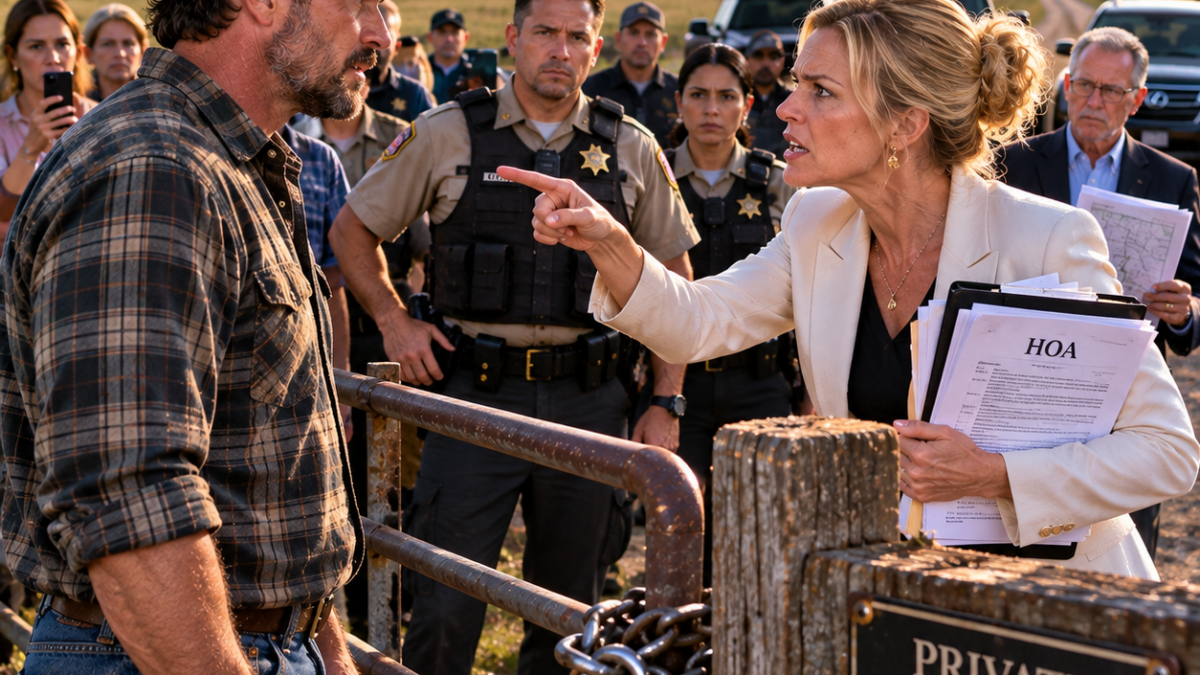
At exactly eight, her white Lexus came sliding up my road.
Same plate.
This time headlights on.
Behind her:
Sheriff’s SUV.
Lights flashing.
Then another unit.
Then a third.
Neighbors from Ridge View had already started gathering near the fence because apparently half the county knew something was happening before breakfast.
Phones came up.
Vanessa stepped from the Lexus carrying a black folder against her chest.
She looked at the gate.
Saw the scratches.
Saw the damaged chain.
Her eyes lingered for maybe one second too long.
Then she turned toward the deputies.
“That’s him.”
Deputy Mark Dalton climbed from the first SUV.
Sergeant Ortega from the second.
A young deputy named Caleb Ross from the third.
Dalton approached.
“Mr. Hendricks.”
“Morning.”
“Ms. Klein says you’re illegally blocking HOA access.”
“This is my ranch gate.”
Vanessa marched forward.
“Don’t let him manipulate you.”
She opened the black folder.
“There is a signed, notarized access agreement.”
“Six years old.”
“Mr. Hendricks himself granted permanent access.”
Dalton held out his hand.
She gave him the paper.
He read.
Slowly.
Then looked at the signature.
Then at me.
“Sir.”
“Yes?”
“This is your name.”
“Yes.”
“Your signature?”
“No.”
The crowd quieted.
Vanessa laughed.
“He’s lying.”
I looked at her.
“No.”
“You signed it.”
“I didn’t.”
“You benefited from the agreement.”
“How?”
She opened her mouth.
Nothing came.
Dalton said:
“Mr. Hendricks, I have a notarized document in front of me.”
“And I have a locked gate blocking what this document claims is an access road.”
“I cannot decide document fraud on a roadside.”
“Understood.”
“If this is valid, obstruction could create a problem.”
“Understood.”
Vanessa jumped in.
“Then cut the chain.”
Dalton held up one hand.
“Ma’am.”
“Let me handle this.”
She crossed her arms.
He looked at me.
“Do you have anything showing contrary ownership?”
“Yes.”
“Plenty.”
“Bring it.”
I handed him a certified deed copy.
Recorded easement list.
Dana’s survey.
Daniel’s notice.
He read.
His expression changed.
Vanessa said:
“Those don’t matter.”
I almost smiled.
“Property records don’t matter?”
“The access agreement overrides them.”
Dalton looked at the fake document again.
I had been waiting for the right moment.
“Deputy.”
He looked up.
“Humor me.”
“Read the notary’s name out loud.”
He frowned.
Then read:
“Gloria Peyton.”
Eleanor stepped from the crowd.
She held a folded funeral program.
“I knew Gloria.”
Vanessa turned.
Eleanor raised the program.
“She died March 11, 2018.”
Dalton looked at the agreement.
Date:
May 14, 2019.
Then back at Eleanor.
“You have proof?”
She handed him the program.
Vanessa laughed.
Thin.
Nervous.
“That’s ridiculous.”
“Clerical error.”
“Obviously.”
Ortega spoke for the first time.
“How does a dead notary make a clerical error fourteen months after her funeral?”
Vanessa’s face tightened.
“The wrong name was typed.”
I said:
“The seal is wrong too.”
Vanessa turned on me.
“You don’t know what you’re talking about.”
A black Mercedes arrived.
Preston Hale.
He parked along the road.
Got out carrying a leather portfolio.
“Deputies.”
he called.
“This is a civil property dispute.”
Vanessa looked relieved.
“Finally.”
Hale approached.
Then Dalton handed him the agreement.
Hale read.
His face changed.
“This is not the copy I was given.”
Vanessa froze.
“What?”
Hale looked at her.
“I was sent a scan.”
“The notary section was cropped.”
“You told me a complete recorded copy existed.”
“It does.”
“Where?”
“County.”
“No.”
A voice came from behind us.
Harold Finch.
He had arrived in a county records car with a sealed envelope tucked under one arm.
His hands shook.
Voice didn’t.
“It doesn’t.”
Everyone turned.
Harold came to Dalton.
“I am Harold Finch.”
“Ridgeview County land records.”
“I brought certified copies at Sergeant Ortega’s request.”
He opened the envelope.
“The Hendricks deed from 1962.”
“Subsequent recorded transfers.”
“Utility easement.”
“Subdivision plats.”
“No permanent road easement granted to Ridge View Estates.”
“No recorded 2019 access agreement.”
Then he pointed toward Vanessa’s paper.
“And that county seal design was not adopted until 2021.”
Silence.
Hale looked at Vanessa.
“Vanessa.”
She whispered:
“Don’t.”
He stepped backward.
“I advised you to verify this.”
“You said it was valid.”
“I said the scanned document required verification.”
“You told me—”
“I told you not to execute construction rights without a recorded instrument.”
That was the moment Vanessa realized her attorney was not going to lie for her.
Her face hardened.
“You’re abandoning your client.”
Hale answered carefully.
“I represent the association.”
“Not you personally in suspected criminal conduct.”
That sentence hit the crowd harder than anything so far.
Then Dana Ruiz’s survey truck arrived.
I almost laughed at the timing.
It wasn’t theatrical.
We had scheduled her to meet Ortega.
Traffic delayed her.
She got out with a rolled survey.
“Morning.”
I said:
“Perfect timing.”
She looked at the crowd.
“Apparently.”
Dana spread the map across the hood of Dalton’s SUV.
Actual property line.
Utility easement.
Private ranch road.
Bright Line survey stakes.
She pointed.
“The proposed development-road centerline is inside Mr. Hendricks’s titled property.”
“How far?”
Ortega asked.
“Varies.”
“About forty feet in several locations.”
“More near the planned curve.”
Dalton crouched beside a nearby pink stake.
Read the tag.
BRIGHT LINE DEVELOPMENT
Vanessa said:
“Those aren’t ours.”
Nobody replied.
I pulled out my phone.
Opened the saved trail-camera footage.
“There’s something else.”
Ortega stood beside me.
Dalton too.
I played the video.
Timestamp:
2:17 a.m.
Man at gate.
Bolt cutters.
Sparks.
Jacket.
Bright Line.
Then the white Lexus.
Vanessa’s breathing changed.
Ortega said:
“We ran the partial plate.”
She looked directly at Vanessa.
“Registered to you.”
The crowd gasped.
Vanessa shook her head.
“I lent the car.”
“To who?”
“I don’t remember.”
“Last night?”
“It was late.”
“You loan vehicles without remembering who has them?”
Vanessa clutched the folder tighter.
“I don’t have to answer this.”
“No.”
Ortega said.
“You don’t.”
Vanessa turned toward her Lexus.
Hale moved away.
“Ms. Klein.”
She stopped.
“What?”
He looked pale.
“I suggest you do not destroy, alter, or remove association records.”
She stared at him.
Then started walking faster.
Ortega stepped into her path.
“Ma’am.”
“Move.”
“I need that folder.”
“No.”
“It contains the document you presented as evidence of access.”
“It belongs to the HOA.”
Hale spoke from behind her.
“If it’s HOA property, Sergeant Ortega may document it with my cooperation as association counsel.”
Vanessa turned on him.
“You coward.”
He didn’t answer.
Dalton stepped closer.
“Ms. Klein.”
“Give Sergeant Ortega the folder.”
She held it against her chest.
For a moment, I thought she might run.
Then her hands dropped.
She gave it over.
Ortega opened it.
Agreement first.
Meeting notes.
Invoices.
Copies of maps.
Then something fell onto the SUV hood.
Small.
Rubber stamp.
Dalton picked it up.
Read.
His face went still.
GLORIA PEYTON — NOTARY PUBLIC
Eleanor whispered:
“Oh my God.”
Ortega removed another stack of pages.
Each one contained a handwritten name.
Again.
Again.
Again.
Walter Hendricks
Some terrible.
Some closer.
Loops.
Initials.
Entire signatures.
Practice.
My signature practiced dozens of times.
No one spoke.
Not even Vanessa.
Ortega looked at her.
“Ms. Klein.”
Vanessa’s face became red.
“You can’t prove I wrote those.”
Ortega held up the pages.
“I didn’t say you did.”
That was important.
She hadn’t.
Evidence first.
Conclusions later.
Vanessa started talking anyway.
“I was preparing comparisons.”
“For litigation.”
“The stamp belonged to Gloria.”
“She gave it to the HOA.”
Eleanor said:
“She died.”
Vanessa snapped:
“I KNOW SHE DIED.”
The words echoed.
Then the sound of an engine came fast up the county road.
Black pickup.
Bright Line logo.
It braked hard.
Trent Mallory jumped out.
“Vanessa!”
His face changed when he saw the deputies.
Then Hale.
Then Dana’s map.
Then me.
He started back toward the truck.
Dalton raised one hand.
“Sir.”
Mallory stopped.
“What?”
“Who are you?”
“Trent Mallory.”
“Bright Line Development.”
He pointed at me.
“I have a contract.”
“For what?”
“Access.”
“I paid for it.”
“How much?”
“Two hundred forty thousand dollars.”
Ortega looked toward Vanessa.
“Paid to whom?”
“The HOA.”
Mallory pulled out his phone.
Then a folded deposit confirmation.
“I have proof.”
He handed it over.
Ortega read.
Her eyebrows narrowed.
“This routing number goes to what account?”
Mallory frowned.
“Ridge View.”
“You sure?”
He looked again.
His face changed.
Hale stepped closer.
“Let me see.”
Mallory gave him the paper.
Hale read.
Then looked at Vanessa.
“This isn’t the association operating account.”
Vanessa said nothing.
“It isn’t the reserve account either.”
Silence.
“What account did you give Bright Line?”
Vanessa’s face had gone white.
Mallory whispered:
“What the hell?”
Ortega asked:
“Mr. Mallory, did you independently verify account ownership?”
He stared at the page.
“No.”
“Who gave you these wiring instructions?”
He looked at Vanessa.
Nobody needed the answer spoken.
That was when Ortega asked Vanessa to step away from the group.
She refused.
Dalton joined her.
They explained that based on the attempted unlawful entry documented overnight, the forged-looking instrument, the notary materials in her possession, and the need to preserve evidence, she was being detained while they consulted investigators and prosecutors.
No one threw her against a vehicle.
No dramatic speech.
No celebration.
The handcuffs clicked.
That sound stayed with me anyway.
Not because I enjoyed it.
Because three weeks earlier Vanessa had stood inside the clubhouse telling two hundred families that my gate was the problem.
Now she stood beside it in cuffs while the paper she had relied on unraveled one line at a time.
The next several hours became controlled chaos.
The sheriff’s office contacted state investigators.
The county prosecutor’s office became involved.
Because the alleged scheme touched association funds, forged documents, real-estate transactions, and developer payments, multiple agencies eventually participated.
Bright Line’s planned roadwork stopped immediately.
Their crews were told not to enter.
The pink survey stakes remained temporarily as evidence and reference points.
Trent Mallory was not arrested at my gate that morning.
That disappointed people who later retold the story.
Reality is often less satisfying than rumor.
He voluntarily provided initial documents through counsel, then quickly discovered that his own company had questions to answer.
Whether Bright Line was a victim, participant, or some combination depended on who knew what and when.
Investigators needed records.
Not roadside theater.
Vanessa was booked initially on allegations tied to the attempted unauthorized entry and suspected forged documentation.
The broader financial investigation came later.
Much broader.
The first warrant for Ridge View’s clubhouse office was executed two days afterward.
Investigators removed financial records.
Computers.
Bank information.
Vendor files.
Assessment records.
Emails.
Digital backups.
Hale cooperated on behalf of the association after Ridge View’s remaining board members held an emergency session and hired separate counsel.
What investigators found explained why Vanessa had been willing to risk everything for one road.
The $1,900 assessment had generated $402,800 if fully collected.
Not every homeowner had paid yet.
Most had.
Vanessa told the community it was for a lawsuit.
There was no lawsuit.
She told them legal bills already existed.
Hale’s firm had billed the HOA for routine document review and a handful of letters.
Nothing remotely close to the amount collected.
She said survey work had cost tens of thousands.
Actual invoice:
Under $7,000.
Then investigators found transfers.
Some money moved from the HOA assessment account to entities that had no legitimate relationship to neighborhood legal defense.
Consulting companies.
A project-management LLC.
A marketing firm.
At least one entity linked indirectly to Vanessa.
Other payments moved through contractors associated with Bright Line.
The exact accounting took months.
But the picture became clear.
Vanessa had used a real development opportunity to manufacture both authority and crisis.
She claimed the HOA already owned access.
Then sold that nonexistent access to Bright Line.
Then told homeowners I threatened to take it away.
Then charged them hundreds of thousands to “defend” something they never possessed.
Money from both directions.
Developer.
Homeowners.
And in the center:
My gate.
A physical bottleneck worth enormous money if Bright Line could convert it into a paved road.
The most disturbing discovery wasn’t financial.
It was the signature material.
Investigators seized digital scans of my signature from county documents.
One file had been cropped from an older recorded land transaction.
Metadata showed it was downloaded months before Vanessa produced the access agreement.
They also recovered scanned samples of Gloria Peyton’s genuine notary seal from archival HOA files.
Marissa Peyton’s photographs became crucial because they documented what her mother’s original materials looked like before Vanessa received the box.
The rubber stamp in Vanessa’s folder wasn’t Gloria’s original.
It was a reproduction.
Ordered after Gloria’s death.
Investigators found the purchase.
That ended any “clerical error” story.
The fake agreement had been created long after 2019 but backdated to make it appear that I’d personally granted access years earlier.
Why 2019?
Because that was before Bright Line became publicly involved.
A six-year-old agreement looked less suspicious than one signed immediately before a $240,000 development payment.
Someone had thought about this.
Badly.
But deliberately.
The county-seal mistake exposed the timing.
The dead notary exposed the forgery.
The practice signatures exposed intent.
Then came the trail-camera footage.
The man with bolt cutters was identified as a Bright Line field employee named Logan Pierce.
Thirty-one.
Assistant site superintendent.
He spoke to investigators through an attorney.
His explanation:
Trent Mallory told him access had been legally obtained.
Vanessa told Mallory the ranch gate was being “wrongfully obstructed.”
Someone—accounts differed about exactly who—directed Pierce to get the gate open before the Wednesday mobilization.
Pierce admitted going there at night.
He admitted trying to cut the chain.
He claimed Vanessa drove him because she knew the road.
The Lexus footage supported that she was present.
Phone-location data later supported it too.
She had not merely lent the vehicle.
That became its own problem.
Trent’s role took longer to understand.
His company had indeed paid $240,000.
But not exactly as he had claimed.
The contract said payment to Ridge View.
The wiring instructions Vanessa supplied directed the money to an account named:
RVE ACCESS DEVELOPMENT ESCROW
That sounded official.
It wasn’t.
It was controlled through an LLC linked to Vanessa.
Bright Line’s accounting department did not verify that the account belonged to the association.
Why?
Because Trent had personally approved the wiring instructions.
Investigators found emails where his finance director asked for an HOA W-9 and formal escrow agreement.
Trent responded:
Vanessa has authority. Don’t slow this down.
That email became important.
Then another:
Western road is worth multiples of this payment once permits clear.
Not illegal by itself.
Developers pay for access all the time.
The problem was whether Trent knew Vanessa’s authority was questionable.
Records showed he knew enough to be worried.
Hale had copied him on an email months earlier:
Title verification remains outstanding. No recorded instrument has been provided to me.
Trent replied separately to Vanessa:
Need this cleaned up before construction.
Her response:
Handled. Hendricks signed years ago.
Did Trent genuinely believe her?
At first, maybe.
Later?
Harder question.
Especially once Daniel Price’s cease-and-desist letter arrived.
Bright Line still planned to mobilize.
And one of its employees tried cutting my lock.
The state opened a separate investigation into the company’s conduct and development permits.
Meanwhile Ridge View collapsed into chaos.
The emergency HOA meeting filled the clubhouse beyond capacity.
People stood along walls.
Overflow watched from outside.
Vanessa was out on bond under conditions preventing her from accessing certain association records or contacting potential witnesses.
She did not attend.
Hale sat at the front table.
Eleanor sat beside him.
Three remaining board members looked as if they hadn’t slept.
I stayed near the back.
Didn’t want to become the center.
Too late.
People stared when I walked in.
Some embarrassed.
Some angry.
Some scared.
One man approached.
“I voted for the assessment.”
I nodded.
“I know.”
“You think we’re idiots?”
“No.”
“We believed her.”
“I know.”
“She showed us your signature.”
“I saw.”
He looked down.
“I told my wife you were trying to blackmail the neighborhood.”
I smiled faintly.
“That was creative.”
“I’m sorry.”
“Thank you.”
Then a woman came over.
Then another.
Eventually I held up both hands.
“We don’t need to do this one at a time.”
They laughed nervously.
Meeting started.
Hale spoke first.
He explained what the association could confirm.
The road-access agreement was disputed and appeared fraudulent.
No recorded access right had been found.
The board had not properly authorized the Bright Line transaction through the procedures required under its governing documents.
The $1,900 assessment had been presented using inaccurate information.
The association’s accounts were under forensic review.
Then someone shouted:
“How much is missing?”
Hale answered:
“We don’t know yet.”
Someone else:
“Did Vanessa steal it?”
“We are not going to announce criminal conclusions before investigators complete their work.”
People booed.
He waited.
Then:
“I understand why you’re angry.”
“But if the association learned anything this week, it should be that confidence is not a substitute for verified facts.”
That quieted the room.
Eleanor stood next.
She wasn’t supposed to speak long.
She did anyway.
“I voted for Vanessa.”
A murmur.
“I supported the road assessment.”
Another murmur.
“I was wrong.”
She looked toward me.
“Walt asked for the document.”
“That’s all.”
“He didn’t threaten the neighborhood.”
“He didn’t sue us.”
“He didn’t block emergency services.”
“He asked us to prove we had the right we claimed.”
“And instead of proving it, our president tried to make his question look like hostility.”
Then:
“If someone asking for proof threatens your authority, maybe the authority isn’t strong enough.”
I looked at the floor.
Eleanor should have been the lawyer.
The board voted.
Vanessa removed as president under the association procedures available while her legal cases continued.
Unanimous.
Eleanor named interim president until a proper election.
She immediately objected.
“No.”
People laughed.
Then voted again.
She lost.
After the meeting, a little boy came toward me.
Maybe seven.
His mother looked embarrassed.
He held a drawing.
Crayon.
A gate.
Longhorn skull.
Bright yellow sun.
Stick figure standing beside it.
He handed it to me.
“What is this?”
“Your gate.”
“I can see that.”
He pointed.
“That’s you.”
I looked like a potato wearing boots.
“Very accurate.”
His mother laughed.
The boy pointed at another part.
There were small houses on the far side of the gate.
Then a word.
FRIENDS
My throat tightened unexpectedly.
“Thank you.”
He smiled.
I had to turn away for a second.
Because that was the part nobody had understood during the fight.
I didn’t hate Ridge View.
I’d helped those people during storms.
Let children watch calves.
Pulled a resident’s truck out of mud.
Opened my gate for ambulances when county roads flooded.
What I objected to was someone turning neighborliness into ownership.
Permission into entitlement.
A favor into a forged deed.
Those are different things.
The criminal cases moved slowly.
Vanessa eventually entered a negotiated plea to multiple state felony counts related to forgery, fraud, misuse of association funds, and her participation in the attempted unauthorized entry at my gate.
The exact legal label for the nighttime bolt-cutter incident was narrower than neighborhood gossip made it sound, but the conduct was part of the case.
She admitted creating and using false documents.
She admitted diverting money.
She admitted misrepresenting association authority.
The court ordered restitution.
The association also obtained civil judgments related to missing funds.
Insurance covered part.
Recovered assets covered more.
Not every dollar appeared instantly.
But over time, the overwhelming majority of verified losses were restored through restitution, insurance, recovered funds, and settlement proceeds.
The $1,900 assessment?
Refunded or credited back to homeowners as the accounting allowed.
Some residents cried when checks arrived.
Not because $1,900 saved their lives.
Because they had spent months thinking their own neighborhood had betrayed them.
Trent Mallory’s consequences were different.
Investigators found enough evidence that he continued pursuing access after receiving warnings about title problems.
He eventually entered a negotiated resolution on charges tied to fraudulent business representations and permitting conduct.
Bright Line faced civil penalties, permit suspensions, and contract losses.
The company did not literally vanish overnight.
Companies rarely do.
It restructured.
Several projects were sold.
Trent lost control.
The proposed road through my ranch died completely.
Preston Hale was not charged.
That mattered.
People wanted him punished because he had stood beside Vanessa at the gate and initially defended the agreement.
The evidence showed something more complicated.
He had reviewed an incomplete scan.
He had repeatedly demanded a recorded copy.
He advised against proceeding until title verification.
Vanessa misrepresented his advice to the board.
At the gate, once he saw the full document and contradictions, he stopped defending it.
Could he have pushed harder earlier?
Probably.
He said so himself.
But negligence, bad judgment, and criminal participation are not interchangeable.
I refused to turn everybody near Vanessa into a villain just because that made the story easier.
Same with Bright Line employees.
Logan Pierce had made a terrible decision by trying to cut my chain.
He admitted it.
His employment ended.
He faced consequences.
But he had not invented the fake deed.
He had been told by people above him that the road legally belonged to their project.
Then ordered to “clear the obstruction.”
He still should have refused the nighttime job.
He didn’t.
Responsibility can be layered.
That case taught everybody in Ridgeview County more about that than we wanted to know.
Harold Finch became a local celebrity against his will.
People started calling the land-record office asking:
“Is this real?”
He told me:
“You ruined my retirement.”
“You were planning to retire?”
“No.”
“Then I ruined nothing.”
He glared.
Dana Ruiz got so many requests for boundary surveys she hired two additional crews.
Eleanor became HOA president after winning the formal election by a ridiculous margin.
She called me afterward.
“I blame you.”
“I don’t vote in your HOA.”
“You caused standards.”
“Terrible thing.”
Her first acts were boring.
Exactly what Ridge View needed.
Independent financial audit.
Every contract posted for resident review.
Recorded votes.
Two signatures on payments over a threshold.
No special assessments without clear written purpose and documentation.
Legal opinions distributed in full instead of summarized by whoever wanted the vote.
She also created a boundary map showing exactly where Ridge View ended.
My ranch appeared beside it.
Different color.
Huge label:
PRIVATE PROPERTY — NOT HOA
I framed that too.
For a while, Ridge View residents treated my gate like sacred ground.
That made me uncomfortable.
They’d slow down when passing.
Wave.
Some apologized repeatedly.
I eventually told Eleanor:
“This needs to stop.”
“What?”
“People acting like they’re trespassing by looking at my fence.”
“They feel guilty.”
“They didn’t forge anything.”
“Some voted for the road.”
“So?”
“They were given false information.”
“People are allowed to make mistakes.”
She smiled.
“Very generous.”
“No.”
“I need neighbors, not penitents.”
That conversation led to the decision that surprised everybody.
The legitimate emergency-access issue had not been entirely fake.
Ridge View did have only one primary entrance capable of handling large emergency vehicles during certain conditions.
The southern service route was limited.
During a wildfire or severe flood, another controlled access could genuinely matter.
My western ranch road connected to the county highway.
I had allowed emergency use before.
So I asked Daniel Price:
“Can we make it official?”
He stared.
“You just spent a year proving they don’t have an easement.”
“I know.”
“And now you want to give them one?”
“For emergency access.”
“Not public traffic.”
“Not development.”
“Not daily use.”
“Gate stays mine.”
“Locked unless needed.”
“Association pays one dollar a year.”
Daniel leaned back.
“Why one dollar?”
“Granddad would’ve laughed.”
He smiled.
“That’s not legal reasoning.”
“Good.”
We drafted it carefully.
Recorded emergency-access easement.
Fire.
Ambulance.
Law enforcement.
Declared evacuation.
Utility emergency under defined conditions.
No commercial development.
No ordinary resident traffic.
No right to widen without my consent.
No transfer to developers.
Gate ownership remained mine.
One dollar annual consideration.
Eleanor signed for Ridge View after a board vote.
I signed.
Proper notary.
Living one.
Recorded with the county.
Harold personally handed me the stamped copy.
“Look.”
he said.
“Actual recording number.”
“Fancy.”
“Don’t mock my profession.”
“I wouldn’t dare.”
Then I added something not required by the agreement.
A brass bell.
Old style.
Mounted beside the pedestrian opening.
If a Ridge View neighbor needed help—a lost child, animal issue, emergency, phone dead—they could ring it.
No legal entitlement.
Just neighborliness.
Caleb Ross, the young deputy from the gate confrontation, saw it and said:
“You know everyone’s going to let their kids ring that.”
“I know.”
They did.
For six months, that bell rang constantly.
Children.
Teenagers.
Adults who thought it was funny.
One night at eleven, it rang for real.
I went out carrying a flashlight.
A Ridge View woman stood there with her eight-year-old son.
Their dog had slipped through a damaged fence and run into my pasture.
We found the dog twenty minutes later hiding beneath a cedar.
She cried.
Thanked me.
I said:
“That’s why the bell’s there.”
The gate worked exactly as Granddad had meant.
Closed until somebody asked.
Opened when it should.
One year after Vanessa’s arrest, Ridge View held a neighborhood picnic.
They asked to use a small meadow near my western fence.
I agreed.
Written permission.
Specific date.
Cleanup responsibility.
Eleanor laughed when I handed her the one-page permission.
“You’re serious?”
“Very.”
“Do we need a notary?”
“Only if she’s alive.”
She stared.
Then burst out laughing.
Dark humor heals oddly.
The picnic ended near sunset.
Children played beneath the oaks.
People brought folding chairs.
Someone hung lights along the fence.
For a few hours, there was no HOA dispute.
No developer.
No fake deed.
Just neighbors.
Eleanor stood beside me.
“Worth it?”
“What?”
“All of it.”
“No.”
She looked surprised.
“You won.”
“I’d rather nobody forged my signature.”
“Fair.”
“Good things that happen afterward don’t make the damage necessary.”
She nodded.
Then:
“But you’re glad the emergency easement exists?”
“Yes.”
“Difference?”
“Choice.”
She understood immediately.
Vanessa had tried to manufacture consent retroactively.
I chose to grant something later.
Same physical road.
Completely different meaning.
Consent isn’t a technical detail.
It’s the whole difference.
My relationship with the land changed too.
For years, I had thought of the ranch as something inherited.
After the gate fight, I understood inheritance differently.
Granddad hadn’t handed me dirt.
He handed me responsibility.
The gate.
Key.
Fences.
Deed.
And the obligation to know the difference between generosity and surrender.
That’s why his old sentence returned so often.
A man who lets somebody else hold his key doesn’t own the lock.
As a child, I thought he meant never lend the key.
He didn’t.
Granddad loaned equipment.
Opened gates.
Let neighbors graze cattle during drought.
He was generous.
What he meant was:
Know when you’re choosing.
If you don’t know whether you can say no, your yes isn’t worth much.
Vanessa wanted people to forget they could say no.
She did it inside Ridge View too.
Residents later told me about meetings.
She would announce decisions as already finalized.
“If we don’t approve this tonight, insurance will cancel.”
“If we don’t pay the assessment, lawsuits will begin.”
“If we question the developer agreement, home values will fall.”
Urgency.
Fear.
Done deal.
People stopped asking.
By the time she claimed my road, she had learned that certainty often defeats curiosity.
Until it doesn’t.
Years later, I visited Gloria Peyton’s grave.
Not because I knew her well.
Because her name had become central to the case.
Eleanor came.
Marissa too.
We brought flowers.
Marissa stood looking at the headstone.
“I feel guilty.”
“Why?”
“I gave Vanessa Mom’s files.”
“You didn’t know.”
“I should’ve asked.”
“Maybe.”
She looked at me.
“You’re supposed to tell me it’s not my fault.”
“I’ll tell you the truth.”
“You made a decision that turned out badly.”
“That isn’t the same as participating in what she did.”
Marissa nodded.
Then said:
“Mom would’ve been furious.”
“About the fake stamp?”
“She hated improper notarization.”
I laughed.
“Of all the crimes…”
“You didn’t know Gloria.”
Fair.
Marissa eventually donated her mother’s legitimate notary records to an archival project used to train local clerks and notaries about identity verification and seal security.
That was a better ending for Gloria’s name.
Not fake paperwork.
Education.
The county updated procedures too.
Developers seeking road access through private land had to provide clearer proof of recorded rights before permits relying on that access were issued.
Not because the county had formally approved Bright Line’s fake road.
It hadn’t reached that stage.
But the case exposed how planning assumptions could move ahead too far before title questions were resolved.
Dana helped write the new checklist.
She sent me a copy.
First line:
VERIFY OWNERSHIP AND RECORDED ACCESS BEFORE DESIGN RELIANCE.
I called.
“That’s because of me.”
She said:
“Everything isn’t about you, Walt.”
“Feels like it.”
“Go feed a cow.”
I did.
Time passed.
Cases closed.
Appeals ended.
News moved on.
The scratches from the bolt cutters remained on Granddad’s gate.
I considered replacing the chain.
Didn’t.
It still worked.
The cutter marks became another layer of history.
Caleb Ross became a sergeant.
Mark Dalton retired.
Rosa Ortega became sheriff years later.
At her election celebration, she found me near the food table.
“Still locking that gate?”
“Still carrying handcuffs?”
“Unfortunately.”
She smiled.
Then:
“You know I almost arrested you that morning.”
“I know.”
“Dalton did too.”
“I know.”
“We had what looked like a notarized agreement.”
“I know.”
“Would you have cooperated?”
“No.”
She laughed.
“Honest.”
“I would’ve let you arrest me.”
Her smile disappeared.
“Really?”
“Yes.”
“I wasn’t cutting the chain.”
“You’d rather get arrested?”
“I’d rather let a judge decide than voluntarily surrender the gate under a forged document.”
She shook her head.
“Stubborn.”
“Family trait.”
Then she said:
“That dead-notary question saved everyone a bad morning.”
“No.”
“The land records did.”
“Gloria’s death certificate did.”
“Dana’s survey did.”
“Your investigation did.”
“People always want one magic moment.”
“Real proof usually arrives in a pile.”
Ortega nodded.
“That should be on a courthouse wall.”
“You can steal it.”
“With permission?”
“Always.”
We laughed.
Bright Line’s old survey stakes eventually disappeared.
I kept one.
Pink flag faded almost white.
Tag still readable.
BRIGHT LINE DEVELOPMENT
It sits in the barn beside the framed fake agreement.
Not because I need trophies.
Because I teach my grandchildren with objects.
My granddaughter Sophie was nine when she asked:
“Why did they put this on our land?”
“Because they thought they’d bought the right.”
“From who?”
“Someone who didn’t own it.”
She frowned.
“That doesn’t work.”
“Exactly.”
“Did they get their money back?”
“Some of it through the legal process.”
“Did Grandma know?”
“Your grandmother died before all this.”
Sophie became quiet.
Then asked:
“Would she have been mad?”
“At Vanessa?”
“Yes.”
I thought of my late wife, Carol.
Carol hated conflict.
She also hated bullies.
“She would’ve brought food to the meeting.”
Sophie looked confused.
“Why?”
“That’s how she fought.”
That made me smile.
Carol had been gone five years when the road dispute happened.
Cancer.
There were moments I wished she had been there.
Not to solve anything.
To sit beside me at the kitchen table while I stared at fake documents.
Grief doesn’t only hurt during funerals.
It appears during problems when you realize the person who knew how you thought isn’t available to argue with you.
Eleanor filled some of that space.
Not the same.
Never.
But friendship matters.
She remained HOA president for one term.
Refused a second.
When residents begged, she said:
“Anybody who enjoys this job too much shouldn’t have it.”
Then went back to gardening and correcting people’s grammar online.
The next president was a young accountant named Michael Chen.
First thing he did was call.
“Mr. Hendricks.”
“Yes?”
“We want to inspect the emergency-access gate under the easement maintenance clause.”
I smiled.
“Excellent.”
He paused.
“Is that sarcasm?”
“No.”
“You asked.”
“Put it in writing.”
“You verify.”
“We schedule.”
“This is exactly what should happen.”
He laughed nervously.
The inspection took fifteen minutes.
No drama.
That may have been my favorite HOA interaction ever.
Boring governance is underrated.
People notice authority only when it becomes irritating.
When it’s working properly, there are minutes, notices, votes, records, predictable processes, and nobody goes viral.
Good.
One afternoon, years later, I found the little boy’s crayon picture while cleaning the barn office.
The gate.
Longhorn skull.
Sun.
Stick figure.
FRIENDS.
The paper had faded.
I framed it beside Vanessa’s fake agreement.
Two versions of the same gate.
One created by fraud.
One by a child.
The fake agreement said:
We have the right to cross.
The drawing said:
We’re neighbors.
The child understood more.
Neighbors ask.
Owners sometimes say yes.
Sometimes no.
Neither destroys the relationship.
Entitlement does.
I used to think the most important day was the morning Vanessa arrived with deputies.
Maybe because that’s the dramatic one.
The white Lexus.
The forged agreement.
Dead notary.
Surveyor arriving.
Trail-camera footage.
Stamp falling from the folder.
Handcuffs.
People love those moments.
They’re satisfying because truth becomes visible all at once.
But the real turning point happened earlier.
At the first HOA meeting.
When Vanessa said the association had access and I asked:
“Show me.”
That’s it.
Two words.
Show me.
Not:
You’re lying.
Not:
I’ll sue you into the ground.
Not:
Get off my property.
Show me.
Legitimate authority should survive that question.
If the county has an easement, show me.
If I signed an agreement, show me.
If the HOA has rights, show me.
If the assessment pays legal costs, show the bills.
If Bright Line bought access, show who had authority to sell it.
Every time somebody asked that question, Vanessa’s story got smaller.
The covenant wasn’t recorded.
The notary was dead.
The seal was too new.
The signature wasn’t mine.
The attorney hadn’t approved it.
The money didn’t reach the HOA.
The lawsuit didn’t exist.
The survey stakes weren’t on HOA land.
The Lexus was hers.
The bolt-cutter man worked for Bright Line.
The $240,000 went to the wrong account.
The $402,800 assessment couldn’t be justified.
One question didn’t end the scheme.
Repeated verification did.
That’s why I never liked the version of the story where I defeated Vanessa by locking the gate.
The chain mattered.
It prevented unauthorized construction long enough for facts to catch up.
But a heavier chain wouldn’t have fixed the records.
A bigger padlock wouldn’t have traced the money.
A taller fence wouldn’t have shown Gloria died fourteen months before she supposedly notarized my signature.
Evidence did that.
People did that.
Harold opening old records.
Dana measuring lines.
Marissa saving photographs.
Eleanor bringing documents.
Ortega checking a plate.
Hale refusing to lie once he saw the full agreement.
Residents demanding an audit.
Even the people who made mistakes became part of correcting them.
That is how the truth actually won.
Not one cowboy at a gate.
A network of ordinary people finally comparing what they had been told with what existed.
I am sixty-eight now.
The ranch is smaller.
I sold sixty acres on the far southern end to my nephew under an agricultural conservation agreement because my knees no longer enjoy fixing fence across three hundred acres.
He runs cattle.
I interfere.
He complains.
Healthy relationship.
Granddad’s original gate still stands.
The automatic opener my nephew wanted?
Denied.
Mostly because I enjoy watching him get out of the truck in bad weather.
The emergency-access easement remains active.
Ridge View pays one dollar a year.
Every January, the HOA treasurer mails me a check.
One dollar.
I frame none of them.
I cash every single one.
Not because I need the money.
Because it confirms the agreement remains exactly what we recorded.
Once, their treasurer forgot.
I called.
“Michael.”
“Yes?”
“You owe me.”
Long silence.
Then he laughed.
“The dollar?”
“The dollar.”
“Walt.”
“Contract is contract.”
He mailed it.
Included a second dollar labeled:
LATE FEE
I returned that one.
Unauthorized assessment.
He thought that was hilarious.
The brass bell remains beside the gate.
It has rung for lost dogs.
A flat tire.
A child whose bicycle chain snapped.
A resident who needed help during a storm.
One genuine medical emergency when an ambulance used our ranch road after a tree blocked Ridge View’s primary entrance.
That night proved something.
The emergency access mattered.
The ambulance came through.
I opened the gate.
Paramedics crossed.
A man got help faster.
Later Eleanor called.
“You see?”
“I know.”
“Vanessa was right that we needed emergency access.”
“Need and entitlement aren’t the same thing.”
“I know.”
“Just making sure.”
She laughed.
It’s possible for someone to identify a real problem and still choose a dishonest solution.
Vanessa understood Ridge View’s access weakness.
She could have approached me honestly.
The HOA could have negotiated.
Maybe I’d have granted the same emergency easement years earlier.
Maybe not.
But she never asked.
Because asking contains the risk of hearing no.
Forgery eliminates that inconvenience.
That’s why it isn’t merely dishonest.
It steals choice.
I think about that whenever people call Vanessa’s crime “just paperwork.”
Paperwork determines who owns what.
Who owes what.
Who agreed.
Who didn’t.
A forged signature is someone trying to use your voice after removing you from the conversation.
That’s personal.
Years after her release, Vanessa wrote to me.
One letter.
I almost didn’t open it.
Then did.
She did not ask for forgiveness.
Good.
She wrote that prison and restitution had forced her to look at how the scheme began.
Not with the road.
Before.
Small HOA decisions.
Moving money temporarily between accounts.
Signing a vendor document without a vote because “the board would’ve approved.”
Describing a recommendation as legal advice.
Changing meeting minutes to make a decision look cleaner than it had been.
Each time, nothing terrible happened.
So the next shortcut became easier.
Then Bright Line appeared.
The road became valuable.
Vanessa believed Ridge View deserved compensation because residents had lived beside my road for years and occasionally benefited from emergency use.
From there, she convinced herself that customary benefit was practically a right.
Then that the right simply lacked paperwork.
Then that creating paperwork merely formalized what was already “true.”
She wrote:
The first forgery happened in my mind before it happened on paper. I decided I deserved the answer before I asked the question.
I sat with that sentence.
It was good.
Painfully good.
She continued:
Once I believed the road ought to belong to the association, your actual ownership became an obstacle rather than a fact.
Exactly.
That was the entire case.
Not only hers.
Trent’s too.
The road would save him millions.
Therefore his mind turned the question from:
Do we own access?
to:
How do we secure access?
Different question.
Dangerous difference.
Vanessa ended:
You once said a gate reminds people who gets to open it. I understand now that I spent years believing every closed gate was an insult. It wasn’t.
I didn’t write back.
Not from anger.
There was nothing I needed to add.
I placed the letter behind the framed fake agreement.
Next to Walt—no, I was Walt. Next to the child’s drawing.
Three layers.
Lie.
Consequence.
Understanding.
Enough.
Last fall, a storm tore one hinge partly off the gate.
My nephew said:
“Replace it.”
“No.”
“Uncle Walt.”
“Repair.”
“This thing belongs in a museum.”
“It belongs here.”
“Why?”
I looked at the scratches from the bolt cutters.
Longhorn skull above.
Brass bell.
Old lock.
Because some objects become useful precisely because they carry history.
We replaced the hinge.
Kept the frame.
Kept the lock.
Same key.
Still in my pocket most days.
My nephew asked:
“You afraid somebody’s coming back?”
“No.”
“Then why still lock it?”
“Cattle.”
He stared.
I laughed.
That’s the funny part.
After all the fraud, lawyers, deputies, developers, and criminal charges, the gate still performs its oldest job.
Keeps cattle where they’re supposed to be.
Life eventually shrinks dramatic symbols back into useful objects.
Good.
One evening, I stood there at sunset while Ridge View’s roofs caught the orange light on the other side.
A boy rode a bicycle to the fence.
Not the same boy who drew the picture.
Years younger.
He rang the brass bell.
I walked over.
“What can I do for you?”
His tire was flat.
“Mom says Mr. Hendricks has an air compressor.”
“Your mom is correct.”
I opened the pedestrian side.
He pushed the bike through.
“Cool skull.”
“Thank you.”
“Is this the famous gate?”
I sighed.
“Unfortunately.”
“My dad says an HOA lady tried to steal it.”
“Your dad simplifies.”
“Did she?”
“She tried to claim rights she didn’t have.”
He frowned.
“That’s stealing.”
Children have low tolerance for nuance.
I fixed his tire.
He said thanks.
Then stopped before leaving.
“Why don’t you just leave the gate open?”
I smiled.
“Because then you wouldn’t have rung the bell.”
He thought.
Didn’t understand.
That’s okay.
I didn’t understand Granddad at ten either.
He rode home.
I locked the gate after him.
Click.
Simple sound.
Not angry.
Not defensive.
Mine to make.
That’s what ownership meant in the end.
Not keeping everybody out.
Not standing alone behind fences.
Not winning against an HOA.
Choice.
I can lock it.
I can open it.
I can grant an emergency easement.
I can let a child through with a flat tire.
I can host a neighborhood picnic.
I can say no to a developer.
I can say yes to an ambulance.
I can ask for paperwork before I surrender anything.
The gate doesn’t decide.
The key doesn’t decide.
The HOA doesn’t decide.
The developer doesn’t decide.
The owner does, within the law and within the promises he has actually made.
Vanessa tried to replace that with confidence.
A forged signature.
A dead notary.
A fake seal.
A $240,000 payment.
More than $400,000 collected from neighbors.
A midnight bolt cutter.
She almost succeeded because enough people believed the paperwork before checking it.
Then Gloria Peyton, dead for fourteen months before she supposedly stamped my agreement, told the truth from the grave simply by having a date on her funeral program.
Harold’s records told the truth.
Dana’s survey told it.
The trail camera told it.
The bank account told it.
Eventually, Vanessa herself told it in court.
My grandfather never met any of them.
But he understood the principle before I was old enough to understand locks.
A gate isn’t hatred.
A boundary isn’t hostility.
And being willing to welcome someone means nothing if you aren’t also free to tell them they cannot simply take what is yours.
Every January, when Ridge View’s one-dollar easement check arrives, I walk out to that old gate.
I turn Granddad’s key.
Open the lock.
Check the hinges.
Ring the brass bell once just to hear it.
Then I usually leave the gate open while I work nearby.
Neighbors wave.
Cattle stare.
Nothing dramatic happens.
That’s exactly how I like it.
Vanessa once said the gate changed everything.
She was right.
Just not in the way she meant.
The gate didn’t make me powerful.
It made the boundary visible.
And once people finally looked closely enough to see where that boundary actually was, all her forged papers in the world couldn’t move it an inch.








