My HOA President Called 911 to Have Me Arrested—Then the Dispatcher Recognized My License Plate.k
PART2:
Rosa lived directly across the street from me.
She had been married to a mechanic named Miguel for forty-six years before he died.
She still called the house “ours.”
She had brought me a plate of cinnamon cookies on the morning I moved in and apologized because they were “a little dry.”
I ate six.
They were perfect.
Now she stood in my driveway clutching paper as though it might explode.
“Come sit down.”
We went to my porch.
I brought water.
She spread the envelopes across the table.
Some were typed notices on HOA letterhead.
Others were handwritten.
PARKING PERMIT FEE.
MONTHLY STREET ACCESS.
VEHICLE COMPLIANCE.
The language changed.
The demand did not.
Money.
I asked:
“How long have you been paying these?”
“About two years.”
“How much?”
“Usually one hundred seventy-five.”
“Sometimes two hundred.”
“For parking where?”
She pointed toward her sedan.
It sat at the curb in front of her house.
Public road.
“Did anyone tell you why the amount changed?”
She shook her head.
“Jillian said the board increased fees because too many visitors were using community streets.”
“Did she give you a copy of the rule?”
“She showed me papers.”
“What papers?”
“I don’t know.”
“She talks fast.”
That sounded like Jillian.
I had met her only once.
She appeared at my front door my third day in the neighborhood holding a clipboard and introducing herself as president before giving me her name.
She told me garbage cans had to be hidden by eight the morning after collection.
I thanked her.
Then she noticed my Jeep.
“You’ll need a windshield sticker.”
“For?”
“Resident parking.”
“I park on Maple Crest.”
“Yes.”
“That’s a public street.”
Her smile tightened.
“We manage neighborhood parking.”
“On the street?”
“Yes.”
I almost asked for authority then.
Didn’t.
I had boxes everywhere and a command staff meeting in forty minutes.
She said:
“I’ll have the management office send you the information.”
They never did.
Instead, the pink fine appeared.
Now Rosa had nearly five thousand dollars in demands.
“Have you paid all of this?”
She nodded.
“Why?”
Her eyes dropped.
“I didn’t want trouble.”
Three words.
I didn’t want trouble.
People who abuse small amounts of authority depend on those words.
I asked:
“How did you pay?”
“Cash sometimes.”
“An app sometimes.”
“What app?”
She showed me.
A transfer history to an account labeled WC PARKING FUND.
Not Willow Creek Estates Association.
WC Parking Fund.
Could be legitimate.
Could be a designated subaccount.
Could be something else.
I kept my face neutral.
“Do you have receipts?”
“Some.”
She opened a worn envelope.
Handwritten slips.
Amount.
Date.
House number.
Initials:
J.R.
“Jillian?”
Rosa nodded.
I counted quickly.
The receipts did not cover every payment.
But there were enough to make me uncomfortable.
“Did Miguel pay these before he died?”
“No.”
“They started after.”
“When?”
“Maybe two months after.”
That bothered me more.
A recently widowed woman.
Living alone.
Fixed income.
Repeated fees she did not understand.
I asked:
“Did you ever question them?”
“Once.”
“What happened?”
“Jillian said if I didn’t pay, the HOA could tow my car and put a lien on my property.”
I sat back.
“Did she say the lien would be for the parking fines?”
“Yes.”
“Did she send anything from an attorney?”
“I don’t think so.”
“Any court papers?”
“No.”
“Any certified mail?”
“No.”
I looked across the street.
Rosa’s little Honda sat beneath an elm tree.
Perfectly legal.
I felt anger arrive.
Not useful yet.
I had been chief for three weeks.
The worst possible thing I could do was convert a neighborhood dispute into the chief of police’s personal crusade without evidence.
So I asked:
“Rosa, are you comfortable letting me copy these?”
Her shoulders relaxed.
“Yes.”
“I’m not promising you anything.”
“I know.”
“I need to know what authority exists before I tell you anyone did something wrong.”
She nodded.
Then:
“I just don’t want her angry at me.”
That sentence followed me for the rest of the investigation.
That evening, I pulled public records.
Not through some secret police database.
County recorder.
Road dedication.
Plat.
Acceptance documents.
Maintenance records.
I printed the 1998 dedication.
Maple Crest Lane, Willow Creek Drive, Hawthorn Court, and two other roads transferred into public control.
Clear.
That did not automatically invalidate every possible HOA parking rule.
HOAs sometimes have restrictions affecting members through covenants even where streets are public, depending on the documents and local law.
But Jillian’s notices were not framed like covenant violations.
They claimed parking permits were required to use the road itself.
That was different.
So I pulled the declaration.
Bylaws.
Recorded amendments.
Board rules publicly available through the association portal.
No street parking permit program.
No $175 monthly charge.
No authority granting Jillian personal collection of cash.
I printed everything.
Then stopped.
I was not going to investigate it myself as police chief.
That distinction mattered.
I called Lieutenant Daniel Pruitt into my office Monday morning.
Dan had twenty-two years in the department.
Calm.
Annoyingly thorough.
Exactly the officer I needed.
I placed the pink notice on his desk.
He read it.
Then looked at me.
“You get cited by your HOA?”
“Apparently.”
He smiled.
“New chief already lawless.”
“Try to contain your disappointment.”
Then I gave him Rosa’s copies.
His smile disappeared.
“What is this?”
“I don’t know yet.”
I explained.
Dan read quietly.
Then:
“What do you want?”
“First, nothing informal.”
“No patrol officer knocking on Jillian’s door because the chief is irritated.”
“Second, I want you to determine whether we’ve had calls involving her and parking disputes.”
“Third, if there is evidence beyond a civil disagreement, kick it outside.”
“County?”
“State if appropriate.”
“You’re recusing?”
“I live there.”
“She cited me.”
“One of the complainants is my neighbor.”
“I’m already a witness to part of it.”
“So yes.”
Dan nodded.
“Good.”
Then:
“You know this will leak eventually.”
“Probably.”
“Neighborhood Facebook page?”
“Already afraid.”
He smiled.
We found the call pattern faster than expected.
Not because dispatchers had identified it as a scheme.
Each call looked ordinary alone.
Parking dispute.
Suspicious vehicle.
Trespassing complaint.
Noise complaint.
Welfare request.
Nine calls over the previous year from the same number.
Jillian.
Seven named or clearly described people who lived in Willow Creek.
All closed without arrest.
Most involved vehicles on public streets.
One alleged a delivery driver was “casing houses.”
Another accused a teenage resident’s boyfriend of trespassing because his pickup sat at the curb after ten.
One involved Rosa’s grandson.
That call bothered me.
The responding officer’s narrative said Jillian demanded enforcement of “HOA permit rules.”
Officer Reyes documented that no municipal violation existed.
No citation issued.
Dan leaned back from the computer.
“She likes 911.”
“Apparently.”
“That doesn’t mean false reporting automatically.”
“I know.”
“People can be wrong.”
“I know.”
“You sound unhappy that I keep saying things you already know.”
“I am.”
“Good.”
We forwarded the financial allegations to the state investigative bureau because the facts might involve theft, fraud, or misuse of association funds and because I wanted my department nowhere near controlling a case involving my own neighborhood.
Investigator Nina Castellano called me two days later.
She had the directness of someone who did not care that my title was chief.
Good.
“Brooks.”
“Castellano.”
“I reviewed what Pruitt sent.”
“And?”
“Thin.”
“Also what I thought.”
“You’ve got one resident.”
“Receipts.”
“An account label.”
“And HOA documents not obviously authorizing the charge.”
“Yes.”
“Enough to ask questions.”
“Not enough to build a criminal case.”
“Agreed.”
She continued:
“I want association financials.”
“Board minutes.”
“Banking.”
“Payment processor records.”
“That takes process.”
“Yes.”
“We’ll start.”
Then:
“Do not go detective in your subdivision.”
“I won’t.”
“You’re already emotionally invested.”
“I know.”
“Chiefs are terrible witnesses when they decide they’re investigators.”
“Is that in the academy?”
“Should be.”
We left it there.
More neighbors came anyway.
Not because I solicited them.
Rosa told someone.
That someone told another.
Within ten days, five homeowners had knocked on my door.
Different stories.
Same pattern.
A retired teacher named Warren Blake had paid $1,050 over seven months for parking a work van belonging to his son.
A single mother named Nicole Price had paid $600 after being told guests needed weekend permits.
A couple on Hawthorn Court paid “street maintenance fees” even though county taxes covered the public road.
Not every complaint involved Jillian directly.
Some notices came from a generic HOA email.
Some payments went through the WC Parking Fund account.
Some people claimed they paid cash to Jillian at community events.
I did the same thing every time.
“Keep originals.”
“Make copies.”
“Write down what you remember.”
“Do not coordinate stories.”
“Do not confront anyone.”
“Contact Investigator Castellano.”
People wanted me to tell them whether they had been robbed.
I refused.
“We don’t know that yet.”
That frustrated them.
But anger is not evidence.
Then came Saturday.
Jillian’s autumn gala.
She held one every year on the broad front lawn of her corner house.
White tents.
String quartet.
Caterer.
Wine table.
Pumpkins arranged with more architectural discipline than some commercial buildings.
About eighty people.
Residents.
Board members.
Business owners.
A councilman named Peter Hutchins.
A few real-estate agents.
Someone from the chamber of commerce.
I had no intention of attending.
Rosa’s grandson Mateo was visiting.
Rosa had grocery bags in the trunk of his car.
Mateo injured his wrist at work and couldn’t lift much.
I saw them struggling when I went outside.
“I’ve got it.”
Rosa protested.
“Chief, you don’t need to.”
“I am literally walking across the street.”
I carried two bags.
Then another.
My Jeep remained parked at the curb outside her house.
Legal.
Maybe twenty yards from Jillian’s gala.
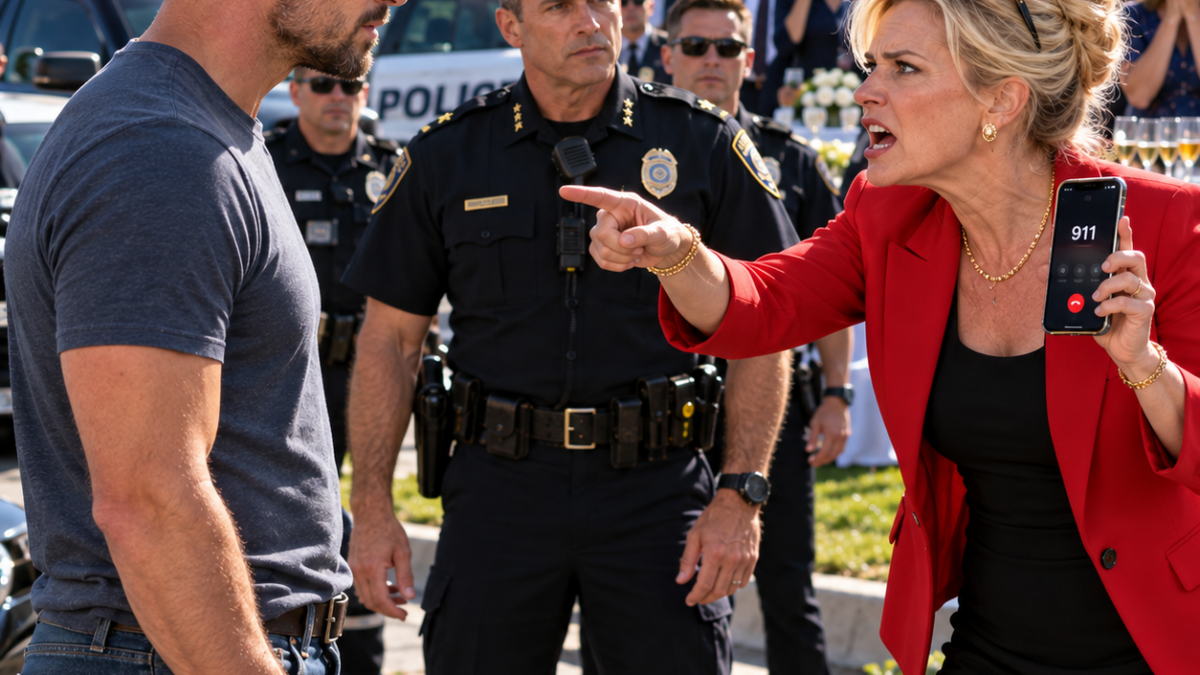
I was halfway up Rosa’s walkway when I heard heels striking pavement quickly behind me.
“Ethan!”
I stopped.
Jillian crossed the street.
Red blazer.
Black pants.
Large sunglasses pushed into her hair.
She pointed at my Jeep.
“You need to move that.”
“Good morning.”
“It’s blocking event parking.”
“No.”
“It is.”
“Your guests are parked on both sides.”
“Exactly.”
“We need the curb.”
I looked.
There was easily enough space.
“You don’t own the curb.”
Her expression sharpened.
“Willow Creek is hosting an association event.”
“Congratulations.”
“Move the Jeep.”
“I’ll move it when I’m finished helping Rosa.”
“How long?”
“Ten minutes.”
“You have two.”
I stared.
“Two?”
“Then I’m having it towed.”
“You can’t tow a legally parked vehicle from a public road because you want the space for a party.”
“We enforce parking.”
“Not like that.”
She stepped closer.
“You also still owe the two-hundred-fifty-dollar violation.”
“No.”
“You ignored official notice.”
“I preserved an interesting piece of paper.”
Her face reddened.
Guests were watching now.
Phones had begun appearing.
I hated that.
Public confrontations become performances fast.
I lowered my voice.
“Jillian.”
“What?”
“Go back to your event.”
“I’ll finish helping Rosa.”
“Then I’ll leave.”
“No scene.”
She laughed.
“You don’t get to tell me what happens in my community.”
I almost reminded her that I owned a house there.
Didn’t matter.
She said:
“You have two minutes or I will have your vehicle towed, fine your property, and have you removed.”
“By whom?”
“Police.”
I looked at her.
“Ma’am, you cannot have a homeowner removed from a public street because he won’t surrender a legal parking space to your party.”
Wrong sentence.
Not legally.
Strategically.
Her hand went into her handbag.
She pulled out her phone.
“Fine.”
Then dialed 911.
I said:
“Jillian.”
She raised one finger at me as if silencing an employee.
The call connected.
“911, what’s your emergency?”
I recognized the voice.
Tina Morales.
Dispatcher for sixteen years.
Jillian turned slightly away.
“There is an armed man threatening me in Willow Creek Estates.”
My entire body went still.
That had just changed the situation.
Tina’s voice:
“Is the weapon displayed?”
“No.”
“Where is the weapon?”
“He’s a police officer or something.”
I was in jeans.
T-shirt.
No badge visible.
My concealed firearm was secured under my shirt, lawful and untouched.
Tina asked:
“Did he point a weapon at you?”
“No, but he’s threatening me and blocking an emergency route.”
Also false.
I was parked at a normal curb nowhere near an emergency lane.
“What’s the address?”
Jillian gave it.
“Description?”
“White male.”
“Forties.”
“Blue shirt.”
“Jeans.”
“Standing across from my house.”
“What is he doing now?”
“Intimidating me.”
I stood beside Rosa’s grocery bags with both hands visible.
Tina said:
“Is he saying anything?”
“He says I can’t make him leave.”
“That is not the same as threatening you, ma’am.”
Jillian became annoyed.
“Just send somebody.”
“Do you know the man?”
“He claims he lives here.”
“Name?”
She looked directly at me.
“Ethan Brooks.”
Silence.
Tina knew my address.
Personnel records listed it.
More importantly, the CAD screen probably connected the name instantly.
Tina asked:
“What vehicle?”
“Old black Jeep.”
“Plate?”
Jillian walked toward the rear.
Read it.
Another silence.
Then Tina said:
“Ma’am, that vehicle is registered to Chief Ethan Brooks.”
Jillian snorted.
“Then send the chief.”
Tina paused.
“Ma’am.”
“Yes?”
“That is our chief.”
Jillian turned toward me.
Actually looked me up and down.
Then laughed.
“Him?”
Tina said:
“Yes.”
“In a T-shirt?”
I could almost hear Tina deciding how much professionalism she had left.
“Chief Brooks is not required to wear a uniform while off duty.”
Jillian’s smile disappeared.
Then returned.
Defensive.
“Well, he’s abusing his position.”
I spoke for the first time loudly enough for Tina to hear through Jillian’s phone.
“Tina.”
“Chief?”
“Do not treat this differently because I’m here.”
“Send a supervisor.”
“Document the call as received.”
“I’m a party.”
“Copy.”
Then:
“Are you safe?”
“Yes.”
“Anyone else unsafe?”
“No.”
“Any weapon displayed?”
“No.”
Jillian shouted:
“He has one!”
I said:
“Concealed.”
“Never touched.”
Tina answered:
“Understood.”
Then I stopped talking.
That was important.
I was not going to run my own incident.
Sirens appeared several minutes later.
Not because I had ordered three cruisers dramatically.
A call alleging an armed threat receives a serious response until facts are clear.
Lieutenant Dan Pruitt arrived first.
Officer Elena Reyes behind him.
Another unit followed.
Lights on.
No sirens once they entered the street.
The quartet stopped playing.
People turned.
Dan got out.
Looked first at Jillian.
Then at me.
His expression said exactly what I felt.
Of course.
He approached.
“Chief.”
“Lieutenant.”
“Everything okay?”
“I want you to treat me as a reporting party and witness.”
“Not chief.”
“Understood.”
Jillian pointed.
“Arrest him.”
Dan raised one hand.
“Ma’am, I need everyone to stop directing the investigation.”
“He threatened me.”
“We’ll speak separately.”
“This road belongs to the HOA.”
Dan looked toward my Jeep.
Then at her.
“That is a separate issue.”
“No.”
“It’s the issue.”
“He refused to move.”
“Then he intimidated me.”
Dan said:
“Officer Reyes will speak with you.”
Jillian turned toward Reyes.
“I want someone senior.”
Dan nodded.
“You have me.”
“That is not what I meant.”
People began whispering.
I stepped toward my porch side of the street.
Dan said:
“Chief, give me a minute.”
“Take all the minutes you need.”
Officer Reyes moved Jillian several yards away.
Another officer spoke to witnesses.
Phones everywhere.
I hated every one of them.
Rosa stood on her porch holding one grocery bag against her chest.
She looked frightened.
I walked toward her.
“It’s okay.”
She whispered:
“This is because of me.”
“No.”
“This is because someone called 911.”
She looked toward Jillian.
“She’ll blame me.”
“I know.”
“I don’t want trouble.”
There were those words again.
I said:
“Rosa, look at me.”
She did.
“You are not responsible for another adult making a false statement.”
“We don’t know yet what officers will conclude.”
“But you standing on your porch is not causing this.”
She nodded.
Then looked unconvinced.
Dan came over five minutes later.
“What happened?”
I gave him the shortest factual version possible.
Groceries.
Parking.
Demand.
Threat of tow.
911 call.
Allegation of weapon.
No display.
No threats.
He asked:
“Body camera?”
“I don’t have one off duty.”
“Any recording?”
I pointed.
“Thirty cell phones.”
Dan did not smile.
“Of course.”
Then:
“Jeep location.”
“Public road.”
“You have documentation?”
I looked at him.
“Don’t make that face.”
“What face?”
“Chief knows things.”
“Fair.”
I walked to the Jeep.
Opened the driver’s door slowly.
Took out the plain white envelope from my glove box.
Inside:
Certified copy of the 1998 road dedication.
County acceptance.
Map.
I gave it to Dan.
He read.
Then passed it to Reyes.
Jillian saw.
“What is that?”
Dan answered:
“County road documentation.”
“I have HOA maps.”
“That doesn’t override recorded dedication.”
“You haven’t seen my map.”
“Then show us.”
She marched to a table.
Grabbed a binder.
Returned.
Opened a glossy site map.
Colored sections.
Common areas.
Lots.
Roads.
Maple Crest Lane shaded like the rest of the development.
Dan looked.
“This appears to be an HOA reference map.”
“It proves the road is ours.”
“No.”
“It shows the road inside the neighborhood.”
“That is not the same thing as ownership or enforcement authority.”
Jillian’s voice rose.
“You’re taking his side.”
“No.”
“I’m reading the documents both of you gave me.”
That silenced her briefly.
Then Rosa stepped off her porch.
Slowly.
Cane in one hand.
Envelope in the other.
“Lieutenant?”
Dan turned.
“Yes, ma’am?”
She held out the envelope.
“If the road is public…”
Her voice shook.
“…why did I pay her?”
Everything stopped.
Not literally.
But attention shifted.
Dan looked at Jillian.
Then Rosa.
“What did you pay?”
“Parking permits.”
“How much?”
“Four thousand eight hundred dollars.”
Jillian immediately said:
“That is an HOA matter.”
Dan raised his hand.
“I didn’t ask you.”
Then to Rosa:
“Do you have receipts?”
“Yes.”
Dan took the envelope only after asking permission.
Looked through.
His expression changed.
He knew about the state referral.
I had told him.
Now the evidence had arrived publicly in front of the very person involved.
He said quietly:
“Mrs. Alvarez, I want Officer Reyes to speak with you separately.”
Rosa nodded.
Jillian said:
“She violated our rules repeatedly.”
Dan looked at her.
“Which recorded or adopted rule authorizes this monthly parking fund?”
She stared.
“I don’t have to explain HOA accounting to police.”
“Maybe not.”
“But you’re currently alleging Chief Brooks committed an offense because he wouldn’t comply with the same parking authority.”
“So yes.”
“The basis matters.”
Her face tightened.
Dan stepped away and called dispatch.
Not over open radio at first.
Then Tina’s voice came through his earpiece.
After a minute, he asked me to come closer.
“Tina says there have been nine calls from Jillian’s number this year involving neighborhood residents.”
“I know Dan.”
“I mean she just flagged the pattern from today’s call.”
“Good.”
“Several contain claims about HOA parking.”
“Okay.”
Then:
“Nina needs to know this blew open.”
I nodded.
“You call her.”
“Not me.”
“Already did.”
That was why I trusted Dan.
Jillian saw us talking.
“You’re coordinating against me.”
I turned.
“Jillian.”
“What?”
“I am not investigating you.”
“Then why is the police lieutenant talking to you?”
“Because you called 911 and named me.”
She opened her mouth.
Closed it.
Then pointed toward her lawn.
“Councilman Hutchins is standing right there.”
I looked.
Peter Hutchins stood near the champagne table.
Gray suit.
Glass in hand.
He looked like a man who would rather be almost anywhere else.
Jillian called:
“Peter!”
Everyone turned.
He reluctantly approached.
She said:
“Tell them the association has always managed parking.”
Hutchins looked at her.
Then at Dan.
“I know the HOA has complained about parking.”
“That is not the same as knowing the legal authority for these fees.”
Jillian stared.
“You supported neighborhood enforcement.”
“I supported residents resolving legitimate issues.”
He set his glass down.
“I am not inserting myself into a police investigation.”
Smart.
Jillian’s face hardened.
“Coward.”
He stepped away.
One of the gala guests did too.
Then another.
Not a dramatic mass exodus.
Just people creating distance from a scene becoming legally uncomfortable.
Rosa finished speaking with Reyes.
Then Warren Blake approached.
“Lieutenant?”
Dan turned.
“I paid too.”
Nicole Price raised a hand.
“So did I.”
Then another resident.
And another.
Within minutes, seven people had identified payments.
Same account label.
Different amounts.
Some cash.
Some electronic.
Dan did not begin interviewing everybody in a shouting circle.
He raised both hands.
“If you believe you made payments connected to this issue, please do not compare details with one another right now.”
“Officer Reyes will collect names and contact information.”
“Investigators will follow up individually.”
That stopped the crowd from turning into contaminated witness testimony.
Good.
Jillian pointed at me.
“This is exactly what he planned.”
“No.”
I said it quietly.
“I planned to carry groceries.”
“Liar.”
I did not answer.
Then a man in a purple shirt stepped forward.
Gil Sutter.
HOA treasurer.
I knew him only by sight.
He looked ill.
Jillian saw him.
“Gil.”
He stopped.
“Tell them.”
He stared.
“Tell them the parking program is legitimate.”
Gil looked at Dan.
Then at me.
Then Jillian.
“I told you we couldn’t collect it that way.”
Jillian’s face changed.
“What?”
“I told you.”
His voice shook.
“Three times.”
“Don’t.”
“You said it wasn’t HOA money because it was a compliance fund.”
“Gil.”
“You said keeping it outside the main account made collection easier.”
People began murmuring.
Dan stepped in.
“Mr. Sutter.”
“Yes?”
“I need you not to continue in front of everybody.”
“If you have relevant financial information, you can speak privately with an investigator.”
Gil nodded rapidly.
Jillian glared at him.
“You coward.”
Gil whispered:
“I told you.”
That was when Nina Castellano arrived.
Not magically from a parked sedan that had been waiting for the perfect reveal.
Dan had called her when the 911 incident connected directly to the existing financial inquiry.
She drove in twenty minutes after patrol officers.
Black state vehicle.
Badge clipped at her belt.
Plain clothes.
She approached Dan first.
They spoke.
Then she came to me.
“Brooks.”
“Castellano.”
“You enjoying your quiet neighborhood?”
“Immensely.”
She did not smile.
“Stay out of my case.”
“Gladly.”
Then she went to Rosa.
Gil.
Other residents.
Jillian watched.
Her confidence was disappearing in layers.
Finally she grabbed her handbag.
“I am leaving.”
Dan said:
“Jillian.”
She stopped.
“For the moment, don’t.”
“Am I under arrest?”
“Not at this moment.”
“Then I am free to go.”
Dan looked toward Nina.
Nina stepped forward.
“Ms. Radcliffe.”
“Yes?”
“I am Investigator Nina Castellano with the state bureau.”
“We have an existing investigation involving payments associated with the WC Parking Fund.”
Jillian’s face changed.
Very slightly.
Enough.
Nina continued:
“I need to speak with you.”
“I have an attorney.”
“Good.”
“You may contact counsel.”
“Am I detained?”
Nina looked at Dan.
Then answered carefully.
“At this moment, I am asking you to remain while officers finish investigating the 911 complaint.”
Dan added:
“You made the call.”
“We’re determining whether the report contained knowingly false information.”
Jillian laughed.
“I was afraid.”
“That may be relevant.”
“I said he was armed.”
“He is.”
Dan replied:
“You also said he threatened you and blocked an emergency route.”
“He intimidated me.”
“That’s different language.”
She turned toward me.
“Say something.”
I shook my head.
“No.”
Her anger increased.
“You think you’re untouchable because you’re chief.”
“No.”
“I think this is exactly why I should stay quiet.”
That was the first correct thing I had done in several minutes.
Then her bag slipped.
Not a dramatic intentional search.
The shoulder strap caught on the corner of a folding chair as she turned.
The bag dropped.
Opened.
Contents spilled.
Wallet.
Makeup case.
Keys.
Phone charger.
Several envelopes.
Cash visible inside one.
House numbers written on the fronts.
Rosa stared.
“So that’s where you put it.”
Nobody moved.
Nina said immediately:
“Do not touch anything.”
One officer secured the area.
Jillian bent toward the bag.
Nina stopped her verbally.
“Ma’am, leave it where it is for a moment.”
“That’s my property.”
“Yes.”
“And we’ll handle it correctly.”
The fact that an envelope was visible did not magically authorize police to rummage through everything in her bag.
Nina photographed what lay in plain view.
Then sought legal authority for further seizure and examination based on the larger investigation.
That part took process.
Not eleven dramatic seconds.
The crowd did not understand why officers were not immediately dumping every envelope onto a table.
Nina did.
Evidence gathered badly can damage good cases.
Jillian was not handcuffed because cash fell out.
She was detained while Dan completed the false-report investigation and Nina coordinated with prosecutors and supervisory personnel.
Witness video mattered.
Several recordings captured the entire confrontation before the 911 call.
No threat.
No weapon display.
No blocked emergency lane.
More importantly, the 911 recording captured Jillian escalating facts after Tina asked precise questions.
Was the weapon displayed?
No.
Did he threaten you?
She claimed yes.
Video contradicted the claim.
Dan spoke to multiple witnesses separately.
Same account.
Jillian demanded I move.
I refused.
She threatened towing.
I told her she lacked authority.
She called.
No threatening gesture.
No displayed weapon.
No approach toward her.
By late afternoon, after consultation with the prosecutor, officers had probable cause for a false-reporting offense.
Dan came to me first.
“Chief.”
“What?”
“We’re making the arrest.”
I felt no satisfaction.
That surprised me.
“Based on?”
He listed it.
911 audio.
Witness statements.
Videos.
The knowingly false claim of a direct threat and emergency-route obstruction.
“Good.”
Then:
“I want nothing to do with the arrest.”
“You don’t.”
“Nothing.”
“I know.”
Officer Reyes and another patrol officer approached Jillian.
Dan remained supervisor.
Reyes said:
“Ms. Radcliffe, based on the investigation into today’s emergency call, you are under arrest for making a false report.”
Jillian stared.
“No.”
Reyes continued with the standard process.
No speech.
No public humiliation.
No:
You messed with the wrong chief.
No handcuffs because I wanted revenge.
Jillian looked at me as Reyes secured her wrists behind her.
“This is you.”
I said:
“No.”
She laughed bitterly.
“You’re the chief.”
“That is why I’m staying out of it.”
“You planned this.”
“I didn’t make your call.”
That ended our conversation.
The gala was effectively over.
Guests left in clusters.
Caterers packed.
Musicians closed cases.
Councilman Hutchins gave Dan his contact information and departed.
Gil remained with Nina for more than an hour.
Rosa sat on her porch.
I finally carried the groceries inside.
Milk first.
Then bread.
Then cans.
Normal things.
When I finished, she touched my hand.
“Thank you, Chief.”
“For what?”
“Everything.”
I shook my head.
“Today?”
“You called police.”
“She called police.”
That made Rosa smile.
“Then thank you for carrying groceries.”
“That’s fair.”
The financial investigation expanded fast after the arrest but did not finish in nine magical days.
The first audit review took several weeks.
Subpoenas and warrants produced banking records.
Payment processor histories.
HOA ledgers.
Board minutes.
Credit-card statements.
Electronic communications.
What investigators found was worse than the original five complaints.
The WC Parking Fund was not an HOA-owned account.
It was a personal business-style account controlled by Jillian.
Over twenty-six months, $63,400 had entered through payments tied to parking permits, access charges, compliance fees, and related demands.
Not every payment was automatically fraudulent.
Investigators had to connect each one to representations made.
Some residents may have paid legitimate HOA fines separately through proper channels.
Those had to be distinguished.
After reconstruction, most of the $63,400 in the parking account had no authorization in the HOA’s governing records and had never entered official association accounting.
That was the critical point.
Gil cooperated.
His story was complicated.
He had objected verbally.
He had warned Jillian.
But he had also remained treasurer while irregularities continued.
Investigators looked closely at whether he had knowingly helped conceal them.
He eventually admitted he should have forced the issue to the full board much earlier.
He had emails proving repeated objections.
He also had messages from Jillian telling him:
This is administrative, not HOA revenue.
Do not clutter financial statements with compliance collections.
One message read:
Residents pay because enforcement works. Stop acting like every dollar needs committee approval.
That was not good for her.
Then came the HOA credit card.
A luxury spa weekend.
Hotel.
Treatments.
Meals.
Charged during a month the community pool had reduced hours because the operating account was short.
Jillian argued the trip was tied to a regional association-management conference.
There had been a conference.
She attended one session.
The rest of the expenses became disputed.
Investigators and auditors separated legitimate reimbursable costs from personal expenses.
Again:
Specificity.
The story spread through Pine Valley.
Too fast.
Local news ran:
HOA PRESIDENT ARRESTED AFTER CALLING POLICE CHIEF ON PARKING DISPUTE.
Accurate enough.
Then social media did what social media does.
One post said I had been undercover in the neighborhood investigating Jillian.
False.
Another said I deliberately parked outside her party to bait her.
False.
One video claimed the state investigator was secretly waiting around the corner because I had planned the arrest.
False.
I issued one statement through the department:
I was involved in the initial incident as a private resident and witness. Because of that conflict, I did not direct the criminal investigation. Lieutenant Pruitt supervised the local response, and the state bureau is handling the related financial matter.
Boring.
Good.
At work, Tina Morales cornered me near dispatch.
“Chief.”
“Yes?”
“You owe me coffee.”
“Why?”
“Do you know what it does to a dispatcher’s nervous system when someone demands the chief and the chief is the suspicious person?”
I laughed.
“Professional development.”
“No.”
“Trauma.”
“Fair.”
She continued:
“I almost said, ‘Ma’am, you’re talking about my boss.’”
“You didn’t.”
“I’m excellent.”
“Yes.”
Then:
“Did I really say ‘That’s our chief’?”
“Yes.”
She covered her face.
“The internet has ruined my life.”
“It could be worse.”
“How?”
“They could turn it into merchandise.”
She stared.
Two weeks later, someone mailed her a mug that said:
THAT’S OUR CHIEF.
She blamed me.
I was innocent.
Probably Dan.
The HOA held an emergency meeting.
The clubhouse had room for eighty seated.
More than a hundred came.
Some stood outside.
I did not sit at the front.
Did not wear a uniform.
Did not speak first.
This was their association.
Not my department.
The board’s attorney explained that the financial review was ongoing.
The board suspended Jillian’s authority immediately after her arrest under the bylaws.
Whether she remained a director pending removal required formal procedure.
Residents demanded resignations.
Some board members genuinely had not known about the separate parking account.
Others had failed to ask enough questions.
That distinction mattered.
Gil stood.
His voice shook.
“I should’ve brought this to the entire board.”
Someone shouted:
“You were treasurer!”
He nodded.
“Yes.”
“I told Jillian the account wasn’t authorized.”
“I did not force a vote.”
“I did not notify counsel.”
“I did not contact the auditor.”
“I was afraid that if I made accusations without proof, I would destroy the board.”
A woman in back said:
“So you let her destroy it instead.”
Gil lowered his head.
“Yes.”
Hard moment.
No easy defense.
He later resigned too, after cooperating with investigators and helping reconstruct the records.
The entire board did not vanish in one dramatic mass resignation that night.
Two resigned immediately.
Another stayed temporarily because somebody had to keep insurance, pool operations, vendors, and required filings functioning.
The association retained independent management.
An interim board was appointed or elected according to its governing procedures.
Then a special election followed.
That was far less satisfying online.
Much healthier in reality.
Rosa attended every meeting.
The first time she spoke publicly, she needed both hands on her cane.
“I paid because I thought if I argued, I would lose my home.”
The room went silent.
The association attorney clarified:
“The association did not hold lawful liens for these street-parking payments.”
Rosa nodded.
“I know that now.”
Then:
“But she knew I didn’t know.”
That sentence became central to the civil restitution effort.
The criminal prosecution took almost a year.
Jillian’s attorney challenged parts of the financial case.
Some payment descriptions were ambiguous.
Some residents had received notices that mixed valid covenant language with invalid road-access claims.
The prosecutor did not charge every dollar as theft.
Good.
Broad overcharging invites weak cases.
The strongest transactions involved residents told they were required to pay personally controlled fees to avoid towing, liens, or loss of parking rights that did not exist.
Rosa’s payments were among them.
Jillian eventually entered a plea agreement.
False report to emergency services.
Theft-related offenses based on deceptive fee collection.
Additional financial counts resolved within the agreement.
She received probation with a period of local confinement, restitution obligations, community service, financial restrictions, and other conditions.
Not life in prison.
Not a judge banning her forever from “all HOAs in America,” which no county judge could casually impose.
The HOA itself amended its bylaws and election rules so Jillian could not hold office there again.
Separate professional and court restrictions addressed fiduciary conduct during supervision.
Those distinctions mattered.
The judge asked Jillian whether she understood the plea.
“Yes.”
Whether anyone forced her.
“No.”
Whether she admitted making false representations to obtain money from residents.
A long pause.
Then:
“Yes.”
I sat in the back.
Not in uniform.
Rosa beside me.
When restitution was discussed, Rosa squeezed my wrist.
After court, Jillian passed us in the hallway.
Plain gray blouse.
No red blazer.
No sunglasses.
She stopped.
Her lawyer touched her elbow as though reminding her not to speak.
She looked at me.
I nodded.
Nothing triumphant.
Nothing cruel.
Then she looked at Rosa.
That was harder.
Rosa said:
“You scared me for two years.”
Jillian’s face tightened.
“I know.”
“Why me?”
Her lawyer started to intervene.
Jillian raised one hand.
Then answered:
“Because you paid.”
Rosa stared.
Jillian’s eyes filled.
“The first time.”
“You paid.”
“So I kept sending the notices.”
The simplicity of it was horrifying.
Not personal hatred.
Opportunity.
Rosa asked:
“Because Miguel was gone?”
Jillian looked down.
“I knew you were alone.”
Rosa closed her eyes.
Then turned away.
She did not forgive Jillian.
Nobody required her to.
Restitution came through a combination of criminal orders, recovered account funds, insurance where applicable, and civil settlement.
Rosa received back every amount investigators could document as having been improperly collected from her.
The first check did not arrive at a packed clubhouse with applause.
It arrived by mail.
She brought it to my porch.
Held it in both hands.
“Look.”
I read the amount.
$4,800.
She smiled.
Then cried.
I made coffee.
We sat.
No crowd.
That felt more appropriate.
She said:
“I feel stupid.”
“No.”
“I paid every month.”
“You believed someone with apparent authority.”
“I should’ve asked.”
“Yes.”
She looked surprised.
Most people expected me to say she had done nothing wrong.
I continued:
“You can wish you had asked without blaming yourself for somebody else lying.”
“Both can be true.”
She nodded.
“Will I ever stop being embarrassed?”
“Probably.”
“How long?”
“No idea.”
“Very helpful.”
“I’m police.”
“Not therapy.”
She laughed.
That was Rosa.
The neighborhood changed after Jillian.
At first, too much.
Every HOA notice triggered suspicion.
Landscaping invoice?
“Fraud.”
Pool closure?
“Where’s the money?”
A proposed dues increase?
“Another Jillian.”
That was not healthy either.
Trust should not be blind.
Distrust should not become permanent government.
The new board published monthly financial summaries.
Bank accounts required two-authorizer controls for certain transactions.
Electronic payments went only to association-owned accounts.
Fines required reference to specific governing authority.
Street-parking notices stopped except where municipal or county rules applied.
If the HOA believed a vehicle violated public law, management called the appropriate authority rather than inventing an HOA permit.
Simple.
Boring.
Better.
The new president was Nicole Price.
Yes, the same single mother who had paid guest-parking fees.
She did not seek the job initially.
Residents asked.
Her first board meeting lasted ninety-three minutes.
People complained it was dull.
I told them:
“Excellent.”
Nicole eventually stopped by my house.
“Chief.”
“Nicole.”
“I need advice.”
“HOA or police?”
“HOA.”
“Then I am probably the wrong person.”
She smiled.
“That’s why I’m asking.”
She showed me a proposed towing policy for vehicles on HOA-owned private parking lots near the clubhouse and pool.
Not public streets.
“Can we do this?”
“I don’t know.”
“You’re chief.”
“Which does not make me your HOA attorney.”
She stared.
“You’re annoying.”
“I’m developing a reputation.”
I continued:
“Have counsel review authority.”
“Make signage clear.”
“Make sure towing complies with state and local law.”
“Separate private lots from public roads.”
“Then enforce whatever lawful policy you adopt consistently.”
She nodded.
“That was useful.”
“Bill is coming.”
She laughed.
That became the new relationship between HOA and police.
Questions.
Not demands.
One year after the gala, I parked the Jeep in exactly the same spot outside Rosa’s house.
Not symbolically.
She had invited me for cookies.
I pulled up.
Got out.
A kid on a bicycle passed.
“Morning, Chief!”
“Morning.”
Rosa opened her door.
“You’re on my road again.”
I smiled.
“County’s road.”
“Don’t ruin my joke.”
I walked up.
She handed me a plate.
Cinnamon cookies.
Still perfect.
We sat on the porch.
Across the street, Jillian’s former house had been sold.
A family with two young children lived there.
No galas.
No clipboards.
No dramatic authority.
They had a basketball hoop in the driveway.
The older child left his bike on the lawn constantly.
Nicole sent no citations because bikes on lawns were not an apocalypse.
Life became normal.
That was the biggest victory.
Not handcuffs.
Not restitution.
Not my title being revealed.
Normal.
For months after the story spread online, strangers wrote to me.
Most wanted the satisfying version.
“Chief, how did it feel when the dispatcher exposed her?”
“Did you know she was going to get arrested?”
“Why didn’t you tell her immediately who you were?”
“Did she really turn white?”
Some of that happened.
Some became exaggerated.
What mattered to me was different.
If Tina had never said who I was, the call still should have been investigated fairly.
If I had been an electrician, teacher, retiree, or unemployed guy carrying groceries, Jillian’s false statement would still have been wrong.
My badge did not make the truth more true.
That was the danger in how people told it.
She messed with the wrong man.
No.
She had been messing with the wrong people for years.
Rosa was the wrong person to exploit.
Warren.
Nicole.
Mateo.
Every neighbor threatened into paying money because they believed a clipboard and title gave someone power over a public street.
I was simply harder to intimidate because I knew the system.
That is not the same thing as deserving more protection.
I told Tina that once.
She said:
“You are ruining the meme.”
“Sorry.”
“No, you’re not.”
“Correct.”
Dan Pruitt eventually became deputy chief.
Not as a reward for handling the Jillian incident.
He had earned promotion over years.
At his ceremony, I told the story differently.
I said:
“When a call came in involving me personally, Lieutenant Pruitt did not ask what outcome I wanted.”
“He asked what happened.”
“That is policing.”
Dan looked uncomfortable.
Good.
I continued:
“The public should never need to hope the person being mistreated happens to be the chief.”
“That sentence became quoted locally.”
I wish people had remembered the rest.
“Systems are trustworthy when ordinary people receive the same careful process powerful people expect.”
That was the point.
When I became chief, I wanted a quiet home because I thought my work and private life could remain separate.
They could not completely.
Small-city policing does not work that way.
People know where you shop.
Where you eat.
Your car.
Your dog.
Your failures.
Your neighbors.
The answer was not hiding from community life.
It was building boundaries.
When I was involved, someone else handled it.
When police authority was not needed, I did not use it.
When an HOA dispute was civil, it stayed civil.
When evidence suggested crime, we handed it to investigators with appropriate independence.
That protected Jillian too.
I know people dislike that sentence.
She had rights.
The state had to prove charges.
Evidence had to be gathered lawfully.
Witnesses needed separate interviews.
Her bag did not become public property because people hated her.
Her title did not convict her.
Neither did mine.
That process is what made the final result credible.
Rosa understood that before many others.
One afternoon, she asked:
“Why didn’t you arrest her yourself?”
I laughed.
“Imagine how terrible that would look.”
“She lied about you.”
“Exactly.”
“You wanted to?”
“For about thirty seconds.”
She smiled.
“Only thirty?”
“Maybe forty-five.”
Then:
“But wanting something is not authority.”
She nodded.
“Jillian should have learned that.”
Yes.
That was the core.
Wanting control is not authority.
Holding office in a private association is not police power.
Being police chief is not personal enforcement power.
Being a councilman is not permission to intervene in a criminal case.
Being treasurer does not excuse silence.
Every role has limits.
Jillian’s failure was partly that she stopped believing hers did.
Over the next two years, more details emerged about how that happened.
She had not always been feared.
When first elected president, she organized storm cleanup.
Negotiated lower landscaping costs.
Helped get the pool repaired.
Created a food drive during winter.
Residents loved her.
Then success changed her.
Or revealed her.
Maybe both.
People started calling Jillian instead of management.
Parking problem?
Jillian.
Fence issue?
Jillian.
Loud party?
Jillian.
She became the person who “got things done.”
At first, probably true.
Then she started treating effectiveness as authority.
If she believed something helped the community, process became an obstacle.
Board vote unnecessary.
Legal review unnecessary.
Separate account convenient.
Cash collection efficient.
Calling police useful.
Each shortcut made the next easier.
Gil told investigators:
“She stopped asking whether we could do something.”
“She only asked how fast.”
That sentence stuck with me.
Power often becomes dangerous before the person holding it realizes they think they are powerful.
They tell themselves they are efficient.
Practical.
Decisive.
Protecting people.
Then one day they are calling 911 because someone refuses to move a Jeep from a public street.
I was not immune.
Being chief creates its own version.
People laugh harder at your jokes.
Return calls faster.
Stop arguing sooner.
Officers stand when you enter certain rooms even if policy doesn’t require it.
It would be easy to mistake that deference for wisdom.
So I kept the pink $250 notice.
Not framed.
Not displayed.
In a desk drawer.
Whenever I caught myself becoming irritated because someone questioned a decision, I sometimes opened the drawer.
PINK PAPER.
Unauthorized Vehicle.
Signed Jillian Radcliffe.
A reminder.
Titles can convince people their assumptions are rules.
Mine included.
Several years later, a young patrol officer named Aaron Mills disagreed with a staffing change I made.
He requested a meeting.
Sat across from me.
Nervous.
“Chief, I think the new schedule creates a coverage problem after two.”
I already knew his argument.
Thought it was wrong.
My first impulse was:
I’ve reviewed this.
Then I saw the pink notice in the open drawer.
I said:
“Show me.”
He did.
His numbers were better than mine.
Not dramatically.
Enough.
We changed part of the schedule.
Aaron looked shocked.
“What?”
I asked.
“Nothing.”
“You expected a fight.”
“No, sir.”
“Terrible liar.”
He smiled.
After he left, I thought about Jillian.
The difference between authority and arrogance is often whether contrary facts are allowed into the room.
Years passed.
I retired from Pine Valley at fifty-nine.
Not because of Jillian.
Knees.
Politics.
Granddaughter.
Desire to stop receiving phone calls when somebody stole a snowblower at 3 a.m.
Dan became chief.
At my retirement reception, Tina Morales attended.
She handed me a box.
Inside:
The mug.
THAT’S OUR CHIEF.
I laughed.
“You kept this?”
“For twelve years.”
“Why?”
“Evidence.”
“Of?”
“Your most embarrassing neighborhood incident.”
Dan stood beside her.
I looked at him.
“You sent it originally.”
He refused to answer.
Guilty.
Rosa was there too.
Ninety then.
Cane upgraded to a walker.
Still baking cookies against medical advice.
Nicole.
Councilman Hutchins, long out of office.
Officer Reyes, now lieutenant.
Investigator Castellano sent a note because she was out of state.
No Jillian.
I had not seen her in years.
After completing supervision and restitution, she moved.
That was all I knew.
Then, about six months after retirement, I received a letter.
No return name I recognized.
Inside:
Chief Brooks,
I don’t know whether you’ll read this.
You were right that day.
That surprised me.
Not because I expected denial forever.
Because apologies often begin with:
I am sorry if.
This did not.
She wrote:
I spent years telling myself you used your position against me. It was easier than admitting you kept trying not to.
I sat down.
Continued.
I still believe some residents abused neighborhood rules and some parking problems were real. That does not excuse what I did. I created charges I had no authority to collect, lied to people about consequences, and used fear because fear worked faster than persuasion.
Then:
Rosa was the person I am most ashamed of.
Good.
She wrote:
I called 911 because I expected officers to make you comply. When the dispatcher said who you were, I felt humiliated. I kept escalating because backing down in front of everyone felt worse than lying more. By the time officers arrived, I knew I had exaggerated the call.
I read that sentence twice.
Then:
I don’t expect forgiveness. I wanted to stop telling myself I was merely misunderstood.
That was an apology.
I showed Rosa.
She read slowly.
Then placed the letter on her lap.
“What do you think?”
I asked.
Rosa shrugged.
“She finally learned English.”
I laughed.
“What?”
“For years she spoke Jillian.”
“What is Jillian?”
“Everything means somebody else’s fault.”
Still sharp at ninety.
“Do you forgive her?”
Rosa looked toward the street.
“I don’t think about her enough to need to.”
That may have been healthier than forgiveness.
I wrote Jillian back.
Thank you for taking responsibility specifically. I hope your life is better now.
Nothing else.
She never wrote again.
Good.
Some stories do not need reunions.
Rosa died two years later.
Ninety-two.
Her grandson Mateo called me.
“She went in her sleep.”
I sat quietly for a long time.
At the funeral, he placed one of her handwritten cookie recipes beside the guest book.
I took a photograph.
Not the card.
I had learned something about taking things that belong to families.
After the service, Mateo said:
“She talked about you all the time.”
“Hopefully not accurately.”
He laughed.
“She said you moved in and immediately caused trouble.”
“That sounds like her.”
Then:
“She kept the refund check stub.”
I looked at him.
“Why?”
“She said it reminded her she wasn’t stupid.”
That hurt.
“Did she think she was?”
“For a while.”
“She said getting the money back helped.”
“But what really helped was you telling her she could regret paying without taking responsibility for being lied to.”
I had forgotten saying it.
People remember different sentences than the ones we think matter.
Mateo handed me an envelope.
Inside was one of the pink HOA notices.
Rosa’s.
Unauthorized street parking.
Amount due:
$175.
She had written across it years later:
ASK QUESTIONS.
I kept that.
It sits beside my pink $250 notice now.
Two reminders.
Mine says authority can overreach.
Hers says fear can make false authority feel real.
Both matter.
Willow Creek Estates is still there.
Of course.
No dramatic dissolution.
The HOA still exists because somebody has to manage the pool, landscaping, entrance signs, clubhouse, insurance, reserves, and common property.
People still complain about it.
They complain differently now.
The governing documents are online.
Financials independently reviewed.
Rules cite their source.
Fines show appeal procedures.
Nobody collects cash in envelopes.
Public-road parking is handled by the actual public authorities.
Private clubhouse parking remains HOA-managed under lawful policies.
Boring governance.
Excellent.
My father’s house eventually went to Mateo and his wife.
Not because Rosa’s family bought it.
I sold it to them years after retirement.
Fair-market transaction.
They wanted to stay near Rosa’s old place, which Mateo inherited.
I moved closer to my daughter.
Before closing, Mateo walked through the garage with me.
Found an old campaign-style sign someone had made after the Jillian story.
BROOKS FOR HOA PRESIDENT.
I had crossed out BROOKS and written:
ABSOLUTELY NOT.
Mateo laughed.
“You should’ve run.”
“No.”
“You would’ve won.”
“Exactly why I couldn’t risk it.”
He kept the sign.
Probably still there.
The old Jeep finally died at 312,000 miles.
Transmission.
Rust.
Exhaust.
My mechanic said:
“Chief, let it go.”
“Retired chief.”
“Even more reason.”
I sold it for parts.
Before they hauled it away, I sat inside one last time.
Opened the glove box.
Empty.
The original pink citation was in my office by then.
I remembered Jillian standing outside Rosa’s house.
Red blazer.
Phone raised.
Eighty guests watching.
The ridiculous certainty in her voice.
“There is an armed man threatening me.”
Then Tina:
“Ma’am, that vehicle belongs to Chief Brooks.”
Jillian:
“Then send the chief.”
And those four words:
“Ma’am, that’s our chief.”
That was the part everybody remembered.
Funny.
Sharp.
Satisfying.
But the story had started long before the dispatcher recognized my plate.
It began when Rosa wrote the first check because she was afraid of losing her car.
Or maybe when Jillian discovered nobody challenged the first fake fee.
Or when Gil warned her and then stayed quiet.
Or when residents decided paying was easier than questioning.
Bad systems rarely begin with one dramatic abuse.
They begin with small things people accept because confrontation costs more.
Twenty dollars.
Fifty.
A notice.
A threat.
A phone call.
Then repetition turns invention into tradition.
By the time I moved in, neighbors were saying:
That’s just how parking works here.
No.
It was how parking had been made to work because nobody had forced the authority behind it into daylight.
The county record helped.
The audit helped.
The investigation helped.
But Rosa asking:
“Then why did I pay her?”
That was the question.
Everything changed after that.
Not because I was chief.
Because once the right question was spoken publicly, everybody else who had been afraid began comparing their private experience to the same fact.
Public street.
Private payments.
Where did the money go?
Questions.
Not revenge.
I tell that whenever retired police groups ask me to speak.
They usually invite me because they want the funny 911 story.
I give them something else.
I say:
“Never teach the public that justice depends on accidentally calling the police chief.”
People laugh.
Then I continue:
“If the only reason your system behaves correctly is that the victim turns out to be powerful, you don’t have justice.”
“You have hierarchy.”
That usually quiets the room.
I tell them Dan handled the scene.
Not me.
State investigators handled the money.
Not me.
Prosecutors decided charges.
Not me.
The court decided guilt and sentence.
Not me.
That separation was not weakness.
It was the thing that made the outcome legitimate.
Then I tell the HOA version.
Being president did not make Jillian evil.
Believing the title converted preference into authority made her dangerous.
Being chief did not make me righteous.
Believing my title entitled me to personally punish her would have made me dangerous too.
Power needs limits precisely because everybody thinks their own reasons are good.
I still believe that.
Especially about myself.
Last year, Tina and I met for coffee.
She’s retired too.
She brought the infamous mug.
I said:
“You need new material.”
She said:
“You need a better story.”
We sat by a window.
Talked about old dispatch calls.
Officers we missed.
Technology.
How everything is recorded now.
Then she asked:
“Did you actually know it was me when Jillian called?”
“Yes.”
“How?”
“Voice.”
She smiled.
“Did you know what I was going to say?”
“No.”
“You looked smug in the video.”
“I was trying not to laugh.”
“Why?”
“Because I knew you had my plate.”
“So?”
“You once called me at home because my registration was two days from expiring.”
“Public safety.”
“You are a menace.”
“Correct.”
Then she became serious.
“You know the call could’ve gone badly.”
“Yes.”
“If she had described a weapon differently.”
“Yes.”
“If officers didn’t know you.”
“Yes.”
“If witnesses weren’t there.”
“Yes.”
She stared into her coffee.
“That’s the part I hate.”
“Me too.”
False emergency calls are not funny when you remove the satisfying ending.
Someone can get hurt.
Officers arrive expecting danger.
People react.
Fear accelerates.
That was why the false-report charge mattered independently of the parking scheme.
Jillian used the emergency system as leverage in a private dispute.
Not merely wasted time.
She inserted armed public authority into a conflict she was losing.
That choice could have produced consequences none of us controlled.
I was fortunate.
Known caller.
Known location.
Calm scene.
Witnesses.
Nobody displaying weapons.
Experienced supervisor.
Plenty of advantages.
Other people do not get all of those.
That thought changed how our department trained around third-party reports and caller language.
Not because dispatchers should distrust callers automatically.
Because precision matters.
Weapon present is not weapon displayed.
Argument is not threat.
Refusal is not aggression.
HOA violation is not crime.
Suspicion is not probable cause.
Words shape response.
Tina had done exactly what good dispatchers are supposed to do.
Asked.
Is the weapon displayed?
What threat was made?
Where is he standing?
What is he doing now?
Jillian became frustrated because specific questions narrowed her story.
Specificity often does that to exaggeration.
That may be why I remember Tina’s questions more than her famous four words.
The internet remembers:
That’s our chief.
I remember:
Did he display the weapon?
One was funny.
The other kept the call accurate.
Years after I left Pine Valley, I drove through Willow Creek once.
No reason.
Nostalgia.
Maple Crest looked smaller.
Dad’s old house had new paint.
Mateo put a blue bench on the porch.
Rosa’s house remained across the street.
Another family member lived there.
Kids’ chalk on the driveway.
I stopped near the curb.
Same place where the Jeep had been.
No one cared.
Cars parked normally.
No windshield stickers.
No pink notices.
Just county rules.
I sat for a minute.
Then drove away.
I did not need to reclaim anything.
The street never belonged to Jillian.
It did not belong to me either.
That was the entire point.
It belonged to the public under the law, and people were entitled to use it without paying invented tribute to whoever happened to possess a clipboard.
When I think about that afternoon now, I do not remember Jillian walking toward the cruiser in handcuffs as the climax.
That was consequence.
The real turning point happened earlier.
Rosa stood on her porch.
Small woman.
Cane.
Old envelope in her hand.
Everybody around her had more visible power.
Chief.
Lieutenant.
Councilman.
HOA president.
State investigator.
She asked one question.
“Then why did I pay her?”
There was nowhere left for the lie to hide after that.
Because authority can survive argument.
It can survive reputation.
It can survive angry neighbors.
What false authority struggles to survive is a simple factual question asked where everyone can hear the answer.
The pink notice in my desk eventually faded.
The ink on Rosa’s did too.
I could throw them away.
Probably should.
I haven’t.
Not because I need reminders of Jillian.
I barely think about her.
I keep them because they represent opposite sides of the same responsibility.
If someone claims authority over you, you are allowed to ask where it comes from.
If you hold authority over someone else, you should be prepared to answer.
Badge.
Title.
Board seat.
Uniform.
Office.
None of them eliminate that obligation.
The afternoon Jillian called 911, she believed the call would prove who had power.
In one sense, she was right.
It did.
Just not the way she expected.
The dispatcher recognized me.
The officers recognized me.
The crowd learned I was chief.
That part made a good story.
But the lesson I carried into retirement came from everybody who had been paying long before I arrived.
Power is not proven when the important person gets treated properly.
It is proven when the person with no title can ask the same question and receive the same answer.
Rosa deserved that before I ever moved across the street.
And if there is one thing I wish had happened differently, it is that somebody had listened to her before the chief of police happened to buy the house next door.








