My New Neighbor Said Part of My Driveway Was His—Then His Fence Contractor Asked for One Document.k
PART2:
I turned off the hose.
Water ran in a thin stream toward the street while I looked from Derek to Natalie and back to the concrete.
“How much of my driveway are you saying is yours?”
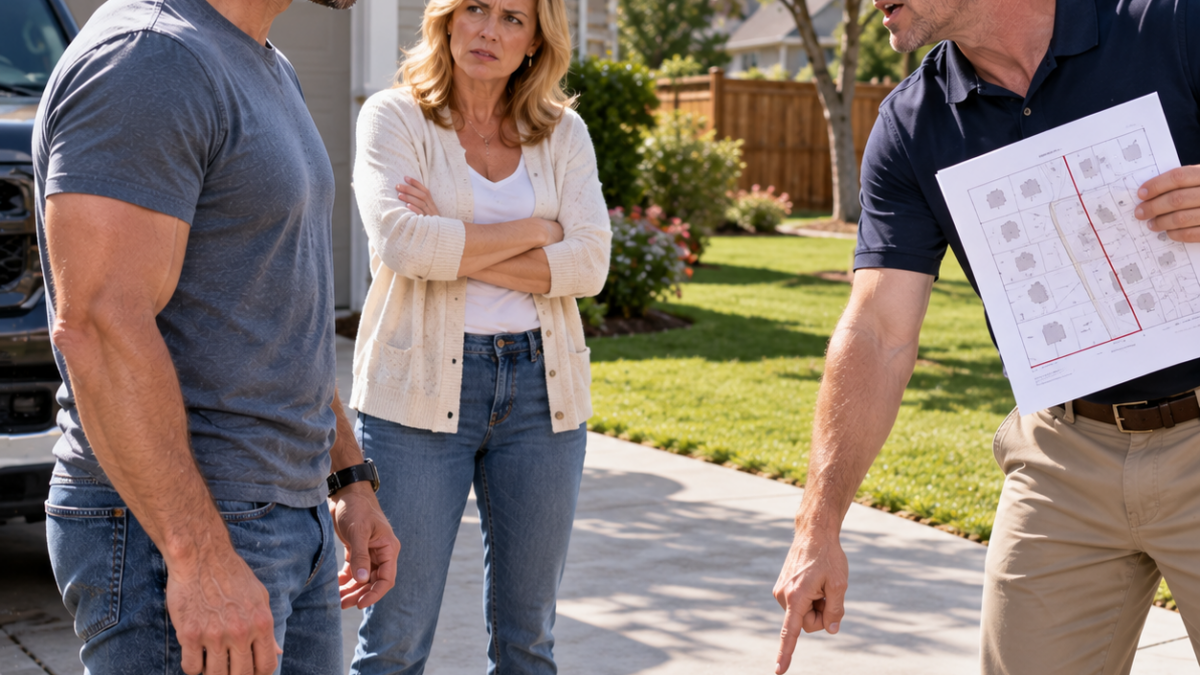
Derek stepped closer and pointed.
“Maybe the first six or eight feet along this side.”
“Six or eight feet?”
“Something like that.”
I stared at him.
The driveway had been exactly where it was since before I bought the house.
The house itself was more than twenty years old.
Nobody had ever questioned it.
No old owner.
No surveyor.
No title company.
No county notice.
Nothing.
I said:
“Derek, this driveway was here when I bought the property.”
He shrugged.
“I’m not saying you poured it illegally.”
“What are you saying?”
“The boundary may not be where you think it is.”
That sentence bothered me far more than his tone.
He didn’t sound aggressive.
He sounded certain.
Like the issue had already been decided somewhere else, and the only unresolved part was how long it would take me to accept it.
Natalie stepped in.
“Our realtor specifically showed us the property line during the purchase.”
“On what?”
“A property sketch.”
“Survey?”
“I think so.”
Derek nodded.
“Yeah.”
Something in the way he said it made me pause.
“Can I see it?”
“Sure.”
He disappeared into his house and returned a few minutes later holding a folder.
He pulled out a sheet.
It looked like a simplified lot sketch attached to some real-estate paperwork.
House footprint.
Street.
Approximate side lot.
A few dimensions.
There was a line angled toward the edge of my driveway.
If you looked at it casually, I could understand the confusion.
If you already believed Derek’s version, it looked even more persuasive.
But I spent enough years working as a project estimator for a regional construction company to know the difference between a drawing meant to explain something and a survey meant to establish something.
This wasn’t a boundary survey.
No certification.
No surveyor’s seal that I could see.
Not enough measurements.
No monument references.
No detailed legal description.
It was the kind of drawing I’d trust to decide where a patio might sit conceptually.
Not where I’d install a permanent fence beside somebody else’s driveway.
I handed it back.
“I’m not saying nobody showed you this.”
Derek smiled slightly.
“Okay.”
“But this doesn’t prove where the boundary is.”
His smile faded.
“Our realtor seemed pretty confident.”
I remember thinking:
Confidence is free.
Land in Tennessee isn’t.
Out loud, I said:
“Then before anybody builds anything permanent, let’s make sure we’re using the actual property line.”
Derek nodded.
But the way he nodded told me he thought I was delaying an inevitable result.
That irritated me more than I wanted to admit.
He wasn’t asking whether part of my driveway might belong to him anymore.
In his mind, it already did.
Natalie asked:
“So what do you have showing something different?”
“A survey from when I bought.”
“Can we see it?”
“I’ll find it.”
Derek said:
“Good.”
Not thank you.
Not great.
Good.
Like I was producing evidence for a dispute I hadn’t known existed thirty minutes earlier.
They walked home.
I picked up the hose again.
Stood there.
Then shut it off.
I wasn’t interested in washing the truck anymore.
That evening, I made dinner and tried not to think about it.
Didn’t work.
I pictured a fence line reaching toward the driveway.
Posts.
Concrete footings.
A contractor relying on Derek’s sketch.
Then me trying to fix everything after installation.
The more I imagined it, the less harmless the misunderstanding became.
A bad assumption doesn’t matter much until somebody pours concrete into it.
Around eight, I went into the spare bedroom.
There was an old plastic storage box in the closet containing everything from my purchase.
Closing documents.
Home inspection.
Title paperwork.
Mortgage records.
Old tax forms.
Warranty documents for appliances that had died years ago.
I spread the contents across the desk.
Eventually I found the survey.
Blue and white.
Folded badly.
Corners softened from age.
I opened it beneath the desk lamp.
There was my property.
House footprint.
Road frontage.
Driveway.
Utilities.
Boundary.
I traced the side line nearest Derek’s property.
Then stopped.
Looked again.
I expected maybe the line would run close enough to explain why his sketch created confusion.
It didn’t.
According to my survey, the boundary didn’t touch my driveway at all.
There were several feet between the edge of my concrete and the legal lot line.
I measured the scaled distance.
Then checked the written dimensions.
Again.
Then the legal description.
Again.
Not six inches.
Not one of those old-neighborhood situations where two surveys disagree over a narrow strip.
Derek was preparing to extend a fence toward land clearly shown inside my parcel.
I sat back.
Relief came first.
Then annoyance.
Then caution.
Because being right on paper doesn’t automatically make a property dispute easy.
Sometimes it makes the emotional part worse.
Especially if the other person just spent hundreds of thousands of dollars buying a home based on a different understanding.
I pulled out the title report.
Read the exceptions.
Utility easement.
Drainage.
Nothing along that side granting Derek’s parcel a right to use my driveway.
No shared drive.
No access strip.
No boundary agreement.
Nothing.
I could have walked next door immediately.
Knocked.
Put the survey in Derek’s face.
Said:
You’re wrong.
I didn’t.
Not because I doubted the document.
Because neighbors outlast arguments.
You can win a property disagreement on Monday and spend the next fifteen years living beside the person you humiliated.
I wanted the boundary protected.
I didn’t need Derek embarrassed.
So the following morning, I called the title company that had handled my purchase.
It took twenty minutes to reach the right person.
Her name was Marissa Lane.
I gave her my information.
Explained the disagreement.
Then asked:
“Is there any chance this old survey isn’t consistent with the recorded parcel?”
She asked me to email it.
I did.
Then waited while she searched county records.
Keyboard clicking came through the phone.
Forty seconds.
Maybe a minute.
Felt longer.
Finally she said:
“No, Mr. Carter. The survey is consistent with what I’m seeing.”
“So my driveway is inside my parcel?”
“Yes.”
“All of it?”
She checked again.
“Yes.”
“The side boundary appears several feet beyond the driveway edge.”
I leaned back in my chair.
That was the moment uncertainty disappeared.
Not conflict.
Uncertainty.
Different thing.
I thanked her and wrote down exactly what she’d confirmed.
Then I asked:
“Any recorded easement favoring the neighboring lot over that area?”
“I’m not seeing one in the records tied to your title.”
“Could something have changed since I bought?”
“It’s always possible a later instrument exists, but I don’t see anything affecting your parcel in what I’m reviewing.”
“Understood.”
I wasn’t going to turn her phone confirmation into legal scripture.
But it matched everything I had.
Survey.
Title.
Recorded information.
The driveway was mine.
For two days, nothing happened.
Then Thursday evening, I saw small landscaping flags in Derek’s side yard.
Yellow.
Red.
Blue.
Probably utilities.
Maybe fence layout.
Nothing crossed onto my property.
Still, my stomach tightened.
The project wasn’t theoretical anymore.
Friday afternoon, Derek caught me near the mailbox.
“You get a chance to look at your paperwork?”
He sounded almost cheerful.
“Yeah.”
“And?”
“I think we should sit down before you build that fence.”
His smile weakened.
“Why?”
“Because my survey doesn’t put your property anywhere near the driveway.”
He exhaled through his nose.
“Ben, we already went through this.”
“No.”
“You showed me a sketch.”
“That’s not the same thing.”
“It came with the house.”
“So did your refrigerator, Derek.”
“That doesn’t make it a land survey.”
The words came out before I could stop them.
I regretted them immediately.
Mostly.
His jaw tightened.
“Our realtor showed us the boundary.”
“And I’m telling you the recorded information doesn’t match what you were shown.”
Natalie had come outside.
She stood near their porch.
“Are you saying our realtor lied?”
“No.”
I turned toward her.
“I’m saying I don’t know what your realtor told you.”
“I don’t know what document they were looking at.”
“I do know my survey and title records put the driveway inside my parcel.”
Derek crossed his arms.
“Your survey.”
The emphasis told me where we were.
He didn’t see it as evidence yet.
He saw it as my evidence.
My version competing with his.
So I said:
“That’s exactly why I contacted the title company too.”
That slowed him.
“What did they say?”
“They checked the county records.”
“Same boundary.”
He didn’t answer.
For the first time since he had pointed at my driveway, I saw something other than certainty.
Not acceptance.
Just a hairline crack.
He looked toward the concrete.
Then toward his side yard.
Finally:
“We’ll have to look at it.”
“Absolutely.”
“That’s all I’ve been asking.”
He walked back home.
I stood by the mailbox thinking maybe that was enough.
He’d review it.
Talk to his realtor.
Fence would move.
Everyone would laugh about it in a month.
That belief survived until seven-thirty Saturday morning.
I woke to the sound of a truck.
Not unusual.
Then metal clanking.
I looked through the front window.
A pickup was parked beside Derek’s house.
Trailer behind it.
Fence panels.
Posts.
Concrete bags.
A man in work clothes stood beside Derek.
I felt my stomach drop.
Then forced myself to slow down.
They were standing inside Derek’s yard.
Nobody was touching my driveway.
Nobody was digging.
I made coffee.
Told myself I would stay out of it.
Then spent ten minutes performing the least convincing attempt in American history at not watching two people through a kitchen window.
Eventually Derek walked over.
Knocked.
I opened the door.
“The fence guy wants to know where you’re saying the line is.”
The phrasing irritated me instantly.
Not:
Where is the line?
Where are you saying it is?
I almost corrected him.
Didn’t.
“Give me a second.”
I got the survey.
The contractor was waiting near the side yard.
Hispanic man around fifty.
Work boots.
Tape measure.
Notebook.
His name was Luis Mendoza.
Unlike Derek, Luis had no emotional investment in either answer.
He wanted to know where he could safely put a fence without getting dragged into a property fight.
I liked him immediately.
I handed over the survey.
He opened it.
Looked at the lot.
Looked at the driveway.
Then asked Derek:
“Do you have a recorded survey showing something different?”
Derek produced the purchase sketch.
Luis glanced at it.
Five seconds.
Maybe less.
“This isn’t a boundary survey.”
Silence.
Derek said:
“This is what we were given.”
Luis nodded.
“Okay.”
“But I can’t lay out a fence into a disputed area based on this.”
Derek’s expression tightened.
“Our realtor said the line comes over.”
Luis looked at him.
“Maybe somebody told you that.”
“I don’t know.”
“But this sheet doesn’t establish it.”
I remained completely silent.
There are rare moments in life when saying nothing is far more satisfying than any sentence you could produce.
This was one.
Natalie came outside carrying her phone.
She started scrolling through old emails.
“Wait.”
“I have the original attachments.”
She found one.
Sent it to Derek.
Then Luis.
Same sketch.
Maybe slightly better resolution.
Still not a survey.
Luis zoomed in.
“This looks like a listing or parcel illustration.”
Natalie asked:
“So it doesn’t mean anything?”
“I wouldn’t say it means nothing.”
“It shows the property generally.”
“But I would not set permanent improvements using this if another recorded survey shows a different boundary.”
Derek looked at me.
“So what?”
“You expect us to redesign the fence because your paperwork says so?”
I said:
“No.”
“I expect all of us to follow the actual boundary.”
He shook his head.
“Convenient answer when you’re the one keeping the driveway.”
That hit me wrong.
“Keeping it?”
My voice sharpened.
“Derek, I bought it.”
“I’ve maintained it for eleven years.”
“I’m not taking anything from you.”
“That isn’t what we were told.”
“I understand.”
“No, you don’t.”
He stepped closer.
“We bought this house believing that strip was part of the lot.”
“That matters.”
His anger surprised me.
Not the fact that he was angry.
Where the anger came from.
I looked at the house behind him.
New purchase.
Mortgage.
Plans.
Fence.
Maybe they had imagined widening that side yard.
Maybe a future shed.
Maybe a larger backyard access point.
Maybe the realtor had literally walked them outside and pointed.
To me, Derek was trying to claim part of my driveway.
To Derek, somebody was telling him that property he believed he’d just purchased had vanished three weeks after closing.
Same land.
Two emotional realities.
I lowered my voice.
“Then I’d be mad too.”
He looked at me.
“But I’d be mad at the information.”
“Not the driveway.”
That stopped him.
Natalie came closer.
I opened my survey on the hood of Luis’s truck.
Showed the line.
Then the dimensions.
The reference monuments.
Where the driveway sat.
I pulled out a copy of the title page I’d brought.
Showed the legal description.
Then told them about Marissa’s confirmation.
Derek asked:
“When was that survey done?”
“When I bought.”
“Eleven years ago.”
“Yes.”
“Could the boundary have changed?”
“Not without something legal happening.”
“Did you search later records?”
“The title company checked what they could see.”
“Could the driveway have moved?”
“The concrete predates my ownership.”
Natalie asked:
“Any easement?”
“None favoring your parcel that I found.”
Luis said:
“If these documents are still current, I am not putting the fence where this sketch shows.”
That changed the practical reality.
Derek could continue arguing with me.
He could believe the realtor.
He could think my eleven-year-old survey was wrong.
But the contractor he’d hired wasn’t putting posts into disputed ground without better evidence.
Derek rubbed his forehead.
“Give us a couple days.”
I nodded.
“Take whatever time you need.”
“Just don’t put anything across the driveway until we know.”
Luis began unloading materials.
But not near the disputed side.
He stacked them farther inside Derek’s yard.
Then left.
Saturday afternoon was quiet.
Sunday too.
I caught myself checking the window whenever a vehicle stopped.
That annoyed me.
I didn’t want to become the guy who monitored every movement next door because of eight feet of imagined property.
Monday morning, I went to work.
When I came home, nothing had changed.
Tuesday evening, Derek and Natalie walked toward my house together.
No sketch in Derek’s hand.
No confident smile.
Natalie carried a folder.
Before they spoke, I knew.
Not because I was brilliant.
Because Derek looked exhausted.
The kind of exhaustion created by hours of phone calls with people explaining that the thing you hoped was wrong is actually correct.
Natalie spoke first.
“We checked everything.”
I waited.
Derek shoved both hands into his pockets.
Stared toward my driveway.
Natalie opened the folder.
“Our realtor went back through the purchase file.”
“The title company sent us the recorded plat.”
“We also talked to the survey company that did work for the previous owner.”
My stomach loosened.
“And?”
“The sketch wasn’t a boundary survey.”
Derek laughed once.
No humor.
“Apparently everybody except me knew that.”
Natalie gave him a look.
He continued.
“The actual line is where your survey shows.”
I waited.
Then he said it.
“So yeah.”
“Your driveway is your driveway.”
I had spent four days imagining clever responses.
I had at least five.
One involved offering to sell him parking spaces by the square foot.
Another involved painting a giant line.
None felt funny now.
I looked at him and realized he wasn’t a villain.
He was embarrassed.
Probably angry.
Maybe at his realtor.
Maybe at himself.
Maybe still a little at me.
But not because he’d launched some calculated land grab.
He had trusted information connected to one of the biggest purchases of his life.
Then built expectations around it.
Those expectations had collapsed.
I said:
“I’m sorry you guys were given bad information.”
And I meant it.
Derek nodded.
“I probably came at you harder than I should have.”
Natalie looked at him.
“Probably?”
I laughed.
Derek looked at her.
Then me.
Finally he laughed too.
Not much.
Enough.
Some of the pressure left the driveway.
He said:
“I’m serious.”
“I thought you were just refusing to accept it because the driveway was already there.”
“I know.”
“And when you showed me your survey, I thought you were showing me something you paid somebody to make your version look right.”
I stared.
“You thought I commissioned a fake survey eleven years ago in preparation for your arrival?”
He smiled reluctantly.
“When you say it like that…”
“How else am I supposed to say it?”
Natalie laughed.
Derek shook his head.
“Fair.”
Then he became serious.
“Our realtor genuinely did point toward the driveway.”
“Did you talk to him?”
“Yes.”
“What did he say?”
“He says he told us the lot extended toward the drive.”
“Not into it.”
Natalie rolled her eyes.
“That’s not how either of us remembers it.”
I nodded.
“Did the sales material show dimensions?”
“No.”
“Did you get your own survey before closing?”
Silence.
Derek looked at the ground.
“No.”
I didn’t say anything.
He knew.
He continued.
“The title company offered one.”
“We didn’t want to delay closing.”
Natalie said:
“And we thought the sketch was enough.”
There are expensive lessons that come from malice.
Others come from convenience.
They had skipped a survey because everything looked straightforward.
Then someone gestured vaguely at a boundary.
They filled the uncertainty with confidence.
That was all.
Derek asked:
“Would you mind if we give Luis a copy of your survey to help with layout?”
“Sure.”
“Not as his only source?”
“No.”
“But until you get your own survey, it can show him where mine is.”
“Okay.”
He nodded.
Then:
“Thanks for not turning this into some giant thing.”
I almost laughed.
“You were the one claiming my driveway.”
“Yeah.”
“Fair.”
They went home.
The fence contractor returned Thursday.
This time Luis had a revised layout.
Posts would remain entirely on Derek’s property.
He measured carefully.
Set strings.
Checked clearances.
The fence turned slightly sooner than Derek originally planned.
Nothing touched my driveway.
No police.
No lawyers standing in the street.
No shouting.
No viral doorbell video.
Just three men looking at a tape measure.
By late afternoon, half the posts were in.
I stood near my garage watching Luis check one section.
Derek walked beside him.
They discussed alignment.
Normal.
Almost disappointingly normal.
That’s the funny part.
Property disputes sound dramatic when described afterward.
But the best resolution often looks like nothing.
A fence where it should be.
A driveway where it always was.
People going back inside for dinner.
Still, the experience stayed with me.
Mostly because the physical facts never changed.
My driveway didn’t move.
The property line didn’t move.
Derek’s house didn’t move.
The concrete hadn’t secretly drifted eight feet during the night.
Reality stayed exactly the same.
Only our understanding changed.
And correcting an expectation can feel emotionally identical to losing something.
That’s what I hadn’t appreciated in the first conversation.
When Derek pointed toward my driveway and said part was his, I heard:
I’m taking your property.
When I showed him the survey, he heard:
Something you paid for isn’t yours.
Neither of us was hearing the same argument.
A week later, I saw Derek by the mailbox.
He waved.
I waved back.
Then he said:
“Got a minute?”
“Sure.”
He held an envelope.
My stomach tightened before I could stop it.
“What?”
He laughed.
“Relax.”
“Not another map.”
“No.”
He handed me a copy of an email from their title representative.
It confirmed the recorded boundary.
“I wanted you to have this.”
“Why?”
“So if this ever comes up with the next owner, you’ve got something connected to our side too.”
That surprised me.
“Planning to move already?”
“No.”
“But after this, Natalie wants every document organized like we’re evacuating the country.”
“Smart woman.”
He smiled.
Then:
“We’re probably getting a new survey.”
“Also smart.”
“It’s expensive.”
“Less expensive than moving a fence.”
“Luis said the same thing.”
Good man.
A month later, survey stakes appeared.
Official ones.
Derek came over before I could ask.
“Surveyor confirmed it.”
“Same?”
“To within basically nothing.”
“Good.”
He stood there awkwardly.
Then:
“Want to know the part that really annoys me?”
“What?”
“Our lot is still the size advertised.”
I frowned.
“How?”
“The square footage was calculated correctly from the actual boundary.”
“So the listing information had the right lot size.”
“Yes.”
“But the sketch made it look wider beside the house.”
“Exactly.”
That was interesting.
Nobody had sold him less land.
He had not lost acreage.
The problem was shape.
The expectation was wrong.
He’d imagined ownership concentrated in one place when the lot actually extended differently elsewhere.
I asked:
“Does that help?”
“No.”
Then he laughed.
“Maybe a little.”
Their survey showed a section at the rear wider than Derek had realized.
That softened the disappointment.
The new fence remained.
Their backyard still looked good.
Within another month, they installed a small patio.
We returned to normal neighbor life.
Not best friends.
That’s important.
Stories often pretend every resolved conflict produces a deep friendship.
It didn’t.
Derek and I were compatible as neighbors.
That was enough.
We waved.
Occasionally talked.
Borrowed tools.
He returned the extension ladder.
Eventually.
One afternoon he walked over while I was replacing a mailbox post.
“Need help?”
“I’m good.”
“You sure that’s on your property?”
I looked at him.
He grinned.
I pointed toward his house.
“Go away.”
That was the first time we joked about it.
The fact that we could told me the dispute was finally behind us.
But another part of the story began months later.
My coworker Jason was buying a house outside Nashville.
At lunch, he complained about closing costs.
“Survey’s another six hundred.”
“Get it.”
He looked at me.
“Six hundred dollars to tell me where grass ends?”
“Yes.”
“Title company already has a plat.”
“Get it.”
“Why are you so intense?”
I told him about Derek.
He listened.
Then:
“So your neighbor tried to steal your driveway?”
“No.”
“That isn’t what happened.”
“He thought it was his.”
“Same difference.”
“No.”
It wasn’t.
That distinction had become important to me.
Intent changes how you solve something.
If Derek had known the boundary and tried to move his fence anyway, I’d have handled it differently.
Attorney.
Formal notice.
Maybe injunction if necessary.
But that’s not what happened.
He relied on bad information.
Stubbornly.
Annoyingly.
But once independent evidence became unavoidable, he accepted it.
Eventually.
Jason said:
“You’re nicer than me.”
“Probably not.”
“I just wanted the problem finished.”
That was closer.
Escalation feels satisfying when you’re imagining it.
Living next door to escalation is exhausting.
I didn’t want to spend years policing a property line after winning it.
I wanted Derek to understand the line himself.
The survey did that better than any argument.
A year after the dispute, a storm blew part of Derek’s new fence down.
Three panels.
I saw them leaning into his yard.
He wasn’t home.
Rain coming sideways.
I could have left them.
His fence.
His problem.
Instead I walked over and secured the panels with temporary braces so they wouldn’t twist the remaining posts.
Derek came home after dark.
Knocked on my door.
“You did that?”
“Yeah.”
“Thanks.”
“No problem.”
He looked toward the side yard.
Then:
“Funny.”
“What?”
“If you had told me a year ago you’d be fixing my fence…”
“I wasn’t fixing it.”
“I was preventing it from landing in my driveway.”
He laughed.
“Of course.”
The next morning he brought coffee.
Good coffee.
Our relationship improved.
Slowly.
Natalie sometimes chatted with me when she walked the dog.
She told me their realtor relationship had ended badly.
Not because of the boundary alone.
Other issues.
Repairs they believed had been overstated.
Confusion about drainage.
Nothing criminal.
Just enough to break trust.
She said:
“We were so excited to buy that house.”
“I understand.”
“We heard what we wanted to hear.”
That was probably true.
Not solely their fault.
But useful insight.
She continued:
“If someone said, ‘The line is around here,’ we remembered it later as, ‘The line is exactly here.’”
Memory does that.
Confidence hardens blurry moments.
I asked:
“Would you do anything differently?”
“Survey before closing.”
She laughed.
“Obviously.”
Then:
“And maybe not walk next door three weeks after moving in and tell the guy part of his driveway is ours.”
“Also strong.”
She smiled.
“Derek still hates that story.”
“Good.”
We kept walking.
The fence itself became invisible to me.
For months after construction, every time I pulled into the driveway, my eyes went to it.
Boundary.
Derek.
Sketch.
Argument.
Eventually I stopped noticing.
That’s how you know a dispute is over.
The physical object no longer carries the whole emotional history.
It’s just a fence.
Several years later, Derek decided to replace some landscaping along the side.
A contractor marked irrigation lines.
One worker accidentally stepped across onto my driveway while unloading stone.
Derek immediately said:
“Careful.”
“That’s Ben’s.”
I heard him from my garage.
Didn’t say anything.
But I smiled.
Not because I had trained him.
Because the boundary had become ordinary to both of us.
Known.
Accepted.
No emotion attached.
That is exactly what property records are supposed to accomplish.
I also became more careful with my own assumptions.
There was a narrow strip near the back of my lot I’d always treated as mine.
Nothing built there.
Mostly trees.
After the driveway dispute, I pulled the survey out again.
Turns out the line was about two feet closer to my shed than I’d remembered.
Still no problem.
But it made me laugh.
Eleven years in a house.
Certain I knew every inch.
And my own memory had drifted too.
Not by eight feet.
Still.
That humbled me.
We like to believe property is obvious because houses and fences make it look physical.
But ownership often exists in documents nobody looks at until conflict.
A fence can be wrong.
A driveway can cross an easement.
A hedge can grow across a line.
A realtor can gesture inaccurately.
An old owner can tell a story that becomes “fact” through repetition.
The ground doesn’t explain itself.
That’s why surveys exist.
A few years after Derek moved in, another neighbor farther down the street had an actual boundary dispute.
Different situation.
Two old surveys appeared inconsistent.
Fence built decades earlier.
Possible encroachment.
Emotions became ugly fast.
One neighbor asked me:
“You went through this.”
“What should we do?”
I said:
“Don’t assume yours is the same.”
He looked disappointed.
“Get a current licensed surveyor.”
“Then attorney if the surveys genuinely conflict.”
“Don’t move the fence yourself.”
“Don’t threaten anybody.”
“Don’t post about it on Facebook.”
He laughed.
“I already posted.”
“Then stop.”
They eventually resolved it too.
Not as easily.
Different facts.
That reinforced another lesson.
There isn’t a magic property-dispute formula.
Sometimes one side is clearly wrong.
Sometimes both have plausible evidence.
Sometimes easements complicate ownership.
Sometimes adverse-possession questions arise.
Sometimes boundaries genuinely need legal resolution.
Our case was comparatively easy because the records lined up.
My survey.
County information.
Derek’s later review.
His own new survey.
All the same.
The hard part was human, not technical.
A couple of years later, Derek and I were standing near our garages talking about replacing roofs.
He said:
“You remember how sure I was?”
“Yes.”
“I hate that.”
“Why?”
“I wasn’t just wrong.”
“I was smug.”
I smiled.
“That part was noticeable.”
He shook his head.
“I can still remember thinking you were in denial.”
“I remember.”
“You laughed at me.”
“You told me you owned my driveway.”
“Fair.”
Then he said something I hadn’t expected.
“I think the laugh made me more stubborn.”
That made sense.
To me, laughing had been involuntary.
To him, it probably felt dismissive.
“You thought I was calling you stupid.”
“Yes.”
“I wasn’t.”
“I know now.”
I looked at the ground.
“I should’ve handled that better.”
He raised an eyebrow.
“Are we both apologizing again?”
“No.”
“Good.”
“Getting uncomfortable.”
We changed subjects.
But his comment stayed with me.
Evidence matters.
So does delivery.
Being right doesn’t require making the other person feel small.
Sometimes the fastest route to a good outcome is protecting their dignity while the facts change their mind.
I hadn’t done that perfectly.
Neither had Derek.
We were lucky neither of us escalated faster than our understanding.
Years passed.
Derek and Natalie had a daughter.
Then a son.
The kids grew up knowing that fence as though it had always existed.
One afternoon their daughter, Emma, chased a ball across my driveway.
She stopped when Derek called:
“Ask Ben before you go onto his property.”
I shouted:
“She can get the ball.”
Derek said:
“Still.”
I laughed.
There was no hostility in it.
Just respect.
Boundaries can do that once they stop being weapons.
My driveway eventually needed resurfacing.
The cracks had spread.
A contractor came out.
Measured.
Proposed widening one side by eighteen inches near the garage.
The widening wouldn’t approach Derek’s boundary.
Still, I walked over.
“I’m resurfacing.”
Derek smiled.
“Need permission?”
“No.”
“Then why are you telling me?”
“Courtesy.”
He nodded.
“Appreciated.”
Then:
“Want my sketch?”
I stared at him.
He laughed and went inside.
The contractor widened the drive.
Before pouring, I showed him the survey.
Not because he asked.
Because I had become that person.
He said:
“You’ve had a dispute.”
“How can you tell?”
“Nobody produces a survey this quickly unless they’ve already been burned.”
Fair.
I watched the new concrete cure.
Still inside the line.
No drama.
The original driveway was mine.
The new section was mine.
Derek’s fence stayed his.
Everybody knew.
That clarity felt more valuable than I would have believed before the whole thing began.
Eventually, Natalie accepted a job in Atlanta.
They decided to sell.
When Derek told me, I was surprised by how disappointed I felt.
“Really?”
“Yeah.”
“Probably spring.”
“You like Georgia?”
“No idea.”
“Excellent planning.”
He laughed.
Their house went on the market.
This time, something different appeared in the listing documents.
A current survey.
Derek showed me.
“First thing in the packet.”
“Look at you.”
“I’ve evolved.”
The property line was clearly drawn.
No driveway ambiguity.
No approximate sketch masquerading as certainty.
He said:
“I told the realtor to make sure buyers understand it before making an offer.”
“Good.”
“And I told them the neighbor is difficult.”
“Better.”
The house sold quickly.
The new owners were Mark and Allison Greene.
Before closing, Mark knocked on my door.
“Hey, Ben.”
We had met once during inspection.
“Hey.”
He held the survey.
I laughed immediately.
He looked confused.
“What?”
“Nothing.”
He pointed toward the fence.
“I just wanted to confirm the fence is inside the line and there’s no shared driveway agreement.”
“Correct.”
“Any access rights I should know about?”
“Nothing beyond what’s in your title package.”
He nodded.
Then:
“Derek said you’d appreciate me asking.”
I stared toward their house.
“Did he?”
“Yes.”
“He was weirdly emphatic about the survey.”
I smiled.
“Derek learned to love surveys.”
Mark had no idea.
Maybe Derek would tell him.
Maybe not.
The important thing was that the next owner didn’t arrive with the same misunderstanding.
On moving day, Derek came over before leaving.
We stood at the edge of the driveway.
Full-circle location.
He held out his hand.
I shook it.
“Good luck.”
“Thanks.”
Natalie hugged me.
Then Derek looked down at the concrete.
“You know, I’m still pretty sure about six inches.”
I stared at him.
He laughed.
“Had to.”
“Get out of Tennessee.”
“Working on it.”
Then he became serious.
“Thanks, Ben.”
“For what?”
“For not being a jerk when I was.”
“You weren’t a jerk.”
He gave me a look.
“Okay.”
“You were a little.”
“Fair.”
Then:
“I genuinely thought it was ours.”
“I know.”
“That might be worse.”
“No.”
“It makes sense.”
He nodded.
They drove away.
I stood there longer than I expected.
The fence remained.
Driveway remained.
Derek didn’t.
Another family moved in.
Life changed.
The dispute became history.
Sometimes when people hear the story, they want a villain.
They ask:
“Did you sue the realtor?”
No.
Not my realtor.
Not my transaction.
Derek and Natalie handled their concerns privately.
“Did you call the police?”
No reason.
“Did you threaten to tear down the fence?”
The fence never crossed the line.
“Did Derek try to steal your land?”
I don’t think so.
He believed it was already his.
That distinction matters.
People also ask whether I would have compromised.
Would I have allowed the fence several feet onto my property to keep the peace?
No.
Absolutely not.
That doesn’t make me inflexible.
A permanent boundary concession has consequences far beyond being nice.
Future buyers.
Title.
Maintenance.
Liability.
Potential ownership claims depending on circumstances.
Mortgage issues.
Insurance.
Once a permanent improvement crosses a known boundary, everybody inherits the ambiguity.
You don’t preserve peace by creating a larger future dispute.
If Derek had needed temporary access to my driveway while constructing his fence?
Probably.
Ask.
Protect the concrete.
Insurance.
Schedule.
Done.
If he wanted permission to landscape a narrow strip?
Maybe.
Written agreement.
Clear ownership retained.
But permanently surrender property simply because his realtor pointed wrong?
No.
Friendliness doesn’t require making legal facts vague.
In fact, clarity usually protects friendships better.
That became my answer to the question I kept asking myself after the dispute.
Was I too rigid?
No.
I was right to hold the boundary.
But I also learned that holding the boundary didn’t require treating Derek like an enemy.
Those are separate choices.
You can say:
No, this land is mine.
And also:
I understand why you’re upset.
You can protect your rights without enjoying somebody else’s disappointment.
You can insist on evidence without turning every conversation into a courtroom.
That was the balance we eventually found.
When Mark, the new neighbor, replaced part of Derek’s old fence years later, he called me first.
“Ben.”
“Yes?”
“Contractor wants to move one post about four inches.”
“Why?”
“Tree root.”
“Toward which side?”
“Mine.”
“Fine.”
“I figured.”
“Then why call?”
“Survey trauma inherited with the house.”
I laughed.
Good.
Some lessons transfer.
I still have the original survey.
Same folds.
Same softened corners.
Except now it lives in a labeled folder instead of a random storage box.
PROPERTY — SURVEY / TITLE / BOUNDARIES
I also scanned it.
Cloud.
Backup drive.
I’m not taking chances.
When my nephew bought his first house, I asked:
“Did you get a survey?”
He groaned.
“You sound like an old man.”
“Did you?”
“Yes.”
“Good.”
“Why are you obsessed?”
I told him.
He laughed.
“Some guy really tried to take your driveway?”
“No.”
“Listen to the story.”
“He thought the driveway was his.”
“Same thing.”
“No.”
I realized I had become repetitive.
But I wanted him to understand.
The biggest danger isn’t always somebody knowingly lying.
Sometimes it’s two honest people carrying incompatible versions of reality.
Those disputes can become uglier because both believe they’re defending something legitimate.
Evidence gives them a path out.
Not always.
But often.
The morning I finally understood that happened years after Derek moved.
I was cleaning the garage.
Found the photocopy of his original sketch.
He’d given it to me at some point.
I put it beside my survey.
The difference was obvious now.
But I could still see why he’d believed it.
The sketch wasn’t absurd.
The line did angle toward the driveway.
There was no precise dimension near that corner.
No note saying:
APPROXIMATE — NOT A SURVEY.
A buyer excited about a new home could easily look at it, then look outside, then hear a realtor say something like:
“The lot runs over toward the drive.”
Memory does the rest.
Weeks later:
“The driveway edge is the line.”
Months later:
“Part of the driveway is ours.”
Certainty grows through repetition.
I thought about my laugh.
That first laugh.
To me, it meant:
This is so obviously incorrect I assume you’re joking.
To Derek, maybe it meant:
I don’t respect you enough to consider your claim.
Small moment.
Big difference.
If I could repeat the conversation, I’d probably respond differently.
I’d say:
“Okay. Show me what you were given, and I’ll show you what I have.”
Same destination.
Less friction.
That’s growth, I suppose.
Or age.
Possibly both.
The driveway has been resurfaced twice now.
Most of the old concrete Derek pointed at is gone.
Physically gone.
Broken up.
Hauled away.
Replaced.
Funny.
We spent two weeks emotionally defending concrete that no longer exists.
The land underneath does.
The line does.
The lesson does.
Objects change.
Records carry continuity.
That matters especially with property because the current owners are temporary.
I had the house eleven years when Derek arrived.
At the time, that felt permanent.
Now I’ve been here more than twenty.
Eventually somebody else will own it.
Maybe they’ll tear out the driveway completely.
Maybe widen it.
Maybe build a detached garage.
Whatever.
The boundary won’t depend on what I remember.
That’s why paper beats memory.
A few months ago, Mark’s teenage son was helping me move mulch.
He asked why the fence had an odd little angle near the front.
I explained.
“Your old owner thought this strip belonged to him.”
The kid looked at the driveway.
“Did it?”
“No.”
“How did you know?”
“Survey.”
He nodded.
Then:
“So why didn’t he just believe you?”
I laughed.
“When you’re older, you’ll learn people rarely become convinced because the person disagreeing with them says they’re wrong.”
“What convinced him?”
“Independent records.”
“His contractor refusing to build.”
“His own title review.”
“His own later survey.”
“So everybody had to tell him?”
“Basically.”
The kid shook his head.
“That’s embarrassing.”
“Maybe.”
Then I asked:
“You ever been completely sure about something and then found out you were wrong?”
He thought.
“Yes.”
“How’d that feel?”
“Bad.”
“Exactly.”
He returned to the mulch.
Simple.
Maybe that’s why I never developed much resentment toward Derek.
I’ve been wrong too.
Not about that driveway.
About plenty else.
The dangerous part isn’t being wrong.
It’s what you do after better evidence arrives.
Do you adjust?
Or defend the mistake because your pride has become more important than the truth?
Derek needed a few days.
He asked annoying questions.
He got defensive.
So did I.
But eventually he adjusted.
That’s enough.
The fence stood where the records said.
The driveway remained where it always had.
No permanent damage.
No destroyed relationship.
There are worse endings.
Much worse.
I’ve seen stories where neighbors spend tens of thousands fighting over strips of land neither uses.
People install cameras aimed at each other.
Call code enforcement over every trash can.
Sue over trees.
Block driveways.
Put up ugly signs.
Their entire homes become extensions of the dispute.
Neither can enjoy the property they’re supposedly fighting to protect.
We could have become that.
The ingredients were there.
Money.
Pride.
New ownership.
Old ownership.
A contractor ready to build.
Conflicting documents—or what Derek thought were conflicting documents.
The difference was that neither of us made an irreversible move before checking.
He didn’t let Luis install the fence into the disputed strip.
I didn’t rip up flags or threaten anyone.
Luis refused to build until the boundary was clear.
Natalie searched the paperwork.
Title companies answered questions.
Facts arrived before concrete.
That’s the real success.
Not that I won.
Reality won before either of us did something stupid.
Sometimes I still think about what would have happened if Luis had been careless.
Suppose he trusted Derek’s sketch.
Suppose posts went in six feet over.
Concrete cured.
Fence panels installed.
Then what?
Formal demand.
Survey.
Lawyer.
Possible removal.
Cost.
Resentment.
Derek paying twice.
Maybe blaming me.
Maybe future title problems.
A simple misunderstanding becomes physical.
Physical becomes expensive.
Expensive becomes personal.
Luis deserves more credit than anybody ever gives him.
He looked at two pieces of paper and said:
I’m not building until you know.
Good professionals do that.
They don’t let a client’s confidence become their liability.
Years later, I happened to see him at a home-improvement store.
I recognized him first.
“Luis?”
He stared.
Then smiled.
“Driveway.”
I laughed.
“Yes.”
“You still have it?”
“Most of it.”
He laughed.
“How is neighbor?”
“Moved.”
“Fence?”
“Still standing.”
“Good fence.”
“It is.”
Then I told him:
“You probably saved us a lot of money.”
“How?”
“By refusing to build.”
He shrugged.
“Boundary fight?”
“Never worth it.”
Then:
“I build fence.”
“I don’t decide land.”
Perfect.
Same distinction that solved everything.
Know your role.
Surveyor determines and describes according to records and evidence.
Attorney interprets legal issues when needed.
Contractor builds according to established line.
Neighbor doesn’t become surveyor because a realtor pointed at grass.
Property owner doesn’t become judge because an old survey favors him.
Everyone has a lane.
Problems happen when confidence crosses lanes faster than facts.
I left the store smiling.
The whole dispute had once felt enormous.
Now it fit into one word.
Driveway.
That’s how life works.
Things shrink after they’re resolved.
The property itself remains one of my favorite parts of the house.
Not because I fought for it.
Because of ordinary things.
Backing the truck out on cold mornings.
Kids drawing chalk when my sister visits with her family.
Rainwater running toward the street.
Setting bags of mulch beside the garage.
Standing there talking with neighbors.
The value was never the disputed eight feet.
The value was certainty.
Knowing where I stood.
Literally, in this case.
If Derek had been right, I would have had to deal with that too.
That’s something I don’t want lost.
I didn’t ask Marissa to prove me right.
I asked her to check.
I pulled the old title because I wanted the actual answer.
If an easement had existed?
I’d have respected it.
If my survey had been wrong?
I’d have needed a new survey.
If the boundary genuinely cut through the driveway?
Then we’d have had a harder conversation.
Being an owner doesn’t make your preferred facts true.
That’s the same mistake Derek initially made from the opposite side.
The goal isn’t to defend your version.
It’s to find the version that survives independent checking.
Once you have that, make decisions.
That principle has saved me in work too.
Someone says:
“Everybody knows.”
Check.
“That’s how we’ve always done it.”
Check.
“The plan shows it.”
Which plan?
“Somebody approved it.”
Who?
“The line is here.”
According to what?
Questions aren’t hostility.
They’re maintenance.
I think Derek eventually understood that.
A Christmas card arrived from Georgia the first year after he moved.
Photo of him, Natalie, their two kids.
He had written:
Hope the driveway is still on your side.
I laughed.
Sent one back:
Survey pending.
We exchanged cards for a few years.
Then life moved.
Less contact.
Normal.
I’m glad the story didn’t require us to become lifelong friends.
Some people enter your life to teach one specific thing.
Then they move to Atlanta.
That’s enough.
Mark and Allison have now lived next door longer than Derek ever did.
Great neighbors.
Their maple tree is huge.
Derek’s fence has needed repairs but still follows the same line.
Nobody discusses it.
That’s my favorite part.
A boundary working properly is boring.
No one stands over it.
No one argues.
It simply tells both sides what belongs where.
That quiet certainty makes cooperation possible.
You can lend ladders because lending doesn’t feel like surrender.
You can allow temporary access because access doesn’t feel like theft.
You can say no without fearing someone believes the no is an attack.
Clarity creates generosity.
Ambiguity makes everybody defensive.
I learned that from six feet of driveway nobody actually lost.
This morning, before sitting down to write all this, I walked outside with coffee.
Sun was coming through the trees.
My truck was parked where it always is.
Fence to the side.
Mark’s dog barking behind it.
I looked down at the edge of the driveway.
You can’t see the property line.
No paint.
No wall.
No dramatic marker.
Just concrete.
Grass.
A little drainage swale.
Somewhere beneath the soil, the old survey monument still exists.
Quiet.
Unconcerned with what anybody believes.
That’s fitting.
Because the most important thing about that whole dispute was how little reality cared about either man’s confidence.
Derek believed part of the driveway was his.
I believed all of it was mine.
For a few days, those beliefs felt equally powerful because both of us could speak loudly enough to defend them.
But land isn’t decided by conviction.
The records didn’t become more accurate because I had owned the house eleven years.
Derek’s sketch didn’t become a survey because his realtor sounded certain.
The contractor didn’t get to settle ownership with a tape measure.
And being friendly neighbors didn’t mean we should split the difference simply to avoid discomfort.
Some questions need a real answer.
This one had one.
The line was where the line was.
Once we stopped treating evidence like an insult, everything got easier.
His fence moved.
My driveway didn’t.
Nobody lost a friendship because we hadn’t built one deeply enough to lose.
Nobody called police.
Nobody sued.
Nobody woke up to a bulldozer.
We simply corrected an assumption before it hardened into something more expensive.
And after all these years, that still feels like the best possible ending.
Not because I got to keep my driveway.
I already owned it.
Because Derek eventually understood that acknowledging the boundary wasn’t the same as letting me take something from him.
And I eventually understood that protecting the boundary didn’t require treating him like someone trying to steal from me.
We were two homeowners standing over the same piece of ground with different information.
The paper settled what pride couldn’t.
Sometimes that’s all a good record needs to do.








