My Parents Came to Take My Paid-Off House—Then My 11-Year-Old Asked About My Sister’s “PhD”.k
PART2:
“Your sister earned her PhD,” Eleanor announced without saying congratulations to me first.
I wiped tears from my face.
“I know Chloe says commencement is next month.”
“Not says.”
Mom corrected sharply.
“Is.”
“Fine.”
“She has accomplished something extraordinary.”
“I’m happy for her.”
“And your father and I have been discussing what the family should do to recognize it.”
I smiled despite myself.
There it was.
Even my mortgage payoff had become background material for Chloe’s achievement.
“What are you thinking?”
“A house.”
I laughed because I assumed she was joking.
Mom didn’t.
“Now that yours is paid off, you should transfer it to Chloe.”
I stopped breathing for a second.
“What?”
“She needs a respectable address.”
“For what?”
“For entertaining colleagues.”
“Mom, what are you talking about?”
“You finally own the property outright.”
“Yes.”
“So there is no bank problem anymore.”
My hand tightened around the phone.
“What bank problem?”
“Your mortgage.”
“The lender would have made transferring it complicated before.”
“You’ve apparently thought about this.”
“Of course we have.”
“It’s a family asset.”
“No.”
“What?”
“It is my house.”
Mom sighed.
That sound had followed me since childhood.
The sigh that meant Evelyn was once again making something unnecessarily difficult.
“Don’t start.”
“I worked two jobs for ten years to pay for this.”
“No one is taking that away from you.”
“You just told me to give away the house.”
“Giving something to your sister is not losing it.”
“It is when the county records stop showing my name.”
She went quiet.
Then:
“You’re being deliberately literal.”
“Property law tends to be.”
That irritated her.
“Chloe is entering a professional world.”
“She cannot invite university people to that apartment she has now.”
“I haven’t even seen the apartment.”
“That isn’t the point.”
“Then what is?”
“You have stability.”
“She needs opportunity.”
I looked across the kitchen at Nora.
She had gone still.
She couldn’t hear Mom’s side clearly, but she could hear mine.
“Where exactly do Nora and I live after I give Chloe my house?”
Mom answered immediately.
“You’ll manage.”
I actually laughed.
Not because it was funny.
Because the alternative was screaming.
“Manage where?”
“You could rent.”
“With a child?”
“Millions of people rent with children.”
“Then Chloe can.”
Mom’s voice sharpened.
“This is why your father says talking to you is impossible.”
“Put Dad on.”
“I don’t think—”
“Put him on.”
There was muffled movement.
Then my father’s voice.
Richard Parker had never needed to raise his voice to make a room feel smaller.
That night, he did anyway.
“What is wrong with you?”
I leaned back in my chair.
“Apparently I don’t want to donate my home.”
“Donate?”
He laughed bitterly.
“Your sister spent years earning a doctorate.”
“And?”
“And you served pancakes.”
I went quiet.
Dad continued.
“Do you have any idea what Chloe’s accomplished?”
“Yes.”
“No, you don’t.”
“You’ve always resented her.”
“That isn’t true.”
“It absolutely is.”
“She worked.”
“She sacrificed.”
“She became the hope of this family.”
Then came the sentence I would remember longer than anything about that phone call.
“You’ll always be its biggest failure.”
Nora looked at me.
She heard that one.
I know because my father was shouting.
For years, I had thought words like that stopped hurting once you became an adult.
They don’t.
You simply become better at standing while they hit you.
I said:
“I’m hanging up.”
“We’ll be there tomorrow at ten.”
“No.”
“We already have the transfer paperwork.”
My stomach dropped.
“You already have what?”
“Quitclaim deed.”
“Dad.”
“You’ll sign it.”
“No.”
“You’re being emotional.”
“I’m being very clear.”
“Ten o’clock.”
“I said no.”
“We’ll be there.”
“Don’t come.”
He hung up.
I stared at the phone.
The kitchen seemed too quiet.
Then Nora reached across the table and covered my hand with hers.
“Mom?”
“Yeah?”
“Are they really trying to take the house?”
“No one can just take it.”
“You have to sign?”
“Yes.”
“Then don’t.”
I looked at her.
That should have been the entire solution.
Don’t sign.
But family pressure rarely feels that simple when you’ve spent thirty-seven years being taught that refusing certain people makes you selfish.
I swallowed.
“I’m not signing.”
“Good.”
Nora looked toward my laptop.
Then back at me.
Her expression had changed.
Calm.
Almost unnervingly calm.
“Let them come.”
“Nora.”
“Seriously.”
“What are you doing?”
“Nothing.”
That answer came too quickly.
“Nora.”
She sighed.
Then said:
“I was going to tell you after your mortgage celebration.”
“Tell me what?”
She looked toward the hallway as if Chloe might somehow be standing there.
“Aunt Chloe isn’t graduating.”
I stared at her.
“What?”
“She isn’t getting a PhD.”
“What are you talking about?”
Nora stood.
“Remember when she used our computer in August because hers wouldn’t start?”
“Yes.”
“She copied a backup folder onto ours.”
I remembered.
Chloe had stayed with us for one night after flying home from Chicago.
Her laptop had started failing during the visit, and she’d used my desktop computer to copy some files from an external drive before taking the machine to a repair shop.
“You opened her files?”
“No.”
Nora looked offended.
“They’re encrypted.”
That made me feel only slightly better.
“How do you know what’s in them?”
“I don’t.”
“Then how do you know she isn’t graduating?”
“Because the archive still shows some filenames.”
She walked toward the desktop computer.
“Nora.”
“I didn’t crack anything.”
“I swear.”
“I was cleaning storage because you said the computer was almost full.”
“There’s a folder called Chloe Backup.”
“I clicked it.”
“It asked for a password.”
“I stopped.”
“That is not evidence she dropped out.”
“I know.”
She sat at the desk.
“But look.”
A file directory appeared.
Not open documents.
Names.
Dates.
Some ordinary.
Taxes_2024
Lease
Photos
Then others.
University_Withdrawal_Notice_2023.pdf
Funding_Termination.pdf
CV_PhD_Final.docx
Commencement_Program_Draft
Faculty_Offer_Template
Mom_Dad_Tuition.xlsx
And:
House_Collateral
I stared.
“Nora.”
“I still didn’t open them.”
“How long have you known?”
“About the folder?”
“Two weeks.”
“And you didn’t tell me?”
“I didn’t know what it meant.”
“Then Grandma kept saying Aunt Chloe’s graduation date.”
“So I searched the university website.”
“You did what?”
“It’s public.”
She pulled up an archived graduate-school page.
“I searched commencement programs for the last three years.”
“No Chloe.”
“That doesn’t prove anything.”
“I know.”
“So I searched the department.”
“Her name isn’t on the current doctoral student list.”
“Could be outdated.”
“I know.”
“So I searched the dissertation database.”
“Nora.”
“What?”
I stared at my eleven-year-old daughter.
She folded her arms.
“You taught me to check sources.”
I had.
Unfortunately.
Still:
“Your aunt’s education is not our investigation.”
“I know.”
“Then why?”
Her eyes suddenly filled.
“Because Grandpa called you a failure again.”
That stopped me.
She continued:
“Every time Aunt Chloe does anything, they use it to make you feel bad.”
“And now they want the house.”
“I thought if they knew she wasn’t graduating, they’d stop.”
I got out of my chair.
Went to her.
Kneeled.
“Nora, listen to me.”
She looked down.
“You never have to prove your mom isn’t a failure.”
Her mouth tightened.
“But you’re not.”
“I know.”
“Do you?”
That question landed harder than it should have.
I sat on the floor beside her.
“I’m working on it.”
She leaned against me.
After a minute, she said:
“So we aren’t giving her the house?”
“No.”
“Even if she really did graduate?”
“No.”
“Good.”
Then:
“But the encrypted files are still weird.”
“Yes.”
“They are.”
I called a lawyer.
Not because I thought my parents could legally take the house by showing up with paper.
They couldn’t.
I called because I needed someone outside my family to tell me exactly what could and couldn’t happen.
Her name was Laura Bennett.
I’d served her family at Whitman’s for years.
Her father drank black coffee, scrambled eggs, rye toast.
When Laura became an attorney, I joked that I had known her before she could afford lunch.
She did estate and property work.
I explained the call.
There was a long silence.
Then:
“Your parents have a quitclaim deed?”
“Apparently.”
“Did you agree to transfer anything?”
“No.”
“Sign anything?”
“No.”
“Give anyone power of attorney?”
“No.”
“Then they can’t voluntarily transfer your property for you.”
“What if they file something?”
“If your signature is forged, we have a different and much more serious problem.”
My stomach tightened.
“They wouldn’t forge it.”
I said that automatically.
Laura didn’t argue.
“Good.”
“Do not sign anything tomorrow.”
“I wasn’t planning to.”
“Do not let somebody tell you it’s ceremonial.”
“Do not let a notary rush you.”
“Do not hand over your original deed.”
“Do not let anyone convince you ownership is a family vote.”
I laughed weakly.
“Family vote.”
“I’m serious.”
“I know.”
“Who is on title?”
“Me.”
“Only you?”
“Yes.”
“Good.”
Then:
“If they show up and refuse to leave when you tell them to leave, call local police.”
“I don’t want police at my parents.”
“Then hopefully they behave.”
Laura also suggested I enroll in the county recorder’s property-notification service, which could alert me if documents affecting my parcel were recorded.
I did it that evening.
Then I emailed her a copy of the mortgage satisfaction once it posted.
One more thing.
I changed the lock code.
Not because my parents had a key.
Because Chloe did.
I’d given her one two years earlier for emergencies.
I didn’t know whether she’d kept it.
By midnight, I felt ridiculous.
My parents had said horrible things.
My sister had possibly lied about college.
No one had committed a burglary.
Still, boundaries are easiest to establish before someone tests them.
At 9:54 the next morning, Nora and I were eating toast.
Neither of us was hungry.
At 9:58, Mom’s Lexus pulled into the driveway.
Dad’s truck followed.
Chloe arrived separately two minutes later.
White SUV.
Dark sunglasses.
Cream coat.
She looked exactly like someone arriving for a congratulatory brunch.
Dad carried a leather folio.
Mom carried flowers.
For Chloe.
Not me.
Of course.
I opened the door but didn’t invite anyone farther than the living room.
Mom walked past me anyway.
She looked around.
“You should start boxing the kitchen first.”
I stared.
“What?”
“Chloe will probably want new dishes.”
Chloe removed her sunglasses.
“Mom.”
“What?”
“Can we just get this done?”
That sentence answered one question.
Chloe knew.
She might not have invented the plan, but she had come expecting me to sign.
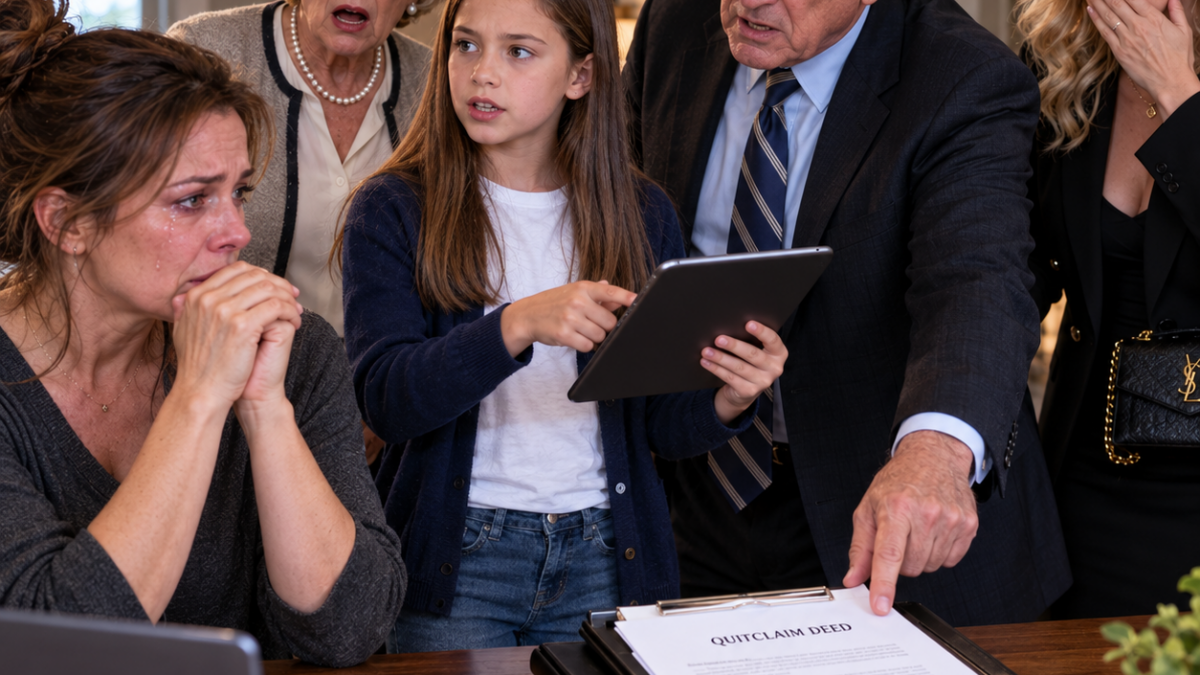
Dad put the folio on my kitchen counter.
“Here.”
I didn’t touch it.
“What is it?”
“You know what it is.”
“Open it.”
He did.
Prepared quitclaim deed.
My full legal name.
Chloe’s full legal name.
Property description.
Someone had paid enough attention to copy the parcel description accurately.
No signature yet.
No notarization.
At least not mine.
Dad pointed.
“Sign there.”
“No.”
He stared.
“What?”
“No.”
Mom closed her eyes.
“Evelyn.”
“I told you last night.”
“You were upset.”
“I am less upset today.”
“Answer is still no.”
Chloe folded her arms.
“Can everyone please not make this humiliating?”
I looked at her.
“Humiliating for you?”
She looked away.
Dad tapped the deed.
“You will still have time to move.”
“I am not moving.”
“You’re acting like we’re throwing you into the street.”
“You told me to rent.”
“You’ve rented before.”
“So has Chloe.”
His face reddened.
“This is exactly the attitude I’m talking about.”
Nora walked into the kitchen.
“Grandpa.”
I turned.
“Nora, sweetheart, go to your room.”
“No.”
Dad looked at her.
“This is an adult conversation.”
Nora stood straight.
“Then adults should probably tell the truth.”
Chloe went still.
I knew what was coming.
Part of me wanted to stop it.
Another part—the exhausted part that had listened to my father call me a failure the night before—didn’t.
Dad frowned.
“What does that mean?”
Nora looked at Chloe.
“Nobody is signing anything.”
“Nora.”
Mom snapped.
“Do not speak to your aunt that way.”
Nora didn’t blink.
“If you’re taking our house because she got a PhD, Aunt Chloe should probably have a PhD.”
Silence.
Chloe’s thumbs froze over her phone.
Mom stared at Nora.
“What did you just say?”
“She hasn’t been a student for three years.”
Chloe’s face changed.
Not anger first.
Panic.
Raw.
Instant.
“Nora.”
I had never heard my sister say my daughter’s name like that.
Nora continued before I could intervene.
“And I think there are encrypted files we should talk about.”
Chloe’s face went white.
“What files?”
Mom looked between them.
“Chloe?”
Chloe ignored her.
“What files, Nora?”
“The backup you left on Mom’s computer.”
Chloe moved.
Fast.
One step toward the hallway.
I stepped between them.
“No.”
“Evelyn, move.”
“No.”
“Those are my private files.”
“I know.”
“Nora had no right—”
“She didn’t open them.”
Chloe stared.
Nora said:
“I couldn’t.”
“They’re password protected.”
Chloe’s shoulders dropped maybe half an inch.
Relief.
That reaction told me the files mattered.
I said:
“But the filenames are visible.”
Relief disappeared.
Dad looked irritated rather than concerned.
“What kind of nonsense is this?”
I turned toward him.
“Ask Chloe.”
“About what?”
“Whether she’s graduating.”
Mom laughed nervously.
“Of course she is.”
“Chloe?”
My sister looked at the floor.
Mom’s voice changed.
“Chloe.”
No response.
Dad said:
“Answer your mother.”
Chloe closed her eyes.
“Not here.”
I almost laughed.
“Where would you prefer?”
“This isn’t Evelyn’s business.”
“You arrived to take Evelyn’s house because of it.”
Dad snapped:
“Stop saying take.”
“Transfer.”
I looked at him.
“Would I continue owning it?”
“No.”
“Then you’re taking it.”
Mom stepped toward Chloe.
“Sweetheart.”
“What’s happening?”
Chloe’s face twisted.
“I said not here.”
Mom reached for her.
“Are you graduating next month?”
Long silence.
“No.”
The word barely came out.
Mom’s hand dropped.
Dad stared.
“What?”
Chloe swallowed.
“I am not graduating next month.”
Mom looked confused.
“Then when?”
Chloe said nothing.
“Summer?”
“No.”
“December?”
“No.”
Dad’s voice hardened.
“When?”
Chloe whispered:
“I don’t know.”
That was when Nora said:
“Because she’s not enrolled.”
I turned.
“Nora.”
She stopped.
Chloe stared at my daughter.
Then nodded.
“No.”
Mom backed toward a chair.
“What do you mean no?”
“I left the program.”
Dad laughed.
Actually laughed.
Not humor.
Disbelief.
“You did not.”
Chloe looked at him.
“I did.”
“When?”
She didn’t answer.
Dad moved closer.
“When?”
“Three years ago.”
Mom sat.
The flowers she’d brought for Chloe slid from her lap onto the floor.
Nobody picked them up.
Dad’s face had changed from red to gray.
“Three years.”
“Yes.”
“You told us you were finishing your dissertation.”
“I know.”
“You told us your committee approved your proposal.”
“I know.”
“You told us you were teaching.”
“I was adjuncting for one semester.”
“You told us the university extended your funding.”
Chloe started crying.
“I know.”
Dad slapped one hand against the counter.
The quitclaim folder jumped.
“Stop saying you know.”
Nora flinched.
I said:
“Dad.”
He looked at me.
“Don’t hit things in my house.”
He stared.
Then removed his hand.
Good.
Mom whispered:
“What happened?”
Chloe wiped her face.
“My proposal failed.”
“What does that mean?”
“My committee rejected it.”
“Then you revise.”
“I did.”
“They rejected it again.”
“So?”
“My advisor left.”
“My funding ended.”
“I was already behind.”
“I couldn’t keep paying tuition.”
“So you withdrew?”
“Yes.”
“Why didn’t you tell us?”
Chloe laughed through tears.
“Because you called me Dr. Parker before I’d even finished coursework.”
Mom recoiled.
“That’s not fair.”
“No?”
Chloe looked at Dad.
“You told everyone at Christmas I was going to be the first doctor in the Parker family.”
“You were.”
“I wasn’t.”
“You were going to be.”
“There.”
Chloe pointed at him.
“That.”
Dad stared.
“You made it sound like if I didn’t finish, I disappeared.”
Mom said:
“We would’ve understood.”
Chloe looked at her.
“Would you?”
Nobody spoke.
Then she looked at me.
“Would they?”
I didn’t answer.
Not my job.
Dad suddenly pointed toward Nora.
“How did she know?”
I said:
“She found the backup folder you left.”
“I didn’t leave it.”
“You copied it onto my computer.”
“I was supposed to delete it.”
“You didn’t.”
“This is a privacy violation.”
“Maybe.”
I looked at Nora.
“We’ll discuss that separately.”
Then back at Chloe.
“But right now, you walked into my house expecting me to transfer my home because you had supposedly earned a degree you haven’t been pursuing for three years.”
Chloe looked ashamed.
“I’m sorry.”
Dad turned on me.
“Don’t.”
I stared.
“Don’t what?”
“Use this.”
“Use what?”
“Your sister is falling apart and you are enjoying it.”
My mouth opened.
Then closed.
That old family machinery had activated instantly.
Chloe lies for three years.
Parents demand my house.
Somehow my reaction becomes the moral problem.
“No.”
I said it quietly.
Dad frowned.
“No what?”
“No.”
“I’m not carrying this for you.”
Mom looked up.
“Evelyn.”
“I didn’t lie about Chloe’s degree.”
“I didn’t ask you to send her money.”
“I didn’t prepare a deed to my house.”
“And I didn’t make any of you come here this morning.”
Dad said:
“This isn’t about you.”
I looked at the quitclaim deed.
“It is literally sitting on my counter.”
Chloe covered her face.
Mom suddenly asked:
“What money?”
Everybody stopped.
Chloe looked at her through her fingers.
“What?”
I remembered one of the filenames.
Mom_Dad_Tuition.xlsx
Mom’s voice sharpened.
“The money.”
“The tuition payments.”
“You said the university still billed you.”
Chloe went pale again.
Dad looked between them.
“How much?”
Mom whispered:
“Richard.”
“How much?”
I said:
“Maybe we should slow down.”
Dad ignored me.
“We sent you money every semester.”
“I know.”
“How much of it went to tuition?”
Chloe didn’t answer.
Mom stood.
“Chloe.”
“How much?”
“Some.”
That was worse than none.
Dad stared.
“Some?”
“I had old balances.”
“Fees.”
“Health insurance.”
“Then rent.”
“Rent?”
Mom repeated.
“You told us you had a stipend.”
“I didn’t.”
Dad’s jaw clenched.
“When did the stipend end?”
“When I left.”
Three years.
Silence again.
Mom sat down.
I had never seen her look old before.
That morning, she did.
Not elderly.
Just suddenly smaller.
“How much did we send?”
she whispered.
Chloe shook her head.
“I don’t know.”
Dad said:
“You know.”
“I would have to calculate.”
“I calculated.”
Mom looked at him.
“What?”
He stared at Chloe.
“Eighty-six thousand dollars.”
Chloe inhaled.
I hadn’t known.
Apparently Dad had.
Or at least he had been tracking transfers.
Mom’s eyes widened.
“Eighty-six?”
Dad’s voice became flat.
“Between tuition, rent, research travel, conference fees, and the car.”
Mom whispered:
“The car was for graduation.”
“Apparently not.”
Chloe sat down hard.
I didn’t feel triumphant.
That’s important.
For one ugly second, a part of me remembered Dad calling me the family’s biggest failure.
I could have thrown it back.
I could have looked at Chloe and said:
Who’s the failure now?
I didn’t.
Because I knew exactly what that sentence felt like.
And because Nora was watching.
I would not teach her that dignity meant waiting until the other person became weak enough to humiliate.
I pulled out a chair.
“Everybody sit.”
Dad laughed bitterly.
“You’re giving orders now?”
“Yes.”
“In my house.”
That stopped him.
He sat.
I put coffee on.
Nobody asked for it.
I made it anyway because I needed something normal happening with my hands.
When I returned, the quitclaim deed was still on the counter.
I closed the folder.
Moved it away from the coffee.
Then I looked at Chloe.
“Tell the truth.”
She wiped her eyes.
“About what?”
“All of it.”
Dad said:
“Evelyn—”
I held up one hand.
“If you want to keep using my kitchen for this, let her speak.”
He stopped.
Chloe stared at the table.
For the next forty minutes, the golden version of my sister collapsed.
Not because Nora hacked encrypted files.
Not because I interrogated her.
Because once the first lie broke, Chloe no longer had enough energy to keep holding the others together.
She had entered a doctoral program in organizational psychology five years earlier.
The first two years went well.
Coursework.
Research assistantship.
Conference presentation.
Then comprehensive exams.
She passed.
Her dissertation proposal became the problem.
She designed a project that required access to corporate employee data.
One company withdrew cooperation.
Her committee asked for major revisions.
Then her advisor accepted a position at another university.
New advisor.
New direction.
Chloe struggled.
She also struggled financially.
Funding tightened.
She began teaching part-time.
Then her revised proposal failed committee review.
Again.
She could have continued.
Maybe.
With more time.
More tuition.
A different project.
Instead, she panicked.
She withdrew.
That part wasn’t shameful.
People leave doctoral programs all the time.
Sometimes with master’s degrees.
Sometimes without.
Sometimes after years.
Life happens.
The lie came afterward.
Mom called two days after Chloe filed the withdrawal paperwork.
“When’s your defense?”
Chloe said:
“Probably next year.”
One sentence.
Then another.
The university had extended her research.
The committee wanted additional data.
Defense delayed.
Funding delayed.
Graduation moved.
Every lie required one more.
When parents offered money because they believed her stipend was late, she took it.
At first, she told herself she’d re-enroll.
Then she didn’t.
When she got a short-term contract editing academic papers, she told them she was “teaching remotely.”
When that contract ended, she said she was focusing full-time on dissertation revisions.
Dad bragged.
Mom posted photographs from old conferences.
People congratulated Chloe.
Eventually, she created a fake expected-graduation letter.
Not to use with banks.
Not with government.
For our parents.
That didn’t make it harmless.
It showed how trapped she’d become by the lie.
“What about the commencement?” Mom asked.
Chloe looked down.
“I was going to say it was postponed.”
“You sent us a date.”
“I know.”
“You told me to buy a dress.”
“I know.”
Mom started crying.
Chloe did too.
Dad didn’t.
He looked like somebody had poured concrete through him.
Then I asked the question that mattered to me.
“What did you know about this house?”
Chloe stared.
“What?”
“Mom told me you needed it to entertain colleagues.”
She winced.
“That’s not exactly—”
“Exactly what?”
Mom looked at Chloe.
“You said your new department expected faculty to host people.”
Chloe closed her eyes.
Dad said:
“You told us you’d accepted a research position at Wright State.”
Chloe whispered:
“I didn’t.”
Dad stood so fast the chair scraped.
“Richard.”
Mom reached for him.
He walked away from the table.
Hands on his head.
I looked at Chloe.
“No job?”
“I applied.”
“Were you offered anything?”
“No.”
“Then why the house?”
She began crying again.
“I was going to lose my apartment.”
That silenced everyone.
“How far behind?”
I asked.
“Two months.”
“Credit cards?”
She nodded.
“How much?”
“About forty-eight thousand.”
Dad turned.
“What?”
Chloe shrank into the chair.
“Some is old.”
“Some was living expenses.”
“I used cards when you stopped sending as much.”
Dad stared.
“We didn’t stop sending.”
“You reduced it.”
“Because we took out a line of credit against our house.”
Mom looked at him.
I turned.
“What?”
Dad didn’t answer.
Mom’s face changed.
“Richard.”
“You said we used savings.”
He looked away.
“How much?”
Dad remained silent.
Mom stood.
“How much did you borrow?”
“Forty.”
“Forty thousand?”
“Yes.”
“Against the house?”
“Yes.”
“You told me it was from the investment account.”
“I didn’t want you worrying.”
I stared at my parents.
The hypocrisy was almost too perfect.
They had arrived to take my paid-off house while lying to each other about debt created by my sister’s fake education.
Still, I didn’t laugh.
Nora was sitting on the stairs by then.
Quiet.
I hadn’t realized she was listening.
I looked at her.
“Go upstairs for a little while.”
She hesitated.
“Nora.”
She stood.
Before leaving, she looked at Chloe.
“I didn’t open the files.”
Chloe wiped her face.
“I know.”
“I wasn’t trying to ruin you.”
Chloe nodded.
“I know.”
Nora went upstairs.
That small exchange mattered to me more than any confession.
I returned to the table.
“Now we solve one problem at a time.”
Dad said:
“You think you’re in charge because it’s your house.”
I looked at him.
“Yes.”
The words came without anger.
For the first time in my life, I didn’t feel guilty saying them.
“Yes.”
“This is my house.”
“So in this house, nobody insults Nora.”
“Nobody yells.”
“Nobody tells me what I’m signing.”
“And nobody uses my property to solve another adult’s financial crisis without my consent.”
Mom looked at me.
“We didn’t know.”
“You knew you were demanding my house.”
Her eyes dropped.
“That part you knew.”
She whispered:
“We thought Chloe had earned something extraordinary.”
I stared.
“And I hadn’t?”
Mom looked up.
“That isn’t what I meant.”
“You called me forty-two seconds after I paid off a hundred-thousand-dollar mortgage.”
“You didn’t say congratulations.”
“You said Chloe deserved my house.”
Mom’s lips trembled.
“I was proud of you.”
“You forgot to mention it.”
Dad said:
“This isn’t the time.”
I turned.
“When is?”
He glared.
I continued:
“You called me a pathetic waitress.”
“I did not say pathetic.”
“Yes, you did.”
“You called me the biggest failure in this family.”
He looked away.
“You’ve always been dramatic.”
“Dad.”
I almost laughed.
“No.”
“You don’t get to revise last night because today is uncomfortable.”
He stood.
“I’m leaving.”
“Okay.”
Mom looked panicked.
“Richard.”
He grabbed his keys.
Then pointed toward Chloe.
“We’re not done.”
She flinched.
I said:
“Not here.”
He looked at me.
“You think you’re protecting her now?”
“No.”
“I think she’s an adult.”
“And I think what happens between you and Chloe happens somewhere else.”
He picked up the leather folio.
I held out my hand.
“Take the deed.”
He did.
Good.
Then he turned.
“What about us?”
I knew what he meant.
Not emotionally.
Financially.
The home-equity line.
The $86,000.
Retirement.
Chloe’s debt.
All the consequences they had expected my property to absorb.
I said:
“You need a financial planner.”
His face changed.
“You have a paid-off house.”
There it was.
Again.
Even after everything.
I stared.
“No.”
“You haven’t even heard me.”
“I heard you last night.”
“This is different.”
“How?”
“We aren’t talking about gifting it to Chloe.”
“Then what?”
He hesitated.
“A temporary loan against it.”
Mom whispered:
“Richard.”
I almost couldn’t believe him.
“You want me to mortgage my house again.”
“Only until we stabilize things.”
“No.”
“We’re your family.”
“So is Nora.”
“You could borrow at a good rate.”
“No.”
“You have equity doing nothing.”
My entire body went cold.
“Doing nothing?”
Dad realized too late.
I continued:
“That equity is the ten years I worked.”
“It is the nights Nora slept at Mrs. Rodriguez’s because I had to close the restaurant.”
“It is the Christmases we kept small.”
“It is the car I drove until the transmission died.”
“It is every extra principal payment.”
“It is not doing nothing.”
No one spoke.
Then I said:
“My house is not the family emergency fund.”
Dad’s face hardened.
“You’ll regret this.”
“Maybe.”
“I’ll regret a lot of things.”
“But I won’t sign today.”
He left.
The front door closed.
Not slammed.
Somehow that felt worse.
Mom stayed.
Chloe stayed.
Nobody knew what to do.
Finally Mom looked at me.
“I am sorry I didn’t congratulate you.”
I believed she meant that sentence.
It wasn’t enough.
But it was something.
“Thank you.”
She looked toward the stairs.
“Does Nora really understand all this?”
“No.”
“Neither do I.”
Mom almost smiled.
Then she looked at Chloe.
“We need to go.”
Chloe didn’t move.
“Can I stay?”
Mom looked surprised.
“Why?”
Chloe looked at me.
“I need to talk to Evelyn.”
Mom’s face tightened.
Of course.
Even then, she hated the idea of Chloe choosing me.
I said:
“She can stay if she wants.”
Mom picked up the flowers from the floor.
They had been crushed slightly.
She carried them toward the door.
Then stopped.
Turned.
Held them toward me.
I looked at them.
“For what?”
Her eyes filled.
“For paying off your house.”
I took them.
“Thank you.”
She left.
Chloe and I sat in silence.
Ten minutes.
Maybe more.
Finally she said:
“I knew they were going to ask you.”
“I figured.”
“I didn’t know Dad already had the deed.”
“You still came.”
“Yes.”
“Why?”
She stared at her hands.
“Because I needed somewhere to live.”
I laughed once.
No humor.
“You thought I’d move out with Nora.”
“I didn’t think about it like that.”
“Then how?”
She looked ashamed.
“I thought Mom and Dad would convince you.”
“Which means you thought I would.”
She said nothing.
“Did you want the house?”
“Yes.”
Honest.
That helped.
Not much.
But some.
“Did you think you deserved it?”
Chloe cried quietly.
“I don’t know.”
“Yes, you do.”
She wiped her face.
“I think I did.”
There it was.
“I’ve been told my whole life that everything I was doing mattered more.”
I leaned back.
“By them.”
“Yes.”
“But you believed it.”
“Yes.”
“Enough to take my home.”
She looked at me.
“Yes.”
I appreciated the answer because it didn’t hide behind our parents.
Favoritism explains behavior.
It does not erase adult choices.
Chloe whispered:
“I’m sorry.”
I nodded.
“I believe you.”
“That doesn’t mean I’m okay with it.”
“I know.”
Then:
“What are the encrypted files?”
She closed her eyes.
“Mostly backups.”
“Withdrawal letter.”
“Bank stuff.”
“Debt spreadsheet.”
“Fake documents I made for Mom and Dad.”
“Faculty offer template?”
She looked humiliated.
“I downloaded a sample because Mom asked to see my offer.”
“Did you send her a fake one?”
“No.”
“I almost did.”
“What is House Collateral?”
Her face changed.
“I was researching secured loans.”
“With my house?”
“No.”
She looked at me quickly.
“Not specifically.”
“Then why house?”
“Because Dad told me if you transferred the property, we could borrow against it if we needed to.”
My stomach dropped.
“He told you that?”
“A week ago.”
“So he wasn’t only giving you a graduation present.”
“No.”
“He planned to use the house as collateral.”
“I think eventually.”
“Eventually?”
Chloe looked away.
“He said there was no point leaving that much equity sitting unused.”
Same phrase.
My father had already rehearsed it.
I stood.
Needed distance.
I walked to the sink.
Looked outside at the tiny backyard I’d fenced so Nora could play safely when she was little.
My paid-off house had lasted less than a minute as mine in my parents’ minds.
Forty-two seconds.
That number became almost funny.
Almost.
“Did Mom know?”
“I don’t think so.”
“About borrowing against it?”
“No.”
“About your debts?”
“No.”
“About Dad’s line of credit?”
“Apparently not.”
I turned.
“So everybody was lying to everybody.”
Chloe gave a broken laugh.
“Pretty much.”
I poured water.
Then asked:
“What do you want now?”
She looked around my kitchen.
“I want to disappear.”
“No.”
“What?”
“That’s what created half of this.”
She stared.
“You disappear from one truth, then invent another.”
“Don’t disappear.”
“Deal with it.”
Her face tightened.
“You make it sound easy.”
“I worked double shifts for ten years.”
“I didn’t say easy.”
She looked down.
Fair.
I continued:
“First, call your landlord.”
“Second, list your debts.”
“Third, tell Mom everything.”
“Fourth, tell Dad everything he doesn’t know.”
“He knows most of it now.”
“I doubt it.”
“Fifth, stop pretending you need a PhD to have a life.”
She looked at me.
“Easy for you to say.”
That stung.
“Is it?”
She immediately shook her head.
“No.”
“Sorry.”
I sat again.
“Chloe.”
“What?”
“I spent most of my adult life being treated like your cautionary tale.”
“If Mom wanted you to study, she said, ‘You don’t want to end up like Evelyn.’”
“If Dad wanted you to work harder, he pointed at my uniform from the diner.”
“You got praise.”
“I got compared.”
“So no.”
“It is not easy for me to say your degree doesn’t determine your worth.”
“I had to learn that because everybody around us kept telling me mine did.”
Chloe cried again.
“I hated that.”
“What?”
“When they compared us.”
I stared.
“You never said anything.”
“I know.”
“Sometimes I liked being the one winning.”
Honest again.
Painfully.
“That doesn’t make you evil.”
I said.
“It does make you responsible for what you did with it.”
She nodded.
We spent the afternoon building the first honest financial picture Chloe had created in years.
Not because I became her rescuer.
I refused to.
She logged into her accounts.
She wrote balances herself.
Credit cards:
$48,612.
Personal loan:
$11,400.
Overdue rent:
$3,800.
Old university balance:
$7,900.
Car loan:
$14,000.
Total unsecured mess larger than she had admitted initially.
She still had a master’s degree.
Skills.
Work history.
No criminal record.
No medical catastrophe.
No reason she couldn’t rebuild.
But she needed to stop living as a fictional future professor.
By five, she had emailed her landlord asking about payment arrangements and scheduled a nonprofit credit-counseling appointment.
Then she called Mom.
I left the room.
Not my conversation.
Chloe talked for almost an hour.
When she came back, her eyes were swollen.
“How’d it go?”
“Bad.”
“Honest?”
“Yes.”
“Then bad is allowed.”
She almost smiled.
Dad refused to speak to her.
That lasted three days.
Mom called me twice.
The first call was grief.
“How could she lie?”
I listened.
Didn’t excuse Chloe.
Didn’t join in destroying her either.
The second call became blame.
“You had to let Nora announce it like that?”
I stared at my phone.
“Mom.”
“She humiliated Chloe.”
“Nora is eleven.”
“She knew what she was doing.”
“She knew her grandparents were trying to take her home.”
Silence.
Then:
“You could’ve told us privately.”
“I learned at the same time you did.”
Mom stopped.
Apparently she hadn’t realized that.
“I didn’t know.”
“No.”
“You didn’t ask.”
She sighed.
“Everything is such a mess.”
“Yes.”
Then:
“What are we going to do about the home-equity line?”
There it was.
I closed my eyes.
“You and Dad need professional financial advice.”
“We need help.”
“I know.”
“You have no mortgage.”
“No.”
“Evelyn—”
“No.”
“You didn’t even let me finish.”
“I know the sentence.”
“What sentence?”
“You want to borrow against my house.”
She went quiet.
“Your father mentioned it.”
“No.”
“We would make the payments.”
“No.”
“It would only be temporary.”
“No.”
“Stop saying no before I—”
“No.”
She hung up.
I cried afterward.
Not because I doubted the decision.
Because holding a boundary can hurt even when the boundary is correct.
Especially with family.
The next week, Laura helped me review my property records.
Everything clean.
No filed deed.
No lien.
No surprise power of attorney.
I added enhanced recording alerts.
Updated my will.
That was something I’d delayed too long.
If something happened to me, Nora needed clear protection.
I created a revocable trust with terms appropriate for her age and named a trustee I actually trusted—my cousin Jennifer, not my parents.
When Mom eventually learned that, she was furious.
“You don’t trust us with Nora?”
I answered carefully.
“I trust you to love her.”
“That wasn’t the question.”
“No.”
“It wasn’t.”
She cried.
I hated hurting her.
Still didn’t change it.
My parents had spent years showing me how they valued achievement, hierarchy, and family image.
I loved them.
That didn’t mean I had to hand them control of my child’s inheritance.
Meanwhile, Chloe’s fake graduation date approached.
Mom had already mailed invitations.
Thirty-two of them.
Family.
Friends.
Dad’s former coworkers.
Church people.
The humiliation was enormous.
Again, I refused to enjoy it.
Mom sent a short correction saying the celebration had been canceled due to “a change in academic circumstances.”
Aunt Linda called me.
“What happened?”
“Ask Chloe.”
“Your mother says you caused a family blowup.”
“I did not.”
“She says your daughter accused Chloe of fraud.”
“Nora asked whether Chloe was enrolled.”
“Was she?”
“No.”
Long silence.
“Oh.”
That pattern repeated.
People called ready to defend Chloe.
Then learned the basic fact.
No degree.
No enrollment.
No graduation.
Most stopped calling.
One cousin sent me:
I heard you refused to give Chloe your house after everything she’s been through.
I replied:
Correct.
Nothing else.
My old habit would’ve been to write paragraphs.
Explain.
Defend.
Prove I wasn’t selfish.
I stopped.
People committed to misunderstanding me could do it without my assistance.
At work, nothing changed.
That’s one of the strangest parts of family catastrophe.
At 5:30 the next morning, I was pouring coffee for a roofer named Dennis who always ordered three eggs over medium and complained if the yolks broke.
He had no idea my family had nearly held an involuntary property-transfer ceremony in my kitchen.
“Morning, Evelyn.”
“Morning.”
“Coffee?”
“You ask every day.”
“You answer every day.”
“Then we’re trapped.”
Normal.
I needed normal.
My manager, Carla, knew something was wrong.
She waited until we were rolling silverware.
“You okay?”
“Family stuff.”
“The bad kind?”
“There’s a good kind?”
She laughed.
Then:
“You need fewer shifts this week?”
My first instinct was:
No.
Money.
Work.
Keep moving.
Then I remembered.
Mortgage:
Zero.
I almost smiled.
“Yes.”
I said.
“Actually.”
“Can I have Thursday night off?”
Carla stared.
“Who are you?”
I laughed.
That Thursday, Nora and I ordered pizza.
We ate on the living-room floor.
Not because we lacked furniture.
Because when she was little and money was tight, floor pizza had been our celebration.
Mortgage payoff deserved one.
The family disaster had interrupted the first attempt.
So we tried again.
Nora raised her soda can.
“To our house.”
I touched mine to it.
“To our house.”
Then I said:
“We need to talk about Aunt Chloe’s files.”
Her smile disappeared.
“I didn’t hack them.”
“I know.”
“I swear.”
“I believe you.”
“But clicking through somebody else’s backup wasn’t great.”
“I was deleting old stuff.”
“I know.”
“And when you realized it belonged to Chloe?”
“I should’ve stopped sooner.”
“Yes.”
She nodded.
“Am I in trouble?”
“A little.”
She accepted that.
Then:
“But what if I hadn’t found it?”
I thought.
“Eventually the truth would’ve come out.”
“Maybe after you gave her the house.”
“No.”
She looked surprised.
“No?”
“Nora.”
“I was never signing that deed.”
Her shoulders relaxed.
“Really?”
“Really.”
“But Grandpa said—”
“I know.”
“He scared me.”
That hurt.
“I know.”
I took her hand.
“Listen carefully.”
“You are eleven.”
“You do not have to protect our house from adults.”
“You do not have to investigate Aunt Chloe.”
“You do not have to prove anything to Grandma or Grandpa.”
“And you definitely don’t have to rescue me.”
She looked down.
“I just wanted them to stop calling you a failure.”
I swallowed.
“The way we stop that isn’t by proving Chloe failed too.”
She looked at me.
“How then?”
“By deciding their label doesn’t control us.”
She thought.
“That’s harder.”
“Yes.”
“Very.”
She nodded.
Then:
“Can I still think Grandpa was mean?”
“Yes.”
“Good.”
We ate pizza.
That night, after Nora slept, I sat alone in the kitchen and looked at the mortgage confirmation again.
Paid in full.
For years, I had imagined that moment as the finish line.
Instead, it turned out to be the moment I finally understood what I had been paying for.
Not just a building.
Choice.
The ability to say:
No bank owns this.
No parent owns this.
No sibling owns this.
No family ranking decides who deserves it.
Mine.
Mine did not mean I was more worthy than Chloe.
It meant ownership had an actual definition.
A month later, Dad showed up alone.
No warning.
He knocked.
I opened the door but didn’t move aside.
“Can I come in?”
That question mattered.
“Yes.”
He entered.
Sat at the kitchen table.
Same table.
No folder.
He looked older too.
Apparently honesty ages entire families.
“How’s Nora?”
“Fine.”
“Chloe?”
“You should ask her.”
“I have.”
“Then why ask me?”
He shrugged.
“Habit.”
Silence.
Then:
“Your mother says I owe you an apology.”
I almost laughed.
“Do you?”
He looked annoyed.
At least familiar.
“I shouldn’t have called you a failure.”
I waited.
“That was wrong.”
Still waited.
He frowned.
“What?”
“Nothing.”
“You’re looking at me like that.”
“Like what?”
“Like it’s not enough.”
I thought.
Then decided to be honest.
“It isn’t.”
His face tightened.
“I apologized.”
“For one sentence.”
He looked away.
“What else do you want?”
“I don’t want anything.”
“That isn’t true.”
“It is.”
“I don’t need you to perform an apology.”
“I need you to understand what happened.”
He folded his arms.
“Fine.”
“What happened?”
“You came to my house with paperwork expecting me to transfer the property to Chloe.”
“We thought—”
“I know what you thought.”
“You believed her doctorate made her more deserving of my home than I was.”
He said nothing.
“You knew Nora lived here.”
“You knew I had paid for it.”
“You knew I said no.”
“You came anyway.”
Dad stared at the table.
I continued:
“And after you learned Chloe’s degree wasn’t real, you still asked me to borrow against my house.”
“That was desperation.”
“Yes.”
“But desperation doesn’t create ownership.”
He looked up.
“We would’ve paid you.”
“You couldn’t make your own home-equity payments without worrying.”
“You would’ve paid mine?”
He flinched.
Fair.
Then:
“I was trying to fix things.”
I nodded.
“I believe you.”
“That is how you fix things.”
“You take control.”
“You decide what asset should move where.”
“You decide who needs what.”
“You decide which daughter matters more.”
His face hardened.
“I never said Chloe mattered more.”
“You called her the hope of the family.”
“You called me its biggest failure.”
Silence.
“Words mean things, Dad.”
He looked away.
For the first time, I saw shame.
Real shame.
Not anger at being challenged.
He whispered:
“I thought I was motivating you.”
I laughed softly.
“For thirty years?”
“I don’t know.”
He rubbed his forehead.
“Your sister was easy to brag about.”
There.
A brutal sentence.
But honest.
“And me?”
He looked at me.
“You were hard to explain.”
“Why?”
“You left college.”
“You had Nora.”
“You worked in restaurants.”
“You never cared about titles.”
“I cared about paying my bills.”
“I know.”
“Now.”
He nodded.
“Now.”
Then:
“When you sent that mortgage screenshot, I looked at it and thought, ‘Good. She has something we can use.’”
He closed his eyes.
“That’s ugly.”
“Yes.”
“I know.”
I didn’t rescue him from the discomfort.
He continued:
“I should have thought, ‘My daughter paid off her house.’”
“Yes.”
“I didn’t.”
“No.”
“I’m sorry.”
This time, the apology landed differently.
Not because the words were prettier.
Because he had named the choice.
I nodded.
“Thank you.”
He looked toward the hallway.
“Will Nora talk to me?”
“I don’t know.”
“Can I ask?”
“Yes.”
“But if she says no?”
He nodded.
“I leave.”
Good.
Nora came downstairs.
Dad stood.
She stopped halfway.
“Hi, Grandpa.”
“Hi.”
He looked nervous.
I had never seen my father nervous around a child.
“I said something about your mother that you heard.”
Nora folded her arms.
“You called her a failure.”
“Yes.”
“I was wrong.”
Nora looked at me.
Then him.
“Do you think Aunt Chloe is a failure now?”
That question stunned him.
“No.”
“Why?”
He swallowed.
“Because doing something wrong doesn’t make someone’s whole life one thing.”
Nora nodded.
“Then Mom wasn’t one either.”
“No.”
“She wasn’t.”
“Okay.”
That was all.
Children sometimes resolve what adults decorate.
Dad stayed fifteen more minutes.
Then left.
He did not ask for money.
Progress.
Mom took longer.
She remained angry at Chloe.
Then angry at Dad for hiding the home-equity line.
Then angry at herself.
Then, periodically, angry at me because I had become the one person in the family least willing to absorb everyone else’s panic.
She called one Sunday.
“We may have to sell.”
“The house?”
“Yes.”
“Do you want to?”
“No.”
“Can you afford it?”
“With the line of credit and retirement reduction?”
“Not comfortably.”
“What does your financial counselor say?”
Silence.
“You saw one?”
“Yes.”
Good.
“He says downsizing would solve most of it.”
“That sounds reasonable.”
Mom started crying.
“I’ve lived here twenty-nine years.”
“I know.”
“You’re not going to offer?”
I closed my eyes.
“Offer what?”
“You know.”
Money.
House.
Equity.
Rescue.
“No.”
She cried harder.
I hated it.
Still no.
“I can help you pack.”
I said.
“I can help you find a realtor.”
“I can help compare apartments or condos.”
“I can bring meals.”
“I can sit through appointments.”
“But I’m not borrowing against my house.”
Mom went quiet.
“That sounds so cold.”
“No.”
“It sounds specific.”
She hung up.
Two weeks later, she called back.
“Can you come look at a condo?”
I smiled.
“Yes.”
That’s how boundaries changed our relationship.
At first, every no sounded like rejection.
Eventually, they learned I still had plenty of yes.
Just not the yes they had assumed ownership of.
My parents sold their large four-bedroom house.
Paid off the home-equity line.
Moved into a two-bedroom condo with lower monthly expenses.
Dad hated the HOA fee.
I found that spiritually satisfying.
I said nothing.
Mostly.
The first time he complained about a landscaping assessment, I took a sip of coffee and looked away.
He noticed.
“Don’t.”
“I didn’t say anything.”
“You’re thinking loudly.”
“Probably.”
Chloe moved too.
Into a smaller apartment.
She got a full-time job with a healthcare research company doing project coordination.
No PhD required.
Her master’s degree was real.
Her organizational skills were real.
Her ability to write and analyze data was real.
Once she stopped spending energy maintaining a fictional academic life, she became very good at work again.
She entered a debt-management plan.
Sold the expensive car.
Bought a used Honda.
Mom cried over that too.
Chloe did not return to the doctoral program.
At least not then.
People kept asking.
“You going back?”
For the first year, she gave long explanations.
Eventually:
“No.”
That’s all.
She learned the same thing I did.
A complete sentence can be one word.
She repaid my parents slowly.
Not because they demanded all $86,000 immediately.
They couldn’t even cleanly distinguish what had been gifts, living support, or money obtained through lies.
But Chloe insisted on a written repayment arrangement for a portion both sides agreed had been explicitly represented as tuition and fees.
A financial counselor helped.
Monthly payment.
No emotional ledger.
No:
After everything we’ve done for you.
No:
You owe us forever.
Paper.
Numbers.
Start date.
End date.
Healthy systems are boring.
About eight months after the confrontation, Chloe came over.
She stood on the porch.
Waited.
I opened the door.
“Can I come in?”
That question again.
“Yes.”
She carried a small external drive.
My stomach tightened.
“The backup?”
“Yes.”
“What about it?”
“I deleted the copy from your computer already.”
“You did?”
“You gave me permission last time I was here.”
I had forgotten.
She held up the drive.
“This is the original.”
“Okay.”
“I wanted to show you something.”
“You don’t have to.”
“I know.”
She plugged it into her laptop.
Entered the password.
No drama.
No hacking.
Inside were the files Nora had seen only by name.
The withdrawal letter.
Funding termination.
Fake commencement program draft.
Budget spreadsheet.
A document titled Faculty_Offer_Template.
Then House_Collateral.
She opened that one.
It wasn’t a loan application.
It was a spreadsheet Dad had sent her.
Columns.
My house’s estimated value.
Possible loan-to-value ratios.
Projected borrowing amounts.
Interest estimates.
At the top:
EVELYN HOUSE — AFTER PAYOFF
I stared.
Date created:
Six months before I paid off the mortgage.
My skin went cold.
“They’ve been planning this six months?”
Chloe shook her head.
“Dad has.”
“Mom didn’t know.”
“How did Dad know my balance?”
“I told him.”
I turned.
“You what?”
Chloe looked ashamed.
“You mentioned last Christmas you were under ten thousand.”
“I told Mom at dinner.”
“She told me.”
“I told Dad.”
“He started calculating.”
I sat back.
The family grapevine had converted my pride into asset planning.
Chloe continued:
“He said once it was paid, transferring it to me would be easy.”
“Why would you agree?”
“I didn’t at first.”
“What changed?”
“Debt.”
“Rent.”
“Fear.”
“And the fact that he kept saying you had no use for all that equity.”
I laughed without humor.
“Apparently owning a house is not a use for a house.”
“I know.”
She opened another file.
An email draft she’d never sent.
To Dad.
I don’t want Evelyn’s house. Stop asking.
I looked at the timestamp.
Three months before payoff.
“You wrote this.”
“Yes.”
“But didn’t send.”
“No.”
“Why?”
“Because the next day a card got declined at the grocery store.”
She looked at me.
“And I thought maybe I did want it.”
Honest.
Again.
“I hated myself.”
“I still didn’t send the email.”
“Then when you told the family group the mortgage was paid off, Dad called me before Mom called you.”
I stared.
“What did he say?”
“He said, ‘It’s time.’”
That sentence made my stomach turn.
Chloe continued:
“I asked if you had agreed.”
“He said you would.”
“I asked about Nora.”
“He said you’d rent closer to work.”
My throat tightened.
“So he had a story for us.”
“Yes.”
“And I let him have it.”
She looked at me.
“That is the part I am most ashamed of.”
Not the PhD.
Not the money.
The house.
Because she had known exactly who would pay the price for her rescue.
I closed the laptop.
“Thank you for showing me.”
“I thought you’d hate Dad more.”
“I don’t have enough energy.”
She smiled sadly.
“Do you hate me?”
I thought.
“No.”
“Are you still angry?”
“Yes.”
“Will you ever trust me?”
“I don’t know.”
She nodded.
Fair.
Then:
“I want to apologize to Nora.”
“You already did.”
“Not enough.”
“Ask her.”
Nora came home from a friend’s house an hour later.
Chloe asked if they could talk.
Nora looked at me.
I said:
“Your choice.”
She nodded.
They sat on the couch.
Chloe said:
“I was angry when you mentioned the files.”
“I know.”
“You didn’t do anything wrong by seeing the filenames when they were on your mom’s computer.”
“But it wasn’t your job to investigate me.”
Nora looked guilty.
“I know.”
Chloe continued:
“I was lying.”
“You didn’t create that.”
“Okay.”
“And you didn’t ruin my life.”
“Okay.”
“I did things that had consequences.”
Nora nodded.
Then:
“Are you really not a doctor?”
I almost laughed.
Chloe smiled.
“No.”
“Do you still have a master’s?”
“Yes.”
“Is that good?”
“It’s fine.”
Nora considered.
“Grandma acted like PhD was the top of a video game.”
Chloe laughed.
“Pretty much.”
Then Nora asked:
“Were you going to take my room?”
Chloe’s face broke.
She started crying.
“No.”
Nora stared.
Chloe corrected herself.
“I mean…”
“Yes.”
“If your mom had signed the house over, I would’ve lived here.”
“So yes.”
“Yes.”
Nora nodded.
“Okay.”
Not forgiveness.
Not comfort.
Just truth.
Then:
“You can’t have it.”
Chloe laughed through tears.
“I know.”
That was the first time they laughed together after the confrontation.
Small.
Important.
A year passed.
The house became normal again.
Mortgage statement no longer arrived.
I kept opening the lender app out of habit for months.
Zero.
Still zero.
One morning I realized I hadn’t checked in six weeks.
I smiled.
Freedom isn’t only getting something.
Sometimes it’s forgetting to verify it’s still yours every day.
I reduced my second job.
Not completely.
I liked working.
I liked the people.
But I stopped treating every unscheduled hour as wasted earning potential.
Three dinner shifts became two.
Then one.
I took Nora to Chicago for spring break.
Our first actual trip that required a hotel for more than one night.
We went to the Field Museum.
Ate deep-dish pizza.
Took ridiculous photographs by the lake.
Nora asked:
“Are we rich now?”
“No.”
“Then why can we do this?”
“Because the mortgage is gone.”
She smiled.
“So the house is buying us Chicago?”
“No.”
“The house is letting us keep more of our money.”
“That’s kind of the same.”
“Please never become a financial advisor.”
She laughed.
I bought a refrigerator the following summer without financing it.
That felt more luxurious than jewelry.
Carla promoted me to breakfast manager at Whitman’s.
I almost refused.
My parents had trained me to think jobs only mattered if they sounded prestigious.
Then I realized I was doing scheduling, ordering, training, customer recovery, cash reconciliation, and half the operational work already.
The title came with better pay.
I accepted.
Dad said:
“Manager?”
I braced for condescension.
Instead:
“That’s good.”
Two words.
Progress.
He came to the diner once.
Sat in my section out of habit even though I wasn’t regularly serving tables anymore.
He watched me solve a supplier problem, cover a missing server, handle a register issue, and calm an angry customer whose breakfast order had gone wrong.
Afterward:
“I never understood how much you did here.”
I looked at him.
“You never asked.”
He nodded.
“I know.”
He left a twenty-dollar tip.
I chased him into the parking lot.
“Dad.”
“What?”
“You don’t tip managers.”
“You were still filling my coffee.”
“Take it.”
“No.”
“Take it.”
He walked away.
I kept it.
Not because I needed twenty dollars.
Because it was probably the first money my father had ever given me without imagining it bought authority.
Mom’s apology came almost two years after the house confrontation.
She’d apologized for pieces before.
Not the whole thing.
We were folding laundry at her condo because her dryer had broken.
She held one of Dad’s shirts.
Then said:
“I hated your house.”
I looked up.
“What?”
“Not the house itself.”
“What it meant.”
I waited.
She continued:
“You bought it without us.”
“You paid it off without us.”
“You raised Nora without needing us financially.”
“Chloe needed us.”
I stared.
Mom’s eyes filled.
“And needing me felt like love.”
That sentence was painfully honest.
“So when you didn’t need money, I found other ways to tell myself you were the unsuccessful one.”
My throat tightened.
She continued:
“Because otherwise I had to ask why the daughter I worried about least was the one I treated as least important.”
I put down the towel.
“Mom.”
“No.”
“Let me finish.”
She looked at me.
“When Chloe got into the doctoral program, I made her achievement part of my identity.”
“I told people.”
“I bragged.”
“I made you stand beside it.”
“And when your mortgage disappeared, I didn’t see your accomplishment.”
“I saw an asset.”
Her voice broke.
“That was ugly.”
I didn’t rescue her.
She continued:
“I am sorry.”
Not:
Sorry you were hurt.
Not:
Sorry things got messy.
Not:
Sorry Nora misunderstood.
“I am sorry.”
I nodded.
“Thank you.”
She wiped her face.
Then:
“I still don’t understand why you needed three bedrooms for two people.”
I stared.
She stared.
Then smiled.
A joke.
Finally.
I threw a sock at her.
Healing does not make people entirely different.
Thank God.
Dad’s relationship with Chloe took longer.
He had built his identity around her success too.
For months, he barely spoke to her without turning conversations into repayment schedules or accusations.
I finally told him:
“You taught her that love was performance.”
He got angry.
Then went quiet.
Months later, he called Chloe and asked her to dinner with no financial agenda.
She said yes.
They began rebuilding.
Slowly.
By then, Chloe had been promoted.
Project manager.
Good salary.
She discovered she liked applied research more than academia.
One night over dinner at my house, she said:
“I don’t think I ever wanted the PhD as much as Mom and Dad wanted to say I had one.”
I looked at her.
“Then why stay five years?”
“Because quitting felt like becoming you.”
Silence.
She immediately looked horrified.
“I don’t mean now.”
“I know.”
“I mean the version of you they taught me.”
I nodded.
“The failure.”
“Yes.”
That hurt.
Still, I wanted truth more than comfort.
She continued:
“They made your life sound like the thing I had to outrun.”
“So when I left the program, I thought I had crossed some invisible line and become worthless.”
I sat back.
“Nobody wins in a family that needs one golden child and one cautionary tale.”
Chloe nodded.
“No.”
“Turns out both roles are terrible.”
That became something we could eventually joke about.
Eventually.
Not immediately.
Nora grew.
Twelve.
Thirteen.
Fifteen.
The house changed with her.
Posters.
Shoes everywhere.
Bathroom counter slowly conquered by products I didn’t understand.
At sixteen, she got her first job.
Hostess at Whitman’s.
I told her:
“You do not have to work here.”
“I know.”
“Carla will fire you if you’re terrible.”
“I know.”
“I’m serious.”
“So am I.”
She lasted.
Saved money.
Complained about customers.
Learned that people who say, “I know the owner,” rarely know the owner.
One afternoon, she brought home her first paycheck.
“Should I pay extra principal?”
I stared.
“What principal?”
“Exactly.”
She grinned.
Then put half into savings.
Smart kid.
She never became a computer hacker.
Thank God.
She did join the robotics club.
Then student council.
Then, ironically, debate.
Grandpa hated debating her.
I loved it.
My parents became grandparents differently after everything.
More careful.
Dad stopped comparing grades.
Mom caught herself once saying:
“You’re the smartest—”
Then changed it to:
“You worked really hard on that.”
Nora noticed.
So did I.
Patterns can change.
Not instantly.
Through repetition.
The same way they formed.
Chloe never went back for the doctorate.
People kept expecting a triumphant return.
Maybe someday.
Maybe not.
Her life no longer needed that ending.
At thirty-eight, she bought a small condo.
With a mortgage.
In her own name.
She invited us over the first night.
Nothing unpacked.
Pizza on the floor.
I looked around.
“Respectable address.”
She nearly choked.
“Too soon.”
“It has been four years.”
“Still too soon.”
Nora laughed.
Mom looked horrified.
Dad tried not to.
Then Chloe raised her cup.
“To paying for our own houses.”
I touched mine to hers.
“To that.”
She paid my parents’ agreed repayment balance in full two years later.
Dad tried to refuse the final payment.
She insisted.
“No hidden debt.”
He nodded.
“No hidden debt.”
That phrase became a family rule.
Not only money.
No hidden emotional debt.
No:
Remember what I did for you.
No:
You owe me because I’m your mother.
No:
I paid for school, so I control your life.
Gifts are gifts.
Loans are loans.
Help is help.
Ownership is ownership.
We got better at naming things.
It sounds small.
It changed everything.
When Nora was seventeen, Dad helped her buy a used car.
Before accepting, she asked:
“Gift or loan?”
Dad looked at me.
I didn’t speak.
He said:
“Gift.”
Nora said:
“Any conditions?”
He laughed.
“Seat belt.”
“Oil changes.”
“No texting while driving.”
“Anything else?”
“No.”
She held out her hand.
“Deal.”
Dad shook it.
I nearly cried.
Not because of the car.
Because my father had learned to answer the question.
One year later, Nora graduated high school.
Real graduation.
We joked about verifying it.
She threatened to ban all of us from the ceremony.
Chloe attended.
Mom and Dad.
Me.
When Nora walked across the stage, Mom cried harder than anyone.
Afterward, we gathered outside.
Photos.
Flowers.
Heat.
Families everywhere.
Chloe handed Nora an envelope.
Nora opened it.
Inside was a hundred-dollar check.
“For college books.”
Nora stared.
“Gift or loan?”
Everyone laughed.
Chloe said:
“Gift.”
“Conditions?”
“Don’t fake a PhD.”
Dad groaned.
Mom said:
“Chloe!”
Chloe laughed so hard she had to lean against me.
For years, I thought healing would mean never mentioning the bad thing again.
Sometimes healing means the thing becomes safe enough to joke about because everybody finally understands why it wasn’t funny at the time.
Nora chose a state university.
Not because it had the highest prestige.
Because the program she wanted was strong and the scholarship package was sensible.
Dad initially started to say:
“You could aim higher.”
Then stopped.
He looked at me.
I said nothing.
He turned back to Nora.
“What do you like about this school?”
Growth.
Not dramatic.
Real.
The night before Nora left for college, we sat on the front steps.
Same house.
Same small brick ranch.
Paint different.
Roof newer.
Kitchen still terrible.
She asked:
“You ever think about what would’ve happened if you gave Aunt Chloe the house?”
“No.”
“Never?”
“I thought about it after.”
“And?”
“I would’ve hated myself.”
“Would we have rented?”
“Probably.”
“Could we have been okay?”
“Yes.”
She frowned.
“Then why does it matter so much?”
I looked at her.
Good question.
“Because being able to survive losing something doesn’t mean somebody else gets to take it.”
She nodded.
Then:
“You know I thought the encrypted files saved us.”
I smiled.
“They didn’t.”
“No?”
“No.”
“You did help uncover the truth.”
“But even if Chloe had really graduated, I wasn’t giving her the house.”
Nora looked surprised.
“Really?”
“Really.”
“So the PhD wasn’t the reason?”
“No.”
“Then what was?”
“The reason was that I owned the house.”
She laughed.
“That simple?”
“Yes.”
“Grandma would’ve hated that answer.”
“She did.”
We sat quietly.
Then Nora said:
“I was scared you’d sign.”
I looked at her.
“Why?”
“Because they made you feel guilty.”
She was right.
I had spent years confusing guilt with obligation.
“I was scared too.”
“You didn’t look scared.”
“I was.”
“What stopped you?”
I thought about the question.
Not Laura.
Not the deed.
Not Chloe’s lie.
Not Nora’s discovery.
Those things helped.
But the answer came from somewhere older.
“I finally got tired of proving I deserved things I had already earned.”
Nora leaned against my shoulder.
“That sounds exhausting.”
“It was.”
The house remained in my name until I created the trust.
Then legally, things became more technical.
But emotionally?
It was still ours.
Home.
Not a trophy.
Not a family prize.
Not evidence that I had beaten Chloe.
Not proof that waitresses were secretly better than PhDs.
That would’ve been the same ugly hierarchy turned upside down.
Chloe’s education had value.
My work had value.
Her mistake did not make my life more respectable.
My mortgage payoff did not make me superior.
The whole point was that we should never have been ranked that way in the first place.
Mom eventually understood.
Dad too.
Mostly.
Families rarely become perfectly enlightened.
At Thanksgiving, Mom still occasionally tells Chloe:
“You were always the academic one.”
Then catches herself.
Chloe says:
“And Evelyn was always the one with actual money.”
I throw a dinner roll at her.
Normal.
Years after the confrontation, Dad gave me the old leather folio.
The one that had held the quitclaim deed.
I stared when he handed it over.
“Why?”
“I was cleaning the office.”
“Throw it away.”
He shook his head.
“Open it.”
Inside wasn’t the deed.
That was gone.
Instead, he’d put a copy of my mortgage satisfaction.
The official county record.
Paid.
Released.
My name.
At the bottom, he had written:
You did this. I should have said so first.
I stared at the page until it blurred.
Dad looked embarrassed.
“I know it’s late.”
“Yes.”
“Still true.”
“Yes.”
I hugged him.
Not because everything vanished.
Because apology and love can exist beside history without erasing it.
That folio sits in my desk now.
I kept the note.
Not the transfer paperwork.
Some documents deserve preserving.
Others deserve shredding.
Mom died years later before Dad.
Peacefully.
Her relationship with both daughters was complicated until the end.
Also loving.
Those can coexist.
At the hospital, Chloe sat on one side of her bed.
I sat on the other.
Mom woke briefly and looked at us.
“My girls.”
Not doctor.
Not waitress.
Not success.
Not failure.
My girls.
Maybe she finally got there.
Maybe she’d been trying for years.
Either way, I took the words.
Dad moved into assisted living later.
He complained about the food.
I reminded him he’d once called restaurant work meaningless.
He said:
“I was an idiot.”
I said:
“Documented.”
He laughed.
Nora finished college.
No PhD.
At least not yet.
She went into information systems.
The irony of that is not lost on us.
At her first real job, she called me.
“You remember Aunt Chloe’s encrypted folder?”
“Yes.”
“I think that’s why I like cybersecurity.”
I groaned.
“Please tell me you’re joking.”
“Mostly.”
Then:
“You taught me something that day.”
“What?”
“Don’t open things that aren’t yours.”
“Excellent.”
“And back up everything.”
“Also excellent.”
“And verify.”
There it was.
Verify.
Not because everyone lies.
Because certainty deserves support when the stakes are high.
Family claims.
Property documents.
Degrees.
Money.
Promises.
Love too, sometimes.
Chloe became one of Nora’s closest adult friends.
That surprised all of us.
Maybe because Chloe never treated Nora like a child after the confrontation.
She admitted mistakes.
She answered hard questions.
When Nora struggled in college and considered changing majors, she called Chloe first.
Chloe said:
“Change if the new path fits.”
Nora asked:
“What if people think I failed?”
Chloe laughed.
“Then they can buy their own diploma.”
That’s growth.
My parents once used Chloe’s education as a weapon against me.
Years later, Chloe used her failure to finish as permission for Nora to choose freely.
Nothing about what happened became good.
But people can make better choices afterward.
That’s enough.
The house is still standing.
Of course it is.
Brick.
New windows now.
Kitchen finally remodeled.
I knocked down half a wall and opened the room into the dining area.
Mom would’ve hated the mess.
Dad would’ve complained about the contractor price.
Nora loves it.
Chloe helped choose cabinet hardware.
There is a framed photograph on the hallway wall from the day I paid off the mortgage.
Not the screenshot.
A picture Nora secretly took after I cried.
I’m sitting at the kitchen table.
Hair messy.
Whitman’s uniform still on.
Face red.
Laptop open.
One hand over my mouth.
The other holding Nora’s.
I used to hate the photograph.
I thought I looked exhausted.
Now I love it.
Because that’s what accomplishment actually looked like.
Not a cap.
Not a gown.
Not a title before my name.
A tired woman in a restaurant uniform sitting beside her daughter after making the final payment on a debt she’d carried for ten years.
Nobody applauded.
No ceremony.
No university president called my name.
My parents didn’t bring flowers.
For forty-two seconds, it was only Nora and me.
Turns out that was enough.
Last year, Chloe came over for dinner.
We sat in the remodeled kitchen.
Nora was visiting.
Dad’s old folio was on the counter because I’d been going through papers.
Chloe recognized it.
“Oh God.”
“What?”
“That folder.”
I laughed.
“You remember.”
“I have nightmares about leather portfolios.”
Nora opened it.
Saw Dad’s handwritten note.
She smiled.
Then looked at me.
“Do you still have the quitclaim?”
“No.”
“Why?”
“Didn’t need it.”
Chloe said:
“You should’ve framed it.”
I looked at her.
“You really want that in my house?”
“No.”
“Fair.”
Nora closed the folio.
Then asked Chloe:
“Do you ever wish Mom had signed?”
Chloe didn’t hesitate.
“No.”
“Even then?”
“Then?”
She thought.
“Yes.”
“I wanted it.”
“I was desperate.”
“But if Evelyn had signed, I would’ve learned the worst possible lesson.”
“What lesson?”
“That lying long enough eventually makes someone else pay your bill.”
Silence.
Chloe looked at me.
“You saying no probably saved me from becoming somebody much worse.”
I shook my head.
“Don’t give me that much credit.”
“I’m serious.”
“You stopped yourself.”
“Eventually.”
“Yes.”
“That part belongs to you.”
She nodded.
No saviors.
Another family rule we learned late.
That night, after everyone left, I walked through the house turning off lights.
Living room.
Kitchen.
Hall.
Nora’s old bedroom, now half guest room and half storage because apparently children move out but their belongings reproduce.
I stopped at the front door.
The mortgage was long gone.
Parents’ demand long gone.
The fake graduation long gone.
Chloe had built a real career.
Nora had built her own life.
I was no longer working double shifts.
Whitman’s had made me general manager two years earlier.
Still smelled like coffee most mornings.
Still fine with me.
I locked the door.
Then looked around.
For years, I had thought paying off the house was my victory.
It was.
But the greater victory came the next morning when people I loved arrived believing love gave them a vote over something I had built.
I said no.
Not elegantly.
Not fearlessly.
Not without crying afterward.
But I said it.
And the world did not end.
My family changed.
Some relationships cracked.
Some repaired stronger.
Some money disappeared.
Some lies surfaced.
Nobody got the easy story they wanted.
Chloe didn’t become Dr. Parker.
My parents didn’t get to say their successful daughter owned a respectable house.
I didn’t become the triumphant sister who proved everyone wrong.
I remained Evelyn.
A mother.
A restaurant manager.
A homeowner.
A woman who worked very hard for a life that looked ordinary from the outside.
Turns out ordinary was never the insult they thought it was.
Ordinary was mortgage payments.
School lunches.
Late shifts.
Burned toast.
Utility bills.
Pizza on the floor.
A daughter doing homework at my kitchen table.
A roof that stayed ours because I finally understood that family could ask for help, but it could not convert my love into ownership.
The deed was never a graduation present.
The house was never unused equity.
It was never proof of who mattered most.
It was simply the place Nora and I lived while we built our lives.
And when my family finally learned to stop measuring love by degrees, titles, sacrifice, and who could surrender the most, something unexpected happened.
The house stopped feeling like the thing I’d had to defend.
It became home again.
Years ago, my father told me Chloe was the hope of our family and I would always be its biggest failure.
He lived long enough to tell me he had been wrong.
But by then, I no longer needed him to.
That was the real freedom.
Not the zero balance.
Not the signed mortgage release.
Not even the deed with my name protected.
The freedom was finally understanding that no one else got to decide whether the life I built counted.
The day I paid off the mortgage, I thought the number on the screen was the proof.
It wasn’t.
The proof had been there all along.
Eleven-year-old Nora asleep safely down the hall.
Food in the refrigerator.
Bills paid.
Keys in my hand.
A home I had earned one exhausting shift at a time.
And when people arrived the next morning to tell me somebody else deserved it more, I finally gave them the only answer they should ever have needed.
No.








