My Husband Dragged Me Out of Bed to Serve His Mother—Three Nights Later, Police Asked Who Really Owned the House.k
PART2:
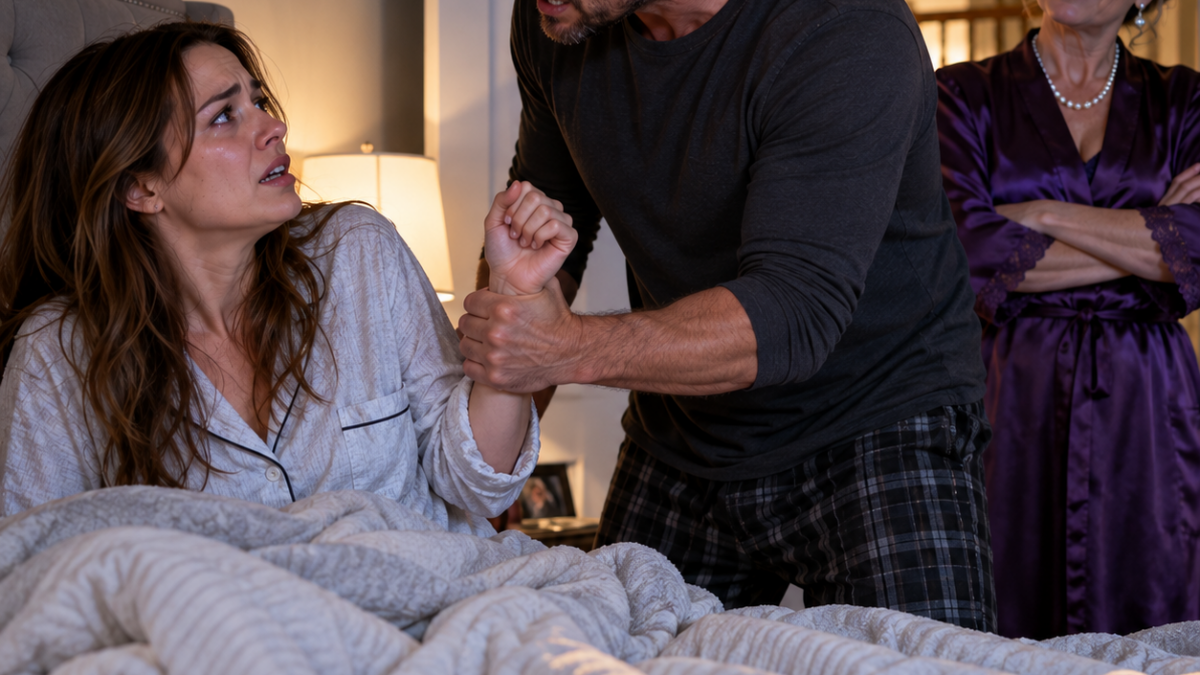
I woke when cold air hit my legs.
Daniel stood beside the bed holding the blanket.
“Get up.”
For a moment I thought something was wrong.
Fire.
Hospital.
Emergency.
“What?”
“Mom’s awake.”
I looked at the clock.
4:40.
“So?”
“She needs breakfast before her medication.”
I stared at him.
“Then make her breakfast.”
His face changed.
People who have never lived with someone like Daniel think anger begins loudly.
It doesn’t.
Daniel’s anger usually began with stillness.
The jaw.
The eyes.
The pause.
A calculation:
Are you really going to challenge me?
He said:
“She wants oatmeal.”
“Then there is oatmeal in the pantry.”
“No sugar.”
“Coffee after.”
“Her pills are on the counter.”
I sat up.
“Daniel.”
“What?”
“Make it yourself.”
Lorraine appeared in the doorway.
She was wearing my blue robe.
I had left it hanging behind the bathroom door.
Something about seeing her inside it made the entire situation feel surreal.
She folded her arms.
“A good wife wouldn’t need to be told.”
I looked at her.
Then Daniel.
“No.”
He stepped closer.
“What did you say?”
“I said no.”
His fingers closed around my wrist.
Hard.
The pain came immediately.
Not enough to break anything.
More than enough to make me gasp.
“Daniel.”
He tightened.
Lorraine smiled.
“Maybe now she’ll remember who the man of this house is.”
Something inside me stopped negotiating.
Not broke.
Not snapped.
Stopped.
For six years, I had interpreted every incident as a problem I could solve if I became better at anticipating him.
The first slap happened after an anniversary dinner.
We were arguing in the garage because I wanted to drive home instead of letting him drive after drinking.
He hit me.
Once.
Open hand.
Then stared at me as though someone else had done it.
He cried.
I comforted him.
That detail still embarrasses me.
He bought flowers.
Promised therapy.
Promised never again.
The second incident came ten months later.
He shoved me into the kitchen counter after I corrected a story he told his friends.
“You humiliated me.”
That was his explanation.
Then grabbing.
Blocking doors.
Taking my phone.
Driving too fast when angry.
Punching walls.
One night he slammed his fist into drywall six inches from my head.
Afterward he patched the hole himself and acted proud of the repair.
Lorraine knew some of it.
Not everything.
Enough.
Her advice never changed.
“You know his temper.”
“Don’t embarrass him.”
“Men need respect.”
“Stop challenging him when he’s angry.”
I learned how to speak softly.
How to watch doors.
How to keep my keys in predictable places.
How to save emergency cash without making it obvious.
How to photograph bruises in bathrooms.
How to email myself screenshots of his apology messages.
I told myself those were precautions.
I did not yet call them an exit plan.
That morning, with his hand around my wrist and his mother smiling behind him, I finally called them what they were.
Preparation.
I looked down at his fingers.
Then at him.
“Do it again.”
He blinked.
Not because he was afraid of me.
Because the sentence did not belong to the version of Claire he understood.
“What?”
“Do it again.”
His grip loosened.
I pulled my wrist free.
Not dramatically.
I did not slap him.
Did not shove him.
I walked past both of them and into the small office at the end of the hall.
Daniel followed.
“Where are you going?”
I opened the closet.
Took out a suitcase.
His laugh sounded forced.
“Oh, come on.”
I began packing.
Jeans.
Sweaters.
Underwear.
Toiletries.
Laptop.
Chargers.
Lorraine called from the hallway:
“She’s putting on a performance.”
Daniel stood in the doorway.
“You walk out that door, you’re finished.”
I stopped.
Looked at him.
“No.”
“What?”
“I’m finished if I stay.”
I opened the locked bottom drawer of my desk.
Inside was a red accordion folder.
Daniel’s eyes went to it.
“What is that?”
I didn’t answer.
The folder contained more than evidence of abuse.
Three years earlier, after Daniel shoved me against the kitchen counter, I had started documenting.
Photos.
Dates.
Urgent-care notes from the time he twisted my shoulder during an argument and I told the nurse I had slipped.
Messages afterward:
I’M SORRY.
YOU KNOW I WOULD NEVER REALLY HURT YOU.
YOU PUSHED ME TOO FAR.
I LOVE YOU MORE THAN ANYTHING.
PLEASE DON’T TELL ANYONE.
Contradiction stacked on contradiction.
I also had financial records.
Daniel operated a consulting firm called Bennett Strategic Group.
When he started it, I had used money inherited from Aunt Ruth to keep us afloat.
At first, $60,000.
Then another $40,000.
Then $75,000 when his biggest client paid ninety days late.
The business paperwork listed me as a forty-percent member.
Daniel held sixty percent and served as managing member.
He liked introducing himself as the founder.
Technically true.
He rarely mentioned who had financed the first two years.
At the beginning, that hadn’t bothered me.
We were married.
I believed we were building something together.
Then eighteen months before Lorraine moved in, I noticed company charges that made no sense.
A hotel in Chicago on a weekend Daniel told me he was in Cleveland.
A restaurant bill for $618.
Luxury purchases coded as client development.
A resort charge.
Transfers into an account I did not recognize.
When I asked, he accused me of “playing accountant.”
So I stopped asking him.
And quietly started saving records.
I put the red folder in my suitcase.
Daniel saw.
His expression changed again.
“Leave that.”
“No.”
“Those are company documents.”
“Some are.”
“Claire.”
He stepped into the room.
I raised my phone.
Camera recording.
He stopped.
His eyes dropped to the screen.
I said:
“Move.”
For several seconds, he didn’t.
Then he stepped aside.
That tiny movement may have saved both of us from something worse.
I rolled the suitcase downstairs.
Lorraine stood near the kitchen island.
Still wearing my robe.
“You’re actually leaving?”
“Yes.”
“Over breakfast?”
I stopped.
For years I had tried explaining Daniel to Lorraine.
This time I didn’t.
“No.”
She scoffed.
“Then what?”
“Ask your son.”
Daniel came down behind me.
“Don’t involve her.”
Interesting.
Lorraine looked between us.
I picked up my purse.
Daniel said:
“If you leave, don’t come crawling back.”
I opened the front door.
His voice followed me.
“And don’t expect to come back here whenever you feel like it.”
That made me turn.
He was standing in Aunt Ruth’s foyer.
Beside the staircase Aunt Ruth had refinished herself.
Under the stained-glass fixture I had watched her choose when I was eleven.
I almost corrected him.
Almost said:
Your name isn’t on the deed.
Instead:
“Goodbye, Daniel.”
I walked out.
I drove twenty minutes before pulling into a gas station and realizing I was shaking so badly I couldn’t safely keep going.
My wrist had already started turning red.
I parked under a light.
Locked the doors.
Then cried.
Not elegant movie crying.
Ugly.
Confused.
Gasping.
I kept saying one sentence aloud:
“You left.”
Then:
“You actually left.”
At 6:08, I called my sister, Rachel.
She lived forty-five minutes away.
She answered half asleep.
“Claire?”
“I need somewhere to stay.”
Instantly awake.
“Where are you?”
“Gas station.”
“Are you hurt?”
That question undid me.
“I don’t know.”
“Send me the location.”
“I can drive.”
“No.”
“Stay there.”
She arrived thirty-two minutes later.
Her husband, Ben, followed in their SUV.
Rachel got out and wrapped both arms around me.
I flinched when she touched my wrist.
Her eyes changed.
“Did he do that?”
I looked away.
“Claire.”
“Yes.”
She didn’t say what I expected.
Not:
I knew it.
Not:
Why didn’t you tell me?
She said:
“We’re going to get it documented.”
I almost resisted automatically.
Then remembered why I had left.
“Okay.”
We went to urgent care.
I told the truth.
For the first time.
“My husband grabbed me.”
The nurse stopped typing.
Looked up.
“Are you safe right now?”
“Yes.”
“Is he here?”
“No.”
“Do you want law enforcement contacted?”
I hesitated.
That hesitation bothered me later.
Not because it was irrational.
Because I could feel six years of conditioning telling me that reporting him would be unfair to him.
I said:
“Not yet.”
They documented bruising and swelling.
No fracture.
Soft-tissue injury.
The provider asked whether there had been previous violence.
I looked at Rachel.
Then said:
“Yes.”
She gave me information for a domestic-violence advocate.
Not pressure.
Options.
That distinction mattered.
By 10:00 that morning, I was sitting at Rachel’s kitchen table with my red folder open.
She read almost nothing.
She looked at the photographs.
Closed the folder.
Then asked:
“How long?”
“Six years.”
Her face crumpled.
I hated that more than anything.
“I thought you were happy.”
“I was good at looking normal.”
“Why didn’t you tell me?”
“I don’t know.”
That was true.
There were a hundred reasons.
Shame.
Fear.
Hope.
Daniel’s apologies.
Our social circle.
The company.
The house.
The belief each incident was not quite severe enough to justify exploding my life.
Abuse survives very well inside the phrase:
It could be worse.
Rachel asked:
“What do you want to do?”
“I don’t know.”
“Divorce?”
I stared at the table.
The word felt enormous.
Then:
“Yes.”
That was the first decision.
The second was not going back alone.
At noon, I called attorney Elena Marquez.
A friend had used her for a difficult divorce.
I expected a receptionist.
Elena answered herself.
I explained enough.
She said:
“Do you feel in immediate danger?”
“Not where I am.”
“Does he know where you are?”
“Probably.”
“Any firearms in the house?”
“Yes.”
“His?”
“Yes.”
That changed her tone.
“Do not return.”
“Do not meet him privately.”
“Do not change locks today.”
“The home may be titled solely to you, but it has been your marital residence.”
“His occupancy rights and your ability to exclude him need to be handled through court process, especially with domestic-violence allegations.”
I appreciated that.
No fantasy.
No:
It’s your deed, throw his clothes onto the lawn.
Real life.
Elena asked for the deed, business documents, medical records, and evidence of abuse.
Then:
“We should discuss an emergency protection order.”
I felt my stomach tighten.
“That sounds dramatic.”
“So does grabbing your spouse hard enough to send her to urgent care.”
“I didn’t go because he sent me.”
“You know what I mean.”
Yes.
We met by video that afternoon.
By evening, she had enough to begin preparing filings.
I still had not decided whether to make a police report.
At 9:20, Daniel called.
I didn’t answer.
9:22.
9:31.
Then text:
THIS IS INSANE.
Another:
MOM IS CRYING.
Another:
YOU EMBARRASSED ME.
Then:
COME HOME AND WE’LL TALK LIKE ADULTS.
Ten minutes later:
I’M SORRY ABOUT YOUR WRIST.
There.
Another apology.
Another piece of evidence.
Then:
YOU KNOW I DIDN’T MEAN TO HURT YOU.
I screenshotted everything.
Did not answer.
The next day, he shifted.
YOU ARE ABANDONING THE MARRIAGE.
YOU CANNOT TAKE COMPANY RECORDS.
MY LAWYER WILL DESTROY YOU.
Then:
I LOVE YOU.
Then:
PLEASE COME HOME.
Then:
YOU’RE SICK.
Then:
I’M WORRIED ABOUT YOU.
It was almost educational seeing the cycle compressed into hours.
Rachel watched me read.
“Block him.”
“Elena told me not yet.”
“Why?”
“Preserve messages.”
“Can someone else monitor?”
“Yes.”
We changed notification settings so I didn’t see every message immediately.
Elena’s office archived them.
I slept most of the second day.
On the third, I met a domestic-violence advocate named Patrice.
She helped me make a safety plan.
Changed passwords.
Reviewed bank access.
Credit freeze.
Location sharing.
Emergency contacts.
Workplace notification.
Not because Daniel was guaranteed to stalk me.
Because safety plans are built before certainty.
That afternoon, I pulled updated company transactions.
Something was wrong.
More transfers.
Two payments from Bennett Strategic Group to a business account called LM Advisory Services.
$9,500.
$12,000.
$7,500.
I searched the state business registry.
LM Advisory belonged to a woman named Lauren Miles.
I knew the name.
Daniel’s “business development consultant.”
I had met her twice.
Thirty-three.
Smart.
Friendly.
Always slightly too familiar with my husband.
My first thought was affair.
My second was:
Don’t guess.
I saved the records.
Sent them to Elena.
She wrote:
We need a forensic accountant before drawing conclusions.
I heard her voice in my head:
Evidence first.
At 2:13 the next morning, my phone started vibrating.
Daniel.
I watched it stop.
Start again.
Again.
Then voicemail.
I almost ignored it.
Then another call.
Then:
EMERGENCY. MOM.
I sat up.
Rachel’s guest room was dark.
I answered.
“Daniel?”
He was crying.
Not performative crying.
Panicked.
“Claire, please.”
“What happened?”
“Mom fell.”
My stomach tightened.
“Is she conscious?”
“Yes.”
“She won’t listen to me.”
“Did you call 911?”
“They’re here.”
I could hear Lorraine in the background.
Not crying.
Screaming.
“GET AWAY FROM ME!”
Then a man’s voice.
Calm.
“Sir, step into the living room.”
Daniel lowered the phone.
“No, no, this is my house.”
Then the stranger:
“Sir, before we proceed with any trespass complaint, we need to speak with the legal owner or see a court order. We are not removing anyone from a residence based only on your statement.”
I sat upright.
Trespass complaint?
Daniel came back on the phone.
“Claire.”
“What happened?”
“Tell them Mom doesn’t live here.”
“What?”
“She attacked me.”
From the background:
“You SHOVED me!”
Lorraine.
Then another voice:
“Ma’am, please stay seated.”
I got out of bed.
Rachel appeared in the doorway.
“What?”
I held up one finger.
Daniel said:
“Mom went crazy.”
“She tried to stop me from putting her things outside.”
“Tell the officer she isn’t supposed to be here.”
I closed my eyes.
Three days earlier:
She’ll be staying a few months.
Now:
Trespasser.
I asked:
“Put the officer on.”
Daniel hesitated.
“Claire.”
“The officer.”
A few seconds later:
“Hello, ma’am.”
“I’m Officer Marcus Reed with city police.”
“Are you Claire Bennett?”
“Yes.”
“Are you the titled owner of 1487 Wexler Avenue?”
“Yes.”
“I want to be careful here.”
“We’re responding to a disturbance.”
“Mr. Bennett requested that his mother be removed as a trespasser.”
“She appears to have been staying in the home with permission.”
“We’re not conducting an eviction or deciding tenancy tonight.”
“Good.”
That sentence alone calmed me.
I asked:
“Is Lorraine hurt?”
“She fell during the argument.”
“EMS is evaluating her.”
“Did Daniel touch her?”
There was a pause.
“I’m not going to discuss witness statements over the phone beyond what’s necessary.”
Professional.
“Understood.”
Then:
“Mr. Bennett says you left the residence permanently and gave him authority over the property.”
“No.”
“I left because he assaulted me three days ago.”
Another pause.
“Have you reported that?”
“Not yet.”
“Do you want to?”
I looked at Rachel.
She had heard enough.
She nodded.
“Yes.”
“Okay.”
“I’ll arrange for an officer to contact you where you are, or you can report at the station.”
“I’m staying elsewhere.”
“I don’t want Daniel knowing the address.”
“Understood.”
He continued:
“For tonight, Mrs. Bennett is choosing to leave voluntarily with EMS after evaluation rather than remain here.”
“We are not removing her as a trespasser.”
“Mr. Bennett has been separated from her.”
“Do you feel safe where you are?”
“Yes.”
“Do not come here tonight.”
“I won’t.”
Daniel’s voice erupted in the background.
“Give me the phone!”
Officer Reed said:
“Sir, stay where you are.”
Then to me:
“We’ll follow up.”
The call ended.
Rachel looked at me.
“What happened?”
I sat on the bed.
“Daniel tried to throw his mother out.”
“Why?”
I didn’t know yet.
The answer came at 8:17 the next morning.
Lorraine called me from the emergency department.
Her voice was small.
I had never heard Lorraine sound small.
“Claire.”
“How are you?”
“My wrist is broken.”
I closed my eyes.
“What happened?”
Silence.
Then:
“He shoved me.”
Those three words carried six years of history between us.
I said nothing.
Lorraine started crying.
“I know what I said to you.”
I still said nothing.
She continued:
“I know.”
“I know.”
“I thought…”
She stopped.
“What?”
“I thought you made him angry.”
There it was.
The whole philosophy.
I asked:
“And last night?”
“He was yelling about the business.”
“Someone froze a company card.”
That was news to me.
“I didn’t.”
“He thought you did.”
“He was drinking.”
“I told him he needed to stop calling you names.”
“He said I was taking your side.”
Then:
“I told him maybe you left because he scared you.”
I could barely breathe.
“What did he do?”
“He told me to get out.”
“I said I had nowhere to go at two in the morning.”
“He started throwing my things into the hallway.”
“I tried to take my suitcase away from him.”
“He shoved me.”
“I fell into the console table.”
“That’s how my wrist broke.”
I gripped the phone.
“Did you tell police?”
“Yes.”
Good.
Then she whispered:
“I’m sorry.”
I closed my eyes.
I had imagined Lorraine apologizing many times.
In those fantasies, I delivered perfect speeches.
Made her understand.
Made her hurt.
Reality gave me nothing like that.
I said:
“I believe you’re sorry.”
She cried harder.
“That doesn’t fix what you did to me.”
“I know.”
Good.
At least she didn’t argue.
I continued:
“I am glad you’re safe.”
“Where are you going?”
“My sister’s.”
Apparently Daniel had refused to let her return even for clothing unless police came.
For once, I did not solve the problem.
“Have the officer help you arrange a safe property pickup.”
“Don’t go alone.”
She said:
“Claire?”
“Yes?”
“Did he really hurt you before?”
That question nearly made me hang up.
Instead:
“Yes.”
“How many times?”
“I’m not discussing that with you today.”
“But—”
“No.”
Silence.
Then:
“Okay.”
That was the beginning of Lorraine learning the word no.
I made my police report that afternoon.
Not because Lorraine’s experience validated mine.
Daniel hurting his mother did not make what he’d done to me more real.
But hearing her say:
He shoved me,
destroyed the last piece of denial I had been carrying.
Officer Reed took my report.
Different officer interviewed me in detail.
I brought photographs.
Messages.
Urgent-care documentation.
I did not hand over my entire divorce folder.
Only material relevant to the alleged assaults.
The detective explained something I needed to hear:
Some older incidents might be difficult or impossible to charge separately because of proof problems or limitations.
The recent wrist-grabbing incident was fresh.
Documented injury.
Texts apologizing.
My contemporaneous call to Rachel.
Urgent-care record.
The earlier evidence could still provide context depending on what prosecutors lawfully used.
I appreciated that nobody promised dramatic justice.
Daniel was not arrested that afternoon.
The prosecutor reviewed.
Investigators interviewed him.
He denied “assaulting” me.
Admitted grabbing my wrist.
Said I was trying to leave during a marital argument and he wanted me to listen.
That admission did not help him.
He also denied pushing Lorraine intentionally.
Claimed she lost balance while trying to take a suitcase.
Lorraine told police otherwise.
Two cases.
Related pattern.
Separate evidence.
Meanwhile, Elena filed my petition for temporary protection and exclusive possession of the residence.
Daniel received notice through proper service.
He called me sixteen times that day.
I did not answer.
Then he emailed:
YOU ARE TRYING TO STEAL MY HOME.
I forwarded it to Elena.
She replied:
Do not respond.
At the emergency hearing, Daniel appeared with an attorney named Mitchell Crane.
I saw him over video.
He looked tired.
Controlled.
Nothing like the man at 4:40.
Abusers can become remarkably composed when a judge appears.
Mitchell argued that Daniel had lived in the home throughout the marriage.
True.
Had contributed to household expenses.
True.
Had paid for improvements.
Partly true.
And that removing him before full divorce proceedings would be disruptive.
True.
Elena did not argue:
Claire owns it, therefore Daniel has no rights.
She argued:
The court had authority under the domestic-violence statute to award temporary exclusive occupancy for safety regardless of ultimate equitable property claims, and the evidence supported protection.
Photos.
Medical note.
Texts.
My sworn statement.
Lorraine’s separate police incident.
The judge was careful.
She did not decide final ownership.
Did not decide the criminal case.
Did not divide marital property.
She entered a temporary protection order.
No direct contact except through counsel.
Stay-away provisions.
I received exclusive temporary use of the residence.
Daniel was allowed a supervised retrieval of personal belongings.
The order also addressed firearms as required under the applicable law and the specific findings.
When the judge finished, I didn’t feel victorious.
I felt nauseated.
Daniel stared at the camera.
Then disappeared when the hearing ended.
Two days later, police supervised his property pickup.
I did not attend.
Elena strongly advised against it.
Rachel and I waited at a coffee shop.
Officer Reed called afterward.
“He’s out.”
“Any problem?”
“Argumentative.”
“Complied.”
“Mother’s property?”
“Some items remain.”
“Mrs. Bennett can arrange separately.”
I thanked him.
Then drove home.
I sat in the driveway fifteen minutes before getting out.
The house looked unchanged.
Same porch.
Same maple.
Same brass numbers.
Yet I was afraid of the front door.
Rachel said:
“I’ll go first.”
“No.”
“Claire.”
“My house.”
I said it quietly.
Not possessively.
Reminding myself.
We entered together.
The inside was a mess.
Not destroyed.
Daniel had not gone on a movie-style rampage.
Drawers open.
Clothes gone.
Bathroom half empty.
His office stripped of electronics.
Lorraine’s things scattered in the guest room.
My blue robe lay on the bed.
I stared at it.
Rachel asked:
“Throw it away?”
“Yes.”
Then:
“No.”
I picked it up.
Washed it.
Kept it.
Not because of Lorraine.
Because I was tired of letting bad memories confiscate ordinary things.
The red folder sat on my desk.
I opened it.
Then called Elena.
“I’m ready to file.”
“For divorce?”
“Yes.”
“Good.”
She didn’t celebrate.
Neither did I.
The business became the ugliest part.
Not because I loved Bennett Strategic Group.
I didn’t.
Because money reveals how much of a marriage can be quietly rearranged without conversation.
We hired forensic accountant Samuel Cho.
Sam wore square glasses and spoke in sentences that made even obvious fraud sound emotionally boring.
Perfect.
He asked for:
General ledger.
Bank statements.
Credit-card records.
Payroll.
Tax returns.
Member distributions.
Vendor files.
Contracts.
Expense reports.
Loan documents.
My capital contributions.
Operating agreement.
Daniel’s records.
I gave him what I had lawfully accessed as an owner.
Elena obtained the rest through formal discovery.
The first finding:
My inheritance money had not simply “helped” the company.
We had documented much of it as capital contributions and part as member loans.
I had forgotten how carefully Aunt Ruth’s estate attorney made me document transfers.
Daniel hadn’t.
The company owed me a legitimate member-loan balance.
That was good.
The second finding was less good.
Over thirty months, Daniel had charged substantial personal expenses to the company.
Some business owners do that and properly classify them as distributions.
Daniel had not.
Many were coded as travel, client entertainment, or vendor development.
Hotels.
Restaurants.
Jewelry.
Resort stays.
Lease payments on an apartment in another city.
Payments to LM Advisory Services.
Sam did not call them “stolen money.”
He said:
“I need purpose, documentation, and authorization.”
Evidence.
Always.
Lauren Miles was subpoenaed for records.
Her attorney responded.
The truth was worse emotionally than financially.
Yes.
She and Daniel had been having an affair.
Nearly two years.
LM Advisory had also performed legitimate work.
She had brought clients into the firm.
So not every payment to her was fake.
Important.
But several payments exceeded invoices.
One transfer covered rent on the apartment Daniel used when telling me he was traveling for work.
Some jewelry had been purchased on the company card and given to Lauren.
A resort weekend billed as “regional strategy summit” included no client meeting.
Sam reconstructed it.
Daniel’s lawyer tried to call everything discretionary owner compensation.
Problem:
The operating agreement required member approval for certain related-party and extraordinary personal distributions.
He had concealed them.
As forty-percent member, I had rights.
As spouse, the value also mattered in divorce.
As lender to the company, I had another claim.
None of that meant police arrived and arrested Daniel for buying a necklace.
It meant his financial position got progressively worse every time records were produced.
Then came the house.
During discovery, Elena found an email between Daniel and a mortgage broker from five months earlier.
Subject:
HOME EQUITY OPTIONS.
My stomach turned.
Daniel had asked about borrowing $250,000 against the house to expand the company.
He wrote:
Property is marital residence. Title currently in spouse’s name due inheritance history but we can address.
The broker replied:
Borrower must establish ownership interest and all titled owners will need to execute required security documents.
Daniel then sent:
Working on transfer.
There was a draft quitclaim deed attached.
Grantor:
Claire Bennett.
Grantees:
Claire Bennett and Daniel Bennett, husband and wife.
Signature blank.
Not forged.
Not recorded.
That distinction mattered.
But Daniel had been planning to ask—or pressure—me to put him on the deed.
Possibly soon.
I stared at the draft.
Then remembered the night Lorraine moved in.
“My house.”
Maybe language had been preparing ground.
Maybe not.
I had spent too many years assigning intention after the fact.
I did not need to guess.
The document existed.
He had considered using my inherited home as collateral.
He had not completed it.
That was enough.
There was another email.
Broker:
Will your spouse agree?
Daniel:
She usually comes around.
I printed that sentence.
Put it in the red folder.
Not for court.
For me.
She usually comes around.
Six years summarized in four words.
A month into the case, Daniel requested mediation.
Standard.
Expected.
His first settlement proposal gave me the house “in exchange” for waiving all claims against the company.
I laughed when Elena read it.
“What?”
“He’s offering me my own house.”
Elena raised a finger.
“Careful.”
“Why?”
“Because while title is separate, marital contributions and appreciation claims still need analysis.”
“Don’t turn accurate indignation into sloppy legal thinking.”
I groaned.
“You ruin every satisfying sentence.”
“That is why you pay me.”
The appraisal and tracing showed the house remained my separately titled inherited property.
Some marital funds had paid for renovations and mortgage-related expenses, creating issues that could be considered in equitable distribution.
But Daniel did not own half the deed by repetition.
The court would address any financial marital claim without rewriting history.
His proposal still made little sense.
We rejected it.
He sent another.
I keep house.
He keeps company.
Company waives repayment of certain “marital debts.”
No accounting.
Rejected.
Another.
He agreed to repay my member loan but wanted all abuse allegations withdrawn.
Elena looked at me.
“Absolutely not.”
I stared.
“She can ask the prosecutor about your wishes.”
“But criminal charging isn’t a bargaining chip in a private property settlement.”
Good.
Rejected.
Meanwhile, Lorraine asked to see me.
I said no.
She asked again two weeks later.
I said no.
A month later, she sent a handwritten letter through Rachel.
I almost didn’t read it.
Then did.
Claire,
I taught my son that anger was something other people had to manage for him.
That first sentence stopped me.
She continued:
When he was a boy, his father was hard on him. When Daniel got angry, I protected him from consequences because I told myself I was protecting my child. When he became a man, I kept doing it. Every woman who upset him was difficult. Every boss who challenged him was unfair. Every friend who left had betrayed him.
Then:
When you told me he frightened you, I chose the version of events that required nothing from me.
I had never told her directly he frightened me.
Not in those words.
She must have inferred.
Then:
I thought because he loved me, I was safe from the part of him I blamed you for bringing out. I was wrong.
That was the sentence.
I read it several times.
The letter ended:
I do not expect you to forgive me or let me back into your life. I am sorry I watched him hurt you and helped him explain it away.
I put the letter in a drawer.
Not the red folder.
Separate.
Two weeks later, I agreed to meet Lorraine in Patrice’s office.
Neutral place.
Rachel nearby.
Lorraine wore a wrist brace.
She looked older.
She sat across from me.
For a minute, neither of us spoke.
Then:
“I’m sorry.”
“I read the letter.”
“I meant it.”
“I believe you.”
She swallowed.
“Can you forgive me?”
“No.”
The word surprised both of us.
I continued:
“Not now.”
“Maybe not ever.”
“I don’t know.”
Her eyes filled.
I felt guilty.
Then angry at myself for feeling guilty.
She nodded.
“I understand.”
Good.
I asked one question.
“Why did you smile?”
She knew exactly what I meant.
That morning.
4:40.
Daniel’s hand around my wrist.
Her face collapsed.
“I thought…”
She stopped.
“Say it.”
“I thought he was putting you in your place.”
The cruelty of the phrase sat between us.
Lorraine whispered:
“I hate that I thought that.”
“You should.”
She cried.
I didn’t comfort her.
That was new for me.
Eventually she said:
“When his father got angry, that was how women talked.”
“Don’t provoke him.”
“Let him cool down.”
“Keep the children quiet.”
“I told myself that’s marriage.”
“You passed it on.”
“Yes.”
“Then blamed me for living inside it.”
“Yes.”
No defense.
That mattered.
I asked:
“Did Daniel ever hit you before?”
“No.”
“Grab?”
“No.”
“Threaten?”
“Not physically.”
“So you thought I must be causing it because he didn’t do it to you.”
She looked down.
“Yes.”
I stood.
Meeting over.
Before I left, Lorraine said:
“I gave the police the messages.”
I turned.
“What messages?”
She pulled out her phone.
Daniel had texted her after I left.
MOM, SHE NEEDS TO LEARN SHE CAN’T WALK OUT EVERY TIME SHE’S MAD.
Then:
DON’T CALL HER.
SHE’LL COME BACK WHEN SHE RUNS OUT OF PLACES TO HIDE.
And:
IF SHE TRIES TO TAKE THE HOUSE I’LL MAKE SURE SHE GETS NOTHING FROM THE COMPANY.
Lorraine had saved them.
She gave them to investigators.
I nodded.
“Thank you.”
That did not repair us.
But it was the first time she used loyalty differently.
The criminal cases resolved before the divorce.
Daniel’s attorney negotiated with the prosecutor.
The most recent incident involving me was supported by my injuries, documentation, messages, and his admission that he had grabbed me.
Lorraine’s case involved the shove and broken wrist.
Daniel ultimately pleaded guilty to domestic-violence-related misdemeanor offenses arising from the recent incidents.
The older conduct was not magically transformed into a list of convictions.
Some served as context.
Some never entered court.
The judge ordered probation, counseling, compliance with protective conditions, and other terms available under state law.
No dramatic twenty-year sentence.
No judge calling him a monster.
No applause.
He stood.
Answered questions.
Entered plea.
Sat down.
I attended remotely.
When it ended, I felt almost nothing.
Patrice had warned me about that.
“You may expect a courtroom to create emotional closure.”
“Usually it creates paperwork.”
She was right.
The longer protection order remained separate.
The judge extended it after a hearing based on the evidence and circumstances.
Again:
Not forever.
Not magical.
Enough to let my nervous system begin learning that a ringing phone did not mean danger.
Daniel moved into the apartment he had been secretly using.
Lauren had already ended the affair.
I learned that through discovery, not because she called me.
Apparently she ended it after discovering Daniel had told her we were “essentially separated” for more than a year.
We weren’t.
We had eaten dinner together the night before one of their hotel weekends.
I could have hated her.
For a while, I did.
Then her sworn statement arrived.
She had been lied to too.
Not in the same way.
Not with the same consequences.
But lied to.
I stopped spending energy there.
Daniel was responsible for his promises to me.
The business accounting took eight months.
Sam Cho’s final report identified approximately $164,000 in personal or inadequately supported expenditures requiring adjustment, reimbursement, or treatment as member distributions.
Not every dollar became “money Daniel stole.”
Some were reclassified compensation.
Some legitimate business expenses had poor documentation.
Some were personal benefits charged improperly.
Some payments to Lauren were legitimate consulting invoices.
The remaining problematic amounts mattered enough.
More importantly, Daniel had taken distributions that distorted the value available to both members.
Settlement discussions finally became realistic.
Bennett Strategic Group could continue.
It was profitable.
Several employees depended on it.
I did not want to destroy the company to punish him.
I also did not want to remain his business partner.
So we negotiated a buyout.
Independent valuation.
Adjustments for improper distributions.
Repayment of my outstanding documented member loan.
Purchase of my forty-percent interest over a secured schedule.
Personal guarantee.
Default provisions.
No handshakes.
Daniel’s attorney hated some terms.
Mine hated others.
That is what settlements look like.
Eventually both sides become unhappy in sufficiently specific ways.
The divorce agreement treated the house separately from the business.
I kept title.
Daniel received credit for a negotiated portion of provable marital contributions to certain improvements, resolved as part of the overall property settlement.
He did not get half the house.
I did not pretend his years of financial contribution had never existed.
Accuracy cut both ways.
I retained my retirement accounts subject to agreed allocation.
He retained his.
Vehicles divided.
Furniture became absurdly emotional for three days.
He wanted Aunt Ruth’s dining table.
I nearly lost my mind.
Elena said:
“Is the table inherited?”
“Yes.”
“Then say that.”
“I should not need to explain this.”
“Marriage is mostly explaining things nobody thought would require explanation.”
He dropped the table claim.
Lorraine wanted the blue robe.
I mailed it to her.
Then regretted it.
Then didn’t.
I bought another one.
Dark green.
Mine.
Daniel’s buyout payments began after the divorce became final.
Automatic transfers.
No direct contact.
The company eventually removed Bennett from its marketing name after taking on another partner.
That pleased me more than it should have.
I used part of the buyout proceeds to start a smaller advisory practice of my own.
Not because I had dreamed of entrepreneurship.
Because six years of helping Daniel build something had taught me more than I realized.
I specialized in operations and financial controls for small professional firms.
One of my most repeated lines to clients became:
“If one person controls every account, approves every expense, and explains every discrepancy, you do not have a system.”
I never told them where I learned it.
The house became harder.
For months, every room contained Daniel.
Not literally.
Memory.
The kitchen counter.
The hallway wall he punched.
The bedroom at 4:40.
The office doorway he blocked.
I considered selling.
Rachel said:
“Do you want to?”
“I don’t know.”
“Then don’t decide because you want to escape a memory.”
That was good advice.
I repainted the bedroom.
Removed the heavy furniture Daniel chose.
Put a reading chair by the window.
The kitchen wall where he’d once punched drywall had a slightly uneven patch.
I hired someone to redo it properly.
Not symbolic.
It just annoyed me.
The guest room became a sewing room.
Lorraine’s four suitcases had sat there for three days.
I refused to let those three days determine the room forever.
The office stayed.
Red folder moved from the bottom drawer to the top shelf of a locked cabinet.
Eventually, I stopped opening it.
That felt important.
Evidence has a purpose.
Once cases end, you do not have to reread the worst moments to keep them real.
Lorraine and I developed something I never expected.
Not reconciliation exactly.
A limited relationship.
She texted on holidays.
I answered when I wanted.
She never showed up unannounced again.
That boundary alone would have been unimaginable before.
She continued therapy.
So did I.
Two years after the divorce, she asked to meet for coffee.
I agreed.
She looked healthier.
Older.
Softer.
She said:
“Daniel doesn’t speak to me.”
I did not say:
I’m sorry.
Because I wasn’t sure I was.
“He says I betrayed him.”
“You told the truth.”
“I know.”
Then:
“I spent his whole life protecting him from that.”
She stirred her coffee.
“I thought love meant standing beside someone no matter what.”
“What do you think now?”
She looked at me.
“Sometimes love is refusing to help someone lie.”
I nodded.
That was probably the best thing Lorraine ever said to me.
She asked:
“Do you hate him?”
I thought.
“No.”
“Really?”
“I don’t want him back.”
“I don’t trust him.”
“I don’t want contact.”
“I hope he never hurts anyone again.”
“But hate?”
I shook my head.
“It takes too much attention.”
She smiled sadly.
“You always were stronger than I gave you credit for.”
That sentence irritated me.
“Lorraine.”
“What?”
“Don’t turn staying alive in an abusive marriage into evidence I was secretly strong all along.”
She looked startled.
I continued:
“I was scared.”
“I made compromises.”
“I lied to people.”
“I protected him.”
“I stayed after things I wish I had left after.”
“Leaving doesn’t make me a heroic person.”
“It means I finally reached a point where staying cost more than I could keep paying.”
She nodded.
“I’m sorry.”
“Thank you.”
That conversation changed something too.
People like stories where the victim was secretly fearless.
I wasn’t.
At 4:40 that morning, when Daniel grabbed me, I was afraid.
When I told him:
Do it again,
I was afraid.
When I packed, afraid.
When I raised my phone, afraid.
When I drove away, terrified.
Courage did not replace fear.
It moved with it.
That distinction matters because I had spent years waiting to feel brave enough.
If I had waited for fear to disappear, I might still be there.
Three years after the divorce, Daniel finished probation.
The protection order had already expired by then.
He complied with the buyout schedule.
No missed payments.
No direct contact.
Through lawyers, I learned he had completed a batterer-intervention program and continued individual counseling.
I did not investigate whether he had changed.
That was not my job.
People sometimes asked:
“What if he’s different now?”
My answer:
“I hope he is.”
That did not mean I owed him another chance.
Improvement does not create a debt in former victims.
Daniel sent one letter through Elena after his final buyout payment.
Elena called.
“You want it?”
“What does it say?”
“I haven’t opened it.”
“Why?”
“It’s addressed to you.”
I thought.
“Send it.”
The envelope sat on my desk two days.
Then I opened it.
Claire,
I have written this a hundred ways and most versions are excuses.
Good opening.
He continued:
I used anger to control conversations because it worked. When you backed down, I told myself that meant I had been right. When you didn’t back down, I told myself you were disrespecting me. Either way, I designed the rule so I could never be wrong.
I stopped.
Kept reading.
I blamed you for my behavior because admitting I frightened you would have required me to see myself differently.
Then:
Mom did not make me hurt you. My father did not make me hurt you. Stress did not. Alcohol did not. You did not. I did.
I sat there for a long time.
The letter did not ask me to come back.
Did not ask forgiveness.
At the end:
You do not need to answer. I am sorry.
I didn’t answer.
But I kept that letter.
Not in the red folder.
That folder held evidence of who he had been when I needed proof.
The letter belonged somewhere else.
Proof that a person could eventually name what he did without requiring me to participate in his rehabilitation.
Whether Daniel truly changed afterward, I do not know.
We have not spoken.
I am comfortable with that uncertainty.
Five years after the morning Lorraine asked for oatmeal, I woke before dawn.
4:38.
My body still occasionally did that.
Trauma loves clocks.
For a while, 4:40 had been a terrible hour.
I would wake and immediately remember cold air on my legs.
Daniel standing beside the bed.
Lorraine in my robe.
That morning, I opened my eyes.
Dark room.
Quiet.
No footsteps.
No demand.
I got up.
Walked downstairs.
Made oatmeal.
For myself.
Brown sugar.
Cinnamon.
Too much cinnamon.
Coffee.
I sat by the kitchen window while the sky changed from black to blue.
At 4:52, I laughed.
Not loudly.
Just enough to hear myself.
I had spent years thinking freedom would feel dramatic.
Doors slamming.
Court orders.
Signatures.
A judge saying:
Divorce granted.
Money returned.
House confirmed.
Business separated.
Those moments mattered.
But freedom itself turned out to be boring.
Making breakfast because I wanted breakfast.
Leaving dishes until later.
Buying the wrong groceries.
Sleeping diagonally.
Saying no without measuring the distance to a doorway.
Allowing my phone to ring without answering.
Inviting someone into my house without asking permission.
Asking someone to leave and trusting they would.
That was freedom.
Rachel came over that weekend.
She brought a plant.
“You’re becoming one of those women with too many plants.”
“I inherited a house.”
“Plants follow.”
She looked toward the staircase.
“You ever think about selling?”
“Sometimes.”
“And?”
“Not yet.”
She nodded.
Then spotted the oatmeal pot drying beside the sink.
“You hate oatmeal.”
“I used to.”
She gave me a suspicious look.
“Is this therapy?”
“No.”
“Breakfast.”
“Very profound.”
“Thank you.”
We laughed.
Eventually I did sell the house.
Not because Daniel had ruined it.
Not because Lorraine had worn my robe.
Not because of 4:40.
I sold because seven years later, I wanted to live closer to my office and nearer Rachel’s children.
Normal reasons.
The morning before closing, I walked through every room.
Empty.
No furniture.
Sound echoed.
The new buyer was a woman named Keisha Morgan.
Thirty-one.
First house.
Software engineer.
She had loved Aunt Ruth’s stained glass.
At closing, she asked:
“Anything I should know about the house?”
I could have told her everything.
Instead:
“The upstairs bathroom pipe gets noisy in winter.”
“The maple drops branches after heavy snow.”
“And the kitchen window sticks when it’s humid.”
She smiled.
“That’s it?”
I looked at the deed.
Her name.
Not mine.
“That’s it.”
Because houses do not need to inherit every story that happened inside them.
I handed over the keys.
No speech.
No symbolic final glance.
I went to Rachel’s house for pizza.
Life continued.
The money from the sale went partly into my new townhouse and partly into investments Aunt Ruth’s old financial adviser helped structure.
I kept one thing from the original house.
The stained-glass pendant from the foyer.
Keisha hated removing original features until I showed her the receipt proving I had installed that fixture after Aunt Ruth died.
Not historic.
Mine.
I replaced it with something she preferred.
The stained glass hangs in my dining room now.
When sunlight hits it in the afternoon, colored shapes spread across the wall.
Sometimes I remember Daniel standing beneath it saying:
My house.
Then I remember how long it took me to understand the deeper issue.
The deed mattered.
Yes.
Financial records mattered.
Yes.
The company records mattered.
The police reports mattered.
But abuse was never wrong because Daniel grabbed a woman who secretly owned the house.
It would have been wrong if I owned nothing.
That is important.
People who heard pieces of my story loved the property reveal.
“He didn’t know the house was yours?”
“He tried to control you in your own house?”
“His mother thought it belonged to him?”
Yes.
I understand why that part is satisfying.
But title did not create my right to leave.
My inheritance did not make me more deserving of safety.
The red folder gave me evidence and financial protection.
It was not the reason I was allowed to say no.
I was allowed to say no because I was a person.
It took me years to understand that.
Daniel did not have the right to hurt me if he paid the mortgage.
He would not have had the right if his name were on the deed.
Lorraine would not have been correct if the house had been his.
No amount of ownership turns a spouse into staff.
No marriage vow turns fear into duty.
That became the real lesson.
Aunt Ruth once told me something when I was seventeen.
We were painting her kitchen.
I complained that she had rejected three shades of white because they all looked identical.
She said:
“If I’m paying for the wall, I get to care which white.”
I rolled my eyes.
Years later, I understood the larger principle.
You are allowed to care about what happens in your own life.
Not because you have money.
Because participation requires consent.
Marriage should have made Daniel more careful with my boundaries.
Not less.
The company taught me another version.
I had assumed partnership meant trust.
It does.
But trust without transparency becomes permission for whoever controls information to define reality.
Daniel managed the books.
I stopped questioning.
The less I questioned, the more normal unexplained charges became.
Same pattern as the marriage.
He got angry.
I backed down.
Next time the threshold moved.
Systems and relationships both deteriorate through tolerated exceptions.
That does not mean victims create abuse by tolerating it.
I did not cause Daniel to escalate.
He chose that.
But once I was safe, understanding the mechanism helped me build differently.
My business now has two-signature controls above certain amounts.
Independent bookkeeping.
Quarterly outside review.
No owner gets to classify personal expenses alone.
I tell clients:
“Good controls are not accusations.”
“They are how trustworthy people avoid being asked to survive on trust alone.”
Same with relationships.
Boundaries are not accusations.
They are information.
A person who respects you can hear:
No.
A person who needs control hears:
Challenge.
Daniel heard challenge.
Lorraine taught him that challenge had to be defeated.
Then eventually she became the person challenging him.
That was the night everything she had defended came back toward her.
I wish it had not taken a broken wrist.
I wish she had believed me before pain made the lesson personal.
But I no longer need to keep replaying the alternate version.
Reality is enough.
Lorraine died twelve years after the divorce.
Stroke.
Quick.
She and I were still in limited contact.
Daniel came to the funeral.
First time I had seen him in nearly a decade.
I knew he would be there.
Almost didn’t go.
Then decided Lorraine’s funeral was not a place I wanted to surrender to old fear.
Rachel came.
We sat near the back.
Daniel saw me.
He did not approach.
After the service, people gathered outside.
He remained across the courtyard.
At one point our eyes met.
He nodded.
I nodded.
That was all.
No reconciliation.
No confrontation.
No cinematic closure.
I was grateful.
Later, Lorraine’s attorney mailed me a small package.
Inside was the blue robe.
The original one.
I stared at it.
A note:
Lorraine requested this be returned to you after her death.
I almost threw it away.
Then laughed.
Of all things.
The robe.
I unfolded it.
Old now.
Faded.
One cuff frayed.
Inside the pocket was another note in Lorraine’s handwriting.
Claire,
I took this from your room because I believed everything in your house became ours once my son lived there.
I was wrong about more than the robe.
Please do whatever you want with it.
That line made me smile.
Do whatever you want with it.
I cut the robe into cleaning rags.
That sounds spiteful.
It wasn’t.
Fabric is fabric.
I used one piece to polish the stained-glass fixture Aunt Ruth had left me.
Then threw it away when it wore out.
Maybe that was symbolic.
Maybe not.
Not everything needs preserving.
The red folder is gone too.
After all limitation periods, legal requirements, and document-retention needs had passed—and after confirming with Elena what I should keep—I shredded duplicates.
Saved final orders.
Settlement.
Business records required for tax reasons.
Medical records that mattered to me.
Then destroyed most of the photographs.
I had once believed throwing them away would mean pretending it never happened.
It didn’t.
I remembered.
I simply no longer needed an image of every bruise to prove my own memory to myself.
One photo remained accidentally.
Stored in an old cloud archive.
My wrist from the oatmeal morning.
Red marks around it.
When I found it years later, I looked for maybe five seconds.
Then deleted it.
No hesitation.
I know what happened.
That’s enough.
Patrice once asked me during therapy:
“When did you leave Daniel?”
“February 14.”
“No.”
“I mean emotionally.”
I thought.
Not the first slap.
Not the shove.
Not the wall.
Not even the 4:40 grip.
It was the moment I looked at his hand on my wrist and understood that I was no longer interested in convincing him to become safe.
That distinction changed everything.
Before, every argument contained a hidden request:
Please understand me.
Please calm down.
Please love me better.
Please admit this is wrong.
At 4:40, I stopped requesting.
“No.”
Then suitcase.
The rest followed.
Not easily.
Not cleanly.
But forward.
People sometimes ask why I didn’t leave after the first slap.
There is no satisfying answer.
I loved him.
I believed him.
I wanted the marriage.
I was embarrassed.
I thought strong women fixed problems instead of abandoning them.
I confused compassion with responsibility.
I thought recognizing his childhood wounds made his behavior understandable enough to endure.
I kept waiting for a threshold obvious enough that nobody—including me—could question leaving.
That threshold kept moving.
The oatmeal morning was objectively less violent than some earlier incidents.
Yet it was the one that ended everything.
Why?
Maybe because Lorraine smiled.
Maybe because it was 4:40.
Maybe because the demand was so small.
Oatmeal.
No crisis.
No complicated argument.
No alcohol.
No financial disaster.
Nothing he could point to later as “stress.”
He hurt me because I said no to making breakfast.
The simplicity removed excuses.
That was it.
The problem was not our arguments.
The problem was that Daniel believed refusal entitled him to force.
Once I saw that clearly, I could not unsee it.
Years later, I received an invitation to speak at a local domestic-violence fundraiser.
I almost declined.
I am not a professional advocate.
Patrice convinced me.
“You don’t need to give advice.”
“Tell the part people misunderstand.”
“What part?”
She said:
“Whatever you wish someone had told you.”
So I stood in front of about sixty people.
No dramatic details.
No names.
I said:
“I spent years asking whether what happened to me was bad enough to leave.”
Then:
“That was the wrong question.”
People became quiet.
“The useful question was whether I was safe enough to stay.”
I paused.
“I wasn’t.”
That was all I wanted to say.
Afterward a woman approached.
Mid-fifties.
She whispered:
“He’s never hit me.”
I waited.
“He blocks the door.”
“Takes my keys.”
“Breaks things.”
“Tells me nobody will believe me because he doesn’t hit me.”
I did not tell her to leave that night.
I wasn’t her lawyer.
Not her advocate.
I gave her Patrice’s organization’s number.
Said:
“You can talk to someone without deciding everything today.”
She cried.
I understood.
Big decisions become possible when they are broken into safe next steps.
That was another thing I wish I’d known.
I thought leaving required knowing the entire future.
Where would I live?
What happens to company?
House?
Money?
Divorce?
Friends?
Court?
What if he changed?
What if I regretted it?
What if people blamed me?
I tried to solve all of that before taking one step.
Impossible.
The actual sequence was:
Leave the room.
Drive away.
Call Rachel.
Urgent care.
Attorney.
Advocate.
Police report.
Court.
Accountant.
One thing.
Then next.
Nobody needs the full map before moving away from danger.
My life now is ordinary.
I like ordinary.
I wake early sometimes.
Not always 4:40.
I run a consulting practice with six employees.
Rachel’s children are nearly grown.
I travel because I want to.
I make oatmeal occasionally.
Still too much cinnamon.
I dated after the divorce.
Slowly.
Badly at first.
The first man who raised his voice during an argument made my entire body lock up.
He noticed.
Stopped.
Apologized.
We talked.
Nothing else happened.
That was almost confusing.
I had forgotten disagreement could end without punishment.
We didn’t stay together.
But he taught me something without knowing it.
Normal conflict is uncomfortable.
It is not terrifying.
Later, I met Andrew.
Widower.
Architect.
Terrible cook.
Patient.
The first time he stayed at my townhouse, he woke before me.
I smelled coffee.
Then oatmeal.
I walked into the kitchen.
He looked up.
“Morning.”
I stared at the pot.
He said:
“What?”
“Nothing.”
“You hate oatmeal?”
“No.”
I started laughing.
Could not stop.
He looked alarmed.
Eventually I explained enough.
Not every detail.
He turned off the burner.
“Should I never make oatmeal again?”
That made me laugh harder.
“No.”
“Please make oatmeal.”
“I’m just having a weird moment.”
He walked over.
Stopped before touching me.
“Can I hug you?”
That question.
Can I.
Such a small thing.
“Yes.”
He hugged me.
I cried into his shirt because apparently breakfast had become emotionally hazardous.
Andrew never tried to rescue me from my history.
That helped.
I didn’t need rescue anymore.
We married three years later.
Small ceremony.
Rachel.
Ben.
Their children.
A few friends.
No promises about obedience.
No symbolic speeches about being “given away.”
At the reception, Andrew’s mother asked if she could stay with us for a week around Christmas.
Asked.
I almost laughed.
“Of course.”
She said:
“Are you sure?”
“Yes.”
“And if it gets annoying, tell me.”
I thought of Lorraine arriving with four suitcases.
“Amazing concept.”
She looked confused.
Andrew squeezed my hand.
He knew.
Our house now is in both our names because we bought it together.
Joint ownership.
Joint mortgage.
Joint decisions.
That does not make me feel less safe than sole title did.
Safety was never really in the deed.
The deed gave me options.
Documents gave me leverage.
Money gave me access to attorneys.
Those things mattered.
I will never pretend otherwise.
Financial independence can make leaving easier.
Housing makes leaving easier.
Family support makes leaving easier.
Legal knowledge makes leaving easier.
I had advantages many people do not.
But the deepest change was understanding that no document had to authorize my refusal.
No deed.
No police report.
No bruise photograph.
No witness.
No judge.
I could say:
No.
Daniel was responsible for what he chose to do with that answer.
That is why the moment I remember most is not the divorce decree.
Not the forensic report.
Not the night Officer Reed said they needed to speak with the legal owner.
Not the day Daniel’s last buyout payment arrived.
It is 4:40.
Cold air.
My wrist in his hand.
Lorraine smiling.
And me hearing my own voice say:
“Do it again.”
People sometimes misunderstand that line.
They think I was daring him.
I wasn’t.
I was telling myself:
If he does this again, you will not explain it away again.
You will see it.
You will name it.
You will leave.
He didn’t grab me again.
He didn’t need to.
For the first time in six years, I believed what had already happened.
That was enough.
Three nights later, when the police officer’s voice came through Daniel’s phone and asked for the legal owner, I thought the universe had handed me some perfect revenge.
It hadn’t.
The officer was simply doing his job carefully.
Daniel had tried to turn a domestic argument with his mother into a trespass removal.
The officer refused to pretend ownership and occupancy could be decided by whoever shouted loudest at two in the morning.
That was all.
But hearing the question mattered.
Who is the legal owner?
For years Daniel had answered every question about authority with himself.
His house.
His company.
His money.
His rules.
His temper.
His mother.
His wife.
Then records started speaking.
The deed said my house.
The operating agreement said forty percent mine.
The member-loan documents said money owed.
The bank records said personal spending.
The messages said apologies.
The medical records said injuries.
Lorraine said he shoved me too.
Daniel’s own texts said she always comes around.
Each document removed another layer of the story he had built.
In the end, he was not destroyed.
That matters to me too.
He lost the marriage.
Lost control over me.
Paid what the financial records supported.
Faced consequences for the recent violence that could be proved.
Completed court requirements.
Continued his life.
I continued mine.
Justice did not require him to disappear.
It required me to stop disappearing inside his version of reality.
I think of Aunt Ruth whenever sunlight hits the stained glass.
She left me a house.
At the time, I thought inheritance was the gift.
Years later, I understood something else.
The house gave me physical space.
But leaving Daniel taught me how to inhabit it.
How to say:
This is mine.
Not just property.
My morning.
My body.
My work.
My money.
My silence.
My answer.
My future.
No one gets those merely because they call themselves the man of the house.
And that is why, whenever I wake before dawn now and see 4:40 glowing on the clock, I no longer remember oatmeal first.
I remember the front door closing behind me.
The suitcase rolling across the porch.
My car starting.
The road opening ahead.
And the first full breath I took after realizing I was finally leaving.








