For Three Years, My Son Never Spoke—Then the New Housekeeper Said One Thing I Never Could.k
part2:
Tutors.
Art therapy.
Equine therapy.
Nutritionists.
Sleep specialists.
A doctor from Boston.
Another from Philadelphia.
A woman from California who charged more for a weekend than some families earned in six months.
I converted a sitting room into a therapy suite.
Soft lighting.
Muted colors.
A weighted blanket.
Special furniture.
A sound machine.
One specialist said routine mattered, so I hired someone to structure Liam’s day.
Another said too much structure might feel controlling, so I canceled half of it.
Every professional arrived with a theory.
Every professional eventually left with some version of the same sentence.
“Recovery can take time.”
I hated that sentence.
Time was the one thing I couldn’t buy.
Every evening, I stood outside Liam’s room.
Sometimes the door was open.
Sometimes closed.
I would say:
“Good night, son.”
No answer.
Then I walked back to my study and poured something expensive into a glass I barely tasted.
I had solved billion-dollar problems.
Negotiated with governments.
Fired executives who frightened everyone else.
Rescued projects analysts said were impossible.
But I couldn’t make my son look at me.
Couldn’t make him speak.
Couldn’t convince him that his life had not ended on the same highway where his mother’s had.
The morning Naomi Carter arrived, I didn’t even meet her.
Gerald, my head of household staff, came into my study around eight.
“The new housekeeper is here, sir.”
I kept reading the contract in front of me.
“Let’s hope this one stays.”
Gerald said nothing.
The previous three had quit within weeks.
One told him the house felt sad.
Another left by text.
The third cried in the kitchen on her last afternoon and apologized to everyone as though the grief inside my home had somehow been her fault.
Gerald had worked for us eleven years.
He knew when not to argue with me.
He left.
I returned to my paperwork.
It was almost noon before I first saw Naomi.
She was carrying folded linens through the main hall.
Young.
Twenty-eight, I later learned.
Simple blouse beneath her uniform.
Dark hair pulled back.
No jewelry beyond tiny earrings.
Nothing about her suggested the polished neutrality I had come to expect from domestic staff who worked in wealthy homes.
She didn’t move like someone afraid of touching expensive things.
She also didn’t move like someone impressed by them.
That interested me.
People behaved differently around wealth.
Some became nervous.
Some became overly respectful.
Some looked at everything as though calculating its price.
Naomi seemed almost completely uninterested.
The next morning, I did something embarrassing.
I put on a security uniform.
The estate employed rotating private security officers because of my business profile.
Staff changed often enough that Naomi wouldn’t necessarily know every face.
I told Gerald I wanted to observe the household informally.
He looked at the uniform.
Then at me.
“Sir.”
“Yes?”
“May I ask why?”
“Staff turnover.”
He waited.
“And Liam.”
Gerald’s face softened slightly.
“I see.”
“I want to know how she behaves when she doesn’t realize I’m watching.”
He stared at me long enough to make me irritated.
Finally:
“Of course, sir.”
Gerald had a remarkable ability to make agreement sound like criticism.
The uniform fit badly.
Too large in the shoulders.
Smelled faintly of somebody else’s cologne.
I felt ridiculous.
But Naomi had never met me.
She assumed I was estate security.
At first, that’s all it was.
Observation.
I watched how she worked.
She didn’t photograph the house.
Didn’t linger over paintings.
Didn’t ask what anything cost.
Didn’t quiz Gerald about the family.
Most new staff eventually asked about Liam.
Sometimes with concern.
Sometimes curiosity disguised as concern.
Naomi never asked.
She simply worked.
Then, on her third day, she encountered him.
I was near the eastern gallery.
Liam walked slowly along the bookshelves carrying a hardcover novel beneath one arm.
It slipped.
Hit the floor.
The sound echoed.
He froze.
Two staff members at the far end looked over.
Neither moved.
People had become afraid of doing the wrong thing around him.
That was another consequence of all my specialists.
Everyone treated Liam as fragile.
A clinical situation.
Naomi stepped from the sitting room.
Saw the book.
Walked over.
Picked it up.
No concerned expression.
No cautious voice.
She simply held it toward him.
“Happens to me all the time.”
Liam looked at the book.
Not her.
Naomi waited.
Then added:
“No big deal. Everybody gets rough days.”
She didn’t ask him to respond.
Didn’t say his name.
Didn’t encourage him.
Didn’t smile like he had just completed a therapeutic exercise.
She waited.
After several seconds, Liam took the book.
Naomi released it.
Then walked away.
That’s all.
I stood in that hallway long after she disappeared.
Because Liam had looked at her.
Only for a second.
But directly.
That evening, I heard Naomi humming in the kitchen.
No lyrics.
Just a melody.
Something that reminded me of a hymn my grandmother used to sing.
I stopped outside the doorway.
Then noticed Liam at the bottom of the staircase.
Barefoot.
Listening.
He stood there almost two minutes.
Naomi never saw him.
When I shifted my weight, Liam noticed me.
He disappeared upstairs.
But something had happened.
For months, I had watched my son retreat from everything.
That night, he had moved toward a sound.
Toward her.
I began watching Naomi more closely.
That’s the part I am least proud of.
At first I told myself I was protecting Liam.
Then I told myself I was assessing her judgment.
Then her character.
Then whether she was trustworthy.
Eventually I stopped pretending those explanations were complete.
I wanted to understand her.
She took the bus despite the estate car service available to staff.
She brought simple meals.
Wore the same few blouses repeatedly.
She sent money somewhere.
Gerald mentioned she had asked where she could transfer funds internationally.
She carried a photograph in the pocket of her uniform.
Sometimes, when she thought nobody was looking, she touched it.
Not removing it.
Just pressing two fingers against the fabric.
She rarely complained.
But she wasn’t one of those relentlessly cheerful people who perform gratitude because they think wealthy employers expect it.
If she was tired, she looked tired.
If something amused her, she smiled.
If Gerald asked whether she could stay late and she couldn’t, she said no.
That interested me too.
No elaborate excuse.
Just:
“I can’t tonight.”
Then she left.
She did something similar with Liam.
She never chased him.
She created space.
If he sat in the garden room, she might polish the low table nearby.
If he moved into the library, she sometimes read during her break in the opposite corner.
If he stood by the window, she didn’t announce that she’d noticed him.
She made proximity safe because she demanded nothing in return.
One afternoon, I watched from the courtyard as Naomi sat reading in the garden room.
Liam stood near the window twenty feet away.
They stayed like that almost an hour.
No conversation.
When Naomi eventually stood to leave, she lifted her book slightly.
“Good one, by the way. If you ever want it.”
She left before he could answer.
That detail struck me.
Before he could answer.
Which meant he didn’t fail if he stayed silent.
No disappointed face.
No missed opportunity.
No adult measuring whether progress had happened.
She offered something and removed the obligation.
I found myself thinking:
She understands something none of us understood.
Including me.
Especially me.
I began taking longer routes through my own house.
The security uniform became an excuse.
If Naomi was in the east wing, I somehow found a reason to check the east wing.
If she took her break near the staff garden, I inspected exterior locks nearby.
One afternoon she caught me standing outside the break room.
She looked up from a notebook.
“You do a lot of walking for a security guy.”
“Rounds.”
“Uh-huh.”
She returned to writing.
The corner of her mouth moved.
Not a full smile.
Enough.
I walked away feeling absurdly pleased.
Gerald confronted me several days later.
We were outside the estate office after most staff had gone.
“If I may, sir.”
“That opening never brings anything enjoyable.”
He ignored me.
“The current arrangement carries some risk.”
“What arrangement?”
Gerald looked at the security uniform.
I sighed.
“What risk?”
“If Miss Carter discovers that the employee she has been speaking with is actually the owner of the estate, she may feel deceived.”
“I’m aware.”
“I thought you might be.”
“Anything else?”
“No, sir.”
He turned.
“Gerald.”
“Yes?”
“You disapprove.”
He considered.
“It isn’t my place.”
“That means yes.”
“It means you already know the answer.”
Then he walked away.
I should have stopped that night.
I didn’t.
A week later, I found Naomi sitting on the low stone wall near the south terrace after her shift.
Shoes off.
Cup in both hands.
Sunset turning the garden copper.
I was still in uniform.
She noticed me.
“You can sit.”
I did.
For a while, neither of us spoke.
Then Naomi said:
“He’s going to be okay.”
I looked at her.
“Who?”
She gave me a look.
“Liam.”
My chest tightened.
“You sound certain.”
“I’m not.”
“But you said it.”
“I think he will.”
“Why?”
She watched the garden.
“Because he’s still paying attention.”
I said nothing.
“People who completely give up stop reaching outward. Liam notices everything.”
“He doesn’t speak.”
“Speaking isn’t the only way people show they’re still here.”
I looked toward the house.
“What if he never comes back?”
Naomi turned toward me.
That was the first time she really studied my face.
Not as security.
As a person.
“Then everybody around him keeps making the world safer until he decides it’s worth coming back to.”
“What if that takes years?”
“Then it takes years.”
“You make that sound easy.”
“I didn’t say easy.”
“What do you do?”
“Show up.”
I looked at her.
She continued.
“Same time tomorrow. Same kindness tomorrow. Same patience tomorrow. Don’t make him earn your staying.”
Something shifted inside my chest.
I asked:
“What if the people around him are afraid too?”
Naomi was quiet.
Then:
“They probably are.”
“How do they help him if they’re scared?”
“By showing up scared.”
Simple.
Brutal.
True.
That night, I walked upstairs.
Stopped outside Liam’s room.
Usually I would say good night and leave.
Instead I sat on the floor.
Back against the wall beside his door.
I felt ridiculous.
After maybe ten minutes, I said:
“I’m here.”
No answer.
“I don’t know what I’m doing.”
Silence.
“I’ve spent three years trying to fix everything except the part where I lost her too.”
My voice broke.
I stared at the opposite wall.
“You don’t have to answer me.”
Nothing.
“I’m going to sit here awhile.”
I stayed almost an hour.
When I stood, my legs were numb.
Liam never spoke.
But as I walked away, I heard movement inside the room.
That became our routine.
Not every night.
Most.
Sometimes I talked.
Sometimes I sat quietly.
Once I read from a book I hated because Margaret had loved it.
No response.
That stopped feeling like failure.
Naomi had given me that.
Then came the storm.
It had rained all Thursday.
Heavy gray sky.
Wind bending trees.
By evening, thunder moved across the valley hard enough to shake windows.
I was in my study around nine when something crashed upstairs.
Then another sound.
Not furniture.
Human.
A broken, strangled noise that made me run.
Gerald reached Liam’s door first.
Inside, something fell.
I grabbed the handle.
Then footsteps came behind us.
Naomi.
She had stayed late because another staff member was sick.
She looked at me.
Not the uniform.
Not security.
Just me.
We both knew something was terribly wrong.
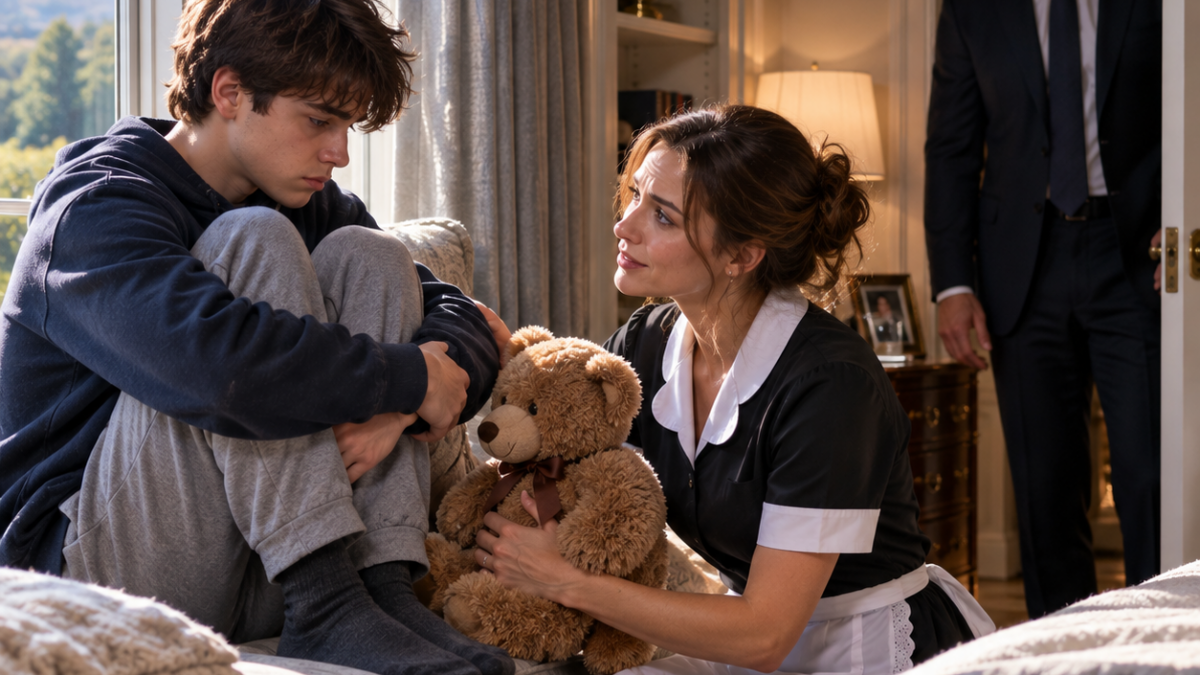
She opened the door.
Liam was against the wall beside his desk.
Hands pressed over his ears.
Body shaking.
A lamp broken.
Books scattered.
He wasn’t attacking anyone.
He looked like he was trying to escape his own skin.
I stepped forward.
Naomi raised one hand.
Not commanding me.
Asking.
I stopped.
She crossed the room.
Slowly.
No bright lights.
No questions.
She lowered herself beside him.
“Liam.”
He shook harder.
“It’s me.”
Nothing.
“I’m going to sit here.”
She sat.
He was breathing too fast.
Naomi stayed close without immediately touching him.
Then Liam leaned toward her.
Barely.
That was the invitation.
She wrapped her arms around him.
He collapsed against her.
The sound coming from him was unlike anything I’d ever heard.
Not crying exactly.
Years of crying trying to happen at once.
Naomi held him.
“You don’t have to be strong right now.”
His hands gripped her sleeves.
“You’ve been strong long enough.”
Thunder shook the windows.
She continued.
“Your mom loved you.”
My throat closed.
Naomi said:
“She wouldn’t want you carrying all of this alone.”
Liam’s entire body convulsed with another sob.
“No one’s leaving you right now.”
Naomi’s voice stayed soft.
“I’m here.”
Then it happened.
A breath.
A rough sound.
Something caught in a throat unused to words.
And my son whispered:
“Mom.”
One word.
The first word I had heard from him in thirty-seven months.
I grabbed the doorframe.
I couldn’t breathe.
Liam said it again.
“Mom.”
Then he cried.
Fully.
Not silently.
Not politely.
His grief filled the room.
Naomi held him.
I stood in the doorway crying so hard my vision blurred.
I wanted to go to him.
I didn’t.
For once, I understood that my desire to enter wasn’t more important than what Liam needed.
He needed Naomi.
So I stayed.
Eventually he fell asleep against her.
She remained on the floor until his breathing became slow and steady.
I stepped into the hallway before she looked up.
I leaned against the wall.
Hands shaking.
And thought:
She gave him back.
Then another thought arrived immediately.
She doesn’t know who I am.
For the first time, the lie felt unbearable.
The week after Liam spoke was the best week I’d had since Margaret died.
Not because he suddenly became the boy he had been.
Recovery doesn’t work like that.
He spoke rarely.
One word.
Sometimes two.
But silence no longer felt sealed.
At breakfast, he sat at the table.
Actually ate.
He opened curtains.
Walked through the garden.
Once he asked Naomi:
“Which ones?”
She was trimming plants.
She looked toward him.
“These?”
He nodded.
“Dead stems.”
That was the entire conversation.
I nearly cried watching from the study.
Another afternoon, Naomi left a notebook outside his room.
No note.
No instruction.
The next day, several lines appeared inside it.
Liam’s handwriting.
No one made a celebration out of it.
That mattered.
I was becoming more aware of Naomi too.
Not only because of Liam.
I looked for her.
Noticed when she wasn’t in a room.
Waited for evenings on the terrace.
Then hated myself for noticing.
Margaret had been dead three years.
Three years felt both enormous and impossibly short.
How could I feel anything for someone else?
Was that betrayal?
Relief?
Loneliness pretending to be love?
I didn’t know.
So I did what I always did with feelings I couldn’t categorize.
Nothing.
Then Naomi discovered the truth.
It happened because an assistant called in sick.
Naomi was helping reorganize files near my estate office.
She opened the wrong door.
Inside my office was a framed magazine cover.
My photograph.
Suit.
Podium.
Headline beneath:
ETHAN COLE: THE QUIET BILLIONAIRE BEHIND A GLOBAL TECHNOLOGY EMPIRE
I had forgotten it was even there.
Naomi stood staring at it.
Then looked at the staff directory.
E. COLE — PRINCIPAL RESIDENT.
She found me that afternoon near the north terrace.
I was still wearing the stupid uniform.
The moment I saw her face, I knew.
She stopped several feet away.
“Who are you?”
Not really a question.
I could have lied.
Could have delayed.
Could have said something clever.
Instead:
“My name is Ethan Cole.”
Her jaw tightened.
“I own this house.”
She stared at the uniform.
Then me.
“You’re him.”
“Yes.”
“You’re Liam’s father.”
“Yes.”
“You’ve been pretending to be security.”
“Yes.”
“For weeks.”
“Yes.”
“Watching me.”
I swallowed.
“Yes.”
Her eyes changed.
Not tears.
Something colder.
“You were testing me.”
“At first.”
“At first?”
“I wanted to know how you treated Liam when you didn’t know I was his father.”
She laughed once.
No humor.
“And after?”
I couldn’t answer fast enough.
“That’s what I thought.”
“Naomi—”
“So everything I said to you…”
“No.”
“You sat there letting me talk to you like we worked in the same house.”
“I know.”
“You asked me about Liam.”
“I know.”
“I told you things because I thought you were…”
She stopped.
“Because I thought you were safe.”
That hurt.
“You are safe with me.”
“No.”
The word came immediately.
“You don’t get to decide that.”
She was right.
I shut my mouth.
Naomi looked at me for another moment.
Then said quietly:
“What you did was cruel.”
She walked away.
I stood there wearing that ridiculous uniform and finally saw myself clearly.
Not cautious.
Not protective.
Afraid.
Control disguised as caution.
I had lost Margaret without warning.
Liam had disappeared emotionally afterward.
My response had been to trust nothing I couldn’t verify.
Employees.
Doctors.
People.
Naomi.
I had observed her because observing felt safer than believing.
But trust without risk isn’t trust.
It’s surveillance.
Naomi didn’t quit.
That almost made it worse.
She did her work.
Spoke to Gerald.
Helped Liam.
Ignored me.
When I tried to apologize in the hallway, she said:
“Mr. Cole, I’m working.”
The title felt like a locked door.
I deserved it.
Liam noticed.
The next day he became quieter.
Returned to the window.
Didn’t come to breakfast.
Fear hit me instantly.
I went to Naomi’s room after her shift.
Knocked.
She opened the door.
I didn’t step inside.
“Whatever you think of me is deserved.”
She waited.
“But Liam saw us.”
“I know.”
“He thinks something happened.”
“Yes.”
“I’m asking you as his father, not your employer.”
Her expression changed slightly.
“Please don’t let him think you’re leaving because of him.”
Naomi stared.
Then said:
“Liam isn’t part of whatever is happening between you and me.”
“I know.”
“Do you?”
“Yes.”
“I won’t disappear on him to punish you.”
I looked down.
“Thank you.”
She walked past me.
Straight to Liam’s room.
Knocked.
“Hey.”
Silence.
“I’m still here.”
Long pause.
“Nothing changed between you and me.”
Another pause.
“Tea?”
We waited.
Then Liam’s voice came through the door.
“Yeah.”
Small.
Rough.
One syllable.
Naomi looked toward me at the end of the hall.
Then back toward the door.
That moment changed me more than any board meeting, acquisition, or crisis of my career.
She was furious with me.
And she still protected my son from becoming collateral damage.
The next morning, I stopped wearing the uniform.
I never put it on again.
I ate breakfast in my own kitchen.
Not study.
Liam came in.
Saw me.
Almost turned around.
I stayed quiet.
He sat.
We ate.
No conversation.
That evening, I ate dinner there too.
He sat across from me.
Naomi wasn’t even in the house.
That mattered.
This wasn’t about her arranging us anymore.
I said:
“Good night.”
Liam stood.
Then:
“Night, Dad.”
I didn’t move.
He walked upstairs.
Two words.
Directed at me.
I went into my study.
Turned off the lights.
Sat alone in the dark.
And cried.
Not because everything was fixed.
Because my son had called me Dad again.
Two days later, I asked Naomi if we could talk.
Not terrace.
Not while I was pretending to be somebody else.
My study.
Door open.
She sat across from me.
I said:
“I’m sorry.”
She watched.
“I lied because I was afraid.”
Nothing.
“I told myself I was protecting Liam.”
Still nothing.
“I wasn’t.”
I took a breath.
“I was protecting myself from trusting someone.”
Naomi’s expression softened slightly.
Not forgiveness.
Attention.
“I treated you like a subject I could evaluate instead of a person who deserved honesty.”
She looked down.
“I’m sorry.”
Silence.
Then:
“Can I ask you something?”
“Yes.”
“Was there ever a moment when you thought you should just introduce yourself?”
I almost laughed.
“Yes.”
“When?”
“Second day.”
That surprised her.
“What stopped you?”
I thought about all the explanations.
Grief.
Security.
Liam.
Staff turnover.
None was really the answer.
“I didn’t know how.”
Naomi stared.
Then something in her face changed.
“That might be the first completely honest thing you’ve said to me.”
“Probably.”
She nodded slowly.
“Okay.”
“Okay?”
“Just okay.”
I understood.
Not forgiven.
Not forgotten.
But not closed forever either.
That evening, Naomi told me about her younger brother Marcus.
She had been seventeen when he stopped speaking.
He was twelve.
Their father had left.
Their mother was overwhelmed.
School labeled Marcus difficult.
Teachers treated him like he was intentionally refusing to participate.
No expensive specialists came.
No private tutors.
No therapy suite.
Naomi had no training.
She simply refused to abandon him.
Every afternoon after school, she sat nearby.
Read aloud.
Watched television.
Cooked.
Didn’t force conversation.
Didn’t demand improvement.
“People kept asking what was wrong with him,” she said.
“What was?”
“He was hurt.”
“That simple?”
“No.”
She smiled.
“But sometimes adults make suffering more complicated because complexity makes us feel useful.”
I thought about my therapy room.
All those specialists.
All that equipment.
Naomi continued.
“Marcus eventually started talking.”
“How long?”
“Almost two years.”
“What happened?”
“No miracle.”
She shrugged.
“One day he asked if we had cereal.”
I smiled.
“That was it?”
“That was the first sentence.”
“And now?”
“Twenty-four.”
“What does he do?”
“Works at a library.”
She smiled.
“Has a cat named Sir Pickles.”
I laughed.
“You said you couldn’t remember the cat’s name.”
“I was protecting his dignity.”
“Sir Pickles has no dignity.”
“Exactly.”
We both laughed.
It was the first easy moment since she discovered the truth.
Not reconciliation.
A crack in the wall.
Liam started playing piano again in November.
Margaret had taught him.
After she died, the music room remained closed.
One afternoon Naomi heard notes.
Slow.
Uncertain.
She didn’t enter.
That evening she told me.
I went upstairs.
Stopped outside the music room.
For years, I had stood outside Liam’s bedroom listening to silence.
Now there was music.
Broken chords.
Wrong notes.
Long pauses.
Then another melody.
I put my hand against the door.
Cried quietly.
Didn’t enter.
I was learning.
By winter, Liam enrolled in two courses at the community college across the valley.
Not because I told him.
His idea.
Psychology and literature.
He came home tired.
Sometimes sat at the kitchen table doing assignments while I worked from my laptop.
Naomi occasionally joined us after work.
The house changed.
No renovation.
No dramatic transformation.
People simply started using rooms again.
The dining table.
Kitchen.
Music room.
Garden.
Liam began making jokes.
Dry ones.
Exactly like Margaret.
One afternoon he said:
“There was a guy in class arguing with the professor for twenty minutes.”
“What about?”
“The professor said symbolism depends on context.”
“And?”
“He said symbols always mean one thing.”
I looked up.
“What did the professor say?”
“Told him that was an impressively symbolic interpretation.”
I laughed.
Liam almost smiled.
Naomi caught my eye across the table.
There he is.
She didn’t say it.
Didn’t need to.
In December, I created the Margaret Cole Foundation.
The idea had been growing for months.
Not charity as grief decoration.
Something useful.
I visited underfunded youth mental-health programs.
School counselors with waiting lists.
Clinics serving neighborhoods where families couldn’t fly specialists across the country.
Teenagers sitting in rooms waiting for somebody to believe silence might be pain instead of defiance.
My wealth had not saved Liam.
But resources still mattered.
Access mattered.
Time mattered.
People mattered.
I funded the foundation quietly.
No press conference.
No giant photograph of Margaret.
No gala.
When I told Liam, he listened.
Then said:
“Mom would’ve liked that.”
“I think so.”
He stared at the table.
Then:
“Can I help?”
I couldn’t answer for a second.
“I was hoping you would.”
He nodded.
That became one of the first decisions we made together.
Then I asked Naomi to become the foundation’s first program director.
She stared at me.
“You’re offering me a job.”
“Yes.”
“I’m a housekeeper.”
“You’re someone who understands the kind of work we’re trying to support.”
“That’s not the same thing as running programs.”
“No.”
“So why me?”
“Because you know what you don’t know.”
She frowned.
I continued.
“I can hire administrators.”
“Yes.”
“Clinical directors.”
“Yes.”
“Researchers.”
“Yes.”
“What I can’t easily hire is somebody who understands that helping people begins before expertise becomes visible.”
She sat quietly.
Then:
“I don’t want this to be payment.”
“It isn’t.”
“For Liam.”
“No.”
“For forgiving you.”
“Definitely not.”
She almost smiled.
“If I say no?”
“You keep your job here as long as you want it.”
“And if I eventually leave?”
“I give you a good reference.”
She studied me.
“Real autonomy?”
“Yes.”
“Program decisions?”
“Within responsible governance.”
She rolled her eyes.
“You became billionaire Ethan again.”
“Occupational hazard.”
She took two days.
Then accepted.
Her first condition was that no program be named after her.
Her second was that foundation staff include people with lived family experience, not only clinical credentials.
Her third was that Liam not become a promotional story unless he independently chose to speak publicly.
All reasonable.
All implemented.
Working together forced Naomi and me to become honest in a new way.
No uniforms.
No hidden role.
No pretending.
Sometimes we disagreed.
She told me when she thought I was solving a problem with money because money was easier than listening.
I told her when passion needed structure.
She told me structure was sometimes fear wearing a tie.
I told her passion without budgets was volunteering.
She called me insufferable.
I called her impossible.
Liam told both of us to stop flirting during foundation meetings.
That was when I realized he had noticed before we had admitted anything.
Naomi nearly dropped her coffee.
I said:
“We are not flirting.”
Liam looked at her.
Then me.
“Okay.”
Naomi covered her face.
He walked away.
I said:
“He’s becoming annoying.”
“He’s eighteen.”
“Same thing.”
By spring, Liam was taking three classes.
Still in therapy.
Real therapy.
His choice.
Not a carousel of professionals I had selected.
Some days he talked normally.
Other days he became quiet.
We stopped treating quiet days like emergencies.
That may have been one of our biggest changes.
Recovery wasn’t a straight road from silence to happiness.
Grief stayed.
He missed his mother.
So did I.
We could miss her without letting missing become the only relationship left between us.
The garden became our shared project.
Liam planted wildflowers.
Naomi took over the herbs.
I handled whatever required purchasing equipment I absolutely did not need.
“You bought a commercial tiller?” Naomi asked.
“It was efficient.”
“For one herb bed?”
“It has multiple applications.”
“Name three.”
“I don’t have to justify myself.”
“Billionaire gardening.”
“Jealousy isn’t attractive.”
She laughed.
I loved that laugh.
By then I had stopped pretending I didn’t love more than the laugh.
That terrified me.
Margaret remained everywhere in my memory.
Her coat near the door.
Her voice on voicemail.
The way she tucked her feet beneath herself on the sofa.
The flowers she never brought home.
Loving Naomi felt at first like moving something of Margaret’s to make room.
Then I realized grief wasn’t furniture.
Nothing had to be removed.
One evening in May, Naomi and I stayed in the garden after Liam went inside.
Stars were beginning to appear.
I said:
“I need to tell you something.”
“That sounds dangerous.”
“Probably.”
She looked at me.
I had rehearsed nothing.
Good.
“I care about you.”
Her expression changed.
“I know.”
That startled me.
“You know?”
“You’re not subtle.”
“I wore a security uniform for a month.”
“Exactly.”
I almost laughed.
Then became serious.
“I don’t mean gratitude.”
“I know.”
“Or Liam.”
“I know.”
“Or the foundation.”
“Ethan.”
I stopped.
She said:
“I know.”
I breathed.
“What do you feel?”
She looked toward the garden.
“For a long time, angry.”
“Fair.”
“Then confused.”
“Also fair.”
“Then…”
She hesitated.
“Something I didn’t want.”
My chest tightened.
“Why?”
“Because you’re my employer.”
“Not at the foundation in the same way.”
“You fund the foundation.”
“True.”
“You’re wealthy enough that almost any relationship with you has a power imbalance.”
That hurt because it was true.
“So what do we do?”
Naomi looked at me.
“We don’t pretend it doesn’t exist.”
I nodded.
“And we don’t rush.”
“Okay.”
“And if I ever feel like my job depends on the relationship, we’re done.”
“Agreed.”
“And Liam doesn’t get used as emotional leverage.”
“Never.”
She nodded.
“Then maybe we see.”
“See what?”
Now she smiled.
“Whether billionaire Ethan Cole can behave like a normal human being.”
“I’ve heard terrible things about him.”
“Mostly true.”
That was how we began.
Not a kiss.
Not a dramatic embrace.
Terms.
Boundaries.
Honesty.
Months passed before anything became serious.
Naomi moved out of the staff quarters before we started formally dating.
Her role at the foundation was restructured under an independent executive director and board so I wasn’t her day-to-day supervisor.
That mattered to her.
It mattered to me once I understood why.
I had already deceived her once from a position of power.
Love didn’t erase the need to be careful with power afterward.
Liam approved far too enthusiastically.
He said:
“Finally.”
I stared.
“Finally?”
“You two have been unbearable.”
Naomi laughed.
“You could’ve said something.”
“I did.”
“When?”
“The flirting comment.”
“I thought you were joking.”
“I wasn’t.”
Then:
“Mom would’ve liked her.”
The room went still.
Naomi looked down.
I couldn’t speak.
Liam added:
“She wouldn’t have wanted us stuck.”
Us.
Not me.
Us.
That was the first time I understood Liam had been watching my grief too.
Maybe children always do.
Even nearly grown ones.
The foundation’s first year was modest compared with what my company could spend.
That was deliberate.
We funded school counseling expansions.
Family respite programs.
Community mental-health teams.
Training for educators to distinguish behavioral refusal from distress.
A pilot program for teenagers struggling to reenter school after prolonged grief or trauma.
Naomi insisted our application forms include a question no consultant had suggested:
What does this young person enjoy when nobody is asking them to improve?
I asked why.
“Because sometimes adults know everything about a kid’s symptoms and nothing about the kid.”
That question became standard.
Liam joined the youth advisory council.
Not as “the billionaire’s son.”
Just Liam.
At first he barely spoke in meetings.
Then one afternoon, a consultant proposed a campaign built around the phrase:
BREAK THE SILENCE.
Liam raised his hand.
“No.”
Everyone looked at him.
The consultant asked:
“Can you say more?”
Liam took a breath.
“Silence isn’t always the problem.”
The room stayed still.
He continued.
“Sometimes silence is what somebody uses to survive until they trust the room.”
Naomi looked at me.
My eyes filled.
Liam said:
“If you tell kids they need to break it, you’re still telling them the thing they’re doing to survive is wrong.”
The slogan disappeared.
That was when I realized my son wasn’t simply returning to the person he’d been.
He was becoming someone new.
Grief had changed him.
Recovery would too.
We stopped asking for the old Liam back.
The old Liam belonged partly to a world where his mother was alive.
The young man becoming himself now deserved to exist without being compared to a ghost.
Naomi taught me that too.
A year after she arrived, we traveled to see Marcus.
Not because I asked.
Naomi invited us.
He worked at a neighborhood library exactly as she’d said.
Quiet.
Funny.
Sir Pickles the cat was enormous and completely undeserving of the title.
Marcus looked at Liam.
Liam looked at Marcus.
Neither said much at first.
Then Marcus asked:
“You play piano?”
Liam nodded.
“Naomi told me.”
“She talks too much.”
Marcus smiled.
“Always.”
Naomi threw a napkin at him.
By evening, Liam and Marcus were arguing about music.
Not therapy.
Not trauma.
Music.
On the drive home, Liam stared out the window.
Then said:
“I liked him.”
“Me too.”
“He gets it.”
I knew what he meant.
“I think so.”
Then:
“Dad?”
“Yes?”
“Do you ever think Mom would be mad?”
“At what?”
“All this.”
My heart tightened.
“No.”
“How do you know?”
“I don’t.”
He looked at me.
I continued.
“But your mother loved us. I don’t think love becomes angry because the people left alive eventually start living.”
Liam considered that.
Then nodded.
A few months later, I finally listened to Margaret’s voicemail again.
Not in a parking garage.
At home.
Liam sat beside me.
Naomi across from us.
Margaret’s voice filled the room.
Flowers.
Hallway.
Love you.
See you soon.
Liam cried.
I did too.
Naomi said nothing.
Afterward Liam asked:
“Why didn’t you answer?”
There are questions fathers want to survive without ever hearing.
I could have defended myself.
Meeting.
Acquisition.
Didn’t know.
Instead:
“I thought work was more important for twenty minutes.”
He looked down.
“I hate myself for that sometimes.”
Liam whispered:
“Don’t.”
I stared.
He continued.
“If you’d answered, she still could’ve crashed.”
“Yes.”
“You didn’t cause the rain.”
“No.”
“You didn’t cause the other driver.”
“No.”
“Then don’t make her death about a missed phone call.”
My son was comforting me.
Three years earlier, I had believed I was the only person in our family responsible for rescuing him.
Now he was handing me something I had not known how to give myself.
Forgiveness.
Not absolution.
Perspective.
That night I finally changed the hallway.
The one Margaret had said felt bare.
For years, I had refused.
Leaving it empty had become a shrine to my guilt.
Naomi and Liam helped me choose photographs.
Not giant formal portraits.
Life.
Margaret laughing with flour on her cheek.
Liam at eight holding a fish.
The three of us at the beach.
My parents.
Naomi’s family.
Marcus.
A photograph of the foundation’s first youth advisory group.
And flowers.
Fresh ones.
Naomi said:
“What kind?”
I didn’t know.
Liam said:
“Mom liked peonies.”
Of course he remembered.
We bought peonies.
The hallway stopped being empty.
Two years after Naomi arrived, I bought an engagement ring.
Then carried it for fourteen days because every planned moment felt artificial.
Restaurant?
Wrong.
Foundation gala?
Absolutely not.
Terrace?
Too symbolic.
Then one Thursday evening, we were standing in the garden.
Lavender everywhere.
Naomi complaining that I had overwatered rosemary.
“I followed the irrigation schedule.”
“You made the irrigation schedule.”
“It was professionally designed.”
“You hired a consultant for herbs.”
“Efficiency.”
“Insanity.”
I looked at her.
She stopped.
“What?”
Nothing dramatic happened.
No music.
No sudden sunset perfectly positioned by the universe.
I simply knew.
I reached into my jacket.
Naomi’s eyes widened.
“Ethan.”
I went down on one knee.
She put both hands over her mouth.
“I had a speech.”
“You did?”
“No.”
She laughed.
Good.
“I love you.”
Her eyes filled.
“I love the way you tell me when I’m wrong even though it’s exhausting.”
She laughed through tears.
“I love that you never treated Liam like a project.”
I swallowed.
“I love that you showed me grief didn’t require abandoning the living.”
Naomi was crying.
So was I.
“And I know what I’m asking isn’t simple.”
“No.”
“You have your own life.”
“Yes.”
“Your own work.”
“Yes.”
“You don’t need my money.”
“No.”
“You don’t need this house.”
“No.”
“You don’t need me.”
She smiled.
“That part isn’t completely true.”
My throat tightened.
I continued.
“I don’t want you because I can give you something.”
I held the ring.
“I want to build whatever comes next with you.”
Then:
“Will you marry me?”
Before Naomi could answer, a voice came from the terrace.
“Please say yes.”
We both turned.
Liam stood there.
Hands in his pockets.
Naomi burst out laughing.
“You’re spying?”
He shrugged.
“Inherited it.”
I covered my face.
Fair.
Naomi looked back at me.
Then said:
“Yes.”
I stood.
She wrapped her arms around me.
I held her.
Behind us, Liam said:
“Okay, I’m leaving now.”
Naomi laughed harder.
“Come here.”
“No.”
“Liam.”
“This is already uncomfortable.”
“Come here.”
He reluctantly crossed the garden.
Naomi grabbed him.
I joined them.
Three people standing between lavender and rosemary, laughing and crying like idiots.
Later, we sat on the terrace steps.
Liam in the middle.
No one planned that.
It simply happened.
The valley disappeared into darkness below us.
After a long silence, Liam said:
“She would’ve loved you.”
Naomi looked at him.
“Your mom?”
He nodded.
I said:
“I know she would have.”
Naomi covered Liam’s hand with hers.
Nothing else.
There are moments language improves.
That wasn’t one.
We married the following spring.
Small wedding.
Garden.
Forty people.
Marcus stood with Naomi.
Gerald stood with me because after fourteen years of silently judging my decisions, he had earned the position.
Liam played piano during the ceremony.
Margaret’s parents came.
That mattered.
I worried they would feel I was replacing their daughter.
Margaret’s mother found me before the ceremony.
She took both my hands.
“Ethan.”
“I want you to know—”
She stopped me.
“No.”
I waited.
“She loved you.”
My eyes burned.
“And she would be furious if you turned loving her into a life sentence.”
I laughed through tears.
“That sounds like Margaret.”
“It absolutely does.”
She hugged Naomi afterward.
No drama.
No competition between past and future.
Just people accepting that love can expand without erasing.
Liam eventually returned to university full-time.
Psychology.
Of course.
He said he didn’t want to become a therapist.
Then became one.
Not because of Naomi.
Not because of me.
Because he discovered he was good at sitting with people who didn’t know what to say.
His specialty became adolescent grief.
He never used his own story publicly without careful boundaries.
The foundation grew.
Naomi became executive director after five years.
Not because she was my wife.
The independent board promoted her over two other candidates.
She made me leave the meeting where compensation was discussed.
“You’re unbearable.”
“Conflict of interest.”
“I founded the thing.”
“Exactly.”
Gerald retired.
We threw him a dinner.
He gave a speech.
The only time I ever heard him speak more than five minutes.
He said:
“I’ve worked in this house through many changes.”
Then looked at me.
“Some more sensible than others.”
Everyone laughed.
I knew exactly what he meant.
After dinner, he handed me something.
The old security uniform.
I stared.
“You kept this?”
“I thought you might appreciate the reminder.”
“You’re evil.”
“I learned from the household.”
Naomi nearly fell over laughing.
I donated the uniform.
Not to charity.
Trash.
Some things do not deserve symbolism.
Ten years after Margaret’s death, Liam and I returned to the stretch of highway where she died.
We had never gone together.
There was no roadside memorial anymore.
Weather had taken it years before.
We stood beside the barrier.
Cars passing.
Ordinary traffic.
Liam said:
“I barely remember the funeral.”
“Neither do I.”
“I remember everybody watching me.”
I looked at him.
“What do you mean?”
“Waiting for me to cry.”
That hurt.
“I couldn’t.”
“I know.”
“I thought something was wrong with me.”
“There wasn’t.”
“I know now.”
We stood.
Then he said:
“When I stopped talking, everybody tried to make me talk.”
“Yes.”
“Except Naomi.”
“Yes.”
“And eventually you.”
That meant more than he knew.
Or maybe he knew exactly.
He continued:
“The night I said Mom…”
I looked at him.
“I wasn’t trying to speak.”
“What happened?”
“I heard Naomi say Mom wouldn’t want me carrying it alone.”
His voice became quiet.
“And I suddenly realized if I never said her name again, it felt like she would disappear.”
I swallowed.
“So you said it.”
“Yes.”
Then:
“I thought if I started talking, everybody would expect me to explain everything.”
That stopped me.
Every therapist.
Every question.
How do you feel?
What do you remember?
Can you tell me?
Do you miss her?
What would you say to her?
We had made language feel like an interrogation.
Naomi made one word enough.
“I’m sorry.”
Liam looked at me.
“You didn’t know.”
“I should’ve.”
“No.”
He shook his head.
“You were drowning too.”
We stood there until the light changed.
Then left.
No grand goodbye.
No closure.
I stopped believing grief closes.
It changes shape.
That’s different.
Today, the estate doesn’t feel cold.
It’s still too large.
Naomi says that constantly.
We use half the rooms.
The therapy suite I built for Liam became an office for foundation outreach.
The expensive weighted blanket was donated.
The window seat remains.
Liam still sits there sometimes when he visits.
But now he’s usually talking.
Or asleep.
Or answering messages.
Life happening.
The front hallway is full of photographs.
And flowers.
Always flowers.
Naomi insists on that.
Sometimes I catch myself watching her move through the house.
Not secretly.
Not evaluating.
Just looking.
She usually catches me.
“What?”
“Nothing.”
“That’s creepy.”
“I’m your husband.”
“Still creepy.”
Fair.
People later turned our story into something simpler than it was.
Billionaire disguises himself as guard.
Poor housekeeper heals mute son.
Billionaire falls in love.
Marriage.
Happy ending.
I understand why.
Stories like clean lines.
Life doesn’t.
Naomi didn’t cure Liam.
She created safety.
Liam did the returning.
Therapy helped later.
Time helped.
His own courage helped.
I didn’t become a good father because one woman gave me advice on a terrace.
I made mistakes after.
Still do.
Naomi didn’t forgive my deception instantly because love supposedly erased it.
Trust took time.
Structure.
Boundaries.
Honesty.
Margaret wasn’t replaced.
She remains part of us.
My money wasn’t useless.
It became useful when I stopped confusing resources with presence.
Those distinctions matter.
If I tell the story honestly, Naomi’s greatest gift was not making Liam speak.
It was teaching all of us that silence did not have to be treated as failure.
She never stood outside his door waiting for him to perform recovery.
She sat nearby.
Read.
Watered plants.
Hummed.
Offered a book.
Made tea.
Showed up.
Then showed up again.
And because she expected nothing, Liam eventually risked giving something.
One word.
Mom.
That word changed our house.
But the change had begun earlier.
The moment Naomi picked up his fallen book and didn’t stare at him afterward.
The moment she hummed without knowing he was listening.
The afternoon she sat in the same room without demanding interaction.
The night she told me:
“Keep showing up.”
Years later, I asked her whether she knew what she was doing from the beginning.
She laughed.
“Absolutely not.”
“You looked like you did.”
“I knew what not to do.”
“Which was?”
“Make him responsible for everybody else’s hope.”
I thought about that for a long time.
She continued.
“Every adult around Liam wanted a sign he was getting better.”
“Yes.”
“So every interaction became a test.”
I closed my eyes.
We had done exactly that.
“If he looked at somebody—progress.”
“Yes.”
“If he ate—progress.”
“Yes.”
“If he wrote—progress.”
“Yes.”
“If he didn’t?”
“Disappointment.”
I hated hearing it.
Naomi touched my hand.
“You loved him.”
“I know.”
“You were scared.”
“I know.”
“You learned.”
Eventually.
That is the word beneath almost everything.
Eventually.
Eventually Liam spoke.
Eventually I admitted I was afraid.
Eventually Naomi trusted me again.
Eventually our family learned to remember Margaret without freezing our lives around the moment we lost her.
Eventually money became a tool instead of my favorite substitute for vulnerability.
Eventually the house became a home again.
Nothing happened quickly except the accident.
Destruction is often faster than healing.
Healing repeats itself.
Morning after morning.
Meal after meal.
Conversation after conversation.
Showing up.
That’s why the moment I remember most isn’t Liam’s first word.
People expect it to be.
It was extraordinary.
I’ll hear that cracked “Mom” until the day I die.
But there’s another memory I return to more often.
Before the storm.
Before the truth about my disguise came out.
Naomi and I were sitting on the terrace.
I asked:
“What if he never finds his way back?”
She said:
“Then the people around him keep making the world a little safer every day until he does.”
At the time, I thought she was talking about Liam.
She was.
I just didn’t understand she was also describing what would happen to me.
I had hidden inside money.
Work.
Control.
Observation.
Grief.
Naomi didn’t rescue me either.
She made honesty safer.
Then waited for me to choose it.
That is different.
And far more valuable.
When Liam was fifteen, I thought being his father meant finding a solution.
At forty-two, I thought being powerful meant never needing anyone.
After Margaret died, I thought grief was something I could manage privately while professionals repaired my son.
I was wrong about all three.
Being Liam’s father meant sitting outside the door without requiring him to open it.
Power meant very little if fear still controlled every intimate decision I made.
And grief wasn’t a problem.
It was love after loss.
It needed somewhere to go.
The Margaret Cole Foundation now serves thousands of families.
Naomi still insists on visiting programs personally.
Liam advises the clinical team.
I attend board meetings and get told no regularly.
Which Naomi finds deeply satisfying.
Our home is louder now.
Not constantly.
Liam still values silence.
So do I.
But silence no longer feels like punishment.
Sometimes it is simply quiet.
Naomi reading on the terrace.
Me working beside her.
Wind through the garden.
Piano from inside when Liam visits.
A house full of people who no longer need every empty space filled to prove they are okay.
Margaret’s last voicemail remains on my phone.
Backed up in three places.
Of course.
I listen occasionally.
Not to punish myself.
Just to hear her.
“I’m stopping for flowers.”
Sometimes I look toward the hallway afterward.
At the photographs.
At the vase Naomi keeps filled.
And I think Margaret was right.
It had been bare.
Not because it lacked decoration.
Because we had stopped allowing life to continue through it.
Now people pass those walls every day.
Foundation staff.
Liam.
Naomi.
Marcus when he visits.
Children eventually, if life takes us there.
Friends.
Gerald sometimes.
People coming.
People leaving.
Nobody trapped inside one November afternoon forever.
That is the life Naomi helped us recover.
Not perfect.
Alive.
I spent years believing the greatest miracle was that my son finally spoke.
It wasn’t.
The real miracle was that after everything he lost, Liam trusted the world enough to try again.
And the person who taught him that trust didn’t arrive with a treatment plan, a prestigious degree, or an answer.
She arrived carrying one canvas bag.
She picked up a book from the floor.
She sat nearby.
She paid attention.
And when everyone else was waiting for Liam to show them he was healing, Naomi did something none of us had thought to do.
She stopped asking him to prove it.
Then she stayed.








