My Blind Former Boss Slapped Me at His Wife’s Gala—Then I Whispered Three Words He Hadn’t Heard in 25 Years.k
part2:
I had imagined seeing him again a thousand times.
In some versions, I screamed.
In others, I handed him evidence and walked away before he could speak.
Once, during a particularly bad year, I imagined simply standing in front of him and letting him hear my voice until he recognized it.
Reality was quieter.
I stayed near the edge of the ballroom.
Accepted water from a server.
Watched.
People noticed me.
Of course they did.
Vanessa had made sure enough of the old story remained alive in certain circles.
Naomi Reeves.
Former Caldwell consultant.
Disgruntled.
Fired.
Attempted legal action.
Unable to move on.
No one saying the words knew me.
That didn’t matter.
Reputation doesn’t require witnesses once it becomes convenient enough to repeat.
I watched Ethan navigate the room.
His blindness had changed his movement but not his presence.
He tilted his head slightly toward voices.
Remembered names.
Placed people by sound.
When someone approached from his left, he knew before they touched his arm.
He had always possessed an almost disturbing memory.
In 1998, he could remember the exact wording of a financing proposal after hearing it once.
He remembered waiters.
Drivers.
Receptionists.
People richer men ignored.
That had been one of the reasons I trusted him.
He saw people.
At least, I had believed he did.
Then Vanessa stepped onto the stage.
The Caldwell Foundation was announcing a new education initiative.
She spoke about children from neighborhoods where opportunity was scarce.
About access.
About fairness.
About giving talented people a chance regardless of where they came from.
That last phrase did it.
I put down my glass.
My heartbeat was steady.
Almost disappointingly steady.
I stood.
“Everything she just told you is a lie.”
The microphone wasn’t mine.
I didn’t need one.
The room quieted in waves.
Vanessa stopped.
Her smile remained for perhaps half a second too long.
Then disappeared.
Heads turned toward me.
Ethan’s did too.
The person beside him whispered something.
He raised one hand.
“Who is speaking?”
I answered.
“Naomi Reeves.”
Nothing happened at first.
Not visibly.
He didn’t recognize the name.
Or perhaps he had trained himself not to.
Vanessa did.
Her right hand tightened around the lectern.
I continued.
“She built this foundation on a story she stole.”
A man behind me muttered:
“Jesus.”
Security started moving.
I ignored them.
“She built her marriage the same way.”
Vanessa found her voice.
“This woman has a history of harassment.”
There it was.
Prepared.
Clean.
Ethan turned toward Vanessa.
“Do you know her?”
Vanessa descended the stage.
“Years ago.”
“She worked briefly for the company.”
Briefly.
Fourteen months during the period when Ethan’s first business nearly collapsed three times.
Fourteen months during which I renegotiated debt, found an equity partner, built projections, and lived on bad coffee beside a man who barely slept.
Briefly.
Vanessa continued:
“She became unstable after she was terminated.”
I laughed.
Not because it was funny.
Because after twenty-five years, hearing the lie spoken aloud almost made it smaller.
Ethan faced me.
“Ms. Reeves, whatever dispute you believe you have with my wife, this is not the place.”
“It became the place when she stood on that stage and used my history to raise money.”
Security reached me.
Two men.
Professional.
Hands visible.
No theatrical grabbing.
I said:
“Ask her who pulled you out of the warehouse fire.”
Ethan froze.
Vanessa said:
“Ethan, don’t.”
I continued.
“Ask her which stairwell.”
“Ask her what she was wearing.”
“Ask her why the hospital records show two injured employees taken to two different hospitals that night.”
Vanessa stepped closer.
“You need to leave.”
I looked directly at her.
“For twenty-five years, you’ve been telling him you saved him.”
She stared.
I said:
“You didn’t.”
Then I looked toward Ethan.
“I did.”
The ballroom became so quiet that I could hear silverware being placed onto a plate somewhere near the back wall.
Ethan’s voice changed.
Not louder.
Colder.
“You are accusing my wife of what?”
“Taking my story.”
“Blocking every attempt I made to reach you.”
“Using company money to keep people quiet.”
“And convincing you that I caused the fire that destroyed my own career.”
Vanessa said:
“She’s lying.”
Ethan turned toward me.
His face was hard.
The Ethan I remembered had always hated public humiliation.
He hated disorder even more.
And I had brought both into the center of his foundation’s most important night.
“You don’t belong here.”
he said.
I felt something inside me become very still.
I had heard versions of that sentence my entire career.
Wrong office.
Wrong room.
Wrong level.
Wrong table.
Wrong person to question the people who already belonged.
I said:
“I was invited.”
That was true.
A donor named Gregory Marsh had arranged it.
Ethan didn’t know yet.
Vanessa did not either.
One of the security men reached for my elbow.
I moved my arm away.
“Don’t touch me.”
Ethan stepped toward my voice.
Someone tried to guide him.
He waved the hand away.
He came within three feet.
Close enough that I could see the pale scar tissue around his left eye.
The fire had changed him there before blindness changed everything else.
“You show up after twenty-five years,” he said, “and accuse my wife of crimes in front of four hundred people?”
“I showed up after spending twenty-five years being prevented from reaching you.”
“That’s not true.”
“You don’t know what’s true.”
His jaw tightened.
“That is enough.”
Then his hand came up.
The slap was fast.
Open palm.
Left cheek.
Not enough to knock me down.
Enough to turn my face.
Enough to produce one flat crack through the ballroom.
I heard people gasp.
Ethan seemed to understand what he had done only after the sound ended.
I turned back slowly.
My cheek burned.
I looked at him.
He couldn’t see my face.
That somehow made the moment worse.
I stepped closer.
Security moved.
Ethan raised a hand.
Stopped them.
I leaned toward his ear.
And whispered:
“New Orleans.”
A pause.
“November 1998.”
His breathing changed.
I added one more thing.
“The back stairwell smelled like burned plastic.”
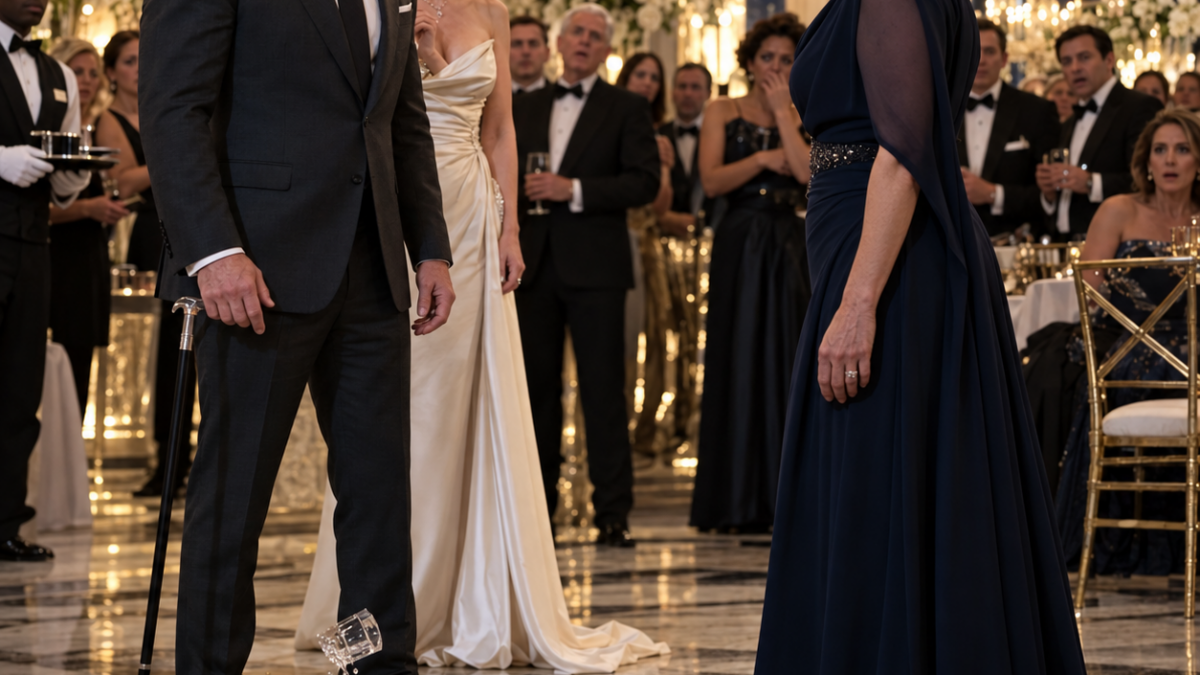
That was when the glass slipped from his hand.
It hit the marble.
Shattered.
Vanessa said his name.
Not the polished Vanessa from the stage.
The real voice underneath.
Afraid.
“Ethan.”
He didn’t turn toward her.
He spoke to me.
“Who are you?”
I nearly laughed.
Then nearly cried.
Neither happened.
“I already told you.”
His face had gone pale.
“You know that stairwell.”
“I carried you through it.”
Vanessa stepped between us.
“This is insane.”
I looked at her.
“You told him you did.”
“I did.”
“No.”
“You arrived at the hospital after I was taken away.”
Vanessa’s hands started shaking.
Small movement.
She hid them against her dress.
Ethan heard something in her breathing.
His head turned.
“Vanessa?”
She immediately softened her voice.
“This woman has spent years constructing a fantasy.”
I opened my bag.
“Then let’s look at what the fantasy left behind.”
I removed a folder.
Ethan said:
“Everyone out.”
Vanessa stared.
“What?”
He raised his voice for the first time.
“Clear the room.”
Security hesitated.
The foundation director moved.
Then staff began ushering guests toward the exits.
Nobody wanted to go.
Of course not.
Four hundred wealthy adults suddenly became schoolchildren being sent away before the interesting part.
Seven minutes later, the ballroom was nearly empty.
Not entirely.
Ethan allowed his personal aide to remain.
The hotel’s director of security stayed near the service entrance.
Gregory Marsh had been waiting in another room.
I had asked him to come because I knew documents alone would be attacked.
He had agreed reluctantly.
Not out of courage.
Out of guilt.
Before bringing Gregory in, I sat across from Ethan and Vanessa.
The three of us at one table beneath chandeliers still glowing over abandoned desserts.
Ethan touched the edge of the table.
“Start from the beginning.”
Vanessa immediately said:
“We should not indulge this.”
Ethan ignored her.
“Naomi.”
Hearing him say my name for the first time in twenty-five years almost broke whatever discipline had carried me there.
I opened the folder.
“In 1998, you had three employees.”
“Four including Vanessa.”
He nodded.
“You were trying to finance the River Street acquisition.”
Another nod.
“You couldn’t close the debt structure.”
Silence.
“I rebuilt it.”
“I remember.”
“You asked me to stay.”
“Yes.”
“You offered me equity.”
Vanessa interrupted.
“That was never finalized.”
I looked at her.
“Correct.”
Because it disappeared after the fire.
Ethan said:
“Continue.”
I described the night.
November.
Cold rain earlier.
Warehouse office.
I had stayed late because a lender packet needed to be revised.
Ethan fell asleep in his office.
Normal for him.
I smelled smoke first.
Hallway.
Electrical fire near the front offices.
I went back for him.
By the time I reached his office, smoke was already heavy.
He was disoriented.
I dragged him toward the rear stairwell.
He could barely stand.
At the second landing, he vomited.
At the bottom, part of the handrail was hot enough to burn my palm.
We reached the alley.
A newspaper photographer caught one image.
My face wasn’t visible.
But my right arm was.
Burned.
Ethan’s arm around my shoulders.
I slid the photograph across the table.
His fingers didn’t move toward it.
Of course.
I hated myself for the instinct.
His aide described it quietly.
Ethan listened.
Then I handed over hospital records.
Two patients connected to the warehouse fire.
Ethan Caldwell.
Naomi Reeves.
Different hospitals.
Same night.
Smoke exposure.
Burns.
Vanessa said:
“None of that proves she saved you.”
“No.”
I answered.
“That’s why there is more.”
I placed a statement from retired attorney Martin Kessler on the table.
Martin had worked for Caldwell’s outside counsel in 1998.
Seventy-one now.
Pancreatic cancer had rearranged his priorities.
His statement described being instructed by Vanessa, who at the time had no formal authority beyond administrative duties, to prepare emergency confidentiality and property notices concerning me.
He admitted he knew the direction was irregular.
He also admitted those notices were prepared while I was still receiving medical treatment.
Ethan’s fingers tightened against the table.
Vanessa said:
“Martin is sick.”
“He is.”
“Confused.”
“His statement was taken with his lawyer present.”
“He hates me.”
“Maybe.”
I looked at Ethan.
“Documents don’t care.”
Then the bank records.
Nine days after the fire, transfers began from a discretionary Caldwell business account into an account belonging to Vanessa’s mother.
Not millions.
Smaller amounts.
$18,000.
$25,000.
$40,000.
Over four years.
The total exceeded $600,000 once related payments were included.
Ethan’s head turned sharply.
“Which account?”
I told him.
He knew it.
Of course he did.
It had been used for confidential consulting, settlements, and early company expenses.
He asked:
“Who authorized those wires?”
I said:
“That is one of the questions I came here to ask.”
Vanessa stood.
“This is over.”
Ethan’s voice stopped her.
“Sit down.”
She stared at him.
He couldn’t see it.
I could.
Pure fury flashed through her face before she replaced it with wounded dignity.
She sat.
He said:
“In the hospital, you told me you carried me out.”
Vanessa answered:
“I did.”
“You described the back stairs.”
“Yes.”
“You said the smoke was black.”
“It was.”
He turned toward me.
Naomi.”
“Gray at first.”
I said.
“Then black near your office.”
His breathing changed.
He asked Vanessa:
“You told me the door at the bottom stuck.”
“Yes.”
“It didn’t.”
I said.
Vanessa snapped:
“You were unconscious half the time.”
I looked at her.
“He wasn’t unconscious at the bottom.”
Ethan’s head turned toward her voice.
Then something strange happened.
He asked:
“What did I say outside?”
Vanessa answered immediately.
“You asked if everyone was out.”
I closed my eyes.
I remembered.
He had said something else.
I answered:
“You asked if your briefcase made it.”
Ethan laughed once.
A broken sound.
Then covered his mouth.
“Of course I did.”
I smiled despite myself.
“Twice.”
Vanessa stood again.
“You’re taking memory fragments and pretending—”
Ethan said:
“Stop.”
Not loud.
Final.
He sat very still.
Then asked for his phone.
His aide placed it in his hand.
Ethan called someone named Daniel Pierce.
Former chief financial officer.
Retired.
He asked one question.
“Daniel, in 1998, did you ever see Naomi Reeves after the fire?”
Pause.
We heard only Ethan’s side.
“Did Vanessa instruct you not to?”
Another pause.
“Did you believe the instruction came from me?”
Longer pause.
“Thank you.”
He ended the call.
Vanessa’s face changed.
Ethan asked:
“What did he say?”
I didn’t answer.
He wasn’t asking me.
Vanessa whispered:
“Ethan.”
He repeated:
“What did he say?”
His aide answered reluctantly.
“He said Ms. Caldwell told him you wanted no further contact with Naomi.”
“And did he hear that from me?”
“No.”
Ethan turned toward Vanessa.
“You told people I ordered her cut off.”
“I was protecting you.”
“From what?”
“She was going to destroy everything.”
I finally said:
“There it is.”
Vanessa looked at me.
Her expression dropped.
No warmth.
No victimhood.
No performance.
Just contempt.
“You were going to take him from me.”
Ethan went still.
I stared.
“I wasn’t trying to take anybody.”
“You already had him.”
“We worked together.”
“You slept together.”
The room froze.
Ethan said:
“Vanessa.”
I didn’t deny it.
There was nothing to protect anymore.
For six months, Ethan and I had crossed the line between business partners and something more.
We were young.
Exhausted.
Ambitious.
Emotionally careless.
It ended before the fire because neither of us knew what we wanted.
Vanessa had known.
Apparently she had known everything.
She looked at Ethan.
“She was going to become part of the company.”
“She was going to own it.”
“She was going to become the person beside you.”
Ethan said:
“And you thought that justified what?”
Vanessa’s eyes filled.
Real tears now.
Maybe.
“I stayed.”
“When you lost your sight, I stayed.”
“I learned everything.”
“I read every report.”
“I sat through surgeries.”
“I rebuilt your schedule.”
“I gave up my career.”
“You needed me.”
Ethan whispered:
“Did you tell me she caused the fire?”
Vanessa didn’t answer.
“Did you?”
“Yes.”
My stomach turned even though I already knew.
Ethan continued.
“Did you know she pulled me out?”
Vanessa looked at me.
“Yes.”
There it was.
No dramatic music.
No police.
Just one word.
Twenty-five years.
Yes.
Ethan’s face folded in a way I had never seen.
He leaned forward.
Hands covering his mouth.
Vanessa continued because once a lie that large begins collapsing, silence becomes impossible.
“She was gone.”
“I was there.”
“You couldn’t see.”
“You couldn’t work.”
“Doctors didn’t know if your vision would stabilize.”
“Everything was falling apart.”
“I made decisions.”
I said:
“You made decisions about my life too.”
She turned on me.
“You survived.”
The sentence hit harder than Ethan’s slap.
I stood.
“So that made it acceptable?”
“No.”
“You had another career.”
“Eventually.”
“You had time.”
“After you destroyed my name.”
“I didn’t destroy you.”
“You had Caldwell attorneys send notices while I was in surgery.”
Her face tightened.
“I was scared.”
“So was I.”
“I didn’t have your money.”
“I didn’t have your access.”
“I didn’t have anyone controlling the door.”
Then Gregory Marsh entered.
The security director brought him through the service entrance.
Gregory looked older than when I’d last seen him.
Sixty-four.
Cane.
Shoulders rounded.
He wouldn’t meet Ethan’s face.
Ethan recognized his footsteps before Gregory spoke.
“Greg?”
Gregory swallowed.
“Yes.”
“Why are you here?”
“Because Naomi asked me.”
“And?”
“Because I should have come twenty years ago.”
Gregory sat.
He confirmed the intercepted communications.
He had worked in operations after the fire.
Vanessa told him all messages from me were to be routed through her office.
Letters disappeared.
Phone notes disappeared.
A courier envelope containing hospital records disappeared.
He saw one.
He did nothing.
“Why?”
Ethan asked.
Gregory looked ashamed.
“Because she said the order came from you.”
“Did you verify?”
“No.”
“Why?”
“You were blind.”
“Recovering.”
“Angry.”
“No one wanted to bring you problems.”
Ethan smiled bitterly.
“So everyone protected me from the truth.”
Gregory whispered:
“Yes.”
Then he described the money.
Not every transfer.
But enough.
Vanessa used company discretionary funds for private investigators, legal pressure, and payments to people who helped reinforce the story that Naomi had been responsible for the fire and had stolen proprietary information.
Some payments also appeared to have been diverted personally.
That was why the financial records mattered beyond the personal betrayal.
Fraud.
Potential embezzlement.
False records.
Possibly obstruction.
Those were questions for attorneys and investigators.
Not me.
Ethan asked:
“Did Vanessa start the fire?”
Gregory shook his head.
“No.”
I answered too.
“I don’t know.”
That mattered.
I had never claimed she did.
The fire marshal’s report in 1998 had listed probable electrical origin but left several questions unresolved because part of the structure was destroyed.
Vanessa didn’t need to start the fire to exploit it.
Ethan turned toward her.
“Did you?”
Vanessa stared at him.
“No.”
“Did you know anything about it before it happened?”
“No.”
I believed that answer more than most of what she’d said.
Not because I trusted her.
Because the evidence I had spent three years collecting pointed toward opportunity after the fire, not planning before it.
She hadn’t created the disaster.
She had recognized the opening it gave her.
That was terrible enough.
The ballroom stayed silent.
Then Vanessa stood.
“I need my things.”
Ethan said:
“Don’t remove company property.”
She laughed.
“You’re giving me orders now?”
“Yes.”
“You would have nothing without me.”
That was probably true in some ways.
He didn’t deny it.
He said:
“That doesn’t make what you did legal.”
She walked toward the private suite adjacent to the ballroom.
The security director followed at a respectful distance.
I looked at Ethan.
He was shaking.
I had imagined this moment for twenty-five years.
I expected satisfaction.
Instead, I felt tired.
He said:
“Naomi.”
“Yes.”
“I hit you.”
“Yes.”
“I am sorry.”
I said nothing.
He continued:
“There is no excuse.”
“No.”
He swallowed.
“I don’t know what to say.”
“Then don’t.”
The security director returned quickly.
“Mr. Caldwell.”
“Yes?”
“Mrs. Caldwell is attempting to leave with several company drives and document folders.”
Ethan stood.
“Stop her.”
The director hesitated.
“Do you authorize us to prevent removal of company property?”
“Yes.”
Vanessa’s voice came from the hall.
“You cannot hold me here.”
Nobody tried to physically imprison her.
Instead, security told her company materials could not leave until ownership was clarified.
She abandoned one bag.
Kept her purse and coat.
Then headed toward the parking garage.
Ethan followed.
So did Gregory.
I don’t know why I went.
Maybe because after twenty-five years, I needed to see the end of the evening.
Rain hammered the concrete ramp outside.
Vanessa reached her car.
Opened the rear door.
Security stayed several feet away.
One guard had begun recording because the dispute over company materials was escalating.
He announced it.
“Mrs. Caldwell, for everyone’s protection, this interaction is being recorded.”
She laughed.
“Of course.”
Then she looked at Ethan.
“You want to know everything?”
Ethan said nothing.
Vanessa began.
Not a clean confession.
Not the perfect monologue people later invented.
Fragments.
Anger.
Rationalization.
Admissions mixed with denials.
She acknowledged ordering my correspondence intercepted.
Admitted telling Ethan I’d been negligent.
Admitted using Caldwell funds to retain people who would keep me away.
Admitted presenting my rescue story as her own during the early years of their relationship.
Denied setting the fire.
Denied stealing every dollar the records suggested.
Said some payments had legitimate business purposes.
Then shouted:
“I did what I had to do because he needed someone who wasn’t going to disappear.”
I said:
“I was in the hospital.”
She turned.
“You always come back to that.”
“Because you keep pretending I chose to leave.”
Ethan said:
“Enough.”
Vanessa opened the driver’s door.
The security director told her again that certain company drives in the rear compartment were disputed property.
She reached for them.
Gregory said:
“Those contain foundation records.”
Vanessa stopped.
For the first time that night, she looked uncertain.
Someone had already called hotel police liaison and local law enforcement because of the property dispute and the admissions being recorded.
Officers arrived within minutes.
Not to drag Vanessa away because I had accused her of something from 1998.
To stabilize an active dispute involving potentially misappropriated corporate records and escalating accusations.
They separated us.
Took names.
Preserved the security recording.
Asked Vanessa not to remove contested materials pending review.
Her attorney was called.
That night did not end with a cinematic conviction.
It ended with reports.
Evidence preservation.
Lawyers.
And a story too large to remain private.
By sunrise, someone had leaked enough information that reporters were outside the Meridian.
The gala had included executives, donors, staff, hotel workers, security, and hundreds of guests.
There was no containing it.
The first headlines were awful.
MYSTERY WOMAN CONFRONTS CALDWELL WIFE AT CHARITY GALA
Then:
FORMER CALDWELL CONSULTANT ALLEGES 25-YEAR DECEPTION
Then somebody obtained footage of Ethan slapping me.
That became its own scandal.
Good.
It should have.
He did not hide from it.
By the afternoon, Ethan issued a statement through counsel.
Short.
He acknowledged striking me.
Called it unacceptable.
Confirmed an independent review of my allegations had begun.
Said he would not ask the public to reach conclusions before evidence was examined.
Then, privately, he asked to meet me.
I almost refused.
Rebecca Sloan—yes, another Rebecca in my life, my attorney in the matter—asked:
“What do you want from him?”
I said:
“Nothing.”
She stared.
“That isn’t true.”
I hated lawyers when they were correct.
“I want him to know.”
“He knows something.”
“I want him to know all of it.”
“Then meet once.”
We met the following afternoon in a smaller hotel owned by one of his companies.
No chandeliers.
No board members.
No Vanessa.
Just Ethan, his attorney, me, and Rebecca.
Ethan sat facing the window although he couldn’t see it.
When I entered, he heard my steps.
“Naomi.”
I sat.
He said:
“I am not going to ask you to forgive me.”
“Good.”
“I need to say what I know now.”
“Okay.”
His legal team had spent less than twenty-four hours checking records.
Already, several things were confirmed.
I had been treated at Charity Hospital the night of the warehouse fire.
I had burn injuries consistent with helping someone through the rear stairwell.
A first responder remembered a woman bringing Ethan out.
The old company file contained correspondence from me that had never been forwarded.
The financial transfers were real.
The private-investigator contracts existed.
The supposed evidence that I’d stolen proprietary materials was weak and possibly manufactured or exaggerated.
Ethan looked broken.
But I refused to make his pain the center.
He said:
“When I woke after the fire, Vanessa told me you caused it.”
“I know.”
“She said you panicked and left.”
“I know.”
“She said she carried me out.”
“I know.”
“I believed her.”
“Yes.”
“My vision deteriorated over the next six months.”
“I followed.”
“You followed?”
“News articles.”
He was quiet.
“I wrote you.”
“I never received them.”
“I know now.”
“I called.”
“I know.”
“I sent hospital records.”
“I know.”
He lowered his head.
Then said:
“The hardest part for me to admit is that there were years when I could have checked.”
I looked at him.
“Yes.”
“At first, I couldn’t.”
“I was barely functioning.”
“I depended on Vanessa for almost everything.”
“That explains the first months.”
“I know.”
“Not twenty-five years.”
His face tightened.
“No.”
I continued.
“You became powerful.”
“Rich.”
“You had lawyers.”
“Investigators.”
“Assistants.”
“You bought companies.”
“You evaluated thousands of pages before making deals.”
“But you never spent one afternoon checking what happened to me.”
He did not defend himself.
Good.
I said:
“That is the part I could never understand.”
He answered:
“I think there were two reasons.”
“What?”
“First, I believed her.”
“And second?”
He swallowed.
“Later, I was afraid I might have been wrong.”
That was honest.
Painfully.
“So you didn’t look.”
“No.”
“Because not knowing became easier.”
“Yes.”
I sat back.
For twenty-five years, part of me had needed Ethan to be another villain.
It made the architecture simpler.
Vanessa lied.
Ethan chose her.
Both discarded me.
Done.
Instead, reality was worse in a quieter way.
He had been deceived.
Then later, when he had enough power to verify, he had chosen emotional comfort over uncertainty.
Victim and participant.
Both.
He said:
“I loved you.”
I almost laughed.
“Don’t.”
“I don’t mean now.”
“I know what you mean.”
“Then don’t use it to soften this.”
He nodded.
“Fair.”
He asked what I wanted.
Public correction?
Financial restitution?
Legal support?
Company records?
I said:
“The years.”
He went silent.
“I want 1999 back.”
“I want 2000.”
“I want the job offers I lost when your lawyers called me unreliable.”
“I want the years I spent wondering whether I had actually done something wrong simply because enough powerful people repeated it.”
He whispered:
“I can’t give you that.”
“Exactly.”
“So don’t ask what will make us even.”
He nodded.
“We won’t be.”
“No.”
“But the record can be corrected.”
“Yes.”
“That I will do.”
And he did.
Not perfectly.
Nothing could.
But within a week, the Caldwell Group hired outside counsel and a forensic accounting firm independent of Ethan’s personal legal team.
The foundation created a separate special committee.
Ethan recused himself from any decision involving Vanessa or my restitution claim.
That mattered.
He could not be both husband, victim, executive, and judge.
Vanessa hired criminal defense counsel.
Her lawyer quickly stopped speaking publicly.
Smart.
The financial review uncovered more than I had known.
Some transfers to Vanessa’s mother had legitimate explanations.
Medical assistance.
Property expenses.
Family support.
Others didn’t.
Several payments were routed through entities controlled by Vanessa or relatives and then used for private investigators, consultants, and personal expenditures not properly disclosed to Caldwell Group accounting.
Investigators found evidence that my personnel file had been altered after the fire.
A memorandum accusing me of mishandling proprietary information had been entered with a date inconsistent with its computer creation history.
The executive whose signature appeared on it had died years earlier.
His archived calendar showed he hadn’t been in New Orleans the week the document claimed he signed it.
That was stronger than rumor.
The retired attorney’s statement became corroboration rather than the only support.
Gregory turned over old notebooks.
One entry contained my name and a handwritten instruction:
All Reeves communications to V.H.
Vanessa Hartley.
Her maiden name.
The old fire investigation was reopened for review.
Not because prosecutors suddenly believed Vanessa started the fire.
They didn’t have evidence for that.
But because information relevant to the original inquiry appeared to have been withheld or distorted.
The fire itself remained most consistent with electrical failure.
That mattered to me.
I had spent years with people implying negligence.
The updated review publicly stated there was no substantiated basis for blaming me.
That sentence did more for me than I expected.
I read it alone.
Then cried for twenty minutes.
Not because I learned something new.
Because an institution finally wrote down what I had known while nobody listened.
Vanessa’s criminal exposure focused elsewhere.
Fraud.
Misuse of corporate money.
Falsified business records.
Interference with evidence and communications.
Potential obstruction connected to later investigative efforts.
The exact charges changed as prosecutors sorted statutes, limitations periods, and which acts were recent enough or continuing enough to support prosecution.
That process took months.
Not days.
Some of the worst moral conduct was too old to prosecute directly.
That angered people.
Law does not exist to match outrage perfectly.
It shouldn’t.
Civil claims had different timelines and theories.
My attorneys pursued those.
The Caldwell Group negotiated instead of forcing me through years of litigation over every fact.
Not generosity.
Exposure.
Documentation.
And, I think, Ethan’s insistence that the company not repeat the original harm by burying me in procedure.
We reached a settlement in under four months.
The number remained confidential.
My choice.
People assumed Ethan demanded secrecy.
He didn’t.
I did.
I had spent twenty-five years watching other people turn my life into a story.
I wasn’t interested in watching the settlement amount become a headline that replaced everything else.
It was significant.
Enough to matter.
Not enough to buy twenty-five years.
No amount is.
I used part of it to establish a fellowship for women from underrepresented backgrounds entering financial services.
Independent organization.
No Caldwell branding.
No Naomi Reeves Fellowship either.
I didn’t want my name on it.
A name can become another burden people have to carry.
I wanted money to become opportunity.
That’s all.
Ethan published an open letter.
Against the advice of several communications people, apparently.
He addressed it to me.
He stated plainly that I had worked with him during the founding years.
That I had helped rescue him from the warehouse fire.
That he had accepted false information about me.
That his company had participated in excluding and discrediting me.
That he had later possessed enough resources to revisit those claims and failed to do so.
He did not blame blindness.
Good.
His physical blindness explained dependence during the beginning.
It did not excuse twenty-five years of silence.
He also acknowledged striking me at the gala.
No “heated moment.”
No “emotional exchange.”
He wrote:
I struck Naomi Reeves. It was wrong.
I appreciated that sentence.
Not forgiveness.
Accuracy.
The board reviewed Ethan too.
That surprised the public.
Some people thought exposing Vanessa automatically made him innocent.
It didn’t.
The foundation’s board examined whether he had allowed too much authority to become concentrated around his wife.
Whether controls had failed.
Whether employees had been discouraged from raising concerns.
Whether the foundation had become too identified with the Caldwell marriage.
He retained his position narrowly.
New controls were imposed.
Independent audit committee.
Conflict disclosures.
Limits on discretionary accounts.
Protected whistleblower channels outside executive leadership.
Ethan accepted everything.
One board member later told a reporter he looked relieved.
I understood.
Truth can ruin your life and still remove a weight.
Vanessa’s social world collapsed faster than her legal case.
Invitations stopped.
Boards accepted resignations.
Magazine profiles vanished.
People who once called her a close friend suddenly remembered they’d barely known her.
I did not enjoy that part.
Maybe I thought I would.
Watching wealthy people abandon someone only after scandal becomes public is not morally satisfying.
Most of them weren’t standing with me.
They were protecting themselves.
Different thing.
The parking-garage recording leaked.
Not the entire video.
Enough.
Vanessa could be heard admitting that she’d told Ethan I caused the fire.
Admitting that she redirected my communications.
Saying:
“I did what was necessary.”
Those four words became famous.
People printed them beneath photographs.
Talk shows replayed them.
I hated it.
Human lives flatten quickly once the internet chooses a quote.
Vanessa became a monster.
I became the wronged heroine.
Ethan became the blind billionaire deceived by his wife.
Clean roles.
False simplicity.
Vanessa had done terrible things.
She had also spent decades helping run a foundation that funded real programs.
Ethan had been victimized.
He had also failed me.
I had survived.
I had also spent years consumed by anger so deep it affected people who had never hurt me.
Reality doesn’t organize itself for headlines.
I declined seventeen media requests in two days.
Then hired a publicist solely to say no for me.
My statement was two sentences.
The truth had been acknowledged.
I had no further comment.
I meant it.
Sandra Hewitt changed that slightly.
Sandra had been a Caldwell Group vice president years after I left.
She gave an interview describing two occasions when she had been asked to alter records concerning the company’s early history.
She refused.
At the time, she assumed the issue was ordinary litigation sensitivity.
After my case became public, she reconsidered.
That added another witness.
Then another former employee contacted investigators.
Then another.
Not all stories supported mine.
Some contradicted pieces.
Good.
Truth should survive contradiction.
The eventual picture remained clear enough.
Vanessa had built a controlled narrative around the fire.
Used company access to isolate Ethan from me.
Redirected communications.
Misused money.
Preserved false records.
And, over years, transformed my rescue into part of her own identity inside the marriage.
Whether she initially intended to marry Ethan when the deception began was impossible to prove.
Probably she didn’t know herself.
Lies grow.
A lie told to solve one immediate problem becomes the foundation under another.
Then another.
By the time Ethan and Vanessa married four years after the fire, her version had become family history.
Their friends knew it.
Donors knew it.
Journalists repeated it.
Ethan repeated it.
That’s what frightened me most.
A falsehood repeated by enough respectable people stops feeling like something anyone needs to verify.
Vanessa eventually entered plea negotiations.
Her attorney was excellent.
He narrowed the case.
Challenged older evidence.
Attacked hearsay.
Separated legal crimes from moral misconduct.
Exactly his job.
The final agreement did not say she was guilty of stealing twenty-five years of my life.
There is no charge for that.
She pleaded guilty to fraud-related offenses involving recent financial transactions and falsified records, along with obstruction-related conduct that prosecutors could still prove within applicable legal frameworks.
Other counts were dismissed or resolved through civil actions.
She received a custodial sentence followed by supervision and substantial financial penalties and restitution obligations.
Not life.
Not some absurd thirty-year revenge sentence.
Real consequences.
When sentencing came, I had the right to speak.
I almost didn’t.
Then I went.
Vanessa sat beside her lawyer.
Less polished.
Still Vanessa.
The prosecutor summarized the provable financial and record misconduct.
My attorney spoke about professional harm.
Then I stood.
I looked at the judge.
Not Vanessa.
“For years, people have asked what she took from me.”
I paused.
“The easiest answer is my career.”
“But careers can be rebuilt.”
“I rebuilt mine.”
“Money can be repaid.”
“Reputation can sometimes be corrected.”
“What she took that cannot be returned is the right to understand my own life while I was living it.”
The courtroom was silent.
“For years, I did not know whether Ethan had chosen to abandon me, whether everyone believed I was dangerous, whether I had somehow caused the fire without remembering, whether my own understanding of that night was reliable.”
I looked toward Vanessa then.
“You didn’t just tell lies about me.”
“You made other people hand those lies back to me until I had to work not to absorb them.”
Vanessa’s eyes filled.
I didn’t know whether the tears were remorse.
Didn’t matter.
I continued.
“I don’t want revenge.”
“I want the record to stop arguing with reality.”
“That has happened.”
Then I sat.
Vanessa spoke later.
At first, I expected performance.
Some remained.
Then something shifted.
She said:
“I wanted Ethan’s trust.”
“I told one lie to get closer to him when he was vulnerable.”
“I thought I could correct it later.”
“I didn’t.”
She looked down.
“Then correcting it would’ve required losing everything the lie gave me.”
That was the most honest thing she ever said.
She continued:
“Naomi became dangerous to me because her existence proved the life I had built began with theft.”
Not literal identity theft.
Something harder to name.
A stolen place in a story.
A stolen act.
A stolen history.
She said:
“I told myself she had recovered.”
“That she had another life.”
“That what I did no longer mattered.”
Then she looked at me.
“It mattered.”
Yes.
The judge imposed sentence.
I walked out.
No reporters answered.
No celebration.
I went back to my hotel.
Ordered soup.
Called my assistant.
Asked what meetings I’d missed.
Life.
That was the part nobody understood.
After twenty-five years, justice did not feel like fireworks.
It felt like returning to ordinary obligations without carrying an argument in my head.
I went home two days later.
My apartment looked over the water.
Nothing dramatic.
Gray morning.
Boats moving slowly.
Coffee on the counter.
I sat by the window and realized I had gone nearly twenty minutes without thinking about Vanessa.
That had not happened in decades.
It scared me.
Then relieved me.
I had built so much of myself in opposition to what happened.
Anger had become structural.
Useful.
It got me through school again.
Jobs.
Promotions.
Bias.
Dismissal.
Bad interviews.
Good interviews.
Starting my own advisory firm.
Winning clients who had no idea Caldwell once blacklisted my name.
Anger helped.
But a load-bearing wall can become unnecessary and still remain because you’re afraid of what happens if you remove it.
I began learning.
Slowly.
Ethan wrote once a month for the first year.
Not emotional letters.
Updates.
What the board had done.
Which records had been corrected.
Which former contacts had received formal notices retracting false claims about me.
Which archived articles he had requested corrections to.
I appreciated that.
Action.
Not apology repeated until it became another request I had to manage.
I rarely answered.
One day he sent a copy of a 1998 photograph.
The one from the old office.
Four of us standing around a folding table.
Ethan.
Me.
Gregory.
Another analyst named Peter.
Vanessa in the background near a file cabinet.
I stared at myself.
Twenty-five.
Hair shorter.
Too-thin suit.
Arms folded.
Smiling like I had no idea how much life was about to change.
On the back, someone had written:
River Street financing closed. April 1998.
I turned it over again.
Ethan included a note.
I cannot see this photograph now. I remember it. I remembered you in it only after Gregory described where you were standing. I am sorry that memory needed someone else to restore it.
I cried.
Then put the photograph in a drawer.
Not on the wall.
I didn’t want 1998 looking at me every morning.
A year after the gala, Ethan asked to see me one more time.
I agreed.
We met in New Orleans.
His suggestion.
Mine to accept.
The old warehouse was gone.
Luxury apartments stood where it had been.
Of course.
Cities do not preserve our personal tragedies out of respect.
We stood on the sidewalk.
He with cane.
Me beside him.
No assistants within earshot.
Ethan asked:
“Where was the stairwell?”
I pointed.
Then remembered.
“You can’t—”
“I know.”
I described it.
“Back corner.”
“About twenty feet behind where the coffee shop is now.”
He nodded.
“I remember the metal steps.”
“So do I.”
We walked.
Slowly.
He said:
“I spent years thinking blindness was the worst thing that happened to me that night.”
I didn’t answer.
“Now I think losing sight may have been the part I understood.”
That was a good sentence.
Maybe too good.
I said:
“Don’t turn me into a lesson.”
He stopped.
“I won’t.”
“Don’t use what happened to become a better public version of Ethan Caldwell.”
His face tightened.
“That is fair.”
“I don’t want redemption to become another product built from me.”
“I understand.”
“Do you?”
He was quiet.
Then:
“Yes.”
We continued.
At the river, we sat on a bench.
He asked about my life.
Not what happened after him.
My life.
My company.
My employees.
My apartment.
Whether I had married.
I hadn’t.
Not because of him.
Mostly.
There had been relationships.
One long one.
Two shorter ones.
I never wanted children.
That decision belonged to me.
For years, people loved telling me trauma had “made me afraid of intimacy.”
Maybe some did.
Maybe I also simply built a life differently.
People use psychology to take decisions away from women almost as efficiently as men use contracts.
Ethan asked:
“Are you happy?”
I thought.
“Sometimes.”
He laughed softly.
“That’s probably the only honest answer.”
“You?”
“Sometimes.”
Good.
We sat there.
Then he said:
“I loved Vanessa.”
I turned.
“I know.”
“I still have feelings I don’t know what to do with.”
“I know.”
“That feels disloyal to what she did.”
“No.”
He looked toward my voice.
“Why?”
“Because emotions aren’t verdicts.”
“You can know she harmed people and still grieve the marriage.”
“You can hate what happened and miss who you thought she was.”
“That doesn’t change facts.”
He was silent.
Then:
“You’re being kinder than I deserve.”
“No.”
“I’m being accurate.”
There is a difference.
Before leaving, he said:
“I loved you too.”
This time I didn’t stop him.
I said:
“I know.”
That was enough.
We never became a couple again.
God, no.
Life is not obligated to return people to the point before harm and continue as though nothing happened.
We became something else.
Occasional correspondents.
People carrying a shared history that had finally been named correctly.
He attended one event for the fellowship I created.
Quietly.
Sat in the back.
No speech.
No donation announced.
Good.
One of the fellows asked me afterward:
“Who was the man with the cane?”
I said:
“Someone I used to work with.”
That felt wonderful.
Not billionaire.
Not lost love.
Not victim.
Not symbol.
Someone I used to work with.
Vanessa served her sentence.
I knew the date she was released because reporters called again.
I declined comment.
She moved to another state.
Never contacted me.
I was grateful.
I didn’t need a letter.
Didn’t need reconciliation.
Didn’t need to hear that prison had changed her.
Maybe it had.
Maybe not.
Her future was hers to manage.
Mine was finally mine too.
The Caldwell Foundation survived.
Barely at first.
Donors left.
Others stayed.
Governance changed.
The organization stopped using Ethan and Vanessa’s marriage as its emotional brand.
That was healthy.
Charity should not require a perfect couple at the center.
Ethan stepped back from day-to-day foundation leadership two years later.
He remained involved in the business group longer.
More oversight.
Less personal control.
People wrote profiles about his “reckoning.”
I read none of them.
Once, my assistant left one on my desk.
Headline:
THE BLINDNESS ETHAN CALDWELL COULD NOT SEE
I threw it away.
Physical blindness is not a metaphor journalists should borrow every time someone fails morally.
Ethan did not fail because he was blind.
He failed because eventually he had enough information, money, and power to ask questions and chose not to.
His blindness made the initial deception easier.
His later choices belonged to him.
He agreed.
That mattered.
Years passed.
The fellowship grew.
First class:
Six women.
Second:
Ten.
Then fourteen.
Financial modeling.
Corporate finance.
Private equity.
Infrastructure.
Risk.
Fields where people like twenty-five-year-old me often enter rooms and discover everyone has already decided what kind of work they expect from them.
We didn’t tell fellows my story unless they asked.
No inspirational mural.
No photograph of me rescuing Ethan.
No Caldwell scandal in the brochure.
The fellowship existed to fund futures.
Not memorialize my past.
One year, a fellow named Priya asked me:
“Why didn’t you put your name on it?”
I said:
“Because you’ll build enough things with other people’s names attached.”
“I wanted this one to belong to whoever is using it.”
She thought.
Then:
“That’s very dramatic.”
I laughed.
“Fine.”
“Because I hate naming committees.”
Better.
At sixty, I sold a majority stake in my advisory company to my partners.
Stayed as chair.
Worked less.
Traveled more.
My apartment still overlooked water.
Different furniture.
Same view.
One morning, a package arrived.
Inside was the final archived report from the Caldwell review.
Ethan had died.
Heart failure.
Sixty-three.
Unexpected.
His attorney had instructions to send me one item after his death.
Not money.
I wanted none.
The old photograph.
Original.
April 1998.
Ethan had kept it on his desk for years.
He couldn’t see it.
Still kept it.
There was a Braille label attached to the frame.
His aide had added it.
NAOMI — GREGORY — ETHAN — RIVER STREET
I sat by the window holding it.
Grief surprised me.
Not the grief of losing the man I might have married.
That life never existed.
The grief of losing the last person who remembered who I was before everything changed.
Gregory was gone by then too.
Cancer.
Vanessa remembered, of course.
But memory shared with someone who harmed you is different.
I cried for Ethan.
Fully.
Without shame.
Then I placed the photograph on a shelf.
Not because 1998 needed to dominate the room.
Because it no longer did.
That’s how I knew I had finally healed more than I’d understood.
I could look at the picture without being pulled inside it.
The gala became a story other people remembered more dramatically than I did.
People always mentioned the slap.
The shattered glass.
The whisper.
“New Orleans, 1998.”
Those moments made excellent retelling.
But the moment that mattered most came later.
No chandeliers.
No audience.
No Vanessa.
Just Ethan and me sitting in a quiet hotel room.
I asked:
“Why didn’t you look?”
And he answered:
“Because at different times I believed her, and later I was afraid I might discover I shouldn’t have.”
That answer gave me something evidence could not.
It gave me the shape of his failure.
Not love.
Not blindness.
Not helplessness.
Fear.
Ordinary human fear.
The fear of discovering your life rests on something false.
People imagine powerful men don’t have that fear.
They do.
Sometimes power gives them more ways to avoid facing it.
Ethan could hire investigators to evaluate a billion-dollar acquisition.
Yet for years he couldn’t bring himself to investigate the story that protected his marriage.
That is what I learned.
We don’t always avoid truth because we lack access to it.
Sometimes we avoid it because truth threatens the architecture we sleep inside.
Vanessa understood that.
She spent years making the architecture beautiful.
Foundation galas.
Magazine covers.
Charity boards.
Stories about loyalty.
Stories about rescuing Ethan.
Stories about staying when everyone else left.
She decorated the lie until questioning it felt almost cruel.
Then I entered the Meridian Grand wearing navy blue and carrying a folder.
I didn’t destroy their marriage.
I didn’t destroy the foundation.
I didn’t destroy Vanessa.
I opened a door that had been nailed shut twenty-five years earlier.
What waited behind it belonged to them.
My part ended when the record stopped calling me a liar.
That’s why I left the city after the gala.
People expected me to stay.
Press conferences.
Interviews.
Victory photographs.
I boarded a plane.
As the city disappeared beneath clouds, I felt almost nothing.
At first, that frightened me.
Shouldn’t justice feel enormous?
Shouldn’t I have cried?
Smiled?
Celebrated?
Instead, I opened a book.
Read three pages.
Then realized I hadn’t understood a word.
I started again.
This time I did.
That simple ability to focus on something unrelated to Ethan Caldwell felt more valuable than revenge ever could.
Twenty-five years is a long time to carry a story someone else wrote about you.
Long enough that even after the story is corrected, your hands still expect the weight.
Putting it down isn’t dramatic.
Nobody applauds.
You simply notice one day that your shoulders are lower.
That you slept.
That someone said Vanessa’s name and your heartbeat didn’t change.
That you can remember Ethan without arguing with him in your head.
That you can remember yourself at twenty-five without pitying her.
She survived.
She did more than survive.
She built me.
I used to think the woman I became existed because Vanessa destroyed the life I should have had.
I don’t think that anymore.
That gives Vanessa too much authorship.
She changed my route.
She did not create my destination.
I did.
The business.
The people I hired.
The fellowship.
The apartment.
The friendships.
The mornings by the water.
Those belong to me.
Entirely.
No settlement created them.
No Caldwell apology validated them.
No gala returned them.
They were mine before the truth became public.
I just needed time to understand that.
The photograph Ethan left me remains on my shelf.
Sometimes visitors ask.
“Who are they?”
I answer honestly.
“People I worked with when I was young.”
That’s all.
If they ask more, sometimes I tell them.
Sometimes I don’t.
I no longer owe anyone the dramatic version.
The truth can exist without performance.
That may be the last thing Vanessa taught me unintentionally.
For twenty-five years, she performed a story until people believed it.
I spent twenty-five years believing the only way to defeat her was to perform the truth just as loudly.
The ballroom proved otherwise.
I only needed to say enough for people to start checking.
Hospital records.
Transfers.
Old correspondence.
Witnesses.
Dates.
Fire reports.
Once reality was examined, it did not need me shouting beside it.
That is why my favorite part of the entire story isn’t what happened under the chandeliers.
It’s what happened afterward in quiet offices.
An accountant finding a transfer.
An attorney locating an old letter.
A fire investigator correcting a record.
A board member asking why controls failed.
A judge separating what could be proved from what could only be believed.
A settlement agreement acknowledging harm without pretending money solved it.
Boring processes.
Durable truth.
At fifty, I thought walking into that gala would be the bravest thing I’d ever done.
I was wrong.
The braver thing came afterward.
Leaving.
Not watching every headline.
Not letting Vanessa’s punishment become my hobby.
Not demanding Ethan spend the rest of his life proving remorse.
Not building my fellowship around my wound.
Not allowing the worst thing that happened to me to become the most interesting thing about me.
The ballroom was one night.
My life was everything after.
When I think of Ethan now, I don’t remember the slap first.
I remember New Orleans.
The old office.
April sunlight through dirty warehouse windows.
Stacks of financing papers.
Bad coffee.
A younger Ethan arguing with me about whether our projections were too conservative.
Me telling him he was reckless.
Him saying:
“That’s why I hired you.”
We were both laughing.
Vanessa was somewhere in the building.
The fire was months away.
None of us knew.
I can remember that without wishing to go back.
That’s freedom too.
Sometimes people are known only after we lose them.
Sometimes lies survive because they become more comfortable than investigation.
And sometimes truth takes decades not because it is weak, but because the people who need to hear it have built very expensive rooms designed to keep it outside.
I walked into one of those rooms.
I spoke.
The room survived.
So did I.
And when the chandeliers finally went dark and everybody else went home, the only thing I carried out of the Meridian Grand was the knowledge that the life Vanessa had stolen from my history was never the life that defined me.
She had taken a story.
She had taken years.
She had taken opportunities.
But she had never taken the woman who rebuilt after them.
That woman was mine.
She always had been.
And for the first time in twenty-five years, I didn’t need anyone else to believe it before I did.








