My Husband Played a Combat Recording to Humiliate Me—Then I Said the Next Words Before the Woman on the Radio.K
PART2:
Russell Vance started it before the salad plates were cleared.
He leaned toward Henderson and said:
“Grant’s always had the gift of understanding what the people on the ground actually need.”
Grant nodded modestly.
I concentrated on cutting lettuce.
Grant managed acquisitions for a defense contractor.
He was good at it.
I never denied that.
He understood budgets, delivery schedules, vendor performance, procurement law, and how to make a PowerPoint deck look as though every decision inside it had been obvious from the beginning.
He had never served in the military.
That hadn’t mattered to me when we met.
It shouldn’t have mattered.
Plenty of excellent people supporting defense work have never worn a uniform.
Grant was the one who had turned service into a hierarchy.
Russell glanced toward me.
“Karin did something administrative, didn’t you, honey?”
I looked up.
“I served in the Air Force.”
“Right.”
He waved one hand.
“Communications.”
Across from me, Clayton Vance stopped chewing.
Grant’s younger brother had served nine years in the Army, including two deployments.
Unlike Grant, Clayton never asked questions designed to produce a story he could repeat later.
If he wanted to know something, he asked privately.
If I didn’t answer, he let it go.
I said:
“Something like that.”
Grant smiled.
“See?”
That little smile had become familiar during the last two years of our marriage.
It meant:
I have simplified you, and you are too tired to correct me.
Henderson asked:
“What do you do now?”
“Avionics systems analysis.”
“What kind?”
I began explaining a current project involving intermittent communication failures during integrated testing.
Grant interrupted.
“Mostly quality checks.”
I looked at him.
He kept going.
“She likes the technical stuff.”
“I handle the strategic side at my firm.”
Henderson’s expression remained polite.
“Quality checks can become strategic very quickly if they fail.”
“Yes.”
I said.
“They can.”
Grant heard the correction.
His jaw tightened.
That was how small our marriage had become.
A sentence could become a challenge.
A factual answer could become disrespect.
I had spent years learning to measure the emotional weather before speaking.
I wasn’t proud of that.
But exhaustion changes people slowly enough that you don’t notice the shape you’ve taken until somebody else points it out.
Grant and I had met at a cookout eight years earlier.
I was home on leave.
He’d asked what I did in the Air Force.
I told him I worked with tactical air-control systems.
He asked intelligent questions.
Not performative ones.
We talked for almost two hours.
When I deployed again, he called.
Remembered names.
Remembered dates.
Sent care packages without turning them into social-media content.
I loved him for that.
After I separated from active duty, my work became easier to discuss.
Systems testing.
Avionics analysis.
Technical integration.
Then his curiosity changed.
At first, the jokes were harmless.
“Don’t let Karin fix the router.”
“She spent years holding a radio.”
“She knows everything about military electronics except our printer.”
People laughed.
I laughed too.
Then he began using my service to make himself look more knowledgeable.
At work dinners:
“My wife was Air Force, but I probably deal with more operational people now than she ever did.”
At neighborhood parties:
“She never really saw combat.”
At his father’s birthday:
“Karin was support.”
The first time I corrected him, we argued in the car for forty minutes.
He accused me of humiliating him in front of colleagues.
“You knew what I meant.”
“No.”
“You made it sound like I was lying.”
“You were wrong.”
“Same thing.”
Eventually I stopped correcting him in public.
Then I stopped correcting him in private.
That’s how people disappear inside relationships.
Not always through shouting.
Sometimes through editing.
You remove one sentence.
Then another.
Then another.
Until the version of you that survives is the one least likely to start an argument.
By the time our separation began, Grant was telling people I had never “really deployed.”
I had stopped asking what that meant.
That evening, though, Daniel Henderson seemed genuinely interested.
“What aircraft were you supporting?”
I opened my mouth.
Grant answered for me.
“Mostly communications platforms.”
Clayton looked up.
I saw his expression change.
He knew enough to understand that answer didn’t match what I’d told him years earlier.
I hadn’t explained everything.
But Clayton knew I’d been attached to ground units.
He knew I had a Combat Action Medal.
He knew I hated fireworks.
He knew there were certain valleys in Afghanistan I never discussed.
Grant knew those things too.
He simply chose to interpret them in whichever way made him most comfortable.
My phone buzzed beneath the table.
Elise.
Don’t initial the revised schedule unless you’re satisfied with the payment deadline. We can discuss tomorrow.
I turned the phone facedown.
Grant noticed.
“Business never stops with you.”
“It’s Elise.”
His eyes flicked toward Henderson.
Of course.
He didn’t want his boss reminded that his wife had a lawyer at dinner.
Dessert arrived.
Cheesecake.
Grant’s mother, Marianne, had taken it from a grocery-store box and placed it on crystal plates.
No criticism.
It tasted fine.
I remember that detail because trauma sometimes saves nonsense.
The pattern in the china.
The little strawberry sauce dot near my fork.
The sound of Grant tapping his phone screen.
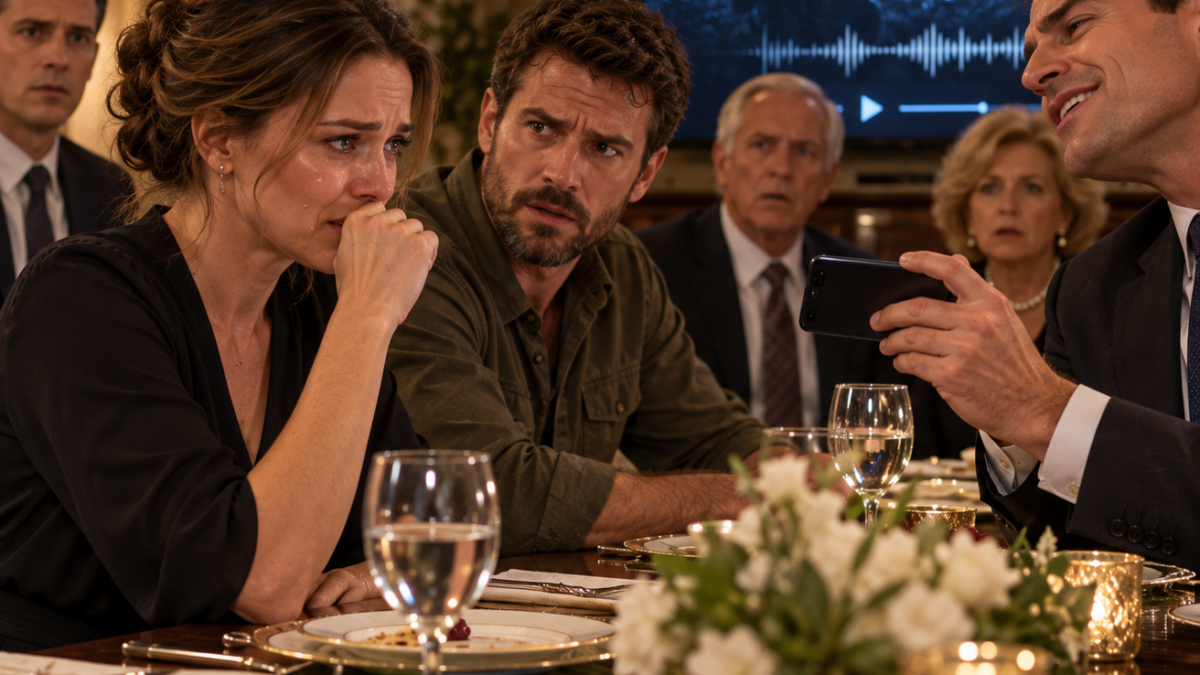
Henderson was talking to Russell about a supplier problem when Grant stood.
“I actually have something relevant.”
He crossed into the living room.
Connected his phone to the soundbar.
Clayton looked at him.
“What are you doing?”
“Training excerpt.”
“From Afghanistan.”
Grant looked toward Henderson.
“We use it in one of our internal leadership modules.”
“Communications under pressure.”
Then he looked at me.
“I thought Karin might appreciate it.”
Something in his voice warned me.
“What excerpt?”
“Korengal area.”
“2018.”
My hand stopped around my water glass.
I had been in eastern Afghanistan in 2018.
There are experiences you remember as stories.
Others you remember as sounds.
A helicopter rotor changing pitch.
A radio squelch.
Someone breathing too fast.
A man screaming for a medic.
Stone fragments falling after gunfire hits a wall.
I didn’t know which operation Grant had found.
I didn’t want to.
He smiled.
“Maybe you’ll finally hear what actual combat communications sound like.”
Nobody laughed.
Not even Russell.
Clayton’s eyes went hard.
“Grant.”
“What?”
“Don’t.”
Grant waved him off.
“This is declassified training material.”
“Relax.”
Static filled the room.
My body reacted before my mind did.
Shoulders locked.
Jaw tightened.
My left hand moved automatically toward a place on my vest that no longer existed.
Someone on the recording called a grid.
Another voice repeated friendly positions.
Then gunfire.
Close.
Stone.
The hollow crack and echo dragged the room away.
I was no longer looking at cheesecake.
I saw dust.
A wall.
A narrow piece of Afghan sky.
A soldier on the ground beside me.
Blood darkening fabric around his thigh.
Another man trying to hold pressure with both hands.
The radio pressed against my shoulder.
Someone shouting that the aircraft was coming around again.
On the recording, a controller asked for final confirmation.
Then a woman’s voice came through.
Lower than I remembered.
Calm in the artificial way people become calm when panic would kill someone.
Grant pointed toward the speaker.
“Listen to her.”
“That’s professionalism.”
“You don’t learn that sitting behind a desk.”
I didn’t realize I was speaking until I heard my own voice.
“Viper One-One, cleared hot.”
A fraction of a second later, the recording said:
“Viper One-One, cleared hot.”
Clayton’s fork stopped.
His face went pale.
He reached across the table.
Pressed pause.
The gunfire vanished.
Silence became almost physical.
Grant turned.
“What the hell?”
Clayton ignored him.
He looked at me.
Not curious.
Not impressed.
Something else.
“Karin.”
I couldn’t make myself answer.
His voice softened.
“Were you there?”
My throat felt dry.
I looked at the black speaker.
Then Grant.
His smug smile was gone.
I said:
“Yes.”
Nobody moved.
Russell blinked.
“What do you mean?”
I looked at Clayton.
“I was there.”
Clayton pushed his chair back slightly.
“You were the controller?”
“Part of the team.”
Grant laughed.
Not because anything was funny.
It was the reflex people have when reality arrives in a shape they don’t like.
“No.”
I looked at him.
He said:
“You weren’t a combat controller.”
“Correct.”
“Then what are you talking about?”
“I was TACP.”
Grant stared.
Clayton closed his eyes briefly.
There it was.
He understood.
Russell didn’t.
Henderson did.
His expression changed immediately.
Tactical Air Control Party.
Air Force personnel working with ground forces.
Some are qualified Joint Terminal Attack Controllers.
The job is not “holding a radio.”
It is integrating air support with troops on the ground.
Sometimes under fire.
Sometimes while people are wounded.
Sometimes while knowing a wrong coordinate or misunderstood transmission can kill the people you are trying to save.
Grant shook his head.
“You told me you worked communications.”
“I told you I worked with tactical air-control systems.”
“That’s not the same as what you’re implying.”
I stared at him.
“What am I implying?”
“That you were calling strikes.”
I didn’t answer.
His face changed.
“Were you?”
“Yes.”
Russell actually laughed once.
Short.
Disbelieving.
“Karin.”
“You would’ve told us.”
Clayton turned toward his father.
“No.”
Russell frowned.
“What?”
“No, Dad.”
“She wouldn’t necessarily tell you.”
Grant looked between us.
“This is insane.”
He grabbed his phone.
“It’s an anonymous training track.”
“There aren’t names.”
Henderson finally spoke.
“Where did you get it?”
Grant looked at him.
“Internal archive.”
“Which module?”
“Operational Communications Under Stress.”
Henderson’s voice stayed calm.
“Grant.”
“Where exactly?”
“Training library.”
“I said where.”
Grant’s confidence cracked slightly.
“One of Marcus’s teams.”
“Legacy material.”
Henderson reached for the phone.
“May I?”
Grant hesitated.
Then handed it over.
Henderson opened the file information.
Scrolled.
His eyes narrowed.
“What?”
Grant asked.
Henderson didn’t answer immediately.
Then:
“This isn’t just a generic training clip.”
He turned the screen slightly away from me.
Probably trying to preserve whatever identifying information was listed.
“It’s a case-study extract.”
Grant said:
“That’s what I told you.”
“No.”
“You said approved training excerpt.”
“It is.”
Henderson looked at him.
“You downloaded this from a restricted internal training repository onto your personal phone?”
Grant’s face tightened.
“It’s not classified.”
“That wasn’t my question.”
Nobody spoke.
Grant had spent the evening trying to prove he understood military professionalism.
Now his boss was asking why company-controlled training material was sitting on his personal device.
Grant immediately shifted.
“I was using it for work.”
“At your parents’ house?”
“It helps demonstrate—”
“To humiliate your wife?”
Grant looked toward me.
“I wasn’t humiliating her.”
Clayton laughed.
A cold sound.
“That’s exactly what you were doing.”
Marianne whispered:
“Clayton.”
“No, Mom.”
He stood.
“What did you think this was?”
“Grant literally said she needed to learn what real combat sounded like.”
Grant snapped:
“She let everybody believe she had some huge combat background.”
I stared at him.
“I did the opposite.”
“You never told me this.”
“Yes, I did.”
“When?”
“The first year we dated.”
“No.”
“I told you what TACP stood for.”
“I explained JTAC qualification.”
“I told you I deployed with an Army ground unit.”
“You said you did communications.”
“I said radios were part of the job.”
“You decided that was the whole job.”
He looked almost angry at me for remembering.
I continued.
“You came to my separation ceremony.”
“You sat beside my mother.”
“You heard my commander read the citation.”
Grant shook his head.
“They always make those things sound dramatic.”
Something inside me settled.
Not broke.
Settled.
For years, I’d thought our arguments came from misunderstanding.
Bad communication.
Different personalities.
His insecurity.
My withdrawal.
But sitting there, I finally understood something simpler.
Grant had heard me.
He just preferred the version that made him feel taller.
Clayton pushed away from the table.
“Jesus Christ, Grant.”
“What?”
“You knew she had a Combat Action Medal.”
Grant snapped:
“Lots of people get medals.”
Clayton stared at him.
“You don’t know enough to say that.”
“And neither do you.”
“I served.”
“So?”
Clayton’s chair scraped backward.
Russell said:
“Enough.”
That old family command.
Enough.
Meaning:
Stop making Grant uncomfortable.
I had heard it before.
Clayton ignored him.
“Karin, was this the mission where you got the medal?”
I looked at the paused audio file.
“Yes.”
Nobody spoke.
Then Henderson said:
“I think we should stop playing the recording.”
“Agreed.”
I said.
Grant reached for the phone.
Henderson kept it for another second.
“I’m going to email myself the file metadata.”
Grant’s head snapped up.
“Why?”
“Because this is company material on a personal device.”
“I’ll delete it.”
“No.”
Henderson’s tone sharpened.
“Do not delete anything.”
That was the first moment Grant looked afraid.
Not ashamed.
Afraid.
The difference mattered.
He wasn’t thinking about what he’d done to me.
He was thinking about his promotion.
“Daniel, come on.”
Henderson handed the phone back.
“We’ll discuss it Monday.”
“This is ridiculous.”
“Monday.”
Grant looked at his father.
Russell looked lost.
Marianne looked like she wanted the table to swallow her.
I wanted to leave.
Then Grant said:
“Fine.”
He picked up the settlement papers.
“If we’re turning this into a courtroom, let’s finish the actual reason we’re here.”
He pushed the revised schedule toward me.
“Initial the payment date.”
I stared at the paper.
Astonished.
Not because he asked.
Because even after everything, he thought he could snap the evening back into the shape he wanted.
Henderson was still at the table.
Clayton still standing.
His mother crying quietly.
The recording still paused on the screen.
And Grant was pointing at a signature line.
“I’m not initialing it.”
His jaw tightened.
“We agreed.”
“No.”
“You agreed I keep the house.”
“I agreed if you pay my equity under the terms our attorneys negotiated.”
“This is six months.”
“Yes.”
“I need six months.”
“Then your lawyer can explain why tomorrow.”
He leaned toward me.
“You brought Elise into everything.”
I looked at him.
“We’re divorcing.”
“Yes.”
“I have a lawyer.”
The absurdity of having to explain that nearly made me laugh.
He lowered his voice.
“This is what you do.”
“What?”
“Turn everything into a technicality.”
I looked toward Henderson.
Then the phone.
Then the settlement schedule.
“No.”
“I think that’s what you do.”
I put the documents into my folder.
Closed it.
Grant’s face flushed.
“You can’t just leave.”
“I can.”
“Dinner isn’t over.”
“Our marriage is.”
That sounded dramatic.
I wish I could claim I had planned it.
I hadn’t.
The words simply arrived.
I stood.
Marianne said:
“Karin.”
I looked at her.
She seemed genuinely distressed.
For me.
For Grant.
For the family story collapsing.
I couldn’t tell.
“I’m sorry.”
She whispered.
I nodded.
“Good night, Marianne.”
Russell didn’t speak.
Clayton followed me to the front door.
Outside, the October air smelled like wet leaves and salt from the bay.
I reached my car.
My hands started shaking before I could unlock it.
Not mildly.
Hard.
The kind that comes after your body has spent twenty minutes pretending it isn’t frightened.
Clayton stopped several feet away.
“Karin.”
“I’m fine.”
“No.”
“I am.”
He looked at my hands.
I hated that.
Not him.
Being seen.
“I shouldn’t have asked in front of everyone.”
“You didn’t know.”
“I should’ve stopped him sooner.”
“You tried.”
He looked toward the house.
“Did Grant really know?”
I breathed in.
“Yes.”
“All of it?”
“Enough.”
“Maybe not the exact mission.”
“Not every detail.”
“But the job?”
“Yes.”
“JTAC?”
“Yes.”
He rubbed his face.
“I don’t understand.”
“I do.”
He waited.
I said:
“He didn’t want it to be true.”
Clayton looked toward the dining-room window.
Then:
“Was that your voice?”
“Yes.”
He nodded slowly.
“I thought so.”
“How?”
“Cadence.”
“What?”
“Certain people sound different on a radio.”
“Heard enough controllers.”
Then:
“And you knew the transmission before it played.”
I leaned against my car.
The shaking eased slightly.
Clayton asked:
“Were people hurt?”
“Yes.”
He stopped.
“Okay.”
That was all.
No:
How many?
Did you kill anyone?
What happened?
Tell me everything.
Just:
Okay.
That was why I trusted him.
I drove back to my rental cottage on the Chesapeake Bay.
Elise called before I reached home.
Apparently Grant had already texted his attorney.
I parked facing the water.
Answered.
“What happened?”
“How much time do you have?”
“Enough.”
I told her.
Not the mission details.
The dinner.
Recording.
Company file.
Settlement pressure.
Elise listened.
Then asked:
“Did you sign anything?”
“No.”
“Good.”
“Grant says you’re refusing terms you already accepted.”
“I didn’t accept the six-month delay.”
“I know.”
“I have the email history.”
“Then don’t engage tonight.”
“He’ll push.”
“Let him.”
“Tomorrow I will contact his counsel.”
“From now on, no settlement discussions in family homes.”
“Agreed.”
She paused.
Then:
“Karin?”
“Yes?”
“Are you okay?”
That question almost did what the recording hadn’t.
I looked through the windshield at black water.
Lights from houses across the inlet.
“I will be.”
I slept badly.
At 2:17 a.m., I woke with my heart racing because I thought I’d heard the radio again.
There was no radio.
Only a refrigerator compressor.
Wind.
A buoy bell far offshore.
I sat on the edge of the bed until the room returned.
I hadn’t had a reaction that strong in years.
Not because I had forgotten Afghanistan.
You don’t.
But I had built structures around the memories.
Therapy.
Routine.
Distance.
Control.
Grant had taken something I had never offered him and played it through a living-room speaker for his boss.
That’s what made me furious the next morning.
Not that he didn’t know.
That he had used war as entertainment.
Even before realizing I was on the recording, he had treated somebody else’s worst day like a prop.
That woman on the radio could have been a stranger.
It still would have been wrong.
At nine, Clayton texted.
Can I call?
I said yes.
He called immediately.
“I found something.”
“What?”
“Dad.”
That wasn’t helpful.
“What about Russell?”
“He remembered your separation ceremony.”
I closed my eyes.
“Okay.”
“He has the program.”
Of course Marianne had saved it.
Families save paper from ceremonies they don’t understand.
Clayton read:
“Technical Sergeant Karin Mercer.”
My maiden name.
“Seventeenth Air Support Operations Squadron.”
“Qualified Joint Terminal Attack Controller.”
He stopped.
Then:
“Grant’s name is on the guest list.”
I didn’t say anything.
“He knew.”
“Yes.”
“I’m sorry.”
“You didn’t do it.”
“I defended him.”
“When?”
“Over the years.”
I leaned back against my kitchen counter.
Clayton continued.
“Not to you.”
“To myself.”
“When he’d joke.”
“I thought maybe I misunderstood what you did.”
“Because if your husband says it…”
He stopped.
“I should have asked.”
“You did.”
“Eventually.”
“That’s enough.”
Then he said:
“Henderson called me.”
That surprised me.
“Why?”
“He wanted to know whether I had any reason to believe Grant intentionally misrepresented your service to company people.”
My stomach tightened.
“What did you say?”
“The truth.”
“That Grant makes jokes.”
“That he calls you support.”
“That he said you never really deployed.”
I closed my eyes.
“Clayton.”
“He asked.”
“I answered.”
“I’m not trying to get Grant fired.”
“I know.”
“Neither am I.”
“This isn’t about you getting him fired.”
“It’s about what he says at work.”
That distinction mattered.
Grant worked for a defense company.
His colleagues included veterans.
Former service members.
Engineers.
Contract specialists.
Program managers.
He had spent years borrowing credibility by implying proximity to military experience.
If he had misrepresented my background to improve his own image, that was his problem.
Not mine.
Still, I didn’t want revenge.
Revenge is expensive.
I wanted the divorce finished.
By Monday, the story had already changed inside Grant’s family.
Russell called me.
I didn’t answer.
He left voicemail.
“Karin, we didn’t understand.”
“We thought you were in communications support.”
“Grant said—”
I deleted it there.
Not because Russell didn’t deserve to speak.
Because I knew the sentence.
Grant said.
That had been the family’s organizing principle for years.
Grant said Karin was sensitive.
Grant said Karin’s deployments weren’t serious.
Grant said Karin didn’t want children.
Grant said Karin was obsessed with work.
Grant said Karin caused the separation.
I had spent too long trying to correct a narrator who owned the room.
I stopped.
Monday afternoon, Henderson called.
I almost didn’t answer.
Then I did.
“Ms. Vance?”
“Karin is fine.”
“This is Daniel Henderson.”
“I know.”
“I wanted to apologize for Friday.”
“You didn’t play it.”
“No.”
“But I stayed at the table.”
I appreciated that.
He continued.
“I also want to clarify something.”
“The recording was approved for internal training use.”
“However, employees are not authorized to download that category of material onto personal devices for nonbusiness presentation.”
“Understood.”
“We’re handling that internally.”
“I don’t need details.”
“Good.”
“Because I can’t provide them.”
Then:
“One more thing.”
“What?”
“Your voice is not identified in the training module available to our managers.”
I felt something loosen.
“Thank you.”
“I wanted you to know we didn’t knowingly distribute your identity.”
“Okay.”
“The source material was obtained through an authorized government training package several years ago.”
“There are redactions.”
“The lesson focuses on communications discipline.”
I looked out at the bay.
“Grant thought it was funny.”
“No.”
Henderson corrected gently.
“He thought it made him look knowledgeable.”
That was more accurate.
Then:
“I also want you to know none of this changes the substance of your divorce.”
“I would hope not.”
“It shouldn’t.”
“But because Grant brought company material into a personal dispute, I’m making sure you’re not contacted by anyone from our office about your service.”
“Thank you.”
He paused.
Then:
“For what it’s worth, what I heard Friday was disciplined work.”
I didn’t know how to answer.
So I said:
“We had people who needed to get home.”
“That tends to focus you.”
He understood.
“Take care, Karin.”
“You too.”
Grant called immediately after.
I let it go to voicemail.
He called again.
Then texted.
We need to talk.
I replied:
Through counsel regarding the divorce.
Three dots.
Then:
You’re seriously going to ruin my career over this?
I stared at the message.
There it was.
Not:
I’m sorry I played that.
Not:
I didn’t realize.
Not:
Are you okay?
His career.
I sent one answer.
I have not contacted your employer. You brought your employer to dinner.
Then blocked him for the night.
Elise loved that sentence more than she should have.
“Do not send anything else.”
“I won’t.”
“Seriously.”
“I won’t.”
“Because that was excellent and you should retire undefeated.”
I laughed for the first time in days.
The settlement negotiation changed afterward.
Not because Henderson intervened.
He didn’t.
Not because Grant suddenly became generous.
He didn’t.
Because Grant wanted the divorce closed quickly.
His attorney sent a revised draft.
Original equity-payment deadline restored.
No six-month delay.
Retirement account divided according to the previously agreed formula.
House refinanced within the agreed period or listed for sale.
Mutual personal-property schedule.
Standard release language.
No demand that I waive unrelated claims about the dinner.
Elise reviewed everything.
Then asked:
“Are you comfortable?”
“Yes.”
“Don’t answer because you’re tired.”
I smiled.
“I know.”
“I’m comfortable.”
We signed at our attorneys’ offices.
Separately.
The civilized way, apparently.
The divorce became final three months later.
People imagine the court hearing after a dramatic marriage must be dramatic too.
It wasn’t.
Judge asked questions.
We answered.
Dates.
Residency.
Irretrievable breakdown.
Property settlement.
No children.
No reconciliation expected.
Then the judge signed.
Grant left through one door.
I left through another.
Cold January sunlight outside.
Nothing exploded.
That’s what endings usually look like.
Administrative.
Quiet.
You walk to your car.
Your life is different.
Traffic continues.
Grant did not lose his job.
I want that clear.
The internal review did affect him.
Henderson later told Clayton, who eventually told me, that Grant received formal discipline for inappropriate handling of company training material and for judgment issues surrounding the incident.
The promotion he had expected that year went to someone else.
Was that because of me?
No.
It was because Grant played controlled company material at his parents’ dinner while insulting the military service of his wife in front of his regional director.
Actions do not become somebody else’s revenge merely because consequences arrive afterward.
Grant stayed with the company.
He recovered professionally, from what I heard.
Probably learned to keep his personal phone out of training repositories.
Good.
I didn’t need him destroyed.
I needed him unable to use me as a ladder.
Clayton and I stayed in contact.
Not constantly.
Birthdays.
Occasional coffee.
When Russell’s health declined, Clayton called.
I visited once.
That surprised both of us.
Russell looked smaller in a hospital bed.
Age does that to powerful fathers.
He apologized.
Not elegantly.
He said:
“I should’ve asked you myself.”
“Yes.”
“I believed Grant.”
“I know.”
“I thought you were exaggerating.”
“I know.”
He stared at his blanket.
“Why didn’t you ever say more?”
That question could have made me angry.
Instead, I answered honestly.
“I tried.”
He looked up.
I continued.
“Every time I did, somebody told me not to embarrass Grant.”
Russell closed his eyes.
That was enough.
Marianne sent me a box after the divorce.
Inside:
Photographs.
Wedding album.
A few Christmas ornaments.
My separation-ceremony program.
The original.
My name.
Unit.
Qualification.
Citation summary.
Grant’s signature in the guest book.
I sat on my cottage floor reading it.
At first I felt vindicated.
Then sad.
Because proof wasn’t the problem.
It had never been the problem.
Grant didn’t need another document.
He had attended.
He had listened.
He had known enough.
Belittling me wasn’t caused by ignorance.
It served him.
That’s harder to repair.
You can teach someone facts.
You cannot teach them to want your reality to be true.
That insight saved me from a lot of unnecessary conversations.
After the divorce, I reverted to my maiden name.
Karin Mercer.
People assumed it was symbolic.
Partly.
Mostly, I was tired of spelling Vance on forms.
Mercer felt like mine.
I also returned to therapy for a while.
The combat recording had reopened things I thought I’d packed away.
My therapist, Dr. Leila Shaw, said:
“You didn’t fail because your body reacted.”
“I know.”
“Do you?”
“Intellectually.”
She smiled.
“Your intellect is overrepresented in this room.”
Fair.
We talked about the Korengal mission.
Not every detail.
Enough.
I had been twenty-six.
Attached to an Army element operating in difficult terrain.
Our patrol took fire from elevated positions.
One soldier suffered severe bleeding.
Communication degraded.
Air support was available but terrain, friendlies, and rapidly changing positions made everything complicated.
There was nothing cinematic about it.
Dust clogged my mouth.
My gloves were wet.
My radio cable kept catching.
Somebody vomited nearby.
I was scared.
That’s the part Grant’s training recording didn’t capture.
His lesson was about composure.
People hear a calm voice and imagine courage feels calm.
It doesn’t.
Sometimes composure is simply what fear sounds like after you’ve given it a job.
I knew the procedure.
So I followed the procedure.
The aircraft crew knew theirs.
Ground leaders knew theirs.
Medics did theirs.
Nobody was performing bravery.
We were working.
That’s why Grant’s statement had hurt so much.
“You don’t learn that behind a desk.”
As if the woman on the radio was some mythic creature.
As if he needed her to diminish me.
Then it turned out the woman was me.
But the real correction wasn’t:
Surprise, Karin was heroic.
I wasn’t.
The correction was:
You never needed to know whether I’d been in combat before treating my service with respect.
A person shouldn’t need a dramatic revelation to deserve dignity.
I wish I’d understood that during the marriage.
I kept thinking if Grant knew enough, he’d stop.
If I explained carefully.
Showed records.
Corrected the terminology.
Eventually he would respect me correctly.
That gave him far too much authority.
Respect should not require cross-examination.
Months after the divorce, I attended an Air Force reunion in San Antonio.
I almost didn’t go.
Old friends.
Old uniforms in photographs.
Too much history.
Clayton encouraged me.
“Go.”
“You don’t even know them.”
“No.”
“But I know you’re about to invent a reason not to.”
Annoying.
Accurate.
I went.
At the hotel bar, I saw Maya Torres.
Former staff sergeant.
We had deployed together.
She hugged me so hard my back popped.
“You look expensive.”
“What does that mean?”
“Divorced.”
I laughed.
She knew.
Military gossip travels through physics we haven’t discovered.
Later, several of us sat around a table.
Nobody asked who had done the most dangerous job.
Nobody compared trauma.
We argued about food.
Bad supervisors.
Who cheated during physical training.
Whether one particular lieutenant had ever learned to read a map.
At some point, Maya said:
“You remember Viper One-One?”
My stomach tightened.
Then I nodded.
She looked at me carefully.
“You okay?”
“Yes.”
“That audio still floating around training?”
“Apparently.”
She groaned.
“I sound like a dying raccoon on that thing.”
I stared.
“You’re on it?”
“Background.”
“I’m yelling for someone to move a litter.”
I started laughing.
Hard.
For years, the recording had lived in my head as a sealed artifact.
Heavy.
Sacred.
Then Maya called herself a dying raccoon.
Something broke loose.
She laughed too.
“What?”
“My ex played that recording to humiliate me.”
Maya stopped.
Then:
“He did what?”
I told the story.
By the end, she was holding both hands over her face.
“He played your own CAS call?”
“Yes.”
“While explaining you didn’t know combat?”
“Yes.”
“In front of his boss?”
“Yes.”
She stared at me.
“I have never met this man, and somehow I am embarrassed for his ancestors.”
I nearly fell out of my chair.
That night helped more than I expected.
Trauma hates ordinary company.
It wants every memory isolated.
Special.
Untouchable.
Sitting with people who had been there made the event become part of a life again.
Not the definition of it.
Maya reminded me that after the patrol we had eaten terrible noodles.
Someone had lost one boot.
A helicopter crew chief had given us bottled water.
I had laughed at something stupid that same night.
The recording contained gunfire.
The memory contained people.
Grant had known only the dramatic part.
So had I, for a while.
I began speaking a little more openly after that.
Not about classified details.
Not about other people’s experiences.
Just enough to stop hiding from my own biography.
At work, when someone asked what I did before avionics analysis, I stopped saying:
“Military communications.”
I said:
“I was Air Force TACP and JTAC-qualified.”
Most people said:
“Oh.”
Then asked normal questions.
Some knew the job.
Some didn’t.
Nobody collapsed.
No one accused me of bragging.
I’d spent years editing myself for a man who wasn’t in the room anymore.
It took time to notice the habit remained after he left.
One afternoon, Daniel Henderson emailed.
Almost a year had passed.
We had not spoken since his apology call.
Subject:
Professional question
He wrote that his company was reviewing a training module about communication-system degradation and wanted an external systems analyst who understood both tactical radio use and avionics integration.
No expectation.
No connection to Grant.
Would I be willing to speak with the program team?
I stared at the email.
My first instinct:
No.
Too messy.
Then I read it again.
This wasn’t an offer because of the dinner.
It was directly related to my current expertise.
I called Elise even though she was a divorce attorney and had no reason to care.
She said:
“Why are you asking me?”
“I don’t know.”
“Are you afraid this somehow affects Grant?”
“Yes.”
“Are you married to Grant?”
“No.”
“Then I have completed my legal analysis.”
I laughed.
“Very expensive advice.”
“I’ll bill you.”
I accepted the meeting.
Not the job.
Just the meeting.
Henderson wasn’t present.
Good choice.
Three engineers.
One program manager.
Two former service members.
We talked for ninety minutes.
Communication failure modes.
Equipment design.
Human factors.
What happens when a technically correct system encounters terrain, stress, overlapping transmissions, damaged antennas, and exhausted users.
For once, the two halves of my career didn’t compete.
They connected.
We worked out a short consulting engagement.
Then another.
Grant and I never crossed paths.
The company was large.
My work went through a separate technical group.
I later accepted a permanent senior systems role at another company, partly because the consulting reminded me I was ready for something new.
None of that was revenge.
It wasn’t:
Grant mocked my career, so I took his industry.
That would give him too much narrative importance.
I simply stopped refusing opportunities because he might have feelings about them.
That was freedom.
I bought a small house near the bay two years after the divorce.
Not the old marital house.
Grant kept that after refinancing.
My house was smaller.
White siding.
Blue shutters.
Deck facing a narrow inlet.
The first night there, I slept on a mattress on the floor because my furniture delivery was delayed.
Rain tapped the windows.
I thought about Afghanistan.
Then the dinner.
Then the court.
Then nothing for a while.
Silence.
Good silence.
I realized I hadn’t missed Grant in months.
That surprised me.
Not because I hated him.
I didn’t.
I had simply stopped organizing my days around the absence of our marriage.
Healing sometimes announces itself through what you fail to notice.
Clayton visited once.
Brought beer.
Helped assemble a bookcase badly.
We sat on the deck.
He asked:
“Do you ever wish you’d told him everything?”
“About deployment?”
“Yeah.”
I thought.
“No.”
“Why?”
“He knew enough.”
Clayton nodded.
Then:
“I used to think Grant was jealous of me because I served.”
“Maybe.”
“I think he was jealous of anyone who had an experience he couldn’t own.”
That sounded right.
Grant had always wanted to be the interpreter.
The person who explained the military to civilians.
Business to soldiers.
Strategy to technicians.
Me to his family.
If he didn’t understand something, he simplified it until he did.
My mistake was allowing simplification to become erasure.
Clayton said:
“Dad still feels guilty.”
“He doesn’t have to.”
“He believed Grant.”
“Everybody did.”
“Not everybody.”
I looked at him.
“You questioned it.”
“Too late.”
“Still counts.”
We sat quietly.
Then he said:
“You know the part that bothers me?”
“What?”
“The recording.”
“What about it?”
“He had no idea who that woman was.”
“No.”
“He still used her to humiliate you.”
Exactly.
That was the part I had come to understand too.
If the voice had belonged to a stranger, Grant’s behavior would still have been ugly.
He had taken someone else’s fear, professionalism, and worst minutes and used them as a measuring stick against his wife.
The dramatic coincidence exposed him.
It didn’t create the problem.
That distinction kept the story from becoming a joke in my mind.
And people did joke.
Eventually.
Friends heard.
Maya told people.
Someone at the reunion called it “the world’s worst PowerPoint decision, but with audio.”
I could laugh.
But I didn’t want the lesson reduced to:
Never play combat audio because your wife might secretly be on it.
No.
Never use another person’s trauma as a prop.
Never build your identity by shrinking somebody else’s.
And if your spouse tells you what they lived through, don’t spend years rewriting it because the truth makes you feel ordinary.
Ordinary isn’t an insult.
Grant had been good at his job.
Smart.
Successful.
He never needed my service to be small.
That’s the tragedy.
He could have been proud of me without becoming less himself.
Instead, he treated respect like a limited resource.
If I had courage, he had less.
If my work mattered, his mattered less.
If I knew something, he had to know more.
Marriage cannot survive that arithmetic.
Three years after the divorce, I ran into Grant at Norfolk International Airport.
I was heading to Denver for a systems conference.
He was waiting near a coffee shop.
Older.
Slightly heavier.
Same expensive watch.
We saw each other at the same moment.
Neither could pretend otherwise.
“Karin.”
“Grant.”
He looked at my badge.
My work conference logo.
“Still doing avionics?”
“Yes.”
“You?”
“Same company.”
“Good.”
Silence.
Then:
“I heard you’re doing well.”
“I am.”
He nodded.
“I owe you an apology.”
I hadn’t expected that.
Not after three years.
I said nothing.
He continued.
“For the dinner.”
“Yes.”
“I was showing off.”
“Yes.”
“I had Henderson there.”
“I wanted him to think I understood military operations better than I did.”
“That was part of it.”
I waited.
He looked toward the gate.
Then back.
“I also knew what you did.”
That surprised me less than he expected.
“I know.”
“No.”
“I mean…”
He swallowed.
“I knew more than I admitted.”
“I remembered the ceremony.”
“The TACP thing.”
“I looked it up when we were dating.”
“I knew it wasn’t just communications.”
I looked at him.
People imagine confirmation feels satisfying.
It doesn’t always.
Sometimes it simply removes the last comforting possibility.
Ignorance.
Misunderstanding.
He continued.
“I think I started joking because people were impressed by you.”
“At first I was too.”
“Then I hated how it made me feel.”
“What did it make you feel?”
“Unimportant.”
There it was.
Not evil.
Not mysterious.
Small.
I said:
“You could have told me that.”
“I know.”
“I probably would’ve understood.”
“I know.”
“Instead you made me smaller.”
“Yes.”
He looked genuinely ashamed.
“I’m sorry.”
I believed him.
That didn’t mean we should have stayed married.
Apology is not a time machine.
I said:
“Thank you.”
He looked almost relieved.
Then:
“Do you hate me?”
I thought.
“No.”
He seemed surprised.
“I don’t really think about you enough to hate you.”
That sounded cruel after I said it.
But it was true.
Grant nodded.
“Fair.”
His flight began boarding.
He picked up his bag.
Then stopped.
“Was the recording really you?”
I almost laughed.
“Grant.”
“I know.”
“I just…”
“Yes.”
I said.
“It was me.”
He nodded.
This time, he didn’t ask for details.
“Take care, Karin.”
“You too.”
He walked toward his gate.
I bought coffee.
Went to mine.
That was the last conversation we’ve had.
I heard later he remarried.
I hope he learned.
Sincerely.
People want me to say I hope his second marriage fails.
I don’t.
Another woman’s unhappiness wouldn’t improve my past.
I hope he learned how to let another person be impressive without feeling diminished.
I hope he learned curiosity without ownership.
I hope he never brings combat audio to dinner again.
Low bar.
Still.
My own life became quieter.
Better.
Not perfect.
I had relationships after Grant.
One ended.
One didn’t become serious.
Eventually I met Aaron Pierce.
Marine Corps veteran turned physical therapist.
I almost didn’t date another veteran.
Too much shared vocabulary.
Too many chances for comparison.
Aaron surprised me.
On our third date, he asked what I had done in the Air Force.
I said:
“TACP.”
He nodded.
“That sounds exhausting.”
Then changed subjects.
I laughed.
“What?”
“Nothing.”
“No.”
“You laughed.”
“Most people ask ten questions.”
“I can if you want.”
“No.”
“Then we’re good.”
Months later, after we were serious, I told him about the dinner.
He stared for a while.
Then:
“Your ex played your own strike-control audio at dinner?”
“Yes.”
“To explain combat to you?”
“Yes.”
“Did he also teach fish about water?”
I laughed so hard I cried.
Aaron waited.
Then realized I actually was crying.
He moved closer.
“Hey.”
“I’m okay.”
“I know.”
He didn’t say:
You’re safe now.
People mean well when they say that.
I never liked it.
Safety isn’t a magic phrase.
He simply sat.
That was enough.
Years later, the recording stopped having the power Grant accidentally gave it.
I heard part of it once during a legitimate training review.
I had been asked to evaluate how communications equipment captured overlapping transmissions under terrain masking.
The analyst played a short segment.
I recognized my voice immediately.
My heart sped up.
But I stayed.
Not to prove anything.
Because I wanted to.
I listened differently.
Heard technical things.
Signal degradation.
Compression artifacts.
Transmission overlap.
Clipped syllables.
The analyst paused.
“You okay?”
He knew my background but not that specific connection.
“Yes.”
Then I said:
“Go back four seconds.”
He did.
I pointed at the waveform.
“The problem isn’t the operator.”
“It’s the audio gate.”
He stared.
Then replayed.
“You’re right.”
That moment meant more than I expected.
For years, the recording belonged to memory.
Then Grant turned it into humiliation.
Now it was data.
Not only data.
Never only data.
But something I could examine without being dragged backward.
I went home that evening.
Aaron was cooking.
Badly.
Smoke alarm had already chirped once.
He said:
“How was work?”
“Interesting.”
“What happened?”
“I heard the recording.”
He stopped stirring.
“The one?”
“Yes.”
“You okay?”
“Yes.”
He waited.
Then:
“Anything else?”
“The audio gate was wrong.”
He stared.
Then laughed.
“Of course that’s what you took from it.”
I laughed too.
That’s healing.
Not forgetting.
Reclaiming function.
People still occasionally ask whether I regret not telling Grant more during the marriage.
No.
I regret shrinking myself.
Different thing.
I didn’t owe him every operational detail.
Some memories involved other people.
Some events were classified at the time.
Some things were simply mine.
Privacy is not dishonesty.
But I did owe myself the right to say:
No.
That isn’t what I did.
No.
Don’t make that joke.
No.
You don’t get to explain my career for me.
No.
I am not initialing a settlement term I didn’t agree to.
Those were the sentences I lost.
The divorce gave them back.
My separation records remain in the same leather folder I brought to dinner.
I never needed to show them that night.
Interesting.
Grant had spent years treating documentation like something I invented after the fact.
But the proof was always there.
The citation.
AFSC history.
Training.
Deployments.
Medals.
None of it mattered until the person listening was willing to believe it.
That’s why Clayton pressing pause mattered more to me than the recording itself.
He didn’t say:
Prove it.
He asked:
Were you there?
A question.
Not an accusation.
Room for an answer.
That is respect.
I once told him that.
He laughed.
“All I did was press pause.”
“Yes.”
“That’s the point.”
Sometimes the kindest thing in a room is the person willing to stop the noise long enough to ask what is true.
Grant kept turning the volume up.
Clayton stopped it.
I think about that whenever I’m in a meeting now and someone talks over a junior engineer.
I’ll interrupt.
“Let her finish.”
Simple.
Maybe I’m overcorrecting.
I don’t care.
People disappear in rooms long before they disappear from organizations.
Let them finish.
My work now involves younger analysts.
Some veterans.
Some civilians.
Nobody gets extra credibility merely because they’ve deployed.
Nobody gets less because they haven’t.
Operational experience matters when relevant.
Technical expertise matters.
Listening matters.
I learned the hard way that hierarchy built from biography becomes poisonous fast.
Grant had been obsessed with who had the more “real” experience.
The people I respected in Afghanistan weren’t.
A medic didn’t say:
My danger is more authentic than yours.
A pilot didn’t say:
I matter because I’m overhead.
A controller didn’t say:
Nothing happens without me.
Everyone had a role.
When things went wrong, status became irrelevant very quickly.
Competence and trust mattered.
That is one of the few clean lessons I carried home.
At our wedding, Grant had given a toast.
He said:
“Karin makes me want to be braver.”
I remembered that after the divorce.
For a long time, it made me sad.
Then I realized maybe the problem was that he thought bravery belonged to me in a way that made him deficient.
It didn’t.
His version of courage would never look like mine.
It didn’t need to.
Courage for Grant might have been saying:
I’m jealous.
I’m intimidated.
I’m scared you don’t need me.
Instead he joked.
Dismissed.
Rewrote.
Then played gunfire at dinner.
Sometimes cowardice wears confidence very well.
I don’t say that to insult him.
I say it because I’ve worn versions of it too.
My silence looked calm.
Often it was fear.
I didn’t correct Grant because I wanted peace.
But peace built on self-erasure is only quiet.
Not peace.
That took me longer to learn than any military procedure.
The night after the divorce became final, I did something ridiculous.
I bought grocery-store cheesecake.
Same kind Marianne served.
Put it on a paper plate.
Sat on the floor of my rented cottage.
Ate one piece.
Then threw the rest away.
My friend Maya asked why.
I said:
“Reclamation.”
She said:
“That’s not how cheesecake works.”
Maybe not.
It felt good anyway.
Years later, Marianne mailed me a Christmas card.
No long letter.
Just:
I hope you’re happy.
I wrote back:
I am. I hope you are too.
That was enough.
Russell died the following year.
Clayton gave the eulogy.
Grant was there.
I attended because Russell had apologized and because families are complicated.
Grant and I nodded to each other.
No conversation.
At the reception, Marianne hugged me.
She whispered:
“He was proud of you at the end.”
I didn’t ask whether she meant Russell.
Probably.
Maybe Grant.
Didn’t matter.
Pride is nice.
Respect would’ve been more useful earlier.
That’s another thing age teaches.
Late recognition can be sincere.
It doesn’t rewrite the years before it.
You can accept an apology without granting it magical powers.
You can forgive and still keep the boundary.
You can wish somebody well from far away.
That was my relationship with the Vances after everything.
Far away.
Mostly well.
Clayton remained the exception.
He eventually left the Army.
Went into emergency management.
Married a nurse named Emily.
At their wedding, I sat on the bride’s side because Clayton thought that would annoy Grant.
It did.
We laughed.
During the reception, the DJ played a sound effect of fireworks before one song.
My shoulders jumped.
Clayton noticed.
Didn’t comment.
He simply moved his chair closer.
That tiny act meant more than any speech.
Trauma doesn’t need everyone watching.
Sometimes it just needs someone noticing without turning you into the event.
The combat recording still exists somewhere.
Training archive.
Government records.
Maybe copied into other educational material.
I don’t own it.
I don’t need to.
The voice is mine.
The experience is partly mine.
The lives around it belong to other people too.
I learned to stop thinking of the recording as evidence that Grant had been wrong.
I don’t need it for that.
The marriage itself proved enough.
Instead, I think about the young woman I hear on that audio.
Twenty-six.
Dusty.
Scared.
Trying to sound calm.
If I could sit beside her now, I wouldn’t tell her:
You’re brave.
She wouldn’t believe me.
I’d tell her:
Keep doing the next correct thing.
That’s all.
Confirm the position.
Listen.
Breathe.
Transmit.
Wait.
The rest comes later.
Maybe that’s what I did during the divorce too.
Not perfectly.
But enough.
Hire counsel.
Read the settlement.
Don’t sign what you don’t agree to.
Leave the dinner.
Answer only what matters.
Let Grant handle his employer.
Let the court handle the marriage.
Let time handle the rest.
The night Grant played that recording, I thought the worst thing happening was that an old trauma had been dragged into a dining room.
I was wrong.
Something useful happened too.
For years, I had allowed him to narrate my life because fighting the narration felt exhausting.
Then he accidentally played my own voice over his.
And for one second, there was no argument available.
He said I didn’t know combat.
The speaker answered in my voice.
He said I had only sat behind a desk.
The recording carried gunfire, coordinates, and my transmission.
He said I had never really deployed.
Clayton pressed pause and asked the only question that mattered.
Were you there?
Yes.
I was.
But the deeper truth was not that I had finally proved myself.
I had never needed to.
That took longer to understand.
My service did not become real because Grant’s boss heard it.
My experience did not gain value because Clayton recognized the cadence.
My career did not become meaningful because Russell found an old ceremony program.
It had always been mine.
The dinner simply exposed how long I’d been allowing someone else’s disbelief to affect the way I carried it.
I stopped after that.
Now, when I tell young women in technical fields anything about my own life, I don’t tell them to collect better proof.
I tell them:
Do not spend years trying to become undeniable to someone committed to misunderstanding you.
Facts matter.
Records matter.
Expertise matters.
But there are relationships where the problem is not insufficient evidence.
The problem is that your full size inconveniences somebody.
If so, shrinking won’t fix the relationship.
It will only make you smaller.
I know.
I tried.
Grant’s smile disappearing at that dinner felt satisfying for maybe thirty seconds.
What came afterward mattered more.
Signing the right settlement.
Living alone without feeling lonely.
Saying my job correctly.
Taking work I wanted.
Hearing the recording again without leaving the room.
Building a life where nobody needed me to be less experienced, less capable, less complicated, or less real so they could feel secure.
That was the victory.
Not embarrassing him.
Not the missed promotion.
Not his apology.
Freedom from needing his version of me to improve.
Sometimes I think about that exact moment.
The gunfire through the soundbar.
My hand around the water glass.
Grant pointing toward the speaker.
“Now that is a professional.”
Then my own voice coming through the static.
The strange thing is, I don’t hear Grant first anymore.
I hear the radio.
Then the younger version of me.
Steady.
Doing her job.
I spent years thinking Grant had reduced that woman to a joke.
He hadn’t.
He never had that power.
He only convinced me for a while that he did.
Clayton’s hand came down on the phone.
Silence.
“Karin… were you there?”
Yes.
I was.
And after years of letting somebody else tell the story for me, that was the night I finally stopped whispering the answer.








