A Navy SEAL Laughed at My Rank—Then I Opened the Report He Signed.K
PART2:
“I’m working,” I said.
“During lunch?”
He grinned.
“That’s dedication.”
Then he leaned forward.
“I’m Derek.”
“I heard.”
His eyebrows lifted.
He had expected me to play along.
The cafeteria was mostly empty by then, but his voice carried across the tile as though he’d been handed a microphone.
“What is your name?”
“Marin.”
“Marin what?”
“Hayes.”
“Well, Marin Hayes, what do you do around here?”
“Work for the Navy.”
That earned a laugh from somewhere behind him.
Sloan glanced toward his teammates.
His smile widened.
“I’ve narrowed it down to everybody on base.”
“Help me out.”
I put down my fork.
“Why?”
“I’m curious.”
“Then ask like you’re curious.”
That produced a different kind of laugh.
Sloan turned back toward his table.
“Did you hear that?”
The uncomfortable petty officer didn’t smile.
Sloan faced me again.
“All right.”
“Rank.”
He studied me theatrically.
“Let me guess.”
“Seaman recruit?”
“Maybe you’re still figuring out where everything is.”
His teammates laughed.
Not all of them.
The dark-haired petty officer said something under his breath.
Sloan waved him away.
I was forty-one.
Nearly nineteen years in uniform.
I’d spent enough time being underestimated to know I had options.
Correct him immediately.
Ignore him.
Embarrass him.
Leave.
Normally, I preferred letting people discover their mistake without help.
Assumptions can be useful.
People reveal themselves when they believe the person in front of them has no authority.
But Sloan had moved past assumption.
He was performing.
And I’d become the prop.
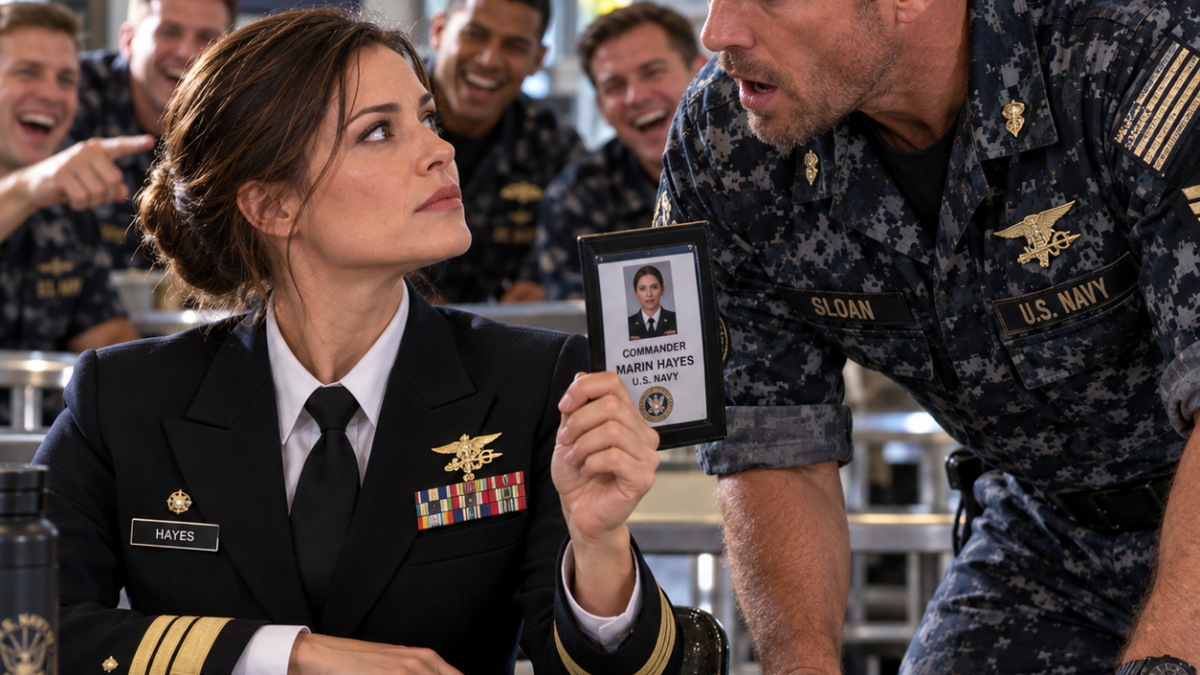
“I’m a commander,” I said.
He chuckled.
“Sure.”
“And I’m the Chief of Naval Operations.”
“I’m sure the actual Chief of Naval Operations would be interested to hear that.”
Someone at another table laughed.
Sloan’s expression tightened.
I turned my exercise directorate badge toward him.
Bad photograph.
Clear words.
COMMANDER MARIN HAYES
INTELLIGENCE COORDINATION
The transformation was instant.
His back straightened.
His grin disappeared.
His eyes dropped toward the table.
“Ma’am.”
I waited.
“I apologize.”
“I didn’t realize.”
“That is obvious.”
He glanced toward his teammates.
None of them were laughing now.
I took a sip of cold coffee.
Made a face.
Sloan almost smiled.
Then wisely decided not to.
“I am not trying to make this a major issue,” I said.
“But you didn’t come here to meet me.”
“You came over because you thought I’d make a good joke.”
His mouth opened.
Closed.
That pause did more for him than a quick excuse would have.
Finally:
“That’s fair.”
“I was showing off.”
“Do you do that often?”
“Not my finest habit.”
“No.”
“It isn’t.”
He looked at the notebook.
Then at me.
“Can we start over?”
“We can start with you letting me finish lunch.”
“Absolutely.”
He stood.
Then hesitated.
“You said intelligence coordination.”
“Yes.”
“Have we worked together?”
“Not directly.”
“My office reviews reports from your training exercises.”
His face changed again.
“All of them?”
“The ones that come through our directorate.”
“Yours included.”
He nodded once.
Then walked back to his table.
His teammates immediately surrounded him.
I heard one say:
“Nice work, Chief.”
Another laughed.
The dark-haired petty officer didn’t.
He looked toward me.
Then toward the notebook.
I noticed.
Returned to my lunch.
And reopened Sloan’s report.
His name sat at the bottom.
DEREK SLOAN, SOC
Signed.
Certified.
Final.
I compared it with the radio log.
14:16:52.
A communications specialist identified as PO2 ELLIS, J. transmitted:
“Lead, Comms Two. Timing package is off by approximately four minutes. Confirm hold before approach.”
Four seconds later:
“Lead copies.”
Then:
“Stand by.”
Then a transmission from Sloan himself.
“Continue current plan.”
The exercise proceeded.
Four minutes later, two simulated elements arrived at an intersection point nearly simultaneously.
That had created temporary confusion.
No one was hurt.
It was training.
The exercise controllers had paused one lane for several minutes and reset.
Not catastrophic.
Not even unusual.
Training exists partly to expose exactly those kinds of mistakes.
The problem was the report.
Sloan’s signed after-action summary said:
No prior timing discrepancy was identified before convergence. Conflict resulted from unexpected movement by support element.
That was not what the radio log showed.
I read it again.
Then pulled the controller notes.
At 14:18, an observer had written:
COMMS ADVISED LEAD OF OFFSET. LEAD ELECTED TO CONTINUE.
Now there were two independent records contradicting the signed report.
I circled the lines.
My appetite disappeared.
Not because somebody had made a bad decision during training.
People make bad decisions in training.
That’s the point.
You expose them somewhere safe enough to learn.
What bothered me was what happened afterward.
If Sloan had written:
Received timing warning. Assessed risk acceptable. Continued. Resulted in convergence. Recommend revised confirmation procedure.
Fine.
Useful.
Maybe still questionable judgment.
But honest.
Instead, his report shifted responsibility to a support element and erased the warning.
I looked toward his table.
Sloan was leaving with his teammates.
The dark-haired petty officer glanced back.
We made eye contact.
He looked away quickly.
Something about that bothered me.
I returned to my office.
My deputy, Lieutenant Commander Samir Patel, was standing at the printer arguing with it.
“It hates me.”
“It hates everybody.”
“It specifically hates leadership.”
“Then it has good instincts.”
He looked over.
“You seem cheerful.”
“I had lunch with Chief Sloan.”
Patel stopped fighting the printer.
“Voluntarily?”
“No.”
“That sounds more accurate.”
I handed him the report.
“Read the highlighted paragraph.”
He did.
Then the radio log.
Then the controller note.
His expression changed.
“That doesn’t match.”
“No.”
“Could be sequence confusion.”
“Maybe.”
“Could be somebody drafted the report from memory.”
“Maybe.”
“Could be Sloan didn’t review before signing.”
“That would still be a problem.”
“Yes.”
Patel leaned against the desk.
“What do you want to do?”
“Nothing dramatic.”
“Start with records.”
I requested the original draft chain.
Training reports rarely appear fully formed.
Someone writes notes.
Another person edits.
Team lead reviews.
Corrections.
Final submission.
I wanted to know where the sentence had changed.
Within an hour, administrative support sent us four versions.
Draft one had been written by Petty Officer Second Class Jordan Ellis.
The communications specialist from the radio log.
His original note said:
At approximately 1417, Comms Two advised team lead that movement package showed a four-minute discrepancy between assault and support timelines. Team lead directed continuation. Elements later converged near Point Bravo.
Clear.
Draft two retained it.
Draft three changed.
Now:
A timing discrepancy was observed during movement. Elements converged near Point Bravo.
No warning.
No decision.
Final draft:
No prior timing discrepancy was identified before convergence. Conflict resulted from unexpected movement by support element.
I stared at the progression.
Patel said:
“Somebody didn’t just shorten this.”
“No.”
“They reversed it.”
“Yes.”
“Who edited draft three?”
Metadata listed:
D. SLOAN
Final changes:
Also Sloan.
Patel exhaled.
“Well.”
I didn’t answer.
Then I noticed another edit.
A recommendation from Ellis:
Recommend mandatory verbal confirmation when timing variance exceeds two minutes.
Removed.
Another:
Recommend junior comms personnel be empowered to call temporary hold for unresolved timeline mismatch.
Removed.
Sloan’s final recommendation instead said:
Support personnel require improved adherence to published timelines.
It wasn’t just that he had protected himself.
He had redirected corrective action toward the people who had warned him.
I stood.
“Get me Ellis.”
Patel nodded.
“Quietly?”
“Very.”
Petty Officer Jordan Ellis arrived at 15:40.
Twenty-seven.
Dark hair.
Same man from the cafeteria.
That explained the expression.
He entered my office at attention.
“Commander.”
“At ease.”
He looked toward Patel.
Then me.
Clearly nervous.
I gestured toward the chair.
“This isn’t disciplinary.”
He sat.
Barely.
I placed the radio log between us.
“Did you transmit this warning?”
“Yes, ma’am.”
“Did Chief Sloan receive it?”
“Yes.”
“How do you know?”
“He acknowledged.”
“Was the timeline offset real?”
“Yes.”
“How did you identify it?”
Ellis explained.
One support movement had been delayed during reset.
The updated schedule had reached his station but apparently not every element.
He noticed the four-minute overlap.
He warned Sloan.
“What happened?”
Ellis looked down.
“Chief said continue.”
“Did you believe that created a safety issue?”
“It was simulated.”
“That isn’t what I asked.”
He hesitated.
“Potentially.”
“How potentially?”
“Low risk if everyone stayed in assigned lanes.”
“But?”
“The convergence point was narrow.”
“Vehicles?”
“One training craft and personnel on foot.”
“Live weapons?”
“No live ammunition.”
“Good.”
I waited.
“Did you recommend a hold?”
“Yes.”
“Why isn’t that in the final report?”
Ellis looked at me.
Then away.
“I don’t know.”
“You wrote the first draft.”
He swallowed.
“Yes.”
“Your language was removed.”
“Yes.”
“Did you ask why?”
“Yes.”
“Who did you ask?”
“Chief Sloan.”
“And?”
Ellis rubbed his palms against his trousers.
“He said my version made it sound like leadership ignored a safety warning.”
“Did leadership ignore a safety warning?”
Ellis looked miserable.
“Ma’am—”
“This is not a trap.”
“I need what happened.”
“He said it wasn’t really a safety warning.”
“What was it?”
“Timing concern.”
“And you told him to hold?”
“Yes.”
“He continued?”
“Yes.”
“So what did he tell you to do?”
“Change the language.”
“Did you?”
“I changed some.”
“Not enough.”
“He changed the rest.”
“Did anyone threaten you?”
“No.”
“Did anyone tell you you’d be punished?”
“No.”
“Then why didn’t you elevate it?”
His answer came quietly.
“Because he’s Chief Sloan.”
I said nothing.
Ellis continued.
“He’s been doing this a long time.”
“I’m just a second class.”
“Everybody says training reports get cleaned up.”
“People don’t want every small mistake becoming a career issue.”
I leaned back.
“That can be true.”
He looked surprised.
“Training reports do not need to read like confessions.”
“But they do need to be accurate enough to teach us something.”
“Yes, ma’am.”
“What did you learn from this one?”
He stared at the report.
Then:
“Not to write down that I warned someone senior.”
That answer landed harder than any accusation.
Patel shifted beside me.
I asked:
“Did anybody else hear the discussion after the exercise?”
“Yes.”
“Who?”
Ellis named three people.
One was Senior Chief Robert Kessler.
Another communications technician.
And Sloan himself.
I thanked Ellis.
Then said:
“One more question.”
“Yes, ma’am.”
“At lunch today, why did you look uncomfortable when Chief Sloan was talking to me?”
His face turned red.
I almost smiled.
“I’m not going to punish you for noticing your Chief making a fool of himself.”
He exhaled.
“He does that sometimes.”
“What?”
“Picks someone he thinks won’t push back.”
“To joke with?”
“To joke at.”
“How often?”
Ellis shrugged.
“Enough.”
“Does it affect work?”
Another hesitation.
“Sometimes people stop bringing him things.”
“What things?”
“Problems.”
That was the sentence that turned a reporting discrepancy into a leadership issue.
People stop bringing him problems.
In military operations, that is not a personality quirk.
That is risk.
The sailor who sees the problem first is often junior.
The person who hears an equipment anomaly first may be the technician sitting closest to it.
The person who notices a timeline conflict may be a second class petty officer while everyone with more stripes is busy executing the plan.
A leader who teaches junior people that speaking up makes them a target eventually stops receiving warnings.
And then one day the warning matters.
I dismissed Ellis.
Then called Captain Laura Whitmore, my director.
She listened without interrupting.
I sent her the documents.
Ten minutes later she walked into my office personally.
Laura had been my boss for fourteen months.
Fifty.
Surface warfare background.
Calm enough to make angry people nervous.
She closed the door.
“This cafeteria incident part of your concern?”
“Not formally.”
“Should it be?”
“I don’t know yet.”
She sat.
“Tell me why it matters.”
I chose my words carefully.
“He approached someone he believed was junior.”
“Used her as entertainment for his team.”
“Then immediately changed behavior when he learned rank.”
“That suggests he understands standards.”
“He may simply apply them differently depending on perceived status.”
Laura nodded.
“And Ellis says people stop bringing him problems.”
“Yes.”
“That matters.”
“Yes.”
She looked at the report.
“What’s your recommendation?”
“Fact-finding first.”
“No accusations.”
“Interview Sloan.”
“Interview Kessler.”
“Compare controller notes.”
“Determine whether report alteration was intentional correction, careless editing, or deliberate concealment.”
Laura nodded.
“And if it was concealment?”
“Then his chain owns the personnel decision.”
“My job is protecting the integrity of the exercise review.”
She smiled faintly.
“Good answer.”
“It’s also true.”
“I know.”
Chief Sloan came to my office the next morning at 08:00.
No audience.
No cafeteria.
No jokes.
He stood in front of my desk.
“Commander.”
“Chief.”
“Sit.”
He did.
I placed the final report in front of him.
“You signed this?”
“Yes, ma’am.”
“Did you write it?”
“Most of it.”
“Did Petty Officer Ellis warn you about a four-minute timing discrepancy?”
His eyes changed.
Tiny shift.
“Yes.”
“Before the convergence?”
“Yes.”
“Then why does your report say no prior timing discrepancy was identified?”
He looked at the page.
“That sentence may be too broad.”
“Too broad?”
“The discrepancy wasn’t confirmed.”
“Your report does not say unconfirmed.”
“No.”
“It says it wasn’t identified.”
“Yes.”
I placed the radio log beside it.
“Here it is.”
Then controller notes.
“And here.”
Sloan’s jaw tightened.
“I understand.”
“Do you?”
“Yes, ma’am.”
“Then explain.”
He sat back.
“The warning came during a fluid evolution.”
“Ellis had incomplete information.”
“I made the call to continue.”
“Which was your call to make.”
“Yes.”
“Then why not write that?”
Sloan was silent.
I waited.
Finally:
“Because it looked bad.”
There it was.
Not elegant.
Not bureaucratic.
True.
“Bad for whom?”
“Me.”
“What did you believe would happen if the report said you received a warning and continued?”
“It could be interpreted as disregarding safety.”
“Did you disregard safety?”
“No.”
“Then defend the decision.”
“I thought the risk was manageable.”
“Then write that.”
He looked irritated now.
“Commander, with respect, you’ve seen how these things work.”
“A sentence gets pulled out.”
“Someone at headquarters reads it without context.”
“Suddenly a training decision becomes a career problem.”
“That happens.”
“So I simplified it.”
“You changed the direction of responsibility.”
“I cleaned up ambiguity.”
“No.”
I pointed to the final sentence.
“You blamed the support element.”
“They were late.”
“And Ellis warned you they were late before the convergence.”
Sloan looked away.
“That should have stayed in.”
“Yes.”
Silence.
I asked:
“Why did you remove his recommendation about verbal confirmation?”
“I didn’t think junior comms should have unilateral authority to stop movement.”
“His draft didn’t say unilateral authority.”
“It said empowered to call a temporary hold.”
“That is functionally the same thing.”
“No.”
“It means anybody can interrupt long enough for someone with authority to decide.”
Sloan folded his arms.
“That becomes chaos.”
“Does it?”
“Yes.”
“Or does it become inconvenient?”
His eyes met mine.
I continued:
“You seem comfortable with people speaking when you’re certain they are beneath you.”
“Less comfortable when their information interrupts what you’ve already decided.”
“That is not fair.”
“Then convince me.”
He leaned forward.
“I have twenty-one years in Naval Special Warfare.”
“I have made decisions under pressure you have never had to make.”
I let that sit.
Then:
“Probably.”
He blinked.
I continued:
“I have never claimed otherwise.”
“But this isn’t about whether I could do your job.”
“It’s about whether you accurately reported what happened in yours.”
He went quiet.
The distinction mattered.
I wasn’t going to play the ridiculous game where a staff officer pretends she could outperform a SEAL chief in his specialty.
I couldn’t.
That did not mean he got to rewrite records.
Different expertise.
Same obligation to tell the truth.
I asked:
“Did you tell Ellis his wording made leadership look like it ignored a safety warning?”
“Yes.”
“Did you direct changes?”
“Yes.”
“Did he resist?”
“He wanted the warning included.”
“Did you remove it anyway?”
“Yes.”
“Did you believe the support element was solely responsible for the convergence?”
Sloan took longer to answer.
“No.”
That was the first moment I saw genuine discomfort.
Not fear of rank.
Something closer to shame.
I closed the report.
“Thank you.”
He looked surprised.
“That’s it?”
“For now.”
He stood.
Then:
“Commander.”
“Yes?”
“About yesterday.”
“The cafeteria.”
“I really was showing off.”
“I know.”
“It wasn’t about you.”
I almost laughed.
“That does not improve it.”
He winced.
“No.”
“I suppose it doesn’t.”
He left.
Senior Chief Kessler came next.
He confirmed most of the sequence.
He had heard Ellis raise the discrepancy after the exercise.
He had heard Sloan say the report did not need to “make a federal case” out of a timing error.
He had not realized Sloan later changed the sentence to say no warning existed.
Kessler looked genuinely angry when I showed him.
“That is not what happened.”
“Would you sign this report?”
“No.”
“Did you review it?”
“No.”
“Why not?”
“Chief Sloan was element lead.”
I nodded.
Another system problem.
Everybody assumed somebody senior had done the checking.
Nobody had.
By noon, Laura had enough.
She notified Sloan’s operational chain.
Not with accusations.
With a factual packet.
Original draft.
Version history.
Radio log.
Controller notes.
Interviews.
His own admission.
The immediate result was not a dramatic removal.
No public humiliation.
No security escort.
No cinematic stripping of insignia.
He was temporarily removed from responsibility for finalizing after-action reports while his chain reviewed the matter.
Training continued.
The Navy did not stop because one chief had altered four sentences.
But the review widened.
Because once people were asked privately whether Sloan’s leadership style affected reporting, they started talking.
Not everyone disliked him.
That is important.
Several sailors described him as technically excellent.
Physically demanding.
Protective of his team in difficult situations.
Generous with his time when people asked for help one-on-one.
One said Sloan had personally spent six hours helping him prepare for a qualification board.
Another credited Sloan with intervening when his family was struggling during a deployment.
People are rarely one thing.
That made what came next more useful.
The problem was not that Sloan was secretly terrible in every part of his life.
The problem was that he had a specific leadership failure.
He used ridicule as a tool.
Especially downward.
People learned to avoid bringing him uncertain information.
If you came to him with a fully formed answer, fine.
If you brought a problem that might slow the plan, you risked becoming a joke.
One junior sailor described it perfectly.
“Chief doesn’t punish bad news.”
“He punishes unfinished bad news.”
I wrote that down.
Because operational warnings are often unfinished.
Smoke before fire.
Noise before equipment failure.
A timing discrepancy before convergence.
If leaders demand certainty before they’ll listen, the warning arrives too late.
Three weeks after the review began, I was invited to sit in on a training standards discussion with Sloan’s chain.
Captain Whitmore.
A SEAL commander named Nathan Briggs.
Senior Chief Kessler.
Two safety officers.
Sloan.
Me.
Ellis was not initially included because I did not want him sitting in a room full of senior personnel wondering whether his career depended on choosing the right sentence.
Commander Briggs agreed.
The meeting began with the exercise.
Not the cafeteria.
Not personality.
The facts.
Briggs asked Sloan:
“Did Ellis warn you?”
“Yes, sir.”
“Did you continue?”
“Yes.”
“Was continuation automatically wrong?”
“No, sir.”
“I agree.”
Sloan looked up.
Briggs continued:
“You were the tactical lead.”
“You had authority.”
“You assessed the risk.”
“The exercise resulted in a manageable convergence.”
“Training controller reset it.”
“Fine.”
“Then why are we here?”
Sloan looked at the table.
“Because I changed the report.”
“Yes.”
“Why?”
“I didn’t want the decision mischaracterized.”
Briggs nodded.
“So you prevented mischaracterization by writing something untrue?”
Sloan said nothing.
Briggs leaned back.
“That is the part I cannot defend.”
Neither could Sloan.
The safety officer reviewed Ellis’s recommendation.
Mandatory confirmation when timing variances exceeded two minutes.
Temporary hold request available to comms personnel.
Briggs asked Sloan:
“Do you still oppose that?”
Sloan answered carefully.
“I oppose automatic stop authority for anyone who sees a mismatch.”
The safety officer said:
“That is not the proposal.”
Sloan looked toward me.
I didn’t smile.
The revised recommendation became:
Any element identifying an unresolved timing discrepancy greater than two minutes will transmit “CHECK TIMELINE.” Movement lead will acknowledge and either confirm continuation or order hold.
Simple.
Nobody had unilateral veto.
Nobody could quietly ignore the warning either.
The acknowledgment itself became part of the record.
That procedural change mattered more to me than what happened to Sloan.
But consequences came.
His evaluation reflected the reporting-integrity issue.
He received formal counseling.
His role in approving after-action reports was restricted for a defined period.
He was required to complete leadership remediation focused on communication climate and reporting.
Not career-ending.
Not nothing.
Some people would have wanted more.
Others believed any formal consequence was excessive for changing a training report where nobody had been hurt.
Neither extreme interested me.
Training only has value if people can admit what went wrong.
If covering a mistake is easier than discussing it, the next mistake arrives better disguised.
A week later, Ellis came to my office.
“Commander.”
“Come in.”
He closed the door.
“The new reporting procedure got approved.”
“I heard.”
He smiled.
Small.
Proud.
Then:
“Chief Sloan apologized to me.”
I looked up.
“What did he say?”
“He said I was right about the warning.”
“And?”
“He said he shouldn’t have changed my draft.”
“Anything else?”
Ellis smiled wider.
“He said I was still annoying.”
“That sounds like him.”
“Yes, ma’am.”
I studied Ellis.
“Did the apology feel forced?”
“No.”
“Did it fix everything?”
“No.”
Good answer.
He hesitated.
“Ma’am?”
“Yes?”
“Did the cafeteria thing cause all this?”
“No.”
He looked surprised.
“It made me pay attention.”
“That is different.”
“If the report had been accurate, Sloan embarrassing himself at lunch would have remained Sloan embarrassing himself at lunch.”
I leaned back.
“Never confuse somebody being rude to you with evidence that they’re professionally dishonest.”
“Those are different findings.”
“Yes, ma’am.”
“And never use your rank to turn a personal irritation into an official weapon.”
His face grew serious.
“Yes, ma’am.”
I meant that as much for myself as for him.
Power makes personal anger dangerous.
Had I gone hunting through Sloan’s reports simply because he called me a seaman recruit, I would have deserved scrutiny too.
The report was already on my desk.
The discrepancy already existed.
The records spoke for themselves.
My embarrassment did not create them.
That distinction was one I guarded carefully.
Months passed.
The CHECK TIMELINE procedure spread into other exercises.
Not because it was revolutionary.
Because it worked.
Call the discrepancy.
Leader acknowledges.
Decision gets made.
Record remains.
No drama.
Training became slightly slower in a few places.
Good.
People who worship speed forget that speed in the wrong direction is not efficiency.
Then I saw Sloan again.
Same cafeteria.
Same general time.
I was eating lunch with Patel.
Sloan entered with several teammates.
He noticed me.
Patel whispered:
“Should I leave?”
“No.”
“Should I get popcorn?”
“No.”
Sloan carried his tray over.
Stopped several feet away.
“Commander.”
“Chief.”
He looked at the empty chair.
“Permission to sit?”
Patel nearly choked on his drink.
I said:
“Granted.”
Sloan sat.
No audience performance.
No joke.
For a minute, we ate in silence.
Then he said:
“You know everyone calls it the Hayes Rule.”
I frowned.
“What?”
“CHECK TIMELINE.”
“No, they do not.”
“They absolutely do.”
“I hate that.”
“I know.”
“Then stop encouraging it.”
He smiled.
“I’ve tried.”
I looked at him more carefully.
Something had changed.
Not personality.
He was still Derek Sloan.
Still confident.
Still capable of taking up more space than necessary.
But there was less edge.
Less need to control the room.
He said:
“I owe you a better apology.”
“You already apologized for the cafeteria.”
“Not that.”
I waited.
“The report.”
I put down my fork.
He continued.
“I spent a lot of years thinking leadership meant giving people confidence.”
“Even if you had to hide uncertainty.”
“I thought if I let every junior guy put every concern into reports, we’d look indecisive.”
“We’d spend our lives explaining noise.”
“Sometimes you would.”
“Yeah.”
He nodded.
“But I started treating anything that challenged my call as noise.”
“That was the problem.”
“Yes.”
He rubbed a thumb along the edge of his tray.
“Ellis was right.”
“I knew he was right when he said it.”
“That is worse.”
“Yes.”
He laughed without humor.
“You really don’t soften much.”
“I’ve been told.”
He looked toward the windows.
Then:
“My father was a chief.”
“Submarines.”
“He used to say if the captain asks whether there’s a problem, you don’t bring him a possibility.”
“You bring him an answer.”
“That works until the possibility is the warning.”
“Exactly.”
He sat back.
“I had that backward.”
For the first time, I felt something like sympathy.
Not absolution.
Understanding.
We inherit leadership habits the same way families inherit phrases.
Some useful.
Some dangerous.
People often do not examine them until they fail.
Patel, who had stayed silent for an impressively long time, finally said:
“Can I ask something?”
Sloan looked at him.
“Sure.”
“Do you really call Commander Hayes a seaman recruit behind her back?”
I turned toward Patel.
He was grinning.
Sloan laughed.
“No.”
Then:
“Only when I want to die.”
I should not have laughed.
I did.
That became the beginning of a functional working relationship.
Not friendship.
We were too different for that.
But professional respect.
Sloan began requesting intelligence input earlier in planning.
My office stopped receiving reports that treated communications personnel as decorative.
Ellis advanced.
A year later, he made first class.
I attended his pinning because he invited me.
Sloan pinned one side.
His wife pinned the other.
Afterward, Ellis introduced me to his mother.
She hugged me before I understood what was happening.
“Jordan told me you listened.”
That sentence embarrassed me more than the hug.
Listening should not be remarkable.
Yet to people who have spent too long being dismissed, it is.
I told her:
“He gave us something worth hearing.”
Ellis heard.
He smiled.
Chief Sloan eventually transferred.
Before leaving Little Creek, he stopped by my office.
No appointment.
Patel wasn’t there.
He handed me a folder.
“What is this?”
“Final report from our last exercise.”
“Should I be worried?”
“Read page seven.”
I did.
The exercise had included another timing discrepancy.
Three minutes.
A junior radio operator called:
CHECK TIMELINE.
Sloan acknowledged.
Held movement for ninety seconds.
Confirmed positions.
Then continued.
No convergence.
No reset.
His report said:
Junior communications watch identified a three-minute schedule variance and correctly initiated timeline verification. Temporary hold prevented lane overlap. Recommend retaining current procedure.
I looked at him.
“This is suspiciously accurate.”
He smiled.
“I’ve changed.”
“Don’t ruin your reputation.”
He turned to leave.
Then stopped.
“Commander.”
“Yes?”
“That first lunch.”
“What about it?”
“If you hadn’t been a commander, I still would’ve been an ass.”
I looked at him.
“That is exactly why the apology mattered.”
He nodded.
Then left.
Years later, that became the part of the story I remembered most.
Not his face when he saw my badge.
Not the satisfaction of watching a confident man realize he’d badly misjudged the person across the table.
Not even the report.
It was that final sentence.
If you hadn’t been a commander, I still would’ve been wrong.
Rank can expose bad behavior.
It should not be the reason behavior becomes bad.
I had spent much of my career watching people change posture when somebody important entered a room.
Voices became careful.
Jokes disappeared.
Everyone suddenly remembered courtesy.
That is useful information.
Because real professionalism is what remains when you believe the person in front of you cannot affect your career.
The junior sailor.
The civilian clerk.
The contractor.
The person serving food.
The communications specialist whose warning is not yet polished enough to sound like certainty.
Anyone can behave well upward.
Leadership is revealed downward.
I thought about my brother Paul too.
He died two years after the Sloan incident.
Heart attack.
Fifty-six.
Far too young.
While cleaning out his house with his daughter, I found an old photograph from one of our family cookouts.
Paul standing beside a smoking grill.
Pointing at me.
Everybody laughing.
On the back he had written:
MARIN HAS BEEN A COMMANDER SINCE BIRTH. NAVY JUST TOOK A WHILE TO NOTICE.
I laughed until I cried.
Paul had been one of the few people allowed to mock my rank forever.
The recipe cards I’d forgotten to send him that week?
I found my copy.
They sit in my kitchen now.
Mom’s handwriting.
Tomato sauce.
Pot roast.
Peach cobbler.
Little pieces of lives that continue after people don’t.
That experience changed how I thought about Sloan too.
Not because grief made his conduct unimportant.
Because time made it proportional.
A cafeteria humiliation.
A falsified training narrative.
A leadership intervention.
A man correcting himself.
Those things mattered.
They did not need to become the only definition of him.
Sloan eventually retired after twenty-four years.
I received an invitation.
Surprised me.
I went.
His retirement ceremony was held in Virginia Beach.
Family.
Teammates.
People from multiple assignments.
Ellis was there.
Now Chief Ellis.
That made me feel ancient.
Sloan’s speech was exactly what I expected.
Too long.
Funny.
Occasionally inappropriate.
Then he became serious.
He talked about mistakes.
Not specific ones at first.
Then:
“I once thought the best leader was the guy who always looked certain.”
He looked toward Ellis.
“I learned eventually that the better leader is the guy whose people are willing to interrupt.”
Ellis smiled.
Then Sloan looked at me.
“And sometimes you learn that from somebody you were dumb enough to call a seaman recruit.”
The room laughed.
I covered my face.
He continued:
“For the record, she was a commander.”
“Very much a commander.”
More laughter.
Afterward, he walked over.
“Was that too much?”
“Yes.”
“Good.”
“You enjoyed that.”
“Completely.”
Then he introduced me to his daughter.
Twenty.
ROTC.
She shook my hand.
“Dad tells the cafeteria story constantly.”
“I am sorry.”
“He says it’s why he stopped guessing rank.”
“That’s not the lesson.”
“I know.”
She smiled.
“He says the lesson is not to be a jerk to people you think can’t outrank you.”
“Better.”
Sloan looked offended.
“I say it more elegantly.”
“No one believes that.”
His daughter laughed.
I looked at him.
Older.
Gray at the temples.
Still Derek.
Different in ways that mattered.
That is what accountability should make possible when the underlying conduct allows it.
Not humiliation forever.
Not pretending nothing happened.
Change.
Some misconduct requires removal.
Some dishonesty destroys trust beyond repair.
Some people refuse every opportunity to learn.
Others don’t.
Leadership systems should be strong enough to tell the difference.
Sloan’s report alteration was serious because accuracy in training affects future safety.
His chain treated it seriously.
He faced consequences.
Then he rebuilt trust.
That mattered too.
I retired several years later as a captain.
The ceremony was smaller than Sloan’s.
By choice.
Paul wasn’t there.
Mom wasn’t either.
That hurt.
Patel gave the speech.
Which was a mistake.
He included the printer incident.
The cold coffee.
The cafeteria.
Everything.
Then Ellis walked up carrying a framed page.
I recognized it immediately.
The original radio log.
14:17.
TIMING PACKAGE IS OFF BY APPROXIMATELY FOUR MINUTES. CONFIRM HOLD BEFORE APPROACH.
Below it, someone had added the final training note from years later:
CHECK TIMELINE PROCEDURE ADOPTED FOR EXERCISE COORDINATION.
At the bottom were signatures.
Ellis.
Kessler.
Whitmore.
Sloan.
Then Patel.
I looked at them.
“What is this?”
Ellis smiled.
“A reminder.”
“Of?”
“That warnings only work if somebody lets them exist.”
I didn’t say anything for a moment.
Then I hugged him.
Which surprised us both.
The frame hangs in my home office now.
Visitors assume it commemorates some major operation.
It doesn’t.
It commemorates four minutes in a training exercise where nobody was hurt.
That’s exactly why I keep it.
The best time to learn a lesson is when the consequence is embarrassment and paperwork.
Not blood.
Not a folded flag.
Not a family receiving a knock at the door.
Training mistakes are gifts if you tell the truth about them.
Sloan almost wasted one because he thought an honest sentence looked bad.
Instead, that sentence eventually made the system better.
The cafeteria incident became a funny story later.
At the time, it wasn’t.
Being reduced to someone’s joke because they think you’re junior, inexperienced, or safe to embarrass is exhausting.
But the rank reveal was never the victory people imagine.
If all Sloan learned that day was:
Be careful who you mock because she might be a commander,
then nothing useful would have happened.
He needed to learn something harder.
The sailor across from you does not need more authority than you to deserve respect.
The petty officer warning you does not need to be certain before you listen.
And admitting you received a warning does not make you weak.
Ignoring it and rewriting the record does.
Nineteen years in uniform had taught me that silence can mean many things.
Fear.
Discipline.
Patience.
Exhaustion.
Observation.
Sometimes strength.
Derek Sloan saw silence and assumed weakness.
That was his first mistake.
His more important mistake came later, when somebody else spoke and he decided the warning was inconvenient enough to erase.
The badge on my chest corrected the first assumption in seconds.
The report took longer.
But in the end, the lesson was the same.
Never decide how much truth somebody deserves based on how little power you think they have.
Because sometimes the quietest person in the room is simply waiting for the record to speak.








