My Mom Called My Army Career “Computer Work”—Then the Bride’s Mother Saw My Scar.k
part2:
I could have corrected them.
Again.
I could have explained that logistics isn’t stapling forms in an air-conditioned office.
It’s people.
Fuel.
Vehicles.
Aircraft.
Medical supplies.
Weapons.
Food.
Water.
Routes.
Timelines.
Permissions.
Contingencies.
It’s knowing that if one truck arrives six hours late, an entire company might not move.
It’s knowing a helicopter is useless if the part keeping it grounded is still sitting in another country.
It’s understanding that every heroic-looking operation someone later puts into a recruiting video was supported by hundreds of people doing work that didn’t look heroic at all.
But my parents had already decided what my career meant.
Facts only irritated them.
Six years earlier, I had told them I worked in logistics.
That was true.
Incomplete, but true.
Some assignments involved joint operations.
Some involved travel I couldn’t discuss.
Some involved places where I couldn’t tell them exactly what I was doing until long after it no longer mattered.
The less specific I became, the more Mom filled in the blanks herself.
Desk.
Computer.
Warehouse.
Paperwork.
Then I started missing family events.
Two Thanksgivings.
Dad’s birthday.
My cousin’s wedding.
Mom called during one deployment and asked whether my “desk job” really required that much overtime.
I said yes.
It was easier than explaining why mortar alarms had interrupted sleep three times that week.
After a while, I stopped trying.
The wedding table conversation continued.
Aunt Brenda smiled at me.
“Well, captain sounds impressive.”
Mom laughed.
“She’s always been stubborn.”
“Remember when she enlisted?”
“I commissioned after college.”
“You know what I mean.”
I did.
She had wanted me to go to law school.
Like Leo.
I’d attended college on an ROTC scholarship instead.
The Army had started as a way to pay tuition.
Then it became something else.
Something I was good at.
Something meaningful.
Something mine.
Mom never forgave it for not being the life she would have chosen.
The morning of Leo’s wedding, she’d introduced him to Chloe’s relatives as:
“My brilliant son, the attorney.”
Then me:
“My daughter who works for the government.”
I had heard worse.
Usually not while wearing four-inch heels.
Across the ballroom, Leo was helping Chloe free the hem of her wedding gown from a chair leg.
Nobody was applauding.
Nobody was explaining what an exceptional husband he was.
He was simply doing something useful.
I liked watching him that way.
Ordinary.
Unperformed.
Then Mom said the sentence that changed the evening.
“It’s not like Morgan has ever been on a real mission.”
She laughed.
“She works at a computer.”
Something pressed hard behind my ribs.
Not anger exactly.
Memory.
The word real.
Real mission.
My fingers tightened around the stem of my water glass.
I could smell something that wasn’t in the ballroom.
Burned rubber.
Jet fuel.
Dust.
I could hear a metal door slamming somewhere that no longer existed.
For half a second, the quartet became rotor noise.
Then I was back.
White flowers.
Crystal glasses.
September humidity.
Wedding.
I kept my voice even.
“Can we talk about something else?”
Mom frowned.
“I was teasing.”
“It’s Leo’s wedding.”
“You’re always so serious about work.”
I looked toward my brother.
“That’s why I’m changing the subject.”
She sighed as though I were the difficult one.
Then someone stopped beside our table.
Victoria Harding.
Chloe’s mother.
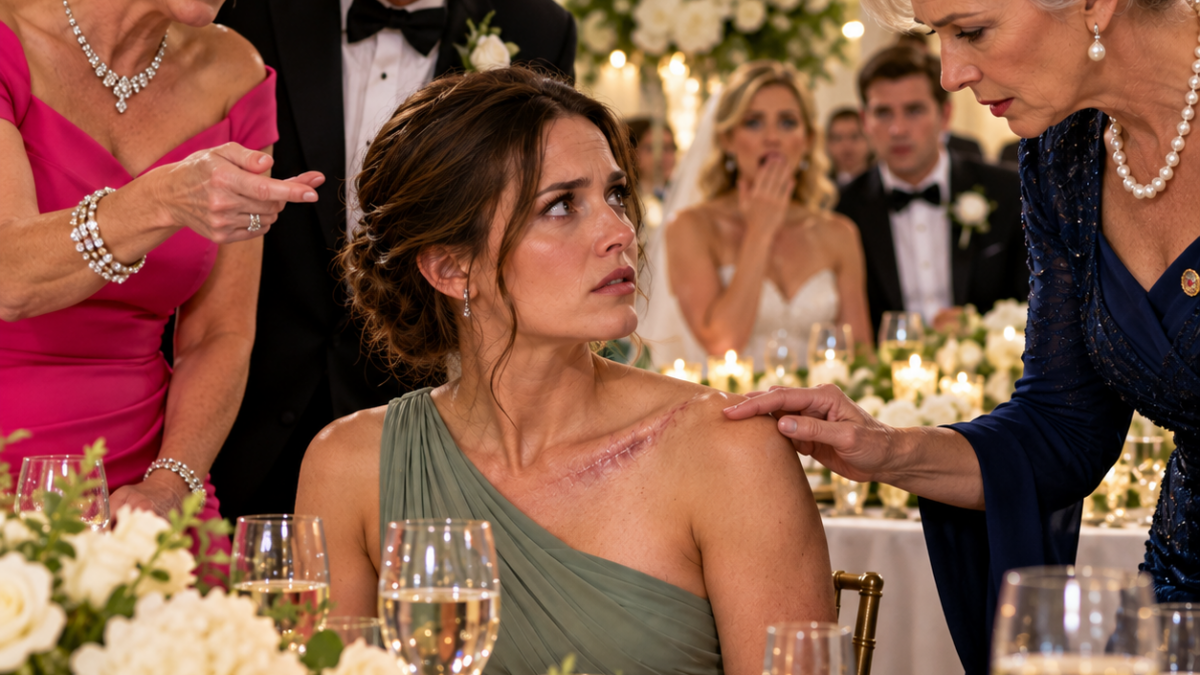
She wore a dark blue dress with three-quarter sleeves and almost no jewelry except a silver bracelet.
Her hair was cut short and gray.
Before retirement, she’d spent more than three decades in the Foreign Service.
Embassies.
Negotiations.
Crisis assignments.
Deputy chief of mission twice.
Ambassador once.
I’d read her official biography when Leo and Chloe got engaged.
Not because I was impressed by titles.
Because Army officers learn very quickly that knowing who is in a room can matter.
Dad stood so fast his napkin hit the floor.
“Victoria.”
She nodded politely.
Then looked at me.
Not my dress.
Not my rank.
My scar.
Her expression changed.
It was subtle.
The kind of change you miss unless you’ve spent years watching rooms where people don’t say everything they’re thinking.
Her smile disappeared.
She took one small step closer.
“Your daughter is Morgan?”
Mom brightened.
“Yes.”
“Our military girl.”
Then she added, because apparently she couldn’t help herself:
“Though as I was saying, she’s really an office person.”
Victoria didn’t look at her.
She looked at my collarbone.
I instinctively pulled my shoulder back.
Her eyes followed the pale line.
Then rose to mine.
“May I ask you something?”
I knew before she asked that this was not casual.
“Of course.”
“How long did that injury take to heal?”
The room sharpened.
Mom stopped smiling.
Dad looked confused.
I said:
“Which part?”
Victoria’s eyes changed again.
“Then there was more than one.”
I didn’t answer.
She pulled the empty chair beside Dad slightly away from the table.
Sat.
Very carefully.
“Left clavicle?”
“Yes.”
“Fracture?”
“Comminuted.”
Her breath caught.
“Plate?”
“Yes.”
“Seven screws?”
My fingers went cold.
Nobody outside a very small group knew that.
Even Leo didn’t.
Mom looked between us.
“What is happening?”
Victoria didn’t answer her.
She asked me:
“Did you have nerve damage down the arm?”
“For a while.”
Her voice dropped.
“How long before you could raise it over your head?”
“About five months.”
The color left her face.
Then she whispered:
“Morgan.”
Not Captain Crawford.
Not Morgan Crawford.
Just Morgan.
Like the name had been sitting somewhere in her mind for years.
I stared at her.
And suddenly I remembered another voice.
A woman coughing inside an armored vehicle.
A hand gripping mine.
Silver hair darkened with blood that wasn’t hers.
A voice asking:
“What’s your name?”
I had answered while trying to cut through a twisted seat belt.
“Morgan.”
Victoria’s hand moved to her mouth.
“Oh my God.”
The ballroom disappeared again.
Not completely.
Enough.
Six years earlier.
A country I rarely discussed.
A diplomatic compound I had never once described to my parents.
A convoy that wasn’t supposed to take fire.
A morning that had become one of those blank spaces on my family’s calendar.
I had told Mom I’d be unavailable for a while.
She’d complained that I was missing Thanksgiving.
Victoria Harding looked at me.
“You were there.”
I swallowed.
“Yes, ma’am.”
Dad leaned forward.
“Where?”
Neither of us answered him.
Victoria’s eyes filled.
“You were the officer at Gate Three.”
The old designation hit like a finger pressing directly into scar tissue.
I glanced around the reception.
People at nearby tables were beginning to notice.
I lowered my voice.
“Mrs. Harding.”
“Victoria.”
“Please.”
She understood immediately.
She looked toward Chloe.
Her daughter was laughing with Leo near the dance floor.
“This is their wedding.”
Victoria nodded.
“Yes.”
Then she sat back.
But my mother had already realized she was missing part of the story.
That was something Elaine Crawford could not tolerate.
“What mission?”
I looked at her.
“Mom.”
“What is she talking about?”
“Later.”
Victoria turned to me.
“You never told them?”
“Not details.”
Mom’s face tightened.
“Why wouldn’t you tell your own family?”
That question should have been funny.
It wasn’t.
I said:
“Because there were things I couldn’t discuss then.”
“Six years ago?”
“Yes.”
“And now?”
“Now I don’t want to.”
Mom looked offended.
“That’s ridiculous.”
Victoria said quietly:
“No.”
My mother stopped.
Victoria rarely raised her voice.
She didn’t need to.
“No, Elaine.”
“This isn’t ridiculous.”
My father sat straighter.
“Victoria, what happened?”
She looked at me first.
Permission.
I appreciated that.
I shook my head slightly.
Not here.
Not like this.
Victoria nodded.
Then said only:
“Your daughter and I met during an evacuation.”
Dad frowned.
“An evacuation?”
“Yes.”
“Where?”
“I don’t think this is the place.”
Mom gave a nervous laugh.
“Well, Morgan evacuates people now?”
I saw Victoria’s eyes turn toward her.
The room temperature seemed to drop.
I touched Victoria’s wrist.
“Please.”
She stopped.
That was the first decision I made that night that kept Leo’s wedding from becoming mine.
I didn’t know how long it would last.
Mom leaned closer.
“You’ve been injured?”
“Yes.”
“When?”
“Six years ago.”
“How?”
I picked up my water.
“Not now.”
“You had surgery?”
“Yes.”
Dad stared at my shoulder as though the scar had appeared only seconds earlier.
“You never said anything.”
“I told you I had an injury.”
Mom shook her head.
“You told us you’d hurt your shoulder.”
“That was true.”
“You said it happened during training.”
“No.”
“You did.”
“I said I couldn’t discuss where it happened.”
She went quiet.
I remembered the phone call.
Hospital room.
Pain medication.
My arm immobilized against my chest.
A nurse adjusting an IV while Mom complained that the military was being unnecessarily secretive.
She had asked:
“Was it at least training?”
I had answered:
“I can’t get into it.”
Over time, she’d turned that into yes.
That’s how family myths are made.
Not always from lies.
Sometimes from convenient memory.
Mom looked at Victoria.
“You knew about this?”
Victoria’s expression hardened.
“I was there.”
That silenced everyone.
Even Dad.
A waiter came by asking whether anyone wanted more wine.
Nobody answered.
He moved on.
I looked toward the dance floor.
Leo and Chloe had disappeared into a crowd of relatives.
Good.
I needed them away from this.
Victoria said softly:
“Would you walk outside with me?”
I nodded.
Mom immediately stood.
“I’ll come.”
“No.”
The word left me faster than I intended.
She stared.
“I need five minutes.”
“With her?”
“Yes.”
Mom’s expression said she had never been denied access to my life so directly.
But Dad touched her arm.
“Elaine.”
For once, he helped.
Victoria and I left through tall French doors onto a terrace.
The air outside was thick and warm.
Small lights hung through the trees.
Beyond the lawn, crickets worked the darkness.
For a few seconds, neither of us spoke.
Then Victoria turned.
“I’ve been trying to find you.”
I stared.
“Why?”
“Afterward.”
She shook her head.
“I asked.”
“They told me you had been transferred for treatment.”
“I wrote a letter through State.”
“I got it.”
Her eyes widened.
“You did?”
“Yes.”
“You never answered.”
“I know.”
She looked toward the ballroom windows.
“I’m sorry.”
“You don’t need to apologize.”
“I thought maybe it never reached you.”
“It did.”
“What happened?”
I knew what she meant.
Why didn’t I answer?
I looked down at my hands.
“I didn’t know what to say.”
Victoria nodded slowly.
“I suppose I wouldn’t either.”
Her diplomatic instincts were still there.
She didn’t demand.
Didn’t fill silence.
She waited.
Eventually I said:
“You thanked me for saving your life.”
“I meant it.”
“I know.”
“But I didn’t know what to do with that.”
She watched me.
“The driver died.”
Her face changed.
“I know.”
“Sergeant Ellison died.”
“I know.”
“Benitez lost his leg.”
Victoria closed her eyes briefly.
“I know.”
I continued.
“You lived.”
“Yes.”
“Four embassy staff lived.”
“Yes.”
“Two contractors.”
“Yes.”
“Everybody kept telling me what I saved.”
My throat tightened.
“I kept thinking about who I couldn’t.”
Victoria stepped closer.
“You were twenty-eight.”
“I was an officer.”
“Both things can be true.”
I looked away.
People had said versions of that before.
Therapists.
Chaplain.
Surgeon.
Leo once, without knowing the details.
Still, coming from Victoria felt different.
She had been inside the vehicle.
She remembered the sound.
The smoke.
The people.
She wasn’t reading a citation.
She had been there.
“What do you remember?” I asked.
Her answer came immediately.
“Your hands.”
I frowned.
“My hands?”
“You kept saying you couldn’t feel your left hand.”
I looked down.
I had forgotten that.
Victoria continued.
“You were bleeding through your sleeve.”
“You had one arm almost useless.”
“And you kept trying to get my seat belt loose.”
She laughed once.
Small.
Broken.
“I kept telling you to leave me.”
I remembered.
Not the exact words.
The feeling.
A trapped armored SUV.
Vehicle tilted.
Fuel smell.
Small-arms fire farther down the road.
Smoke filling the cabin.
Victoria unable to get free because the seat assembly had twisted.
Diplomatic Security agent unconscious beside her.
My shoulder already fractured after our truck had been hit.
I had crawled back.
Not because I was heroic.
Because there were people still inside.
Victoria said:
“You told me something.”
“What?”
“‘Ma’am, if you keep arguing, I’m going to outrank you by annoyance.’”
I stared.
Then laughed.
Actually laughed.
I had forgotten that too.
“That sounds like me.”
“It did.”
She smiled.
Then her eyes filled again.
“I’ve remembered that sentence for six years.”
I looked toward the reception.
“You shouldn’t tell them.”
“Your parents?”
“Not tonight.”
Victoria was quiet.
Then:
“Do they know any of it?”
“They know I was injured.”
“Apparently not.”
“I don’t talk about it.”
“Because you can’t?”
“Some things I still can’t.”
“And the rest?”
I shrugged.
“Because every time I tried telling Mom anything about the Army, it became a competition with Leo.”
Victoria looked through the glass at my brother.
“He doesn’t strike me as competitive with you.”
“He isn’t.”
“That makes it worse?”
“Sometimes.”
I smiled.
“Leo never asked to be the favorite.”
Victoria studied me.
“What did your mother say earlier?”
I knew exactly which part she meant.
“Doesn’t matter.”
“It mattered to you.”
I looked at my shoulder.
“Real mission.”
Victoria’s jaw tightened.
“I heard.”
“She didn’t know.”
“No.”
“That’s why I let it go.”
Victoria’s voice became very quiet.
“Not knowing is different from refusing to know.”
That sentence stayed with me.
Before I could answer, the terrace door opened.
Chloe stepped outside.
Wedding dress gathered in both hands.
“There you are.”
Then she saw her mother.
“Mom?”
Victoria straightened.
Chloe looked between us.
“Is everything okay?”
“Yes.”
We answered together.
Chloe narrowed her eyes.
“You both look like somebody just told you the venue burned down.”
I smiled.
“Everything’s fine.”
She wasn’t convinced.
Then Leo appeared behind her.
“Morgan.”
His expression changed when he saw me.
“What’s wrong?”
“Nothing.”
“You’re doing the thing.”
“What thing?”
“The face.”
“What face?”
“The Army face.”
Chloe looked at him.
“What’s the Army face?”
Leo demonstrated by flattening his expression until he looked constipated.
“This.”
I laughed despite myself.
“Idiot.”
“See?”
He smiled.
Then noticed my eyes.
“Morgan.”
I shook my head.
“Not tonight.”
Leo looked toward Victoria.
She gave him the same small nod she’d given me.
Later.
He accepted it.
That’s one of the things I love about my brother.
When I say no, he usually hears the word.
“Fine.”
He pointed toward the ballroom.
“But if you two miss cake, I am not saving any.”
Chloe gasped.
“You absolutely are.”
“I paid for it.”
“My parents paid for it.”
Leo looked at me.
“You see what I’ve married into?”
Victoria smiled.
The moment passed.
For twenty minutes.
Then came the speeches.
Leo’s best man told a story about law school.
Chloe’s maid of honor made everyone cry.
Dad spoke about Leo’s determination.
Mom spoke too.
That wasn’t originally planned.
I knew because Leo’s face changed the second she took the microphone.
My mother and open microphones have always been a dangerous combination.
She started well.
Leo as a child.
His first debate trophy.
How proud they were.
Then she mentioned me.
I felt my stomach drop.
“Of course, raising two children means accepting they may choose very different paths.”
People smiled.
“Leo always knew exactly where he was going.”
Not true.
He changed majors twice.
“And Morgan…”
There it was.
“…decided she needed adventure.”
A few people laughed.
“She joined the Army despite our hopes she’d follow her brother into law.”
I stared at my napkin.
Mom continued.
“Thankfully, she’s found a nice safe niche in military administration.”
Victoria’s head turned.
I saw it.
So did Chloe.
Mom laughed.
“We’ve always joked that Leo runs toward courtrooms while Morgan runs toward spreadsheets.”
Dad chuckled.
Not because he was cruel.
Because he was used to laughing where Mom expected.
Then Mom said:
“So tonight, I’m proud of both my children.”
“Leo for building the life he always wanted.”
“And Morgan for finally being home long enough to attend the wedding.”
A few people laughed again.
My face burned.
Leo didn’t.
He was staring at Mom.
Chloe looked furious.
Then Victoria stood.
Not abruptly.
She simply rose.
Mom was handing the microphone back when Victoria reached out.
“Elaine.”
Mom brightened.
“Yes?”
“May I?”
There was no graceful way to refuse the bride’s mother.
Victoria took the microphone.
I stood halfway.
“Victoria.”
She looked at me.
I shook my head.
She understood.
And what she did next was smarter than anything I could have planned.
She didn’t reveal the mission.
Didn’t mention the country.
Didn’t say I had pulled her from a burning vehicle.
Didn’t mention awards.
She looked around the room.
“I spent thirty-two years in the United States Foreign Service.”
The room quieted.
“In that time, I learned something about public service.”
She paused.
“The people whose work is most visible are rarely the only people carrying the burden.”
Her eyes found mine.
“There are diplomats who give speeches.”
“Soldiers who appear in photographs.”
“Attorneys who stand in courtrooms.”
“Leaders whose names appear in newspapers.”
Then:
“And there are people behind them moving food, vehicles, medical supplies, communications equipment, aircraft schedules, evacuation plans, and human beings.”
Nobody laughed now.
Victoria continued.
“I have personally been alive at the end of a very bad day because people doing so-called support work did their jobs when everything else had gone wrong.”
Mom’s smile disappeared.
Victoria didn’t look at her.
She looked at Leo and Chloe.
“So my toast is to the people who understand that love, service, and competence don’t become less real simply because they happen behind the scenes.”
Then she raised her glass.
“And to Leo and Chloe.”
“May you spend your marriage noticing the work the other person does when nobody is applauding.”
That was it.
Perfect.
No exposure.
No stolen wedding.
Everybody raised glasses.
Leo looked at me.
He knew.
Not what.
Enough.
The music started again.
Mom waited exactly six minutes before cornering me near the hallway.
“What was that?”
I kept walking.
“What was what?”
“Victoria’s speech.”
“A toast.”
“Don’t do that.”
“Do what?”
“Pretend I can’t tell when someone is making a point at my expense.”
I stopped.
“Mom, this is Leo’s wedding.”
“You said that already.”
“Because you keep forgetting.”
Her face hardened.
“You told her something about us?”
“No.”
“Then how would she know?”
“She heard you.”
“That isn’t what I mean.”
I looked around.
Guests moving toward the dance floor.
Waiters collecting plates.
I lowered my voice.
“She knew me before tonight.”
Mom stared.
“From where?”
“Work.”
“What work?”
“The Army.”
She laughed nervously.
“You’re telling me you worked with Victoria Harding?”
“Yes.”
“Doing paperwork?”
I closed my eyes.
She realized the mistake immediately.
But pride got there before apology.
“Well, that’s what you’ve always told us.”
“No.”
“I told you logistics.”
“Same thing.”
“It’s not.”
“Then maybe if you’d explained yourself better—”
I looked at her.
Something in my face stopped her.
“Do not make this my fault.”
Mom’s lips parted.
I continued.
“I have spent twelve years answering your questions.”
“You didn’t listen to the answers unless they sounded like something you already believed.”
“That is not fair.”
“It is exactly fair.”
Dad appeared at the end of the hallway.
“Morgan.”
I looked at him.
He wasn’t smiling.
Mom said:
“Arthur, she apparently had some secret job with Victoria.”
Dad looked at me.
“Did you?”
“No.”
“Not secret job.”
“Then what?”
I exhaled.
“I was part of a joint support element during an evacuation.”
Mom folded her arms.
“Where?”
“I can’t discuss every detail.”
“Of course.”
That tone.
The little dismissive edge.
For twelve years, I’d swallowed it.
I was too tired now.
“Do you actually want to know?”
She blinked.
“What?”
“Do you want to know?”
“Or do you want enough information to explain me to other people?”
Her face went pale.
Dad said:
“Morgan.”
“No.”
I looked at him too.
“You laughed.”
“At what?”
“When she said I’d never been on a real mission.”
His expression changed.
“I didn’t know.”
“You never asked.”
Mom snapped:
“We ask about your work constantly.”
“No.”
“You ask whether I’m still doing Army stuff.”
“Whether I’ve gotten a promotion.”
“Whether I’m coming home for Christmas.”
“Whether I can wear my uniform to a charity dinner because it would look nice.”
“You don’t ask what my work costs.”
Dad stared at my shoulder.
Then:
“What happened to you?”
The question was so simple I nearly cried.
Six years late.
But simple.
I answered.
“I was injured during an evacuation.”
Dad’s eyes stayed on the scar.
“How badly?”
“Broken collarbone.”
“Shoulder damage.”
“Nerve injury.”
“Surgery.”
Mom whispered:
“Oh my God.”
I continued because stopping would make it harder.
“Metal plate.”
“Seven screws.”
“Months of physical therapy.”
Dad looked like he had aged ten years in ten seconds.
“You were hospitalized?”
“Yes.”
“How long?”
“About three weeks between the field hospital and follow-on care.”
“Three weeks?”
“Yes.”
“And we didn’t know?”
“You knew I was hurt.”
“Not like that.”
I nodded.
“No.”
“Why?”
That question again.
“Because the first time I called, Mom spent ten minutes asking whether the Army would reimburse the flight I’d missed for Thanksgiving.”
Mom’s face collapsed.
“I did not.”
“You did.”
“No, Morgan.”
“You said the airline credit would expire.”
She stared.
Memory arrived.
I watched it.
Her mouth opened.
Then closed.
Dad looked at her.
“Elaine?”
She whispered:
“I didn’t know.”
“I know.”
My voice softened despite everything.
“That’s the point.”
“You thought I had some training injury.”
“Because it was easier.”
Nobody spoke.
Then Leo appeared.
He had removed his tuxedo jacket.
Chloe was behind him.
He looked at us.
“Seriously?”
Mom turned.
“Leo, not now.”
“No.”
He stepped closer.
“For once, yes.”
“It’s your wedding.”
“Exactly.”
He looked at Mom.
“So why have you spent half the reception talking about Morgan?”
Mom looked wounded.
“I was praising you.”
“By making her smaller.”
That landed harder than anything I’d said.
Because Leo was the person she’d been praising.
He continued.
“I’ve told you for years to stop doing that.”
I looked at him.
“You have?”
He turned.
“You think I don’t notice?”
I genuinely hadn’t known.
Mom said:
“Nobody is making anyone smaller.”
Leo laughed once.
“Mom.”
“You introduce me as your successful son.”
“You introduce Morgan as if she’s doing a government internship.”
“That is not true.”
“Today you told Chloe’s uncle that Morgan ‘never really figured out the civilian world.’”
I stared at Mom.
She looked away.
Leo continued.
“She is a captain in the United States Army.”
“Do you understand how ridiculous you sound when you talk about her like she’s sorting mail?”
Mom’s eyes filled.
“I’m proud of both of you.”
“Then act like it.”
Silence.
Chloe touched Leo’s arm.
Not to stop him.
To steady him.
Then she looked at me.
“My mom knows you from an evacuation?”
I nodded.
“Apparently.”
Chloe stared.
“How?”
I glanced toward the ballroom.
“This is not how I wanted your wedding to go.”
She said:
“I asked how.”
Victoria appeared behind her daughter.
She must have followed.
“Chloe.”
Chloe turned.
“Mom.”
Victoria looked at me.
“You decide.”
For years, other people had decided how my story would be told.
Army reports.
Award citations.
Briefings.
Family assumptions.
For once, someone handed the choice back.
I took a breath.
“I was attached to a joint logistics task force supporting the embassy evacuation.”
Chloe’s face changed.
She knew the event.
Of course she did.
Her mother had been there.
The evacuation had shaped their family too.
Victoria had been unreachable for almost nineteen hours.
Chloe had been twenty-three.
She’d thought her mother might die.
I continued.
“My team was coordinating vehicles, routes, fuel, manifests, staging locations, and movement to the airfield.”
Mom looked confused.
“That sounds like logistics.”
“It was.”
I nodded.
“That was my job.”
“Then the convoy was attacked.”
Nobody moved.
I stared at a pattern in the hallway carpet.
“An explosive device disabled the lead vehicle.”
“Small-arms fire followed.”
“One of the armored vehicles rolled against a barrier.”
“Victoria and several others were trapped.”
I could feel my left hand tingling.
Phantom memory.
“I had already broken my collarbone when our truck was hit.”
Dad whispered:
“And you went back?”
“Yes.”
“Why?”
“Because they were still inside.”
That answer came too fast.
Because it had always been the only answer.
Victoria said softly:
“She came back three times.”
I looked at her.
“Victoria.”
Chloe’s eyes filled.
Her mother continued carefully.
Not details.
Not classified information.
Only what she had personally seen.
“The first time, Morgan and another soldier pulled our security officer out.”
“The second time, they came for two embassy employees.”
“And the third time…”
She looked at me.
“…she came for me.”
Mom put one hand against the wall.
Victoria said:
“She had one functioning arm.”
“That is enough.”
I interrupted.
“I wasn’t alone.”
Nobody answered.
“I need that clear.”
“There were other soldiers.”
“Security personnel.”
“Drivers.”
“Medics.”
“I was not alone.”
Victoria nodded.
“You weren’t.”
Then:
“But you were the one who cut me out.”
I closed my eyes.
I didn’t want the hallway anymore.
Didn’t want six faces staring at me.
Didn’t want to be twenty-eight.
Leo stepped toward me.
“Morgan.”
“I need air.”
I walked.
Past the ballroom.
Past the bar.
Through the terrace doors.
Nobody followed immediately.
Thank God.
I reached the lawn.
My heels sank into grass.
I kicked them off.
Walked barefoot toward a stone wall overlooking the dark property.
My shoulder burned.
I rubbed it.
Not the scar.
The deeper ache.
The plate.
The memory.
I’d spent years learning that trauma doesn’t arrive only when something explodes.
Sometimes it arrives at a wedding because your mother uses the wrong adjective.
Real.
A few minutes later, Leo came out.
Alone.
He carried my shoes.
“Thought you’d want these.”
“I don’t.”
“Fair.”
He set them down.
Then leaned against the wall beside me.
For a while, we listened to crickets.
Finally he said:
“I’m sorry.”
“For what?”
“I didn’t know.”
“Neither did they.”
“I’m not them.”
I looked at him.
He continued.
“I knew you were deployed.”
“Knew you got hurt.”
“You told me enough to know it wasn’t nothing.”
“And I let Mom keep making those jokes.”
I shrugged.
“You told her to stop.”
“Not enough.”
“Leo.”
He looked at me.
“It’s your wedding.”
“So?”
“You should be dancing with your wife.”
“She sent me out here.”
That made me smile.
“Smart woman.”
“Terrifying woman.”
“You married her.”
“I know.”
We stood there.
Then he asked:
“Did you get some kind of medal?”
I laughed softly.
“Lawyer.”
“What?”
“You heard that story and immediately looked for documentary evidence.”
“Occupational hazard.”
“Yes.”
I hesitated.
“Bronze Star with Valor.”
Leo stared at me.
“And a Purple Heart.”
His mouth opened.
Then closed.
“Mom doesn’t know?”
“No.”
“Dad?”
“No.”
“Why?”
“I’ve got them in a drawer.”
“That doesn’t answer the question.”
I looked at the lawn.
“Because every award ceremony felt like someone taking the worst day of my life and polishing it.”
Leo was quiet.
Then:
“I think I understand.”
“No, you don’t.”
He nodded.
“Probably not.”
That was the right answer.
I looked at him.
He smiled slightly.
“But I can shut up and listen.”
Also right.
So I told him more than I’d ever told anyone in the family.
Not everything.
Enough.
We had been supporting an ordered embassy drawdown during a rapidly deteriorating security situation.
My team had spent days building movement tables.
Who went in which vehicle.
What equipment stayed.
What was destroyed.
What was moved.
Fuel margins.
Alternate routes.
Medical contingencies.
Airfield capacity.
Weight limits.
Passport manifests.
Names.
Every name mattered.
Then the situation accelerated.
A road considered viable at six in the morning became unusable by eight.
One convoy had to reroute.
Another stalled.
Our vehicles became separated.
The attack came during movement.
I remembered the first blast.
Then not much in order.
My shoulder hit something hard.
The world turned sideways.
Someone screaming.
I couldn’t lift my arm.
I remember thinking:
That’s inconvenient.
Not:
I’m badly hurt.
Just:
I can’t use my arm and that’s inconvenient.
Training does strange things to thought.
The logistics plan stopped being a spreadsheet.
It became people trapped along a road.
Fuel.
Vehicles.
Alternative movement.
Casualties.
Decisions.
The exact work Mom called computer work had put every passenger into a vehicle, assigned a backup route, pre-positioned medical support, and given the convoy enough fuel to reroute without stopping.
And when the plan broke, because plans always break, we adapted.
That’s logistics too.
Not glamorous.
Necessary.
I told Leo about Sergeant First Class Maya Ellison.
She had been one of the best NCOs I’d ever served with.
Forty-one.
Two children.
Could glance at a load plan and spot a mistake before software caught it.
She died that morning.
I told him about Specialist Benitez.
Twenty-two.
Funny.
Annoying.
Lost his left leg.
Later sent me a photograph of himself finishing a 5K with a prosthetic.
I told him about Lieutenant Aaron Pike, who had carried two people after taking fragments through his calf.
I told him about the diplomatic security team that stayed on the line long enough for us to move vehicles.
Nobody had saved anyone alone.
That’s not how it works.
Leo listened.
No interruptions.
No lawyer questions.
When I finished, he said:
“Mom called all of that a desk job.”
I almost smiled.
“It was also a desk job.”
“What?”
“Most days.”
“That’s the point.”
“Jobs aren’t either heroic or boring.”
“Most useful work is boring until something goes wrong.”
Leo leaned forward.
“That’s the most Army thing you’ve ever said.”
“Probably.”
He looked toward the reception.
“Do you want me to throw Mom into the pond?”
“No.”
“Chloe’s family has one.”
“I noticed.”
“I can make it look accidental.”
“You’re a terrible lawyer.”
“I’m a partner.”
“Somehow.”
He laughed.
Then his expression softened.
“Come back inside?”
“In a minute.”
“Okay.”
He left my shoes.
Walked away.
Five minutes later, Chloe appeared.
Of course.
Married fifteen minutes and already ignoring instructions.
She sat on the stone wall in a wedding gown worth more than my car.
“I was specifically told not to come out here.”
“Good start to marriage.”
“I’ve always had authority problems.”
“Leo will love that.”
“He does.”
We smiled.
Then she looked toward the house.
“I’ve heard pieces of that evacuation my whole adult life.”
I said nothing.
“Mom never talked about the soldier who got her out.”
“Probably because she didn’t know much about me.”
“She knew your first name.”
“Apparently.”
Chloe swallowed.
“My mother had nightmares afterward.”
I looked at her.
“So did I.”
“I figured.”
Then:
“She stopped flying for almost a year.”
“I didn’t know.”
“She never told anyone at State.”
“Diplomats.”
“Soldiers.”
“Same disease.”
We smiled again.
Chloe looked at my shoulder.
“Can I ask one thing?”
“Sure.”
“Does it still hurt?”
“Sometimes.”
“Tonight?”
“Yes.”
She nodded.
Then stood carefully.
“I’m going back inside.”
“Good.”
“And you’re coming too.”
“Eventually.”
“Morgan.”
“Yes?”
“If my mother decides to tell everyone you saved her life, I can’t control her.”
“I know.”
“But I can hide the microphone.”
I laughed.
“Thank you.”
She went inside.
When I returned, the atmosphere had changed.
Not publicly.
The reception continued.
Music.
Cake.
Dancing.
But my parents were quiet.
Mom didn’t tell another story about my job.
Dad looked at me several times.
Not the way strangers did after they learned about the award.
Worse.
Like he was trying to reconcile two daughters.
The one he thought he knew.
And the one he’d never asked enough about.
I danced with Leo.
He stepped on my foot.
Twice.
Partner at a Manhattan law firm.
Still couldn’t dance.
At eleven, the band slowed things down.
Victoria came over.
“May I steal you?”
“From my brother?”
“He has a wife now.”
“Good point.”
We walked toward a quieter side room.
She handed me a small glass of water.
Not wine.
“Thank you for stopping me earlier.”
“You would have stopped.”
“Eventually.”
“After destroying my mother.”
Victoria smiled.
“I have negotiated with dictators.”
“Your mother is more frightening.”
I laughed.
Then she became serious.
“I kept something.”
My stomach tightened.
“What?”
She opened a small clutch and removed a folded piece of paper.
Old.
Creased.
She handed it to me.
I unfolded it.
A handwritten evacuation manifest.
Not official now.
A photocopy.
Names partly redacted.
At the bottom, in my handwriting:
Vehicle 4 — Harding + 5
My writing looked younger somehow.
Sharper.
Victoria touched the page.
“You gave me this at the staging point.”
“I don’t remember.”
“You were yelling at people to stay with their assigned vehicles.”
“That sounds right.”
“You put this in my hand.”
“Then you told me that if we got separated, I was to show it to anyone wearing an American flag.”
I stared.
She continued.
“I carried it in my diplomatic passport for five years.”
“Why?”
“I don’t know.”
“Yes, you do.”
She smiled sadly.
“Probably.”
Then she took out something else.
An envelope.
The letter.
The one she’d sent through State after I was injured.
“I kept a copy.”
I didn’t take it.
Victoria said:
“You don’t have to read it.”
“I read the original.”
“I know.”
“Then why bring this?”
She looked toward Chloe.
“Because after tonight, I think I finally understand why you never answered.”
I took the envelope.
“I wasn’t angry.”
“I know.”
“I just…”
“Didn’t want to be thanked?”
I nodded.
She said:
“Then I won’t thank you.”
That surprised me.
She continued.
“I’ll tell you something else instead.”
“What?”
“I remember Sergeant Ellison.”
My throat tightened.
Victoria said:
“She checked my identification twice.”
I laughed through my nose.
“That was Maya.”
“She gave me half a protein bar.”
“She hoarded those.”
“She told me her daughter hated chemistry.”
I stared.
Victoria remembered.
Not just me.
Maya.
A person.
Not casualty number.
Not line in a report.
I asked:
“What else?”
Victoria smiled.
“She swore at a printer.”
That broke me.
I laughed so hard I started crying.
Because Maya hated printers.
Absolutely hated them.
She could manage a multinational movement plan and still get into a personal feud with office equipment.
I wiped my face.
Victoria laughed too.
“She called it a government-issued toaster.”
“That was her.”
“She said if we survived, she was going to throw it out a window.”
My breathing changed.
For six years, every memory of Maya had ended with the road.
Now suddenly I had one that ended with a printer.
Alive.
Annoyed.
Funny.
I sat down.
Victoria sat beside me.
“Tell me more.”
So she did.
Maya had checked on the embassy staff before departure.
Made sure somebody had medication.
Found a missing passport pouch.
Argued with a State Department employee who tried switching vehicles.
Threatened to staple him to his seat.
Also Maya.
For twenty minutes, the wedding disappeared again.
But this time the past wasn’t only smoke.
There was laughter in it.
That mattered.
When we returned, Dad was waiting.
Alone.
“Can we talk?”
I nodded.
We stepped onto the terrace.
Dad was never good at emotional conversations.
He could explain a mortgage amortization schedule for an hour.
Tell his daughter he was sorry?
Harder.
He put both hands into his pockets.
“I failed you.”
I immediately shook my head.
“No.”
“Yes.”
“Dad.”
“I laughed.”
“At Mom’s joke.”
“I thought it was a joke.”
“That doesn’t make you a bad father.”
“No.”
He looked at me.
“But I didn’t know enough to know it wasn’t funny.”
That was closer.
He continued.
“I knew when Leo changed firms.”
“His cases.”
“His promotion.”
“His partner track.”
“I don’t know what unit you’re in.”
I stared at him.
He looked ashamed.
“I’m not even sure what base you’re assigned to right now.”
“Fort Belvoir.”
He nodded.
“See?”
I almost smiled.
“I told you.”
“I know.”
“I didn’t listen.”
The words were simple.
No defense.
No explanation.
That helped.
Then:
“Can I ask about your medal?”
“Leo told you?”
“No.”
“Your mother googled you.”
Of course she did.
I closed my eyes.
Dad said:
“She found a press release.”
“Great.”
“Morgan.”
“Yes?”
“I read the citation.”
My stomach tightened.
“I wish you hadn’t.”
He looked confused.
“Why?”
“Because it makes the worst day of my life sound like the best thing I ever did.”
Dad absorbed that.
Then nodded slowly.
“I can understand that.”
I wasn’t sure he could.
But he was trying.
He said:
“It mentioned Ellison.”
“Yes.”
“Was she your friend?”
“Yes.”
“Tell me about her.”
No one in my family had ever asked that.
Not:
What did you do?
Not:
How dangerous was it?
Not:
Did you really get a medal?
Tell me about her.
So I did.
Maya had terrible taste in music.
She called everyone younger than thirty “child.”
She carried cinnamon gum.
She cheated at cards.
She loved her daughters so much she became unbearable when showing pictures.
Dad listened.
Then:
“I’m sorry she died.”
“Me too.”
He hugged me.
Carefully.
He didn’t know my shoulder still hurt.
But somehow he avoided it.
Mom took longer.
Of course.
She found me around midnight.
The reception had thinned.
Chloe and Leo were preparing to leave.
Mom stood near a side hallway holding her clutch with both hands.
“I looked you up.”
“Dad told me.”
“There are articles.”
“Yes.”
“Why didn’t you tell us?”
I was too tired for that question again.
“Mom.”
“I’m trying.”
“Then ask a different question.”
She stared.
Then:
“Were you scared?”
That one surprised me.
“Yes.”
“How scared?”
“Very.”
“Did you think you were going to die?”
I looked toward the dance floor.
“At one point.”
Her eyes filled.
“Did you call us?”
“No.”
“Why?”
“There wasn’t time.”
“No.”
“I mean afterward.”
“I did.”
“The hospital call.”
“Yes.”
She looked down.
“The Thanksgiving flight.”
“Yes.”
Her face crumpled.
Not theatrically.
Actually.
“I remember now.”
I didn’t rescue her from it.
She needed to remember.
“I was angry because you had canceled again.”
“Yes.”
“I asked about the ticket.”
“Yes.”
“You were in a hospital.”
“Yes.”
She covered her mouth.
“I didn’t know.”
“I know.”
“I should have known.”
Maybe.
Maybe not.
She should have listened.
That’s different.
She whispered:
“Why didn’t you tell me to shut up?”
I almost laughed.
“Because I was twenty-eight and on pain medication.”
That did make her laugh.
One broken sound.
Then tears.
“I have been awful.”
I said nothing.
“Not always.”
“No.”
“But about this.”
“Yes.”
She nodded.
“I don’t know why.”
I did.
But she needed to get there herself.
Finally:
“I think I understood Leo’s life.”
She wiped her cheek.
“Law school.”
“Firm.”
“Partner.”
“I knew how to brag about it.”
Then:
“I didn’t understand yours.”
“So I made it smaller.”
There it was.
I felt something inside me loosen.
Not forgiveness exactly.
Recognition.
Mom continued.
“I thought if your Army career was basically administrative, then I didn’t have to worry about you.”
I looked at her.
That made sense.
More than I wanted it to.
“When you missed holidays, I got angry.”
“But if I admitted you might be somewhere dangerous…”
She stopped.
I finished quietly.
“Then you’d be scared.”
“Yes.”
“You were deployed.”
“I pretended you were in an office.”
“You got hurt.”
“I told myself it was training.”
“You stopped talking about work.”
“I decided you were being private.”
Her voice broke.
“I made ignorance comfortable.”
Victoria’s sentence came back.
Not knowing is different from refusing to know.
Mom had refused.
But maybe not because she didn’t care.
Because caring honestly frightened her.
That didn’t erase the hurt.
It made it human.
I said:
“You don’t get to do that anymore.”
She nodded immediately.
“No.”
“If I say I can’t tell you something, don’t invent an explanation.”
“I won’t.”
“If I tell you work is difficult, don’t compare it to Leo.”
“I won’t.”
“If you introduce me as your military girl, I’m leaving.”
A tiny smile.
“Captain?”
“Mom.”
“Sorry.”
I almost smiled too.
Then she looked at my collarbone.
“Does it hurt?”
“Tonight.”
“Because of the dress?”
“Partly.”
Her face changed.
“Oh, Morgan.”
“It’s fine.”
“No.”
She touched the edge of her own shoulder.
“I spent the whole morning worrying that scar would ruin the photographs.”
“Yes.”
She looked sick.
“I’m sorry.”
That apology mattered more than the dramatic ones.
Because it was specific.
Not:
Sorry for everything.
Sorry for this.
The scar.
The dress.
The picture.
A real thing.
I nodded.
“Thank you.”
Then Chloe yelled from across the ballroom:
“WHO STOLE MY HUSBAND?”
Leo shouted:
“HELP!”
Everyone laughed.
The moment ended.
Good.
No family repair should last long enough to become a hostage negotiation.
We went outside for the sendoff.
Sparklers.
Photography.
The entire ridiculous beautiful wedding.
Leo kissed Chloe.
The car pulled away.
Mom didn’t explain my career to anyone.
For once.
The next morning, I woke at the hotel with my shoulder stiff.
I had three missed texts.
One from Leo.
WIFE SAYS I AM NOT ALLOWED TO THROW MOM IN POND. MARRIAGE ALREADY OPPRESSIVE.
One from Chloe.
Ignore him. Also Mom wants to know if she can give you something before you leave.
And one from Dad.
Coffee? Just us?
I met Dad first.
Hotel lobby.
Seven-thirty.
He had two coffees.
Wrong order.
I drank it anyway.
We sat near the windows.
He had printed my official biography.
Of course.
Folded in half.
I stared.
“What?”
“I have questions.”
“That sounds dangerous.”
“Normal questions.”
“Define normal.”
He looked at the paper.
“What’s a brigade support battalion?”
I laughed.
Then explained.
That conversation lasted two hours.
Not about the attack.
About my career.
ROTC.
Commissioning.
Assignments.
Logistics.
Promotions.
People I’d led.
The ridiculous amount of planning required to move units across countries.
Why fuel forecasts matter.
Why maintenance readiness matters.
Why Army officers spend so much time in meetings.
Dad asked intelligent questions.
A few stupid ones.
Perfect.
When we finished, he folded the biography.
“I should’ve done this twelve years ago.”
“Yes.”
“I’m sorry.”
“I know.”
Then:
“Are you staying in?”
“Probably.”
“For twenty?”
“Maybe.”
He nodded.
“What do you want after?”
Nobody had asked that either.
I thought.
“I don’t know.”
“Good.”
“What?”
“You’re allowed not to know.”
I smiled.
“Thanks, Dad.”
Victoria met me later in the hotel garden.
She gave me a small envelope.
Inside was the copy of the evacuation manifest.
And a photograph.
Five people standing near the rear of a transport aircraft after evacuation.
Victoria.
Two embassy employees.
A Diplomatic Security agent with a bandaged head.
Another staff member.
All alive.
On the back:
Five people who got to go home because the plan held long enough.
I stared.
Victoria said:
“I wrote that years ago.”
I looked at her.
“The plan didn’t hold.”
“Parts of it did.”
“Others didn’t.”
“Yes.”
She paused.
“But Morgan, plans aren’t failures because reality damaged them.”
“You adapted.”
“Your people adapted.”
“Enough of us got through.”
I stared at the photograph.
She continued.
“I don’t want you to mistake grief for evidence that the whole mission failed.”
That sentence took longer to absorb.
Maybe years.
I put the photo back into the envelope.
“Thank you.”
She smiled.
“That one you’re allowed to say.”
Then she held out another item.
A small black notebook.
I recognized the cover instantly.
“No.”
“You left it in the vehicle.”
I took it.
My old field notebook.
I’d assumed it was lost.
Water-stained.
Burned along one corner.
Inside:
Movement times.
Vehicle numbers.
Fuel figures.
Names.
Handwritten corrections.
A coffee stain.
Maya’s handwriting in the margin:
PRINTER STILL POSSESSED. REQUEST EXORCISM.
I laughed.
Then sat down hard on the garden bench.
Victoria sat beside me.
“I kept it because nobody knew where to send it.”
“You could have sent it through Army channels.”
“I didn’t trust them not to lose it.”
“Reasonable.”
I ran my thumb over Maya’s handwriting.
For six years, I’d remembered her last hour.
Now I had a stupid joke from the day before.
That notebook became more valuable to me than the Bronze Star.
I didn’t tell Victoria that.
She probably knew.
Back in Virginia, life resumed.
Morning formation.
Meetings.
Maintenance reports.
Staff estimates.
Email.
Lots of computer work.
Mom called that Sunday.
Her first question:
“What are you working on this week?”
I almost said:
“Nothing interesting.”
Habit.
Then I stopped.
“Movement planning exercise.”
“What does that mean?”
I explained.
She listened.
Didn’t interrupt.
Didn’t compare me to Leo.
At the end:
“That sounds complicated.”
“It is.”
“Are you good at it?”
“Yes.”
She laughed.
“I suppose that was a stupid question.”
“A little.”
We improved slowly.
Not movie-montage fast.
Mom still slipped.
Once she told a neighbor:
“Morgan does Army logistics, which is apparently much more serious than it sounds.”
I stared at her.
She corrected herself.
“It’s serious.”
“Without apparently.”
Better.
Dad started reading about military logistics.
Too much.
He sent me articles.
Half were wrong.
He asked whether I had enough socks.
I was thirty-four.
Some things never change.
Leo called more.
Sometimes about work.
Mostly not.
Chloe sent photographs of Victoria visiting them in Manhattan.
Then, six months after the wedding, Victoria invited me to lunch in Washington.
She was speaking at a foreign-policy conference.
I met her afterward.
We ate sandwiches in a quiet café.
She asked:
“Would you ever talk about the mission publicly?”
“No.”
“Fair.”
“Why?”
“There’s an oral-history project.”
“No.”
She smiled.
“I expected that.”
“Then why ask?”
“Because I think Maya Ellison deserves to exist somewhere besides casualty reports.”
That stopped me.
Victoria continued.
“You don’t have to talk about the attack.”
“Talk about her.”
“Talk about logistics.”
“The work before.”
“The ordinary part.”
I looked out the window.
For years, I’d rejected every request because they wanted the dramatic story.
The blast.
The rescue.
The scar.
Heroism.
Nobody had asked me to talk about Maya fighting a printer.
“What exactly would it be?”
“Recorded interview.”
“Archived with participant approval.”
“You control what can be released.”
“Family permission for details involving her.”
I went home.
Thought.
Then called Maya’s husband.
David Ellison.
We hadn’t spoken in three years.
He answered after two rings.
“Morgan.”
“Hey.”
Long pause.
“You okay?”
“Yes.”
“What’s wrong?”
“Nothing.”
“That is suspicious.”
I laughed.
Maya had clearly trained him.
I told him about the oral history.
He became quiet.
Then:
“What would you say?”
“I don’t know.”
“Tell them she hated printers.”
I closed my eyes.
“You know?”
“She hated ours too.”
We both laughed.
Then he said:
“Tell them she loved cinnamon gum.”
“She cheated at cards.”
“Only when losing.”
“She was always losing.”
“Exactly.”
His voice softened.
“Tell them she was more than that road.”
That settled it.
I agreed.
The interview happened two months later.
Three hours.
I talked about logistics.
Training.
Planning.
Maya.
Benitez.
People.
Only a few minutes about the attack.
For the first time, I told the story without letting the worst moment swallow everything before it.
When the interviewer asked:
“What do you want people to understand about support officers?”
I thought of Mom.
Then Victoria.
Then Gate Three.
I said:
“The phrase ‘behind the scenes’ makes people think the work is less important.”
“It isn’t.”
“Most missions are held together by work nobody sees.”
“Fuel.”
“Maintenance.”
“Movement.”
“Food.”
“Communications.”
“Paperwork.”
“Yes, paperwork.”
“If those things fail, the person at the front discovers very quickly how real they were.”
That clip eventually became part of a professional military education course.
Mom found it online.
Of course.
She called.
“I watched your interview.”
My stomach tightened.
“All of it?”
“Yes.”
“Oh.”
“You swear more than I realized.”
I laughed.
“That’s your takeaway?”
“No.”
Then:
“I liked Maya.”
I went quiet.
“You never met her.”
“I know.”
“But I liked hearing you talk about her.”
That mattered.
She continued.
“I wish I’d known you then.”
I said:
“You did.”
She stopped.
“You knew me.”
“You just didn’t know that part.”
“There’s a difference.”
“Yes.”
There was.
Parents don’t know every part of their adult children.
They aren’t supposed to.
The problem was never that Mom lacked classified details.
The problem was that she had replaced what she didn’t know with a smaller version that made her comfortable.
She stopped doing that.
Mostly.
Two years after Leo’s wedding, I promoted to major.
The ceremony was small.
I invited Mom and Dad.
Leo and Chloe came.
Victoria too, because Chloe was visiting.
I wore my Army Service Uniform.
Ribbons.
Purple Heart.
Bronze Star Medal with “V” device among them.
Mom stared at the rack for a long time.
Then whispered:
“Which one is which?”
I showed her.
She didn’t touch them.
Didn’t cry.
Didn’t make a speech.
She just nodded.
Good.
Dad pinned one shoulder.
Leo pinned the other.
His hands shook.
I whispered:
“Don’t stab me.”
He whispered:
“I’m an attorney.”
“Exactly why I’m worried.”
He laughed.
Afterward, Mom introduced me to someone.
I braced automatically.
“This is my daughter, Morgan.”
Pause.
“She serves in the Army.”
That was all.
No minimizing.
No decorating.
No borrowed accomplishment.
Just true.
I hugged her later.
She knew why.
Another year passed.
Dad developed heart problems.
Nothing catastrophic.
Enough to scare all of us.
I spent a week in Connecticut after one hospitalization.
One night, we sat in his kitchen after Mom went to bed.
He asked:
“Do you still have nightmares?”
I stared at him.
“Sometimes.”
“How often?”
“Less.”
“About that mission?”
“Sometimes.”
“What else?”
“Nothing I want to discuss.”
He nodded.
Then:
“I wish I’d known.”
I smiled.
“You keep saying that.”
“Because it keeps being true.”
He looked older.
“I’m your father.”
“I thought I was supposed to know when you were hurt.”
“That stops being possible once your kids grow up.”
“I don’t like it.”
“I know.”
He looked at the table.
Then said:
“Thank you for coming when I was in the hospital.”
“Of course.”
He smiled sadly.
“I finally understand why missed Thanksgiving shouldn’t have mattered so much.”
That hit me harder than expected.
Because parents age.
Perspectives change.
Things once enormous become ridiculous.
An airline credit.
A birthday dinner.
A holiday.
Compared to:
Alive.
Home.
Here.
Dad reached across the table.
Touched my hand.
“You don’t owe us attendance.”
“I know.”
“We want you.”
“Different thing.”
“Yes.”
We sat quietly.
The family changed after that.
Not perfectly.
There were still arguments.
Mom remained Mom.
Leo remained annoyingly successful.
Chloe remained the only person who could tell my mother to stop rearranging furniture and survive.
Victoria became something between a mentor and an unexpected aunt.
She never again told the evacuation story publicly.
Neither did I.
Not the dramatic version.
I didn’t need to.
The people who mattered knew enough.
Then came Maya’s daughter’s wedding.
Her oldest, Grace.
I received an invitation.
At first, I didn’t want to go.
Weddings and old missions had become a dangerous combination.
David called.
“You’re coming.”
“I am?”
“Yes.”
“Is that an order?”
“Maya outranked both of us emotionally.”
Fair.
So I went.
Grace looked so much like her mother that when she walked down the aisle, I lost my breath.
After the ceremony, she found me.
“Major Crawford.”
“Morgan.”
She hugged me.
Then handed me something.
A cinnamon gum wrapper.
I stared.
“Dad said you’d understand.”
I laughed and cried at the same time.
At dinner, Grace’s younger sister gave a toast.
She talked about Maya.
Not the Army first.
Her pancakes.
Her singing.
Her terrible driving.
Then:
“And apparently she was also pretty good at her job.”
Everyone laughed.
I looked down.
That’s what I had wanted all along.
For Maya to be a whole person.
Not a casualty.
Not a heroic NCO.
Not the woman who died on the worst day of my life.
A mother who cheated at cards and hated printers.
Afterward, I texted Victoria:
You were right.
She answered:
I usually am. Diplomat.
I sent an obscene emoji.
She replied:
Major Crawford, I am appalled.
She wasn’t.
Years passed.
The scar faded.
Still visible.
The plate remained.
I eventually had two screws removed because they irritated the tissue.
Mom came with me to the surgery.
That was strange.
In pre-op, she asked:
“Is this from the old injury?”
“Yes.”
She sat quietly.
Then:
“Can I ask something stupid?”
“Always.”
“When I saw the scar at the wedding, I thought it looked ugly.”
“I remember.”
“I don’t anymore.”
I looked at her.
“Don’t turn it into something beautiful either.”
She frowned.
“What?”
“It’s a scar.”
“Not a symbol.”
“Not proof I’m strong.”
“Not something inspirational.”
“It hurt.”
“It still hurts sometimes.”
“That’s all.”
Mom nodded.
“Okay.”
That answer told me she’d learned more than I realized.
She didn’t need to make the scar ugly.
She didn’t need to make it noble.
She could let it be true.
After surgery, she drove me home.
Made soup.
Asked whether I needed anything.
No speeches.
Good.
I stayed in the Army.
Eventually lieutenant colonel.
Then a command assignment.
The first day, a young captain briefed me on a deployment support plan.
Nervous.
Brilliant.
She had color-coded everything.
Fuel.
Maintenance.
Personnel.
Medical.
Transport.
At the end, a visiting officer joked:
“So basically your people are the delivery service.”
The captain laughed politely.
I didn’t.
I said:
“No.”
The room quieted.
“Her people are the reason everybody else’s mission has what it needs when it needs it.”
The visiting officer straightened.
I didn’t embarrass him further.
Didn’t need to.
Afterward, the captain found me.
“Ma’am.”
“Yes?”
“Thank you.”
“For what?”
“You didn’t have to say that.”
“Yes, I did.”
I thought about my mother at Leo’s wedding.
Computer work.
Not real.
I wasn’t angry anymore.
But I remembered.
Leadership is partly deciding which old wounds should become protection for somebody else.
Not permission to become cruel.
Just awareness.
I made sure my support officers got credit.
Not inflated credit.
Accurate credit.
There’s a difference.
When a movement went well, I named the people who made it work.
When it failed, we examined systems instead of hunting for a junior person to sacrifice.
Maya would have approved.
Probably while chewing cinnamon gum.
Victoria died several years after Leo’s wedding.
Stroke.
Sudden.
Chloe called me herself.
I sat in my office after the call holding the old field notebook.
Her funeral was in Connecticut.
Leo and Chloe had two children by then.
Mom and Dad came.
Victoria’s diplomatic colleagues filled half the church.
Ambassadors.
Foreign Service officers.
Retired security personnel.
People from countries I’d never visited.
Chloe asked me to speak.
I refused.
Then she said:
“Mom left instructions.”
Of course she did.
Apparently diplomats negotiate from beyond the grave.
The note said:
Morgan, if Chloe asks you to speak, stop being difficult.
So I spoke.
I didn’t mention the attack.
I told people Victoria remembered names.
That was her gift.
Not titles.
People.
She remembered Maya.
She remembered the driver.
She remembered a junior officer named Morgan who thought she’d been forgotten.
I told the story about the manifest.
How Victoria had carried it for five years.
Then returned it at a wedding.
I ended with:
“She spent a career representing the United States in rooms where words mattered.”
“The best thing she ever said to me was not diplomatic at all.”
“She told me that not knowing someone is different from refusing to know them.”
“That sentence changed my family.”
Chloe cried.
Leo cried.
Mom definitely cried.
Dad pretended allergies.
Afterward, Chloe gave me Victoria’s silver bracelet.
The one she’d worn at Leo’s wedding.
“I can’t take this.”
“Yes, you can.”
“Why me?”
“She wrote your name on the envelope.”
Inside was another note.
FOR MORGAN. SHE KNOWS WHAT IT MEANS TO CARRY SOMETHING WITHOUT DISPLAYING IT.
I wore the bracelet occasionally.
Never in uniform.
That felt wrong somehow.
But at family weddings?
Always.
By the time I retired from the Army, I had served twenty-six years.
Longer than I’d planned.
My retirement ceremony was modest by Army standards.
Which means still too many speeches.
Leo attended.
Chloe.
Their kids.
Mom.
Dad, older and using a cane.
Maya’s husband David.
Grace and her sister.
Benitez, walking on a prosthetic leg and still impossible.
Several soldiers I’d served with.
I wore Victoria’s bracelet after changing out of uniform.
At the reception, Mom ended up beside a young lieutenant.
I overheard him ask:
“Ma’am, what did your daughter do in the Army?”
I froze.
Twenty-six years of history balanced on one answer.
Mom smiled.
“She was a logistics officer.”
The lieutenant nodded.
“That’s a big field.”
Mom said:
“It is.”
Then:
“I used to think that meant she worked behind a desk.”
I waited.
She glanced at me across the room.
“But I learned something.”
The lieutenant leaned in.
Mom continued:
“If you want to know what somebody’s work means, ask them.”
“Don’t decide because the answer sounds easier.”
That was all.
No medal.
No mission.
No scar.
No bragging.
I smiled.
Mom smiled back.
We were okay.
Not perfect.
Okay is better.
Dad died two years later.
At home.
Leo and I were both there.
Among Dad’s papers, we found a folder.
My name on it.
Inside:
Every Army article he’d saved.
Promotion announcements.
A printed copy of my logistics interview.
Photographs.
One handwritten page.
At the top:
Questions for Morgan.
Below:
What does theater sustainment mean?
Why do convoys need recovery assets?
Difference between battalion and brigade?
Why does she hate award ceremonies?
Ask about Maya, not medal.
That last one broke me.
He had written it down.
Because he’d been afraid he’d forget what mattered.
Leo sat beside me on the floor.
We cried.
Then laughed because one of the questions read:
Does Army really need so many acronyms?
No, Dad.
It doesn’t.
After retirement, I taught occasionally.
Professional military education.
Leadership seminars.
Logistics.
Crisis planning.
Young officers sometimes recognized my name from the old citation.
They’d get awkward.
Want to ask.
Not know how.
I usually made it easy.
“Yes.”
“That’s me.”
“No.”
“We’re not spending class on it.”
“Open your planning guide.”
They laughed.
Then we worked.
Because that’s what I wanted when I was thirty-four.
To be more than one day.
More than one scar.
More than one medal.
More than my mother’s misunderstanding.
A whole career.
A whole person.
Years after Leo’s wedding, Chloe sent me the photographs.
I’d avoided them.
Then one evening, I opened the gallery.
There I was.
Sage-green dress.
Hair pinned.
Scar visible above my left shoulder.
Mom had worried it would ruin the pictures.
It didn’t.
In one photograph, Victoria stood behind me.
She wasn’t looking at the camera.
She was looking at the scar.
That exact moment.
Recognition just beginning.
Another picture showed Leo and me dancing.
He was laughing.
I was probably insulting his footwork.
Another showed Mom fixing my hair.
Her hand near my shoulder.
Before she knew.
Then one from late that night.
Mom and me standing outside.
No idea who took it.
We weren’t posing.
She had one hand around my forearm.
I was listening.
The scar visible.
No makeup.
I printed that one.
Not because it showed reconciliation.
Life is more complicated than photographs.
Because it captured a moment when my mother had finally stopped explaining who I was and started asking.
That’s the difference I remember.
At the wedding dinner, she’d announced:
“My daughter has never been on a real mission.”
She wasn’t trying to be monstrous.
She thought she knew me.
That’s what made it hurt.
Strangers underestimate you all the time.
You shrug.
Family does it and something deeper gets touched.
Because somewhere inside, no matter how old you get, you still want the people who raised you to see you accurately.
Not admire you.
Not brag.
See.
It took a scar.
A retired diplomat.
A wedding.
And six years of buried history before my family finally did.
But the strangest part is that, by the end, the mission itself became less important.
Yes, Victoria had recognized me.
Yes, my parents learned about the attack.
Yes, they found the medal citation.
Those things changed the room.
What changed us came later.
Dad asking about Maya.
Mom asking whether I had been scared.
Leo admitting he’d noticed how they’d minimized me.
My parents learning what logistics actually meant.
Me learning I could tell parts of the story without letting the story own me.
That was the real repair.
No public reveal could have done that.
There are still things I don’t talk about.
Names.
Sounds.
A particular smell after rain that can turn my stomach before I know why.
Sometimes my left hand tingles when I’m exhausted.
Sometimes the shoulder aches beneath a seat belt.
And every once in a while, when a serving tray crashes in a restaurant, I am twenty-eight again for half a second.
Then I’m not.
I’m here.
Older.
Safe.
A whole life away.
The blue dress Victoria wore that night is probably gone.
The estate outside Greenwich hosts other weddings.
The string quartet has played a hundred receptions since ours.
Nobody there remembers the awkward Army captain in sage green.
That’s fine.
I remember.
I remember sitting at that table trying to become smaller so the evening would stay easy.
I remember Mom laughing.
Dad joining her.
I remember the old familiar temptation to let them believe whatever version of me required the least explanation.
Then Victoria’s face.
Her eyes dropping to my collarbone.
The sudden silence.
“Morgan?”
And after all those years, somebody who had known me on one of the worst days of my life had found me in the middle of one of my brother’s best.
She didn’t recognize a medal.
I wasn’t wearing one.
She didn’t recognize a uniform.
I was in a bridesmaid dress.
She recognized a scar.
For a long time, I hated that scar.
It pulled.
Ached.
Ruined certain necklines.
Reminded me of people who didn’t come home.
At Leo’s wedding, it became something else.
Not beautiful.
Not heroic.
A door.
One my family should probably have opened years earlier.
Victoria opened it by asking one gentle question.
Not:
Were you a hero?
Not:
What medal did you get?
Not:
How many people did you save?
Just:
“How long did that injury take to heal?”
Five months before I could lift my arm normally.
Longer before I slept normally.
Six years before I could sit at a wedding and talk about it without wanting to leave the room.
And much longer before I understood that healing isn’t the same as forgetting.
Sometimes healing is being able to remember the printer joke along with the explosion.
Maya chewing cinnamon gum.
Benitez complaining about coffee.
Victoria arguing with me while trapped in a vehicle.
Leo carrying my shoes across a wedding lawn.
Mom finally asking what I did instead of telling everyone.
Dad writing:
Ask about Maya, not medal.
That’s what survived.
Not one dramatic reveal.
People.
Ordinary details.
The work nobody saw.
The love nobody applauded.
And the truth my family finally learned at my brother’s wedding:
I had never needed them to think I was extraordinary.
I only needed them to stop making me smaller because the real version of my life was harder to understand.








