The Stray Cat Vanished for Two Weeks—Then She Came Back Carrying Something.k
part2:
Pepper had rules.
I learned them gradually.
If I opened the back door while she was eating, she disappeared.
If I stood inside the kitchen and looked directly at her for too long, she stopped eating.
If I moved the bowl more than a few feet, she circled the yard suspiciously before approaching.
If I left it beside the old bench, she came almost immediately after dark.
So the bowl stayed beside the bench.
I began buying better food.
That was ridiculous.
I wasn’t adopting her.
I wasn’t even feeding her in any official sense.
I had simply become the unpaid manager of a feline restaurant whose only customer disliked me.
Still, I researched nutrition for underweight outdoor cats.
Wet food.
Dry food.
Clean water.
I bought flea treatment and then realized that administering flea treatment required contact with the animal.
Pepper and contact were not yet on speaking terms.
The first month, she allowed me to stand about twenty feet away.
Second month, maybe twelve.
By the third, I could sit on the back steps while she ate beside the bench.
I learned not to move.
Not even when my leg went numb.
Some nights we sat there together for half an hour.
Me with coffee.
Pepper with chicken-flavored kibble.
I talked occasionally.
Not because I believed she understood English.
Because living alone makes you narrate things.
“Long day.”
Pepper ate.
“Client changed the project again.”
Pepper ate.
“My sister says I should date.”
Pepper stopped eating and looked at me.
“Exactly.”
Then she returned to the bowl.
I worked as a freelance architectural illustrator.
Mostly remote.
Renderings.
Renovation proposals.
Commercial interiors.
The work was quiet.
That suited me.
I had been married once.
Her name was Rachel.
We divorced three years earlier.
No scandal.
No betrayal.
No dramatic courtroom battle.
We simply spent too many years becoming people who no longer wanted the same life and too little time admitting it.
Rachel wanted children.
I thought I did.
Then I kept saying:
Later.
After this project.
After finances improve.
After the move.
After things settle down.
Things never settle down.
Eventually she stopped asking.
That was worse.
When she left, the house became very quiet.
I told myself I preferred it.
Maybe I did.
Mostly.
Then Pepper started showing up.
She required nothing except food and distance.
I was good at distance.
Maybe that’s why we understood each other.
I noticed she had probably lived outside for a long time.
She knew which fences had gaps.
Which dogs barked.
Where the neighbor’s motion lights reached.
Which evenings garbage trucks came.
She never crossed open ground without checking first.
When a delivery driver once came through the side gate, Pepper shot underneath the bench before the latch stopped moving.
Another time, a plastic bag blew across the yard.
She disappeared for three hours.
Fear wasn’t a reaction for her.
It was a system.
That made me sad.
But I resisted the temptation to turn her into a tragedy.
I didn’t know her history.
Maybe she’d been born outside.
Maybe abandoned.
Maybe lost.
Maybe someone’s cat years ago.
The missing ear could have come from a fight.
A fence.
A predator.
I didn’t know.
So I stopped inventing explanations.
I fed the cat I actually knew.
One evening in February, I found her sitting beside the bowl before sunset.
That was unusual.
Pepper was almost always nocturnal.
I opened the kitchen window.
“Early dinner?”
Her head turned.
She looked wider around the middle.
Not fat.
Different.
I stared.
“No.”
Pepper blinked.
I searched online.
Pregnant stray cat signs.
Of course.
I had spent months congratulating myself for providing dinner while apparently operating a maternity program.
I called a local rescue group.
A woman named Marlene answered.
I explained.
“Can you trap her?”
“I don’t know.”
“Can you touch her?”
“No.”
“How close?”
“Five feet on a good day.”
“Any ear tip?”
“Piece missing, but ragged.”
“Probably not a TNR clip.”
“What should I do?”
“Keep feeding.”
“Provide shelter.”
“Don’t chase her.”
“If she is pregnant, she’ll choose somewhere she considers safe.”
“What about trapping?”
“We can lend you a humane trap.”
I looked through the window at Pepper.
She was licking her front paw.
“Will that make her stop coming?”
“Maybe temporarily.”
“Better than kittens being born outside.”
True.
We arranged a trap.
Pepper refused to enter it.
Of course.
I tried tuna.
Chicken.
Sardines.
Something so smelly I had to move the garbage bin after opening it.
Pepper walked around the trap like an engineer inspecting a bridge.
Then sat beside it.
Looked directly through the kitchen window at me.
I swear she knew.
For three nights, she ate nothing I placed inside.
The fourth night, she didn’t show at all.
The fifth, she returned after midnight and ate from the normal bowl while completely ignoring the trap.
Marlene said:
“Some cats are professional skeptics.”
Pepper was apparently management.
We decided not to force the issue unless there was immediate danger.
I built a small shelter near the bench.
Plastic storage container.
Insulated walls.
Straw.
Weatherproof opening.
Pepper inspected it.
Never entered.
Instead she slept beneath the bench one rainy evening.
I had spent seventy dollars building an empty box.
Cats are good at humility.
Then, sometime in early March, Pepper disappeared.
The first night, I wasn’t worried.
She sometimes vanished for twenty-four hours.
Second night, I assumed she’d found another food source.
Third night, I started checking the camera recordings.
Nothing.
Day five.
No Pepper.
The bowl stayed untouched.
A raccoon visited.
So did a possum.
Pepper didn’t.
I walked around the neighborhood.
That was the first time I realized how little I actually knew.
Where would I look?
She belonged everywhere and nowhere.
I checked alleys.
Under parked cars.
Near sheds.
Behind the small grocery store two blocks away.
I asked a neighbor named Mrs. Bennett.
“Have you seen a small black cat?”
“The skinny one?”
“Yes.”
“With the funny ear?”
“Yes.”
“Not for a while.”
My stomach tightened.
I posted in the neighborhood group.
FOUND/SEEN? SMALL BLACK STRAY, RUSTY PATCH, DAMAGED LEFT EAR.
No useful responses.
Someone sent a photograph of an entirely gray cat.
Another person argued that outdoor cats should not be fed.
A third asked whether Pepper might be a coyote.
I logged off.
Day seven.
Rain.
Cold.
No Pepper.
I called Marlene.
“She may have moved somewhere to give birth.”
“That’s possible.”
“Would she come back?”
“Maybe.”
“And if something happened?”
Silence.
“Marlene.”
“I don’t know.”
That was the answer I hated.
I don’t know.
By day nine, I was leaving the kitchen light on all night.
As though Pepper cared.
I checked the camera before bed.
Then at two in the morning.
Then when I woke.
Nothing.
Day twelve, I stopped expecting her.
That sounds colder than it was.
Expectation had become painful.
Every time the motion light came on, my chest tightened.
Then:
Raccoon.
Possum.
Wind.
Neighbor’s orange cat.
No Pepper.
On the thirteenth evening, I picked up her bowl.
There was still dry food inside from the previous night.
I carried it to the sink.
Washed it.
Put it in a cabinet.
That felt strangely final.
I stood in the kitchen afterward longer than necessary.
The yard looked empty.
I had known Pepper for a few months.
Never touched her.
Never heard her meow.
Didn’t own her.
Still, her absence changed the shape of the evening.
I went to bed around eleven.
At 12:17 a.m., the motion light came on.
I almost ignored it.
Then habit won.
I walked downstairs.
Looked through the kitchen window.
Pepper stood beneath the old bench.
I actually said:
“Oh my God.”
Out loud.
She looked terrible.
Thinner.
Wet fur.
Mud along her legs.
But alive.
I reached for the door handle.
Then saw movement beside her.
Something tiny.
Black and brown.
Barely standing.
A kitten.
I froze.
Pepper looked toward the house.
Then down at the kitten.
Then back at me.
I opened the door.
She didn’t run.
That alone was shocking.
I crouched just inside.
“Pepper.”
Her ears shifted.
I stepped backward.
Made room.
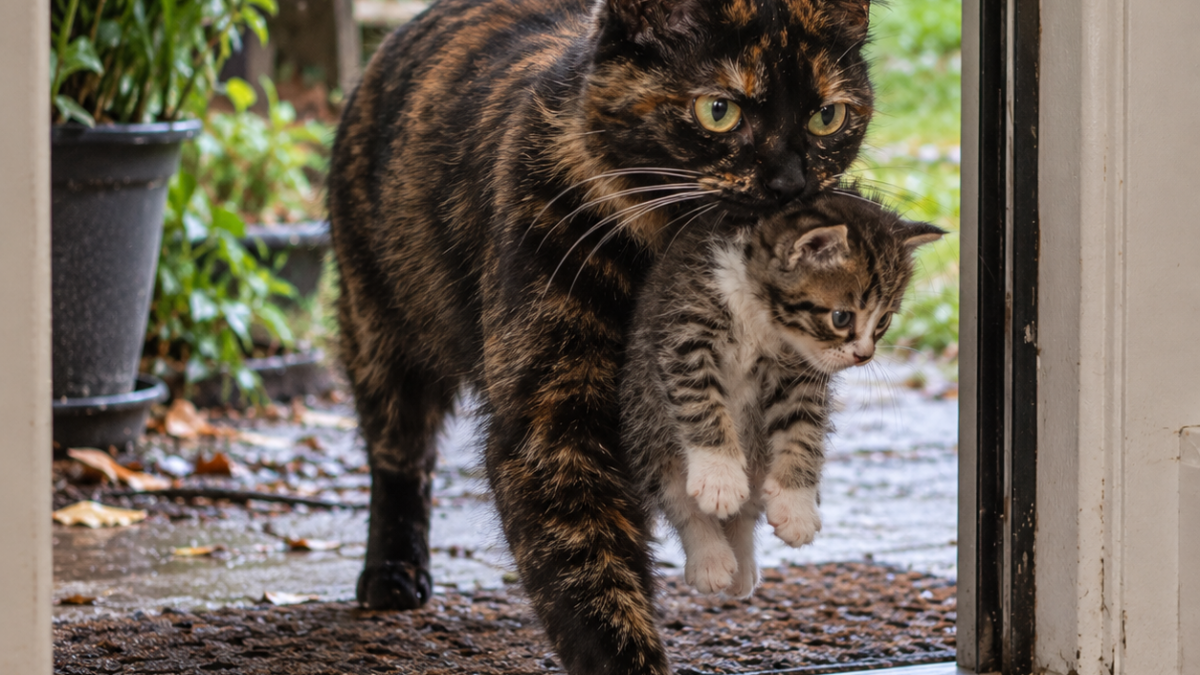
Pepper picked the kitten up by the scruff.
Walked toward the door.
Stopped.
Looked inside.
Then crossed the threshold.
For the first time.
No trap.
No food lure.
No chase.
She entered because she chose to.
She carried the kitten under my dining table.
Put him down.
Then immediately ran back outside.
I thought:
More kittens.
Of course.
I grabbed a flashlight but stopped myself from following.
If she had a nest, chasing her could make things worse.
So I waited.
Five minutes.
Ten.
Twenty.
Pepper didn’t return carrying another kitten.
At forty minutes, she appeared alone.
She walked inside.
Went beneath the table.
Curled around the tiny kitten.
That’s when I understood.
She hadn’t brought me the first.
She had brought me the last.
I don’t know how I knew.
Maybe her body language.
Maybe the way she settled.
Maybe because she stopped searching.
But I knew.
I found a cardboard box.
Clean towels.
Heating pad wrapped beneath half the box so the kitten could move away from warmth if needed.
I had no idea what I was doing.
Marlene’s emergency number went to voicemail.
So I called the twenty-four-hour veterinary clinic.
They asked:
“How old?”
“I don’t know.”
“Eyes open?”
“Yes.”
“Walking?”
“Barely.”
“Breathing normally?”
“I think.”
“Any discharge?”
“Yes.”
“Bring them.”
Pepper complicated that.
I had one cat carrier from borrowing a friend’s years earlier.
Getting Pepper into it without destroying the trust she’d just handed me seemed impossible.
The veterinarian suggested bringing the kitten first if the mother could not safely be transported, as long as I returned quickly and kept Pepper inside.
I closed every exterior door.
Blocked access to dangerous hiding spaces.
Set food and water near the dining table.
Then reached for the kitten.
Pepper’s head rose.
Low growl.
I stopped.
“Okay.”
“I know.”
I placed my hand on the floor.
Not toward her.
Just there.
Pepper stared.
The kitten made a tiny sound.
Barely a squeak.
Pepper looked down at him.
Then at me.
I waited.
Finally, she shifted backward.
Not much.
Enough.
I lifted the kitten in a towel.
He weighed almost nothing.
That scared me.
His body felt too warm in some places and too cold in others.
Eyes crusted.
Nose dirty.
Ribs visible beneath fur.
Pepper watched.
Didn’t attack.
I put him in the carrier.
Then drove faster than I should have.
The emergency clinic was fifteen minutes away.
A veterinarian named Dr. Priya Shah examined him.
Estimated age:
Four to five weeks.
Severely underweight.
Dehydrated.
Upper respiratory infection.
Possible gastrointestinal infection.
Flea burden.
Low body temperature despite the feverish feel I’d noticed around his face.
Dr. Shah looked at me.
“Where’s the mother?”
“At my house.”
“Can you bring her tomorrow?”
“If she lets me.”
“She needs evaluation too.”
I nodded.
Then asked:
“Is he going to live?”
Dr. Shah didn’t give me false certainty.
“I think he has a reasonable chance.”
“But he’s fragile.”
“We’ll start fluids.”
“Antibiotics if indicated based on the exam.”
“Supportive care.”
“Nutrition.”
“Warmth.”
“Watch his breathing.”
She looked at the kitten.
“He’s still fighting.”
That was enough.
I filled out paperwork.
OWNER NAME.
I hesitated.
Then wrote:
Daniel Mercer.
PET NAME.
Blank.
I stared.
The receptionist said:
“You can leave it blank.”
I don’t know why that bothered me.
So I wrote:
Bean.
No great meaning.
Tiny black-and-brown shape.
Small as a coffee bean.
Bean.
When I returned home around two-thirty, Pepper was exactly where I’d left her.
Under the dining table.
Head up.
Waiting.
She stood immediately.
Looked at the carrier.
Then at me.
I opened it.
Bean made one tiny squeak.
Pepper stepped forward.
Sniffed him.
Then began licking his head so aggressively I worried she’d remove his fur.
I sat on the floor.
Far enough away.
Pepper ignored me.
For the first time, I heard her purr.
Very softly.
Almost vibration more than sound.
That noise broke me.
Not dramatically.
I didn’t sob.
My eyes just filled.
I sat on the kitchen floor at almost three in the morning while a stray cat I’d never touched cleaned her sick kitten beneath my dining table.
And I understood something uncomfortable.
Pepper trusted me more than I had realized.
Maybe not with herself.
But with the one thing she could not afford to lose.
I called Marlene at seven.
She arrived at nine carrying supplies, traps, towels, and the confidence of somebody who had handled hundreds of frightened cats.
Pepper hated her instantly.
Marlene looked under the table.
“Well.”
“What?”
“Congratulations.”
“For?”
“You’ve been chosen.”
“I didn’t agree to anything.”
“Cats don’t care.”
She examined Bean from a distance while I explained the veterinary visit.
Then we worked on Pepper.
The goal wasn’t forcing affection.
It was medical evaluation.
Marlene set up a larger humane trap with food.
Pepper stared at it.
Walked around it.
Then went back to Bean.
Marlene sighed.
“She knows.”
“Of course she knows.”
We eventually used a transfer setup that minimized handling and stress.
Pepper went to the clinic later that afternoon.
She was underweight.
Flea-ridden.
Mildly anemic.
Had recently given birth.
No microchip.
The veterinarian estimated her age around two years.
Maybe three.
There were signs she’d had more than one kitten.
That confirmed what I’d feared.
Dr. Shah couldn’t tell me exactly what happened to the others.
Predation.
Illness.
Exposure.
Congenital problems.
Accident.
We would never know.
I asked:
“Would she understand they’re gone?”
Dr. Shah considered.
“Not the way you or I would describe grief.”
“But cats respond to loss.”
“She may search.”
“Call.”
“Become restless.”
“Become more protective of the surviving kitten.”
I looked toward Pepper’s carrier.
“Will she leave him?”
“Probably not if she believes he’s vulnerable.”
Then:
“She brought him into your house.”
“Yes.”
Dr. Shah smiled.
“That’s significant.”
I didn’t want to romanticize it.
Pepper may simply have known:
Food here.
Shelter here.
Human not dangerous.
That was enough.
You don’t need magic when trust already explains something extraordinary.
Bean improved slowly.
Very slowly.
The first week was exhausting.
Medication.
Warm food.
Cleaning eyes.
Monitoring weight.
Watching breathing.
Pepper remained under the table.
I turned the dining room into a temporary cat ward.
Blankets around the edges.
Low litter tray.
Food.
Water.
Box.
The actual cat shelter I’d built outside remained completely unused.
Naturally.
I slept on the sofa because every sound woke me.
One morning at four, Bean started crying.
Pepper immediately stood.
I crawled from the sofa.
He was trying to climb out of the box.
That was good.
Annoying.
Good.
Pepper watched me place him back.
She didn’t growl.
Progress.
Another night, I fell asleep on the floor beside the table.
When I woke, Pepper was sitting three feet from my face.
Watching.
I did not move.
She sniffed the air.
Then walked away.
Progress.
Bean gained weight.
His eyes cleared.
His breathing improved.
He discovered walking properly.
Then immediately used this new ability to become a menace.
He escaped the box.
Climbed behind the curtains.
Attacked shoelaces.
Tried to eat the corner of a paper grocery bag.
Pepper followed him everywhere.
Patient.
Watchful.
Whenever Bean wandered too far, she picked him up and carried him back.
He hated that.
I sympathized.
At six weeks, Bean decided my sofa belonged to him.
He couldn’t climb it.
So he screamed at it.
I lifted him.
Pepper watched.
Still no attack.
Bean crawled across the cushions.
Then slept.
I said:
“This is temporary.”
Pepper blinked.
“Both of you.”
She blinked again.
I knew I was losing.
Marlene started talking about adoption.
“Once Bean is old enough, we can list him.”
“Good.”
“And Pepper?”
I looked at her.
“What about Pepper?”
“She can be evaluated for socialization.”
“If she’s not comfortable indoors long-term, we consider options.”
“But she’s already indoors.”
“Yes.”
“She’s been here three weeks.”
“Yes.”
“She hasn’t tried to leave.”
“Also yes.”
I stared.
Marlene smiled.
“You hear yourself, right?”
“I can’t have two cats.”
“Why?”
“I work.”
“From home.”
“I travel.”
“How often?”
“Almost never.”
“My house isn’t set up.”
“There are literally cat ramps in your online shopping cart.”
I looked at her.
“How do you know that?”
“You told me.”
I had.
Terrible mistake.
I said:
“I was researching.”
“Of course.”
Marlene had the decency not to laugh.
Pepper’s first touch happened thirty-one days after she carried Bean inside.
I remember because I had been counting without admitting I was counting.
Morning.
Seven-twelve.
Coffee brewing.
Bean asleep on a chair after spending ten minutes attacking my sock.
Pepper sat by the kitchen doorway.
She had started waiting there every morning.
Not close.
But visible.
I placed her breakfast down.
Backed away.
She ate.
Then instead of returning beneath the table, she walked toward me.
I froze.
She stopped about two feet away.
Sniffed.
I lowered my hand slowly.
Not toward her head.
Just down.
Pepper took one step.
Then another.
Touched her nose to my knuckle.
My heart was pounding harder than it had on my wedding day.
Ridiculous.
She sniffed.
Turned her head.
Then rubbed the side of her cheek against one finger.
I didn’t move.
She did it again.
I whispered:
“Hi.”
Pepper stepped back.
That was all.
Maybe three seconds.
I called my sister immediately.
Megan answered:
“Is someone dead?”
“What?”
“You’re calling at seven in the morning.”
“Pepper touched me.”
Silence.
Then:
“Who is Pepper?”
I realized I had never told her about the cat.
That became a very long conversation.
Megan came over that weekend.
Pepper disappeared beneath the dining table.
“Great relationship.”
“She doesn’t know you.”
“She barely knows you.”
“She’s touched me.”
“Congratulations.”
Bean climbed Megan’s leg.
She screamed.
I laughed.
Megan fell in love with him instantly.
Then ruined my adoption plan.
“You aren’t giving this kitten away.”
“I am.”
“No.”
“Marlene has families.”
“Daniel.”
“What?”
“Look at your living room.”
Cat toys.
Blanket.
Scratching pad.
Two cardboard boxes.
A tiny tunnel.
One expensive cat tree Bean couldn’t properly climb yet.
I said:
“That doesn’t prove anything.”
“You have become somebody’s divorced aunt.”
“I don’t know what that means.”
“Neither do I.”
Then she picked up Bean.
He purred immediately.
“I’m stealing him.”
“No.”
The word came out too fast.
Megan smiled.
There it was.
I sighed.
“Shut up.”
“I said nothing.”
“You’re thinking loudly.”
Runs in the family.
I called Marlene Monday.
“I think Bean’s staying.”
She said:
“Shocking.”
“And Pepper.”
Long pause.
“Are you sure?”
“No.”
“Good.”
“You’re learning.”
That was how I adopted two cats.
Not officially that day.
There was paperwork.
Veterinary follow-up.
Pepper was spayed once medically appropriate.
Bean vaccinated.
Microchips.
Registration.
The rescue helped make sure no owner had reported Pepper missing.
Not one.
No chip.
No matching lost-cat reports.
After the required process, she became mine legally.
Or I became hers.
Depends who you ask.
Pepper adapted slowly.
Very slowly.
Visitors scared her.
Doorbells sent her under furniture.
Vacuum cleaner meant apocalypse.
Sudden reaching terrified her.
I learned to let her initiate contact.
Bean did not share these concerns.
Bean believed strangers existed to entertain him.
At eight weeks, he greeted the mail carrier through the window.
At ten weeks, he stole a piece of chicken from Megan’s plate.
At twelve, he figured out how to open the bathroom cabinet.
Pepper watched him with an expression I can only describe as maternal disappointment.
Their personalities couldn’t have been more different.
Pepper moved like somebody checking every exit.
Bean entered rooms as though he owned shares in the property.
Pepper slept curled tightly.
Bean slept upside down with his legs spread like a small drunk person.
Pepper ate carefully.
Bean inhaled meals and then checked hers.
She corrected that with one paw.
He learned.
Mostly.
Then something changed in me.
I started inviting people over.
That sounds unrelated.
It wasn’t.
Rachel and I had entertained constantly when we were married.
After the divorce, I stopped.
The house became functional.
Work.
Eat.
Sleep.
Repeat.
Megan visited because of Bean.
Then my friend Marcus.
Then a neighbor.
Everyone wanted to see “the cat who brought her baby inside.”
Pepper hid at first.
Eventually she watched from the stairs.
Then the doorway.
Months later, she remained in the room when visitors came.
One evening, Marcus sat on the sofa.
Pepper walked across the floor.
Everyone froze.
She sniffed his boot.
Marcus whispered:
“I’m being selected.”
I said:
“Don’t ruin it.”
He didn’t move.
Pepper rubbed against his ankle.
Marcus looked at me with genuine emotion.
“Oh my God.”
“She likes me.”
“Don’t make this about yourself.”
Bean jumped into his lap and immediately knocked over his drink.
Balance restored.
My house felt different.
Not full exactly.
Alive.
There were sounds.
Little feet on hardwood.
Bean chirping at birds.
Pepper jumping onto the windowsill.
Food bowls.
Water fountain.
Occasional object falling at two in the morning.
At night, Pepper started sleeping downstairs near the window.
Then on the armchair.
Then one evening I woke on the sofa and found her curled against my leg.
I didn’t move for almost an hour.
My back hurt.
Worth it.
The old outdoor bowl stayed in the cabinet.
I kept thinking I should throw it away.
Didn’t.
Eventually I put it on a shelf in the garage.
Megan saw it.
“You kept the bowl?”
“Apparently.”
“Sentimental.”
“No.”
“It’s a plastic bowl.”
“Exactly.”
“Daniel.”
“Go away.”
She laughed.
One summer evening, Rachel contacted me.
We hadn’t spoken beyond practical things for more than a year.
She’d remarried.
Had a baby daughter.
I knew because Megan had seen it online.
Rachel texted:
I heard you adopted cats.
I replied:
They adopted poorly.
She sent a laughing emoji.
Then:
I’m glad the house isn’t so quiet anymore.
That sentence hit differently than I expected.
I stared at it.
Then wrote:
Me too.
No bitterness.
No reopening old history.
Just two people acknowledging that life had moved.
Pepper changed over the first year.
Not completely.
She remained cautious.
But she began meeting me at the kitchen every morning.
If I slept late, she sat outside the bedroom and scratched once.
Precisely once.
Bean scratched continuously.
Pepper had standards.
She learned my work schedule.
At nine, I sat at the computer.
At eleven, coffee.
At one, lunch.
At four, Bean demanded play.
At six, Pepper waited for dinner.
Animals learn the shape of your life.
Then they become part of the shape.
Sometimes I wondered about those missing kittens.
Especially when Pepper washed Bean’s ears.
Did she remember them?
Did she search after bringing him inside?
Was that why she ran outside immediately?
Had she gone back to the nest one final time?
I don’t know.
I had to accept that.
There are parts of Pepper’s story I will never know.
Where she was born.
How she lost the ear tip.
Whether someone once owned her.
How many kittens she had.
What happened during those thirteen days.
Which danger finally convinced her to carry Bean toward my house.
I could invent a beautiful answer.
She knew I was kind.
She remembered I never chased her.
She chose me.
Maybe.
But animals don’t need to turn their choices into human poetry for those choices to matter.
Pepper knew my garden was predictable.
Food appeared.
Water stayed clean.
No one cornered her.
No dog chased her.
No person grabbed her.
Maybe safety is simply the accumulation of things that don’t happen.
That thought stayed with me.
I had always assumed trust was built through action.
Doing.
Proving.
Helping.
Pepper taught me that sometimes trust grows because you consistently refrain.
Don’t chase.
Don’t force.
Don’t touch.
Don’t demand.
Just show up.
Fill the bowl.
Leave.
Repeat.
That’s harder than it sounds.
Especially when you want to help.
The rescue group eventually asked me to volunteer.
I said no.
Then yes.
Not animal handling.
I wasn’t ready for that.
Photography.
They needed decent adoption pictures.
My architecture work meant I understood light and composition.
Turns out cats do not care about composition.
I volunteered twice a month.
Senior cats.
Shy cats.
Kittens.
Cats who climbed my equipment.
Cats who refused to look anywhere except directly away from the camera.
Marlene loved making fun of me.
“You’re supposed to make them look adoptable.”
“They are sabotaging the shoot.”
“They’re cats.”
“Exactly.”
I got better.
Pepper helped indirectly.
I learned patience.
Wait.
Let the animal settle.
Don’t force eye contact.
Don’t make every photo about perfect posture.
Catch who they are.
A gray senior named Walter got adopted after one of my photographs showed him asleep with his paw hanging off a cushion.
Marlene said:
“That picture did it.”
I said:
“Walter did it.”
Good answer.
She nodded.
By then Pepper allowed Megan to touch her.
Marcus occasionally.
No one else.
Bean allowed anyone with functional hands.
At two years old, he weighed eleven pounds and believed the sofa belonged to him.
Pepper remained smaller.
Seven pounds.
Rusty patch still visible in summer light.
Ear still ragged.
One winter morning, I caught her staring through the back door at the old bench.
Snow covered the yard.
She sat for a long time.
I wondered whether she wanted out.
That frightened me.
Not because I intended to imprison her.
Because I didn’t know what I would do if she chose the garden again.
I opened the door an inch.
Cold air rushed in.
Pepper stepped forward.
Sniffed.
Then turned around.
Walked to the sofa.
Curled beside Bean.
That was her answer.
She still liked the window.
Not the weather.
Fair.
The old bench eventually collapsed.
The cracked center slat finally gave way after a storm.
I dragged it toward the curb.
Stopped.
Pepper watched through the window.
Ridiculous.
I took it back.
Repaired it.
Sanded.
Replaced the rotten board.
Painted it dark green.
The job I’d promised my mother I’d do years earlier.
When Megan saw it, she said:
“You restored the cat bench?”
“It was Mom’s.”
“Convenient.”
Both things were true.
The bowl had sat beside that bench.
Pepper had stood beneath it carrying Bean.
Some objects become meaningful because life happens around them.
Not because we plan it.
I put the bench back.
No food bowl.
Just bench.
Sometimes I sat there in summer.
Pepper watched through the window.
Bean pawed at the glass.
I never fed strays outside again without a plan.
That’s another thing I learned.
Feeding outdoor cats can help an individual animal, but it can also create dependence without solving reproduction, disease, or welfare problems.
So when another stray appeared two years later, I called the rescue immediately.
Humane trap.
Scan for chip.
Veterinary care.
TNR or adoption depending on temperament.
Actual system.
Pepper had turned me from a man putting food in a bowl into somebody who understood that kindness works better when paired with responsibility.
Marlene said:
“Look at you.”
“Don’t.”
“Community cat advocate.”
“I will resign.”
“You don’t work here.”
“Even better.”
Bean had one major health scare at age three.
He stopped eating.
Then vomited twice.
I drove him to the emergency clinic convinced the universe had decided I was too comfortable.
Turned out he had swallowed a piece of string.
Not enough to cause a complete obstruction, thankfully.
Veterinarian monitored him carefully.
Treatment worked.
He passed it.
I spent twelve hours terrified and then several hundred dollars being furious.
I came home.
Pepper inspected Bean.
Licked his head.
Then swatted him.
Correct response.
I said:
“Your son is an idiot.”
Pepper looked at me.
“Your genetics.”
She turned away.
No accountability.
Motherhood.
Pepper herself remained surprisingly healthy.
Routine exams showed old dental damage.
One fractured tooth.
Scarred ear.
No major chronic disease.
At five, she had a dental procedure.
I was more nervous than she was.
At seven, mild arthritis started.
At eight, she became more affectionate.
Maybe age.
Maybe trust.
She began sleeping beside me every night.
Not on top.
Beside my legs.
Bean slept above my head like an entitled hat.
At nine, Pepper finally let a stranger pet her voluntarily.
The stranger was Dr. Shah.
The same veterinarian who had treated Bean that first night.
She came to the house for dinner after Marlene introduced us socially.
No romance.
People always expect that part.
No.
Priya and I became friends.
She sat on my sofa.
Pepper approached.
Sniffed.
Then rubbed against her hand.
Priya looked at me.
“This is historic?”
“Yes.”
“Should we call the press?”
“Don’t scare her.”
Bean climbed into Priya’s lap before dessert.
Predictable.
Years passed.
That’s the part stories usually rush.
But years are the story.
Pepper didn’t remain frozen as the frightened mother beneath my table.
Bean wasn’t always a sick kitten.
They became ordinary.
That is the happiest possible outcome for rescued animals.
Ordinary.
Pepper hated vacuum day.
Bean stole socks.
Pepper sat beside me whenever it rained.
Bean discovered mirrors and fought himself for a week.
Pepper developed a habit of tapping my wrist when dinner was late.
Bean knocked a Christmas tree over.
Twice.
I took a vacation and hired a cat sitter.
Pepper hid for two days.
When I returned, she ignored me for six hours.
Then slept against my chest.
Punishment completed.
Megan got married.
Bean tried to climb her dress when she visited before the wedding.
Pepper sat on the gift bag.
Rachel sent a Christmas card one year with her daughter holding a kitten.
I smiled.
Life doesn’t always end relationships cleanly.
Sometimes people simply move into different stories.
Pepper and Bean had done something similar for me.
They didn’t “heal” my divorce.
I wasn’t broken.
They changed my routines.
Made the house less centered on absence.
That mattered.
At fifty, I sold my architecture business to a younger partner and cut my hours.
More time in the garden.
I expanded native plants.
Added bird-safe window decals after Bean launched himself into the glass trying to reach a chickadee.
I built a screened catio attached to the kitchen.
Pepper’s reaction the first time I opened the catio door surprised me.
She stepped outside.
Stopped.
Wind moved through the mesh.
Leaves rustled.
She sniffed for almost a full minute.
Then walked to the far corner.
Sat.
For the first time in years, she was technically outdoors.
But protected.
No open fences.
No predators.
No roads.
No need to run.
Bean joined her immediately and tried to climb the roof.
Of course.
The catio became their favorite place.
Pepper watched the garden.
The bench.
The spot where her old food bowl once sat.
Sometimes she’d fall asleep in the sun.
I wondered whether the smells brought anything back.
Maybe.
Again:
I don’t know.
By eleven, Pepper’s arthritis worsened.
Medication helped.
Ramps.
Low furniture.
Heated bed.
I became the kind of person who owned orthopedic cat furniture.
Megan sent photographs to everyone.
Betrayal.
Bean was nine then.
Still acting five.
He slowed slightly but remained healthy.
Pepper’s kidney values began creeping upward.
Early disease.
Common in older cats.
Manageable.
Special diet.
Monitoring.
More water.
She refused the expensive fountain.
Preferred a ceramic cup on the windowsill.
Of course.
Animals enjoy rejecting money.
At twelve, Pepper had her first bad episode.
Dehydration.
Weakness.
Not eating.
Dr. Shah treated her.
She recovered.
I knew then that the end had entered the story.
Not immediately.
But somewhere ahead.
That knowledge changes how you watch an animal sleep.
You start measuring.
Was today good?
Did she eat?
Did she climb?
Did she groom?
Was she comfortable?
You become an accountant of quality.
I hated that.
Then remembered the first year.
Pepper had never been promised forever.
None of us are.
What mattered was that she had moved from a garden where survival required hiding to a house where old age became possible.
Old age is a privilege rescue stories sometimes forget.
She reached thirteen.
Then fourteen.
Bean was eleven.
One autumn morning, Pepper didn’t come to breakfast.
I found her in the catio.
Curled beneath a blanket.
Awake.
She looked at me.
Didn’t stand.
My stomach dropped.
At the clinic, bloodwork showed her kidneys had worsened significantly.
There were treatment options.
Fluids.
Medication.
Diet support.
We tried.
For two months, she had good days.
Not perfect.
Good.
She ate.
Sat in the sun.
Groomed Bean.
Slept beside me.
Then one night, she stopped eating.
The next morning, she struggled to stand.
I knew.
Dr. Shah came to the house.
That was a kindness I will never forget.
Pepper lay on the windowsill cushion.
Bean nearby.
Priya examined her gently.
Then looked at me.
“We can hospitalize.”
“Would it change where this is going?”
“Probably not.”
“Could she have another few days?”
“Maybe.”
“At what cost to her?”
Priya didn’t answer immediately.
Then:
“She is tired.”
I sat beside Pepper.
For fourteen years, nearly, she’d controlled every step toward me.
First five feet.
Then three.
Then a nose against my knuckle.
Then sofa.
Then bed.
Trust had always been her decision.
It felt wrong to make the last decision without asking in the only way I could.
I put my hand beside her.
Pepper lifted her head.
Slowly.
Pressed her cheek against my fingers.
Then left it there.
I cried.
Not quietly.
Bean watched.
Priya waited.
I said:
“Okay.”
Pepper died at home.
On the windowsill.
Sunlight across her rusty-brown patch.
My hand under her cheek.
Bean beside her.
No fear that I could see.
No bushes to hide under.
No cold garden.
Home.
Afterward, Bean searched for her.
That nearly destroyed me.
He checked:
Under the dining table.
Bedroom.
Catio.
Window.
The old places.
He called.
A sound I’d rarely heard from him.
Priya had suggested letting him see Pepper after she died so he could process her absence in his own way.
He sniffed her.
Sat beside her.
Then eventually walked away.
For several days, he was quiet.
So was I.
The house became strange.
Pepper had always been the softer presence.
Bean made noise.
Pepper made patterns.
She was simply there.
Window.
Chair.
Catio.
Bed.
When she disappeared, empty spaces became visible.
I understood why people avoid older animals.
Not because older animals are less lovable.
Because we know the math.
Less time.
Maybe more medical care.
A goodbye that can feel too close to hello.
But here’s what people get wrong.
I didn’t have “only” fourteen years with Pepper because she came to me as an adult stray.
I had fourteen years I never would have had if she’d stayed afraid beneath a bush.
Fourteen winters.
Fourteen springs.
Thousands of mornings.
Her life did not become less valuable because I could eventually lose it.
Bean stayed with me another five years.
He became old too.
Slower.
Still entitled.
Still convinced the sofa belonged to him.
At sixteen, he developed heart disease.
Managed for a while.
Then one January night, he climbed into my lap.
That had become rare because arthritis made jumping difficult.
I lifted him.
He slept on my chest.
I remembered carrying him in a towel to the emergency clinic when he weighed almost nothing.
Tiny.
Dirty.
Barely making sound.
Now sixteen pounds of elderly cat snoring against my ribs.
He died six months later.
Also at home.
Also peacefully.
After Bean, I told everyone:
No more cats.
Megan laughed.
Marlene, now retired, laughed harder.
Priya said nothing because veterinarians know better than to challenge grieving declarations.
For eight months, no cat.
The house was clean.
Very clean.
Too clean.
No litter.
No fur.
No food bowls.
No one screaming at closed doors.
I traveled.
Worked a little.
Visited Megan.
Sat in the garden.
The old bench remained.
One evening, I saw a small gray cat near the fence.
I went inside.
Did not put food out.
Instead, I called the rescue.
“Daniel?”
New coordinator.
Marlene had apparently told them about me.
“Yes.”
“We heard you were retired.”
“I am.”
“From what?”
“Cats.”
She laughed.
The gray cat turned out to have a microchip.
Lost for six days.
Owner lived three streets away.
We reunited them.
That should have been the end.
Two months later, the rescue asked if I would foster an older cat recovering from dental surgery.
“Temporary.”
They said.
Her name was June.
Twelve years old.
White paws.
Angry.
Hated men.
Naturally, she came to my house.
She hid under the bed for eleven days.
On day twelve, she bit me.
On day sixteen, she slept beside my foot.
I adopted her three months later.
Apparently retirement failed.
June was not Pepper.
That’s important.
I didn’t want another Pepper.
No animal should be forced to become a replacement for one that died.
June was loud.
Pepper had been quiet.
June loved visitors.
Pepper tolerated three people.
June hated the catio.
Pepper loved it.
Different life.
Different relationship.
Good.
The old bowl stayed in the garage.
I never used it again.
Not because it was sacred.
Because it belonged to the beginning of one specific story.
Years later, when I moved to a smaller house, Megan helped me pack.
She found the bowl.
“Seriously?”
“What?”
“You still have this?”
“Yes.”
“Daniel, this thing cost four dollars.”
“Probably less.”
She held it up.
“Why?”
I looked through the window at the garden.
The repaired green bench.
The rhododendrons.
The place Pepper first stood beside Bean.
Then I said:
“Because she came back.”
Megan’s expression softened.
That was all.
Pepper came back.
For nearly two weeks, I thought she was gone.
Maybe she could have taken Bean somewhere else.
Maybe another porch.
Another shed.
Another food bowl.
But she came to mine.
I don’t know whether cats understand kindness in the moral way humans like to imagine.
I don’t need them to.
Pepper understood pattern.
This house:
Food.
Distance.
No chasing.
No grabbing.
No threat.
When everything else had apparently failed, she remembered that.
Sometimes trust is nothing more complicated than remembering where nobody hurt you.
That thought changed me more than I expected.
People often believe trust is built by grand gestures.
Apologies.
Promises.
Declarations.
Pepper didn’t care about any of those.
For months, all I did was put down a bowl and walk away.
The walking away mattered as much as the food.
Maybe more.
I showed her:
I can come near you and choose not to.
I can want to help you and still respect the distance you’re asking for.
I can be consistent without demanding anything back.
Then, when she needed somewhere safe enough for the only kitten she had left, the decision was hers.
She crossed the threshold.
I didn’t carry her inside.
Didn’t trap her that night.
Didn’t coax.
She chose.
That’s why I never say:
I rescued Pepper.
It sounds wrong.
I fed her.
Veterinarians treated her.
The rescue helped.
I gave her a room.
Eventually a home.
But Pepper made the first impossible choice.
She walked inside.
And she didn’t come alone.
The kitten she carried became the reason she trusted me enough to stay.
Or maybe she became the reason I trusted life enough to let something depend on me again.
That’s the part I understand better now.
After Rachel left, I had built a life where nothing could surprise me emotionally.
Work.
Bills.
Meals.
Quiet house.
No one needing too much.
No one leaving because I wasn’t enough.
Then a stray cat dragged a sick kitten through my back door and destroyed the arrangement.
Thank God.
I didn’t need a perfect family.
Pepper didn’t need a perfect rescuer.
Bean definitely didn’t need perfection.
He once ate string.
We needed consistency.
Morning.
Food.
Medicine.
Window.
Sofa.
Someone there.
Those ordinary repetitions became a life.
When people hear Pepper’s story, they always ask:
“Why do you think she chose you?”
I used to invent answers.
She knew I was kind.
She sensed I would help.
She trusted my energy.
All very flattering.
Now I say:
“I was the house that kept putting food out and never chased her.”
That’s enough.
Maybe the best kind of trust isn’t mysterious at all.
It’s earned through hundreds of small moments nobody photographs.
The door that doesn’t slam.
The hand that doesn’t grab.
The bowl that appears.
The person who leaves space.
Then one night, when the world has become too dangerous to handle alone, you remember where safety was boring.
And you go there.
I think about that whenever I see the old bench.
The wood is fading again.
Green paint peeling.
One armrest still slightly crooked despite my repair.
I could replace it.
I won’t.
Not yet.
Sometimes I sit there in the evening.
No food bowl beside me.
No black cat under the bushes.
No tiny kitten.
Just memory.
But not sad memory.
Not mostly.
Pepper got old.
Bean got old.
That is the happy ending.
They didn’t remain dramatic rescue animals forever.
They became annoying household cats.
They shed.
They cost money.
They woke me up.
They ruined furniture.
They got arthritis.
They lived long enough to become ordinary.
That’s all I ever wanted for them after that first night.
Ordinary.
Safe.
Fed.
Loved.
Home.
And when I think back to 12:17 in the morning, motion light glowing across wet grass, Pepper standing beneath that bench with Bean trembling beside her, I no longer wonder why she came.
I think I know enough.
She remembered the bowl.
She remembered the door.
Most of all, she remembered that for months I’d been close enough to frighten her and had chosen not to.
So when she had one tiny life left to protect, she came to the place where nothing had ever demanded anything from her.
She carried Bean through my door.
Then she went back outside one last time.
When she returned alone, she curled around him beneath my table.
And without any of us realizing it yet, that was the night the stray cat stopped visiting my house.
She came home.








