HOA Karen Sent Armed Security to Seize My Lakeside Cabin and Clear a Protected Wetland—She Vastly Underestimated What I Had Already Recorded.k
HOA Karen Sent Armed Security to Seize My Lakeside Cabin and Clear a Protected Wetland—She Vastly Underestimated What I Had Already Recorded
She arrived before breakfast with private security, a lawyer, and paperwork claiming my inherited cabin had suddenly become an HOA violation.
Behind her threats was something much larger: two protected acres beside my property that developers had been trying to reach for years.
When one of her men stepped onto my porch and told me I had ten minutes to leave my own land, I realized they weren’t there to inspect anything.
The engines reached my cabin before the sunlight did.
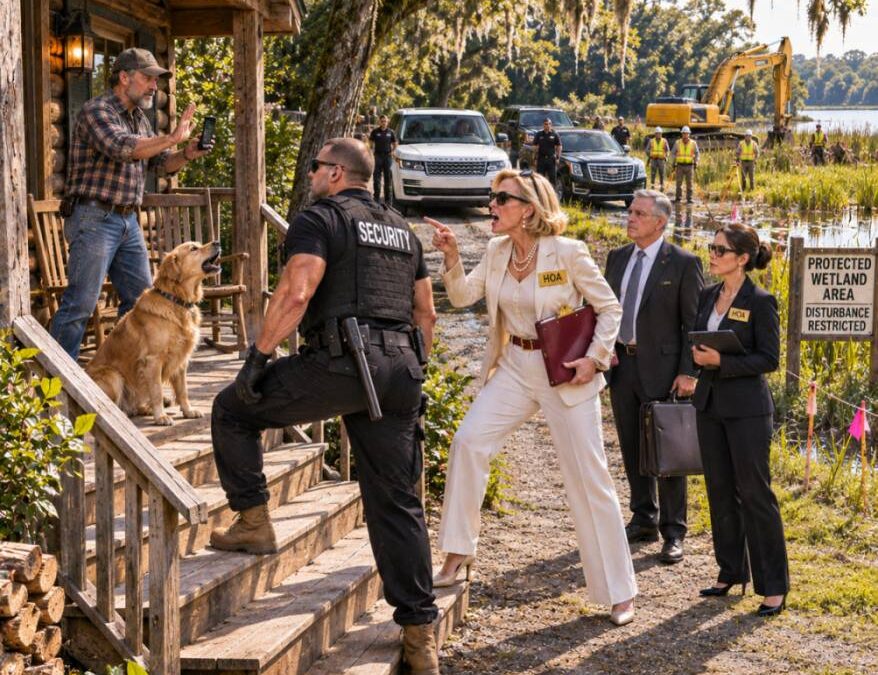
I was halfway through my first cup of coffee when a white Range Rover appeared through the fog, followed by a black Cadillac SUV and a silver Lexus throwing dust over the dirt road that curved around Serenity Lake.
Scout lifted his head from beside my chair.
My golden retriever rarely barked.
That morning, he stood.
Three vehicles stopped in front of my gate.
The driver’s door of the Range Rover opened first.
Vanessa Sterling stepped out wearing a cream blazer, white trousers, oversized sunglasses, and enough confidence to suggest the entire lake had been waiting for her permission to exist.
She was fifty-eight and president of the Serenity Lake Property Owners Association.
Behind her came a man I knew only as Bruno Callahan, owner of a private security company the HOA had recently hired.
Six-four.
Heavy shoulders.
Black polo stretched across his chest.
A stun baton clipped to his belt.
Then Leonard Price, an attorney whose name had begun appearing on every threatening HOA letter I’d received that summer.
Last came Chloe Reed, Vanessa’s board secretary, clutching a tablet.
I stayed on the porch.
“Morning.”
Vanessa stopped at the bottom step.
“Mr. Harper.”
“Nathan is fine.”
“We’re past informality.”
Scout gave a low growl.
Vanessa looked at him.
“That dog is another issue.”
“He’s lying beside his own porch.”
“Unrestrained.”
“On private property.”
She smiled.
“That phrase keeps getting you into trouble.”
Leonard opened his briefcase.
Vanessa gestured toward my cabin.
“This structure is in violation of Article Twenty-Three governing exterior maintenance, approved materials, and compatibility standards.”
I took another drink of coffee.
“My cabin predates Serenity Lake Estates by twenty-eight years.”
“That does not exempt you from current standards.”
“Actually, my recorded deed does.”
Her smile thinned.
Behind them, Bruno wasn’t looking at my cabin.
Neither was Chloe.
Both kept glancing past the eastern fence toward the low wetland beyond my property.
Two acres of reeds, blackwater channels, cypress knees, and nesting habitat stretched between my land and the wider lake.
A faded government marker stood near the boundary.
PROTECTED WETLAND AREA — DISTURBANCE RESTRICTED.
Vanessa noticed me watching them.
She changed the subject.
“We’re conducting a compliance inspection.”
“Show me the inspection authorization.”
Chloe handed Leonard a paper.
He gave it to me.
The sheet was warm.
Fresh printer heat.
I rubbed my thumb across one signature.
Ink smeared.
I looked at Vanessa.
“You printed this in the car?”
Her jaw tightened.
Bruno stepped forward.
“Cooperate, old man.”
I looked at him.
“I’m fifty-four.”
“Whatever.”
He rested one hand near the baton.
“Move aside.”
I set my coffee on the railing.
“Take your hand off that.”
He smiled.
“Or what?”
I had spent thirty years in the Navy.
I had been yelled at by admirals, worked flight decks in storms, and once watched a destroyer lose power in seas high enough to make seasoned sailors pray.
Bruno did not frighten me.
But he did concern me.
There is a difference.
I took out my phone.
Vanessa said, “You are not authorized to record this inspection.”
“You’re standing on my land.”
Bruno climbed the first porch step.
Scout barked.
I raised one hand toward my dog.
“Stay.”
Bruno climbed another.
“Last warning.”
I looked at the baton.
Then at Vanessa.
Then at the freshly printed paper.
And something on Leonard’s business card caught my eye.
Lakeside Ventures LLC.
Same mailing address Vanessa used on her HOA correspondence.
I looked past them again toward the wetland.
That was when the real shape of the visit became clear.
“This isn’t about my cabin,” I said.
Nobody answered.
I pointed toward the marsh.
“You’re trying to get through my property.”
Vanessa’s face changed.
Only for a second.
But after three decades of reading people under pressure, a second was enough.
Bruno raised his foot toward the final porch step.
And I knew whatever they wanted beyond my fence was worth enough money that they had stopped caring how obvious they looked.
part 2
My name is Nathan Harper.
I retired from the United States Navy as a captain after thirty years of service.
That sounds more dramatic than my actual retirement.
I did not ride into civilian life beneath flags while a brass band played.
I signed paperwork.
Turned over keys.
Packed three boxes.
Shook hands.
Then drove six hours to a cedar cabin beside Serenity Lake that had belonged to my uncle Tom.
Tom was my mother’s older brother.
Never married.
Never had children.
He spent most of his life repairing marine engines and complaining about politicians regardless of party.
He bought the cabin in 1984, when Serenity Lake was mostly fishing camps, gravel roads, and trees.
The HOA came much later.
So did the stone entrance signs.
The private tennis courts.
The million-dollar homes built on the hills above the lake.
Tom never cared about any of that.
His cabin remained where it always had.
Weathered cedar siding.
Green metal roof.
Two bedrooms.
A porch that leaned just enough to make visitors ask whether it was safe.
It was.
Mostly.
When Tom died, he left the property to me.
I kept it as a weekend place for several years while I finished my last assignments.
When I retired, I moved in permanently.
My plan was simple.
Fish.
Repair the porch.
Read books I had spent thirty years pretending I would read someday.
Take Scout on long walks.
Stay out of everybody’s business.
For the first year, it worked.
Then Vanessa Sterling became HOA president.
Strict HOA presidents are not automatically villains.
Someone has to manage roads.
Someone has to collect assessments.
Someone has to enforce genuinely adopted rules.
The problem begins when a person mistakes administrative responsibility for ownership.
Vanessa did that almost immediately.
Her first letter concerned my exterior paint.
The cabin wasn’t painted.
It was stained cedar.
She said the color did not match the approved Serenity Lake palette.
I replied with the recorded exemption attached to my deed.
Tom had signed a limited road-maintenance agreement when the surrounding subdivision formed.
His parcel contributed to private-road upkeep but was not subjected to the later architectural declaration.
The HOA’s lawyer acknowledged that.
Notice withdrawn.
Second complaint:
Unapproved roof material.
Same answer.
Cabin predates declaration.
Metal roof was installed with county permit after storm damage.
Withdrawn.
Third complaint:
Scout off leash.
The cited rule applied to common property.
Scout had been standing ten feet inside my fence.
Withdrawn.
Then the letters changed.
They stopped identifying clear violations and started talking about “community compatibility.”
“Visual harmony.”
“Changed conditions.”
“Public safety.”
Language vague enough to sound official while proving almost nothing.
I began keeping a binder.
Uncle Tom used to save receipts in old coffee cans.
I had inherited the same instinct in a slightly more organized form.
Then I noticed the vehicles.
SUVs near the wetland.
Survey crews.
Men photographing the eastern property line.
One afternoon, I caught a drone hovering above the reeds.
I wasn’t interested in playing neighborhood detective.
But I knew enough from my Navy years to recognize reconnaissance when I saw it.
So I checked county planning records.
That was where Lakeside Ventures first appeared.
The company had submitted an early concept plan for a marina resort on the far side of the wetland.
Eighty boat slips.
Boutique hotel.
Restaurant.
Forty-six luxury cottages.
Private event pavilion.
The project had one obvious problem.
Access.
The existing road approached from the north through steep terrain and would require extensive grading.
The easier route ran across the eastern edge of my property.
Then through the protected wetland.
The concept plan had been withdrawn after regulators flagged wetland impacts and access deficiencies.
I printed everything.
Three weeks later, Vanessa began claiming my cabin represented a “hazardous nonconforming structure.”
That coincidence interested me.
Then Leonard Price appeared.
His first letter demanded that I grant the HOA an inspection easement.
There was no such easement.
Second letter suggested the association might pursue emergency nuisance authority.
Third letter offered me $180,000 for a strip of land along my eastern boundary.
I declined.
Four days later, Vanessa increased it to $250,000.
I declined again.
She called.
“You’re being unreasonable.”
“I don’t need to sell.”
“Everybody has a number.”
“Maybe. You haven’t found mine.”
“This isn’t only about you.”
“It is my land.”
“Progress requires cooperation.”
“Progress for whom?”
She hung up.
That was when I searched Lakeside Ventures more carefully.
The LLC’s registered office matched an address used by a real-estate holding company tied to Vanessa.
Leonard was listed as counsel.
One of Vanessa’s adult sons held a minority interest through another entity.
None of that was illegal.
It did create a conflict.
The HOA president had been using association channels to pressure me over land that could financially benefit a company connected to her.
So I requested HOA records.
Board minutes.
Contracts.
Legal invoices.
Security contracts.
Communications concerning my parcel.
Vanessa denied most of it.
“Confidential.”
I retained an attorney.
His name was Daniel Mercer.
Former state environmental enforcement lawyer.
Now private practice.
He had the personality of a man who considered enthusiasm suspicious.
I liked him immediately.
He reviewed everything.
Then said:
“Don’t do anything clever.”
“What does that mean?”
“You’re retired Navy.”
“So?”
“Military people think preparation makes them clever.”
“It usually does.”
“No traps. No confrontation. No hacking. No hidden bear pits. No electrified fences.”
“I wasn’t planning any of those.”
He stared at me.
“Good.”
Then he read Leonard’s letters.
“This is pressure.”
“Illegal?”
“Not necessarily by itself.”
“Conflict?”
“Potentially serious.”
“And the wetland?”
“That is where this gets interesting.”
Daniel hired an environmental consultant.
Dr. Hannah Lowell.
Wetland ecologist.
She walked the eastern boundary with me for almost three hours.
The wetland was not simply a swamp somebody had arbitrarily labeled untouchable.
It connected to Serenity Lake through a narrow channel.
Contained wetland vegetation.
Supported amphibian breeding.
Migratory birds.
Shallow spawning habitat along the lake margin.
Some portions potentially fell under federal jurisdiction depending on current law and site-specific hydrology.
Other protections came from state and local rules.
Hannah was careful.
“Don’t tell people this is federally protected in every square foot unless we verify jurisdiction.”
“The sign says protected wetland.”
“That may refer to multiple layers of regulation.”
I smiled.
“Daniel warned me about you.”
“Why?”
“You sound like a lawyer.”
“Occupational hazard.”
She reviewed archived permitting records.
Uncle Tom had participated in a conservation agreement years earlier after a road project threatened the marsh.
That agreement restricted disturbance along a buffer area bordering my property.
My land was not itself a federal nature preserve.
The wetland did have real protections.
And any developer trying to build a road through it would need serious permitting and environmental review.
Lakeside Ventures knew that.
Their withdrawn concept plan proved it.
Then Vanessa’s convoy arrived.
Back on the porch, Bruno stood one step below me.
He had not drawn the stun baton.
But his hand remained close enough to communicate intent.
I kept my voice level.
“Leave.”
Vanessa said, “We’re authorized to inspect.”
“No.”
Leonard opened his briefcase.
“We can resolve this peacefully.”
“Then start by stepping off my property.”
He pulled out another document.
“Emergency inspection authority.”
Daniel had warned me about this possibility.
I read the first page.
It cited an HOA provision allowing access to covered lots when immediate conditions threatened common property.
My parcel was not a covered lot.
There was also no emergency.
I handed it back.
“This doesn’t apply here.”
Leonard sighed.
“Mr. Harper, refusing access will only increase your exposure.”
“Exposure to what?”
“Enforcement.”
“By an HOA that doesn’t have architectural jurisdiction over this parcel?”
Vanessa snapped:
“You benefit from Serenity Lake roads.”
“I pay the road assessment.”
“You live inside this community.”
“My land sits beside it.”
“Technicality.”
Property boundaries are often dismissed as technicalities by people standing on the wrong side of them.
Bruno stepped up.
Scout barked again.
“Stay,” I told him.
Bruno smiled.
“Cute dog.”
Then he reached toward me.
That was the moment he crossed the line.
I stepped back.
Not because I was afraid of him.
Because I wanted the camera above my porch to see everything.
I had installed it two weeks earlier.
Wide angle.
Audio.
Cloud backup.
Bruno didn’t know.
He put one hand on the railing and said:
“You need to cooperate.”
I looked directly at him.
“Do not touch me.”
Vanessa said:
“Bruno, remove him from the inspection area.”
There it was.
Not whispered.
Not implied.
Recorded.
Bruno reached.
I moved sideways.
His boot hit a loose patch on the wet porch.
Not a trap.
Not an irrigation ambush.
Just thirty-year-old cedar after morning fog.
He slipped.
Caught the railing.
Recovered.
Embarrassed.
For a man like Bruno, embarrassment was more dangerous than pain.
His hand went to the stun baton.
I raised both palms.
“Do not.”
Leonard immediately said:
“Bruno.”
Vanessa shouted:
“Get him off the property.”
My property.
Bruno unclipped the baton.
Then another voice came from the driveway.
“That’s enough.”
Everybody turned.
George Miller stood beside the gate holding his phone.
Seventy years old.
Retired accountant.
Vanessa had fined him three times that year because his newspaper remained near the curb after the association’s preferred pickup time.
Behind George were Maria Lopez and Ethan Park.
Three neighbors.
Three cameras.
Vanessa stared at them.
“What are you doing?”
George said:
“Watching.”
Bruno clipped the baton back.
That decision probably saved him from a much worse morning.
I said:
“Everyone leaves now.”
Leonard looked at Vanessa.
She was furious.
But she understood the optics.
Four cameras.
One private security employee who had nearly drawn an electrical weapon against a homeowner.
No warrant.
No court order.
No valid inspection right.
She turned.
“This isn’t over.”
I nodded.
“I know.”
They left.
Within twenty minutes, I downloaded every camera file.
Sent copies to Daniel.
Then to cloud storage.
Then I wrote a timeline.
Not because I was planning revenge.
Because memory becomes less reliable with every retelling.
Daniel called.
“You have audio of Vanessa ordering him to remove you?”
“Yes.”
“And the baton?”
“Yes.”
“Call the sheriff.”
“I was going to.”
“Good.”
“Will they do anything?”
“They’ll document it.”
He paused.
“Nathan, that’s enough for today.”
The deputy who arrived was named Carla Bennett.
She watched the video twice.
Then asked narrow questions.
Did Bruno touch me?
No.
Did he strike me?
No.
Did he activate the baton?
No.
Did he threaten me verbally?
He said he would drag me off the property earlier.
Was that recorded?
Yes.
Did Vanessa have permission to enter?
No.
Had she been told to leave?
Yes.
Bennett took copies.
She did not arrest Vanessa.
She did not arrest Bruno.
She wrote an incident report and referred the potential trespass and threat issues for further review.
That disappointed George.
He wanted handcuffs.
“Television has ruined you,” I told him.
He grunted.
Then he handed me a folder.
“What is this?”
“My fines.”
Newspaper violations.
Trash-bin warnings.
A $300 penalty for a porch railing color difference that had existed before he purchased the house.
“Why are you giving me this?”
“Because you’re not the only one.”
Maria handed me her folder next.
She was thirty-nine.
Single mother.
Two daughters.
Vanessa had issued her repeated warnings for sidewalk chalk, children’s bicycles, and “excessive outdoor play.”
One letter threatened to refer a “persistent supervision concern” to local authorities.
Maria’s hands shook while she explained it.
“My daughter drew flowers on our driveway.”
I felt something cold settle in my stomach.
Ethan Park was next.
He lived near the entrance and worked in cybersecurity.
His dispute involved laundry.
He had installed an energy-efficient drying rack behind a privacy screen.
Vanessa called it an “unapproved domestic utility installation.”
She pushed him into buying an electric dryer after threatening fines.
“This rule never existed,” Ethan said.
“How do you know?”
“Because I downloaded every version of the governing documents.”
I looked at him.
He shrugged.
“IT.”
Of course.
Then he said:
“There’s more.”
He had been helping former HOA president Walter Grayson reconstruct board records after Walter resigned.
Not hacking.
Not stolen passwords.
Walter had retained lawful copies of emails and minutes from his tenure.
The resignation had always seemed strange.
Walter had led Serenity Lake for nine years.
Calm.
Popular.
Then suddenly resigned citing family reasons.
Vanessa replaced him without a regular membership election, claiming an emergency vacancy procedure.
Daniel became very interested.
“Get Walter.”
We did.
Walter arrived at my cabin two days later carrying a cardboard banker’s box.
Silver hair.
Suspenders.
The posture of a man who had spent months carrying shame.
“I should have come sooner.”
“Why didn’t you?”
He looked at Vanessa’s house across the lake.
“She had something on me.”
“What?”
He opened the box.
Inside were printed emails.
Board minutes.
Screenshots.
Financial reports.
Then a photograph.
Walter with a woman who was not his wife.
At least that’s what it appeared to show.
“I never met her.”
I looked closer.
The image was convincing.
Walter said:
“Vanessa emailed this to me anonymously first. Then she showed me other images. Said if I didn’t resign, she’d send them to my wife and the community.”
Ethan had examined the files with Walter’s permission.
He believed several images showed signs consistent with AI manipulation.
Not proof by itself.
But enough that Walter later found the originals from public photographs where his face had apparently been sourced.
Vanessa had allegedly used fabricated compromising imagery to pressure him out.
Daniel’s response was immediate.
“This goes to law enforcement.”
Walter hesitated.
“My wife knows now.”
“What does she think?”
“That I’m an idiot for not telling her immediately.”
“Smart woman.”
Walter almost smiled.
Then he produced financial records.
During Vanessa’s presidency, the HOA’s “security and consulting” expenses had exploded.
Bruno’s company received $3,000 monthly.
Lakeside Ventures received reimbursements labeled “future amenity planning.”
Leonard’s law firm billed for “Phase Two land-access strategy.”
Association money appeared to be supporting work connected to Vanessa’s private development interests.
That did not automatically mean theft.
There might have been authorizations.
Contracts.
Board votes.
We needed records.
So Daniel sent formal demands.
At the same time, Walter filed his own police report regarding the alleged blackmail.
The sheriff’s office referred the digital evidence for forensic review.
Vanessa responded by calling an emergency HOA meeting.
Her email said:
“An organized group of dissident homeowners is spreading defamatory allegations designed to sabotage community development.”
Community development.
There it was again.
The meeting was packed.
Not fifty thousand Facebook viewers.
Not television cameras.
Real homeowners sitting in folding chairs under fluorescent lights.
Vanessa sat at the front.
Leonard beside her.
Bruno stood near the door.
I brought Daniel.
Walter brought his wife.
Maria.
George.
Ethan.
Almost eighty residents.
Vanessa opened with accusations.
“Certain residents have engaged in coordinated harassment.”
Daniel leaned toward me.
“Say nothing unless called.”
I nodded.
Vanessa described my refusal to allow inspection.
She called Walter disgruntled.
She accused Ethan of unauthorized access to HOA records.
Ethan immediately raised his hand.
“That’s false.”
Vanessa ignored him.
Then Daniel stood.
“Point of clarification.”
Leonard sighed.
Daniel continued.
“Mr. Park reviewed records voluntarily supplied by their lawful custodian and former board president. If the association claims otherwise, please identify the specific system it alleges was accessed without authorization.”
Silence.
Ethan smiled.
Daniel sat.
Vanessa moved on.
Then Walter stood.
He did not wait to be recognized.
“I resigned because Vanessa blackmailed me.”
The room exploded.
Vanessa hit the gavel.
“Sit down!”
Walter lifted one of the fabricated photographs.
“She sent me this.”
His wife stood beside him.
“I know the photograph is fake.”
The room quieted.
Walter continued.
“I should have come forward immediately. I was embarrassed. I let fear make the decision.”
Vanessa shouted:
“This is a lie.”
Walter opened the box.
“Then explain the messages.”
Daniel had advised him not to publish everything publicly.
But he could state the existence of evidence already provided to law enforcement.
So he did.
Then George spoke.
Maria.
Ethan.
I stayed quiet.
Vanessa’s eyes kept finding me anyway.
Eventually she snapped:
“This all started because Nathan refuses to support the marina project.”
That sentence changed the room.
Leonard turned toward her.
Daniel stopped writing.
I looked up.
Vanessa realized it.
Too late.
A homeowner asked:
“What marina project?”
Vanessa waved one hand.
“A conceptual development.”
Another voice:
“What does Nathan have to do with it?”
Nobody answered.
Then George said:
“His land is in the way.”
The room erupted again.
Someone shouted:
“Are HOA dues paying for this?”
Another:
“Does Vanessa own Lakeside Ventures?”
Leonard whispered urgently to her.
She ignored him.
“The marina would increase everyone’s property values.”
Susan Hall, the treasurer, said:
“That’s not an answer.”
Vanessa looked at her.
Susan had been quiet for most of Vanessa’s presidency.
Not anymore.
“Did you use association funds for Lakeside Ventures?”
“Planning expenses benefited the community.”
“Did the board approve them?”
“They were within presidential authority.”
Susan shook her head.
“No.”
The word landed harder than shouting.
“You do not have unilateral authority to pay a private company you control.”
Vanessa’s face flushed.
“I don’t control it.”
Daniel quietly slid a public corporate filing toward Susan.
She read it.
Then looked up.
“You are its manager.”
Vanessa stood.
“This meeting is adjourned.”
Susan stood too.
“No.”
The room went silent.
Under the bylaws, four directors could continue a properly noticed meeting if quorum remained.
Four did.
Vanessa walked out.
Leonard followed.
Bruno hesitated.
Then followed them.
The board voted that night to suspend Vanessa’s presidential powers pending independent investigation.
Not remove her from the board yet.
The bylaws required a membership process for that.
But she lost access to HOA financial systems.
Lost unilateral contracting authority.
Lost control of records.
Independent counsel was hired.
A forensic accountant was retained.
That was when the conspiracy stopped being rumor.
The audit found more than $120,000 in questionable expenditures over two years.
Some had legitimate invoices but undisclosed conflicts.
Some lacked adequate authorization.
Some went to companies connected to Vanessa, Bruno, or Leonard.
The exact amount of criminally improper spending was not for homeowners to decide.
Investigators would handle that.
But governance failures were undeniable.
The marina project was more advanced than anyone knew.
Lakeside Ventures had circulated investor materials describing a “community-supported access corridor” through the eastern side of my parcel.
Community-supported.
Nobody had asked me.
A preliminary engineering map showed a road crossing near my cabin and continuing through the wetland buffer.
Another document estimated the cost of acquiring my property.
Next to my parcel:
“Resistance expected — nuisance/condition leverage may improve position.”
I stared at that line.
Daniel read it twice.
“They were going to use HOA enforcement to pressure you into selling.”
“That is how it looks.”
“No.”
He pointed.
“That is what this document says.”
For the first time, anger almost felt clean.
Months of absurd cabin violations had not been random.
Wrong roof.
Wrong siding.
Dog.
Workshop.
Aesthetics.
Inspection.
Every nuisance complaint created leverage.
Make ownership unpleasant.
Then offer money.
The same strategy had apparently been used elsewhere.
Not necessarily criminally.
Not always fraudulently.
But aggressively.
George had been pressured over his property after refusing to support a shoreline easement.
Maria’s lot bordered a proposed walking trail.
Ethan had criticized technology spending.
Different motives.
Same instrument.
HOA enforcement.
Then the environmental problem grew.
Daniel sent the marina maps to the state environmental agency and the relevant federal permitting office.
Again, no dramatic raid.
No helicopter.
Regulators requested information.
Site visits occurred.
Wetland specialists mapped the proposed corridor.
The development concept faced substantial permitting obstacles.
A road through the area could require state and possibly federal approvals, mitigation, alternative analysis, and local land-use review depending on the final design and jurisdictional findings.
The project was nowhere near legally ready.
Yet investor materials described construction as “anticipated within eighteen months.”
Vanessa had been selling certainty she did not possess.
That created another set of angry people.
Investors.
Then came the intimidation.
A black SUV parked outside my cabin overnight.
Could have been coincidence.
I photographed it.
A man called and told me to “let the marina happen.”
Unknown number.
I preserved the voicemail.
Someone cut part of my fence.
Police report.
No accusation without evidence.
Daniel insisted on that.
“Do not turn fear into certainty.”
Easy advice.
Hard practice.
Then Bruno came back.
Not with mercenaries.
Not with tactical teams.
Alone.
He drove his pickup to the cabin at 10:30 one night.
I watched from inside.
Scout stood beside me.
Bruno stayed outside the gate.
Good choice.
He called.
I answered.
“What?”
“I need to talk.”
“Through the phone.”
“I’m done with Vanessa.”
I said nothing.
“She lied to me.”
“That’s unfortunate.”
“She told me the inspection was legal.”
“You threatened to drag me off my porch.”
Silence.
“I was doing my job.”
“No. You were doing something stupid while employed.”
Another silence.
Then:
“I have records.”
That got my attention.
“Send them to your lawyer.”
“I don’t have one.”
“Get one.”
“I want protection.”
“I’m not law enforcement.”
“I know.”
“Then why call me?”
“Because she thinks you started all this.”
“I didn’t.”
“I know.”
He sounded tired.
Not like the wall of muscle from the porch.
Like an employee realizing the person who paid him might leave him holding the bag.
I gave him Daniel’s office number.
Nothing else.
Bruno eventually obtained counsel and cooperated with investigators.
His company records showed Vanessa had personally directed surveillance of my property beyond ordinary HOA inspection activity.
Invoices described:
HARPER ACCESS ASSESSMENT.
ROUTE FEASIBILITY OBSERVATION.
OWNER PRESSURE SUPPORT.
Those phrases were not subtle.
Bruno claimed he believed they were lawful security tasks.
Investigators would decide what they believed.
He also turned over messages where Vanessa instructed him:
“If Harper refuses inspection, make him understand we can make living there difficult.”
Another:
“We need him tired of fighting before Lakeside Ventures makes the final offer.”
That message became central.
Not murder.
Not dark-web poison.
Not a multi-state killing ring.
Something more believable and, in its own way, uglier.
Use bureaucracy.
Use security.
Use social pressure.
Use fines.
Wear the owner down.
Then buy the land.
The criminal investigation expanded into potential fraud, extortion-related conduct, misuse of association funds, and blackmail involving Walter.
I learned not to predict charges.
Daniel corrected me every time I tried.
“We provide evidence. Prosecutors select statutes.”
Vanessa remained free during most of that period.
Neighbors hated that.
They expected obvious wrongdoing to trigger immediate imprisonment.
Real law does not work on neighborhood impatience.
Evidence had to be authenticated.
Digital files examined.
Financial transactions traced.
Witnesses interviewed.
Intent proved.
Leonard’s role was investigated separately.
An attorney representing a client is not criminal merely because the client’s plan is ugly.
What mattered was what he knew and what he personally did.
Some of his documents raised serious questions.
One purported “emergency access order” used against me had never been approved by a court or government authority.
It was an internal demand formatted to look unusually official.
Not technically a court order.
But close enough that several residents believed it was.
The state bar eventually opened disciplinary proceedings based on his conduct.
I stayed away from predicting the result.
The HOA held its membership vote before the criminal cases resolved.
Vanessa attended.
Pink suit again.
I remember that.
Same armor.
Different battlefield.
More than two hundred members voted in person or by proxy.
Walter spoke first.
He apologized.
Not for becoming a victim of blackmail.
For letting fear hand Vanessa authority.
Susan presented the financial audit.
Maria described her experience.
George held up his newspaper fines and said:
“I’ve been afraid of a woman with a clipboard for two years. That is embarrassing.”
People laughed.
Then he added:
“It should also embarrass all of us.”
No laughter after that.
Ethan spoke about systems.
“How many of you assumed somebody else had checked the rules?”
Hands slowly rose.
“How many assumed if a fine appeared on official letterhead, it must be authorized?”
More hands.
“How many stayed quiet because Vanessa wasn’t targeting you?”
Fewer hands.
But enough.
Then my name was called.
I walked to the microphone.
I had spent thirty years speaking to sailors.
Briefing rooms.
Command meetings.
Ceremonies.
Casualty notifications.
There are moments when words matter.
And moments when too many words become a hiding place.
So I kept it simple.
“My cabin is not the issue.”
Vanessa looked at me.
“The marina is not even the whole issue.”
I looked around.
“The issue is what happens when an organization stops asking whether its authority is real.”
Silence.
“Vanessa wanted my land. Instead of negotiating and accepting no, she used HOA machinery to make no expensive.”
I listed the records.
Inspection demands.
Security invoices.
Lakeside Ventures.
Financial conflicts.
Messages.
“Some of you were targeted for different reasons.”
I looked at George.
Maria.
Ethan.
Walter.
“That matters. We don’t improve justice by pretending every person was harmed in exactly the same way.”
Then Vanessa.
“But the instrument was the same.”
I touched the stack of violation notices beside me.
“Authority used without limits.”
I stepped away.
Vanessa demanded to respond.
She got five minutes.
She used twelve.
The first five were controlled.
Volunteer service.
Property values.
Modernization.
Economic opportunity.
Then she began attacking witnesses.
Walter was weak.
Susan disloyal.
George confused.
Maria emotional.
Ethan dangerous.
Me arrogant.
That list told everyone more than her defense did.
Then a homeowner asked from the floor:
“Did you own part of Lakeside Ventures while using HOA resources to pressure Nathan?”
Vanessa answered:
“The project would have benefited the entire community.”
The homeowner repeated:
“Did you own part of it?”
“Yes.”
The room erupted.
Another homeowner:
“Did the board approve the security surveillance?”
Vanessa:
“The president has discretion.”
Susan shouted:
“No, you did not.”
Then Vanessa said the sentence that ended whatever support she had left.
“If I had waited for everyone here to understand what was good for them, nothing would ever get done.”
Even Leonard closed his eyes.
The vote was overwhelming.
Vanessa was removed from the board.
No applause from me.
Others clapped.
I understood why.
But I didn’t feel victorious.
The marina threat still existed.
The environmental review still mattered.
The financial investigations were ongoing.
The HOA was injured.
People had lost money.
Walter had nearly lost his marriage because of fabricated images.
Maria’s children had learned that chalk could become a weapon.
George had spent mornings rushing through pain because a newspaper might trigger a fine.
Systems leave residue.
Removing one person doesn’t erase it.
The criminal cases took almost a year.
Vanessa eventually faced charges tied to financial fraud and coercive conduct supported by the investigation.
Walter’s blackmail evidence played a significant role.
Several suspicious HOA transactions were included.
The exact indictment was narrower than neighborhood rumors.
Good.
Rumors had expanded Vanessa into a supervillain responsible for everything from missing pets to tax fraud in three states.
Most of that was nonsense.
Prosecutors pursued what they could prove.
She ultimately entered a plea agreement resolving multiple felony counts involving financial misconduct and coercive activity.
The court imposed restitution, financial penalties, supervision, and other conditions.
Some victims wanted a longer sentence.
Others thought the outcome harsh.
I did not see much value in pretending I should decide.
Bruno faced consequences for his own conduct, including the porch confrontation and licensing issues involving his company.
His cooperation mattered.
Leonard faced professional discipline and civil exposure related to documents and conflicts uncovered during the investigation.
Sheriff Callahan never appeared with Vanessa to arrest half the neighborhood because there was no corrupt cousin-led sheriff conspiracy.
What did happen was simpler.
The sheriff’s office reviewed why earlier complaints had been treated as “civil disputes” and updated guidance requiring deputies to distinguish private HOA disagreements from allegations involving threats, trespass, fraud, or coercive conduct.
That reform mattered to me.
“Civil matter” should not become a magic phrase that causes government to ignore possible crimes.
The environmental side ended the marina.
Not because regulators wanted to punish Vanessa.
Because the proposed route could not satisfy the project’s environmental, access, and permitting realities at the price investors were willing to pay.
Lakeside Ventures collapsed.
Investors withdrew.
The wetland remained.
My cabin remained.
The old faded sign was eventually replaced with something more accurate explaining the protected buffer and applicable restrictions.
I liked the new sign less.
Too many words.
Government signs always suffer from being written by committees.
Walter returned to HOA leadership temporarily.
He refused to become permanent president.
“I already had one nervous breakdown in this clubhouse.”
Susan became president instead.
Maria became treasurer.
Ethan chaired a technology and records committee.
I agreed to serve as vice president for one year.
That was a mistake.
Not morally.
Personally.
HOA meetings are worse than military staff meetings because nobody can order anybody to stop talking.
The first meeting lasted four hours.
Forty-seven minutes concerned mailbox posts.
At one point, I looked at Walter.
“You abandoned me.”
He smiled.
“You’re welcome.”
But reform happened.
All contracts over a certain amount required competitive review.
Conflicts of interest had to be disclosed.
Directors could not participate in decisions involving companies they owned.
Security contracts were rewritten.
No surveillance of homeowners without documented purpose consistent with association authority.
Enforcement notices had to cite actual provisions.
Appeals went to a panel excluding the complaining director.
Financial statements became easier to inspect.
Members could request records through a standardized process.
No president could appoint themselves into a vacancy without the procedures being independently verified.
And perhaps most important, the board began publishing a simple sentence beneath every enforcement policy:
HOA AUTHORITY DOES NOT EXTEND BEYOND THE GOVERNING DOCUMENTS AND APPLICABLE LAW.
Boring sentence.
Beautiful sentence.
George stopped getting newspaper fines.
Maria’s daughters covered half her driveway in chalk the following spring.
A dragon.
A castle.
A giant purple sun.
Nobody called child services.
Ethan installed a clothesline behind an approved screen.
He sent me a photograph.
Subject:
FREEDOM.
I replied:
Laundry has never looked so revolutionary.
Scout remained Scout.
He never led a pack of neighborhood dogs into battle.
He did something more useful.
He slept beside me through most of the stress.
Dogs are better at recovery than revenge.
Six months after Vanessa’s plea, I received a letter from her.
Handwritten.
I almost threw it away.
Then opened it.
Nathan,
I know an apology does not undo what happened. I convinced myself the marina would improve Serenity Lake and that anyone opposing it was selfish or afraid of progress. Once I believed that, every action I took felt justified.
I was wrong.
I used people. I used the HOA. I hurt Walter, George, Maria, you, and others.
I do not expect forgiveness.
Vanessa.
That was all.
No tragic childhood explanation.
No request for therapy money.
No sudden friendship.
I read it twice.
Then put it in the file.
People sometimes believe accountability stories need forgiveness at the end.
They don’t.
Sometimes forgiveness comes.
Sometimes it doesn’t.
Sometimes the most honest ending is that harm occurred, consequences followed, and everyone carried on.
I did not write Vanessa in prison.
I did not fund her defense.
I did not adopt responsibility for repairing the person who had tried to take my land.
Compassion does not require confusion about boundaries.
If she found a way to become better, I hoped she did.
From a distance.
My cabin needed work after everything.
Bruno’s crew had damaged one porch rail during the confrontation.
Storms had warped the western deck.
The roof needed sealing.
So I rebuilt.
Not into a luxury lodge.
Still cedar.
Still creaky in places.
Still Tom’s cabin.
I added stronger railings.
Better drainage.
A new camera system.
Scout got an elevated bed beside the porch.
He hated it and continued sleeping on the boards.
The wetland remained beyond the eastern fence.
Hannah visited twice a year to monitor restoration work from an unrelated storm-damage project upstream.
One morning she found me fishing.
“You know you’re terrible at this.”
“I’m retired. Skill is optional.”
She looked toward the reeds.
“Marsh looks good.”
“Better without a road?”
“Much.”
A heron lifted from the shoreline.
For several seconds, we watched it cross the lake.
No investors.
No boards.
No development map.
Just wings over water.
That was what Vanessa never understood.
Not everything needs to become more valuable on paper.
Some places are valuable because nobody improves them.
Uncle Tom knew that.
He could have sold years earlier.
Developers had asked.
He always refused.
“Too many people already have good ideas about other people’s land,” he once told me.
I understand now.
The story became famous locally, though not in the absurd way rumors later described.
No sprinkler trap.
No rainbow paint.
No dog army.
No undercover FBI agent secretly living among us for two years.
The truth was slower.
Less funny.
More useful.
A president had financial interests she failed to separate from association authority.
She used enforcement and security pressure against people who interfered with those interests.
She manipulated a former board president.
Money moved without proper oversight.
Residents stayed quiet until evidence made silence uncomfortable.
Then ordinary systems—audits, police reports, regulators, lawyers, elections, courts—did their imperfect work.
That was enough.
People kept asking me whether my Navy training helped.
Yes.
Not because I knew combat tricks.
Because I understood process.
Document.
Verify.
Do not assume.
Know the objective.
Do not escalate because your ego is bruised.
Separate intelligence from rumor.
Never confuse confidence with evidence.
And always know who actually has authority before you obey an order.
Those principles work surprisingly well at HOA meetings.
One summer evening, almost three years after Vanessa first arrived with her convoy, I sat on the porch with Scout.
He was older.
Gray around the muzzle.
The lake was perfectly still.
George came walking down the dirt road carrying a newspaper.
He held it up.
“Seven-thirty!”
“What?”
“I left it out until seven-thirty this morning.”
“Anarchy.”
“Come arrest me.”
“I’m retired.”
Maria appeared behind him with her daughters.
One of them carried sidewalk chalk.
Ethan came next.
Then Susan.
Apparently my quiet evening had become a meeting without my consent.
I looked at Scout.
“This is why your uncle Tom never joined committees.”
Scout yawned.
Susan sat on the railing.
“We have a problem.”
“No.”
“You don’t know what it is.”
“I’m still saying no.”
“New owner wants to build a gazebo.”
“Congratulations.”
“It may violate setback rules.”
“Then read the setback rules.”
“We did.”
“And?”
“It complies.”
I stared at her.
“So what’s the problem?”
“Three neighbors don’t like it.”
George laughed.
I leaned back.
“Then we have no problem.”
Susan smiled.
“Exactly.”
She stood.
“That was the meeting.”
“You drove here for that?”
“We’re retraining ourselves.”
I shook my head.
But after they left, I realized she was serious.
For years, Serenity Lake had treated discomfort like authority.
Someone dislikes a gazebo?
Create a violation.
Someone dislikes a clothesline?
Create a rule.
Someone dislikes children drawing chalk flowers?
Call it community standards.
Someone wants another man’s land?
Call the cabin unsafe.
The hardest reform was teaching people to hear a complaint and sometimes answer:
There is no violation.
That sentence saved more peace than a hundred pages of policy.
Scout eventually walked toward the edge of the porch.
I joined him.
Across the lake, new homes reflected in the water.
Some belonged to wealthy families.
Some to retirees.
One to Maria, after she remarried and moved closer to the shore.
Serenity Lake had changed.
Vanessa had been right about that.
Communities change.
People arrive.
People leave.
Children grow.
Buildings age.
Priorities shift.
The mistake is believing change automatically belongs to whoever has the loudest vision for controlling it.
Vanessa wanted a marina.
I wanted a wetland.
George wanted time to pick up his newspaper.
Maria wanted her girls to draw.
Ethan wanted to dry shirts without receiving a fine.
Walter wanted his reputation back.
None of those interests were automatically supreme.
Rules exist because shared communities need ways to negotiate competing interests.
But rules become dangerous when the person enforcing them also controls the definition of what counts as good for everyone.
I looked toward the eastern reeds.
A frog called.
Then another.
Scout lay down.
Somewhere beyond the marsh, a fish jumped.
No engines.
The first morning Vanessa came, I believed the most important thing I could do was stand my ground.
I was wrong.
Standing is only the beginning.
The harder part is knowing what not to do next.
Not retaliate recklessly.
Not hack computers.
Not spread rumors.
Not transform suspicion into certainty.
Not invent crimes because the real misconduct feels insufficiently dramatic.
Not become the same kind of person who believes a good goal excuses any method.
Evidence took longer.
So did lawful accountability.
But when it arrived, it held.
The following spring, I resigned as HOA vice president exactly twelve months after agreeing to serve.
Susan tried to stop me.
“No.”
“You’re good at it.”
“That is not relevant.”
“We need institutional memory.”
“Write minutes.”
“You’re impossible.”
“I am retired.”
Walter threw me a small party.
On the cake, he had written:
HONORABLE DISCHARGE — SECOND TIME.
I laughed harder than I had in months.
Then I went home.
That evening, I pulled Tom’s old fishing rod from the shed.
Walked down to the dock.
Scout followed.
The wetland stretched untouched beside us.
I cast toward the dark water.
Missed where I intended.
Tom would have mocked me.
I smiled anyway.
For years, I had thought retirement meant leaving conflict behind.
That was naive.
Conflict follows people.
What changes is what you are willing to give it.
Vanessa had tried to turn my cabin into leverage.
Then my land.
Then my reputation.
For a while, I gave her too much space inside my head.
Eventually, the investigations ended.
The meetings ended.
The lawyers stopped calling.
And the cabin returned to being a cabin.
That was the victory.
Not Vanessa’s conviction.
Not the failed marina.
Not the audit.
Not the viral porch video.
Home became ordinary again.
I poured another cup of coffee the next morning.
Sat on the same creaky porch.
Mist covered Serenity Lake.
Scout slept beside my chair.
A vehicle appeared in the distance.
For half a second, my shoulders tightened.
Then I recognized George’s old pickup.
He stopped at the gate.
Rolled down the window.
“Fishing?”
“No.”
“You’re holding a rod.”
“Thinking.”
“About fish?”
“Go away, George.”
He laughed and drove on.
I looked at the wetland.
No survey stakes.
No bulldozers.
No luxury convoy.
Just reeds moving in the morning breeze.
Vanessa had believed power meant forcing reality to match her plan.
The Navy taught me something different.
Real authority comes with limits.
Orders have sources.
Jurisdiction has boundaries.
Responsibility travels with command.
And when someone refuses to recognize those limits, the answer is not always to overpower them.
Sometimes you simply preserve every document, every recording, every vote, every invoice, every boundary line—
and wait for the truth to become heavier than their authority.
That was what saved Serenity Lake.
Not a trap.
Not revenge.
Not me.
The record did.
THE STORY ENDS HERE
HOA Karen Sent Armed Security to Seize My Lakeside Cabin and Clear a Protected Wetland—She Vastly Underestimated What I Had Already Recorded
She arrived before breakfast with private security, a lawyer, and paperwork claiming my inherited cabin had suddenly become an HOA violation.
Behind her threats was something much larger: two protected acres beside my property that developers had been trying to reach for years.
When one of her men stepped onto my porch and told me I had ten minutes to leave my own land, I realized they weren’t there to inspect anything.
The engines reached my cabin before the sunlight did.
I was halfway through my first cup of coffee when a white Range Rover appeared through the fog, followed by a black Cadillac SUV and a silver Lexus throwing dust over the dirt road that curved around Serenity Lake.
Scout lifted his head from beside my chair.
My golden retriever rarely barked.
That morning, he stood.
Three vehicles stopped in front of my gate.
The driver’s door of the Range Rover opened first.
Vanessa Sterling stepped out wearing a cream blazer, white trousers, oversized sunglasses, and enough confidence to suggest the entire lake had been waiting for her permission to exist.
She was fifty-eight and president of the Serenity Lake Property Owners Association.
Behind her came a man I knew only as Bruno Callahan, owner of a private security company the HOA had recently hired.
Six-four.
Heavy shoulders.
Black polo stretched across his chest.
A stun baton clipped to his belt.
Then Leonard Price, an attorney whose name had begun appearing on every threatening HOA letter I’d received that summer.
Last came Chloe Reed, Vanessa’s board secretary, clutching a tablet.
I stayed on the porch.
“Morning.”
Vanessa stopped at the bottom step.
“Mr. Harper.”
“Nathan is fine.”
“We’re past informality.”
Scout gave a low growl.
Vanessa looked at him.
“That dog is another issue.”
“He’s lying beside his own porch.”
“Unrestrained.”
“On private property.”
She smiled.
“That phrase keeps getting you into trouble.”
Leonard opened his briefcase.
Vanessa gestured toward my cabin.
“This structure is in violation of Article Twenty-Three governing exterior maintenance, approved materials, and compatibility standards.”
I took another drink of coffee.
“My cabin predates Serenity Lake Estates by twenty-eight years.”
“That does not exempt you from current standards.”
“Actually, my recorded deed does.”
Her smile thinned.
Behind them, Bruno wasn’t looking at my cabin.
Neither was Chloe.
Both kept glancing past the eastern fence toward the low wetland beyond my property.
Two acres of reeds, blackwater channels, cypress knees, and nesting habitat stretched between my land and the wider lake.
A faded government marker stood near the boundary.
PROTECTED WETLAND AREA — DISTURBANCE RESTRICTED.
Vanessa noticed me watching them.
She changed the subject.
“We’re conducting a compliance inspection.”
“Show me the inspection authorization.”
Chloe handed Leonard a paper.
He gave it to me.
The sheet was warm.
Fresh printer heat.
I rubbed my thumb across one signature.
Ink smeared.
I looked at Vanessa.
“You printed this in the car?”
Her jaw tightened.
Bruno stepped forward.
“Cooperate, old man.”
I looked at him.
“I’m fifty-four.”
“Whatever.”
He rested one hand near the baton.
“Move aside.”
I set my coffee on the railing.
“Take your hand off that.”
He smiled.
“Or what?”
I had spent thirty years in the Navy.
I had been yelled at by admirals, worked flight decks in storms, and once watched a destroyer lose power in seas high enough to make seasoned sailors pray.
Bruno did not frighten me.
But he did concern me.
There is a difference.
I took out my phone.
Vanessa said, “You are not authorized to record this inspection.”
“You’re standing on my land.”
Bruno climbed the first porch step.
Scout barked.
I raised one hand toward my dog.
“Stay.”
Bruno climbed another.
“Last warning.”
I looked at the baton.
Then at Vanessa.
Then at the freshly printed paper.
And something on Leonard’s business card caught my eye.
Lakeside Ventures LLC.
Same mailing address Vanessa used on her HOA correspondence.
I looked past them again toward the wetland.
That was when the real shape of the visit became clear.
“This isn’t about my cabin,” I said.
Nobody answered.
I pointed toward the marsh.
“You’re trying to get through my property.”
Vanessa’s face changed.
Only for a second.
But after three decades of reading people under pressure, a second was enough.
Bruno raised his foot toward the final porch step.
And I knew whatever they wanted beyond my fence was worth enough money that they had stopped caring how obvious they looked.
part 2
My name is Nathan Harper.
I retired from the United States Navy as a captain after thirty years of service.
That sounds more dramatic than my actual retirement.
I did not ride into civilian life beneath flags while a brass band played.
I signed paperwork.
Turned over keys.
Packed three boxes.
Shook hands.
Then drove six hours to a cedar cabin beside Serenity Lake that had belonged to my uncle Tom.
Tom was my mother’s older brother.
Never married.
Never had children.
He spent most of his life repairing marine engines and complaining about politicians regardless of party.
He bought the cabin in 1984, when Serenity Lake was mostly fishing camps, gravel roads, and trees.
The HOA came much later.
So did the stone entrance signs.
The private tennis courts.
The million-dollar homes built on the hills above the lake.
Tom never cared about any of that.
His cabin remained where it always had.
Weathered cedar siding.
Green metal roof.
Two bedrooms.
A porch that leaned just enough to make visitors ask whether it was safe.
It was.
Mostly.
When Tom died, he left the property to me.
I kept it as a weekend place for several years while I finished my last assignments.
When I retired, I moved in permanently.
My plan was simple.
Fish.
Repair the porch.
Read books I had spent thirty years pretending I would read someday.
Take Scout on long walks.
Stay out of everybody’s business.
For the first year, it worked.
Then Vanessa Sterling became HOA president.
Strict HOA presidents are not automatically villains.
Someone has to manage roads.
Someone has to collect assessments.
Someone has to enforce genuinely adopted rules.
The problem begins when a person mistakes administrative responsibility for ownership.
Vanessa did that almost immediately.
Her first letter concerned my exterior paint.
The cabin wasn’t painted.
It was stained cedar.
She said the color did not match the approved Serenity Lake palette.
I replied with the recorded exemption attached to my deed.
Tom had signed a limited road-maintenance agreement when the surrounding subdivision formed.
His parcel contributed to private-road upkeep but was not subjected to the later architectural declaration.
The HOA’s lawyer acknowledged that.
Notice withdrawn.
Second complaint:
Unapproved roof material.
Same answer.
Cabin predates declaration.
Metal roof was installed with county permit after storm damage.
Withdrawn.
Third complaint:
Scout off leash.
The cited rule applied to common property.
Scout had been standing ten feet inside my fence.
Withdrawn.
Then the letters changed.
They stopped identifying clear violations and started talking about “community compatibility.”
“Visual harmony.”
“Changed conditions.”
“Public safety.”
Language vague enough to sound official while proving almost nothing.
I began keeping a binder.
Uncle Tom used to save receipts in old coffee cans.
I had inherited the same instinct in a slightly more organized form.
Then I noticed the vehicles.
SUVs near the wetland.
Survey crews.
Men photographing the eastern property line.
One afternoon, I caught a drone hovering above the reeds.
I wasn’t interested in playing neighborhood detective.
But I knew enough from my Navy years to recognize reconnaissance when I saw it.
So I checked county planning records.
That was where Lakeside Ventures first appeared.
The company had submitted an early concept plan for a marina resort on the far side of the wetland.
Eighty boat slips.
Boutique hotel.
Restaurant.
Forty-six luxury cottages.
Private event pavilion.
The project had one obvious problem.
Access.
The existing road approached from the north through steep terrain and would require extensive grading.
The easier route ran across the eastern edge of my property.
Then through the protected wetland.
The concept plan had been withdrawn after regulators flagged wetland impacts and access deficiencies.
I printed everything.
Three weeks later, Vanessa began claiming my cabin represented a “hazardous nonconforming structure.”
That coincidence interested me.
Then Leonard Price appeared.
His first letter demanded that I grant the HOA an inspection easement.
There was no such easement.
Second letter suggested the association might pursue emergency nuisance authority.
Third letter offered me $180,000 for a strip of land along my eastern boundary.
I declined.
Four days later, Vanessa increased it to $250,000.
I declined again.
She called.
“You’re being unreasonable.”
“I don’t need to sell.”
“Everybody has a number.”
“Maybe. You haven’t found mine.”
“This isn’t only about you.”
“It is my land.”
“Progress requires cooperation.”
“Progress for whom?”
She hung up.
That was when I searched Lakeside Ventures more carefully.
The LLC’s registered office matched an address used by a real-estate holding company tied to Vanessa.
Leonard was listed as counsel.
One of Vanessa’s adult sons held a minority interest through another entity.
None of that was illegal.
It did create a conflict.
The HOA president had been using association channels to pressure me over land that could financially benefit a company connected to her.
So I requested HOA records.
Board minutes.
Contracts.
Legal invoices.
Security contracts.
Communications concerning my parcel.
Vanessa denied most of it.
“Confidential.”
I retained an attorney.
His name was Daniel Mercer.
Former state environmental enforcement lawyer.
Now private practice.
He had the personality of a man who considered enthusiasm suspicious.
I liked him immediately.
He reviewed everything.
Then said:
“Don’t do anything clever.”
“What does that mean?”
“You’re retired Navy.”
“So?”
“Military people think preparation makes them clever.”
“It usually does.”
“No traps. No confrontation. No hacking. No hidden bear pits. No electrified fences.”
“I wasn’t planning any of those.”
He stared at me.
“Good.”
Then he read Leonard’s letters.
“This is pressure.”
“Illegal?”
“Not necessarily by itself.”
“Conflict?”
“Potentially serious.”
“And the wetland?”
“That is where this gets interesting.”
Daniel hired an environmental consultant.
Dr. Hannah Lowell.
Wetland ecologist.
She walked the eastern boundary with me for almost three hours.
The wetland was not simply a swamp somebody had arbitrarily labeled untouchable.
It connected to Serenity Lake through a narrow channel.
Contained wetland vegetation.
Supported amphibian breeding.
Migratory birds.
Shallow spawning habitat along the lake margin.
Some portions potentially fell under federal jurisdiction depending on current law and site-specific hydrology.
Other protections came from state and local rules.
Hannah was careful.
“Don’t tell people this is federally protected in every square foot unless we verify jurisdiction.”
“The sign says protected wetland.”
“That may refer to multiple layers of regulation.”
I smiled.
“Daniel warned me about you.”
“Why?”
“You sound like a lawyer.”
“Occupational hazard.”
She reviewed archived permitting records.
Uncle Tom had participated in a conservation agreement years earlier after a road project threatened the marsh.
That agreement restricted disturbance along a buffer area bordering my property.
My land was not itself a federal nature preserve.
The wetland did have real protections.
And any developer trying to build a road through it would need serious permitting and environmental review.
Lakeside Ventures knew that.
Their withdrawn concept plan proved it.
Then Vanessa’s convoy arrived.
Back on the porch, Bruno stood one step below me.
He had not drawn the stun baton.
But his hand remained close enough to communicate intent.
I kept my voice level.
“Leave.”
Vanessa said, “We’re authorized to inspect.”
“No.”
Leonard opened his briefcase.
“We can resolve this peacefully.”
“Then start by stepping off my property.”
He pulled out another document.
“Emergency inspection authority.”
Daniel had warned me about this possibility.
I read the first page.
It cited an HOA provision allowing access to covered lots when immediate conditions threatened common property.
My parcel was not a covered lot.
There was also no emergency.
I handed it back.
“This doesn’t apply here.”
Leonard sighed.
“Mr. Harper, refusing access will only increase your exposure.”
“Exposure to what?”
“Enforcement.”
“By an HOA that doesn’t have architectural jurisdiction over this parcel?”
Vanessa snapped:
“You benefit from Serenity Lake roads.”
“I pay the road assessment.”
“You live inside this community.”
“My land sits beside it.”
“Technicality.”
Property boundaries are often dismissed as technicalities by people standing on the wrong side of them.
Bruno stepped up.
Scout barked again.
“Stay,” I told him.
Bruno smiled.
“Cute dog.”
Then he reached toward me.
That was the moment he crossed the line.
I stepped back.
Not because I was afraid of him.
Because I wanted the camera above my porch to see everything.
I had installed it two weeks earlier.
Wide angle.
Audio.
Cloud backup.
Bruno didn’t know.
He put one hand on the railing and said:
“You need to cooperate.”
I looked directly at him.
“Do not touch me.”
Vanessa said:
“Bruno, remove him from the inspection area.”
There it was.
Not whispered.
Not implied.
Recorded.
Bruno reached.
I moved sideways.
His boot hit a loose patch on the wet porch.
Not a trap.
Not an irrigation ambush.
Just thirty-year-old cedar after morning fog.
He slipped.
Caught the railing.
Recovered.
Embarrassed.
For a man like Bruno, embarrassment was more dangerous than pain.
His hand went to the stun baton.
I raised both palms.
“Do not.”
Leonard immediately said:
“Bruno.”
Vanessa shouted:
“Get him off the property.”
My property.
Bruno unclipped the baton.
Then another voice came from the driveway.
“That’s enough.”
Everybody turned.
George Miller stood beside the gate holding his phone.
Seventy years old.
Retired accountant.
Vanessa had fined him three times that year because his newspaper remained near the curb after the association’s preferred pickup time.
Behind George were Maria Lopez and Ethan Park.
Three neighbors.
Three cameras.
Vanessa stared at them.
“What are you doing?”
George said:
“Watching.”
Bruno clipped the baton back.
That decision probably saved him from a much worse morning.
I said:
“Everyone leaves now.”
Leonard looked at Vanessa.
She was furious.
But she understood the optics.
Four cameras.
One private security employee who had nearly drawn an electrical weapon against a homeowner.
No warrant.
No court order.
No valid inspection right.
She turned.
“This isn’t over.”
I nodded.
“I know.”
They left.
Within twenty minutes, I downloaded every camera file.
Sent copies to Daniel.
Then to cloud storage.
Then I wrote a timeline.
Not because I was planning revenge.
Because memory becomes less reliable with every retelling.
Daniel called.
“You have audio of Vanessa ordering him to remove you?”
“Yes.”
“And the baton?”
“Yes.”
“Call the sheriff.”
“I was going to.”
“Good.”
“Will they do anything?”
“They’ll document it.”
He paused.
“Nathan, that’s enough for today.”
The deputy who arrived was named Carla Bennett.
She watched the video twice.
Then asked narrow questions.
Did Bruno touch me?
No.
Did he strike me?
No.
Did he activate the baton?
No.
Did he threaten me verbally?
He said he would drag me off the property earlier.
Was that recorded?
Yes.
Did Vanessa have permission to enter?
No.
Had she been told to leave?
Yes.
Bennett took copies.
She did not arrest Vanessa.
She did not arrest Bruno.
She wrote an incident report and referred the potential trespass and threat issues for further review.
That disappointed George.
He wanted handcuffs.
“Television has ruined you,” I told him.
He grunted.
Then he handed me a folder.
“What is this?”
“My fines.”
Newspaper violations.
Trash-bin warnings.
A $300 penalty for a porch railing color difference that had existed before he purchased the house.
“Why are you giving me this?”
“Because you’re not the only one.”
Maria handed me her folder next.
She was thirty-nine.
Single mother.
Two daughters.
Vanessa had issued her repeated warnings for sidewalk chalk, children’s bicycles, and “excessive outdoor play.”
One letter threatened to refer a “persistent supervision concern” to local authorities.
Maria’s hands shook while she explained it.
“My daughter drew flowers on our driveway.”
I felt something cold settle in my stomach.
Ethan Park was next.
He lived near the entrance and worked in cybersecurity.
His dispute involved laundry.
He had installed an energy-efficient drying rack behind a privacy screen.
Vanessa called it an “unapproved domestic utility installation.”
She pushed him into buying an electric dryer after threatening fines.
“This rule never existed,” Ethan said.
“How do you know?”
“Because I downloaded every version of the governing documents.”
I looked at him.
He shrugged.
“IT.”
Of course.
Then he said:
“There’s more.”
He had been helping former HOA president Walter Grayson reconstruct board records after Walter resigned.
Not hacking.
Not stolen passwords.
Walter had retained lawful copies of emails and minutes from his tenure.
The resignation had always seemed strange.
Walter had led Serenity Lake for nine years.
Calm.
Popular.
Then suddenly resigned citing family reasons.
Vanessa replaced him without a regular membership election, claiming an emergency vacancy procedure.
Daniel became very interested.
“Get Walter.”
We did.
Walter arrived at my cabin two days later carrying a cardboard banker’s box.
Silver hair.
Suspenders.
The posture of a man who had spent months carrying shame.
“I should have come sooner.”
“Why didn’t you?”
He looked at Vanessa’s house across the lake.
“She had something on me.”
“What?”
He opened the box.
Inside were printed emails.
Board minutes.
Screenshots.
Financial reports.
Then a photograph.
Walter with a woman who was not his wife.
At least that’s what it appeared to show.
“I never met her.”
I looked closer.
The image was convincing.
Walter said:
“Vanessa emailed this to me anonymously first. Then she showed me other images. Said if I didn’t resign, she’d send them to my wife and the community.”
Ethan had examined the files with Walter’s permission.
He believed several images showed signs consistent with AI manipulation.
Not proof by itself.
But enough that Walter later found the originals from public photographs where his face had apparently been sourced.
Vanessa had allegedly used fabricated compromising imagery to pressure him out.
Daniel’s response was immediate.
“This goes to law enforcement.”
Walter hesitated.
“My wife knows now.”
“What does she think?”
“That I’m an idiot for not telling her immediately.”
“Smart woman.”
Walter almost smiled.
Then he produced financial records.
During Vanessa’s presidency, the HOA’s “security and consulting” expenses had exploded.
Bruno’s company received $3,000 monthly.
Lakeside Ventures received reimbursements labeled “future amenity planning.”
Leonard’s law firm billed for “Phase Two land-access strategy.”
Association money appeared to be supporting work connected to Vanessa’s private development interests.
That did not automatically mean theft.
There might have been authorizations.
Contracts.
Board votes.
We needed records.
So Daniel sent formal demands.
At the same time, Walter filed his own police report regarding the alleged blackmail.
The sheriff’s office referred the digital evidence for forensic review.
Vanessa responded by calling an emergency HOA meeting.
Her email said:
“An organized group of dissident homeowners is spreading defamatory allegations designed to sabotage community development.”
Community development.
There it was again.
The meeting was packed.
Not fifty thousand Facebook viewers.
Not television cameras.
Real homeowners sitting in folding chairs under fluorescent lights.
Vanessa sat at the front.
Leonard beside her.
Bruno stood near the door.
I brought Daniel.
Walter brought his wife.
Maria.
George.
Ethan.
Almost eighty residents.
Vanessa opened with accusations.
“Certain residents have engaged in coordinated harassment.”
Daniel leaned toward me.
“Say nothing unless called.”
I nodded.
Vanessa described my refusal to allow inspection.
She called Walter disgruntled.
She accused Ethan of unauthorized access to HOA records.
Ethan immediately raised his hand.
“That’s false.”
Vanessa ignored him.
Then Daniel stood.
“Point of clarification.”
Leonard sighed.
Daniel continued.
“Mr. Park reviewed records voluntarily supplied by their lawful custodian and former board president. If the association claims otherwise, please identify the specific system it alleges was accessed without authorization.”
Silence.
Ethan smiled.
Daniel sat.
Vanessa moved on.
Then Walter stood.
He did not wait to be recognized.
“I resigned because Vanessa blackmailed me.”
The room exploded.
Vanessa hit the gavel.
“Sit down!”
Walter lifted one of the fabricated photographs.
“She sent me this.”
His wife stood beside him.
“I know the photograph is fake.”
The room quieted.
Walter continued.
“I should have come forward immediately. I was embarrassed. I let fear make the decision.”
Vanessa shouted:
“This is a lie.”
Walter opened the box.
“Then explain the messages.”
Daniel had advised him not to publish everything publicly.
But he could state the existence of evidence already provided to law enforcement.
So he did.
Then George spoke.
Maria.
Ethan.
I stayed quiet.
Vanessa’s eyes kept finding me anyway.
Eventually she snapped:
“This all started because Nathan refuses to support the marina project.”
That sentence changed the room.
Leonard turned toward her.
Daniel stopped writing.
I looked up.
Vanessa realized it.
Too late.
A homeowner asked:
“What marina project?”
Vanessa waved one hand.
“A conceptual development.”
Another voice:
“What does Nathan have to do with it?”
Nobody answered.
Then George said:
“His land is in the way.”
The room erupted again.
Someone shouted:
“Are HOA dues paying for this?”
Another:
“Does Vanessa own Lakeside Ventures?”
Leonard whispered urgently to her.
She ignored him.
“The marina would increase everyone’s property values.”
Susan Hall, the treasurer, said:
“That’s not an answer.”
Vanessa looked at her.
Susan had been quiet for most of Vanessa’s presidency.
Not anymore.
“Did you use association funds for Lakeside Ventures?”
“Planning expenses benefited the community.”
“Did the board approve them?”
“They were within presidential authority.”
Susan shook her head.
“No.”
The word landed harder than shouting.
“You do not have unilateral authority to pay a private company you control.”
Vanessa’s face flushed.
“I don’t control it.”
Daniel quietly slid a public corporate filing toward Susan.
She read it.
Then looked up.
“You are its manager.”
Vanessa stood.
“This meeting is adjourned.”
Susan stood too.
“No.”
The room went silent.
Under the bylaws, four directors could continue a properly noticed meeting if quorum remained.
Four did.
Vanessa walked out.
Leonard followed.
Bruno hesitated.
Then followed them.
The board voted that night to suspend Vanessa’s presidential powers pending independent investigation.
Not remove her from the board yet.
The bylaws required a membership process for that.
But she lost access to HOA financial systems.
Lost unilateral contracting authority.
Lost control of records.
Independent counsel was hired.
A forensic accountant was retained.
That was when the conspiracy stopped being rumor.
The audit found more than $120,000 in questionable expenditures over two years.
Some had legitimate invoices but undisclosed conflicts.
Some lacked adequate authorization.
Some went to companies connected to Vanessa, Bruno, or Leonard.
The exact amount of criminally improper spending was not for homeowners to decide.
Investigators would handle that.
But governance failures were undeniable.
The marina project was more advanced than anyone knew.
Lakeside Ventures had circulated investor materials describing a “community-supported access corridor” through the eastern side of my parcel.
Community-supported.
Nobody had asked me.
A preliminary engineering map showed a road crossing near my cabin and continuing through the wetland buffer.
Another document estimated the cost of acquiring my property.
Next to my parcel:
“Resistance expected — nuisance/condition leverage may improve position.”
I stared at that line.
Daniel read it twice.
“They were going to use HOA enforcement to pressure you into selling.”
“That is how it looks.”
“No.”
He pointed.
“That is what this document says.”
For the first time, anger almost felt clean.
Months of absurd cabin violations had not been random.
Wrong roof.
Wrong siding.
Dog.
Workshop.
Aesthetics.
Inspection.
Every nuisance complaint created leverage.
Make ownership unpleasant.
Then offer money.
The same strategy had apparently been used elsewhere.
Not necessarily criminally.
Not always fraudulently.
But aggressively.
George had been pressured over his property after refusing to support a shoreline easement.
Maria’s lot bordered a proposed walking trail.
Ethan had criticized technology spending.
Different motives.
Same instrument.
HOA enforcement.
Then the environmental problem grew.
Daniel sent the marina maps to the state environmental agency and the relevant federal permitting office.
Again, no dramatic raid.
No helicopter.
Regulators requested information.
Site visits occurred.
Wetland specialists mapped the proposed corridor.
The development concept faced substantial permitting obstacles.
A road through the area could require state and possibly federal approvals, mitigation, alternative analysis, and local land-use review depending on the final design and jurisdictional findings.
The project was nowhere near legally ready.
Yet investor materials described construction as “anticipated within eighteen months.”
Vanessa had been selling certainty she did not possess.
That created another set of angry people.
Investors.
Then came the intimidation.
A black SUV parked outside my cabin overnight.
Could have been coincidence.
I photographed it.
A man called and told me to “let the marina happen.”
Unknown number.
I preserved the voicemail.
Someone cut part of my fence.
Police report.
No accusation without evidence.
Daniel insisted on that.
“Do not turn fear into certainty.”
Easy advice.
Hard practice.
Then Bruno came back.
Not with mercenaries.
Not with tactical teams.
Alone.
He drove his pickup to the cabin at 10:30 one night.
I watched from inside.
Scout stood beside me.
Bruno stayed outside the gate.
Good choice.
He called.
I answered.
“What?”
“I need to talk.”
“Through the phone.”
“I’m done with Vanessa.”
I said nothing.
“She lied to me.”
“That’s unfortunate.”
“She told me the inspection was legal.”
“You threatened to drag me off my porch.”
Silence.
“I was doing my job.”
“No. You were doing something stupid while employed.”
Another silence.
Then:
“I have records.”
That got my attention.
“Send them to your lawyer.”
“I don’t have one.”
“Get one.”
“I want protection.”
“I’m not law enforcement.”
“I know.”
“Then why call me?”
“Because she thinks you started all this.”
“I didn’t.”
“I know.”
He sounded tired.
Not like the wall of muscle from the porch.
Like an employee realizing the person who paid him might leave him holding the bag.
I gave him Daniel’s office number.
Nothing else.
Bruno eventually obtained counsel and cooperated with investigators.
His company records showed Vanessa had personally directed surveillance of my property beyond ordinary HOA inspection activity.
Invoices described:
HARPER ACCESS ASSESSMENT.
ROUTE FEASIBILITY OBSERVATION.
OWNER PRESSURE SUPPORT.
Those phrases were not subtle.
Bruno claimed he believed they were lawful security tasks.
Investigators would decide what they believed.
He also turned over messages where Vanessa instructed him:
“If Harper refuses inspection, make him understand we can make living there difficult.”
Another:
“We need him tired of fighting before Lakeside Ventures makes the final offer.”
That message became central.
Not murder.
Not dark-web poison.
Not a multi-state killing ring.
Something more believable and, in its own way, uglier.
Use bureaucracy.
Use security.
Use social pressure.
Use fines.
Wear the owner down.
Then buy the land.
The criminal investigation expanded into potential fraud, extortion-related conduct, misuse of association funds, and blackmail involving Walter.
I learned not to predict charges.
Daniel corrected me every time I tried.
“We provide evidence. Prosecutors select statutes.”
Vanessa remained free during most of that period.
Neighbors hated that.
They expected obvious wrongdoing to trigger immediate imprisonment.
Real law does not work on neighborhood impatience.
Evidence had to be authenticated.
Digital files examined.
Financial transactions traced.
Witnesses interviewed.
Intent proved.
Leonard’s role was investigated separately.
An attorney representing a client is not criminal merely because the client’s plan is ugly.
What mattered was what he knew and what he personally did.
Some of his documents raised serious questions.
One purported “emergency access order” used against me had never been approved by a court or government authority.
It was an internal demand formatted to look unusually official.
Not technically a court order.
But close enough that several residents believed it was.
The state bar eventually opened disciplinary proceedings based on his conduct.
I stayed away from predicting the result.
The HOA held its membership vote before the criminal cases resolved.
Vanessa attended.
Pink suit again.
I remember that.
Same armor.
Different battlefield.
More than two hundred members voted in person or by proxy.
Walter spoke first.
He apologized.
Not for becoming a victim of blackmail.
For letting fear hand Vanessa authority.
Susan presented the financial audit.
Maria described her experience.
George held up his newspaper fines and said:
“I’ve been afraid of a woman with a clipboard for two years. That is embarrassing.”
People laughed.
Then he added:
“It should also embarrass all of us.”
No laughter after that.
Ethan spoke about systems.
“How many of you assumed somebody else had checked the rules?”
Hands slowly rose.
“How many assumed if a fine appeared on official letterhead, it must be authorized?”
More hands.
“How many stayed quiet because Vanessa wasn’t targeting you?”
Fewer hands.
But enough.
Then my name was called.
I walked to the microphone.
I had spent thirty years speaking to sailors.
Briefing rooms.
Command meetings.
Ceremonies.
Casualty notifications.
There are moments when words matter.
And moments when too many words become a hiding place.
So I kept it simple.
“My cabin is not the issue.”
Vanessa looked at me.
“The marina is not even the whole issue.”
I looked around.
“The issue is what happens when an organization stops asking whether its authority is real.”
Silence.
“Vanessa wanted my land. Instead of negotiating and accepting no, she used HOA machinery to make no expensive.”
I listed the records.
Inspection demands.
Security invoices.
Lakeside Ventures.
Financial conflicts.
Messages.
“Some of you were targeted for different reasons.”
I looked at George.
Maria.
Ethan.
Walter.
“That matters. We don’t improve justice by pretending every person was harmed in exactly the same way.”
Then Vanessa.
“But the instrument was the same.”
I touched the stack of violation notices beside me.
“Authority used without limits.”
I stepped away.
Vanessa demanded to respond.
She got five minutes.
She used twelve.
The first five were controlled.
Volunteer service.
Property values.
Modernization.
Economic opportunity.
Then she began attacking witnesses.
Walter was weak.
Susan disloyal.
George confused.
Maria emotional.
Ethan dangerous.
Me arrogant.
That list told everyone more than her defense did.
Then a homeowner asked from the floor:
“Did you own part of Lakeside Ventures while using HOA resources to pressure Nathan?”
Vanessa answered:
“The project would have benefited the entire community.”
The homeowner repeated:
“Did you own part of it?”
“Yes.”
The room erupted.
Another homeowner:
“Did the board approve the security surveillance?”
Vanessa:
“The president has discretion.”
Susan shouted:
“No, you did not.”
Then Vanessa said the sentence that ended whatever support she had left.
“If I had waited for everyone here to understand what was good for them, nothing would ever get done.”
Even Leonard closed his eyes.
The vote was overwhelming.
Vanessa was removed from the board.
No applause from me.
Others clapped.
I understood why.
But I didn’t feel victorious.
The marina threat still existed.
The environmental review still mattered.
The financial investigations were ongoing.
The HOA was injured.
People had lost money.
Walter had nearly lost his marriage because of fabricated images.
Maria’s children had learned that chalk could become a weapon.
George had spent mornings rushing through pain because a newspaper might trigger a fine.
Systems leave residue.
Removing one person doesn’t erase it.
The criminal cases took almost a year.
Vanessa eventually faced charges tied to financial fraud and coercive conduct supported by the investigation.
Walter’s blackmail evidence played a significant role.
Several suspicious HOA transactions were included.
The exact indictment was narrower than neighborhood rumors.
Good.
Rumors had expanded Vanessa into a supervillain responsible for everything from missing pets to tax fraud in three states.
Most of that was nonsense.
Prosecutors pursued what they could prove.
She ultimately entered a plea agreement resolving multiple felony counts involving financial misconduct and coercive activity.
The court imposed restitution, financial penalties, supervision, and other conditions.
Some victims wanted a longer sentence.
Others thought the outcome harsh.
I did not see much value in pretending I should decide.
Bruno faced consequences for his own conduct, including the porch confrontation and licensing issues involving his company.
His cooperation mattered.
Leonard faced professional discipline and civil exposure related to documents and conflicts uncovered during the investigation.
Sheriff Callahan never appeared with Vanessa to arrest half the neighborhood because there was no corrupt cousin-led sheriff conspiracy.
What did happen was simpler.
The sheriff’s office reviewed why earlier complaints had been treated as “civil disputes” and updated guidance requiring deputies to distinguish private HOA disagreements from allegations involving threats, trespass, fraud, or coercive conduct.
That reform mattered to me.
“Civil matter” should not become a magic phrase that causes government to ignore possible crimes.
The environmental side ended the marina.
Not because regulators wanted to punish Vanessa.
Because the proposed route could not satisfy the project’s environmental, access, and permitting realities at the price investors were willing to pay.
Lakeside Ventures collapsed.
Investors withdrew.
The wetland remained.
My cabin remained.
The old faded sign was eventually replaced with something more accurate explaining the protected buffer and applicable restrictions.
I liked the new sign less.
Too many words.
Government signs always suffer from being written by committees.
Walter returned to HOA leadership temporarily.
He refused to become permanent president.
“I already had one nervous breakdown in this clubhouse.”
Susan became president instead.
Maria became treasurer.
Ethan chaired a technology and records committee.
I agreed to serve as vice president for one year.
That was a mistake.
Not morally.
Personally.
HOA meetings are worse than military staff meetings because nobody can order anybody to stop talking.
The first meeting lasted four hours.
Forty-seven minutes concerned mailbox posts.
At one point, I looked at Walter.
“You abandoned me.”
He smiled.
“You’re welcome.”
But reform happened.
All contracts over a certain amount required competitive review.
Conflicts of interest had to be disclosed.
Directors could not participate in decisions involving companies they owned.
Security contracts were rewritten.
No surveillance of homeowners without documented purpose consistent with association authority.
Enforcement notices had to cite actual provisions.
Appeals went to a panel excluding the complaining director.
Financial statements became easier to inspect.
Members could request records through a standardized process.
No president could appoint themselves into a vacancy without the procedures being independently verified.
And perhaps most important, the board began publishing a simple sentence beneath every enforcement policy:
HOA AUTHORITY DOES NOT EXTEND BEYOND THE GOVERNING DOCUMENTS AND APPLICABLE LAW.
Boring sentence.
Beautiful sentence.
George stopped getting newspaper fines.
Maria’s daughters covered half her driveway in chalk the following spring.
A dragon.
A castle.
A giant purple sun.
Nobody called child services.
Ethan installed a clothesline behind an approved screen.
He sent me a photograph.
Subject:
FREEDOM.
I replied:
Laundry has never looked so revolutionary.
Scout remained Scout.
He never led a pack of neighborhood dogs into battle.
He did something more useful.
He slept beside me through most of the stress.
Dogs are better at recovery than revenge.
Six months after Vanessa’s plea, I received a letter from her.
Handwritten.
I almost threw it away.
Then opened it.
Nathan,
I know an apology does not undo what happened. I convinced myself the marina would improve Serenity Lake and that anyone opposing it was selfish or afraid of progress. Once I believed that, every action I took felt justified.
I was wrong.
I used people. I used the HOA. I hurt Walter, George, Maria, you, and others.
I do not expect forgiveness.
Vanessa.
That was all.
No tragic childhood explanation.
No request for therapy money.
No sudden friendship.
I read it twice.
Then put it in the file.
People sometimes believe accountability stories need forgiveness at the end.
They don’t.
Sometimes forgiveness comes.
Sometimes it doesn’t.
Sometimes the most honest ending is that harm occurred, consequences followed, and everyone carried on.
I did not write Vanessa in prison.
I did not fund her defense.
I did not adopt responsibility for repairing the person who had tried to take my land.
Compassion does not require confusion about boundaries.
If she found a way to become better, I hoped she did.
From a distance.
My cabin needed work after everything.
Bruno’s crew had damaged one porch rail during the confrontation.
Storms had warped the western deck.
The roof needed sealing.
So I rebuilt.
Not into a luxury lodge.
Still cedar.
Still creaky in places.
Still Tom’s cabin.
I added stronger railings.
Better drainage.
A new camera system.
Scout got an elevated bed beside the porch.
He hated it and continued sleeping on the boards.
The wetland remained beyond the eastern fence.
Hannah visited twice a year to monitor restoration work from an unrelated storm-damage project upstream.
One morning she found me fishing.
“You know you’re terrible at this.”
“I’m retired. Skill is optional.”
She looked toward the reeds.
“Marsh looks good.”
“Better without a road?”
“Much.”
A heron lifted from the shoreline.
For several seconds, we watched it cross the lake.
No investors.
No boards.
No development map.
Just wings over water.
That was what Vanessa never understood.
Not everything needs to become more valuable on paper.
Some places are valuable because nobody improves them.
Uncle Tom knew that.
He could have sold years earlier.
Developers had asked.
He always refused.
“Too many people already have good ideas about other people’s land,” he once told me.
I understand now.
The story became famous locally, though not in the absurd way rumors later described.
No sprinkler trap.
No rainbow paint.
No dog army.
No undercover FBI agent secretly living among us for two years.
The truth was slower.
Less funny.
More useful.
A president had financial interests she failed to separate from association authority.
She used enforcement and security pressure against people who interfered with those interests.
She manipulated a former board president.
Money moved without proper oversight.
Residents stayed quiet until evidence made silence uncomfortable.
Then ordinary systems—audits, police reports, regulators, lawyers, elections, courts—did their imperfect work.
That was enough.
People kept asking me whether my Navy training helped.
Yes.
Not because I knew combat tricks.
Because I understood process.
Document.
Verify.
Do not assume.
Know the objective.
Do not escalate because your ego is bruised.
Separate intelligence from rumor.
Never confuse confidence with evidence.
And always know who actually has authority before you obey an order.
Those principles work surprisingly well at HOA meetings.
One summer evening, almost three years after Vanessa first arrived with her convoy, I sat on the porch with Scout.
He was older.
Gray around the muzzle.
The lake was perfectly still.
George came walking down the dirt road carrying a newspaper.
He held it up.
“Seven-thirty!”
“What?”
“I left it out until seven-thirty this morning.”
“Anarchy.”
“Come arrest me.”
“I’m retired.”
Maria appeared behind him with her daughters.
One of them carried sidewalk chalk.
Ethan came next.
Then Susan.
Apparently my quiet evening had become a meeting without my consent.
I looked at Scout.
“This is why your uncle Tom never joined committees.”
Scout yawned.
Susan sat on the railing.
“We have a problem.”
“No.”
“You don’t know what it is.”
“I’m still saying no.”
“New owner wants to build a gazebo.”
“Congratulations.”
“It may violate setback rules.”
“Then read the setback rules.”
“We did.”
“And?”
“It complies.”
I stared at her.
“So what’s the problem?”
“Three neighbors don’t like it.”
George laughed.
I leaned back.
“Then we have no problem.”
Susan smiled.
“Exactly.”
She stood.
“That was the meeting.”
“You drove here for that?”
“We’re retraining ourselves.”
I shook my head.
But after they left, I realized she was serious.
For years, Serenity Lake had treated discomfort like authority.
Someone dislikes a gazebo?
Create a violation.
Someone dislikes a clothesline?
Create a rule.
Someone dislikes children drawing chalk flowers?
Call it community standards.
Someone wants another man’s land?
Call the cabin unsafe.
The hardest reform was teaching people to hear a complaint and sometimes answer:
There is no violation.
That sentence saved more peace than a hundred pages of policy.
Scout eventually walked toward the edge of the porch.
I joined him.
Across the lake, new homes reflected in the water.
Some belonged to wealthy families.
Some to retirees.
One to Maria, after she remarried and moved closer to the shore.
Serenity Lake had changed.
Vanessa had been right about that.
Communities change.
People arrive.
People leave.
Children grow.
Buildings age.
Priorities shift.
The mistake is believing change automatically belongs to whoever has the loudest vision for controlling it.
Vanessa wanted a marina.
I wanted a wetland.
George wanted time to pick up his newspaper.
Maria wanted her girls to draw.
Ethan wanted to dry shirts without receiving a fine.
Walter wanted his reputation back.
None of those interests were automatically supreme.
Rules exist because shared communities need ways to negotiate competing interests.
But rules become dangerous when the person enforcing them also controls the definition of what counts as good for everyone.
I looked toward the eastern reeds.
A frog called.
Then another.
Scout lay down.
Somewhere beyond the marsh, a fish jumped.
No engines.
The first morning Vanessa came, I believed the most important thing I could do was stand my ground.
I was wrong.
Standing is only the beginning.
The harder part is knowing what not to do next.
Not retaliate recklessly.
Not hack computers.
Not spread rumors.
Not transform suspicion into certainty.
Not invent crimes because the real misconduct feels insufficiently dramatic.
Not become the same kind of person who believes a good goal excuses any method.
Evidence took longer.
So did lawful accountability.
But when it arrived, it held.
The following spring, I resigned as HOA vice president exactly twelve months after agreeing to serve.
Susan tried to stop me.
“No.”
“You’re good at it.”
“That is not relevant.”
“We need institutional memory.”
“Write minutes.”
“You’re impossible.”
“I am retired.”
Walter threw me a small party.
On the cake, he had written:
HONORABLE DISCHARGE — SECOND TIME.
I laughed harder than I had in months.
Then I went home.
That evening, I pulled Tom’s old fishing rod from the shed.
Walked down to the dock.
Scout followed.
The wetland stretched untouched beside us.
I cast toward the dark water.
Missed where I intended.
Tom would have mocked me.
I smiled anyway.
For years, I had thought retirement meant leaving conflict behind.
That was naive.
Conflict follows people.
What changes is what you are willing to give it.
Vanessa had tried to turn my cabin into leverage.
Then my land.
Then my reputation.
For a while, I gave her too much space inside my head.
Eventually, the investigations ended.
The meetings ended.
The lawyers stopped calling.
And the cabin returned to being a cabin.
That was the victory.
Not Vanessa’s conviction.
Not the failed marina.
Not the audit.
Not the viral porch video.
Home became ordinary again.
I poured another cup of coffee the next morning.
Sat on the same creaky porch.
Mist covered Serenity Lake.
Scout slept beside my chair.
A vehicle appeared in the distance.
For half a second, my shoulders tightened.
Then I recognized George’s old pickup.
He stopped at the gate.
Rolled down the window.
“Fishing?”
“No.”
“You’re holding a rod.”
“Thinking.”
“About fish?”
“Go away, George.”
He laughed and drove on.
I looked at the wetland.
No survey stakes.
No bulldozers.
No luxury convoy.
Just reeds moving in the morning breeze.
Vanessa had believed power meant forcing reality to match her plan.
The Navy taught me something different.
Real authority comes with limits.
Orders have sources.
Jurisdiction has boundaries.
Responsibility travels with command.
And when someone refuses to recognize those limits, the answer is not always to overpower them.
Sometimes you simply preserve every document, every recording, every vote, every invoice, every boundary line—
and wait for the truth to become heavier than their authority.
That was what saved Serenity Lake.
Not a trap.
Not revenge.
Not me.
The record did.