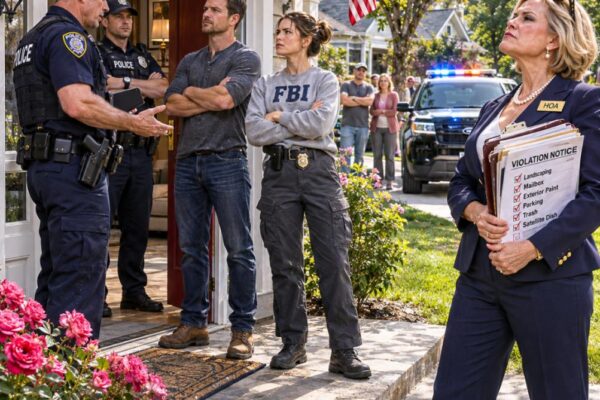
HOA Karen Had Me Handcuffed After a Fake 911 Call—She Thought I Was a Broke Nobody She Could Erase.k
HOA Karen Had Me Handcuffed After a Fake 911 Call—She Thought I Was a Broke Nobody She Could Erase
She told 911 I was a violent intruder even though I had a signed lease and had never threatened anyone.
Then HOA Karen stood ten feet away smiling while deputies put me in handcuffs in front of half the neighborhood.
What she did not know was that the arrest was the last piece of evidence I had been waiting for.
“Sir.”
Police Chief Michael Torres said the word so quietly I almost missed it.
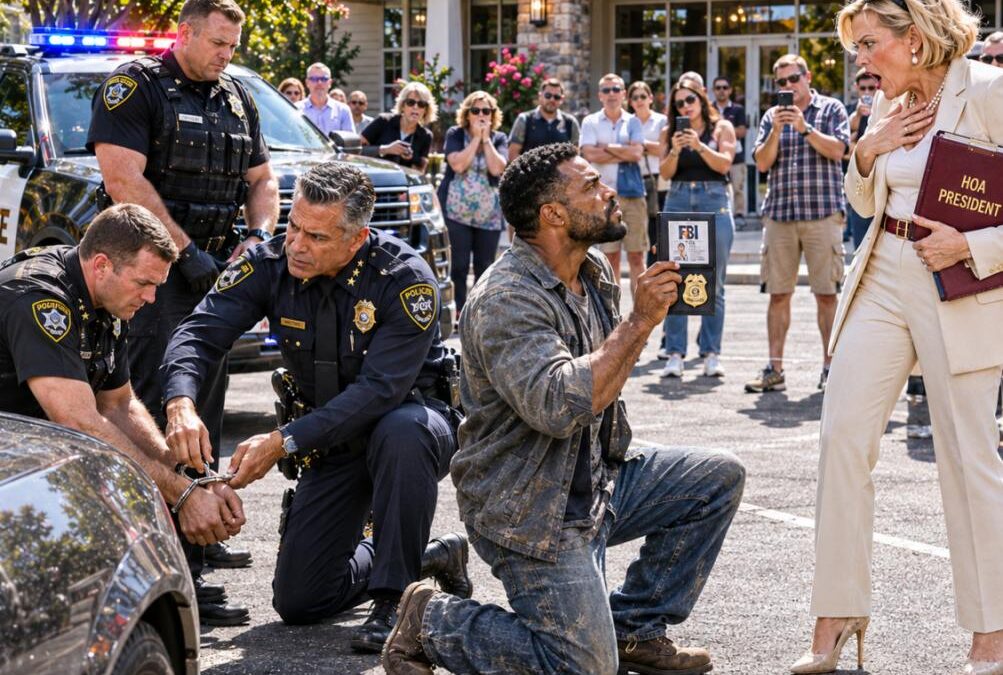
I was on my knees beside the hood of my battered Chevy Malibu with my hands cuffed behind my back.
Two deputies stood over me.
Red and blue lights filled the Willowbrook community center parking lot. Residents crowded the sidewalk, some recording, others whispering.
Rebecca Norwood stood near the entrance in an ivory pantsuit, one hand pressed dramatically against her chest.
“He threatened me,” she said.
I looked at her.
I had not.
Ten minutes earlier, I had been sitting inside the small office I leased at the community center when Rebecca burst through the door and demanded that I leave the property.
I refused.
She called 911.
Not the nonemergency number.
Her exact words, according to the call log we would later recover, were:
“There is a dangerous man refusing to leave. He is becoming aggressive. I’m afraid he may have a weapon.”
I had a laptop.
A legal pad.
Half a chicken burrito.
No weapon.
Now I was cuffed.
Chief Torres had just arrived.
He walked toward me, stopped, and stared.
Recognition moved across his face slowly.
First confusion.
Then disbelief.
Then something close to horror.
“Sir?”
The younger deputy looked at him.
“Chief?”
Torres came closer.
“Take the cuffs off.”
Rebecca stepped forward.
“What are you doing?”
Nobody answered her.
The deputy hesitated.
“Chief, dispatch said violent trespass—”
“I said remove them.”
Metal clicked.
My hands came free.
I stood slowly and rubbed my wrists.
Rebecca looked from Torres to me.
“What is happening?”
I had spent eleven weeks pretending to be exactly the man she believed I was.
Jordan Hayes.
Thirty-nine.
Behind on his bills.
Driving a car worth less than some Willowbrook residents’ patio furniture.
Cheap clothes.
Fast-food wrappers.
Past-due notices visible through an open briefcase.
A struggling mobile mechanic renting the cheapest office in the community center because I supposedly needed somewhere to handle invoices.
That man existed only on paper.
The real Jordan Hayes was a federal special agent assigned to a joint public-corruption task force investigating repeated misuse of emergency dispatch, fraudulent 911 reporting, and possible preferential police response connected to Willowbrook.
Rebecca had called 911 sixty-seven times in eight months.
Too many of those calls had turned ordinary HOA disagreements into armed police responses.
Too many had targeted people she described as suspicious, transient, undesirable, or out of place.
And somehow her calls received priority treatment.
Chief Torres stared at me.
“You’re Hayes.”
I nodded once.
Rebecca laughed nervously.
“No. His name is Hayes. He works here.”
Torres looked at her.
“He does not work for you.”
Her face changed.
I reached into my jacket.
Slowly.
One deputy tensed.
I removed my credentials and opened them.
Rebecca stared at the badge.
Then at my face.
“No.”
That one word came out like air escaping a punctured tire.
I looked at Chief Torres.
“Chief, secure the original 911 recording, dispatch logs, CAD notes, and every communication between Rebecca Norwood and your dispatcher Carla Ruiz.”
Rebecca backed away.
“What?”
I continued.
“And nobody deletes a thing.”
Her face went white.
That was when she finally understood.
The police had not caught the intruder.
She had just called them into her own investigation.
part 2
Three months earlier, I had never heard of Willowbrook Estates.
That was probably how Rebecca Norwood preferred it.
From the outside, Willowbrook looked like a successful upper-middle-class neighborhood wrapped around a small commercial square twelve miles outside Richmond.
Stone entrance monuments.
Decorative lamps.
Ponds.
A clubhouse.
A privately owned community center that contained meeting rooms, HOA offices, and six small professional suites leased to residents and local businesses.
The neighborhood had money.
Not extreme wealth.
Comfort.
Enough comfort that people could spend ninety minutes arguing about whether somebody’s pickup truck was visible from the wrong angle.
My involvement started with a spreadsheet.
Most investigations do.
I was assigned to a joint public-corruption task force involving federal agents, the state attorney general’s office, the county prosecutor, and local internal-affairs investigators.
A pattern had surfaced during a routine review of emergency dispatch statistics.
One residential address had generated an extraordinary number of 911 calls.
Not domestic violence.
Not medical emergencies.
Not repeated burglaries.
HOA disputes.
Suspicious landscaper.
Unrecognized delivery driver.
Unknown man walking near mailboxes.
Contractor sitting in van.
Teenagers at playground after approved hours.
Possible trespasser taking photographs.
Woman sleeping in parked car.
Noise complaint involving “unfamiliar individuals.”
Many calls came from Rebecca Norwood.
President of the Willowbrook Estates Homeowners Association.
Sixty-seven emergency calls in eight months.
The number alone did not make them fraudulent.
Some people genuinely live around recurring problems.
The response pattern made us look closer.
Average priority response to comparable nonviolent calls in that district was around fourteen to seventeen minutes depending on workload.
Rebecca’s calls averaged under five.
Sometimes under three.
Several were coded at higher priority levels after dispatch notes described supposed threats not present in the original call recordings.
Then came complaints.
A Black delivery driver said police ordered him out of his van after Rebecca reported a man “casing houses.”
He was waiting for a customer to answer.
A Latino landscaping crew had three patrol cars arrive because music from their truck was allegedly connected to “possible drug activity.”
No drugs.
A white plumber eating lunch in his van was detained after Rebecca called him an unidentified transient.
A teenage babysitter walking home after dark was stopped because Rebecca said she appeared to be “wandering without purpose.”
Different people.
Same caller.
Same dispatcher appeared repeatedly in the records.
Carla Ruiz.
That got our attention.
Then a whistleblower contacted the state.
Louise Gomez.
Seventy-two years old.
Retired school secretary.
Willowbrook resident since 1998.
She had saved eight years of HOA newsletters because, in her words, “I don’t trust anybody who writes that much about mulch.”
I liked Louise immediately.
She told investigators Rebecca treated 911 like a private security hotline.
“She calls police if a leaf falls wrong.”
“Why would dispatch keep prioritizing her?”
Louise looked at me.
“Carla.”
“You know the dispatcher?”
“Rebecca does.”
“How?”
“Carla’s sister lives here.”
That was interesting.
Louise continued.
“Rebecca brings Carla gifts every Christmas.”
“What kind?”
“Wine. Gift cards. Salon certificates. Once a weekend at some spa.”
“Do you know that personally?”
“I saw the thank-you card.”
“Still have it?”
Louise smiled.
“Young man, I told you I keep newsletters.”
That was how I entered Willowbrook.
Not as an FBI agent.
Not as an investigator.
As Jordan Hayes, freelance mechanic and part-time property-code consultant.
We built the cover carefully.
A basic business registration.
Lease.
Phone.
Website.
Old Chevy Malibu.
The car was real.
The financial distress was not.
The debt notices were props generated for the operation and clearly marked internally so nobody could mistake them for genuine creditors.
My clothes were ordinary.
Work boots.
Discount-store shirts.
Nothing theatrical.
The point was not to create poverty as a costume.
The point was to see whether Rebecca’s behavior changed when she believed she was dealing with somebody without money, influence, or institutional protection.
It did.
Fast.
My office was Suite 6B.
Smallest room in the community center.
No windows except a narrow glass panel beside the door.
Beige walls.
Buzzing fluorescent light.
Faded carpet.
One desk.
Two chairs.
A filing cabinet.
It looked exactly like the kind of place a struggling small business would rent because it was cheap.
Day one, Rebecca introduced herself.
She did not knock.
She appeared in the doorway wearing an ivory blazer, gold earrings, white trousers, and oversized sunglasses pushed into her hair.
Dark burgundy leather folder under one arm.
“Who are you?”
Not hello.
Not welcome.
Who are you?
“Jordan Hayes.”
“What business?”
“Automotive diagnostics. Some property-code consulting.”
Her eyes traveled over my desk.
Cheap coffee mug.
Paper bag from a taco place.
Old laptop.
“You’re leasing here?”
“Signed Friday.”
“Who approved it?”
“Management company.”
“That doesn’t mean the HOA approved it.”
“The lease didn’t mention HOA approval.”
She smiled.
“You’ll learn that Willowbrook has its own standards.”
There it was.
I had heard variations of that sentence from targets for twenty years.
Most people who misuse small amounts of power eventually start talking about standards.
I nodded.
“Good to know.”
Rebecca left.
Eleven minutes later, property management emailed asking whether I planned to perform vehicle repairs in the parking lot.
I replied no.
Twenty minutes after that, the HOA sent a reminder that commercial signage had to be approved.
I had no sign.
Day two, a parking violation appeared on my windshield.
VEHICLE ANGLED OUTSIDE DESIGNATED LINES.
I measured.
The Malibu was centered.
I photographed it.
Saved the notice.
Day three, I left one of the fake debt envelopes partly visible beside my laptop.
Rebecca came by at 3:15.
She said she was inspecting business suites.
No such inspection had been scheduled.
Her eyes went immediately to the envelope.
FINAL NOTICE.
PAST DUE.
$4,728.16.
The effect was subtle.
Her shoulders tightened.
She looked at my fast-food bag.
Then at the peeling edge of my phone case.
“You should understand,” she said, “these offices are intended for stable businesses.”
“Mine’s stable.”
Her eyes returned to the fake debt notice.
“Of course.”
That one word told me enough to keep going.
Day five, she stormed into the office at 5:42 p.m.
I had left a small tool case beside the filing cabinet.
Nothing hazardous.
No fluids.
No auto parts.
She pointed.
“What is that?”
“Tools.”
“This isn’t a garage.”
“I know.”
“We are not turning this center into some mechanic shop.”
“I don’t repair cars here.”
“Then why do you have tools?”
“Because I’m a mechanic.”
She stared at the desk.
Ramen cup.
Discount grocery receipt.
Cheap pen.
The props seemed to offend her physically.
“This is exactly what I was afraid of.”
“What?”
“The standard slipping.”
I stayed seated.
“What standard?”
“This facility is for professional services.”
“I have a signed commercial lease.”
“You don’t look professional.”
There it was.
Clean.
Clear.
Not illegal by itself.
Still revealing.
“What does professional look like?”
Her nostrils flared.
“Don’t play games.”
“I’m asking.”
“People pay a premium to live here.”
“So?”
“So they should not have to watch the community center turn into a place for people who can’t keep their lives together.”
I looked at the fake debt notice.
She had too.
“What makes you think I can’t?”
“Please.”
The contempt in that word was almost impressive.
She leaned toward my desk.
“People like you think rules are harassment because nobody taught you standards.”
“People like me?”
She stopped.
Then recovered.
“People who resent structure.”
I wrote that phrase down after she left.
People who resent structure.
Not poverty.
Not class.
Not race.
Not yet.
Rebecca was careful.
At least when she thought she needed to be.
Louise came by ten minutes later.
She carried grocery-store cookies inside a plastic container.
“I heard her yelling.”
“She yells?”
“Only when breathing.”
I laughed.
Louise sat.
“She hates you already.”
“Why?”
“You look poor.”
That directness surprised me.
“She hates poor people?”
“She hates reminders.”
“Of what?”
Louise watched me carefully.
“What do you know about Rebecca Norwood?”
“Real-estate family. Widow. HOA president six years.”
“That’s Rebecca.”
She lowered her voice.
“Ask about Emily Carter.”
I did.
That night.
Emily Carter was born in 1971.
Different county.
Mother worked temporary jobs.
Father absent.
Public assistance records were not generally available to me merely because I had a badge, nor should they have been.
But lawful investigative databases, court records, name-change filings, marriage records, property records, and archived civil cases built a partial history.
Emily Carter married Charles Norwood in 2005.
Charles was twenty-three years older.
Wealthy real-estate investor.
Rebecca began using Rebecca Emily Norwood socially soon afterward and later obtained a legal name change.
That alone meant nothing.
People change names.
People reinvent themselves.
Charles died from a heart attack eight years later.
He left her substantial assets.
Again, nothing suspicious by itself.
What mattered was what Rebecca appeared to do with the past afterward.
She bought the land where her mother’s old trailer had stood.
Then razed the structure.
She pressured online data brokers to remove old addresses.
She filed takedown requests concerning old photographs.
One former classmate told an investigator Rebecca had once threatened litigation if she publicly mentioned “Emily from the trailer park.”
Trauma?
Shame?
Image management?
We did not know.
None of those things excused crimes.
None proved crimes either.
I refused to reduce her into an easy psychological story.
People love that.
Poor child becomes cruel adult.
Victim becomes villain.
It is narratively neat.
Human beings are rarely neat.
Plenty of people grow up poor and never abuse anyone.
Plenty grow up wealthy and do.
Pain can explain a behavior without granting permission for it.
That distinction became central later.
For now, I kept watching.
Week two.
Rebecca cited my Malibu again.
This time for “commercial appearance.”
It had no logo.
She complained about the coffee mug on my office desk being visible through the glass.
Not joking.
A written note said:
Business suites should project an orderly image at all times.
I ate tacos one afternoon.
She emailed management about “food odors.”
The restaurant was four blocks away.
Half the building smelled like someone’s lunch every day.
I left a desk lamp on after seven.
Security complaint.
I typed during an HOA committee meeting in the room next door.
Noise complaint.
Keyboard.
I tested the sound level later.
Less than normal conversation.
Each complaint became evidence of fixation.
Then we started seeing differences.
Suite 3A belonged to a financial adviser.
He left golf clubs in his office hallway.
No warning.
Suite 4C belonged to an architect.
Pizza boxes stayed outside overnight.
No warning.
A realtor parked across two spaces for twenty minutes.
Rebecca laughed with her.
I placed one tire-pressure gauge on my desk.
Violation photograph.
That was not enough to prove unlawful discrimination.
It proved selective scrutiny.
The motive remained open.
Then came the neighborhood data.
Rebecca’s 911 calls were not random.
We categorized them carefully.
Not by ethnicity based on names.
That would have been sloppy.
We used only cases where race or ethnicity was known through reports, video, witness identification, or individuals’ own statements.
A disproportionate share involved Black and Latino workers, low-income service employees, teenagers, tenants, and people Rebecca described as “transient,” “rough,” “urban,” “unfamiliar,” or “not resident quality.”
Not every call was false.
Some were legitimate.
A garage break-in.
A domestic disturbance.
A medical emergency.
We separated those.
What remained was still disturbing.
One call:
“Suspicious Black male sitting in vehicle.”
Man was a rideshare driver waiting for a passenger.
Another:
“Possible gang activity.”
Three Latino roofers were eating lunch while music played.
Another:
“Unstable woman wandering.”
She was a home-health aide walking during her break.
Then the response times.
Rebecca’s low-level calls were regularly elevated in priority.
The common link was Carla Ruiz.
Our internal-affairs partner obtained lawful records.
Personal texts between Carla and Rebecca.
Nothing direct at first.
Rebecca:
Sweetie, watch for our Willowbrook alerts tonight. Lots of unfamiliar traffic after the event.
Carla:
Got you.
Another:
Can you flag our calls? Patrol has been slow lately.
Carla:
Always take care of my Willowbrook lady.
Then gift references.
Spa certificate.
Restaurant gift card.
Holiday basket.
Not enormous bribes.
That almost made it worse.
Institutional favoritism can grow from embarrassingly small favors.
Carla later insisted the gifts were friendship, not payment.
Maybe she believed that.
But when dispatch discretion repeatedly changed after Rebecca contacted her privately, the distinction became a legal question, not merely social etiquette.
Nina Patel became our second major whistleblower.
She worked part-time as the HOA administrative assistant.
Thirty-two.
Careful.
Terrified.
She called the task-force tip line from a grocery-store parking lot.
“I have invoices.”
“What kind?”
“Security.”
“Whose?”
“They don’t exist.”
That got our attention.
Rebecca had pushed the board to add a $24 monthly “enhanced neighborhood security assessment.”
Residents paid it.
The budget listed contracted patrol support.
We found no current patrol contract.
No officers.
No licensed security company during most of the billing period.
Where did the money go?
At first, nowhere dramatic.
Operating account.
Then transfers.
Then reimbursements.
Then an entity called Norwood Community Strategies.
Owned by Rebecca.
She had disclosed the company years earlier as a consulting business.
The board had never clearly approved paying it for security coordination.
Payments totaled roughly $18,000.
Not millions.
Enough.
Invoices described:
Threat monitoring.
Community intelligence.
Risk assessment.
Emergency liaison.
Nina said most of those services consisted of Rebecca calling Carla, driving the neighborhood, and compiling lists of “problem properties.”
“Who knew?”
“Board treasurer signed some checks.”
“Did he know it was her company?”
“I don’t know.”
“Any fake invoices?”
“Some describe patrol hours.”
“Did patrols happen?”
“Not that I saw.”
We did not call it embezzlement yet.
We called it suspicious self-dealing requiring proof.
That is how investigations stay useful.
Rebecca escalated against me during week three.
She posted a community message:
Residents should be alert to increasing deterioration in professional standards at the Willowbrook center. Unauthorized persons, distressed vehicles, and unstable commercial activities can quickly affect safety and property values.
No name.
Photograph attached.
My Malibu.
I smiled when I saw it.
Then I stopped smiling when the comments appeared.
One resident wrote:
Why was this tenant approved?
Another:
Looks like Section 8 moved into the office park.
Someone replied:
That’s disgusting.
The original poster deleted the comment.
Rebecca left the photograph up.
That afternoon she entered my office again.
No knock.
“You saw the post?”
“Yes.”
“Then perhaps you understand people are concerned.”
“About my car?”
“About what it represents.”
“What does it represent?”
“Decline.”
The word came fast.
Too fast.
I stayed quiet.
She looked at the fake past-due notice.
Then the ramen cup.
“Willowbrook was built by people who sacrificed to get away from this.”
I looked around the tiny office.
“From what?”
She gestured.
“This.”
“What is this?”
“Chaos. Dependency. People making one bad decision after another and expecting everyone else to absorb it.”
The anger surprised me.
It was deeper than a dirty-car complaint.
I asked:
“Did someone do that to you?”
Her face changed completely.
For one second, Rebecca disappeared.
Someone else looked back.
Frightened.
Furious.
Then she slammed the folder against my desk.
“You know nothing about me.”
“I didn’t say I did.”
“You filth don’t belong here.”
There it was.
She heard herself.
So did I.
She stepped back.
“I meant this business.”
“Of course.”
“You are deliberately provoking me.”
“No.”
“You want people to think I’m some kind of elitist monster.”
I said nothing.
That silence hurt her more than denial.
“I built my life,” she said. “I didn’t have anyone hand me anything.”
I looked at her.
“I didn’t ask.”
Her breathing changed.
“People make excuses. They stay broke because it’s easier than becoming better.”
Then she left.
My recording device captured every word under the authorization governing the operation.
That night, we reviewed the audio.
Our supervisor asked:
“You think she knows you found the Carter identity?”
“No.”
“You touched something.”
“Yes.”
“Does it matter legally?”
“Not yet.”
It mattered psychologically.
But psychology was not the case.
Conduct was.
Nina produced more records.
Rebecca’s internal enforcement spreadsheet ranked properties.
RED.
YELLOW.
GREEN.
Supposedly risk categories.
Red homes included tenants, families with older vehicles, households with frequent contractors, several minority families, and two elderly owners on payment plans.
Green properties were mostly long-established owners Rebecca socialized with.
One note beside my cover address said:
LIKELY TEMPORARY / FINANCIALLY UNSTABLE / MONITOR.
Another resident:
BLACK DRIVER FREQUENTLY IDLING—VERIFY RESIDENT CONNECTION.
Another:
LATINO CREW / LOUD MUSIC / POSSIBLE DRUG CONCERN.
No drug evidence.
Another:
SINGLE MOM—BIKES / CLUTTER / WATCH FOR DECLINE.
That spreadsheet changed the nature of the inquiry.
This was no longer just Rebecca being dramatic on 911.
She was systematizing suspicion.
And people with less money, minority workers, tenants, or anyone she associated with disorder received more scrutiny.
Still, we needed to understand the police side.
Carla Ruiz became crucial.
Internal affairs interviewed her without revealing the full undercover operation.
She minimized the relationship.
Rebecca was a friend.
The gifts were harmless.
Priority codes were based on caller descriptions.
Then investigators showed her the call recordings.
Rebecca says:
“There’s a man sitting in a van.”
Carla enters:
SUSPICIOUS MALE POSSIBLY CASING RESIDENCES.
Rebecca says:
“Three workers are listening to loud music.”
Carla enters:
POSSIBLE DRUG ACTIVITY / MULTIPLE MALES.
Rebecca says:
“A teenager is walking around after dark.”
Carla enters:
SUSPICIOUS PERSON / POSSIBLE TRESPASS.
The escalation was not in the caller’s words.
It was Carla’s.
Carla began crying.
Not proof.
People cry for many reasons.
But she changed her story.
Rebecca had pressured her.
Rebecca told her Willowbrook residents were major donors to local civic organizations.
Rebecca implied complaints about response time could reach the police chief.
Rebecca gave gifts.
Carla wanted to keep her happy.
“Did she pay you cash?”
“No.”
“Did she explicitly say alter dispatch codes?”
“No.”
“Did you know higher codes produced faster responses?”
“Yes.”
“Did you change them because she asked you to make Willowbrook calls a priority?”
Carla cried harder.
“Yes.”
There it was.
Not a cinematic bribery conspiracy.
Something more ordinary.
Favoritism.
Pressure.
Gifts.
Fear.
A public employee bending procedure for someone who knew how to make herself feel important.
Chief Torres was informed at that point.
Only partially.
He was furious.
He wanted Carla removed immediately.
The task-force prosecutor asked him to wait long enough to preserve evidence and avoid alerting Rebecca.
Torres agreed.
That decision later explained why he recognized me in the parking lot.
He knew an undercover investigator existed.
He did not know exactly when Rebecca would force the final confrontation.
Neither did I.
The operation could have ended quietly.
We already had enough for search warrants and administrative action.
Then Rebecca announced an emergency HOA meeting.
Subject:
COMMUNITY SAFETY AND PROFESSIONAL STANDARDS.
Nina forwarded the presentation draft.
Slide one:
WILLOWBROOK UNDER THREAT.
Slide two:
EVIDENCE OF DECLINING STANDARDS.
My Malibu.
My office.
My coffee mug.
Fake debt notice.
Fast-food wrappers.
Slide three:
UNSTABLE TENANCIES AND UNVETTED COMMERCIAL ACTIVITY.
Me.
Slide four:
911 RESPONSE IS OUR LAST LINE OF DEFENSE.
That sentence nearly made me laugh.
She was going to publicly celebrate the exact system we were investigating.
The task-force supervisor asked if I wanted to attend.
“Yes.”
“Cover could blow.”
“Good.”
“Good?”
“If she calls police in front of everyone, we document the process from beginning to end.”
“Don’t provoke a false call.”
“I won’t.”
That mattered.
We were not allowed to manufacture criminal behavior.
I could refuse an unlawful demand.
I could behave exactly as my cover identity had behaved.
Rebecca would choose the rest.
The meeting began at seven.
More than eighty residents attended.
Louise sat in the second row.
Nina stayed near the back.
Rebecca stood at the podium wearing a pale-blue suit and pearls.
Her first twenty minutes were theater.
Crime statistics with no comparison baseline.
Photographs of service vehicles.
Blurry pictures of teenagers.
Warnings about “declining quality.”
Then my car appeared on the screen.
“There,” she said.
The room shifted.
“This is what happens when oversight weakens.”
I raised my hand.
Rebecca ignored me.
She displayed my office.
“Commercial suites were created to provide professional value to Willowbrook residents. Instead, we now have transient operators, distressed vehicles, food waste, and questionable activities.”
Louise shouted:
“He fixes cars, Rebecca. He isn’t running a meth lab.”
People laughed.
Rebecca snapped:
“This is not funny.”
I stood.
“Why is my financial condition HOA business?”
Her face flushed.
“Sit down.”
“I have a lease.”
“You are disrupting a private community meeting.”
“I rent office space in the building.”
“You are not a Willowbrook homeowner.”
“Then stop using my photograph in your presentation.”
The room murmured.
Rebecca pointed toward the door.
“Leave.”
“No.”
Her eyes widened.
I stayed calm.
“You can stop displaying my personal information and we can discuss the lease through management.”
“You are trespassing.”
“No.”
“I am directing you to leave.”
“You’re not my landlord.”
That was enough.
She pulled out her phone.
Louise stood.
“Rebecca, don’t.”
Rebecca ignored her.
She dialed 911.
Speakerphone.
I could hear Carla’s voice.
“Nine-one-one, what is your emergency?”
Rebecca looked directly at me.
“There is a dangerous intruder at the Willowbrook community center.”
The room went silent.
Carla asked:
“Is he armed?”
Rebecca stared at my hands.
“I don’t know. He’s aggressive and refusing to leave.”
I said clearly, loud enough for the room and the phone:
“I have not threatened anyone. I am a lawful commercial tenant.”
Rebecca shouted:
“He’s escalating now.”
The call became the most important piece of evidence in the operation.
Because eighty people heard the gap between what was happening and what Rebecca reported.
Carla coded it high priority.
Armed-risk response.
Deputies arrived fast.
Too fast.
Rebecca met them at the door.
I stayed where I was.
One deputy approached.
“Hands where I can see them.”
I complied.
“Sir, step outside.”
I did.
The younger deputy asked whether I had a weapon.
“No.”
“Any weapons in the office?”
“No.”
“Are you refusing to leave private property?”
“I have a valid lease.”
Rebecca came outside.
“He has been warned repeatedly.”
I said nothing.
The deputy had been given a high-risk dispatch.
He did what officers often do when information is incomplete.
Controlled the scene first.
Investigated second.
He turned me around and cuffed me temporarily.
Rebecca watched.
And smiled.
That smile became famous later, although I wish it had not.
Half the neighborhood was recording.
Then Chief Torres arrived.
He recognized me.
“Sir.”
Everything changed.
The cuffs came off.
My credentials came out.
Rebecca went white.
That was the cliff she had been running toward for months.
But exposure was not the end.
It was the beginning of a much less cinematic process.
Evidence preservation.
Search warrants.
Interviews.
Financial subpoenas.
Internal-affairs review.
HOA records.
Bank accounts.
Dispatch logs.
Device extractions authorized through proper legal process.
Rebecca was not arrested in the parking lot.
That disappointed half the internet later.
Real investigations are not written for applause.
She was allowed to leave after officers documented the scene.
Her attorney contacted the task force the next morning.
Carla Ruiz was placed on administrative leave.
The dispatcher investigation confirmed unauthorized priority manipulation.
She eventually admitted misconduct in an internal disciplinary proceeding and later entered a negotiated criminal resolution on a state charge connected to falsifying public records.
She lost her dispatch job.
No prison.
Probation.
Community service.
Restitution for investigative costs where authorized.
Rebecca’s case was broader.
The false 911 report.
The HOA funds.
Invoices.
Self-dealing.
Possible fraud.
The search of her home office uncovered meticulous records.
That surprised me.
People imagine criminals burn everything.
Some do.
Control-oriented people often keep everything because records make them feel powerful.
Folders.
Resident files.
Printed photographs.
Lists.
Old newspapers about herself.
Financial documents.
And one locked box.
Inside:
Emily Carter.
Old school records.
A food-assistance card expired decades earlier.
Photographs of a trailer.
A handwritten eviction notice issued to her mother.
A photograph of Rebecca—Emily then—at maybe fifteen, standing beside a rusted sedan wearing a thrift-store dress.
None of that was criminal evidence by itself.
It was personal history.
The government did not release it.
It became relevant only because Rebecca herself later discussed it during sentencing and in a psychological evaluation her defense submitted.
That distinction matters.
The public eventually learned she had grown up poor because her attorneys offered that history to explain her behavior and argue for leniency.
Not because investigators humiliated her with childhood welfare documents.
I was glad.
Justice does not require stripping people naked emotionally.
The financial evidence did matter.
Norwood Community Strategies had billed the HOA for security services not supported by real vendor work.
Some payments represented actual administrative tasks.
Others did not.
The amount ultimately substantiated as improperly obtained was lower than the rumors.
Roughly $18,000.
Rebecca also used association money for private surveillance-related expenses she had not properly disclosed.
Not a fortune.
Enough for felony charges under state law.
Then the false-call pattern.
Investigators reviewed all sixty-seven 911 calls.
We did not call all sixty-seven fraudulent.
Several were legitimate.
Some were judgment calls.
A subset contained materially false or exaggerated claims.
Those became part of the prosecution.
The most powerful was mine because it had witnesses, audio, video, a lease, and no actual threat.
Rebecca’s own presentation also helped establish motive.
Threat to our purity.
That phrase appeared in her draft notes.
She had crossed it out before the meeting.
The original remained on her laptop.
Below it:
We cannot let Willowbrook become another neighborhood where standards collapse because people are afraid to enforce them.
Then a line:
Hayes is the example.
I had been right about one thing.
My cover had become a mirror.
Not because poverty automatically triggered her.
Because she had built her adult identity around distance from the person she once had been.
Her defense psychologist later described severe shame associated with childhood deprivation, fear of instability, and compulsive status control.
The prosecution did not dispute that she had suffered.
We disputed what she had done with that suffering.
At sentencing, Rebecca spoke publicly about Emily Carter.
That was the first time I heard her say the name herself.
“I hated that girl,” she said.
The courtroom was quiet.
“She had nothing. Her mother begged relatives for grocery money. We wore donated clothes. I remember pretending not to be hungry at school because kids noticed who got free lunch.”
She looked down.
“When I got out, I swore nobody would ever look at me like that again.”
Her voice broke.
“So I became someone nobody could look down on.”
Then the sentence that stayed with me:
“And eventually I started looking down first.”
That did not excuse anything.
It did explain something.
Rebecca admitted she associated visible poverty with danger and failure because she had spent her adult life terrified of returning to it.
She described the fake debt notices in my office.
“They made me furious.”
The judge asked why.
“Because I thought he was comfortable being what I spent my life escaping.”
I wanted to tell her I had never been comfortable.
It was a cover.
But that was not the point.
Rebecca had seen a struggling man and converted her private terror into public punishment.
The judge did not give her the twelve-year sentence social media wanted.
The actual outcome was narrower.
Rebecca entered guilty pleas to state charges involving theft from the association, filing or causing false emergency reports in documented incidents, and related misconduct resolved under the negotiated agreement.
The court imposed twelve months of custodial confinement, followed by probation.
She was ordered to pay restitution and financial penalties totaling roughly forty-five thousand dollars across the criminal and civil resolutions.
She also received hundreds of hours of community service.
No dramatic order requiring her to mop the same community center she ruled.
That rumor circulated anyway.
It was false.
Her community service was assigned through an approved nonprofit program.
The irony did not need help.
Willowbrook’s consequences lasted longer.
Nina Patel became the most trusted person in the neighborhood almost by accident.
Residents asked her to help the interim board rebuild records because she was the one person who had kept them properly.
She refused the presidency.
Smart woman.
Eventually, the membership elected a new board.
Open meetings.
Conflict disclosures.
Vendor bidding.
Emergency-call policy.
No HOA officer could instruct residents or employees to call 911 for covenant enforcement unless an actual emergency existed.
Nonemergency disputes went through the proper channels.
The police department created a review protocol for unusually frequent callers.
Dispatch supervisors received retraining.
Priority-code changes became more visible to auditing systems.
One dispatcher could no longer repeatedly inflate the same caller’s reports without triggering review.
That reform mattered more than Rebecca’s sentence.
The HOA commissioned an outside audit.
Valid fines remained.
Invalid or selectively imposed fines were refunded or canceled.
Louise Gomez received $300 back for the garden ornament Rebecca had cited after Louise’s husband died.
A single mother had bicycle-related fines erased because the enforcement record showed comparable homes had received warnings.
Carlos Mendez, a landscaper who lived in Willowbrook, received an apology after records revealed repeated complaints describing his employees in language the board could not defend.
Not everyone got money.
Not every grievance was substantiated.
That mattered.
Accountability without standards becomes another kind of favoritism.
The association also reviewed enforcement by income and demographic patterns where lawful data existed.
The numbers did show disparities.
Not the wild eighty-nine-percent figure circulating online.
The actual analysis was more complicated.
Lower-income residents, tenants, service workers, and some minority households were significantly more likely to receive formal enforcement instead of informal reminders.
Why?
Partly Rebecca.
Partly complaint patterns.
Partly a system where friends of board members received phone calls while people outside the social circle received paperwork.
Bias does not always require a secret racist policy.
Sometimes it grows inside discretion.
Who gets a warning?
Who gets photographed?
Whose unfamiliar car feels suspicious?
Whose mistake feels temporary?
Whose mistake feels like evidence of decline?
Those questions became the center of Willowbrook’s reforms.
The civil settlement created standardized enforcement steps.
First notice.
Opportunity to correct.
Written evidence.
Appeal.
Conflict recusal.
No director could invent punishment through social-media posts.
Emergency services were explicitly separated from covenant disputes.
Property values did not collapse.
They did not magically jump twenty-eight percent because Rebecca left either.
That number appeared online too.
I never found credible support for it.
Homes continued selling.
Some increased.
Some did not.
Markets are complicated.
One HOA president does not control the housing economy.
That was another lesson.
People wanted the ending exaggerated.
Monster falls.
Neighborhood flourishes.
Everyone learns.
Life is slower.
Some residents still defended Rebecca.
They said she had kept Willowbrook safe.
She had organized food drives.
She had helped widows.
She had negotiated landscaping contracts.
All true.
People struggled with the idea that someone could do generous things and still abuse power.
Louise understood it better than most.
“She wasn’t fake nice,” Louise told me.
“What?”
“She did help people.”
“I know.”
“That’s what everybody wants to forget.”
“Why?”
“Because then we have to admit bad people aren’t bad every minute.”
I smiled.
“You’re getting philosophical.”
“I’m old. It’s free.”
Rebecca had paid for a resident’s hotel after a house fire.
Raised money for a child with leukemia.
Driven an elderly neighbor to chemotherapy.
Then called police on a plumber for eating lunch in a van.
Human beings contain contradictions.
Understanding that does not weaken accountability.
It makes it more important.
If only obvious monsters abused power, systems would be easy to design.
The dangerous people are often useful enough that everyone learns to tolerate the rest.
That was Rebecca.
“That’s just Rebecca” became Willowbrook’s version of permission.
Louise admitted she had said it herself.
“So did I help her?” she asked.
“I wouldn’t say that.”
“I would.”
She looked at me.
“I knew she abused 911.”
“You reported it.”
“Eventually.”
“That matters.”
“So does eventually.”
Fair.
I stopped going undercover at Willowbrook after the arrest operation.
Obviously.
My Malibu disappeared too.
The car belonged to the government fleet through a front arrangement.
I almost missed it.
My actual vehicle was a six-year-old pickup.
Nothing impressive.
Louise was disappointed.
“You don’t drive a black Suburban?”
“No.”
“Federal government going downhill.”
Nina laughed.
The task force moved to other cases.
That is the unglamorous truth of investigative work.
One neighborhood feels like the center of the world for three months.
Then files close.
Evidence gets archived.
Another complaint arrives.
Another city.
Another person convinced rules do not apply to them.
Before leaving Willowbrook for good, I attended one community meeting without a cover identity.
No cheap mechanic shirt.
No staged bills.
Just me.
Jordan Hayes.
Special agent.
Same person underneath.
Some residents looked embarrassed when they saw me.
One man had written online that my Malibu was “a visual warning sign.”
He approached after the meeting.
“I owe you an apology.”
“For what?”
“I made assumptions.”
“You made a comment on a neighborhood forum.”
“That too.”
I waited.
He looked uncomfortable.
“I thought because you looked broke, you were probably trouble.”
“Why?”
He opened his mouth.
Closed it.
Good question.
He finally said, “I don’t know.”
That answer can be useful if a person actually examines it afterward.
Carlos approached too.
He had been the landscaper Rebecca repeatedly described as suspicious.
“You really FBI?”
“Federal task force.”
“That means yes?”
“It means bureaucracy.”
He laughed.
“You ate terrible tacos for three months.”
“Occupational sacrifice.”
Then he became serious.
“You think Rebecca racist?”
I had been asked that repeatedly.
I gave him the same answer.
“I think her records showed prejudice tied to race, class, occupation, and perceived social status.”
“That’s a lawyer answer.”
“I work with lawyers.”
“You think growing up poor caused it?”
“No.”
That answer came faster.
“Why not?”
“Because millions of people grow up poor and don’t do what she did.”
Carlos nodded.
“So what did it do?”
“I think it became part of the story she told herself.”
“What story?”
“That poverty meant danger. That distance from poor people meant success. That control meant safety.”
“And race?”
“She attached some of those fears to people through stereotypes. The records showed that.”
Carlos looked toward the clubhouse.
“So she hated herself.”
“Maybe parts of herself.”
“That’s sad.”
“Yes.”
“Still glad she went to jail.”
“Those can both be true.”
He smiled.
“Federal answer.”
Probably.
Rebecca’s childhood became the most debated part of the case.
Some people felt sympathy.
Others said discussing her trauma distracted from the people she harmed.
I understood both reactions.
I do not believe empathy requires absolution.
Understanding why a person became dangerous can help prevent the next person from becoming dangerous.
It does not erase victims.
Rebecca’s past explained why my fake debt notice affected her so strongly.
It did not make her tell dispatchers to inflate calls.
It did not make her take HOA money.
It did not make her label Black drivers suspicious or Latino workers potential drug threats.
Those were choices.
History applies pressure.
Character still makes decisions.
Months after sentencing, Rebecca sent me a letter.
Not directly.
Through her attorney.
I almost did not read it.
Then curiosity won.
Jordan,
I know now that most of what I believed about you was manufactured for the investigation. That is humiliating.
But the person I thought you were was real in my mind, and what frightens me is how quickly I decided he was worthless.
I stopped.
Read that sentence again.
She continued.
You were messy. Broke. Defiant. You ate cheap food and drove a damaged car. I saw every version of my mother, my childhood, and myself that I had spent forty years trying to erase.
None of that gave me the right to treat you as less human.
I used standards because “fear” sounded weak.
I used safety because “disgust” sounded ugly.
I used community because saying “people who remind me where I came from” would have exposed me.
I hurt people.
That is not your fault, and it is not Emily Carter’s fault either.
That line mattered.
Not because I needed her apology.
Because she had finally separated the child she once was from the adult choices she made.
I finished the letter.
She did not ask forgiveness.
Smart.
I never responded.
Not because I hated her.
Because sometimes accountability does not require continued relationship.
A year later, Louise called me.
I was working another case.
“Jordan.”
“Louise.”
“Guess what.”
“I’m afraid to.”
“Nina got elected.”
“President?”
“Unfortunately.”
I laughed.
“I thought she refused.”
“People wore her down.”
“How’s Willowbrook?”
“Boring.”
“Good.”
“No fake emergencies.”
“Excellent.”
“Board meetings still terrible.”
“Democracy.”
“Your old office is a tax-preparation business now.”
“Professional?”
“Very.”
“Any ramen?”
“Don’t start.”
Then she told me something I had not expected.
Willowbrook had created a small assistance fund.
Not HOA dues used secretly.
Voluntary donations.
Emergency help for residents struggling with temporary hardship.
Utility shutoff.
Medical crisis.
Job loss.
No public names.
No shame.
Nina’s idea.
“Why?”
I asked.
Louise became quiet.
“Because everybody learned what happens when people start treating poverty like evidence of bad character.”
That stayed with me.
Rebecca had spent her life trying to outrun the humiliation of needing help.
Willowbrook’s answer was not to romanticize poverty.
It was to remove some of the shame around asking for help.
That felt more meaningful than any punishment.
My work continued.
A marina case.
Procurement fraud.
A sheriff’s contractor.
Different people.
Different excuses.
Same basic question.
Who gets power?
Who watches them use it?
What happens when everyone assumes somebody else is checking?
I still think about the moment Chief Torres called me “sir.”
Not because of the respect.
Because ten seconds earlier I was simply another man in handcuffs based on a false report.
Then a title became visible.
Special agent.
Task force.
Federal credentials.
Suddenly everybody moved differently.
That bothered me more with time.
My rights should not have become more valuable when Torres recognized me.
The mechanic Rebecca thought I was deserved the same careful police response.
The delivery driver did.
The landscaper did.
The babysitter did.
The plumber eating lunch did.
That became the part I talked about during department training afterward.
Not Rebecca’s humiliation.
Dispatch information is information.
Not truth.
A caller saying “dangerous” does not make someone dangerous.
A wealthy neighborhood does not make a caller more credible.
A familiar name should not create a faster emergency response unless the facts justify it.
Uniforms cannot outsource judgment.
Neither can databases.
Chief Torres took that seriously.
His department changed procedures.
Carla’s conduct embarrassed them.
He could have hidden behind one bad dispatcher.
Instead, he let outside reviewers examine the system.
That cost him politically.
I respected him for it.
At a training six months later, he stood beside me.
“You know what still bothers me?” he asked.
“What?”
“I recognized you.”
“That bothered you?”
“It saved the situation.”
“Yes.”
“That’s the problem.”
I looked at him.
He understood.
“If you hadn’t been you…”
He did not finish.
He did not need to.
That was the real nightmare inside the staged arrest.
Not that I had been cuffed.
That the exact same false call could have landed on someone without credentials in his pocket.
Someone who might get angry.
Someone frightened.
Someone who moved too quickly.
Someone whose lease paperwork was inside instead of on him.
The operation was designed to expose misuse of 911.
For a few minutes, it exposed something larger.
How much safety can depend on being recognized as respectable.
Rebecca built her entire adult identity around that idea.
Respectable clothes.
Respectable house.
Respectable neighbors.
Respectable cars.
Respectable poverty kept out of sight.
Then I walked into her space looking like a man she had spent her life becoming afraid of.
She tried to erase me.
That was her failure.
Not being born Emily Carter.
Not growing up in a trailer.
Not using food assistance.
Not marrying a wealthy man.
Not changing her name.
People are allowed to reinvent themselves.
What they are not allowed to do is turn reinvention into a weapon against anyone who reminds them of the life they escaped.
That is what Rebecca did.
And eventually, the systems she manipulated stopped asking whether she looked respectable enough to trust.
They started asking what the records showed.
The records showed false calls.
Preferential dispatch.
Improper payments.
Selective enforcement.
Class prejudice.
Racialized suspicion.
A false emergency report made in front of witnesses.
No childhood story could make those disappear.
Today, Willowbrook is still Willowbrook.
Same entrance stones.
Same ponds.
Same clubhouse.
Kids still ride bikes where Rebecca once complained they were too loud.
Contractors still eat lunch in vans.
Delivery drivers still wait at curbs.
The world did not end.
Nina once sent me a photograph from a neighborhood picnic.
Carlos was grilling.
Louise was seated under an umbrella apparently ordering everyone around.
A Black family, two Latino families, an elderly white couple, an Indian American couple, teenagers, toddlers, contractors, homeowners, renters.
No one looked particularly united.
That made me smile.
Healthy communities are not uniform.
They are negotiated.
Messy.
Sometimes irritating.
People disagree.
The goal is not to eliminate difference.
It is to make sure nobody gets to convert personal fear into public authority without being questioned.
Rebecca forgot that.
Then everyone else forgot to question her.
Until a cheap car, a fake debt notice, a bowl of ramen, and one false 911 call finally forced them to.
I keep one thing from Willowbrook in my office.
Not the handcuffs.
Those belonged to the department.
Not Rebecca’s letter.
That stays in the case archive.
It is a photograph Louise took after the operation.
My battered Malibu parked crookedly outside Suite 6B.
On the windshield is one of Rebecca’s violation notices.
COMMERCIAL VEHICLE INCONSISTENT WITH COMMUNITY STANDARDS.
Louise wrote beneath it:
LOOKS FINE TO ME.
I framed that.
Not because the car mattered.
Because for three months, Rebecca believed everything visible about that man proved he was beneath her.
Cheap car.
Cheap food.
Debt.
Mess.
Uncertainty.
No status.
No influence.
She thought that made him safe to abuse.
She never understood the simplest fact about power.
The person you dismiss does not need to be secretly important before mistreating him becomes wrong.
I happened to be an investigator.
The next person might not be.
That is why Willowbrook changed.
Not because HOA Karen picked the wrong undercover agent.
Because everyone finally had to confront what would have happened if she had picked exactly the person she thought she had.
Someone broke.
Someone unknown.
Someone with no badge hidden beneath his jacket.
Someone who still deserved to hear the police chief say “sir.”
THE STORY ENDS HERE
HOA Karen Had Me Handcuffed After a Fake 911 Call—She Thought I Was a Broke Nobody She Could Erase
She told 911 I was a violent intruder even though I had a signed lease and had never threatened anyone.
Then HOA Karen stood ten feet away smiling while deputies put me in handcuffs in front of half the neighborhood.
What she did not know was that the arrest was the last piece of evidence I had been waiting for.
“Sir.”
Police Chief Michael Torres said the word so quietly I almost missed it.
I was on my knees beside the hood of my battered Chevy Malibu with my hands cuffed behind my back.
Two deputies stood over me.
Red and blue lights filled the Willowbrook community center parking lot. Residents crowded the sidewalk, some recording, others whispering.
Rebecca Norwood stood near the entrance in an ivory pantsuit, one hand pressed dramatically against her chest.
“He threatened me,” she said.
I looked at her.
I had not.
Ten minutes earlier, I had been sitting inside the small office I leased at the community center when Rebecca burst through the door and demanded that I leave the property.
I refused.
She called 911.
Not the nonemergency number.
Her exact words, according to the call log we would later recover, were:
“There is a dangerous man refusing to leave. He is becoming aggressive. I’m afraid he may have a weapon.”
I had a laptop.
A legal pad.
Half a chicken burrito.
No weapon.
Now I was cuffed.
Chief Torres had just arrived.
He walked toward me, stopped, and stared.
Recognition moved across his face slowly.
First confusion.
Then disbelief.
Then something close to horror.
“Sir?”
The younger deputy looked at him.
“Chief?”
Torres came closer.
“Take the cuffs off.”
Rebecca stepped forward.
“What are you doing?”
Nobody answered her.
The deputy hesitated.
“Chief, dispatch said violent trespass—”
“I said remove them.”
Metal clicked.
My hands came free.
I stood slowly and rubbed my wrists.
Rebecca looked from Torres to me.
“What is happening?”
I had spent eleven weeks pretending to be exactly the man she believed I was.
Jordan Hayes.
Thirty-nine.
Behind on his bills.
Driving a car worth less than some Willowbrook residents’ patio furniture.
Cheap clothes.
Fast-food wrappers.
Past-due notices visible through an open briefcase.
A struggling mobile mechanic renting the cheapest office in the community center because I supposedly needed somewhere to handle invoices.
That man existed only on paper.
The real Jordan Hayes was a federal special agent assigned to a joint public-corruption task force investigating repeated misuse of emergency dispatch, fraudulent 911 reporting, and possible preferential police response connected to Willowbrook.
Rebecca had called 911 sixty-seven times in eight months.
Too many of those calls had turned ordinary HOA disagreements into armed police responses.
Too many had targeted people she described as suspicious, transient, undesirable, or out of place.
And somehow her calls received priority treatment.
Chief Torres stared at me.
“You’re Hayes.”
I nodded once.
Rebecca laughed nervously.
“No. His name is Hayes. He works here.”
Torres looked at her.
“He does not work for you.”
Her face changed.
I reached into my jacket.
Slowly.
One deputy tensed.
I removed my credentials and opened them.
Rebecca stared at the badge.
Then at my face.
“No.”
That one word came out like air escaping a punctured tire.
I looked at Chief Torres.
“Chief, secure the original 911 recording, dispatch logs, CAD notes, and every communication between Rebecca Norwood and your dispatcher Carla Ruiz.”
Rebecca backed away.
“What?”
I continued.
“And nobody deletes a thing.”
Her face went white.
That was when she finally understood.
The police had not caught the intruder.
She had just called them into her own investigation.
part 2
Three months earlier, I had never heard of Willowbrook Estates.
That was probably how Rebecca Norwood preferred it.
From the outside, Willowbrook looked like a successful upper-middle-class neighborhood wrapped around a small commercial square twelve miles outside Richmond.
Stone entrance monuments.
Decorative lamps.
Ponds.
A clubhouse.
A privately owned community center that contained meeting rooms, HOA offices, and six small professional suites leased to residents and local businesses.
The neighborhood had money.
Not extreme wealth.
Comfort.
Enough comfort that people could spend ninety minutes arguing about whether somebody’s pickup truck was visible from the wrong angle.
My involvement started with a spreadsheet.
Most investigations do.
I was assigned to a joint public-corruption task force involving federal agents, the state attorney general’s office, the county prosecutor, and local internal-affairs investigators.
A pattern had surfaced during a routine review of emergency dispatch statistics.
One residential address had generated an extraordinary number of 911 calls.
Not domestic violence.
Not medical emergencies.
Not repeated burglaries.
HOA disputes.
Suspicious landscaper.
Unrecognized delivery driver.
Unknown man walking near mailboxes.
Contractor sitting in van.
Teenagers at playground after approved hours.
Possible trespasser taking photographs.
Woman sleeping in parked car.
Noise complaint involving “unfamiliar individuals.”
Many calls came from Rebecca Norwood.
President of the Willowbrook Estates Homeowners Association.
Sixty-seven emergency calls in eight months.
The number alone did not make them fraudulent.
Some people genuinely live around recurring problems.
The response pattern made us look closer.
Average priority response to comparable nonviolent calls in that district was around fourteen to seventeen minutes depending on workload.
Rebecca’s calls averaged under five.
Sometimes under three.
Several were coded at higher priority levels after dispatch notes described supposed threats not present in the original call recordings.
Then came complaints.
A Black delivery driver said police ordered him out of his van after Rebecca reported a man “casing houses.”
He was waiting for a customer to answer.
A Latino landscaping crew had three patrol cars arrive because music from their truck was allegedly connected to “possible drug activity.”
No drugs.
A white plumber eating lunch in his van was detained after Rebecca called him an unidentified transient.
A teenage babysitter walking home after dark was stopped because Rebecca said she appeared to be “wandering without purpose.”
Different people.
Same caller.
Same dispatcher appeared repeatedly in the records.
Carla Ruiz.
That got our attention.
Then a whistleblower contacted the state.
Louise Gomez.
Seventy-two years old.
Retired school secretary.
Willowbrook resident since 1998.
She had saved eight years of HOA newsletters because, in her words, “I don’t trust anybody who writes that much about mulch.”
I liked Louise immediately.
She told investigators Rebecca treated 911 like a private security hotline.
“She calls police if a leaf falls wrong.”
“Why would dispatch keep prioritizing her?”
Louise looked at me.
“Carla.”
“You know the dispatcher?”
“Rebecca does.”
“How?”
“Carla’s sister lives here.”
That was interesting.
Louise continued.
“Rebecca brings Carla gifts every Christmas.”
“What kind?”
“Wine. Gift cards. Salon certificates. Once a weekend at some spa.”
“Do you know that personally?”
“I saw the thank-you card.”
“Still have it?”
Louise smiled.
“Young man, I told you I keep newsletters.”
That was how I entered Willowbrook.
Not as an FBI agent.
Not as an investigator.
As Jordan Hayes, freelance mechanic and part-time property-code consultant.
We built the cover carefully.
A basic business registration.
Lease.
Phone.
Website.
Old Chevy Malibu.
The car was real.
The financial distress was not.
The debt notices were props generated for the operation and clearly marked internally so nobody could mistake them for genuine creditors.
My clothes were ordinary.
Work boots.
Discount-store shirts.
Nothing theatrical.
The point was not to create poverty as a costume.
The point was to see whether Rebecca’s behavior changed when she believed she was dealing with somebody without money, influence, or institutional protection.
It did.
Fast.
My office was Suite 6B.
Smallest room in the community center.
No windows except a narrow glass panel beside the door.
Beige walls.
Buzzing fluorescent light.
Faded carpet.
One desk.
Two chairs.
A filing cabinet.
It looked exactly like the kind of place a struggling small business would rent because it was cheap.
Day one, Rebecca introduced herself.
She did not knock.
She appeared in the doorway wearing an ivory blazer, gold earrings, white trousers, and oversized sunglasses pushed into her hair.
Dark burgundy leather folder under one arm.
“Who are you?”
Not hello.
Not welcome.
Who are you?
“Jordan Hayes.”
“What business?”
“Automotive diagnostics. Some property-code consulting.”
Her eyes traveled over my desk.
Cheap coffee mug.
Paper bag from a taco place.
Old laptop.
“You’re leasing here?”
“Signed Friday.”
“Who approved it?”
“Management company.”
“That doesn’t mean the HOA approved it.”
“The lease didn’t mention HOA approval.”
She smiled.
“You’ll learn that Willowbrook has its own standards.”
There it was.
I had heard variations of that sentence from targets for twenty years.
Most people who misuse small amounts of power eventually start talking about standards.
I nodded.
“Good to know.”
Rebecca left.
Eleven minutes later, property management emailed asking whether I planned to perform vehicle repairs in the parking lot.
I replied no.
Twenty minutes after that, the HOA sent a reminder that commercial signage had to be approved.
I had no sign.
Day two, a parking violation appeared on my windshield.
VEHICLE ANGLED OUTSIDE DESIGNATED LINES.
I measured.
The Malibu was centered.
I photographed it.
Saved the notice.
Day three, I left one of the fake debt envelopes partly visible beside my laptop.
Rebecca came by at 3:15.
She said she was inspecting business suites.
No such inspection had been scheduled.
Her eyes went immediately to the envelope.
FINAL NOTICE.
PAST DUE.
$4,728.16.
The effect was subtle.
Her shoulders tightened.
She looked at my fast-food bag.
Then at the peeling edge of my phone case.
“You should understand,” she said, “these offices are intended for stable businesses.”
“Mine’s stable.”
Her eyes returned to the fake debt notice.
“Of course.”
That one word told me enough to keep going.
Day five, she stormed into the office at 5:42 p.m.
I had left a small tool case beside the filing cabinet.
Nothing hazardous.
No fluids.
No auto parts.
She pointed.
“What is that?”
“Tools.”
“This isn’t a garage.”
“I know.”
“We are not turning this center into some mechanic shop.”
“I don’t repair cars here.”
“Then why do you have tools?”
“Because I’m a mechanic.”
She stared at the desk.
Ramen cup.
Discount grocery receipt.
Cheap pen.
The props seemed to offend her physically.
“This is exactly what I was afraid of.”
“What?”
“The standard slipping.”
I stayed seated.
“What standard?”
“This facility is for professional services.”
“I have a signed commercial lease.”
“You don’t look professional.”
There it was.
Clean.
Clear.
Not illegal by itself.
Still revealing.
“What does professional look like?”
Her nostrils flared.
“Don’t play games.”
“I’m asking.”
“People pay a premium to live here.”
“So?”
“So they should not have to watch the community center turn into a place for people who can’t keep their lives together.”
I looked at the fake debt notice.
She had too.
“What makes you think I can’t?”
“Please.”
The contempt in that word was almost impressive.
She leaned toward my desk.
“People like you think rules are harassment because nobody taught you standards.”
“People like me?”
She stopped.
Then recovered.
“People who resent structure.”
I wrote that phrase down after she left.
People who resent structure.
Not poverty.
Not class.
Not race.
Not yet.
Rebecca was careful.
At least when she thought she needed to be.
Louise came by ten minutes later.
She carried grocery-store cookies inside a plastic container.
“I heard her yelling.”
“She yells?”
“Only when breathing.”
I laughed.
Louise sat.
“She hates you already.”
“Why?”
“You look poor.”
That directness surprised me.
“She hates poor people?”
“She hates reminders.”
“Of what?”
Louise watched me carefully.
“What do you know about Rebecca Norwood?”
“Real-estate family. Widow. HOA president six years.”
“That’s Rebecca.”
She lowered her voice.
“Ask about Emily Carter.”
I did.
That night.
Emily Carter was born in 1971.
Different county.
Mother worked temporary jobs.
Father absent.
Public assistance records were not generally available to me merely because I had a badge, nor should they have been.
But lawful investigative databases, court records, name-change filings, marriage records, property records, and archived civil cases built a partial history.
Emily Carter married Charles Norwood in 2005.
Charles was twenty-three years older.
Wealthy real-estate investor.
Rebecca began using Rebecca Emily Norwood socially soon afterward and later obtained a legal name change.
That alone meant nothing.
People change names.
People reinvent themselves.
Charles died from a heart attack eight years later.
He left her substantial assets.
Again, nothing suspicious by itself.
What mattered was what Rebecca appeared to do with the past afterward.
She bought the land where her mother’s old trailer had stood.
Then razed the structure.
She pressured online data brokers to remove old addresses.
She filed takedown requests concerning old photographs.
One former classmate told an investigator Rebecca had once threatened litigation if she publicly mentioned “Emily from the trailer park.”
Trauma?
Shame?
Image management?
We did not know.
None of those things excused crimes.
None proved crimes either.
I refused to reduce her into an easy psychological story.
People love that.
Poor child becomes cruel adult.
Victim becomes villain.
It is narratively neat.
Human beings are rarely neat.
Plenty of people grow up poor and never abuse anyone.
Plenty grow up wealthy and do.
Pain can explain a behavior without granting permission for it.
That distinction became central later.
For now, I kept watching.
Week two.
Rebecca cited my Malibu again.
This time for “commercial appearance.”
It had no logo.
She complained about the coffee mug on my office desk being visible through the glass.
Not joking.
A written note said:
Business suites should project an orderly image at all times.
I ate tacos one afternoon.
She emailed management about “food odors.”
The restaurant was four blocks away.
Half the building smelled like someone’s lunch every day.
I left a desk lamp on after seven.
Security complaint.
I typed during an HOA committee meeting in the room next door.
Noise complaint.
Keyboard.
I tested the sound level later.
Less than normal conversation.
Each complaint became evidence of fixation.
Then we started seeing differences.
Suite 3A belonged to a financial adviser.
He left golf clubs in his office hallway.
No warning.
Suite 4C belonged to an architect.
Pizza boxes stayed outside overnight.
No warning.
A realtor parked across two spaces for twenty minutes.
Rebecca laughed with her.
I placed one tire-pressure gauge on my desk.
Violation photograph.
That was not enough to prove unlawful discrimination.
It proved selective scrutiny.
The motive remained open.
Then came the neighborhood data.
Rebecca’s 911 calls were not random.
We categorized them carefully.
Not by ethnicity based on names.
That would have been sloppy.
We used only cases where race or ethnicity was known through reports, video, witness identification, or individuals’ own statements.
A disproportionate share involved Black and Latino workers, low-income service employees, teenagers, tenants, and people Rebecca described as “transient,” “rough,” “urban,” “unfamiliar,” or “not resident quality.”
Not every call was false.
Some were legitimate.
A garage break-in.
A domestic disturbance.
A medical emergency.
We separated those.
What remained was still disturbing.
One call:
“Suspicious Black male sitting in vehicle.”
Man was a rideshare driver waiting for a passenger.
Another:
“Possible gang activity.”
Three Latino roofers were eating lunch while music played.
Another:
“Unstable woman wandering.”
She was a home-health aide walking during her break.
Then the response times.
Rebecca’s low-level calls were regularly elevated in priority.
The common link was Carla Ruiz.
Our internal-affairs partner obtained lawful records.
Personal texts between Carla and Rebecca.
Nothing direct at first.
Rebecca:
Sweetie, watch for our Willowbrook alerts tonight. Lots of unfamiliar traffic after the event.
Carla:
Got you.
Another:
Can you flag our calls? Patrol has been slow lately.
Carla:
Always take care of my Willowbrook lady.
Then gift references.
Spa certificate.
Restaurant gift card.
Holiday basket.
Not enormous bribes.
That almost made it worse.
Institutional favoritism can grow from embarrassingly small favors.
Carla later insisted the gifts were friendship, not payment.
Maybe she believed that.
But when dispatch discretion repeatedly changed after Rebecca contacted her privately, the distinction became a legal question, not merely social etiquette.
Nina Patel became our second major whistleblower.
She worked part-time as the HOA administrative assistant.
Thirty-two.
Careful.
Terrified.
She called the task-force tip line from a grocery-store parking lot.
“I have invoices.”
“What kind?”
“Security.”
“Whose?”
“They don’t exist.”
That got our attention.
Rebecca had pushed the board to add a $24 monthly “enhanced neighborhood security assessment.”
Residents paid it.
The budget listed contracted patrol support.
We found no current patrol contract.
No officers.
No licensed security company during most of the billing period.
Where did the money go?
At first, nowhere dramatic.
Operating account.
Then transfers.
Then reimbursements.
Then an entity called Norwood Community Strategies.
Owned by Rebecca.
She had disclosed the company years earlier as a consulting business.
The board had never clearly approved paying it for security coordination.
Payments totaled roughly $18,000.
Not millions.
Enough.
Invoices described:
Threat monitoring.
Community intelligence.
Risk assessment.
Emergency liaison.
Nina said most of those services consisted of Rebecca calling Carla, driving the neighborhood, and compiling lists of “problem properties.”
“Who knew?”
“Board treasurer signed some checks.”
“Did he know it was her company?”
“I don’t know.”
“Any fake invoices?”
“Some describe patrol hours.”
“Did patrols happen?”
“Not that I saw.”
We did not call it embezzlement yet.
We called it suspicious self-dealing requiring proof.
That is how investigations stay useful.
Rebecca escalated against me during week three.
She posted a community message:
Residents should be alert to increasing deterioration in professional standards at the Willowbrook center. Unauthorized persons, distressed vehicles, and unstable commercial activities can quickly affect safety and property values.
No name.
Photograph attached.
My Malibu.
I smiled when I saw it.
Then I stopped smiling when the comments appeared.
One resident wrote:
Why was this tenant approved?
Another:
Looks like Section 8 moved into the office park.
Someone replied:
That’s disgusting.
The original poster deleted the comment.
Rebecca left the photograph up.
That afternoon she entered my office again.
No knock.
“You saw the post?”
“Yes.”
“Then perhaps you understand people are concerned.”
“About my car?”
“About what it represents.”
“What does it represent?”
“Decline.”
The word came fast.
Too fast.
I stayed quiet.
She looked at the fake past-due notice.
Then the ramen cup.
“Willowbrook was built by people who sacrificed to get away from this.”
I looked around the tiny office.
“From what?”
She gestured.
“This.”
“What is this?”
“Chaos. Dependency. People making one bad decision after another and expecting everyone else to absorb it.”
The anger surprised me.
It was deeper than a dirty-car complaint.
I asked:
“Did someone do that to you?”
Her face changed completely.
For one second, Rebecca disappeared.
Someone else looked back.
Frightened.
Furious.
Then she slammed the folder against my desk.
“You know nothing about me.”
“I didn’t say I did.”
“You filth don’t belong here.”
There it was.
She heard herself.
So did I.
She stepped back.
“I meant this business.”
“Of course.”
“You are deliberately provoking me.”
“No.”
“You want people to think I’m some kind of elitist monster.”
I said nothing.
That silence hurt her more than denial.
“I built my life,” she said. “I didn’t have anyone hand me anything.”
I looked at her.
“I didn’t ask.”
Her breathing changed.
“People make excuses. They stay broke because it’s easier than becoming better.”
Then she left.
My recording device captured every word under the authorization governing the operation.
That night, we reviewed the audio.
Our supervisor asked:
“You think she knows you found the Carter identity?”
“No.”
“You touched something.”
“Yes.”
“Does it matter legally?”
“Not yet.”
It mattered psychologically.
But psychology was not the case.
Conduct was.
Nina produced more records.
Rebecca’s internal enforcement spreadsheet ranked properties.
RED.
YELLOW.
GREEN.
Supposedly risk categories.
Red homes included tenants, families with older vehicles, households with frequent contractors, several minority families, and two elderly owners on payment plans.
Green properties were mostly long-established owners Rebecca socialized with.
One note beside my cover address said:
LIKELY TEMPORARY / FINANCIALLY UNSTABLE / MONITOR.
Another resident:
BLACK DRIVER FREQUENTLY IDLING—VERIFY RESIDENT CONNECTION.
Another:
LATINO CREW / LOUD MUSIC / POSSIBLE DRUG CONCERN.
No drug evidence.
Another:
SINGLE MOM—BIKES / CLUTTER / WATCH FOR DECLINE.
That spreadsheet changed the nature of the inquiry.
This was no longer just Rebecca being dramatic on 911.
She was systematizing suspicion.
And people with less money, minority workers, tenants, or anyone she associated with disorder received more scrutiny.
Still, we needed to understand the police side.
Carla Ruiz became crucial.
Internal affairs interviewed her without revealing the full undercover operation.
She minimized the relationship.
Rebecca was a friend.
The gifts were harmless.
Priority codes were based on caller descriptions.
Then investigators showed her the call recordings.
Rebecca says:
“There’s a man sitting in a van.”
Carla enters:
SUSPICIOUS MALE POSSIBLY CASING RESIDENCES.
Rebecca says:
“Three workers are listening to loud music.”
Carla enters:
POSSIBLE DRUG ACTIVITY / MULTIPLE MALES.
Rebecca says:
“A teenager is walking around after dark.”
Carla enters:
SUSPICIOUS PERSON / POSSIBLE TRESPASS.
The escalation was not in the caller’s words.
It was Carla’s.
Carla began crying.
Not proof.
People cry for many reasons.
But she changed her story.
Rebecca had pressured her.
Rebecca told her Willowbrook residents were major donors to local civic organizations.
Rebecca implied complaints about response time could reach the police chief.
Rebecca gave gifts.
Carla wanted to keep her happy.
“Did she pay you cash?”
“No.”
“Did she explicitly say alter dispatch codes?”
“No.”
“Did you know higher codes produced faster responses?”
“Yes.”
“Did you change them because she asked you to make Willowbrook calls a priority?”
Carla cried harder.
“Yes.”
There it was.
Not a cinematic bribery conspiracy.
Something more ordinary.
Favoritism.
Pressure.
Gifts.
Fear.
A public employee bending procedure for someone who knew how to make herself feel important.
Chief Torres was informed at that point.
Only partially.
He was furious.
He wanted Carla removed immediately.
The task-force prosecutor asked him to wait long enough to preserve evidence and avoid alerting Rebecca.
Torres agreed.
That decision later explained why he recognized me in the parking lot.
He knew an undercover investigator existed.
He did not know exactly when Rebecca would force the final confrontation.
Neither did I.
The operation could have ended quietly.
We already had enough for search warrants and administrative action.
Then Rebecca announced an emergency HOA meeting.
Subject:
COMMUNITY SAFETY AND PROFESSIONAL STANDARDS.
Nina forwarded the presentation draft.
Slide one:
WILLOWBROOK UNDER THREAT.
Slide two:
EVIDENCE OF DECLINING STANDARDS.
My Malibu.
My office.
My coffee mug.
Fake debt notice.
Fast-food wrappers.
Slide three:
UNSTABLE TENANCIES AND UNVETTED COMMERCIAL ACTIVITY.
Me.
Slide four:
911 RESPONSE IS OUR LAST LINE OF DEFENSE.
That sentence nearly made me laugh.
She was going to publicly celebrate the exact system we were investigating.
The task-force supervisor asked if I wanted to attend.
“Yes.”
“Cover could blow.”
“Good.”
“Good?”
“If she calls police in front of everyone, we document the process from beginning to end.”
“Don’t provoke a false call.”
“I won’t.”
That mattered.
We were not allowed to manufacture criminal behavior.
I could refuse an unlawful demand.
I could behave exactly as my cover identity had behaved.
Rebecca would choose the rest.
The meeting began at seven.
More than eighty residents attended.
Louise sat in the second row.
Nina stayed near the back.
Rebecca stood at the podium wearing a pale-blue suit and pearls.
Her first twenty minutes were theater.
Crime statistics with no comparison baseline.
Photographs of service vehicles.
Blurry pictures of teenagers.
Warnings about “declining quality.”
Then my car appeared on the screen.
“There,” she said.
The room shifted.
“This is what happens when oversight weakens.”
I raised my hand.
Rebecca ignored me.
She displayed my office.
“Commercial suites were created to provide professional value to Willowbrook residents. Instead, we now have transient operators, distressed vehicles, food waste, and questionable activities.”
Louise shouted:
“He fixes cars, Rebecca. He isn’t running a meth lab.”
People laughed.
Rebecca snapped:
“This is not funny.”
I stood.
“Why is my financial condition HOA business?”
Her face flushed.
“Sit down.”
“I have a lease.”
“You are disrupting a private community meeting.”
“I rent office space in the building.”
“You are not a Willowbrook homeowner.”
“Then stop using my photograph in your presentation.”
The room murmured.
Rebecca pointed toward the door.
“Leave.”
“No.”
Her eyes widened.
I stayed calm.
“You can stop displaying my personal information and we can discuss the lease through management.”
“You are trespassing.”
“No.”
“I am directing you to leave.”
“You’re not my landlord.”
That was enough.
She pulled out her phone.
Louise stood.
“Rebecca, don’t.”
Rebecca ignored her.
She dialed 911.
Speakerphone.
I could hear Carla’s voice.
“Nine-one-one, what is your emergency?”
Rebecca looked directly at me.
“There is a dangerous intruder at the Willowbrook community center.”
The room went silent.
Carla asked:
“Is he armed?”
Rebecca stared at my hands.
“I don’t know. He’s aggressive and refusing to leave.”
I said clearly, loud enough for the room and the phone:
“I have not threatened anyone. I am a lawful commercial tenant.”
Rebecca shouted:
“He’s escalating now.”
The call became the most important piece of evidence in the operation.
Because eighty people heard the gap between what was happening and what Rebecca reported.
Carla coded it high priority.
Armed-risk response.
Deputies arrived fast.
Too fast.
Rebecca met them at the door.
I stayed where I was.
One deputy approached.
“Hands where I can see them.”
I complied.
“Sir, step outside.”
I did.
The younger deputy asked whether I had a weapon.
“No.”
“Any weapons in the office?”
“No.”
“Are you refusing to leave private property?”
“I have a valid lease.”
Rebecca came outside.
“He has been warned repeatedly.”
I said nothing.
The deputy had been given a high-risk dispatch.
He did what officers often do when information is incomplete.
Controlled the scene first.
Investigated second.
He turned me around and cuffed me temporarily.
Rebecca watched.
And smiled.
That smile became famous later, although I wish it had not.
Half the neighborhood was recording.
Then Chief Torres arrived.
He recognized me.
“Sir.”
Everything changed.
The cuffs came off.
My credentials came out.
Rebecca went white.
That was the cliff she had been running toward for months.
But exposure was not the end.
It was the beginning of a much less cinematic process.
Evidence preservation.
Search warrants.
Interviews.
Financial subpoenas.
Internal-affairs review.
HOA records.
Bank accounts.
Dispatch logs.
Device extractions authorized through proper legal process.
Rebecca was not arrested in the parking lot.
That disappointed half the internet later.
Real investigations are not written for applause.
She was allowed to leave after officers documented the scene.
Her attorney contacted the task force the next morning.
Carla Ruiz was placed on administrative leave.
The dispatcher investigation confirmed unauthorized priority manipulation.
She eventually admitted misconduct in an internal disciplinary proceeding and later entered a negotiated criminal resolution on a state charge connected to falsifying public records.
She lost her dispatch job.
No prison.
Probation.
Community service.
Restitution for investigative costs where authorized.
Rebecca’s case was broader.
The false 911 report.
The HOA funds.
Invoices.
Self-dealing.
Possible fraud.
The search of her home office uncovered meticulous records.
That surprised me.
People imagine criminals burn everything.
Some do.
Control-oriented people often keep everything because records make them feel powerful.
Folders.
Resident files.
Printed photographs.
Lists.
Old newspapers about herself.
Financial documents.
And one locked box.
Inside:
Emily Carter.
Old school records.
A food-assistance card expired decades earlier.
Photographs of a trailer.
A handwritten eviction notice issued to her mother.
A photograph of Rebecca—Emily then—at maybe fifteen, standing beside a rusted sedan wearing a thrift-store dress.
None of that was criminal evidence by itself.
It was personal history.
The government did not release it.
It became relevant only because Rebecca herself later discussed it during sentencing and in a psychological evaluation her defense submitted.
That distinction matters.
The public eventually learned she had grown up poor because her attorneys offered that history to explain her behavior and argue for leniency.
Not because investigators humiliated her with childhood welfare documents.
I was glad.
Justice does not require stripping people naked emotionally.
The financial evidence did matter.
Norwood Community Strategies had billed the HOA for security services not supported by real vendor work.
Some payments represented actual administrative tasks.
Others did not.
The amount ultimately substantiated as improperly obtained was lower than the rumors.
Roughly $18,000.
Rebecca also used association money for private surveillance-related expenses she had not properly disclosed.
Not a fortune.
Enough for felony charges under state law.
Then the false-call pattern.
Investigators reviewed all sixty-seven 911 calls.
We did not call all sixty-seven fraudulent.
Several were legitimate.
Some were judgment calls.
A subset contained materially false or exaggerated claims.
Those became part of the prosecution.
The most powerful was mine because it had witnesses, audio, video, a lease, and no actual threat.
Rebecca’s own presentation also helped establish motive.
Threat to our purity.
That phrase appeared in her draft notes.
She had crossed it out before the meeting.
The original remained on her laptop.
Below it:
We cannot let Willowbrook become another neighborhood where standards collapse because people are afraid to enforce them.
Then a line:
Hayes is the example.
I had been right about one thing.
My cover had become a mirror.
Not because poverty automatically triggered her.
Because she had built her adult identity around distance from the person she once had been.
Her defense psychologist later described severe shame associated with childhood deprivation, fear of instability, and compulsive status control.
The prosecution did not dispute that she had suffered.
We disputed what she had done with that suffering.
At sentencing, Rebecca spoke publicly about Emily Carter.
That was the first time I heard her say the name herself.
“I hated that girl,” she said.
The courtroom was quiet.
“She had nothing. Her mother begged relatives for grocery money. We wore donated clothes. I remember pretending not to be hungry at school because kids noticed who got free lunch.”
She looked down.
“When I got out, I swore nobody would ever look at me like that again.”
Her voice broke.
“So I became someone nobody could look down on.”
Then the sentence that stayed with me:
“And eventually I started looking down first.”
That did not excuse anything.
It did explain something.
Rebecca admitted she associated visible poverty with danger and failure because she had spent her adult life terrified of returning to it.
She described the fake debt notices in my office.
“They made me furious.”
The judge asked why.
“Because I thought he was comfortable being what I spent my life escaping.”
I wanted to tell her I had never been comfortable.
It was a cover.
But that was not the point.
Rebecca had seen a struggling man and converted her private terror into public punishment.
The judge did not give her the twelve-year sentence social media wanted.
The actual outcome was narrower.
Rebecca entered guilty pleas to state charges involving theft from the association, filing or causing false emergency reports in documented incidents, and related misconduct resolved under the negotiated agreement.
The court imposed twelve months of custodial confinement, followed by probation.
She was ordered to pay restitution and financial penalties totaling roughly forty-five thousand dollars across the criminal and civil resolutions.
She also received hundreds of hours of community service.
No dramatic order requiring her to mop the same community center she ruled.
That rumor circulated anyway.
It was false.
Her community service was assigned through an approved nonprofit program.
The irony did not need help.
Willowbrook’s consequences lasted longer.
Nina Patel became the most trusted person in the neighborhood almost by accident.
Residents asked her to help the interim board rebuild records because she was the one person who had kept them properly.
She refused the presidency.
Smart woman.
Eventually, the membership elected a new board.
Open meetings.
Conflict disclosures.
Vendor bidding.
Emergency-call policy.
No HOA officer could instruct residents or employees to call 911 for covenant enforcement unless an actual emergency existed.
Nonemergency disputes went through the proper channels.
The police department created a review protocol for unusually frequent callers.
Dispatch supervisors received retraining.
Priority-code changes became more visible to auditing systems.
One dispatcher could no longer repeatedly inflate the same caller’s reports without triggering review.
That reform mattered more than Rebecca’s sentence.
The HOA commissioned an outside audit.
Valid fines remained.
Invalid or selectively imposed fines were refunded or canceled.
Louise Gomez received $300 back for the garden ornament Rebecca had cited after Louise’s husband died.
A single mother had bicycle-related fines erased because the enforcement record showed comparable homes had received warnings.
Carlos Mendez, a landscaper who lived in Willowbrook, received an apology after records revealed repeated complaints describing his employees in language the board could not defend.
Not everyone got money.
Not every grievance was substantiated.
That mattered.
Accountability without standards becomes another kind of favoritism.
The association also reviewed enforcement by income and demographic patterns where lawful data existed.
The numbers did show disparities.
Not the wild eighty-nine-percent figure circulating online.
The actual analysis was more complicated.
Lower-income residents, tenants, service workers, and some minority households were significantly more likely to receive formal enforcement instead of informal reminders.
Why?
Partly Rebecca.
Partly complaint patterns.
Partly a system where friends of board members received phone calls while people outside the social circle received paperwork.
Bias does not always require a secret racist policy.
Sometimes it grows inside discretion.
Who gets a warning?
Who gets photographed?
Whose unfamiliar car feels suspicious?
Whose mistake feels temporary?
Whose mistake feels like evidence of decline?
Those questions became the center of Willowbrook’s reforms.
The civil settlement created standardized enforcement steps.
First notice.
Opportunity to correct.
Written evidence.
Appeal.
Conflict recusal.
No director could invent punishment through social-media posts.
Emergency services were explicitly separated from covenant disputes.
Property values did not collapse.
They did not magically jump twenty-eight percent because Rebecca left either.
That number appeared online too.
I never found credible support for it.
Homes continued selling.
Some increased.
Some did not.
Markets are complicated.
One HOA president does not control the housing economy.
That was another lesson.
People wanted the ending exaggerated.
Monster falls.
Neighborhood flourishes.
Everyone learns.
Life is slower.
Some residents still defended Rebecca.
They said she had kept Willowbrook safe.
She had organized food drives.
She had helped widows.
She had negotiated landscaping contracts.
All true.
People struggled with the idea that someone could do generous things and still abuse power.
Louise understood it better than most.
“She wasn’t fake nice,” Louise told me.
“What?”
“She did help people.”
“I know.”
“That’s what everybody wants to forget.”
“Why?”
“Because then we have to admit bad people aren’t bad every minute.”
I smiled.
“You’re getting philosophical.”
“I’m old. It’s free.”
Rebecca had paid for a resident’s hotel after a house fire.
Raised money for a child with leukemia.
Driven an elderly neighbor to chemotherapy.
Then called police on a plumber for eating lunch in a van.
Human beings contain contradictions.
Understanding that does not weaken accountability.
It makes it more important.
If only obvious monsters abused power, systems would be easy to design.
The dangerous people are often useful enough that everyone learns to tolerate the rest.
That was Rebecca.
“That’s just Rebecca” became Willowbrook’s version of permission.
Louise admitted she had said it herself.
“So did I help her?” she asked.
“I wouldn’t say that.”
“I would.”
She looked at me.
“I knew she abused 911.”
“You reported it.”
“Eventually.”
“That matters.”
“So does eventually.”
Fair.
I stopped going undercover at Willowbrook after the arrest operation.
Obviously.
My Malibu disappeared too.
The car belonged to the government fleet through a front arrangement.
I almost missed it.
My actual vehicle was a six-year-old pickup.
Nothing impressive.
Louise was disappointed.
“You don’t drive a black Suburban?”
“No.”
“Federal government going downhill.”
Nina laughed.
The task force moved to other cases.
That is the unglamorous truth of investigative work.
One neighborhood feels like the center of the world for three months.
Then files close.
Evidence gets archived.
Another complaint arrives.
Another city.
Another person convinced rules do not apply to them.
Before leaving Willowbrook for good, I attended one community meeting without a cover identity.
No cheap mechanic shirt.
No staged bills.
Just me.
Jordan Hayes.
Special agent.
Same person underneath.
Some residents looked embarrassed when they saw me.
One man had written online that my Malibu was “a visual warning sign.”
He approached after the meeting.
“I owe you an apology.”
“For what?”
“I made assumptions.”
“You made a comment on a neighborhood forum.”
“That too.”
I waited.
He looked uncomfortable.
“I thought because you looked broke, you were probably trouble.”
“Why?”
He opened his mouth.
Closed it.
Good question.
He finally said, “I don’t know.”
That answer can be useful if a person actually examines it afterward.
Carlos approached too.
He had been the landscaper Rebecca repeatedly described as suspicious.
“You really FBI?”
“Federal task force.”
“That means yes?”
“It means bureaucracy.”
He laughed.
“You ate terrible tacos for three months.”
“Occupational sacrifice.”
Then he became serious.
“You think Rebecca racist?”
I had been asked that repeatedly.
I gave him the same answer.
“I think her records showed prejudice tied to race, class, occupation, and perceived social status.”
“That’s a lawyer answer.”
“I work with lawyers.”
“You think growing up poor caused it?”
“No.”
That answer came faster.
“Why not?”
“Because millions of people grow up poor and don’t do what she did.”
Carlos nodded.
“So what did it do?”
“I think it became part of the story she told herself.”
“What story?”
“That poverty meant danger. That distance from poor people meant success. That control meant safety.”
“And race?”
“She attached some of those fears to people through stereotypes. The records showed that.”
Carlos looked toward the clubhouse.
“So she hated herself.”
“Maybe parts of herself.”
“That’s sad.”
“Yes.”
“Still glad she went to jail.”
“Those can both be true.”
He smiled.
“Federal answer.”
Probably.
Rebecca’s childhood became the most debated part of the case.
Some people felt sympathy.
Others said discussing her trauma distracted from the people she harmed.
I understood both reactions.
I do not believe empathy requires absolution.
Understanding why a person became dangerous can help prevent the next person from becoming dangerous.
It does not erase victims.
Rebecca’s past explained why my fake debt notice affected her so strongly.
It did not make her tell dispatchers to inflate calls.
It did not make her take HOA money.
It did not make her label Black drivers suspicious or Latino workers potential drug threats.
Those were choices.
History applies pressure.
Character still makes decisions.
Months after sentencing, Rebecca sent me a letter.
Not directly.
Through her attorney.
I almost did not read it.
Then curiosity won.
Jordan,
I know now that most of what I believed about you was manufactured for the investigation. That is humiliating.
But the person I thought you were was real in my mind, and what frightens me is how quickly I decided he was worthless.
I stopped.
Read that sentence again.
She continued.
You were messy. Broke. Defiant. You ate cheap food and drove a damaged car. I saw every version of my mother, my childhood, and myself that I had spent forty years trying to erase.
None of that gave me the right to treat you as less human.
I used standards because “fear” sounded weak.
I used safety because “disgust” sounded ugly.
I used community because saying “people who remind me where I came from” would have exposed me.
I hurt people.
That is not your fault, and it is not Emily Carter’s fault either.
That line mattered.
Not because I needed her apology.
Because she had finally separated the child she once was from the adult choices she made.
I finished the letter.
She did not ask forgiveness.
Smart.
I never responded.
Not because I hated her.
Because sometimes accountability does not require continued relationship.
A year later, Louise called me.
I was working another case.
“Jordan.”
“Louise.”
“Guess what.”
“I’m afraid to.”
“Nina got elected.”
“President?”
“Unfortunately.”
I laughed.
“I thought she refused.”
“People wore her down.”
“How’s Willowbrook?”
“Boring.”
“Good.”
“No fake emergencies.”
“Excellent.”
“Board meetings still terrible.”
“Democracy.”
“Your old office is a tax-preparation business now.”
“Professional?”
“Very.”
“Any ramen?”
“Don’t start.”
Then she told me something I had not expected.
Willowbrook had created a small assistance fund.
Not HOA dues used secretly.
Voluntary donations.
Emergency help for residents struggling with temporary hardship.
Utility shutoff.
Medical crisis.
Job loss.
No public names.
No shame.
Nina’s idea.
“Why?”
I asked.
Louise became quiet.
“Because everybody learned what happens when people start treating poverty like evidence of bad character.”
That stayed with me.
Rebecca had spent her life trying to outrun the humiliation of needing help.
Willowbrook’s answer was not to romanticize poverty.
It was to remove some of the shame around asking for help.
That felt more meaningful than any punishment.
My work continued.
A marina case.
Procurement fraud.
A sheriff’s contractor.
Different people.
Different excuses.
Same basic question.
Who gets power?
Who watches them use it?
What happens when everyone assumes somebody else is checking?
I still think about the moment Chief Torres called me “sir.”
Not because of the respect.
Because ten seconds earlier I was simply another man in handcuffs based on a false report.
Then a title became visible.
Special agent.
Task force.
Federal credentials.
Suddenly everybody moved differently.
That bothered me more with time.
My rights should not have become more valuable when Torres recognized me.
The mechanic Rebecca thought I was deserved the same careful police response.
The delivery driver did.
The landscaper did.
The babysitter did.
The plumber eating lunch did.
That became the part I talked about during department training afterward.
Not Rebecca’s humiliation.
Dispatch information is information.
Not truth.
A caller saying “dangerous” does not make someone dangerous.
A wealthy neighborhood does not make a caller more credible.
A familiar name should not create a faster emergency response unless the facts justify it.
Uniforms cannot outsource judgment.
Neither can databases.
Chief Torres took that seriously.
His department changed procedures.
Carla’s conduct embarrassed them.
He could have hidden behind one bad dispatcher.
Instead, he let outside reviewers examine the system.
That cost him politically.
I respected him for it.
At a training six months later, he stood beside me.
“You know what still bothers me?” he asked.
“What?”
“I recognized you.”
“That bothered you?”
“It saved the situation.”
“Yes.”
“That’s the problem.”
I looked at him.
He understood.
“If you hadn’t been you…”
He did not finish.
He did not need to.
That was the real nightmare inside the staged arrest.
Not that I had been cuffed.
That the exact same false call could have landed on someone without credentials in his pocket.
Someone who might get angry.
Someone frightened.
Someone who moved too quickly.
Someone whose lease paperwork was inside instead of on him.
The operation was designed to expose misuse of 911.
For a few minutes, it exposed something larger.
How much safety can depend on being recognized as respectable.
Rebecca built her entire adult identity around that idea.
Respectable clothes.
Respectable house.
Respectable neighbors.
Respectable cars.
Respectable poverty kept out of sight.
Then I walked into her space looking like a man she had spent her life becoming afraid of.
She tried to erase me.
That was her failure.
Not being born Emily Carter.
Not growing up in a trailer.
Not using food assistance.
Not marrying a wealthy man.
Not changing her name.
People are allowed to reinvent themselves.
What they are not allowed to do is turn reinvention into a weapon against anyone who reminds them of the life they escaped.
That is what Rebecca did.
And eventually, the systems she manipulated stopped asking whether she looked respectable enough to trust.
They started asking what the records showed.
The records showed false calls.
Preferential dispatch.
Improper payments.
Selective enforcement.
Class prejudice.
Racialized suspicion.
A false emergency report made in front of witnesses.
No childhood story could make those disappear.
Today, Willowbrook is still Willowbrook.
Same entrance stones.
Same ponds.
Same clubhouse.
Kids still ride bikes where Rebecca once complained they were too loud.
Contractors still eat lunch in vans.
Delivery drivers still wait at curbs.
The world did not end.
Nina once sent me a photograph from a neighborhood picnic.
Carlos was grilling.
Louise was seated under an umbrella apparently ordering everyone around.
A Black family, two Latino families, an elderly white couple, an Indian American couple, teenagers, toddlers, contractors, homeowners, renters.
No one looked particularly united.
That made me smile.
Healthy communities are not uniform.
They are negotiated.
Messy.
Sometimes irritating.
People disagree.
The goal is not to eliminate difference.
It is to make sure nobody gets to convert personal fear into public authority without being questioned.
Rebecca forgot that.
Then everyone else forgot to question her.
Until a cheap car, a fake debt notice, a bowl of ramen, and one false 911 call finally forced them to.
I keep one thing from Willowbrook in my office.
Not the handcuffs.
Those belonged to the department.
Not Rebecca’s letter.
That stays in the case archive.
It is a photograph Louise took after the operation.
My battered Malibu parked crookedly outside Suite 6B.
On the windshield is one of Rebecca’s violation notices.
COMMERCIAL VEHICLE INCONSISTENT WITH COMMUNITY STANDARDS.
Louise wrote beneath it:
LOOKS FINE TO ME.
I framed that.
Not because the car mattered.
Because for three months, Rebecca believed everything visible about that man proved he was beneath her.
Cheap car.
Cheap food.
Debt.
Mess.
Uncertainty.
No status.
No influence.
She thought that made him safe to abuse.
She never understood the simplest fact about power.
The person you dismiss does not need to be secretly important before mistreating him becomes wrong.
I happened to be an investigator.
The next person might not be.
That is why Willowbrook changed.
Not because HOA Karen picked the wrong undercover agent.
Because everyone finally had to confront what would have happened if she had picked exactly the person she thought she had.
Someone broke.
Someone unknown.
Someone with no badge hidden beneath his jacket.
Someone who still deserved to hear the police chief say “sir.”