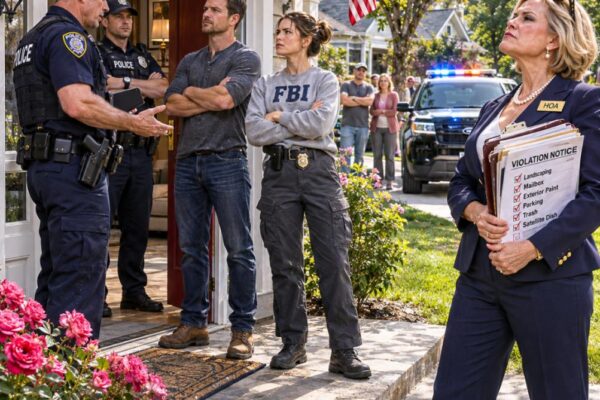
HOA Karen Chained Shut a Farmer’s Only Gate During Haying Season and Threatened $500-a-Day Fines—She Vastly Underestimated the Man Standing Beside Him.k
HOA Karen Chained Shut a Farmer’s Only Gate During Haying Season and Threatened $500-a-Day Fines—She Vastly Underestimated the Man Standing Beside Him
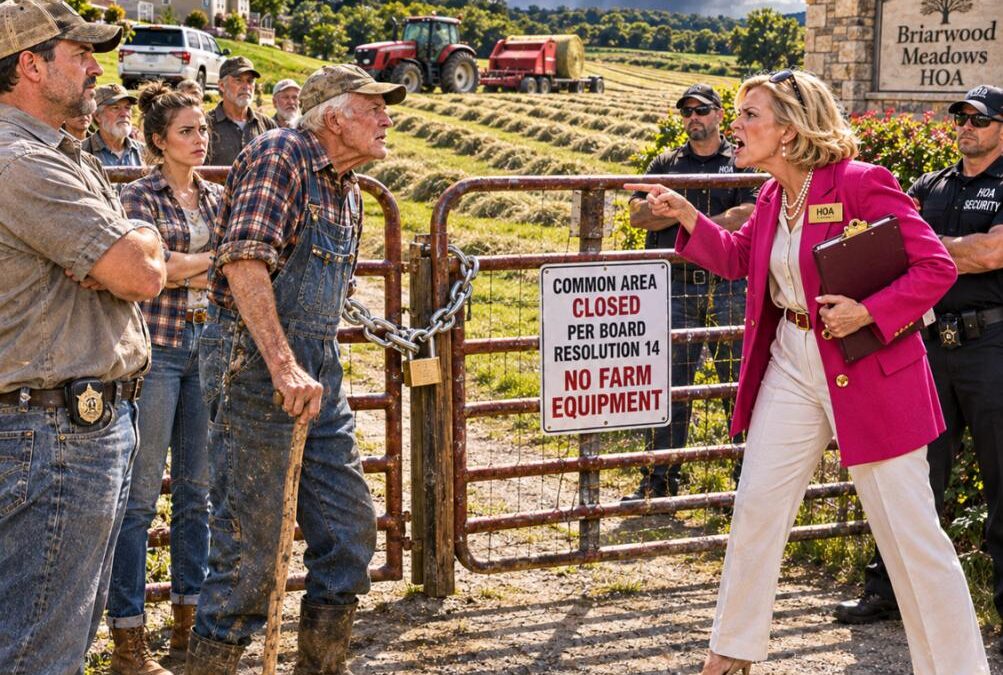
HOA Karen locked the only road into a seventy-eight-year-old farmer’s hay field while forty acres of cut alfalfa sat under a storm warning.
She called the lane “HOA property,” threatened trespass charges if we touched her chain, and dismissed twenty thousand dollars of winter feed like it was somebody else’s inconvenience.
Then she looked straight at me in my seed cap and sweat-stained shirt, called me the hired help, and swore she’d have a court order by morning.
The chain was thick enough to secure farm equipment.
That was the first thing I noticed.
Not the laminated sign zip-tied to the gate.
Not the woman in the pink wool coat standing beside it with a clipboard.
The chain.
Thumb-thick steel looped twice through the sixteen-foot pipe gate and around the cedar post my neighbor’s father had sunk into the ground before most of Briarwood Meadows existed even on paper.
A brass padlock hung from it.
New.
Shiny.
Deliberate.
Behind the gate, Ian Lane’s east field stretched toward the tree line in long green windrows.
Forty acres of orchard grass and alfalfa had been cut that morning.
The weather service had rain coming Friday night.
We had maybe thirty hours.
If that hay got soaked before baling, a season’s worth of winter feed would turn into moldy compost.
Ian killed the truck engine.
For a moment, nobody moved.
Then he took off his cap.
He was seventy-eight, thin as fence wire, one hip replaced in April, hands permanently bent from a lifetime of machinery and cold mornings.
“What in God’s name is this?”
The woman stepped forward.
“I’m Karen Ford. President of the Briarwood Meadows Homeowners Association.”
“I know who you are.”
“Then you know the board voted last night.”
She tapped the sign.
COMMON AREA CLOSED
PER BOARD RESOLUTION 14
NO FARM EQUIPMENT
Ian stared at it.
“Ma’am, that lane’s been my way into that field since before your subdivision had sewer pipe.”
Karen smiled.
“That does not give you the right to damage association property.”
“My hay’s in there.”
“Then you should’ve considered access before repeatedly rutting our common area.”
Ian looked at me.
I stayed quiet.
Thirty-one years practicing law and nine years on the county bench had taught me that silence is sometimes the cheapest discovery tool ever invented.
Karen mistook it for weakness.
She turned toward me.
“And you are?”
“A neighbor.”
She glanced at my Pioneer Seed cap, sweat-stained work shirt, and mud-covered boots.
“Well, neighbor, you’re also standing on HOA property.”
I took out my phone.
Photographed the chain.
The padlock.
The sign.
Karen.
Timestamp: 1:52 p.m.
Her face hardened.
“Put the phone away.”
“No, ma’am.”
“I’ll add you to the complaint.”
“Please spell my name correctly.”
She gave me the kind of look people reserve for men they believe are too stupid to understand what’s happening.
Then she faced Ian.
“If you cut this chain, the association will treat it as trespass and intentional destruction of HOA property. The fines begin at five hundred dollars per day.”
Ian’s granddaughter Eva stepped out of the truck.
“He’s seventy-eight.”
Karen looked at her.
“And?”
“It’s supposed to rain tomorrow night.”
“The weather is not the association’s responsibility.”
I finally spoke.
“Did your lawyer review this?”
Karen turned toward me.
“Excuse me?”
“The lane closure.”
“Yes.”
“Good.”
“Very.”
I nodded.
“Then I assume you won’t mind putting all of that in writing.”
She lifted her clipboard.
“I already have.”
Then she smiled.
“We’re filing for an emergency injunction this afternoon.”
Ian’s jaw tightened.
“Against me?”
“Against continued unauthorized use of Briarwood common property.”
She walked toward her white SUV.
At the door, she looked back.
“You people have gotten away with treating this development like your private farm for long enough.”
Ian went still.
Eva inhaled sharply.
Karen got into the SUV and drove away.
I watched her disappear between the new stone entrance pillars.
Then I turned to Ian.
“Where’s your coffee can?”
He blinked.
“What?”
“The old deeds.”
His face changed.
And twenty minutes later, in a pantry that smelled like flour and coffee, we unfolded a piece of paper Karen Ford should have read before she ever bought that padlock.
part 2
Ian kept property records the way farmers of his generation kept everything important.
Not in a fireproof safe.
Not scanned into cloud storage.
In a dented Folgers can behind a sack of flour.
Inside were tax receipts, two faded photographs, a handwritten fence agreement from 1968, and beneath all of that, folded into wax paper, a certified copy of an easement recorded in 1941.
I carried it to the kitchen table.
Eva stood behind me.
Ian leaned on his cane.
The paper had yellowed, but the legal description was clear.
A perpetual easement for ingress and egress across what was then the Caldwell parcel, benefiting the Lane tract and running with the land.
The language wasn’t poetic.
Good property documents rarely are.
But one phrase mattered more than anything Karen had said at the gate.
In perpetuity.
I read it twice.
Ian scratched his jaw.
“My daddy bought that strip before the war.”
“Your father didn’t buy the strip. He bought the right to cross it.”
“Same difference.”
“No.”
I looked at him.
“And today that difference is probably going to save your hay.”
Eva pulled out her phone.
“Can I scan it?”
“Scan everything.”
Under the easement was the 2006 recorded subdivision plat for Briarwood Meadows.
The development had gone in around Ian’s farm rather than replacing it.
One hundred sixty acres of old farmland sat behind the new houses like a reminder the land had existed before cul-de-sacs and decorative stone monuments.
Briarwood’s developer had purchased the surrounding tract, carved it into residential lots, then recorded a plat showing the old farm lane crossing a narrow strip labeled Tract C.
Near the bottom corner was a note.
TRACT C SUBJECT TO RECORDED EASEMENT
BOOK 212, PAGE 40
LANE ACCESS TO REMAIN UNOBSTRUCTED
I sat back.
Eva read it over my shoulder.
“That’s it?”
“That’s a lot.”
Ian stared at the papers.
“I never needed them.”
“Nobody needs an easement until somebody decides the road belongs to them.”
He looked toward the window.
The chain wasn’t visible from the farmhouse, but the field was.
Wind moved through the cut hay.
“Can we cut the lock?”
“No.”
Ian frowned.
“Why not?”
“Because right now Karen is the person who chained a gate across a recorded access easement. If you cut it, tomorrow she’ll tell a judge you destroyed association property.”
“It’s my road.”
“It’s your right to use the road.”
“Lawyers.”
“Farmers.”
Eva smiled despite herself.
I called the sheriff’s non-emergency line.
I didn’t identify myself as Judge Warren McCoy.
I gave my name, described the obstruction, and asked for a deputy to document a property-access dispute before anyone touched anything.
Deputy Lucas McCoy arrived a little after four.
No relation.
Small counties collect repeated surnames like barns collect dust.
He knew me, of course.
“Judge.”
“Today I’m Warren.”
He looked at the chain.
“Looks like trouble.”
“It is.”
I gave him copies of the recorded easement and subdivision plat.
He read them beneath the porch light.
Then walked the lane.
Photographed the sign.
The lock.
The gate.
Took statements from Ian and Eva.
Then from me.
“Who put it up?”
“Karen Ford says she personally ordered it.”
“You see her do it?”
“No. We returned from the co-op and she was standing beside it.”
“What’d she say?”
I repeated the conversation as accurately as memory allowed.
Lucas looked toward the field.
“Storm coming.”
“That’s the concern.”
Ian couldn’t stand it anymore.
“Can I cut the damn thing?”
Lucas looked at me.
I looked at Lucas.
He said, “I’m not giving anybody legal advice.”
“Neither am I.”
Ian cursed both of us.
The deputy documented the obstruction and left.
Eva and I spent the next two hours making copies.
Recorded deed.
Plat.
Weather forecast.
Hay invoices.
Estimated value of the crop.
Photographs of previous seasons showing tractors using the lane.
Invoices from gravel maintenance Ian had paid over the years.
Anything showing open, continuous use.
At 8:40 that night, my phone rang.
Marcy Bell.
Clerk of county court.
“Judge, I’m sorry to bother you.”
“What happened?”
“We got an emergency petition at 4:52.”
I already knew.
“Briarwood?”
“Yes.”
I closed my eyes.
“Who’s the defendant?”
“Ian Lane.”
“Assigned where?”
Silence.
Then:
“Your docket.”
I stood from Ian’s kitchen table.
Eva watched my face.
“Marcy, read me the verification.”
Papers shuffled.
Then she read:
“I, Karen Ford, being duly sworn, state that on September twenty-eighth I personally caused the disputed gate to be secured with chain and lock to protect Briarwood Meadows common property from continuing unauthorized vehicular access.”
I rubbed my forehead.
“Keep going.”
“Paragraph six: ‘No recorded instrument grants Defendant Ian Lane a right of access across Tract C or other association-owned property.'”
That one mattered.
“Anything about an easement search?”
“No.”
“Plat?”
“No.”
“What relief?”
“Immediate injunction prohibiting Ian from cutting the chain, crossing the tract with farm equipment, or interfering with HOA property until final hearing.”
I looked at Eva.
She couldn’t hear Marcy but she knew something had gone wrong.
“Marcy.”
“Yes?”
“Flag the conflict.”
“I already did.”
“Good.”
“You were at the scene?”
“I’m a fact witness.”
“I figured.”
“Call the visiting judge.”
Judge Bethany Ford was in town for the week hearing overflow matters.
No relation to Karen.
County life again.
“Tell Bethany I need to recuse.”
“Should I move the case?”
“Yes, but I want the recusal on the record first thing in the morning.”
“Judge—”
“I know.”
“You sure?”
“Absolutely.”
I hung up.
Ian stared at me.
“What?”
“She filed.”
“Can she do that?”
“Anybody can file.”
“Can she win?”
“Anybody can win.”
He frowned.
“That’s not helpful.”
“I’m recused.”
“From what?”
“The case got assigned to me.”
Eva’s eyes widened.
Ian stared.
Then laughed.
Actually laughed.
Hard enough he started coughing.
“You mean that woman called you hired help and then filed in your court?”
“Technically she filed in county court.”
“Your court.”
“I share it with the taxpayers.”
Ian wiped his eyes.
“Lord.”
“Don’t enjoy it too much.”
“Why not?”
“Because I won’t be deciding anything.”
His smile faded.
“You’re the judge.”
“Which is exactly why I can’t touch it.”
That was the part people later got wrong when the story spread.
They imagined some revenge fantasy where I sat on the bench and destroyed Karen Ford because she’d insulted me.
That would’ve been unethical.
Worse, it would’ve contaminated Ian’s case.
I had witnessed facts.
I had photographs.
I knew the defendant personally.
I had been on his tractor.
I had a personal interest in saving the hay.
I had to step away.
The smartest thing a judge can sometimes do is remove himself from power.
Bethany arrived at my chambers at eight the next morning.
She wore reading glasses and carried two coffees.
“One of these is mine.”
“Which?”
“The better one.”
She took my chair without asking.
I handed her the file.
She read for twenty minutes.
Then looked over her glasses.
“You took these photographs?”
“Yes.”
“At 1:52?”
“Timestamped.”
“Heard Ford threaten trespass?”
“Yes.”
“And you located the easement later.”
“Correct.”
“You didn’t know about it at the gate?”
“No.”
“Good.”
“Why good?”
“Because if you’d known and started arguing law with her, I’d have to listen to three hours of testimony about what you said.”
I smiled.
Bethany tapped the petition.
“Plaintiff says there is no recorded instrument.”
“The subdivision plat says otherwise.”
“I see that.”
“Holly Park is representing Ian.”
Bethany nodded.
“Good lawyer.”
“Very.”
“And you want to open the session personally?”
“I want the recusal stated from the bench so there’s no suggestion the transfer happened quietly.”
Bethany leaned back.
“She doesn’t know you’re a judge.”
“No.”
“Why?”
“She never asked.”
Bethany almost smiled.
“What did she call you?”
“Hired help.”
That did it.
She laughed once.
Then immediately went serious.
“Warren.”
“I know.”
“No performance.”
“No performance.”
“No enjoying yourself.”
“I make no promises about internal conditions.”
She pointed a pen at me.
“I mean it.”
At 8:58, the courtroom filled.
Not packed.
Small-town full.
Ian sat at the defense table wearing the dark jacket he usually wore to funerals.
Eva had a manila folder in her lap.
Holly Park sat beside them with a certified easement copy she’d pulled from the recorder’s office the moment it opened.
Three Briarwood residents occupied the back row.
Karen Ford entered at 8:56.
Pink wool coat.
White sneakers.
Burgundy binder.
Her attorney, Lloyd Barrett, followed carrying a litigation bag heavy enough to suggest bad news inside.
Karen looked at Ian.
Then Eva.
Then Holly.
She did not look toward the bench.
“All rise.”
I walked through the side door in my robe.
Took the bench.
Karen’s eyes moved upward.
Then stopped.
I watched recognition arrive in stages.
Seed cap.
Sweat-stained shirt.
Phone camera.
Neighbor.
Hired help.
Judge.
The color left her face.
“Be seated.”
Chairs scraped.
I opened the file.
“In the matter of Briarwood Meadows Homeowners Association versus Ian Lane, before any substantive issue is heard, the court makes the following disclosure.”
Karen leaned toward Barrett.
He whispered something.
I continued.
“Yesterday at approximately 1:52 p.m., I was physically present at the gate located on Lane’s Lane. I observed a chain and padlock securing the gate. I heard statements made by the plaintiff’s president, Mrs. Karen Ford, concerning the association’s claimed ownership and the defendant’s access rights.”
Barrett stood slowly.
“Your Honor—”
“I am not ruling on those facts, counsel.”
He sat.
“I photographed the scene. I later became aware of records relating to the access dispute. Because I am a fact witness and have personal knowledge relevant to the controversy, I am recused from all further proceedings in this matter.”
Karen whispered to Barrett.
Courtrooms amplify whispers.
“That was the hired man.”
I looked at her.
“Neighbor.”
Her eyes snapped toward me.
“I believe I said neighbor.”
Bethany entered through the side door.
I stepped down.
She took the bench.
The entire transfer lasted less than three minutes.
Yet that was the moment people later remembered.
Not because I had power over Karen.
Because I didn’t use it.
Karen had built her strategy around knowing exactly who mattered.
She had misidentified me completely.
Then Bethany did what judges do.
She ignored the theater.
Barrett argued first.
Briarwood owned Tract C.
Heavy agricultural equipment damaged landscaping.
The board had authority to protect common property.
Ian had alternative access possibilities through the north field.
The chain was temporary.
The association faced continuing harm.
Holly stood.
“Your Honor, before we discuss balancing equities, I’d like the court to look at title.”
She handed up the certified records.
Book 212.
Page 40.
Perpetual easement.
Then the recorded Briarwood plat.
Tract C subject to recorded easement.
Lane access to remain unobstructed.
Bethany read silently.
Almost a full minute.
Radiator ticked.
Somebody coughed.
Karen shifted in her chair.
Bethany looked at Barrett.
“Counsel, did your client provide you this plat before filing?”
Barrett glanced at Karen.
“No, Your Honor.”
Karen stiffened.
Bethany turned pages.
“Mrs. Ford submitted a sworn verification.”
Barrett nodded.
Bethany read:
“No recorded instrument grants Defendant Ian Lane a right of access across association property.”
Then she looked at Karen.
“Mrs. Ford, did you read the subdivision plat before signing your affidavit?”
Barrett stood.
“Your Honor, I would ask that questions to my client be directed through counsel.”
“Fair.”
Bethany looked at him.
“Counsel, was there a title search?”
“We relied on association records.”
“Which include the recorded plat?”
Barrett’s jaw tightened.
“I don’t yet know what the association’s internal records contain.”
“Do you dispute authenticity?”
“No.”
“Do you dispute that the plat places Tract C subject to Book 212, Page 40?”
“No.”
“Do you dispute that the easement grants ingress and egress to the Lane parcel?”
“At this stage, we would reserve—”
“Counsel.”
“No.”
That was the case.
Not entirely.
But enough for emergency relief.
Bethany denied Briarwood’s injunction request.
Then Holly asked for affirmative temporary relief requiring removal of the obstruction.
Barrett objected to lack of separate pleading.
Bethany gave him time to respond.
Short recess.
Everyone returned.
Then she ruled.
The association was temporarily restrained from obstructing Ian’s recorded easement pending further proceedings.
Chain removed by 11:00 a.m.
No boulders.
No vehicles.
No barriers.
No interference with reasonable agricultural ingress and egress.
The order preserved whatever claims Briarwood might later have concerning actual damage to the surface, maintenance responsibilities, or unreasonable use.
That distinction mattered.
Ian had an easement.
He did not have a license to destroy the road.
Karen had the right to raise legitimate maintenance questions.
She did not have the right to make the access disappear.
Then Bethany addressed the affidavit.
“The court is setting a show-cause hearing for Monday concerning representations made in the verified petition, potential fees, and compliance with this order.”
Karen shot to her feet.
“This is a setup.”
Barrett touched her arm.
“Karen.”
She pulled away.
“He’s the judge.”
Bethany looked toward where I had been sitting before leaving the courtroom.
“He recused.”
Karen pointed at the bench.
“He was involved.”
“Which is why he recused.”
“You all know each other.”
Bethany’s voice went flat.
“Mrs. Ford.”
Karen stopped.
“You signed a sworn statement filed in this court. Your attorney is beside you. I strongly recommend you speak through him from this point forward.”
Karen sat.
That was the best legal advice she received all week.
At 10:40, the landscaping crew returned to Lane’s Lane.
Same truck.
Same two men.
Deputy Lucas McCoy stood nearby while they cut the chain.
Ian watched from the gravel.
Karen did not attend.
At 11:15, I was back where I belonged.
On Ian’s Case tractor.
Seed cap.
No robe.
Eva drove the wagon.
Ian sat on an overturned feed bucket beside the gate, keeping count.
We baled until dark.
Twenty bales.
Forty.
One hundred.
The sky thickened west of us.
Humidity climbed.
Two hundred.
Three hundred.
Eva’s hair turned dark with sweat beneath her cap.
My back reminded me I was sixty-one and had no business pretending otherwise.
Ian kept counting.
“Three eighty-nine.”
“That’s not right.”
“It is.”
“You missed the wagon.”
“I’ve counted hay longer than you’ve counted cases.”
“Poorly, apparently.”
He flipped me off.
We kept going.
At 9:30, the last wagon backed inside the barn.
Four hundred ten square bales.
Rain struck the roof at 9:50.
Not heavy.
At first.
Then hard enough we couldn’t hear ourselves talk.
Ian stood inside the doorway.
Watched water hit the yard.
His eyes shined.
“Twenty minutes.”
“Twenty.”
“If she’d kept that gate shut—”
“I know.”
He held out his hand.
“Judge, I don’t know whether to thank you or the Lord.”
“Thank Eva.”
Eva was leaning against the wagon, filthy and exhausted.
“Why me?”
“You drove.”
Ian nodded.
“Lord mostly supervised anyway.”
Rain hammered the barn.
For one night, I thought we were done.
Saturday morning, Eva called.
“Can you come over?”
“What’s wrong?”
“I bought something.”
“That sounds expensive.”
“Trail camera.”
I sat up.
“When?”
“Thursday night.”
“Why?”
“Because I didn’t trust her.”
“Good instinct.”
“I mounted it on the gate post after the chain came off.”
“Okay.”
“It recorded something.”
I was at Ian’s kitchen table twenty minutes later.
Eva put an SD card into her laptop.
The video started at 1:14 a.m. Saturday.
Grainy infrared.
Lane’s Lane.
Empty.
Then headlights appeared.
A dump truck backed toward the gate.
Amber beacon rotating.
Truck bed lifted.
The first landscaping boulder rolled out.
Then another.
Then another.
Six cubic yards of stone dumped directly across the lane.
Each rock the size of a bushel basket or larger.
Enough to block tractor access completely.
Ian leaned toward the screen.
“You’ve got to be kidding.”
Then someone stepped into frame.
Pink coat.
Over pajama pants.
Karen.
She held a flashlight.
Waved the truck farther backward.
A second clip had audio.
Not perfect.
Good enough.
“A little farther.”
The truck moved.
Then Karen’s voice:
“That judge can’t stop us on a Saturday.”
Nobody in the kitchen spoke.
Eva looked at me.
“What now?”
I closed the laptop.
“Now I do nothing.”
Ian exploded.
“What do you mean nothing?”
“I’m recused.”
“She’s violating the order.”
“Exactly.”
“And you’re the judge.”
“Not on this case.”
Eva understood first.
“Monday.”
I nodded.
“Monday.”
Holly filed notice with Bethany’s chambers.
The video.
Photographs.
Deputy report.
Request for emergency enforcement.
Bethany ordered the lane cleared immediately and set Monday’s show-cause hearing.
The boulders were removed Saturday afternoon after Briarwood’s attorney learned what had happened.
Karen blamed a “miscommunication with landscape services.”
The camera showed her directing the truck.
Miscommunication had a pink coat and a flashlight.
I stayed away from the courtroom Monday morning.
A judge who recuses should not hover in the hallway like a father outside prom.
I worked in chambers.
Tried to review a criminal docket.
Read the same paragraph four times.
At 9:50, Marcy knocked.
“Judge Brooks wants you.”
I looked up.
“Why?”
“Authentication.”
Bethany had transferred the show-cause portion to Judge Anita Brooks, another visiting judge, after becoming concerned the case might expand beyond the narrow emergency question she’d first handled.
That was smart.
Anita wanted my photographs authenticated live.
“Tell her I’m available.”
“She said courtroom.”
Of course.
This time, I entered through the public door.
No robe.
Dark suit.
White shirt.
I sat behind Holly until the clerk called me.
Karen sat at the plaintiff’s table in the pink coat.
Her attorney was still Lloyd Barrett.
He looked ten years older than Friday.
I walked to the witness stand.
Raised my right hand.
Swore to tell the truth.
“State your name.”
“Warren McCoy.”
“Occupation?”
“County judge.”
“Are you presiding over this matter?”
“No. I recused before substantive proceedings because I have personal knowledge of relevant facts.”
Holly began.
Simple questions.
Thursday.
1:52 p.m.
Gate.
Chain.
Brass lock.
Sign.
Karen’s statements.
“Did Mrs. Ford tell Mr. Lane he would be fined if he cut the chain?”
“Yes.”
“Did she identify the lane as HOA property?”
“Yes.”
“Did she refer to you?”
“Yes.”
“How?”
I looked toward Karen.
“As Mr. Lane’s hired help.”
A few people in the back laughed.
Anita looked over her glasses.
The laughter died.
Holly asked:
“How did you identify yourself?”
“As a neighbor.”
“Did you tell Mrs. Ford you were a judge?”
“No.”
“Why not?”
“Because it was irrelevant to what was happening at the gate.”
Karen looked down.
Holly introduced my photographs.
Authenticated.
Timestamp.
Admitted.
Then:
“Judge McCoy, did you later locate the easement?”
“Ian Lane located it in his pantry. I read it.”
“Did you rely on that document in any judicial capacity?”
“No. Once the case was assigned to me, I immediately disclosed my involvement and recused.”
“Any personal financial interest?”
“No.”
“Any ownership interest in Mr. Lane’s farm?”
“No.”
“Why were you there?”
“I was helping bale hay.”
“That’s all.”
Barrett stood.
He walked toward me.
“Judge McCoy, you’ve known Mr. Lane how long?”
“About thirty years.”
“Friends?”
“Neighbors.”
“Close?”
“I know where he keeps his coffee can.”
Someone laughed again.
Barrett didn’t.
“Would you like Mr. Lane to prevail?”
“I’d like the law applied correctly.”
“That wasn’t my question.”
“No. I’d also like his hay not to rot.”
Anita looked at me.
“Judge.”
“Apologies.”
Barrett paused.
Then:
“You have strong feelings about Mrs. Ford’s conduct.”
“I have observations.”
“Strong ones?”
“I saw a chained gate.”
He knew better than to keep going.
“No further questions.”
Then Eva testified.
Her trail camera.
When she bought it.
Where she placed it.
How the footage was retrieved.
No edits.
Original SD card preserved.
Video admitted.
The courtroom watched Karen direct the dump truck.
Pink coat.
Pajama pants.
Flashlight.
Boulders.
Then the audio.
“That judge can’t stop us on a Saturday.”
Nobody laughed.
Barrett closed his eyes.
After the video, he asked for recess.
Granted.
Twenty minutes later, he returned alone.
Karen entered behind him.
They did not sit together.
Barrett stood.
“Your Honor, I request permission to withdraw.”
Karen’s head snapped toward him.
Anita frowned.
“Basis?”
“Professional considerations I am not at liberty to detail publicly.”
Karen stood.
“You can’t leave.”
Anita looked at her.
“Mrs. Ford, sit down.”
“I paid him.”
“Sit.”
She sat.
Barrett’s withdrawal was granted after the court ensured Karen would have reasonable opportunity to obtain counsel for any matters requiring continued hearing.
But Anita was not finished with factual findings about compliance with the temporary order.
Then Thomas Hargrove stood from the back.
Briarwood treasurer.
Gray-haired.
Quiet man.
He asked whether the court would hear from a board officer.
Anita told him to consult counsel.
Briarwood’s replacement counsel hadn’t been retained yet.
Holly asked to call him as a witness.
Karen objected personally.
Anita overruled.
Thomas took the stand.
He brought the board minute book.
Not copies.
Original bound minutes.
Resolution 14.
Vote: four to three.
Then the paragraph no one knew about.
“Prior to the vote,” Thomas read, “the president advised the board that counsel had identified a possible recorded easement across Tract C but recommended immediate closure while ownership and access rights were challenged.”
Holly stopped him.
“Who stated counsel had identified the possible easement?”
“Karen Ford.”
Karen shifted.
Thomas continued.
“The minutes also say, ‘President Ford believes Lane is unlikely to litigate due to cost and age and recommends proceeding despite uncertainty.'”
Ian stared at Karen.
Eva covered her mouth.
My stomach turned.
That was worse than ignorance.
Karen had known.
Maybe not with certainty.
Enough to know her sworn affidavit saying no recorded instrument existed was dangerous.
Holly asked:
“Who drafted those minutes?”
“Secretary drafted. Karen reviewed before approval.”
“Did the board authorize placement of boulders after the court’s order?”
“No.”
“Did it authorize any obstruction after Friday’s order?”
“No.”
“Who authorized the dump truck?”
Thomas looked at Karen.
“Not the board.”
Anita lifted Karen’s sworn affidavit.
“Mrs. Ford.”
Karen now had temporary counsel who had arrived during the recess, a local attorney named Susan Bell.
Susan stood immediately.
“Your Honor, my client invokes her right not to answer questions that may expose her to criminal liability.”
Anita nodded.
“Understood.”
That was the correct move.
No dramatic confession.
No forced self-destruction.
Courts have rules even when somebody has behaved badly.
Anita made findings from the evidence already admitted.
The 1941 easement was valid on the current record.
The 2006 plat expressly acknowledged it.
The chain materially interfered with access.
The court’s Friday order prohibited further obstruction.
The Saturday boulder placement violated that order.
Board minutes showed Karen had been informed before filing that an easement might exist.
Her sworn representation that no recorded instrument existed was therefore, at minimum, sufficiently serious to require referral and further proceedings.
Then came sanctions.
Not revenge numbers.
Documented ones.
Ian’s attorney submitted time records.
Emergency title work.
Court appearances.
Weekend enforcement.
Survey consultation.
Farm-access mitigation.
Costs.
The court awarded fees and expenses against the association where its conduct had caused unnecessary litigation.
Then Anita separated the Saturday conduct.
Because the board had not authorized the midnight boulder placement, she ordered briefing on Karen’s personal responsibility and contempt sanctions.
The final amount came later.
Just over thirty-eight thousand dollars in attorney fees and costs apportioned between the association and Karen based on the court’s findings.
Additional coercive sanctions applied until the lane was fully restored and verified clear.
It was cleared that afternoon.
Then Anita referred the sworn-filing issue and the possible violation of the court order to the district attorney.
Not a conviction.
Referral.
That distinction matters.
Judges don’t prosecute people from the bench because they’re angry.
Evidence goes where evidence is supposed to go.
The HOA meeting that night was the first Briarwood meeting I’d attended in years.
I didn’t speak.
I didn’t need to.
Sixty homeowners packed the clubhouse.
Karen sat at the front.
No gavel.
Thomas Hargrove opened the meeting as treasurer because three directors had signed a request to consider officer removal.
Karen objected.
Then the association’s new attorney read the bylaws.
The board could remove an officer by majority vote even if separate procedures governed removing an elected director.
Thomas made the motion.
“Remove Karen Ford as president effective immediately.”
Seconded.
Karen stared at them.
“This entire thing happened because I protected association property.”
One director named Susan Hale answered:
“You were told there might be an easement.”
Karen pointed toward Thomas.
“He undermined the board.”
Thomas shook his head.
“I kept minutes.”
“You sided with Lane.”
“I sided with the plat.”
That line spread around the county for weeks.
Karen looked toward the homeowners.
“Do you really want farmers driving heavy equipment through our common property whenever they want?”
Ian stood in the back.
“No.”
Every head turned.
Ian leaned on his cane.
“I want to drive through when I need to farm my land. Same as I’ve done since before you bought yours.”
Karen’s face tightened.
Ian continued.
“I’ll fix a rut if I make one.”
That surprised people.
“I always have.”
He looked around.
“An easement isn’t permission to tear up somebody else’s ground. But owning the ground isn’t permission to lock me out.”
There.
The whole dispute in two sentences.
Not farmer versus suburb.
Not old versus new.
Rights in the same piece of land can overlap.
Good neighbors manage that.
Bad leaders pretend only one right exists.
The board voted.
Six to one.
Karen was the one.
Removed as president.
She remained a director for another week.
Then resigned.
Her criminal case took months.
The district attorney reviewed the affidavit, board minutes, trail-camera video, court orders, and witness statements.
Karen’s attorneys challenged intent.
That mattered.
False statements require more than somebody being wrong.
They argued she relied on incomplete association records.
They argued the plat notation had not been brought directly to her attention in certified form before filing.
They argued the Saturday obstruction had been an attempt to protect landscaping while lawyers sorted access.
The state argued the board minutes showed she knew an easement issue existed before swearing none did and that directing boulders onto the lane after being served with a court order was intentional.
The case ended through a negotiated plea.
No theatrical trial.
Karen pleaded to offenses involving the false filing and intentional interference with property rights.
She received probation.
Restitution obligations.
Community service.
Court costs.
Conditions limiting involvement in association governance during the probationary period.
Some people wanted jail.
Ian didn’t.
“She put rocks in a road,” he said. “She didn’t kill anybody.”
Eva was less generous.
“She could’ve ruined twenty thousand dollars of hay.”
Ian shrugged.
“But she didn’t.”
That was Ian.
He could hold a grudge for thirty years over a borrowed wrench and forgive somebody for almost destroying his harvest because the rain came twenty minutes late.
Farmers contain contradictions.
Briarwood’s insurer created another fight.
Intentional acts by individual directors weren’t treated the same as ordinary negligent board decisions.
Coverage questions went back and forth.
The HOA ended up paying part of the association-level legal expense from reserves while pursuing reimbursement and resolving coverage issues separately.
Homeowners were furious.
Not at Ian.
At the fact that one president’s decision had turned into association-wide cost.
That’s when governance reform became more than a slogan.
The new board ordered a title review.
Every common tract.
Every easement.
Every recorded access right.
Every utility corridor.
Every maintenance obligation.
They discovered three other old easements nobody had discussed in years.
One drainage access.
One utility corridor.
One pedestrian path benefiting an older parcel.
Thomas called me.
“Warren, we’re drowning in paper.”
“Congratulations.”
“This is your fault.”
“No. Your subdivision has always contained paper.”
“We’re hiring a title company.”
“Excellent.”
“Expensive.”
“Cheaper than padlocks.”
He hung up on me.
That winter, Briarwood adopted a formal easement policy.
Not one that favored Ian.
One that acknowledged the recorded access and set reasonable maintenance expectations.
Farm equipment could cross.
Ian would repair damage beyond ordinary wear attributable to his operations.
The HOA couldn’t obstruct access.
If disputes arose, notice first.
Then inspection.
Then mediation or court if necessary.
No chains.
No midnight boulders.
No unilateral “emergency” because somebody disliked tractor tires.
Ian hated the paperwork.
Which meant it was probably balanced.
The next spring, Thomas stood at the gate while Ian spread gravel.
“You put too much on the west side.”
Ian leaned against his shovel.
“You’re HOA president now, Thomas, not God.”
Thomas looked at me.
“Does he talk to everybody like this?”
“Only people he likes.”
Thomas grinned.
They became friends.
Not close friends.
Property-rights friends.
The kind who argue about ditch maintenance for thirty minutes, then drink coffee.
Eva transferred to the state university the following fall.
She changed her major.
Property law track eventually.
That was partly my fault.
“You’re ruining your life,” I told her.
“I watched a woman nearly destroy Grandpa’s hay because nobody read a document from 1941.”
“And your conclusion was law school?”
“Exactly.”
“Seek counseling.”
She laughed.
Ian was proud enough to be unbearable.
He told everyone in the co-op.
“My granddaughter’s going to be a lawyer.”
Eva corrected him every time.
“I’m pre-law.”
“Same thing.”
“No.”
“You’re already arguing. Lawyer.”
The Lane’s Lane sign came later.
Brass plate mounted to the gate post.
A gift from the Briarwood board.
LANE’S LANE
FARM ACCESS EASEMENT RECORDED 1941
PLEASE KEEP CLEAR
Ian complained about it.
“Looks fancy.”
“You don’t like it?”
“People know where the road is.”
“Apparently not.”
He couldn’t argue with that.
For me, the strangest part was how quickly the story became folklore.
The weekly paper ran it.
Then regional radio.
Then social media got hold of it.
Every version added nonsense.
One claimed I sentenced Karen personally.
False.
One said I fined her fifty thousand dollars from the bench.
False.
One said she chained my farm gate.
Not my farm.
Another said I arrested her.
Judges do not arrest people like cowboys.
The truth was better because it was ordinary enough to happen.
An HOA president assumed the common tract gave her absolute control.
She failed to respect a recorded easement.
She underestimated an elderly farmer.
She filed too aggressively.
She made a sworn statement without reconciling the association’s own plat.
Then, after a judge ordered the lane left open, she decided she could create a new obstruction in the middle of the night.
No conspiracy required.
Just arrogance.
Power.
Bad advice.
And records.
Years on the bench have taught me people imagine law as dramatic speeches.
Mostly, law is documents people didn’t read until something went wrong.
Deeds.
Plats.
Minutes.
Affidavits.
Orders.
Receipts.
Photographs.
Timestamps.
The coffee can beat the clipboard because the coffee can had a recorded easement inside.
That’s not cinematic.
It’s true.
Karen eventually sold her house.
Not immediately.
About a year later.
She stayed mostly out of HOA matters.
The pink coat disappeared from meetings.
I saw her once at the grocery store.
We reached the same produce display from opposite directions.
She recognized me.
“Judge.”
“Mrs. Ford.”
She looked different.
Not broken.
Not transformed.
Just ordinary.
“I suppose you’re pleased.”
“About what?”
“How everything turned out.”
I put an apple in my cart.
“Ian got his access.”
“You know what I mean.”
I did.
“No.”
She seemed surprised.
“You don’t think I deserved what happened?”
“That’s not what I said.”
“You testified against me.”
“I testified about what I saw.”
“You could’ve stayed out of it.”
“No.”
That answer came easily.
She looked away.
“The tractors did damage the tract.”
“I believe they did.”
Her eyes snapped back.
That wasn’t what she expected.
“I told Ian from the beginning an easement doesn’t mean he can destroy the road.”
Karen stared.
“Then why did everyone act like I was crazy?”
“Because you chained the gate.”
“I was protecting property.”
“You had other remedies.”
“He never listened.”
“You didn’t send a repair demand.”
“He’d have ignored it.”
“Maybe.”
I shrugged.
“Then you sue for maintenance. You negotiate. You document damage. You seek contribution if the deed allows it.”
She folded her arms.
“He would’ve kept driving.”
“Yes.”
“Exactly.”
“Because he had an easement.”
There it was again.
Two rights.
Same land.
Karen’s mistake wasn’t caring about the common tract.
Her mistake was believing ownership erased the easement.
“You could’ve told me who you were,” she said.
I laughed.
“Why would that matter?”
She didn’t answer.
“Would you have left the gate open if you knew I was a judge?”
Her face tightened.
“Maybe you would’ve explained it differently.”
“I asked whether your lawyer reviewed it.”
“You were wearing a seed cap.”
That sentence said more than she intended.
I smiled.
“Yes.”
She heard herself.
Looked away.
“You made me look stupid.”
“No.”
I put another apple in the cart.
“You decided who was worth listening to before you knew what they knew.”
Karen’s face closed.
Conversation over.
That was the last time we spoke.
Ian farmed another six years.
Less each year.
Hip got worse.
Then his shoulder.
Eva started handling leases and paperwork before she even finished law school.
Eventually, Ian rented most of the acreage to a younger cattleman but kept twenty acres because retirement, according to him, was “how people die from boredom.”
At eighty-four, he still drove a tractor.
Badly.
One October, he called.
“Warren.”
“What?”
“Gate’s stuck.”
I laughed.
“You can’t be serious.”
“Different gate.”
“Thank God.”
“You coming?”
“I’m a judge, not a maintenance service.”
“You were hired help first.”
He had me there.
I drove over.
No pink coat.
No chain.
Just rust.
We fixed the hinge.
Afterward, Ian poured coffee from a thermos.
We sat on the tailgate.
Lane’s Lane ran past us toward Briarwood.
Kids rode bicycles on the subdivision sidewalks beyond the fence.
A landscaping truck crossed the entrance.
Nothing dramatic.
Ian looked at the brass sign.
“Think we needed all that?”
“What?”
“The mess.”
“No.”
“Could’ve been solved with one phone call.”
“Probably.”
He sipped coffee.
“She should’ve called me.”
“You would’ve yelled.”
“I would’ve listened after.”
“Maybe.”
He looked at me.
“You miss court?”
I had retired the year before.
“Some days.”
“Liar.”
“Most days I miss the people. Not the filings.”
Ian nodded toward his pantry through the farmhouse window.
“Still got the coffee can.”
“Good.”
“Eva put copies in a safe.”
“Better.”
“Also online.”
“Best.”
He frowned.
“Don’t trust online.”
“You don’t trust anything invented after 1975.”
“Most of it’s unnecessary.”
We sat quietly.
The rain that almost destroyed the hay years earlier had become one of those memories weather turns into mythology.
But the lesson stayed simple.
Property doesn’t care who feels powerful.
A recorded easement doesn’t become less recorded because a board president has a clipboard.
An HOA owns what its deed says it owns.
A farmer owns what his deed says he owns.
When one parcel is burdened by a valid easement benefiting another, both owners have rights and obligations.
Neither side gets to erase the other because cooperation is inconvenient.
That was what Briarwood finally learned.
It wasn’t anti-HOA.
It was anti-invention.
The board eventually became competent enough that nobody talked about it.
That is the highest compliment I can give a homeowners association.
Thomas served two terms.
Then refused a third.
“People complain about mailbox colors.”
“That’s the job.”
“I hate them.”
“The mailboxes?”
“The people.”
“Time to retire.”
The next president was a woman named Denise Carter.
Accountant.
Terrifyingly organized.
Every board packet had tabs.
Ian loved her.
Not because they agreed.
Because she called before making decisions.
The first time a tractor left mud on Tract C, Denise photographed it.
Then called Ian.
“You left mud.”
“Rain.”
“Clean it.”
“Yes, ma’am.”
He cleaned it.
No lawsuit.
No injunction.
No boulders.
No news article.
Good governance is painfully uninteresting.
Eva graduated law school.
Property law, just as threatened.
At her graduation dinner, Ian raised a glass.
“To the coffee can.”
Eva groaned.
“Grandpa.”
“What?”
“You know I studied more than one easement.”
“First one mattered most.”
She looked at me.
“This is your fault.”
“I warned you.”
“Too late.”
She ended up working for a regional firm representing landowners, developers, and occasionally associations.
I asked how she handled HOA cases.
“Carefully.”
“Good.”
“And I always pull the plat.”
“Better.”
Years later, she told me she’d represented a subdivision where a farmer claimed an access right that didn’t exist.
I laughed.
“What’d you do?”
“Beat him.”
Ian overheard.
“Traitor.”
Eva smiled.
“Facts first.”
That made me proud.
Not because farmers were always right.
They aren’t.
Not because HOAs are always wrong.
They aren’t.
Because justice becomes dangerous the moment we decide who deserves to win before reading the documents.
Karen did that.
She saw an old farmer crossing a manicured common tract and decided he was trespassing.
Then she built every fact around that conclusion.
The ruts became proof.
The tractors became invasion.
The farmer became a problem.
The easement became inconvenient enough to ignore.
Even me.
Seed cap.
Sweat.
Mud.
Hired help.
Unimportant.
She didn’t lose because I was secretly powerful.
She lost because facts don’t become different when the man holding them changes clothes.
That’s why I never liked people calling the courtroom reveal revenge.
My robe didn’t defeat Karen.
The robe removed me from the case.
The easement defeated her argument.
The plat defeated her affidavit.
The trail camera defeated her excuse about the boulders.
The minutes defeated the claim that nobody had warned her.
The court order made the consequences possible.
Documents.
Not identity.
Not status.
Not theatrics.
There is something satisfying about that.
The last hay season Ian worked personally, I showed up on a Saturday.
No robe.
Same kind of seed cap.
Different brand.
Eva was driving the wagon.
Ian sat beside the gate.
“You’re late.”
“I’m retired.”
“Means you have less excuse.”
I climbed onto the tractor.
The gate stood open.
Old pipe hinges.
Rust along the bottom.
Brass easement sign on the post.
Briarwood houses beyond it.
New families lived there now.
Most had no idea who Karen Ford was.
Good.
History should leave procedures behind, not permanent enemies.
We worked until afternoon.
Not four hundred ten bales.
Only one hundred thirty-two.
Small field.
Good weather.
No storm.
When we finished, Eva leaned against the trailer.
“You know what Grandpa still tells people?”
“That I’m hired help?”
“That too.”
She smiled.
“He says a lane is closed only as long as everybody believes the chain.”
I looked at the gate.
“That’s too dramatic for Ian.”
“He steals lines.”
“From who?”
“You.”
“I never said that.”
“Then maybe he improved you.”
Possible.
The thing about chains is they look absolute.
Steel.
Lock.
Authority.
A sign.
A board resolution.
The whole visual language says stop.
Most people stop.
Sometimes they should.
Sometimes the person behind the chain owns the ground and has every right to keep you out.
Other times, there is a coffee can in a pantry holding a document older than the neighborhood, quietly saying the chain is in the wrong place.
The hard part is knowing which world you’re standing in.
That’s why you read.
That’s why you document.
That’s why judges recuse.
That’s why boards keep minutes.
That’s why recorded instruments matter.
That’s why nobody, no matter how certain they sound, should be allowed to turn personal confidence into legal authority without somebody asking to see the paper.
We loaded the final bales.
Ian counted aloud.
“One twenty-eight.”
“One thirty.”
“I said one twenty-eight.”
“You skipped two.”
“I never skip.”
Eva rolled her eyes.
“You both skipped four.”
Ian glared.
“Lawyers.”
She grinned.
“Farmers.”
I climbed down.
The sun was low.
No rain.
No patrol car.
No pink coat.
No padlock.
Just an old lane crossing newer land exactly the way the records said it could.
Ian closed the gate after the tractor passed.
Not locked.
Just latched.
He looked at me.
“Coffee?”
“Always.”
We walked toward the farmhouse.
Behind us, Lane’s Lane remained open.
Not because Karen had lost.
Not because I had won.
Because eighty years earlier, somebody had taken the time to put a right into writing.
And when the moment came, somebody else had taken the time to read it.
THE STORY ENDS HERE
HOA Karen Chained Shut a Farmer’s Only Gate During Haying Season and Threatened $500-a-Day Fines—She Vastly Underestimated the Man Standing Beside Him
HOA Karen locked the only road into a seventy-eight-year-old farmer’s hay field while forty acres of cut alfalfa sat under a storm warning.
She called the lane “HOA property,” threatened trespass charges if we touched her chain, and dismissed twenty thousand dollars of winter feed like it was somebody else’s inconvenience.
Then she looked straight at me in my seed cap and sweat-stained shirt, called me the hired help, and swore she’d have a court order by morning.
The chain was thick enough to secure farm equipment.
That was the first thing I noticed.
Not the laminated sign zip-tied to the gate.
Not the woman in the pink wool coat standing beside it with a clipboard.
The chain.
Thumb-thick steel looped twice through the sixteen-foot pipe gate and around the cedar post my neighbor’s father had sunk into the ground before most of Briarwood Meadows existed even on paper.
A brass padlock hung from it.
New.
Shiny.
Deliberate.
Behind the gate, Ian Lane’s east field stretched toward the tree line in long green windrows.
Forty acres of orchard grass and alfalfa had been cut that morning.
The weather service had rain coming Friday night.
We had maybe thirty hours.
If that hay got soaked before baling, a season’s worth of winter feed would turn into moldy compost.
Ian killed the truck engine.
For a moment, nobody moved.
Then he took off his cap.
He was seventy-eight, thin as fence wire, one hip replaced in April, hands permanently bent from a lifetime of machinery and cold mornings.
“What in God’s name is this?”
The woman stepped forward.
“I’m Karen Ford. President of the Briarwood Meadows Homeowners Association.”
“I know who you are.”
“Then you know the board voted last night.”
She tapped the sign.
COMMON AREA CLOSED
PER BOARD RESOLUTION 14
NO FARM EQUIPMENT
Ian stared at it.
“Ma’am, that lane’s been my way into that field since before your subdivision had sewer pipe.”
Karen smiled.
“That does not give you the right to damage association property.”
“My hay’s in there.”
“Then you should’ve considered access before repeatedly rutting our common area.”
Ian looked at me.
I stayed quiet.
Thirty-one years practicing law and nine years on the county bench had taught me that silence is sometimes the cheapest discovery tool ever invented.
Karen mistook it for weakness.
She turned toward me.
“And you are?”
“A neighbor.”
She glanced at my Pioneer Seed cap, sweat-stained work shirt, and mud-covered boots.
“Well, neighbor, you’re also standing on HOA property.”
I took out my phone.
Photographed the chain.
The padlock.
The sign.
Karen.
Timestamp: 1:52 p.m.
Her face hardened.
“Put the phone away.”
“No, ma’am.”
“I’ll add you to the complaint.”
“Please spell my name correctly.”
She gave me the kind of look people reserve for men they believe are too stupid to understand what’s happening.
Then she faced Ian.
“If you cut this chain, the association will treat it as trespass and intentional destruction of HOA property. The fines begin at five hundred dollars per day.”
Ian’s granddaughter Eva stepped out of the truck.
“He’s seventy-eight.”
Karen looked at her.
“And?”
“It’s supposed to rain tomorrow night.”
“The weather is not the association’s responsibility.”
I finally spoke.
“Did your lawyer review this?”
Karen turned toward me.
“Excuse me?”
“The lane closure.”
“Yes.”
“Good.”
“Very.”
I nodded.
“Then I assume you won’t mind putting all of that in writing.”
She lifted her clipboard.
“I already have.”
Then she smiled.
“We’re filing for an emergency injunction this afternoon.”
Ian’s jaw tightened.
“Against me?”
“Against continued unauthorized use of Briarwood common property.”
She walked toward her white SUV.
At the door, she looked back.
“You people have gotten away with treating this development like your private farm for long enough.”
Ian went still.
Eva inhaled sharply.
Karen got into the SUV and drove away.
I watched her disappear between the new stone entrance pillars.
Then I turned to Ian.
“Where’s your coffee can?”
He blinked.
“What?”
“The old deeds.”
His face changed.
And twenty minutes later, in a pantry that smelled like flour and coffee, we unfolded a piece of paper Karen Ford should have read before she ever bought that padlock.
part 2
Ian kept property records the way farmers of his generation kept everything important.
Not in a fireproof safe.
Not scanned into cloud storage.
In a dented Folgers can behind a sack of flour.
Inside were tax receipts, two faded photographs, a handwritten fence agreement from 1968, and beneath all of that, folded into wax paper, a certified copy of an easement recorded in 1941.
I carried it to the kitchen table.
Eva stood behind me.
Ian leaned on his cane.
The paper had yellowed, but the legal description was clear.
A perpetual easement for ingress and egress across what was then the Caldwell parcel, benefiting the Lane tract and running with the land.
The language wasn’t poetic.
Good property documents rarely are.
But one phrase mattered more than anything Karen had said at the gate.
In perpetuity.
I read it twice.
Ian scratched his jaw.
“My daddy bought that strip before the war.”
“Your father didn’t buy the strip. He bought the right to cross it.”
“Same difference.”
“No.”
I looked at him.
“And today that difference is probably going to save your hay.”
Eva pulled out her phone.
“Can I scan it?”
“Scan everything.”
Under the easement was the 2006 recorded subdivision plat for Briarwood Meadows.
The development had gone in around Ian’s farm rather than replacing it.
One hundred sixty acres of old farmland sat behind the new houses like a reminder the land had existed before cul-de-sacs and decorative stone monuments.
Briarwood’s developer had purchased the surrounding tract, carved it into residential lots, then recorded a plat showing the old farm lane crossing a narrow strip labeled Tract C.
Near the bottom corner was a note.
TRACT C SUBJECT TO RECORDED EASEMENT
BOOK 212, PAGE 40
LANE ACCESS TO REMAIN UNOBSTRUCTED
I sat back.
Eva read it over my shoulder.
“That’s it?”
“That’s a lot.”
Ian stared at the papers.
“I never needed them.”
“Nobody needs an easement until somebody decides the road belongs to them.”
He looked toward the window.
The chain wasn’t visible from the farmhouse, but the field was.
Wind moved through the cut hay.
“Can we cut the lock?”
“No.”
Ian frowned.
“Why not?”
“Because right now Karen is the person who chained a gate across a recorded access easement. If you cut it, tomorrow she’ll tell a judge you destroyed association property.”
“It’s my road.”
“It’s your right to use the road.”
“Lawyers.”
“Farmers.”
Eva smiled despite herself.
I called the sheriff’s non-emergency line.
I didn’t identify myself as Judge Warren McCoy.
I gave my name, described the obstruction, and asked for a deputy to document a property-access dispute before anyone touched anything.
Deputy Lucas McCoy arrived a little after four.
No relation.
Small counties collect repeated surnames like barns collect dust.
He knew me, of course.
“Judge.”
“Today I’m Warren.”
He looked at the chain.
“Looks like trouble.”
“It is.”
I gave him copies of the recorded easement and subdivision plat.
He read them beneath the porch light.
Then walked the lane.
Photographed the sign.
The lock.
The gate.
Took statements from Ian and Eva.
Then from me.
“Who put it up?”
“Karen Ford says she personally ordered it.”
“You see her do it?”
“No. We returned from the co-op and she was standing beside it.”
“What’d she say?”
I repeated the conversation as accurately as memory allowed.
Lucas looked toward the field.
“Storm coming.”
“That’s the concern.”
Ian couldn’t stand it anymore.
“Can I cut the damn thing?”
Lucas looked at me.
I looked at Lucas.
He said, “I’m not giving anybody legal advice.”
“Neither am I.”
Ian cursed both of us.
The deputy documented the obstruction and left.
Eva and I spent the next two hours making copies.
Recorded deed.
Plat.
Weather forecast.
Hay invoices.
Estimated value of the crop.
Photographs of previous seasons showing tractors using the lane.
Invoices from gravel maintenance Ian had paid over the years.
Anything showing open, continuous use.
At 8:40 that night, my phone rang.
Marcy Bell.
Clerk of county court.
“Judge, I’m sorry to bother you.”
“What happened?”
“We got an emergency petition at 4:52.”
I already knew.
“Briarwood?”
“Yes.”
I closed my eyes.
“Who’s the defendant?”
“Ian Lane.”
“Assigned where?”
Silence.
Then:
“Your docket.”
I stood from Ian’s kitchen table.
Eva watched my face.
“Marcy, read me the verification.”
Papers shuffled.
Then she read:
“I, Karen Ford, being duly sworn, state that on September twenty-eighth I personally caused the disputed gate to be secured with chain and lock to protect Briarwood Meadows common property from continuing unauthorized vehicular access.”
I rubbed my forehead.
“Keep going.”
“Paragraph six: ‘No recorded instrument grants Defendant Ian Lane a right of access across Tract C or other association-owned property.'”
That one mattered.
“Anything about an easement search?”
“No.”
“Plat?”
“No.”
“What relief?”
“Immediate injunction prohibiting Ian from cutting the chain, crossing the tract with farm equipment, or interfering with HOA property until final hearing.”
I looked at Eva.
She couldn’t hear Marcy but she knew something had gone wrong.
“Marcy.”
“Yes?”
“Flag the conflict.”
“I already did.”
“Good.”
“You were at the scene?”
“I’m a fact witness.”
“I figured.”
“Call the visiting judge.”
Judge Bethany Ford was in town for the week hearing overflow matters.
No relation to Karen.
County life again.
“Tell Bethany I need to recuse.”
“Should I move the case?”
“Yes, but I want the recusal on the record first thing in the morning.”
“Judge—”
“I know.”
“You sure?”
“Absolutely.”
I hung up.
Ian stared at me.
“What?”
“She filed.”
“Can she do that?”
“Anybody can file.”
“Can she win?”
“Anybody can win.”
He frowned.
“That’s not helpful.”
“I’m recused.”
“From what?”
“The case got assigned to me.”
Eva’s eyes widened.
Ian stared.
Then laughed.
Actually laughed.
Hard enough he started coughing.
“You mean that woman called you hired help and then filed in your court?”
“Technically she filed in county court.”
“Your court.”
“I share it with the taxpayers.”
Ian wiped his eyes.
“Lord.”
“Don’t enjoy it too much.”
“Why not?”
“Because I won’t be deciding anything.”
His smile faded.
“You’re the judge.”
“Which is exactly why I can’t touch it.”
That was the part people later got wrong when the story spread.
They imagined some revenge fantasy where I sat on the bench and destroyed Karen Ford because she’d insulted me.
That would’ve been unethical.
Worse, it would’ve contaminated Ian’s case.
I had witnessed facts.
I had photographs.
I knew the defendant personally.
I had been on his tractor.
I had a personal interest in saving the hay.
I had to step away.
The smartest thing a judge can sometimes do is remove himself from power.
Bethany arrived at my chambers at eight the next morning.
She wore reading glasses and carried two coffees.
“One of these is mine.”
“Which?”
“The better one.”
She took my chair without asking.
I handed her the file.
She read for twenty minutes.
Then looked over her glasses.
“You took these photographs?”
“Yes.”
“At 1:52?”
“Timestamped.”
“Heard Ford threaten trespass?”
“Yes.”
“And you located the easement later.”
“Correct.”
“You didn’t know about it at the gate?”
“No.”
“Good.”
“Why good?”
“Because if you’d known and started arguing law with her, I’d have to listen to three hours of testimony about what you said.”
I smiled.
Bethany tapped the petition.
“Plaintiff says there is no recorded instrument.”
“The subdivision plat says otherwise.”
“I see that.”
“Holly Park is representing Ian.”
Bethany nodded.
“Good lawyer.”
“Very.”
“And you want to open the session personally?”
“I want the recusal stated from the bench so there’s no suggestion the transfer happened quietly.”
Bethany leaned back.
“She doesn’t know you’re a judge.”
“No.”
“Why?”
“She never asked.”
Bethany almost smiled.
“What did she call you?”
“Hired help.”
That did it.
She laughed once.
Then immediately went serious.
“Warren.”
“I know.”
“No performance.”
“No performance.”
“No enjoying yourself.”
“I make no promises about internal conditions.”
She pointed a pen at me.
“I mean it.”
At 8:58, the courtroom filled.
Not packed.
Small-town full.
Ian sat at the defense table wearing the dark jacket he usually wore to funerals.
Eva had a manila folder in her lap.
Holly Park sat beside them with a certified easement copy she’d pulled from the recorder’s office the moment it opened.
Three Briarwood residents occupied the back row.
Karen Ford entered at 8:56.
Pink wool coat.
White sneakers.
Burgundy binder.
Her attorney, Lloyd Barrett, followed carrying a litigation bag heavy enough to suggest bad news inside.
Karen looked at Ian.
Then Eva.
Then Holly.
She did not look toward the bench.
“All rise.”
I walked through the side door in my robe.
Took the bench.
Karen’s eyes moved upward.
Then stopped.
I watched recognition arrive in stages.
Seed cap.
Sweat-stained shirt.
Phone camera.
Neighbor.
Hired help.
Judge.
The color left her face.
“Be seated.”
Chairs scraped.
I opened the file.
“In the matter of Briarwood Meadows Homeowners Association versus Ian Lane, before any substantive issue is heard, the court makes the following disclosure.”
Karen leaned toward Barrett.
He whispered something.
I continued.
“Yesterday at approximately 1:52 p.m., I was physically present at the gate located on Lane’s Lane. I observed a chain and padlock securing the gate. I heard statements made by the plaintiff’s president, Mrs. Karen Ford, concerning the association’s claimed ownership and the defendant’s access rights.”
Barrett stood slowly.
“Your Honor—”
“I am not ruling on those facts, counsel.”
He sat.
“I photographed the scene. I later became aware of records relating to the access dispute. Because I am a fact witness and have personal knowledge relevant to the controversy, I am recused from all further proceedings in this matter.”
Karen whispered to Barrett.
Courtrooms amplify whispers.
“That was the hired man.”
I looked at her.
“Neighbor.”
Her eyes snapped toward me.
“I believe I said neighbor.”
Bethany entered through the side door.
I stepped down.
She took the bench.
The entire transfer lasted less than three minutes.
Yet that was the moment people later remembered.
Not because I had power over Karen.
Because I didn’t use it.
Karen had built her strategy around knowing exactly who mattered.
She had misidentified me completely.
Then Bethany did what judges do.
She ignored the theater.
Barrett argued first.
Briarwood owned Tract C.
Heavy agricultural equipment damaged landscaping.
The board had authority to protect common property.
Ian had alternative access possibilities through the north field.
The chain was temporary.
The association faced continuing harm.
Holly stood.
“Your Honor, before we discuss balancing equities, I’d like the court to look at title.”
She handed up the certified records.
Book 212.
Page 40.
Perpetual easement.
Then the recorded Briarwood plat.
Tract C subject to recorded easement.
Lane access to remain unobstructed.
Bethany read silently.
Almost a full minute.
Radiator ticked.
Somebody coughed.
Karen shifted in her chair.
Bethany looked at Barrett.
“Counsel, did your client provide you this plat before filing?”
Barrett glanced at Karen.
“No, Your Honor.”
Karen stiffened.
Bethany turned pages.
“Mrs. Ford submitted a sworn verification.”
Barrett nodded.
Bethany read:
“No recorded instrument grants Defendant Ian Lane a right of access across association property.”
Then she looked at Karen.
“Mrs. Ford, did you read the subdivision plat before signing your affidavit?”
Barrett stood.
“Your Honor, I would ask that questions to my client be directed through counsel.”
“Fair.”
Bethany looked at him.
“Counsel, was there a title search?”
“We relied on association records.”
“Which include the recorded plat?”
Barrett’s jaw tightened.
“I don’t yet know what the association’s internal records contain.”
“Do you dispute authenticity?”
“No.”
“Do you dispute that the plat places Tract C subject to Book 212, Page 40?”
“No.”
“Do you dispute that the easement grants ingress and egress to the Lane parcel?”
“At this stage, we would reserve—”
“Counsel.”
“No.”
That was the case.
Not entirely.
But enough for emergency relief.
Bethany denied Briarwood’s injunction request.
Then Holly asked for affirmative temporary relief requiring removal of the obstruction.
Barrett objected to lack of separate pleading.
Bethany gave him time to respond.
Short recess.
Everyone returned.
Then she ruled.
The association was temporarily restrained from obstructing Ian’s recorded easement pending further proceedings.
Chain removed by 11:00 a.m.
No boulders.
No vehicles.
No barriers.
No interference with reasonable agricultural ingress and egress.
The order preserved whatever claims Briarwood might later have concerning actual damage to the surface, maintenance responsibilities, or unreasonable use.
That distinction mattered.
Ian had an easement.
He did not have a license to destroy the road.
Karen had the right to raise legitimate maintenance questions.
She did not have the right to make the access disappear.
Then Bethany addressed the affidavit.
“The court is setting a show-cause hearing for Monday concerning representations made in the verified petition, potential fees, and compliance with this order.”
Karen shot to her feet.
“This is a setup.”
Barrett touched her arm.
“Karen.”
She pulled away.
“He’s the judge.”
Bethany looked toward where I had been sitting before leaving the courtroom.
“He recused.”
Karen pointed at the bench.
“He was involved.”
“Which is why he recused.”
“You all know each other.”
Bethany’s voice went flat.
“Mrs. Ford.”
Karen stopped.
“You signed a sworn statement filed in this court. Your attorney is beside you. I strongly recommend you speak through him from this point forward.”
Karen sat.
That was the best legal advice she received all week.
At 10:40, the landscaping crew returned to Lane’s Lane.
Same truck.
Same two men.
Deputy Lucas McCoy stood nearby while they cut the chain.
Ian watched from the gravel.
Karen did not attend.
At 11:15, I was back where I belonged.
On Ian’s Case tractor.
Seed cap.
No robe.
Eva drove the wagon.
Ian sat on an overturned feed bucket beside the gate, keeping count.
We baled until dark.
Twenty bales.
Forty.
One hundred.
The sky thickened west of us.
Humidity climbed.
Two hundred.
Three hundred.
Eva’s hair turned dark with sweat beneath her cap.
My back reminded me I was sixty-one and had no business pretending otherwise.
Ian kept counting.
“Three eighty-nine.”
“That’s not right.”
“It is.”
“You missed the wagon.”
“I’ve counted hay longer than you’ve counted cases.”
“Poorly, apparently.”
He flipped me off.
We kept going.
At 9:30, the last wagon backed inside the barn.
Four hundred ten square bales.
Rain struck the roof at 9:50.
Not heavy.
At first.
Then hard enough we couldn’t hear ourselves talk.
Ian stood inside the doorway.
Watched water hit the yard.
His eyes shined.
“Twenty minutes.”
“Twenty.”
“If she’d kept that gate shut—”
“I know.”
He held out his hand.
“Judge, I don’t know whether to thank you or the Lord.”
“Thank Eva.”
Eva was leaning against the wagon, filthy and exhausted.
“Why me?”
“You drove.”
Ian nodded.
“Lord mostly supervised anyway.”
Rain hammered the barn.
For one night, I thought we were done.
Saturday morning, Eva called.
“Can you come over?”
“What’s wrong?”
“I bought something.”
“That sounds expensive.”
“Trail camera.”
I sat up.
“When?”
“Thursday night.”
“Why?”
“Because I didn’t trust her.”
“Good instinct.”
“I mounted it on the gate post after the chain came off.”
“Okay.”
“It recorded something.”
I was at Ian’s kitchen table twenty minutes later.
Eva put an SD card into her laptop.
The video started at 1:14 a.m. Saturday.
Grainy infrared.
Lane’s Lane.
Empty.
Then headlights appeared.
A dump truck backed toward the gate.
Amber beacon rotating.
Truck bed lifted.
The first landscaping boulder rolled out.
Then another.
Then another.
Six cubic yards of stone dumped directly across the lane.
Each rock the size of a bushel basket or larger.
Enough to block tractor access completely.
Ian leaned toward the screen.
“You’ve got to be kidding.”
Then someone stepped into frame.
Pink coat.
Over pajama pants.
Karen.
She held a flashlight.
Waved the truck farther backward.
A second clip had audio.
Not perfect.
Good enough.
“A little farther.”
The truck moved.
Then Karen’s voice:
“That judge can’t stop us on a Saturday.”
Nobody in the kitchen spoke.
Eva looked at me.
“What now?”
I closed the laptop.
“Now I do nothing.”
Ian exploded.
“What do you mean nothing?”
“I’m recused.”
“She’s violating the order.”
“Exactly.”
“And you’re the judge.”
“Not on this case.”
Eva understood first.
“Monday.”
I nodded.
“Monday.”
Holly filed notice with Bethany’s chambers.
The video.
Photographs.
Deputy report.
Request for emergency enforcement.
Bethany ordered the lane cleared immediately and set Monday’s show-cause hearing.
The boulders were removed Saturday afternoon after Briarwood’s attorney learned what had happened.
Karen blamed a “miscommunication with landscape services.”
The camera showed her directing the truck.
Miscommunication had a pink coat and a flashlight.
I stayed away from the courtroom Monday morning.
A judge who recuses should not hover in the hallway like a father outside prom.
I worked in chambers.
Tried to review a criminal docket.
Read the same paragraph four times.
At 9:50, Marcy knocked.
“Judge Brooks wants you.”
I looked up.
“Why?”
“Authentication.”
Bethany had transferred the show-cause portion to Judge Anita Brooks, another visiting judge, after becoming concerned the case might expand beyond the narrow emergency question she’d first handled.
That was smart.
Anita wanted my photographs authenticated live.
“Tell her I’m available.”
“She said courtroom.”
Of course.
This time, I entered through the public door.
No robe.
Dark suit.
White shirt.
I sat behind Holly until the clerk called me.
Karen sat at the plaintiff’s table in the pink coat.
Her attorney was still Lloyd Barrett.
He looked ten years older than Friday.
I walked to the witness stand.
Raised my right hand.
Swore to tell the truth.
“State your name.”
“Warren McCoy.”
“Occupation?”
“County judge.”
“Are you presiding over this matter?”
“No. I recused before substantive proceedings because I have personal knowledge of relevant facts.”
Holly began.
Simple questions.
Thursday.
1:52 p.m.
Gate.
Chain.
Brass lock.
Sign.
Karen’s statements.
“Did Mrs. Ford tell Mr. Lane he would be fined if he cut the chain?”
“Yes.”
“Did she identify the lane as HOA property?”
“Yes.”
“Did she refer to you?”
“Yes.”
“How?”
I looked toward Karen.
“As Mr. Lane’s hired help.”
A few people in the back laughed.
Anita looked over her glasses.
The laughter died.
Holly asked:
“How did you identify yourself?”
“As a neighbor.”
“Did you tell Mrs. Ford you were a judge?”
“No.”
“Why not?”
“Because it was irrelevant to what was happening at the gate.”
Karen looked down.
Holly introduced my photographs.
Authenticated.
Timestamp.
Admitted.
Then:
“Judge McCoy, did you later locate the easement?”
“Ian Lane located it in his pantry. I read it.”
“Did you rely on that document in any judicial capacity?”
“No. Once the case was assigned to me, I immediately disclosed my involvement and recused.”
“Any personal financial interest?”
“No.”
“Any ownership interest in Mr. Lane’s farm?”
“No.”
“Why were you there?”
“I was helping bale hay.”
“That’s all.”
Barrett stood.
He walked toward me.
“Judge McCoy, you’ve known Mr. Lane how long?”
“About thirty years.”
“Friends?”
“Neighbors.”
“Close?”
“I know where he keeps his coffee can.”
Someone laughed again.
Barrett didn’t.
“Would you like Mr. Lane to prevail?”
“I’d like the law applied correctly.”
“That wasn’t my question.”
“No. I’d also like his hay not to rot.”
Anita looked at me.
“Judge.”
“Apologies.”
Barrett paused.
Then:
“You have strong feelings about Mrs. Ford’s conduct.”
“I have observations.”
“Strong ones?”
“I saw a chained gate.”
He knew better than to keep going.
“No further questions.”
Then Eva testified.
Her trail camera.
When she bought it.
Where she placed it.
How the footage was retrieved.
No edits.
Original SD card preserved.
Video admitted.
The courtroom watched Karen direct the dump truck.
Pink coat.
Pajama pants.
Flashlight.
Boulders.
Then the audio.
“That judge can’t stop us on a Saturday.”
Nobody laughed.
Barrett closed his eyes.
After the video, he asked for recess.
Granted.
Twenty minutes later, he returned alone.
Karen entered behind him.
They did not sit together.
Barrett stood.
“Your Honor, I request permission to withdraw.”
Karen’s head snapped toward him.
Anita frowned.
“Basis?”
“Professional considerations I am not at liberty to detail publicly.”
Karen stood.
“You can’t leave.”
Anita looked at her.
“Mrs. Ford, sit down.”
“I paid him.”
“Sit.”
She sat.
Barrett’s withdrawal was granted after the court ensured Karen would have reasonable opportunity to obtain counsel for any matters requiring continued hearing.
But Anita was not finished with factual findings about compliance with the temporary order.
Then Thomas Hargrove stood from the back.
Briarwood treasurer.
Gray-haired.
Quiet man.
He asked whether the court would hear from a board officer.
Anita told him to consult counsel.
Briarwood’s replacement counsel hadn’t been retained yet.
Holly asked to call him as a witness.
Karen objected personally.
Anita overruled.
Thomas took the stand.
He brought the board minute book.
Not copies.
Original bound minutes.
Resolution 14.
Vote: four to three.
Then the paragraph no one knew about.
“Prior to the vote,” Thomas read, “the president advised the board that counsel had identified a possible recorded easement across Tract C but recommended immediate closure while ownership and access rights were challenged.”
Holly stopped him.
“Who stated counsel had identified the possible easement?”
“Karen Ford.”
Karen shifted.
Thomas continued.
“The minutes also say, ‘President Ford believes Lane is unlikely to litigate due to cost and age and recommends proceeding despite uncertainty.'”
Ian stared at Karen.
Eva covered her mouth.
My stomach turned.
That was worse than ignorance.
Karen had known.
Maybe not with certainty.
Enough to know her sworn affidavit saying no recorded instrument existed was dangerous.
Holly asked:
“Who drafted those minutes?”
“Secretary drafted. Karen reviewed before approval.”
“Did the board authorize placement of boulders after the court’s order?”
“No.”
“Did it authorize any obstruction after Friday’s order?”
“No.”
“Who authorized the dump truck?”
Thomas looked at Karen.
“Not the board.”
Anita lifted Karen’s sworn affidavit.
“Mrs. Ford.”
Karen now had temporary counsel who had arrived during the recess, a local attorney named Susan Bell.
Susan stood immediately.
“Your Honor, my client invokes her right not to answer questions that may expose her to criminal liability.”
Anita nodded.
“Understood.”
That was the correct move.
No dramatic confession.
No forced self-destruction.
Courts have rules even when somebody has behaved badly.
Anita made findings from the evidence already admitted.
The 1941 easement was valid on the current record.
The 2006 plat expressly acknowledged it.
The chain materially interfered with access.
The court’s Friday order prohibited further obstruction.
The Saturday boulder placement violated that order.
Board minutes showed Karen had been informed before filing that an easement might exist.
Her sworn representation that no recorded instrument existed was therefore, at minimum, sufficiently serious to require referral and further proceedings.
Then came sanctions.
Not revenge numbers.
Documented ones.
Ian’s attorney submitted time records.
Emergency title work.
Court appearances.
Weekend enforcement.
Survey consultation.
Farm-access mitigation.
Costs.
The court awarded fees and expenses against the association where its conduct had caused unnecessary litigation.
Then Anita separated the Saturday conduct.
Because the board had not authorized the midnight boulder placement, she ordered briefing on Karen’s personal responsibility and contempt sanctions.
The final amount came later.
Just over thirty-eight thousand dollars in attorney fees and costs apportioned between the association and Karen based on the court’s findings.
Additional coercive sanctions applied until the lane was fully restored and verified clear.
It was cleared that afternoon.
Then Anita referred the sworn-filing issue and the possible violation of the court order to the district attorney.
Not a conviction.
Referral.
That distinction matters.
Judges don’t prosecute people from the bench because they’re angry.
Evidence goes where evidence is supposed to go.
The HOA meeting that night was the first Briarwood meeting I’d attended in years.
I didn’t speak.
I didn’t need to.
Sixty homeowners packed the clubhouse.
Karen sat at the front.
No gavel.
Thomas Hargrove opened the meeting as treasurer because three directors had signed a request to consider officer removal.
Karen objected.
Then the association’s new attorney read the bylaws.
The board could remove an officer by majority vote even if separate procedures governed removing an elected director.
Thomas made the motion.
“Remove Karen Ford as president effective immediately.”
Seconded.
Karen stared at them.
“This entire thing happened because I protected association property.”
One director named Susan Hale answered:
“You were told there might be an easement.”
Karen pointed toward Thomas.
“He undermined the board.”
Thomas shook his head.
“I kept minutes.”
“You sided with Lane.”
“I sided with the plat.”
That line spread around the county for weeks.
Karen looked toward the homeowners.
“Do you really want farmers driving heavy equipment through our common property whenever they want?”
Ian stood in the back.
“No.”
Every head turned.
Ian leaned on his cane.
“I want to drive through when I need to farm my land. Same as I’ve done since before you bought yours.”
Karen’s face tightened.
Ian continued.
“I’ll fix a rut if I make one.”
That surprised people.
“I always have.”
He looked around.
“An easement isn’t permission to tear up somebody else’s ground. But owning the ground isn’t permission to lock me out.”
There.
The whole dispute in two sentences.
Not farmer versus suburb.
Not old versus new.
Rights in the same piece of land can overlap.
Good neighbors manage that.
Bad leaders pretend only one right exists.
The board voted.
Six to one.
Karen was the one.
Removed as president.
She remained a director for another week.
Then resigned.
Her criminal case took months.
The district attorney reviewed the affidavit, board minutes, trail-camera video, court orders, and witness statements.
Karen’s attorneys challenged intent.
That mattered.
False statements require more than somebody being wrong.
They argued she relied on incomplete association records.
They argued the plat notation had not been brought directly to her attention in certified form before filing.
They argued the Saturday obstruction had been an attempt to protect landscaping while lawyers sorted access.
The state argued the board minutes showed she knew an easement issue existed before swearing none did and that directing boulders onto the lane after being served with a court order was intentional.
The case ended through a negotiated plea.
No theatrical trial.
Karen pleaded to offenses involving the false filing and intentional interference with property rights.
She received probation.
Restitution obligations.
Community service.
Court costs.
Conditions limiting involvement in association governance during the probationary period.
Some people wanted jail.
Ian didn’t.
“She put rocks in a road,” he said. “She didn’t kill anybody.”
Eva was less generous.
“She could’ve ruined twenty thousand dollars of hay.”
Ian shrugged.
“But she didn’t.”
That was Ian.
He could hold a grudge for thirty years over a borrowed wrench and forgive somebody for almost destroying his harvest because the rain came twenty minutes late.
Farmers contain contradictions.
Briarwood’s insurer created another fight.
Intentional acts by individual directors weren’t treated the same as ordinary negligent board decisions.
Coverage questions went back and forth.
The HOA ended up paying part of the association-level legal expense from reserves while pursuing reimbursement and resolving coverage issues separately.
Homeowners were furious.
Not at Ian.
At the fact that one president’s decision had turned into association-wide cost.
That’s when governance reform became more than a slogan.
The new board ordered a title review.
Every common tract.
Every easement.
Every recorded access right.
Every utility corridor.
Every maintenance obligation.
They discovered three other old easements nobody had discussed in years.
One drainage access.
One utility corridor.
One pedestrian path benefiting an older parcel.
Thomas called me.
“Warren, we’re drowning in paper.”
“Congratulations.”
“This is your fault.”
“No. Your subdivision has always contained paper.”
“We’re hiring a title company.”
“Excellent.”
“Expensive.”
“Cheaper than padlocks.”
He hung up on me.
That winter, Briarwood adopted a formal easement policy.
Not one that favored Ian.
One that acknowledged the recorded access and set reasonable maintenance expectations.
Farm equipment could cross.
Ian would repair damage beyond ordinary wear attributable to his operations.
The HOA couldn’t obstruct access.
If disputes arose, notice first.
Then inspection.
Then mediation or court if necessary.
No chains.
No midnight boulders.
No unilateral “emergency” because somebody disliked tractor tires.
Ian hated the paperwork.
Which meant it was probably balanced.
The next spring, Thomas stood at the gate while Ian spread gravel.
“You put too much on the west side.”
Ian leaned against his shovel.
“You’re HOA president now, Thomas, not God.”
Thomas looked at me.
“Does he talk to everybody like this?”
“Only people he likes.”
Thomas grinned.
They became friends.
Not close friends.
Property-rights friends.
The kind who argue about ditch maintenance for thirty minutes, then drink coffee.
Eva transferred to the state university the following fall.
She changed her major.
Property law track eventually.
That was partly my fault.
“You’re ruining your life,” I told her.
“I watched a woman nearly destroy Grandpa’s hay because nobody read a document from 1941.”
“And your conclusion was law school?”
“Exactly.”
“Seek counseling.”
She laughed.
Ian was proud enough to be unbearable.
He told everyone in the co-op.
“My granddaughter’s going to be a lawyer.”
Eva corrected him every time.
“I’m pre-law.”
“Same thing.”
“No.”
“You’re already arguing. Lawyer.”
The Lane’s Lane sign came later.
Brass plate mounted to the gate post.
A gift from the Briarwood board.
LANE’S LANE
FARM ACCESS EASEMENT RECORDED 1941
PLEASE KEEP CLEAR
Ian complained about it.
“Looks fancy.”
“You don’t like it?”
“People know where the road is.”
“Apparently not.”
He couldn’t argue with that.
For me, the strangest part was how quickly the story became folklore.
The weekly paper ran it.
Then regional radio.
Then social media got hold of it.
Every version added nonsense.
One claimed I sentenced Karen personally.
False.
One said I fined her fifty thousand dollars from the bench.
False.
One said she chained my farm gate.
Not my farm.
Another said I arrested her.
Judges do not arrest people like cowboys.
The truth was better because it was ordinary enough to happen.
An HOA president assumed the common tract gave her absolute control.
She failed to respect a recorded easement.
She underestimated an elderly farmer.
She filed too aggressively.
She made a sworn statement without reconciling the association’s own plat.
Then, after a judge ordered the lane left open, she decided she could create a new obstruction in the middle of the night.
No conspiracy required.
Just arrogance.
Power.
Bad advice.
And records.
Years on the bench have taught me people imagine law as dramatic speeches.
Mostly, law is documents people didn’t read until something went wrong.
Deeds.
Plats.
Minutes.
Affidavits.
Orders.
Receipts.
Photographs.
Timestamps.
The coffee can beat the clipboard because the coffee can had a recorded easement inside.
That’s not cinematic.
It’s true.
Karen eventually sold her house.
Not immediately.
About a year later.
She stayed mostly out of HOA matters.
The pink coat disappeared from meetings.
I saw her once at the grocery store.
We reached the same produce display from opposite directions.
She recognized me.
“Judge.”
“Mrs. Ford.”
She looked different.
Not broken.
Not transformed.
Just ordinary.
“I suppose you’re pleased.”
“About what?”
“How everything turned out.”
I put an apple in my cart.
“Ian got his access.”
“You know what I mean.”
I did.
“No.”
She seemed surprised.
“You don’t think I deserved what happened?”
“That’s not what I said.”
“You testified against me.”
“I testified about what I saw.”
“You could’ve stayed out of it.”
“No.”
That answer came easily.
She looked away.
“The tractors did damage the tract.”
“I believe they did.”
Her eyes snapped back.
That wasn’t what she expected.
“I told Ian from the beginning an easement doesn’t mean he can destroy the road.”
Karen stared.
“Then why did everyone act like I was crazy?”
“Because you chained the gate.”
“I was protecting property.”
“You had other remedies.”
“He never listened.”
“You didn’t send a repair demand.”
“He’d have ignored it.”
“Maybe.”
I shrugged.
“Then you sue for maintenance. You negotiate. You document damage. You seek contribution if the deed allows it.”
She folded her arms.
“He would’ve kept driving.”
“Yes.”
“Exactly.”
“Because he had an easement.”
There it was again.
Two rights.
Same land.
Karen’s mistake wasn’t caring about the common tract.
Her mistake was believing ownership erased the easement.
“You could’ve told me who you were,” she said.
I laughed.
“Why would that matter?”
She didn’t answer.
“Would you have left the gate open if you knew I was a judge?”
Her face tightened.
“Maybe you would’ve explained it differently.”
“I asked whether your lawyer reviewed it.”
“You were wearing a seed cap.”
That sentence said more than she intended.
I smiled.
“Yes.”
She heard herself.
Looked away.
“You made me look stupid.”
“No.”
I put another apple in the cart.
“You decided who was worth listening to before you knew what they knew.”
Karen’s face closed.
Conversation over.
That was the last time we spoke.
Ian farmed another six years.
Less each year.
Hip got worse.
Then his shoulder.
Eva started handling leases and paperwork before she even finished law school.
Eventually, Ian rented most of the acreage to a younger cattleman but kept twenty acres because retirement, according to him, was “how people die from boredom.”
At eighty-four, he still drove a tractor.
Badly.
One October, he called.
“Warren.”
“What?”
“Gate’s stuck.”
I laughed.
“You can’t be serious.”
“Different gate.”
“Thank God.”
“You coming?”
“I’m a judge, not a maintenance service.”
“You were hired help first.”
He had me there.
I drove over.
No pink coat.
No chain.
Just rust.
We fixed the hinge.
Afterward, Ian poured coffee from a thermos.
We sat on the tailgate.
Lane’s Lane ran past us toward Briarwood.
Kids rode bicycles on the subdivision sidewalks beyond the fence.
A landscaping truck crossed the entrance.
Nothing dramatic.
Ian looked at the brass sign.
“Think we needed all that?”
“What?”
“The mess.”
“No.”
“Could’ve been solved with one phone call.”
“Probably.”
He sipped coffee.
“She should’ve called me.”
“You would’ve yelled.”
“I would’ve listened after.”
“Maybe.”
He looked at me.
“You miss court?”
I had retired the year before.
“Some days.”
“Liar.”
“Most days I miss the people. Not the filings.”
Ian nodded toward his pantry through the farmhouse window.
“Still got the coffee can.”
“Good.”
“Eva put copies in a safe.”
“Better.”
“Also online.”
“Best.”
He frowned.
“Don’t trust online.”
“You don’t trust anything invented after 1975.”
“Most of it’s unnecessary.”
We sat quietly.
The rain that almost destroyed the hay years earlier had become one of those memories weather turns into mythology.
But the lesson stayed simple.
Property doesn’t care who feels powerful.
A recorded easement doesn’t become less recorded because a board president has a clipboard.
An HOA owns what its deed says it owns.
A farmer owns what his deed says he owns.
When one parcel is burdened by a valid easement benefiting another, both owners have rights and obligations.
Neither side gets to erase the other because cooperation is inconvenient.
That was what Briarwood finally learned.
It wasn’t anti-HOA.
It was anti-invention.
The board eventually became competent enough that nobody talked about it.
That is the highest compliment I can give a homeowners association.
Thomas served two terms.
Then refused a third.
“People complain about mailbox colors.”
“That’s the job.”
“I hate them.”
“The mailboxes?”
“The people.”
“Time to retire.”
The next president was a woman named Denise Carter.
Accountant.
Terrifyingly organized.
Every board packet had tabs.
Ian loved her.
Not because they agreed.
Because she called before making decisions.
The first time a tractor left mud on Tract C, Denise photographed it.
Then called Ian.
“You left mud.”
“Rain.”
“Clean it.”
“Yes, ma’am.”
He cleaned it.
No lawsuit.
No injunction.
No boulders.
No news article.
Good governance is painfully uninteresting.
Eva graduated law school.
Property law, just as threatened.
At her graduation dinner, Ian raised a glass.
“To the coffee can.”
Eva groaned.
“Grandpa.”
“What?”
“You know I studied more than one easement.”
“First one mattered most.”
She looked at me.
“This is your fault.”
“I warned you.”
“Too late.”
She ended up working for a regional firm representing landowners, developers, and occasionally associations.
I asked how she handled HOA cases.
“Carefully.”
“Good.”
“And I always pull the plat.”
“Better.”
Years later, she told me she’d represented a subdivision where a farmer claimed an access right that didn’t exist.
I laughed.
“What’d you do?”
“Beat him.”
Ian overheard.
“Traitor.”
Eva smiled.
“Facts first.”
That made me proud.
Not because farmers were always right.
They aren’t.
Not because HOAs are always wrong.
They aren’t.
Because justice becomes dangerous the moment we decide who deserves to win before reading the documents.
Karen did that.
She saw an old farmer crossing a manicured common tract and decided he was trespassing.
Then she built every fact around that conclusion.
The ruts became proof.
The tractors became invasion.
The farmer became a problem.
The easement became inconvenient enough to ignore.
Even me.
Seed cap.
Sweat.
Mud.
Hired help.
Unimportant.
She didn’t lose because I was secretly powerful.
She lost because facts don’t become different when the man holding them changes clothes.
That’s why I never liked people calling the courtroom reveal revenge.
My robe didn’t defeat Karen.
The robe removed me from the case.
The easement defeated her argument.
The plat defeated her affidavit.
The trail camera defeated her excuse about the boulders.
The minutes defeated the claim that nobody had warned her.
The court order made the consequences possible.
Documents.
Not identity.
Not status.
Not theatrics.
There is something satisfying about that.
The last hay season Ian worked personally, I showed up on a Saturday.
No robe.
Same kind of seed cap.
Different brand.
Eva was driving the wagon.
Ian sat beside the gate.
“You’re late.”
“I’m retired.”
“Means you have less excuse.”
I climbed onto the tractor.
The gate stood open.
Old pipe hinges.
Rust along the bottom.
Brass easement sign on the post.
Briarwood houses beyond it.
New families lived there now.
Most had no idea who Karen Ford was.
Good.
History should leave procedures behind, not permanent enemies.
We worked until afternoon.
Not four hundred ten bales.
Only one hundred thirty-two.
Small field.
Good weather.
No storm.
When we finished, Eva leaned against the trailer.
“You know what Grandpa still tells people?”
“That I’m hired help?”
“That too.”
She smiled.
“He says a lane is closed only as long as everybody believes the chain.”
I looked at the gate.
“That’s too dramatic for Ian.”
“He steals lines.”
“From who?”
“You.”
“I never said that.”
“Then maybe he improved you.”
Possible.
The thing about chains is they look absolute.
Steel.
Lock.
Authority.
A sign.
A board resolution.
The whole visual language says stop.
Most people stop.
Sometimes they should.
Sometimes the person behind the chain owns the ground and has every right to keep you out.
Other times, there is a coffee can in a pantry holding a document older than the neighborhood, quietly saying the chain is in the wrong place.
The hard part is knowing which world you’re standing in.
That’s why you read.
That’s why you document.
That’s why judges recuse.
That’s why boards keep minutes.
That’s why recorded instruments matter.
That’s why nobody, no matter how certain they sound, should be allowed to turn personal confidence into legal authority without somebody asking to see the paper.
We loaded the final bales.
Ian counted aloud.
“One twenty-eight.”
“One thirty.”
“I said one twenty-eight.”
“You skipped two.”
“I never skip.”
Eva rolled her eyes.
“You both skipped four.”
Ian glared.
“Lawyers.”
She grinned.
“Farmers.”
I climbed down.
The sun was low.
No rain.
No patrol car.
No pink coat.
No padlock.
Just an old lane crossing newer land exactly the way the records said it could.
Ian closed the gate after the tractor passed.
Not locked.
Just latched.
He looked at me.
“Coffee?”
“Always.”
We walked toward the farmhouse.
Behind us, Lane’s Lane remained open.
Not because Karen had lost.
Not because I had won.
Because eighty years earlier, somebody had taken the time to put a right into writing.
And when the moment came, somebody else had taken the time to read it.