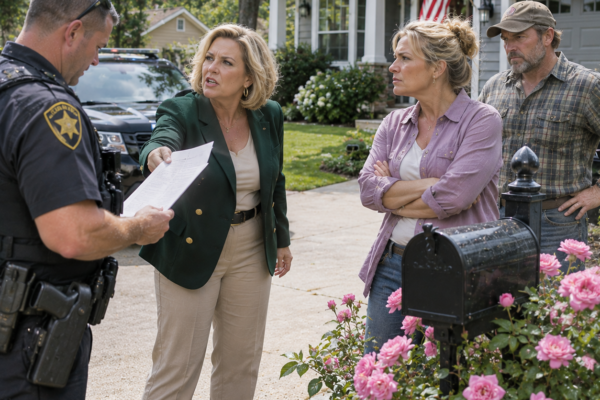
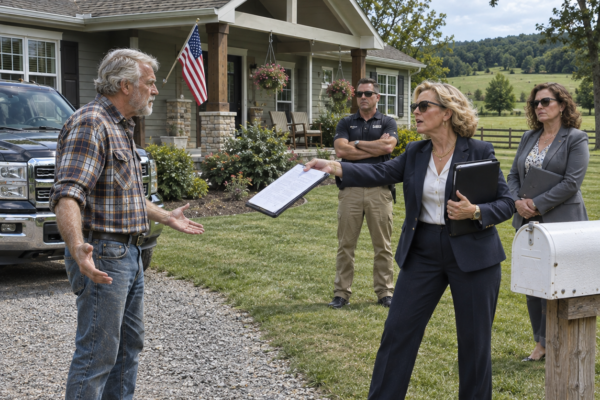
“Tear Down That Fence or I’ll Do It Myself!” the HOA President Threatened My 78-Year-Old Grandpa After Claiming His Texas Ranch Had Been Added to Her Subdivision. That Night, She Climbed His Electric Livestock Fence, Got Shocked, and Fell Into a Patch of Prickly Pear Cactus. She Demanded Grandpa’s Arrest—Then We Discovered Why She Wanted His Land So Badly….k
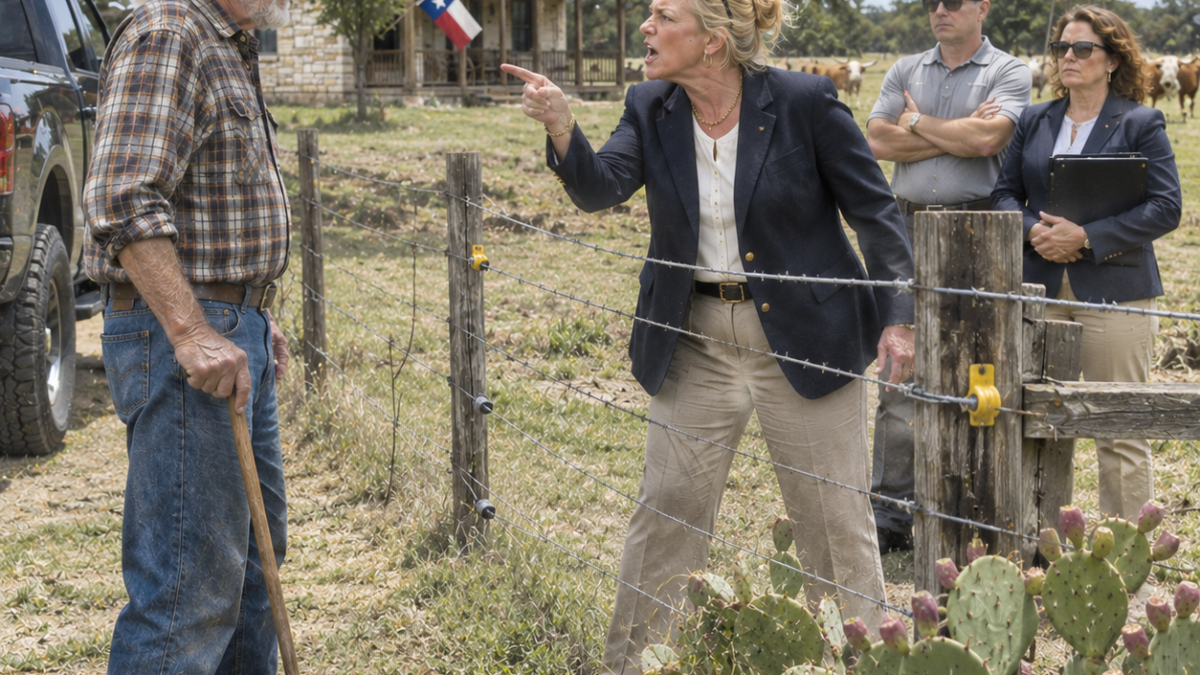
“Tear Down That Fence or I’ll Do It Myself!” the HOA President Threatened My 78-Year-Old Grandpa After Claiming His Texas Ranch Had Been Added to Her Subdivision. That Night, She Climbed His Electric Livestock Fence, Got Shocked, and Fell Into a Patch of Prickly Pear Cactus. She Demanded Grandpa’s Arrest—Then We Discovered Why She Wanted His Land So Badly…
The first time Patrice Thorne threatened to tear down my grandfather’s fence, he didn’t even get out of his rocking chair.
He just looked at her over his coffee mug and said, “Ma’am, I’ve owned this ranch longer than you’ve been telling people what color to paint their mailboxes.”
Patrice’s face turned red.
“This property is now part of Willow Creek Trails Phase Three,” she snapped, waving a clipboard. “Your fence violates our architectural standards, and you have seventy-two hours to remove it.”
Grandpa Roy scratched the ear of his old hound, Buster.
“Funny. I don’t remember joining your little club.”
“You don’t have to remember. The boundaries were updated.”
“Then I reckon you can show me where I signed.”
She didn’t.
Instead, she took six photographs of our fence, threatened us with legal action, and drove away in her black SUV.
My name is Mason Bennett. I was twenty-three, fresh out of college, and had moved in with Grandpa Roy on his ranch outside Fredericksburg, Texas, two weeks earlier.
I’d planned to save money, help him maintain the property, and figure out what to do with my degree.
I hadn’t planned to spend my first summer defending a seventy-eight-year-old veteran from a woman who thought a clipboard gave her the power to redraw property lines.
Grandpa’s ranch sat beside Willow Creek Trails, a luxury subdivision with stone entrance columns, matching fences, and a homeowners association that seemed to consider rural life a personal insult.
Our land wasn’t part of it.
Grandpa had purchased the property from Wayne Thorne three years earlier.
Wayne happened to be Patrice’s ex-husband.
That alone should have warned me we were heading for trouble.
Their divorce had apparently been bitter, and Patrice hadn’t been pleased when Wayne sold the ranch to Grandpa instead of making it available for the subdivision’s next expansion.
But Grandpa had a recorded deed, a survey, and a title policy showing that his property wasn’t burdened by the HOA’s residential covenants.
Patrice had something else.
A glossy map with red lines drawn across our pasture.
And she seemed convinced her map mattered more.
For the next several days, she drove slowly past the eastern fence, photographed our cattle, and left violation notices at the gate.
She complained about the cedar posts.
The barbed-wire sections along the far pasture.
The height of the gate.
And the appearance of Grandpa’s little cattle-warning signs.
One morning, she declared that the fence would have to go before the association installed a landscaped walking trail.
Grandpa lowered his coffee.
“Lady, there’s livestock on the other side of that fence.”
“We’ll address those animals during the transition.”
“What transition?”
“The transition to community ownership.”
Grandpa stared at her.
Then he laughed.
Not a friendly laugh.
The kind that tells you an old man has finally heard something too ridiculous to answer politely.
“Patrice, this ranch isn’t yours. It isn’t your HOA’s. And it won’t become yours because you printed a picture.”
She slammed her clipboard shut.
“We’ll see about that.”
Grandpa had been repairing the electric livestock fencing along the eastern pasture before I moved in. A fencing contractor had checked the system, and warning signs marked the energized section.
It was ordinary ranch equipment, meant to contain cattle—not a device Grandpa installed to hurt somebody.
Patrice had been warned repeatedly not to climb it.
That Tuesday, she ignored the warnings.
I spotted her black SUV just after sunrise.
She was standing by the eastern fence in beige slacks, carrying a tape measure and a folder.
I stepped outside.
“Grandpa, she’s back.”
He looked up from feeding Buster.
“What’s she doing?”
I squinted.
“Looks like she’s trying to climb over.”
Grandpa stood immediately.
“Tell her to stop.”
I hurried toward the fence.
“Mrs. Thorne! Don’t touch that wire!”
She turned toward me.
“You people cannot prohibit an HOA officer from inspecting community property!”
“That fence is energized!”
“I’m not an idiot, young man!”
Then she grabbed the upper wire.
The shock made her jerk backward with a startled cry.
She lost her footing, stumbled down the sloping ground, and landed hard in a patch of prickly pear beside the fence.
Her clipboard flew into the grass.
For a second, I just stared.
Then I ran toward her.
“Don’t move! Let me help you!”
She was furious, frightened, and covered in cactus spines.
Grandpa came down the path behind me.
“Patrice, are you hurt?”
She looked up at him.
“You did this on purpose!”
“No, ma’am. I told you not to climb a livestock fence.”
She fumbled for her phone.
“I’m calling the sheriff! You’re going to jail for this!”
Grandpa looked at the warning sign beside the gate.
Then at her dropped tape measure.
Then at the torn sleeve of her expensive blouse.
“Go ahead and call,” he said. “But you might want to explain why you were climbing onto my ranch.”
I thought that would be the end of the confrontation.
I was wrong.
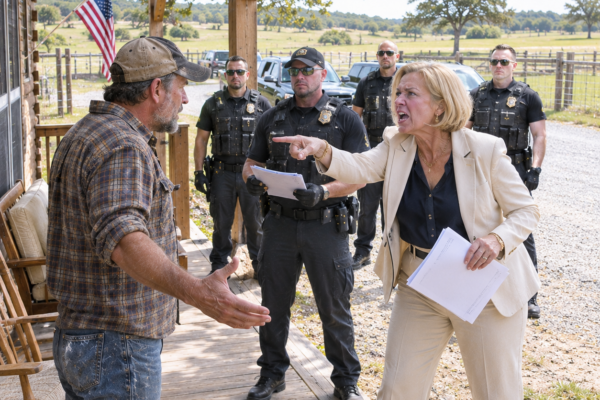
Because when Deputy Cole arrived, Patrice didn’t simply accuse Grandpa of hurting her.
She claimed the fence belonged to Willow Creek Trails.
She demanded its immediate removal.
And she produced a boundary map that supposedly proved our pasture had been annexed into the HOA.
Deputy Cole examined the document.
Then he looked toward Grandpa.
“Mr. Bennett, do you still have the survey from when you bought this place?”
Grandpa nodded.
“Right inside.”
The deputy pointed to a section of Patrice’s map.
“Because I think somebody needs to explain where this new boundary came from.”
Patrice stopped shouting.
And for the first time that morning, I saw something besides anger in her face.
Worry.
Part 2:
Patrice Thorne was still sitting in a patch of prickly pear cactus when she announced that my grandfather was going to prison.
“That old man electrified his fence to attack me!” she screamed.
Grandpa Roy stood on the other side of the pasture gate, his coffee mug in one hand and his old hound, Buster, leaning against his leg.
“Patrice,” he said, “you climbed a marked livestock fence. I told you not to touch it.”
She glared at him.
“You expect me to believe that thing is legal?”
“I expect you to stop climbing fences that don’t belong to you.”
I was twenty-three years old, and I’d been living on Grandpa’s ranch for exactly fourteen days.
Already, I was beginning to understand why he’d warned me that retirement communities could be more exhausting than working cattle.
Patrice reached for her phone.
“I’m calling the sheriff!”
“Then tell them you’re hurt,” I said. “You might need medical attention.”
She looked at the cactus spines sticking out of her sleeve.
Then she looked at me.
“Don’t you dare tell me what I need!”
I stepped back.
Grandpa’s expression lost its usual humor.
“Mason, call for help yourself. I don’t want anybody leaving here with injuries we didn’t have checked.”
I made the call.
Patrice was too busy accusing us of attempted murder to notice.
Fifteen minutes later, a sheriff’s deputy and an ambulance came up the ranch road.
Deputy Cole stepped out first.
He was a stocky man in his fifties who’d known Grandpa long enough to recognize the sound of Buster barking.
He didn’t laugh when he saw Patrice.
He didn’t take Grandpa’s side simply because they knew each other.
He asked what happened, checked that the medics could reach her safely, and separated us long enough to hear everyone’s account.
Patrice said Grandpa had deliberately constructed a dangerous electrical trap to stop HOA officials from inspecting community property.
Grandpa explained that the electric section was standard livestock fencing, inspected by a fencing contractor and marked with warning signs.
I showed Cole where I’d stood when Patrice grabbed the wire.
Then I showed him the photographs I’d taken that morning, including the warning sign she had climbed past.
Cole asked Grandpa to leave the fence turned off while the responders worked nearby.
Grandpa immediately complied.
Patrice was examined, treated for her fall, and advised to obtain additional medical care if necessary.
When the medics finished, Cole turned toward her.
“Mrs. Thorne, what were you doing on the fence?”
“Inspecting an unauthorized structure.”
“Who owns the property?”
“The Willow Creek Trails Association.”
Grandpa gave me a look.
I knew that look already.
It meant he was doing his best not to say something unhelpful.
Cole opened his notebook.
“Do you have documentation for that?”
Patrice pulled a glossy map from her folder.
“This ranch falls within Phase Three of our newly expanded subdivision.”
The deputy examined it.
Then he looked at Grandpa.
“Mr. Bennett, do you have your recorded survey and deed?”
“Inside the house.”
“I’d like to see them.”
Grandpa nodded.
“Come on up.”
Patrice started protesting.
Cole raised a hand.
“Ma’am, I’m documenting what happened. Ownership and easement questions may require review by the county records office or a court. I’m not going to decide title from a drawing in someone’s folder.”
He looked toward the fence.
“But I do need to know why you were trying to climb onto property the owner says you’re not authorized to enter.”
Patrice followed him toward the gate, complaining the entire way.
That’s how my first real confrontation with the Willow Creek Trails HOA ended.
Not with an arrest.
Not with Grandpa declaring victory.
With an injured HOA president, a deputy requesting documents, and me realizing my grandfather’s quiet little ranch was about to become the center of a much bigger dispute.
To understand how we got there, you need to know something about Roy Bennett.
Grandpa was seventy-eight.
He’d served in the Army when he was young, then spent most of his adult life farming and working around cattle.
He had enormous hands, a crooked little finger from an old machinery accident, and a habit of wearing denim overalls regardless of the weather.
His hearing wasn’t perfect.
His knees bothered him when rain was coming.
And he’d developed the kind of stubborn independence that comes from surviving a lifetime of problems without waiting for somebody else to solve them.
He wasn’t mean.
But he wasn’t easily intimidated either.
If a storm damaged the roof, he repaired it.
If a calf got sick, he called the veterinarian and stayed awake until the animal was stable.
If somebody needed help hauling hay, he brought the truck without asking whether there would be payment.
Grandpa had never enjoyed arguments.
He simply didn’t believe being polite required surrendering what belonged to you.
I moved in after graduating from college in May.
My degree was in agricultural business, and I was still deciding whether to pursue a job with a feed company or work toward managing a small operation myself.
Rent in Austin was more than I wanted to spend.
Grandpa had been asking for help around the ranch.
So we made a deal.
I’d live in the spare bedroom, help with the animals and maintenance, and contribute to the household expenses while I saved money.
He’d teach me the things I didn’t know.
That first evening, he handed me a pair of work gloves.
“College teach you how to fix a gate latch?”
“Not specifically.”
“Good. Then I can still be useful.”
I laughed.
He took me out to the eastern pasture.
The fence there had cedar posts that had stood for roughly forty years, although individual rails and stretches of wire had been replaced many times.
A small group of cattle grazed beyond it.
Prickly pear grew along the rocky slope, and an old mesquite leaned over the corner nearest the subdivision.
Beyond the fence stood Willow Creek Trails.
It looked like a different world.
Wide streets.
Stone entrance columns.
Large houses with carefully trimmed landscaping.
A community pool and clubhouse.
And a decorative walking trail that ended uncomfortably close to our boundary.
Grandpa pointed toward the newest row of houses.
“That’s where the trouble lives.”
“What trouble?”
“The HOA’s got a new president. Patrice Thorne.”
He said the name as though he’d discovered termites in the kitchen.
I laughed.
“What’s she want?”
“About six acres of my ranch, last I heard.”
I stopped.
“What?”
“Claims her subdivision needs room for a future walking trail and some fancy community garden.”
“Does she own any of it?”
“Nope.”
“Then how does she plan to get it?”
Grandpa shrugged.
“That’s what I’m curious to find out.”
Three years earlier, he’d bought the ranch from Wayne Thorne.
Wayne was a local businessman who’d inherited the land from an uncle.
He’d considered several development proposals before deciding to sell it intact.
He also happened to be Patrice’s former husband.
According to Grandpa, their divorce had been bitter enough that Wayne refused to attend functions where Patrice might appear.
But the property records were what mattered.
The ranch wasn’t part of Willow Creek Trails.
It had its own legal description and recorded deed.
The subdivision’s declaration didn’t encumber it.
There were some ordinary utility easements near the county road, but nothing granting the HOA control of the cattle pasture.
Grandpa had checked the title carefully before buying.
He’d even kept a copy of an old subdivision planning exhibit showing that the ranch had been excluded from the proposed residential phases.
Wayne had supplied that document along with the sale records.
“Why would Patrice think she can take it now?” I asked.
Grandpa looked toward the houses.
“Because people get strange ideas when nobody tells them no.”
I assumed he was exaggerating.
Then Patrice arrived the following morning.
Her black SUV stopped beside our gate at 8:17.
She climbed out wearing beige slacks, a pastel blouse, and shoes that looked expensive enough to have their own insurance policy.
She carried a clipboard.
She didn’t introduce herself.
She looked at the fence and announced, “This structure appears to exceed the association’s height restriction.”
Grandpa was sitting on the porch with Buster.
“Good morning to you too.”
Patrice ignored the greeting.
“Our newly adopted Phase Three guidelines require uniform fencing along the eastern perimeter.”
“Then apply them to your eastern perimeter.”
She looked up.
“Excuse me?”
“This is my western pasture, ma’am. Not your subdivision.”
She opened her folder.
“Your land has been added to the Phase Three planning area.”
Grandpa set down his mug.
“Planning area isn’t the same as ownership.”
She smiled.
“The association’s boundary map has been updated.”
“Then somebody made a mistake.”
Her expression tightened.
“Mr. Bennett, the board has authority to establish community standards.”
“On property subject to its declaration.”
Patrice stared.
I could tell she hadn’t expected him to know that distinction.
Then he continued.
“This place was excluded before your subdivision was built. Wayne Thorne sold it to me three years ago.”
At the mention of Wayne’s name, something changed in her face.
“Wayne had no authority to exempt this parcel from future development.”
Grandpa looked toward me.
“Mason, get the folder from the kitchen.”
I did.
Grandpa opened it on the porch table.
The deed.
The title policy.
The survey.
The subdivision plat.
Patrice barely glanced at them.
“Those records predate our updated planning documents.”
“Then show me a recorded change that affects this land.”
She closed her folder.
“I’ll return with the appropriate paperwork.”
“Bring it before you tell me to move another fence.”
She walked back to her SUV.
Then she turned around.
“You’re going to find cooperation much less expensive than resistance.”
Grandpa watched her leave.
He picked up his coffee.
“Well,” he said, “that wasn’t much of a welcome.”
I laughed.
I didn’t laugh when she returned the next day.
Or the day after.
She photographed the fence.
She measured the gate opening from the road.
She left a notice alleging a height violation.
She complained about livestock near the subdivision.
Then she demanded that Grandpa submit an architectural modification application for a fence that had existed long before her neighborhood.
Every time he asked for the legal document giving the HOA authority, she changed the subject.
Finally, she announced that the association would begin enforcing its new boundary within thirty days.
That was when Grandpa called a local fencing contractor.
He’d already planned to service the livestock electric fence before summer.
He wanted the contractor to check the equipment and make sure the warning signs were visible.
I was with him when the contractor finished the inspection.
Grandpa looked toward the subdivision.
“I’ve got somebody who keeps walking right up to that fence.”
The contractor frowned.
“Then keep the warning signs clear. And tell her not to climb it. An electric livestock fence isn’t something people should fool around with.”
Grandpa nodded.
“I don’t want anybody hurt.”
He meant it.
For all his dry humor, I’d never seen him enjoy somebody else’s pain.
When Patrice later climbed the fence and fell, the first thing he did was ask whether she needed medical help.
And that mattered because Patrice’s next move was to tell half the county he’d designed a trap specifically to attack her.
She posted the accusation that very afternoon.
The HOA’s Facebook page carried a photograph of her bandaged arm beneath a headline announcing an Electrical Assault on a Community Officer.
She claimed Grandpa had deliberately energized an association-owned fence in retaliation for legitimate enforcement activity.
She also described me as an aggressive young man who had tried to prevent her from performing a lawful inspection.
I stared at my phone.
“Grandpa, she’s making it sound like we attacked her.”
He sat at the kitchen table eating a sandwich.
“Well, that’s the trouble with a story, Mason. Whoever tells it first gets a head start.”
“What are we going to do?”
“Tell the truth. Then let the paperwork do its job.”
That sounded simple.
But I was beginning to understand how much trouble one determined liar could cause before the truth caught up.
The next morning, a certified letter arrived.
It came from the Willow Creek Trails Homeowners Association and listed three violations.
Unauthorized fencing.
Improper electrical modifications.
Failure to comply with community appearance standards.
The final paragraph threatened fines and removal of the fence at Grandpa’s expense.
He read it twice.
Then he handed it to me.
“Mason, put that with the other letters.”
“You’re not going to answer?”
“I’ll answer through somebody who knows the law better than Patrice.”
That afternoon, we drove into Fredericksburg and met with Laura McKenzie, a real estate attorney Grandpa had used when he purchased the ranch.
Laura was in her fifties, with silver-framed glasses and a desk covered in files.
She greeted Grandpa warmly.
“Roy, what have you gotten yourself into this time?”
“Apparently I’ve misplaced my ranch.”
Laura looked up.
“Excuse me?”
“Lady down the road says it’s part of her HOA.”
Laura removed her glasses.
“Sit down.”
For the next hour, we explained everything.
The letters.
The boundary claims.
The attempted fence inspection.
Patrice’s fall.
And the allegations she’d posted online.
Laura reviewed the recorded deed and survey.
Then she examined Patrice’s glossy map.
“Where did this come from?”
“The HOA president,” I answered.
Laura studied the red boundary line running across our pasture.
“This is a planning illustration. It isn’t a recorded conveyance or a legally effective amendment affecting Roy’s property.”
Grandpa leaned forward.
“So she can’t annex me with a marker?”
“No, Roy.”
“That’s a relief. I was worried about my cattle having to apply for residency.”
Laura smiled briefly.
Then she became serious.
“The HOA may have a development plan involving nearby land. But it cannot simply impose its declaration on an independently owned parcel without the required legal authority and property-owner consent.”
She looked toward the notice.
“And these violation charges appear to be based on a claim they haven’t established.”
I pointed to the part about the electric fence.
“What about Patrice getting shocked?”
“That needs to be handled separately. We need the equipment inspection records, photographs of the warnings, and the deputy’s incident report. We also need to verify any applicable fencing requirements.”
Grandpa nodded.
“Already got the contractor’s invoice.”
“Good.”
Laura paused.
“And no more inviting confrontation. No tricks, no deliberate surprises, and no trying to teach anybody a lesson with electricity.”
Grandpa held up both hands.
“Lady, the fence is for cattle.”
“Then let’s keep it that way.”
She prepared a letter demanding the HOA withdraw its enforcement notices and stop entering the ranch without permission.
She also asked for the specific recorded instrument on which Patrice based her annexation claim.
Meanwhile, I began organizing our evidence.
I’d taken photographs before moving in.
Grandpa had pictures of the fence from previous years.
The fencing contractor had documented his inspection.
We had copies of the warnings and messages.
I created folders on my laptop for each incident.
Then I installed trail cameras covering the gates, barn approach, and pasture access points.
Grandpa watched me adjusting one near the equipment shed.
“College finally came in useful, huh?”
“I learned computer systems too, Grandpa.”
“Good. Because I still think the internet is mostly people arguing about things they don’t understand.”
“That’s surprisingly accurate.”
He laughed.
The cameras were useful almost immediately.
At 3:14 one morning, a motion alert woke me.
I opened the recording.
A figure was moving along the eastern fence carrying a flashlight and a measuring tape.
It was Patrice.
She wasn’t climbing the fence this time.
She stayed on the subdivision side for most of the recording, taking photographs and measuring the distance between posts.
Then she stepped through an opening near the old gate and moved several yards onto Grandpa’s land.
She appeared to inspect the fence warning signs before returning to her SUV.
I saved the footage.
The following morning, I showed Grandpa.
He watched silently.
Then he said, “She’s determined, I’ll give her that.”
“Should we post it?”
“No. Send it to Laura.”
I looked at him.
“Really?”
Grandpa nodded.
“Folks might laugh at her on the internet. That doesn’t establish our property rights.”
He pointed toward the screen.
“Keep the original recording. That’s worth more than a hundred jokes.”
I sent it to Laura.
She included the incident in the documentation and renewed the request that Patrice stay off the ranch.
The next day, something began hovering over the chicken coop.
At first, I thought it was an unusually loud insect.
Then I stepped outside and saw a small drone moving above the backyard.
It paused near the coop.
Turned toward the barn.
Then drifted toward the windows on the east side of the house.
Grandpa came outside carrying his breakfast.
“What’s that thing doing?”
“Looks like a drone.”
“Whose?”
“No idea.”
I took out my phone and recorded it.
Grandpa looked toward the barn.
“For thirty seconds there, I was tempted to get my potato launcher.”
“Please don’t.”
He looked at me.
“Wasn’t going to. Just remembering the old county fair.”
We stayed clear of it.
The drone eventually flew back toward the subdivision.
Our cameras recorded its flight path, and Craig Thompson, a neighbor who maintained security systems for a living, helped me preserve the footage.
Craig lived in Willow Creek Trails and had grown increasingly frustrated with Patrice’s enforcement tactics.
When I showed him the recording, he frowned.
“I’ve seen a drone like that at the association office.”
“Are you sure?”
“Same model. I can’t say it’s the same aircraft.”
That was enough to justify questions, not accusations.
Laura contacted the association’s attorney about possible unauthorized surveillance and requested preservation of the relevant flight records.
Then we received an invitation to an emergency HOA meeting.
It described a proposed expansion of Willow Creek Trails Phase Three.
The agenda included the adoption of revised boundary maps and the incorporation of adjacent parcels into future community planning.
Our ranch was among those parcels.
I stared at the letter.
“They’re actually going to vote on Grandpa’s land.”
Grandpa took the paper.
“Let them vote on the moon while they’re at it.”
“Grandpa, this is serious.”
“I know.”
He placed the notice beside his coffee.
“That’s why we’re calling Wayne.”
Wayne Thorne arrived two days later in a faded Ford pickup.
He stepped out wearing work boots and a sunburned expression that made him look like somebody who spent most of his time outdoors.
Grandpa met him beside the barn.
“Wayne. Been a while.”
“Roy.”
They shook hands.
Then Wayne looked toward the subdivision.
“Heard Patrice is still trying to collect property she doesn’t own.”
Grandpa sighed.
“She’s got a map now.”
Wayne laughed.
“Of course she does.”
We sat at the kitchen table.
Wayne opened a large manila envelope.
Inside were copies of the original purchase documents, the recorded subdivision boundaries, and correspondence from the period before he sold the ranch.
He placed one letter in front of us.
It was from the developer’s former planning consultant.
The ranch parcel was identified as outside the approved residential subdivision.
Any future inclusion would require properly obtained property rights and the necessary approvals.
Then Wayne produced an older email from Patrice.
It proposed extending a walking trail across the eastern pasture to reach a scenic overlook behind our barn.
The plan also included a landscaped entrance and an outdoor event space.
I looked at the drawing.
“That’s why she keeps talking about the fence.”
Wayne nodded.
“The fence blocks the route she wants.”
Grandpa studied the map.
“She planning to turn my cattle pasture into a wedding venue?”
Wayne smiled grimly.
“She brought up something like that when we were still married.”
I looked at him.
“Why didn’t she buy the land herself?”
“She wanted the development to acquire it. I told her I wasn’t selling it for that purpose.”
He glanced toward Grandpa.
“When Roy offered a fair price for the ranch as it stood, I sold it to him.”
“Was that because of the divorce?”
Wayne considered the question.
“Partly. Mostly because I wanted the ranch to remain a ranch.”
He took a breath.
“Patrice never forgave me for that.”
Laura joined us later and reviewed the documents.
Wayne agreed to provide a statement concerning the sale and the earlier proposed expansion.
He also agreed to explain his records to the HOA board if he was permitted to speak.
The meeting was held on a Saturday morning in early June.
Patrice had arranged rows of chairs in the clubhouse.
A large screen stood behind the board table.
When we arrived, she was already speaking with several directors.
Her smile disappeared when she saw Grandpa.
Then she noticed Wayne.
For the first time, she looked genuinely unsettled.
“What are you doing here?” she asked him.
Wayne shrugged.
“Meeting about land I used to own. Thought I might have something useful to say.”
“This is a private association meeting.”
Laura stepped forward.
“Your counsel agreed that Mr. Bennett and Mr. Thorne could address the board concerning the property affected by the proposed expansion.”
Patrice looked toward the association manager.
The manager nodded.
She clearly wasn’t happy.
But she let us inside.
The meeting began with a presentation about future amenities.
Patrice showed photographs of walking trails, community gardens, and a hilltop pavilion.
She spoke about expanding recreational opportunities.
Then she displayed her proposed boundary map.
The red line extended directly across Grandpa’s eastern pasture.
I watched the board members study it.
Some nodded.
Others looked uncertain.
Then Laura stood.
“Before the board considers that map, I need to clarify something.”
Patrice tried to interrupt.
Laura continued calmly.
“The parcel shown inside the proposed expansion is privately owned by Roy Bennett. It is not presently subject to the Willow Creek Trails declaration.”
She displayed the recorded survey and deed.
Then she explained the earlier planning documents.
Wayne spoke next.
He confirmed that he’d sold the ranch to Grandpa three years earlier and that no agreement had been executed granting the HOA authority over the parcel.
One director named Helen Price leaned forward.
“Patrice, were we told the ranch owner had already agreed to inclusion?”
Patrice stiffened.
“The planning committee understood the land would eventually become part of Phase Three.”
“That’s not what I asked.”
Wayne looked toward the board.
“I never agreed to sell it to the association. Roy hasn’t agreed to join. You’re discussing land you don’t own.”
Several people began whispering.
Patrice raised her voice.
“We’re voting on a future planning designation, not stealing anybody’s deed!”
Laura nodded.
“Then the board should make that distinction explicit. A planning preference is not an annexation, and it doesn’t grant enforcement authority over the parcel.”
Helen studied the documents.
Then she looked at Patrice.
“Why have we been sending violation notices if we don’t have that authority?”
Patrice said nothing.
The meeting changed direction after that.
Several directors demanded a review of the maps and notices before any further action.
The board postponed the expansion vote.
It also instructed association counsel to examine how the disputed parcel had come to be shown inside the supposed HOA boundary.
Grandpa didn’t celebrate.
He simply collected his papers.
As we walked toward the exit, Patrice stepped into our path.
“This isn’t finished, Roy.”
He looked at her.
“Ma’am, it would’ve been finished months ago if you’d respected the property line.”
Her face tightened.
“Wayne always was good at finding people willing to cause trouble for me.”
Wayne sighed.
“Patrice, I sold him a ranch. That’s all.”
She looked at Grandpa’s folder.
Then at me.
And I realized the most dangerous part of the confrontation wasn’t her anger.
It was her refusal to accept that the facts could matter more than what she wanted.
By the Fourth of July, the entire neighborhood knew about Grandpa’s dispute with Patrice.
Some homeowners thought it was funny.
Others were beginning to worry about what their HOA president had been doing with association money and property maps.
A few residents came by the ranch to apologize for the letters.
One woman told Grandpa she’d been fined for displaying the wrong kind of American flag.
Another said Patrice had threatened her family over the placement of a solar panel.
Craig told me several board members were reviewing older enforcement decisions because they no longer trusted the maps the association had been using.
But Patrice wasn’t finished.
And Grandpa knew it.
We held our annual Fourth of July barbecue that afternoon.
It was a small affair.
Family.
A few neighbors.
Wayne.
Craig and his wife.
Grandpa smoked a brisket, my uncle brought potato salad, and I spent most of the morning setting up folding tables beneath the oak trees.
Buster wandered among the guests, hoping somebody would drop a piece of meat.
For once, the ranch felt peaceful.
At about three, my phone buzzed.
A motion alert from the eastern gate.
I opened the camera feed.
Patrice was standing outside the fence with two association volunteers.
One carried a measuring wheel.
The other held a clipboard.
I stared at the screen.
“You’ve got to be kidding me.”
Grandpa looked over my shoulder.
“What’s she doing now?”
“Looks like another inspection.”
He sighed.
“On the Fourth of July?”
Then the camera showed Patrice opening the pedestrian gate.
She stepped onto our land.
The other two followed.
I immediately called Craig over.
He looked at the screen.
“She’s not supposed to be there.”
“No.”
I started walking toward the gate.
Grandpa came with me.
Near the barn, we’d installed a simple motion-activated announcement system after the earlier trespassing incidents.
It was intended to alert us when somebody entered the farmyard through the side gate.
As Patrice crossed the path, the speaker came on.
A cheerful banjo tune played for several seconds.
Then Grandpa’s recorded voice announced:
“Private property. Please return to the gate and contact the owner.”
Patrice jumped.
One volunteer stepped backward into a shrub.
The other dropped his measuring wheel.
Nobody was seriously hurt.
But the three of them looked thoroughly embarrassed when Grandpa and I arrived.
Patrice immediately started shouting.
“You’re recording us!”
“Yes, ma’am,” Grandpa said. “You’re standing in my farmyard.”
“We’re conducting a safety inspection.”
“Without permission.”
She pointed toward the fence.
“The board has a right to inspect disputed structures.”
Laura had already addressed that claim.
The board had postponed the proposed expansion, and nothing in the documents gave its volunteers permission to enter the ranch.
I told them to leave.
Craig stood nearby as a witness.
Patrice argued for another minute.
Then one of the volunteers spoke.
“Mrs. Thorne, I don’t think we should be here.”
She turned on him.
“We were instructed to document the site.”
“By you,” he replied.
For a moment, she looked stunned.
Then she marched back toward the gate.
The volunteers followed.
When they were gone, Grandpa looked at me.
“Well, that’s one way to interrupt a barbecue.”
Craig laughed.
I didn’t.
Not immediately.
I was too angry that she’d tried to enter the property again after everything the board had been told.
I sent the footage to Laura.
Then I returned to the picnic.
Grandpa handed me a plate.
“Eat something, Mason.”
“How can you be so calm?”
He looked toward the pasture.
“Because the cattle still need feeding tomorrow. Patrice doesn’t get to become the only thing we think about.”
I sat beside him.
For the first time, I understood that his stubbornness wasn’t just about refusing to surrender land.
It was also about refusing to let a bully take over his life.
That evening, as fireworks sounded in the distance, Grandpa and I sat on the porch.
He watched the lights above the hills.
Then he said, “Your grandmother would’ve loved having all these people here.”
I smiled.
“She would’ve complained about your brisket being too smoky.”
“She always did.”
He chuckled.
Then his expression grew thoughtful.
“Mason, don’t ever confuse defending something with wanting to hurt somebody.”
I looked at him.
“You’re talking about Patrice?”
“Partly.”
He rested his hands on his knees.
“That fence is there because we’ve got animals to keep safe. The cameras are there because people keep wandering onto our land. I don’t want anybody injured. I want them to leave us alone.”
I nodded.
He looked toward the dark pasture.
“There’s a difference between protecting your home and letting anger turn you into somebody you don’t recognize.”
I remembered that conversation several weeks later.
Because Patrice’s next move was no longer simply ridiculous.
It was potentially criminal.
The first indication came from an envelope she mailed to Grandpa in late July.
Across the top, in bold letters, it said:
NOTICE OF INTENT TO RECORD PROPERTY LIEN.
The letter claimed Grandpa owed the association $18,750 in accumulated violations, inspection expenses, and special assessments.
It demanded payment within ten days.
Otherwise, the association threatened to pursue a lien against the ranch.
Grandpa read it at breakfast.
“That’s quite a bill for belonging to an organization I never joined.”
I took the letter from him.
“She’s threatening the property itself now.”
“Then call Laura.”
Laura reviewed it that morning.
She confirmed that no valid HOA lien against the ranch appeared in the county records.
But she didn’t dismiss the letter as harmless.
An unsupported claim of lien could create real trouble if somebody attempted to record it or use it to pressure a property owner.
She contacted the association’s attorney, demanded withdrawal of the notice, and requested the documents authorizing the charges.
That inquiry revealed something important.
The board hadn’t voted to levy those assessments against Grandpa.
Several directors said they hadn’t even known the letter existed.
The association’s attorney also confirmed that his office hadn’t approved the notice.
Patrice had apparently been issuing demands under the HOA’s name without the authorization she claimed to possess.
Then Laura found an older correspondence file.
It contained an email from Patrice to the association’s former planning consultant.
The subject line read:
PHASE FOUR — EASTERN RIDGE ACQUISITION.
The message proposed an expanded walking trail, a scenic pavilion, and an outdoor event area.
It also discussed the need to bring Grandpa’s pasture within the development’s control before the next planning cycle.
One sentence stood out.
Owner resistance may be reduced through continued compliance pressure and future assessment exposure.
I read it three times.
“She’s been planning this.”
Laura nodded.
“That’s what the language suggests.”
Grandpa studied the email.
Then he said quietly, “She thought if she made living here miserable enough, I’d sell.”
Wayne had warned us that Patrice wanted the land.
But this was the first written indication that enforcement pressure might have been part of her strategy.
Laura submitted the new information through the pending legal process.
She also advised the board that the association could face serious exposure if its president continued asserting rights it didn’t possess.
For a brief period, everything went quiet.
No new notices.
No black SUV beside the gate.
No compliance volunteers.
I began thinking Patrice had finally recognized that she’d pushed too far.
Then, just after midnight on a Tuesday in August, my phone sounded another alert.
Movement near the barn.
I opened the recording.
Patrice was standing beside the locked utility enclosure that served the ranch’s fencing equipment.
She wore dark clothes and carried something in her hand.
I turned on the porch light.
Grandpa was already awake.
“What’s going on?”
“She’s at the equipment enclosure.”
He picked up his phone.
“Call the sheriff.”
We didn’t go down to confront her.
The enclosure contained electrical equipment, and I wasn’t interested in creating a dangerous scene.
We stayed on the porch while the cameras recorded.
The footage showed Patrice manipulating the enclosure door and attempting to open it.
Then she stepped back toward the gate.
When deputies arrived, she was already gone.
Deputy Cole examined the enclosure, photographed the damaged latch, and took our statement.
He also preserved the footage through the proper evidence process.
This time, the issue wasn’t an argument over a boundary map.
Someone had entered private property at night and interfered with locked equipment.
Cole looked at Grandpa.
“Roy, I know this has been going on a long time.”
Grandpa nodded.
“But the more serious the conduct becomes, the more important it is that you leave the investigation to us.”
“That’s the plan.”
“And keep that equipment secured until it’s checked.”
“I’ll have the contractor inspect it.”
Cole nodded.
“Good.”
The contractor came the following morning.
He found damage to the enclosure latch and evidence that somebody had attempted to access the electrical controls.
He confirmed the equipment needed inspection before ordinary use could resume.
Grandpa arranged repairs and added the findings to the evidence file.
I watched him sign the contractor’s report.
“You’re taking this better than I would.”
He looked at me.
“Mason, I’m angry enough to chew nails. That doesn’t mean I’m going to act foolish.”
He placed the pen down.
“Let the evidence speak.”
By then, it finally could.
The disputed boundary maps had been examined.
The unauthorized notices had been documented.
The older expansion emails had surfaced.
And the camera footage showed repeated unwanted entries, including the incident at the equipment enclosure.
The HOA board called a special meeting.
Patrice wasn’t controlling the agenda this time.
Helen Price, the director who’d questioned the expansion map in June, chaired the session under the association’s procedures.
The board’s attorney presented the findings.
He confirmed that Grandpa’s ranch wasn’t part of Willow Creek Trails.
No legally effective annexation had occurred.
No agreement had been signed by Grandpa.
And no association declaration gave Willow Creek Trails the authority to regulate his cattle fence.
He also explained that the disputed assessments had not been properly authorized and could not be enforced against the ranch as claimed.
The room was crowded.
Several residents who’d previously supported Patrice were sitting near the front.
Wayne attended.
So did Craig.
Grandpa and I sat near the back.
Patrice appeared halfway through the attorney’s presentation.
She walked toward the board table with her usual clipboard.
Helen stopped her.
“Patrice, the board has already begun the review.”
Patrice looked furious.
“I’m the president.”
“You’re the subject of the governance review.”
The room went quiet.
Patrice stared at her.
Then she demanded to know who had authorized the meeting.
Helen explained that the directors had called it under the bylaws.
The attorney continued.
He outlined the unsupported enforcement actions, the misleading boundary claims, and the pending concerns about misuse of association authority.
He also confirmed that the association had a duty to preserve relevant records and cooperate with lawful investigative requests.
Patrice tried to interrupt several times.
Finally, Helen addressed her directly.
“Did you know Roy Bennett’s parcel wasn’t included in our recorded declaration?”
Patrice hesitated.
“The property was intended for future expansion.”
“That isn’t what I asked.”
Patrice’s face reddened.
Helen continued.
“Did you know we hadn’t obtained the landowner’s consent?”
Patrice said nothing.
“Then why did you send notices claiming the ranch was already subject to our rules?”
Patrice looked around the room.
“Because somebody had to protect this community from people who refused to cooperate!”
Grandpa stood slowly.
He hadn’t planned to speak.
I could tell by the way he gripped the back of the chair.
But something in Patrice’s answer had finally exhausted his patience.
“Patrice,” he said, “you’ve spent months telling people I’m a danger to this neighborhood.”
She turned toward him.
“You are!”
Grandpa shook his head.
“I’ve got a little cattle ranch. I keep my fences repaired. I feed my animals. I mind my business.”
He pointed toward the documents.
“You wanted my land for a walking trail. I told you it wasn’t for sale. So you decided I’d become a violation.”
Nobody spoke.
“You came onto my property without permission. You climbed my fence. You threatened me with fines. You tried to make an old man believe a neighborhood committee could take away his home.”
His voice remained steady.
“But here’s the part you never understood.”
He looked around the room.
“I don’t have anything against your neighborhood. I’ve helped some of your residents pull cars out of ditches. I’ve brought hay to people with horses. I’ve lent tools to men who didn’t even know my last name.”
He looked back at Patrice.
“All I ever asked was that you treat me like a neighbor instead of somebody you could push out of the way.”
For a moment, she seemed unable to answer.
Then she said, “This development needs room to grow.”
Grandpa nodded.
“Then buy land from somebody willing to sell.”
He sat down.
The directors voted to remove Patrice from the office of president in accordance with the governing documents.
A separate procedure addressed her position on the board.
The association withdrew the pending claims against Grandpa’s property and agreed to correct its boundary materials.
It also directed its legal counsel to investigate the questionable notices and implement safeguards against unauthorized enforcement activity.
Patrice left before the meeting ended.
She didn’t apologize.
She didn’t congratulate the new leadership.
She walked through the doors with her clipboard held tight against her chest.
And for the first time since I’d moved onto the ranch, nobody followed her instructions simply because she gave them.
The property damage and unwanted-entry incidents continued through the appropriate investigative process.
Grandpa cooperated.
He provided records and recordings.
He allowed qualified inspectors to examine the fence equipment.
He didn’t try to decide for law enforcement what charges should be pursued.
The legal proceedings and HOA corrections took time.
There was no miraculous overnight resolution.
But the threats stopped.
The association’s attorney confirmed in writing that the ranch was outside its governing boundaries.
The disputed assessments were withdrawn.
And the board approved a policy requiring independent verification before anyone claimed authority over property not already subject to its declaration.
Patrice’s effort to control the ranch had failed.
By Labor Day, a FOR SALE sign appeared outside her house.
I saw it while driving home from the feed store.
Her black SUV was parked in the driveway.
The flower beds were trimmed perfectly.
The windows were spotless.
And for once, there was no clipboard in sight.
I didn’t stop.
I didn’t take a photograph.
I didn’t need to know where she was moving.
When I told Grandpa, he was repairing a hinge on the chicken coop.
“Patrice is selling her house.”
He looked up.
“That so?”
“Yep.”
He went back to tightening the hinge.
After a moment, I asked, “You don’t have anything to say?”
He shrugged.
“Hope the new neighbors like cattle.”
I laughed.
Then Buster barked from beneath the porch, and Grandpa told me to fetch the feed bucket.
Life went on.
The cattle needed care.
The fence still needed occasional repair.
The chickens still escaped whenever somebody forgot to latch the coop properly.
And Grandpa still made coffee strong enough to keep a man awake for three days.
But the ranch felt different.
For months, every vehicle passing the gate had made me wonder whether another notice was coming.
Now the road was quiet.
Craig visited without worrying that Patrice would report him for spending time with us.
Neighbors occasionally came by to buy eggs.
One family from Willow Creek Trails asked whether their children could visit to learn about the cattle.
Grandpa welcomed them.
He showed the kids how to feed the animals safely and explained why farm fences were different from decorative neighborhood fences.
When one little boy pointed to the warning sign and asked what it meant, Grandpa crouched beside him.
“It means you don’t touch that part of the fence, partner. You stay where it’s safe and ask the owner before you go inside.”
The boy nodded solemnly.
Grandpa smiled.
“Good. That’s a lesson worth remembering.”
That evening, we sat on the porch watching the sun drop behind the hills.
The cattle were moving slowly toward the water trough.
Buster slept beneath Grandpa’s chair.
A warm breeze carried the smell of dry grass and mesquite.
I looked toward the eastern fence.
“Grandpa?”
“Hmm?”
“Was any of this worth it?”
He didn’t answer immediately.
Then he said, “You mean the letters, lawyers, and headaches?”
“Yeah.”
He considered the question.
“I wish none of it had happened.”
I nodded.
“But I reckon some things are worth defending even when defending them is a nuisance.”
He pointed toward the pasture.
“This place isn’t special because it’s expensive. It isn’t special because somebody could build a clubhouse on it.”
He looked at me.
“It’s special because people have worked it, cared for it, and respected it. And because nobody has the right to take it simply by deciding they’d make better use of it.”
I sat quietly.
Then I asked, “What do you think Patrice’s biggest mistake was?”
Grandpa smiled faintly.
“Climbing the fence was foolish.”
I laughed.
“But it wasn’t her biggest mistake.”
“What was?”
“Thinking a map she wanted to be true mattered more than the truth itself.”
He leaned back in his chair.
“And thinking an old farmer would hand over his land just because somebody with a clipboard told him to.”
I looked toward the fence again.
The cedar posts were weathered.
The warning signs were still visible.
Beyond them stood the large houses of Willow Creek Trails.
For months, Patrice had treated that fence as an insult.
Something standing between her and the future she wanted to build.
But for Grandpa, it had never been a symbol of power.
It was simply a boundary.
One that kept the animals where they belonged and reminded people where one person’s land ended and another’s began.
I had moved onto the ranch thinking I was there to save money and learn how to run a farm.
Instead, I learned something else.
You don’t need to shout louder than a bully.
You don’t need to become crueler.
And you certainly don’t need to turn your property into a battlefield.
You need to know what belongs to you, document the truth, and refuse to let somebody else’s threats make your decisions for you.
Grandpa finished his coffee.
Then he stood, stretched his aching back, and looked toward the barn.
“Come on, Mason. Gate latch still needs adjusting.”
I smiled.
“Didn’t we fix that yesterday?”
“We did.”
“Then why are we fixing it again?”
He grinned.
“Because cattle don’t care how many times you fix a gate.”
I followed him down the porch steps.
The evening air was warm.
The ranch was quiet.
And the fence Patrice Thorne had spent an entire summer trying to remove was still standing exactly where it belonged.
On Grandpa Roy’s land.
Beyond the reach of an HOA that had never owned a single inch of it.
And nobody needed a clipboard to understand why.