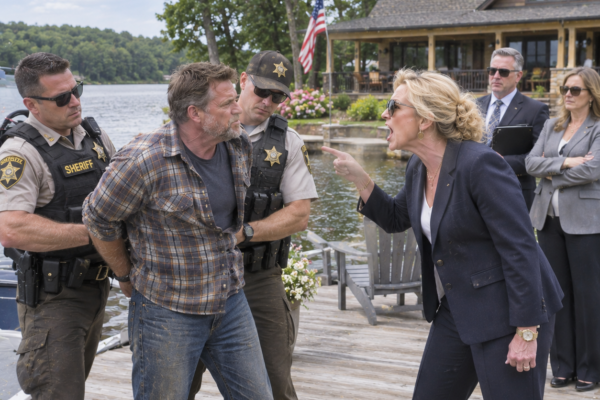
I Came Home to a 180-Foot Cell Tower on My 11 Acres—With a 20-Year Lease Bearing My Forged Signature. The HOA President Told Me the “Community Had Moved Forward” After I Refused Her Proposal Six Months Earlier. Then the Tower Company Opened Its File and Found Every Approval Document Had Come From One Email Account: Hers.k
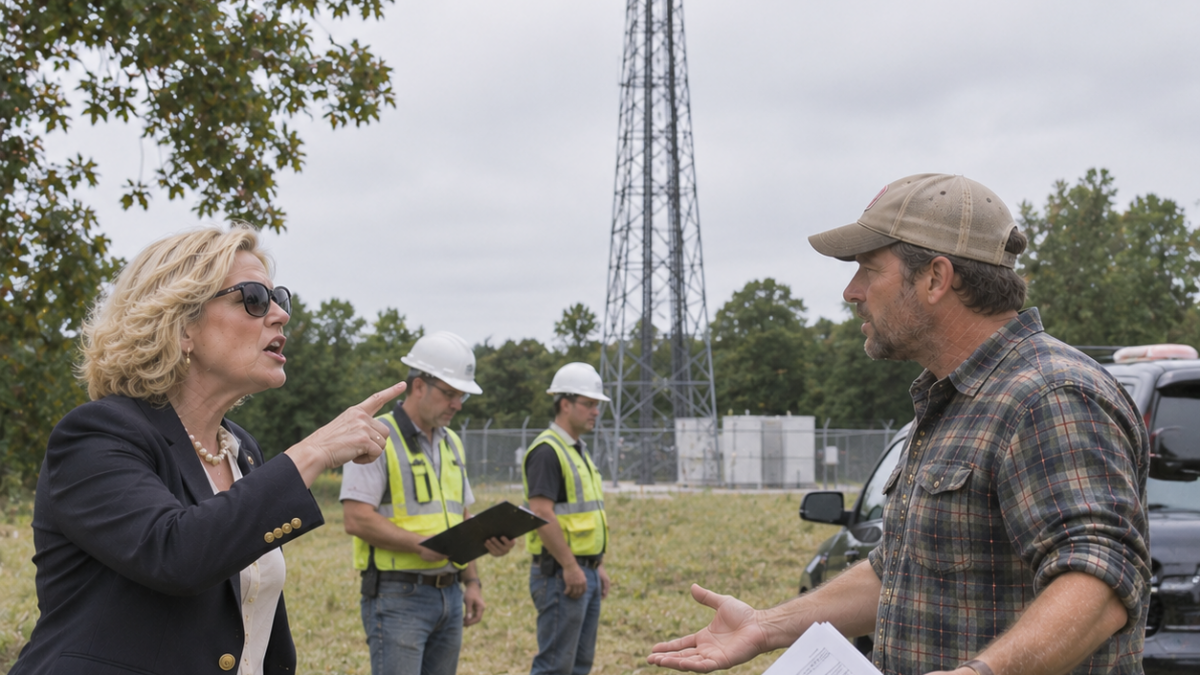
I Came Home to a 180-Foot Cell Tower on My 11 Acres—With a 20-Year Lease Bearing My Forged Signature. The HOA President Told Me the “Community Had Moved Forward” After I Refused Her Proposal Six Months Earlier. Then the Tower Company Opened Its File and Found Every Approval Document Had Come From One Email Account: Hers.
I had been gone three days when somebody built a communications tower on my hill.
Not a temporary antenna.
Not a survey stake.
A 180-foot steel tower.
It stood above the oak trees behind my house with red aviation lights blinking against the evening sky.
Below it sat two service trucks, a portable generator, fresh concrete, electrical cabinets, and a new gravel access road that had not existed when I left Monday morning.
Four fence posts had been pulled from my property and stacked neatly beneath an oak.
I drove straight past my house.
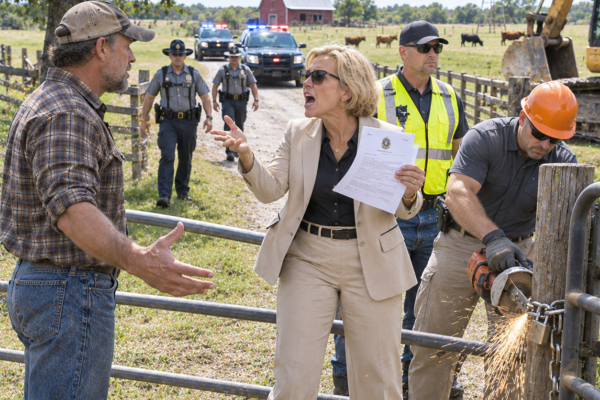
At the top of the hill, a man in a reflective vest told me the crew had lawful access from the landowner.
“I am the landowner.”
He stopped smiling.
A project manager named Gavin Shaw came over with a tablet.
He opened the site file.
Owner consent.
Ground-access agreement.
Utility easement.
Site plan.
Twenty-year land lease with renewal options.
Every page carried my name.
Calvin Reic.
Correct address.
Correct parcel number.
Correct property description.
And at the bottom of the lease was a signature that looked almost like mine.
Almost.
I have signed my name tens of thousands of times.
The person who copied it didn’t know the little habit I picked up from my mother: I always cut the second letter low through the loop.
That signature didn’t.
“Who gave you these documents?”
Gavin scrolled through the file.
“The coordination package came through Cedar Crest Estates.”
My stomach tightened.
“Who specifically?”
He read from the transmittal page.
“Brin Holloway. President, Cedar Crest Estates Homeowners Association.”
Six months earlier, Brin had stood on my porch with the same project in a cream-colored folder.
Cedar Crest had terrible cellular coverage on the east side.
A carrier study identified my hill as the strongest available location within several miles.
Brin offered a twenty-year lease.
I said no.
Not because I hated technology.
Not because I wanted my neighbors to have bad service.
I said no because the only road to that hill passed within sixty feet of my back door.
A tower meant trucks.
Fuel deliveries.
Generators.
Utility trenches.
Maintenance at all hours.
And a legal right of access that could outlive me.
I had bought those eleven acres with money my mother spent thirty-one years earning in a hospital laundry.
I bought quiet.
I told Brin I would consider a smaller, shorter arrangement with strict access limits.
She wasn’t interested.
At the bottom of my porch steps, she turned and said:
“There are things bigger than one person’s ownership, Calvin.”
Now, six months later, her tower was standing on the exact ground I had refused to lease.
I called her that evening.
“There’s a tower on my hill.”
“I know.”
“I never agreed to it.”
“The project moved forward.”
“My signature is on a lease I didn’t sign.”
A pause.
Then she said:
“Maybe you ought to check your memory.”
That ended any possibility that this was an innocent clerical mistake.
The next morning, Gavin sent me the complete Northline Wireless Infrastructure file.
That was when I found the part that made my hands shake.
Cedar Crest had not merely represented itself as project coordinator.
The HOA was receiving money.
An $18,000 “coordination fee.”
Plus recurring quarterly administrative payments for the life of the lease.
My signature had not only been used to put 180 feet of steel on my property.
It had been used to create an income stream for an association that did not own one square foot of my hill.
I drove to the HOA office.
Brin sat at the head of the conference table and told me I wasn’t losing anything.
“The hill is still yours.”
“Then why is your association getting paid for it?”
“We incurred administrative costs.”
“If everything is legitimate, why is my name on the lease instead of yours?”
For four seconds, she said nothing.
Then she leaned forward.
“You’re turning this into something you don’t understand.”
I stood.
“No, Brin. I think I finally understand it.”
I left without shouting.
Without threatening her.
Without touching the tower.
That decision mattered.
Because my attorney would later tell me something I never forgot:
“If this was built with forged paper, Calvin, then paper is what takes it down.”
And buried inside Cedar Crest’s own meeting minutes was one sentence Brin Holloway had apparently forgotten existed:
Mr. Reic declined participation.
Part 2:
I had been gone three days when somebody built a communications tower on my hill.
Not a temporary antenna.
Not a survey stake.
A 180-foot steel tower.
It stood above the oak trees behind my house with red aviation lights blinking against the evening sky.
Below it sat two service trucks, a portable generator, fresh concrete, electrical cabinets, and a new gravel access road that had not existed when I left Monday morning.
Four fence posts had been pulled from my property and stacked neatly beneath an oak.
I remember gripping the steering wheel and staring through the windshield while my brain tried to explain something my eyes already understood.
People don’t accidentally build towers.
Somebody had surveyed this.
Permitted it.
Ordered steel.
Scheduled concrete.
Coordinated power.
Sent crews.
And somehow none of those people had spoken to the man who owned the ground.
My name is Calvin Reic.
I was forty-eight years old when this happened, and for eleven years I had owned eleven acres bordering the eastern side of Cedar Crest Estates.
My parcel was never part of Cedar Crest.
Never annexed.
Never subject to its covenants.
The subdivision stopped at my western fence.
My land began there.
Simple.
The highest part of my property was an open rise the old survey called East Knoll.
Everyone around town called it Reic Hill after I bought the place.
From the top, you could see the county water tower, the state highway bending south, and the roofs of Cedar Crest laid out below.
I knew every foot of that hill.
Where deer crossed at dawn.
Where the ground stayed soft after heavy rain.
Where my mother used to sit in a folding chair the first summer after I bought the property.
She never lived there.
Cancer took her less than a year after closing.
But she saw it.
That mattered.
My mother, Lorraine, worked thirty-one years in the laundry department at St. Matthew’s Hospital.
Sheets.
Gowns.
Towels.
Hot rooms.
Heavy carts.
She saved relentlessly.
When she died, she left me enough money to pay down the loan on those eleven acres.
That is why I could never think of the land as merely real estate.
Every acre contained years of her life.
So I drove past my house and took the track toward the hill.
Except half the track was gone.
Someone had widened it by nearly eight feet.
Hawthorn brush had been cut back.
Fresh crushed stone covered the ground.
The gravel crunched under my tires.
Halfway up stood a gray electrical cabinet on newly poured concrete.
I could still smell curing cement.
That detail bothered me immediately.
Concrete meant planning.
Whoever built this knew exactly when I was away.
At the top were four workers.
One man was in a bucket lift near the tower.
Two were feeding cable.
Another stood beside a pickup.
I got out.
“Who authorized this?”
The man nearest me looked up.
“Sir?”
“This work. Who authorized it?”
He gestured toward a sign beside the temporary gate.
“There’s a contact number there if you’ve got a complaint.”
“There was no gate here Monday.”
He blinked.
“Well, there is now.”
“Who gave you permission to install it?”
“We’ve got a complete access package.”
“From who?”
“The landowner.”
“I’m the landowner.”
That changed everything.
He reached for his radio.
“Gavin, can you come up?”
A white pickup arrived several minutes later.
Gavin Shaw stepped out.
Around forty.
Clean work clothes.
Tablet in hand.
He introduced himself as project manager for Northline Wireless Infrastructure.
“Mr. Reic?”
“Yes.”
“Okay. Let’s figure this out.”
He opened the project file.
At first his tone was reassuring.
Owner consent form.
Site-access agreement.
Construction plan.
Lease.
Utility routing.
He showed each document as though paperwork itself would calm me.
Then he turned the screen.
My name appeared at the top.
CALVIN REIC.
My parcel identification number.
My mailing address.
Everything accurate.
At the bottom:
Calvin Reic.
A signature.
My signature.
Except it wasn’t.
It was close enough to fool someone who had never watched me sign anything.
Looping capital C.
Tight letters.
Hard final stroke.
But whoever copied it missed the low cut through the second letter.
I inherited that habit from Mom.
She signed Reic the same way.
I touched the screen.
“I didn’t sign this.”
Gavin looked at me.
“You’re saying this isn’t your signature?”
“I’m telling you it isn’t.”
He stopped swiping.
“What about the lease negotiations?”
“There weren’t any.”
“Site walk?”
“No.”
“Owner call?”
“No.”
“Closing packet?”
“No.”
He looked back toward the tower.
“You never spoke with anyone from Northline?”
“Until right now, I’d never heard the name.”
That was when his confidence disappeared.
I asked:
“Who delivered the documents?”
He searched the file.
“Coordination came through Cedar Crest Estates.”
“Who?”
He scrolled.
Then read:
“Brin Holloway. President.”
Everything inside me went quiet.
Six months earlier, Brin Holloway had asked me for this exact hill.
She came to my house on a Saturday.
Cream blazer.
Folder.
Printed coverage maps.
A company brochure.
Brin was fifty-four and spoke in a way that made every proposal sound as though the decision had already been made.
“Calvin, the eastern section of Cedar Crest has had serious coverage complaints.”
“I know.”
“We’ve had dropped emergency calls.”
“That’s not good.”
“A carrier study found your hill is the optimal site.”
She opened the map.
My property was circled red.
I noticed that before anything else.
Somebody had selected the location before asking me whether they could use it.
She proposed a twenty-year ground lease.
Two renewal options.
Access road.
Utilities.
Permanent equipment rights.
The compensation was respectable.
Not life-changing.
But real money.
I still said no.
Brin smiled at first.
“Maybe you haven’t seen the annual figure.”
“I saw it.”
“Then what concerns you?”
“The road runs sixty feet from my house.”
“Service visits are minimal.”
“Minimal is not zero.”
“Calvin, it’s telecommunications infrastructure.”
“I understand.”
“You’ll barely notice it.”
“I bought eleven acres because I wanted to notice eleven acres.”
That annoyed her.
“I think you’re focusing on inconvenience rather than community benefit.”
“I’m focusing on the lease.”
“It would improve coverage for more than two hundred households.”
“I’ll consider a shorter agreement with strict access windows.”
“The carrier needs long-term certainty.”
“Then my answer is no.”
The warmth vanished.
She closed the folder.
“You’re turning an empty hill into a problem for an entire neighborhood.”
“It isn’t empty.”
“There’s nothing up there.”
“There’s land.”
“Unused land.”
“My land.”
She stood.
At the bottom step, she turned around.
“There are things bigger than one person’s ownership.”
I remember almost laughing.
Instead, I said:
“Not on a deed.”
Then I went inside.
I forgot about the conversation.
Brin didn’t.
Standing beside Gavin six months later, I realized what that sentence had really meant.
I asked the crew to stop work temporarily.
Gavin agreed.
Not because I had legal authority over Northline in that moment.
Because a project manager who has just been told the landowner signature may be forged does not keep pouring concrete casually.
He told his men to secure the site.
No expansion until his legal team reviewed the issue.
I thanked him.
Then drove home.
From my kitchen window, the tower light blinked red after dark.
I called Brin.
She answered quickly.
“Calvin.”
“You know why I’m calling?”
“I assume you’ve seen the site.”
Not surprise.
Not confusion.
“You knew construction started.”
“Of course.”
“I never agreed.”
“The project moved forward.”
“My signature is on a lease.”
“Yes.”
“I didn’t sign it.”
A pause.
“You participated in the process.”
“No.”
“You agreed conceptually.”
“No.”
“Calvin—”
“I said no on my porch.”
“Maybe you ought to check your memory.”
That was it.
Honest mistakes create questions.
Who filed the wrong form?
Whose signature is that?
How did this happen?
Brin asked none.
She told me I remembered incorrectly.
I said:
“Good night.”
Then hung up.
I sat at my kitchen table until the coffee went cold.
The generator hummed outside.
On land bought with my mother’s money.
The next morning I emailed Gavin.
I requested everything.
Not summaries.
Not screenshots.
Complete file.
Metadata if available.
Attachments.
Transmittals.
Signatures.
Payment instructions.
He delivered the packet by noon.
I printed it at an office-supply store because important documents feel different on paper.
Maybe that sounds old-fashioned.
I didn’t care.
I sat inside my truck for two hours reading.
The forged lease was only one piece.
There was an owner-consent form.
Signature.
Mine.
Not mine.
Ground-access agreement.
Twenty-year continuous access.
Renewals.
Contractors.
Agents.
Assigns.
Utility trench across two of my best acres.
Future equipment additions without additional owner approval.
Indemnity language where I supposedly accepted responsibility for certain property impacts.
Then the compensation page.
Annual lease payment to me.
That was expected.
Below it was another line.
CEDAR CREST ESTATES HOA — PROJECT COORDINATION FEE: $18,000.
Then:
QUARTERLY ADMINISTRATIVE PAYMENT.
For the life of the lease.
I reread it.
Cedar Crest had somehow become a paid intermediary on a lease to land it did not own.
That afternoon, I drove to the association office.
Brin saw me through the glass.
She waved me into the conference room.
She sat at the head of the table.
I set the packet in front of her.
She glanced at it.
“You have the documents.”
“Yes.”
“That should clear things up.”
“It did.”
She waited.
“You’re getting paid.”
“So are you.”
“The association handled coordination.”
“What coordination?”
“Planning. Carrier communication. Community outreach.”
“You’re receiving eighteen thousand dollars.”
“That’s the initial fee.”
“And quarterly payments.”
“The association will have continuing administrative responsibilities.”
“For my land.”
“For infrastructure benefiting Cedar Crest.”
“Did the board approve this?”
“Yes.”
“Did the board witness me sign?”
Her expression changed.
“Calvin, the hill remains yours.”
“That isn’t what I asked.”
“You’re not losing the property.”
“My title now has a twenty-year lease memorandum recorded against it.”
“Which you agreed to.”
“No.”
She sighed.
“You’re making this more emotional than necessary.”
I looked at the packet.
Then at her.
“If everything was proper, why is my name on those pages instead of yours?”
Silence.
One second.
Two.
Three.
Four.
Then:
“You’re turning this into something you don’t understand.”
I stood.
“I think I understand perfectly.”
I left.
The man I hired was Miles Keaton.
Real-estate and title attorney.
Fifty-two.
Office above a shoe-repair shop two towns away.
He read every page without interrupting.
Then asked:
“Have you signed anything connected to Cedar Crest in the last year?”
“No.”
“Anything?”
“No.”
“No petition?”
“No.”
“No receipt?”
“No.”
“Board attendance sheet?”
“No.”
He nodded.
“That simplifies one thing.”
“What?”
“We don’t have to argue that a real signature was repurposed.”
He tapped the lease.
“If this isn’t yours, someone created it.”
Then he gave me the advice that probably saved me.
“Do not interfere physically with the tower.”
“I own the land.”
“I know.”
“I can close the road.”
“Don’t.”
“Why?”
“Because Northline may be a victim too. More importantly, there is now equipment, power, and a 180-foot structure on that hill. We are going to resolve legal rights without creating a safety problem.”
I didn’t like it.
He continued.
“No cutting locks.”
“Fine.”
“No blocking crews.”
“Fine.”
“No confronting technicians.”
“Fine.”
“No removing equipment yourself.”
“I wasn’t going to climb the tower.”
“I’ve met angry property owners.”
“I restore my own tractors, Miles. I’m not stupid.”
“Good. Be boring.”
I became boring.
He ordered the title record.
My deed was clean.
Cedar Crest’s subdivision plat ended at my boundary.
No HOA restrictions.
No annexation.
No telecommunications easement.
Nothing.
Then we found the memorandum of lease Northline had recorded.
That made me angrier than the tower itself.
The forged lease was not merely sitting in somebody’s corporate file.
It had reached the county land records.
My chain of title now showed a long-term encumbrance.
If I sold, it appeared.
If I refinanced, it appeared.
If I died, whoever inherited my land inherited the problem.
Miles filed a formal notice disputing the instrument.
He notified Northline.
Demanded no additional trenching or expansion.
Demanded preservation of documents.
Then he sent Cedar Crest its own preservation letter.
Emails.
Minutes.
Drafts.
Budget documents.
Communications with Northline.
Payment records.
Everything.
I installed two game cameras on my land.
Not to intimidate anyone.
To record access.
Every truck.
Date.
Time.
License plate.
Then I waited.
It was difficult.
Crews still needed to inspect the tower.
Northline had temporarily stopped expansion but could not simply abandon partially commissioned infrastructure.
I watched strangers drive past my house and reminded myself:
Paper.
Not anger.
Miles requested eighteen months of HOA minutes.
The line appeared in an early spring meeting.
Coverage Initiative:
Mr. Reic declined participation.
I stared at it.
“Brin’s own minutes.”
“Yes.”
Six weeks later:
Landowner authorization obtained.
No meeting between those dates.
No call.
No letter.
No visit.
Just a refusal.
Then authorization.
Miles placed both pages side by side.
“That gap is our case.”
Brin went public before we did.
At a Cedar Crest coffee morning, she told residents I had originally supported the project.
Then she emailed all 206 households.
Her story:
I agreed in principle.
Construction proceeded.
Once the tower was valuable and operational, I discovered the HOA received compensation and demanded more money.
She never called me greedy.
She didn’t need to.
People understood the suggestion.
It hurt.
I’m not going to pretend otherwise.
A man I had helped jump-start his truck stopped acknowledging me at the hardware store.
A woman who used to wave from her SUV looked away.
Someone left an unsigned note in my mailbox.
STOP PUNISHING THE NEIGHBORHOOD.
I was a Black man living alone on acreage beside a large subdivision.
I had spent enough of my life understanding how quickly a calm disagreement could become a story about an angry man.
So I gave Brin nothing.
No social-media posts.
No public accusations.
No driveway confrontation.
Not one sentence she could quote out of context.
Every time she defended herself, though, she created evidence.
She wrote Northline claiming I was renegotiating.
She emailed the board.
She circulated member notices.
Miles collected everything.
“A liar with a pen,” he said once, “is an unpaid paralegal for the other side.”
Then Owen Sutter called.
Cedar Crest treasurer.
Sixty.
Retired sales manager.
He didn’t want to meet at the clubhouse.
We met at a diner parking lot.
He climbed into my truck with a manila envelope.
For thirty seconds he just held it.
“I should have asked questions sooner.”
I said nothing.
He opened it.
Budget workbook.
Projected revenue.
Capital plan.
There was a line:
SITE COORDINATION INCOME.
Initial payment.
Quarterly income.
Carried forward across future years.
The money financed promises already made to residents.
Clubhouse renovation.
Pool deck.
Pavilion roof.
Tennis-court resurfacing.
No dues increase.
I looked at the file creation date.
Then at Owen.
“When was this entered?”
He stared through the windshield.
“Before Brin met you.”
“How long?”
“Eleven weeks.”
I felt something inside me settle.
Not anger.
Certainty.
The HOA had budgeted income from my land eleven weeks before asking permission.
That meant my refusal hadn’t derailed a plan.
My refusal had exposed a problem in a plan that already assumed yes.
“Did the board know I hadn’t agreed?”
“Brin told us site control was being finalized.”
“Before she asked me?”
“Yes.”
“Did anyone ask to see a lease?”
“No.”
“Why?”
Owen looked ashamed.
“Because we wanted the capital projects.”
That was honest.
Not noble.
Honest.
Miles loved the workbook.
Not emotionally.
Legally.
Its metadata predated my refusal.
It showed anticipated revenue before consent.
Then Brin’s attorney sent an offer.
I could sign a new, properly witnessed set of lease documents.
Retroactive ratification.
$7,500 additional payment.
Letter of appreciation from the board.
I read it.
“They want me to make it valid.”
“Yes.”
“If I sign now, the forged documents disappear?”
“No. But the practical dispute becomes easier for them.”
“Meaning?”
“Your genuine consent would make the current site legally salvageable.”
I pushed the paper back.
“No.”
Miles smiled slightly.
“Good.”
That night I remembered an old email.
I searched my inbox.
Found it.
Sent by Brin the week after I rejected her proposal.
Three polite paragraphs.
Community benefit.
Shared responsibility.
Coverage.
Then the final line:
If you are unwilling to cooperate, the board will have to find another path forward for the project.
Miles told me not to forward it casually.
A forensic specialist preserved it with full headers.
Sent from Brin’s account.
Received by mine.
Dated nineteen days before the forged owner authorization.
Now the sequence looked ugly.
Budget assumes site revenue.
Owner says no.
President writes that the board will find another path.
Three weeks later, owner “signs.”
Except he doesn’t.
Meanwhile, Gavin Shaw began his own investigation.
Northline’s internal file bothered him.
He had worked tower projects eleven years.
He had never finished a site without direct owner contact.
Somebody always attended a walk-through.
A verification call.
Lease execution.
Something.
His company’s checklist showed owner identity verified.
But Gavin had never spoken to me.
Neither had the site-acquisition coordinator.
The file showed the HOA represented me.
So he traced the documents.
Every executed page came from Brin Holloway’s email account.
Owner consent.
Lease.
Access agreement.
Revised site plan.
Utility route.
Nothing came from me.
No phone log.
No identity verification interview.
No witness who had seen me sign.
No notary acknowledgment.
No owner-site walk.
No email from an address associated with Calvin Reic.
Northline’s own internal procedure had failed.
The company froze further work.
By then it had already paid Cedar Crest approximately $28,000 in fees and quarterly amounts.
That changed the company’s position fast.
Before, Northline had a landowner dispute.
Now it had potential trespass, invalid site rights, clouded title, and money paid to an entity with no authority to receive it.
Cedar Crest called an emergency member meeting.
Brin entered with a slide presentation.
Miles brought one binder.
I brought nothing.
The clubhouse was packed.
Brin spoke for eleven minutes.
Coverage crisis.
Engineering study.
Community initiative.
Landowner consultation.
She said I had shown “tacit agreement.”
Twice.
Then:
“Once construction was substantially completed and Mr. Reic understood the site’s financial value, he changed his position and attempted to renegotiate.”
A few people nodded.
Miles stood.
“Five documents.”
That was all he said.
First:
Cedar Crest meeting minutes.
Mr. Reic declined participation.
Date.
Second:
Brin’s email.
The board will have to find another path forward.
Nineteen days later.
Third:
Executed owner-consent form.
My forged signature.
Twenty-two days after the email.
Fourth:
Northline transmittal history.
Every approval document sent from Brin’s account.
No communication from me.
Fifth:
Budget workbook.
Created eleven weeks before Brin first asked me.
Site revenue already projected.
Clubhouse improvements already tied to it.
The room became silent.
Not dramatic silence.
Arithmetic silence.
Two hundred people recalculating what they thought they knew.
Brin stood.
“There were procedural irregularities.”
Miles sat down.
She kept talking.
“Our recordkeeping has historically been informal.”
Nobody answered.
“The underlying project was approved in good faith.”
Still nothing.
“Any issue with documentation was procedural.”
That word appeared repeatedly.
Procedural.
Then Gavin stood at the back.
He wore a plain gray jacket.
No slides.
“Who sent Northline Mr. Reic’s signature?”
Brin looked at him.
“The project package was assembled through association coordination.”
Gavin waited.
“Who sent us Mr. Reic’s signature?”
“Our office transmitted documentation from multiple sources.”
“Every file came from your email address.”
“That doesn’t mean I created each document.”
“Who gave you the signed consent?”
She looked toward the board.
“I would need to review the file.”
Gavin held up a folder.
“The file is here.”
No answer.
“Did you ever witness Mr. Reic sign?”
“No.”
“Did anyone on the board?”
Silence.
Owen stood.
His hands shook.
“In four years as treasurer, I never witnessed Calvin sign anything.”
Brin turned.
“Owen.”
He continued.
“The board never met with him after his refusal. Brin reported to us that authorization had been obtained.”
“Sit down.”
“No.”
That one word ended something.
Owen looked toward the residents.
“We should have asked to see it.”
Then he sat.
I still had not spoken.
That was the moment Cedar Crest stopped seeing me as the problem.
Four business days later, Northline formally notified the association.
It no longer recognized Cedar Crest as an authorized representative of the landowner.
All future payments stopped.
Northline demanded repayment of approximately $28,000 already disbursed.
It reserved claims related to misrepresentation and project costs.
The HOA’s anticipated revenue vanished.
The clubhouse renovation vanished with it.
Brin called me Sunday.
Her voice had changed.
“Calvin, I hope we can still resolve this sensibly.”
“That would be good.”
“We have common interests.”
“Do we?”
“I’ve always respected you.”
I almost laughed.
Instead:
“You had the chance to ask me before you put my name on a contract.”
“Calvin—”
“Good afternoon.”
I hung up.
Then I sat on my porch.
The tower was still there.
That created a new problem.
What now?
Some residents expected me to lock the gate immediately.
Others assumed Northline would tear the tower down the next morning.
Neither was realistic.
The structure was energized.
Equipment was active.
Emergency and ordinary cellular traffic had begun using it.
You cannot responsibly abandon a 180-foot tower.
And none of the 206 households in Cedar Crest had forged my signature.
Children lived there.
Older people.
People with medical conditions.
People who might need 911 service.
So Miles drafted a temporary access license.
Ninety days initially.
Directly between Northline and me.
Limited hours except emergencies.
Specified vehicles.
No expansion.
No additional antennas.
No new utility work.
Fixed temporary fee.
Revocable for breach.
Northline signed immediately.
Gavin called.
“Thank you.”
“This isn’t approval of the permanent site.”
“I understand.”
“I’m not ratifying anything.”
“I understand.”
“Your company still has to clear my title.”
“It will.”
That temporary license changed the tone of the dispute.
Brin could no longer tell residents I wanted to destroy their service.
I was the person legally keeping the tower operating while everyone unwound what she had done.
Residents demanded HOA records.
The association’s own attorney shifted focus.
His client was Cedar Crest Estates, not Brin Holloway personally.
That distinction became very important.
Records showed the board had never reviewed my executed lease.
Never seen me sign.
Never received direct confirmation from me.
Brin had repeatedly reported “site control achieved.”
The $18,000 payment entered the operating account.
Quarterly payments followed.
Some of that money had already been spent on preliminary design and deposits for capital projects.
Owen resigned.
Before leaving, he turned over everything.
Emails.
Budget drafts.
Bank records.
Board notes.
I never decided whether that made him courageous.
Probably not.
But people do not have to be heroic to eventually do the right thing.
Brin was removed as president by the board pending the internal review.
No handcuffs.
No police cruiser.
No dramatic arrest.
The signature question was referred through counsel to appropriate authorities and insurers, but my civil case did not depend on whether prosecutors ever charged anyone.
That was Miles’s position.
“We know what outcome you need.”
“Clear title.”
“Exactly.”
Northline agreed to release the recorded memorandum of lease.
That mattered more to me than any public apology.
The county recorded the release.
My property title was no longer burdened by a twenty-year agreement I never signed.
Then Northline gave me two options.
Option one:
A completely new lease.
Directly negotiated with me.
No HOA.
Different financial terms.
A shorter initial duration if I wanted.
Strict access conditions.
Noise controls.
Restoration bond.
Every term negotiable.
Option two:
Full decommissioning.
Tower removed.
Concrete removed.
Electrical infrastructure removed.
Access road restored.
Fence rebuilt.
Land regraded and reseeded.
Northline’s expense.
They gave me time.
I took eleven days.
The money in option one was substantial.
More than Brin had offered.
I considered it seriously.
I am not romantic enough to pretend money doesn’t matter.
Twenty years of site rent could have changed my retirement.
But every time I looked at the tower light from my kitchen, I remembered why I had said no before there was money.
I did not want permanent industrial access sixty feet from my back door.
The presence of the tower did not magically make the original concern disappear.
There is a difference between choosing a lease and accepting one because somebody already poured the concrete.
I chose removal.
Northline accepted.
The company had an alternative commercially zoned site three and a half miles west.
It had scored nearly as well in the original coverage study.
Development there took months.
My temporary license was extended carefully while the alternate site came online.
During that period, Gavin personally notified me before every significant visit.
“Two trucks tomorrow between nine and eleven.”
“Okay.”
“Battery inspection Thursday.”
“Fine.”
“We may need emergency access if the generator alarms.”
“That’s in the license.”
It was remarkable how simple cooperation became once someone remembered who owned the land.
Cedar Crest held its own reckoning.
The HOA returned the coordination payments.
Settled portions of Northline’s claim.
Paid its attorneys.
Canceled the planned clubhouse renovation.
Canceled the pool-deck project.
Canceled tennis-court resurfacing.
Residents approved a dues increase just under forty dollars per quarter to rebuild reserves and cover legal costs.
I heard the vote was ugly.
I did not attend.
Not my HOA.
That fact had somehow survived everything.
One afternoon, a Cedar Crest resident named Linda Graves came to my gate.
She had lived there fifteen years.
“I owe you an apology.”
“You personally?”
“I believed Brin.”
“A lot of people did.”
“She said you wanted more money.”
“I know.”
“I repeated it.”
That surprised me.
“To who?”
“Several neighbors.”
I appreciated that she admitted it.
“I was angry because the pool project got canceled.”
“That makes sense.”
“No, it doesn’t.”
“It explains it.”
She looked up at the tower.
“So you’re really taking it down?”
“Northline is.”
“That will hurt coverage.”
“They’re building another site first.”
She nodded.
“I didn’t know that.”
“Most people didn’t.”
“Brin made it sound like you wanted to leave everyone without service.”
“I gave them temporary access for months.”
Linda looked embarrassed.
“I’m sorry.”
“Thank you.”
She left.
That conversation mattered.
Not because I needed every neighbor to like me.
Because Brin’s most effective weapon had never been the forged paper.
It was the story she wrapped around it.
Greedy landowner.
Unreasonable man.
Community versus one person.
Once the documents became visible, the story collapsed.
Seven months after I chose removal, the alternative tower was activated.
Northline tested it.
Migrated traffic.
Then scheduled decommissioning.
I stood on my porch when the crane arrived.
This time every truck had permission.
Every worker was expected.
Every date had been agreed to.
The tower came down in sections.
Top antennas first.
Then lattice segments.
Then equipment shelter.
Generator.
Cabinets.
Concrete pad.
The foundation was deeper than I expected.
They excavated it completely.
Removed the crushed-stone road expansion.
Regraded the slope.
Replaced topsoil.
Seeded grass.
Rebuilt my fence.
It took weeks for the property to stop looking like a construction site.
Months before the new grass blended.
But the red light disappeared from my kitchen window immediately.
The first night without it, I stood at the sink longer than necessary.
Dark hill.
Dark sky.
Nothing blinking.
I hadn’t realized how much that light bothered me until it was gone.
Brin Holloway sold her Cedar Crest house later that year.
I heard she moved about ninety miles away.
I never verified it.
Never spoke to her again.
There was no reason.
What happened with the signature beyond the civil resolution moved through processes I did not control.
Northline conducted an internal investigation.
Cedar Crest’s insurer reviewed the conduct.
Counsel handled the association’s claims.
My focus remained narrow.
My land.
My title.
My restoration.
People sometimes found that disappointing when I told the story.
They wanted handcuffs.
A courtroom confession.
A judge pointing at Brin while a gallery gasped.
Real property disputes rarely end that neatly.
What ended Brin’s authority was less cinematic.
A signature.
Board minutes.
An email.
A budget spreadsheet.
Metadata.
Payment records.
A corporate transmission log.
The exact things she thought would make her plan look official.
Paper.
Paper does not get nervous.
Paper does not forget what date it was created.
Paper does not suddenly claim you agreed “in principle” when an earlier page says:
Mr. Reic declined participation.
By late spring, Reic Hill looked almost normal again.
I walked up the restored dirt road one evening.
Narrow.
Rutted slightly.
Exactly how I remembered it.
New grass covered the tower pad.
A little brighter than the surrounding field.
Scars often grow back that way.
Different enough to remember.
Not different enough to ruin the whole thing.
The fence was intact.
The utility cabinet was gone.
No generator.
No service trucks.
No tower hum.
From the top, I could see the water tower in town.
State highway.
Cedar Crest rooftops.
And between me and the horizon:
Air.
Ordinary air.
I sat on the grass.
Thought about Mom.
Thirty-one years in hospital laundry.
Hands rough from detergent.
Back hurting after long shifts.
She never owned much.
But she understood ownership better than Brin Holloway ever did.
Mom used to say:
“If you borrow somebody’s scissors, ask first even if you know they’ll say yes.”
As a kid, I thought that was about manners.
Standing on the hill, I understood it was about something larger.
Consent matters because the answer might be no.
If the answer is guaranteed to be yes, asking is meaningless.
Brin told me the community needed my land.
She may even have believed that.
But believing your goal is important does not authorize another person’s signature.
Northline’s alternative site proved something else.
My hill had been best.
It had never been the only option.
The difference between “optimal” and “necessary” had disappeared inside Brin’s argument because necessary sounds more powerful.
That happens often when people want something.
Convenience becomes need.
Preference becomes right.
Resistance becomes selfishness.
Then boundaries start looking like obstacles rather than boundaries.
A week later, the final envelope arrived from Miles.
Inside:
Recorded release.
County stamp.
Memorandum of disputed lease discharged.
Restoration certification.
I laid it on my kitchen table.
Then opened the drawer where I kept the original Northline packet.
I placed the forged lease beside the release.
Two documents.
One with a signature pretending to be mine.
One restoring the record.
The first took a decision about my land out of my hands.
The second put it back.
Miles came over that afternoon.
We sat on the porch.
“You keeping the forged copy?”
“Yes.”
“Why?”
“Reminder.”
“Of Brin?”
“No.”
“Then what?”
I thought about it.
“That official-looking paper can still be false.”
He nodded.
“That’s a useful lesson.”
“You lawyers should put it on your business cards.”
“We’d lose clients.”
I laughed.
He handed me one more document.
Northline’s final waiver of any site claim.
“No residual rights.”
“Good.”
“Utility easement never recorded, so nothing else to release.”
“Better.”
“And Cedar Crest signed settlement confirmation.”
“Best.”
He leaned back.
“You could have made a lot of money keeping that tower.”
“I know.”
“Any regret?”
“Ask me when I’m seventy.”
“Fair.”
For now, no.
I never hated the tower itself.
That surprised people.
Steel doesn’t forge signatures.
Technicians don’t create fake consent because they enjoy invading property.
Most of the workers who came onto my land believed they had permission.
Northline made serious verification failures.
The company admitted that.
Changed procedures.
Gavin later told me any private-land project in his region now required direct documented owner contact independent of an association or broker.
No owner verification through a third party alone.
That policy came too late for me.
Maybe it prevented the next case.
That counts for something.
Cedar Crest changed too.
New board.
Independent financial review.
Large contracts required direct supporting documentation.
No president could represent private off-HOA property owners without written authority independently verified by counsel.
The clubhouse still had the old furniture.
Pool deck still needed resurfacing.
Residents complained.
Life continued.
Owen wrote me once.
A handwritten letter.
He apologized.
Said he knew the budget assumptions were premature but trusted Brin when she said site control was virtually certain.
Then when the money arrived, he accepted the explanation because questioning it would have meant admitting the board had built an entire capital plan on something it never owned.
That sentence was the most honest explanation of the whole mess.
People often don’t keep walking in the wrong direction because they cannot see the sign.
They keep walking because turning around gets more expensive every step.
Brin had promised improvements.
The board had repeated those promises.
Vendors had been contacted.
Residents expected results.
Then I said no.
At that moment, the correct response was:
We need a different site.
Instead, my no threatened a chain of promises.
So someone removed the no.
That is what the forged signature did.
It didn’t merely fake consent.
It erased inconvenience.
I think about that every time someone calls a property dispute “just paperwork.”
Paperwork is where consent lives after people leave the room.
Deeds.
Easements.
Leases.
Releases.
Signatures.
Dates.
You don’t have to love paperwork.
You do have to respect what it represents.
One summer evening, nearly a year after the tower came down, I saw Gavin’s white Northline truck at the county road.
He pulled over.
I walked down.
“Lost?”
“Checking the alternative site.”
“How’s it performing?”
“Better than expected.”
“That’s good.”
He looked toward my hill.
“Looks normal.”
“Almost.”
“I owe you an apology.”
“Your company already gave me several.”
“This one is mine.”
I waited.
“I should have spoken to you before construction.”
“Yes.”
“I relied on the file.”
“Yes.”
“I told myself site acquisition had done its job.”
“Yes.”
He smiled slightly.
“You’re making this painful.”
“You drove a tower onto my hill.”
“Fair.”
Then he became serious.
“The first night you showed up, I knew something was wrong when you said nobody had called.”
“Why?”
“Landowners complain all the time. They argue about access, noise, rent, crops, gates. But they know our name.”
“I didn’t.”
“You had never heard Northline.”
“No.”
“That should have stopped the project before steel ever arrived.”
“It did stop eventually.”
“After 180 feet.”
We both looked up at the empty sky.
Then he held out his hand.
I shook it.
“Take care, Calvin.”
“You too.”
His truck disappeared down the road.
I walked back up the hill.
The grass was dry beneath my boots.
Deer tracks crossed the fence line.
Wind moved through the oaks.
Nothing extraordinary.
That was the point.
Eleven acres of nothing in particular.
People use that phrase like nothing means worthless.
But quiet is something.
Choice is something.
Knowing who can come onto your land is something.
Looking through your kitchen window and seeing darkness where you chose darkness is something.
Brin once told me there were things bigger than one person’s ownership.
She was right.
Consent is one of them.
So is trust.
So is the integrity of a public land record.
So is the principle that a community cannot solve its problems by quietly transferring the cost of those solutions onto one person who already said no.
Cedar Crest needed better coverage.
It got better coverage.
Northline needed a tower.
It built one somewhere else.
The world did not end because my hill remained mine.
That may be the simplest lesson in the entire story.
Sometimes no creates inconvenience.
That does not make no invalid.
The final copy of the release still sits in my fireproof box.
The forged lease sits in a separate drawer.
Every once in a while, I take them out.
The signatures look similar.
That still bothers me.
Somebody studied mine closely.
Copied the shape.
Got almost everything right.
But almost is not ownership.
Almost is not consent.
Almost is not a twenty-year lease.
And no matter how many board minutes, construction trucks, invoices, or steel sections you stack on top of a false signature, the foundation underneath remains false.
The tower looked permanent.
The concrete looked permanent.
The recorded memorandum looked permanent.
Brin’s authority looked permanent.
None of it was.
The deed was.
My refusal was.
And eventually, after seven months of lawyers, surveys, corporate reviews, meetings, temporary access agreements, and more paper than I ever wanted to see again, the hill became what it had been before anybody decided it was useful to them.
Mine.
That spring, I carried a folding chair to the top.
Same kind Mom used.
I sat there near the patch of newer grass.
The water tower stood in the distance.
Cedar Crest below.
No blinking red light.
No generator.
No widened road.
Just eleven acres and an old fence.
I thought about the first evening.
Gavin turning the tablet toward me.
My name.
My parcel.
That counterfeit signature.
For a few minutes, a computer screen had told the world someone else had the right to decide what happened on my land.
Then I thought about the final county-stamped release.
Same system.
Different paper.
Truth restored to the record.
Brin used to speak as though community authority grew larger every time somebody agreed with her.
But authority doesn’t expand simply because more people want the same thing.
Two hundred six households wanting better reception did not create an easement over one man’s property.
An HOA vote could not manufacture ownership.
A budget could not manufacture consent.
And a forged signature could not turn theft into cooperation simply because it was filed neatly.
I stayed on the hill until the sun went down.
Then picked up the chair.
Walked home.
Locked the gate behind me.
Not because I expected anyone.
Because it was my gate.
And after everything that had happened, there was something deeply satisfying about hearing that lock click only because I had chosen to close it.