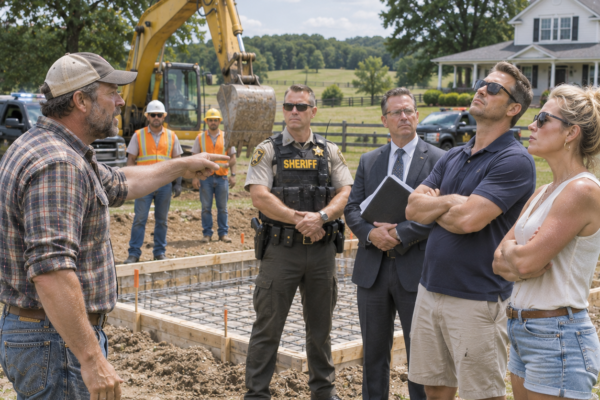
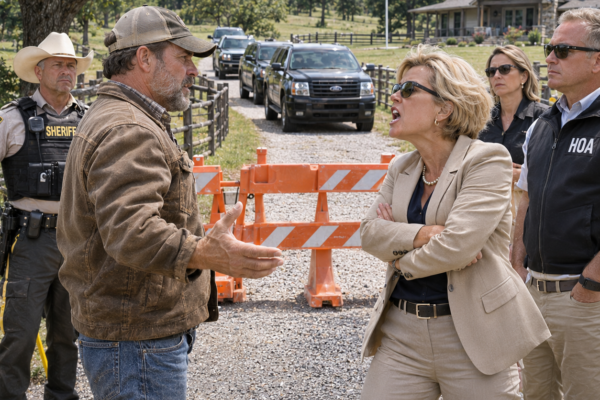
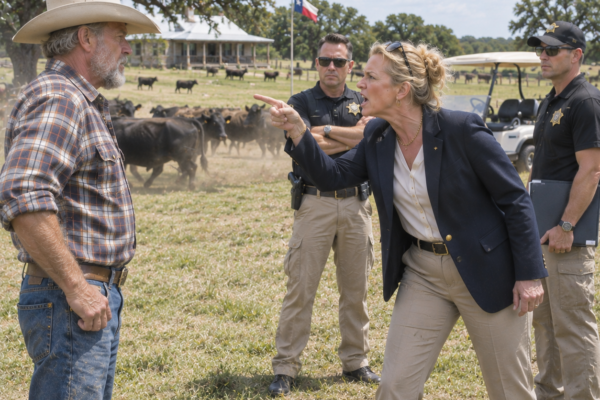
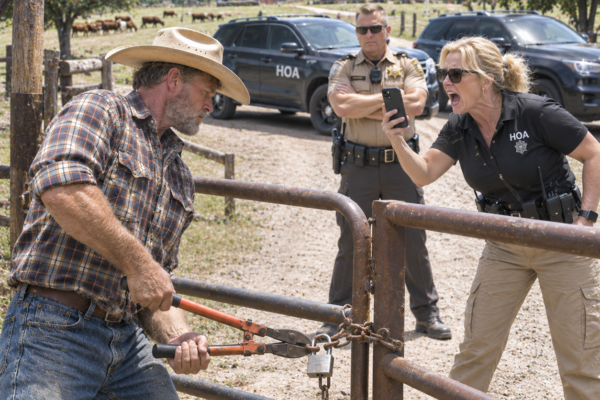
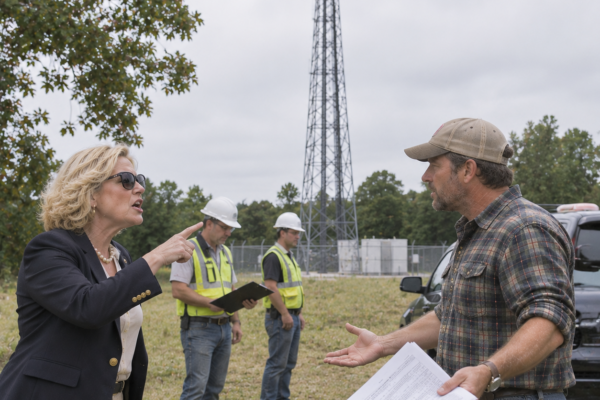
“Cut That Lock—He Has No Right to Stop Us!” the HOA President Screamed as Her Crew Broke Into My 420-Acre Family Farm at 7:12 A.M. She Waved a County “Entry Order,” Claimed a 40-Foot Emergency Road Across My Pasture, and Told the Contractor to Ignore Me. I Warned Her Twice. Then Two State Police Cruisers Rolled Through the Gate..k
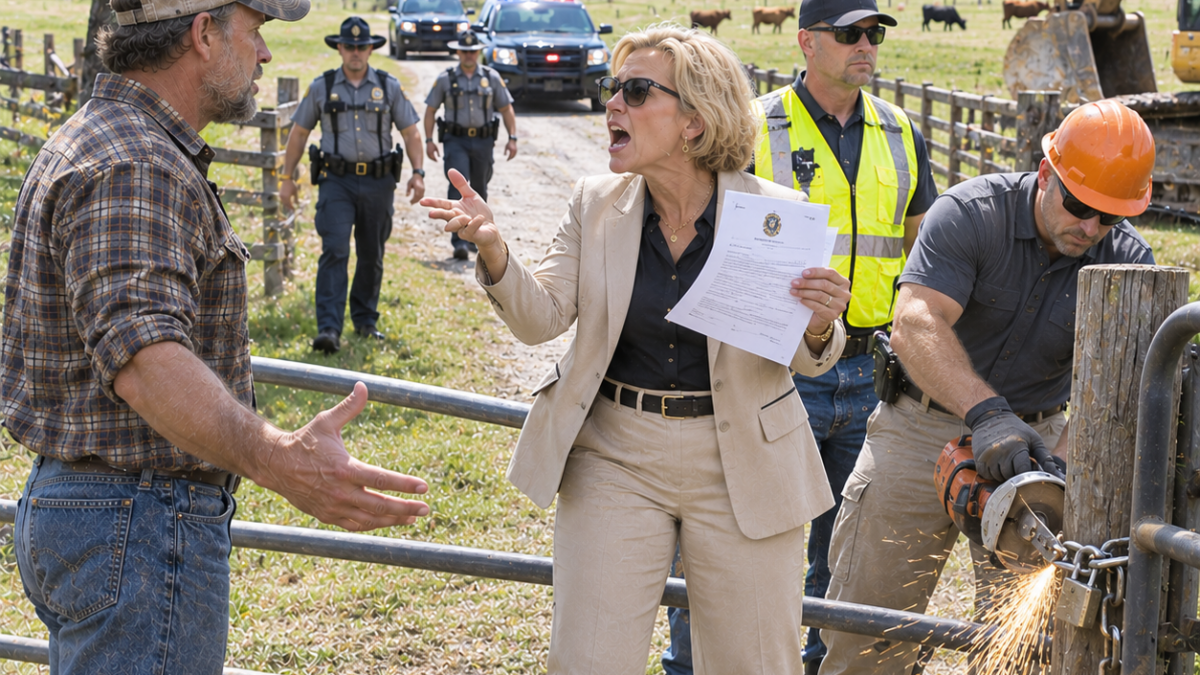
“Cut That Lock—He Has No Right to Stop Us!” the HOA President Screamed as Her Crew Broke Into My 420-Acre Family Farm at 7:12 A.M. She Waved a County “Entry Order,” Claimed a 40-Foot Emergency Road Across My Pasture, and Told the Contractor to Ignore Me. I Warned Her Twice. Then Two State Police Cruisers Rolled Through the Gate.
The sound of a metal-cutting saw carried across my pasture at 7:12 on a Monday morning.
I was halfway through checking the northern fence when I heard it.
At first, I thought a utility crew might have stopped along the county road. Then I saw sparks flying from the steel gate my father had built more than thirty years earlier.
Two men were cutting through my padlock.
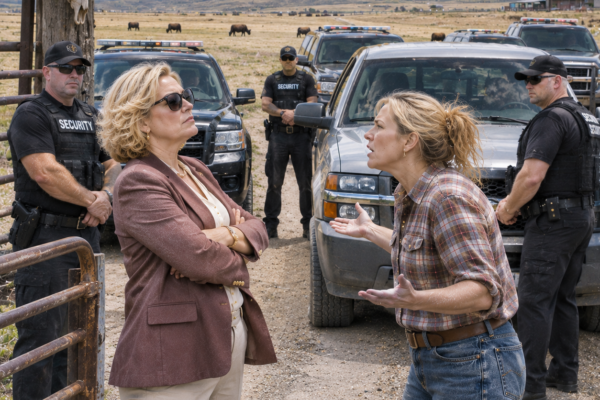
Behind them stood a small excavator, two contractor trucks, a survey vehicle, and a white SUV with a placard in the windshield.
BRIAR RIDGE HOA PRESIDENT.
I stopped my pickup twenty feet from the gate.
One of the men lifted the cutting saw away from the chain.
The second stared at me.
Before either could speak, a woman in a cream blazer stepped out of the SUV carrying a thick folder.
“Keep working, Travis,” she ordered. “We have authorization.”
I climbed out of my truck.
“Who authorized you to cut my gate?”
She barely looked at me.
“I’m Claudia Mercer, president of Briar Ridge Homeowners Association. This road is now part of our community’s emergency-access corridor.”
I stared at her.
“My family’s owned this farm since before your subdivision existed.”
She gave a short laugh.
“Well, that explains the attitude.”
My name is Grant Roark. I’m fifty-one years old, and my family owns 420 acres of farmland in southern Pennsylvania, where open pastures and wooded hills are gradually giving way to expensive subdivisions.
My grandfather bought the first part of the property more than seventy years ago.
My father expanded it, raised cattle, planted corn and hay, and built most of the fences himself.
When the farm passed to me, I promised I’d keep it intact.
I wasn’t a wealthy developer.
I wasn’t trying to prevent anyone from building homes on their own property.
I simply wanted the people next door to respect mine.
Briar Ridge had been built along our eastern boundary about twelve years earlier. Its residents had beautiful homes, landscaped streets, and a large clubhouse overlooking the valley.
Their HOA owned none of my farmland.
Not one acre.
And it certainly didn’t own the private lane running from my gate toward the equipment barn.
Yet Claudia was standing there with contractors preparing to turn it into a road.
She opened her folder and thrust a document toward me.
“Emergency Property Access Order,” she announced. “County authorization. You were notified.”
I unfolded the paper.
At the top was an official-looking seal.
Beneath it, several paragraphs claimed the county had granted Briar Ridge immediate access across a forty-foot-wide strip of my land.
But something wasn’t right.
No judge’s name.
No verifiable case number.
No clerk’s signature.
And the seal looked blurred, as though somebody had enlarged it from an online photograph.
“Which office issued this?” I asked.
“The county.”
“Which department?”
Her smile stiffened.
“You don’t need to know the internal details.”
I looked from the document to the workers.
“Nobody has permission to enter this farm. Stop cutting that gate.”
Claudia turned toward the man with the saw.
“Travis, finish the job.”
He hesitated.
“Mrs. Mercer, the owner says—”
“The owner doesn’t understand the access agreement. You’re working for me.”
A second later, the final piece of chain snapped.
The gate swung inward.
Claudia smiled as though she’d won.
Then she stepped through it.
Ten feet onto my land.
She pointed toward the barn.
“Wade, mark the corridor. Travis, get the excavator ready. I want this entrance cleared before lunch.”
The surveyor unfolded a map and studied it.
“Mrs. Mercer,” he said cautiously, “this boundary doesn’t match the county plat I reviewed.”
She snapped her head toward him.
“Use the drawing I gave you.”
I could see where the dispute was heading.
Claudia wanted me angry enough to argue with her crew, push somebody, or give her a reason to accuse me of interfering with an authorized project.
I wasn’t going to do that.
Instead, I photographed the broken chain, the trucks, and the survey stakes.
Then I called dispatch.
I gave my location, reported ongoing damage and unauthorized entry, and requested responding units.
Claudia watched with an amused expression.
“Call whoever you like,” she said. “The police aren’t going to arrest an HOA president for maintaining community infrastructure.”
I looked at her.
“This is your last opportunity to stop the work and leave.”
She folded her arms.
“Farmers don’t get to dictate county access, Mr. Roark.”
Behind her, Travis began securing the cutting saw in its case.
He apparently understood that something was wrong.
Claudia didn’t.
She ordered another man to start the excavator.
Its engine roared to life.
Then she pointed toward the open gate.
“Move it through.”
I stood beside my pickup and kept recording.
A few minutes later, sirens sounded beyond the ridge.
Two state police cruisers appeared on the county road.
Claudia straightened her blazer and smiled.
“Perfect,” she said. “Now we can finally have you removed.”
The first trooper stepped out, looked at the broken gate, and then turned toward me.
Claudia opened her mouth to explain why I was trespassing on my own farm.
But the trooper spoke before she could.
And the first two words out of his mouth made Claudia stop smiling.
Part 2:
The first piece of metal hit the gravel at 7:12 on a Monday morning.
It was the shackle from the padlock on my northern farm gate, severed by a cutting saw that had no business being anywhere near my property.
I watched it fall from behind the windshield of my pickup.
Then I looked at the men responsible.
One was holding the saw. The other had a steel chain in his hands. Behind them waited two contractor trucks, a small excavator, and a survey vehicle. A white SUV stood near the county-road shoulder with a placard identifying its driver as the president of Briar Ridge Homeowners Association.
I switched off my engine.
For a moment, I simply sat there.
That gate had been standing since my father welded it together thirty-two years earlier. I’d helped him hang it when I was nineteen. He’d made me hold the lower hinge steady while he welded the upper bracket, and I’d complained that the steel was too heavy.
He told me to quit complaining and hold it straight.
Now two strangers were cutting through his lock like it belonged to nobody.
I climbed out.
“Who told you to do that?”
The man holding the saw stopped immediately.
He was broad-shouldered, with reddish hair and a name embroidered above his shirt pocket.
TRAVIS BELLAMY.
He glanced toward the white SUV.
“Sir, we’re working under an access authorization.”
“From whom?”
Before he answered, the driver’s door opened.
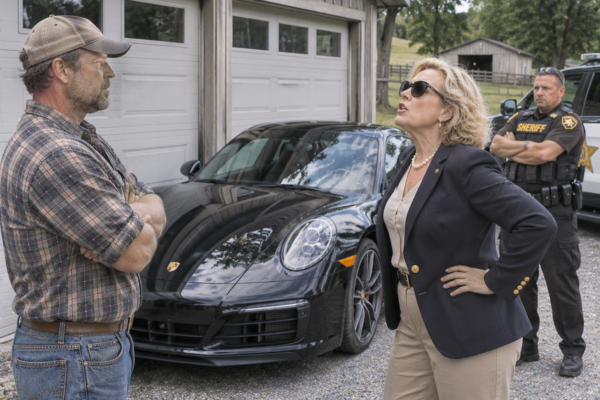
A woman in a cream blazer stepped out holding a leather folder. She had dark sunglasses, carefully styled blonde hair, and the impatient stride of someone who expected everyone to clear a path.
“I’m Claudia Mercer,” she announced. “President of Briar Ridge Homeowners Association.”
I looked at her.
“I’m Grant Roark. This is my farm.”
She gave me a small smile.
“Yes, Mr. Roark. And this entrance now falls inside our designated community access corridor.”
“No, it doesn’t.”
Her smile tightened.
“You’ve received several notices.”
“I haven’t received anything.”
“Then perhaps you should check your mail more carefully.”
I looked toward the gate.
“That doesn’t answer why your people are cutting my lock.”
Claudia opened her folder.
“Because the association has obtained an emergency property access order. We have work to complete, and your refusal to cooperate won’t delay us any longer.”
She handed me a single sheet of paper.
I examined it.
At the top was a faded reproduction of what purported to be a county seal. Underneath were several paragraphs describing an emergency access corridor across my northern pasture.
The document contained no court case number I could verify, no issuing judge, and no clerk’s certification.
Something about the signature block looked particularly wrong.
I’d seen plenty of official documents during my career.
This wasn’t one I recognized.
“Which agency issued this?” I asked.
“The county.”
“Which county office?”
“Mr. Roark, I don’t intend to explain administrative procedures to a farmer.”
I looked directly at her.
“Then you can explain them to the authorities.”
She laughed.
“Call whoever you want.”
My name is Grant Roark. I was fifty-one years old that morning, and the 420 acres behind my gate had belonged to my family for generations.
Our farm lay in southern Pennsylvania, where the fields rolled into wooded hills and older agricultural properties were increasingly surrounded by housing developments.
My grandfather bought the first parcel in the 1950s.
Dad expanded the farm when neighboring acreage became available, raised cattle, planted hay and corn, and maintained the roads and fencing himself.
When he died, the property passed to me.
I kept the herd smaller than he had, leased some of the hayfields to a local farmer, and hired a neighbor to help with the cattle whenever my work kept me away.
But I never stopped thinking of the place as home.
I knew its boundaries.
I’d walked them with Dad.
I’d paid for a modern survey after inheriting the land.
And I’d reviewed the recorded deed and title history closely before making improvements to the barn.
Briar Ridge didn’t exist when Dad built that gate.
The subdivision had been developed along our eastern property line about twelve years earlier. Its residents had attractive houses, landscaped streets, and a clubhouse on a hillside overlooking the valley.
I didn’t object to any of that.
People were entitled to enjoy the land they owned.
The problem was that Claudia Mercer apparently believed their entitlement extended onto mine.
“Travis,” she said, turning toward the contractor, “finish opening the entrance.”
He looked at me.
“Mr. Roark, do you dispute the access order?”
“Yes. And I’m informing you that nobody has permission to damage this gate or enter my property.”
Travis lowered the saw slightly.
Claudia’s voice sharpened.
“You’re working for the association, not for him.”
A second worker pulled at the chain.
The severed lock fell.
The gate swung inward.
I felt anger rise, but I kept my hands away from the men and their equipment.
“Stop the work.”
Claudia walked through the opening.
She was nearly ten yards inside my boundary before she turned back.
“Your permission isn’t required.”
She pointed toward the lane.
“Wade, establish the corridor markers. Travis, bring the excavator through.”
A surveyor in a yellow safety vest stepped away from his vehicle. He carried a rolled drawing and a field tablet.
He introduced himself as Wade Prescott.
“Mr. Roark, can I confirm where you believe your property line runs?”
I pointed toward the old stone wall on the far slope.
“The entire lane is inside my parcel. The eastern boundary follows the recorded monuments. Your client’s subdivision stops on the other side.”
Wade studied his map.
Then frowned.
“That’s not what this drawing shows.”
“Let me see.”
He hesitated, then held it where I could examine the details.
A thick shaded corridor ran nearly forty feet wide across the northern portion of my farm.
It was labeled:
BRIAR RIDGE SECONDARY EMERGENCY ACCESS EASEMENT.
I looked at Wade.
“Where did you get that?”
“Mrs. Mercer supplied it.”
“Did you verify the easement against the recorded instrument?”
“I downloaded the base plat, but this revision was provided as an approved access overlay.”
I looked at the parcel numbers.
The underlying geometry resembled the real county map.
But the added corridor didn’t.
“No such easement exists,” I said.
Claudia stepped between us.
“The association’s counsel has reviewed everything.”
“Then you’ll have no trouble producing the recorded document.”
She ignored that.
“The easement predates your purchase.”
I stared at her.
“I never purchased this farm.”
She looked confused.
“I inherited it. My family owned this land before Briar Ridge was built.”
For the first time, Wade looked genuinely concerned.
He stepped aside and began comparing the supplied drawing with the county file on his tablet.
Claudia didn’t wait.
She ordered another worker toward the excavator.
I stepped back from the machinery and took out my phone.
I photographed the cut lock, the open gate, and the trucks. Cameras mounted on the gatepost and barn were also recording the approach.
Then I called dispatch and reported damage and unauthorized entry in progress.
Claudia heard me.
“Good,” she said. “Maybe the police can explain why county access takes priority over your personal preferences.”
I didn’t answer.
I knew there was no advantage in arguing with somebody who wouldn’t even acknowledge a recorded property line.
The excavator started.
Its engine echoed along the lane.
Travis stood beside it, looking increasingly uncomfortable.
“Mrs. Mercer, I’d rather wait until this gets cleared up.”
She rounded on him.
“The association is paying you eighteen thousand dollars for this work. Do your job.”
“With respect, ma’am, the owner has disputed the authority.”
“I have an order.”
She waved the document.
Then she pointed toward me.
“He’s just a farmer trying to bully everyone.”
I looked at Travis.
“You’ve been told this is private property. Don’t bring that equipment across the gate.”
He switched off the excavator.
Claudia’s face reddened.
“Fine. I’ll find somebody with the courage to work.”
She looked toward the second truck.
“Get that machine moving.”
I checked my watch.
7:26.
Two responding patrol units were several minutes away.
Claudia saw me looking at the time and laughed.
“Counting down to something, Mr. Roark?”
“Waiting for someone who can verify your order.”
“Then you’re wasting your morning.”
She turned to Wade.
“Plant the stakes.”
Wade didn’t move.
He was still examining the map.
“Mrs. Mercer, the county plat on my tablet doesn’t show this corridor.”
Claudia snapped her folder shut.
“Use the approved drawing I gave you.”
“I need to establish the source of the revision.”
“You were hired to stake the road, not question the board.”
I looked toward the county road.
The sound of sirens was growing louder.
Two Pennsylvania State Police cruisers appeared beyond the tree line, their emergency lights flashing through the morning haze.
Claudia straightened her blazer.
“Finally.”
She walked toward the open gate, holding her printed order like a royal proclamation.
The first cruiser stopped.
Sergeant Paige Whitlock stepped out.
She looked at the severed chain.
Then the excavator.
Then the woman marching toward her.
Finally, she saw me standing beside my pickup.
“Morning, Captain,” she said.
Claudia stopped walking.
Her head turned sharply toward me.
“Captain of what?”
I reached inside my jacket and took out my credentials.
“Pennsylvania State Police.”
For several seconds, Claudia didn’t speak.
Then she looked at Paige.
Then back at me.
And the woman who’d spent the entire morning explaining why farmers had no authority on their own land suddenly seemed very interested in discussing the law.
Claudia recovered quickly.
“Well, that explains it,” she said. “You’re using your position to intimidate a homeowners association.”
I put my credentials away.
“I’m standing on my own land. I asked you to stop cutting my gate before you knew what I did for a living.”
Sergeant Whitlock looked toward the damaged lock.
“Mrs. Mercer, let’s start with that. Who authorized the work?”
Claudia held out her paper.
“The county. This is an emergency property access order.”
Paige took it and read the first page.
Her expression remained neutral.
“Which office issued it?”
Claudia gave the same answer she’d given me.
“The county.”
“Can you identify the official who signed it?”
“It’s all there.”
Paige turned the page.
“There isn’t a named issuing judge or a clerk’s certification.”
“The association’s attorneys handled the process.”
“Then I need the filing information.”
Claudia folded her arms.
“Sergeant, you’re letting a state police captain interfere with a civil property dispute.”
Paige nodded toward the gate.
“The ownership issue may require a civil determination. But the broken lock and the conduct occurring here are separate questions.”
She asked Travis to step away from his equipment.
Then she directed the other workers to remain at their vehicles while officers established what had happened.
I provided the recorded property survey and explained what I’d witnessed.
Paige checked the dispatch information she’d received about the call. Then she requested verification of the purported county order.
Claudia stood beside the SUV, watching the process with growing impatience.
At one point, she looked toward me.
“Your badge doesn’t give you special rights.”
“Agreed,” I said.
That answer seemed to surprise her.
I continued.
“It also doesn’t take away my rights as a property owner.”
She looked away.
A few minutes later, dispatch confirmed that no matching county order had been issued or recorded.
The reference number didn’t correspond to an identified court or county authorization.
Paige looked down at the paper.
Then at Claudia.
“Mrs. Mercer, we’re unable to verify this order.”
“That’s impossible.”
“Do you have the original or a contact at the issuing office?”
“My attorney will provide whatever you need.”
“Fine. For now, you need to stop the work and leave Mr. Roark’s property.”
Claudia stared.
“You’re ordering the president of Briar Ridge to leave a community access corridor?”
“I’m directing you to stop entering land you have no demonstrated right to occupy while we investigate the reported damage.”
Claudia stepped forward.
“This is outrageous.”
“Ma’am, please stay where you are.”
She reached for the document in Paige’s hand.
“I’ll take that back.”
Paige moved it out of reach.
“We’re preserving it in connection with the report.”
Claudia tried to grab it a second time.
Paige stepped back and gave a firmer instruction.
“Mrs. Mercer, stop.”
Claudia’s face went scarlet.
“You have no authority to treat me this way!”
Paige looked toward the cut chain, the equipment, and the open gate.
Then she asked Travis whether he’d actually cut the lock.
“Yes, ma’am,” he answered. “Mrs. Mercer told me the county had approved the work.”
“Did the landowner tell you to stop?”
“Yes. I stopped as soon as I understood there was a dispute.”
I watched Claudia turn toward him.
“Travis, you’ve been paid to finish this job.”
He looked miserable.
“Ma’am, I wasn’t hired to break into a farm.”
That was the first time someone she’d brought with her openly refused to follow her directions.
Paige separated the witnesses for statements.
The responding troopers documented the cut lock, the equipment, the entry onto the lane, and the repeated warnings.
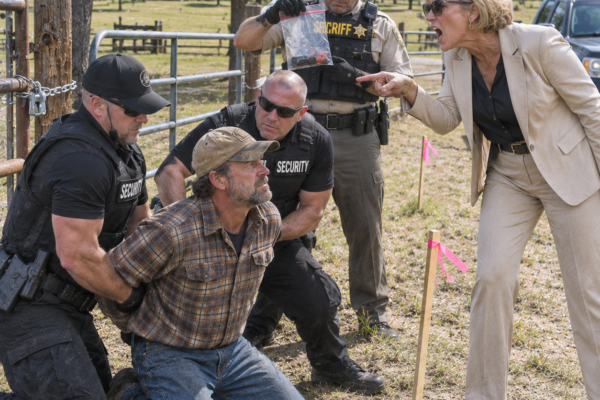
With the property records available at the scene and no verified authority for the forced entry, Paige placed Claudia under arrest on the offenses supported by the observations and evidence developed there.
Claudia began shouting before the trooper finished explaining.
“You can’t arrest me! This is private association business!”
I stood beside my pickup.
Nobody asked me to make the decision.
I didn’t place handcuffs on her or supervise the arrest.
She would later accuse me of doing both.
But the cameras recorded the sequence.
By the time Claudia was escorted to a cruiser, I’d already requested that a supervisor independent of my immediate assignment take responsibility for the investigation involving my property.
Lieutenant Owen Callahan arrived shortly afterward.
He was tall, deliberate, and not particularly interested in anyone’s opinion of his rank.
He shook my hand briefly.
“Grant. You all right?”
“Yes.”
“Then give me your account, your records, and your footage. After that, you’re a complainant and witness. My team handles the investigation.”
“That’s what I want.”
He nodded.
Then he turned to Paige.
“Start from the beginning.”
While they worked, Wade Prescott approached with two printed maps.
“Lieutenant, I think there’s a problem with the survey Mrs. Mercer gave me.”
He spread the documents across the hood of a cruiser.
The first was the genuine county parcel map.
It showed Briar Ridge’s property ending at the eastern boundary of my farm.
The second was the version Claudia had supplied.
It showed an added forty-foot-wide corridor extending across the pasture toward the barn road.
Both carried the name of the surveyor who’d prepared the underlying plat.
But Wade pointed to the new markings.
“That corridor wasn’t on the original. Someone altered this drawing after it was produced.”
Owen examined it.
“Can you identify the recorded easement that supposedly created the corridor?”
Wade shook his head.
“The reference on this version appears to point to an old utility agreement. It doesn’t identify a roadway easement.”
I knew the agreement.
Years earlier, a utility had maintained lines along part of the farm boundary.
Its limited access arrangement had ended when the lines were relocated.
It had never given Briar Ridge permission to construct a road.
Owen made a note.
Then he asked Travis for the work contract.
Travis retrieved a copy from his truck.
The price was $18,400.
The scope included removing the gate, establishing a forty-foot corridor, clearing vegetation, grading more than a mile of road, and preparing an approach suitable for heavy construction vehicles.
Owen looked at the description.
“Why would an emergency access route need provisions for repeated heavy construction traffic?”
Travis shook his head.
“I didn’t draw the plans. I was told they had county approval.”
He showed Owen an email from Claudia instructing the crew to have the entrance established before a Thursday inspection.
“What’s happening Thursday?” Owen asked.
“I don’t know. She said missing the deadline would cost the association a fortune.”
That sentence stayed with me.
Claudia had arrived before sunrise with a forged-looking order, heavy equipment, and a contractor under strict instructions to open a road immediately.
Whatever the Thursday inspection involved, she considered it important enough to risk trespass and property damage.
When Owen asked her about it, Claudia requested an attorney.
The interview ended.
I respected that.
But I couldn’t stop thinking about her urgency.
Then I remembered a letter sitting in Dad’s old file cabinet.
It was dated two months earlier.
Briar Ridge had offered to purchase a road easement across the exact strip Claudia now claimed to control.
I’d refused.
And the offer bore Claudia Mercer’s signature.
I brought the original letter to Owen.
He read it slowly.
“So two months ago, she offered to buy access.”
“Correct.”
“And this morning, she claimed the association already possessed it.”
“Correct.”
Owen looked toward the cruiser where Claudia sat.
“That’s an important difference.”
I nodded.
Because nobody offers to buy something they genuinely believe they already own without a reason.
And Claudia had just handed the investigators evidence that she knew the difference long before she cut my gate.
By lunchtime, the gate was closed again.
The excavator remained parked on the county-road shoulder until its removal could be coordinated. Investigators had photographed the equipment and documented the work site, while Travis agreed to preserve his messages, contract, and job records.
One of my farmhands came over with a replacement chain.
I told him to leave the damaged lock where it was until the scene documentation was complete.
Then I walked the lane alone.
The excavator hadn’t reached the pasture.
No trees had been removed.
But someone had already marked a route with orange paint and survey stakes, running through ground where my cattle grazed in spring.
Farther uphill, the proposed corridor crossed a stand of mature oaks.
I remembered planting clover beneath those trees with Dad.
He was seventy-one then and already had trouble with his knees, but he refused to let me finish alone.
He said a man ought to keep caring for land even when he knew he wouldn’t live to see every season that followed.
I stood looking at the orange markings.
Claudia had viewed the same field and seen a road.
She hadn’t seen the family history.
She hadn’t even bothered asking about it.
That afternoon, my phone rang.
The caller identified herself as Marla Hensley, the treasurer of Briar Ridge.
Her voice was tight.
“Captain Roark, is it true Claudia was arrested at your farm?”
“She was taken into custody after an incident at my gate. The investigation’s being handled independently.”
Marla was quiet.
Then she said, “I think I know why she wanted your road.”
I considered the question.
“Marla, I appreciate the call. But you need to speak directly with Lieutenant Callahan. I’m not investigating this.”
“Are you telling me not to tell you?”
“I’m telling you the evidence needs to go through the proper process.”
She hesitated.
Then agreed.
An hour later, she arrived at the state police post carrying a thick binder of association records.
I learned what she disclosed during a subsequent case update.
Briar Ridge was renovating and expanding its clubhouse.
The total project budget was approximately $2.4 million.
The work included a new swimming pool, an outdoor pavilion, expanded parking, retaining walls, and major drainage improvements.
Most of the ordinary construction could be completed using the subdivision’s existing access roads.
The problem involved several oversized deliveries.
Large concrete sections.
Steel members.
Heavy equipment and loads requiring specialized hauling arrangements.
The southern route was available, but it was longer and required more complicated scheduling.
The general contractor had warned the board that using it would increase transportation costs significantly.
Claudia had proposed a cheaper alternative.
A new route across my farm.
It would shorten the distance and allow trucks to approach the clubhouse construction site from the west.
There was one obvious problem.
I wouldn’t sell an easement.
Two months earlier, she’d sent the purchase proposal.
I replied in writing that the road corridor was not for sale.
That should have ended the matter.
Instead, according to Marla, Claudia became furious.
During a closed board discussion, she reportedly said I would change my mind once the road was already in place.
I sat silently when Owen relayed that statement.
“She meant to build first and argue later.”
“That’s one possibility supported by the records we’re reviewing,” he said.
He slid the contractor’s scope across the table.
The proposed work wasn’t a simple emergency turnout.
It called for widening and grading a road capable of carrying construction traffic.
The specifications matched the clubhouse project’s logistical needs.
Then Owen showed me the financial records Marla had provided.
A withdrawal of $24,700 from the association’s reserve account.
The entry was labeled:
EMERGENCY INFRASTRUCTURE PRESERVATION.
Part had funded Travis’s contract.
Other expenses appeared connected to mapping and preparatory work.
A portion couldn’t immediately be reconciled with the available invoices.
The board hadn’t approved an emergency declaration authorizing the withdrawal.
And Claudia’s signature appeared on payment instructions exceeding the ordinary limits of her office.
The Thursday inspection finally made sense.
A lender financing the clubhouse expansion was scheduled to review construction progress and logistics.
If Briar Ridge couldn’t demonstrate a workable route for the remaining heavy deliveries, the next funding release could be delayed.
Claudia had been under pressure to show a solution.
She’d chosen mine.
My gate.
My lane.
My pasture.
And when I refused to sell, she’d apparently decided the county could be made to look as though it had ordered me to cooperate.
Marla’s records explained the financial motive.
The digital evidence began explaining how Claudia had tried to conceal it.
Investigators obtained the underlying files associated with the purported county order.
The seal hadn’t been created by an issuing office.
It had been copied from a publicly available county document and enlarged.
The signature beneath it had been lifted from an unrelated permit.
The file history led investigators to an association office laptop and a user account assigned to Claudia.
The altered survey told a similar story.
Wade Prescott confirmed that he’d never prepared the forty-foot access corridor shown on the version supplied to Travis.
In fact, Claudia had approached him before the incident and asked whether he could draw a community road easement onto the existing parcel map.
He refused.
He told her a surveyor could show an easement only if it was supported by the proper legal instrument.
Days later, the altered map appeared anyway.
It still carried the original surveyor’s identifying information, even though that person had never approved the added corridor.
The pattern grew clearer with every document.
Claudia had tried to buy an easement.
I’d said no.
She’d asked a surveyor to show the easement anyway.
He’d said no.
Then she used an altered map and fabricated entry order to hire a contractor and cut through my gate.
The county hadn’t given her authority.
The HOA board hadn’t authorized her spending.
And the emergency she cited wasn’t an actual emergency.
It was a financing deadline.
On Friday, Audrey arrived at the farm.
Not to investigate Claudia personally, but to speak with me about the internal review that had begun concerning my conduct.
It was a necessary step.
I was a state police captain who’d called dispatch about an incident on my own property. The responding officers were from the same agency where I served.
Defense counsel was already suggesting that my rank had influenced Claudia’s arrest.
Audrey was direct.
“Grant, you’ll need to provide your communications, available footage, and a complete statement. You won’t review the decision-making of the officers who responded.”
“I understand.”
“Did you identify yourself as a captain before the troopers arrived?”
“No. I wanted the crew to leave. I wasn’t trying to conduct a police operation.”
“Did you give Claudia an opportunity to stop?”
“More than once.”
“Did you order Sergeant Whitlock to arrest her?”
“No. I requested that an independent supervisor take over.”
She nodded.
“That’s what the recordings appear to show. But the review needs to examine the entire sequence.”
I gave her everything requested.
The gate camera.
The barn camera.
My phone recording.
The dispatch chronology.
The deed and survey.
I also wrote a full statement describing my actions, including the moment I’d stepped toward the lane to warn the operator not to bring the excavator through the gate.
I didn’t omit that because I thought it might sound confrontational.
The truth included it.
If I wanted a fair review, I had to let it examine what I did, not just what Claudia did.
Within weeks, the review concluded that I’d acted consistently with my obligations during the incident and had appropriately transferred the criminal investigation to another officer.
Claudia had treated the existence of the review as proof I was in trouble.
She’d told residents the state police were investigating their own captain for misconduct.
They had reviewed my conduct.
That much was true.
The conclusion was not what she’d implied.
By then, however, Briar Ridge’s board had a much more immediate problem.
Its clubhouse project was in jeopardy.
The lender had paused the next funding release pending a credible logistics plan.
The unauthorized access work couldn’t continue.
The purported emergency easement wasn’t supported by the recorded land records.
And the association had spent reserve money on a project its president had no authority to order.
The residents were beginning to demand answers.
Marla called an emergency association meeting.
Claudia insisted on attending as president.
She arrived with her attorney and prepared to tell everyone how I’d abused my police authority.
But when Marla opened the financial binder, the conversation went in a direction Claudia hadn’t expected.
The Briar Ridge clubhouse was packed when the emergency meeting began.
Homeowners stood along the walls because every chair was taken. A few people had brought folders containing assessment statements and construction notices.
The clubhouse expansion had been advertised as an improvement that would benefit the entire neighborhood. Residents had voted on financing it, paid special assessments, and endured months of construction noise.
Now they were being told the next funding release had been suspended because the association couldn’t demonstrate how large trucks would reach the site.
They wanted to know why.
Claudia sat at the head of the table wearing a charcoal blazer.
Her attorney occupied the seat beside her.
Marla Hensley opened the meeting by reading the applicable financial procedures.
Then she presented the $24,700 reserve withdrawal.
“Was this expenditure approved by the board?” she asked.
Claudia leaned toward her microphone.
“It was an emergency infrastructure expense necessary to protect the clubhouse project.”
“Where is the emergency declaration?”
Claudia shifted.
“The president has discretion in urgent circumstances.”
“Not to spend this amount without the required authorization.”
A man near the front raised his hand.
“Did we pay somebody to break into a farmer’s property?”
Claudia’s jaw tightened.
“We paid a licensed contractor to establish an access route.”
“Did we own that route?”
She glanced toward her attorney.
He said quietly, “The association’s claimed access rights remain disputed.”
Marla lifted another document.
“This is the written easement offer Claudia sent to Captain Roark two months ago.”
She read the relevant paragraph.
The association had offered money in exchange for a permanent road easement.
Grant Roark had refused.
Then Marla looked at the board.
“If we already possessed access rights, why did we need to buy them?”
Claudia responded with a long explanation about anticipated future arrangements.
Nobody seemed satisfied.
Marla continued.
“The association has no recorded easement across Roark Farm. Our title review confirms that. And the county has verified that it issued no emergency property access order.”
A woman stood near the back.
“Then where did that order come from?”
Claudia’s attorney interrupted.
“Given the pending criminal matter, my client won’t address the preparation of the document.”
That answer produced a low murmur across the room.
Marla turned to the contractor’s agreement.
“Eighteen thousand four hundred dollars for the initial clearing and access work. Claudia signed it without the board’s authorization.”
She displayed the stated scope.
Removing the gate.
Clearing trees.
Widening the lane.
Preparing it for heavy construction traffic.
Then she showed the treasurer’s account of the remaining reserve withdrawal.
Several thousand dollars lacked satisfactory supporting records.
More documentation was needed before the board could determine where every dollar had gone.
Claudia’s expression hardened.
“This community elected me to make decisions.”
A homeowner answered from the back.
“We elected you to follow the rules.”
Several people applauded.
Claudia turned toward the voice.
“You have no idea what it takes to manage a project this large.”
Marla leaned forward.
“Then explain why you assured the lender that a route through Roark Farm would be available when he’d already refused to sell an easement.”
For several seconds, Claudia said nothing.
Then she pointed toward me, though I wasn’t in the room.
“That man is deliberately trying to destroy this project.”
Marla shook her head.
“He’s a neighboring landowner who said no. We don’t get to cut through his gate because the answer inconveniences us.”
The room fell quiet.
Then a resident asked whether the association could simply use the southern road the general contractor had identified.
Marla nodded.
“Yes. It will cost more and require schedule changes. But it’s available.”
“So this entire situation was about saving money?”
“That appears to have been a major motivation.”
Claudia raised her voice.
“You don’t understand the financial pressure I was under!”
Marla looked directly at her.
“Then you should have brought the problem to the board. You should not have forged your way across someone else’s farm.”
Claudia’s attorney put a hand on her arm before she could answer.
A motion was made to remove her from the presidency under the association’s bylaws.
The directors voted overwhelmingly in favor.
Claudia challenged the procedure.
The board’s attorney confirmed that the required notice, voting rules, and removal provisions had been followed.
She was no longer president.
Her authority to sign association contracts ended with the vote.
I heard about the result later that evening.
I wasn’t at the clubhouse.
I’d spent the afternoon replacing temporary gate hardware and repairing a section of fence damaged during the attempted entry.
Marla called while I was putting away my tools.
“Grant, the board removed Claudia.”
I looked toward the new chain.
“Good.”
“We’ve also stopped all work connected to the proposed corridor.”
“That’s necessary.”
“And we’re reviewing every payment she approved.”
I nodded.
Then I said, “Marla, your residents shouldn’t have to pay for somebody’s decision to ignore a property line.”
She sighed.
“I know.”
I looked toward the farmhouse.
“Then help them fix their own house. I’ll take care of mine.”
That should have ended the dispute between Briar Ridge and my farm.
But the criminal case was moving forward.
And Claudia still had one argument she hoped would save her.
Through her attorney, she claimed an old utility access agreement created a reasonable basis for believing the association could use the road.
The theory was weak, but the defense was entitled to raise it.
A title attorney located the original agreement.
It permitted a local power company to enter a narrow portion of the property for maintenance of specified electrical equipment.
It granted no rights to Briar Ridge.
No access for construction trucks.
No authority to widen a lane.
And no permission to cut a gate.
The agreement had also terminated under its own terms after the equipment was relocated years earlier.
Then investigators found an earlier board discussion.
Three months before the gate incident, Claudia had told another director that the utility agreement wouldn’t help the association obtain a roadway.
The remark was documented in meeting notes and confirmed by a witness.
That made it considerably harder to argue she’d genuinely believed the agreement gave her access.
Meanwhile, the digital examination of the fabricated order had been completed.
The supposed county seal was copied from an unrelated document.
The official’s signature had been inserted from another permit.
And file records connected the final editing to the HOA office computer under Claudia’s user account.
Wade’s statement showed she’d first tried to persuade an actual surveyor to draw a corridor unsupported by a recorded easement.
Travis’s messages showed she’d then hired a contractor and assured him the county had approved the project.
The original offer letter showed she knew she needed my consent.
The gate footage showed her proceeding without it.
And the body-camera recordings showed her refusing repeated opportunities to stop.
When the prosecutor reviewed the sequence, there was no single dramatic clue on which everything depended.
There was a chain of documents and actions.
Each supported by another.
Each narrowing the explanations available to Claudia.
I gave my testimony when requested.
I explained what I’d seen and heard that morning.
The cutting saw.
The chain falling.
Claudia handing me the purported order.
Her claim that the easement predated my purchase.
Her refusal to stop the workers.
The surveyor’s concerns.
The call to dispatch.
And the arrival of Sergeant Whitlock.
Claudia’s attorney asked whether I’d identified myself as a police captain before the troopers arrived.
“No.”
“Why not?”
“Because I was speaking to people trespassing on my property. I wanted them to stop and leave. My rank wasn’t necessary to explain that.”
“Wouldn’t revealing your position immediately have prevented the confrontation?”
“I don’t know. I gave them several opportunities to stop before they knew what I did.”
He studied me.
“Could you have allowed Mrs. Mercer to walk away without consequences?”
“I tried to get her to walk away before the damage escalated.”
“When?”
I looked toward Claudia.
“Before she knew I was a captain.”
The courtroom was quiet.
That was the heart of it.
She’d believed I was an ordinary farmer who wouldn’t understand her paperwork.
A man she could intimidate with an official-looking seal.
Someone whose property rights mattered less than her construction deadline.
Only when the troopers arrived did she suddenly care about procedural fairness.
But procedural fairness had been available to her from the beginning.
She could have negotiated.
Used the southern road.
Asked the board for additional funding.
Or accepted that I didn’t want a forty-foot corridor cut across my pasture.
Instead, she chose a forged order and a cutting saw.
The criminal proceedings ultimately resulted in findings and guilty pleas involving the fabricated government document, unlawful entry, and property damage.
Claudia received a custodial sentence followed by supervision, along with restitution and conditions preventing further contact or interference with my property.
The unauthorized association expenditures were addressed through a separate financial review and recovery process.
Her former position didn’t protect her from responsibility.
And my badge didn’t entitle me to determine her punishment.
That was for the court.
The association resolved my property-damage claims separately.
Its new leadership acknowledged in writing that Briar Ridge possessed no road easement across Roark Farm.
The board agreed to pay the documented cost of repairing the gate, fence, and disturbed ground, along with appropriate survey expenses.
I accepted a settlement focused on actual losses rather than trying to extract money from homeowners who’d never approved Claudia’s conduct.
Travis returned to install the replacement gate under a properly authorized contract.
I was standing beside the barn when his truck arrived.
He approached without his cutting saw.
“Captain Roark,” he said, “I owe you an apology.”
I looked at him.
“For what?”
“For believing that paper without checking it. I should’ve verified the authority before touching your lock.”
I nodded.
“You should have.”
He looked toward the northern pasture.
“When you told me to stop, I knew something was wrong.”
“You did stop.”
“Not soon enough.”
I thought about the morning he’d lowered his saw while Claudia shouted at him to keep working.
He’d made a mistake.
But he’d also listened when confronted with contrary evidence.
There was a difference between that and deliberately manufacturing authority.
“Get the gate hung properly,” I told him. “Then we’ll call it settled between us.”
He smiled faintly.
“Yes, sir.”
The new gate was stronger than the old one.
Travis used heavier hinges and properly sized posts. He checked the alignment twice before tightening the final hardware.
When the work was finished, it swung smoothly and closed with a satisfying metallic click.
I inspected it.
Then I signed the completion acknowledgment.
Travis offered his hand.
I shook it.
He drove away.
That afternoon, Marla arrived with the association’s signed acknowledgment of my property boundary.
She also brought a personal letter from the new board.
It apologized for Claudia’s unauthorized activities and confirmed that Briar Ridge would not use my road without a lawful agreement.
I read it on the porch.
Then I looked at her.
“Thank you.”
She nodded.
“We’ve changed our approval procedures. No president can sign property-access contracts or authorize large emergency expenditures without the required votes and legal review.”
“That should help.”
“We hope so.”
She looked toward the rebuilt gate.
“Claudia thought being president meant she could make the rules herself.”
I folded the letter.
“Then I hope the board remembers what happened when she tried.”
Marla smiled sadly.
“Trust me. Nobody’s going to forget.”
The clubhouse expansion continued.
The project was delayed, and the contractor had to revise delivery schedules and pricing.
The lender required a realistic logistics plan before releasing the next funds.
But eventually, construction resumed.
Material trucks used the longer southern route.
They crossed bridges and roads intended to carry commercial traffic.
They entered Briar Ridge through access points the association actually had authority to use.
I watched one of the convoys from the upper pasture.
A line of trucks moved along the distant county road, turned south, and disappeared behind the hills.
Not one approached my gate.
For several minutes, I stood listening as the sound faded.
The road through my farm was no longer part of anyone else’s construction plan.
That should have felt ordinary.
Instead, after everything that had happened, it felt like a victory.
A month later, I found myself working in the barn where Dad had kept his tools.
The old wooden workbench was still there.
So was the dent in its metal edge where he’d once dropped a tractor part while teaching me how to rebuild an engine.
I opened the drawer beneath it and found a photograph taken the summer we hung the original gate.
Dad stood on one side.
I stood on the other.
We were both covered in dust, smiling like we’d just completed something much more impressive than an ordinary farm entrance.
I held the picture for a long time.
Dad had taught me plenty about hard work.
He’d also taught me that a man’s property wasn’t more important than other people’s safety, but that being a good neighbor didn’t require surrendering land whenever someone asked.
I thought about Claudia arriving with contractors and a fake order.
She’d assumed my work boots told her everything she needed to know.
She’d looked at a farmer and seen somebody who wouldn’t challenge her.
The irony was that my profession hadn’t changed what the deed said.
If I’d been a carpenter, a schoolteacher, or a retired mechanic, she would have been just as wrong to cut my gate.
The badge hadn’t created my rights.
It had only forced Claudia to recognize that someone intended to enforce them.
I placed the photograph back in the drawer and walked outside.
The afternoon sun was lowering over the pasture.
Beyond the eastern fence, Briar Ridge’s access road followed the same boundary it always had.
A few rooftops showed through the trees.
Farther away, I could hear machinery working at the clubhouse construction site.
But the entrance to my farm was quiet.
No survey crew.
No excavator.
No white SUV with an HOA placard.
No forged county document.
Only the repaired fence and the new gate, hanging exactly where Dad had put the first one.
I drove my pickup down the lane, stepped out, and opened it.
The hinges moved smoothly.
I pulled through, climbed down, and closed it behind me.
The chain settled into place.
I turned the key.
For a moment, I stood beside the gate looking across the fields.
Four hundred twenty acres.
A farmhouse that needed painting.
A barn full of tools.
Pastures that demanded constant work.
Not much of it would ever impress a luxury developer.
But it was the place my family had spent generations caring for.
And it was still ours.
Claudia Mercer had believed cutting a single chain would give her control over the road.
Instead, it exposed the false papers, unauthorized spending, and abuse of authority she’d hidden behind her presidency.
She’d had every opportunity to walk away when I first asked her.
Back when she thought I was only a stubborn farmer.
She chose not to.
I put the key in my pocket and headed toward the house.
The cattle were moving toward the lower pasture.
A cool breeze crossed the fields.
And for the first time since that Monday morning, the loudest sound on the farm was the wind moving through the trees.
I didn’t need to be Captain Roark for any of it.
I was Grant.
I was home.
And nobody was coming through that gate without my permission.