“Your Tomato Garden Is an HOA Violation!” Our Self-Appointed Patrolman Shouted After Climbing My 75-Year-Old Grandpa’s Fence to Photograph His Plants. The HOA President Called Him “Enthusiastic” and Refused to Stop Him. Three Nights Later, He Returned at Midnight With Bolt Cutters, Certain Grandpa Was Asleep—But Grandpa Was Sitting on the Porch Watching One Little Light Blink…k
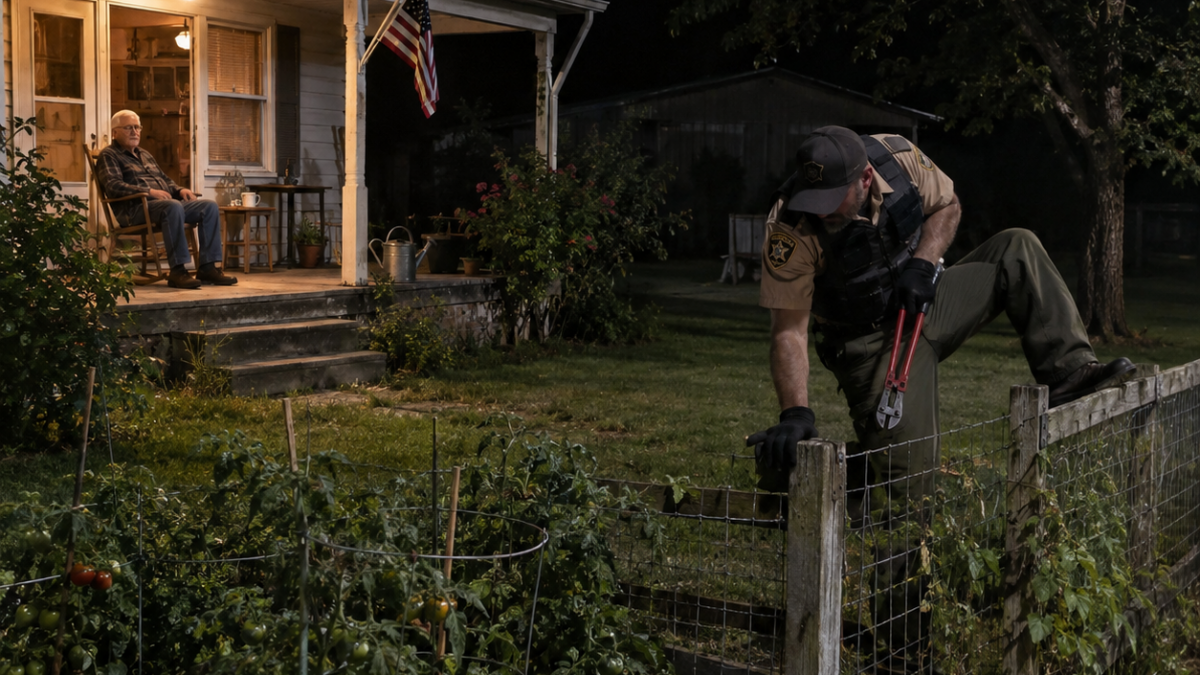
“Your Tomato Garden Is an HOA Violation!” Our Self-Appointed Patrolman Shouted After Climbing My 75-Year-Old Grandpa’s Fence to Photograph His Plants. The HOA President Called Him “Enthusiastic” and Refused to Stop Him. Three Nights Later, He Returned at Midnight With Bolt Cutters, Certain Grandpa Was Asleep—But Grandpa Was Sitting on the Porch Watching One Little Light Blink…
Part 1:
The first time I caught Doyle Mason climbing my grandfather’s backyard fence, it was 5:32 on a Thursday morning.
He had one boot balanced on the top rail, his phone held above his head, and the expression of a man who believed he was performing an important public service.
His target?
Twenty-three tomato plants.
That’s right.
A seventy-five-year-old Army veteran’s tomato garden had apparently become a neighborhood emergency.
“Grandpa,” I whispered, standing beside the kitchen window. “He’s doing it again.”
Walter Thompson didn’t get up from his rocking chair.
He took another sip of black coffee.
“Figured he would.”
Outside, Doyle lowered himself into our backyard and began photographing the tomato cages.
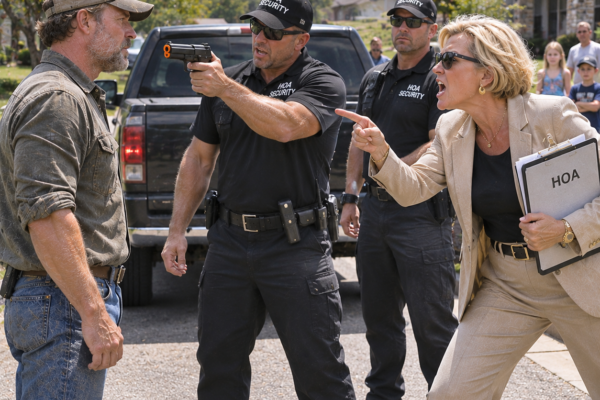
He wore a navy polo shirt with HOA PATROL embroidered across the chest.
A laminated badge hung from his belt.
He wasn’t a police officer.
He wasn’t a security guard.
And he wasn’t even an elected member of the Maple Court Homeowners Association.
He was simply a man who had decided the entire neighborhood needed his supervision.
I watched him kneel beside Grandpa’s tomatoes.
Then he pulled out a measuring tape.
“He’s measuring the plants,” I said.
Grandpa sighed.
“Well, tell him the tomatoes haven’t applied for building permits.”
I almost laughed.
Almost.
Because this wasn’t funny anymore.
My name is Ethan Thompson. I’m twenty-nine, and I’d been living with Grandpa in our quiet North Carolina neighborhood since moving home to help him recover from knee surgery.
He’d served in the Army when he was young, spent thirty-five years working as a mechanic, and raised three children in the same modest brick house.
My grandmother died six years earlier.
Since then, his garden had become the center of his world.
Every spring, he planted tomatoes, green beans, peppers, and marigolds.
He kept a little wooden bench near the back fence where Grandma used to sit with a glass of iced tea.
Nothing about the garden was dangerous.
Nothing extended onto neighboring property.
And the HOA’s own rules permitted ordinary backyard vegetable gardens.
But Doyle Mason didn’t seem interested in the actual rules.
He was interested in catching people breaking the rules he imagined existed.
Two weeks earlier, we’d caught him poking around Grandpa’s tool shed.
The following Monday, he returned to photograph the back porch.
Then he rattled the shed door, apparently hoping to find something he could report.
Grandpa complained to the HOA board.
Its president, Linda Clay, dismissed the matter with a smile.
“Oh, Walter, Doyle’s just enthusiastic. He cares about keeping Maple Court beautiful.”
Grandpa looked her straight in the eye.
“Linda, enthusiasm doesn’t give a man permission to climb my fence.”
She shrugged.
“Perhaps you should maintain your garden to community standards.”
I thought Grandpa was going to lose his temper.
Instead, he quietly asked that his complaint be entered into the meeting minutes.
Linda refused.
Now Doyle was trespassing again.
I reached for the back door.
“Enough. I’m going out there.”
Grandpa raised one finger.
“Not yet, Ethan.”
“He’s inside our fence!”
“I can see that.”
“Then why aren’t you doing something?”
Grandpa placed his coffee cup on the porch table.
“Because a fool who’s given enough rope usually ties the knot himself.”
I didn’t appreciate the philosophy.
I wanted Doyle off our property.
But Grandpa had already installed cameras after the earlier incidents, and I could see the small recording indicator glowing above the garage.
He took out his phone.
Photographed Doyle from the porch.
Then called the sheriff’s nonemergency number.
By the time a deputy arrived, Doyle had climbed back over the fence and disappeared.
The deputy reviewed the video, documented our complaint, and explained how to establish clear notice that Doyle wasn’t permitted to enter.
Grandpa followed the advice.
He sent a written notice to Doyle and the HOA.
He put up fresh no-trespassing signs.
Then he hired a licensed contractor to repair the backyard gate and install a motion-activated security alarm.
It had a warning light, a loud siren, and a camera aimed directly at the entrance.
No electricity running through the gate.
No traps.
Nothing intended to injure anybody.
Just a security system designed to make an unauthorized visitor impossible to ignore.
Grandpa checked the recordings every morning.
For two days, the yard remained quiet.
On the third afternoon, Doyle confronted him at the mailbox.
“You think cameras are going to stop me from enforcing HOA standards?”
Grandpa looked at him.
“Doyle, you’re not an HOA officer.”
“Linda says I have authority.”
“Then ask Linda to put that in writing.”
Doyle stepped closer.
“You can’t hide violations behind a locked fence.”
Grandpa smiled faintly.
“No, but I can keep trespassers outside it.”
Doyle’s face turned red.
He walked away muttering about legal consequences.
That evening, Grandpa tested the new alarm while I watched from the porch.
A small light blinked beside the gate.
The siren sounded.
Then everything went quiet.
“Think that’ll do it?” I asked.
Grandpa looked toward the fence.
“For an honest person, the sign should’ve been enough.”
At 12:17 the following night, my phone vibrated on the nightstand.
BACK GATE — MOTION DETECTED.
I opened the camera feed.
A man was crouching beside our gate.
He wore a dark jacket and work gloves.
A flashlight beam moved across the lock.
Then he reached into a canvas bag.
And pulled out a pair of bolt cutters.
I recognized his face immediately.
Doyle Mason.
But what frightened me wasn’t the tool in his hands.
It was the second figure standing near the street.
Someone was watching him.
And when Doyle turned toward that person, I heard him say something through the camera microphone that made me sit straight up in bed.
“Linda promised she’d handle the board. Just make sure we get inside before Walter wakes up.”
I jumped out of bed.
Then I heard Grandpa’s voice from the hallway.
“Ethan. Don’t open that door.”
He stood there in his robe, phone in hand, looking toward the blinking camera indicator.
“Call the sheriff,” he said. “And save that recording.”
Part 2:
The first thing Doyle Mason photographed was my grandfather’s tomato garden.
The second was the little wooden bench where Grandma used to sit.
The third was the inside of our tool shed, after he tried the handle and discovered it was locked.
I watched him from the kitchen window at 5:32 on a Thursday morning, wondering how a grown man could be so convinced of his own importance that he thought climbing a seventy-five-year-old veteran’s backyard fence was a legitimate neighborhood inspection.
“Grandpa, he’s in the yard again.”
Walter Thompson sat on the back porch in his favorite rocking chair, holding a mug of black coffee.
He didn’t move.
“Figured he’d show up eventually.”
I stared at him.
“You’re not surprised?”
“Nope.”
Outside, Doyle crouched beside a row of tomato cages, holding a measuring tape in one hand and his phone in the other.
He wore a navy polo shirt with HOA PATROL embroidered across the chest.
The shirt was tucked into khaki cargo pants.
A cheap plastic badge hung from his belt.
He looked like a man who’d ordered his own uniform online and spent the next six months waiting for somebody to salute him.
“He’s taking pictures of your tomatoes.”
Grandpa sipped his coffee.
“Hope he gets my good side.”
“I’m serious.”
“So am I. Those Better Boys are coming along nicely.”
I started toward the back door.
Grandpa raised one hand.
“Don’t.”
“He’s trespassing!”
“Yes, he is.”
“Then why are we sitting here?”
Grandpa looked at me.
“Because the camera is recording, the gate was closed, and he’s already been told twice not to come into this yard. We don’t need to chase him around the tomatoes to prove it.”
I stopped.
Grandpa had installed a small security camera above the garage after Doyle’s earlier visits.
The camera covered the backyard gate, garden, and part of the shed.
A second camera watched the driveway.
Both were recording.
Grandpa picked up his phone and photographed Doyle from the porch.
Then he called the sheriff’s nonemergency number.
I watched Doyle move closer to the shed.
He bent down.
Examined the lock.
Then tugged the handle again.
That did it.
I stepped onto the porch.
“DOYLE!”
He spun around.
For a moment, he looked genuinely frightened.
Then he recognized me.
His expression changed to annoyance.
“You’re interfering with an HOA inspection.”
I stared at him.
“You’re standing inside our locked backyard.”
He raised his phone.
“Your grandfather has multiple landscaping violations.”
“Then take your pictures from somewhere you’re legally allowed to stand.”
He glanced toward Grandpa.
“Mr. Thompson, the association has a right to inspect visible exterior conditions.”
Grandpa finally set down his coffee.
“Doyle, you’ve been told not to enter my yard.”
“Linda authorized me.”
“Then tell Linda to come explain why she thinks that.”
Doyle pointed toward the tomatoes.
“These plants exceed acceptable height limits.”
Grandpa looked at his garden.
Then at Doyle.
“Son, I’ve never heard of a tomato needing a height waiver.”
Doyle’s ears turned red.
“This isn’t a joke.”
“No,” Grandpa agreed. “Trespassing isn’t funny.”
He held up his phone.
“I’ve reported it. The deputy will want to speak to you.”
That wiped the expression off Doyle’s face.
He climbed back over the fence without another word.
I watched him drop onto the sidewalk and hurry toward his dented pickup.
Grandpa returned to his coffee.
“Well,” he said, “that’s one way to start Thursday.”
I looked at him.
“How are you so calm?”
He shrugged.
“Because I’m seventy-five, Ethan. I’ve met a lot of men who confuse making noise with having authority.”
Then he looked toward the tomato plants.
“And I’m not letting one of them ruin breakfast.”
My name is Ethan Thompson.
I was twenty-nine that spring, and I’d been living with my grandfather in Maple Court, a small North Carolina subdivision outside Raleigh.
The house was a modest three-bedroom brick ranch with white shutters, a broad front porch, and a fenced backyard.
Grandpa had purchased it with Grandma Helen in the early eighties.
They raised three children there.
My mother was the youngest.
When I was little, I spent summers at their house, eating watermelon on the porch and helping Grandpa with projects I was usually too young to understand.
He’d served in the Army during the Vietnam era, then worked thirty-five years as a mechanic.
He wasn’t a man who talked much about his military service.
Most of his stories concerned the people he’d worked beside, the vehicles he’d repaired, and how much better the coffee tasted when somebody else made it.
He believed in showing up on time.
Finishing what you started.
And never using a position of authority to humiliate someone who couldn’t fight back.
Grandma Helen was the opposite of him in almost every visible way.
She laughed loudly.
Loved bright-colored flowers.
Talked to strangers in grocery stores.
And believed every person who visited should leave with leftovers.
She’d started the vegetable garden along the southern fence.
Grandpa helped with the heavier work.
They grew tomatoes, beans, peppers, cucumbers, and enough marigolds to make the backyard look like a small botanical garden.
When Grandma died six years earlier, Grandpa kept everything growing.
He told us it helped him feel close to her.
He still planted the varieties she’d liked.
Still watered the flower beds on the schedule she’d written inside an old notebook.
And every spring, he set two chairs beside the garden, even though only one of them was usually occupied.
Last year, Grandpa had knee-replacement surgery.
The operation went well, but recovery was slower than he’d expected.
He hated asking for help.
I was working remotely as a software support specialist and had recently ended the lease on my apartment, so moving in made sense.
Mom visited often.
I handled the heavier yard work.
Grandpa handled the things he refused to surrender, which included gardening, making breakfast, and telling me my generation didn’t understand how to sharpen a lawn mower blade.
For several months, life was good.
Then Doyle Mason decided Grandpa’s tomatoes were a threat to Maple Court.
Doyle lived three streets away in a gray two-story house with a perfect lawn and a garage that appeared to contain more measuring equipment than tools.
He was fifty-three, retired from a sales-management job, and apparently desperate for something to manage again.
He drove a rusty blue pickup.
He carried a clipboard everywhere.
And he’d developed the habit of photographing anything he considered inconsistent with neighborhood standards.
Trash cans visible after collection day.
Grass a little too long.
A basketball hoop.
Children’s bicycles.
Patio furniture.
Holiday decorations that remained up several days past his preferred deadline.
At first, most residents treated him as an irritation.
He’d walk along the sidewalk with his clipboard, pause in front of a house, take photographs, then tell the owner that something needed correcting.
Some people ignored him.
Others complied because they assumed he was an official HOA representative.
That assumption was understandable.
He wore the shirt.
He carried a badge.
And Linda Clay, the association president, regularly referred to him as the neighborhood’s eyes and ears.
But Doyle had never been elected to the board.
He wasn’t an authorized law-enforcement officer.
And the HOA’s own management company had no record of a formal position called neighborhood patrol.
He’d simply given himself the title.
Grandpa didn’t particularly care what Doyle called himself.
He cared when the man began entering our property.
The first incident occurred on a Tuesday afternoon.
Grandpa was watering the peppers when he heard a noise near the tool shed.
Doyle was standing inside the backyard fence, photographing the shed roof.
Grandpa asked him to leave.
Doyle claimed he was documenting a possible maintenance violation.
Grandpa pointed toward the gate.
“You’re not inspecting anything without my permission.”
Doyle argued for another minute, then left.
The second incident happened the following week.
I was in my bedroom when the garage camera sent an alert.
Doyle had entered through the side gate and was rattling the shed door.
By the time I went outside, he’d disappeared.
We saved the recording.
Then Grandpa went to the HOA office.
He asked Linda Clay to address the matter.
Linda was sixty, wore expensive jewelry, and had served as HOA president for four years.
She had the practiced smile of somebody who could insult you while making the conversation sound pleasant.
Grandpa showed her the footage.
Linda barely glanced at it.
“Oh, Walter, Doyle’s just enthusiastic.”
“He’s trespassing.”
“He cares about the neighborhood.”
“He can care from the sidewalk.”
She smiled.
“Perhaps if you kept your backyard to community standards, he wouldn’t feel the need to check.”
Grandpa stared at her.
“Are my tomato plants against the rules?”
“Some residents have concerns about the appearance of vegetable gardens.”
“Then those residents are welcome to buy their tomatoes at the grocery store.”
Linda’s smile disappeared.
She told Grandpa that the association had broad authority to maintain neighborhood aesthetics.
He asked her to identify the specific rule he’d violated.
She couldn’t.
He requested that his complaint against Doyle be added to the board meeting minutes.
Linda said it wasn’t an appropriate board matter.
That irritated Grandpa more than anything else.
He wasn’t asking the board to admire his garden.
He was asking it to stop a man from climbing his fence.
Instead, Linda had practically encouraged him.
So Grandpa came home, called the sheriff’s office for guidance, and began documenting everything.
That was why he stayed calm when Doyle climbed the fence again at 5:32 on Thursday morning.
He’d been expecting another incident.
And this time, he had the recording.
Deputy Maria Benton arrived shortly after six.
She was in her early forties and had worked the area for years.
Grandpa showed her the footage.
She watched Doyle climb over the fence, photograph the garden, and try the shed door.
Then she asked whether we’d previously told him not to enter.
“Twice,” Grandpa said.
“Do you have that in writing?”
“Not yet.”
She nodded.
“Then let’s make the notice unmistakable.”
She explained that unauthorized entry onto private property after clear notice could support a trespass complaint under North Carolina law.
The exact offense and available remedies would depend on the evidence and circumstances.
She advised us to preserve the recordings, send written notice, and report any further entry.
Grandpa thanked her.
Then he went inside and wrote a letter.
It identified Doyle by name.
It stated clearly that he wasn’t permitted to enter the property without consent.
It also informed the HOA that Grandpa expected its representatives, volunteers, and contractors to respect the same boundary.
We sent copies through a method that documented delivery.
Grandpa posted fresh signs at the gate and along the fence.
Then he called a contractor.
And that’s when Doyle’s obsession with Grandpa’s backyard took a much stranger turn.
The contractor’s name was Pete Alvarez.
He owned a small security-installation company that mostly worked on residential camera systems, driveway lighting, and monitored alarms.
He came Friday morning with an assistant and spent nearly an hour examining our backyard entrance.
The old gate was made of wrought iron.
Grandpa had installed it shortly after Grandma died because she had always wanted something more attractive than the wooden gate that came with the original fence.
It wasn’t elaborate.
Just black metal with a simple curved top and a locking latch.
Doyle apparently believed it was his personal inspection entrance.
Pete suggested a camera, a motion sensor, and an audible alarm that would activate if somebody attempted to enter after the system was armed.
Grandpa asked about adding electrical protection.
Pete shook his head.
“I wouldn’t electrify a residential gate, Mr. Thompson. It’s not necessary, and it could create serious hazards and liability.”
Grandpa considered that.
“Then we’ll stick to the alarm.”
Pete installed an ordinary low-voltage security system.
The gate itself wasn’t electrified.
There was no hidden mechanism intended to injure anyone.
The installation included a camera with a clear view of the entrance, a warning light, and a siren that would sound if the protected gate was disturbed after hours.
Pete also gave Grandpa documentation describing the equipment and its safe operation.
When he finished, he walked us through the test.
The warning light blinked.
The siren sounded.
Grandpa smiled.
“That ought to wake the neighbors.”
Pete laughed.
“Probably. Let’s hope it never has to.”
He placed a small sign beside the gate explaining that the property had monitored security.
Then he packed up.
By lunchtime, our backyard was quiet again.
I thought the whole business might finally be over.
That afternoon, Doyle proved me wrong.
He appeared near the mailbox just as Grandpa was carrying a basket of tomatoes toward the front porch.
I was replacing a loose board near the steps.
Doyle stopped beside his pickup.
“So you’ve installed surveillance equipment.”
Grandpa looked at him.
“Yep.”
“To interfere with official inspections?”
“To keep people from climbing my fence.”
Doyle folded his arms.
“I have a responsibility to document violations.”
“You have a responsibility to stay off my property.”
He pointed toward the backyard.
“The new gate installation may violate association rules.”
Grandpa lowered the basket.
“Doyle, you haven’t inspected the installation.”
“That’s why I need access.”
“No.”
“Linda says the board can authorize inspections.”
“Then have Linda put the request in writing.”
Doyle’s face reddened.
“You can’t just hide behind a fence.”
Grandpa smiled.
“That’s usually what a fence is for.”
I heard Doyle inhale sharply.
Then he looked at me.
“Your grandfather thinks he’s above the rules.”
I put down my hammer.
“No. He thinks the rules apply to you too.”
Doyle climbed into his pickup.
Before driving away, he rolled down the window.
“This isn’t finished.”
Grandpa watched him leave.
“That man needs a hobby.”
I looked toward the garden.
“He has one. It’s bothering us.”
Grandpa nodded.
“Then he’s going to need a new one.”
The first alarm went off at 4:46 that afternoon.
I was in the kitchen making sandwiches.
Grandpa was on the porch trimming dead leaves from a potted basil plant.
The siren sounded from the backyard.
I dropped the bread knife and ran to the window.
Doyle stood beside the gate with one hand on the latch.
His shoulders were raised.
He looked startled.
Then he stepped backward, caught his heel on the edge of the flower bed, and stumbled into a pile of loose mulch.
He didn’t fall hard.
But he landed on one knee and got dirt across his trousers.
I went outside.
“Doyle! What are you doing?”
He scrambled upright.
“That gate attacked me!”
I stopped.
“What?”
“Your grandfather rigged an electric trap!”
Grandpa came around the corner.
He looked at Doyle.
Then at the gate.
“There’s an alarm on it.”
Doyle held up his hand.
“I felt something!”
“You heard the siren and jumped.”
“You’re going to pay for this!”
Grandpa pointed toward the warning sign.
“Read that before touching the gate again.”
Doyle hurried toward the street.
By six that evening, he’d apparently told half the neighborhood that Grandpa had electrified the entire backyard fence.
By seven, Linda Clay had called an emergency HOA meeting.
I went with Grandpa.
The clubhouse conference room was nearly full.
Linda sat at the head of the table wearing a pearl necklace and an expression of injured dignity.
Doyle sat beside her with his right arm in a sling.
I stared at him.
Two hours earlier, he’d been climbing into his pickup using that same arm without difficulty.
Now he looked as though he’d survived a major industrial accident.
Linda tapped her gavel.
“We’re here to address a dangerous security installation at the Thompson residence.”
Grandpa sat down.
I took the chair beside him.
Doyle immediately stood.
“This man has installed an electrified weapon on his gate!”
Several homeowners turned toward us.
Grandpa waited.
Doyle continued.
“I was attempting to verify compliance when the device discharged. I nearly suffered a serious electrical injury.”
I looked toward Grandpa.
He simply opened his folder.
Linda gave him an impatient smile.
“Walter, would you like to explain your conduct?”
“Certainly.”
Grandpa placed Pete’s invoice and installation description on the table.
“The gate has a professionally installed security alarm. It’s not electrified. It sounds when somebody tries to enter without permission.”
Doyle’s face tightened.
“That’s a lie.”
Grandpa turned toward him.
“Then we can have the installer explain it.”
Linda glanced at the paperwork.
“Legal or not, this seems unnecessarily aggressive.”
Grandpa looked at her.
“Linda, a locked gate and a security alarm aren’t aggressive. Climbing somebody else’s fence is.”
She raised her voice.
“The association has a duty to maintain community standards.”
“And I have a right to keep an uninvited man out of my backyard.”
Doyle struck the table.
“I was inspecting violations!”
Grandpa looked straight at him.
“Who appointed you?”
That stopped him.
Linda leaned forward.
“Let’s not get distracted.”
“No,” Grandpa replied. “I’d like an answer.”
Doyle looked at Linda.
She adjusted her necklace.
“Doyle assists the association with monitoring neighborhood conditions.”
“Was he appointed by a board vote?”
Linda hesitated.
“His participation has been informally accepted.”
“Does he have authority to enter residents’ fenced yards?”
“That depends on the circumstances.”
“Does he have authority to rattle their shed doors?”
Linda said nothing.
Grandpa opened another folder.
Then he placed a photograph on the table.
It showed Doyle climbing our fence at 5:32 that morning.
He added a second photograph showing Doyle examining the shed.
Then a copy of the written no-trespassing notice.
Linda’s expression changed.
“This is not the place for personal accusations.”
A woman near the back raised her hand.
Her name was Margaret Ellis.
She lived around the corner and had two grandchildren who visited every weekend.
“Linda, Doyle entered my backyard last month to measure my shrubs.”
Another homeowner spoke.
“He photographed my daughter’s bicycle and told her it violated community appearance rules.”
A third man raised his hand.
“Doyle tried to inspect my garage while I was at work.”
The room grew louder.
For years, people had apparently assumed they were the only ones dealing with him.
Now they were discovering a pattern.
Linda struck her gavel.
“Order, please!”
Grandpa remained seated.
He waited for the noise to settle.
Then he spoke quietly.
“Linda, nobody is asking you to abandon the association’s rules. We’re asking you to stop letting an unauthorized man enter our homes and yards.”
Doyle glared at him.
“You’ve always had a problem with authority.”
Grandpa looked at him.
“No, Doyle. I’ve had a problem with people pretending to possess it.”
The silence that followed was almost satisfying.
Linda adjourned the meeting without approving any formal action against Grandpa’s gate.
But she also refused to condemn Doyle’s conduct.
As we were leaving, she caught up with us near the clubhouse door.
“Walter, this matter could become expensive if you continue resisting inspections.”
Grandpa turned.
“Then I suggest you stop sending people onto my property without permission.”
She smiled coldly.
“You don’t understand how much power an association can have.”
Grandpa looked back at her.
“Power and permission aren’t the same thing, Linda.”
Then he walked toward the parking lot.
I followed.
Once we reached the truck, I asked whether he thought the meeting had accomplished anything.
Grandpa put on his seat belt.
“Oh, yes.”
“What?”
He looked at the clubhouse.
“People finally started talking.”
I glanced toward the windows.
Several neighbors were still standing inside, arguing with Linda.
Grandpa started the engine.
“And Doyle’s getting nervous.”
He was right.
But I didn’t realize how nervous until the following night.
At 12:17 a.m., my phone vibrated.
BACK GATE — MOTION DETECTED.
I opened the camera feed.
Doyle stood outside our fence.
He was wearing a dark jacket and work gloves.
A flashlight illuminated the lock.
Then he reached into a canvas bag and removed a pair of bolt cutters.
My stomach tightened.
He wasn’t taking photographs anymore.
He was preparing to force his way into our yard.
And he wasn’t alone.
Another figure stood near the street, partially hidden beside a parked vehicle.
I turned up the camera audio.
Doyle glanced toward that person.
“Linda promised she’d handle the board. Just make sure we get inside before Walter wakes up.”
I sat straight up.
Then Grandpa appeared in my bedroom doorway, wearing his robe and holding his phone.
“Ethan,” he said quietly, “don’t go outside.”
I looked toward the screen.
Doyle was positioning the cutters around our lock.
Grandpa’s expression was calm.
But his eyes were serious.
“Call the sheriff,” he said.
I reached for my phone.
“And save that recording.”
I called 911 at 12:19 a.m.
I told the dispatcher two people were at our back gate, that one was carrying bolt cutters, and that we’d previously reported the same man’s unauthorized entries.
She asked whether they were inside.
“Not yet.”
“Do you know them?”
“One of them. Doyle Mason. He lives in the neighborhood.”
I looked at the screen.
Doyle squeezed the cutter handles.
Our lock fell onto the gravel.
“He’s cut through the lock,” I told her.
The dispatcher asked us to stay inside and keep our doors secured.
Grandpa had already locked the back door.
He stood beside the kitchen window, watching the live camera feed on his phone.
Doyle pushed the gate.
The alarm sounded.
Even through the camera’s microphone, the siren was sharp.
The warning light began flashing.
Doyle jumped backward.
His boot caught the edge of the landscaping timber.
He stumbled, dropped the cutters, and landed in a patch of wet dirt beside Grandma’s old rosebush.
I heard Grandpa exhale.
“Well, that answers whether the alarm works.”
I stared at him.
“Grandpa, somebody’s trying to break into our yard.”
“I know.”
He looked toward the phone.
“Stay with the dispatcher.”
Outside, Doyle got to his feet.
He looked furious.
The second figure moved closer.
For a moment, the camera caught part of a face beneath the hood.
It was a younger man.
He appeared to be urging Doyle to leave.
Instead, Doyle picked up his cutters and began shouting at our house.
“WALTER! YOU’RE DONE! YOU’VE GOT AN ILLEGAL ELECTRIC FENCE!”
Grandpa didn’t answer.
Doyle raised his phone.
Then he called 911 himself.
He told the dispatcher he’d been electrocuted by a dangerous security device while performing an HOA inspection.
I couldn’t hear the dispatcher.
But I could hear Doyle’s responses.
“He deliberately set a trap!”
A pause.
“Yes, I’m injured!”
Another pause.
“No, I don’t need an ambulance. I need him arrested!”
The younger man stepped away toward the parked vehicle.
Doyle followed, limping slightly.
By the time the first sheriff’s cruiser arrived, both were near the street.
Deputy Maria Benton stepped out.
A second deputy, James Holloway, approached the gate from the sidewalk.
Doyle began shouting before either officer reached him.
“That man tried to kill me!”
Benton looked toward the locked backyard.
Then at the broken lock lying in the dirt.
“Mr. Mason, let’s establish what happened.”
Doyle held up his right hand.
“The gate shocked me.”
“Where did you touch it?”
“Right there.”
He pointed toward the latch.
Holloway examined the entrance without touching anything unnecessarily.
He saw the alarm housing, warning sign, and broken padlock.
Then Benton asked a question.
“Why were you at the Thompson family’s backyard gate after midnight with bolt cutters?”
Doyle’s mouth opened.
Then closed.
“I was conducting an inspection.”
“At midnight?”
“The HOA authorized it.”
“Who authorized you to cut their lock?”
Doyle stared at her.
I watched from our kitchen window as his confidence began collapsing.
Grandpa had told me not to open the door until the deputies requested contact.
So we waited.
A few minutes later, Benton knocked at the front entrance.
Grandpa opened it.
“Evening, Deputy.”
She glanced at her watch.
“Morning, technically.”
Grandpa smiled faintly.
“Coffee?”
“Not right now, Mr. Thompson. We need to discuss your gate.”
He nodded.
“Of course.”
She asked whether it was electrified.
“No, ma’am.”
“Did you activate any device when Mr. Mason approached?”
“The motion alarm activated automatically when he disturbed the gate.”
“Can you show me the system information?”
Grandpa handed her Pete Alvarez’s installation documents.
Then he opened the camera footage.
Benton watched Doyle approach with the cutters.
She watched the second man standing near the street.
She heard the statement about Linda handling the board.
Then she watched Doyle cut the lock, trigger the siren, and fall into the mud.
Holloway joined her.
They watched the recording again.
Neither said much.
Finally, Benton looked at Grandpa.
“Do you have the original recording saved?”
“Yes.”
“We’ll need a copy.”
Grandpa nodded.
“You’re welcome to it.”
Then she looked toward the garden.
“Mr. Thompson, did you physically confront Mr. Mason at any point tonight?”
“No. Ethan and I stayed inside.”
She nodded.
“Good.”
The deputies arranged to document the damaged lock and obtain the relevant recordings.
They also asked for the earlier trespassing reports and written notices.
Grandpa produced the folder he’d been building.
I helped him identify the dates.
The first shed incident.
The second unauthorized entry.
The Thursday morning fence climb.
The Saturday afternoon alarm incident.
And now the midnight cutting of the lock.
Every event had been documented.
Benton looked through the material carefully.
Then she returned to Doyle.
I couldn’t hear every word from the porch.
But I saw his expression change when she pointed toward the camera.
She asked about the cut lock.
The written notice.
The second person.
And his claim that the gate had shocked him.
Doyle insisted the HOA had empowered him to enter.
Benton explained that a private association’s instructions didn’t automatically override property rights or authorize breaking into a fenced yard.
After reviewing the circumstances, the deputies placed Doyle under arrest on suspicion of offenses arising from the unlawful entry and damaged property.
The precise charges would be determined through the normal legal process.
He began shouting about conspiracies.
He accused Grandpa of attacking him.
He insisted Linda Clay would have everybody’s job.
But this time, nobody was interested in his imaginary title.
The deputies weren’t arresting him because Grandpa was a veteran.
They were responding to the evidence of a person who had been told not to enter private property and then returned after midnight with cutters.
I watched them place Doyle in the patrol vehicle.
Then I looked toward Grandpa.
He was standing beside the porch railing, holding a cup of coffee.
“You okay?” I asked.
He nodded.
“Fine.”
“You’re really not upset?”
He considered that.
“I’m upset somebody cut my lock. I’m more upset they thought they had a right to do it.”
He looked toward the garden.
“But I’m glad we stayed inside.”
I nodded.
So was I.
The following morning, Pete Alvarez returned to inspect the damaged gate.
He replaced the lock, checked the alarm, and documented the condition of the installation.
He also confirmed for the investigators that no part of the gate had been wired to deliver an electric shock.
Doyle’s story about being electrocuted had no support in the installation or the recordings.
That was when the neighborhood began talking.
By breakfast, people knew Doyle had been arrested.
By lunchtime, nearly everybody knew he’d been caught at Grandpa’s gate with bolt cutters.
And by Saturday evening, a group of homeowners had begun demanding an explanation from Linda Clay.
But Linda had a surprise for us.
She issued a statement saying Doyle had acted independently, without the HOA’s authorization or knowledge.
When I read it to Grandpa, he stopped peeling potatoes.
“Independently?”
“That’s what she says.”
He set down the knife.
“Well, that’s interesting.”
“Why?”
Grandpa walked to the filing cabinet in the hallway.
He pulled out the folder containing his correspondence with the board.
“Because I asked her in writing whether Doyle was acting on behalf of the association.”
I looked at the emails.
In one response, Linda had described Doyle as a community compliance volunteer carrying out approved monitoring duties.
In another, she’d written that he was assisting the board with enforcement.
Grandpa placed the pages on the kitchen table.
“Now she says she doesn’t know anything about him.”
I stared at the papers.
“She can’t have it both ways.”
“Nope.”
Grandpa put the documents in another envelope.
Then he called an attorney.
Her name was Caroline Brooks.
She’d handled a dispute for a retired neighbor several years earlier and was familiar with homeowners association governance.
We met her the following Monday.
Caroline listened while Grandpa explained the incidents.
She reviewed the recordings, letters, bylaws, and police reports.
Then she asked for the board’s official records concerning Doyle’s appointment and compensation.
I looked at her.
“Compensation?”
She nodded.
“People sometimes call themselves volunteers while receiving expense reimbursements, stipends, or payments through a related arrangement. We need to know the actual facts.”
Grandpa leaned back.
“You think Linda’s paying him?”
“I don’t know. That’s why we check.”
Caroline also examined the HOA declaration.
It permitted backyard vegetable gardens subject to ordinary maintenance requirements.
Grandpa’s garden was within the approved fenced area.
There was no blanket prohibition on tomato plants.
There was no special rule limiting the height of his vegetables.
And nothing in the documents authorized an unelected resident to enter another homeowner’s enclosed yard without permission merely to photograph landscaping.
The association had legitimate processes for addressing violations.
Doyle had ignored them.
Linda had encouraged him.
And now she was publicly disavowing the man she’d previously described as an approved volunteer.
Caroline began sending formal records requests and preservation notices.
Several homeowners came forward.
Margaret Ellis provided photographs showing Doyle inside her backyard.
A retired teacher named Harold Jenkins produced messages in which Doyle threatened to fine him over children’s bicycles.
Another resident described Doyle shining a flashlight through a side window while looking for alleged maintenance violations.
We didn’t automatically treat every complaint as proven.
But the witnesses and records showed a pattern requiring examination.
Then Caroline obtained the HOA’s financial documents through the appropriate process.
The first thing she noticed was a recurring expense labeled COMMUNITY SAFETY REIMBURSEMENT.
The payments were small enough that most residents hadn’t paid attention.
But over several months, they’d totaled more than four thousand dollars.
The recipient was Doyle Mason.
I looked at the records.
“So he wasn’t just a volunteer.”
Caroline nodded.
“He received payments. The next question is who approved them and what services they were supposed to cover.”
The approval signature belonged to Linda Clay.
But the supporting board minutes contained no formal appointment giving Doyle enforcement authority.
Instead, the expense descriptions referred vaguely to neighborhood monitoring support.
Then came something worse.
A reimbursement request listed photographs of our property as a completed compliance assignment.
The date matched the morning Doyle climbed Grandpa’s fence.
Grandpa looked at the document.
Then at Caroline.
“So Linda paid him for doing the very thing I complained about.”
Caroline examined the record.
“That’s what the payment description suggests. We still need to establish exactly who instructed him and what they knew.”
Grandpa folded his hands.
“Then let’s keep looking.”
The answer came from a board member named Judith Palmer.
She’d served as treasurer for three years and was growing increasingly uncomfortable with the attention surrounding Doyle.
She contacted Caroline after reviewing the records.
Judith provided correspondence obtained through the association’s lawful review process.
The emails showed Linda had encouraged Doyle to gather evidence against certain residents who challenged her decisions.
Grandpa’s name appeared repeatedly.
One message instructed Doyle to find enough violations to support an enforcement hearing.
Another discussed the new gate alarm.
Then Caroline found a message sent shortly before Doyle’s midnight visit.
Linda had written:
Walter thinks a locked gate makes him untouchable. We need photographs of that installation before the next meeting. I don’t care how stubborn he gets.
Doyle replied that he’d handle it.
Linda hadn’t expressly instructed him to cut the lock.
But the correspondence established that she knew he intended to obtain access and had encouraged his campaign against Grandpa despite the written trespass complaints.
And the video from the gate captured Doyle telling his companion that Linda would handle the board.
That was enough to make the association’s official explanation look very different.
Grandpa had spent weeks being told that Doyle was just an enthusiastic neighbor.
Now the records showed he’d been receiving money and instructions connected to his supposed inspections.
And Linda Clay had been signing off on both.
The special HOA meeting took place the following Thursday.
It was the largest gathering I’d ever seen at the Maple Court clubhouse.
Every chair was occupied.
People stood along the walls and crowded near the doors.
Several carried copies of Doyle’s violation notices.
Others had photographs showing him in their yards.
Grandpa arrived in a clean blue shirt, pressed trousers, and the brown jacket he’d worn to church for nearly twenty years.
He carried one folder.
Linda Clay sat at the head of the table.
Her smile disappeared when she saw Caroline Brooks beside us.
“This is an internal association meeting,” Linda announced.
Caroline calmly identified herself as Grandpa’s attorney and explained that we were attending to address the conduct documented in the association’s records.
Judith Palmer stood.
“As treasurer, I’ve requested that we review the payments made to Mr. Mason.”
Linda’s expression hardened.
“Those payments were legitimate reimbursements.”
Judith placed a financial statement on the table.
“Then why were they approved without a documented appointment or clear description of his duties?”
Linda opened her mouth.
Judith continued.
“And why did you authorize payment for photographs taken inside the Thompson family’s fenced backyard after receiving written notice that Mr. Mason wasn’t permitted there?”
The room became silent.
Linda looked toward Grandpa.
“This is a coordinated attack against my leadership.”
Grandpa didn’t stand.
He simply asked, “Did you authorize Doyle to inspect my property?”
Linda hesitated.
“He was assisting with compliance monitoring.”
“Did you know I’d told him not to enter?”
She didn’t answer.
“Did you receive my letters?”
“Yes.”
“Then why did he keep getting paid to photograph my yard?”
For the first time, Linda had no prepared response.
Caroline presented the relevant correspondence.
The recordings.
The payments.
The written trespass notices.
And the message Linda had sent about obtaining photographs of the new gate installation.
Several homeowners began speaking at once.
Margaret Ellis described finding Doyle behind her house.
Harold Jenkins explained how he’d been threatened over his grandchildren’s bicycles.
Another resident said she’d stopped gardening because she was afraid Doyle would photograph her through the fence.
Then Grandpa stood.
He didn’t raise his voice.
“I’m not here because I dislike homeowners associations. I’ve lived in Maple Court for more than forty years. I’ve paid every legitimate assessment, maintained my property, and tried to be a decent neighbor.”
He looked toward Linda.
“But no association president gets to appoint a man to climb fences, enter sheds, and intimidate residents simply because somebody questions her judgment.”
He paused.
“My wife planted that tomato garden. I’ve kept it growing since she passed. I shouldn’t have to spend my mornings wondering whether a stranger is prowling around it with a camera.”
Nobody interrupted.
Grandpa continued.
“Doyle was told to stop. Linda knew that. And instead of protecting the residents she was elected to serve, she defended him.”
Then he sat down.
Judith requested formal action.
The board voted to suspend the unauthorized monitoring arrangement, stop further payments, and initiate an independent review of Linda’s conduct.
The homeowners demanded new leadership.
Under Maple Court’s governing procedures, a properly noticed removal and election process followed.
Linda lost the presidency.
The new board withdrew the unsupported garden violations and formally acknowledged that Doyle had no authority to enter private yards or conduct coercive inspections.
Doyle’s criminal case proceeded separately.
The court considered the midnight entry, the damaged lock, the previous notice, and the video evidence.
He ultimately accepted a negotiated resolution involving responsibility for the property damage, court-imposed conditions, and an obligation to stay away from Grandpa’s property.
His allegation about the supposedly electrified gate wasn’t supported by the evidence.
Caroline also helped us resolve the civil claims arising from the repeated unauthorized entries.
The resulting agreement included compensation for documented damage and expenses, a written acknowledgment of the limits of the association’s authority, and enforceable restrictions on further interference with Grandpa’s property.
The association adopted clearer procedures for hiring contractors, authorizing inspections, and reviewing expenditures.
Nobody would again be permitted to create an unofficial HOA patrol simply by printing a badge and winning the president’s approval.
The financial review also required Linda to account for the payments she’d approved.
I didn’t get much satisfaction from watching her lose the position.
I got satisfaction from watching neighbors begin asking questions they should’ve been allowed to ask all along.
The following spring, Grandpa planted twenty-six tomato plants.
Three more than the year before.
When I asked why, he shrugged.
“Had a little extra room.”
I laughed.
“You’re not making a statement, are you?”
He gave me an innocent look.
“About tomatoes?”
“Grandpa.”
He smiled.
“Well, perhaps a small one.”
The backyard felt different.
The camera was still there.
So was the gate alarm.
But we no longer spent mornings watching the fence to see whether Doyle would appear.
The neighbors had started visiting again.
Margaret brought fresh biscuits.
Harold helped Grandpa replace a broken garden trellis.
Children stopped by in the summer to collect tomatoes with their parents’ permission.
And for the first time in months, Grandpa could sit in his rocking chair with a cup of coffee without wondering whether somebody was measuring his vegetables.
One afternoon, I found him beside Grandma’s old bench.
He was tying a tomato plant to its support.
I handed him a piece of garden twine.
“Do you ever regret not confronting Doyle yourself that first morning?”
He looked up.
“What do you mean?”
“You could’ve chased him off. You could’ve gotten angry.”
Grandpa returned to his work.
“Wouldn’t have changed what he believed.”
“What did change it?”
He considered the question.
“Consequences.”
I smiled.
“That’s your whole philosophy?”
“Part of it.”
He straightened slowly.
“When a man believes he has authority he never earned, shouting at him usually just gives him another reason to shout back.”
He looked toward the gate.
“But when he has to explain his conduct in front of the people affected by it, with the facts sitting there on the table, things change.”
I nodded.
Grandpa continued.
“Besides, I spent enough years fixing machines to know you don’t solve every problem by hitting it with a hammer.”
I laughed.
“That’s definitely not what you taught me when I was twelve.”
He grinned.
“Some machines are exceptions.”
We finished tying the tomatoes.
Then we sat together on the porch.
The afternoon sunlight stretched across the grass.
A breeze moved through the marigolds.
Grandpa rested his coffee cup on the little table beside him.
After a while, I asked about the security alarm.
“Think you’ll ever remove it?”
He shook his head.
“No reason to. It’s useful.”
I looked toward the wrought-iron gate.
The repaired lock hung where it belonged.
The warning sign was still visible.
And the little security light blinked quietly above the entrance.
Doyle had once stood outside that same gate, convinced his homemade HOA badge gave him the right to break through it.
Linda had defended him, paid him, and treated Grandpa’s objections as an inconvenience.
But the gate had never been theirs to control.
Neither had the garden.
Neither had the shed.
And neither had the peace Grandpa and Grandma had spent decades building around their home.
As the sun began setting, Grandpa pointed toward the tomatoes.
“Those plants are going to give us a good crop.”
“They’d better,” I said. “After everything we’ve been through.”
He chuckled.
Then he looked at me.
“You know the best part, Ethan?”
“What?”
“Doyle spent months taking pictures of my tomatoes, looking for something wrong.”
I smiled.
“And?”
Grandpa leaned back in his rocking chair.
“In the end, the camera that mattered wasn’t his. It was mine.”
He picked up his coffee.
Across the backyard, the tomatoes moved gently in the evening breeze.
And nobody was climbing the fence anymore.