An Old Dog Was Left Outside Our Shelter—Then I Read the Note Under Him.k
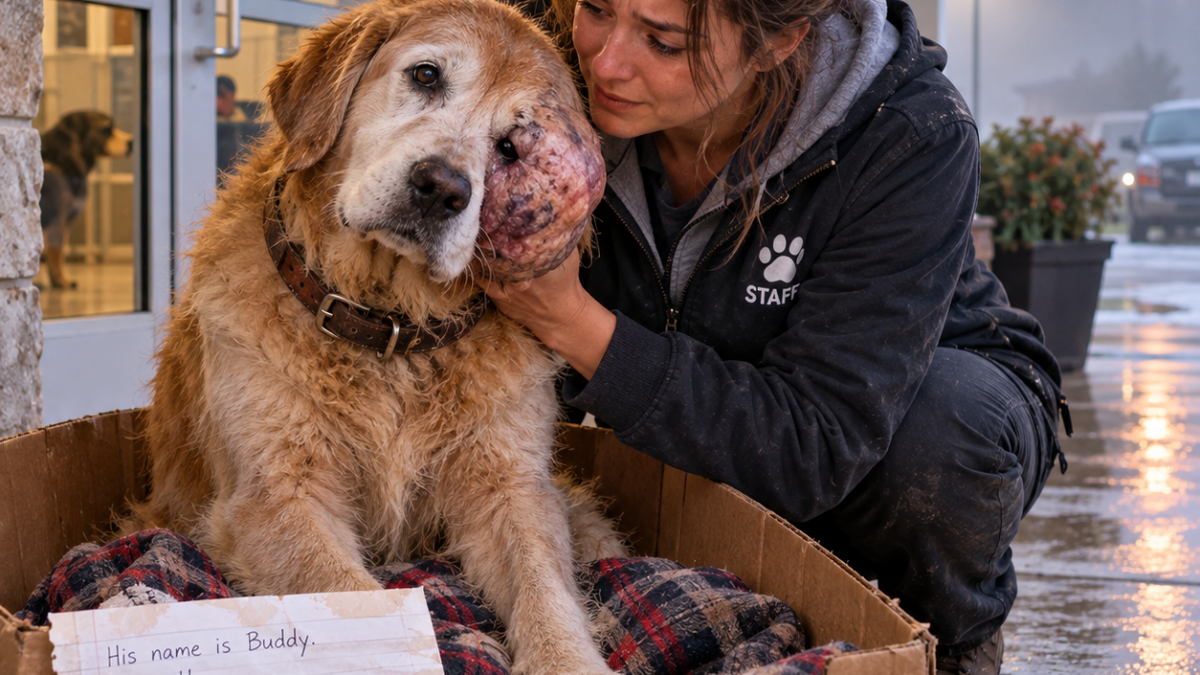
PART2:
By seven-ten, Buddy was inside.
We didn’t have an intake team scheduled until eight, but shelters teach you to improvise.
I pulled a clean blanket from the laundry room.
Found a stainless-steel water bowl.
Opened half a can of senior dog food.
Buddy drank first.
Slowly.
Carefully.
He had to angle his head strangely because the mass made normal movement difficult.
When he tried to eat, I held the bowl higher.
He looked at me once.
Almost apologetically.
“Don’t you dare,” I whispered.
“You’ve done enough apologizing for one lifetime.”
His tail moved again.
The tumor was warm beneath the skin.
Not bleeding.
No open wound.
But enormous.
I didn’t touch it more than necessary.
I had seen tumors before.
Mammary masses.
Mast-cell tumors.
Lipomas the size of softballs.
Ulcerated cancers.
Nothing like this.
By eight, everyone had arrived.
Kev Daniels was first.
Twenty-six.
Kennel tech.
Big heart.
No filter.
He read the note.
Then stared through the treatment-room window.
“Who does that?”
I said nothing.
He slapped a stack of clean food bowls onto the counter.
“Seriously, Maya.”
“Who watches a dog’s head turn into that and then dumps him in a box?”
Diane Keller from reception read the note next.
Her eyes filled.
Then anger replaced it.
“Please don’t let him die alone?”
She shook her head.
“So you leave him alone in a parking lot?”
I heard the words.
I understood them.
Part of me felt the same.
But I kept looking at the flannel shirt.
Whoever abandoned Buddy hadn’t tossed him beside a highway.
They hadn’t left him tied to our fence in the rain.
They had chosen the awning.
A box.
A shirt.
A note.
Wrong?
Yes.
Abandoning an animal without arranging surrender is dangerous.
He could have deteriorated overnight.
We could have been closed for an emergency.
He could have crawled into the road.
He could have died before anyone arrived.
But something about that shirt prevented me from turning the unknown person into a monster.
At ten, Dr. Sam Whitfield arrived.
Sam was forty-eight, calm, and irritatingly difficult to impress.
He had worked emergency medicine before shelter practice, which meant he could examine a dog with half its face swollen and still sound as though he were discussing a grocery list.
That steadiness helped animals.
It also helped us.
He examined Buddy carefully.
Heart.
Lungs.
Eyes.
Ears.
Mouth.
Lymph nodes.
Mobility.
Then the tumor.
Buddy tolerated everything.
When Sam touched near the base of the mass, Buddy flinched.
Not much.
Sam noticed.
“So it hurts.”
I swallowed.
“How much?”
“Enough.”
He measured it.
Then weighed Buddy.
Forty-seven pounds.
Far too thin for his frame.
The mass itself distorted the number.
Sam estimated it might weigh four pounds or more.
“Four pounds?”
“Possibly.”
I looked at Buddy.
Imagine carrying a four-pound weight off one side of your skull every hour of every day.
Sam continued.
“It appears attached deeply.”
“How deeply?”
“Can’t know from palpation.”
“Need imaging.”
“CT?”
“Yes.”
“Biopsy first?”
“Probably fine-needle aspirate initially.”
“Then tissue depending on results.”
He looked at the way Buddy sat.
“You see this?”
I nodded.
“He can’t comfortably rest on the left.”
“He’s likely been compensating for a long time.”
“How long?”
Sam looked at me.
“I won’t guess six years because Kev guessed six years.”
I smiled despite myself.
“Could be months.”
“Could be longer.”
“Growth rate depends on tumor type.”
“Anyone claiming an exact timeline by looking at it is making one up.”
That was Sam.
Facts first.
I appreciated it.
Then he said the sentence I was afraid of.
“If this involves skull bone extensively, or if we find metastatic disease, surgery may not be reasonable.”
I looked down.
Buddy’s tail thumped once.
Sam sighed.
“And if it’s resectable?”
“Big surgery.”
“Expensive.”
“Potential blood loss.”
“Complex closure.”
“Possibly referral.”
“How expensive?”
He gave me a range.
Imaging.
Biopsy.
Referral consult.
Surgery if possible.
Pathology.
Recovery.
We were talking thousands.
Maybe much more.
For a rescue that counted every bag of food.
Carol Bennett walked into the room at noon.
Our director.
Fifty-six.
Former veterinary technician.
Twenty years in shelter management.
She could negotiate medical bills, calm angry adopters, write grants, and tell you exactly how many paper towels disappeared in a week.
She had already seen the estimate.
She stood in front of Buddy’s kennel.
Read his intake card.
Then looked at me.
“Maya.”
I knew that tone.
“No.”
“I haven’t said anything.”
“You’re about to.”
Carol put down the clipboard.
“Our medical fund has twenty-three thousand left until January.”
“I know.”
“We have Parvo puppies in isolation.”
“I know.”
“Two heartworm-positive dogs.”
“I know.”
“Daisy’s orthopedic repair next week.”
“I know.”
“We cannot spend the entire emergency fund on one patient because his story hurts.”
“I know.”
My throat tightened.
Then Carol reached into her pocket.
She took out a red plastic kennel tag.
At our shelter, red did not mean euthanasia.
People assumed that when they saw it.
For us, red meant:
MEDICAL HOLD.
NO ADOPTION.
NO TRANSFER.
STAFF AUTHORIZATION REQUIRED.
She hung it on Buddy’s kennel.
I exhaled.
Carol looked at me.
“You thought I was putting him down.”
“I didn’t know.”
“Neither do I.”
She crouched in front of the kennel.
Buddy leaned toward her.
Carol put two fingers through the door.
He pressed his nose against them.
She closed her eyes briefly.
Then stood.
“We don’t make decisions before diagnostics.”
That became our first rule.
Within an hour, we had photographs.
Not exploitative ones.
No dramatic close-up designed to make people gasp.
Just Buddy.
Sitting crooked.
White muzzle.
Warm eyes.
Big impossible tumor.
The note photographed beside him.
Carol wrote the post herself.
Senior dog abandoned before dawn. Medical evaluation underway. We do not yet know whether surgery is possible. Donations toward diagnostic care may be made to our medical fund.
No promises.
No miracle language.
No:
WE MUST SAVE HIM AT ALL COSTS.
Good rescue work requires hope.
It also requires not lying.
The post went up at 1:14.
By two, donations had passed four thousand dollars.
By five, eleven thousand.
By bedtime, more than twenty-eight thousand.
I stared at the number on my phone from my apartment.
Then called Carol.
“Have you seen this?”
“Yes.”
“What do we do with the extra?”
“If there is extra, it remains in the medical fund for other animals unless donor restrictions require otherwise.”
“Good.”
“You thought I’d buy Buddy a private jet?”
“Maybe business class.”
Carol hung up.
The next morning, Buddy had already learned my footsteps.
When I entered the kennel room, his tail thumped.
I sat outside his door.
“Morning.”
He stood.
Slowly.
Walked toward me.
The tumor pulled his balance sideways.
He corrected.
One step.
Another.
I opened the kennel.
He rested his forehead against my thigh.
Not the tumor side.
The good side.
I scratched his neck.
The cracked leather collar felt unusually thick.
I looked at it more closely.
There were small indentations along the inside.
Years of wear.
This wasn’t a collar somebody had bought last week to make an abandonment look sentimental.
Buddy had worn it a long time.
Probably years.
A small brass tag hung from the ring.
Worn smooth.
No readable engraving.
Sam took an aspirate that morning.
Buddy never snapped.
Never growled.
Never tried to bite.
He simply leaned against me while Sam worked.
When the needle entered the tumor, his back legs trembled.
I whispered:
“Almost done.”
Then:
“You’re okay.”
I hated saying it.
Because I didn’t know if he was.
The preliminary cytology was inconclusive.
Not unusual.
The mass contained mixed cells and a lot of inflammatory material.
We needed more.
Carol arranged a discounted CT at a specialty hospital in Richmond.
Two days later, I drove Buddy there.
He sat in the back seat wearing a safety harness.
He couldn’t comfortably lie down.
Halfway there, I pulled over.
Opened the rear door.
He was still sitting.
Eyes tired.
I sat beside him.
“You’ve been sleeping like this?”
He licked my wrist.
That was answer enough.
At the specialty hospital, Dr. Hannah Lee reviewed the imaging.
She called Carol and me into a consultation room.
I hated consultation rooms.
They are designed to contain bad news politely.
Hannah brought the CT images onto a screen.
“This is the mass.”
I stared.
Even without medical training, I could see how much space it occupied.
“Is it in the skull?”
“There’s some involvement with the superficial bone.”
My stomach dropped.
Then she continued.
“But not the degree I was afraid of.”
I looked at her.
“What does that mean?”
“The tumor appears to arise primarily from soft tissue.”
“There is localized bony change.”
“It’s large.”
“Very large.”
“But there is not clear extensive invasion into the cranial cavity.”
I realized I had been holding my breath.
Carol asked:
“Chest?”
“No obvious metastatic disease on the imaging we’ve done.”
“Lymph nodes mildly reactive.”
“We still need pathology.”
“But you’re saying surgery?”
Hannah nodded slowly.
“I think surgery is possible.”
Not easy.
Possible.
I had to look away.
Carol asked the practical questions.
Margins.
Bleeding.
Need for skin reconstruction.
Eye involvement.
Facial nerve risk.
Pain.
Anesthesia.
Buddy’s age.
Recovery.
Hannah answered each.
The mass sat above and behind the left eye but had not obviously invaded the globe.
Removing it might require sacrificing some adjacent tissue.
Possibly partial muscle.
Maybe a skin flap.
Potential complications:
Hemorrhage.
Infection.
Wound breakdown.
Nerve damage.
Recurrence.
And because we still didn’t know exactly what it was, no one could promise surgery would buy Buddy years.
Maybe months.
Maybe years.
Maybe simply comfort.
Carol asked:
“If you do nothing?”
Hannah looked at the image.
“It will continue affecting his quality of life.”
“Pressure.”
“Pain.”
“Inability to rest normally.”
“Eventually skin breakdown or neurologic issues depending on growth.”
Then:
“I would not recommend simply watching it indefinitely.”
Carol nodded.
“What would you do if he were yours?”
Doctors hate that question.
Hannah didn’t avoid it.
“If staging remains favorable and pathology doesn’t reveal something that changes the plan, I would operate.”
I put my hand over my mouth.
Buddy was asleep in the adjoining recovery area after sedation.
Probably lying on his right side.
Because he couldn’t lie on the left.
I thought about all the nights he’d spent sitting up.
How long?
Nobody knew.
We scheduled surgery.
Five days.
That gave Buddy time to regain some strength.
Higher-calorie diet.
Pain control.
Preoperative bloodwork.
Hydration.
And five days for us to become completely attached to a dog we might lose on the operating table.
Shelter work is professionally stupid that way.
You are expected to care deeply while remaining capable of making decisions that hurt.
People say:
Don’t get attached.
Impossible.
The trick isn’t avoiding attachment.
It’s learning not to make the animal carry your emotions.
Buddy didn’t need me crying over what might happen.
He needed food.
Medication.
Walks.
A clean bed.
So I gave him those.
We moved him into the staff office during the day.
He hated kennels.
Not dramatically.
He never barked.
He just sat by the door.
Waiting.
In the office, he rested beside my desk.
Still upright most of the time.
Sometimes he’d lower himself onto his right side.
The tumor prevented his head from reaching the floor comfortably.
I rolled a towel under his neck.
That helped.
On the third afternoon, Buddy fell asleep deeply enough to snore.
The entire office stopped working.
Diane looked over the partition.
“Is that him?”
“Yes.”
“He snores?”
“Apparently.”
Kev came in.
We all stood there listening to an old dog sleep.
That’s rescue work too.
Finding joy in breathing noises.
That night, something unexpected happened.
Our front desk received a voicemail.
Male voice.
Old.
Shaking.
“I saw the dog online.”
Pause.
“I think Buddy is mine.”
Then the caller disconnected.
No name.
Caller ID blocked.
Carol replayed it three times.
Diane said:
“Call police.”
“With what?”
“He abandoned him.”
“We don’t even know who he is.”
I said nothing.
The voice bothered me.
Not because it sounded threatening.
It sounded terrified.
The next morning, another call.
Same voice.
This time, he stayed on the line.
Diane transferred him to Carol.
I sat in her office.
Speakerphone.
Carol said:
“This is Carol Bennett, shelter director.”
Silence.
Then:
“My name is Walter Hayes.”
The voice was barely above a whisper.
“I left Buddy.”
Kev, standing near the door, stiffened.
Carol raised one hand.
Nobody spoke.
Walter continued.
“I know what I did was wrong.”
“I just…”
His breathing hitched.
“I didn’t know what else to do.”
Carol said:
“Mr. Hayes, where are you now?”
“Home.”
“Do you understand that leaving an animal outside a shelter without surrender arrangements can be dangerous and may violate local law?”
“Yes, ma’am.”
“I understand.”
“Why didn’t you come inside?”
Long silence.
Then:
“I was ashamed.”
That word changed the room.
Walter said:
“I had him since he was a puppy.”
“My wife brought him home.”
“Eleven years.”
“My wife died two years ago.”
“Buddy’s all I got left of her.”
I looked toward the office window.
Buddy was asleep beside my desk.
Walter continued.
“The lump started small.”
“Vet said it needed testing.”
“I had money then.”
“I was going to do it.”
“Then my wife got sick.”
“Everything went to her treatment.”
“After she died, I thought I could save.”
“I couldn’t.”
The mass grew.
He called clinics.
Got estimates.
Couldn’t afford them.
He lived on Social Security and a small pension.
His truck transmission failed.
Property taxes increased.
He began feeding Buddy before himself.
That part I later verified through circumstances, not because suffering automatically makes every statement true.
Walter said:
“I kept thinking next month.”
“Next check.”
“Next month.”
Then one day Buddy tried to sleep and couldn’t get his head down.
Walter cried on the phone.
“I knew I’d waited too long.”
Nobody in the room moved.
Carol asked:
“Why the box?”
“My neighbor throws those away.”
“Why the shirt?”
Walter’s answer nearly broke me.
“He sleeps on my shirts.”
“Always has.”
“I thought if he woke up before you came…”
His voice cracked.
“…he’d smell me.”
Kev turned away.
The anger went out of his face.
Not all of it.
Enough.
Carol said:
“You could have surrendered him properly.”
“I know.”
“You could have called us.”
“I know.”
“We have hardship programs.”
“I didn’t know.”
“You could have asked.”
“I know.”
Walter whispered it again.
“I know.”
Then:
“Is he alive?”
Carol looked at me.
I nodded.
“Yes.”
Walter made a sound I will never forget.
Half sob.
Half gasp.
“Is he hurting?”
“We are controlling his pain.”
“We have completed imaging.”
“He may be a surgical candidate.”
Long silence.
Then:
“You’re going to fix him?”
Carol chose her words carefully.
“We are going to try to help him.”
“We cannot promise an outcome.”
Walter cried openly.
Then said:
“I don’t deserve to see him.”
Carol looked at me again.
That wasn’t her decision alone.
The ownership situation needed to be clarified.
Buddy had been abandoned with a note asking us to take responsibility.
Legally, we needed documentation.
Emotionally?
More complicated.
Carol asked Walter to come in.
Not secretly.
Not after hours.
He arrived at three.
I recognized him immediately even though I had never seen him.
Because he wore no coat.
Just an old thermal shirt.
It was forty-eight degrees outside.
The flannel Buddy had been lying on had probably been his warmest layer.
Walter Hayes was seventy-six.
Thin.
Gray hair.
Slight tremor in both hands.
He stood at reception holding a grocery bag.
Inside:
Buddy’s leash.
A rubber ball.
Medical records.
A photograph.
And a folder containing everything he could find.
He said:
“I brought his things.”
Carol invited him into the conference room.
No public confrontation.
No staff crowd.
Just Carol.
Me.
Walter.
And later, our humane officer liaison by phone for guidance.
Walter signed a formal surrender.
He answered questions.
Veterinary history.
Dates.
When tumor noticed.
What clinics he’d contacted.
Why care stopped.
No minimizing.
No:
It wasn’t that bad.
He said:
“I failed him.”
I remember that.
Not:
I was forced.
Not:
The vets were greedy.
I failed him.
Carol said:
“You also brought him somewhere people could find him.”
Walter looked down.
“Too late.”
“Maybe.”
“But you did.”
Accountability and compassion are allowed in the same room.
People forget that.
Walter had neglected necessary veterinary care.
That was serious.
His financial hardship explained part of the situation.
It did not erase Buddy’s suffering.
Leaving him overnight without arrangement was also wrong.
But Walter had not stopped loving him.
The worn collar.
The shirt.
The dry awning.
The note.
All of it belonged to the same truth.
Love without resources and good decisions can still fail an animal.
Love alone is not care.
But failure does not automatically mean absence of love.
That was harder to hold than anger.
Anger is cleaner.
Then Walter asked:
“Can I see him?”
Carol looked at me.
I said:
“Yes.”
We brought Buddy into the conference room.
The moment he saw Walter, the old dog’s entire body changed.
Tail.
Not one thump.
Not two.
It hammered against the wall.
Buddy stood so quickly his balance failed.
I reached for him.
Walter dropped to his knees.
“Buddy.”
That dog pulled toward him.
Tumor.
Age.
Weakness.
Everything forgotten.
Walter wrapped both arms around his neck.
Buddy pressed his good cheek beneath Walter’s chin.
The sound Walter made was worse than the phone call.
“I’m sorry.”
Over and over.
“I’m sorry, buddy.”
“I’m sorry.”
Buddy licked his face.
No hesitation.
Dogs make forgiveness look easy because they don’t have to build justice systems around it.
Humans do.
I stood there crying.
So did Carol.
Walter reached into the grocery bag.
Pulled out a faded green rubber ball.
Buddy’s ears lifted.
For the first time, he looked young.
Not physically.
Something in the eyes.
Walter rolled it two feet.
Buddy took one crooked step.
Picked it up.
Tail wagging.
Then brought it back.
Kev later claimed he wasn’t crying when he watched through the glass.
Nobody believed him.
Walter stayed forty minutes.
Before leaving, he said:
“I want him back if he lives.”
The room changed.
Carol sat down.
“Mr. Hayes.”
“I know.”
“I know what it sounds like.”
“He’s my dog.”
Carol answered carefully.
“You surrendered Buddy today.”
“You did that because you said you could not provide his medical care.”
“Even if surgery succeeds, he may need ongoing care.”
“Medication.”
“Follow-ups.”
“Possibly recurrence monitoring.”
Walter looked at his hands.
“I know.”
“Can you afford that?”
“No.”
Honest.
Then:
“I could care for him.”
“Feed him.”
“Walk him.”
“Sleep beside him.”
“I just can’t pay thousands.”
I thought about the shelter’s usual model.
Owner surrenders animal because of unaffordable medical care.
Rescue treats.
Adopts elsewhere.
Clean.
Common.
But was clean automatically best for Buddy?
He had spent eleven years with Walter.
He loved Walter.
That was obvious.
Carol said:
“We are not making that decision today.”
Walter nodded.
“Whatever is best for him.”
Then he left.
Buddy watched the door for ten minutes.
Surgery morning came.
5:30 a.m.
I drove Buddy to Richmond.
Walter had given us his green ball.
It rode beside him.
He hadn’t eaten overnight because of anesthesia.
He was offended.
At the specialty hospital, Hannah reviewed consent.
Bleeding risk.
Possible incomplete margins.
Possible inability to remove the entire tumor.
Potential need to stop if anatomy made surgery unsafe.
I signed as rescue representative.
Then crouched beside Buddy.
“Okay, old man.”
He leaned into me.
“You’ve got a lot of people waiting.”
A technician led him away.
The door closed.
I sat in the waiting area.
Could have driven back.
Didn’t.
Carol called.
Walter called the shelter every hour but had promised not to call the specialty hospital.
At 10:20, no update.
At 11:47, still operating.
At 12:35, I started imagining every complication.
At 1:16, Hannah called my name.
I stood so fast my chair fell backward.
She smiled.
That smile saved me before she spoke.
“He’s in recovery.”
I covered my face.
“Did you get it?”
“We removed the visible mass.”
She showed me photographs from the operation.
I didn’t need to see many.
The tumor weighed 4.3 pounds.
Nearly ten percent of Buddy’s body weight.
It had displaced tissue and adhered deeply in several areas, but the surgical team had been able to separate it from critical structures without entering the cranial cavity.
Some superficial bone was abnormal and sampled.
The left eye remained intact.
Facial nerve function couldn’t be fully evaluated until swelling decreased.
Skin closure required a rotation flap.
Hannah said:
“The next forty-eight hours matter.”
“Bleeding.”
“Swelling.”
“Wound viability.”
“Infection.”
“And pathology.”
I nodded.
“Can I see him?”
“Briefly.”
Buddy looked awful.
There is no honest version where major surgery looks beautiful immediately afterward.
Bandage.
Swelling.
Drain.
Shaved head.
Eyes sleepy.
But the mass was gone.
His head lay flat on a folded blanket.
Flat.
For the first time since we’d known him.
I stared.
Hannah noticed.
“He can lie on his left eventually once the incision tolerates it.”
I touched Buddy’s front paw.
He didn’t wake fully.
His head was centered.
Not dragged sideways.
I started crying.
Again.
I had apparently become professionally useless around this dog.
I sent Carol one photograph approved for staff only.
No posting.
Not yet.
She called.
“He’s flat.”
“I know.”
“Oh my God.”
Then:
“Walter?”
“You tell him.”
She did.
Walter cried.
Naturally.
Pathology took five days.
Those five days aged all of us.
Buddy returned to the rescue after two nights in specialty care.
We placed him in a quiet medical room.
Pain control.
Antibiotics where indicated.
Wound checks.
Cone.
Buddy hated the cone with the moral intensity of a dog who had endured a four-pound tumor but considered plastic neckwear unacceptable.
He discovered he could ram it into my shins.
Repeatedly.
Good sign.
Walter visited daily.
Supervised.
He brought nothing except himself.
Buddy’s recovery accelerated.
Not magically.
There were setbacks.
One part of the skin flap looked questionable on day four.
Hannah rechecked it.
Blood supply remained adequate.
Drain removed.
Swelling reduced.
Buddy’s appetite returned.
Then the pathology call came.
Carol gathered us in her office.
Sam on speaker.
Hannah on speaker.
I stood with one hand on Buddy’s back.
Diagnosis:
Low-grade peripheral nerve sheath tumor.
Locally aggressive.
Slow-growing.
Margins not perfect in every microscopic direction because of the anatomy.
No evidence at that time of distant metastasis.
I swallowed.
“So cancer?”
“Yes,” Hannah said.
“Low grade.”
“Could recur locally.”
“How long?”
“No responsible person can tell you exactly.”
“Months?”
“Years?”
“Either possible.”
“Would you do radiation?”
“Depends on goals, residual disease assessment, his age, recovery, and family resources.”
Family.
The word sat there.
We had a shelter dog.
And a seventy-six-year-old man calling daily.
Carol asked:
“What is his quality of life now?”
Hannah said:
“If healing continues?”
“Potentially very good.”
That was enough for the moment.
Three weeks after surgery, Buddy walked into the shelter lobby without the mass.
People stopped talking.
His head still tilted slightly from years of compensation and muscle changes.
But he could raise it.
He could look left.
He could lie down normally.
And he had gained six pounds.
Walter was sitting in the conference room.
We hadn’t told him Buddy was coming that moment.
Buddy saw him through the glass.
Tail exploded.
I unclipped the leash.
“Go.”
Buddy trotted.
Not walked.
Trotted.
Crooked.
Old.
Beautiful.
Walter opened his arms.
Buddy nearly knocked him over.
Carol let them have the reunion.
Then we had the meeting.
Hardest one.
Carol.
Me.
Walter.
Sam.
A board member joining remotely.
The question:
Where should Buddy live?
The rescue now legally owned him.
We could adopt him to a financially stable family.
People had already offered.
Dozens.
One couple promised to pay for every future cancer treatment.
Another had a fenced acreage.
A retired veterinary technician applied.
On paper, several homes were perfect.
Walter’s home was not.
Small.
Old.
Limited income.
No car after the transmission failure.
But Buddy had already chosen emotionally.
You could see it.
Every time Walter left, Buddy watched the door.
I asked Walter:
“Do you have family?”
“A daughter in Richmond.”
“Relationship?”
“Complicated.”
“Does she help?”
“Sometimes.”
“Transportation?”
“Church friend.”
“Food?”
“Enough.”
“What happened when Buddy needed care before?”
Walter looked at me.
“I waited too long.”
“Yes.”
He didn’t flinch.
“I won’t again.”
“How?”
“I don’t know.”
That was the problem.
Promises without structure had already failed once.
So Carol proposed something different.
Not return Buddy with no plan.
Not permanently separate them because Walter was poor.
A supported foster-to-adopt arrangement.
The rescue would retain medical oversight.
Buddy’s cancer-related follow-ups covered through designated donations and our veterinary partners.
Walter responsible for daily care.
Food assistance available if needed.
Monthly check-ins.
Transportation coordinated through volunteers.
Any deterioration reported immediately.
No delayed care because of money.
If Walter’s health changed, Buddy returned to us.
The board had concerns.
Reasonable ones.
What precedent did this create?
Could we do it for every owner?
No.
Would donors object?
Some might.
Was Walter’s previous neglect disqualifying?
That was the hardest question.
Sam said:
“We’re not deciding whether Walter deserves Buddy.”
“We’re deciding what arrangement best serves Buddy now.”
That changed the room.
Buddy deserved:
Medical security.
Food.
Comfort.
And, if possible, the person he loved.
Could we provide all four?
Maybe.
Carol said:
“Then we try.”
Walter covered his face.
He cried silently.
I said:
“There are conditions.”
He nodded before I listed them.
“Every appointment.”
“Yes.”
“You call if he stops eating for one day.”
“Yes.”
“Any swelling.”
“Yes.”
“Any pain.”
“Yes.”
“No deciding you don’t want to bother us.”
His eyes filled.
“Yes.”
“Ever.”
“Yes.”
Then I said:
“And no leaving him in a box.”
Walter broke.
So did I.
He whispered:
“Never again.”
Buddy went home ten days later.
I drove them.
Walter lived in a small white house on the edge of Roanoke.
Peeling porch paint.
Neat yard.
One maple tree.
Inside, every surface held some trace of his late wife, June.
Photographs.
Ceramic birds.
Quilt.
Buddy’s old bed beside Walter’s recliner.
Flattened in the middle from years of use.
On the wall:
Photo of Buddy as a puppy.
Golden ears too big.
June holding him.
Walter standing behind them.
Younger.
Stronger.
Happy.
I understood the flannel shirt then.
Buddy hadn’t simply been Walter’s dog.
He had been the last living daily routine Walter shared with his wife.
Breakfast.
Walk.
Evening television.
Bed.
When June died, Buddy became the only part of their marriage still moving through the house.
That didn’t excuse delayed care.
It explained why surrender had felt like another death.
Walter showed me where Buddy slept.
“Used to be here.”
Then:
“When the tumor got heavy, he stopped lying down.”
I looked at the carpet beside the recliner.
There was a circular worn patch.
“He sat here?”
“Most nights.”
“How long?”
Walter looked ashamed.
“Months.”
I had to look away.
There are moments compassion and anger occupy the same body.
That was one.
I wanted to hug him.
I wanted to shout.
Instead:
“You call us next time.”
“I will.”
“No matter what.”
“I will.”
Buddy circled the bed.
Then lay down.
Left side first.
Walter made a sound.
Buddy’s left side.
The side the tumor had made impossible.
He rested his head flat on the cushion.
Closed his eyes.
Walter sat on the floor beside him.
I went outside and cried in my car.
That should have been the ending.
Dog rescued.
Tumor removed.
Owner reunited.
It wasn’t.
Real lives continue after the photograph.
The first month went well.
Walter attended everything.
Every appointment.
Every call.
Volunteer named Denise drove him when I couldn’t.
Buddy gained weight.
Coat improved.
Energy returned.
He walked two blocks every morning.
Then three.
At six weeks, he tried chasing a squirrel.
Walter reported it proudly.
I said:
“Don’t encourage orthopedic nonsense.”
At three months, imaging showed no obvious rapid recurrence.
Good.
At six months, still stable.
The head tilt improved but never disappeared completely.
Likely years of compensation.
It gave Buddy character.
As though he was constantly asking a question.
Our social-media followers loved him.
We posted sparingly.
Not every vet visit.
Not every moment turned into content.
Walter agreed to one update photograph.
Buddy lying on his left side beside the recliner.
Caption:
HOME.
That post raised enough money to replenish much of what his surgery had used.
We directed excess to the general medical fund.
Walter insisted.
“If Buddy got what he needed, help the next one.”
Good man.
Flawed.
Good.
Both.
Then people found out who he was.
Someone recognized the house in a photo.
Comments became ugly.
ANIMAL ABUSER.
JAIL HIM.
HE DOESN’T DESERVE THAT DOG.
TAKE BUDDY AWAY.
One person drove past Walter’s house and photographed him through the window.
That crossed a line.
Carol removed identifying posts.
We issued a statement.
No names.
No defense of abandonment.
Just facts:
Buddy is under a structured rescue-supported placement. His welfare is monitored. Harassment of private individuals will not be tolerated.
People were furious.
Some donors threatened to stop giving.
A few did.
Most didn’t.
One email said:
If you return dogs to people who neglect them, you are not a rescue.
I understood the concern.
I did.
But I had seen Buddy and Walter together.
I had seen the follow-up records.
I knew the support structure.
Animal welfare is not always the same as punishing the person hardest.
Sometimes separating a bonded old dog from the only home he has known creates harm too.
We weren’t ignoring history.
We built safeguards because of it.
That distinction mattered.
Walter took the criticism hard.
He called.
“Maybe I should give him back.”
“Why?”
“People say I’m selfish.”
“What does Buddy say?”
“He sleeps beside me.”
“Then stop reading comments.”
“I don’t know computers.”
“How are you reading them?”
“My daughter.”
“Tell your daughter to stop showing you.”
He laughed.
First time I heard him laugh.
Then something good happened.
His daughter, Susan, became involved.
She had been distant after her mother’s death.
Not estranged exactly.
Grief had turned the family into separate islands.
Susan lived two hours away.
Work.
Children.
Life.
She believed Walter was managing.
Walter told her he was.
Both avoided discussing money.
After Buddy’s story spread, she called him.
Then called us.
“I didn’t know it was this bad.”
I said:
“He didn’t tell you.”
“I should’ve asked.”
“Maybe.”
She started visiting weekly.
She bought Walter a reliable used car with help from her brother.
He objected.
Lost.
She went to Buddy’s appointments.
Then started taking Walter to his own medical appointments.
Because once people looked closely, Buddy wasn’t the only one who had delayed care.
Walter had untreated diabetes.
High blood pressure.
Vision problems.
He had spent so much of the little money and attention he had on survival that he had neglected himself too.
Again:
Not justification.
Context.
Susan later told me:
“That dog probably saved my dad twice.”
“What do you mean?”
“Once because you found Buddy.”
“And once because Buddy made us realize Dad wasn’t okay.”
Families are complicated.
Rescue expands in directions you don’t expect.
A year passed.
Buddy turned twelve.
We celebrated at the shelter.
Small.
Walter brought him.
No giant crowd.
Staff.
Susan.
Dr. Sam.
Hannah drove from Richmond because she happened to be nearby.
Buddy wore a blue bandana.
Kev made dog-safe cupcakes.
Buddy ate one and spent fifteen minutes looking for more.
His scar was visible.
The left side of his head had a slight hollow where the tumor had been.
No one cared.
Walter stood beside me.
“He looks different.”
“Better?”
He nodded.
Then:
“June would’ve killed me.”
“For leaving him?”
“For letting it get that bad.”
I didn’t disagree.
Walter looked at Buddy.
“She would’ve sold my truck.”
“Your truck was already broken.”
“She’d sell somebody else’s.”
I laughed.
Then he said:
“I wish I’d called sooner.”
That became his most repeated sentence.
Not performative.
Regret.
I told him:
“Use it.”
“For what?”
“Tell other people.”
We started a hardship outreach program six months later.
Not because Walter became some heroic spokesperson.
Because he knew exactly where shame had taken him.
He agreed to record an audio message.
No video.
No face.
His voice.
Old.
Shaky.
He said:
“If your animal is sick and you don’t have money, call before you think it’s too late. I waited because I was embarrassed. Waiting made my dog suffer. There may be help you don’t know about. Ask.”
That recording played on our website.
Donations funded:
Emergency exams.
Low-cost diagnostic support.
Transportation.
Short-term food assistance.
Referral resources.
Not unlimited surgery for everyone.
No rescue can promise that.
But a first call.
A plan.
Information.
Sometimes that changes everything.
We called it Buddy’s Bridge.
Walter hated the name.
Good.
He deserved some discomfort after naming our fundraising program without consent.
Buddy remained stable for almost two years.
Then, at thirteen, I felt something.
Small.
Firm.
Near the original surgical site.
My stomach dropped.
Walter noticed my face.
“What?”
I didn’t lie.
“I feel a nodule.”
We scheduled Hannah.
Imaging confirmed local recurrence.
Much smaller than the original.
No obvious distant spread.
Options:
Another surgery.
Radiation.
Palliative care.
Buddy was older now.
Thirteen.
Early kidney changes.
Mild arthritis.
But otherwise surprisingly strong.
Walter looked at me in the consultation room.
“What do I do?”
I said:
“You ask what gives him the best quality, not what makes you feel least guilty.”
That was harsh.
Necessary.
Hannah discussed risks.
A second operation was possible but more complicated because of scar tissue and prior reconstruction.
Radiation could provide local control but required multiple treatments and logistics.
No guaranteed cure.
Walter asked:
“If we do nothing?”
“Likely growth.”
“Eventually discomfort.”
“How long?”
“Unknown.”
He looked at Buddy.
Buddy was asleep.
Flat.
Comfortable.
Walter said:
“I don’t want him spending whatever time he has left in hospitals because I couldn’t let go.”
That was the sentence that told me Walter had changed.
Not because palliative care is always right.
It isn’t.
But he was finally making the decision from Buddy’s quality of life instead of his own fear.
We chose a limited surgical debulking after consultation because the recurrent nodule was still relatively small and accessible, with the goal of preserving comfort rather than chasing aggressive margins.
Buddy recovered quickly.
Pathology confirmed recurrence.
Still low grade.
The next year was good.
Not perfect.
Good.
Walks shortened.
Arthritis medication.
Kidney diet.
More naps.
Walter bought a ramp for the porch.
Buddy refused it for two weeks.
Then discovered it required less effort and acted as if he’d invented ramps.
At fourteen, his hearing faded.
Walter’s did too.
They shouted at each other accidentally.
I visited once.
Walter called:
“BUDDY!”
Dog continued sleeping.
I said:
“He can’t hear you.”
Walter said:
“Neither can I.”
They were perfect together.
Susan moved Walter into a smaller house closer to her when he turned seventy-nine.
That transition worried us.
Old dogs and old people both dislike change when they’ve finally made peace with routine.
Buddy adapted faster than Walter.
New yard.
New bed.
Same flannel shirt.
Yes.
Walter still had another one.
Blue plaid this time.
Buddy slept on it.
At fourteen and a half, Buddy’s cancer progressed again.
This time differently.
Multiple nodules.
Not one clean target.
His kidneys were worse.
Weight dropped.
Appetite inconsistent.
Hannah and Sam agreed:
No more surgery.
Walter didn’t argue.
That matters.
He simply asked:
“How do I know when?”
Every person who loves an old animal asks that.
There is no perfect answer.
We talked quality-of-life markers.
Eating.
Hydration.
Mobility.
Interest.
Comfort.
Breathing.
Sleep.
More good days than bad.
Walter made a calendar.
Green dot.
Good day.
Yellow.
Mixed.
Red.
Bad.
For a while:
Mostly green.
Then yellow increased.
One red.
Then two.
Buddy still wagged for Walter.
Still wanted chicken.
Still watched squirrels.
Then came a morning in February.
Susan called me.
“Maya.”
I knew before she said anything.
“Buddy won’t get up.”
I drove there.
Sam came too.
Buddy lay on his bed beside Walter’s recliner.
Blue flannel shirt beneath him.
His breathing was shallow.
Not panicked.
Just tired.
Walter sat on the floor.
At eighty, getting down there was not easy.
He held Buddy’s paw.
“You remember me?”
I knelt.
Buddy’s eyes opened.
Tail moved once.
Same as the morning I found him.
One thump.
I touched his good cheek.
“Hi, old man.”
He leaned slightly.
Barely.
Enough.
Sam examined him.
Cancer progression.
Weakness.
Pain despite medication.
Kidney decline.
Could hospitalize.
Fluids.
Maybe stabilize briefly.
Walter asked:
“Would he come home better?”
Sam took his time.
“Maybe a little stronger for a short period.”
“Would we change where this ends?”
“No.”
Walter closed his eyes.
Then nodded.
“I promised him.”
Susan cried.
“What promise?”
Walter looked at Buddy.
“That he wouldn’t be alone.”
The note.
Please don’t let him die alone.
I had spent years thinking that sentence was Walter asking us to do what he couldn’t.
Now I understood something else.
He had been terrified Buddy would die after he left him.
He had carried that fear every day since.
Sam prepared everything.
At home.
No clinic.
No stainless steel.
No unfamiliar kennel.
Walter beside him.
Susan.
Me.
Buddy’s old green rubber ball near his front paws.
Sam gave the sedative first.
Buddy relaxed.
His head settled fully against Walter’s shirt.
Walter bent forward.
Pressed his forehead to Buddy’s.
“I’m sorry I left you.”
His voice broke.
Then:
“Thank you for coming back.”
That destroyed me.
Because Buddy had come back.
Not physically to the shelter.
Back to Walter’s life.
Back home.
Back into a family.
Back into sleep.
Comfort.
Old age.
The final injection was peaceful.
Buddy died at fourteen years and seven months.
Walter’s hand on his chest.
My hand on his shoulder.
Susan holding Walter.
He was not alone.
Not even close.
Afterward, Walter sat there for nearly an hour.
No one rushed him.
Eventually he said:
“Can he have the shirt?”
“Yes.”
We wrapped Buddy in the blue flannel.
The rescue arranged cremation through our partner service.
Walter kept the ashes.
A month later, he brought the old brown collar to the shelter.
The cracked one Buddy had worn in the box.
“I don’t want this in the house.”
“Why?”
“Every time I see it, I see that morning.”
I understood.
“What do you want us to do?”
“Keep it somewhere people can see what waiting costs.”
That became difficult.
We did not want a shame display.
Not:
LOOK WHAT BAD OWNER DID.
So instead, Buddy’s collar went into a small frame in our education room beside a copy of the original note.
Under it, Carol wrote:
ASK EARLY.
THERE MAY BE HELP BEFORE A CRISIS BECOMES AN EMERGENCY.
No Walter.
No blame.
Just the lesson.
Buddy’s Bridge continued.
Over the next five years, it helped hundreds of animals receive at least some form of early assistance.
Not every outcome was happy.
Some illnesses were terminal.
Some owners still had to surrender.
Some couldn’t keep their animals safely.
Some treatment costs exceeded what anyone could fund.
But people called.
Earlier.
That matters.
One woman brought in a terrier with a pea-sized mammary lump because she’d seen Buddy’s story.
Surgery early.
Benign.
One man called because his cat had stopped eating and he had twelve dollars until payday.
We helped get the cat examined.
Urinary obstruction.
Emergency.
He would have waited.
The cat survived.
Another family surrendered an older shepherd because they could no longer manage his seizures.
They cried.
No one called them monsters.
We had learned.
Or at least I had.
Sometimes surrender is an act of care.
Sometimes keeping an animal without meeting its needs is not.
Sometimes poverty and shame make good people do harmful things.
None of those truths cancel the others.
Walter became part of our shelter family.
Not staff.
Not volunteer initially.
He simply visited.
Every Tuesday.
He sat in the senior-dog room and read newspapers out loud.
Dogs did not care about county politics.
They liked his voice.
Eventually we made him an official volunteer because insurance required paperwork.
He complained.
“I’m eighty-one.”
“Still need the form.”
“Ridiculous.”
“Sign.”
He signed.
Walter specialized in dogs other volunteers found emotionally difficult.
Old.
Terminal.
Shy.
Dogs nobody wanted to become attached to.
He would sit beside their kennels.
Not touch unless invited.
Read.
Sometimes for hours.
Kev called him Grandpa Dog.
Walter pretended to hate it.
At eighty-three, Walter adopted again.
That surprised everyone.
Including Walter.
Her name was Molly.
Twelve-year-old beagle mix.
Arthritis.
Heart murmur.
Terrible teeth.
Nobody applied for her.
Walter said:
“I’m too old.”
Susan said:
“So is she.”
That ended the debate.
The rescue retained support for medical expenses under our senior-placement program.
Walter took Molly home.
He told me:
“I can’t replace Buddy.”
I said:
“Good.”
“She shouldn’t have to.”
He nodded.
Molly had nothing in common with Buddy.
Buddy gentle.
Molly opinionated.
Buddy loved everyone.
Molly trusted approximately four humans and one specific blanket.
Buddy barely barked.
Molly announced every package delivery within three counties.
Walter loved her.
She lived two more years.
When she died, Walter said:
“Two years sounds short until you count the mornings.”
That became one of my favorite things anyone ever said.
Count the mornings.
Buddy had almost three extra years after surgery.
More than a thousand mornings.
Not all perfect.
Enough.
People often asked whether removing his tumor had been “worth it” if the cancer eventually returned.
I never understood the question.
Worth it compared to what?
Buddy arrived unable to sleep normally.
Head pulled sideways.
Underweight.
Hurting.
Surgery gave him the ability to:
Lie flat.
Walk comfortably.
Eat easier.
Play with his ball.
Return home.
Sleep beside Walter.
Age.
Cancer returning later did not erase any of that.
Medicine isn’t only worthwhile when it creates immortality.
Comfort matters.
Time matters.
Ordinary life matters.
Buddy got ordinary life back.
That was enough.
I kept the original photograph from his intake.
Not public.
My own copy.
Buddy in the paper-towel box.
Fog.
White muzzle.
Head tilted beneath the tumor.
Sometimes I compare it to the photograph taken six months after surgery.
Buddy lying on his left side in sunlight.
Eyes closed.
Walter’s hand on his back.
The difference is almost impossible to explain without seeing both.
But again, I try not to make the tumor his entire identity.
Buddy was funny.
That’s what people forget.
He stole bread.
Not meat.
Bread.
Any bread.
Bagel.
Dinner roll.
Toast.
Once took half a hamburger bun from Carol’s desk and left the burger untouched.
He hated wet grass.
Loved car rides.
Snored.
He carried that green rubber ball everywhere despite almost never wanting anyone to throw it.
Possession mattered more than recreation.
He was terrified of the shelter’s automatic mop machine.
A four-pound facial tumor?
Accepted.
Floor-cleaning robot?
Unacceptable.
Walter said June used to bake bread.
Maybe that explained the theft.
Maybe Buddy just liked carbohydrates.
Either way, he was more than medical drama.
That’s the happiest part.
A rescued animal should eventually be allowed to become annoying.
Buddy did.
Years after his death, I became shelter director when Carol retired.
She handed me the keys.
Then said:
“Don’t become sentimental.”
I laughed.
“You spent three thousand dollars last year on a one-eyed chicken.”
“Different.”
“Why?”
“I liked her.”
Exactly.
Running the shelter changed how I saw Buddy’s story.
When I was younger, I thought compassion meant:
Save everything.
Always.
No matter the cost.
Then budgets taught me.
Medicine taught me.
Animals taught me.
Compassion without judgment can become another form of harm.
Sometimes surgery is right.
Sometimes euthanasia is kind.
Sometimes returning an animal to an imperfect owner with support is better than permanent separation.
Sometimes it isn’t.
You decide case by case.
Evidence.
Quality of life.
Safety.
Resources.
Not internet applause.
Buddy helped shape that philosophy.
Not because his case gave one universal answer.
Because it refused to give an easy one.
Walter had failed him.
Walter also loved him.
Buddy had cancer.
Buddy also had a treatable period.
Surgery was expensive.
Donors wanted to help.
The shelter had other animals.
Walter was poor.
Poverty wasn’t abuse by itself.
Waiting too long caused suffering.
Abandonment was wrong.
Returning Buddy still became the best plan once safeguards existed.
Every sentence pulled against another.
That’s life.
People want rescue stories with heroes and villains.
Buddy gave us people.
Messy people.
Trying.
Failing.
Trying again.
Walter died at eighty-seven.
Susan called me.
He died in his sleep.
Molly had been gone two years.
Buddy’s ashes sat on the bedside table.
Susan found a note in Walter’s drawer.
Not addressed to anyone.
Just a page.
His handwriting shakier than the original Buddy note.
It said:
If someone ever tells the story, don’t say I saved Buddy. They saved him. Buddy saved me. I just got lucky enough to have him twice.
Susan brought us a copy.
I keep it in my desk.
Not displayed.
Private.
The original abandonment note remains framed in the education room.
Visitors read it.
Some cry.
Some get angry.
Then we tell the whole story.
Not just the box.
That’s important.
If you stop at the box, Walter becomes cruelty.
If you continue, he becomes complexity.
And if you continue farther, he becomes the old man reading newspapers to senior dogs nobody else sat with.
People are allowed to be more than the worst thing they’ve done.
Animals are too.
Buddy was more than the dog with the giant tumor.
He was an old golden dog who loved bread, hated wet grass, adored Walter, and got nearly three more years of mornings.
That’s how I remember him.
The red tag from his kennel?
I kept that too.
MEDICAL HOLD.
The thing I thought might mean we were preparing to euthanize him.
Years later, Carol admitted she saw my face when she hung it.
“You thought I was killing him.”
“Yes.”
“You should’ve known me better.”
“You enjoy terrifying staff.”
“That is leadership.”
No.
It isn’t.
But I miss her.
The shelter has changed.
New building.
Better medical suite.
Larger hardship fund.
Covered surrender vestibule with heated kennels for emergencies after hours.
That was partly because of Buddy.
We realized people were going to leave animals whether we approved or not.
So we built a safer option.
Camera.
Intercom.
Instructions.
Emergency contact.
No cardboard boxes needed.
We still tell people:
Call first.
But if shame or panic wins at three in the morning, at least the animal has a protected place.
Policies should account for how humans actually behave, not how we wish they behaved.
Buddy taught us that too.
One October morning, years after his death, I arrived before sunrise.
Fog.
Same raw air.
For a second, I saw a cardboard box beneath the awning.
My heart stopped.
Then I realized it was a delivery of donated blankets.
I laughed at myself.
Carried it inside.
On top was a red-and-black flannel shirt.
Coincidence.
Of course.
Still, I stood there with it in my hands for a while.
Then placed it in the senior-dog room.
An old hound named Chester slept on it that afternoon.
Good.
Fabric doesn’t need memorial status forever.
It can become useful again.
Maybe that’s true of grief too.
You don’t throw it away.
You let it become something softer.
Something another animal can rest on.
When new staff hear Buddy’s story, they usually ask the same question.
“Did Walter deserve to get him back?”
I always correct it.
Wrong question.
The question was:
What did Buddy need?
He needed medical security.
Walter could not provide that alone.
So we did.
Buddy needed daily love.
Walter could.
He had for eleven years.
Buddy needed monitoring.
We built it.
Transport.
We built that too.
Once the structure existed, returning home made sense.
That is what rescue should do when possible.
Not punish poverty.
Not romanticize love.
Solve the animal’s actual problem.
Buddy’s problem was never that Walter didn’t love him.
It was that love had become disconnected from timely care.
We reconnected them.
That saved both of them.
If Walter had been cruel?
Different decision.
If he had refused oversight?
Different.
If Buddy feared him?
Different.
If the home were unsafe?
Different.
Facts matter.
Always.
I think about that first morning often.
Buddy sitting straight inside the box.
Front paws neatly together.
As though he had been trained his whole life to wait politely.
The tumor pulling his head down.
Fog moving through the parking lot.
The note.
Please don’t let him die alone.
At the time, I thought the writer was asking us to carry the burden he had abandoned.
Maybe he was.
But years later, I think Walter was really confessing his greatest fear.
He believed he’d already failed Buddy.
He was begging strangers not to let his final failure be leaving the dog alone at the end.
We didn’t.
But neither did Walter.
When Buddy’s end came, Walter was there.
Hand on his chest.
Flannel beneath his head.
Exactly where Buddy wanted him.
The first note asked us not to let Buddy die alone.
The ending was better than that.
Buddy didn’t just avoid dying alone.
He got to live with his person again.
He got to sleep flat.
He got to carry his ridiculous green ball.
He got to steal bread.
He got to grow older.
He got another birthday.
Then another.
He got more than a thousand mornings.
Sometimes rescue is measured in survival.
Sometimes in years.
Sometimes in one good night without pain.
Buddy gave me a different measure.
The first time I saw him, he was sitting upright because he had no other comfortable choice.
The last photograph Walter ever sent me showed Buddy asleep on his left side, sunlight across his white muzzle, one paw resting on that old flannel shirt.
Every time I look at it, I think the same thing.
That is what we saved.
Not just his life.
His ability to rest.








