“Arrest Him for Trespassing!” the HOA President Demanded While I Swept the Porch of My Brand-New, Non-HOA Home. At 67, I’d Sold My Old House to Escape Fifteen Years of Ridiculous Fines. Now She Claimed My Driveway, Lawn, and Mailbox Were “Community Property,” Sent Men to Threaten Me, and Produced a New Boundary Map—But the County Records Told a Different Story…K
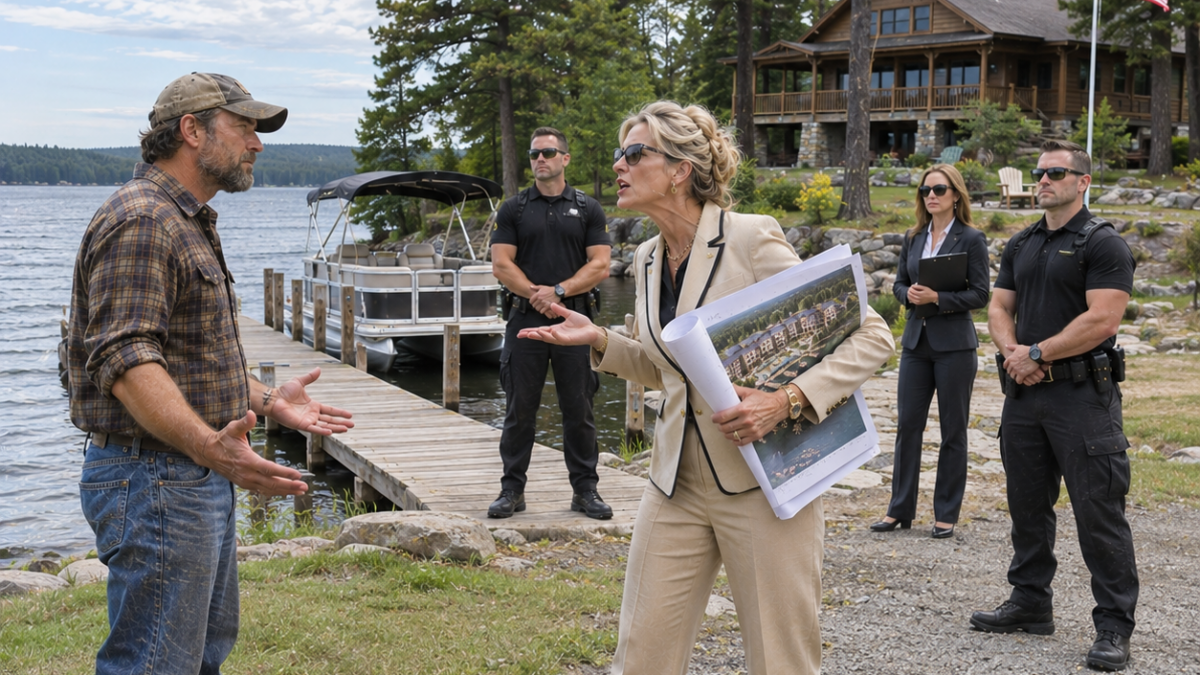
“Arrest Him for Trespassing!” the HOA President Demanded While I Swept the Porch of My Brand-New, Non-HOA Home. At 67, I’d Sold My Old House to Escape Fifteen Years of Ridiculous Fines. Now She Claimed My Driveway, Lawn, and Mailbox Were “Community Property,” Sent Men to Threaten Me, and Produced a New Boundary Map—But the County Records Told a Different Story…
The police officer looked uncomfortable as he stepped out of his cruiser and approached my front porch.
“Sir, we’ve received a complaint that you’re unlawfully occupying property controlled by the Maple Grove Estates Homeowners Association.”
I stared at him.
Then at the broom in my hand.
Then at the house I’d purchased eight days earlier.
“Officer, I’m sixty-seven years old. I’m sweeping my own porch. What exactly am I supposed to be trespassing on?”
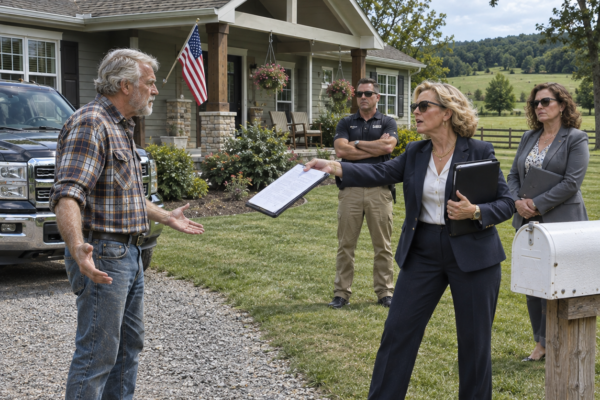
Before he could answer, a woman in a pastel blazer marched up my driveway.
“Everything!” she snapped. “His driveway, his front yard, even that ridiculous sign. All of it falls under HOA jurisdiction!”
Her name was Karen Miller.
She was president of Maple Grove Estates.
And she’d spent the past week trying to convince me that my new home belonged to an association I’d never joined.
She pointed at my wooden sign.
PRIVATE PROPERTY — NO HOA TRESPASSING.
“That sign is an unauthorized structure,” she declared. “I’ve already told him to remove it.”
The older officer glanced toward me.
“Sir, do you have documents showing you own this property?”
“Every document you could possibly want.”
Karen laughed.
“He’s been waving outdated paperwork around since he moved in. Our community boundaries were amended last year.”
I looked her straight in the eye.
“Then show us the recorded amendment.”
Her smile tightened.
That was the first time I’d seen her hesitate.
My name is Frank Rivers, and until eight days earlier, I genuinely believed my retirement nightmare was over.
For nearly fifteen years, I’d lived in a subdivision controlled by an HOA that seemed to invent new violations whenever its board needed something to discuss.
They fined me because my American flag was three inches larger than their approved dimensions.
They sent a warning when my granddaughter drew hopscotch squares on the sidewalk with washable chalk.
They complained about my pickup.
My trash cans.
The color of my front door.
Once, they threatened a fine because I left a folding chair on my porch after sunset.
After my wife, Elaine, died, I lost the patience to keep arguing.
I wanted peace.
I wanted a porch where I could drink coffee without someone measuring my furniture.
I wanted my grandchildren to visit without worrying that somebody would report their bicycles as a community nuisance.
So I sold the house.
And I gave my real estate agent one absolute requirement.
“No HOA. Not a small HOA. Not a voluntary HOA. None.”
Eventually, she found a beautiful brick home at the end of a quiet cul-de-sac in Ohio.
Mature maple trees.
A wide driveway.
A garage large enough for my tools.
And a covered porch that reminded me of the first house Elaine and I owned.
Before buying, I checked everything.
The deed.
The subdivision plat.
The title documents.
The county land records.
My property had never been included in Maple Grove Estates.
I signed the papers and moved in.
My son helped carry furniture.
My daughter unpacked the kitchen.
My granddaughter Lily announced that the porch was the perfect place to watch thunderstorms.
For the first time in years, I felt like I could breathe.
Then Karen appeared.
She arrived in a black SUV with a clipboard and announced that Maple Grove had expanded its boundaries.
According to her, my driveway was a community access area, my lawn was HOA-managed landscaping, and I needed to complete a seventeen-step residency approval process.
I thought she was joking.
She wasn’t.
When I showed her my deed, she said county records could be outdated.
When I asked for the amended plat, she refused.
When I told her to leave my property, she threatened fines, liens, and legal action.
Then she asked whether I lived alone.
The way she said it made my skin crawl.
Over the following days, the letters started arriving.
NOTICE OF UNAUTHORIZED OCCUPANCY.
FINAL WARNING OF NONCOMPLIANCE.
POTENTIAL PHYSICAL REMOVAL.
People I didn’t know began photographing my house.
A black SUV passed slowly several times a day.
Two men wearing HOA security shirts appeared at my door, demanding permission to inspect my fence.
I installed cameras and contacted attorney Cindy Han.
She checked the county records and confirmed what I already knew: my home wasn’t part of Maple Grove.
But Karen wasn’t finished.
She called the police and accused me of illegally occupying association property.
Now two officers were standing on my driveway, comparing my recorded deed with the glossy map Karen had brought.
The younger officer pointed to a red boundary line she’d drawn around my house.
“This says your property was added last year.”
Karen smiled triumphantly.
“Exactly.”
The older officer studied the paper.
Then he looked at the county recording information on my documents.
“Mrs. Miller, I have one question.”
She straightened.
“Of course, Officer.”
“Where is the recording number for this amendment?”
Karen opened her mouth.
Then closed it.
The officer waited.
And for the first time since she’d stepped onto my driveway, the woman who claimed to own everything around me had no answer.
Part 2:
The police officer looked uncomfortable as he stepped out of his cruiser and approached my front porch.
“Sir, we’ve received a complaint that you’re unlawfully occupying property controlled by the Maple Grove Estates Homeowners Association.”
I stared at him.
Then at the broom in my hand.
Then at the house I’d purchased eight days earlier.
“Officer, I’m sixty-seven years old. I’m sweeping my own porch. What exactly am I supposed to be trespassing on?”
Before he could answer, a woman in a pastel blazer marched up my driveway.
“Everything!” she snapped. “His driveway, his front yard, even that ridiculous sign. All of it falls under HOA jurisdiction!”
Her name was Karen Miller.
She was president of Maple Grove Estates.
And she’d spent the past week trying to convince me that my new home belonged to an association I’d never joined.
She pointed at my wooden sign.
PRIVATE PROPERTY — NO HOA TRESPASSING.
“That sign is an unauthorized structure,” she declared. “I’ve already told him to remove it.”
The older officer glanced toward me.
“Sir, do you have documents showing you own this property?”
“Every document you could possibly want.”
Karen laughed.
“He’s been waving outdated paperwork around since he moved in. Our community boundaries were amended last year.”
I looked her straight in the eye.
“Then show us the recorded amendment.”
Her smile tightened.
That was the first time I’d seen her hesitate.
My name is Frank Rivers, and until eight days earlier, I genuinely believed my retirement nightmare was over.
For nearly fifteen years, I’d lived in a subdivision controlled by an HOA that seemed to invent new violations whenever its board needed something to discuss.
They fined me because my American flag was three inches larger than their approved dimensions.
They sent a warning when my granddaughter drew hopscotch squares on the sidewalk with washable chalk.
They complained about my pickup.
My trash cans.
The color of my front door.
Once, they threatened a fine because I left a folding chair on my porch after sunset.
After my wife, Elaine, died, I lost the patience to keep arguing.
I wanted peace.
I wanted a porch where I could drink coffee without someone measuring my furniture.
I wanted my grandchildren to visit without worrying that somebody would report their bicycles as a community nuisance.
So I sold the house.
And I gave my real estate agent one absolute requirement.
“No HOA. Not a small HOA. Not a voluntary HOA. None.”
Eventually, she found a beautiful brick home at the end of a quiet cul-de-sac in Ohio.
Mature maple trees.
A wide driveway.
A garage large enough for my tools.
And a covered porch that reminded me of the first house Elaine and I owned.
Before buying, I checked everything.
The deed.
The subdivision plat.
The title documents.
The county land records.
My property had never been included in Maple Grove Estates.
I signed the papers and moved in.
My son helped carry furniture.
My daughter unpacked the kitchen.
My granddaughter Lily announced that the porch was the perfect place to watch thunderstorms.
For the first time in years, I felt like I could breathe.
Then Karen appeared.
She arrived in a black SUV with a clipboard and announced that Maple Grove had expanded its boundaries.
According to her, my driveway was a community access area, my lawn was HOA-managed landscaping, and I needed to complete a seventeen-step residency approval process.
I thought she was joking.
She wasn’t.
When I showed her my deed, she said county records could be outdated.
When I asked for the amended plat, she refused.
When I told her to leave my property, she threatened fines, liens, and legal action.
Then she asked whether I lived alone.
The way she said it made my skin crawl.
Over the following days, the letters started arriving.
NOTICE OF UNAUTHORIZED OCCUPANCY.
FINAL WARNING OF NONCOMPLIANCE.
POTENTIAL PHYSICAL REMOVAL.
People I didn’t know began photographing my house.
A black SUV passed slowly several times a day.
Two men wearing HOA security shirts appeared at my door, demanding permission to inspect my fence.
I installed cameras and contacted attorney Cindy Han.
She checked the county records and confirmed what I already knew: my home wasn’t part of Maple Grove.
But Karen wasn’t finished.
She called the police and accused me of illegally occupying association property.
Now two officers were standing on my driveway, comparing my recorded deed with the glossy map Karen had brought.
The younger officer pointed to a red boundary line she’d drawn around my house.
“This says your property was added last year.”
Karen smiled triumphantly.
“Exactly.”
The older officer studied the paper.
Then he looked at the county recording information on my documents.
“Mrs. Miller, I have one question.”
She straightened.
“Of course, Officer.”
“Where is the recording number for this amendment?”
Karen opened her mouth.
Then closed it.
The officer waited.
And for the first time since she’d stepped onto my driveway, the woman who claimed to own everything around me had no answer.
Finally, she tapped her clipboard.
“The document was approved through our internal procedures. Our legal team handles the county filings.”
The older officer, whose name tag read RICHARDS, looked unimpressed.
“Do you have something showing the county accepted and recorded it?”
“Not with me.”
“Then I can’t treat this as proof that Mr. Rivers is occupying HOA property.”
She folded her arms.
“Officer, the association has managed this neighborhood for more than twenty years.”
“That doesn’t answer my question.”
Karen’s smile disappeared.
I handed Officer Richards a copy of the recorded plat and pointed out the lot number. The sheet showed my house at the end of the cul-de-sac, separated from the Maple Grove development by a heavy boundary line. The county’s recording information appeared along the margin.
He examined both documents and spoke briefly with the second officer.
Then he turned toward Karen.
“Ma’am, this appears to be a disagreement over property rights. We don’t have grounds to remove this gentleman from his residence. You’ll need to address any genuine title or easement dispute through the proper civil process.”
Karen stared at him as if he’d refused to recognize an elected governor.
“You’re allowing him to continue his illegal occupation?”
“I’m telling you we aren’t evicting a man from a house he holds a recorded deed to based on an unverified HOA map.”
She pointed toward my porch.
“That sign violates our community standards.”
“Is his property subject to those standards?”
“According to our records, yes!”
“Then have your attorney establish that.”
I almost smiled.
Not because the situation was funny anymore, but because someone had finally insisted that Karen support a claim with more than her own opinion.
She stepped closer to Richards.
“What about the harassment? He’s been filming our compliance volunteers.”
“On his own property?”
“They were performing association business.”
The officer looked toward me.
“Mr. Rivers, have you threatened anyone?”
“No, sir. I told people who weren’t invited to leave my property. I have recordings of the visits.”
“Keep those.”
Karen made an exasperated sound.
Richards turned back to her.
“And ma’am, unless you have a lawful reason to enter this property, I strongly recommend you stop treating the owner’s driveway as association common area.”
She was furious.
I could see it in the stiff way she held her shoulders and the white pressure of her fingers around the clipboard.
But she wasn’t finished.
As the officers walked toward their cruiser, Karen leaned close enough that only I could hear.
“You think two police officers are going to save you?”
I looked at her.
“Save me from what?”
“From the consequences of refusing to cooperate.”
I glanced toward the camera mounted above my front door.
“Karen, I suggest you choose your next words carefully.”
Her eyes followed mine.
For the first time, she noticed the little blinking indicator.
Her expression changed.
Then she stepped backward and walked to her SUV.
Before getting in, she pointed toward the house.
“This isn’t over, Mr. Rivers.”
I watched her drive away.
The cruiser followed a minute later.
The street was quiet again.
I stood beside the porch railing with my broom and stared at the place where Karen’s SUV had been parked.
I’d lived through fifteen years of HOA letters in my old neighborhood.
But this was different.
Back there, the association at least had governing documents that applied to my property, however foolishly some directors interpreted them.
Here, Karen was trying to enforce rules against a home that had never belonged to her organization.
That wasn’t an argument over a flower bed or a trash can.
It was an attempt to claim authority where none existed.
And I was beginning to suspect she knew it.
That evening, Cindy Han came to my house.
She was forty-six, with short dark hair, a practical manner, and the habit of reading every page in a folder before announcing what she thought.
I’d met her through my neighbor Greg, who had warned me that Karen had a history of pressuring homeowners.
Cindy sat at my kitchen table with the county documents spread in front of her.
“Let’s start with what we actually know,” she said.
I poured us coffee.
“That Karen’s nuts?”
“That’s your opinion, Frank. I want the things we can prove.”
I sat down.
“Fair enough.”
She tapped my deed.
“You have a recorded title to this parcel. Your title search did not identify an HOA declaration affecting it. The official subdivision plat places your home outside Maple Grove.”
She moved to another sheet.
“The proposed amendment Karen is relying on was submitted to the county last year.”
I leaned forward.
“Submitted?”
“Yes. Not accepted and recorded.”
“Why not?”
“The submission was deficient. The county returned it for corrections and additional supporting documentation. I haven’t found a later approved filing.”
I stared at her.
“So the county rejected her map.”
“The proposed filing never became an effective recorded plat amendment. That’s the important point.”
I sat back.
“Then how does she keep saying my lot was added?”
Cindy looked toward the stack of HOA letters.
“That is what we need to investigate.”
I rubbed my forehead.
“Can a homeowners association just expand its boundaries if the board votes for it?”
“Not in the way she’s describing. It would require the appropriate property rights, governing instruments, owner consent where necessary, and legally effective documentation. A board doesn’t acquire somebody else’s land by coloring a new line on a drawing.”
I laughed once.
“Somebody should tell Karen.”
“We’re going to.”
Cindy prepared a formal letter demanding that Maple Grove stop issuing enforcement notices, cease unauthorized entry, and provide the legal basis for its claims.
She asked the association to preserve all relevant maps, meeting minutes, correspondence, financial records, and communications with contractors.
She also warned that any attempt to file a lien against my title based on unsupported fines would be challenged immediately.
I looked at her.
“Will that stop her?”
“Maybe.”
She didn’t sound convinced.
“Maybe?”
“Frank, some people stop when they realize their legal position is weak. Others decide that admitting a mistake would be worse than continuing it.”
I thought about Karen’s expression when Officer Richards asked for the recording number.
“Guess which kind she is.”
Cindy gave me a small, weary smile.
“I have a suspicion.”
The next morning, someone left another notice in my mailbox.
I didn’t know who’d delivered it until I checked the camera.
A man wearing a Maple Grove polo shirt had walked up to my driveway at 6:12 a.m., placed the envelope inside, photographed the mailbox, and left.
The notice claimed I’d accumulated $4,750 in noncompliance charges.
There was a $500 initial occupancy assessment.
Another $750 for refusing architectural review.
Then daily penalties for alleged unauthorized use of the driveway and yard.
At the bottom, Karen had added a handwritten warning.
Continued refusal will lead to enforcement at the owner’s expense.
I sent the document to Cindy.
She called before lunch.
“Do not pay any of this, Frank. And don’t sign their residency application.”
“I wasn’t planning to.”
“I’m emphasizing it because the forms appear designed to have you acknowledge HOA authority that you dispute.”
I looked at the seventeen-page application Karen had delivered earlier.
It asked for my household information, vehicle details, exterior modification history, and agreement to be bound by Maple Grove’s enforcement policies.
At sixty-seven, I was too old to confuse an application for permission to live in my own home with a neighborly welcome packet.
I put it back in the folder.
Then I went outside to work on the garden bed.
That’s when Greg walked over.
Greg Dawson lived three houses down.
He was fifty-three, wore New Balance sneakers with nearly everything, and seemed to know everybody who had lived on our street since it was built.
He stopped beside my driveway.
“Heard the police were here again.”
I sighed.
“Karen called to report me trespassing on my porch.”
Greg shook his head.
“She’s getting desperate.”
“Desperate for what? I don’t own anything she needs.”
He looked at my house.
Then down the cul-de-sac.
“Actually, Frank, I think you do.”
I set my garden trowel down.
“What?”
Greg pointed toward the intersection where our dead-end street connected to Maple Grove’s main entrance road.
“Your place is one of the last original properties on this end of the neighborhood. Karen’s been trying to bring all these older lots under the association for years.”
“Why?”
“That’s the question nobody’s been able to answer.”
He hesitated.
Then said, “Come take a walk with me.”
We went slowly along the sidewalk beneath the maple trees.
He pointed out which homes were original non-HOA properties and which had been purchased by owners who later voluntarily joined Maple Grove.
Several houses had matching mailboxes, new fences, and identical landscaping.
Others retained their older appearances.
Greg stopped outside a freshly renovated two-story home with gray siding.
“The Johnson family lived there.”
“What happened to them?”
“Karen hit them with repeated violation notices. Their dog, their fence, their shed, their trash cans. They finally got tired of arguing.”
“Were they actually members?”
“Not when the trouble started.”
I looked at the house.
“They sold?”
“To an investment group. The house was renovated and sold again. By then, the paperwork included a new HOA arrangement.”
“Was it the same with anybody else?”
Greg nodded toward another house farther down.
“The Millers before you? Different Millers, no relation to Karen. Similar story. They sold to the same group after months of pressure.”
I stopped walking.
“Same buyer?”
“Same investment outfit, or companies connected to it. That’s what I heard.”
He looked at me.
“I’m not saying I can prove Karen arranged those sales. But she pushed both families hard before they left.”
I studied the houses.
They looked ordinary.
Clean yards.
Fresh paint.
Children’s bicycles.
There was nothing about them that suggested their former owners had walked away exhausted by harassment.
“What’s the investment company called?”
Greg thought for a moment.
“Briarstone Acquisitions, I believe.”
I repeated the name.
He nodded.
“Something like that.”
We walked back toward my house.
Greg stopped beside the porch steps.
“I don’t want to scare you, Frank. But Karen isn’t just trying to make you fill out a form. She wants that house under her control.”
I looked up at the brick walls, the porch where Lily had announced she’d watch storms, and the garage containing my tools.
I’d bought it because I was finished fighting over where I lived.
Now a woman with a clipboard appeared determined to decide whether I was allowed to stay.
I turned toward Greg.
“Well, she picked the wrong old man.”
He smiled.
“That’s what I was hoping you’d say.”
That night, I called my son, David.
He was forty-two and had inherited his mother’s talent for noticing when I was pretending not to be upset.
“Dad, you sound tired.”
“Just been busy.”
“With the house?”
“With a woman who thinks she owns the house.”
I explained the police visits, the notices, and the proposed boundary amendment.
When I finished, he was quiet.
“Do you want me to come down?”
“No. You’ve got work and the kids.”
“Dad.”
“I’m fine, David.”
He sighed.
“You know Mom used to say that exact thing right before telling you what was bothering her.”
I smiled despite myself.
“Your mother was usually right.”
“She usually was.”
He promised to visit that weekend.
After we hung up, I walked through the quiet house.
There were still unopened boxes in the guest bedroom.
Elaine’s favorite blue-and-white dishes sat in the kitchen cabinet.
Her photograph stood on the mantel beside a small wooden clock we’d bought on our twenty-fifth anniversary.
When we were younger, we’d talked about retiring somewhere peaceful.
A little yard.
A porch.
Enough space for the grandchildren to play.
She hadn’t lived long enough to see this house.
I had chosen it partly because I could imagine her liking it.
And I wasn’t about to let Karen Miller turn it into another place filled with threatening letters.
The following morning, I finished installing the last of my security cameras.
One covered the porch.
One faced the driveway.
Another overlooked the garage and side gate.
The fourth monitored the backyard.
I configured them to save recordings automatically and made a second copy of anything involving the HOA.
It seemed excessive for a man who mostly spent his days gardening.
Then, at 10:34 that morning, I opened the front door and found two men standing beside Karen.
Both wore black polo shirts with gold Maple Grove logos.
One was broad-shouldered with a shaved head.
The other stood slightly behind him, wearing sunglasses despite the cloudy sky.
Karen smiled.
“Good morning, Mr. Rivers. We’re conducting your final compliance inspection.”
I stayed inside the doorway.
“No, you’re not.”
She looked past me into the house.
“We need to examine the exterior modifications you’ve made without authorization.”
“The house isn’t part of your association.”
“That’s your interpretation.”
“It’s also the county’s recorded boundary.”
The larger man stepped forward.
“Sir, Mrs. Miller is asking you to cooperate.”
I looked at him.
“What’s your name?”
“Trent.”
“Trent what?”
“Trent Barlow.”
“And you work for the HOA?”
“I’m with its contracted compliance service.”
“Are you a police officer?”
“No.”
“Do you have a court order?”
“No.”
“Then you have no authority to enter my property or inspect my house without permission.”
Karen sighed loudly.
“Frank, you’re making this unnecessarily confrontational.”
I looked toward the camera.
“All three of you have been told to leave. Please go.”
The man in sunglasses stepped closer.
“Wouldn’t want anything unfortunate to happen to that fence.”
I stared at him.
“What exactly does that mean?”
He shrugged.
“Unauthorized structures can be removed.”
“My fence has been standing since the house was built.”
“Then it should be easy to replace,” he replied.
Karen gave his arm a quick tap.
“Let’s not get sidetracked.”
I reached for my phone.
“You’re threatening to damage my property, and you’re refusing to leave. I’m calling the sheriff.”
Karen rolled her eyes.
“Go ahead. They’ve already told you it’s a civil matter.”
“That doesn’t give you permission to threaten me at my own front door.”
I called.
Then I stayed inside, with the front door locked.
The three of them remained on the porch.
Trent rang the bell twice.
Karen paced beside the railing.
At one point, she held up her clipboard toward the camera and announced that I was refusing a lawful inspection.
I saved every second.
When two sheriff’s deputies arrived, they separated the parties and asked what had happened.
I gave them the video.
Karen interrupted repeatedly, saying the men were authorized enforcement personnel and that I was interfering with community operations.
The senior deputy watched the recording.
Then he looked toward Trent.
“Did you threaten to remove this gentleman’s fence?”
Trent shook his head.
“We were explaining compliance procedures.”
The deputy played the section where the other man mentioned that something unfortunate might happen to the fence.
He looked toward him.
“That’s a poor choice of words, particularly on property where your employer’s authority is disputed.”
The man in sunglasses looked away.
The deputy turned toward Karen.
“Mrs. Miller, Mr. Rivers has asked you and your associates to leave his property. There’s no court order authorizing an inspection here. We’re directing you to leave the premises.”
Karen stared.
“You can’t take his side when the ownership is under review!”
“We aren’t deciding title. We’re responding to a complaint about unwanted entry and threatening conduct.”
She pointed at me.
“He’s obstructing enforcement!”
The deputy’s voice hardened.
“Ma’am, leave the porch.”
For several seconds, nobody moved.
Then Trent walked toward the driveway.
The other man followed.
Karen remained where she was.
The deputy repeated himself.
She finally turned and stormed toward the SUV.
Before getting in, she looked back at me.
“You think cameras make you untouchable?”
“No,” I said. “I think they make it easier to show what happened.”
She slammed the vehicle door.
The deputies documented the incident and advised me to continue working through Cindy on the property dispute.
One stayed behind briefly to ask about Karen’s earlier visits.
I showed him the envelopes, the messages, and the footage of people photographing my house.
He listened carefully.
“Some of this may be lawful activity from the public street,” he explained. “But if people are repeatedly entering your property after being told not to, or threatening you, keep reporting the specific conduct.”
I nodded.
“I will.”
When they left, I sat on the porch and looked at the road.
I was tired of being angry.
Tired of looking through the curtains whenever a vehicle slowed.
Tired of wondering what Karen would do next.
That evening, my granddaughter called.
“Grandpa, can we still come Saturday?”
“Of course, sweetheart.”
“Dad says somebody’s been bothering you.”
I looked toward the mailbox.
“Just a disagreement with a neighbor.”
“Is she going to make us leave?”
The question hit me harder than any of Karen’s threats.
“No, Lily. This is your grandpa’s house. You’re welcome here whenever you want.”
She sounded relieved.
“Good. I’m bringing my sidewalk chalk.”
I smiled.
“Bring every color you’ve got.”
After the call, I sat for a long time looking at Elaine’s photograph.
I hadn’t bought the house to become a neighborhood crusader.
I wanted the grandchildren to remember laughter on the porch, not their grandfather arguing with strangers over a fence.
But if I let Karen frighten me out of the house, she’d be teaching Lily a lesson I couldn’t accept.
That bullies were entitled to whatever they demanded.
I wasn’t going to let that happen.
The next day, Cindy called with news.
“I obtained the county’s returned amendment packet.”
“Anything useful?”
“Quite a bit. And I’ve also heard from someone who served on the HOA board.”
I sat down.
“Who?”
“Melanie Ruiz. She was the association secretary during part of last year.”
“What did she say?”
“That the board never took the vote the amendment paperwork claims it took.”
I stared at the phone.
“Karen submitted a boundary change without a board vote?”
“That’s what Melanie says. She has copies of the meeting minutes and attendance records.”
I thought about the glossy map Karen had waved in front of the officers.
“Can I see them?”
“Come to my office.”
An hour later, I sat across from Cindy with the packet open on the table.
The proposed amendment claimed approval by a majority of the Maple Grove board.
Attached was a signature sheet.
Four names appeared beneath the approval language.
Cindy pointed to the first.
“Melanie says she didn’t sign this.”
Then the second.
“This director told her he wasn’t even present at the meeting where the approval supposedly occurred.”
She turned to another page.
“And according to the official minutes Melanie retained, the board discussed possible expansion but deferred any action pending legal review.”
I looked at the signature sheet.
“Could the signatures be mistakes?”
“Possibly. They could have been copied from other documents, or the packet might have been assembled improperly. That’s why we need verification rather than assumptions.”
Cindy had already requested originals and relevant records from the association’s counsel.
She also explained that the county’s return of the packet didn’t, by itself, prove fraud.
But the documents were troubling enough to warrant a formal investigation.
I read the supposed approval language again.
The undersigned authorize the inclusion of the designated properties within Maple Grove Estates.
My lot was listed in the attached schedule.
So were several other homes on the same street.
The Johnson property.
The former Miller property.
Greg’s house.
A handful of original lots near the cul-de-sac.
I looked up.
“She didn’t just try to add my property.”
“No.”
“She tried to add the entire end of the street.”
Cindy nodded.
“And the documents we have don’t establish valid consent from those landowners.”
I thought about Greg telling me how two families had sold after months of violation notices.
Suddenly, the harassment looked less random.
It looked coordinated.
Then Cindy turned to the last section of the packet.
It contained an invoice.
PINE RIDGE RESOURCES — BOUNDARY INTEGRATION CONSULTING.
Amount: $28,500.
I stared at it.
“What kind of boundary consulting costs almost thirty thousand dollars?”
“That depends on the work. Some legitimate surveys and legal projects can be expensive. But this invoice doesn’t identify a licensed surveyor or the work performed.”
She tapped the company name.
“I’ve requested more information.”
I looked toward her.
“Do you think this is connected to the investment company Greg mentioned?”
“I don’t know yet.”
Cindy closed the folder.
“But we’re going to find out.”
That was the moment I understood Karen’s obsession might have very little to do with community standards.
She hadn’t merely been protecting a neighborhood from an elderly man with an unauthorized garden border.
She had been trying to bring a collection of privately owned homes under Maple Grove’s control.
And somebody was getting paid to help.
Over the following two weeks, the situation began unraveling in ways Karen couldn’t control.
Melanie provided a sworn statement describing the disputed board records.
Another former director confirmed that he’d never approved a compulsory annexation of the non-HOA lots.
The county clerk’s office certified that no accepted amendment adding my property appeared in the official land records.
Cindy also contacted the owners of the two houses Greg had mentioned.
The Johnsons had moved to a town about forty miles away.
They agreed to speak with her.
What they described sounded painfully familiar.
Repeated violation notices.
Threats of fines.
Unwanted visits from compliance contractors.
Letters suggesting they could face legal expenses if they refused to submit to Maple Grove’s governing documents.
Then, after months of pressure, an investor approached them with an offer.
The price was below what they’d hoped to receive.
But they were exhausted.
Mrs. Johnson had begun dreading the sight of the mail carrier.
Her husband was losing sleep.
They accepted the offer because they wanted the harassment to stop.
After the sale, the house was renovated.
A later owner signed documents bringing the property under Maple Grove’s covenants.
That didn’t prove Karen had arranged the harassment to force a sale.
But it established a sequence worth investigating.
Cindy obtained the public property records showing which companies had acquired the houses.
One of the buyers was Briarstone Acquisitions LLC.
The records connected it through ownership filings to a larger investment group.
And when Cindy traced the available business registrations, she found a name connected to both that group and Pine Ridge Resources.
Derek Miller.
Karen’s husband.
I stared at the printed records on Cindy’s desk.
“Her husband?”
“Yes.”
I looked at the consulting invoice again.
Then at the two home purchases.
“So Karen pressures owners to sell, a company connected to her husband buys their houses, and the HOA later adds them to the association?”
“That’s the pattern we’re examining,” Cindy replied. “We still need evidence connecting her decisions to the company’s transactions and any improper benefit.”
I leaned back.
I had believed Karen wanted control because she enjoyed ordering people around.
That was certainly part of it.
But now there was a possible financial reason to pressure homeowners on our street.
The companies could acquire houses more cheaply from exhausted owners.
They could renovate and resell them.
And the association could gain more dues-paying properties.
I thought about the way Karen had looked at my house when she first stepped out of her SUV.
Not like a neighbor welcoming someone new.
Like a buyer evaluating an opportunity.
Cindy looked at me.
“Frank, I’m going to pursue civil relief to stop the unsupported enforcement and protect your title. I’m also referring the suspected document and financial irregularities to the appropriate investigators.”
I nodded.
“Good.”
“But you need to keep doing what you’ve been doing. Don’t confront Derek. Don’t accuse people publicly of crimes we haven’t established. Preserve everything.”
I smiled without humor.
“You’re asking an old man to stay patient.”
“I’m asking a smart man to let the evidence catch up with his suspicions.”
I could live with that.
For the moment.
Karen didn’t know how much we had uncovered when she came to my house that Friday evening.
It was 7:22.
I remember because I’d just taken a frozen lasagna out of the oven and glanced at the kitchen clock when the doorbell rang.
The camera showed her standing on my porch.
No clipboard this time.
Just a thick stack of papers and an expression of absolute fury.
I spoke through the doorbell intercom.
“Karen, you’ve been told not to come onto my property.”
She leaned toward the camera.
“You think you’re going to destroy everything I’ve worked for?”
“I filed a complaint because you tried to claim my house.”
“You’ve been spreading lies about my family!”
“I haven’t made any public accusations about your family.”
She struck the door with her palm.
“Open it!”
“No.”
“You’re trying to ruin me!”
I thought about the Johnsons, who had sold their house after months of pressure.
I thought about the people who had accepted fines they might never have owed.
And I thought about Elaine, who had wanted us to spend our later years somewhere peaceful.
“Karen, I bought this house because I wanted to live without an HOA. You knew I wasn’t a member. You tried to force me into your association anyway.”
She backed away from the door.
“Maple Grove needs order! People like you ruin neighborhoods!”
“People like me?”
“People who think they can do whatever they please!”
I looked at her through the camera.
“You mean people who expect you to respect their property?”
Her face reddened.
Then she said something that explained more than she probably intended.
“You could have made this easy. You could have filled out the application, accepted the rules, or sold the house to somebody willing to cooperate.”
I remained silent.
She continued.
“But no. You had to bring lawyers into it.”
I watched her grip the papers.
“Karen, did you want me to sell?”
She stopped speaking.
I asked again.
“Was that what this was about?”
She looked directly into the camera.
“Some people aren’t suited to living in a planned community.”
“This isn’t part of your planned community.”
She stepped toward the door again.
“It will be eventually.”
I had heard enough.
I told her I was calling the sheriff and that she needed to leave.
Then I called.
She stayed on my porch another five minutes, shouting through the door.
When a deputy arrived, he reviewed the situation, confirmed the earlier complaints, and directed her to leave.
She argued.
Then she finally retreated to her vehicle.
The deputy documented the incident and told her that further conduct could lead to additional enforcement action.
Before driving away, Karen lowered her window.
“You’ll regret this, Rivers.”
I looked at her.
“No, Karen. I’m done regretting the decision to buy a home that belongs to me.”
She drove off.
The next morning, I sent the recording to Cindy.
Her response was short.
Keep the original. Don’t communicate with her directly.
By then, our civil case was moving forward.
Cindy had requested an injunction preventing the association and its representatives from entering my property for purported compliance inspections, imposing unsupported fines, or interfering with my possession while the ownership dispute was addressed.
The county’s accepted land records supported my position.
The association had yet to produce an effective recorded instrument establishing any right over my lot.
At the initial hearing, Karen’s attorney tried to argue that the boundaries remained uncertain because of the proposed amendment.
The judge asked whether that amendment had ever been accepted and recorded.
The attorney admitted it had not.
The judge then asked whether I had signed an agreement submitting my property to Maple Grove.
No such agreement existed.
Finally, the court asked what legal basis justified sending contractors to threaten removal of my fence.
The attorney couldn’t identify one.
The judge entered temporary relief protecting my property while the remaining issues were resolved.
For the first time since moving in, I had something stronger than Karen’s promises to behave.
I had an enforceable court order.
But the civil case was only one part of what followed.
The county’s financial-crimes investigators and the state authorities responsible for examining the suspected document fraud began reviewing the records Cindy had referred.
They obtained the necessary documents through proper investigative procedures.
The work took time.
Bank records had to be examined.
Corporate ownership information had to be verified.
Witnesses had to be interviewed.
And the disputed signatures required more than somebody saying they looked suspicious.
The investigators eventually established that several signatures on the proposed HOA expansion paperwork had been reproduced without authorization.
They also uncovered payments from the association to Pine Ridge Resources for services that weren’t adequately supported by legitimate work records.
The company was connected to Derek Miller.
Other records linked him to the investment group that had acquired properties from owners who’d experienced prolonged enforcement pressure.
The investigators didn’t simply assume every house sale was fraudulent.
They examined communications, payment records, property transactions, and the relationship between the companies and Karen’s decisions as president.
What emerged was a far more troubling picture than an overenthusiastic woman enforcing landscaping rules.
The evidence showed that Karen had used her position to support expansion claims she knew lacked the necessary approval.
Financial benefits flowed to businesses connected with her household.
And some homeowners had been subjected to enforcement demands despite the absence of valid HOA authority over their lots.
I wasn’t given every detail during the investigation.
I wasn’t entitled to be.
But I cooperated when asked.
I provided the original letters, recordings, property documents, and my account of each visit.
Greg and several former homeowners did the same.
Melanie supplied the meeting records.
Other board members answered questions about the disputed signatures.
Eventually, prosecutors brought charges arising from the document and financial misconduct.
Karen and Derek retained attorneys and contested the allegations.
The criminal proceedings took months.
During that period, Maple Grove held a special board meeting.
The clubhouse was crowded.
People who’d once accepted Karen’s statements without question were now demanding to see the association’s accounts.
A retired homeowner stood and asked why reserve money had been paid to a business connected to the president’s husband.
Another wanted to know why the board had received inaccurate boundary information.
A woman whose family had paid several questionable assessments asked whether the association intended to refund them.
Karen tried to frame the situation as a campaign against community order.
But the directors had already reviewed the official plat.
The rejected amendment.
The legal correspondence.
And the financial irregularities.
They voted to remove her as president under the association’s procedures.
A separate process addressed her remaining board position.
Maple Grove retained an independent auditor and new legal counsel.
The pending expansion claims were withdrawn.
The association began reviewing enforcement actions involving properties outside its recorded jurisdiction.
Some fines were canceled.
Some homeowners received reimbursements or settlements after their circumstances were examined.
The board also adopted controls requiring conflicts of interest to be disclosed and major contracts to receive independent review.
It wasn’t a perfect transformation overnight.
The residents still had to deal with legal expenses and the consequences of decisions made in their association’s name.
But at least the people asking questions were finally being heard.
Later, the criminal proceedings resulted in convictions connected to the fraudulent documentation and improper financial transactions.
The court imposed sentences and financial obligations based on the offenses established.
Separate civil proceedings and settlements addressed claims by affected homeowners.
I didn’t attend every hearing.
I attended the ones where my testimony was needed.
When the final rulings became public, I read them at my kitchen table.
Then I closed the folder.
I didn’t feel triumphant.
I felt tired.
For months, Karen had treated my house like a prize she intended to claim.
Now the county records, the court orders, and the corrected HOA documents all confirmed what had been true from the day I signed my purchase contract.
My property was independent of Maple Grove.
The association had no authority to regulate my lawn, mailbox, driveway, fence, or front porch.
Its claims against me had been withdrawn or rejected.
And nobody was going to force me into a seventeen-step residency approval process simply because Karen Miller didn’t like hearing the word no.
One afternoon, Greg came over carrying a six-pack of root beer.
He held it up.
“Thought we should celebrate.”
I laughed.
“At our age, this is about as wild as I get.”
We sat on the porch.
The sun was moving through the maple leaves.
A little breeze made the wind chimes beside the door ring softly.
Greg looked toward the street.
“Funny thing. The new board wants to organize a neighborhood picnic.”
I raised an eyebrow.
“Are they going to fine me for eating potato salad without a permit?”
He laughed so hard he nearly spilled his drink.
“No. I think they’ve finally learned the difference between a homeowners association and the federal government.”
“Good. Somebody should tell them that neighborhood harmony doesn’t require everyone having the same mailbox.”
Greg nodded.
He was quiet for a moment.
Then he said, “You know, Frank, the Johnsons called me. They heard what happened.”
“How are they?”
“Doing better. They say they’re relieved somebody finally investigated.”
I looked down at my hands.
“I wish somebody had helped them sooner.”
“So do I.”
We sat together without speaking.
Then Greg looked at the sign beside my driveway.
“You going to leave that up forever?”
I followed his gaze.
PRIVATE PROPERTY — NO HOA TRESPASSING.
I considered the question.
Then I smiled.
“Maybe not forever.”
The following weekend, David arrived with my daughter and the grandchildren.
Lily climbed out of the car carrying a plastic bucket filled with sidewalk chalk.
“Grandpa!”
I stepped off the porch.
She ran into my arms.
“Are the mean people gone?”
I looked toward the quiet street.
“Yes, sweetheart. They’re gone.”
She pulled back.
“Can we draw on the driveway?”
I smiled.
“Every square inch.”
Within an hour, there were pink stars, blue flowers, orange butterflies, and a crooked hopscotch court stretching from the garage toward the sidewalk.
My grandson drew a dinosaur that looked suspiciously like a very angry chicken.
David helped me set up the grill.
My daughter arranged plates on the porch table.
And for the first time since moving in, I stopped checking the security-camera notifications every few minutes.
That evening, Lily came to sit beside me.
She was holding a piece of purple chalk.
“Grandpa, why did that lady want to tell you what to do?”
I thought about how to answer.
“Because some people forget that having a little authority doesn’t mean they get to control everybody.”
She considered that.
“Like when someone says they’re the boss of the playground?”
I laughed.
“Exactly like that.”
She pointed toward the driveway.
“But this is your house.”
“Yes.”
“So she wasn’t the boss here.”
“No, sweetheart. She wasn’t.”
Lily nodded, satisfied.
Then she climbed down and went back to drawing.
I watched her for a moment.
The late sunlight fell across the driveway.
My family was laughing around the grill.
The porch smelled faintly of fresh coffee and charcoal smoke.
It was the sort of ordinary evening Elaine and I had talked about having when we retired.
And suddenly I missed her so badly that my chest hurt.
I looked toward the empty chair beside me.
“You’d have liked it here, sweetheart,” I whispered.
The wind chimes moved softly.
I sat for another moment, then stood and went inside.
When I returned, I was carrying a small wooden board.
I’d made it in the workshop earlier that week.
I took down the old sign.
Then I mounted the new one beside the driveway.
It read:
RIVERS FAMILY HOME — EST. 2026
Nothing about HOAs.
Nothing about trespassing.
Just a name.
A home.
And the year I’d finally found the peace I’d been looking for.
I stepped back to make sure it was straight.
Then I walked onto the porch and sat down with my family.
I’d spent fifteen years arguing with one HOA and months defending myself against another.
But that evening, nobody was measuring my grass.
Nobody was photographing my mailbox.
Nobody was threatening fines because I hadn’t filled out an application.
My grandchildren were drawing on the driveway.
My children were laughing.
And I was sitting on a porch I’d chosen because it reminded me of the life Elaine and I had built together.
Karen Miller had tried to convince me I was trespassing on my own land.
She’d sent letters, security men, and police officers.
She’d invented boundaries that didn’t exist and expected me to surrender because I was an older man living alone.
What she hadn’t understood was that I didn’t need her permission to live in my own home.
I needed a valid deed, the truth in the public records, and the determination not to let her frighten me away from either.
I leaned back in my chair and watched Lily finish her enormous purple heart on the driveway.
For the first time since moving in, the house felt exactly the way I’d hoped it would.
Like home.
And nobody was coming up my driveway to tell me otherwise.