Everyone Walked Past the Scarred Pit Bull—Then One Man Took Off His Hat.k
part2:
It was October.
Cold rain had fallen overnight, and the shelter smelled the way shelters always smell on wet mornings—a mixture of disinfectant, damp concrete, dog food, and fur.
By ten-thirty, the adoption floor was busy.
A family came through first.
Mother.
Father.
Two children.
Their son couldn’t have been older than six.
I was explaining Ash’s history when the boy looked through the chain-link gate.
Ash saw him.
Immediately pressed his body against the wall.
Eyes closed.
The little boy pulled back.
“He’s scary.”
His mother touched his shoulder.
“Let’s look at the puppies.”
They left.
I didn’t blame the boy.
Children react to what they see.
Adults do too.
The problem was that Ash’s scars entered every room before his personality had a chance.
By eleven, three more visitors had passed Kennel 14.
Nobody stopped for more than a few seconds.
One woman whispered:
“Poor thing.”
Then kept walking.
Sometimes pity hurts almost as much as rejection.
Ash didn’t need people to feel sorry for him from a safe distance.
He needed somebody willing to stay.
Mia arrived at eleven-ten.
Yellow raincoat.
Purple backpack.
Her mother, Sarah, carried coffee and greeted me at the front desk.
Mia went straight toward Kennel 14.
She had brought a book about a dog that believed the moon was following him.
She sat down.
Crossed her legs.
Opened it.
I noticed the sleeve on her left arm had slipped slightly.
There was a faint pink scar across the back of her hand.
Mia immediately tugged the sleeve down.
I’d noticed it before.
Never asked.
Shelter work teaches you that curiosity isn’t the same thing as entitlement.
People tell you things when they’re ready.
Animals do too, in their own way.
Ash watched Mia.
Not directly.
But his eyes remained open.
His chin rested on his front paws.
Mia began reading.
“Once there was a little dog who thought the moon belonged only to him…”
Ash’s ears—or what remained of them—shifted slightly toward her voice.
Then the front door opened.
The man who came in didn’t look like someone eager to be noticed.
Late thirties.
Maybe forty.
Broad shoulders.
Navy hoodie.
Gray baseball cap.
Hood pulled over the cap.
Sunglasses, even indoors.
Hands in his pockets.
Head down.
He stood near reception for almost thirty seconds before speaking.
Our receptionist, Carla, smiled.
“Can I help you?”
His voice was soft.
“I’m looking at dogs.”
“Any particular type?”
“No.”
“Size?”
He shook his head.
“No.”
“Puppy?”
“No.”
That made Carla pause.
Most people entered with a list.
Small.
Young.
Hypoallergenic.
Good with kids.
Already house-trained.
Doesn’t bark.
Some wanted a living animal with the inconvenience settings turned off.
This man wanted nothing specific.
Carla called me.
“Denise?”
I came over.
“I’m Denise.”
He nodded.
“Ethan.”
That was all he gave me.
“First time here?”
“Yes.”
“We’ve got dogs of all ages.”
He nodded again.
I started our normal walk.
Kennel 1 contained a ten-month-old Labrador mix named Peanut who could jump almost high enough to see over his gate.
Ethan barely looked.
Kennel 4 had two bonded beagles.
No reaction.
Kennel 8 had a shepherd mix everybody loved.
Nothing.
He wasn’t cold.
He just seemed distracted.
Or nervous.
His shoulders remained tight.
He kept one hand near the brim of his cap whenever anybody passed too close.
Then we reached Kennel 14.
Ethan stopped.
Not slowed.
Stopped.
Ash was in his corner.
Mia had finished her book and gone to wash her hands before leaving.
So the aisle was quiet.
Ethan stared into the kennel.
Ash felt the attention.
His eyes closed.
His face turned toward the wall.
Ethan’s breathing changed.
I heard it.
Small inhale.
Then another.
“What happened to him?”
he asked.
I told him the short version.
“Dogfighting investigation.”
“Severe neglect.”
“Old injuries.”
“His ears were mutilated before he came to us.”
“The facial scars appear to be from burns.”
Ethan’s hand moved toward his own face.
Stopped.
I continued:
“He’s been here seven months.”
“Seven?”
“Yes.”
“Anybody interested?”
“People look.”
“They don’t stay.”
Ethan swallowed.
“Does he bite?”
“No bite history with us.”
“He doesn’t really defend himself at all.”
“What does he do?”
“Hides.”
That word landed.
Ethan looked through the gate again.
Ash had somehow pressed himself even flatter against the wall.
I said:
“He won’t let us touch him while he’s fully conscious.”
“Veterinary care has been difficult.”
“We’ve tried desensitization.”
“Quiet introductions.”
“Food.”
“Different staff.”
“He tolerates our presence better now, but physical contact still terrifies him.”
Ethan was silent.
Then he asked:
“What happens if nobody adopts him?”
I hated that question.
Not because people shouldn’t ask.
Because sometimes honesty feels cruel.
“Our behavioral team meets Friday.”
“What does that mean?”
“They review dogs who’ve been here long-term and aren’t progressing enough for normal adoption placement.”
“And then?”
I looked at Ash.
“We decide what gives him the most humane future.”
Ethan understood.
His jaw tightened.
I added:
“No decision has been made.”
He didn’t respond.
Then he did something I had never seen an adopter do.
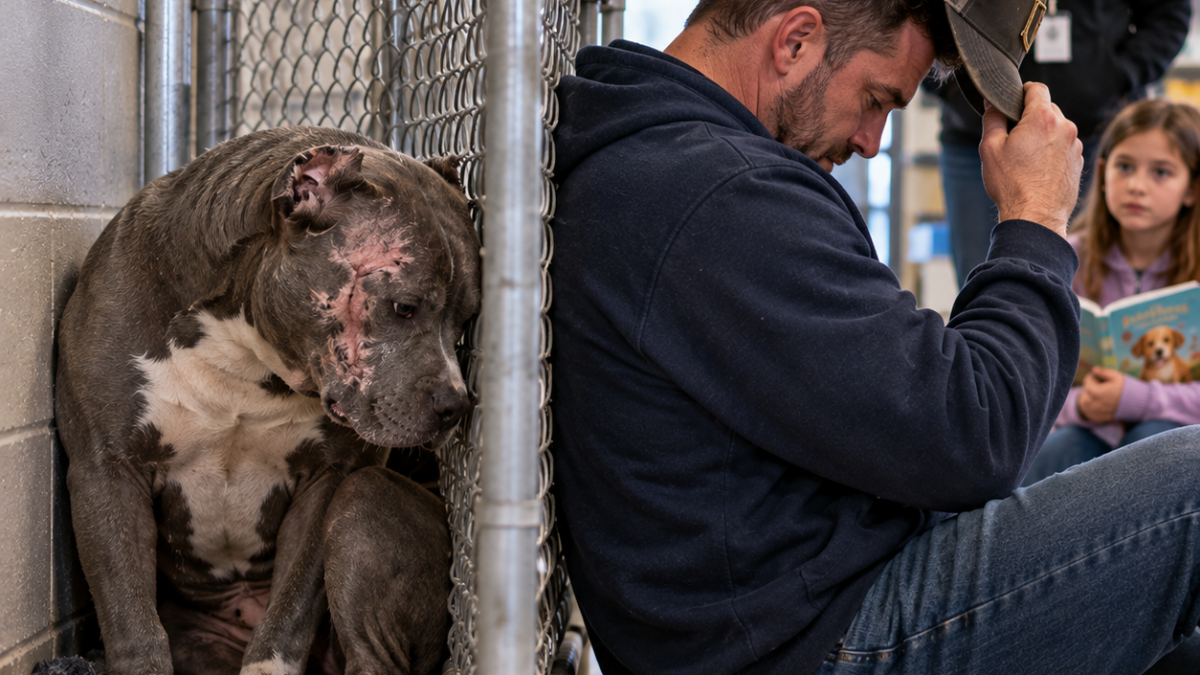
He sat down on the concrete.
Not facing Ash.
Facing away.
His back toward Kennel 14.
He pulled his hands out of his pockets.
They were shaking.
Then he pushed the hood down.
Reached toward the gray cap.
And removed it.
I stopped breathing.
The right side of Ethan’s scalp was covered in scar tissue.
Not a small line.
Not an old childhood cut.
Large burn scars extended from above his temple across part of his head and disappeared behind his ear.
Except part of that ear wasn’t there.
The upper edge had been badly damaged.
Skin grafts crossed the side of his neck.
He placed the cap beside him.
Then removed his sunglasses.
The scar continued around his right temple.
Ash opened his eyes.
For several seconds, nothing happened.
Ethan didn’t turn.
Didn’t call him.
Didn’t put his hand through the gate.
He simply sat there with his scars visible.
Then he said quietly:
“I don’t like people staring either, buddy.”
My throat tightened.
Ash’s nose moved.
Once.
Twice.
Ethan kept talking.
Not baby talk.
Not the cheerful shelter voice people use when they’re desperate for a dog to like them.
Normal.
“I know.”
“You don’t know me.”
“That’s okay.”
“You don’t owe me anything.”
Ash lifted his head.
I saw it happen.
His chin came off his paws.
Maybe an inch.
Ethan continued:
“I’m just going to sit here.”
And he did.
Five minutes.
Ten.
Visitors walked past.
Ethan put his cap back on when the aisle became busy.
But he stayed.
Ash did too.
At twenty minutes, the dog shifted.
Not forward.
Sideways.
Still progress.
At thirty, Ethan looked over his shoulder.
Ash immediately lowered his head.
Ethan turned away again.
“Sorry.”
I smiled despite myself.
He understood more intuitively than most people learned after months of training.
Pressure matters.
Eye contact can be pressure.
Touch can be pressure.
Expectation can be pressure.
Sometimes kindness means removing pressure rather than adding affection.
Ethan sat for forty-seven minutes.
I know because I checked the clock.
Then he stood.
Ash closed his eyes again.
Ethan picked up his cap.
“Can I come back?”
“Yes.”
“When?”
“Tomorrow.”
“We’re closed to the public Sunday.”
“Oh.”
I thought.
“Come Monday.”
“I’ll arrange it.”
He nodded.
Then looked at Ash.
Not for long.
“I’ll see you.”
Ash didn’t move.
Ethan left.
Carla watched him cross the lobby.
Then whispered:
“What happened?”
I told her.
She stared toward Kennel 14.
“You think he’ll adopt?”
“No idea.”
But that night, for the first time in months, I thought about Friday’s board meeting without dread.
Monday, Ethan came at eight-thirty.
Before public hours.
Same hoodie.
Different cap.
No sunglasses this time.
He carried a paperback and a paper cup.
“Coffee?”
I asked.
“Tea.”
“You don’t drink coffee?”
“Can’t stand it.”
I decided this was his first obvious character flaw.
He sat outside Kennel 14.
Back to the gate.
Read silently.
Ash watched.
Twenty-five minutes passed.
Then Ash stood.
I was halfway down the aisle.
I froze.
Ash stretched.
Slowly.
His back legs trembled slightly.
Then he took one step.
Ethan didn’t see.
Another.
Ash stopped roughly six feet from the rear corner.
Farther forward than I’d seen him voluntarily stand when a stranger was present.
I backed away.
No celebration.
No calling staff.
No phones.
Let the dog have the moment without turning it into an event.
Ash sniffed.
Ethan’s scent probably reached him.
Then he returned to his corner.
That was enough.
Tuesday, Ethan came again.
Wednesday.
Thursday.
Every morning.
He never asked:
“Why isn’t he coming to me?”
Never said:
“Doesn’t he remember me?”
Never shoved treats through the fence.
He sat.
Sometimes spoke.
Sometimes read.
On Wednesday, Mia arrived after school because Sarah had heard about the upcoming behavioral review.
She brought another book.
Ethan was already sitting outside the kennel.
Mia stopped.
He looked up.
“Hi.”
“Hi.”
“You read to him?”
She nodded.
“Every Saturday.”
Ethan shifted.
“You want my spot?”
Mia looked at the floor beside him.
“Can I sit there?”
“Sure.”
She sat.
Opened her book.
Ethan turned slightly away from Ash.
Mia did the same.
They looked ridiculous.
Two people sitting backward outside a dog kennel.
It was perfect.
Mia read.
Ethan listened.
Ash watched both.
Halfway through the story, Mia’s sleeve moved again.
Ethan saw the scar.
He didn’t stare.
Mia saw his.
Because he wasn’t wearing the cap.
Her eyes widened.
Then she looked away.
After a minute, she whispered:
“Does yours hurt?”
Ethan touched the side of his head.
“Sometimes.”
“Mine doesn’t much anymore.”
He nodded.
“That’s good.”
Mia hesitated.
“People ask about mine.”
“People ask about mine too.”
“I don’t like it.”
“Me either.”
She looked toward Ash.
“He doesn’t like it either.”
Ethan followed her eyes.
“No.”
“He doesn’t.”
I stood behind the kennel-room door pretending to review medication charts while trying not to cry.
Mia asked:
“Were you in a fire?”
Ethan paused.
Then answered.
“Yes.”
“My mom says I don’t have to tell people what happened to me.”
“Your mom’s right.”
“Do you?”
“No.”
“Okay.”
That was it.
No demand.
No tragedy competition.
No explanation.
Three living beings with scars.
Sitting together.
None asking the others to perform their pain.
That afternoon, Ethan finally told me a little more.
We were outside near the staff entrance.
He had his cap on.
“House fire.”
he said.
I didn’t ask.
He continued anyway.
“Three years ago.”
“My wife died.”
I felt my chest tighten.
“I’m sorry.”
He nodded.
“Our daughter was at my sister’s.”
“Thank God.”
“I went back inside.”
“For your wife?”
“Yes.”
He looked toward the parking lot.
“Didn’t get to her.”
The silence after that needed no filling.
He continued:
“Burns over thirty percent.”
“Mostly right side.”
“Eleven surgeries.”
“Skin grafts.”
“People think scars are the hard part.”
“They’re not.”
“What is?”
“Everybody’s face when they see them.”
That I understood.
Not personally.
But I’d watched people react to Ash.
Ethan rubbed his thumb across the brim of his cap.
“First year, strangers stared.”
“Kids asked questions.”
“Adults looked away too fast.”
“I started wearing hats.”
“Long sleeves.”
“Sunglasses.”
“Then I stopped going anywhere I didn’t have to.”
“Work?”
“Remote now.”
“What do you do?”
“Structural drafting.”
“I can work from home.”
“You live alone?”
“Yes.”
“Family?”
“My daughter lives with my sister.”
I looked at him.
That surprised me.
He saw it.
“Temporary became less temporary.”
“How old?”
“Twelve.”
“Her name’s Sophie.”
“After the fire, I couldn’t manage anything.”
“Pain meds.”
“Therapy.”
“Surgeries.”
“Nightmares.”
“My sister took Sophie.”
“Then Sophie got settled there.”
“School.”
“Friends.”
“I kept saying I’d bring her home when I was better.”
He smiled without humor.
“Turns out ‘better’ is a terrible deadline.”
I knew exactly why Ash had stopped him.
Two creatures waiting in corners for themselves to become acceptable again.
“What does Sophie want?”
I asked.
Ethan looked at me.
“To come home.”
“And you?”
His eyes filled.
“The same.”
“Then what’s stopping you?”
He didn’t answer.
Didn’t need to.
Fear.
Not of his daughter.
Of being seen by the person whose opinion mattered most.
He said:
“She saw me in the hospital.”
“She knows what I look like.”
“That’s not it.”
“What is it?”
“I don’t want her life to become taking care of me.”
“That sounds like something you should ask Sophie.”
He almost smiled.
“You sound like my therapist.”
“I’m much cheaper.”
Friday morning came.
Board review at ten.
I hated those meetings.
They’re necessary.
Shelters have finite space.
Some dogs cannot safely or humanely remain indefinitely.
Keeping an animal alive in constant terror is not automatically kindness.
We had to consider quality of life.
Medical needs.
Behavior.
Adoption potential.
Staff safety.
Public safety.
Ash’s file was thick.
Seven months.
Minimal handling tolerance.
No aggression, but profound fear.
Limited progress.
I entered the conference room carrying the latest notes.
Our executive director, veterinarian, behavior consultant, two board representatives, and adoption coordinator sat around the table.
Before we started, I said:
“I want to add new information.”
I explained Ethan.
Daily visits.
Ash moving forward.
Increased engagement.
Response to Mia.
The behavior consultant asked:
“Has there been physical contact?”
“No.”
“Food acceptance?”
“Not directly.”
“Approach?”
“Two voluntary approaches within six feet.”
“That is progress.”
“Yes.”
“Enough?”
That was the question.
I said:
“Enough to justify time.”
The veterinarian looked at Ash’s history.
“Time with a specific adopter?”
“Potential adopter.”
“Has Ethan applied?”
“Not yet.”
The executive director sighed.
“We can’t postpone decisions based on someone sitting outside the kennel.”
“I know.”
Then the door opened.
Carla leaned in.
“Denise?”
“Yes?”
“Ethan’s here.”
I looked at the board.
“Give me five minutes.”
I went out.
Ethan stood at reception.
He looked terrified.
Not Ash terrified.
Human terrified.
Paper in hand.
“I filled this out.”
Adoption application.
Every line.
Housing.
Veterinarian reference.
Landlord information.
Work schedule.
No other pets.
Fenced yard?
No.
He’d written:
Dog will not be left outside unattended.
Under reason for adopting:
I understand needing time.
That was all.
I read it.
“Ethan.”
“Yeah?”
“Are you sure?”
“No.”
That was the best answer he could have given.
Then:
“But I want to try.”
I smiled.
“We’ll need several supervised meetings.”
“I know.”
“Home evaluation.”
“Okay.”
“Behavior plan.”
“Okay.”
“He may never become an easy dog.”
“I don’t need easy.”
“He may always be afraid of strangers.”
“So am I.”
“He may not tolerate visitors.”
“I don’t have many.”
“He might never want to be touched the way people expect dogs to want touch.”
Ethan looked toward Kennel 14.
“Then I won’t make him.”
I brought the application into the meeting.
The board postponed Ash’s final disposition.
Thirty days.
One potential placement.
Structured foster-to-adopt trial if behavior staff approved.
I walked back into the kennel area feeling like somebody had removed a weight from my chest.
Ethan sat down.
Ash watched him.
I crouched several feet away.
“Thirty days.”
Ethan looked up.
“What?”
“You have thirty days to show us this can work.”
He swallowed.
“Okay.”
Then:
“How do we start?”
We started with the gate.
Not opening it.
Just proximity.
Ethan sat closer.
Ash chose distance.
Next day:
Treats placed between them.
Not hand-fed.
Then leash work with staff after mild calming medication prescribed by our vet.
Then a larger meet-and-greet room.
That first session nearly failed.
Ash entered on a loose lead with two staff members.
Saw Ethan.
Stopped.
Ethan immediately turned sideways.
Didn’t approach.
Ash backed toward the wall.
Ethan sat.
Ten minutes.
Fifteen.
Twenty.
Ash’s breathing slowed.
Then he sniffed the floor.
We scattered small pieces of chicken.
Ash ate one.
Then another.
The final piece sat four feet from Ethan.
Ash stared at it.
Ethan stared at the opposite wall.
Ash stepped forward.
One step.
Chicken.
Another.
Stopped.
His body shook.
Ethan whispered:
“You don’t have to.”
Ash took the chicken.
Then retreated.
Ethan started crying.
Quietly.
He wiped his face before turning around.
I pretended not to notice.
Session two went better.
Session three:
Ash sat five feet from him.
Session four:
Three feet.
Session five changed everything.
Mia was reading outside the meet room while waiting for her mother.
Ethan sat on the floor.
Ash entered.
No shaking.
Not at first.
He sniffed the room.
Walked toward Mia’s voice.
Then stopped behind Ethan.
Ethan’s hands rested on his knees.
Ash stretched his neck.
Sniffed the back of Ethan’s hoodie.
I held my breath.
Ethan didn’t move.
Ash sniffed again.
Then his nose touched Ethan’s shoulder.
Ethan closed his eyes.
Ash backed away.
But didn’t flee.
That was contact.
Voluntary.
Entirely Ash’s choice.
Three days later, Ash touched Ethan’s hand.
Not with his nose.
With his cheek.
One second.
Maybe less.
Ethan didn’t pet him.
He let Ash decide.
The next time:
Two seconds.
Then four.
Within another week, Ash allowed Ethan to touch the white patch on his chest.
One finger.
Then hand.
No head.
Never the ears.
Never the scarred side of his face.
Ethan understood.
The first tail movement happened on day twenty-one.
I almost missed it.
We were in the outdoor exercise yard.
Ash had begun tolerating a leash with Ethan holding the end under staff supervision.
A leaf blew across the concrete.
Ash watched it.
Ethan crouched.
The leaf spun.
Ash stepped toward it.
Then Ethan said:
“Get it.”
Ash looked at him.
And the tail moved.
Barely.
One sweep.
Left.
Right.
I grabbed the fence.
“Did you see that?”
Ethan looked panicked.
“What?”
“His tail.”
Ash stopped.
Ethan’s face crumpled.
“Oh.”
I started laughing.
Then crying.
After seven months, Ash had wagged his tail once.
We did not tell the board it was “proof” of anything.
Behavior doesn’t work that way.
But personally?
I celebrated.
Carla bought a grocery-store cupcake and wrote:
ONE WAG
on the box.
Mia drew Ash with an enormous tail.
It looked like a feather duster.
We taped the drawing inside the staff room.
Then came the home trial.
Ethan’s house was small.
One-story.
Quiet neighborhood outside Columbus.
Fenced side patio.
No other animals.
The house surprised me.
Almost empty.
Functional.
Dark curtains.
Very few photographs.
One picture of Sophie sat on a shelf.
Ten years old in the photo.
Smiling.
Ethan noticed me looking.
“Old.”
“You should update it.”
“I know.”
We prepared a safe room.
Open crate.
Bed.
Water.
White-noise machine.
Blankets from the shelter carrying familiar scent.
No forcing Ash through the whole house.
No visitors.
Ethan spent the first night on the living-room floor twenty feet away.
Ash stayed behind the open crate.
Didn’t eat until three in the morning.
Day two, he explored the hallway.
Day three, kitchen.
Day four, he slept outside the safe-room doorway.
Day six, Ethan called me.
His voice sounded strange.
“Is he okay?”
“What happened?”
“He’s on my couch.”
I waited.
“And?”
“He got on by himself.”
I laughed.
“Ethan, that’s legal.”
“I didn’t know if I should move.”
“Don’t.”
“I wasn’t going to.”
He sent me a photograph.
Ash curled at one end of the couch.
Ethan sitting at the other.
Six feet between them.
Both looking uncomfortable.
Perfect family portrait.
Then Sophie came into the story.
Ethan had delayed it.
I understood.
Ash had barely adjusted.
Sophie lived forty minutes away with Ethan’s sister, Rachel.
But a home placement couldn’t be considered permanent without knowing how Ash responded to Ethan’s child.
Sophie was twelve.
Old enough to follow instructions.
Young enough that safety still came first.
We planned carefully.
Outside.
Neutral space.
No hugging dog.
No direct staring.
No reaching toward his head.
Let Ash choose.
Sophie arrived carrying a book.
I smiled when I saw it.
“Was that your idea?”
She looked at her father.
“He told me about Mia.”
Ethan looked embarrassed.
Sophie was tall for twelve.
Same brown eyes as him.
She saw his scars without reacting.
That told me more about their relationship than anything.
Ash noticed her.
Body stiffened.
Sophie sat on a bench.
Opened the book.
Read.
Not loudly.
Just enough for Ash to hear.
Ethan stood twenty feet away.
Ash looked between them.
Then something unexpected happened.
Ethan removed his cap.
Outside.
In daylight.
In front of his daughter.
I watched Sophie look at him.
No shock.
She simply smiled.
Then kept reading.
Ash stepped toward Ethan.
One step.
Another.
Then stood beside him.
Ethan’s hand lowered.
Ash leaned against his leg.
Full body.
Not accidental.
Ethan froze.
I whispered:
“Don’t make a big deal.”
He gave me a look that said he might stop breathing permanently.
Sophie saw it.
Her eyes filled.
She closed the book.
“Dad?”
“Yeah?”
“Can I come home soon?”
The question landed harder than anything else that day.
Ethan looked down.
Ash remained against his leg.
Then Ethan looked at his daughter.
“Yes.”
Not someday.
Not when I’m better.
“Yes.”
Sophie cried.
Ethan cried.
I looked away because shelter managers deserve privacy too.
Ash simply stood between them.
Two weeks later, Sophie began spending weekends.
Then more time.
Ash became her shadow faster than he had become Ethan’s.
Not physically attached.
But aware.
If Sophie went into the kitchen, Ash watched.
If she sat on the floor doing homework, he lay several feet away.
She never touched his head.
She scratched his chest.
His shoulder.
Eventually his back.
One evening, she fell asleep on the couch.
Ethan texted me a photograph.
Sophie on one end.
Ash curled against her feet.
Caption:
Is this allowed too?
I replied:
Still legal.
The adoption became official on the thirty-first day.
Technically one day beyond our original review window.
I didn’t care.
Ethan signed the papers.
His hand shook.
Ash wore a simple blue harness.
Mia came after school.
She had made him a card.
ASH’S NEW HOME
Inside, she drew three people.
Ethan.
Sophie.
Ash.
She included his scars.
Not exaggerated.
Not hidden.
Just part of him.
Mia crouched several feet away.
“Bye, Ash.”
Ash looked at her.
Then he did something nobody expected.
He walked forward.
Mia stayed still.
Ash sniffed her sleeve.
Then the back of her left hand.
The scar.
Mia’s eyes widened.
He touched his nose to it.
Once.
Then stepped away.
Mia started crying.
Sarah covered her mouth.
Ethan looked at me.
I said:
“Nobody move.”
Ash turned.
Walked back toward Ethan.
And his tail wagged.
Not once.
Several times.
Carla started sobbing at the front desk.
I gave up pretending professionalism.
The whole staff cried.
Ethan knelt.
Ash leaned against him.
Not hiding.
Not shaking.
Just leaning.
They left through the front door at 4:18 p.m.
I remember the time because I wrote it in Ash’s file.
Adopted.
Seven months and twenty-three days after intake.
Kennel 14 was empty.
I stood inside it after closing.
The pale rubbed patch on the cinderblock was still there where Ash had pressed his body for months.
We could’ve painted over it.
I didn’t.
Not immediately.
For several weeks, that patch reminded me that survival can look like doing absolutely nothing.
Stay in corner.
Don’t move.
Close eyes.
Make yourself smaller.
People sometimes judge traumatized animals for not “getting over it.”
Humans too.
They see safety.
Food.
Warmth.
Kind staff.
Then ask why fear remains.
Because the nervous system doesn’t read the adoption brochure.
Ash didn’t know our intentions.
He knew what hands had meant before.
What people had meant.
What being looked at had meant.
Trust wasn’t a command we could teach him.
It was an experience he needed to collect.
Over and over.
Ethan understood because he was doing the same thing.
I learned more about him gradually.
His wife, Claire, had died in a kitchen fire caused by a faulty appliance.
Ethan had been outside when the smoke alarm triggered.
He went in.
Reached the hallway.
Part of the ceiling collapsed.
He suffered severe burns and damage to his ear while trying to reach Claire.
Firefighters pulled him out.
He spent weeks in the hospital.
Sophie visited once early.
Ethan saw her expression when she first looked at his bandages and scars.
Not disgust.
Fear.
But grief translated it.
He convinced himself she was afraid of him.
She wasn’t.
She was afraid of losing him too.
But Ethan pulled away.
Let Rachel care for her.
Missed school events.
Stopped attending restaurants.
Stopped seeing friends.
Started wearing hats and sunglasses indoors.
By the time he met Ash, he’d spent almost three years turning his own face toward the wall.
He told me that once.
Six months after the adoption.
We were drinking tea in the shelter office.
Still terrible choice of beverage.
“I thought he was hiding because he knew he looked bad.”
Ethan said.
“Maybe.”
“That’s what I was doing.”
He tapped his cap.
“I thought if I didn’t make people look at me, I could control the moment they decided I was different.”
“What changed?”
He looked toward the kennel floor.
“A dog didn’t care.”
Then:
“And Mia.”
I smiled.
“Mia doesn’t care about much except books.”
“She saw me.”
“Didn’t make a face.”
“Asked if it hurt.”
“Then went back to reading.”
“Kids can be good at cutting through nonsense.”
He nodded.
“So can dogs.”
Ethan stopped wearing sunglasses indoors.
Then stopped wearing the hood.
The cap lasted longer.
Eventually that changed too.
Not always.
But choice replaced hiding.
Sophie moved back home permanently the following spring.
Rachel remained part of their lives.
No custody battle.
No resentment.
Just a family repairing itself.
Sophie brought her bedroom furniture back.
Painted the walls green.
Ash slept in her doorway for three nights while movers came and went.
Then returned to Ethan’s room.
I asked:
“Where does he sleep now?”
Ethan sighed.
“My bed.”
“Of course.”
“At first he slept on the floor.”
“Then the rug.”
“Then the foot of the bed.”
“Now he takes my pillow.”
“That’s progression.”
“That’s theft.”
Ash had developed preferences.
Turkey treats.
Not chicken.
Blue blanket.
Not gray.
Rain?
Absolutely not.
Snow?
Interesting for six minutes.
Vacuum cleaner?
Enemy of the state.
Men wearing baseball caps?
Fine, eventually.
People reaching over his head?
Still frightening.
Strangers?
Handled with distance.
Crowded places?
No.
Dog parks?
Never.
And that was okay.
Recovery didn’t turn Ash into a completely different dog.
It allowed him to become more of the dog he’d never been safe enough to show.
He loved car rides.
That surprised us.
First few trips to the vet, he trembled.
Then learned car didn’t always mean something bad.
Ethan bought a seat cover.
Ash started putting his nose near the cracked window.
Eventually, he became the dog who heard keys and ran to the door.
Not a sprint.
He still carried old stiffness.
But excitement.
One year after adoption, Ethan brought Ash back to the shelter.
Not inside at first.
We met outdoors.
Ash saw me.
Stopped.
I didn’t approach.
Old rule.
Let him decide.
He sniffed.
Then walked toward me.
Slowly.
My throat tightened.
I’d spent seven months feeding him.
Cleaning near him.
Speaking softly.
And he’d never let me touch him voluntarily.
Now he stopped beside me.
I lowered my hand.
Ash sniffed.
Then leaned his shoulder against my leg.
I cried immediately.
“Really?”
Ethan laughed.
“He does that now.”
I scratched the white patch on Ash’s chest.
The same place he’d first allowed Ethan to touch.
Ash stayed.
Then his tail wagged.
I looked at Ethan.
“You ruined him.”
“He’s spoiled.”
“Good.”
Sophie was with him.
So was Mia.
Mia had grown taller.
The pink scar on her hand remained faintly visible.
She no longer pulled her sleeve over it.
I had eventually learned her story.
A pot of boiling water had tipped from a stove when she was six.
Burned her hand and wrist.
Skin graft.
Long recovery.
Children at school asked questions.
One called her “melted hand.”
After that, she started hiding it.
Her mother enrolled her in the reading program partly because Mia had become withdrawn.
Then Mia chose Ash.
Nobody arranged the connection.
She just saw a dog hiding scars and decided to sit near him.
Sarah told me:
“She said he shouldn’t have to be alone because people look at him.”
That was all.
Mia didn’t heal Ash.
Ethan didn’t heal Ash.
Ash didn’t heal Ethan.
I dislike that language when it’s used too easily.
Living beings aren’t medicine prescribed to fix each other.
What they did was make room.
Mia made room beside the kennel without demands.
Ethan made room in his home.
Ash made room beside his body.
Sophie made room for a father who didn’t look the way he had before the fire.
Healing happened inside that room.
Slowly.
Messily.
Not because anyone forced it.
The second anniversary of Ash’s adoption fell on a Saturday.
Ethan asked whether we could hold a small gathering at the shelter.
I almost said no.
Ash didn’t like crowds.
Then Ethan said:
“Outside.”
“Five people.”
“His choice whether to participate.”
Good.
We met behind the shelter.
Me.
Carla.
Mia and Sarah.
Ethan.
Sophie.
Technically six.
Ash arrived wearing his blue harness.
His face had changed.
Not physically.
The scars remained.
Missing ears remained.
Gray coat.
White chest.
But his posture was different.
Head up.
Mouth relaxed.
Tail neutral.
He sniffed the grass.
Ignored us for the first several minutes.
Perfect.
Sophie brought cupcakes for humans.
Ethan brought turkey treats for Ash.
Mia brought a book.
Same one she’d read the first week Ethan came.
The dog who thought the moon followed him.
She sat beneath a tree.
Ash wandered over.
Lay down five feet away.
She read.
Halfway through, Ethan sat beside her.
No cap.
Sun on his scarred scalp.
Sophie leaned against his shoulder.
Ash lifted his head.
Looked at them.
Then rolled onto his side.
Completely exposed.
I had never seen him do that at the shelter.
Not once.
His belly.
Chest.
Neck.
All vulnerable.
Relaxed.
I felt tears coming.
Carla whispered:
“Don’t start.”
“You’re already crying.”
“So are you.”
Fair.
Mia closed the book.
Looked at Ash.
Then at Ethan.
“You both look different.”
Ethan touched his scar.
“What do you mean?”
“Not your scars.”
She thought.
“Happier.”
Ethan smiled.
“That’s probably Ash.”
Mia shook her head.
“No.”
“All of you.”
Children sometimes say things adults spend years paying therapists to help us understand.
Years later, Ash became part of something we never planned.
Our shelter created a quieter adoption program for dogs with fear-based behavior.
Instead of walking every visitor down rows of barking kennels, selected dogs could meet potential adopters in low-pressure environments.
No reaching through gates.
No forced petting.
No expectation of instant affection.
We trained volunteers to explain:
A dog refusing touch isn’t rejecting you.
A dog hiding isn’t necessarily aggressive.
A dog shutting down is communicating.
Wait.
Observe.
Let them have choices.
We called it the Ash Room at first.
Ethan objected.
“Don’t name things after us.”
So officially, it became the Quiet Start Program.
Unofficially?
Everybody still called it Ash’s Room.
We repainted Kennel 14.
Eventually.
I was almost sad to cover the pale rubbed patch.
Then I realized we weren’t erasing Ash.
We were making room for the next dog.
A little brown hound named Cricket moved in.
Terrified of men.
She stayed three weeks before going to a foster family.
Then Bruno.
Then Penny.
Then a shepherd called Walter who was afraid of leashes.
Not every outcome was perfect.
Some dogs required long-term sanctuary placement.
Some never became conventional pets.
One case ended in humane euthanasia because severe medical suffering couldn’t be relieved.
Love doesn’t guarantee happy endings.
But Ash changed how we asked the question.
Not:
Why won’t this dog trust us?
Instead:
What are we doing that makes trust difficult?
That’s a better question.
It removes the accusation from the animal.
Ash was seven, maybe eight, when arthritis became noticeable.
The old injuries caught up with him.
Ethan sent me updates.
Joint supplements.
Medication.
Rugs added to slippery floors.
A ramp beside the back steps.
Sophie, now in high school, accused her father of turning the house into an “elderly dog assisted-living facility.”
Ethan replied:
“Yes.”
No shame.
Ash developed gray around his muzzle.
Interesting thing about gray dogs:
You don’t notice aging color as quickly.
But the eyes change.
Softer.
Tired sooner.
He still hated the vacuum.
Still stole Ethan’s pillow.
Still wouldn’t allow most strangers to touch his head.
But he’d come farther than anyone expected.
One winter, Ethan called.
Not shelter business.
I knew from his voice.
“Ash has cancer.”
My stomach dropped.
“What kind?”
“Splenic mass.”
“Vet thinks malignant.”
“Options?”
“Surgery.”
“Maybe.”
“He’s older.”
“Anesthesia risk.”
“They don’t know if it’s spread.”
I sat at my desk.
The same desk where Ash’s file once lived.
“What are you thinking?”
“I don’t know.”
“Then don’t decide because you’re scared of losing him.”
Silence.
I continued:
“Decide based on what gives him the best life.”
“That sounds familiar.”
“It should.”
They did more imaging.
The cancer had spread.
Surgery would not cure it.
Maybe buy limited time.
Maybe create difficult recovery.
Ethan chose comfort care.
Ash stayed home.
Pain management.
Favorite food.
Short walks.
Sun.
Family.
Mia visited.
By then she was sixteen.
She sat on the floor.
Read.
Same ritual.
Ash slept beside her.
No one made it a goodbye.
Not aloud.
The final week, Ash stopped climbing onto Ethan’s bed.
Ethan moved his mattress to the living-room floor.
Sophie slept on the couch nearby.
Rachel came over.
They took turns.
Ash wanted to be close.
That was how they knew.
The dog who once pressed himself against a kennel wall to escape people now became restless when his people left the room.
Ethan called me Thursday.
“You want to see him?”
I drove over.
Ash lay on the blue blanket.
Thinner.
Breathing slower.
Scarred face resting on his paws.
I sat across the room.
Old habit.
Ethan smiled sadly.
“You can go closer.”
“I know.”
“But I want him to decide.”
Ash opened his eyes.
Saw me.
For several seconds, nothing.
Then his tail moved.
One sweep.
That was enough.
I moved closer.
Sat beside him.
He lifted his head.
Put it against my knee.
I touched the white patch on his chest.
“Hey, Ash.”
His tail moved again.
Ethan sat on the floor opposite me.
No cap.
He hadn’t worn one regularly in years.
His scars were still there.
So were Ash’s.
Neither needed hiding anymore.
Sophie came in carrying water.
She sat beside her father.
We talked quietly.
Not about death.
About Ash’s crimes.
The pillow theft.
The turkey incident at Thanksgiving.
The time he’d barked at a garden statue for forty-five minutes.
The afternoon he refused to walk because someone put a Halloween skeleton on a porch.
Normal dog memories.
That’s what Ethan had wanted more than anything.
Not a symbol.
Not “the abused dog.”
A dog.
Ash became that.
Two days later, Ethan and Sophie helped him die at home with a veterinarian.
Blue blanket.
Ethan’s hand on his chest.
Sophie’s hand against his back.
No kennel.
No strangers.
No corner.
Ethan called me afterward.
I didn’t say:
“He’s in a better place.”
Didn’t say:
“At least you gave him good years.”
People say things because silence scares them.
Sometimes silence is kinder.
Finally, Ethan said:
“He wasn’t afraid.”
I closed my eyes.
“That matters.”
“Yeah.”
“It does.”
Ash had lived with them almost six years.
Nobody expected that when he sat in Kennel 14.
Certainly not me.
A month later, Ethan came to the shelter.
Alone.
He brought the blue harness.
“I don’t know what to do with this.”
I touched it.
“Keep it.”
“I can’t look at it.”
“Then don’t decide today.”
He nodded.
We walked to Kennel 14.
A young brindle dog named Daisy was inside.
She barked happily at Ethan.
He smiled.
Then looked at the wall.
The old pale spot was long gone under paint.
“Feels weird.”
“What?”
“That he was here.”
“I know.”
“He seemed so small in that corner.”
“He wasn’t small.”
“You know what I mean.”
I did.
Fear can shrink a body.
Ethan put his hands in his pockets.
“Do you ever think about what would’ve happened Friday?”
The board review.
“Yes.”
“What would you have done?”
“I would’ve argued for more time.”
“Would you have gotten it?”
“I don’t know.”
He nodded.
Then:
“I almost didn’t come in that Saturday.”
“What changed your mind?”
He laughed quietly.
“I drove past.”
“Twice.”
“Third time, I pulled in.”
“Why?”
“My therapist told me to do one thing every week that made me leave the house.”
“And you picked a shelter?”
“I thought maybe I’d walk dogs.”
“Didn’t think I’d adopt.”
“You didn’t.”
“Ash adopted you.”
He rolled his eyes.
“That’s cheesy.”
“Yes.”
“Also true.”
He looked toward Daisy.
“I’m not ready for another dog.”
“You don’t need to be.”
“Maybe someday.”
“Maybe.”
No pressure.
That’s the lesson Ash left me.
No pressure.
Give choices.
Give time.
Let relationships become themselves.
Ethan eventually did adopt again.
Two years later.
Not another pit bull because he was trying to recreate Ash.
A senior mutt named Harold.
Twelve years old.
Overweight.
One eye.
Terrible breath.
Ethan saw him online.
Called me.
“Why do I keep getting the broken ones?”
I corrected him.
“He’s not broken.”
Pause.
“Right.”
“Sorry.”
He came in.
Harold adored him instantly.
No dramatic slow trust.
Walked over.
Sat on Ethan’s foot.
Demanded cheese.
Different dog.
Different story.
That’s healthy too.
Not every relationship needs to repeat the first.
Sophie went to college.
Studied occupational therapy.
She said it wasn’t because of her father’s rehabilitation.
Then admitted it probably was.
Mia eventually volunteered at the shelter herself.
The scar on her hand remained.
She stopped hiding it years earlier.
One afternoon, I saw her talking with a little girl who had a facial birthmark.
The child kept covering her cheek with her hair.
Mia didn’t mention the mark.
Didn’t say:
“You’re beautiful anyway.”
Didn’t tell her to be confident.
She simply handed her a book and said:
“There’s a dog in Kennel 6 who likes stories.”
The child sat outside Kennel 6.
Read.
I stood at the end of the aisle.
Thought about circles.
Not perfect circles.
Nothing in life is that tidy.
But moments echo.
A dog sits in fear.
A child sits nearby.
A man removes his cap.
Somebody chooses not to stare.
Somebody chooses not to run.
Trust begins.
I still work at Columbus Humane Rescue.
Twenty-five years now.
My hair is mostly gray.
My knees complain about concrete floors.
Carla retired.
Sarah still sends holiday cards.
Ethan sends pictures of Harold stealing furniture.
Sophie sends updates from college.
Mia is studying veterinary social work and shelter behavior.
Kennel 14 still exists.
Different dogs.
Different histories.
I sometimes stop there.
Not because I think Ash’s ghost is sitting in the corner.
I’m not sentimental in that way.
Mostly.
I stop because that kennel changed the way I understand fear.
For years, I had believed my job was to convince frightened animals that people could be good.
Ash taught me something better.
It isn’t their job to believe us.
It’s our job to become believable.
That’s different.
You cannot say:
Trust me.
while reaching for a dog who is begging you not to touch him.
You cannot say:
You’re safe.
while ignoring every signal his body gives.
Safety isn’t a statement.
It’s a pattern.
The hand stops.
The person backs away.
The door opens.
Food appears.
Nobody forces.
Today.
Tomorrow.
Again.
Again.
Eventually, maybe the dog believes the pattern.
Ash needed seven months before Ethan.
Then more weeks with Ethan.
He never forgot everything.
I don’t believe trauma works like that.
He remembered enough to dislike hands above his head until the end.
Remembered enough to dislike crowded rooms.
Remembered enough that certain smells or noises could make him freeze.
But remembering wasn’t the same as remaining trapped.
That’s what recovery looked like for Ash.
Not forgetting the corner.
Learning he could leave it.
It was similar for Ethan.
He never stopped having scars.
Never became the man he looked like before the fire.
That wasn’t the goal.
He stopped organizing his life around hiding them.
Sophie told me once:
“Dad used to think coming home meant becoming the old Dad again.”
“What changed?”
“He realized I wanted this Dad.”
That sentence stayed with me.
People sometimes postpone living until they become versions of themselves that no longer exist.
Thinner.
Healthier.
Unscarred.
Less anxious.
Less grieving.
More successful.
Better.
Then life waits outside the door.
Ash couldn’t imagine a future because his body was still living in the past.
Ethan understood.
Maybe that’s why sitting backward worked.
He wasn’t asking Ash to become anything.
Not friendly.
Not adoptable.
Not brave.
He simply said:
You don’t have to look at me.
I won’t look at you either.
We can exist in the same place without hurting each other.
Sometimes that is the first form of love traumatized beings can tolerate.
Not closeness.
Non-threat.
Then one inch.
Then another.
A nose against a shoulder.
A cheek against a hand.
A tail moving once.
A couch.
A child.
A home.
Years.
Ash became famous locally after we shared his adoption story.
We were careful.
No sensational photographs.
No graphic details.
Still, people responded.
Donations came in.
Messages.
Some people called Ethan inspirational.
He hated that.
He told me:
“I sat on the floor.”
I said:
“People love symbolism.”
“I hate symbolism.”
“You adopted a scarred dog while being a scarred burn survivor.”
“You’re fighting uphill.”
He groaned.
We laughed.
But he was right about something.
People wanted to turn him into a hero because that made the story clean.
He wasn’t.
He was a grieving man who needed a reason to leave his house.
Ash wasn’t a heroic survivor either.
He was a frightened dog.
Mia wasn’t a magical child healer.
She was a kid who liked reading and understood what it felt like when people noticed a scar before they noticed you.
Ordinary people.
Ordinary animal.
Extraordinary result created through ordinary patience.
I prefer that version.
Because it means you don’t need to be heroic to help.
You might need to sit down.
Stop reaching.
Pay attention.
Make room.
Show up tomorrow.
That’s available to more people than heroism.
Sometimes new volunteers ask:
“What was the biggest breakthrough with Ash?”
They expect:
First touch.
First tail wag.
Adoption day.
I always answer:
“The first time someone turned his back.”
They look confused.
So I explain.
Every visitor before Ethan had approached Ash with good intentions.
They leaned toward him.
Looked.
Called.
Reached.
Wanted connection.
Ethan removed himself from the demand.
He sat down.
Turned away.
Then removed the things he used to hide himself.
Not as a performance.
As recognition.
I won’t make you show me yours while I hide mine.
That’s what I think the gesture meant.
I never asked Ethan.
Some things are better left unexamined.
But Ash noticed.
Animals notice congruence.
Body language.
Breathing.
Tension.
Direction.
Maybe Ash understood nothing about scars.
Maybe the matching wounds meant absolutely nothing to him.
That’s possible.
Dogs don’t construct symbolism the way humans do.
Maybe what mattered was simply:
Man seated.
Back turned.
No eye contact.
Low pressure.
Safe.
That’s enough.
I don’t need Ash to understand poetry.
Humans supplied that afterward.
The behavioral mechanics were simple.
The emotional meaning was ours.
Both can be true.
Years after Ash died, Ethan donated a bench for the Quiet Start room.
Small wooden bench.
No bronze statue.
No dramatic plaque.
Just a little metal plate:
SIT. WAIT. LET THEM CHOOSE.
That was his wording.
I cried when I saw it.
He pretended not to notice.
The bench is still there.
Potential adopters sit on it.
Children read from it.
Volunteers use it during quiet socialization.
Sometimes frightened dogs don’t approach.
That’s okay.
Sometimes they do.
Also okay.
The point isn’t producing a moment.
The point is giving the animal enough control that a moment can happen honestly.
I sat on that bench last Friday.
Kennel 14 was empty between dogs.
Shelter closing.
Lights dimmed.
Rain outside.
For a second, I remembered Ash exactly as he had been the first day.
Gray body.
White chest.
Face turned to wall.
Eyes shut.
Tail still.
Then another memory replaced it.
Ash at his second adoption anniversary.
Grass beneath him.
Mia reading.
Sophie beside Ethan.
Sun on Ethan’s uncovered scars.
Ash rolling onto his side.
Completely vulnerable.
Completely safe.
Same dog.
That matters.
Whenever anyone passed Kennel 14 in those early months, Ash closed his eyes because he had learned that being seen could hurt.
By the end of his life, he slept pressed against the people who loved him, scars exposed, body relaxed, no corner required.
That transformation did not begin when someone touched him.
It began when someone finally understood that he wasn’t asking to be touched.
He was asking not to be afraid.
And one Saturday morning, a scarred man sat down on cold concrete, turned his back, removed his cap, and quietly showed Ash something none of us had managed to explain in seven months:
You don’t have to stop being scared before you’re allowed to come home.








