I Adopted Her Last Puppy—Then the Shelter Called About the Mother 12 Days Later.k
part2:
The shelter sat outside town in an old low building beside a gravel lot.
Nothing fancy.
Chain-link exercise runs.
A painted sign near the entrance.
A row of donated blankets stacked inside the lobby.
The woman behind the desk introduced herself as Grace Miller.
She looked to be somewhere in her forties, with brown hair tied back and the sort of calm voice people develop when they spend their days around frightened animals.
“What are you looking for?” she asked.
I almost said:
Company.
Instead, I said:
“Maybe a small dog.”
“Puppy?”
“I hadn’t decided.”
“First dog?”
“No.”
My husband and I had dogs when we were younger.
Older dogs.
Big dogs.
Dogs who stole sandwiches and dug holes and somehow always chose the cleanest blanket in the house after rolling in mud.
But I hadn’t owned one in years.
Grace nodded.
“We’ve got a few you can meet.”
Then I saw Tucker.
He was eleven weeks old.
Mostly brown.
White chest.
One ear stood straight up.
The other flopped sideways as if the rest of his body hadn’t informed it what puppies were supposed to look like.
He spotted my shoelace before he spotted me.
The first thing Tucker did was grab it.
The second thing he did was pull.
Hard.
I nearly stepped out of my shoe.
Grace laughed.
“He’s got plenty of personality.”
“I can see that.”
Tucker growled at the shoelace.
Not an aggressive growl.
A tiny, ridiculous sound produced by a puppy who believed cotton laces had personally challenged him.
“He’ll keep you busy,” Grace said.
I looked down at him.
“That’s what I’m hoping.”
That answer surprised me.
Because I meant it.
For three years, I had spent so much time trying to make life easier.
Fewer obligations.
Fewer plans.
Fewer reasons to leave the house.
I had told myself I was simplifying.
Really, I think I had been slowly removing every opportunity for life to inconvenience me.
Tucker looked like an inconvenience with four paws.
Exactly what I needed.
Grace told me his story while I sat on a plastic chair and Tucker tried climbing into my handbag.
He had four siblings.
Five puppies altogether.
They’d been found with their mother in an abandoned house outside Mill Creek.
Nobody knew exactly how long they’d been there.
Long enough that their mother had become dangerously thin.
“She kept them alive,” Grace said.
“With almost nothing.”
“What happened to the owners?”
“We don’t know.”
“House had been empty for a while.”
“Someone nearby reported dogs moving inside.”
“When animal control got there, the puppies were hungry but in better shape than she was.”
I looked at Tucker.
He was chewing the edge of my coat sleeve.
“Because she fed them.”
Grace nodded.
“Pretty much everything she had.”
The puppies recovered quickly.
Good food.
Warmth.
Veterinary care.
Four had already been adopted.
Tucker was the last one.
I scratched the top of his head.
His tail beat against my ankle.
“Why is he still here?”
“Probably because his siblings were slightly prettier.”
I gasped.
“Don’t say that in front of him.”
Grace smiled.
“He knows he’s handsome.”
Tucker bit my shoelace again.
Twenty minutes later, I had decided.
Maybe it was impulsive.
At sixty-four, I had become suspicious of anything resembling impulse.
My husband used to be the spontaneous one.
He once bought us train tickets to Chicago because he’d had a bad week and decided we needed deep-dish pizza.
After he died, I planned everything.
Doctor.
Groceries.
Bank.
Medication.
No surprises.
Then Tucker climbed onto my lap without asking and fell asleep with his chin against my wrist.
Something inside me said:
Take him home.
So I did.
There was paperwork.
Vaccination records.
Feeding instructions.
Information about his next veterinary appointment.
Grace gave me a list of puppy-proofing reminders.
I bought a small bag of treats from a shelf near the front desk because apparently I’d already become the sort of woman who bought a dog presents before getting him into the car.
I thought that was the beginning of the story.
An older widow finds a puppy.
Puppy fills quiet house.
Maybe I learn to cook again because I’m already in the kitchen preparing his food.
Maybe I walk around the block more.
Maybe Tucker destroys a cushion and I yell for the first time in months.
A happy little story.
Simple.
Then Grace lifted Tucker into her arms and carried him toward the front entrance.
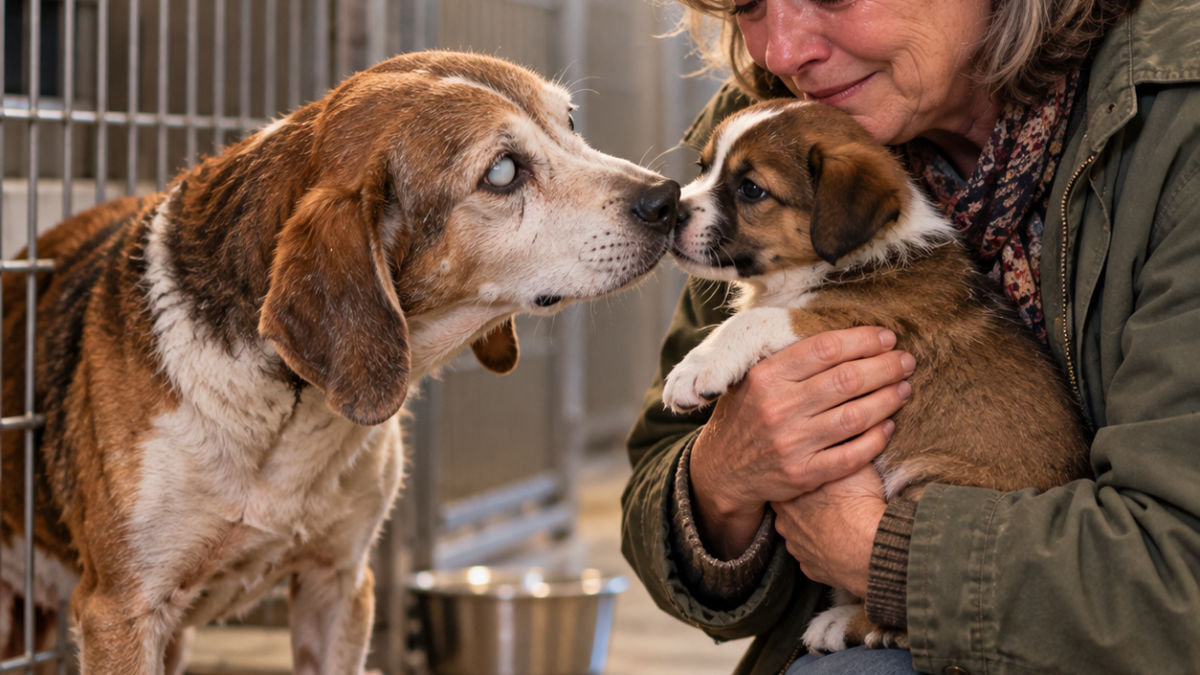
Across the room, a dog raised her head.
I hadn’t noticed her before.
She was lying on a folded blanket near the far wall.
Medium-sized.
A hound mix, Grace told me later.
Brown and white coat.
Gray beginning around her muzzle even though she wasn’t particularly old.
She looked tired in a way that had nothing to do with sleep.
Her body had filled out since rescue.
Her ribs weren’t protruding anymore.
But you could still see what hunger had taken from her.
Then I noticed her eyes.
Cloudy.
Both of them.
She stared in our direction, but not quite at us.
“Who’s that?” I asked.
Grace stopped.
“Mabel.”
“Tucker’s mother.”
I looked again.
“She’s beautiful.”
Grace’s smile became sad.
“She has had a rough time.”
Mabel pushed herself up.
Slowly.
Her front legs straightened first.
Then the back.
She stood still for a moment.
Her nose lifted.
Then lowered close to the floor.
She started walking toward us.
Not in a straight line.
She moved carefully.
One step.
Pause.
Sniff.
Another step.
Twice she stopped like she’d lost her orientation.
I looked at Grace.
“What’s wrong with her eyes?”
“We think she can see light and movement.”
“Maybe shapes.”
“But not much detail.”
“What happened?”
“We don’t know for sure.”
“The vet thinks the vision loss may have been developing for a while.”
Mabel took another uncertain step.
Then Tucker made a small squeaking noise.
Everything changed.
Mabel’s ears came up.
Her head snapped toward us.
The uncertainty disappeared.
She walked directly toward the sound.
Not fast.
But certain.
For the first time since she’d stood up, she didn’t hesitate once.
Grace looked down at Tucker.
Then lowered him carefully.
The puppy’s paws touched the floor.
Mabel reached him immediately.
Nose first.
She smelled his face.
His neck.
His ears.
Then Tucker made another tiny sound.
Mabel pressed her muzzle against him.
Tucker’s tail started wagging so hard that his entire body moved.
He tried climbing toward her face.
Mabel stood over him.
Still.
Almost frozen.
Then she began licking him.
One ear.
Forehead.
Cheek.
Again.
Again.
Again.
The frantic little movements of a mother checking something she’d been afraid of losing.
Tucker wriggled beneath her.
He didn’t seem bothered.
He climbed against her chest.
Mabel lowered herself.
And Tucker crawled partly under her.
I felt something in my throat tighten.
Grace crouched beside them.
“Mabel.”
The dog ignored her.
Her entire world seemed to be the puppy beneath her nose.
I said:
“She knows.”
Grace looked up.
“Oh, yes.”
“She knows every one of them.”
I stared at the two dogs.
“What happened when the others left?”
Grace didn’t answer immediately.
That was the first moment I sensed something I hadn’t considered.
Finally she said:
“She looked for them.”
I looked at her.
“What do you mean?”
“When each puppy was adopted.”
“Mabel searched afterward.”
“She’d walk through the room.”
“Check the kennels.”
“Then wait near the front.”
“How long?”
“Usually a day or two.”
I looked down at Tucker.
The last puppy.
My puppy now.
Mabel pressed her cloudy-eyed face against him.
I felt suddenly guilty.
Not rationally.
Grace must have seen it.
“Evelyn.”
I looked up.
“She’s ready for the puppies to be weaned.”
“You aren’t hurting her by adopting Tucker.”
“I know.”
“She needs a home too.”
That sentence stayed there between us.
I looked at Mabel.
Then at Tucker.
Then around my imagined future.
I’d come for something small.
Easy.
Friendly.
A puppy I could carry.
A dog who could grow with me.
Mabel was not what I’d planned.
Adult.
Nearly blind.
Recovering from starvation.
Possibly carrying whatever emotional scars came with surviving in an abandoned house while feeding five puppies.
I wish I could tell you I immediately said:
I’ll take both.
I didn’t.
People like clean acts of compassion in stories because they make us feel certain about who the good person is.
Real life often begins with hesitation.
I was sixty-four.
Alone.
I had come looking for one dog.
Could I manage two?
A puppy and a nearly blind adult?
What if Mabel needed expensive medical care?
What if she couldn’t navigate my stairs?
What if she became frightened in a new house?
What if Tucker absorbed all my energy and Mabel needed more than I could give?
I thought about all of that.
Then thought:
Maybe somebody else will adopt her.
Grace had not asked me to take her.
She wasn’t trying to make me feel guilty.
She simply said:
“Mabel needs a quieter home.”
“I think she’ll do well once she feels secure.”
I nodded.
“I’m sure someone will fall in love with her.”
Grace looked at Mabel.
“I hope so.”
The answer should have bothered me more than it did.
But Tucker chose that moment to climb over his mother’s leg and attack my shoelace again.
I laughed.
The emotion broke.
Grace stood.
“All right.”
“Let’s get this little menace home.”
Mabel followed as far as the entrance.
Not because Grace called.
Because she could hear Tucker.
Grace carried him.
I carried the paperwork and treats.
Mabel walked behind us.
Nose moving.
Occasionally bumping Grace’s calf.
At the front door, Grace stopped.
There was a small gate separating the lobby from the entrance area.
She closed it gently so Mabel couldn’t follow us outside.
Tucker squeaked.
Mabel stood behind the gate.
Her ears forward.
I remember her face.
Cloudy eyes.
Gray muzzle.
Head slightly tilted.
Trying to locate him through sound.
Grace lowered Tucker one last time.
Mabel pushed her nose through the bars as far as she could.
Tucker touched his nose to hers.
Then Grace picked him up.
The moment their faces separated, Mabel moved along the gate.
Trying to follow.
Grace opened the front door.
Cold October air came in.
Tucker wriggled.
Mabel began making a sound.
Soft.
Not barking.
Not exactly whining.
A low searching cry.
I turned back.
Grace’s expression had changed.
“Will she be okay?”
I asked.
Grace nodded.
But not immediately.
“She’ll adjust.”
I wanted to believe that.
So I took Tucker home.
The first night was chaos.
Wonderful chaos.
He peed on the kitchen floor ten minutes after I had taken him outside.
He dragged a dish towel out of the laundry basket.
He discovered his reflection in the sliding glass door and barked at himself.
Then he became frightened when the other puppy in the window barked back.
I laughed so hard I had to sit down.
At nine, he fell asleep under the coffee table.
At nine-fifteen, he woke up and decided sleep was a ridiculous waste of time.
By midnight, I was exhausted.
For the first time in years, I went to bed without thinking about how quiet the house felt.
It wasn’t quiet.
Tucker objected to the crate.
Then objected to being outside the crate.
Then objected to the blanket.
Then apparently forgave the blanket and fell asleep on it.
At two in the morning, I took him outside.
The grass was cold and wet.
I stood on the porch in slippers and an old robe while Tucker inspected every leaf in Ohio.
My husband would have laughed until he cried.
That thought came gently.
Not like a knife.
I looked up at the dark kitchen window and almost expected to see him there.
For once, the memory didn’t make me want to go back inside and hide from it.
I smiled.
“Your dog would’ve driven you crazy,” I whispered.
Tucker looked up.
“Not you.”
“I wasn’t talking to you.”
He wagged anyway.
The next morning, I called Grace.
I told myself I was calling about Tucker.
Mostly.
“He ate.”
“Good.”
“He seems determined to destroy a slipper.”
“Normal.”
“He cried for forty minutes.”
“Also normal.”
Then I asked:
“How’s Mabel?”
There was the smallest pause.
“She waited near the front door most of the night.”
My heart sank.
“For Tucker?”
“Probably.”
“Does she always do that?”
“She did it with the others.”
“I told you.”
“She usually settles.”
I looked at Tucker sleeping under my chair.
“Can she hear well?”
“Very.”
“Smell?”
“Excellent.”
“That’s how she manages.”
I imagined her standing behind the shelter gate.
Listening.
Waiting for the puppy sound to return.
“Should I bring him back to visit?”
Grace hesitated.
“That can sometimes make separation harder.”
“She needs to adjust to the puppies being gone.”
“And Tucker needs to settle with you.”
I nodded even though she couldn’t see.
“Right.”
Then:
“Is anyone interested in adopting her?”
“Not yet.”
That hurt.
I didn’t know why.
I had met Mabel for maybe five minutes.
Still, I thought about her all day.
Tucker didn’t give me much time for serious reflection.
He found the toilet-paper roll.
Discovered the underside of the sofa.
Tried eating a dead leaf.
Then fell asleep with his head inside my slipper.
I took a photograph.
For the first time since my husband died, I sent a picture to three people just because I was excited about something.
My sister responded:
LOOK AT THAT EAR.
My neighbor sent:
He owns you now.
She was correct.
At five, I cooked dinner.
Actually cooked.
Chicken breast.
Vegetables.
Rice.
Tucker sat behind me looking betrayed because none of it was for him.
I realized halfway through eating that I had used a dinner plate instead of standing over the sink.
Small thing.
Mattered.
On the second day, Grace texted.
Tucker settling?
I sent a photograph of him sleeping upside down.
Then asked:
Mabel okay?
A few minutes passed.
Still waiting by the front entrance on and off. Eating some. We’re keeping an eye on her.
I stared at the message.
Eating some.
Not well.
Some.
I called.
Grace answered.
“She’s not sick.”
“We’ve checked.”
“She’s just unsettled.”
“Will she stop?”
“I think so.”
“She’s lost all five puppies pretty quickly.”
“That can be an adjustment.”
I looked at Tucker.
“Do dogs understand adoption?”
“No.”
“Not the way we do.”
“They understand presence.”
“And absence.”
That sentence stayed with me.
Presence and absence.
Dogs weren’t so different from widows, apparently.
On day three, Tucker learned the kitchen was where food came from.
He stationed himself there whenever I stood up.
He also discovered the front window.
Every passing truck became an emergency.
Every squirrel a national crisis.
I laughed more that week than I had in months.
Then Grace called.
Not a crisis.
Just an update.
“Mabel finally slept away from the door for a few hours.”
I felt relieved.
“Good.”
“But she went back after breakfast.”
“Still waiting.”
“Yes.”
“Is she eating?”
“Not as much as we’d like.”
My happiness about Tucker and worry about Mabel began existing at the same time.
That was uncomfortable.
Part of me felt guilty whenever Tucker did something adorable.
As if his joy had been taken from hers.
I knew that wasn’t fair.
He needed a home.
All five puppies did.
Mabel couldn’t remain with them forever.
Still, facts don’t automatically remove emotion.
Day four.
I brought Tucker for his veterinary check.
He weighed just over twelve pounds.
Healthy.
Energetic.
Normal puppy heart.
Normal puppy lungs.
The vet laughed at his ears.
Everyone did.
On the way home, I drove past the road leading to the shelter.
I almost turned.
Didn’t.
Grace had said visits might make separation harder.
So I kept driving.
That night, Tucker fell asleep on my lap for the first time.
His body was warm.
Heavy in the way only sleeping puppies are.
I sat in the living room without turning on the television.
His breathing slowed.
I touched the white patch on his chest.
Then thought of Mabel.
I wondered whether she had ever slept without listening for her puppies.
Day five.
Grace said she had started taking Mabel outside more often.
She liked the grass.
Followed scents.
Walked carefully.
Her cloudy eyes didn’t stop her from exploring once she knew the space.
That made me smile.
Then Grace said:
“She keeps returning to the lobby.”
I asked:
“Door?”
“Yes.”
Day six.
No update.
I tried not to call.
Made it until four in the afternoon.
Grace laughed when she answered.
“You were waiting all day, weren’t you?”
“No.”
“Yes.”
“Maybe.”
“Mabel’s okay.”
“Still by the door?”
“Some of the time.”
“Eating?”
“Enough.”
I relaxed.
Then Grace said:
“You really like her.”
I looked at Tucker.
“I barely know her.”
“That’s not what I said.”
I changed the subject.
Day seven.
Tucker learned his name.
Or maybe he learned that “Tucker” often preceded food.
Either way, he started turning when I called.
We walked halfway down the street.
Then back.
It took forty minutes because every mailbox required investigation.
My neighbor Mrs. Palmer came outside.
“Evelyn!”
She hadn’t seen me walking the neighborhood regularly in years.
“Who’s this?”
“Tucker.”
She crouched.
Tucker immediately tried climbing into her coat.
Mrs. Palmer looked at me.
“You look good.”
I hated comments like that after my husband died.
People said:
You look stronger.
You look better.
As if grief had an acceptable appearance.
But this time I understood what she meant.
I was outside.
Talking.
Holding a leash.
Annoyed because a puppy was trying to eat decorative mulch.
I felt more present.
That evening, I called Grace again.
“Mabel?”
“Still waiting.”
I closed my eyes.
“How long is too long?”
“We’re watching her.”
“What does that mean?”
“Weight.”
“Hydration.”
“Behavior.”
“Medical checks.”
“She has been through a lot.”
“Maybe she just needs time.”
I looked around my house.
Time.
I had been given three years.
People had told me:
Take your time.
Nobody had expected me to stop missing my husband because a certain number of days had passed.
Why was I expecting Mabel’s body to understand that her puppies weren’t coming back after a week?
“Okay.”
I said it more to myself than Grace.
Day eight.
Tucker stole one of my socks.
I found him carrying it through the hallway like a trophy.
I laughed.
Then suddenly remembered Mabel touching noses with him through the shelter gate.
The laugh disappeared.
I called Grace.
No answer.
Five minutes later, she texted:
Busy intake. Mabel stable. Will call later.
Stable.
I didn’t like that word.
Stable is what people say when good isn’t available.
Grace called at seven.
“Mabel’s fine.”
“You wrote stable.”
“I was in the middle of three stray dogs and a cat who hated everyone.”
I laughed.
“Sorry.”
“Don’t apologize.”
Then:
“She isn’t herself, though.”
“What does that mean?”
“Quieter.”
“Waiting more.”
“She listens every time the front door opens.”
I felt my throat tighten.
“Does she think he’s coming back?”
Grace was silent.
Then:
“I don’t know what she thinks.”
“But she knows something is missing.”
Day nine.
I dreamed about the shelter.
Not Mabel exactly.
A door.
Something waiting behind it.
When I woke, Tucker was crying.
I took him outside.
Then sat on the back steps while dawn came gray over the neighboring rooftops.
Tucker crawled against my ankle.
I thought about the first months after my husband died.
How I’d listen whenever a car slowed outside.
How for half a second I’d think:
He’s home.
Even after the funeral.
Even after the death certificate.
Even after I’d watched them lower him into the ground.
The body sometimes keeps expecting what the mind already knows is impossible.
Maybe that was what Mabel was doing.
Waiting with her ears.
Her nose.
Her entire body.
For a puppy who had left.
I started crying.
Tucker tried licking my chin.
It was not a dignified moment.
I didn’t care.
Later that morning, I called Grace.
“Can I ask something?”
“Of course.”
“Why hasn’t anyone adopted Mabel?”
Another pause.
“Her vision scares people.”
“What else?”
“She’ll need patience in a new environment.”
“She navigates well once she learns a space.”
“But nearly blind adult dogs aren’t usually the first ones people choose.”
“Especially when there are younger dogs.”
“What about her health?”
“Better than when she arrived.”
“Vet thinks she’s probably around six.”
“Six?”
I’d thought she was older.
The gray muzzle fooled me.
“Malnutrition can age them.”
Grace said.
My chest hurt.
Six years old.
Not old.
Just tired.
I asked:
“Does she need medication?”
“Nothing major right now.”
“Eye drops?”
“Monitoring.”
“We’ll keep evaluating her vision.”
I went quiet.
Grace said:
“Evelyn.”
“Yes?”
“Are you thinking about something?”
“No.”
That was a lie.
I spent the rest of the day thinking about Mabel in my house.
Where would she sleep?
Could she manage the three porch steps?
I could put textured mats near doors.
Keep furniture in the same places.
Use scent cues.
I’d read about blind dogs before lunch.
Then stopped myself.
I had Tucker.
One dog.
That had been the plan.
I was sixty-four.
One puppy was already exhausting.
Two dogs would mean more expense.
More veterinary bills.
More responsibility.
Mabel might be frightened.
She might not bond with me.
She might only want Tucker.
And what happened when he grew up?
I told myself I was being practical.
That evening, I cooked pasta.
Tucker slept under the table.
I looked at the empty chair where my husband used to sit.
For years, practicality had been my favorite excuse for staying exactly where I was.
Day ten.
Grace called before I could.
“Mabel ate breakfast.”
“Good.”
“Almost all of it.”
I smiled.
“Maybe she’s turning a corner.”
“Maybe.”
That word again.
Then Grace said:
“She spent the night beside the front desk instead of directly at the door.”
“That sounds better.”
“We hope.”
I allowed myself to relax.
I told Grace I might come by later in the week.
She didn’t ask why.
Day eleven.
Tucker and I had our best day yet.
He made it around the whole block.
He met Mrs. Palmer’s old beagle.
He discovered puddles.
He came home muddy and thrilled.
I gave him a bath.
He hated it.
I ended up almost as wet as he was.
Then he ran through the house and shook water against my sofa.
I laughed until my stomach hurt.
That evening, I called the shelter.
A volunteer answered.
Grace had already left.
“How’s Mabel?”
The volunteer knew immediately who I meant.
“Oh.”
“Mabel.”
“She’s resting.”
“Was she by the door today?”
“Most of the afternoon.”
“Eating?”
“A little.”
My worry returned.
“Can you tell Grace I called?”
“Of course.”
I went to bed thinking:
Tomorrow.
Tomorrow I’ll call and ask whether I can bring Tucker over.
Or maybe I’ll ask what adoption would involve.
Not commit.
Just ask.
That felt safer.
Ask.
Then decide.
At 7:18 the next morning, my phone rang.
Grace.
I was still in my robe.
Tucker was attacking the corner of a rug.
I answered immediately.
“Grace?”
“Evelyn.”
Something in her voice made me stand straighter.
“What happened?”
She said:
“She’s not waiting by the door anymore.”
My entire body relaxed.
“Oh.”
“Thank goodness.”
I closed my eyes.
“Is she doing better?”
Silence.
Long enough that relief began turning into something else.
“Grace?”
“No, Evelyn.”
Her voice broke.
“That’s why I’m calling.”
I sat down at the kitchen table.
Tucker stopped playing and looked at me.
“What do you mean?”
Grace took a breath.
“Mabel wouldn’t get up this morning.”
The room went completely still.
“What?”
“One of the staff found her on the blanket.”
“She was awake.”
“But she wouldn’t stand.”
“Is she sick?”
“We’re trying to determine that.”
“She’s barely eaten since yesterday afternoon.”
“The vet is examining her now.”
I gripped the edge of the table.
“Is she dying?”
“I don’t know.”
“Grace.”
“I don’t know.”
That honesty frightened me more than reassurance would have.
Tucker walked over.
Placed both front paws against my knee.
I looked down at him.
His one upright ear.
His one crooked ear.
The puppy Mabel had followed across the shelter because she recognized his voice when her eyes couldn’t find him.
Grace said something else.
Softly.
Almost as if she wasn’t sure she should.
“Evelyn…”
“Yes?”
“Before she stopped getting up, she spent almost eleven days waiting for that front door to open.”
I couldn’t speak.
Grace continued.
“And every time one of us came through…”
“She lifted her head.”
“Every time.”
My eyes filled.
Tucker whined.
I put one hand on his back.
Then asked the question I’d spent eleven days avoiding.
“Grace.”
“Yes?”
“If I bring Tucker…”
She went silent.
I could hear shelter sounds behind her.
A dog barking.
A metal bowl moving.
Someone speaking farther away.
Then Grace said:
“You should come.”
“How soon?”
“Now.”
I stood.
Tucker’s tail began wagging because he thought something exciting was happening.
I grabbed my coat.
Forgot my keys.
Went back.
Grabbed them.
Then stopped beside the kitchen table.
For eleven days, I had told myself Mabel needed time.
That someone else might adopt her.
That I was being practical.
That taking one puppy was enough.
Now the mother who had nearly starved keeping five puppies alive was lying in a shelter and refusing to stand.
I clipped Tucker’s leash to his collar.
He bounced toward the door.
I followed.
And for the entire drive back to the shelter, one thought kept repeating in my head.
I had gone there looking for one dog because my house felt too empty.
I was suddenly terrified that I had left behind the one dog who understood exactly what empty felt like.
Complete Mabel’s rescue and endingContinue beyond the cliffhanger








