I Followed a Three-Legged Dog Across a Frozen Field—Then I Saw What Was Waiting Beyond My Fence.k
part2:
For two mornings, Marge had complained about the barn cats’ food bowl.
“Licked clean.”
She’d said.
“Not a crumb.”
I’d blamed a raccoon.
It wasn’t unusual.
Raccoons came through when weather turned bad.
Possums too.
But Marge had said:
“Whatever’s eating it is bigger than a raccoon.”
I had laughed.
“How can you tell from an empty bowl?”
“Because the bowl has moved six feet.”
I should have listened.
Then there were the coyotes.
December had been bad.
Three calves killed in less than a month.
The first was a newborn heifer.
Then a bull calf.
Then one we’d been bottle-feeding after its mother rejected it.
That third one broke something in me.
Not because coyotes are evil.
They aren’t.
They’re animals doing what animals do.
But losing calves costs money, and after forty-four years farming, I’d learned sentiment doesn’t pay feed bills.
So I called Dale Fenske.
A trapper from north of Wausau.
Marge hated the idea.
“Gene, there are dogs running around here too.”
“Dale knows what he’s doing.”
“So does everybody right before something goes wrong.”
That was my wife.
Fifty years of marriage and still capable of making a sentence hurt more because she said it quietly.
Dale came out.
Walked the property.
Identified coyote trails along the woods.
Set traps well away from the barn.
At least that’s what I believed.
He told me he’d check them.
I didn’t follow him.
Didn’t ask to see every location.
Didn’t ask exactly what type he used.
I was busy.
Milking.
Snow.
Equipment repair.
Calves.
Always something.
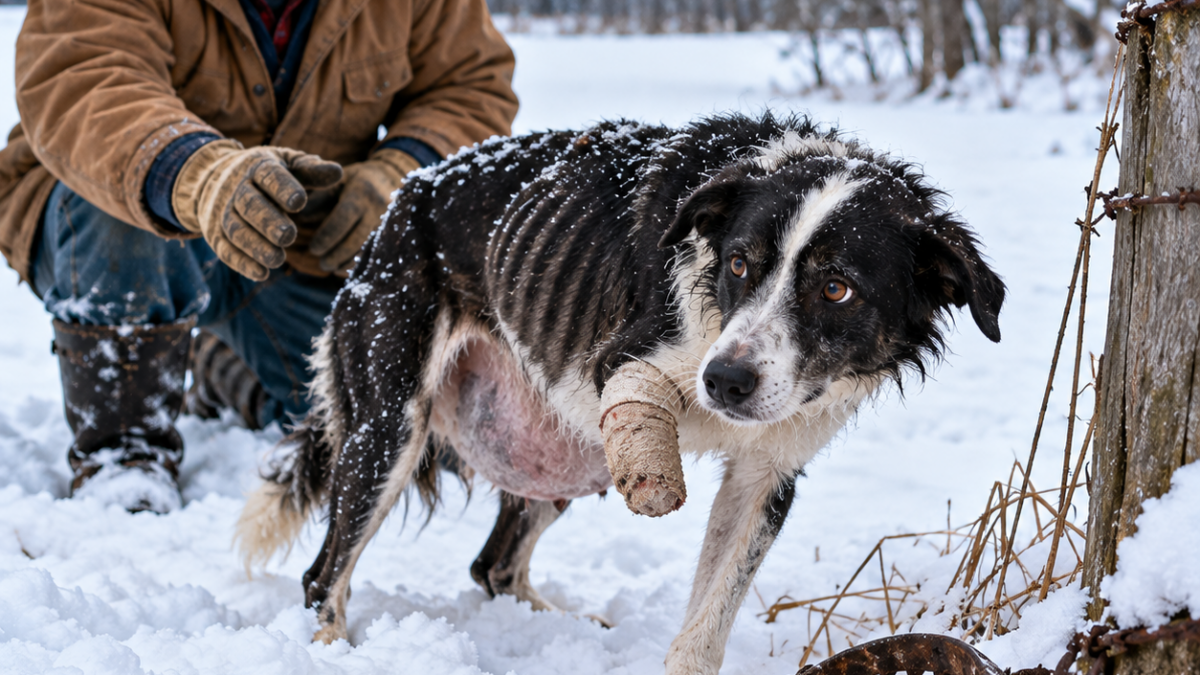
Now I stood beside a three-legged dog with a fresh wound, watching her drag herself toward the same woods where Dale had been setting steel.
I followed.
The dog squeezed through a sagging opening in the old barbed-wire fence.
I stopped beside the cedar post.
Something dark stuck from the snow.
I brushed it with my glove.
Steel.
Chain.
Swivel.
A trap.
Open.
Empty.
There was dried blood around the jaws.
Black fur caught in the metal.
My stomach turned.
“No.”
I whispered.
The dog kept moving.
I knelt beside the trap.
The chain was anchored at the cedar.
The snow around it had been torn apart.
A broad circle of packed ice and blood showed where an animal had fought.
Then a trail.
Dark drops.
Leading toward the farm.
She had been caught there.
I didn’t need a forensic expert.
She’d been trapped by the right front leg.
Fought until something gave.
Maybe the trap.
Maybe her leg.
Then somehow made it to my barn.
Found food.
Found burlap.
That part still didn’t make sense.
A dog doesn’t wrap its own wound.
Someone had helped her.
I stood.
“Girl!”
She was twenty yards into the trees.
I followed.
The snow beneath the pines wasn’t as deep.
She moved faster there.
Still barely.
I stayed several yards behind so I wouldn’t pressure her.
Her belly swayed.
I looked more carefully.
The underside was exposed where her fur had thinned.
Her nipples were enlarged.
Not pregnant.
Nursing.
My heart dropped.
“Oh, no.”
She had puppies.
Somewhere ahead.
That was what she was trying to reach.
I pulled out my phone and called Marge.
She answered before the second ring.
“What broke?”
“Nothing.”
“You only call from the field before eight if something broke.”
“I found a dog.”
Silence.
Then:
“What kind of dog?”
“Collie mix.”
“Black and white.”
Another pause.
“That’s what’s eating the cat food.”
“Probably.”
“Bring her inside.”
“I can’t.”
“Why?”
“She won’t come with me.”
“Gene.”
“She has puppies.”
I heard Marge inhale.
“How do you know?”
“Nursing.”
“And she’s going toward the woods.”
“I’m following.”
“Where?”
“South timber.”
“Near the river.”
Then I said:
“She lost a leg.”
Marge went completely silent.
“Fresh.”
I continued.
“Looks like she was caught in one of Dale’s traps.”
Marge said one word.
“I told you.”
Not angry.
Worse.
Heartbroken.
“I know.”
“Can you catch her?”
“Not without fighting her.”
“Then don’t.”
“Follow her.”
“I am.”
“I’m calling Doc.”
Our veterinarian, Dr. Amelia Hart, had cared for our cattle and barn animals for almost twenty years.
Large animals mostly.
But she handled dogs too.
Marge hung up.
I continued into the woods.
The dog stopped beneath a fallen pine.
She turned toward me for the first time.
Amber-brown eyes.
Tired.
Warning.
Then she crawled beneath the branches.
I heard something.
At first, wind.
Then again.
A tiny squeak.
I dropped to my knees.
“Jesus.”
Beneath the fallen tree, someone—or something—had dug a shallow den into the bank.
Pine needles.
Leaves.
Snow.
The entrance was barely wide enough for the dog.
She disappeared inside.
Then came a sound I will never forget.
Tiny whines.
Several.
Suddenly alive.
I crawled closer.
Could see almost nothing.
Then my eyes adjusted.
Puppies.
Five.
Maybe six.
Small black-and-white bodies crowded against the mother’s belly.
One gray.
One mostly white.
They were old enough to crawl but not old enough to survive without her.
Three weeks, perhaps.
Maybe four.
The mother lay on her side.
Her remaining front leg trembling.
The puppies immediately began rooting against her.
She tried to nurse them.
I saw her whole body shake.
Not fear.
Exhaustion.
She had crossed that field with a fresh amputation because these pups were waiting.
I sat back in the snow.
I had been farming my entire adult life.
I’d watched cows deliver calves in storms.
Seen mothers stand over dead young.
Seen animals do things that made human ideas about instinct seem almost insulting.
But I had never seen anything like that dog.
She should not have been able to make the trip.
Not through that snow.
Not that thin.
Not with that wound.
Yet she’d done it.
Probably more than once.
That thought hit me.
The barn cats’ food had disappeared two mornings in a row.
The wound was several days old.
She had likely been traveling between the den and my barn.
Three legs.
Two feet of snow.
Maybe a quarter mile each direction.
Stealing cat food.
Dragging herself back.
Feeding puppies.
Again.
And again.
I called Marge.
“Found them.”
“How many?”
“I think six.”
“You think?”
“They’re piled up.”
“Are they alive?”
“Yes.”
“All?”
“I think so.”
“Don’t ‘think’ at me.”
“I can’t count without crawling into the tree.”
Marge said:
“Amelia’s coming.”
“Twenty minutes.”
“Can you get the mother out?”
“Not willingly.”
“Then wait.”
I looked at the dog.
Her eyes were open.
Watching me from the dark.
I said:
“Tell Amelia to bring everything.”
“She is.”
Then Marge said:
“Gene?”
“Yes?”
“You need to call Dale.”
My jaw tightened.
“I know.”
“Not yet.”
“What?”
“Not until the dog is safe.”
She was right.
Again.
I hate when that happens.
I waited beside the den.
The cold worked its way through my jeans.
My left knee began throbbing.
I barely noticed.
The mother dog stayed with her puppies.
Every few minutes she licked one.
Then put her head down.
Once she closed her eyes long enough that I thought she’d stopped breathing.
I crawled forward.
“Hey.”
Her eyes opened.
“Stay with me.”
She gave no sign of understanding.
But her tail moved once beneath the puppies.
Maybe.
Maybe I imagined it.
Twenty-five minutes later, I heard the tractor.
Then Marge shouting my name.
Dr. Amelia Hart came through the trees wearing insulated coveralls and carrying a veterinary bag.
Our hired man, Luis, followed with blankets and a plastic livestock sled we’d used for hauling feed.
Marge came last.
Seventy years old.
Five feet three.
Carrying a laundry basket.
“What’s that?”
I asked.
“For the puppies.”
“Of course.”
She crouched beside the den.
The mother growled.
Marge stopped.
“Good.”
I looked at her.
“Good?”
“She still has enough life to tell me no.”
Amelia crawled closer.
The dog growled again.
Amelia spoke softly.
“That’s okay.”
“No one is taking them.”
“She needs to be sedated.”
I asked:
“Is that safe?”
“Safer than letting her bite one of us.”
“Or hurting herself trying to protect them.”
She prepared an injection.
Then looked at me.
“Can you distract her?”
“With what?”
Marge pulled a container from her coat.
Cooked ground beef.
Of course she had food.
She pushed a little toward the entrance.
The dog smelled it.
Her eyes changed.
Hunger.
Severe hunger.
She tried getting up.
Couldn’t.
Marge moved the food closer.
The dog took a bite.
Then another.
While she ate, Amelia gave the injection.
Several minutes later, the growling stopped.
Her head lowered.
Amelia checked reflexes.
“Okay.”
“Let’s move.”
We removed the puppies first.
Six.
I had counted correctly.
That mattered more to me than it should.
Four girls.
Two boys.
Cold but alive.
Round bellies.
Meaning their mother had somehow kept producing enough milk despite starving herself.
We placed them in Marge’s laundry basket with warm towels.
Then came the mother.
Up close, the wound was worse than I’d realized.
Her lower leg wasn’t cleanly amputated.
The tissues were torn.
Bone exposed beneath the frozen burlap.
Infection had begun.
Amelia’s face went tight.
“How long?”
I asked.
“Three days at least.”
“Maybe five.”
“Can you save the rest of the leg?”
She looked.
“Possibly not.”
My stomach twisted.
“She already lost half.”
“I know.”
“If infection has traveled higher, we may need to amputate above the elbow.”
I looked toward the steel trap behind us.
The anger arrived then.
Hot.
Immediate.
I wanted Dale Fenske standing in front of me.
I wanted him to look at this dog.
Instead, Amelia said:
“Gene.”
I focused.
“What?”
“Anger later.”
“Truck now.”
Right.
We loaded mother and puppies onto the sled.
Pulled them through the snow.
The mother remained sedated.
The puppies squeaked.
Marge kept one hand inside the basket the entire way.
At the barn, Amelia examined the dog under better light.
Temperature low.
Dehydrated.
Severely underweight.
Infected wound.
Possible anemia.
But her heart was still strong.
“She needs surgery.”
“Now?”
“Soon.”
“I want fluids and antibiotics first.”
“We need radiographs.”
“Blood work.”
“Can you take her?”
“Yes.”
“Then take her.”
Marge looked at me.
“We’re going too.”
Of course.
I called Luis.
“Can you handle morning chores?”
“Yeah.”
“You sure?”
He looked at the mother dog.
“Go.”
We loaded everyone into Amelia’s veterinary truck.
The puppies rode with Marge.
The mother lay on blankets beside them.
Before we left, I went to the barn corner.
The stack of burlap feed sacks.
One had been ripped open.
Not cut.
Torn.
The top half was missing.
I stared.
Then found blood on the floor.
And something else.
Boot prints.
Not mine.
Not Luis’s.
Large tread.
Near the feed sacks.
The mother hadn’t wrapped herself.
Somebody had found her after the trap injury.
Somebody had tied burlap around the stump.
Then left.
I took photographs.
Marge called from the truck.
“Gene!”
I went.
At the clinic, Amelia’s technician took blood.
The puppies were checked individually.
The smallest female weighed just over two pounds.
One male had mild frostbite at the tips of two toes.
Otherwise, astonishingly, they were stable.
The mother wasn’t.
Her white blood cell count was elevated.
Anemia.
Low protein.
Dehydration.
Radiographs showed the remaining section of her radius and ulna shattered near the wound.
Amelia called us into the exam room.
“She needs an amputation higher up.”
My chest tightened.
“How high?”
“Shoulder-level is safest.”
Marge covered her mouth.
“Will she manage?”
“Dogs adapt well to three legs.”
I looked at Amelia.
“She already has.”
“Yes.”
“More than most.”
“What are the odds?”
“Good if we control infection.”
“But she’s weak.”
“Anesthesia carries risk.”
We didn’t own her.
Legally, she was a stray.
No chip.
No collar.
No registration tag.
The county shelter had to be notified.
Amelia made the call.
Because it was an emergency, they authorized treatment while ownership was investigated.
Then the receptionist brought me an estimate.
I barely looked.
Marge did.
Then looked at me.
“You’re going to say yes.”
“Yes.”
“We’re not twenty anymore.”
“I know.”
“Farm’s not exactly printing money.”
“I know.”
She nodded.
“Good.”
Then:
“Say yes.”
I did.
The surgery started just after noon.
Marge and I sat in the waiting room.
Six puppies slept in a heated enclosure behind glass.
I looked at them.
Then at my hands.
Marge said:
“Don’t.”
“What?”
“You’re blaming yourself.”
“I hired Dale.”
“You hired him to trap coyotes.”
“I put traps on this farm.”
“You hired somebody you believed would do it responsibly.”
“Still my land.”
“Yes.”
“That means you fix what you can.”
Not absolution.
Responsibility.
Marge was good at that.
The surgery lasted an hour and forty minutes.
Amelia came out.
“The leg is gone.”
My stomach tightened even though I knew.
“She did well.”
I breathed.
“Very well, considering.”
“Wound was badly contaminated.”
“We removed damaged tissue.”
“She’s on strong antibiotics.”
“Next forty-eight hours matter.”
“Can we see her?”
“When she’s awake.”
Then:
“I found something.”
She held a plastic bag.
A small metal fragment.
Number stamped into it.
“Embedded near the wound.”
“From the trap?”
“Likely.”
I took a photograph.
Then went outside.
Called Dale.
He answered cheerfully.
“Gene.”
“How’s the coyote situation?”
I nearly hung up.
Instead:
“Where are your traps?”
Silence.
“What?”
“I found one on my south fence.”
“Cedar post.”
Another silence.
“Yeah.”
“That one’s mine.”
“What did it catch?”
Pause.
“Nothing.”
My anger sharpened.
“Don’t lie to me.”
“I ain’t lying.”
“I found blood.”
“Black fur.”
“A dog is in surgery because her leg got torn off.”
Dale said nothing.
Then:
“Gene, those traps are legal.”
“I didn’t ask whether they were legal.”
“Dogs shouldn’t be running loose.”
“She’s nursing six puppies.”
“That’s not my—”
I cut him off.
“Did you find her?”
“No.”
“Did you wrap her leg in burlap?”
“No.”
“Who did?”
“I don’t know.”
“Did you check the trap after she got caught?”
Dale’s breathing changed.
“Gene.”
“Answer.”
“I checked it Tuesday.”
“And?”
“There was blood.”
“No animal.”
“So you knew something had been caught.”
“Yeah.”
“Did you follow the trail?”
“No.”
“Why?”
“I figured coyote pulled loose.”
“It wasn’t a coyote.”
“I know that now.”
“Your truck came by the barn?”
“No.”
“Don’t come back to my property.”
“Gene—”
“I’m serious.”
“You have equipment out here?”
“I’ll collect it with someone present.”
Then I hung up.
Marge had come outside.
“He do it?”
“Says no.”
“Believe him?”
“I don’t know.”
That bothered me.
The boot prints.
The burlap.
Somebody had tried to help.
Badly.
Maybe saved her life temporarily.
Maybe made things worse.
We would eventually find out.
But first, she needed a name.
Teddy—that’s another story’s child. In this one, it was our granddaughter Emma who became responsible.
Emma was eleven.
Our daughter Katie brought her to the clinic after school.
Emma saw the puppies.
Immediately forgot every instruction not to get attached.
“What are their names?”
“They don’t have names.”
“That’s a problem.”
“Their mother doesn’t have one either.”
Emma looked through the glass.
The dog was beginning to wake.
Three-legged now.
Bandaged shoulder.
Eyes unfocused.
Emma stared.
Then said:
“Scout.”
“Why Scout?”
“Because she kept going to find them.”
Marge looked at me.
I shrugged.
“Scout.”
The mother became Scout.
The puppies got temporary names.
Emma chose all of them.
Maple.
Otis.
Pearl.
Juniper.
Finn.
And Boots.
Boots had four perfectly ordinary feet.
Nobody questioned Emma.
Scout woke fully that evening.
The first thing she did was try to stand.
Failed.
Tried again.
Amelia stopped her.
“Easy.”
Scout whined.
Not from pain.
She heard the puppies.
They were in another enclosure.
Marge said:
“She wants them.”
Amelia nodded.
“We can bring them close.”
They placed Scout on padded bedding.
Then brought the six pups.
The moment they squeaked, Scout’s whole body changed.
Head up.
Eyes alert.
Tail moving.
The puppies crawled to her.
Scout tried to position herself around them despite the fresh surgery.
Amelia helped.
I stood behind the glass.
That was when guilt hit hardest.
Because Scout had not been crossing my field to save herself.
She had been going to them.
Every trip to the barn.
Every stolen mouthful of cat food.
Every fall into the snow.
Every step on three legs.
For them.
I had hired the trapper whose steel nearly killed her.
And she had spent the aftermath trying to keep six puppies alive.
Marge slipped her hand into mine.
“We fix what we can.”
I nodded.
The next morning, I went back to the farm with a game warden and a sheriff’s deputy.
Not because trapping coyotes itself was automatically illegal.
It wasn’t.
I wanted the scene documented.
The trap.
Blood.
Location.
We found four more traps on my property.
Three where Dale had said he would place them.
One he had not mentioned.
The trap that caught Scout was close to a route animals used to reach my barn.
Too close for my comfort.
The game warden examined it.
Asked about authorization.
Checked identification tags.
Then photographed everything.
He said:
“We’ll sort out compliance separately.”
No dramatic arrest.
No instant villain.
Real enforcement takes evidence.
At the barn, the deputy looked at the bloody burlap stack.
Then followed prints.
Snow had preserved more than I expected.
Large boot tracks came from the south barn door.
Then out toward the field.
A second set of tire tracks ended near the equipment lane.
Pickup.
The tread pattern wasn’t Dale’s truck.
Luis came out.
He looked worried.
“Gene.”
“What?”
“I should’ve told you.”
My chest tightened.
“Told me what?”
“Tuesday night.”
“I heard barking.”
“What time?”
“Maybe eleven.”
“I was checking the heifer barn.”
“I saw headlights by the south field.”
“Who?”
“Didn’t know.”
“Then?”
“A guy came into the barn.”
“Carrying the dog.”
Everything inside me stopped.
“What guy?”
“Older.”
“Beard.”
“Brown coat.”
“He said he was helping Dale.”
“What did he do?”
Luis swallowed.
“The dog’s leg was almost off.”
“I thought she was dead.”
“He wrapped it with one of the feed sacks.”
“Then he said he was taking her to a vet.”
“But he didn’t.”
“No.”
“I saw him put her in the truck.”
“Why didn’t you tell me?”
“He said Dale knew.”
“And we were busy.”
“I forgot.”
His face showed how terrible that sounded.
But farms run on exhaustion.
Midnight events blur.
Still, the question remained.
Who put Scout back on our property?
Luis described the truck.
Dark red Ford.
The deputy looked at the game warden.
The warden said:
“I know one.”
Dale had a brother-in-law.
Marty Fenske.
Sometimes helped him run trap lines.
Dark red Ford.
We found Marty that afternoon.
He admitted it.
Not immediately.
Then enough.
He had gone with Dale earlier that week to check traps.
Found Scout caught.
She was alive.
Her paw badly damaged.
Dale wasn’t there that night.
Marty said he panicked.
Didn’t want trouble.
Released the trap.
The lower leg was nearly severed.
He wrapped it with burlap from my barn because it was the first thing he found.
Then loaded Scout into his truck.
He planned to take her to a clinic.
That part may have been true.
Then he realized emergency veterinary care would cost money.
And that questions would be asked about the trap.
So he drove around for almost an hour.
Then brought Scout back near my barn.
Left her there.
He told himself she’d find shelter.
Told himself farm dogs survive injuries.
Told himself enough lies to go home.
I was furious.
Marty wasn’t a cartoon monster.
That almost made it worse.
He had held Scout.
Seen the wound.
Had a truck.
Had choices.
Then chose fear over responsibility.
The sheriff and warden handled the legal consequences from there.
I gave statements.
So did Luis.
The clinic documented Scout’s injury.
There were citations and later a cruelty-related case involving the abandonment after injury, along with trapping violations reviewed by the state.
I didn’t control the outcome.
Nor should I have.
I had my own responsibility to face.
I had hired Dale because I wanted a simple answer to dead calves.
Coyotes equal problem.
Trapper equal solution.
I never asked enough about how.
That was mine.
I removed every trap from the farm.
Then called a wildlife specialist through the University of Wisconsin Extension.
We changed things.
Night calving moved closer to the barn during vulnerable periods.
Better carcass removal.
Guard animals.
Lighting in one area.
Electric fencing around a smaller calving lot.
Nothing perfect.
Predators remained predators.
But I had learned that “solve the problem” isn’t enough instruction when the solution can harm animals you never intended to touch.
Scout stayed at Amelia’s clinic for six days.
By day two, she could stand.
Three legs.
Not gracefully.
But she stood.
By day three, she walked from one side of the kennel to the other.
Her center of balance had shifted.
She compensated quickly.
Dogs do that.
Humans mourn what is missing.
Dogs often seem more interested in what still works.
Scout’s biggest problem was food.
She wanted all of it.
Every meal.
Immediately.
We had to feed small portions because her body was too depleted.
She would finish.
Then stare at the empty bowl.
Then at us.
Marge said:
“I know that look.”
“What look?”
“Farm wife married to Gene.”
I ignored her.
The puppies thrived.
Scout’s milk production improved as her nutrition improved.
But nursing six pups was taking too much from her.
Amelia started supplementing them.
Emma volunteered.
Of course.
Every afternoon after school, she came to bottle-feed whichever puppy was least cooperative.
Usually Boots.
Boots had opinions.
Scout watched.
At first suspicious.
Then eventually she slept while Emma handled them.
That was the first sign of trust.
Not letting us touch her.
Sleeping while we touched her puppies.
Big difference.
On day six, Scout came to the farm.
Officially foster.
The county shelter retained the stray hold and legal process.
Practically, everyone knew.
Marge had prepared the mudroom.
Blankets.
Bowls.
Puppy pen.
Heat lamp secured safely overhead.
I walked in.
Looked around.
“You said we weren’t keeping them.”
“We aren’t.”
“There are six labeled feeding bottles.”
“For fostering.”
“You bought a new dog bed.”
“Temporary.”
“There’s a bag of toys.”
“Gene.”
“Yes?”
“Go milk something.”
Fifty years.
Still knew when I’d lost.
Scout recognized the barn before we reached the house.
Her head lifted in the truck.
She looked toward the south door.
Then toward the field.
I wondered what she associated with it.
Food?
Pain?
Shelter?
I didn’t know.
We brought her inside.
The puppies followed.
Scout walked three-legged across the mudroom.
Stopped.
Looked around.
Then lay beside the puppy pen.
The expensive bed?
Ignored.
Naturally.
She chose the floor.
Marge put a folded blanket there.
Scout moved two feet away.
I laughed.
“Smart dog.”
“Don’t encourage her.”
The first week was exhausting.
Puppies wake.
Puppies eat.
Puppies pee.
Puppies discover they can climb.
Six puppies discover this simultaneously.
Marge threatened to divorce me.
I reminded her the dogs were technically her idea.
She said:
“I told you not to hire Dale.”
Not the same issue.
Impossible woman.
Scout improved daily.
Her appetite normalized.
Coat thickened.
The incision healed.
She learned to move quickly on three legs.
Too quickly.
By the third week, she could beat me from mudroom to barn door.
Not a tremendous athletic accomplishment at sixty-seven.
Still.
Her personality emerged.
Quiet.
Observant.
Protective.
Not aggressive.
If a stranger approached the puppies, she stepped between.
If we told her it was okay, she’d move aside.
She loved Marge first.
That bothered me.
I found her.
Marge fed her cheese.
Apparently cheese outranks rescue.
Scout tolerated me.
Then trusted me.
The first time she came willingly and put her head under my hand, I had to look away.
She never licked faces.
Never jumped.
Her affection was quieter.
Stand near you.
Lean against your leg.
Follow at a distance.
At night, she slept where she could see the mudroom door.
Always.
The barn cats were less impressed.
Scout had been stealing their food for days.
They remembered.
A yellow tom named Herman hissed every time she passed.
Scout ignored him.
Eventually Herman discovered Scout produced warmth.
By February, I found him sleeping against her back.
Animals are pragmatic.
The puppies reached eight weeks.
The shelter began adoption screening.
That’s when our house became unbearable.
Emma wanted all six.
Marge said no.
Then listed reasons we could maybe keep one.
I said no.
Then found myself reading adoption applications.
Hypocrites.
Maple went first.
Family in Stevens Point.
Two children.
Fenced yard.
Their previous dog had died at fourteen.
Maple climbed directly into the mother’s lap.
Done.
Otis went to a dairy family near Wausau.
Pearl to a retired couple.
Finn to a veterinary technician.
Juniper to a teacher.
Boots took longer.
Because Boots was Boots.
He chewed shoelaces.
Climbed barriers.
Barked at his reflection.
Stole Marge’s dish towel three times.
We were secretly relieved every time an applicant chose another puppy.
Then Emma’s father, our son-in-law Matt, looked at Katie.
Katie looked at Emma.
Emma looked at Boots.
And that was the end.
Boots moved twelve miles away.
Close enough for Marge to complain we still had six puppies.
Then came Scout.
Applications arrived.
More than I expected.
Her story had spread locally.
Three-legged mother dog survives trap.
People wanted her.
That should have made me happy.
Instead, every application irritated me.
Apartment.
No.
Too many stairs.
No.
Another dog.
Maybe.
Young children.
Would she be nervous?
A retired couple sounded perfect.
I hated them immediately.
Marge watched me reading.
“You know you’re not giving her away.”
“I am.”
“No.”
“She’s a foster.”
“You sleep with the mudroom monitor on your nightstand.”
“For medical reasons.”
“Her incision healed six weeks ago.”
“Complications can happen.”
Marge smiled.
“Gene.”
“What?”
“Just admit it.”
I looked toward the barn.
Scout was outside.
Three legs.
Black-and-white coat shining.
She had gained nearly fifteen pounds.
She stood watching the field.
The same field she’d crossed half-dead.
A month earlier, I couldn’t imagine her surviving.
Now the wind lifted the fur along her chest.
Strong.
Alert.
Home.
I said:
“She likes it here.”
“Obviously.”
“The farm is good for her.”
“Obviously.”
“Plenty of space.”
“Yes.”
“She knows the cats.”
“Herman sleeps on her.”
“That’s my point.”
Marge waited.
I hated her patience.
Finally:
“Fine.”
“Fine what?”
“She’s staying.”
Marge kissed my cheek.
Then immediately:
“I already filled out the adoption paperwork.”
I stared.
“You what?”
“Yesterday.”
“You were waiting for me to say yes?”
“No.”
“I was waiting for you to catch up.”
Fifty years.
Impossible.
Scout became ours officially in March.
By then, snow had begun sinking under warmer afternoons.
The trap site still bothered me.
Every time I drove past the south field, I saw the bloody circle in the snow.
When spring came, the physical evidence disappeared.
Grass.
Mud.
New growth.
But I remembered.
So did Scout, perhaps.
For months, she refused to go near the south fence.
We never forced her.
Then one April morning, she followed me while I repaired wire.
We reached maybe a hundred yards from the cedar post.
Scout stopped.
I kept walking.
Ten feet.
Turned.
She stood frozen.
Ears back.
I put down my fencing pliers.
Sat on a bucket.
Waited.
Five minutes.
Ten.
Scout took one step.
Stopped.
Another.
I didn’t call her.
Didn’t bribe.
Didn’t coax.
She came at her pace.
Eventually she reached me.
Then looked toward the cedar post.
The trap was gone.
Chain gone.
Blood gone.
Nothing there.
Scout walked another step.
Smelled the ground.
Then moved on.
That’s all.
No dramatic breakthrough.
No triumphant music.
Just a dog deciding the ground was safe enough now.
She went into the woods.
I followed.
We found the old den beneath the fallen pine.
Empty.
Collapsed partly from snowmelt.
Scout smelled it.
Then looked at me.
I thought about six puppies piled beneath her while she lay there with an infected stump.
“You did good.”
I said.
She leaned against my leg.
Three legs.
Still enough to nearly knock an old man sideways.
That summer, Scout became a farm dog.
Not officially working.
She assigned herself jobs.
Morning inspection.
Calf barn.
Feed room.
Cats.
Marge’s garden.
Then back porch.
She never chased cows recklessly.
Never bothered chickens.
Barked at coyotes.
That was complicated.
The first time we heard coyotes one evening, Scout’s entire body stiffened.
She stood on the porch.
Growled.
Low.
I went beside her.
“It’s okay.”
No.
Not okay exactly.
But safe.
There is a difference.
We added a livestock guardian dog that summer.
A Great Pyrenees named Amos.
Big.
White.
Not smart in the conventional sense.
Extremely committed to his opinions.
Scout hated him for three days.
Then realized he took night duty.
They became partners.
Amos patrolled outside.
Scout supervised from the porch.
Management.
The coyote losses dropped.
Not to zero.
Farming doesn’t offer zero.
But enough.
I thought often about how quickly I had chosen the first solution.
Trap predators.
Done.
Only problems don’t stay inside the categories you give them.
A trap doesn’t know coyote.
It knows foot.
A snare doesn’t know threat.
It knows body.
Technology does exactly what it is designed to do, not what you morally intend.
I knew that from farm equipment.
Should’ve applied it elsewhere.
Marty Fenske eventually pleaded to misdemeanor charges related to abandoning Scout after finding her injured, and there were penalties connected with improper handling of the trapping incident.
Dale received citations for violations identified during the investigation and lost permission to trap our property permanently.
I never spoke with Marty after court.
Dale called once.
“I heard you kept the dog.”
“Yes.”
“She’s doing okay?”
“She’s missing a leg.”
“I know.”
He sounded genuinely sorry.
That complicated anger.
Then:
“I should’ve checked better.”
“Yes.”
“I thought those sets were far enough from the barn.”
“They weren’t.”
“I know.”
Silence.
Then:
“I’m sorry, Gene.”
I could have told him what I thought of apologies.
Instead:
“Don’t make the same mistake on somebody else’s land.”
“I won’t.”
I hope he meant it.
I stopped carrying anger daily.
Not forgiveness exactly.
Just exhaustion with it.
Scout didn’t need my rage.
She needed arthritis supplements later.
Good food.
A safe farm.
That was more useful.
Boots visited almost every weekend.
Scout recognized him immediately.
Even months later.
Boots grew into a lanky black-and-white dog with too much energy and no understanding of personal space.
He’d run toward Scout.
She’d tolerate exactly three seconds.
Then give him the mother look.
Boots stopped.
Every time.
Mothers have authority no HOA, colonel, or police chief could match.
Emma loved telling people:
“He’s scared of his mom.”
Boots was seventy pounds.
Scout forty-three.
Three legs.
Didn’t matter.
The other puppies sent photographs through their families.
Maple sleeping with two children.
Pearl on a pontoon boat.
Finn wearing a ridiculous birthday hat.
Otis riding in a farm truck.
Juniper asleep beneath a teacher’s desk during summer planning.
Marge printed every picture.
Put them on the refrigerator.
Eventually there was no refrigerator visible.
Scout sometimes looked at the photos.
Probably smelled food.
We pretended she was admiring her children.
A year after we found Scout, January returned hard.
Snow.
Cold.
Eight degrees again one morning.
Almost the same.
I was clearing the lane.
Looked toward the field.
For half a second, I saw the old trail.
One print.
Smear.
One print.
Smear.
Except it wasn’t there.
Memory overlaid on snow.
Then Scout came running from the barn.
Three-legged gait.
Fast.
Efficient.
She charged through the shallow snow beside the plowed lane and barked at the tractor.
I shut it off.
“You coming?”
She jumped—well, more like launched herself—into the truck when I opened the door.
She had become obsessed with rides.
Sat in the passenger seat.
Looked out.
I drove toward the south field.
At the tree line, she got down.
No hesitation.
Walked past the cedar post.
Into the woods.
I followed.
The old den had collapsed completely.
Scout sniffed.
Then urinated on it.
I laughed.
“Fair enough.”
Then we returned.
Some endings don’t require ceremony.
She reclaimed the place.
That was enough.
Scout lived another six years.
People always ask that after rescue stories.
How long?
As though length is the final score.
Six years.
Good years.
Not perfect.
She developed arthritis in her remaining front leg because it carried more weight.
We managed it carefully.
Weight control.
Medication.
Rugs on slippery floors.
A ramp onto the porch when steps became harder.
She hated the ramp for a week.
Then realized it was easier.
Pretended she’d always liked it.
At twelve or thirteen—age was guesswork—her muzzle went white.
Hearing faded.
She still knew the sound of the refrigerator opening.
Selective medical miracle.
She stayed thin but healthy.
Never forgot hunger completely.
Food left unattended disappeared.
Once, Marge made roast beef sandwiches for church volunteers.
Turned around.
Half the roast was gone.
Scout stood in the doorway.
Amos looked guilty too.
No proof.
Case dismissed.
We blamed both.
Scout never became comfortable with metal snapping sounds.
If I closed a toolbox hard, she flinched.
If a chain dropped, she left the room.
We learned.
Not difficult.
People sometimes want rescued animals to become completely unafraid so the story feels finished.
That’s for us.
Not them.
Healing doesn’t erase history.
It makes history less powerful.
Scout still remembered something.
But fear no longer controlled the whole farm.
One summer afternoon, a thunderstorm knocked a branch onto the old fence.
I carried a chain into the yard to drag it.
The chain hit the truck bed.
Scout flinched.
Then looked at me.
I waited.
She didn’t run.
After a few seconds, she walked over.
Smelled the chain.
Then leaned against my leg.
Progress.
Not forgetting.
Choosing.
That’s better.
Marge and I got older too.
Farming has a way of pretending you aren’t aging until one day a feed bag weighs twice what it used to.
At seventy-two, I reduced the herd.
At seventy-four, Katie and Matt began handling more operations.
At seventy-five, Emma could run machinery better than I could at sixteen.
That annoyed me.
At seventy-six, I finally admitted my knees had opinions.
Scout slowed with me.
We became a matched set.
Old farmer.
Three-legged dog.
Morning rounds in the pickup.
Marge called us:
“The Department of Unnecessary Supervision.”
Probably accurate.
We checked calves.
Fences.
Waterers.
Barn cats.
Scout rode shotgun.
If I took too long getting back into the truck, she sighed dramatically.
“I’m coming.”
Another sigh.
“You have three legs.”
“You don’t get to judge my speed.”
She judged.
Dogs.
One day, Emma—seventeen then—asked about the trap.
We had told her the broad story.
Not every detail when she was young.
Now she wanted the truth.
“Did Scout chew her own leg off?”
I looked at her.
“No.”
“Not exactly.”
“The injury was catastrophic.”
“She tore free.”
“Maybe part of the leg was already destroyed.”
“Marty released her.”
“We’ll never know precisely.”
Emma looked at Scout sleeping in the grass.
“Did Grandpa cause it?”
That word.
Cause.
I was Grandpa to her.
I knew what she meant.
“I hired the trapper.”
“So yes?”
I thought carefully.
“I helped create the circumstances.”
“That isn’t the same as wanting it.”
“No.”
“But intent doesn’t erase responsibility.”
She considered.
“Do you forgive yourself?”
I almost laughed.
Seventeen-year-olds ask questions adults avoid for decades.
“Mostly.”
“What does mostly mean?”
“It means I stopped thinking guilt was useful after I changed what I could.”
She nodded.
Then:
“Grandma said you cried.”
“Marge is unreliable.”
“I heard that.”
Marge yelled from the porch.
Scout lifted her head.
Emma laughed.
I did too.
The truth:
I had cried.
More than once.
Not because farmers are secretly sentimental.
Though we are.
Because there is a particular kind of guilt when something hurt on your land because of a decision you made.
Even indirectly.
You can either build a shrine to your guilt or change your practices.
I tried the second.
Better fences.
Better calving management.
Guardian dogs.
Wildlife consultations.
No steel traps near travel corridors.
More attention.
Not perfection.
Attention.
That’s what Scout taught me.
Notice who else shares the land.
Farms are not empty production spaces.
They’re ecosystems.
Cattle.
Coyotes.
Foxes.
Owls.
Barn cats.
Dogs.
Deer.
People.
Every solution reaches farther than its intended target.
Scout had been somebody’s dog before us.
That remained a mystery for years.
No microchip.
No reports matching her.
Then, almost four years after adoption, we got an answer.
A woman named Rebecca called.
She had seen an old article the shelter reposted about Scout.
The white stripe.
Freckled nose.
Ear shape.
She thought Scout might be a dog named Nell.
Rebecca’s brother had owned Nell on a small farm near Merrill.
Two years before we found Scout, he died suddenly.
His property went through foreclosure.
Several animals were rehomed informally.
Nell disappeared during the transition.
Rebecca searched.
Shelters.
Posts.
Nothing.
She sent photographs.
Young Scout.
Absolutely.
Same markings.
Same nose.
No missing leg, obviously.
Same habit of crossing her front paws when lying down.
Marge looked at the pictures.
“That’s her.”
Rebecca came to visit.
Scout was older.
Gray.
Three-legged.
Rebecca crouched.
“Nell?”
Scout looked.
No dramatic recognition.
Then Rebecca said:
“Come here, Nellie girl.”
Scout’s ears lifted.
She walked over.
Smelled her.
Then leaned against her knees.
Rebecca cried.
So did Marge.
I did not.
Allegedly.
Rebecca told us Scout had always been a farm dog.
Good with chickens.
Loved rides.
Food thief.
Had once raised a litter before being spayed—except Scout wasn’t spayed when we found her, so that detail may have been another dog or family confusion.
Human records aren’t perfect.
Still, enough fit.
Rebecca said:
“My brother adored her.”
“When he died, everything fell apart.”
“I thought somebody had taken her.”
Maybe someone did.
Maybe she changed homes several times.
Maybe she ran.
We never knew how she reached Mosinee or how she ended up pregnant and living wild along the Rib River.
That part stayed hers.
Rebecca asked:
“Would you ever consider letting me take her?”
My chest tightened.
Then Rebecca smiled.
“I’m kidding.”
I exhaled.
“Not funny.”
“No.”
She looked around the farm.
“She belongs here.”
Scout was lying beside my truck.
Yes.
She did.
Rebecca visited occasionally after that.
Called her Nell.
We called her Scout.
The dog answered to both when food was involved.
Identity flexible.
Love less so.
Scout’s final winter was mild.
For Wisconsin, anyway.
She was probably fourteen.
Maybe fifteen.
Her remaining front leg had become severely arthritic.
We used medication.
A supportive harness.
Sometimes a small wheeled cart for longer distances, though she hated it.
She still wanted to walk under her own power.
Three legs.
Then two-and-a-half, practically.
Stubborn until the end.
One February morning, Scout didn’t get up for breakfast.
That frightened me more than anything.
I sat beside her.
“Hey.”
Eyes opened.
Tail moved.
But she didn’t stand.
Marge came.
Kneeled despite her own arthritis.
“Time?”
I hated the word.
“No.”
Marge looked at me.
Not arguing.
Waiting.
We called Amelia.
Same veterinarian.
Older now too.
Gray in her hair.
She examined Scout at home.
Arthritis.
Weakness.
Heart slowing.
Kidneys not great.
Nothing sudden.
Nothing we could fix back into youth.
Amelia said:
“We can adjust pain medication.”
“Maybe get a little more time.”
“But we’re close.”
“How close?”
She looked at Scout.
“Let her tell you.”
Farmers understand that answer.
Animals usually do tell you.
Not in words.
Food.
Mobility.
Interest.
Comfort.
Scout ate chicken that evening.
Good.
Next morning, she stood.
Good.
For two more weeks, she rode in the truck.
Not every day.
Then one morning, she refused the truck.
Scout loved the truck.
I sat beside her.
She rested her head on my boot.
Marge came outside.
No words.
We knew.
Emma came.
Katie.
Matt.
Boots, now gray around the muzzle himself.
When Boots saw Scout, he became a puppy again for about thirty seconds.
Then slowed.
Walked to her.
Lay down.
Scout lifted her head.
Licked his face once.
Boots stayed beside her.
That broke me.
Mothers.
Children.
Years.
Same relationship.
Different bodies.
Amelia came that afternoon.
Scout lay on her favorite blanket near the barn door.
The door was open.
Cold air.
Hay smell.
Cows shifting inside.
Amos had died two years earlier.
Herman the cat long before that.
The farm kept changing.
Scout had stayed.
I sat beside her.
Put my hand on the white stripe along her face.
“Remember the field?”
Marge said:
“Gene.”
“What?”
“Don’t make her remember that.”
She was right.
I changed it.
“Remember the truck?”
Scout’s tail moved.
Better.
I laughed.
“Remember stealing cat food?”
Another small tail tap.
“Thief.”
Marge leaned close.
“You were a good girl.”
Scout looked at her.
Always Marge first.
Cheese.
Then she looked at me.
I said:
“You did enough.”
That phrase again.
I hadn’t known Dolores or Duke—that belonged to another life, another story. This was ours.
Scout.
Snow.
Farm.
Six puppies.
A mistake.
A second chance.
Amelia gave the sedative.
Scout relaxed.
Her breathing slowed.
Before the final injection, she did one last thing.
She pushed her nose under my hand.
The same movement she’d used for years when asking me to scratch her forehead.
I did.
“Okay.”
I whispered.
“Okay, girl.”
She died beside the barn.
Not in snow.
Not alone.
Not caught in steel.
Home.
Boots remained beside her for almost an hour afterward.
Emma sat with him.
Marge and I went inside.
I made coffee.
Didn’t drink it.
The farm felt wrong.
Anyone who has lost a dog understands.
A house doesn’t become quieter because dogs are loud.
Scout wasn’t.
It becomes quieter because one set of expectations disappears.
You open the door and nobody rises.
Start the truck and nobody appears.
Drop food and nobody arrives before it hits the floor.
Silence takes shape.
We buried Scout on the edge of the south pasture.
Not at the trap site.
I didn’t want that place owning her story.
We chose a hill near the oak line where she’d liked lying in summer.
Emma made a small marker.
Nothing sentimental.
SCOUT
SHE KEPT GOING
That was enough.
Boots died two years later.
Different family.
Different home.
Loved.
The other five puppies lived long lives too.
We heard from most families over the years.
Maple reached thirteen.
Otis twelve.
Pearl fourteen.
Finn eleven.
Juniper thirteen.
Six lives Scout crossed that field to protect.
Sometimes I think about that.
She didn’t know where they would go.
Didn’t know families would adopt them.
Didn’t know Emma would name them.
Didn’t know there was a veterinary clinic waiting.
She only knew:
They were in the woods.
Hungry.
Cold.
And she needed to get back.
So she moved.
One print.
Smear.
One print.
Smear.
Across two feet of snow.
That trail is still the clearest thing I remember.
Not the wound.
Not the trap.
The trail.
Every mark said the same thing.
Keep going.
Not inspirational.
Not heroic in the human sense.
She wasn’t trying to teach anyone.
She had puppies.
That’s all.
But sometimes the simplest motives produce the strongest acts.
Years later, after I mostly retired from farming, I walked the south field with Emma.
She was twenty-three.
Studying veterinary medicine.
Scout had something to do with that.
Emma wouldn’t admit how much.
We reached the cedar post.
The original post was gone.
Rotten.
I’d replaced it years earlier.
Emma said:
“Was it here?”
“Yes.”
“The trap?”
“Yes.”
She looked toward the barn.
Then toward the woods.
“That’s far.”
“Feels farther in two feet of snow.”
“How many trips do you think she made?”
“I don’t know.”
“Two?”
“Three?”
“Maybe more.”
Emma shook her head.
Then:
“Why didn’t she stay in the barn?”
“Puppies.”
“I know.”
“But still.”
I looked at her.
“You’ll learn this in vet school.”
“What?”
“Animals make decisions that make perfect sense to them.”
“Our job isn’t always to make them act human.”
She smiled.
“That sounds suspiciously wise.”
“I’ve been practicing.”
We continued to the woods.
The old den was gone.
Fallen tree decomposed.
Bank collapsed.
Nothing left.
Emma said:
“Do you regret hiring Dale?”
“Yes.”
“Still?”
“Yes.”
“Even after everything good that came?”
I understood the question.
Scout.
Puppies.
Emma’s career.
Changes on the farm.
“No.”
I corrected.
“I don’t believe the bad thing became good because we responded well.”
“The trap was still a mistake.”
“Scout didn’t need to lose a leg for us to learn something.”
“Good doesn’t cancel cause.”
Emma nodded.
“Grandma says that too.”
“Your grandmother steals all my best thoughts.”
From somewhere behind us:
“I heard that.”
Marge.
Of course.
She’d followed in the side-by-side.
Still impossible.
We laughed.
That was life after Scout.
Not grief every day.
Story.
Memory.
Sometimes guilt.
Mostly gratitude.
The county eventually required clearer reporting and inspection practices related to certain trapping operations after several unrelated incidents raised similar concerns.
I don’t claim Scout caused broad reform.
Life isn’t a movie.
But her case became one example discussed locally.
That was enough.
We changed our farm.
Other landowners asked more questions.
Some stopped using traps.
Some didn’t.
At least they thought about placement.
Responsibility.
Non-target animals.
That matters.
I am seventy-nine now.
Marge says I am eighty when convenient.
She is wrong by seven months.
We still live on the farm.
Katie and Matt operate most of it.
Emma is a veterinarian in Wausau.
Of course she is.
On her office wall is a photograph of Scout.
Not the terrible first-day photograph.
A later one.
Scout standing beside the barn.
Three legs.
Coat shining.
Head high.
Behind her are six nearly grown puppies.
The caption says:
PAY ATTENTION TO THE ANIMAL THAT KEEPS GOING.
I told Emma that’s too sentimental.
She ignored me.
Inherited that from Marge.
I keep one photograph too.
Taken the first summer.
Scout riding in the passenger seat of the green pickup.
One ear up.
One ear sideways.
Tongue out.
Happy.
That’s the Scout I prefer.
People who hear the story focus on the injury.
I understand.
A dog crossing a frozen Wisconsin field on three legs is dramatic.
A steel trap is dramatic.
Six puppies hidden in the woods are dramatic.
But the real story continued after those moments.
Breakfast.
Healing.
Puppies growing.
Adoptions.
Truck rides.
Barn cats.
Cheese from Marge.
Years.
Ordinary days.
That is what rescue is supposed to create.
Not an animal permanently trapped inside the worst photograph of its life.
Scout became more than the three-legged dog.
She became the dog who knew which calf was sick before I did.
The dog who stole roast beef.
The dog who tolerated Boots.
The dog who refused expensive beds.
The dog who hated chains but learned they didn’t always mean pain.
The dog who slept beside the porch when thunderstorms came.
The dog who made an eleven-year-old girl think maybe she wanted to become a veterinarian.
That’s a life.
Not a rescue headline.
Sometimes in winter I still look across the field when the snow is fresh.
The surface is clean.
Every track easy to read.
Deer.
Rabbit.
Coyote.
Fox.
Dog.
I learned to look differently after Scout.
Not just:
What’s crossing my land?
But:
Where is it going?
Why?
What happened before this track?
What might happen because of something I put in its path?
Land records everything for a little while.
Snow especially.
Then wind comes.
New snow.
Thaw.
The marks disappear.
Responsibility doesn’t.
That morning, the snow showed me exactly what Scout had endured.
One paw print.
Then a smear.
One paw print.
Then a smear.
All the way from the barn to the woods.
She didn’t know I was watching.
Didn’t know anyone would follow.
Didn’t know help was coming.
She simply knew six puppies were waiting beneath a fallen pine.
So she kept moving.
And I’m grateful I finally paid attention.
Because if I had looked at that dark speck in the field and decided it was a coyote, or a stray that would eventually leave, or somebody else’s problem, Scout might have disappeared into those trees and never come back.
Instead, I followed.
I found the steel.
Then the den.
Then six tiny lives.
And I learned something I should have known after forty-four years working the same ground.
Knowing your land doesn’t mean you know every story happening on it.
Sometimes the most important one is being written in the snow while you’re looking somewhere else.








